
20 Marigold Tattoo Ideas: Best Floral Designs (October 2026)
These 20 marigold tattoo ideas cover everything from a single-needle sprig on the inner forearm to a statement cluster across the back of the arm. Marigolds are the October birth flower and the cempasuchil of Dia de los Muertos, so people choose them for birthdays, for a grandmother, or simply because the bloom is warm and dense enough to read clearly at small sizes.
What makes a marigold work on skin is its ruffled, layered petal structure. Unlike a smooth rose, the petals sit in concentric rows, which gives an artist a lot to work with in a small footprint. The five things that decide whether a design lands are petal detail, how much yellow you use, contrast against your skin tone, overall scale, and where the piece sits.
20 Marigold Tattoo Ideas: Quick Guide
Every design below is chosen for a specific body site rather than adapted to it. Marigolds sit well on round, curved or flat surfaces, and the bolder the style, the more room the bloom needs. Read the table first to narrow the field, then scroll to the idea that matches the placement you actually want.
| Idea | Style | Best placement | Size | Pain |
|---|---|---|---|---|
| 1. Fine-line marigold sprig | Fine line | Inner forearm | 2 to 3 inch tall | Medium |
| 2. Traditional yellow bloom | American traditional | Outer upper arm | 3 to 4 inch | Medium |
| 3. Watercolor marigold | Watercolor | Shoulder cap | 3 to 5 inch | Low to medium |
| 4. Micro-marigold | Micro fine line | Behind the ear | 0.5 to 0.75 inch | Medium to high |
| 5. Marigold wreath | Black and gold | Outer upper arm | 3 to 4 inch circle | Medium |
| 6. Blackwork marigold | Blackwork | Sternum | 3 to 4 inch | High |
| 7. Marigold and butterfly | Small color | Inner calf | 2 to 3 inch group | Medium |
| 8. Geometric marigold | Geometric | Outer forearm | 2.5 to 3 inch | Medium |
| 9. Realistic marigold | Micro realism | Upper outer thigh | 4 to 6 inch | Low to medium |
| 10. Marigold rose | Soft realism | Collarbone | 2.5 to 3.5 inch | Medium |
| 11. Minimal line art | Minimalist | Inner wrist | 1.5 to 2 inch | Medium |
| 12. Marigold bouquet | Botanical | Between the shoulder blades | 4 to 5 inch group | Low |
| 13. Dotwork marigold | Dotwork | Side rib | 2 to 2.5 inch | High |
| 14. Marigold branch | Botanical | Outer lower leg | 5 to 7 inch | Low to medium |
| 15. Neon-color marigold | Color realism | Back of the hand | 2.5 to 3 inch | High |
| 16. Finger cluster | Micro fine line | Side of a finger | 0.75 to 1 inch | High |
| 17. Marigold sun | Illustrative | Outer upper arm | 3.5 to 4.5 inch | Medium |
| 18. White ink marigold | White ink | Inner ankle | 1.5 to 2 inch | Medium |
| 19. Marigold half-moon | Illustrative | Outer hip | 3 to 4 inch | Medium |
| 20. Large marigold cluster | Neo-traditional | Back of the upper arm | 5 to 7 inch group | Low to medium |
1. Fine-Line Marigold Sprig on the Forearm
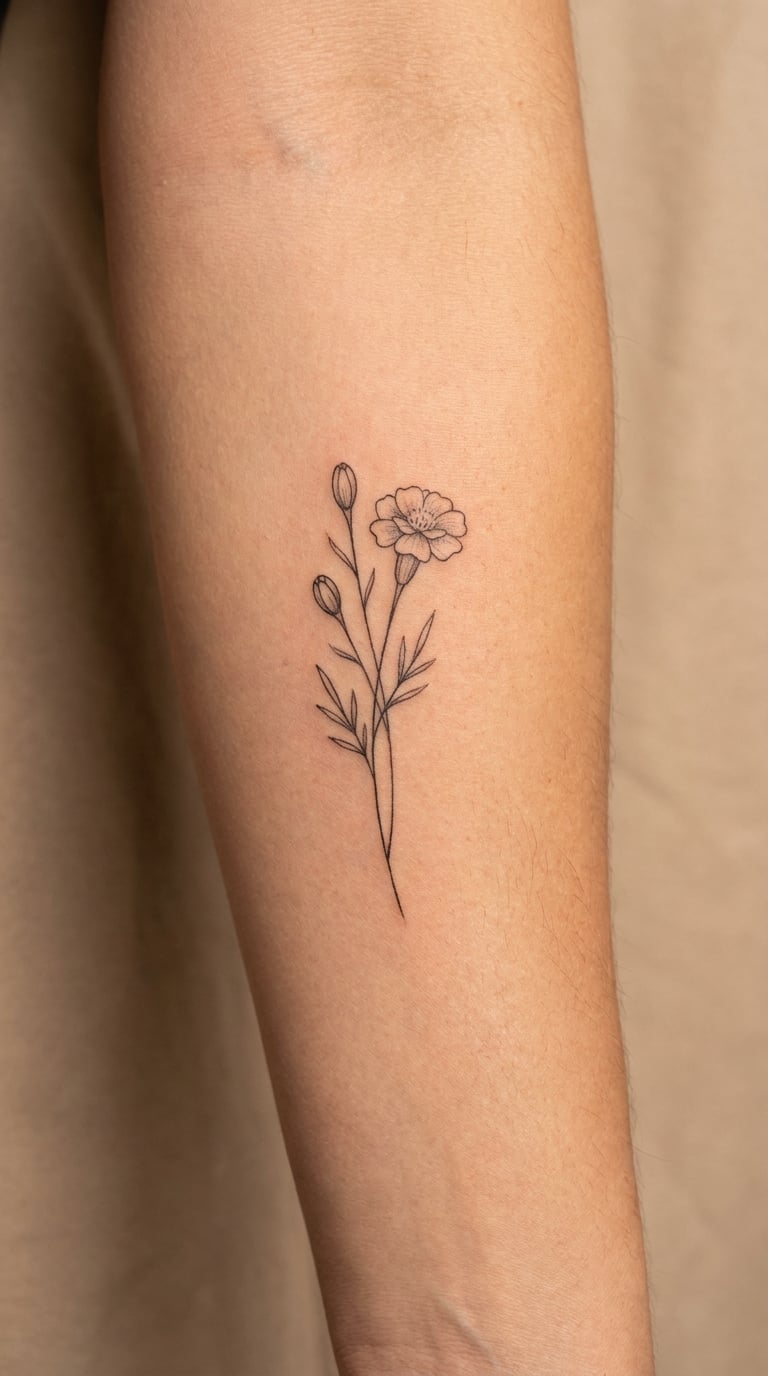
One stem, one open bloom, two closed buds, drawn in single-needle line work with almost no shading. The petals are suggested with a few nested ruffled contours rather than filled, which is what keeps the piece light. Leaves are thin, pointed and sparse so the flower stays the focus.
People pick this one when they want a marigold that reads as botanical rather than decorative, and it is a common first tattoo because the line work is light on the body.
Placement: inner forearm, wrist to elbow, vertical along the muscle · Size: 2 to 3 inch tall, 1 inch wide · Style: fine line · Pain: medium, and the inner forearm near the wrist is stingy even for fine line. Fine line loses definition in about five years, and touching it up is normal.
Make it yours: add the year along the stem in the same needle weight, so the date curves with the plant instead of sitting under it like a caption.
2. Traditional Yellow Marigold Bloom
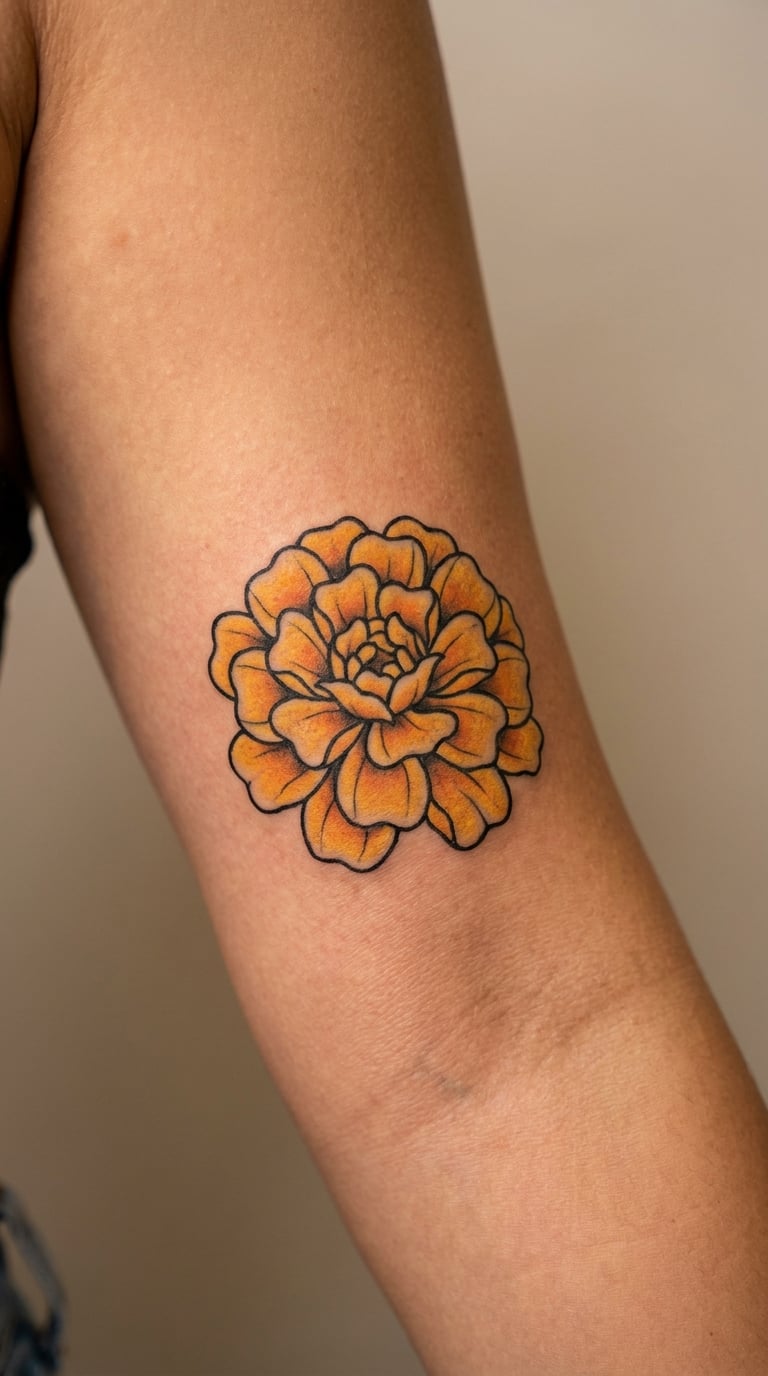
A single saturated bloom with a heavy black outline, golden yellow fill and burnt orange shading in the shadowed petals. The style is old-school American traditional: bold contour, limited palette, no grey. Petal edges stay slightly ruffled so it never gets confused with a sunflower.
Bold color is the reason people book this version, and it is the one most likely to be readable from across a room.
Placement: outer upper arm, shoulder or calf, where there is a flat muscle to work with · Size: 3 to 4 inch across · Style: American traditional or neo-traditional · Pain: medium, the fleshiest part of the upper arm. Yellow is the first pigment to soften, so expect a touch-up on the pale petals within a few years.
Make it yours: shift the palette from golden yellow to deep red-gold and add a second smaller bloom below it, angled, so the pair reads as a plant rather than a repeat.
3. Watercolor Marigold on the Shoulder
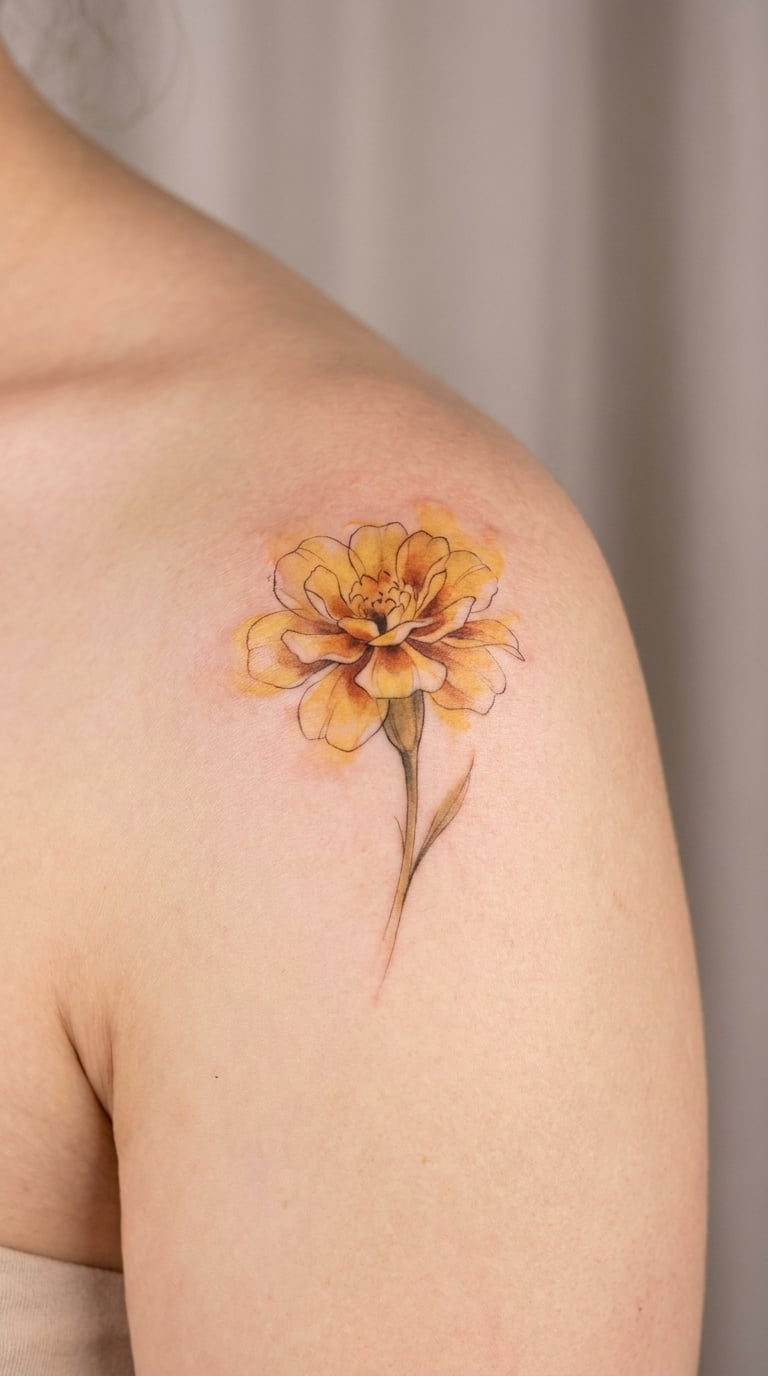
Loose washes in yellow, ochre and burnt orange, with pigment bleeding past the petal edges into the skin. The bloom is built from two or three loaded passes rather than outline, so parts of the flower are suggested and parts are dense. A few thin stems trail off and fade out unfinished.
The painterly look appeals to people who would rather have a colour impression than an illustration, and it hides small imperfections better than any other style on this list.
Placement: shoulder cap, where the curve lets the wash run · Size: 3 to 5 inch · Style: watercolor · Pain: low to medium, though the shoulder cap gets tender near the spine. Watercolor is unforgiving with sun; the pale edges disappear first.
Make it yours: keep the marigold loose and add a single crisp ink stem in black, so one sharp line holds the whole soft composition together.
4. Micro-Marigold Behind the Ear
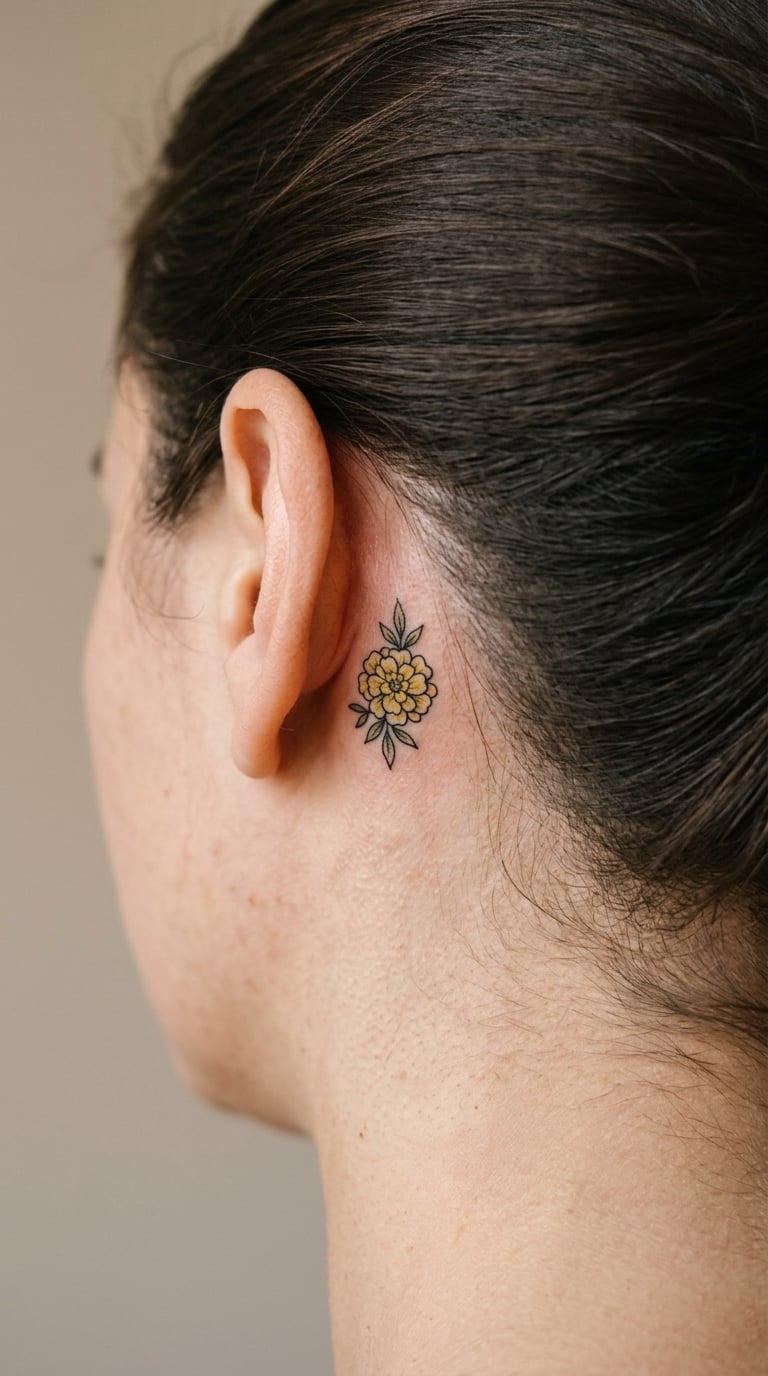
At this size the design is reduced to essentials: one ruffled circle, a five-petal center and two short leaves. Colour is limited to a golden yellow wash in the center with a fine black outline. There is no shading, because there is no room for it.
It is chosen for being nearly invisible at a glance, which suits people who want a flower tattoo without announcing it.
Placement: behind the ear, in the gap between the ear and the hairline · Size: 0.5 to 0.75 inch · Style: micro fine line · Pain: medium to high, the neck and behind the ear stay sensitive. Micro work behind the ear softens faster than anywhere else, partly from hair rubbing over it, so expect a slightly blurred petal edge.
Make it yours: make it a matching piece, one behind each ear, and change the centre colour so the two are the same flower in different tones.
5. Marigold Wreath on the Upper Arm
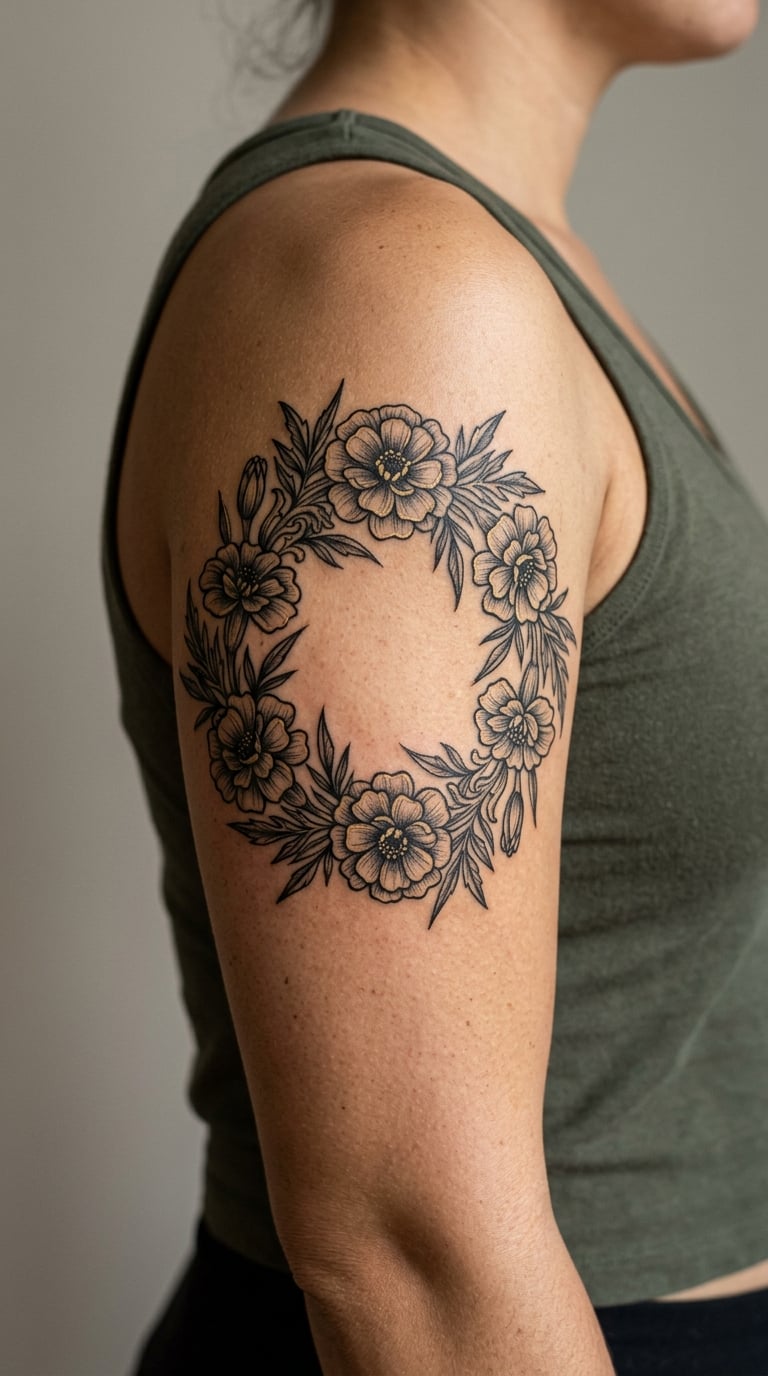
A closed circle of three to five marigold blooms at different stages, linked by stems and pointed leaves. Black line work carries the structure while muted gold fills the open flowers. The blooms are spaced evenly so the ring reads as a ring, and one gap is left open rather than forcing symmetry.
Round compositions suit joints and limbs that taper, and the wreath is a favourite for a memorial piece because it frames the flowers without a hard border.
Placement: outer upper arm, upper thigh, or wrapped slightly around the calf · Size: 3 to 4 inch diameter · Style: black and gold botanical · Pain: medium, and steady because it takes a while. Small leaf tips in a tight ring are the first detail to blur after several years.
Make it yours: put a date in a gap in the circle, curving along the ring so the lettering becomes part of the stem line.
6. Blackwork Marigold on the Sternum
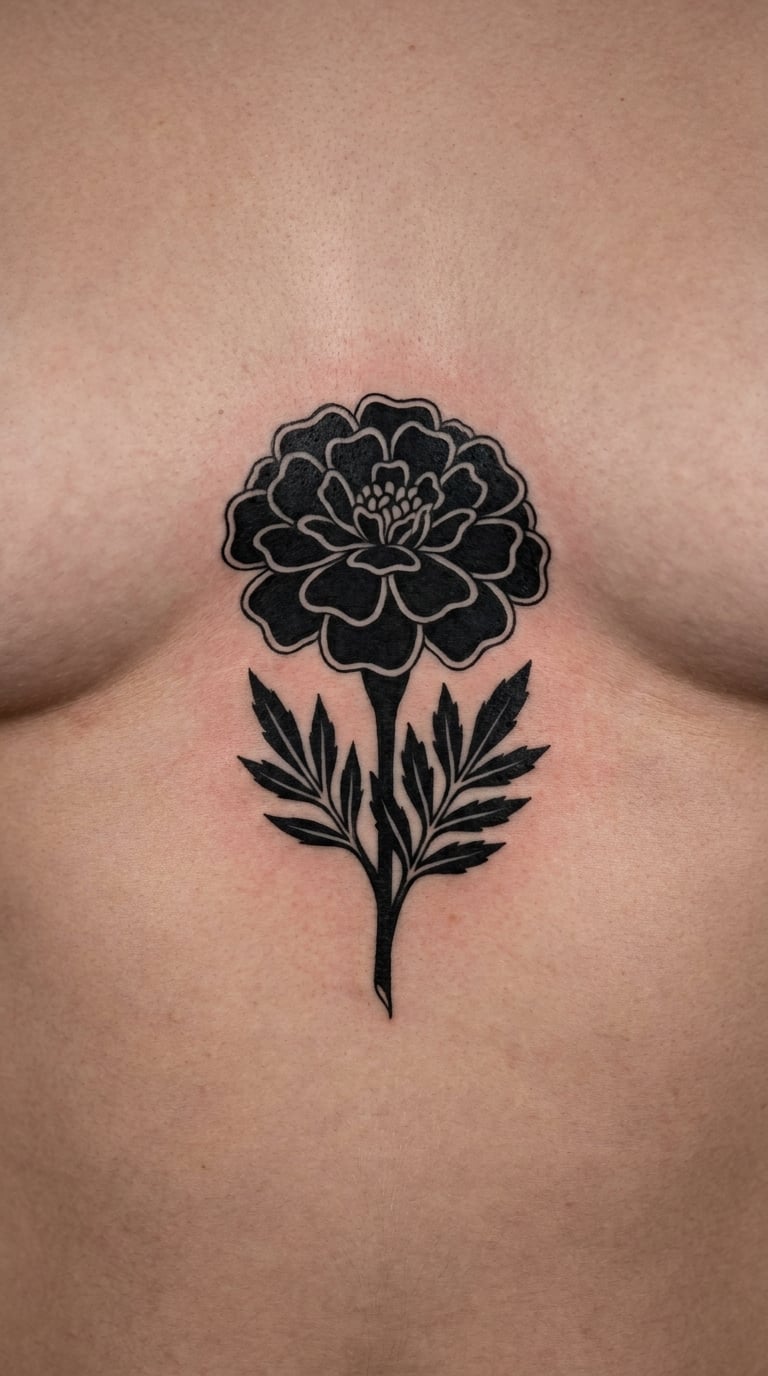
Solid black petals, layered in three rings, with thin white slivers left between rows to suggest the ruffled edges. The centre is a dense dark disc broken by a few uninked dots. No colour, no grey, just contrast between packed ink and bare skin.
Blackwork is chosen when the goal is weight and graphic punch rather than softness, and it holds its shape longer than a colour bloom.
Placement: upper sternum between the pecs, or centred on the chest · Size: 3 to 4 inch across · Style: blackwork · Pain: high, the sternum is bone over thin skin and everyone feels it. The white gaps stay clean, but fine black lines inside the petals can fade toward grey.
Make it yours: run a thin stem down from the bloom toward the ribs, which fills the empty chest space and makes the flower look placed rather than floating.
7. Marigold-and-Butterfly Pairing on the Calf
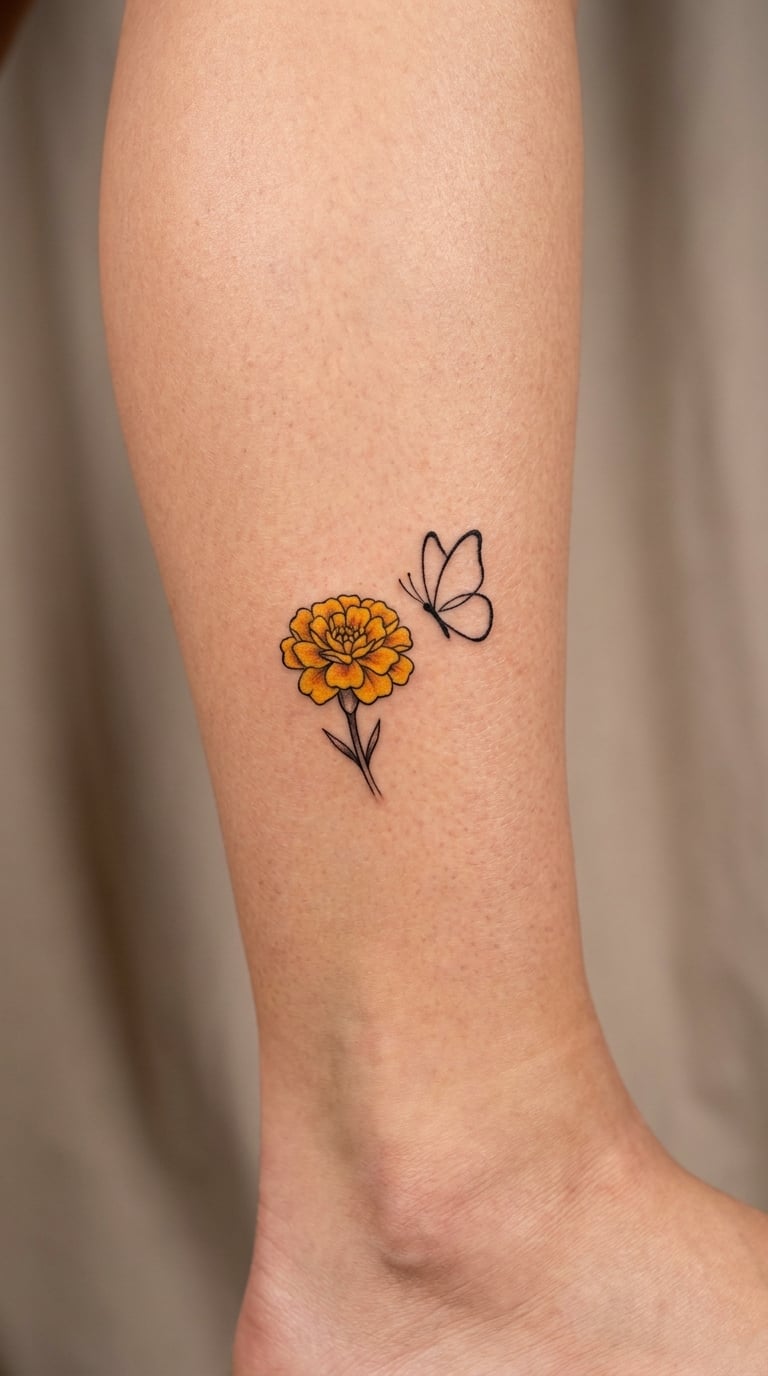
One marigold in warm colour on one side, a simple black butterfly on the other, with clear space between them so neither shape crowds the other. The butterfly is drawn with clean outline and two thin antennae, no pattern in the wings. The flower carries the detail, the insect stays graphic.
Pairing a bloom with a flying insect is a long-standing floral convention, and the two elements balance each other on a limb.
Placement: inner calf or inner forearm, arranged along the muscle · Size: 2 to 3 inch across the whole group · Style: illustrative with light colour · Pain: medium, the inner calf bruises easily. The butterfly antennae are the first line to disappear.
Make it yours: angle the butterfly upward and away from the flower, so the pair looks like one moment of movement rather than two separate stickers.
8. Geometric Marigold on the Forearm
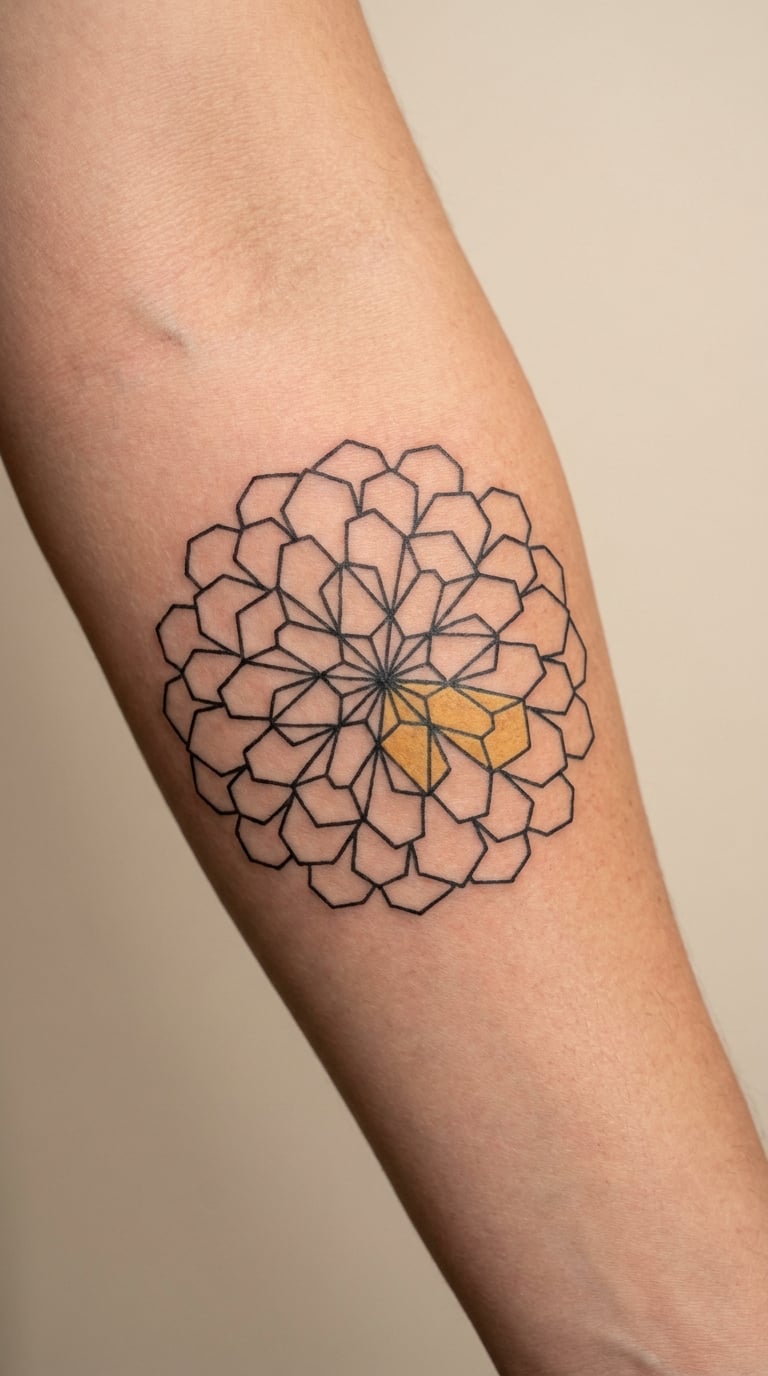
The flower is cut into symmetrical segments, each petal reduced to a triangle or a wedge, and the segments meet at a central polygon. Black line work does all the drawing; one muted yellow fill sits in the centre wedge so the design is not purely monochrome.
Geometric treatment suits people who like maths in their art, and it turns a soft, organic flower into something architectural.
Placement: outer forearm, flat muscle, vertical or along the bone · Size: 2.5 to 3 inch · Style: geometric · Pain: medium. Straight geometry actually ages well, though hair growing inside the segments softens the crisp edges over time.
Make it yours: double the design into a small mirrored pair, one on each forearm, and tint the centre fill a different shade on each side.
9. Realistic Marigold on the Thigh
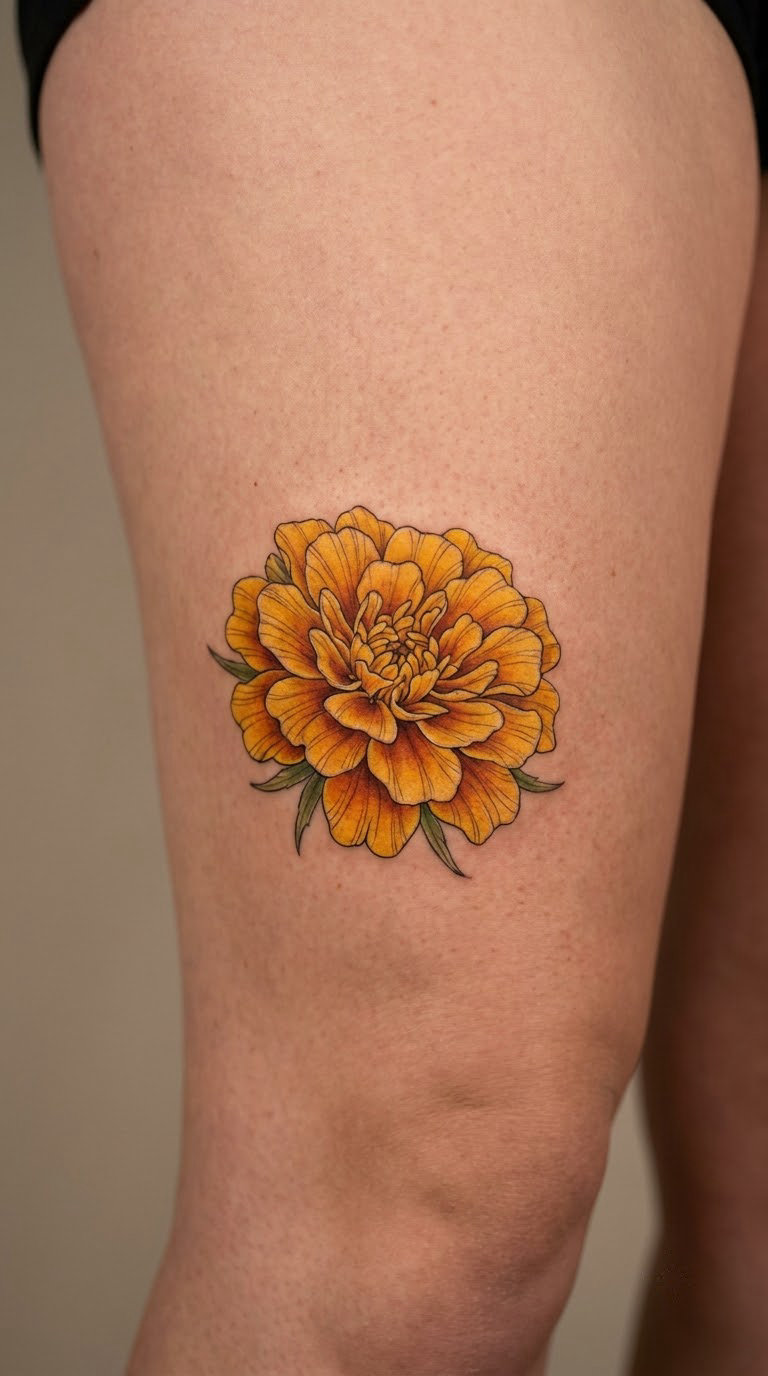
A full botanical rendering: layered petals moving from pale gold at the edges to deep orange near the centre, fine veins branching into each petal, and small green sepals tucked under the bloom. Shading is soft rather than outlined, which is what separates realism from traditional work.
People who want their flower to look like a photograph of a living plant choose this style, and the thigh gives an artist a large flat surface to work on.
Placement: upper outer thigh, where the skin stays smooth and unbroken · Size: 4 to 6 inch across · Style: micro realism · Pain: low to medium, the thigh is one of the easier canvases. Realistic yellow is the fastest-fading pigment on this whole list, and veins fill with a warmer tone as they heal.
Make it yours: keep the bloom but change the sepals to a deep green that matches a plant you actually grew, so the tattoo holds a private reference.
10. Marigold Rose on the Collarbone
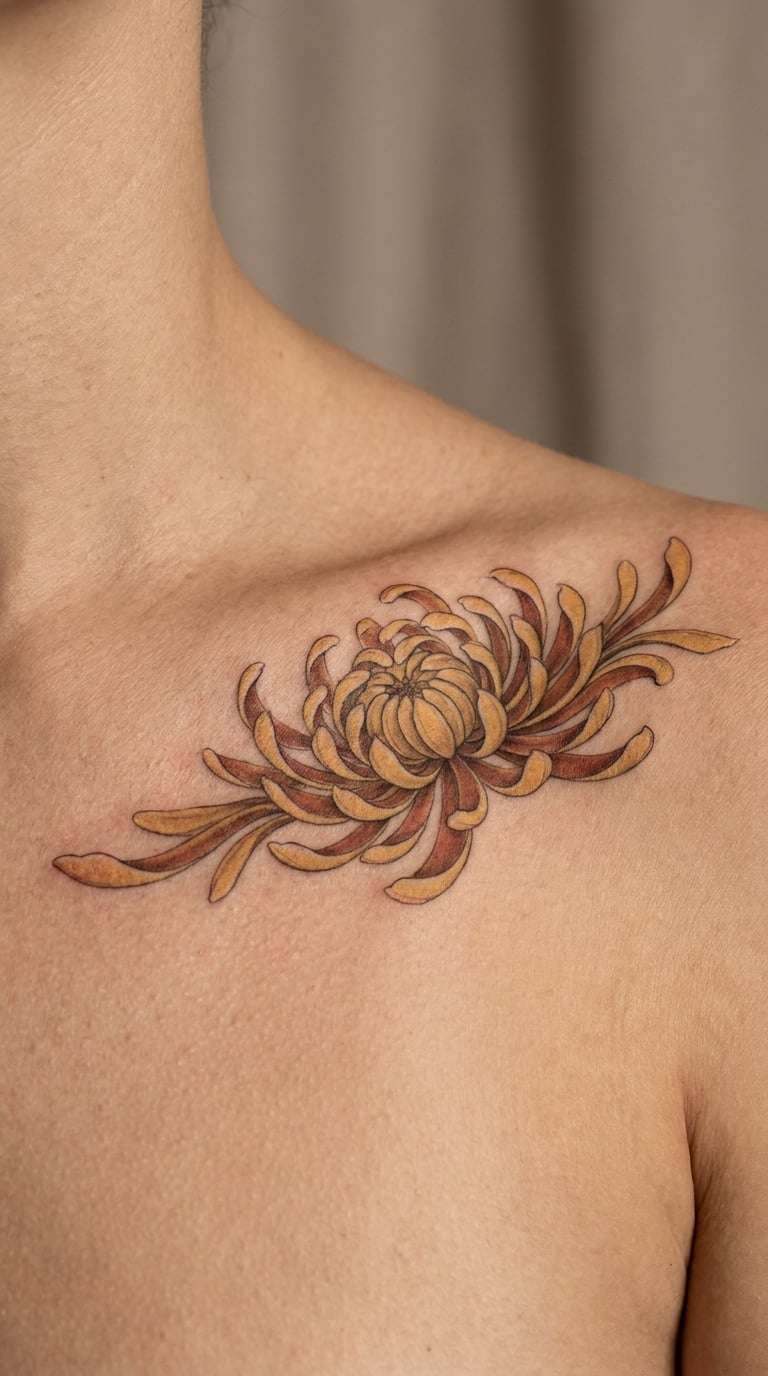
The marigold petals are drawn in overlapping spirals, more rose-like in structure than the real flower but still ruffled and layered. Colours stay in a golden yellow and muted rust range with no hard outline, so the edges of each petal fade into the next.
A spiral-petal marigold keeps the flower readable while reading as a softer, traditionally feminine design, and it sits flat rather than standing off the body.
Placement: along the collarbone, running horizontally toward the shoulder · Size: 2.5 to 3.5 inch · Style: soft realism · Pain: medium, the collarbone is sharp and the skin under it is thin. Soft shading without outline spreads a little during healing, so the artist will over-draw the edges slightly.
Make it yours: add two or three tiny buds trailing toward the shoulder, which follows the bone and makes the piece look designed for that line rather than placed on it.
11. Minimal Marigold Line Art on the Wrist
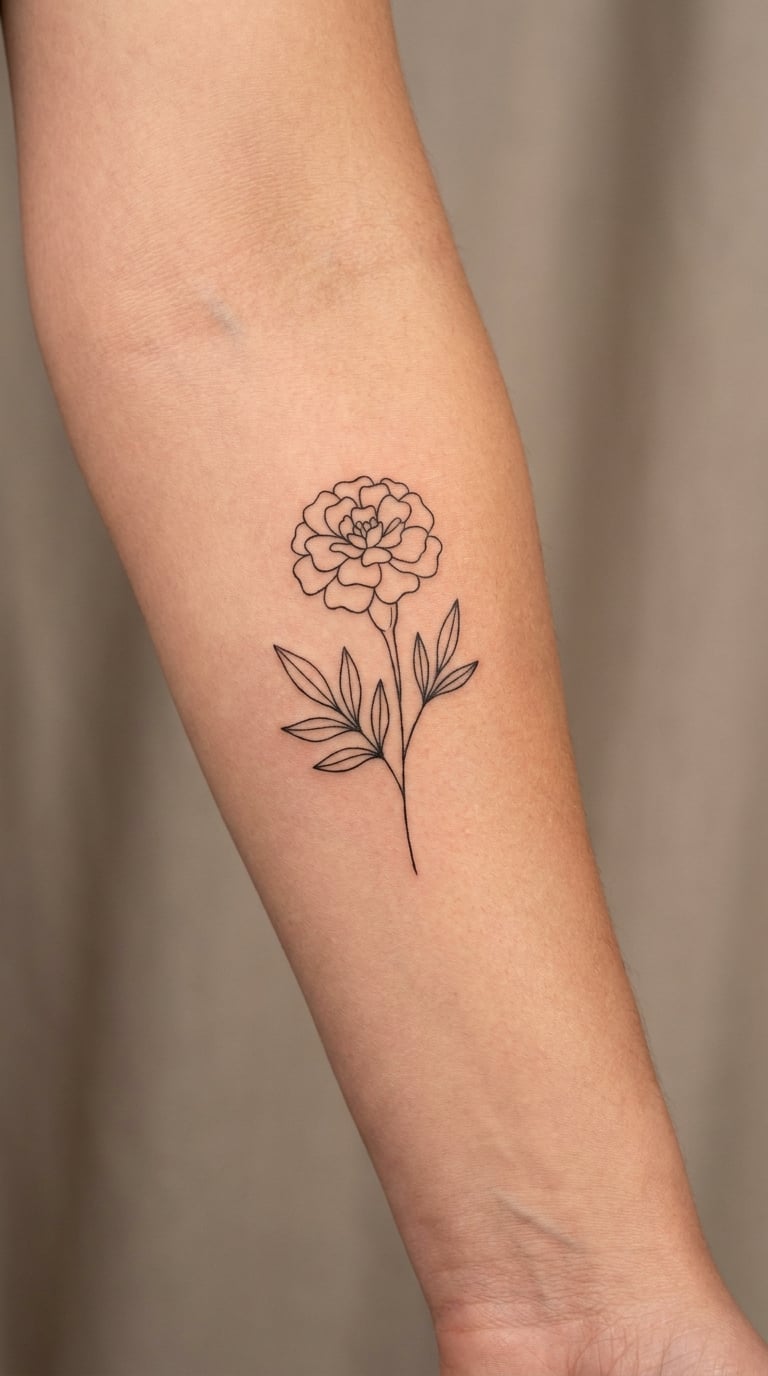
A few confident contours, one open bloom and three simple leaves, drawn with a single needle at a consistent weight. There is no shading and no colour, only line. The petals are indicated by a handful of interior curves rather than a full ruffled edge.
Minimal work is chosen when the flower matters but the decoration does not, and it is one of the more forgiving first-tattoo options.
Placement: inner wrist or inner arm, above the vein · Size: 1.5 to 2 inch · Style: minimalist · Pain: medium, and wrist placements catch knocks from daily life. Wrist line work fades fastest on this list, largely from hand washing and sun, so plan on a refresh after a few years.
Make it yours: put a second, smaller bloom on the same wrist a few inches along, so the two read as one plant interrupted by a gap.
12. Marigold Bouquet on the Back
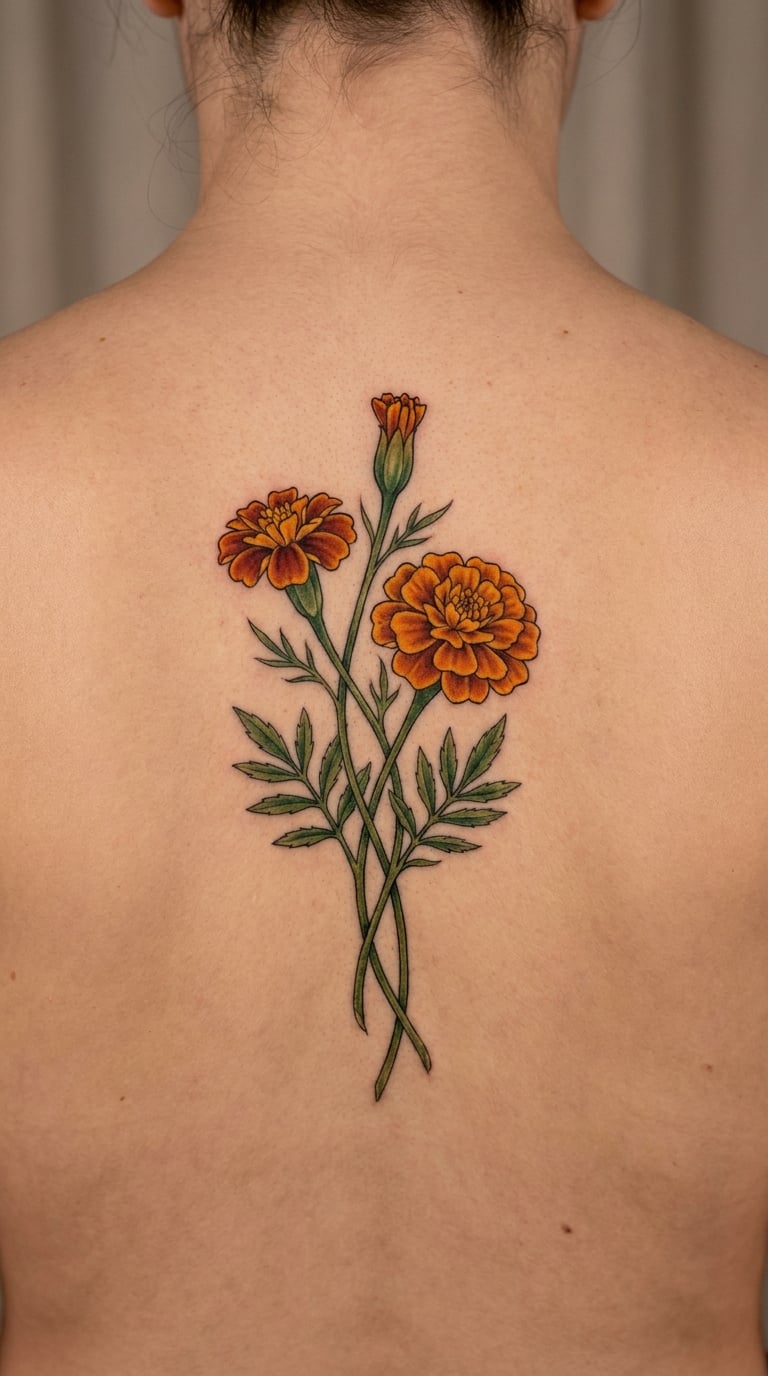
Three marigolds in different stages, one fully open, one half open and one a tight bud, tied loosely with green stems and pointed leaves. Stems cross and shorten as they gather, so the bouquet reads as held without a ribbon or a wrapped base.
Grouping flowers into a bouquet is the standard way to make a small design feel substantial, and the mixed stages keep it from looking like a repeated pattern.
Placement: between the shoulder blades or centred on the upper back, where a bouquet has room to spread · Size: 4 to 5 inch group · Style: botanical with light colour · Pain: low, the upper back is one of the least sensitive spots on the body. Bud and stem detail in a tight group is what softens first.
Make it yours: replace the loose stems with a small name in handwriting underneath, the way you would sign a note, so the bouquet reads as a gift.
13. Dotwork Marigold on the Rib
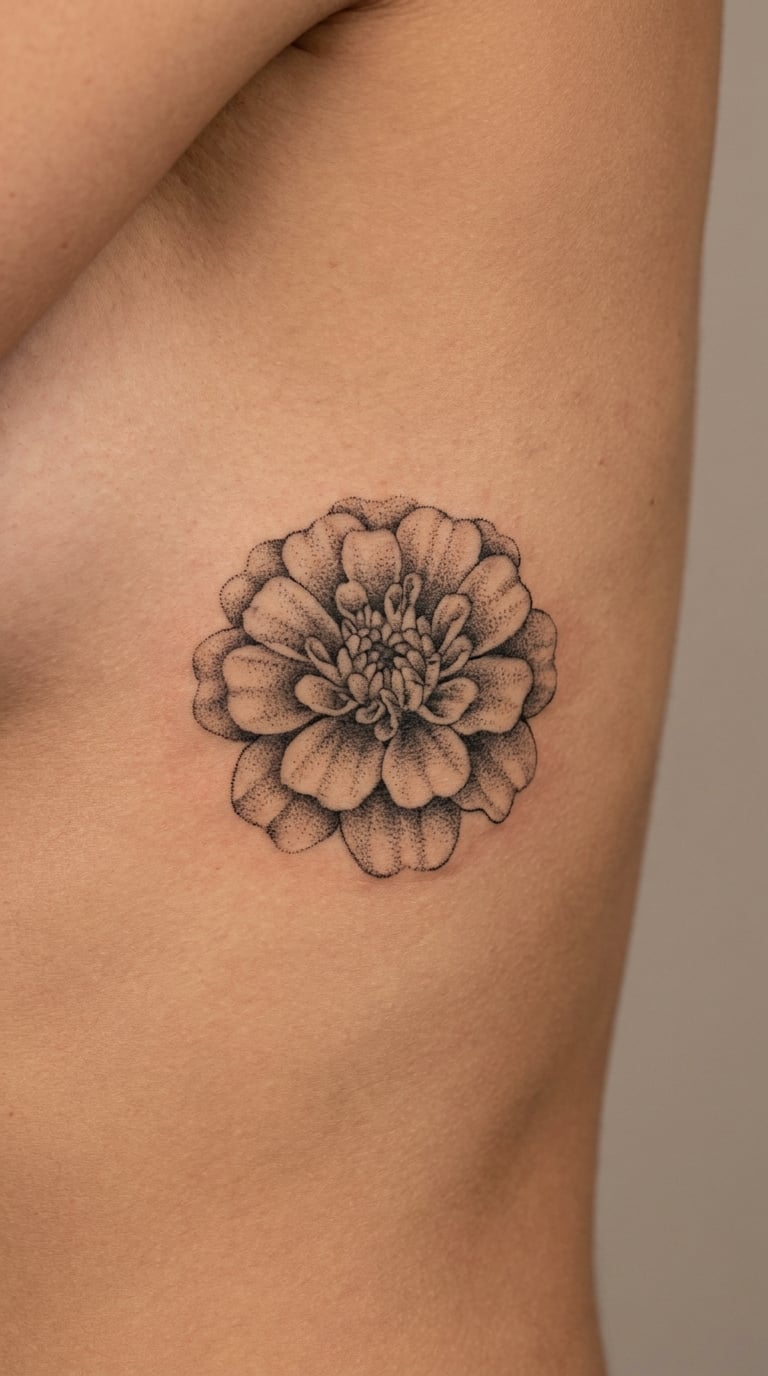
The bloom is built from graduated black dots, dense at the centre and opening toward the outer petals, with a small uninked circle left open at the middle. The dot size does the shading, so the flower has texture rather than tone. Petal rows are readable because the dot density changes between them.
Dotwork is chosen for its graphic texture, and it gives a marigold an entirely different read from a filled-in version of the same flower.
Placement: side ribs, between two ribs rather than across them · Size: 2 to 2.5 inch · Style: dotwork · Pain: high, and dotting is slow, so the session runs long. Dots soften and spread over the years, which reads as a fade unless the piece is refreshed.
Make it yours: run a graduated dot trail from the bloom down toward the hip, fading out after a foot, so the flower sits inside a larger field of texture.
14. Marigold Branch on the Leg
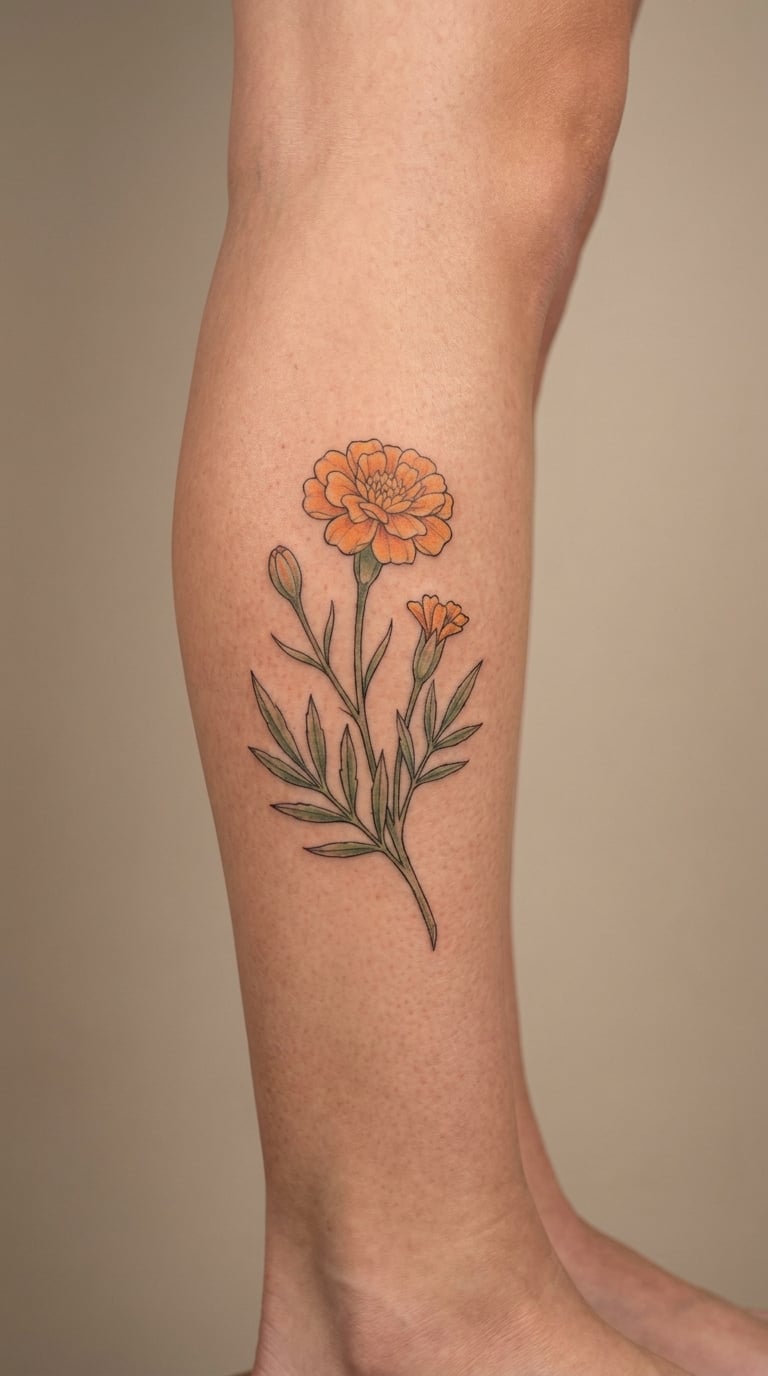
A vertical branch with one large open bloom near the top, two smaller buds below it, and narrow pinnate leaves alternating down the stem. The branch is drawn with fine tapering lines and the flower carries soft yellow colour while the leaves stay green or black.
Botanical branch work is chosen when the plant matters more than the flower, and it fills a long narrow area of skin better than a single bloom.
Placement: outer lower leg or inner calf, running vertically · Size: 5 to 7 inch tall, 1.5 to 2 inch wide · Style: botanical · Pain: low to medium, the shin and calf are forgiving. Narrow leaves on a long stem lose their edges first because there is little ink holding them.
Make it yours: add a second smaller branch running parallel, so the leg reads as a planting rather than a single stem.
15. Neon-Color Marigold on the Hand
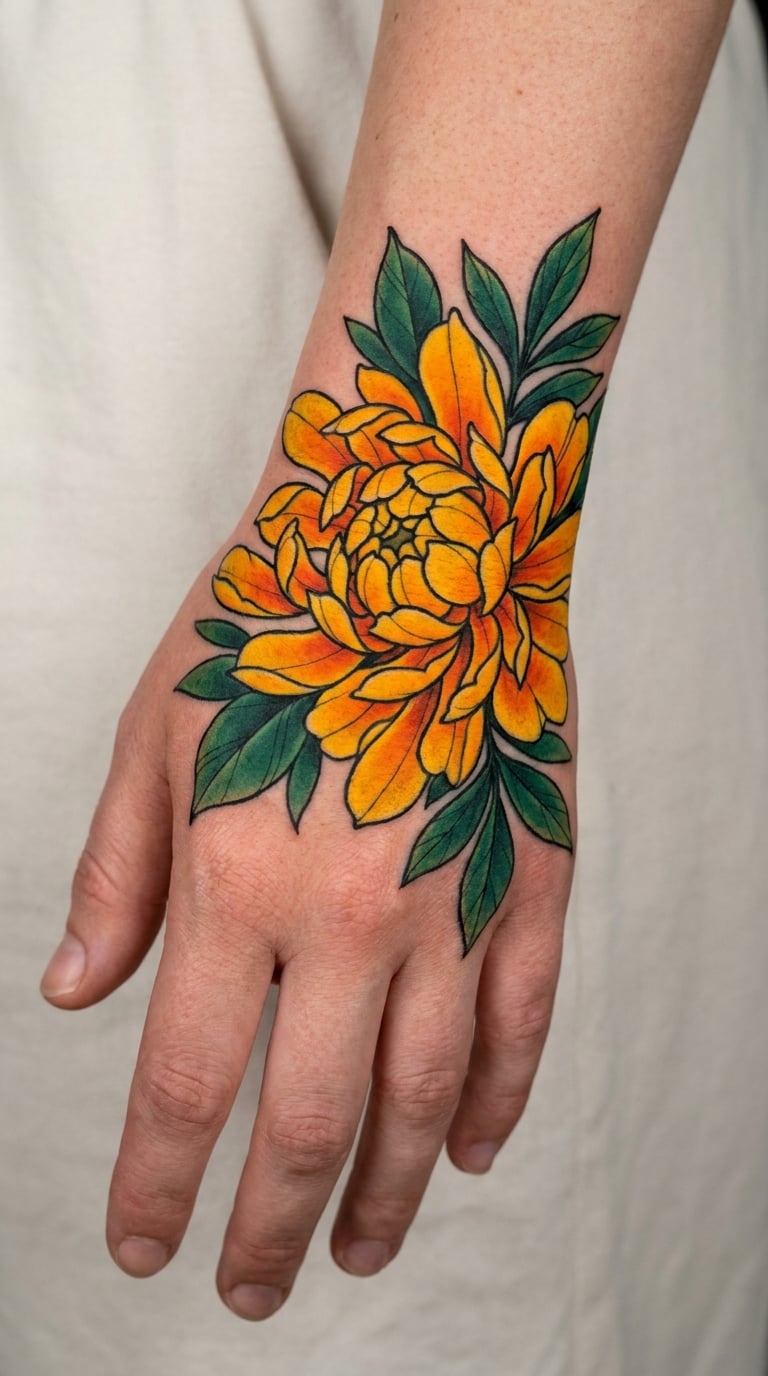
Heavy saturation: pure yellow petals pushed into orange at the centre, a bright green calyx underneath, and a dark outline holding the edges. The colour is laid in at full strength rather than mixed pale, which makes the bloom look lit from behind. The veins are drawn in a warm red-orange.
Maximum colour is the reason to choose this version, and the hand is where a bright bloom shows up most.
Placement: back of the hand, centred between the knuckles and the wrist · Size: 2.5 to 3 inch across · Style: colour realism · Pain: high, the hand is bony, the skin is thin and the veins sit right under the surface. Bright yellow and green fade fastest of all, and the hand is out in the sun and washed constantly, so this design needs the most upkeep.
Make it yours: add a matching small bloom on the other hand in the same three colours, and keep both in step when one needs a refresh.
16. Small Marigold Cluster on the Finger
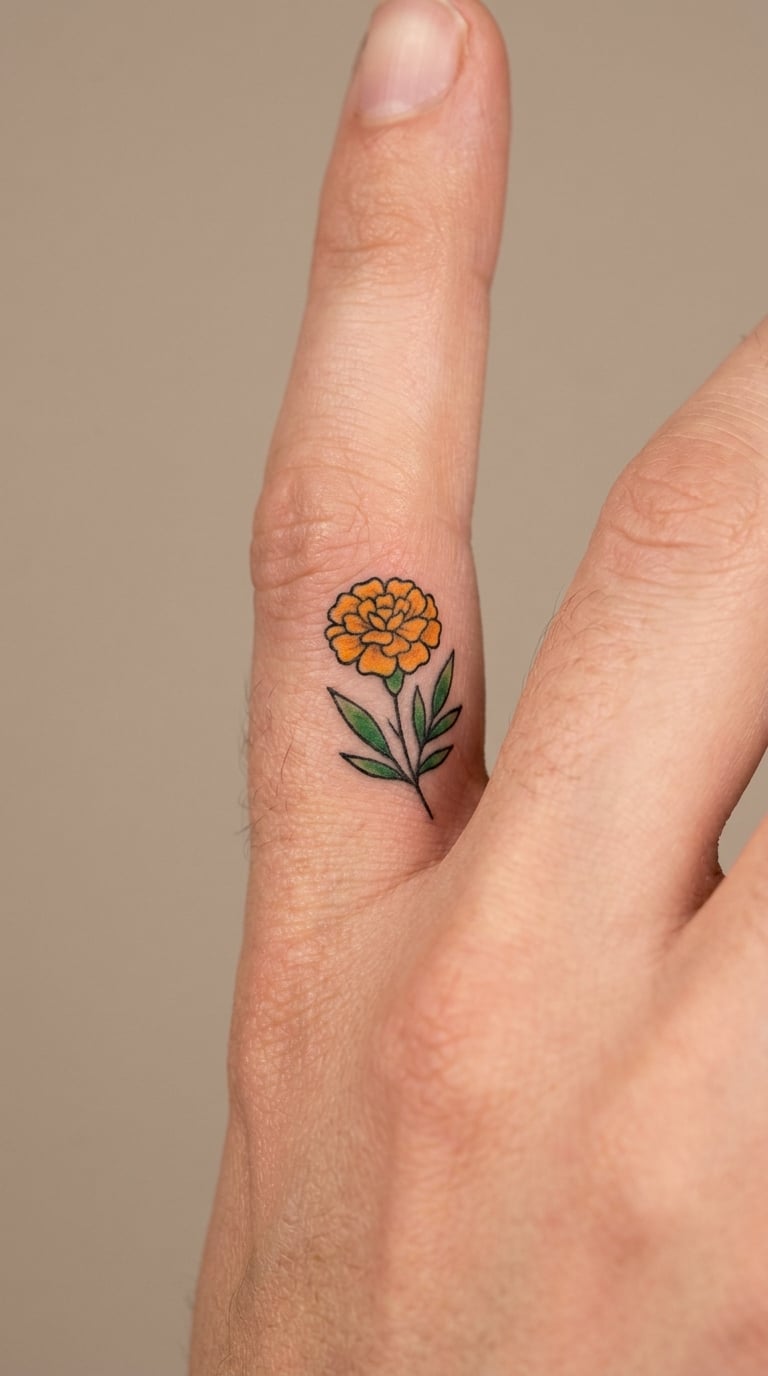
One small bloom with two leaves on a short stem, sized to the width of the finger itself. The design is simplified rather than detailed: a ruffled circle, a filled centre and two leaf shapes. Anything finer would not survive the surface it sits on.
Finger work is chosen for the intimacy of it, and the marigold version suits a client who wants something colourful and small in a place most people never examine.
Placement: side of the finger, near the base, or just below the knuckle · Size: 0.75 to 1 inch · Style: micro fine line · Pain: high, the sides and knuckles of fingers hurt disproportionately for the amount of skin involved. This is the first design to lose definition on the list, because hands flex, knock and get washed dozens of times a day.
Make it yours: put one on the ring finger of each hand, same size and same colour, which makes a small piece read as deliberate rather than impulsive.
17. Marigold Sun on the Upper Arm
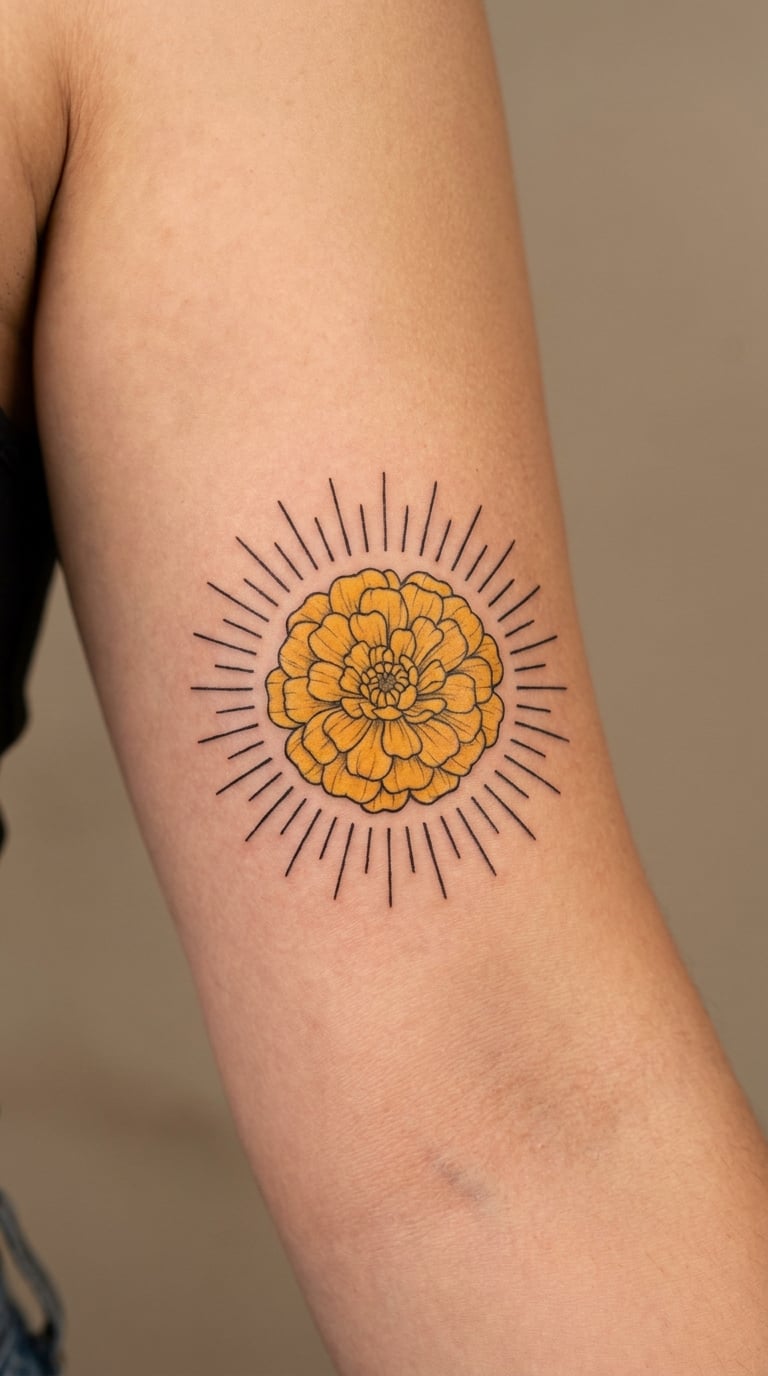
A yellow marigold sits in the middle with short, evenly spaced black rays radiating outward like a sun. The rays are the same length and the same weight, evenly spaced, and stop well short of the edge of the design so nothing looks cut off. The flower stays detailed; the rays stay plain.
Combining the bloom with radiating lines gives the piece a focal centre and a lot of visual energy, without adding a second motif.
Placement: outer upper arm, centred in the muscle · Size: 3.5 to 4.5 inch including the rays · Style: illustrative with colour · Pain: medium, flat and straightforward. Fine ray tips blur after several years, so keep the rays short and thick rather than long and thin.
Make it yours: double the ray count on one half and leave the other half plain, which turns a symmetrical design into something more graphic.
18. White Ink Marigold on the Ankle
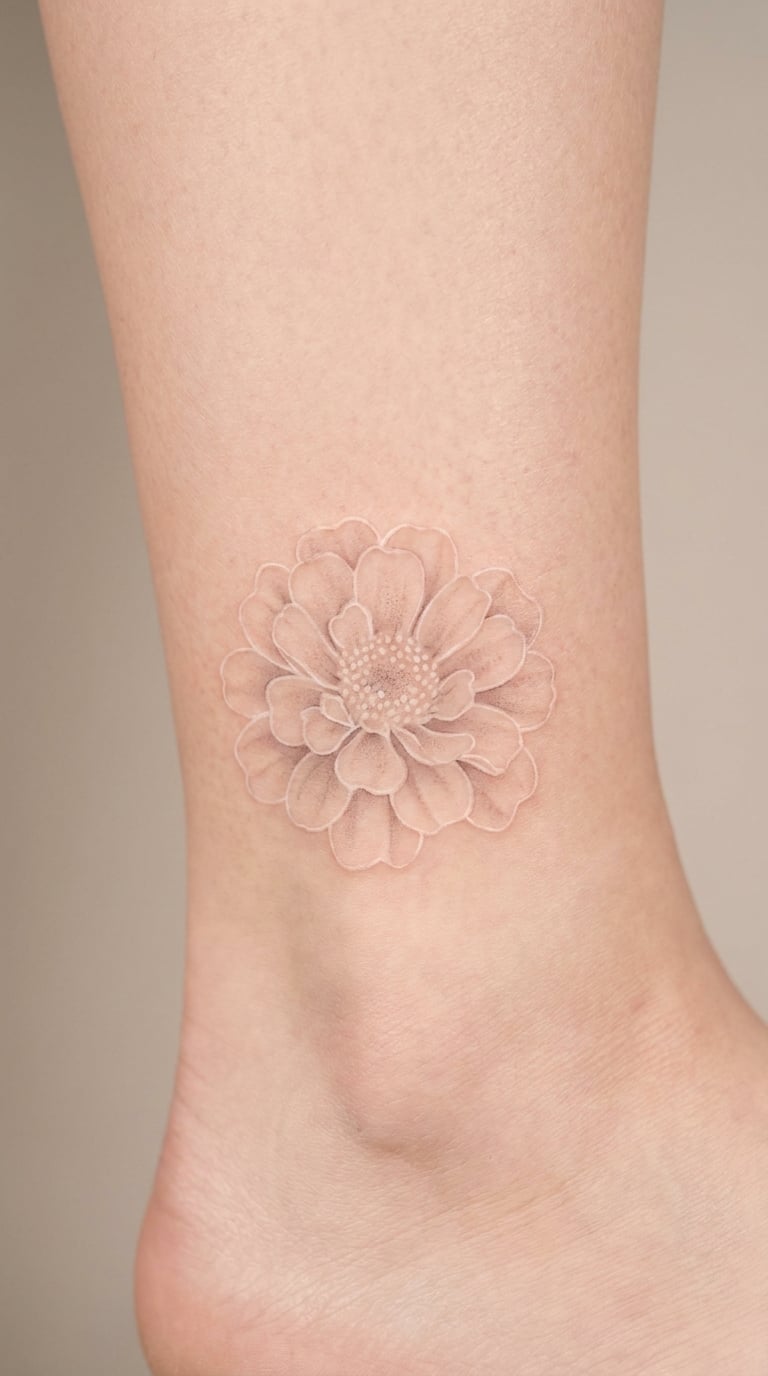
A pale marigold built from white ink washes with faint grey and a hint of yellow left out of the centre, so the flower only shows at an angle or in raking light. There is no black outline, which is the point: the design is made of light rather than dark.
White ink is chosen by people who want body art that is almost invisible day to day. It suits pale skin, and it cannot compete with a bold colour piece.
Placement: inner ankle or the bony top of the foot · Size: 1.5 to 2 inch · Style: white ink · Pain: medium, the ankle bone is the sensitive part and the rest is not. White ink is not permanent in the way black is, and it needs refreshing sooner, often within a couple of years.
Make it yours: keep the flower in white and add a single black stem, so the piece has one anchor that will not fade while the bloom does.
19. Marigold Half-Moon on the Hip
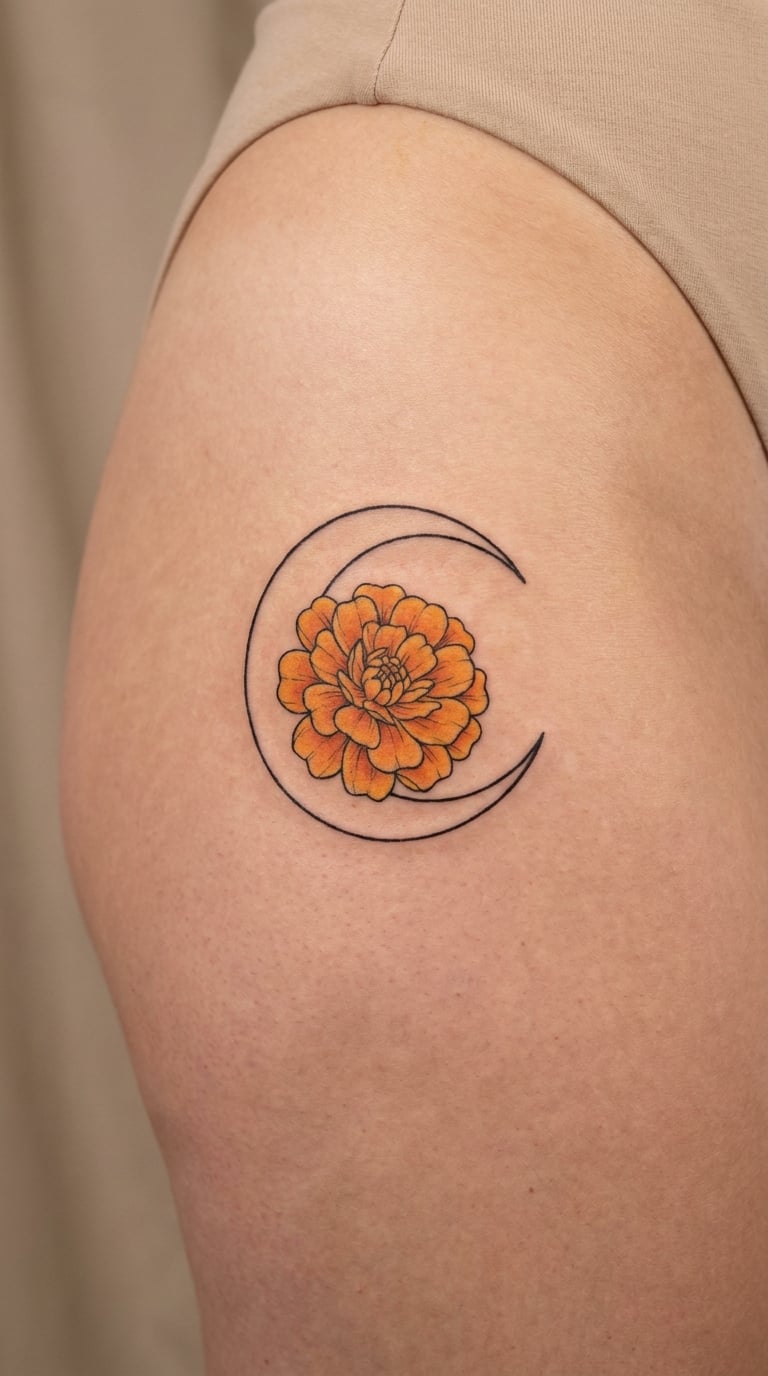
A single marigold in muted colour nests inside a simple black crescent moon, with the flower sitting in the open curve rather than overlapping it. The crescent is drawn with one confident line and a solid inner edge, and the bloom fills the negative space the moon creates. No stars, no extra leaves.
The pairing works because both shapes are curved and the flower fills the gap the moon leaves, which is why this composition holds together at any size.
Placement: outer hip, curving with the body’s line, or on the side of the ribcage · Size: 3 to 4 inch · Style: illustrative · Pain: medium, the hip is fleshy and works well for curved designs. Small gaps between the moon and the petals are where the design loses its shape first.
Make it yours: point the crescent’s opening upward and place the bloom at the lower tip, so the composition reads the same from any angle.
20. Large Marigold Cluster on the Back of the Arm
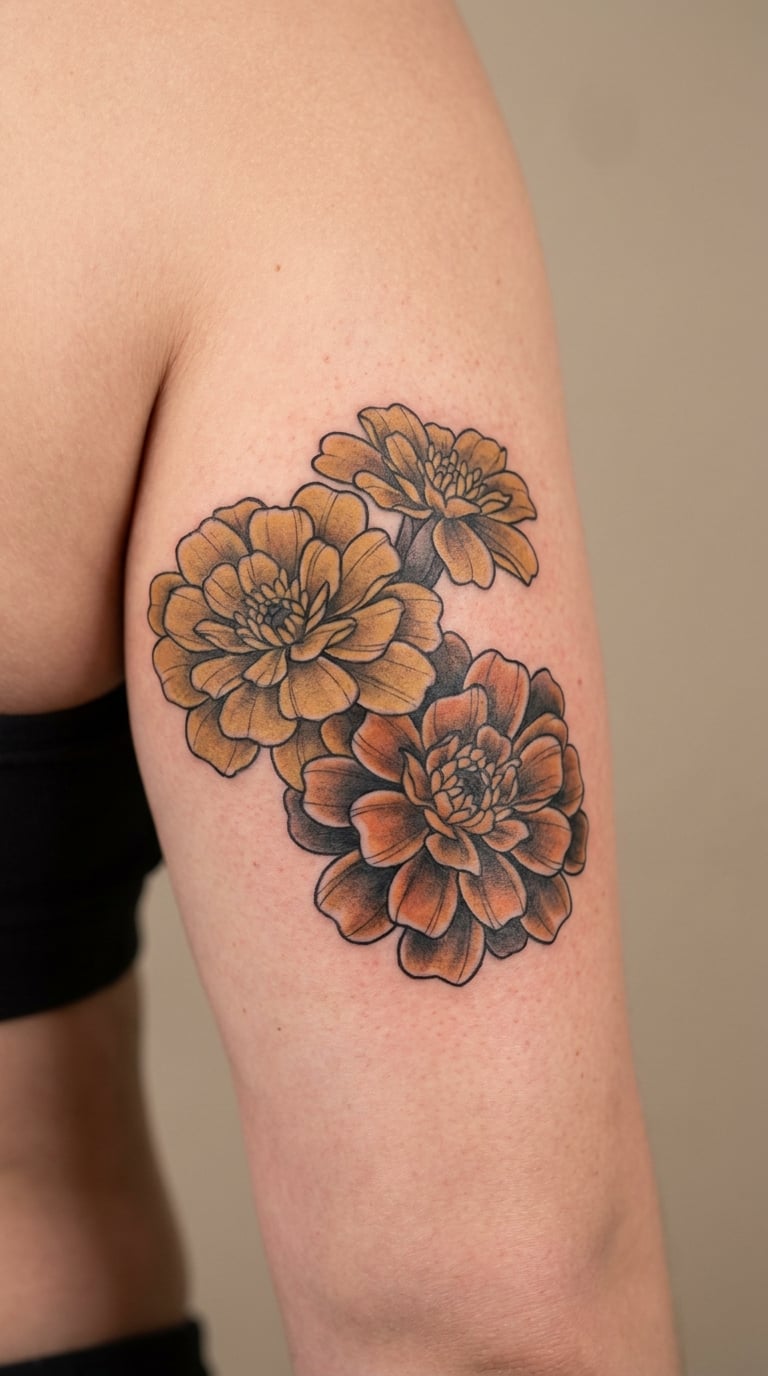
Three marigolds overlapping, one in golden yellow, one in rust, one with black shading between the petals, layered so each one partly hides the next. Leaves fill the gaps underneath, and the whole group runs diagonally across the arm. This is the piece people build a floral collection around.
A large cluster is chosen when a single bloom would look empty, and it also works as the anchor for a sleeve that grows over the following years.
Placement: back of the upper arm, running from the deltoid toward the elbow · Size: 5 to 7 inch group · Style: neo-traditional · Pain: low to medium, and the shoulder blade and tricep are comfortable areas. Overlapping petals hide each other’s edges, which actually slows fading compared with an isolated bloom.
Make it yours: leave a small open patch of skin in the lower corner of the cluster, and fill it years later with a date or a small second flower as a planned follow-up piece.
How to Choose the Right Design
Most people who are unhappy with a floral tattoo later were not unhappy with the flower, they were unhappy with the scale or the spot. Work through these six questions before the consultation and the artwork starts making the decisions for you.
How do you narrow 20 marigold tattoo ideas down to one?
Decide on the placement first, then let it cut the list. Behind the ear can only hold a micro design, the sternum suits one bold bloom, and the upper arm has room for a wreath or a cluster. If two ideas appeal, book a consultation with both sketched and ask which one your skin can actually carry.
Which style should you pick?
Fine line and minimal work look refined but lose definition sooner. Blackwork holds its shape the longest and needs no colour decisions. Watercolor suits people who want something soft and loose. Realistic and traditional work is the most immediately readable, and it is the style that survives a small size best because the petals are filled rather than drawn.
How big should the marigold be?
Scale the flower to the body site rather than to the reference photo. Behind the ear and the finger work in under an inch, the wrist and collarbone sit between 1.5 and 3 inches, and the thigh, calf and back can take anything from 4 inches upward. A bloom scaled past the flat area of the body will follow the curve and look bent.
Should you go in colour or black?
Colour gives a marigold its golden warmth and is what most people are picturing when they search for a marigold. It also fades fastest, particularly in yellow and orange. Black and blackwork need touch-ups less often and read more graphic, which suits a forearm or a sternum where you want weight rather than softness.
How much detail is too much?
Every interior vein, petal separation and leaf tip is detail that has to survive healing and then survive years of sun. Below two inches, ask the artist to cut the detail in half. Tattooers regularly tell clients that colour looks duller while it heals and settles into its proper tone afterwards, so a fresh tattoo is not a fair preview of the healed result.
Is a marigold a good first tattoo?
A small fine-line or micro marigold is a reasonable first piece, because the line work is light and the sitting is short. A realistic thigh bloom or a large cluster is a different proposition entirely and takes a real commitment of time. If you are new to being tattooed, start small and work up to a cluster later rather than starting with the statement piece.
If your flower is going somewhere other than an arm, our pine forest tattoo ideas for the forearm piece covers how dense foliage behaves on that particular canvas.
Cost and Session Time
Tattoo pricing in the US usually runs by the hour, and a shop minimum applies to almost everything. Most artists charge somewhere between 80 and 150 USD per hour, and many studios set a minimum of 120 to 150 USD, which is the number that really matters for a small design.
- Small, under 2 inches: one short sitting, often 10 to 30 minutes. Expect to pay the shop minimum rather than an hourly rate.
- Medium, 2 to 4 inches: one sitting of roughly 45 to 90 minutes. This covers a single realistic bloom, a traditional flower or a small cluster.
- Large, 4 inches and up: 90 minutes to 2.5 hours, and sometimes two sittings for a bouquet, a branch or a statement cluster.
What moves the total is detail and colour. A blackwork flower with clean shapes takes an hour; the same flower in layered realistic colour with veining can take three. Placement matters too, since ribs, the sternum, fingers and the hand cost more per hour than a thigh or an upper arm. A consultation is the only reliable way to confirm both the cost and the time, because the artist needs to see the skin before they can tell you what a design takes.
Aftercare Basics
Always start with your artist’s own aftercare instructions, because they match the ink, the needle depth and the style they used. The list below is general guidance to sit alongside that, not a replacement for it.
- Follow whatever aftercare sheet or verbal instructions your artist gives you, including any product they recommend, rather than products you already own.
- Wash gently with clean water and a mild unscented soap, then pat the area dry with something disposable rather than a towel.
- Keep it moisturised with a plain, fragrance-free product if the skin feels tight. A heavy ointment can smother a fresh piece.
- Leave the skin alone. No picking, no scratching, no scraping off flakes, even when they are driving you mad.
- Cover it loosely with clean clothing while it is healing, and choose loose fabric over anything tight across the new tattoo.
- Once it is healed, protect it from sun. Yellow and orange fade faster than any other colour, so shade and sunscreen are the difference between a marigold that stays gold and one that turns pale.
Ask at the appointment when the artist expects a touch-up and what it will cost, so yellow settling is a planned part of the piece rather than a surprise a year later.
Frequently Asked Questions
Will a yellow marigold tattoo fade?
Yellow is the first tattoo pigment to fade, and orange follows closely. A marigold done in full colour will usually need a refresh on the pale petals within a few years, even with careful sun protection. Black line work and blackwork versions hold their shape far longer. Plan a touch-up budget in from the start and ask your artist when the first one should happen.
Is a marigold tattoo a good first tattoo?
A small fine-line or micro marigold works well as a first tattoo. The line work is light, the sitting is short and the design is forgiving if the artist simplifies it. A realistic thigh bloom or a large cluster is a very different commitment and better left until you already have a piece. Start small, then build toward a floral collection.
How big should a marigold tattoo be for the placement?
Behind the ear and finger work in under one inch. Wrist, collarbone and hand designs sit comfortably between 1.5 and 3 inches. Upper arm, calf, thigh and back can take anything from 4 inches upward. The rule is simple: if the flower is bigger than the flat area of the body, it will follow the curve and read as bent.
Why does my marigold look duller than the reference photo?
This is normal in the first weeks. Fresh colour looks flatter and slightly darker because of swelling, and tattooers consistently tell clients that the tone settles into its proper shade as the piece heals. Judging a colour tattoo before it has fully healed is the most common source of panic in the first month.
Can I add a marigold to an existing floral sleeve?
Yes, and it is a common request. Artists regularly fit a single coloured marigold into a blackwork piece, or add one to a forearm alongside existing flowers. Bring healed photos of the current work to the consultation so the artist can match line weight and colour depth before drawing anything.
Conclusion
For a first tattoo, the small options win: the fine-line sprig, the micro piece behind the ear or the minimal line art on the wrist. Short sitting, forgiving detail and a size you can actually sit still for.
If you are already building a floral collection, the realistic thigh bloom, the blackwork sternum piece and the large cluster on the back of the arm give you something to grow around. Whichever direction you lean, pick the placement first, cut the detail to fit the space, and expect to refresh the yellow later. If the whole arm is the eventual goal, our ocean sleeve tattoo ideas piece covers how a full arm layout is planned.