
20 Best Tattoo Ideas for Soccer Fans: September 2026 Picks
Tattoo ideas for soccer fans work best when the design means something specific to you, not just because a ball looks tidy in a circle. These twenty are all original, logo-free designs built from the ball, the goal, the numbers, the pitch and the rituals of match day, so nothing you wear depends on a club badge or a player’s face.
That matters more than it sounds. On an old r/soccer thread asking fans to post their soccer tattoos and explain the significance, the most memorable answer was an Atlético Madrid crest paired with a bust of Neptune, because colchoneros gather at the Fountain of Neptune in Madrid when they win something. A plain ball got no love in that thread at all. Fans read tattoos as a statement of how serious they are, so a design needs a story behind it.
Below each idea you will find what the design looks like, what it usually says, the placement and realistic size that work best, how it feels, and one way to make it yours. If you are booking a first tattoo, start small and skip the ones with fine detail in awkward places. If you already have ink, read further down for the panel and blackwork options.
One quick note before the gallery. Soccer and football are used interchangeably in most of the world, and both words get searched, so the ideas here work as football tattoos too. Every size below is the finished size on skin, not the size of the drawing on a screen.
Tattoo Ideas for Soccer Fans: Quick Guide
| Idea | Style | Best placement | Size | Pain |
|---|---|---|---|---|
| 1. Fine-line football and net | Fine line | Inner forearm | 2 in (5 cm) | Low to medium |
| 2. Classic black-and-grey football | Black and grey | Outer upper arm | 2.5 in (6 cm) | Medium |
| 3. Football with a heartbeat | Fine line, minimal | Inner wrist | 3 in (7.5 cm) | Medium |
| 4. Watercolour football splash | Watercolour | Calf | 3 in (7.5 cm) | Medium |
| 5. Geometric football pattern | Geometric, blackwork | Shoulder | 2.5 in (6 cm) | Medium to high |
| 6. Football and goalkeeper gloves | Blackwork, illustrative | Outer forearm | 3.5 in (9 cm) | Medium |
| 7. Minimal football icon | Minimal, solid fill | Side of a finger | 0.75 in (2 cm) | High |
| 8. Football with laurel leaves | Traditional blackwork | Upper arm | 4 in (10 cm) | Medium |
| 9. Number 10 script football | Calligraphy | Inner bicep | 3 in (7.5 cm) | Medium |
| 10. Stadium light tattoo | Fine line | Forearm | 3.5 in (9 cm) tall | Medium |
| 11. Football in motion | Blackwork, illustrative | Outer thigh | 2.5 in (6 cm) | Medium |
| 12. Four-leaf clover football | Fine line | Ankle | 2 in (5 cm) | Medium |
| 13. Football and travel coordinates | Fine line | Shoulder | 3.5 in (9 cm) | Medium to high |
| 14. Traditional football with banner | Neo-traditional | Upper arm | 4 in (10 cm) | Medium to high |
| 15. Abstract football sleeve panel | Blackwork pattern | Outer arm | 5 in (13 cm) panel | High |
| 16. Football and whistle | Fine line | Outer forearm | 3 in (7.5 cm) | Medium |
| 17. Blackwork football with tifo banners | Blackwork | Calf | 4 in (10 cm) | Medium |
| 18. Micro-realism football boot | Micro-realism | Forearm | 2.5 in (6 cm) | Medium |
| 19. Football with player silhouette | Blackwork, illustrative | Upper arm | 4 in (10 cm) tall | Medium |
| 20. Watercolour football trophy | Watercolour | Upper arm | 4 in (10 cm) | Medium |
1. Fine-Line Football and Net
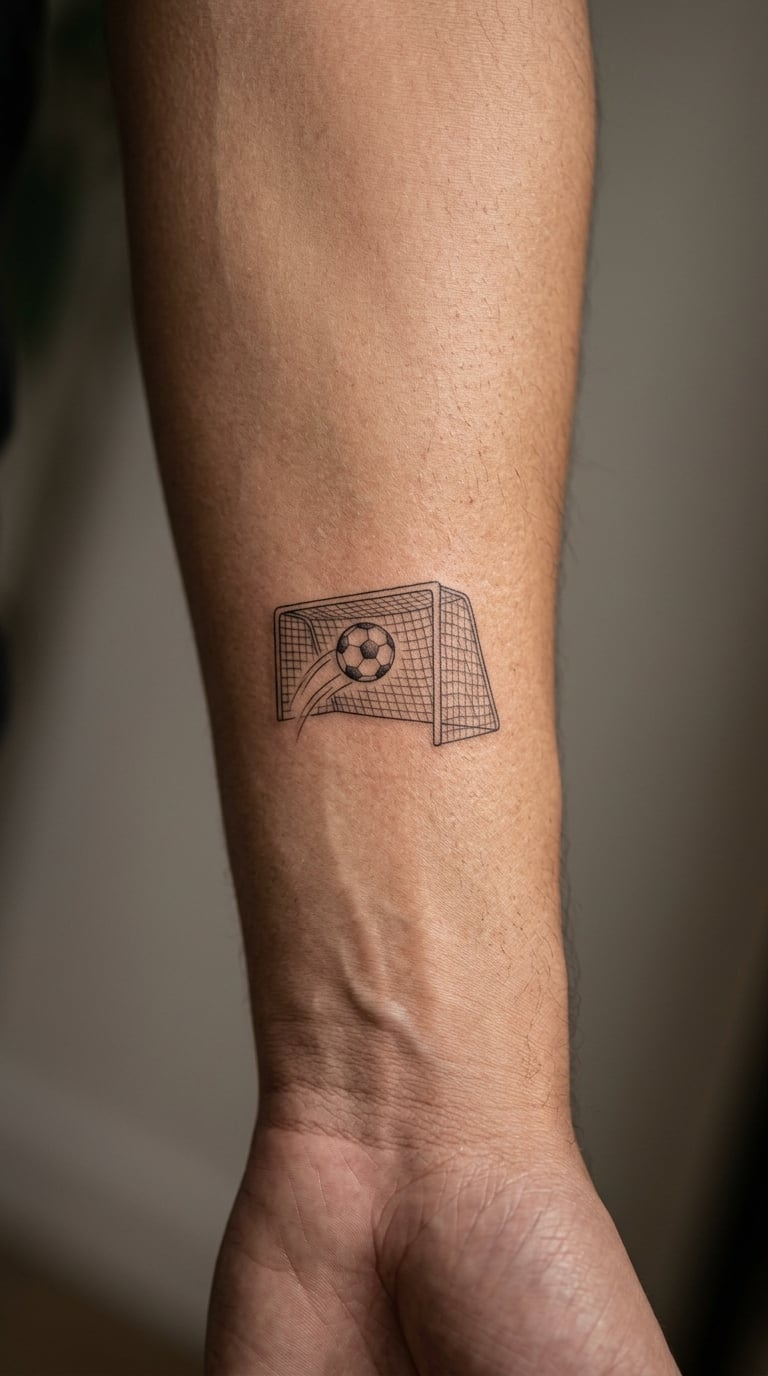
The ball sits in a single unbroken circle with a few panel lines, and a loose grid of netting curls away behind it. Line weight stays thin and even, with no shading, so the design reads as one confident drawing rather than a sketch of a picture.
It says you follow the game closely without needing anyone to read your team off your skin. That is usually the reason people pick it.
Placement: inner forearm, wrist to elbow, so the net can trail toward the elbow. Size: 2 in (5 cm) wide for the ball, 3.5 in (9 cm) with the net. Style: fine line.
Pain: low to medium, a scratchy burn that settles quickly. Fine line on the inner forearm softens and blurs a little within a few years, so keep the netting looser than you think you need.
Make it yours: have the artist draw the net slightly wider than the ball, which reads as a goal being scored rather than a ball sitting still.
2. Classic Black-and-Grey Football
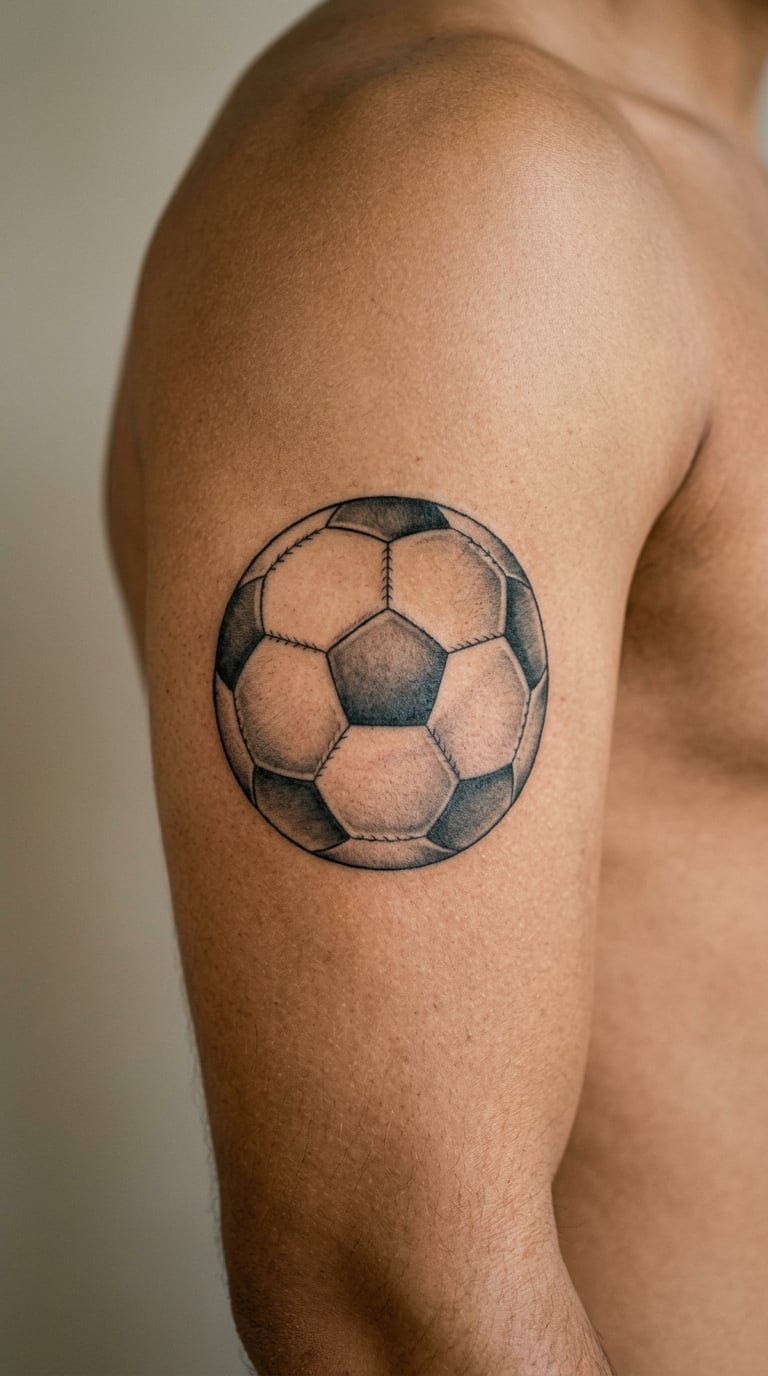
A traditional shaded ball, built from a dark outline, mid-grey body and near-black panels, with the stitched seams drawn as a few short dashes. It is the version most people picture before they realise they want something less generic.
It marks you as a supporter who does not need the badge to prove anything. The ball is the sport itself, nothing more or less.
Placement: outer upper arm, where a round shape sits flat and reads from a distance. Size: 2.5 to 3 in (6 to 7.5 cm). Style: black-and-grey realism.
Pain: medium, steady and constant. The grey wash takes longer than the outline, so expect the last twenty minutes to be the most uncomfortable part of the session.
Make it yours: ask for slightly heavier saturation than you see in photos, because grey shading reads lighter once it heals.
3. Football with a Heartbeat
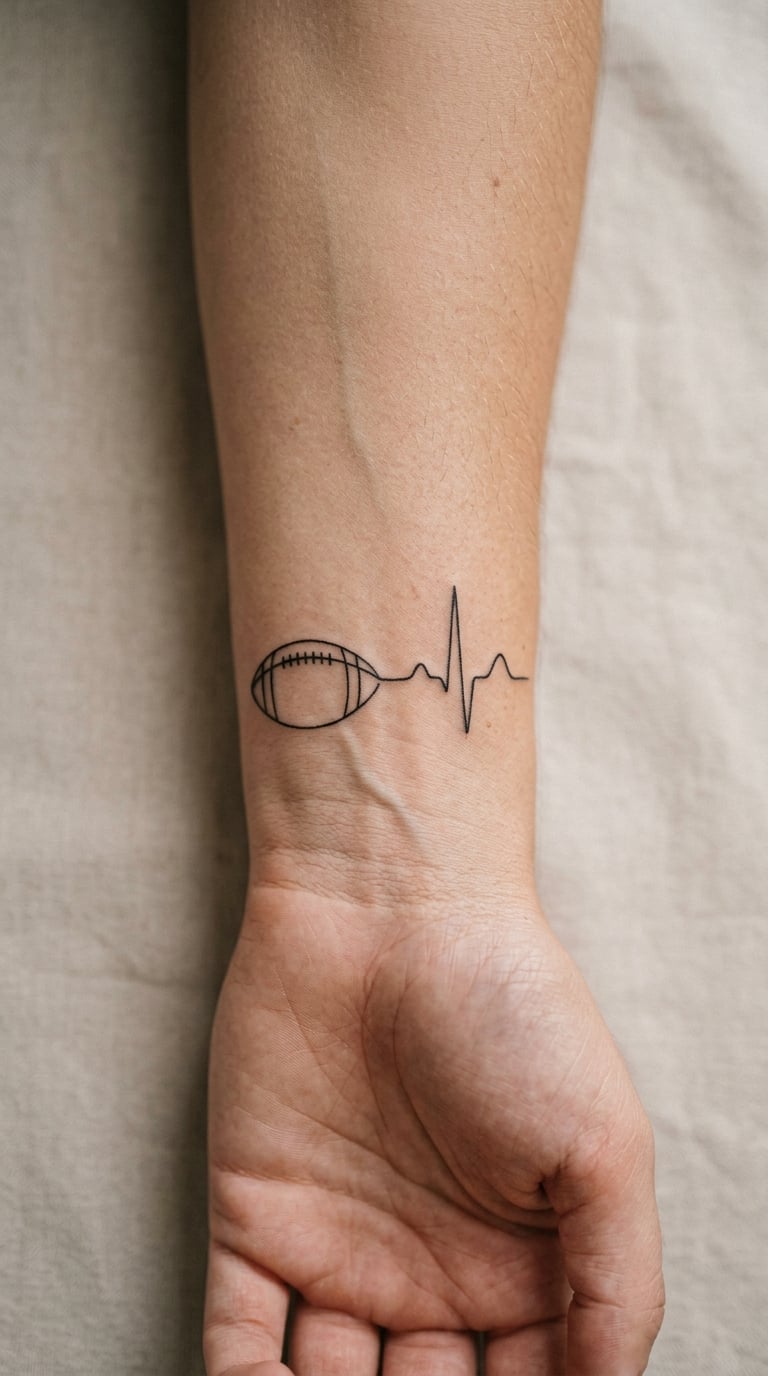
A small ball sits at the start of a pulse line that runs into a steady rhythm, spiking twice before trailing off into a thin tail. The whole thing is one continuous line with no fill, so it looks like a signature that happens to contain a football.
It is usually chosen for a specific match, a person, or the feeling in the ninety minutes that made someone a fan. Wearers tend to know exactly which one it is.
Placement: inner wrist, running along the forearm so the line has room to travel. Size: 2 in (5 cm) ball, 3 in (7.5 cm) total length. Style: fine line, minimal.
Pain: medium on the wrist, where skin is thin and the bone sits close. The line will fade fastest anywhere it curves over a joint, so the artist should avoid wrapping it around the wrist crease.
Make it yours: change the beat pattern to match your own, which makes the piece impossible to copy and nobody will ever ask about it twice.
4. Watercolour Football Splash
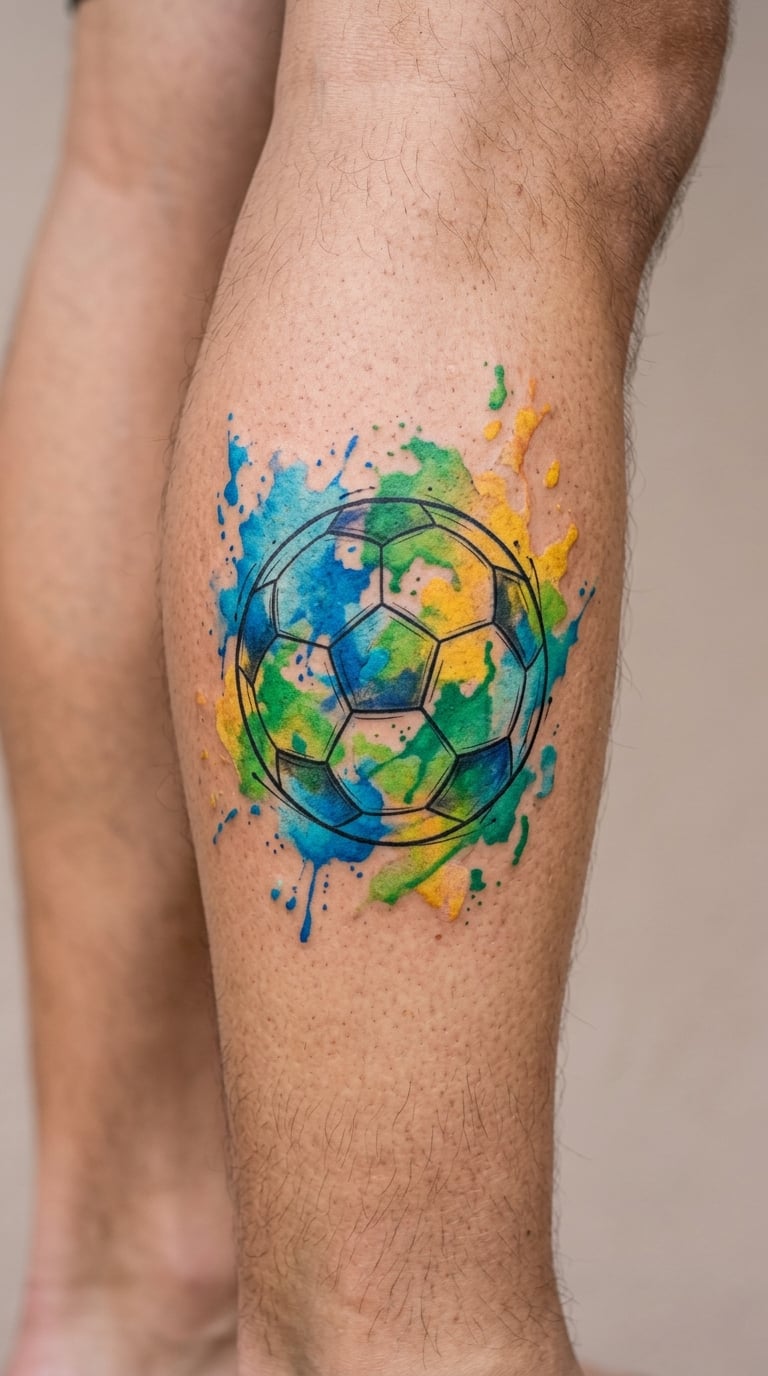
A loosely drawn ball in black, with colour washing out past the outline in blue, green and yellow, plus a few scattered droplets. The edges are soft and slightly uncontrolled, which is what separates watercolour from a blurry print.
It suits fans who want visible colour without a badge that dates the design to one season. Support for the sport, not for a specific club.
Placement: outer calf or inner arm, somewhere with flat surface and no sharp curve. Size: 3 in (7.5 cm) ball, up to 4 in (10 cm) including the splash. Style: watercolour.
Pain: medium for the ball, and the splashes are quick passes of light wash rather than long shading. Colour will fade and soften first, so plan on a refresh every five to eight years if you care.
Make it yours: use your birth sign’s colours instead of a club palette, so the piece is unmistakably yours and not a team statement.
5. Geometric Football Pattern
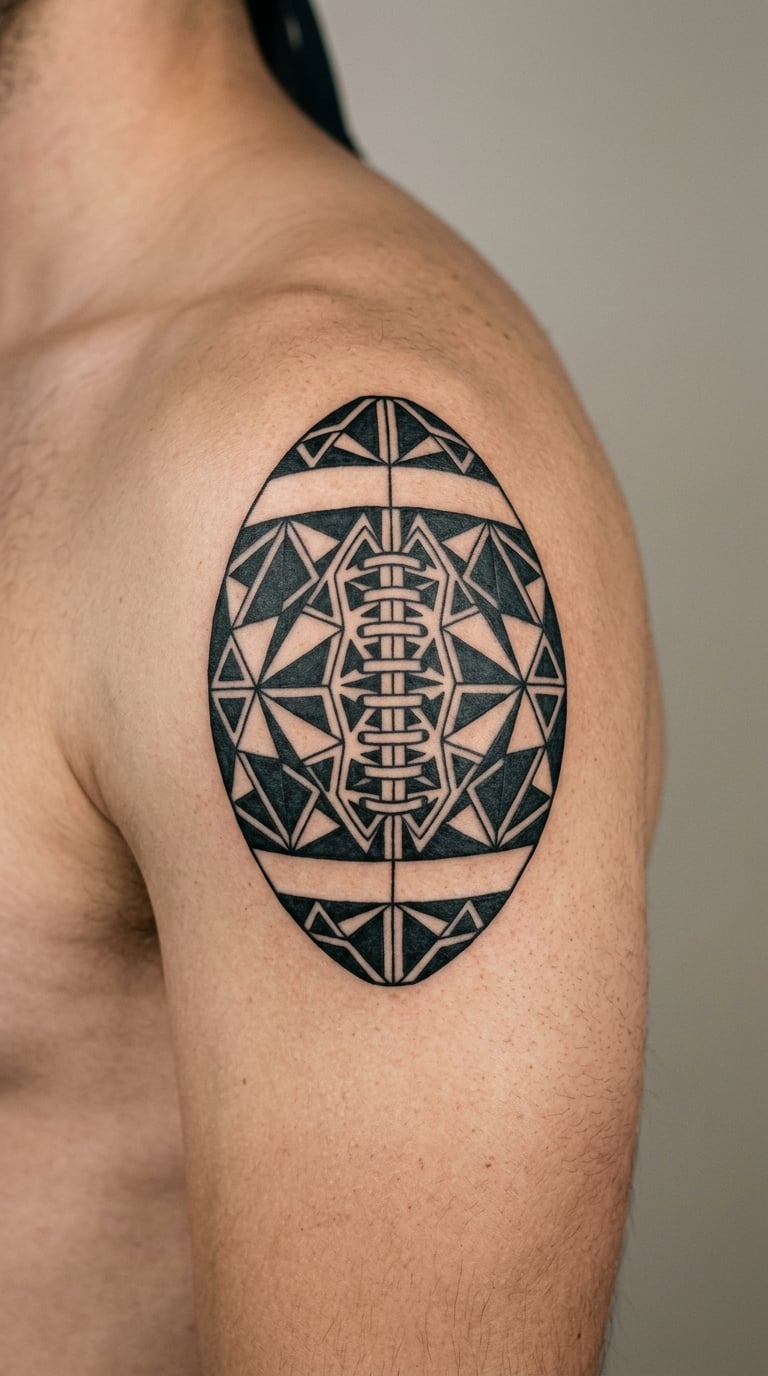
The ball is broken into triangles that share exact edges, with each panel filled in solid black or left empty so the negative space does half the work. Symmetry is the whole point, and it looks best when the outer circle is a perfect ring.
It reads as an appreciation of craft and structure rather than a club statement. Fans who like mathematics and clean shapes tend to end up here.
Placement: shoulder cap, deltoid, or the flat of the upper chest. Size: 2.5 in (6 cm), and never smaller than 2 in or the internal lines merge. Style: geometric blackwork.
Pain: medium to high, mostly because the shoulder cap is a bony curve and every line has to be redrawn around it. Solid fills add time but not much extra discomfort.
Make it yours: extend the triangle pattern into a band of three smaller balls along the forearm to turn one design into a matching set.
6. Football and Goalkeeper Gloves
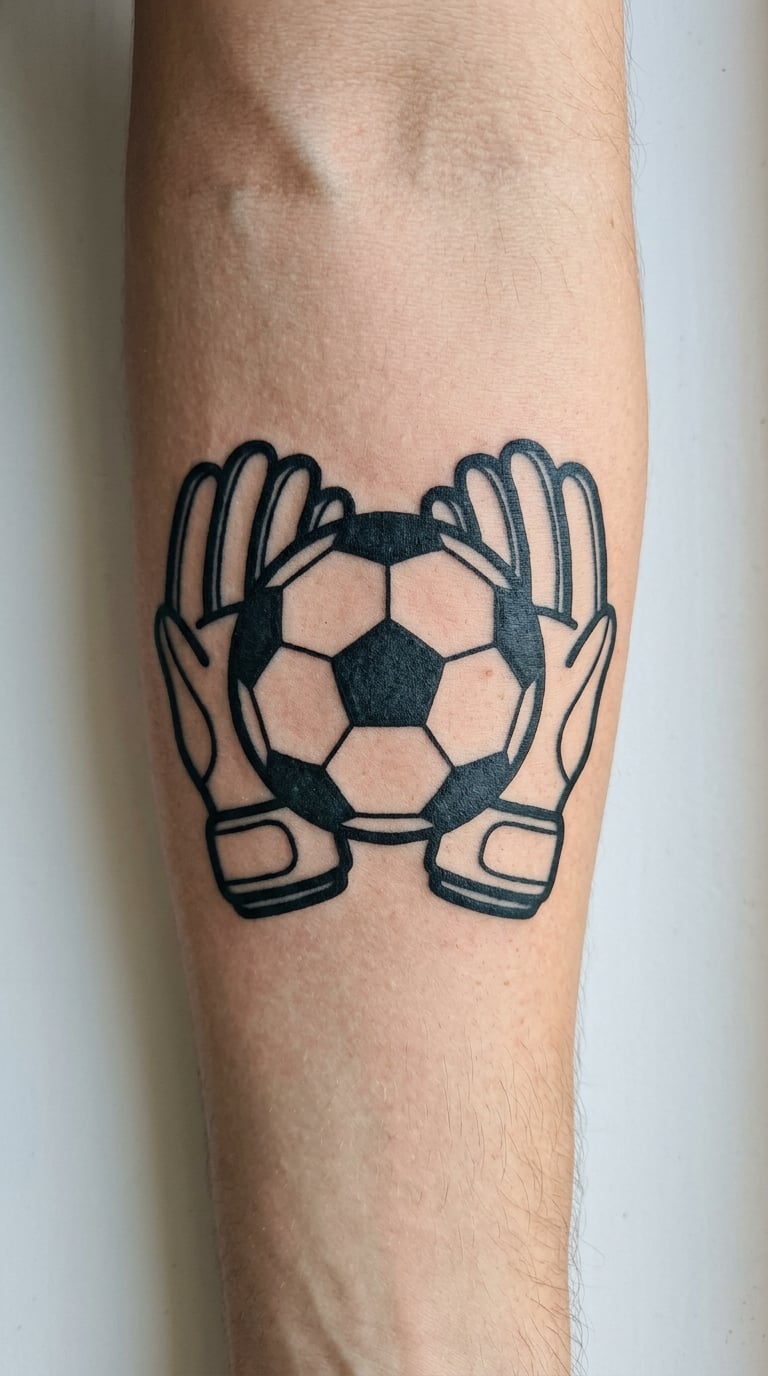
A ball sits between two gloves drawn with a few confident lines: curled fingers, a wide cuff, palm seams. The gloves stay plain, with no brand marks, no sponsor strips and no specific kit design.
It is a nod to the hardest job in football, chosen by keepers and by anyone who respects the position rather than the goalscorers.
Placement: outer forearm, gloves pointing down toward the wrist so the ball sits near the elbow. Size: 3.5 in (9 cm) across both gloves. Style: blackwork, illustrative.
Pain: medium, with brief stingier passes over the wrist bones as the artist shapes the cuffs. Interior glove detail is the first thing to blur, so keep the palm lines short.
Make it yours: have the artist leave one glove ungloved and bare, which adds an unexpected asymmetry to an otherwise symmetrical piece.
7. Minimal Football Icon
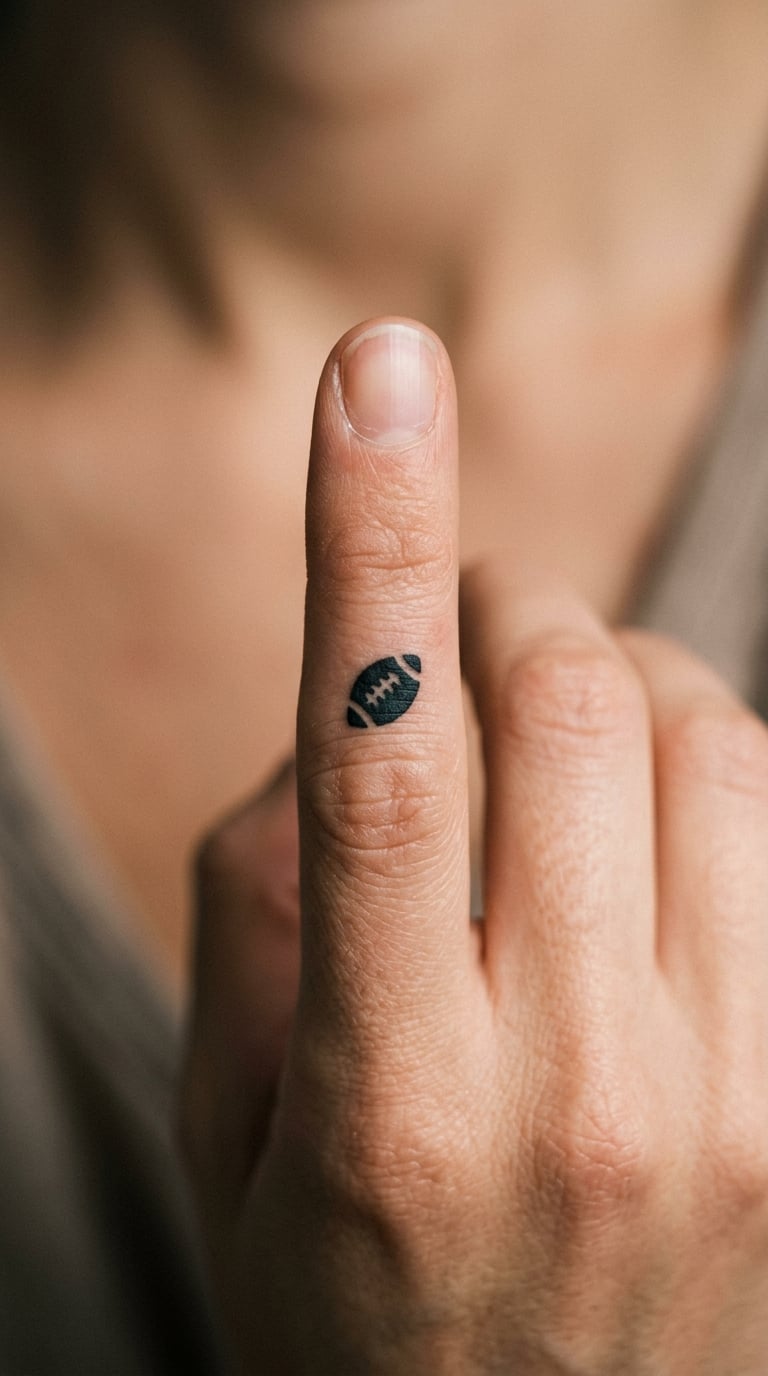
A single filled black circle with three or four thin cut lines for the panels. No shading, no outline, no background. At this size the whole design is about the decision to stop before the detail gets silly.
It is the discreet option, the one that only shows up when someone sits next to you or you take your shirt off. Plenty of committed fans have started exactly here.
Placement: side of a finger, or the inside of a wrist. Size: 0.6 to 0.75 in (1.5 to 2 cm). Style: minimalist.
Pain: high, and not because of the size. Fingers and knuckles have little soft tissue and no muscle to absorb the needle, so it stings the whole way through.
Make it yours: put your shirt number inside the ball, hidden in the negative space, and tell nobody about it.
8. Football with Laurel Leaves
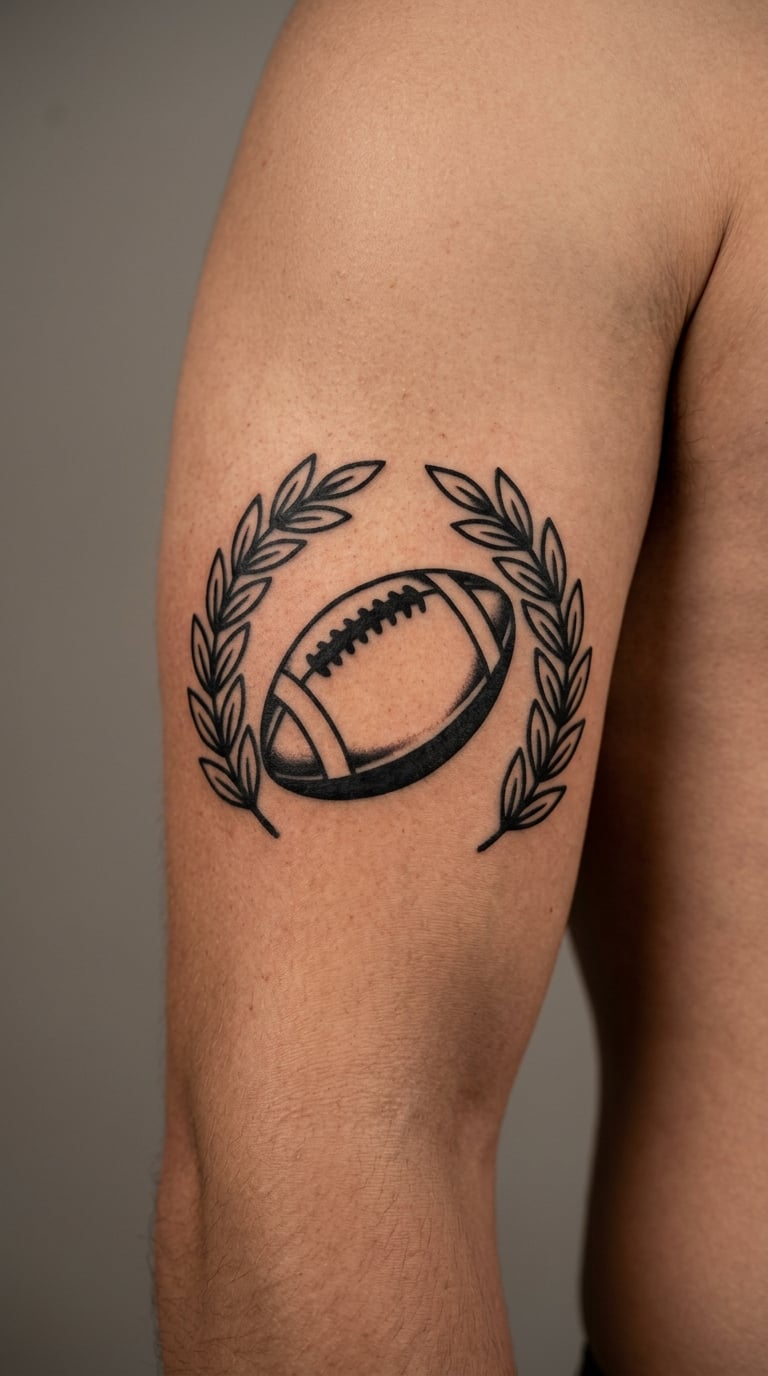
A solid black football anchors a pair of laurel branches that curve up and around it, each leaf drawn with a single interior vein. The composition is symmetrical and slightly arched, closer to a crest than a drawing, without a single letter or team name in it.
Laurel is associated with honour and victory, so fans usually pair it with a season or a competition they care about. It commemorates something rather than declaring allegiance.
Placement: upper arm or the flat of the chest, where the arch can sit level. Size: 4 in (10 cm) across the full composition. Style: traditional blackwork.
Pain: medium, longer in the session because of the leaf detail. Laurels sit well and hold their shape far better than fine line, so this one ages gracefully.
Make it yours: put the year of your first match or the season that mattered most inside the ball in negative space.
9. Number 10 Script Football
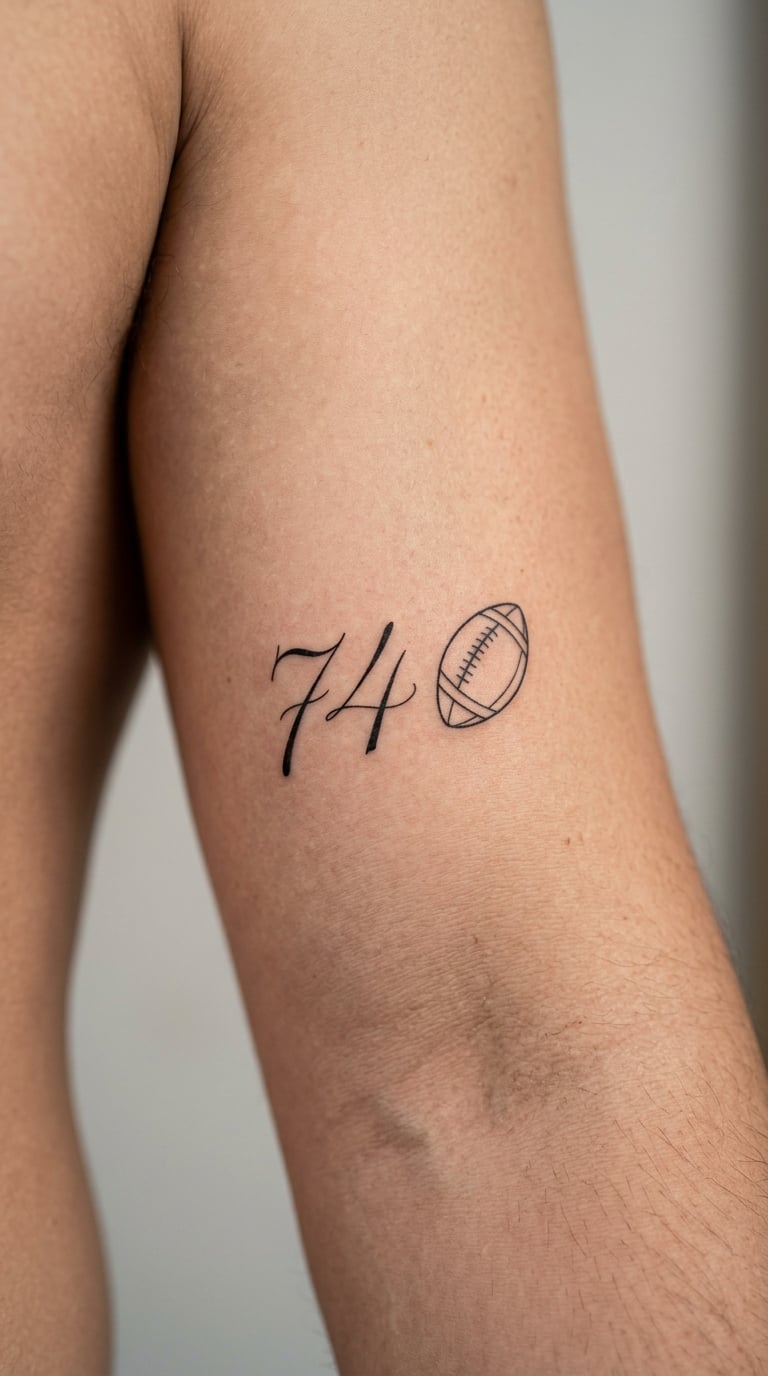
Two elegant numerals in flowing script, a hairline to a medium weight, sit beside a small outlined football. The numbers should be hand-drawn rather than typed, with slight variation in stroke so they look written rather than printed.
The tenth shirt is the classic creative number, so this one usually points to a playing position or to the number a fan actually wore. It avoids naming a player while still carrying the reference.
Placement: inner bicep, which keeps the script upright when the arm is down. Size: 2.5 to 3 in (6 to 7.5 cm) tall. Style: calligraphy and fine line.
Pain: medium, and script is harder to heal than solid black because thin strokes lose definition. Expect to need a touch-up in a year, and pick a font with thick downstrokes rather than hairlines everywhere.
Make it yours: have the numerals overlap the ball slightly, or swap the font for a hand-lettered version that matches the shape of your own handwriting.
10. Stadium Light Tattoo
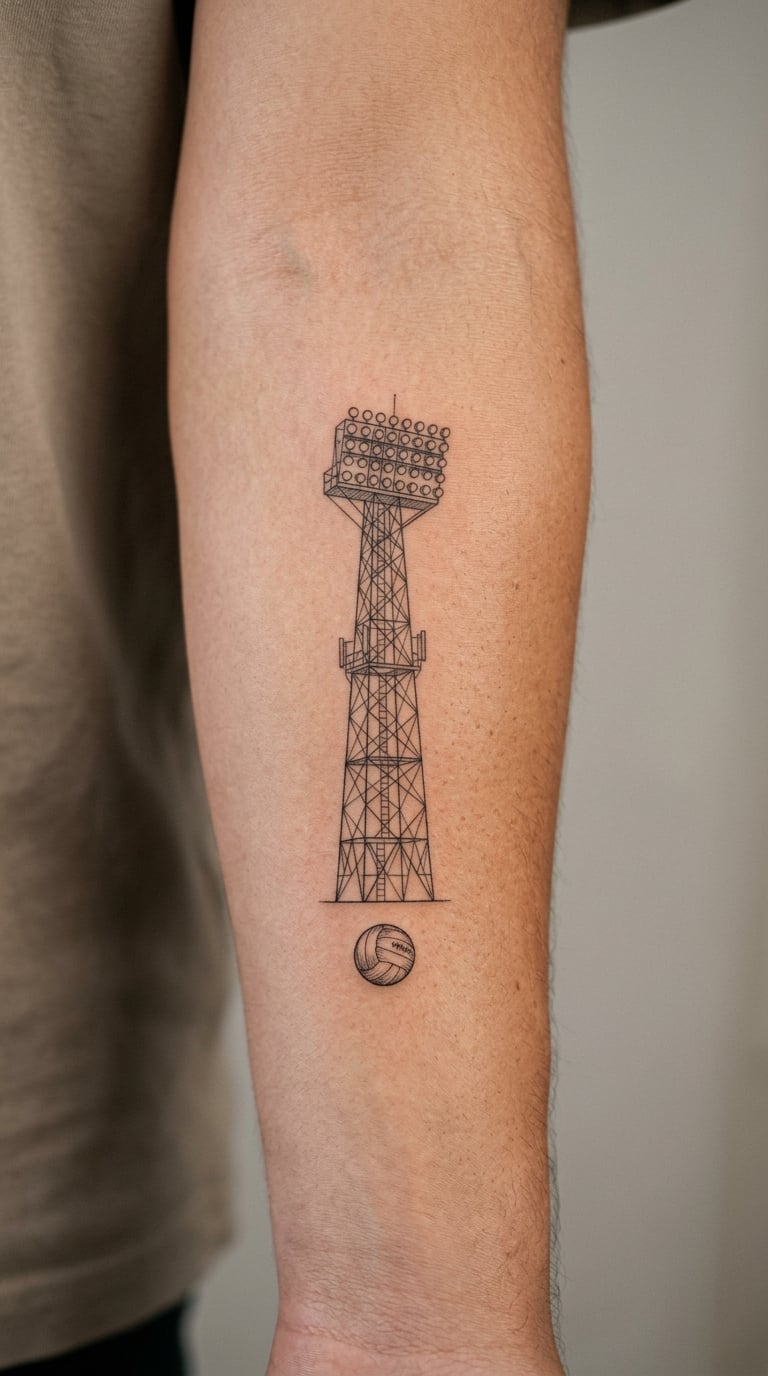
A floodlight pylon drawn in thin architectural lines, with the lamp array rendered as a grid of small squares, and a football resting at its base. It is a place rather than an object, which is the point of the design.
Supporters describe match day as the thing they miss most, and this is the design for people whose football memory is a stadium at night rather than a team they followed.
Placement: forearm, vertical, or the outer arm if you want it bigger. Size: 3.5 in (9 cm) tall including the ball. Style: fine line.
Pain: medium, and the lamp grid is the fiddly bit, so budget extra time for it. The grid squares fill in with ink over the years and start reading as a grey block, which is the main ageing note here.
Make it yours: add a single floodlight beam behind the pylon in pale grey, which gives the design depth without adding a single colour.
11. Football in Motion
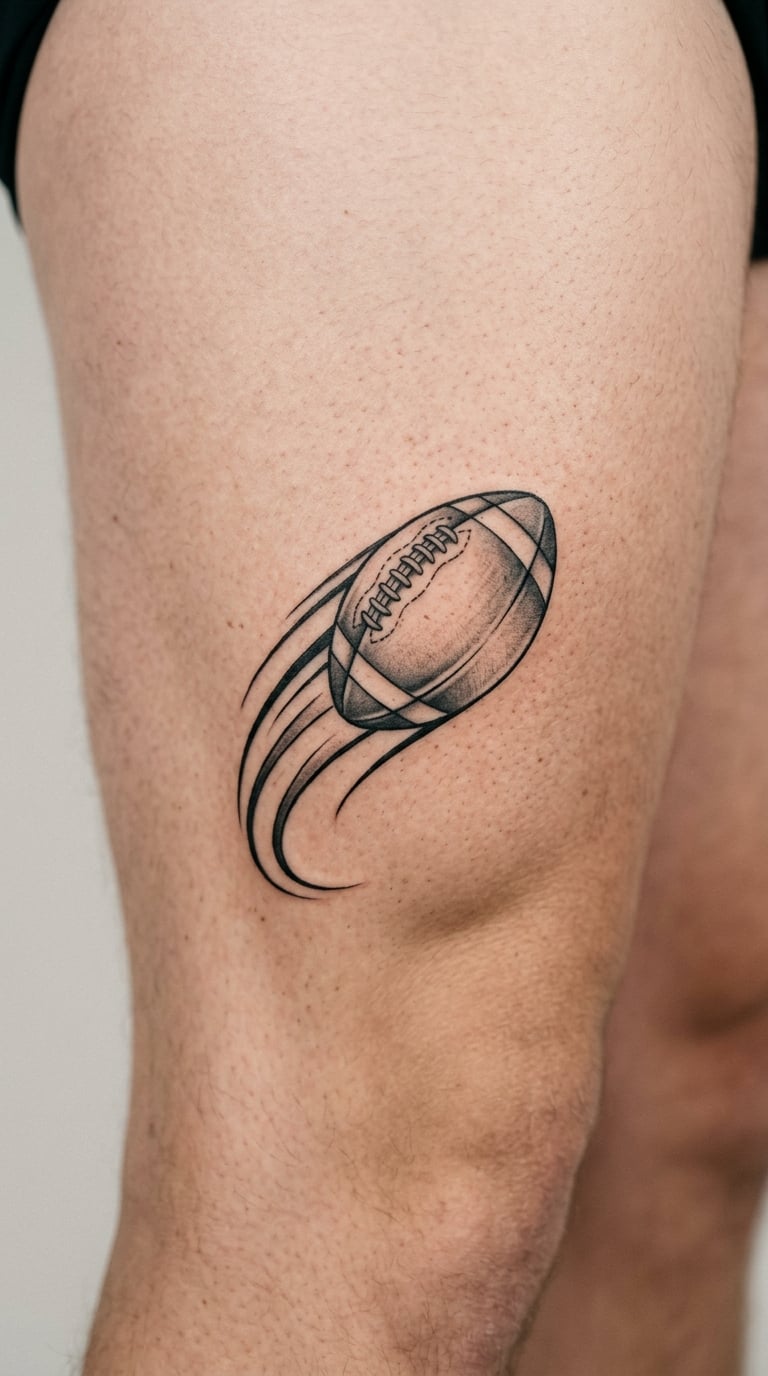
A ball shaded in black and grey with three curved lines sweeping away behind it and a soft cast shadow underneath. The motion lines are the whole trick, because they turn a static icon into a frame of action.
It usually goes in for the ninety minutes, the last-minute winner, the ball that flew. Fans who care about the game moving rather than the club they sit with pick this one.
Placement: outer thigh, where the taper of the leg gives the lines somewhere to run. Size: 2.5 in (6 cm) ball, 3.5 in (9 cm) with the trails. Style: blackwork with light grey shading.
Pain: medium, and the outer thigh is one of the more forgiving spots because there is muscle under the skin. The thigh does move a lot, so sit still for the shading pass or the lines will wobble.
Make it yours: have the trails fade out rather than end, so the ball looks like it is already leaving the frame.
12. Four-Leaf Clover Football
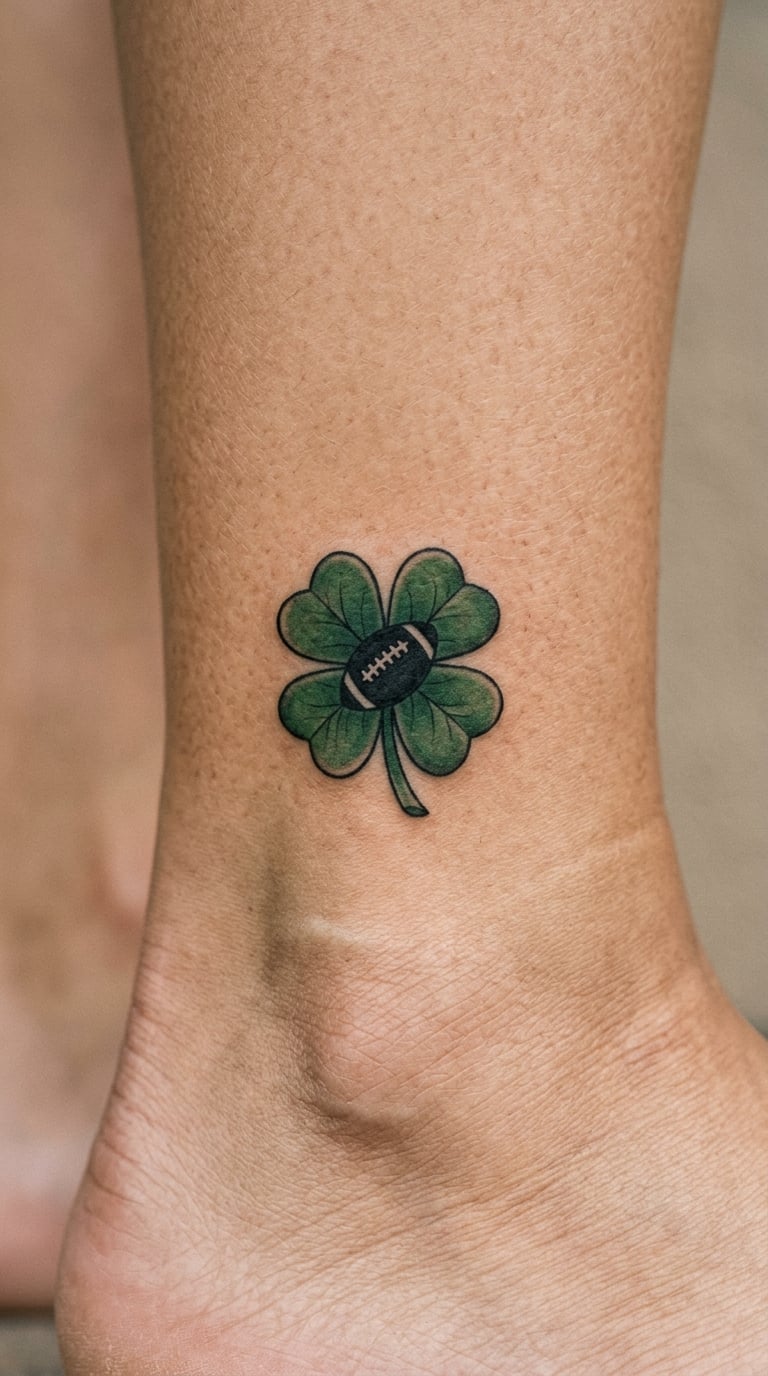
A small football resting in the middle of a four-leaf clover, with each leaf outlined in a single thin line and a short stem curving away. Simple, symmetrical, and much softer than most tattoo ideas for soccer fans.
People choose it for luck, and often tie it to a match-day ritual or a lucky shirt rather than a fixed piece of symbolism. Keep the meaning in your own head; the design does not claim one.
Placement: ankle, just above the bone, or the inner wrist. Size: 2 in (5 cm) across the clover. Style: fine line.
Pain: medium, with the ankle competing with the wrist for the title of most exposed bone. The clover is a common first tattoo for that reason, so ask for a stencil before anything else.
Make it yours: have one leaf left as an outline only, which quietly points to a fourth thing you are not explaining.
13. Football and Travel Coordinates
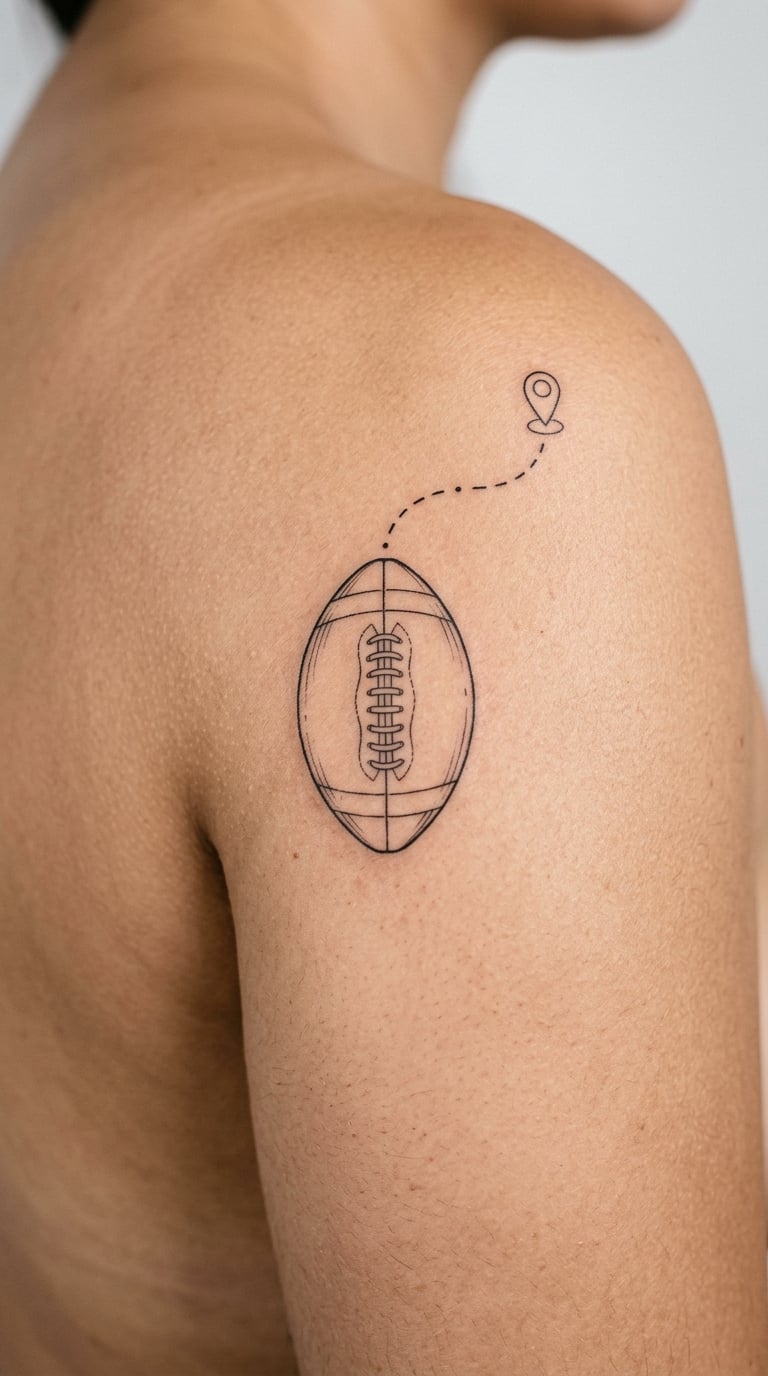
A fine-line ball paired with a small map pin, a dashed route line and a scatter of contour marks, laid out like a fragment of a map rather than a labelled document. The pin sits slightly off-centre, away from the ball, so the composition has direction.
It is for fans who connect the game to somewhere. A tournament travelled to, a club in a hometown that will never see a match, a stadium visited once and never forgotten.
Placement: shoulder or upper arm, where a wide flat surface suits map work. Size: 3.5 in (9 cm) across the layout. Style: fine line, cartographic.
Pain: medium to high, since the shoulder cap is bone over bone. The dashed line needs steady hands, so this is a design where artist choice matters more than the reference you bring.
Make it yours: use the real coordinates of your first match, and keep the numbers off the visible side of the arm so only you know.
14. Traditional Football with Banner
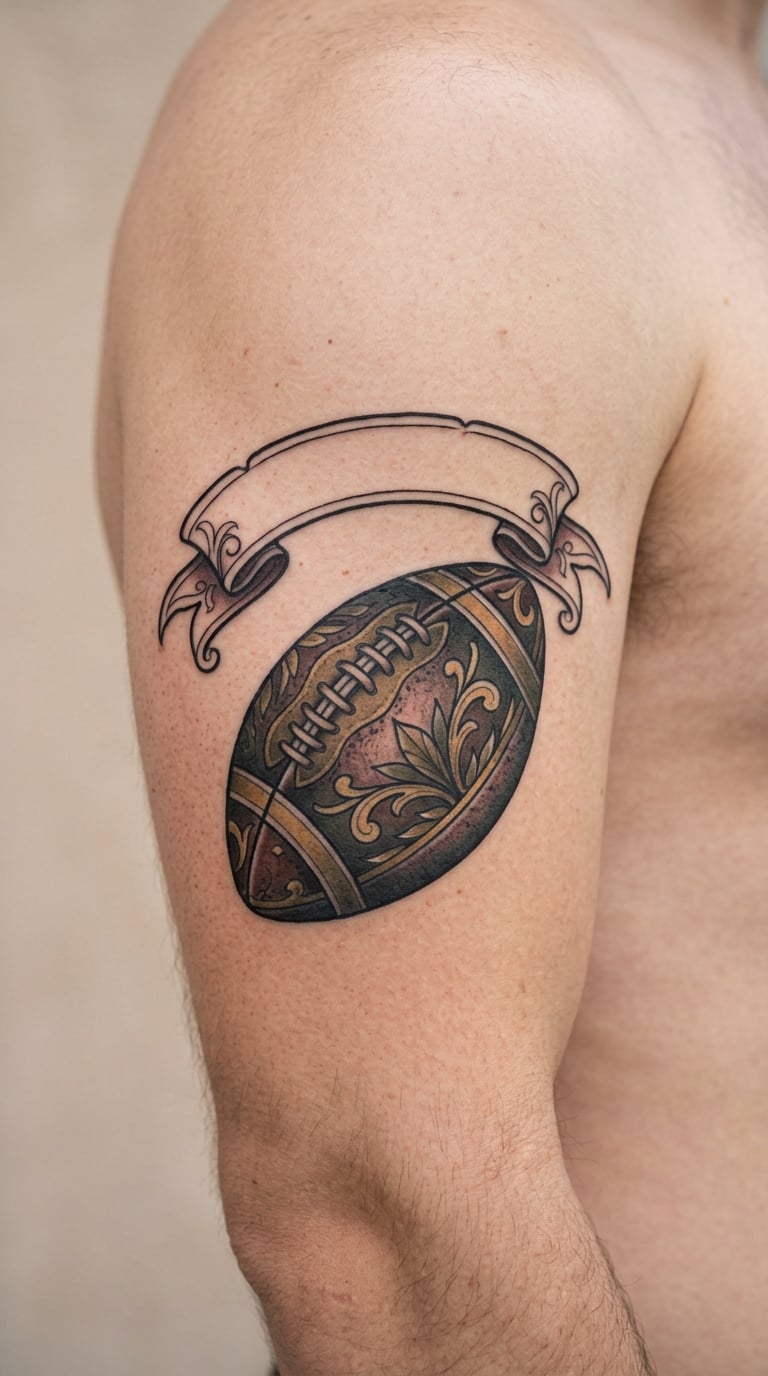
A neo-traditional ball with heavy black outlines, a limited grey wash and a curved banner ribbon arcing above it. The banner stays blank on the design, ready for lettering you add yourself, so nothing borrowed or copyrighted ends up on your skin.
It is the version for people who like big classic tattoo shapes and want a line of their own inside them. A date, a season, a short phrase in your own words.
Placement: upper arm or outer thigh, roomy enough for the banner to sit level. Size: 4 in (10 cm) across. Style: neo-traditional.
Pain: medium to high, and this is a long session because the shading and the banner lettering each need their own pass. Book it when you are not in a rush, and plan the lettering as a second sitting if the artist suggests it.
Make it yours: add a single muted colour to the ball only, so the banner lettering stays the sharpest thing in the design.
15. Abstract Football Sleeve Panel
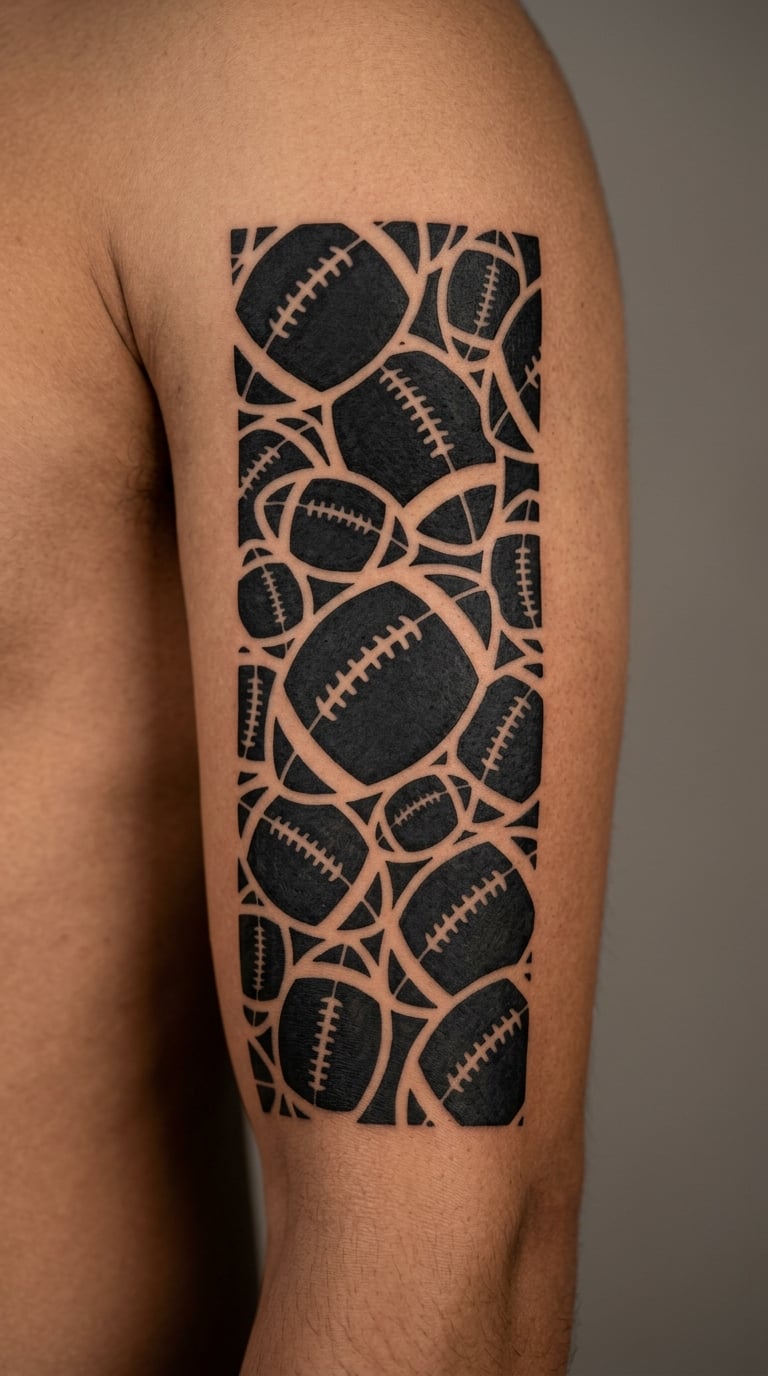
A repeating field of blackwork footballs at varied scale, some solid, some reduced to a circle with a few panel lines, spaced so the gaps form visible negative shapes. It is planned as one panel of a larger arm or leg composition, not a standalone piece.
This is a commitment design. People choose it when football is the main thing they tattoo, and the pattern gives room to add other motifs later without the sleeve looking finished.
Placement: outer arm, from the elbow to mid-bicep, as a single panel you can extend later. Size: 5 in (13 cm) wide panel at minimum. Style: blackwork pattern.
Pain: high, and a long one, because a pattern this dense is several hours of work. It is the most expensive option on this list, so treat it as the start of a project and book a consultation first.
Make it yours: vary the scale deliberately, big balls near the shoulder narrowing toward the elbow, so the pattern has a direction instead of repeating flat.
16. Football and Whistle
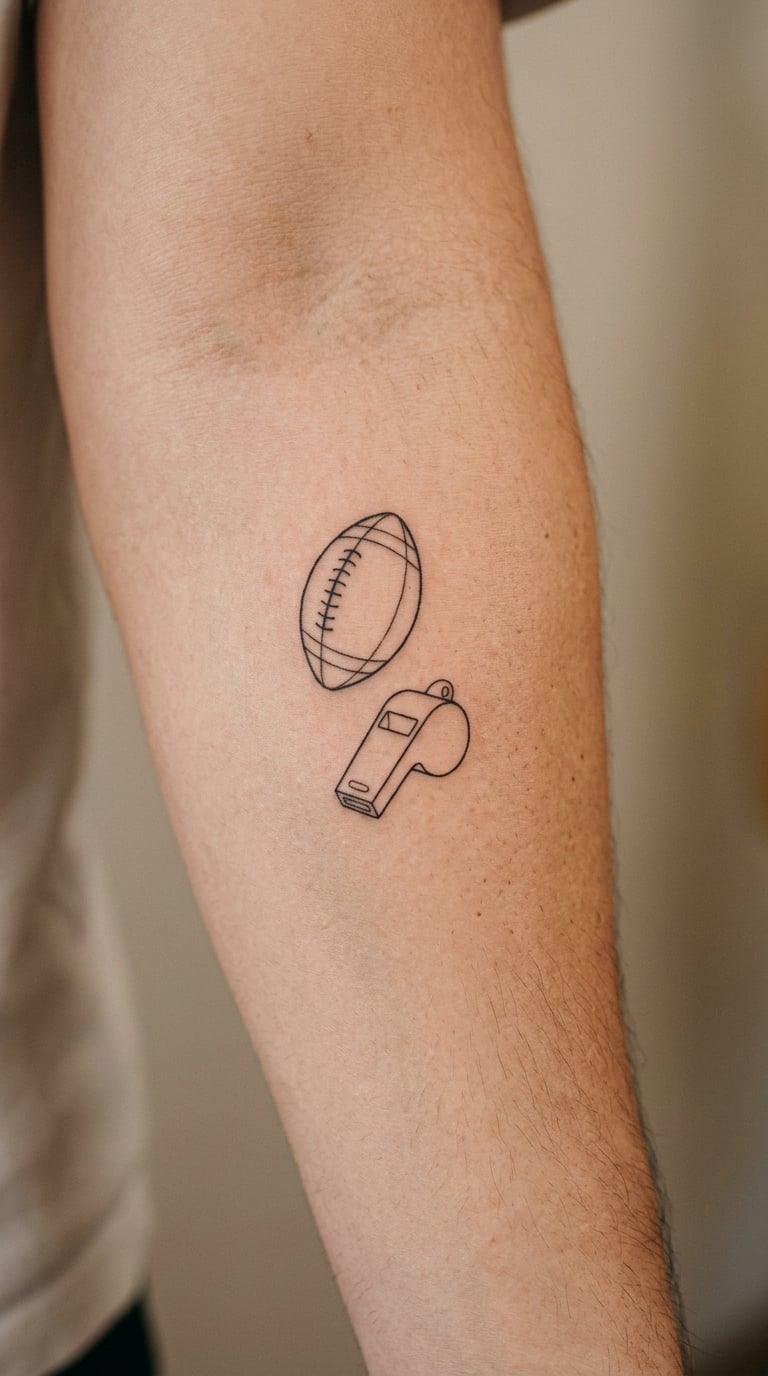
A clean outlined football next to a small referee whistle, both in the same fine line, with the lanyard loop left open. Two objects, nothing else, which keeps the design readable at a small size.
It is a broader reference to the game than a ball on its own, and it tends to go to people who think about the whole ninety minutes rather than one team.
Placement: outer forearm, with the whistle sitting lower than the ball. Size: 3 in (7.5 cm) across both. Style: fine line.
Pain: medium, though the wrist end of the forearm stings more where the bone comes up. The lanyard loop is the detail that softens first, so keep it open rather than detailed.
Make it yours: have the artist leave the whistle without a lanyard, which reads as a quiet nod to the referee rather than a piece of equipment.
17. Blackwork Football with Tifo Banners
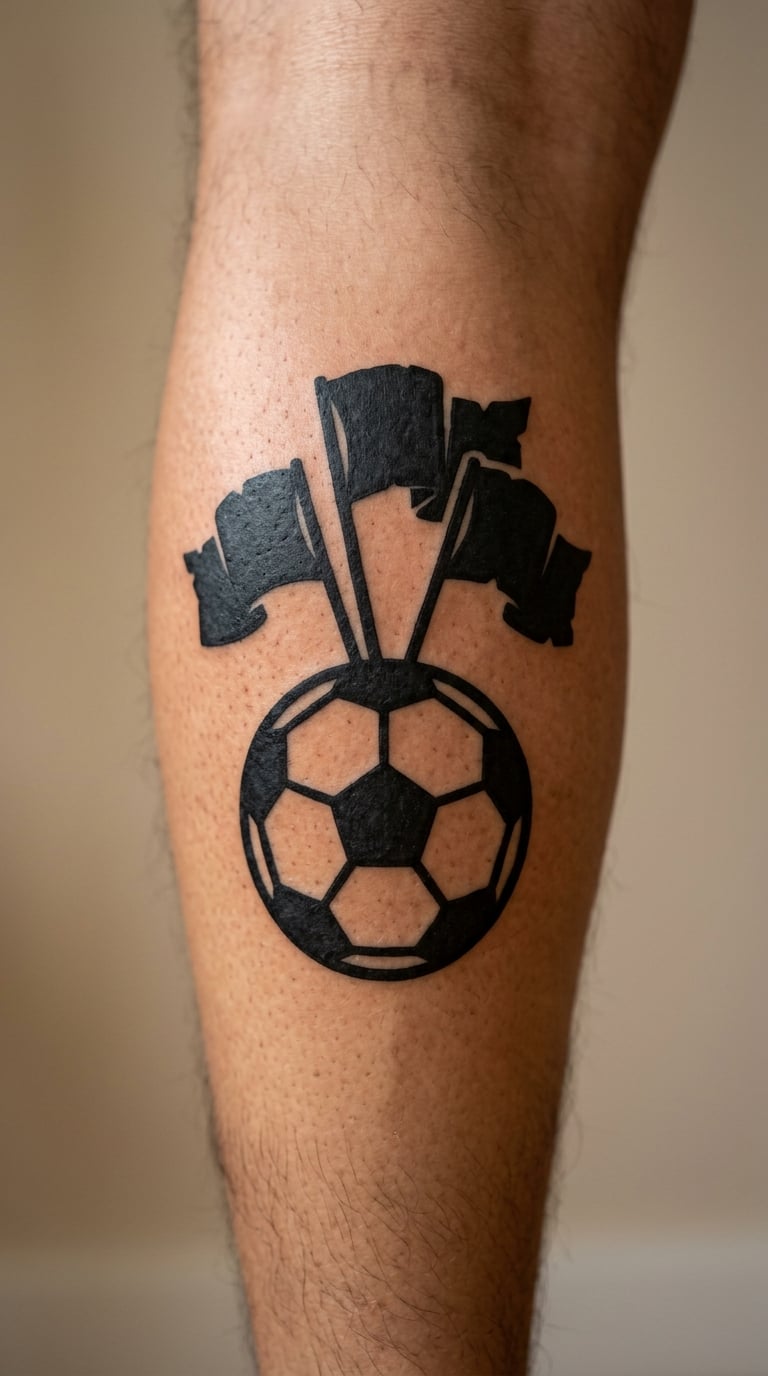
A heavy black football with three abstract banner shapes rising behind it, filled in solid, their lower edges ragged like fabric in the air. No colours, no crests, no lettering, no copied supporter artwork. Just the idea of a stand full of people.
Tifos are the part of the match that belongs to the supporters rather than the players, so this is the fan-first option in a list full of ball designs. It answers the people who think a plain ball is dull.
Placement: calf or upper arm, wherever the banners have vertical room to rise. Size: 4 in (10 cm) tall. Style: solid blackwork.
Pain: medium, and the calf is comfortable because there is muscle under the skin. Solid black is quick to lay down and easy to retouch later, which is why it holds up better than fine detail.
Make it yours: have the banners arranged at different heights so the silhouette is uneven, the way a real stand looks rather than a neat icon.
18. Micro-Realism Football Boot
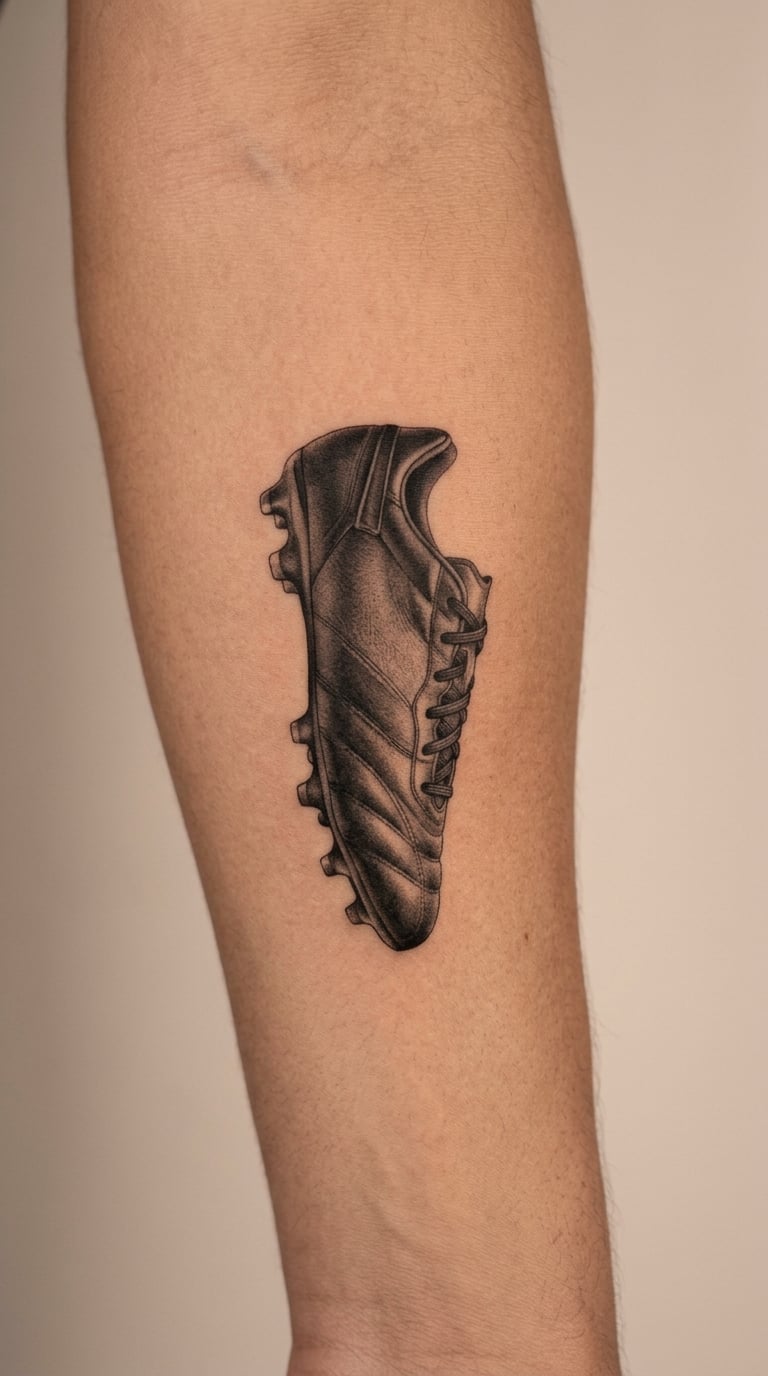
A small, believable football boot, laces crossed properly and studs shaped, shaded so the leather looks like leather. There are no brand markings anywhere on it, which keeps the design original and lets the artist focus on form.
It is the equipment-focused option, and people who grew up on the boot rather than the shirt tend to choose it. The detail is the point, so it needs an artist who does small realism work.
Placement: inner forearm, where a boot can sit lengthwise along the bone. Size: 2.5 in (6 cm) long. Style: micro-realism.
Pain: medium, and the forearm is comfortable, but micro-realism is slow and the shading takes patience. Lace crossings blur with time, so expect a refresh of the lacework after a few years.
Make it yours: have the boot modelled on a well-worn pair rather than a new one, with slight creasing across the toe box that most ball tattoos ignore.
19. Football with Player Silhouette
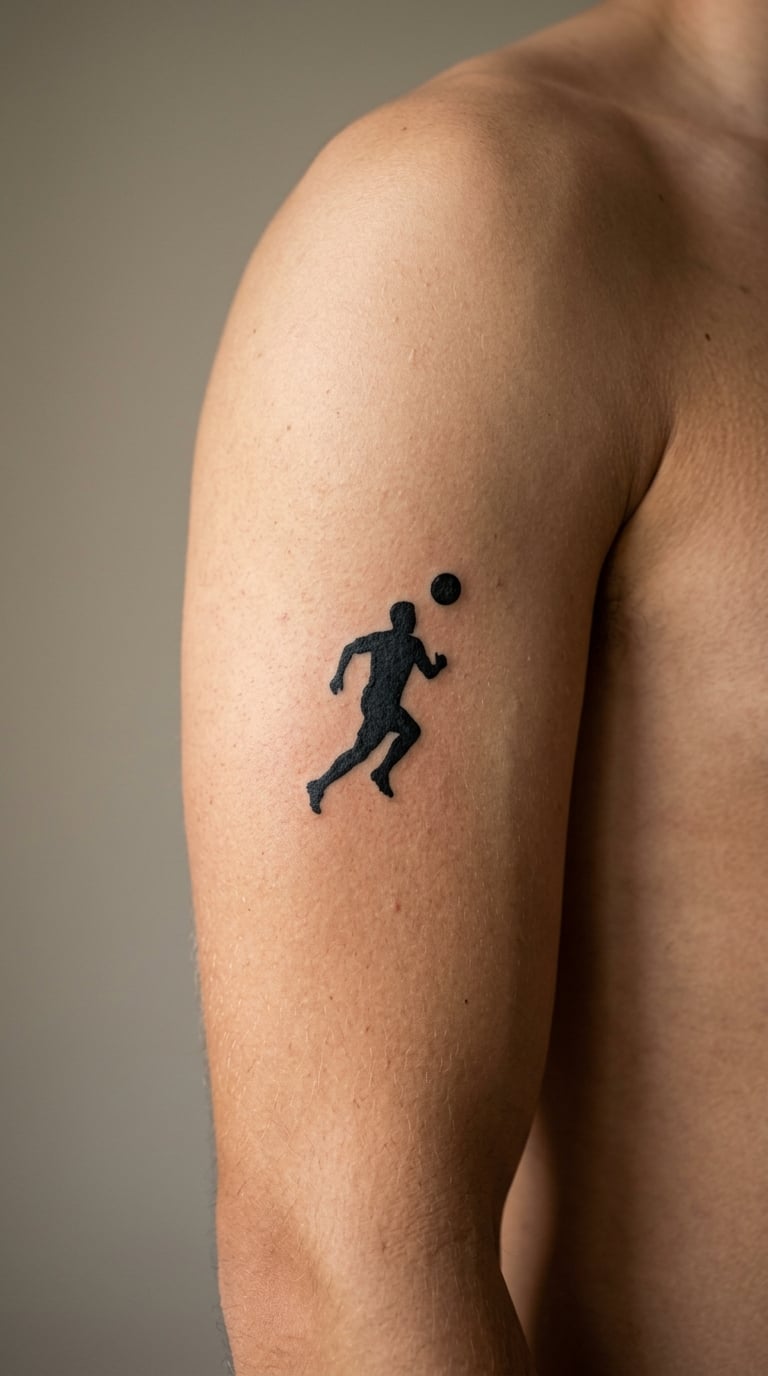
A solid black figure mid-stride, seen from behind or in three-quarter view so the face is not there, with a ball above or beside them. No face, no kit numbers, no badge, no likeness of any real player. The silhouette does all the work.
It is about the action and the emotion rather than a person, which is why it stays comfortable for fans whose heroes change every few years. Nobody can date it to one player.
Placement: upper arm, with the football at the top so the eye moves downward. Size: 4 in (10 cm) tall. Style: blackwork silhouette.
Pain: medium, and the inner arm near the elbow is tender, so ask for breaks. Solid shapes heal reliably, though the ball above the figure will soften slightly as the years go.
Make it yours: have the figure kicking rather than running, and keep the ball at head height as though it is about to be struck.
20. Watercolour Football Trophy
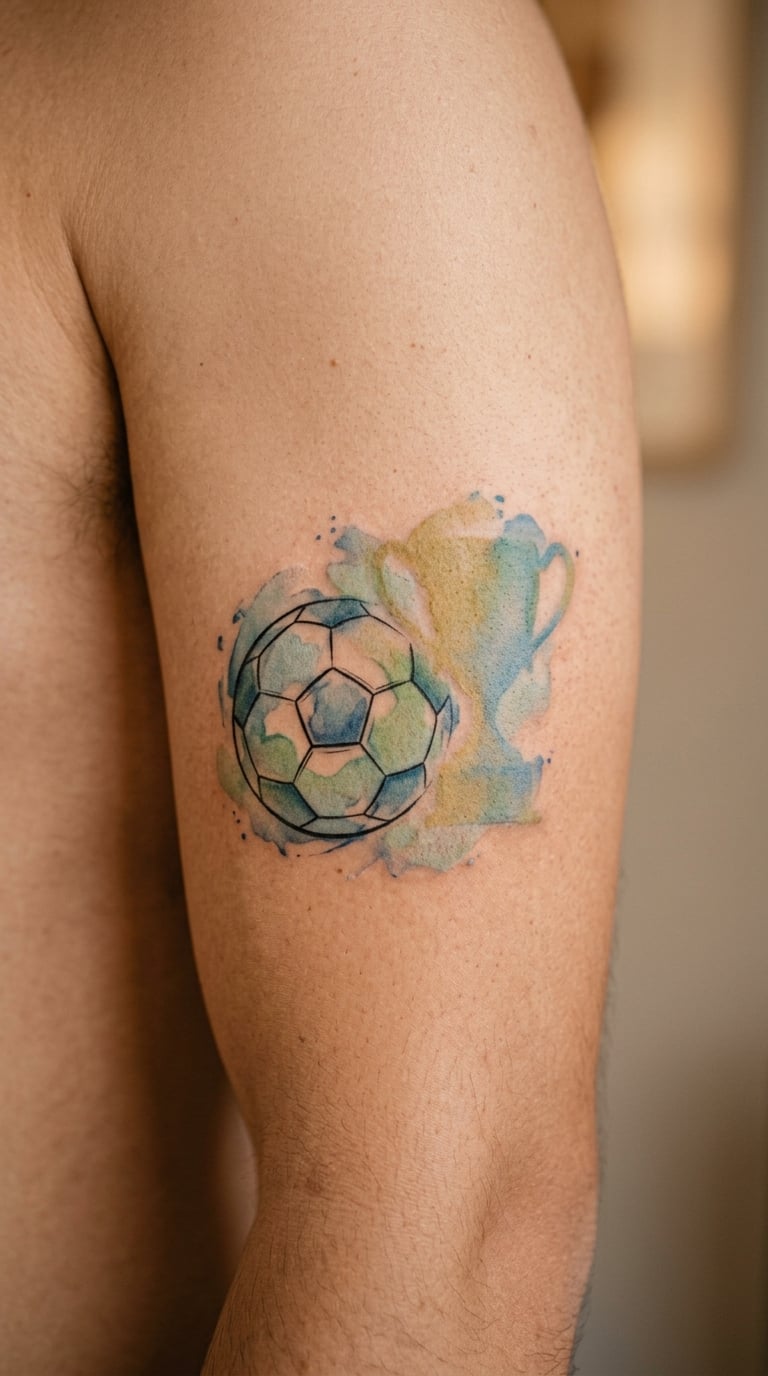
A football and a plain trophy cup in soft washes of muted green, gold and blue, the colour bleeding past the outlines in the watercolour way. The trophy is drawn as a simple silhouette with two handles and a base, nothing engraved on it.
It suits a fan marking a competition win, a season, or something personal they finished. The trophy is generic on purpose, so it can stand for any achievement you want.
Placement: upper arm or the flat of the outer chest. Size: 4 in (10 cm) across both shapes. Style: watercolour.
Pain: medium, and colour is quick work compared with the outline. Watercolour is the least permanent style here: the washes lighten and the edges soften, and a colour refresh is normal after several years.
Make it yours: tint the trophy in the colours of a team you support without ever using its badge or name, so the reference is yours alone.
How to Choose the Right Design
Most people choose a tattoo idea for soccer fans in the wrong order: they fall for an image, then look for somewhere to put it. Flip that. Decide the body part and the size first, and pick a motif that will read at that scale. A four-leaf clover football at 2 inches looks considered. The same clover at half an inch looks like a smudge.
How small is small for tattoo ideas for soccer fans?
Under 1 inch, and the answer is a solid silhouette or a single number, because anything with panel lines or stitching stops being legible. Between 1 and 2 inches you can have a full ball with clean panels. Above 3 inches you gain room for secondary elements like nets, laurel branches or a second object, and detail stops being a liability.
Match the design to the body part
The inner forearm is the flattest canvas most people have and it reads well from both sides. The outer upper arm gives you a large round surface for a ball. The calf takes tall vertical designs such as floodlights or banner compositions. The finger takes almost nothing, and the ribs and the side of the foot are the two placements that age badly because the skin there stretches.
Think about what you will still like in ten years
A team crest is the one design in this whole topic with a real expiry date on it. Allegiances change, players retire, clubs get relegated, and a crest you loved at nineteen can be awkward at forty. A ball, a number, a position, a floodlight or a goal net carries no such risk. If you are under twenty-five and thinking hard about a badge, come back to it in a year before booking.
Decide how much detail and colour you can live with
Fine line and watercolour both need a touch-up over the years, and the second costs money every time. Solid blackwork and traditional styles hold their shape with far less maintenance. If you would rather not chase a fading tattoo, ask for solid fills and heavier line weight from the start.
Check what is already on your body
Before you commit, look at the neighbours. A 2-inch ball next to a dense 6-inch sleeve piece looks lost, and it will look worse in five years as the sleeve fills in. Bring photos of the whole area to the consultation so the artist can judge scale against what is already there.
Cost and Session Time
Tattoo prices in the US mostly follow size and hourly rate, and shops bill by the hour with a minimum, so a small piece and a very cheap one can cost nearly the same. A simple ball around 2 inches is usually a short job of an hour or so, in the region of a hundred to two hundred dollars at many shops. A 3 to 4 inch design with shading, banner lettering or a second element commonly runs two to four hundred dollars and takes two to three hours.
Watercolour and fine-line work take longer than their size suggests, because colour washes and single-line detailing are slow. Micro-realism is the slowest per inch on this list, and a single 2.5 inch boot can take as long as a much larger blackwork design. Large panels and any sleeve work are quoted as multi-session projects, and the total is where the four-figure numbers come from.
Rates vary enormously by city, by shop and by artist, and the tattooer you want may be booked months ahead. Use the consultation to get a real quote rather than a website range, ask whether the shop has a minimum charge, and confirm what a touch-up within the first year is included in.
Aftercare Basics
Follow your artist’s aftercare instructions first. They know exactly what they did in your skin, and this list is a general companion, not a replacement for that conversation.
- Wash the area gently with lukewarm water and unscented soap for the first few days, then pat it dry with a clean hand or paper towel rather than a rough towel.
- Keep it covered with a clean, non-stick dressing while you sleep or for the first day or two, and change the dressing if it gets damp or dirty.
- Wear loose clothing over the tattoo for the first week. Tight waistbands, boot tops, hat bands and sleeve cuffs rubbing on fresh ink are the fastest route to a blown-out patch.
- Keep it out of direct sun, and do not soak it in pools, hot tubs or the sea while it is still healing. Sunscreen on healed work matters just as much for keeping the colour.
- Do not pick, itch, scrub or peel the flaking skin. It will come off on its own, and pulling it is how people end up with patchy linework.
- Contact your artist, and then your doctor, if you see spreading redness, swelling, heat, pus or pain that is getting worse instead of settling. Mild redness, itching and a warm feeling in the first few days are normal.
Frequently Asked Questions
What size should a first soccer fan tattoo be?
For a first tattoo, stay between 1 and 2.5 inches and keep it to one motif with no internal shading. That range is large enough to read clearly from a few feet away but small enough to finish in a single short session, which is a good first experience. Avoid anything with laces, stitching or tiny panel details at that size, because the detail will not hold.
Is it a bad idea to tattoo my club crest?
It is a real commitment. Club crests are protected artwork, so an artist will usually offer an original shield or monogram rather than a copy, and some shops decline crest work entirely. More practically, a crest ties the design to one team at one moment in time, and many supporters change clubs or lose interest over the years. If you are under twenty-five, consider a ball, a number or a goal net instead.
Do soccer tattoos fade faster than other tattoos?
It depends entirely on the style, not the subject. Fine line and watercolour designs fade and soften noticeably within a few years, especially on the inner forearm, the fingers and the wrist where skin moves constantly. Solid blackwork and traditional styles hold their edges far longer because there is more pigment in the skin. Sun exposure speeds all of it up, so covering new work and protecting it once healed makes a real difference.
Which placement hurts least for a football tattoo?
The outer upper arm, outer thigh and calf are the three easiest places, because there is muscle between the skin and the bone to cushion the needle. The inner forearm is manageable but sensitive. The ribs, the spine, the inner arm near the elbow, the wrist and the fingers are the placements fans mention most often as the worst, and the side of the foot is uncomfortable for a different reason, since the skin there is thin and very mobile.
How do I describe a soccer tattoo to an artist?
Bring three to five reference images you actually like, and mark what you want from each one, such as the shading, the line weight or the composition. Say the finished size in inches and the exact body part, then ask the artist to draw a stencil at that size on your skin before anything is tattooed. A good artist will redraw the idea in their own style rather than copying a reference exactly, and that redrawn version is the one that will suit your body.
Can a soccer fan tattoo work without being about a team?
Most of the tattoo ideas for soccer fans here do exactly that. A ball entering a net, a floodlight pylon, goalkeeper gloves, a whistle, a referee silhouette and a trophy are all about the sport rather than a club, and they are easier to live with for the reason that they cannot go out of date. Fans who add a shirt number, a position or a year are personalising them without borrowing anybody’s identity.
Where to Start With Your Soccer Tattoo
If this is your first tattoo, start with idea 1, the fine-line football and net, or idea 7, the minimal icon. Both are small, both are quick, and neither locks you to a team you might stop following. Book a stencil first and let the artist adjust the size on the day.
If you already have ink and you are adding to a collection, ideas 8, 15 and 17 have the least trouble sitting alongside existing work, because the solid black holds its weight next to almost anything. Bring photos of the whole area to the consultation, because a design that photographs well can still be the wrong scale for your body.
Whatever you pick, make sure someone can explain what it means, including you. That is the standard the good soccer tattoos have always met, and it is the reason the interesting ones outlive the rest.