
Tattoo Blowout vs Bruising: How to Tell (October 2026)
A tattoo blowout is permanent ink that has spread under the skin into a soft, blurry shadow around the lines. A tattoo bruise is a temporary pool of blood under the skin from the needle, and it fades on its own in about a week. That is the whole game in one sentence: one heals, the other does not.
If your new ink looks hazy, discolored, or tender and you are trying to figure out which one you are seeing, this guide walks you through the differences side by side. You will get a quick check you can do tonight, a week-by-week timeline, and the calls you should make when something looks off.
What Is the Difference Between Tattoo Blowout and Bruising?
Tattoo blowout and bruising are two completely different things that can show up in the same first week. A blowout is the tattoo itself going wrong: ink gets pushed past the dermis into the fatty layer below, where it spreads out as a soft blue-gray halo around the line. A bruise has nothing to do with the ink. It is blood that has leaked from tiny capillaries damaged by the needle and pooled under the skin.
The reason people confuse them is timing. Both can appear within the first few days, both can make the area look cloudy, and both happen more on thin or bony skin. The simplest rule: if the color changes and fades, it is a bruise. If the lines themselves look fuzzy and stay fuzzy after a week, it is a blowout.
What Tattoo Bruising Looks and Feels Like
Bruising around a fresh tattoo looks like the kind of bruise you would get from bumping your shin on a coffee table. The skin can turn pink, red, purple, deep blue, green, or yellow as the days pass, and the area often feels tender or a little sore when you press on it.
It usually shows up in the first day or two and is gone within 3 to 7 days for most people. You will see it most on bony spots with thin skin over them, like the wrist, ankle, ribs, inner biceps, and spine. The cause is straightforward: the needle is puncturing skin thousands of times per minute, and a few small blood vessels under the surface get nicked in the process.
Some things make bruising more likely, even with a gentle artist. Taking ibuprofen, aspirin, or any blood thinner before your session will leave you bruising more than your neighbor in the chair. Alcohol the night before, fish oil supplements, and even a heavy workout right before the appointment can do the same. None of that is a sign the artist did anything wrong.
What Tattoo Blowout Looks and Feels Like
A blowout looks like the tattoo line has a soft, blurry edge that fades into the surrounding skin. You might see a faint blue-gray shadow around a black line, or a hazy color bloom around a shaded area, almost as if someone smudged the design with a finger before it dried.
It usually shows up within the first few days and does not go away. Where a bruise changes color and disappears, a blowout stays the same shade and gets slightly more visible as the tattoo heals and the swelling goes down. You will see it most on thin skin that does not give the needle much depth to work with: the wrist, fingers, ankles, ribs, inner arm, and around the collarbone.
The cause is mechanical. The needle went too deep, at the wrong angle, or the same area was worked over too many times. Ink that should have stayed in the dermis slips into the fatty hypodermis below, and because that layer is loose, the pigment spreads sideways instead of holding its shape. That is why a blowout looks like a halo rather than a sharp line.
Side-by-Side Comparison: Blowout vs Bruising
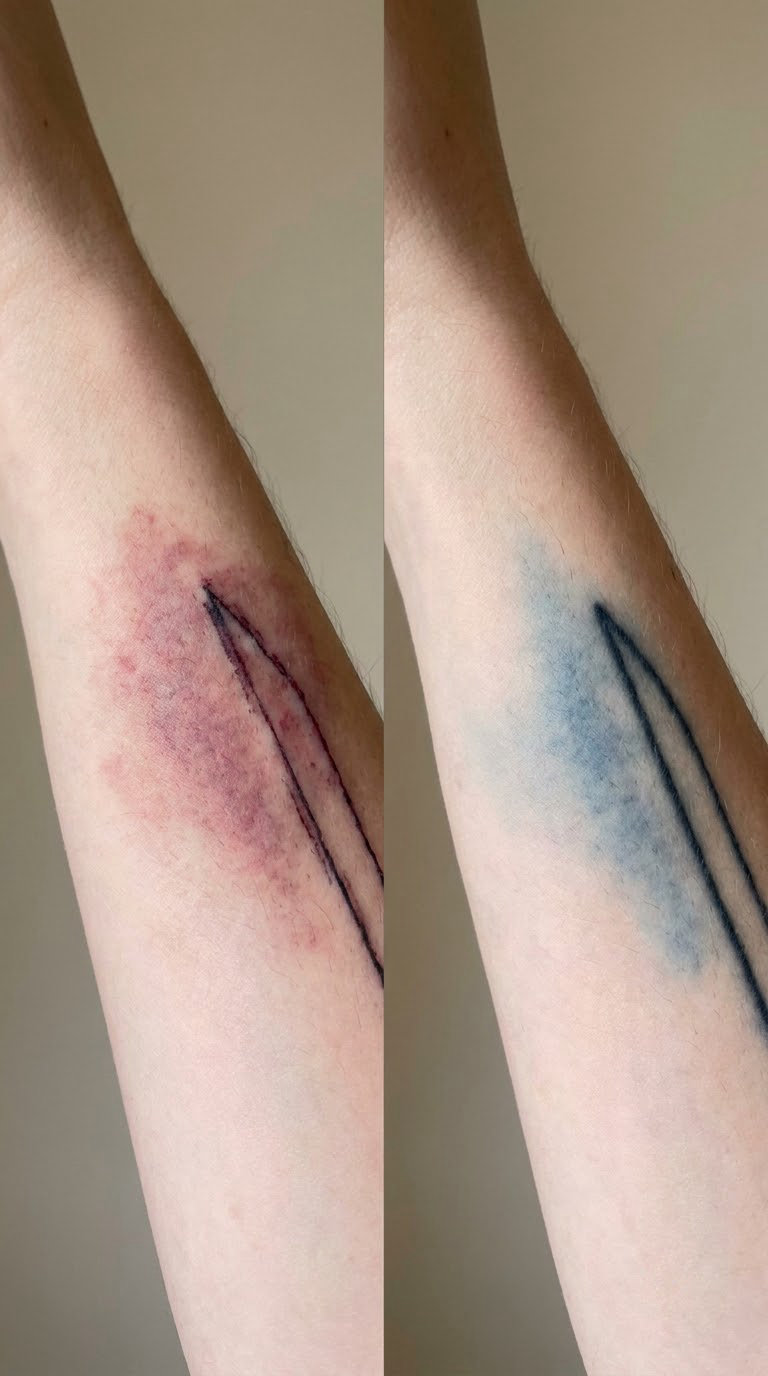
The table below lines up the two side by side so you can match what you are seeing to the right column at a glance.
| Feature | Tattoo Bruising | Tattoo Blowout |
|---|---|---|
| What it is | Blood pooled under the skin | Ink spread into deeper fat layer |
| Color | Pink, red, purple, blue, green, yellow as it fades | Soft blue-gray or colored halo around the line |
| When it appears | First 1 to 2 days | First 1 to 3 days, sometimes later |
| Does it fade | Yes, in 3 to 7 days | No, it stays or becomes more visible |
| Pain or tenderness | Often tender when pressed | Usually not painful once the tattoo is done |
| Lines look | Sharp under the discoloration | Fuzzy, blurred, or shadowed |
| Common placements | Wrist, ribs, inner bicep, spine, ankle | Wrist, fingers, ankles, ribs, collarbone |
| What to do | Follow aftercare, give it a week | Wait 6 to 8 weeks, then talk to your artist |
Where Each One Is Most Common
Bruising and blowouts show up on similar body parts for the same underlying reason: thin skin over bone. The wrist, ankle, ribs, inner biceps, and the area around the collarbone do not have much fat or muscle between the skin and the bone, so the needle works close to the surface. That means more capillary damage and a higher chance of the needle slipping past the dermis.
Fingers and hands bruise easily and are also the most blowout-prone spots on the body, even with experienced artists. Spine, hip, and sternum tattoos bruise more than you would expect, especially if you were lying down for a long session. Spots with more padding, like the outer thigh, upper arm, shoulder, and calf, bruise less and blow out less because the skin is thicker and gives the needle more room.
If you are booking a new tattoo and you are worried about either outcome, choosing a meatier placement is one of the simplest things you can do. It is not a guarantee, but it tilts the odds in your favor.
How to Tell Which One You Have: A Quick Check
Use this quick check the next time you are staring at your fresh tattoo under bathroom light. It takes about 30 seconds and will tell you most of what you need to know.
- Look at the color. If the mark is shifting through pink, purple, blue, or green tones, it is a bruise. If the color is a soft blue-gray that matches the tattoo ink and sits right against the line, it is more likely a blowout.
- Press gently with a clean finger. A bruise will blanch briefly and return to its color. A blowout will not change because it is pigment, not pooled blood.
- Wait 5 to 7 days. Bruises fade to yellow and disappear. Blowouts stay put or become more obvious as the swelling goes down.
- Look at the line itself. Use your phone flashlight at an angle. If the tattoo line is sharp and the haze is sitting outside it, that is a bruise. If the line itself is fuzzy and the edges are soft, that is a blowout.
- Compare both sides. If only one side of a symmetrical tattoo looks hazy, that often points to a blowout where the artist hit a different skin depth on each side.
The clear rule: fuzzy ink after a full week is a blowout, not a bruise.
Healing Timeline: What Happens Week by Week
The week-by-week view below shows you what to expect from a normal bruise, and what a developing blowout looks like in the same window. Use it as a checklist against your own tattoo.
| Phase | What a Bruise Does | What a Blowout Does |
|---|---|---|
| Days 1 to 3 | Appears pink, red, or deep purple, tender to the touch | Soft halo becomes visible around one or more lines |
| Days 4 to 7 | Shifts to blue, then green, then yellow as it fades | Lines still look fuzzy, halo the same color and size |
| Week 2 | Mostly gone, faint yellow patch may linger | No change in the blurred area, may look more obvious |
| Week 3 | Gone, normal tattoo healing continues | Stable. The blowout is now what the tattoo will look like |
| Week 4 and beyond | No trace left, tattoo continues to settle | Permanent unless you choose a touch-up, cover-up, or laser |
If your mark is following the bruise column, you are in the clear. If it is following the blowout column, give it one more week and then start the conversation with your artist.
What Causes a Blowout vs What Causes Bruising
Bruising and blowouts have different root causes, and the difference matters for what you do next. Bruising is about the skin under the tattoo. Blowouts are about the tattoo itself.
Bruising happens because of capillary trauma. The needle nicks small blood vessels under the skin, blood pools, and you get a colored mark. Things that thin the blood or make capillaries more fragile make bruising worse: ibuprofen, aspirin, prescription blood thinners, fish oil, vitamin E supplements, alcohol in the 24 hours before or after, and even a hard workout right before the session. Bony or thin-skin areas bruise more because there is less padding to absorb the needle pressure.
Blowouts happen because of needle mechanics. The needle goes too deep, hits the wrong angle, or works over the same patch too many times. Ink slips past the dermis into the loose fat below, and the body cannot hold it in place, so it spreads. Thin-skin placements, over-stretching the skin during tattooing, and very fine or very detailed designs that need many passes are the most common situations where blowouts show up. Tattoo style matters too: fine line and script work blow out more easily than bold blackwork or traditional designs.
What to Do if You Have Bruising
Bruising is the easier of the two. It needs time and gentle aftercare, not a fix. The most useful things you can do are the boring ones: follow your artist’s aftercare instructions, leave the tattoo alone, and let your body do the work.
Skip the hot baths and long showers in the first 48 hours because heat can make the bruise spread. Avoid alcohol for the first day or two for the same reason. If the tattoo is on a limb, sleep with that limb slightly elevated on a pillow the first couple of nights to keep blood from pooling. Do not press, poke, or massage the bruised area. Just keep the tattoo clean and lightly moisturized the way your artist showed you.
Most bruises are gone within a week. If yours is still bright and tender after 10 days, send your artist a clear photo and ask them to take a look. If the area is getting worse instead of better, that is a reason to call a doctor, and we cover that in the red flags section below.
What to Do if You Have a Blowout
Blowouts feel scary, but they are not an emergency, and you have time. The very first step is to wait. A tattoo is not fully settled for at least 6 to 8 weeks, and a small amount of softness in the lines on day 3 is often just swelling, not a blowout. Give it the full window before you make any decisions.
After 6 to 8 weeks, take a clear photo in natural light and send it to your artist. Many small blowouts soften and become less obvious as the tattoo heals, and what looked dramatic on day 4 can read as soft shading by month two. If the blowout is still bothering you, your options are a touch-up to add definition, a rework that incorporates the blur into the design, a cover-up with a new tattoo, or laser fading to lighten the area before a cover-up. Most artists will offer a free or low-cost touch-up if they agree the blowout is on their end. Be honest and calm when you reach out, and most artists will work with you.
Whatever you do, do not try to fix it yourself at home, and do not let a different artist laser over a fresh tattoo. The fastest path to a good result is patience followed by a real conversation with the person who did the work.
Mistakes to Avoid When Judging Your Tattoo
Most tattoo panic in the first week comes from one of these five misreads, and they are all easy to fall into when you are checking your new ink ten times a day.
Do not confuse a fresh bruise for an infection. Bruises change color and fade. Infections spread, get hotter, and produce pus or red streaks. The color test alone is usually enough to tell them apart. Do not pick at scabs to “check” whether the line is sharp underneath. You will damage the healing tattoo and may cause a real blowout. Do not sun-tan the tattoo to see the line better, because UV on a healing tattoo can scar it and ruin the ink.
Do not compare your day 2 tattoo to a fully healed photo online. Fresh tattoos always look puffier and softer than healed ones. And do not trust one stranger on the internet over your own artist when both of you can see your skin. Send your artist the photo and trust their read on it.
When to Contact Your Artist or a Doctor
Most blowouts and bruises do not need medical help, but some signs mean you should not wait. Reach out to your artist first if the tattoo looks fuzzier at week 2 than it did at week 1, if one side of a symmetrical piece looks very different from the other, or if a line that was sharp is now soft and you cannot tell why.
Reach out to a doctor instead of your artist if you notice spreading redness that keeps growing after day 3, the skin around the tattoo is hot to the touch, there is pus or fluid that is yellow, green, or smells bad, you develop a fever, the pain is getting worse instead of better after the first few days, or you see red lines spreading out from the tattoo. Those are signs of infection, not bruising or blowout, and they need medical care, not a fix from the tattoo chair.
When in doubt, send your artist the photo first. They see this every week and will tell you straight away whether you are looking at a bruise, a blowout, or something that needs a doctor.
Frequently Asked Questions
Can a tattoo bruise turn into a blowout?
No, a bruise and a blowout are separate things. A bruise fades in about a week, while a blowout is ink that has spread into a deeper layer of skin and stays put. If a bruise appears and then a fuzzy halo shows up later, that halo is its own blowout, not the bruise changing form.
How long does tattoo bruising usually last?
Most tattoo bruising fades in 3 to 7 days. Color shifts from pink or purple through blue, green, and yellow before disappearing. If a colored mark is still bright and tender after 10 days, send a photo to your artist for a closer look.
Does a tattoo blowout get worse as it heals?
A blowout does not usually get worse, but it does not fade either. As swelling goes down in the first few weeks, the soft halo can look more obvious simply because the rest of the tattoo is settling. The shape and color of the blowout itself tends to stay stable after about week 4.
Can a small blowout be fixed without a cover-up?
Yes, in many cases. A skilled artist can add definition, drop a soft shadow over the blur, or rework nearby lines so the blowout reads as part of the design. Larger or darker blowouts often need laser fading before a cover-up, but small ones can usually be touched up without redoing the whole piece.
Is it normal to bruise after a tattoo on the wrist or ribs?
Yes, the wrist, ribs, inner arm, and ankle are some of the most bruise-prone spots because the skin is thin and sits close to the bone. Tenderness and color changes in the first week are very common there, and they are not a sign the artist went too deep.
How do I know if my tattoo is infected and not just bruised?
Bruises shift color and fade over a week, and the skin stays a normal temperature. Infections get worse, not better, with spreading redness, hot skin, pus, a fever, or pain that increases after day 3. Those are reasons to see a doctor, not just your artist.
Here is the simple takeaway. If the mark on your fresh tattoo is changing color and getting softer by the day, it is a bruise and it will be gone within a week. If the lines themselves are fuzzy and they look the same after 7 days, it is a blowout, and the first thing to do is wait 6 to 8 weeks, then talk to your artist. If you ever see spreading redness, hot skin, pus, or a fever, skip the artist and see a doctor. That is the whole picture in three sentences, and now you have the rest of the article to back it up.