
25 Candle Tattoo Ideas: Best Small Flame Designs (October 2026)
A candle tattoo is a small everyday object turned into permanent ink, usually drawn with a lit flame, a soft wax body and often a second element like a date, a rose or an hourglass. People pick candle tattoo ideas for a reason that is usually personal rather than decorative, and the design sits well on skin because the flame gives every version one bright focal point.
Below are 25 candle tattoo ideas with the placement, realistic size, style and pain level for each one, plus a line on how to make it yours. Read the quick guide first if you want to narrow the list before you start sketching references. If you are planning around a season, remember most people book a tattoo four to six weeks ahead, so autumn and winter placements need to be sorted by early summer.
25 Candle Tattoo Ideas: Quick Guide
| Idea | Style | Best placement | Size | Pain |
|---|---|---|---|---|
| 1. Minimal line-art candle | Fine line | Inner wrist | 1.5–2 in (4–5 cm) | Low to medium |
| 2. Realistic amber flame | Black and grey realism | Inner forearm | 2–2.5 in (5–6 cm) | Medium |
| 3. Tiny candle behind the ear | Micro fine line | Behind the ear | 1 in (2.5 cm) | Low to medium |
| 4. Blackwork candle, large flame | Blackwork | Outer forearm | 3–4 in (7.5–10 cm) | Medium |
| 5. Watercolor blue flame | Watercolor | Outer forearm | 2.5–3 in (6–7.5 cm) | Medium |
| 6. Skeleton candle | Illustrative blackwork | Outer forearm | 3–3.5 in (7.5–9 cm) | Medium to high |
| 7. Rose-wrapped candle | Floral fine line | Forearm | 2.5 in (6 cm) | Medium |
| 8. Roman numeral memorial candle | Fine line with lettering | Inner forearm | 2.5–3 in (6–7.5 cm) | Medium |
| 9. Three candles, family trio | Black and grey | Inner forearm | 3 in (7.5 cm) across | Medium |
| 10. Matchstick in micro-realism | Micro-realism | Outer forearm | 2 in (5 cm) | Medium |
| 11. Candle in a glass tumbler | Fine line with light grey | Inner forearm | 2.5 in (6 cm) | Medium |
| 12. Gothic ornate candle with halo | Gothic black and grey | Upper forearm | 3–3.5 in (7.5–9 cm) | Medium |
| 13. Lunar-phase candle | Fine line and dotwork | Outer forearm | 2.5–3 in (6–7.5 cm) | Medium |
| 14. Traditional candle in a holder | Traditional | Outer upper arm | 3 in (7.5 cm) | Medium |
| 15. Dotwork candle with moths | Dotwork | Forearm | 3 in (7.5 cm) | Medium to high |
| 16. Maple leaf and falling wax | Black and grey realism | Outer forearm | 2.5 in (6 cm) | Medium |
| 17. Gradient candle made of smoke | Black gradient | Inner forearm | 3 in (7.5 cm) | Medium |
| 18. Birth-flower candle | Fine line botanical | Outer forearm | 2.5 in (6 cm) | Medium |
| 19. Candle burning inside an hourglass | Fine line illustrative | Forearm | 3 in (7.5 cm) | Medium |
| 20. Book with a burning candle | Blackwork | Outer forearm | 3.5 in (9 cm) | Medium to high |
| 21. Matching candles with a heart | Fine line | Inner forearm | 2.5 in (6 cm) across | Medium |
| 22. Candle with butterflies | Black and grey | Forearm | 3 in (7.5 cm) | Medium |
| 23. Patchwork-style candle element | Neo-traditional | Upper arm | 3 in (7.5 cm) | Medium |
| 24. Candle reflected in a hand mirror | Trompe-l’oeil fine line | Forearm | 3.5 in (9 cm) | Medium |
| 25. Heart-shaped flame candle | Minimal line art | Inner wrist | 1.5 in (4 cm) | Low to medium |
1. Minimal Line-Art Candle on the Inner Wrist
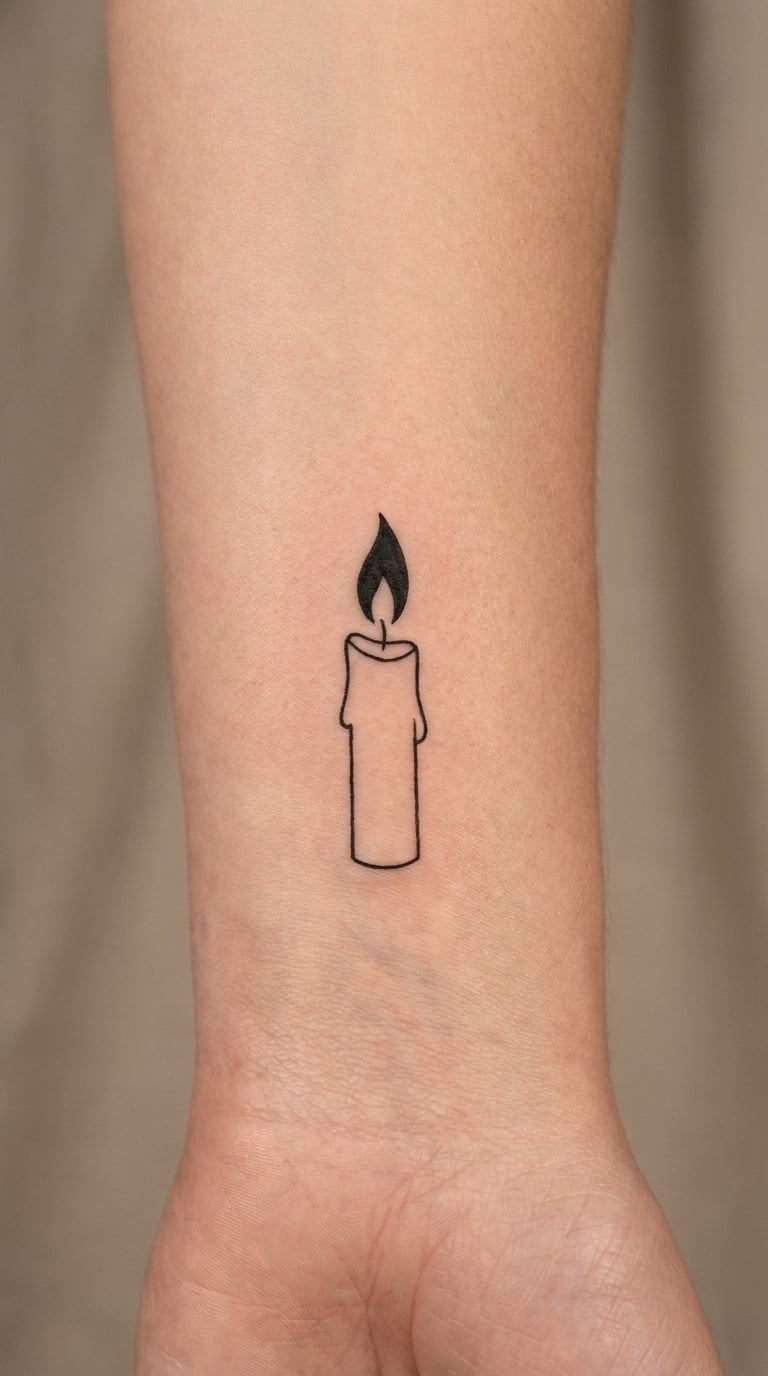
A single uncolored candle outline, drawn in one consistent black line weight, with the flame filled solid so it reads instantly at a distance. The wax body stays empty white space, which is what makes it look calm rather than busy.
Most people choose this version because it is quiet and does not need explaining, and because a candle this clean works as a first tattoo.
Placement: inner wrist, just above the wrist crease, or the inner forearm. Size: 1.5 to 2 inches (4 to 5 cm) tall. Style: fine line. Pain: low to medium, and the wrist area is bony so expect a brief sting near the crease. Fine line on the wrist softens with sun exposure over the years, so ask for a slightly heavier line than feels right on day one. Make it yours: add a thin smoke curl or a single wick curve in the same line weight.
2. Candle with a Realistic Amber Flame
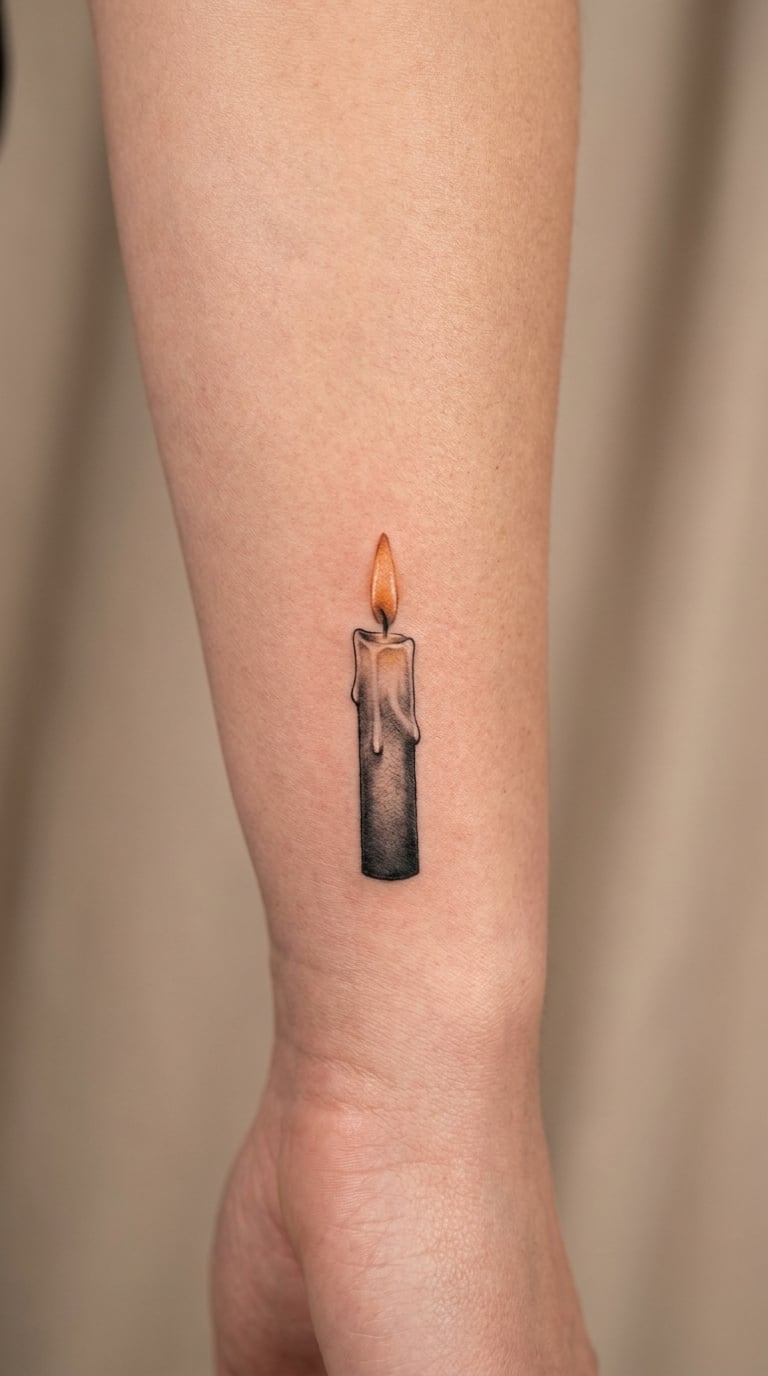
A candle rendered in soft black and grey with a shaded wax body, a visible wick and one realistic amber-orange flame. The flame is the only warm colour in the design, so the eye goes straight to it.
People tend to pick the realistic version when they want something warmer and more lifelike than an outline, without going fully traditional.
Placement: inner forearm, where the flame sits upright and reads well. Size: 2 to 2.5 inches (5 to 6 cm). Style: black and grey realism with one colour accent. Pain: medium, since the shaded grey areas need more passes than a line. The amber flame is the first thing to fade, so agree on a deeper orange at the wick base. Make it yours: change the wax tone from grey to a soft cream or leave a melt pool at the base.
3. Tiny Candle Behind the Ear
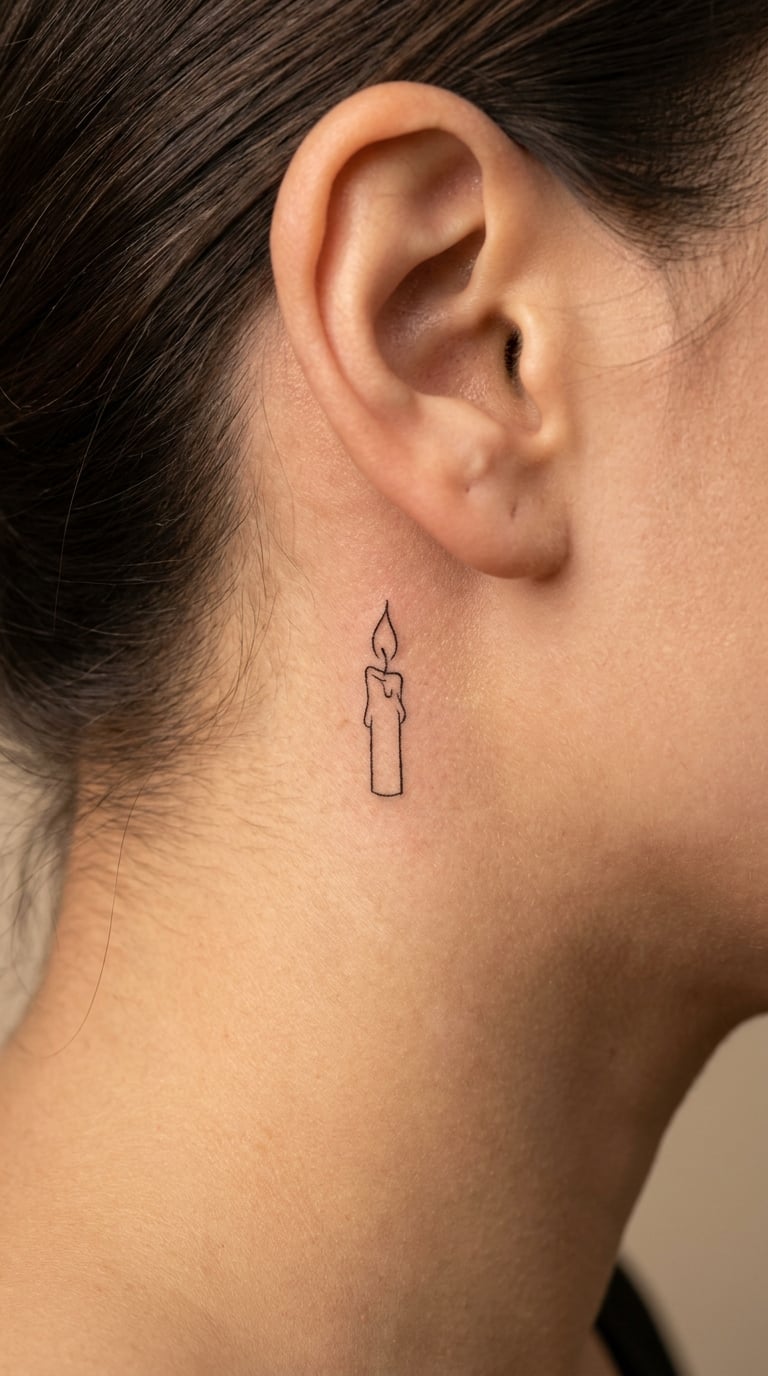
A micro fine-line candle, barely taller than the flame itself, drawn in a single black line with one small solid flame. It sits in the soft skin behind the earlobe where hair and angle decide how much anyone sees.
This is a good pick for someone who wants a candle but not an announcement, and it is a common first small tattoo for that reason.
Placement: directly behind the ear or the tiny patch below the lobe. Size: around 1 inch (2.5 cm), smaller if the flame is drawn with three strokes. Style: micro fine line. Pain: low to medium, and skin this thin shows redness for longer. Tiny detail behind the ear blurs noticeably after several years, so an artist with steady micro linework matters more here than anywhere else on the body. Make it yours: add a small initial or a single dot for a year.
4. Blackwork Candle with a Large Flame
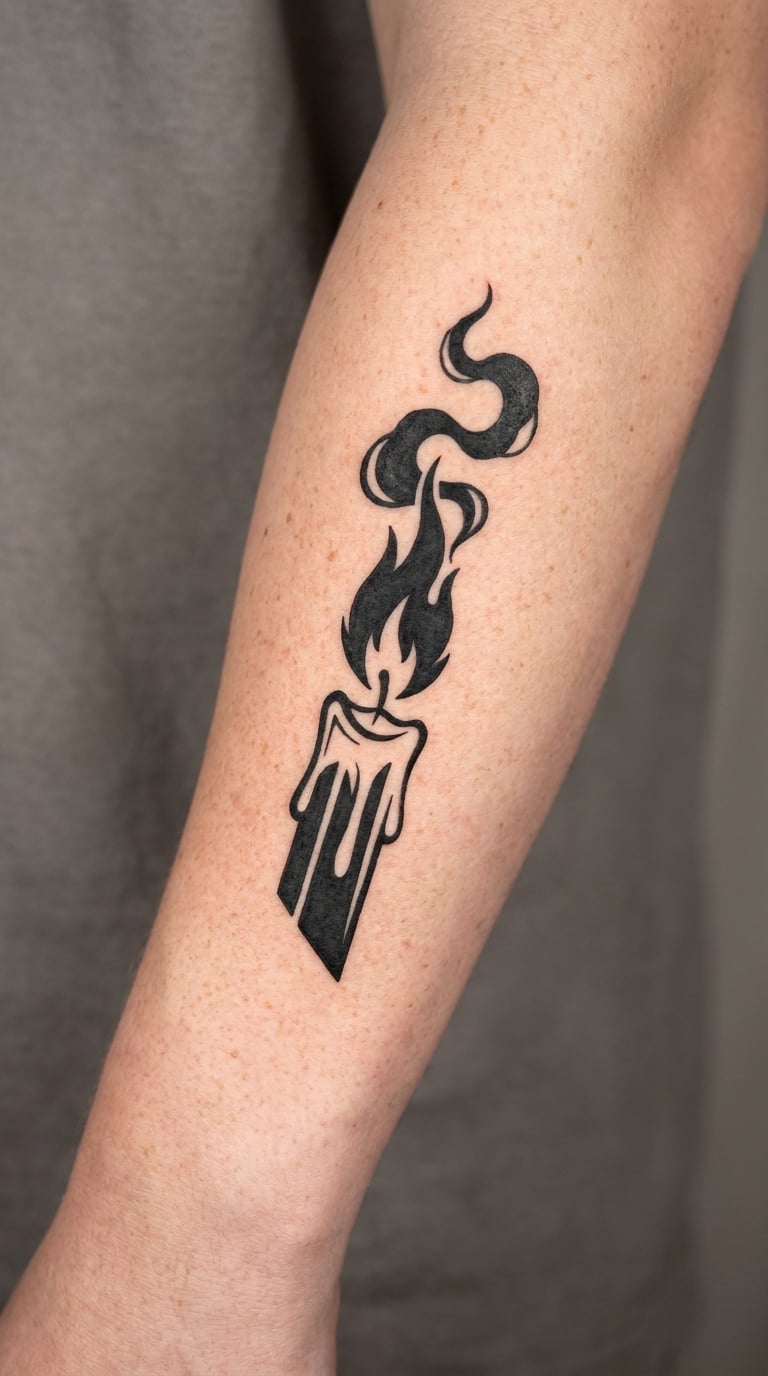
A solid black candle with a heavy flame built from big filled shapes, and narrow white cuts left inside the wax so the form stays readable. The contrast between the black flame and the bare skin inside the candle is what gives it weight.
Blackwork is the choice for someone who wants a candle with visual authority, and the heavy fill is what makes it hold up over time.
Placement: outer forearm or upper arm, where there is room for the solid black areas. Size: 3 to 4 inches (7.5 to 10 cm). Style: blackwork. Pain: medium, and the filled flame needs a longer session than the outline suggests. Bold black holds its shape far better than hairline detail, so this design ages well if you keep it out of hard sun. Make it yours: change the flame shape to a teardrop or a spade-style point instead of a rounded tongue.
5. Watercolor Candle With a Blue Flame
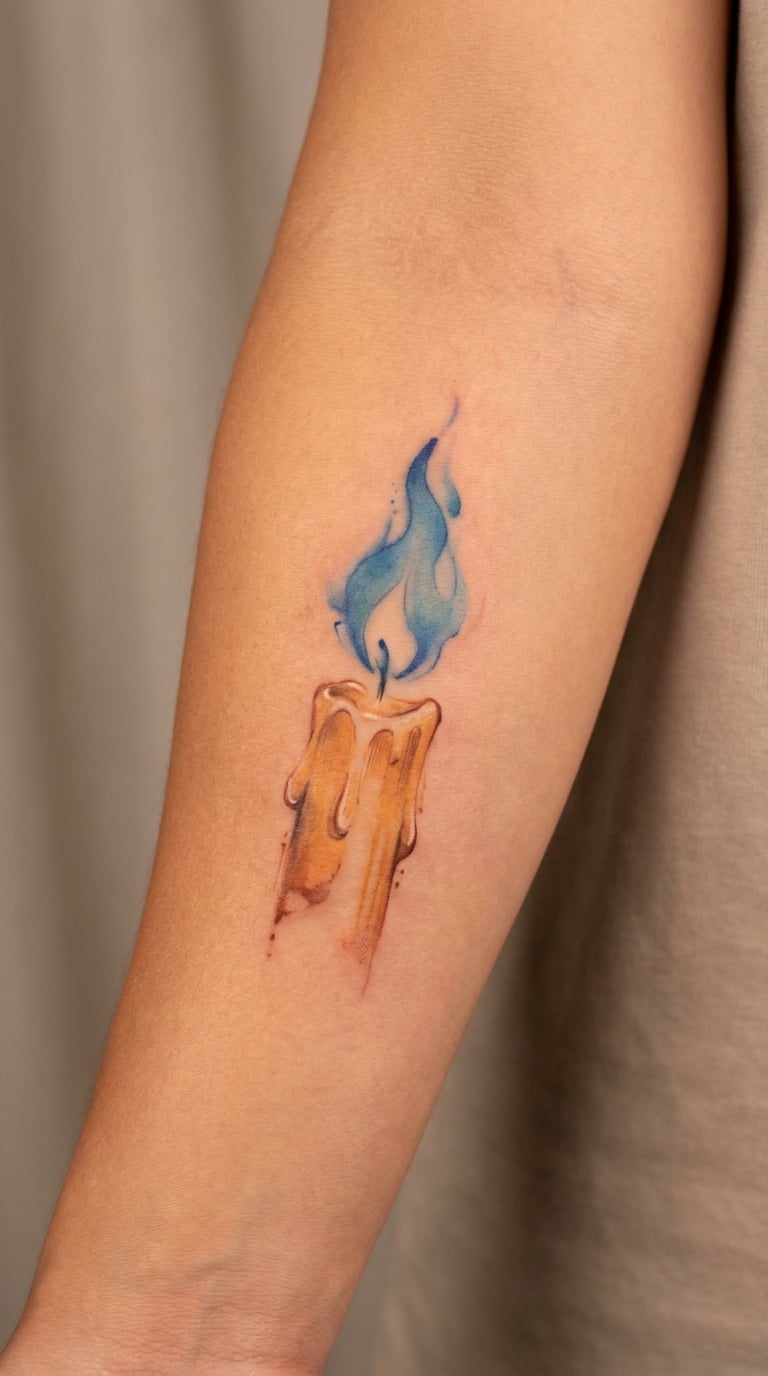
A loose watercolor composition where amber pigment bleeds outward from the wax body and a vivid blue flame sits at the top with soft, uneven edges. There is no outline holding it together, so the whole design reads as one wash of colour.
Colour that breaks the rules is the reason people book this one, since a blue flame cannot be a real candle but still reads as a light.
Placement: outer forearm, ideally on skin with no existing colour nearby. Size: 2.5 to 3 inches (6 to 7.5 cm). Style: watercolor. Pain: medium, and a big colour wash takes longer than its light look suggests. Watercolour sits near the surface of the skin, so expect the edges to soften and the blue to lighten in the first couple of years. Make it yours: pick the two colours from something you own, or have the pigment fade from blue at the flame to amber at the base.
6. Skeleton Candle with a Glowing Flame
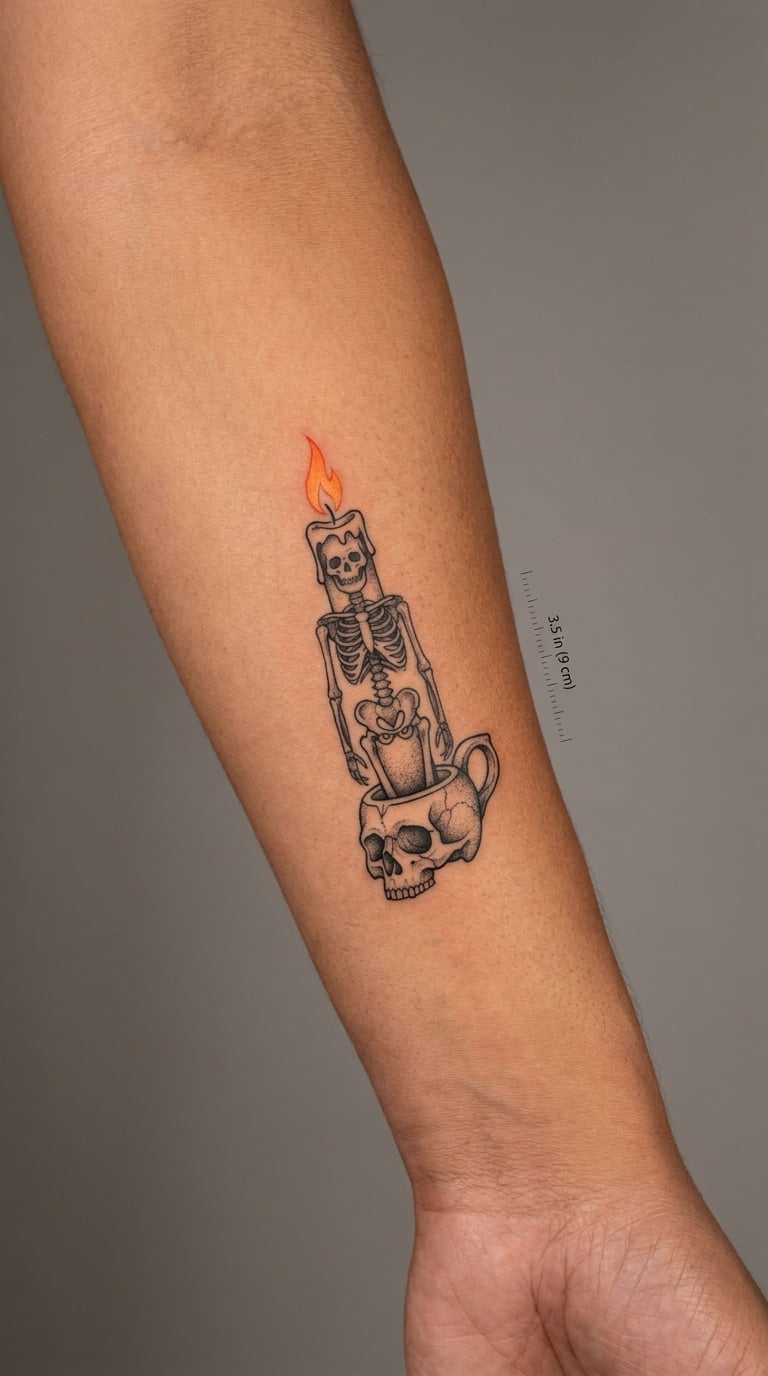
An illustrative design where a small skull is built into the candle holder or the base, and the burning candle rises above it in black and grey with one bright flame. The bone structure and the wax are shaded differently so the two textures stay separate.
Skulls and candles together read as memento mori imagery, and that is the reason this version gets chosen as a memorial or a reminder of mortality.
Placement: outer forearm or outer upper arm. Size: 3 to 3.5 inches (7.5 to 9 cm). Style: illustrative blackwork. Pain: medium to high, because the bone detail and the flame shading both need small needle work. The fine cracks in the bone soften faster than the bold flame, so ask your artist to leave a little breathing room between the lines. Make it yours: swap the plain skull for a hand, a small animal, or a set of initials cut into the base.
7. Rose-Wrapped Candle
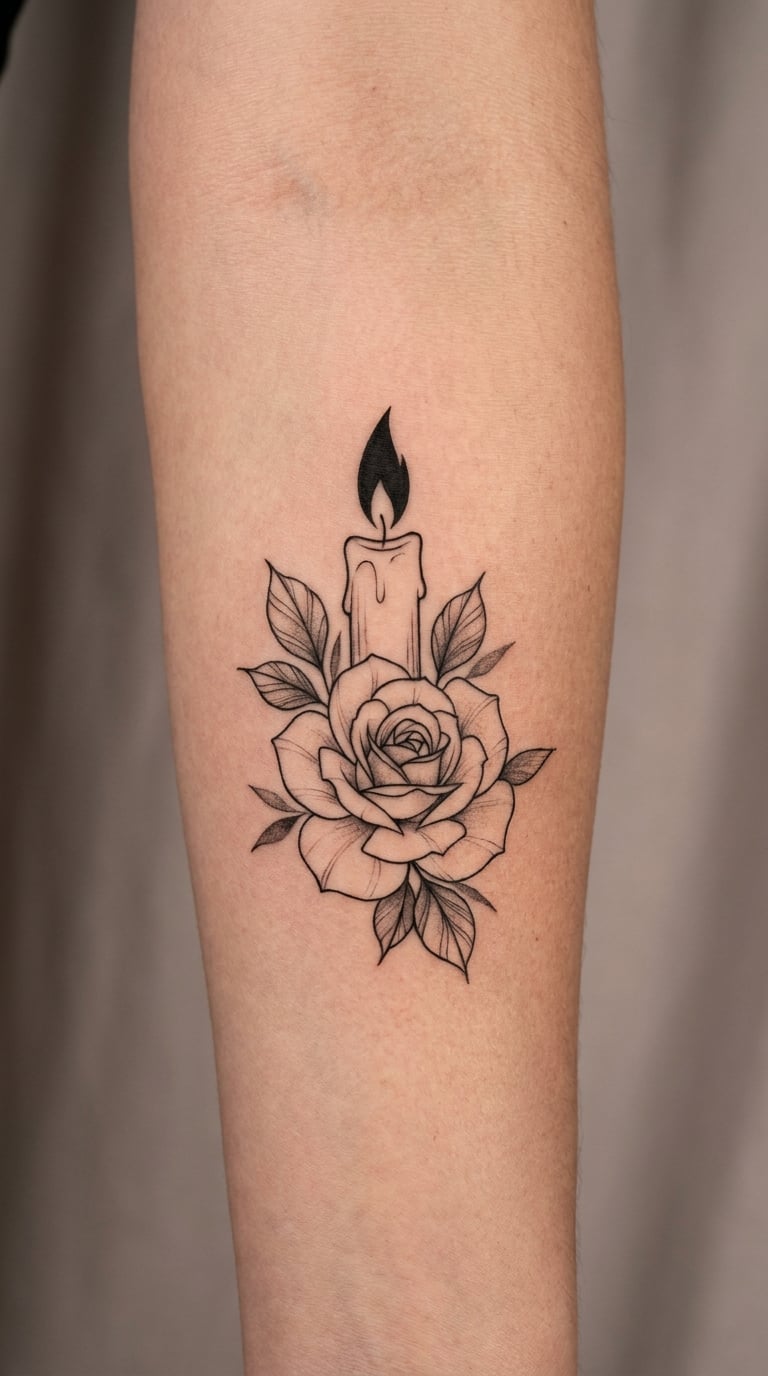
A single blooming rose and a couple of leaves wind around an upright candle, all in black fine line with a small solid flame at the top. The stem follows the curve of the wax rather than sitting beside it, so the two elements look like one object.
Flowers and candles turn up together because both are short-lived things worth marking, and a rose adds colour potential without adding a second heavy element.
Placement: forearm, inner or outer. Size: 2.5 to 3 inches (6 to 7.5 cm) including the flower. Style: fine line floral. Pain: medium, and the petal edges take longer than the candle outline. Petal linework and the flame are both fine details that lose definition over time, so keep this away from daily sun if you can. Make it yours: use your birth flower instead of a rose, or add a single colour to the petals and leave the rest black.
8. Roman Numeral Memorial Candle
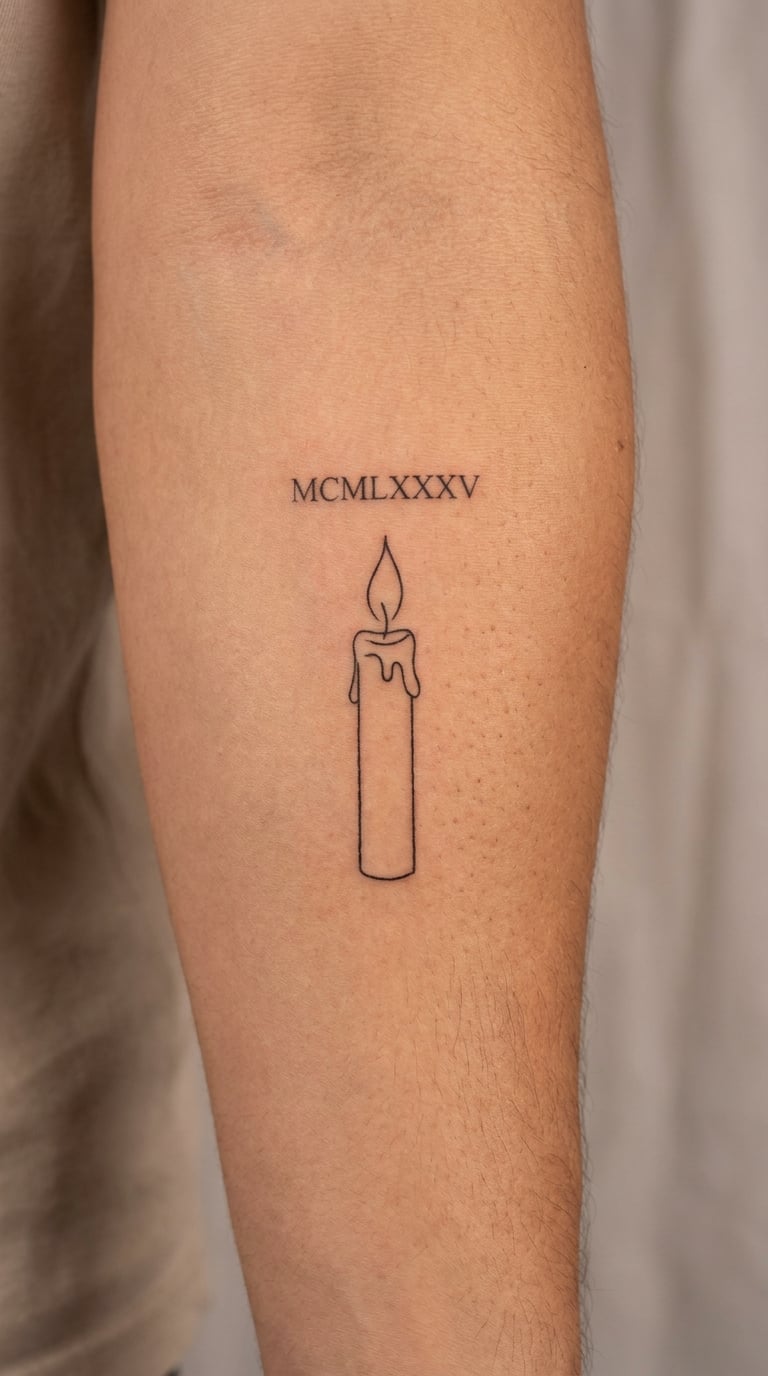
A plain upright candle in fine black line with a date, name or short inscription set above the flame in small Roman numerals. The lettering is the only element that changes, and the restraint is the whole point of the design.
Memorial candles are chosen for a specific person or a specific date, and numerals keep the words short enough to sit in a small space.
Placement: inner forearm, above the wrist, or the flat of the upper arm. Size: 2.5 to 3 inches (6 to 7.5 cm) including the text. Style: fine line with lettering. Pain: medium, and lettering slows the session since each letter is built from separate strokes. Letters change with body movement and lose definition as skin ages, so ask for numerals at least a quarter inch tall and check the spacing on a stencil first. Make it yours: add one line of coordinates or a single word beneath the candle instead of a full quote.
9. Three Candles for a Family Trio
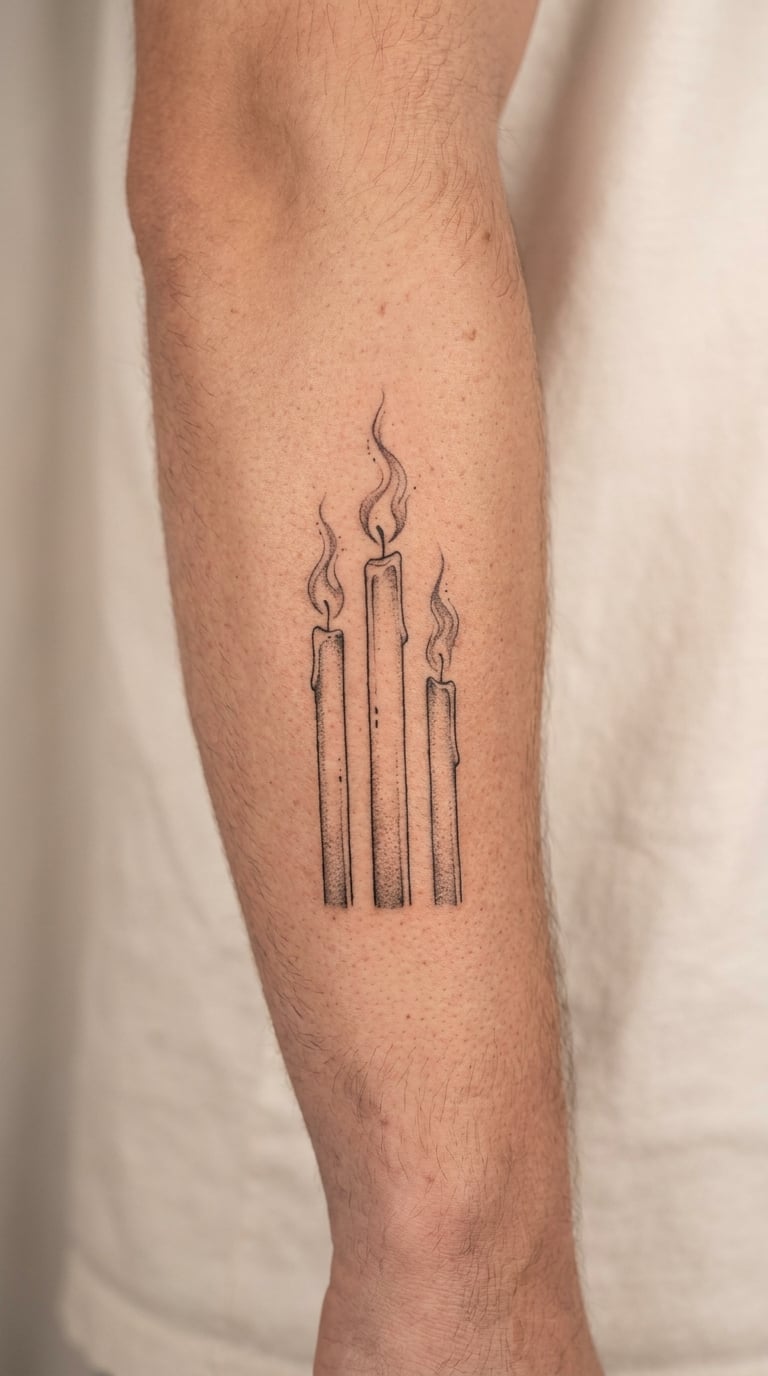
Three slender candles of graduated height, each with its own small flame, arranged side by side on a straight baseline. Black and grey shading gives each one a slightly different body so they do not blend together.
Counting candles is a way to mark a specific set of people, and the differing heights are what stop the row looking like a copy-and-paste repeat.
Placement: inner forearm, laid horizontally so the three sit along the bone line. Size: 3 inches (7.5 cm) across with the candles at 1 to 2 inches (2.5 to 5 cm) tall. Style: black and grey line with light shading. Pain: medium, and three separate flames add detail to an area that is sensitive near the wrist. Keep the gaps between candles wide enough that healed lines do not merge. Make it yours: stagger the heights to match the people you have in mind, or add one small date below the row.
10. Matchstick Candle in Micro-Realism
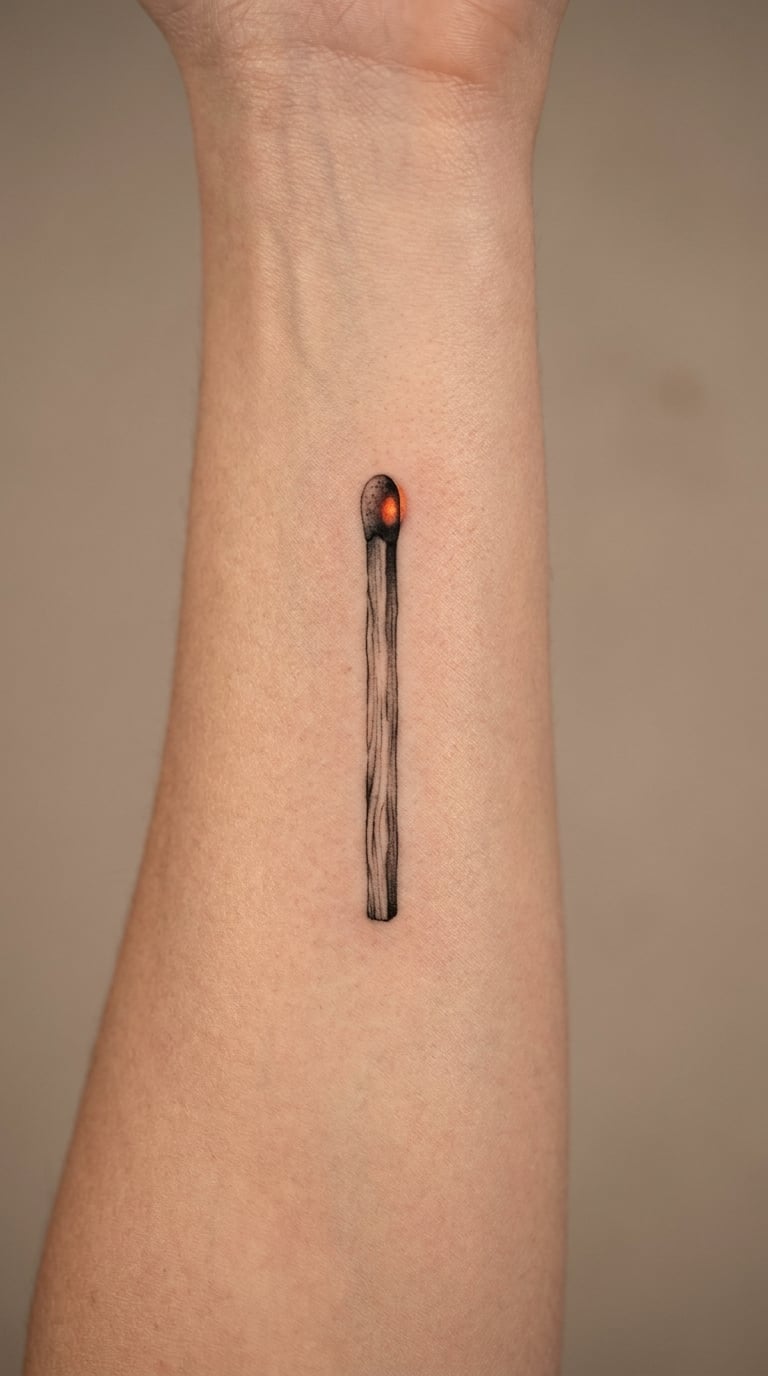
A photorealistic matchstick lying at a slight angle, with visible wood grain along the shaft and one small glowing ember at the head. It is the smallest and quietest design in this list, which is exactly what makes it interesting.
A match is the compressed version of the same idea as a candle, so people choose it when they like the light metaphor but not the object.
Placement: outer forearm, or the outer arm near the elbow. Size: 2 inches (5 cm) long. Style: micro-realism. Pain: medium, and the wood grain means many short lines rather than one pass. Micro-realism relies on fine shading that softens noticeably after five or six years, so it is a design to pick for how it looks now. Make it yours: burn it out, so the match is used, or add a tiny wisp of smoke rising from the ember.
11. Candle Inside a Glass Tumbler
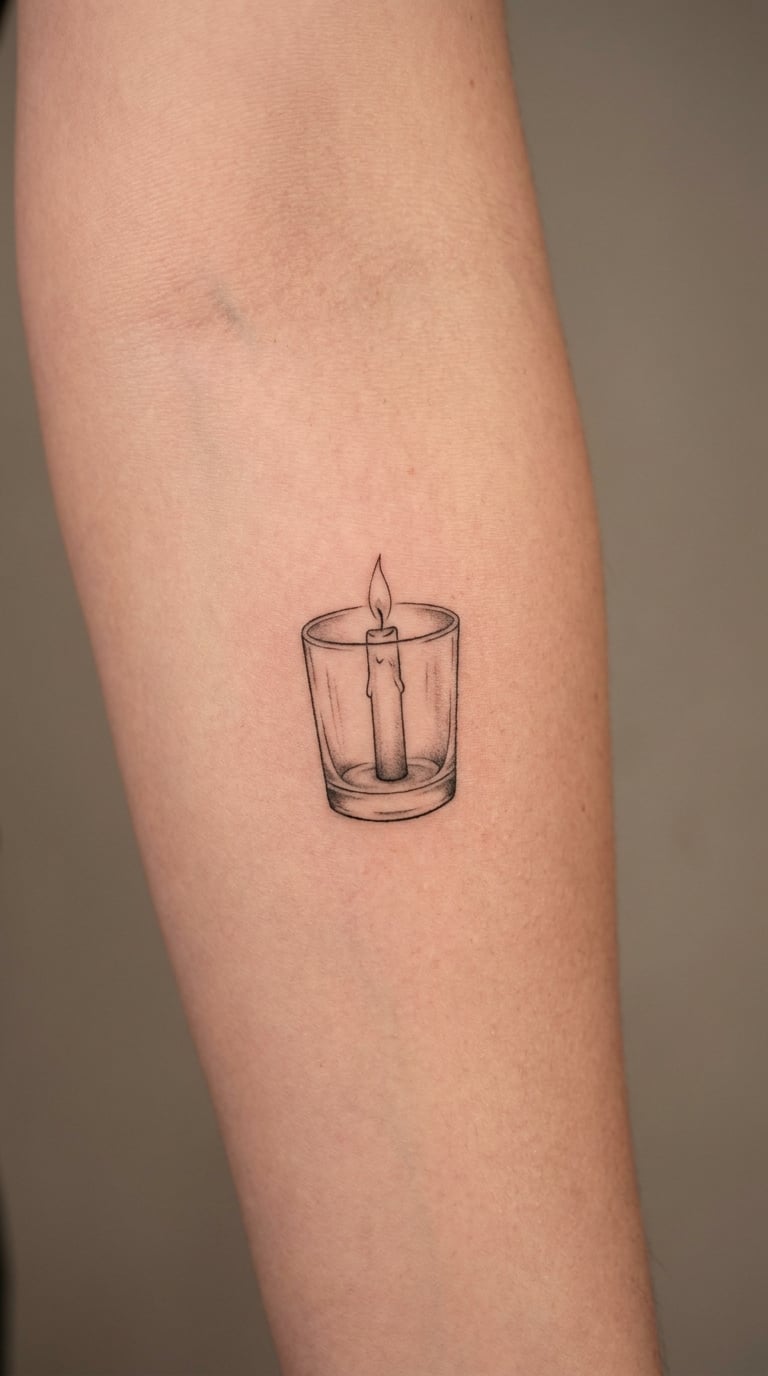
A narrow taper candle standing inside a straight-sided glass, with a few light grey strokes standing in for reflections on the glass and one small flame above the rim. The transparency is what gives the design its depth without heavy shading.
A glass changes the feel of a candle entirely, since the object reads as protected and enclosed rather than exposed.
Placement: inner forearm, or scaled down for the wrist. Size: 2.5 inches (6 cm) tall for the full composition, 2 inches (5 cm) on a wrist. Style: fine line with minimal grey. Pain: medium, and the two vertical lines of the glass need steadiness more than depth. The light grey reflection strokes are the fragile part here, so ask for them slightly stronger than they look on paper. Make it yours: add condensation dots on the glass, or put a date on the outside of the tumbler.
12. Gothic Ornate Candle with Halo
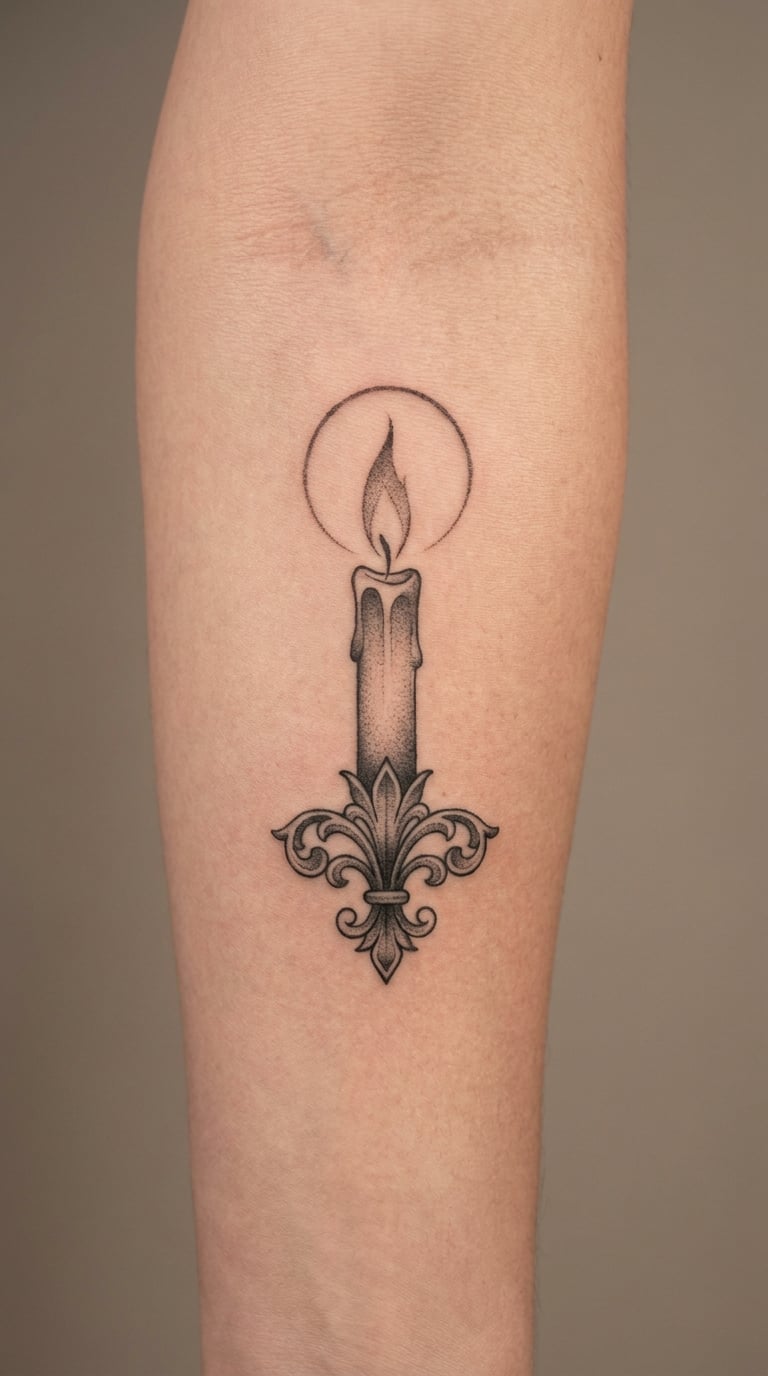
A black-and-grey candle framed by a thin circular halo, with restrained ornamental scrollwork on the base and one narrow shaded flame. The detail is decorative but limited, so the silhouette stays compact and gothic rather than turning into a full engraving.
A halo is a religious visual reference, and people pair it with a candle when faith and remembrance are the point of the design.
Placement: upper forearm, upper arm or the back of the shoulder. Size: 3 to 3.5 inches (7.5 to 9 cm). Style: gothic black and grey. Pain: medium, and the scrollwork adds time even though none of it is deep. Ornamental linework softens with age, so expect the halo circle to stay crisper than the scroll detail. Make it yours: swap the scrollwork for a name in old-style lettering, or reduce the halo to a thin broken ring.
13. Lunar-Phase Candle
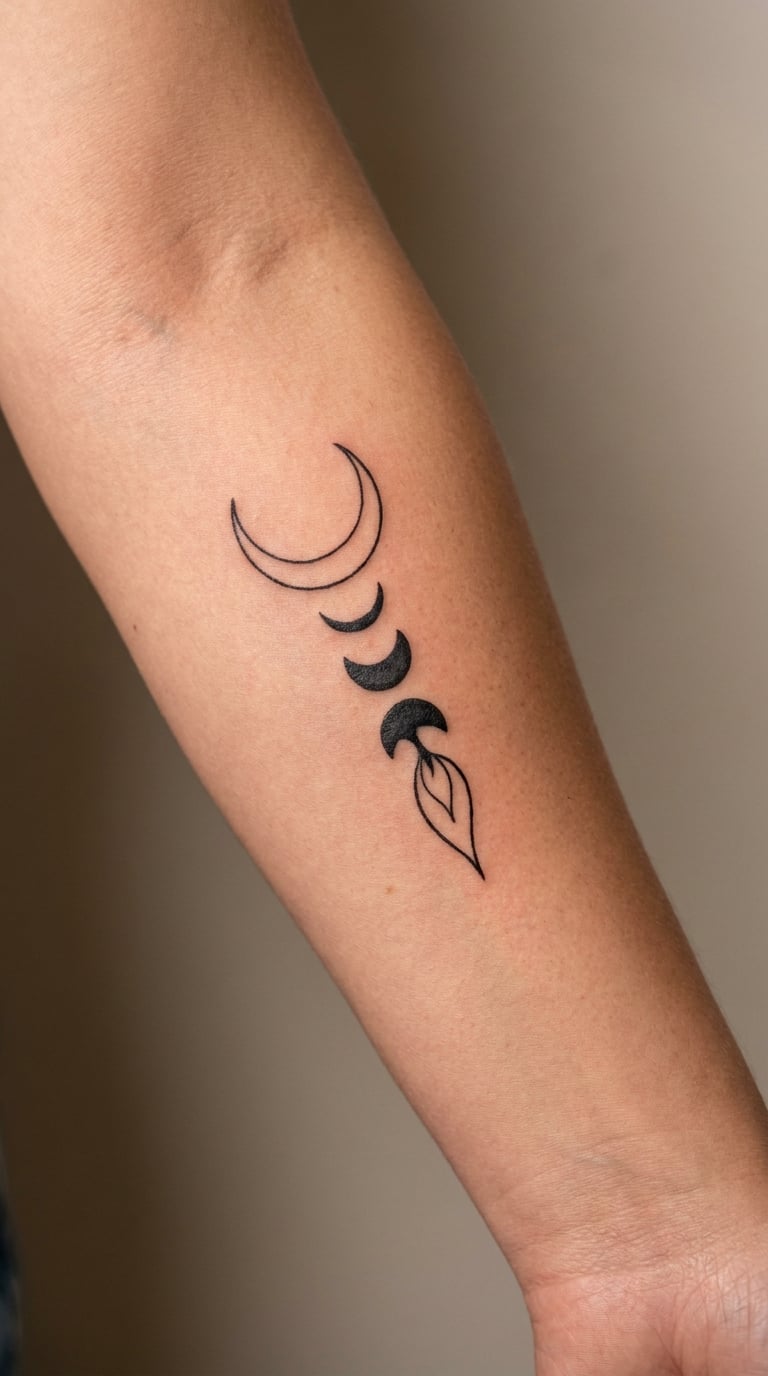
A candle whose flame breaks apart into a crescent and a row of small lunar phases, all in solid black fine line. The moon shapes sit where the flame should be, so the design still has a single bright focal area at the top.
Moon phases are chosen for a reason, often a period of time marked out by the wearer, and merging them with a flame keeps the two symbols in one compact image.
Placement: outer forearm, where there is flat skin for a vertical row of shapes. Size: 2.5 to 3 inches (6 to 7.5 cm). Style: fine line with dotwork shading. Pain: medium, and the small filled moon shapes take more passes than they look like they should. Dots in the shading fill can spread during healing, so a single-session piece is worth asking about. Make it yours: use the phase that matches your date and leave the other three out, or run the full set around the candle as a band.
14. Traditional Candle in a Holder
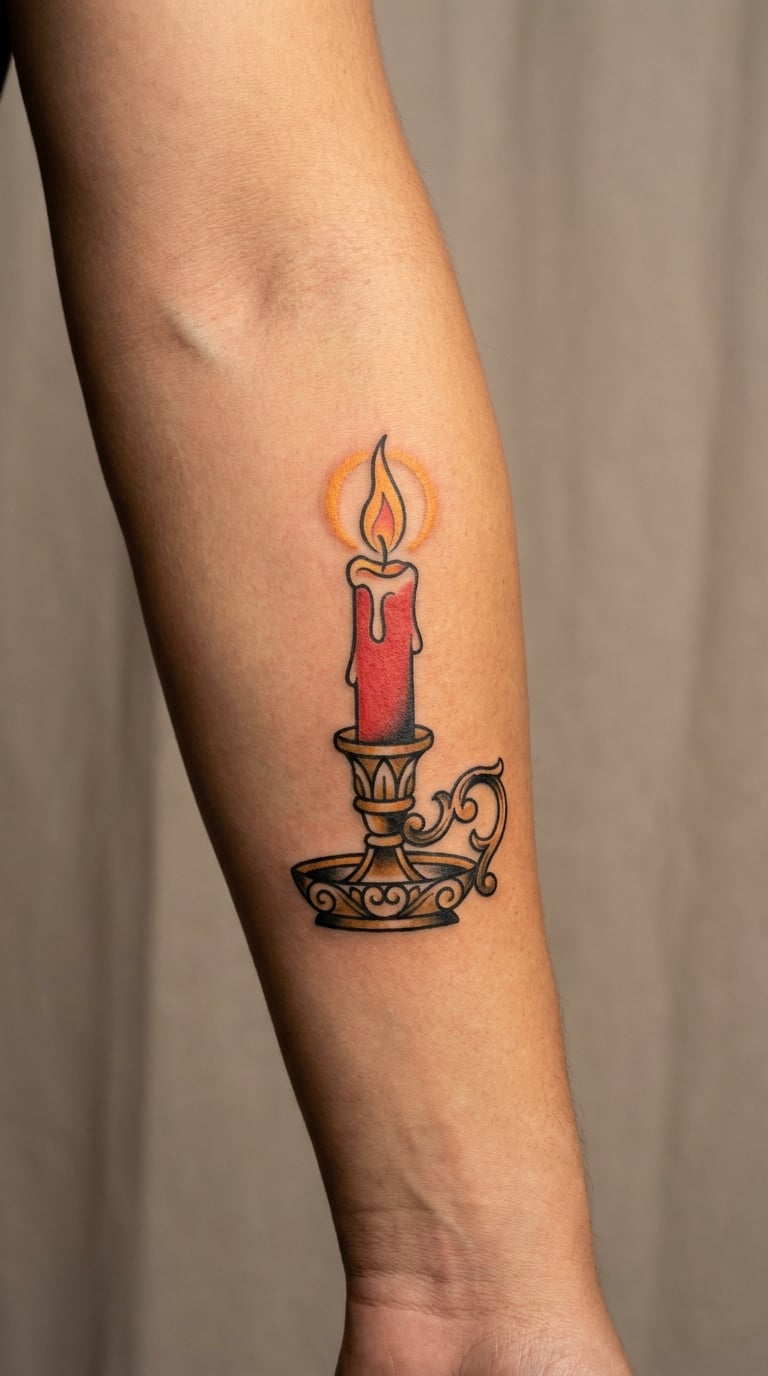
A bold candle seated in a decorative saucer or holder, with heavy black outlines, red wax, a yellow flame and shading in the holder. The thick outlines and limited palette are what make it read as traditional rather than illustrative.
This is the version to pick if you want a candle that has presence at a distance rather than one that rewards close looking.
Placement: outer upper arm or upper forearm. Size: 3 inches (7.5 cm) tall, larger if the holder is detailed. Style: traditional. Pain: medium, and the solid red fill covers more skin than the outline alone suggests. Traditional linework and flat colour hold their shape better than most fine styles, which makes this an easy one to live with. Make it yours: add a banner with a date beneath the holder, or change the wax colour to your birthstone shade.
15. Dotwork Candle Filled with Stargazer Moths
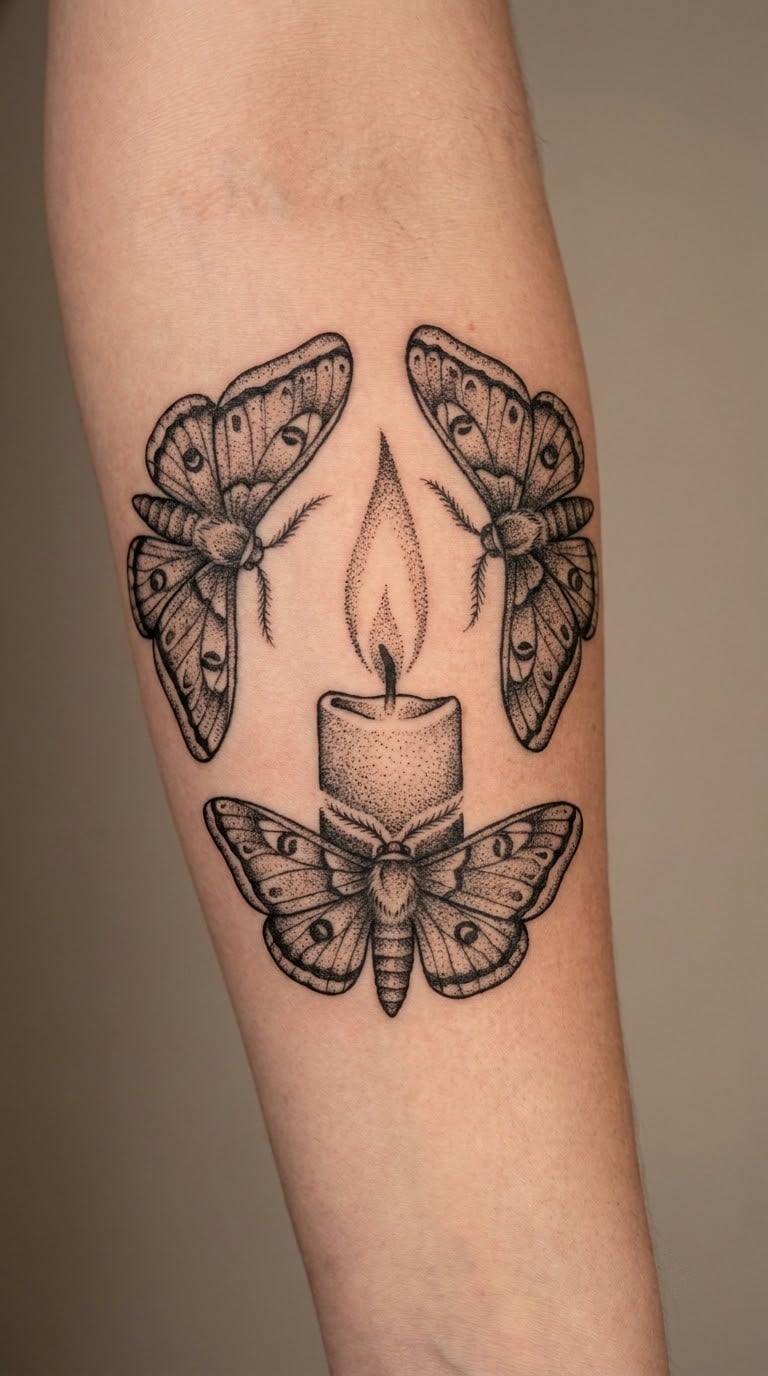
A simple candle silhouette at the centre, surrounded by three moths drawn entirely in stippled black dots, with the heaviest dot density building the candle and the lightest describing the wings. One moth sits above the flame and two hover below.
Moths around a light source is a nature reference rather than an invented symbol, and it gives a plain candle a second layer of interest.
Placement: forearm, with enough room around the candle for the wings. Size: 3 inches (7.5 cm) across. Style: dotwork. Pain: medium to high, and dotwork is tedious work, so expect this to run longer than its size suggests. Stippling spreads slightly as it heals, so leave a little space between dot clusters or the moths blur into the background. Make it yours: swap the moths for fireflies, bees or a few leaves and keep the same dot density.
16. Maple Leaf and Falling Wax
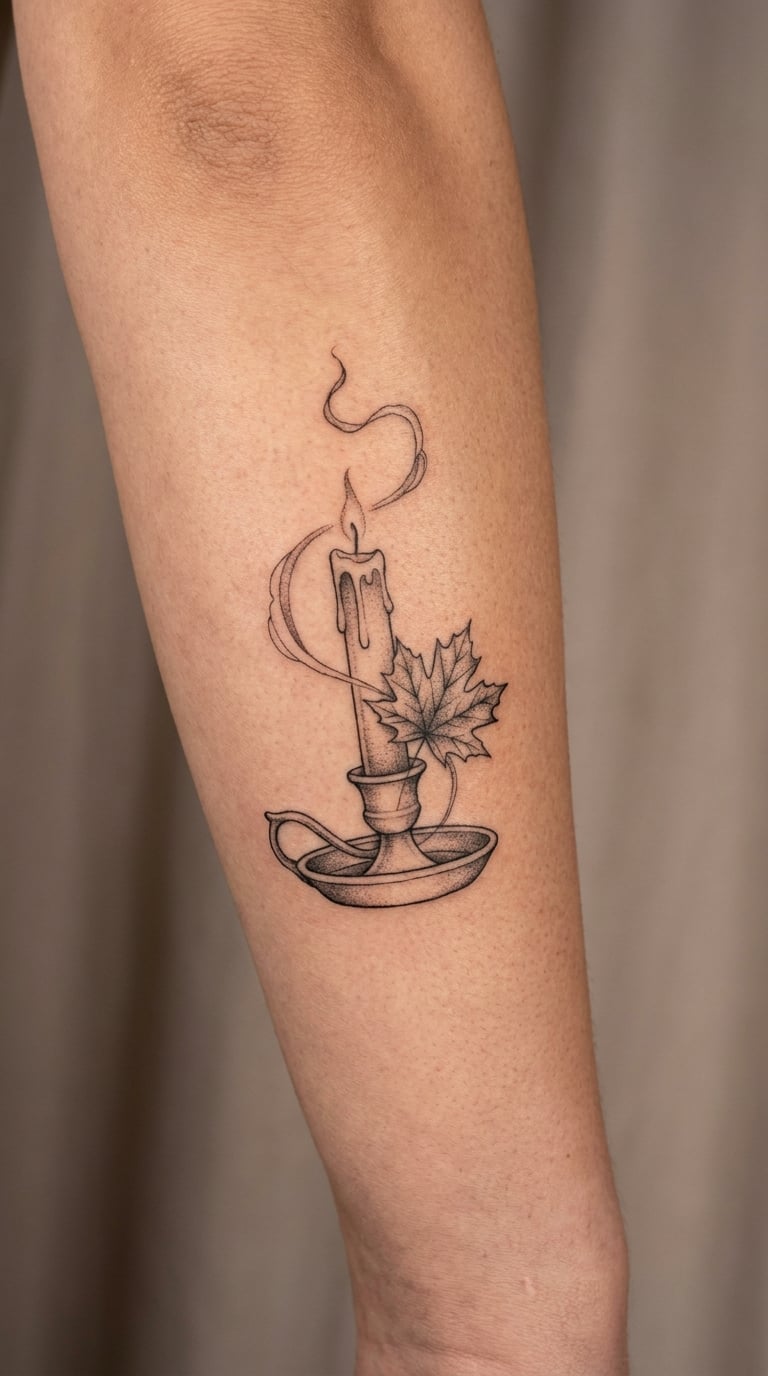
A candle in black and grey with one detailed maple leaf beside the holder and a thin trail of wax curling down and away from the base. The leaf’s veins are drawn in fine detail so it carries its own texture next to the smooth wax.
It reads as a specific season rather than a general mood, and a lot of people book this one in late summer for an autumn piece.
Placement: outer forearm, with room below the candle for the wax trail. Size: 2.5 inches (6 cm). Style: black and grey realism. Pain: medium, and the leaf veins are small enough to slow the session. The thin wax trail is the element that softens first, so a slightly heavier line there is worth asking for. Make it yours: swap the leaf for the plant connected to your birthday, or add a second leaf in a lighter grey.
17. Gradient Candle Made of Smoke
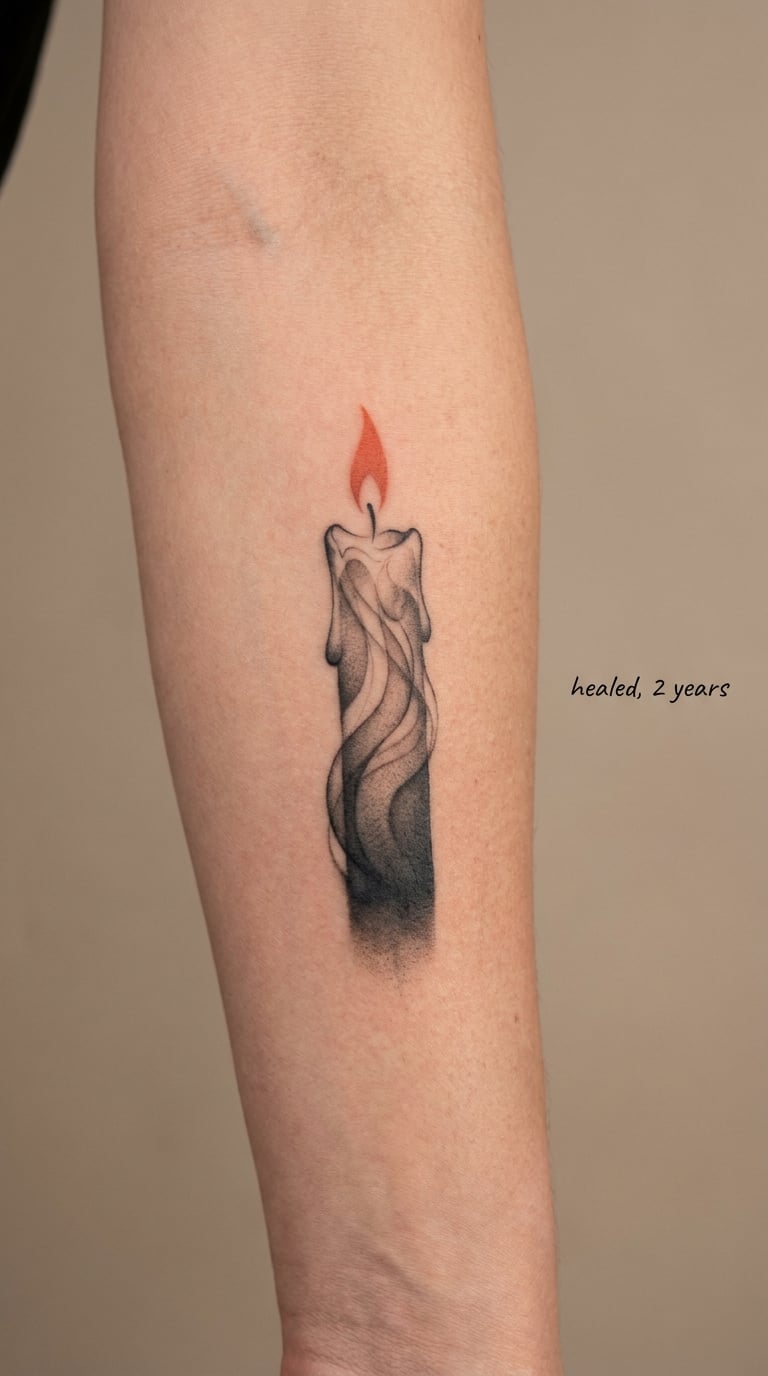
A soft black-grey gradient where candle smoke forms the wax body and the outline of a single solid flame at the top. The wisp edges stay translucent, so the design fades into the skin rather than ending in a hard border.
A smoke candle is chosen when someone wants the light idea with as little structure as possible, since most of the design is atmosphere.
Placement: inner forearm, on skin that photographs evenly. Size: 3 inches (7.5 cm). Style: black gradient. Pain: medium, and building up grey tone is slower work than it appears. Gradients are the first thing to change shape as the skin ages, so this design deliberately depends on soft edges. Make it yours: have the smoke curl in a direction that matches the line of your arm, or add a few loose wisps above the flame.
18. Birth-Flower Candle
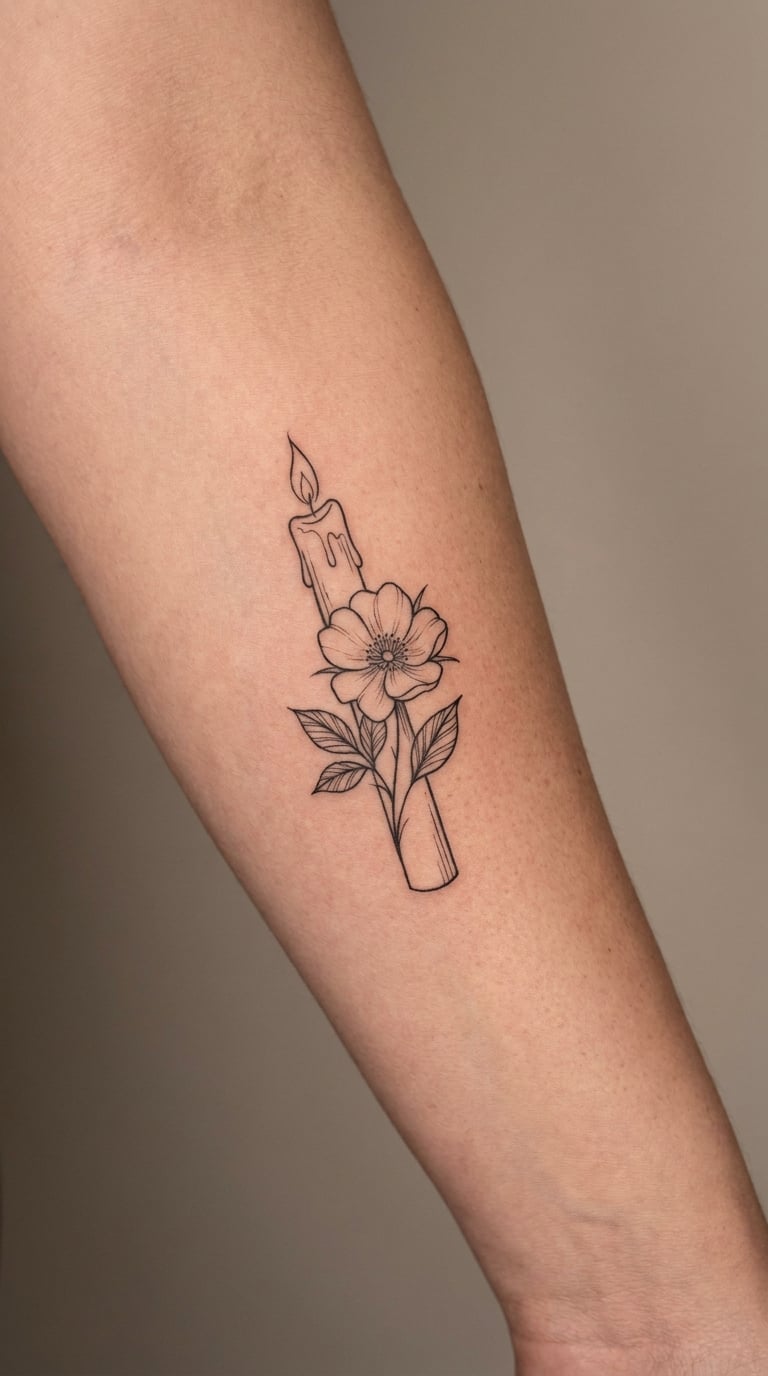
A simple candle with one birth-flower bloom and two leaves growing naturally out of the wax body, all in fine black line with a single colour in the petals if you want it. The stem emerging from the wax is what keeps it from looking like two separate tattoos.
Birth flowers are personal by definition, and this is a common choice when the wearer wants their candle tattoo to mean something specific rather than being general.
Placement: outer forearm, anywhere the stem has room to curve. Size: 2.5 inches (6 cm). Style: fine line botanical. Pain: medium, and petal detail sets the session length more than the candle does. Petal edges blur faster than stems, so a bolder petal outline holds the shape longer. Make it yours: confirm the bloom and leaf count with your artist against a real reference photo, since botanical drawings often drift from the actual species.
19. Burning Candle in an Hourglass
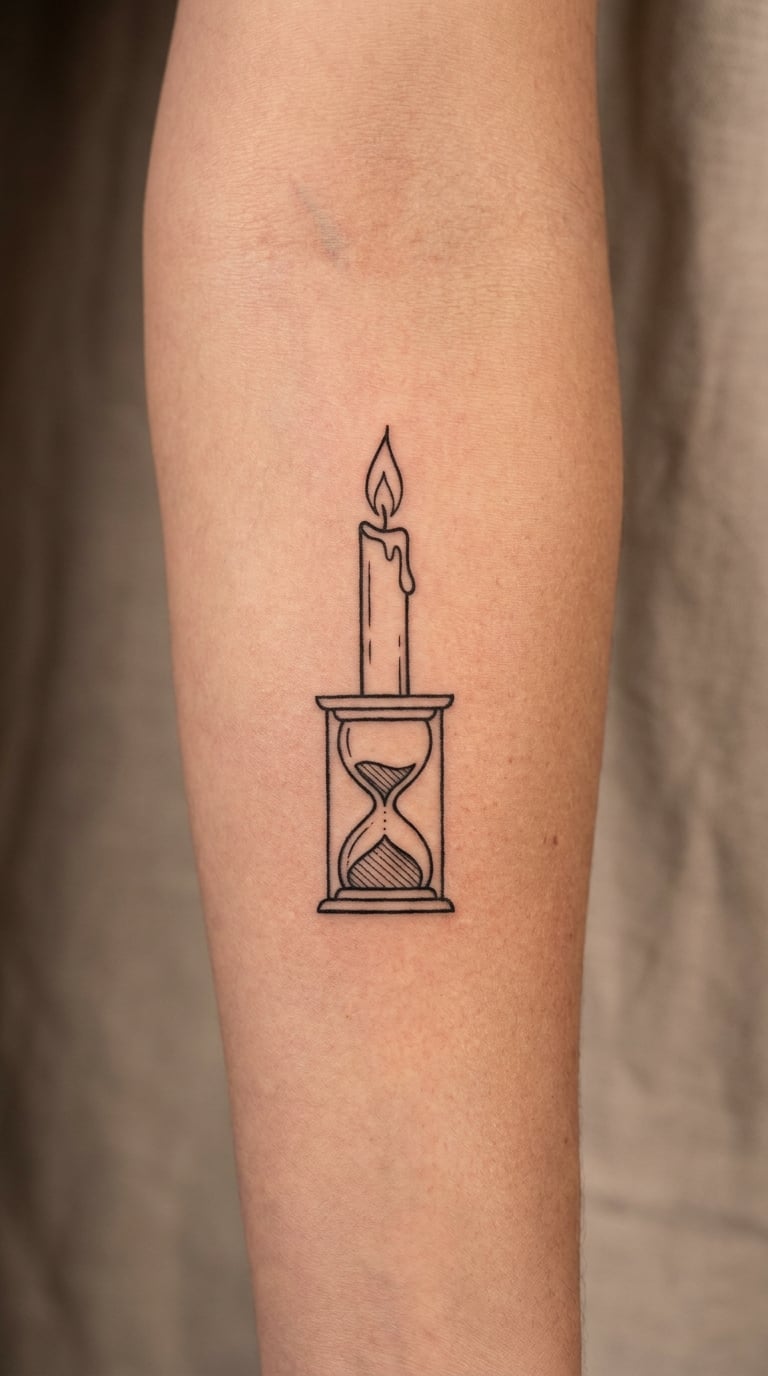
A lit taper candle standing in the top half of an hourglass, with minimal crosshatching for the sand and a thin frame around the glass. The composition works because the candle’s vertical line continues the hourglass axis instead of fighting it.
Time and a burning light in one image is the whole idea, and what it means to you is the part you decide rather than the part the design decides.
Placement: forearm, ideally where a vertical composition sits straight. Size: 3 inches (7.5 cm). Style: fine line illustrative. Pain: medium, and the hourglass frame adds a long outline to the session. The crosshatched sand is the fragile part and spreads during healing, so an experienced hand matters more here than a bigger size. Make it yours: add a small infinity symbol in the sand, or remove the sand and leave the hourglass empty for a cleaner read.
20. Burning Book and Candle
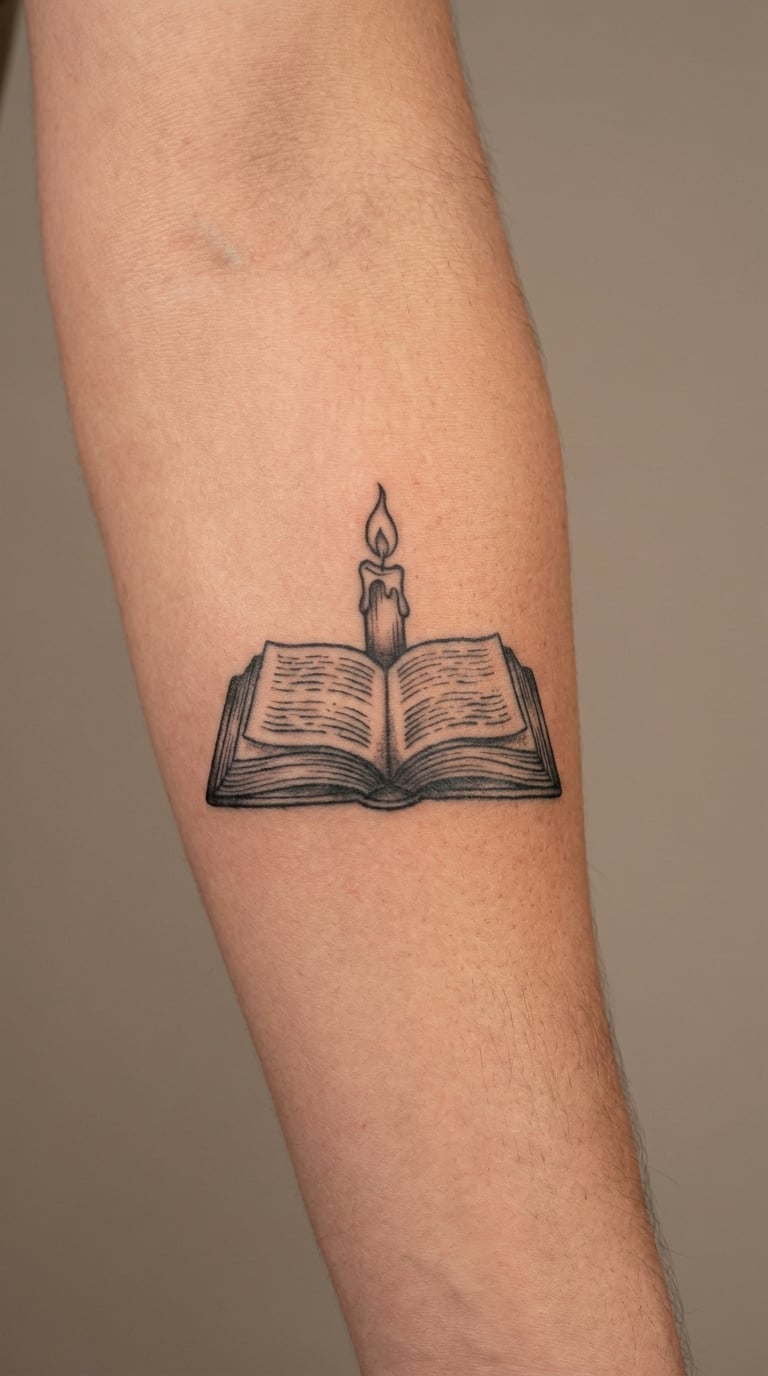
An open book drawn in bold blackwork with a single candle rising from the centre pages and a compact flame above it. Heavy shadow inside the page edges gives the book depth while the candle stays clean and bright.
Books and candles together usually mean learning, or knowledge kept for its own sake, and that is why this version turns up so often in literary tattoos.
Placement: outer forearm or the flat of the upper arm. Size: 3 to 3.5 inches (7.5 to 9 cm). Style: blackwork. Pain: medium to high, because the pages need dense black fills across a wide area. Bold fills hold up well, so the pages will outlast any small detail you add inside them. Make it yours: have the flame form out of the page text, or add a pair of glasses resting on the open book.
21. Matching Candles with a Small Heart
Two slim candles in fine black line, one slightly taller than the other, linked by a single tiny heart between them. Each person gets one candle on the same spot on their own arm, and the heart sits on the inner edge of the composition.
Matching designs work here because each half reads as a complete candle on its own, so nobody is carrying a piece that only makes sense as half of something.
Placement: inner forearm, mirrored on both people. Size: 2.5 inches (6 cm) across for the pair, with each candle around 1.5 inches (4 cm). Style: fine line. Pain: medium, and the inner forearm is sensitive but flat enough for a straight composition. The tiny heart is the first detail to blur, so ask for a slightly larger heart than looks necessary. Make it yours: use the two dates that matter to you, or match on the candle and change the flame shape on each arm.
22. Candle with Surrounding Butterflies
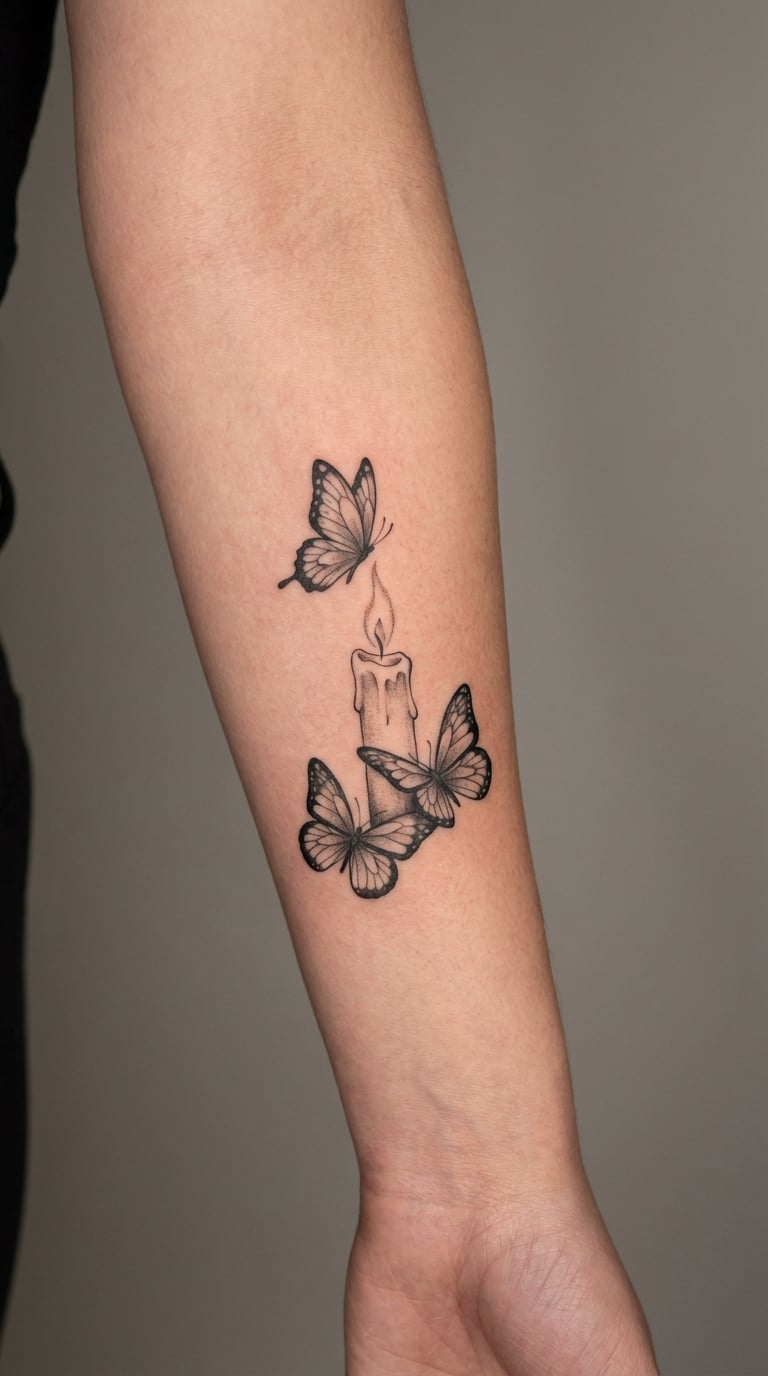
One candle in black and grey framed by three butterflies, with one above the flame and two below the wax so the composition stays balanced top and bottom. The wing detail stays fine while the candle body carries the heavier shading.
Butterflies around a flame is a nature reference like the moth design, and it reads as transformation without anyone having to explain it.
Placement: forearm, with clear skin around the candle. Size: 3 inches (7.5 cm) across, and larger if you want the wing markings readable. Style: black and grey. Pain: medium, and antennae and wing edges are fiddly at any size. Small wing markings are the detail that fades, so ask the artist to simplify them rather than shrink them. Make it yours: choose two butterflies instead of three, or vary the size so one is clearly younger.
23. Patchwork-Style Candle Sleeve Element
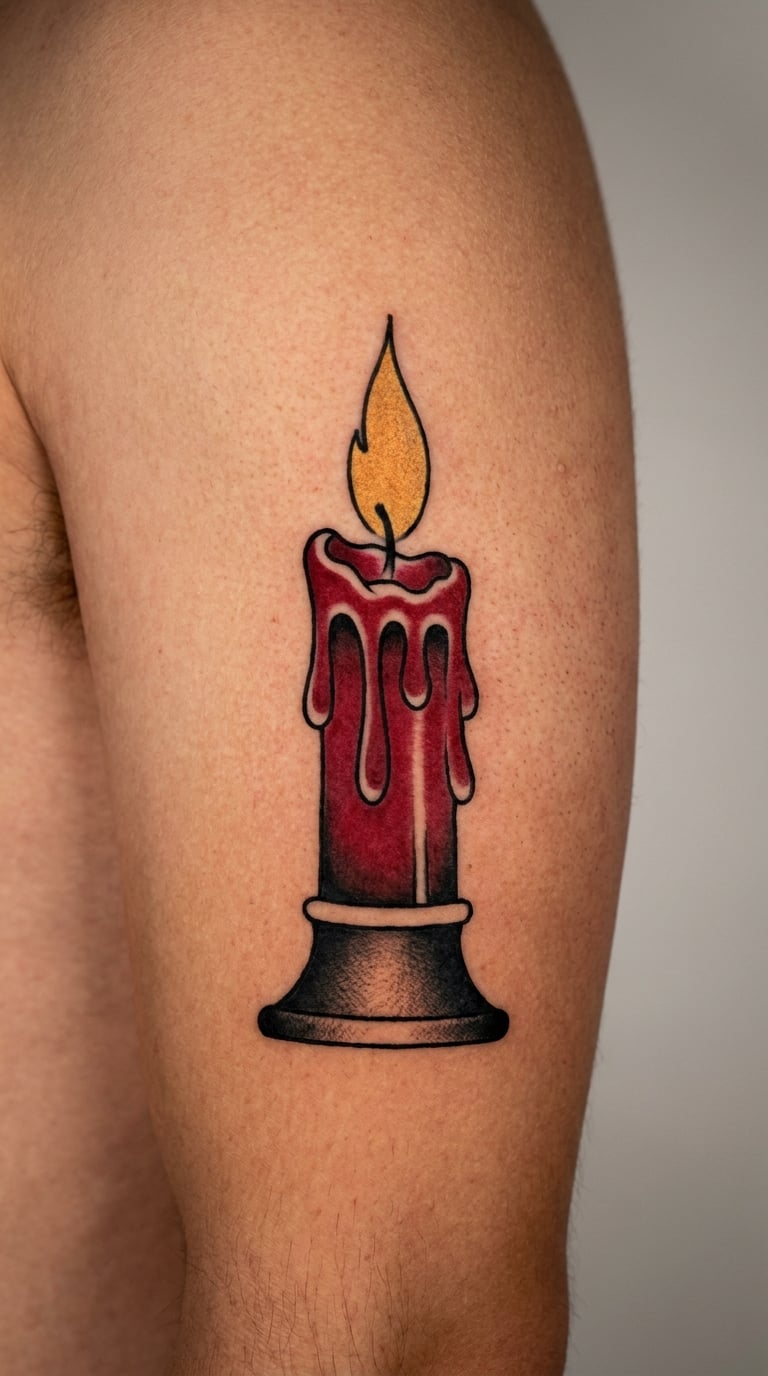
A bold candle drawn with heavy black outlines, red wax, a yellow flame and a simple shaded black base, built to sit as one panel inside a wider arm composition. The limited palette and strong outline are what let it hold its own next to other traditional elements.
Anyone building a traditional arm piece needs a candle that matches the line weight of everything around it rather than a delicate design that looks borrowed.
Placement: upper arm, positioned as a panel in a larger sleeve. Size: 3 inches (7.5 cm), scaled to fit the spacing you have. Style: neo-traditional. Pain: medium for a single candle, and more if it is part of a multi-hour sleeve session. Traditional fills age better than almost anything else in this list, which makes it a good long-term investment. Make it yours: match the red and yellow to the other elements in the sleeve so the whole arm reads as one palette.
24. Candle Reflected in a Hand Mirror
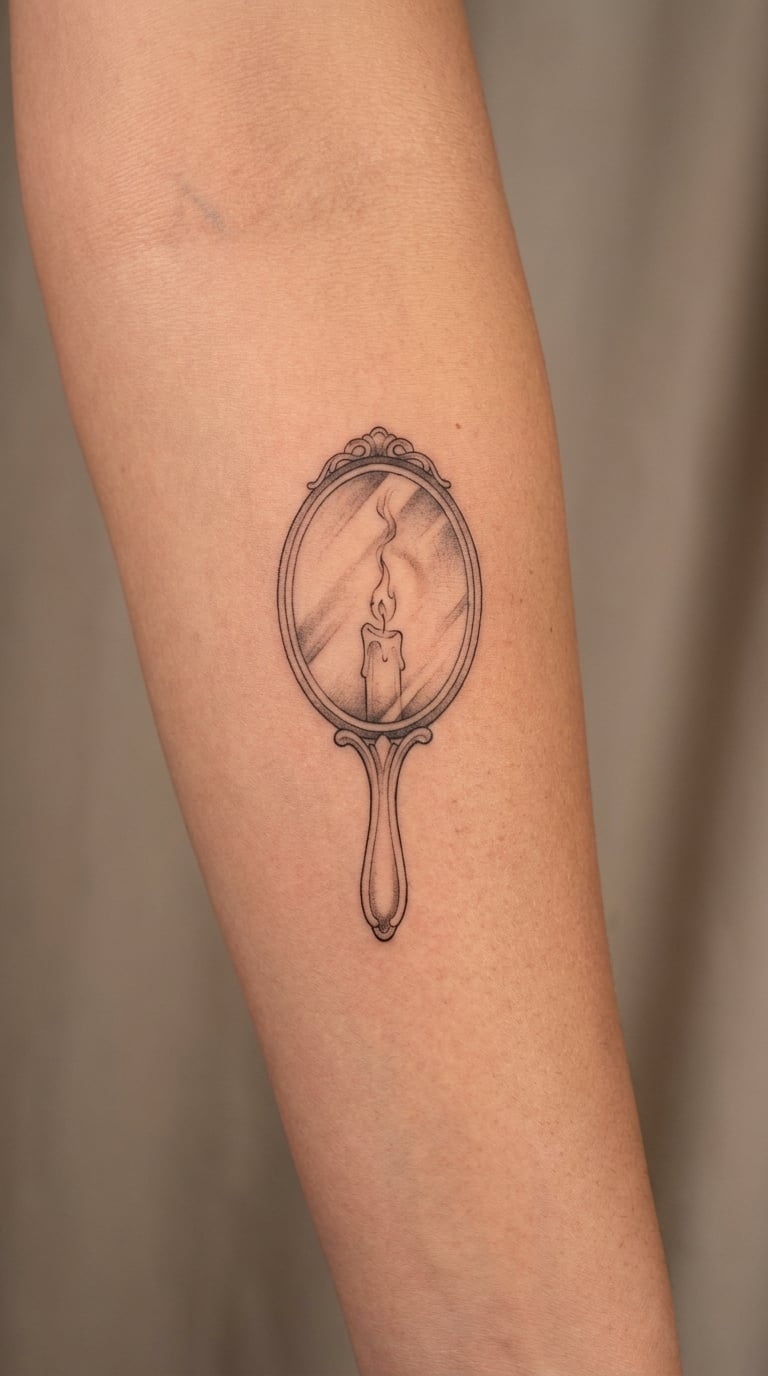
An oval hand mirror seen at a slight angle with one burning candle inside the glass, drawn in fine line with subtle grey highlights standing in for reflection. The mirror frame gives the design a boundary that keeps it from becoming a full scene.
A mirror turns a candle into a self-portrait of sorts, and the frame makes it easy to keep the composition to a size you can actually place.
Placement: forearm, on skin flat enough for the oval to sit level. Size: 3.5 inches (9 cm). Style: trompe-l’oeil fine line. Pain: medium, and the frame outline is a long continuous line that rewards a steady hand. The grey highlights inside the glass are the parts that fade, so they need to be laid in heavier than you would like. Make it yours: add a hand holding the mirror from below, or reflect a second small candle instead of one.
25. Minimal Candle with a Heart-Shaped Flame
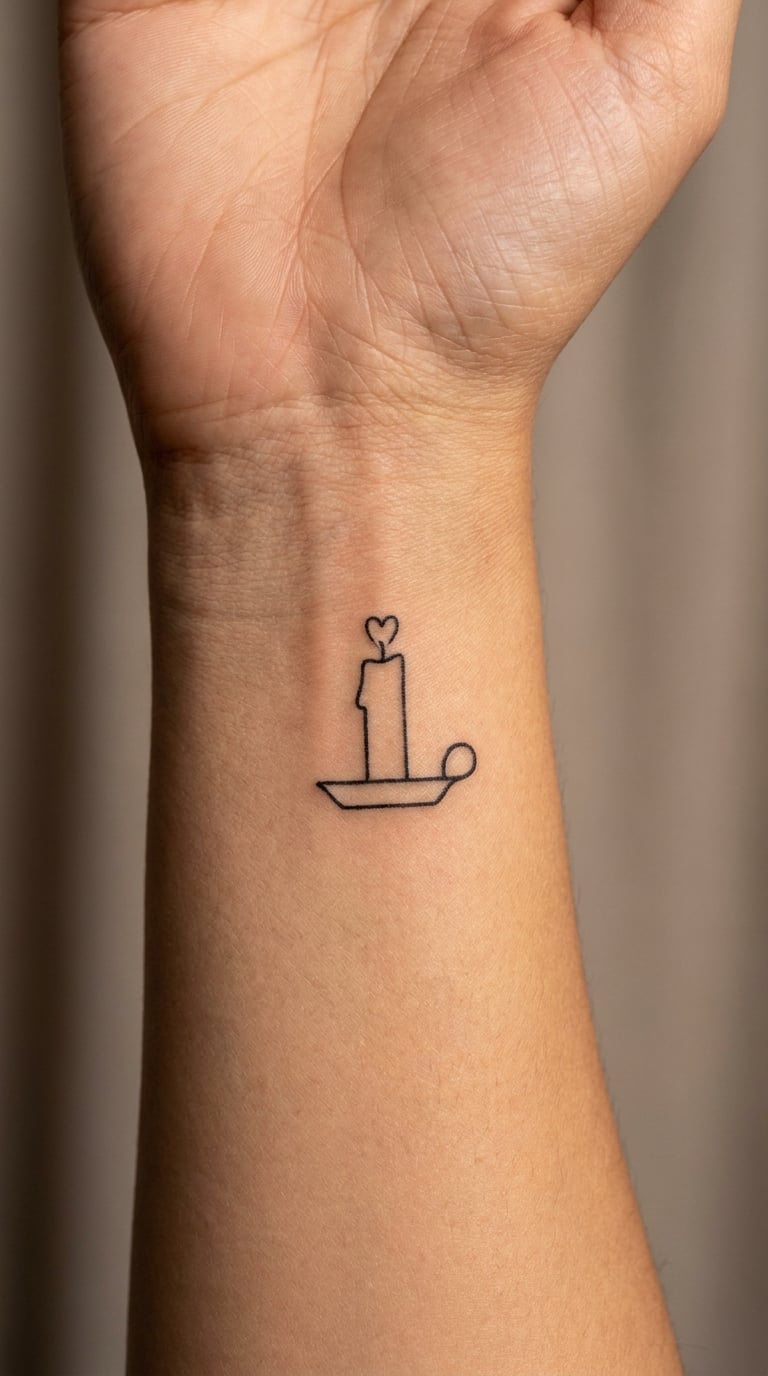
A single candle drawn with clean single-weight black lines, where the flame is a small heart shape sitting directly on the wick. There is no shading anywhere in the design, and that flatness is what keeps it readable at a small size.
It closes this list as the most straightforward first tattoo here, and a heart flame gives you one personal touch without complicating the drawing.
Placement: inner wrist or the rib area, both of which work with a design this simple. Size: 1.5 to 2 inches (4 to 5 cm). Style: minimal line art. Pain: low to medium, and the ribs hurt more than the wrist despite the design being simple. The heart outline is the only vulnerable line, so ask the artist to close the shape fully rather than leaving the point open. Make it yours: add a thin halo or a single dot, and keep the rest of the design untouched.
How to Choose the Right Design
Pick the line weight first. A one-needle line suits wrist and rib placements, while anything you want to survive heavy sun exposure needs a heavier line or a filled style such as blackwork or traditional.
Then look at the flame, because in every one of these 25 candle tattoo ideas the flame is where the detail sits. A solid flame survives almost anything, and a flame drawn with three hairlines will blur.
Count the extra elements. One candle plus one addition reads clearly at a small size, and a third element usually needs a bigger canvas than most people have free.
Match the complexity to the canvas. A wrist has less flat skin than a forearm, so a mirror or hourglass composition belongs on the arm while a single outline belongs on the wrist.
Check the placement against your day. Inner wrists and ribs show up in every handshake and every photograph, and behind the ear shows up only when you turn your head.
Finally, think about the ten-year version of the design, not the fresh one. A traditional or blackwork candle will look broadly the same in a decade, while micro-realism and fine lettering will not.
Cost and Session Time
Tattoo pricing in the US usually works by hourly rate with a shop minimum. Most studios quote a rate per hour that depends on the city, the shop and how long the artist has been working, and a small fine line candle is often quick enough to fall under the shop minimum, so the minimum is the real number on the day.
As a rough guide, US prices by size and complexity tend to land in these bands:
- Simple line-art candle, 1 to 2 inches, one colour: about $80 to $160, usually a 30 to 60 minute session that most shops bill at their minimum.
- Small candle with grey shading, a flower or a date, 2 to 3 inches: about $150 to $300, one to two hours.
- Blackwork or traditional candle with colour fills, 3 to 4 inches: about $250 to $500, two to four hours.
- Dense work such as the dotwork moths, the hourglass or the mirror reflection: about $350 to $700, three to five hours.
Shop minimums, city, artist experience and travel all shift those numbers, and custom work costs more than picking a design straight from flash. Treat any range you find online as a starting point, then ask your own artist for a quote in writing before you book.
Aftercare Basics
- Follow your artist’s aftercare instructions first, since they will match the style and the ink they used.
- Wash the area gently with clean water and unscented soap, then pat it dry rather than rubbing it.
- Keep it covered from sun and friction for the first couple of weeks, and skip tight clothing over a fresh forearm piece.
- Moisturise with a plain fragrance-free product once the skin has stopped feeling raw, and keep going through the flaking stage.
- Do not soak, swim or cover a healing candle tattoo with a tight bandage.
- Watch for anything spreading redness, swelling or discharge, and contact your artist or a doctor if it starts rather than settling.
Fine flame linework needs the most care of any design in this list, so protect the first two weeks properly and the small details tend to settle in where you wanted them.
Frequently Asked Questions
What does a candle tattoo symbolize?
A candle tattoo usually stands for light kept alive in difficult conditions: hope, remembrance, a person you carry, faith, or time passing. People also choose it simply because a flame is quiet and personal without needing a story. The meaning belongs to the wearer, not the design, so ask yourself what the light means to you before you book.
What does a burning candle at both ends tattoo mean?
A candle burning at both ends usually points to spending yourself completely, working too hard, or refusing to slow down. Some people wear it as a warning to themselves rather than a description. It is worth deciding honestly whether you want that reminder, because the design is blunt and people do read it that way.
Where should I put a candle tattoo?
The inner forearm suits most designs because it is flat, visible and easy to cover. The inner wrist works for small single-line candles, ribs suit minimal designs, and behind the ear suits micro work. Larger blackwork or mirror compositions need the upper arm or a wider area of forearm to sit level.
How small can a candle tattoo be?
A simple line-art candle works at about 1 inch (2.5 cm) tall. Below half an inch the flame and wick blur together within a few years, and behind the ear is the least forgiving spot for tiny detail. If you want fine detail rather than a plain outline, 1.5 inches (4 cm) is a more realistic minimum.
Is a candle tattoo a good choice for a first tattoo?
Yes, and it is one of the easier subjects to get right. A single outline candle on the wrist or behind the ear is quick, sits in a small area, and leaves room to add shading or a second element later if you want more. Book a consult and bring two or three references rather than a single image to copy exactly.
Do candle tattoos fade?
Fine line and micro-realism versions fade fastest, usually on the wrist and behind the ear where skin is thin and exposed. Blackwork, traditional and neo-traditional candles hold their shape far better. Whatever style you pick, fading is mostly a sun problem, so covering a healed forearm piece is the cheapest maintenance there is.
Conclusion
If this is your first tattoo, start with the minimal line-art candle or the heart-shaped flame version. Both are small, quick to heal and easy to sit with, and you can always add detail around them later.
If you are building a collection and want a candle that carries weight on its own, a blackwork candle with a large flame or a mirror composition will sit comfortably next to other work in a set of these 25 candle tattoo ideas. Take two or three references to the consult, and let the artist tell you which elements will hold up at the size you have in mind.