
22 Ram Skull Tattoo Ideas: Bold & Simple Picks (October 2026)
If you have been saving ram skull tattoo ideas for a while, you have probably noticed the same problem I do: almost every pin is the same frontal skull with two identical spiral horns, and half of them were drawn from a goat reference to begin with. This list is 22 genuinely different directions, from a 1.5 inch outline behind the ear to a 6 inch blackwork piece across the back of the arm, with honest notes on where each one sits best and how it ages.
Ram skulls work on skin because of the horn curl. That single spiral gives a strong, readable silhouette even when the rest of the drawing gets small, which makes the motif forgiving on awkward flat planes like the collarbone and the calf. A ram is also the Aries animal, so the design quietly doubles as a zodiac marker, though plenty of people come for the memento mori side of it and never mention the horoscope at all. Book early if you are planning around autumn, since this is one of the motifs that fills up weeks ahead. If you would rather start from a different animal skull, my longhorn skull tattoo ideas and cow skull tattoo ideas with flowers guides cover the wider horn shape.
22 RAM Skull Tattoo Ideas: Quick Guide
| Idea | Style | Best placement | Size | Pain |
|---|---|---|---|---|
| 1. Minimal fine-line outline | Fine line | Inner forearm | 2 in (5 cm) | Low |
| 2. Curled-horn side profile | Black and grey | Outer upper arm | 3 in (7.5 cm) | Medium |
| 3. Geometric ram head | Geometric | Centre chest | 3 in (7.5 cm) | Medium |
| 4. Floral wrapped ram skull | Blackwork with colour | Outer forearm | 4 in (10 cm) | Medium |
| 5. Traditional American ram skull | Traditional | Calf | 3 in (7.5 cm) | Medium |
| 6. Blackwork horned skull | Blackwork | Back of upper arm | 5 in (13 cm) | High |
| 7. Micro-realism weathered skull | Micro-realism | Inner bicep | 1.5 in (4 cm) | Low |
| 8. Watercolour ram skull | Watercolour | Shoulder | 3 in (7.5 cm) | Medium |
| 9. Dotwork skull and horns | Dotwork | Forearm | 3 in (7.5 cm) | Low |
| 10. Anatomical skull study | Anatomical realism | Outer forearm, vertical | 4 in (10 cm) | Medium |
| 11. Mountain behind a skull | Fine line with landscape | Outer upper arm | 3 in (7.5 cm) | Medium |
| 12. Crescent moon and ram skull | Fine line | Inner forearm | 2.5 in (6.5 cm) | Low |
| 13. Small skull behind the ear | Minimal black | Behind ear | 1.5 in (4 cm) | Medium |
| 14. Skull above the collarbone | Black and grey | Collarbone | 3.5 in (9 cm) | Medium |
| 15. Stag and ram split design | Fine line symmetry | Upper chest | 5 in (13 cm) | Medium |
| 16. Celtic knots around horns | Ornamental blackwork | Shoulder | 3 in (7.5 cm) | Medium |
| 17. Mandala surround skull | Geometric ornamental | Upper back | 4 in (10 cm) | High |
| 18. Compass and ram skull | Fine line symbolic | Outer forearm | 3 in (7.5 cm) | Medium |
| 19. Western skull with sunburst | Old western colour | Forearm | 3.5 in (9 cm) | Medium |
| 20. Gothic skull with roots | Blackwork gothic | Calf, vertical | 4 in (10 cm) | Medium |
| 21. Numbered or dated skull | Fine line with text | Inner forearm | 2.5 in (6.5 cm) | Low |
| 22. Matching twin skull | Fine line pair | Matching inner forearms | 2.5 in (6.5 cm) each | Low |
1. Minimal Fine-Line Ram Skull Outline
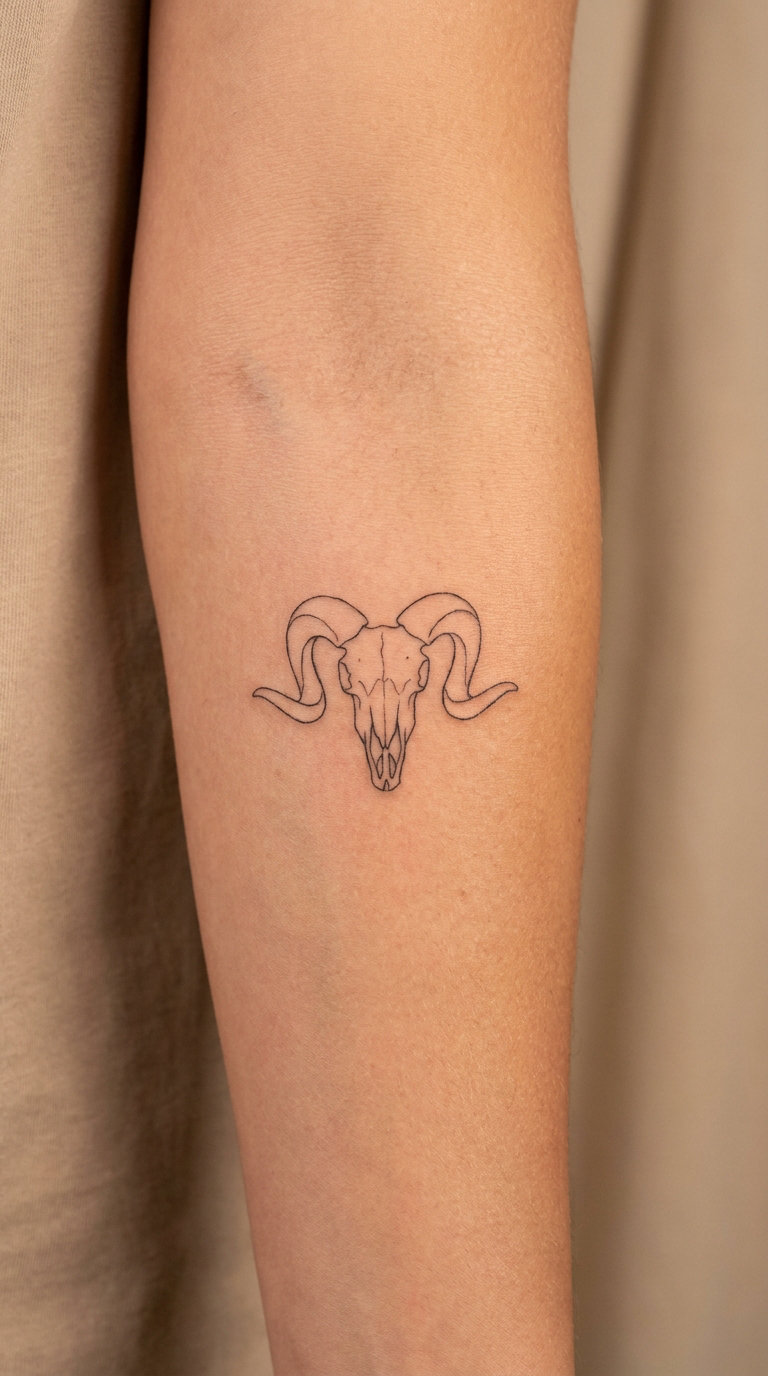
This is the simplest version that still reads as a ram: a single-weight outline of the skull with the horn curl traced in one unbroken line, no shading, no fill. People pick it when they want a first tattoo that does not shout, or a small addition to an existing arm piece. The thin line is the whole design, so the artist keeps the horn loop smooth rather than adding texture.
Placement: inner forearm, wrist crease side, or the flat of the upper inner arm. Size: 1.5 to 2.5 inches (4 to 6.5 cm) across. Style: fine line, single weight.
Pain: low on the inner forearm, though the inner elbow dips higher. Ageing note: fine line on the inner forearm softens noticeably within a few years, so pick a lineweight slightly heavier than feels right. Make it yours: add a single thin ring of tiny dots along the horn edge, or place a small date beneath the jaw line.
2. Curled-Horn Side Profile
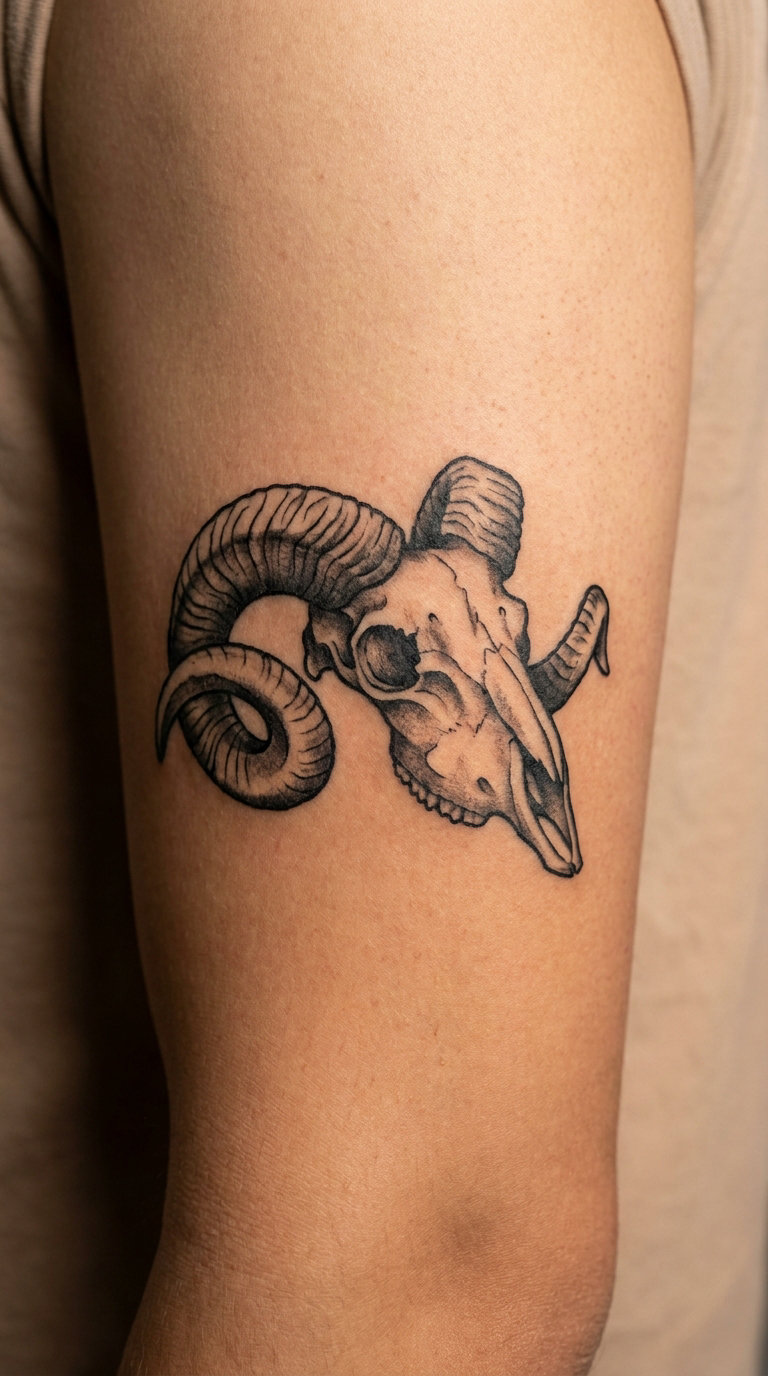
A profile view is the most honest way to show a ram, because the horn spiral is fully visible from the side. The artist exaggerates the curl and lets one horn overlap the other slightly, which gives the piece movement instead of a flat mirrored look. Soft grey shading under the brow and inside the horn ridge adds depth without turning it into a realism piece.
Placement: outer upper arm or the side of the thigh, oriented so the horns point forward along the limb. Size: 3 to 4 inches (7.5 to 10 cm) long. Style: black and grey with soft shading.
Pain: medium, rising toward high where the piece wraps the bicep curve. Ageing note: the shaded horn ridge holds well, but the fine crease lines inside the spiral blur first. Make it yours: angle the skull downward slightly so it appears to charge, or add a short script word beneath it.
3. Geometric Ram Head
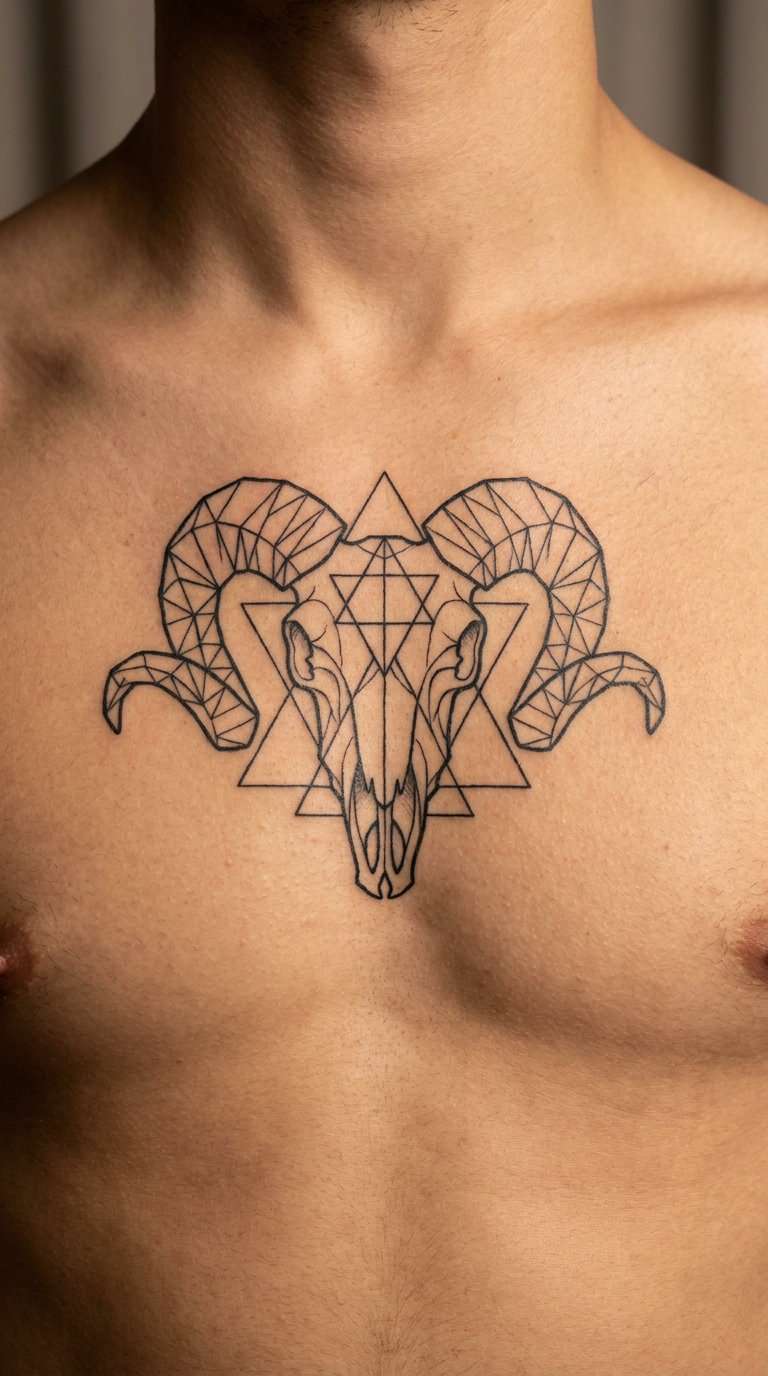
The geometric version rebuilds the skull from straight edges and angular polygons, so the horns become chains of triangles rather than organic curves. Symmetry is the whole point here, and a frontal view is what makes the mirroring readable. The result looks more like a badge or a crest than an animal, which suits people who like tattooing that reads as graphic design.
Placement: centre chest between the pecs, sternum for a smaller version, or the outer arm. Size: 2.5 to 3.5 inches (6.5 to 9 cm) wide. Style: geometric black linework.
Pain: medium on the chest, with the collarbone and upper sternum more sensitive than the area between the pecs. Ageing note: sharp interior angles stay crisp; tiny facets under a centimeter wide start to merge as the skin ages. Make it yours: fill every other triangle with solid black, or reduce the whole design to just the horns and the jaw.
4. Floral Wrapped Ram Skull
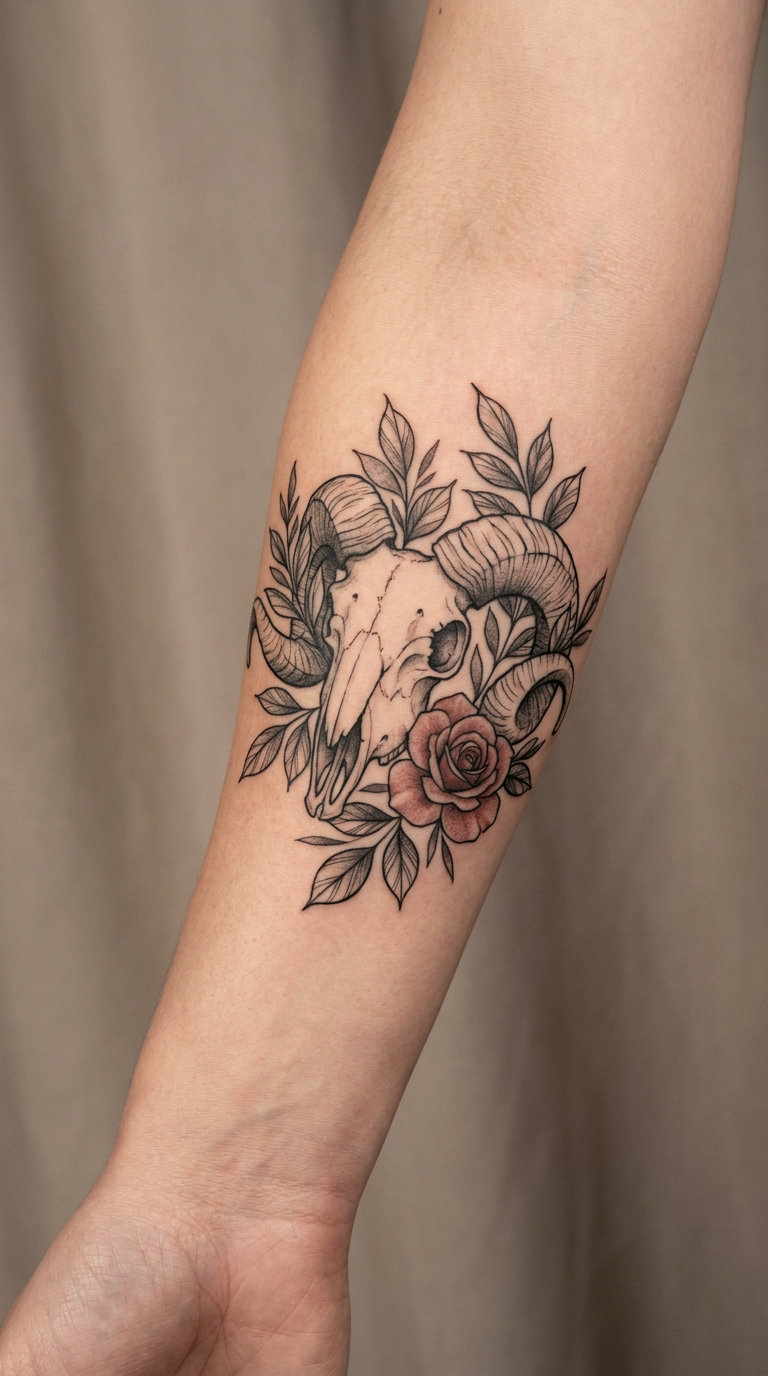
Here the skull stays realistic in the bone structure while leaves and stems weave around the horns and jaw, often rising from below rather than sitting on top. One muted colour, usually a deep red or a dusty pink, is enough; the rest stays black and grey so the piece does not turn busy. It is the most requested version for people who like skull work but not the hard edge of pure blackwork.
Placement: outer forearm or shoulder, where a long vertical shape has room to grow. Size: 3.5 to 4.5 inches (9 to 11.5 cm) long. Style: blackwork with a single colour accent.
Pain: medium across the forearm, and the stem lines over the rib of the bone can sting more than the flat bone plate. Ageing note: fine leaf veins fade before the skull does, so expect the stems to go soft first. Make it yours: use a flower native to where you grew up, or pick a species that matches a birth month.
5. Traditional American Ram Skull
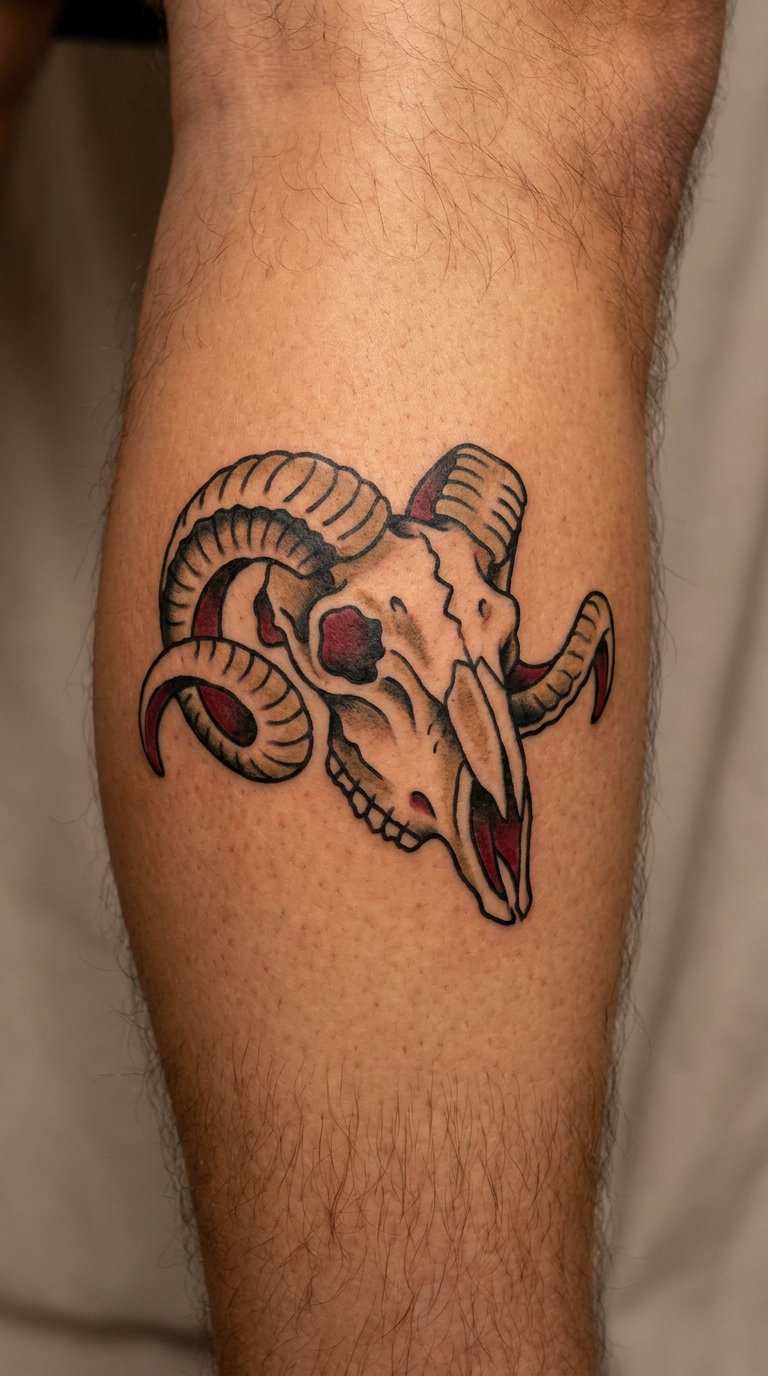
Traditional style means bold black outlines, a limited shading palette and colour that sits flat and slightly aged, closer to old flash than to a photograph. The skull is drawn front-on with symmetrical horns and a few deliberate shadow shapes under the cheekbones. Colour choices stay muted: oxblood red, mustard, forest green or a tired-looking tan.
Placement: calf, outer thigh, or the front of the shoulder. Size: 3 to 4 inches (7.5 to 10 cm) wide. Style: traditional American.
Pain: medium on the calf, less so on the outer thigh, and the calf muscle tightens if you flex during the shading passes. Ageing note: solid colour blocks stay strong, which is exactly why this style ages better than a shaded one. Make it yours: swap the standard red for a single colour pulled from an existing piece, or add a banner ribbon for a classic flash look.
6. Blackwork Horned Skull
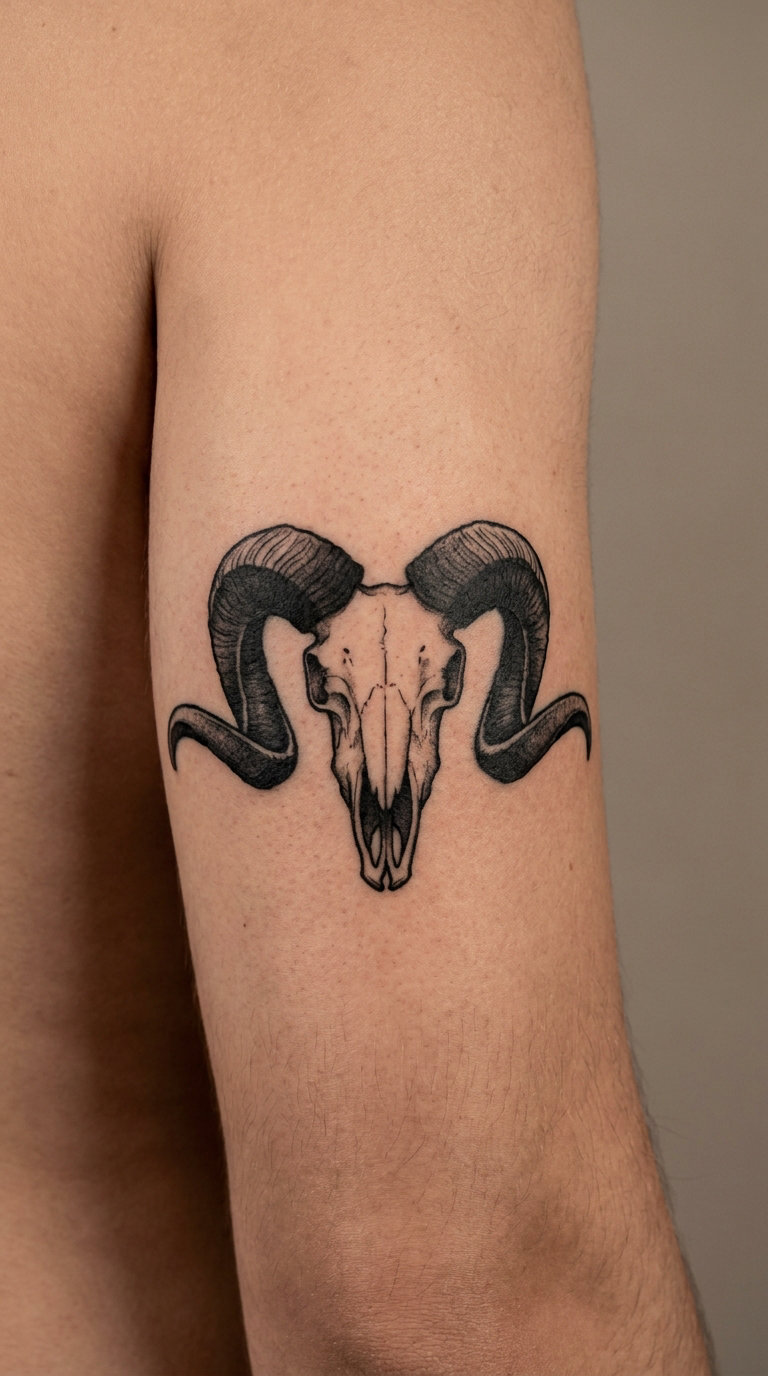
Blackwork is the boldest direction: large areas of solid ink with skin left as negative space for the teeth, eye sockets and horn ridges. On a ram skull the two dark horn sweeps frame a lighter skull in the middle, so the design carries itself even at a distance. This is the version tattooers call a statement piece and the one that most rewards a flat, wide surface.
Placement: back of the upper arm, outer thigh, or across the upper back. Size: 4 to 6 inches (10 to 15 cm) wide. Style: solid blackwork with negative space.
Pain: high, and it takes real time. The solid fills are deep work, and tattooers report horn curves and flat bone planes as some of the slower areas on the body. Ageing note: black can look patchy in the first few weeks before it settles, so give it the full healing window before worrying. Make it yours: carry the black out into the surrounding negative space as a smoke shape, or break one horn with a single white gap line.
7. Micro-Realism Weathered Ram Skull
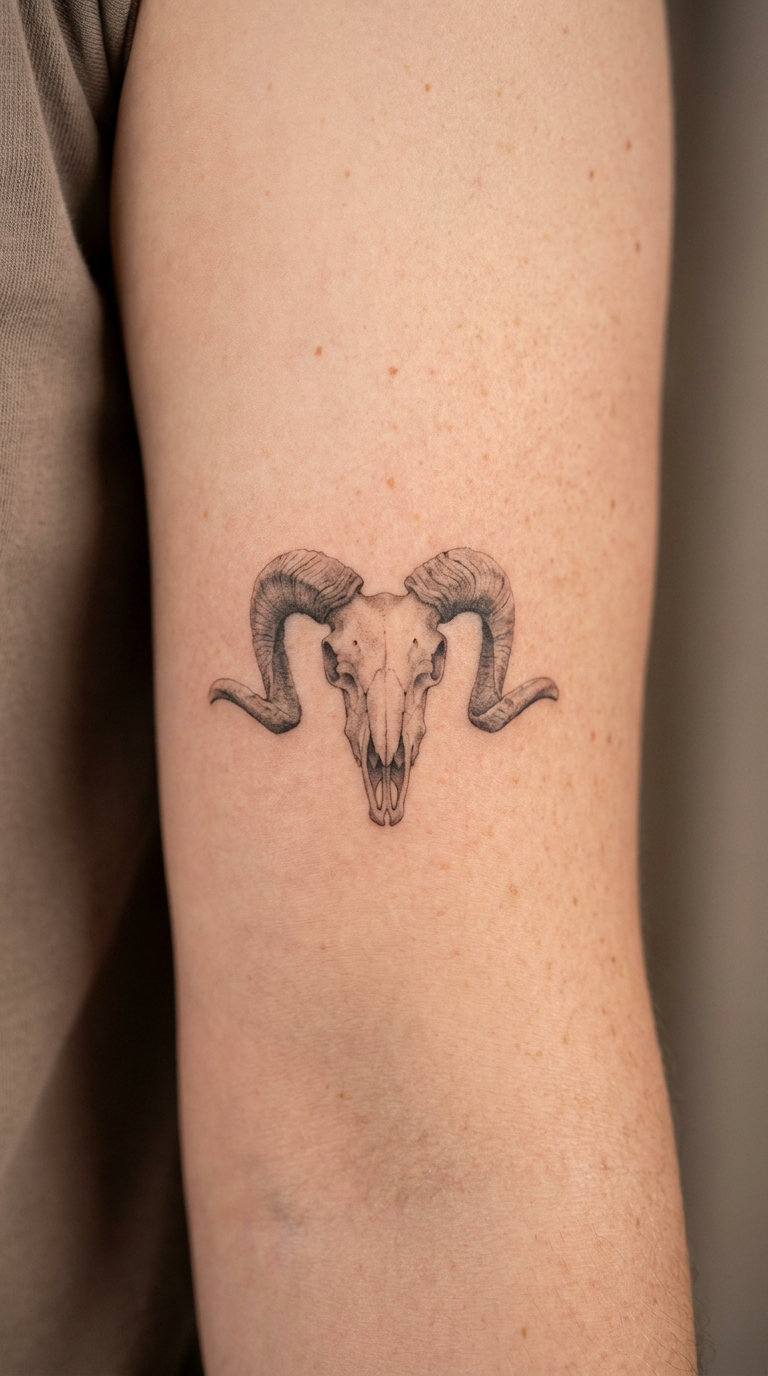
At this scale the design is mostly shadow: a soft grey suggestion of a skull with the horn curl described by a few dark lines rather than a full drawing. Weathered texture, cracks and porosity hint at the bone without turning into noise. It suits people who want a real-looking piece that still reads as small and quiet from a few feet away.
Placement: inner bicep, forearm, or behind the ear. Size: 1 to 1.5 inches (2.5 to 4 cm) long. Style: micro-realism in grey wash.
Pain: low to medium, quick, and mostly over in under an hour. Ageing note: this is the one size where detail really does blur, and the micro bone texture is usually the first thing to go soft. Make it yours: add one thin chain or cord line running out of the horn tip, or a single hairline crack pattern across the cranium.
8. Watercolour Ram Skull
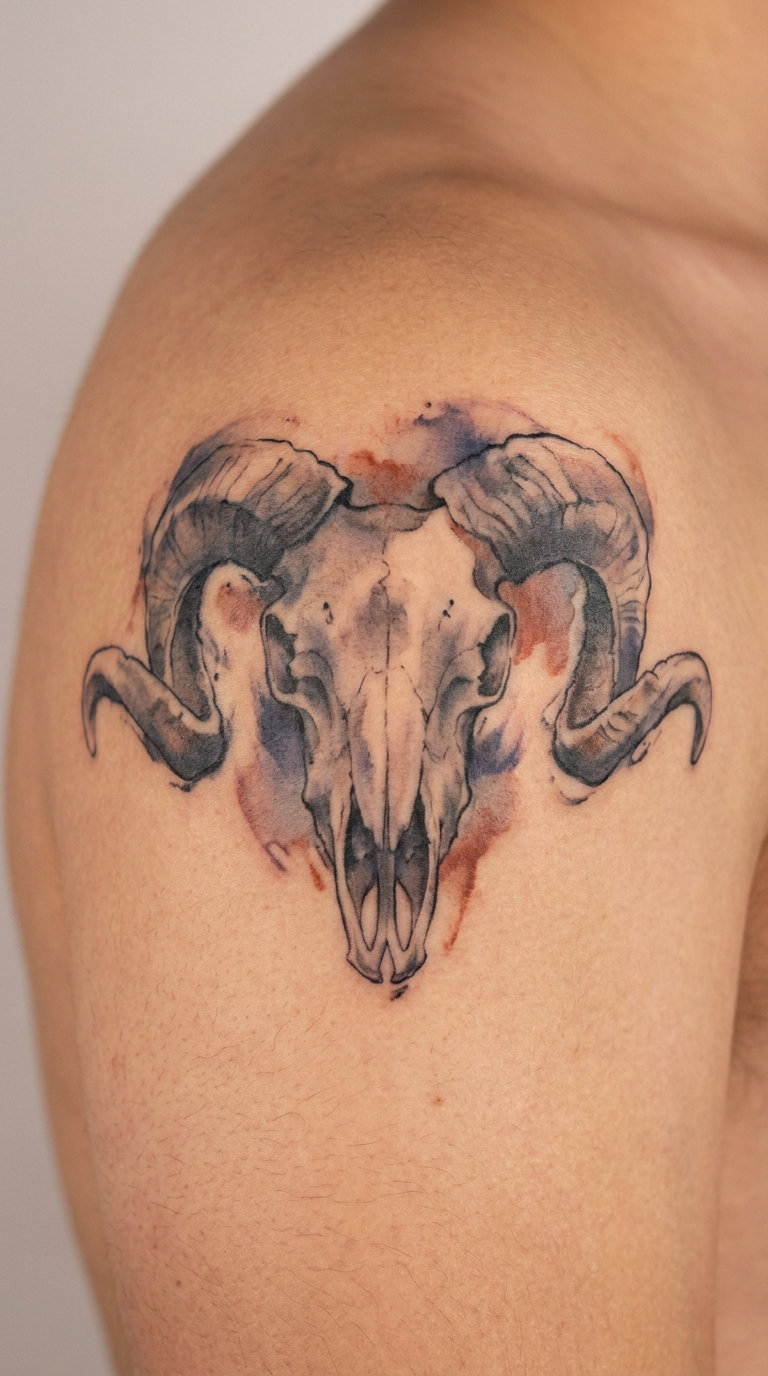
Watercolour work keeps the drawing loose, with edges that bleed and grey washes that pool unevenly, so the skull looks more painted than tattooed. Smoky greys do most of the work, with one or two muted colour bleeds such as indigo or rust drifting out past the horns. The style rewards a big flat area because the washes need room to spread.
Placement: shoulder, upper arm, or the upper back. Size: 3 to 4 inches (7.5 to 10 cm) wide. Style: watercolour with soft colour bleeds.
Pain: medium, since much of this is light shading work rather than deep lines. Ageing note: pale washes and colour bleeds lighten noticeably within a couple of years, so the design drifts softer over time. Make it yours: name a colour that means something to you and ask the artist to bleed only that one, or have the drips run downward toward the wrist instead of outward.
9. Dotwork Ram Skull and Horns
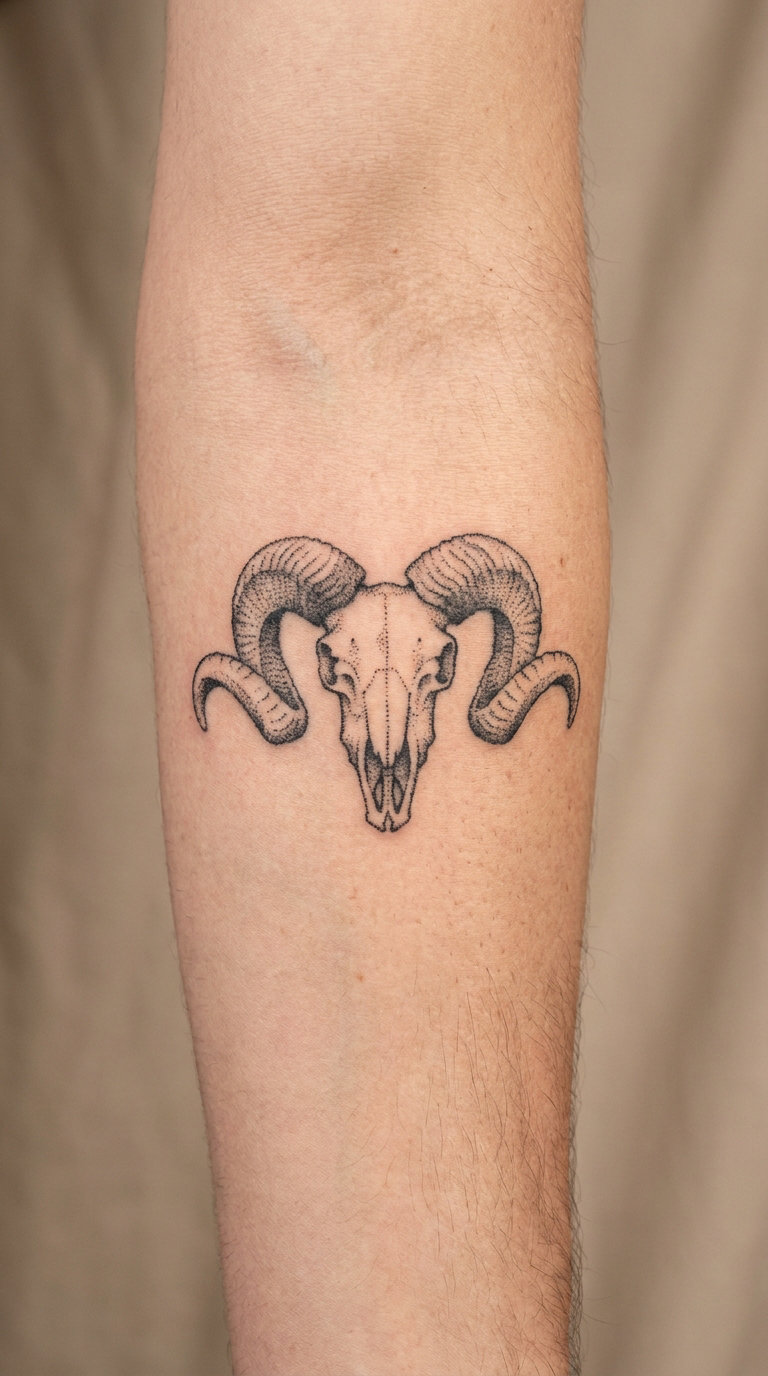
Dotwork builds the whole skull out of graduated dots, with density doing the work that shading does elsewhere. The eyes, cheek hollows and horn ridges read as clusters rather than shapes, and the two sides need to match closely or the piece looks lopsided. It is a slow, patient style that most artists build over more than one sitting.
Placement: forearm, upper arm, or the back of the calf. Size: 2.5 to 3.5 inches (6.5 to 9 cm) wide. Style: dotwork or stipple.
Pain: low to medium, but the session count is what tires you rather than the sensation. Ageing note: dotwork greys out over the years as the dots blur together, so a high-contrast version fades less than a soft one. Make it yours: ask for the dot density to run heavier at the skull and lighter at the horn tips, or add a scattered constellation of dots above it.
10. Anatomical Ram Skull Study
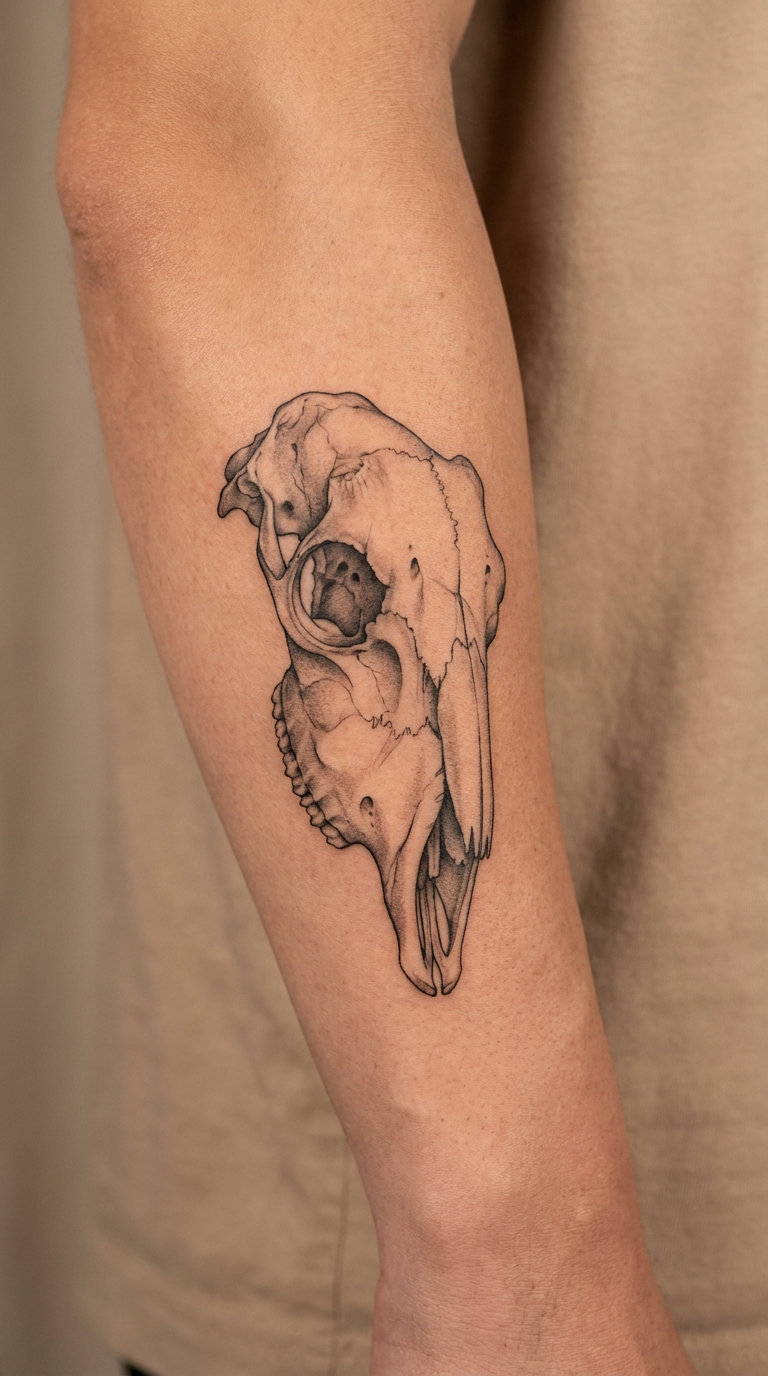
This one treats the skull as a study rather than a symbol: the bone plates, suture lines, sinus cavity and horn core are all described in layered grey, usually in a three-quarter or profile view. The result looks like a page lifted from an anatomy book and dropped onto skin. It suits people drawn to the science of the animal as much as to the imagery.
Placement: outer forearm running vertically, or the flat of the upper arm. Size: 3.5 to 4.5 inches (9 to 11.5 cm) long. Style: anatomical realism in black and grey.
Pain: medium over a long stretch of forearm. Ageing note: the mid-tone layering that sells the depth is the first thing to soften, so the piece gradually flattens. Make it yours: have the artist highlight one bone plate in a different grey so your own structure shows through, or pair it later with a second study of a different skull.
11. Mountain Behind a Ram Skull
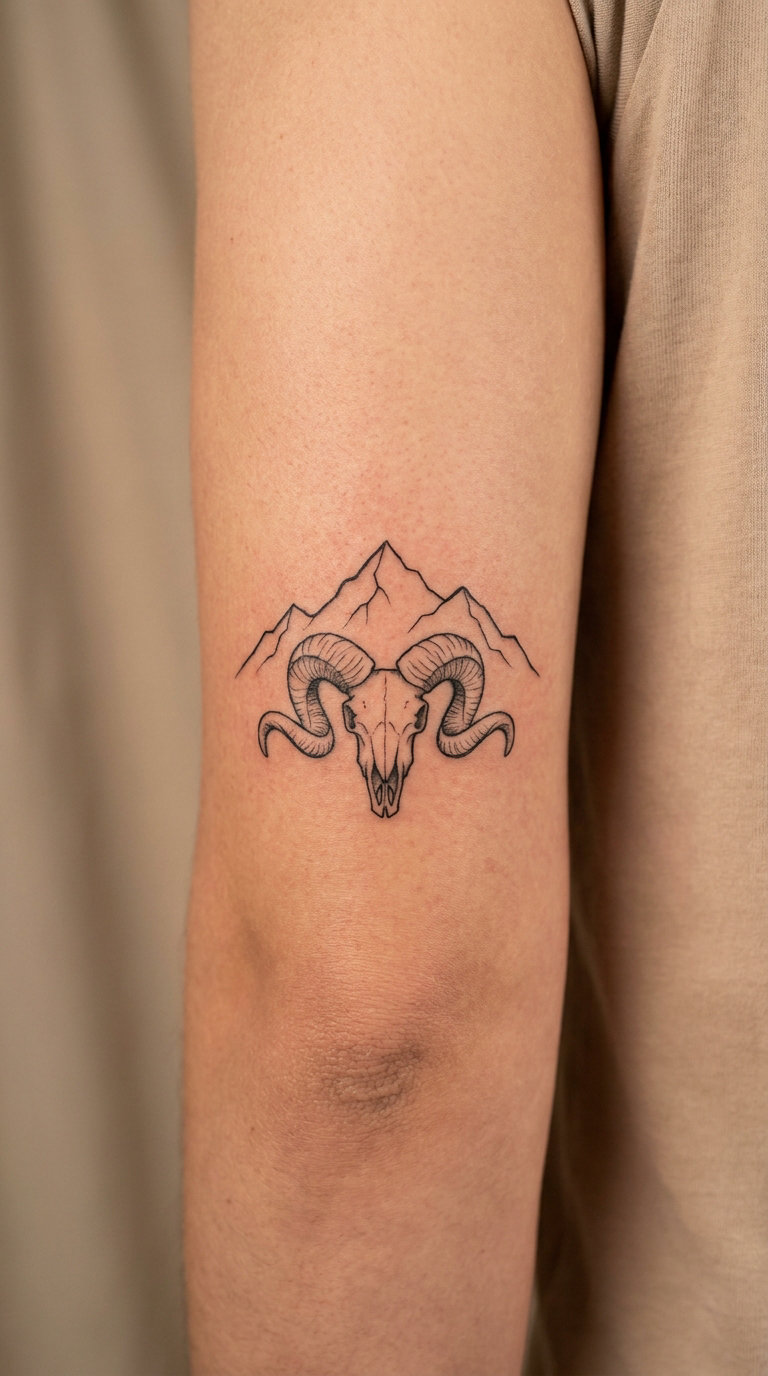
The horns are the problem in a composition like this, because they are the most detailed element on the animal. Artists solve it by keeping the skull simple and letting the mountain range do the work: a few clean peaks tucked directly behind the skull, framed so the outer curves of the horns echo the ridgeline. Nothing else gets added, and the restraint is what makes it read well.
Placement: outer upper arm, shoulder blade, or the back of the forearm. Size: 3 to 4 inches (7.5 to 10 cm) wide. Style: fine line with simple landscape.
Pain: medium on the arm, and the peaks sitting over the bony shoulder blade feel sharper than they look. Ageing note: this is a fine line design, so the ridgeline thins faster than the skull outline. Make it yours: give the artist one real peak from a place that matters to you and ask for that specific silhouette rather than a generic range.
12. Crescent Moon and Ram Skull
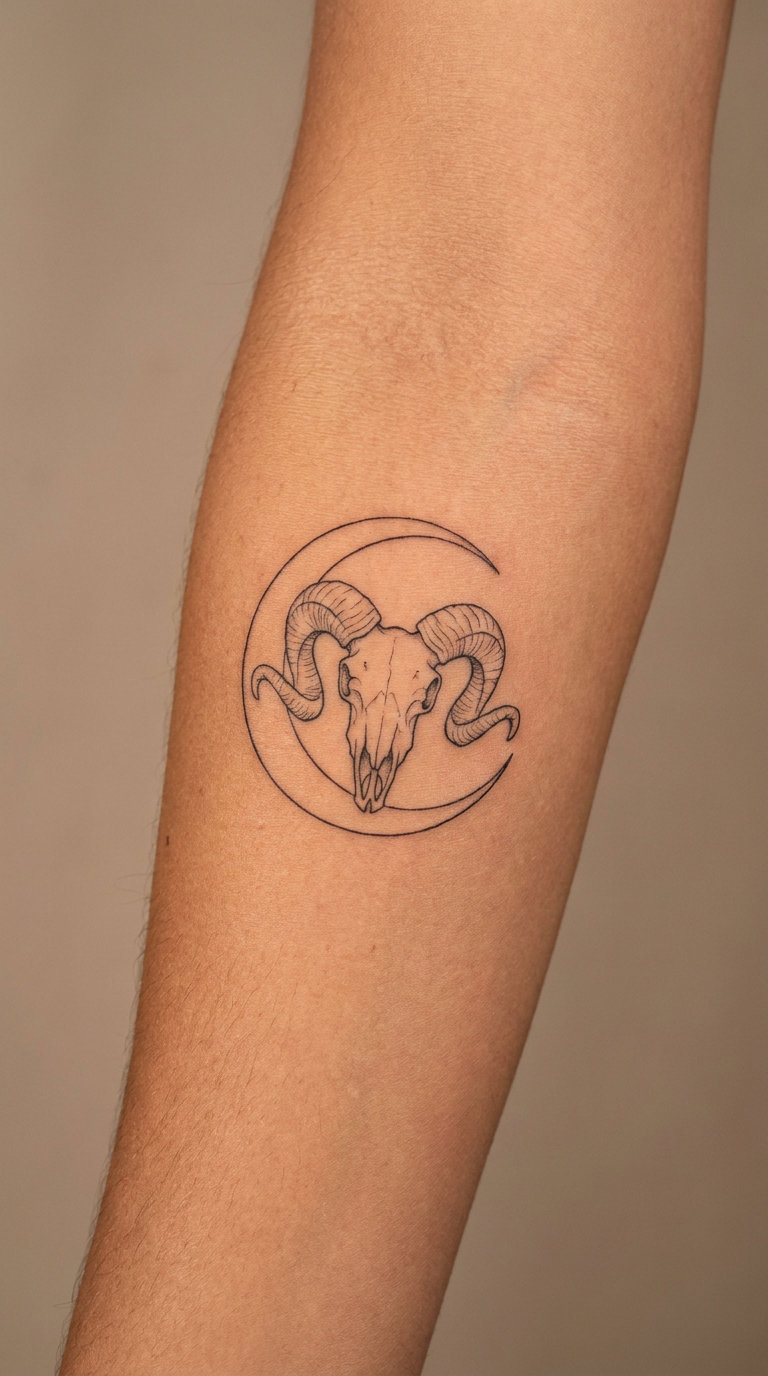
A slim crescent curving around the outer edge of the skull gives the design a frame, and the frame does the compositional work. Lineweights stay matched between the moon and the bone so neither element dominates, and the moon tips can be drawn as horns continuing the skull’s own curve. Ask for a crescent rather than a full moon so the piece stays narrow and wearable on a slim area.
Placement: inner forearm, wrist, or the inside of the upper arm. Size: 2 to 3 inches (5 to 7.5 cm) tall. Style: fine line.
Pain: low on the inner forearm, and the wrist area is a quick sit. Ageing note: matching lineweights matter more here than anywhere else, because a moon that thins faster than the skull looks like a mistake within a few years. Make it yours: add a couple of small stars along the outer crescent, or set a tiny stone in the hollow of the moon shape.
13. Small Ram Skull Behind the Ear
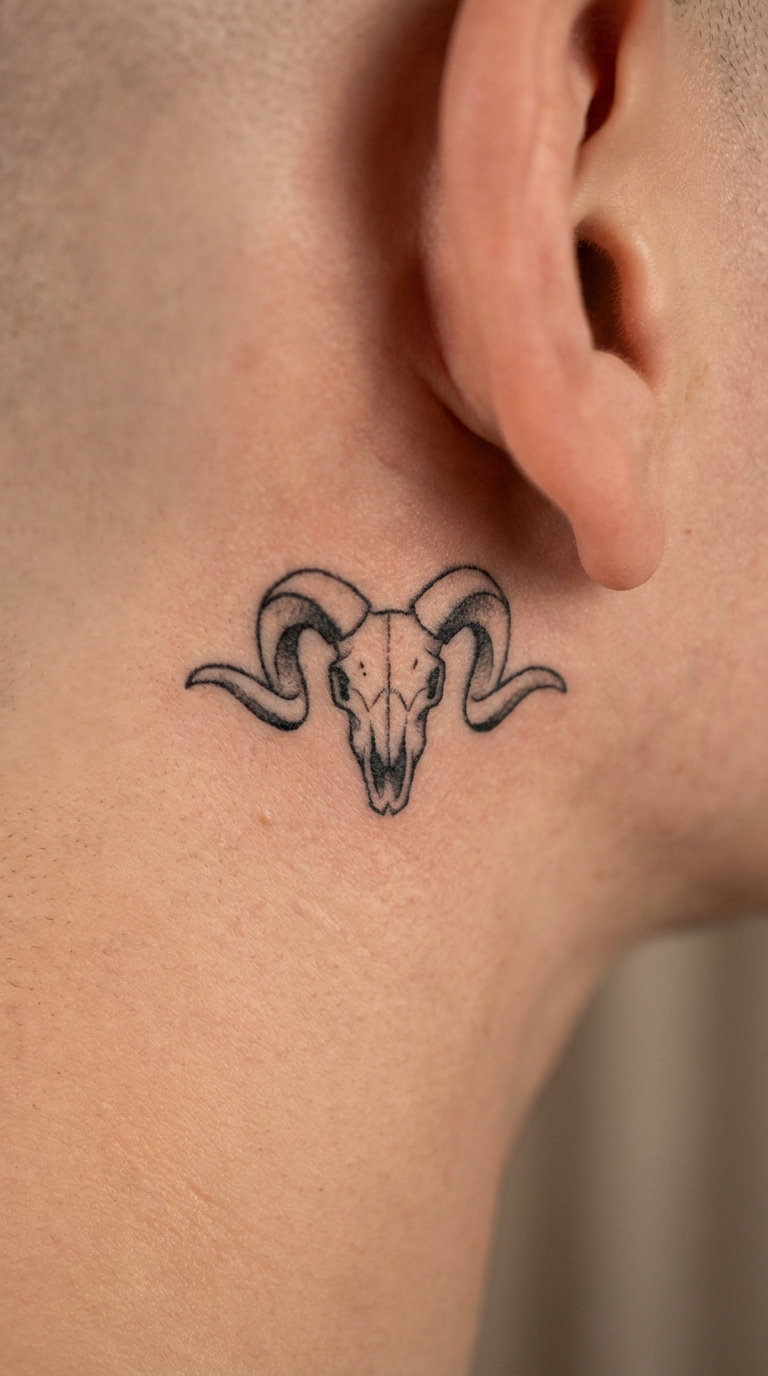
Behind the ear, a ram skull is reduced to the essentials: the dome of the cranium and two horn curls, done in simple black line or a small amount of fill. The piece mostly hides unless you push your hair back, and it sits exactly where the curve of the skull meets the neck, which gives it a natural lean. Sizes above 2 inches look heavy from the side, so this is one to keep genuinely small.
Placement: just behind the ear, or the small dip where the neck meets the jaw. Size: 1 to 1.5 inches (2.5 to 4 cm) wide. Style: minimal black line or single needle.
Pain: medium, because the spot has thin skin over bone and nerve endings sit close to the surface. Ageing note: a spot this small cannot hold fine internal detail, so simplified horn shapes hold up better than a realistic bone texture. Make it yours: run a thin line from the lower horn down behind the ear and around the neck, or add a tiny filled star beside it.
14. Ram Skull Above the Collarbone
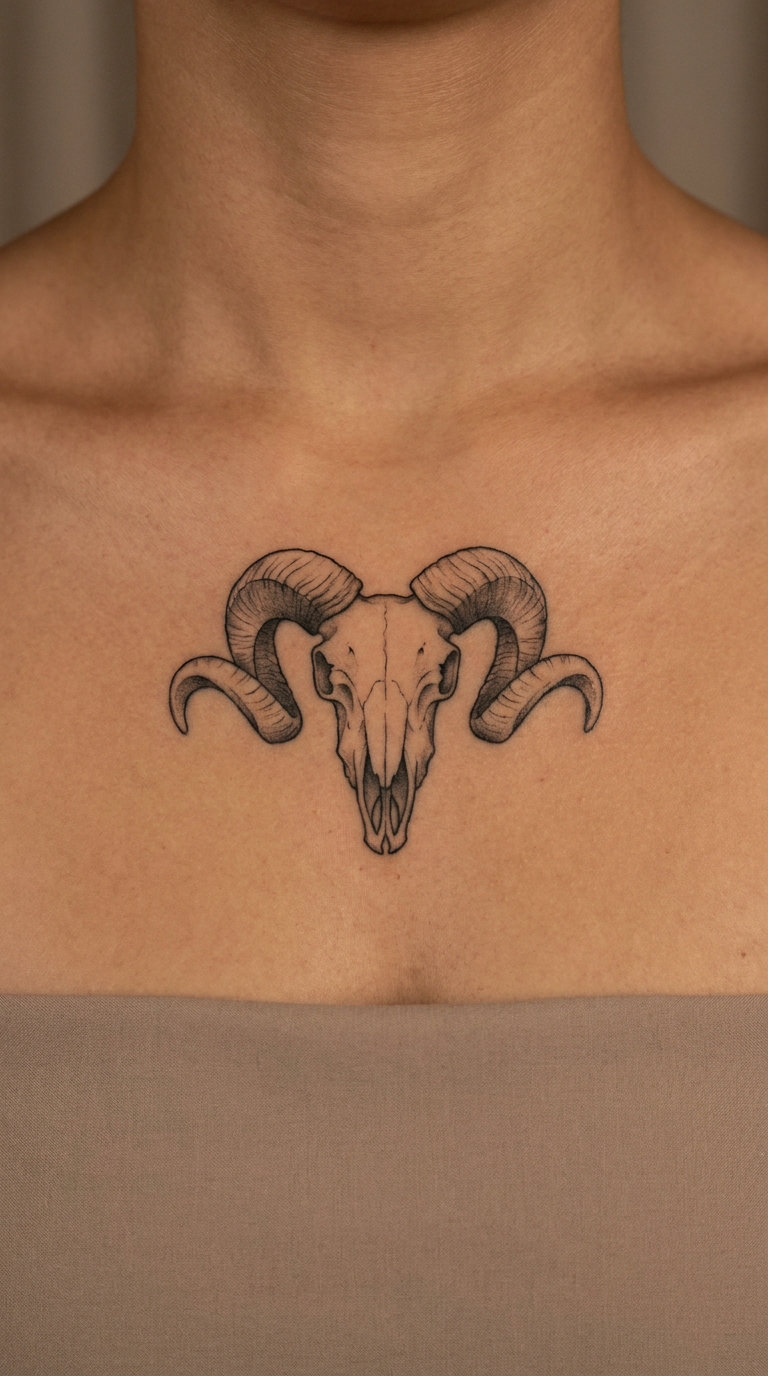
The collarbone is a horizontal plane, so a wide symmetric skull sits there naturally with the horns spreading along the bone and the jaw dropping into the hollow above the sternum. Artists keep the linework confident and the shading even, because any unevenness shows immediately across a flat horizontal surface. It is a bold placement that reads clearly on its own without a chest piece around it.
Placement: centred above one collarbone, or spanning the gap between them. Size: 3 to 4 inches (7.5 to 10 cm) across. Style: black and grey, symmetrical.
Pain: medium, and the bone ridge itself is more sensitive than the soft hollow beside it. Ageing note: the sun hits this placement more than most, so colour saturation drops faster here than on the upper arm. Make it yours: offset the skull slightly toward one shoulder rather than centring it, or add a thin laurel or branch line running along the collarbone.
15. Stag and Ram Skull Split Design
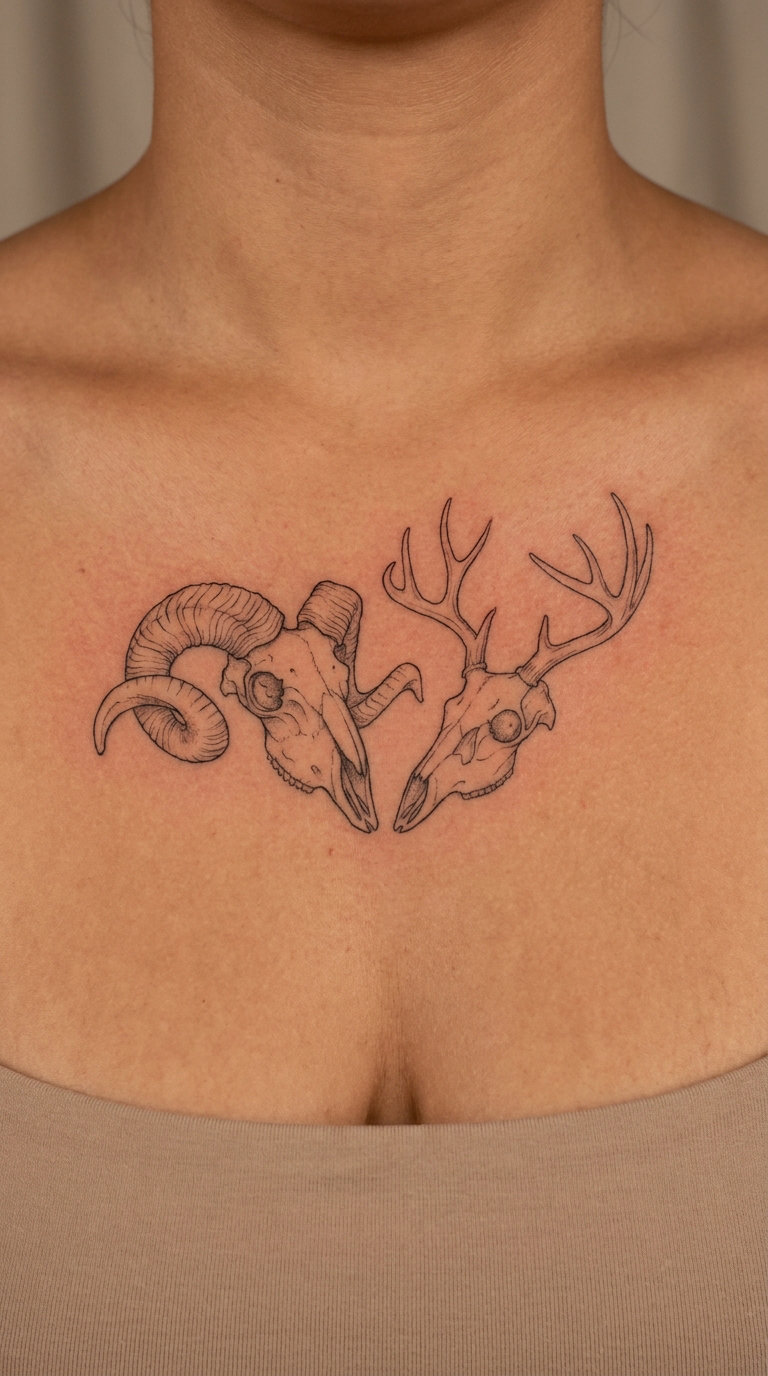
Two skulls facing each other, drawn in matching line weight with the horn shapes deliberately different: the ram’s tight spiral against the stag’s branching antlers. The contrast between a spiral and a branching rack is what makes the pair worth looking at, and the faces can nearly meet in the middle. It often means two people, two signs, or two stubborn personalities, but the wearer decides that.
Placement: upper chest across the pecs, or a wide back piece. Size: 4.5 to 6 inches (11.5 to 15 cm) across. Style: fine line with mirror symmetry.
Pain: medium to high, and this is usually a multi-session piece because of the total area. Ageing note: mirror symmetry drifts as skin changes over the years, so an artist can mirror the untouched side later if you want to refresh it. Make it yours: have the ram drawn slightly heavier than the stag, so the two pieces read as a pair without being identical.
16. Celtic Knots Around the Horns
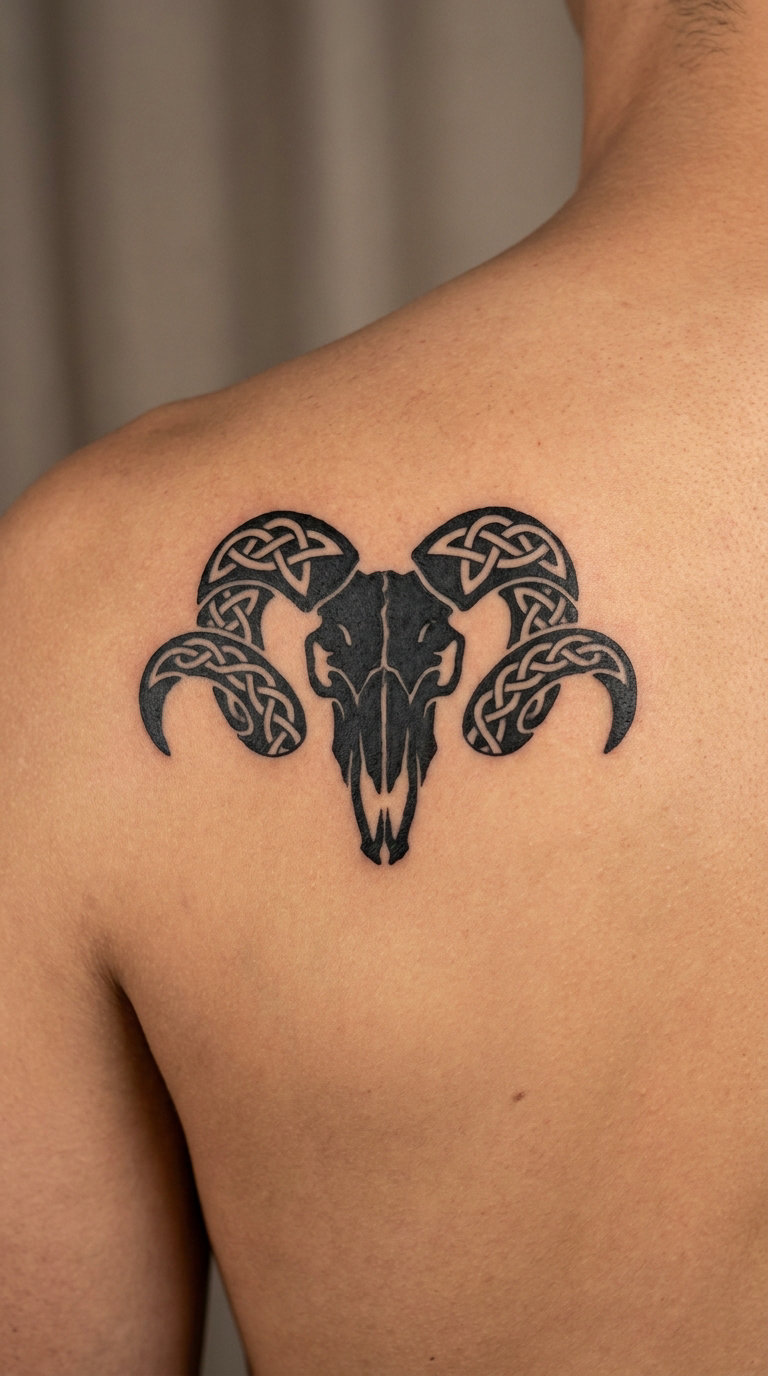
Two short interlaced knot sections wrapped around the horns give the design an ornamental edge without turning it into a heritage piece. Each section is one continuous line that passes over and under itself, so it needs a steady hand and a stencil or a freehand plan agreed beforehand. Keep the knotwork to the horns and leave the skull itself plain, otherwise the two elements fight.
Placement: shoulder, upper back, or the outer arm. Size: 3 to 3.5 inches (7.5 to 9 cm) wide. Style: ornamental black linework.
Pain: medium, and the interlaced crossings need a steady hand, so sessions often run longer than the size suggests. Ageing note: the crossings are where ink spreads most, so they soften into each other first. Make it yours: have the artist substitute a knot pattern that carries something personal, or add a single small clan or family mark inside one of the loops.
17. Mandala Surround Ram Skull
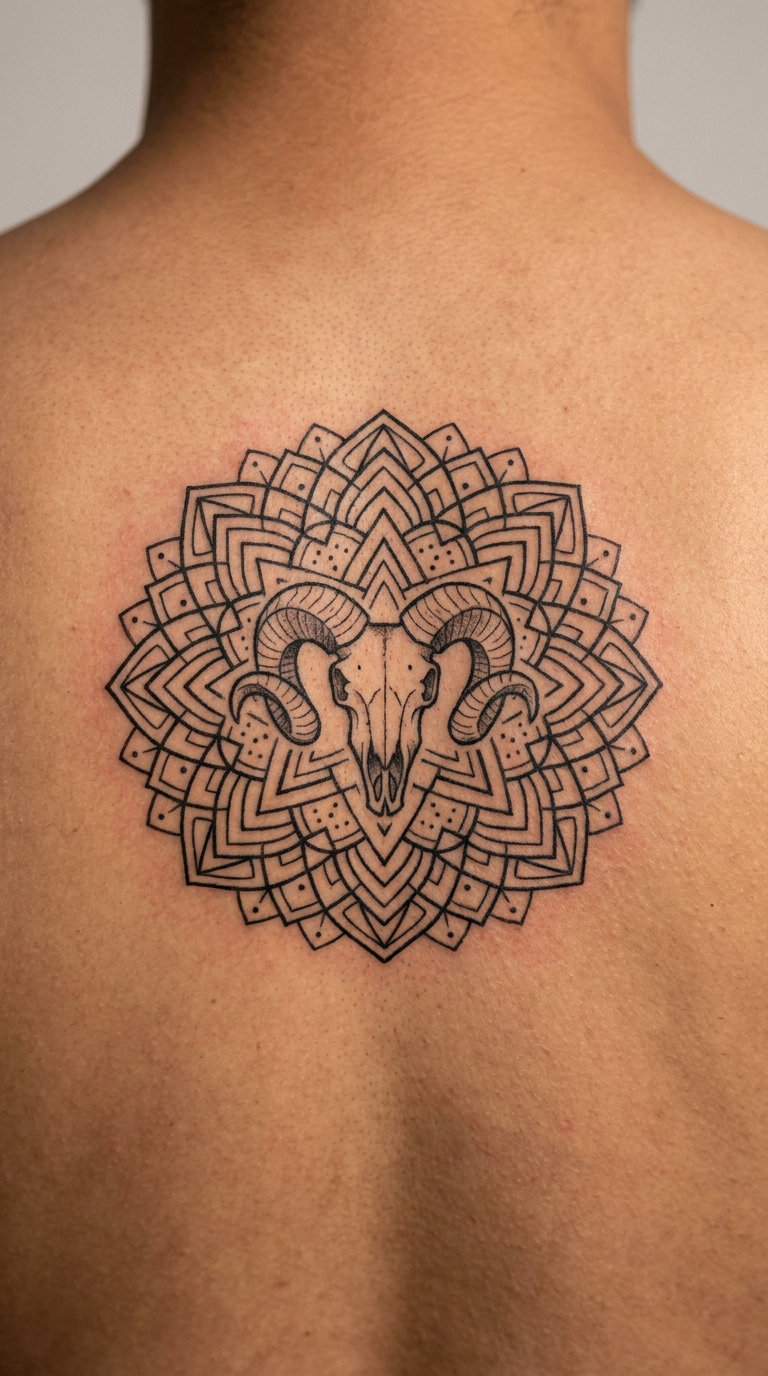
A circular mandala framing a frontal skull turns the design into a symmetrical emblem, with concentric rings of repeating geometry radiating out from the cranium. The skull stays simple because the surround is doing the visual work, and the circle makes the whole piece sit tidily on a flat back. It is a bigger, more ceremonial design than most, and it wants space around it.
Placement: upper or mid back between the shoulder blades, or the chest. Size: 3.5 to 5 inches (9 to 12.5 cm) wide. Style: geometric ornamental blackwork.
Pain: high, and the upper back is a large area to cover in one go, so expect it to be split across sessions. Ageing note: the outer thin rings are the first elements to lose definition, while the central skull stays legible. Make it yours: reduce the ring count and make the pattern irregular on one side only, or leave a gap in the circle where you and a family member later add a matching piece.
18. Compass and Ram Skull
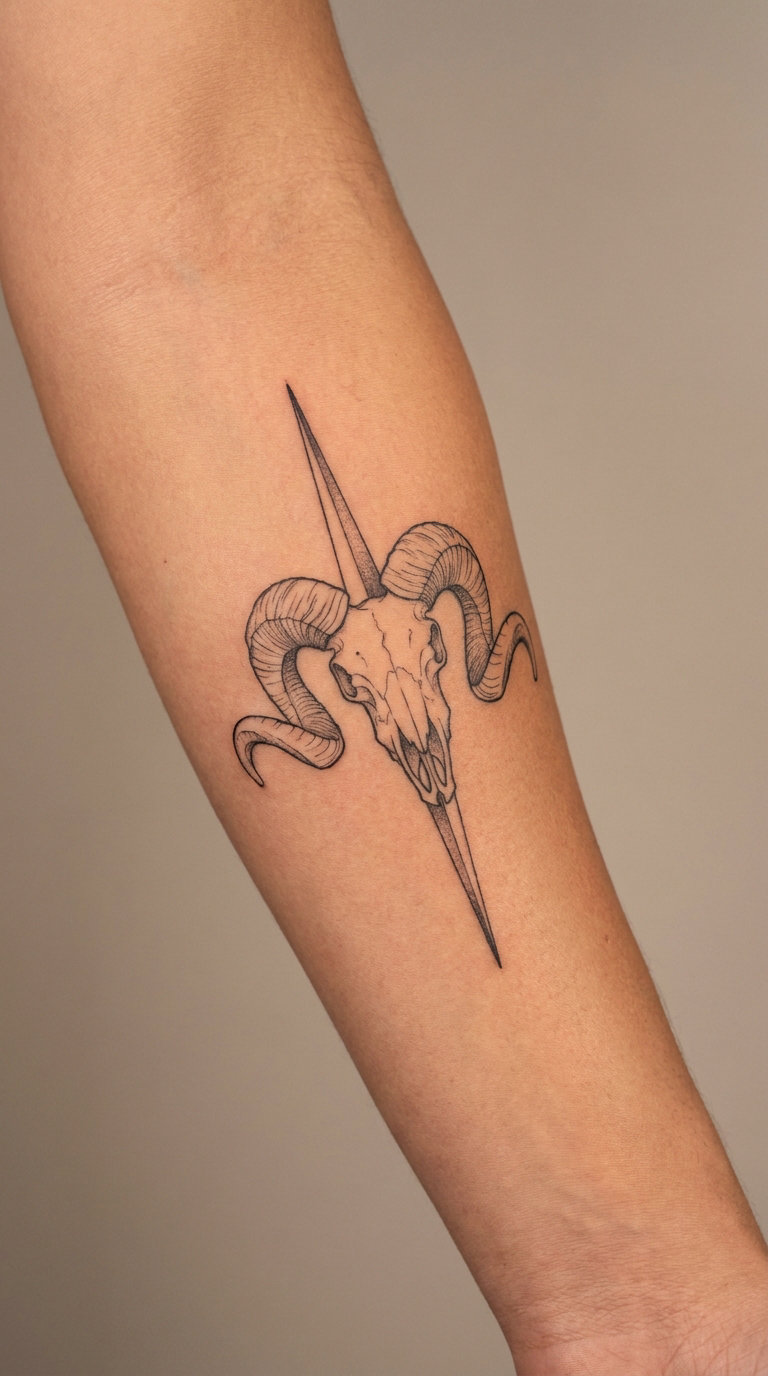
Rather than a full compass rose, this version uses one point, placed so a horn line extends into it or the skull sits inside an open compass frame. A single point is easier to keep symmetrical than four, and it makes the design read clearly at small sizes. It works well for anyone marking a direction, a move, or simply a stubborn sense of where they are going.
Placement: outer forearm, upper arm, or the chest. Size: 2.5 to 3.5 inches (6.5 to 9 cm) wide. Style: fine line symbolic.
Pain: medium on the forearm, with the point’s tip landing on nerve-dense areas if you angle it toward the elbow. Ageing note: a thin compass point fades faster than the skull, so the two halves can drift in weight over time. Make it yours: have the point face a real bearing from the place you were born or the place you want to end up, and leave it at that.
19. Western Ram Skull with Sunburst
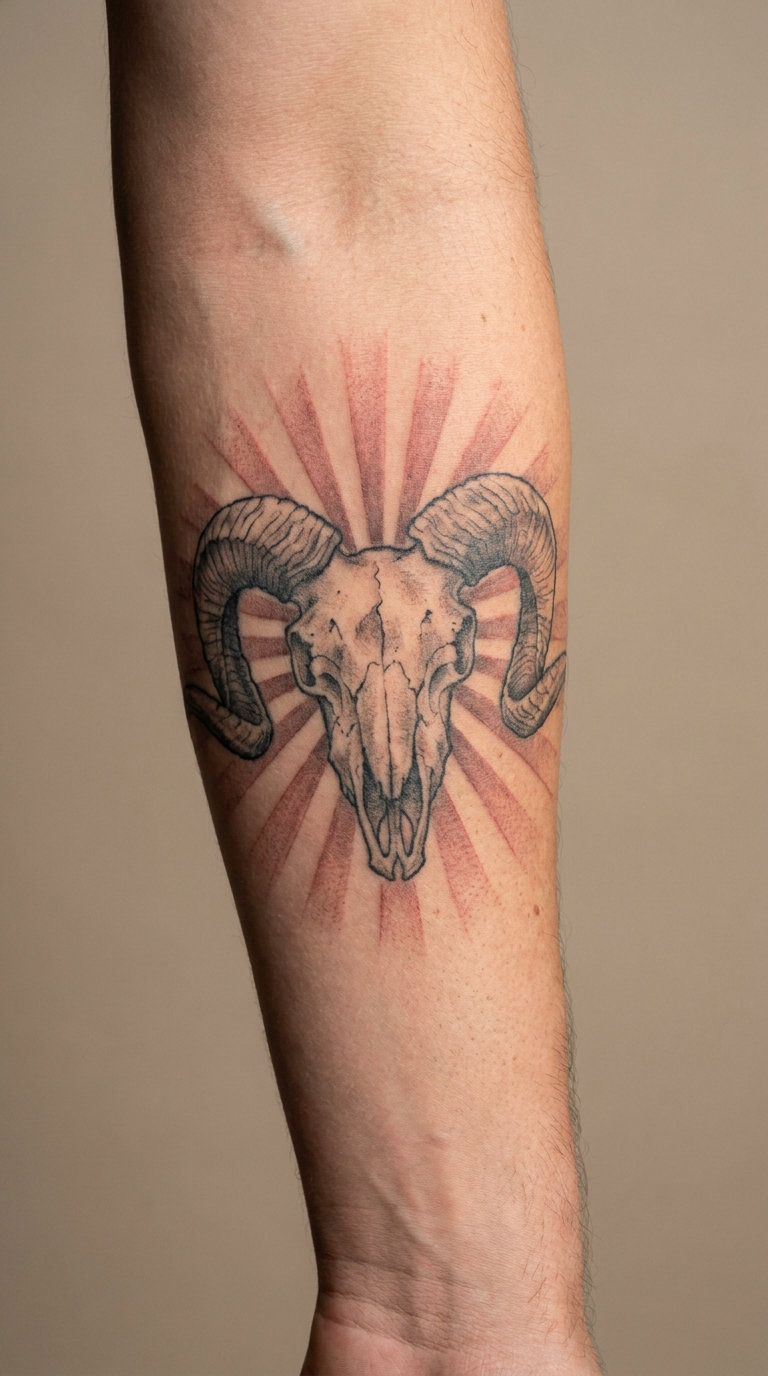
The old western look comes from a limited number of rays set behind the skull, a heavy dark outline, and colour that looks worn rather than fresh. Muted red is the classic choice, sometimes with a second warm tone, while the skull itself stays pale against the rays. It reads like a 19th century poster, and the restraint is why it feels period-correct instead of modern.
Placement: forearm, chest, or the front of the shoulder. Size: 3 to 4 inches (7.5 to 10 cm) wide. Style: old western colour.
Pain: medium, and the shaded rays over the forearm bump are more noticeable than the skull itself. Ageing note: flat colour blocks hold better than shaded gradients, so this style stays readable longer than most. Make it yours: restrict the rays to a half circle so the skull seems to rise rather than sit inside a badge, or age the colour deliberately so the reds look sun-faded.
20. Gothic Ram Skull with Roots
A detailed skull emerging from tapering roots, with thin tendrils running down into the skin and bare earth shading beneath, gives the design a heavier gothic weight than a plain skull. The linework is the challenge: hairline root lines have to hold while the skull above stays solid, and that mix takes patience. Vertical layouts suit it because the roots want somewhere to travel.
Placement: calf, forearm, or the back of the upper arm. Size: 3.5 to 5 inches (9 to 12.5 cm) long. Style: blackwork gothic.
Pain: medium on the calf, higher over the inner calf near the knee. Ageing note: the thinnest root lines will blur first, and heavy black that looked solid fresh can lighten a shade in the first months. Make it yours: have the roots wrap around a wrist or ankle band, or add a single bare branch silhouette behind the skull for depth.
21. Numbered or Dated Ram Skull
A small skull with a date or set of initials beneath it works because the text gives the design a hierarchy: the skull reads first, the numbers carry the meaning. The number style matters more than people expect, so pick something with even stroke widths, whether that is a plain sans-serif, a hand-drawn style, or something older-looking. Stacked dates work better than a long row, which turns into a blur on a narrow placement.
Placement: inner forearm, wrist, or the calf. Size: 2 to 3 inches (5 to 7.5 cm) tall including text. Style: fine line with lettering.
Pain: low to medium, and text placement along the inner forearm line is a quick sit. Ageing note: lettering fades faster than line art on the inner arm, so expect to need a touch-up on the numbers within a few years. Make it yours: use a date only you recognise, or set the numbers in a ring around the skull so the piece works as a seal.
22. Matching Twin Ram Skull Design
Matching tattoos for two people usually fall into two camps: identical copies, or pieces that clearly belong together without being the same drawing. The second version ages better and suits people with different body plans. Coordinating them means agreeing on line weight, size range, horn direction and a shared detail, then letting each artist place the piece on the anatomy that suits them.
Placement: matching inner forearms, or one on the arm and one on the ankle for people who want the pair to be less obvious. Size: 2 to 3 inches (5 to 7.5 cm) each. Style: fine line, complementary.
Pain: low on the inner forearm, and small fine line pieces finish fast. Ageing note: the two pieces will not fade at the same rate, since skin, sun exposure and ink depth all differ, so expect to need one touch-up before the other. Make it yours: give each skull a different horn curl count and keep the line weight identical, or have both face inward toward the wrist so the pair reads as one gesture.
How to Choose the Right Design
Most disappointing ram skull tattoos are not bad drawings. They are good drawings in the wrong style for the size, the skin, or the body part. Run through these five checks before you commit to a reference.
- Line weight against size. If the finished piece is under 2 inches (5 cm), everything has to be simplified. Single-weight line or solid black; nothing in between.
- Horn span against canvas. Measure the horn curl across, not the skull height. A wide horn span is the dimension that makes a piece run out of room on a forearm.
- Detail level against skin texture. Bone texture, cracks and pores need at least half an inch of space to stay visible. On the calf and the upper arm you have it; on the inner wrist you do not.
- Contrast against the area. Bold solid black reads best on flat, unbroken skin. On a joint, a ribbed forearm or an area with existing ink, soft grey shading sits better.
- Symmetry against the design. Frontal mirrored skulls are the classic look and the hardest to keep matched. A profile or three-quarter view removes the problem and usually reads more naturally on skin.
At the consultation, bring more than one reference and be specific about which part you actually like. Artists on tattoo forums repeatedly ask clients to bring a front view and a side view with the horn curl clearly visible, on a plain background, because most reference photos that circulate online are goat skulls with straight backward horns. That mix-up is the single most common reason a finished piece reads as a goat or an antelope. If you have drawn anything yourself, bring the drawing; tattooers say they would far rather work from your reference than substitute stock flash and hope you like it. Ask to see healed work, not fresh work, and ask the artist how many sessions they think it will take. Honest answers are a good sign.
How to Choose a Size for 22 RAM Skull Tattoo Ideas
Match the design to the room you have. A micro piece at 1 to 1.5 inches (2.5 to 4 cm) works when the design is mostly line and silhouette, and it is the usual choice for a first ram skull. Medium versions at 2.5 to 4 inches (6.5 to 10 cm) are where black-and-grey shading starts to earn its place and where horn detail holds up for years. Large pieces at 4 inches and up are for wide horn spans, scenery, mandalas and anything with an environment around the skull; the 5 inch blackwork and split stag-and-ram designs on this list need that space. If the reference you love is a large piece, ask the artist what it looks like scaled down rather than abandoning it. Plenty of great compositions translate to a 3 inch version with a simpler surround.
Cost and Session Time
Rates vary more for this motif than almost any other, because a ram skull can be a one-hour fine line piece or a full-day blackwork session. In the US, tiny pieces of 1 to 1.5 inches generally fall somewhere around 100 to 250 dollars, small pieces of 2 to 3 inches around 200 to 500, medium pieces of 3.5 to 4.5 inches around 400 to 900, and large pieces of 5 inches or more from 800 up into the low thousands. Those numbers move with hourly shop rate, city, artist experience and shop minimums, so treat them as a range to argue with rather than a quote.
Hourly rates in US studios commonly run from about 100 to 300 an hour depending on region and how established the artist is, and most shops have a minimum charge that applies even to a small piece. A second session is normal for anything with heavy black fills, mandala surrounds, split symmetrical designs, or any fine line piece where the client wants a touch-up done properly. Dotwork and watercolour both tend to spread across visits because the artist works in layers. Ask at the consultation how long the whole piece takes, and budget for the touch-up appointment that every fresh tattoo needs, small or large.
Aftercare Basics
- Follow your artist’s aftercare directions first. They know what went into your skin. Everything below is general advice, not a replacement for what you were told in the chair.
- Wash gently, twice a day. Clean water and a mild unscented soap, patted dry with clean hands rather than a rough towel. Let the skin air dry before you cover it.
- Keep it covered and clean. A fresh tattoo should stay protected from dust, pets, gym floors and damp clothing for as long as your artist advises. Loose dark fabric is the safest cover.
- Use only the product you were given. Thin layers, nothing thick. Creams and butters that are fine for a fully healed tattoo can trap heat and irritate fresh skin.
- Stay out of the sun and off the heat. Direct sun, hot tubs, saunas and swimming pools all affect how a tattoo heals and how colour holds over the years. Once healed, sunscreen on exposed areas like the forearm and collarbone is still the best long-term protection.
- Tell the artist about anything unusual. If something looks or feels wrong to you, message or call the studio and describe it. Redness spreading past the design, heat coming off the area, or a dull ache that builds rather than fades are all worth a phone call. Photographs usually settle it faster than a description.
Frequently Asked Questions
What does a ram skull tattoo usually represent?
Most people choose it for determination, fearlessness and stubborn resolve, and skull imagery generally carries a memento mori reminder of mortality. Because the ram is the Aries animal, the design also works as a zodiac marker. Some people pick it simply for the strong symmetrical silhouette, and plenty of tattooers see it as one of the most requested animal skull motifs.
Is a small ram skull tattoo suitable for a first tattoo?
It is one of the easier first tattoos, mainly because the silhouette is bold and forgiving at small sizes. Keep it to fine line or solid black with no shading, and around 1.5 to 2.5 inches (4 to 6.5 cm). A ram skull in miniature works especially well on an inner forearm or a calf, both of which heal evenly and are easy to cover.
Where is the least painful place to get a ram skull tattoo?
The upper outer arm, the calf and the outer thigh are the calmest spots, with the forearm close behind. The inner elbow, the ribs, the spine and the back of the knee run noticeably higher. Bone-heavy areas feel sharper, so if you are nervous, choose a flat muscle area and keep the piece medium sized.
Should I choose a coloured or black-and-grey ram skull?
Black and grey holds its contrast best over time and suits almost any placement, so it is the safer long-term choice. Colour works well when the piece is traditional or old western style, where flat saturated blocks age more evenly than gradients. A good middle ground is black and grey with a single colour accent, such as one muted red flower or a tan shading block.
How much does a detailed ram skull tattoo cost?
In the US, tiny pieces of 1 to 1.5 inches usually run 100 to 250 dollars, and small pieces of 2 to 3 inches around 200 to 500. Medium work at 3.5 to 4.5 inches tends to fall between 400 and 900, while large 5 inch blackwork pieces start around 800. Hourly rates, city and shop minimums shift these ranges considerably.
Final Thoughts on 22 RAM Skull Tattoo Ideas
If this is your first tattoo, start at number 1 or number 7. A fine line outline or a small micro-realism skull is quick, cheap to redo if the placement feels wrong, and still unmistakably a ram.
If you already have ink and are building a collection, the 4 inch scale is where the interesting work is: the blackwork horned skull, the gothic roots piece, or the anatomical study. Bring a horn-accurate reference, ask how many sessions it takes, and let the artist’s knowledge of your skin shape the design. For skull work in a completely different register, my sugar skull tattoo ideas are worth a look.