
22 Beetle Tattoo Ideas: Small, Bold and Detailed Designs 2026
Beetle tattoos usually mean resilience, rebirth, protection and stubborn hard work, and the right one depends on how much detail you actually want living on your skin forever. These 22 beetle tattoo ideas run from a 1 inch fine-line weevil at the ankle to a 6 inch blackwork goliath across the chest.
Beetles are one of the toughest motifs in tattooing. The shell holds its shape, the mandibles give you an instant read at a distance, and there are enough species to suit almost any style. Pick a species first, then a style, then a placement. If you like the insect side of things, our 20 Best Pine Forest Tattoo Ideas for the Forearm covers the same kind of detail-versus-minimalism decision on a different animal.
22 Beetle Tattoo Ideas: Quick Guide
| Idea | Style | Best placement | Realistic size | Pain |
|---|---|---|---|---|
| 1. Fine-line stag beetle | Fine line | Inner forearm | 2.5 to 3.5 in | Low |
| 2. Tiny ladybird | Fine line with color | Inner wrist | 1 to 1.5 in | Medium |
| 3. Micro-realism rhinoceros beetle | Micro-realism | Front shoulder | 3 to 3.5 in | Medium |
| 4. Blackwork Hercules beetle | Blackwork | Outer calf | 4.5 to 5.5 in | Medium |
| 5. Watercolor scarab | Watercolor | Outer upper arm | 3.5 to 4.5 in | Low |
| 6. Japanese-style kabuto beetle | Irezumi-inspired | Upper back | 4.5 to 5.5 in | High |
| 7. Dotwork jewel beetle | Dotwork | Side rib | 2.5 to 3.5 in | High |
| 8. Geometric beetle | Geometric linework | Forearm | 3 to 4 in | Low |
| 9. Realistic bombardier beetle | Black and gray realism | Outer thigh | 4.5 to 5.5 in | Medium |
| 10. Minimal weevil | Minimal single line | Outer ankle | 0.75 to 1 in | Medium |
| 11. Emerald green beetle | Realism with color accent | Shoulder blade | 3.5 to 4.5 in | Low |
| 12. Traditional scarab | Old school traditional | Inner bicep | 3.5 to 4.5 in | Medium |
| 13. Blue morpho beetle | Color gradient | Upper back | 4.5 to 5.5 in | High |
| 14. Neon firefly beetle | Illustrative color | Forearm | 3 to 4 in | Low |
| 15. Beetle flight path | Fine line | Behind the ear | 1.5 in | Medium |
| 16. Blackwork goliath beetle | Blackwork | Upper chest | 5.5 to 6.5 in | High |
| 17. Rose chafer in color | Color realism | Outer thigh | 3.5 to 4.5 in | Medium |
| 18. Engraving-style beetle | Vintage engraving | Inner arm | 3 in | Low |
| 19. Gold-accented beetle | Black with gold detail | Collarbone | 2.5 to 3.5 in | Medium |
| 20. Beetle and leaf pair | Fine line, two pieces | Both inner forearms | 1.5 in each | Low |
| 21. Abstract sternum beetle | Abstract linework | Sternum | 3 in tall | High |
| 22. Full-color atlas beetle | Color realism | Back of upper arm | 4.5 to 5.5 in | Low |
1. Fine-Line Stag Beetle on the Forearm
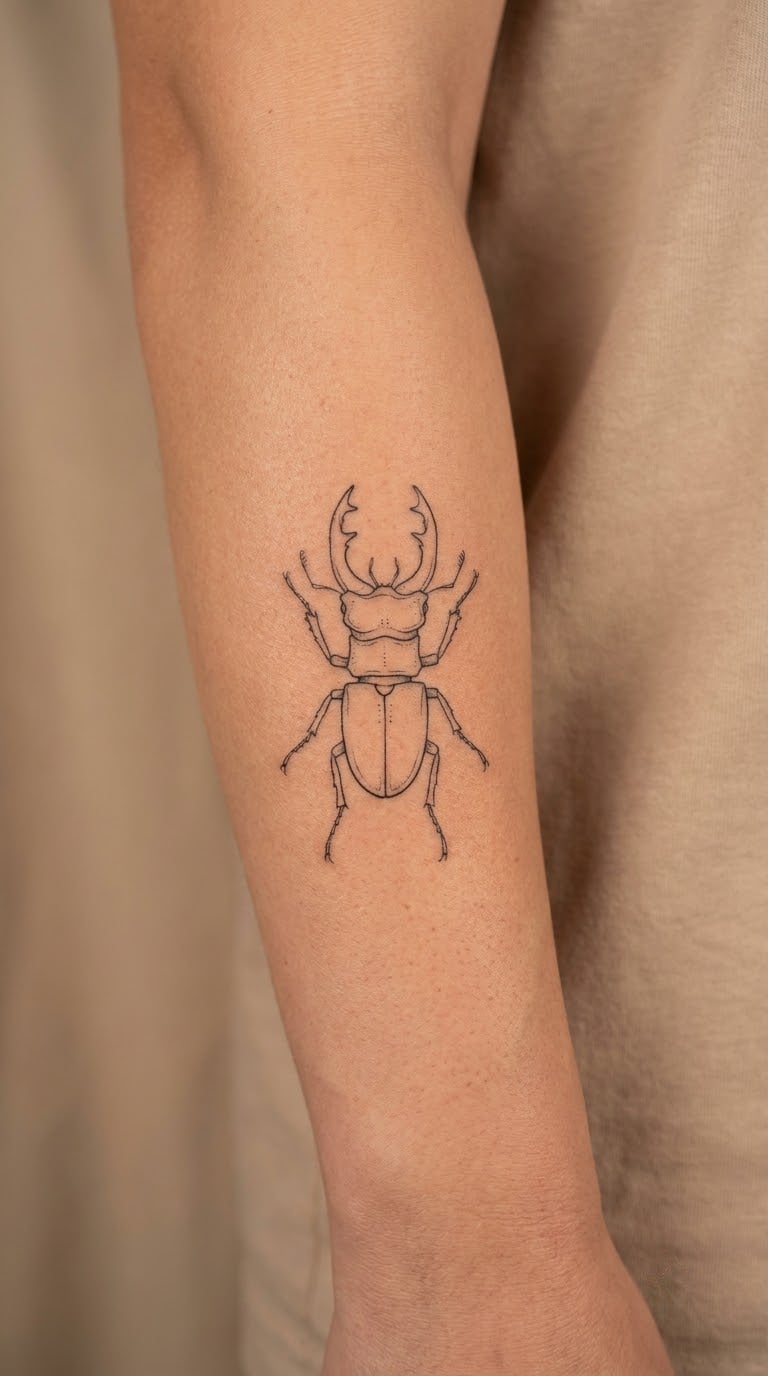
This is a stag beetle drawn with one confident line weight, antennae included, with just a few short ticks on the elytra for texture. Nothing shaded, no background, plenty of skin showing through.
Stag beetles are the natural pick if you like the antler-like mandibles and want something that reads as a beetle without turning into a full illustration. People choose them for the quiet, slightly armoury look.
Placement: inner or outer forearm, which gives you a flat stretch of skin and easy visibility. Size: 2.5 to 3.5 inches (6 to 9 cm) long. Style: fine line, single weight. Pain: low on the forearm, though the inner arm near the elbow stings more.
Thin single-weight lines soften and blur over time, so expect a touch-up in five or six years rather than a rewrite. Make it yours by having the mandibles exaggerated slightly or adding a single small mark from a date nearby.
2. Tiny Ladybird on the Wrist
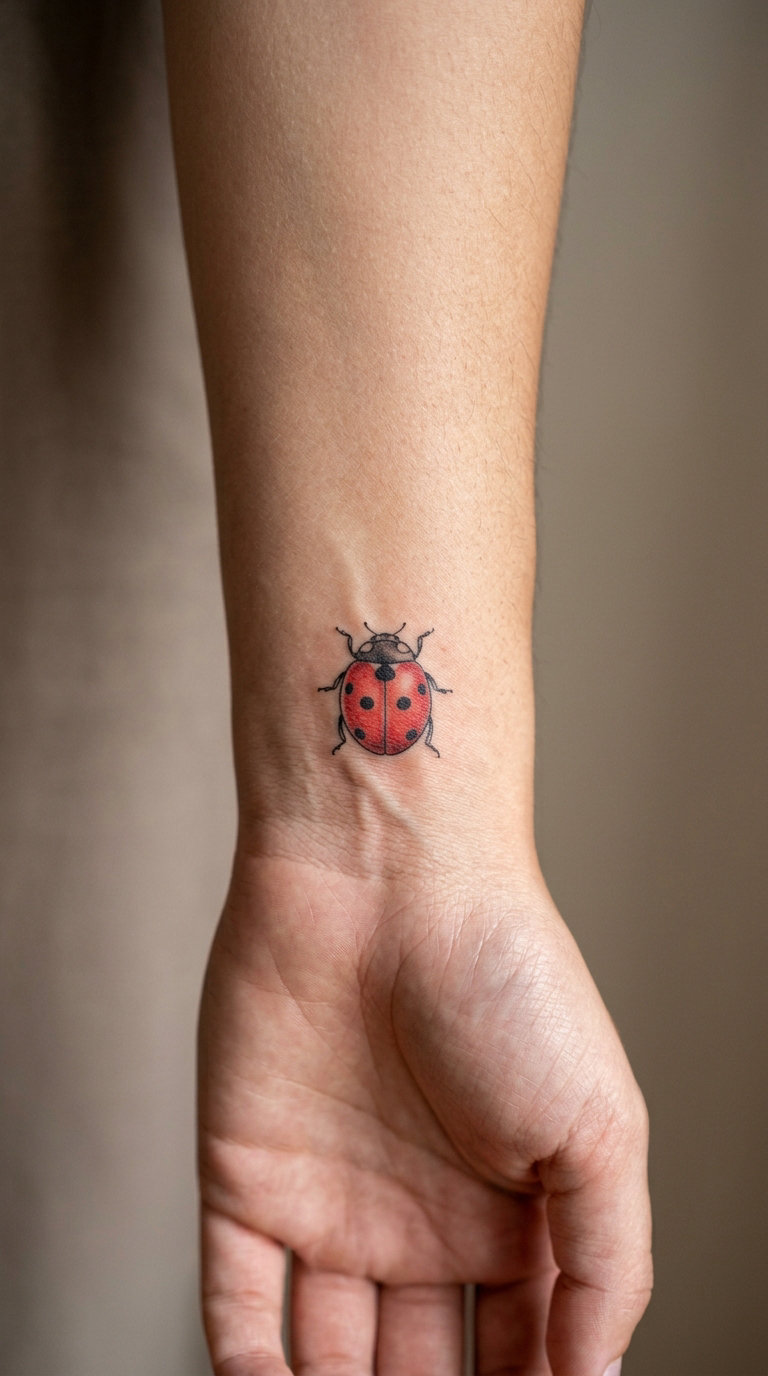
A simple red dome with two or three black spots, a thin black outline and a fine dividing line down the middle of the wing cases. That is the whole design, and it works because it is stopped before it gets fussy.
Ladybirds carry a lighter, friendlier energy than most insects, and plenty of people use one to mark a first tattoo or a good-luck habit. The color is doing all the work here.
Placement: inner wrist just above the bone, or the outer wrist. Size: 1 to 1.5 inches (2.5 to 4 cm) wide. Style: fine line with flat color. Pain: medium, because wrist veins and wrist bones make anything there noticeable.
Red on a small fill fades toward orange over time, and wrist sun exposure speeds that up. Add a personal note with a small flower stem trailing off the ladybird or a tiny date in the same line weight.
3. Micro-Realism Rhinoceros Beetle on the Shoulder
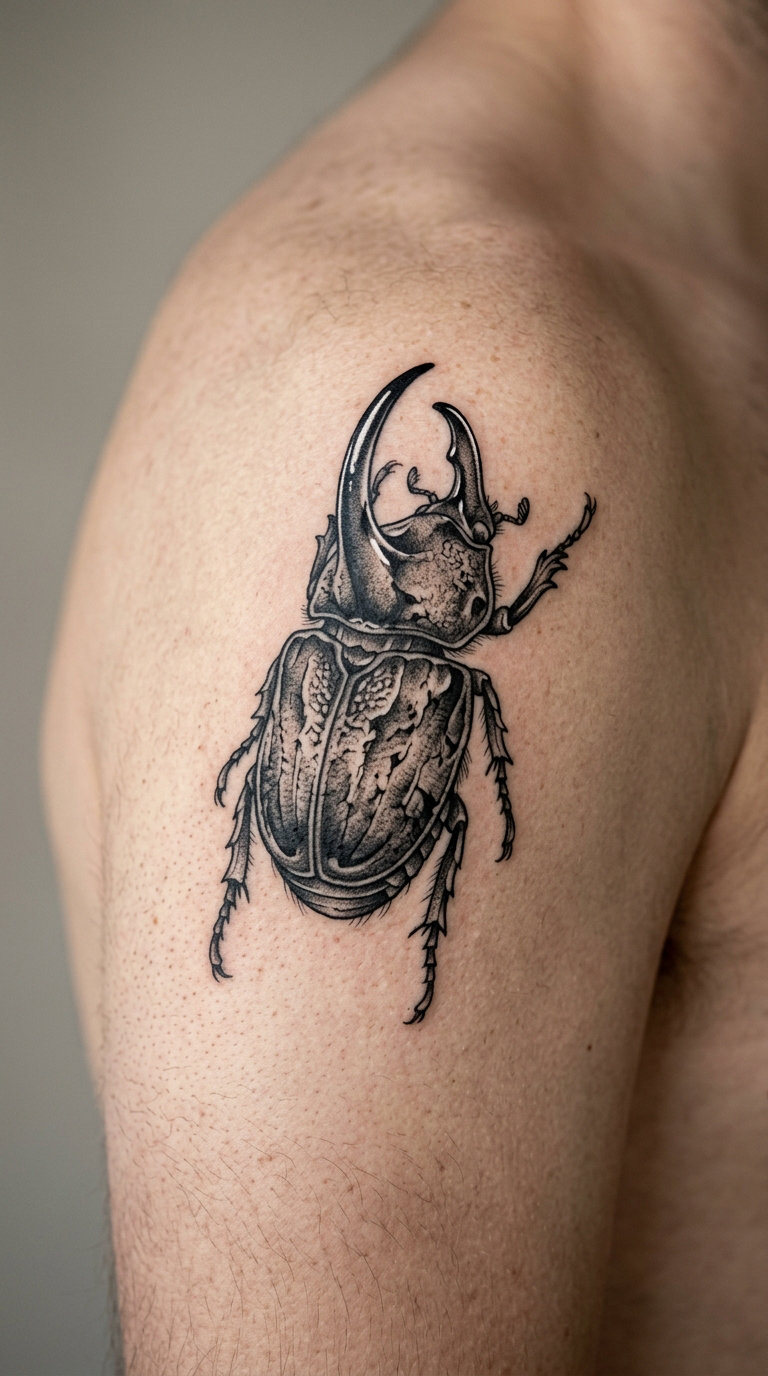
A compact rhinoceros beetle rendered almost photographically: a curved horn catching a highlight, pitted shell texture, six legs tucked under the body, all in black and gray. Detail is concentrated where the eye lands first.
The horn is the whole point of this species, so the design only works when the artist commits to it rather than shrinking everything down evenly. Collectors of insect tattoos tend to choose this one for the anatomy.
Placement: front shoulder or the top of the shoulder cap. Size: 3 to 3.5 inches (7.5 to 9 cm) long. Style: micro-realism. Pain: medium; shoulders ache but the skin is thick.
Pitted texture is the first thing to blur once the tattoo softens, so keep the shell micro-texture shallow. Personalize it with a small pencil inscription of the species name beneath the specimen, like a museum label.
4. Blackwork Hercules Beetle on the Calf
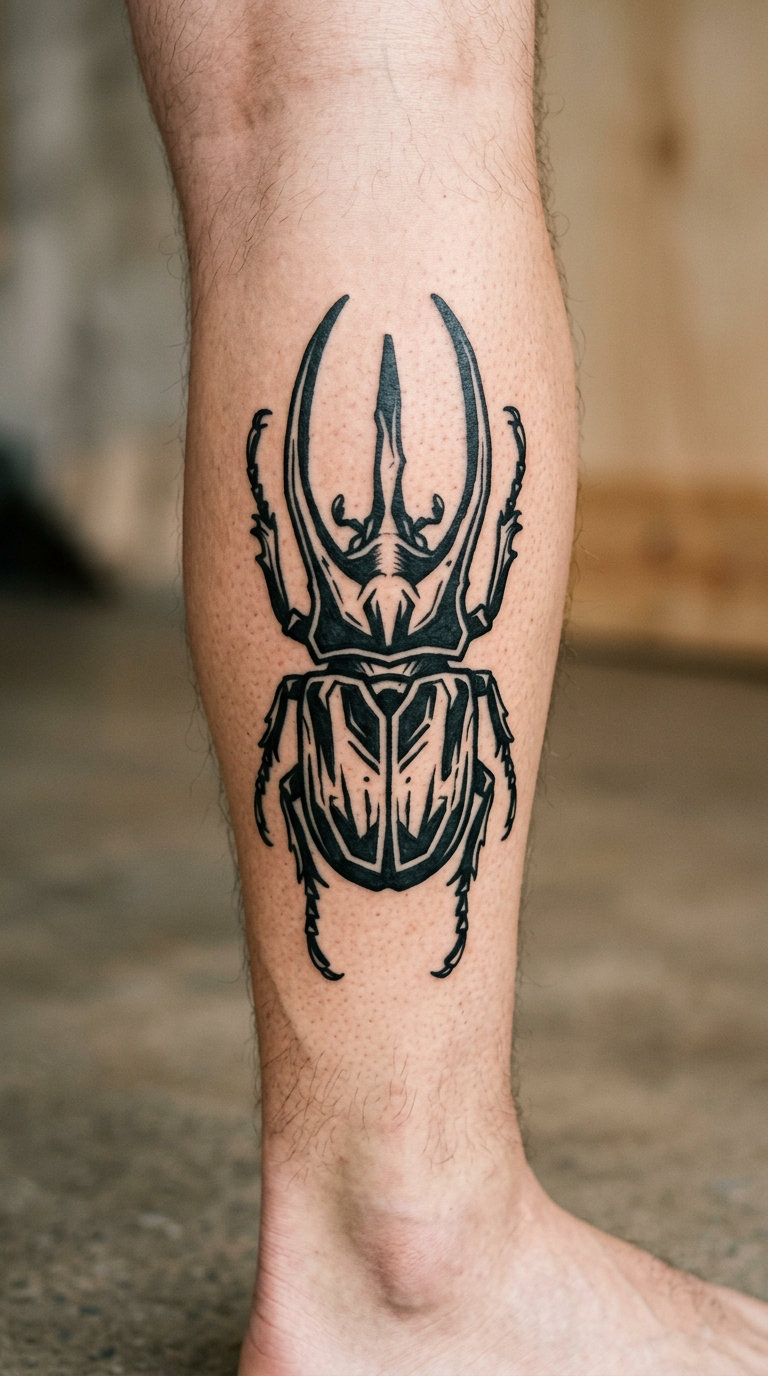
Thick angular outlines, oversized mandibles opened wide, and large blocks of solid black on the thorax with clean skin left as negative space. No gradient, no softness, no second guessing.
People gravitate to this look when they want the beetle to feel armored and slightly intimidating rather than decorative. It also survives a long time, since solid black holds its edge better than hairline shading.
Placement: outer calf, which is one of the flattest large canvases on the body. Size: 4.5 to 5.5 inches (11 to 14 cm) long. Style: blackwork. Pain: medium; the outer calf is meaty, the inner side is not.
Solid black fills do soften at the edges with sun exposure, so a sleeve or a covering habit helps. Add personal weight with a date tucked into the negative space under the body instead of lettering the whole design.
5. Watercolor Scarab Beetle on the Upper Arm
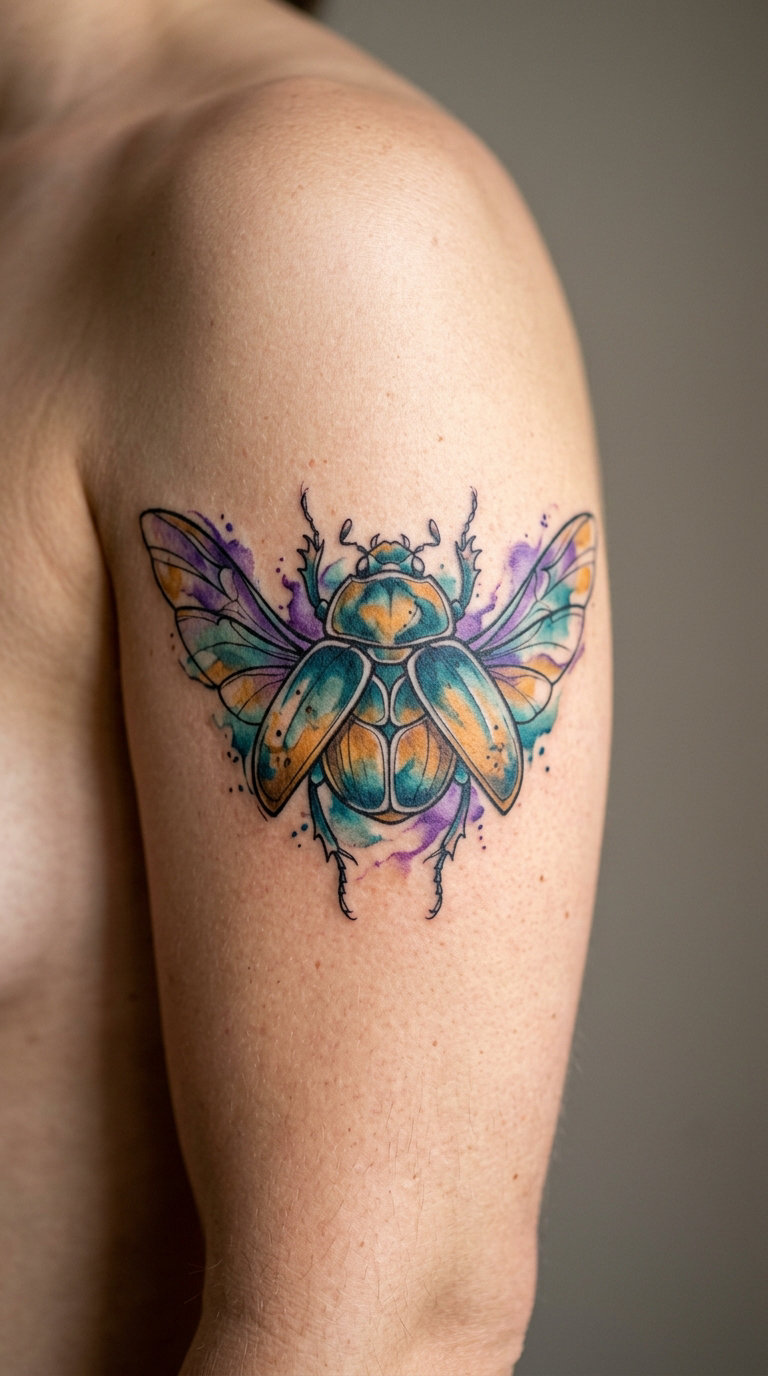
Translucent washes in teal, amber and violet, with the elytra suggested by overlapping color rather than outline. Edges bleed slightly and a few watercolor splatters sit outside the body shape.
This suits anyone who collects color tattoos and finds pure blackwork too severe. The scarab shape is forgiving because the silhouette stays soft instead of snapping into hard edges.
Placement: outer upper arm, where there is room for the color to spread without hitting bone. Size: 3.5 to 4.5 inches (9 to 11 cm) long. Style: watercolor. Pain: low to medium; the upper arm is a comfortable spot.
Watercolor fades fastest of any style here, and light washes turn to ghosts sooner than solid fills. Make it yours by picking two colors with personal meaning rather than a full rainbow, which ages better and looks less busy.
6. Japanese-Style Kabuto Beetle on the Back
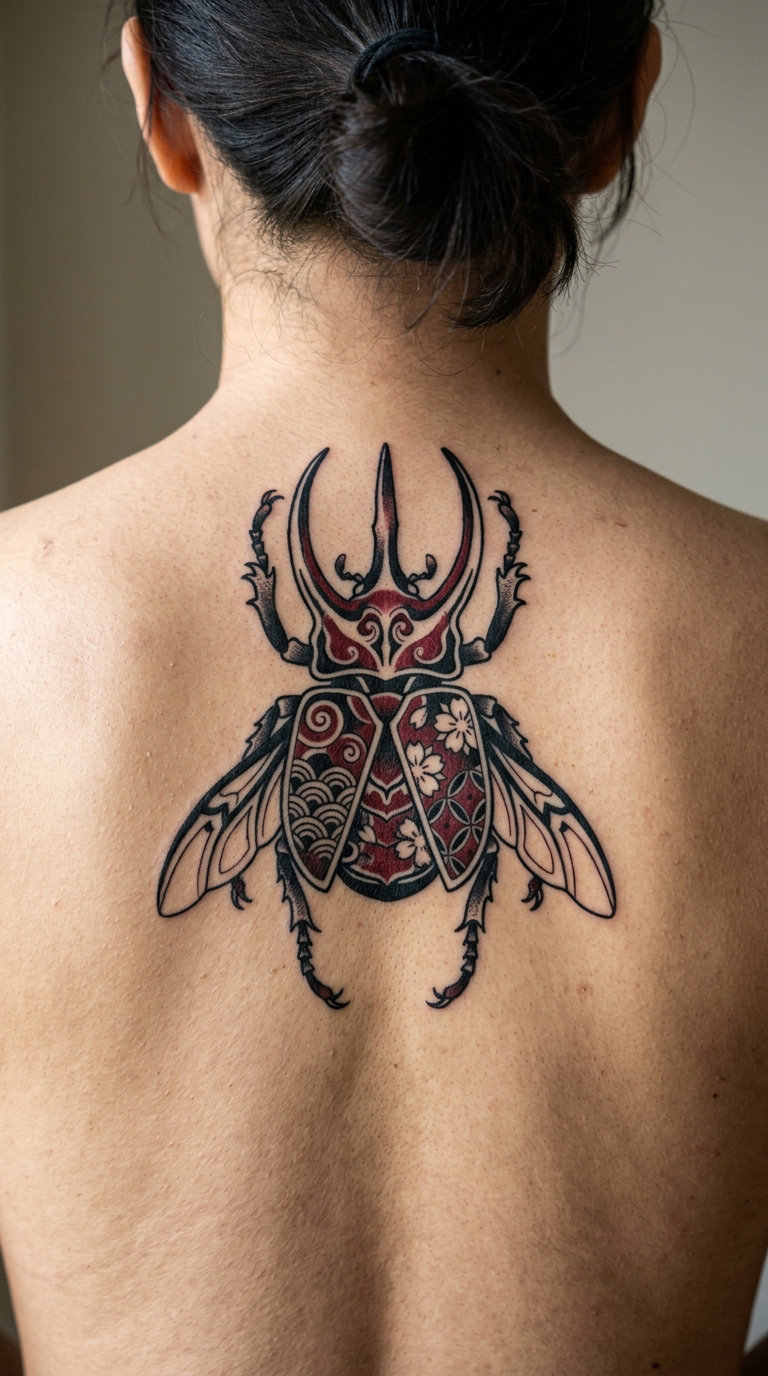
A strong symmetrical silhouette with a horn sweeping back, bold contour lines, decorative markings across the shell, and red filling the negative shapes between the legs. It reads as a piece of armor more than a photograph of an insect.
Japanese rhinoceros beetles are collected and admired for their dramatic horns, and plenty of people want the armor-plate quality of that look rather than entomological accuracy. Ask for a working reference rather than a cultural claim.
Placement: upper back between the shoulder blades, or centered low on the back. Size: 4.5 to 5.5 inches (11 to 14 cm) long. Style: Irezumi-inspired black and red. Pain: high; the back is sensitive and the session will run long.
Bold contour work holds up well, but the small decorative marks inside the shell are the first to blur. Personalize it with a seasonal flower or wave motif in the same visual language if you want the piece to feel complete.
7. Dotwork Jewel Beetle on the Rib
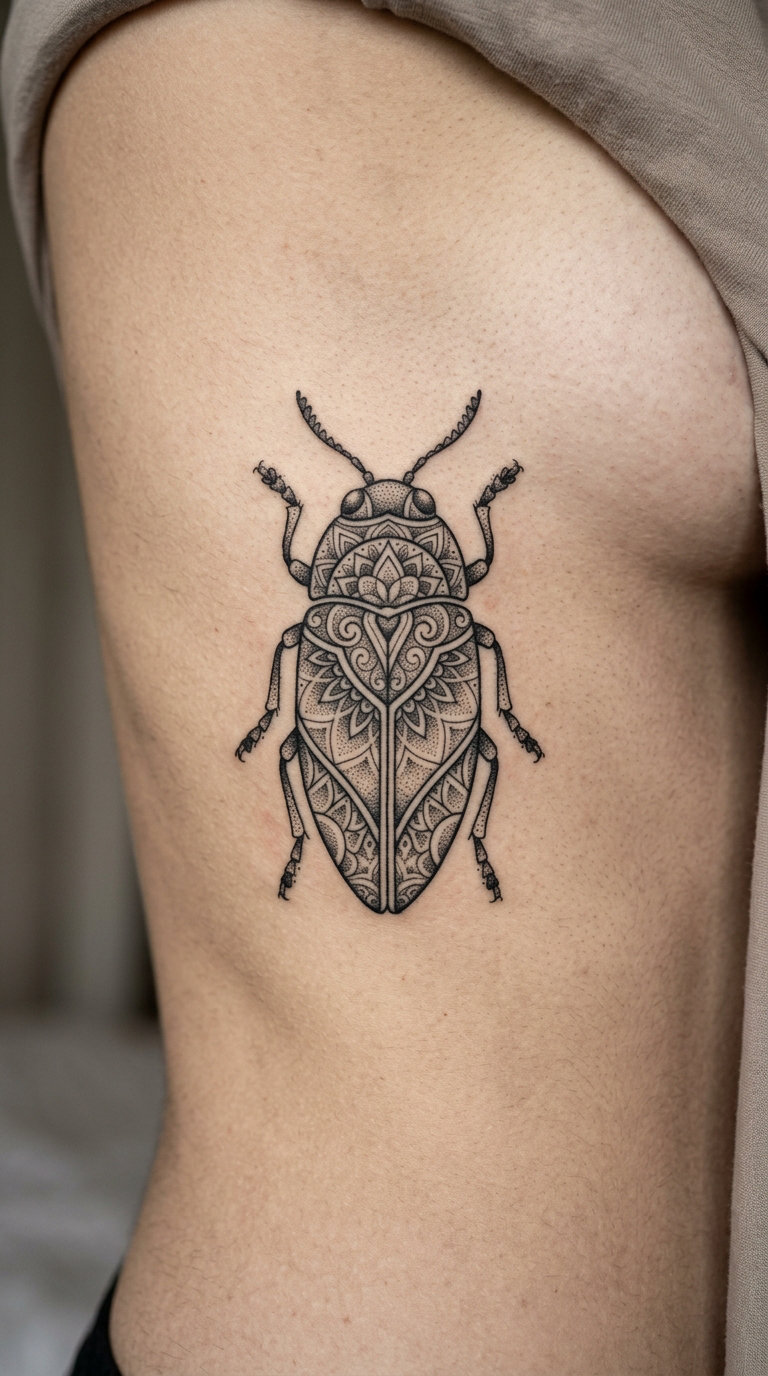
A jewel beetle built entirely from stippling: dense dot clusters on the thorax, looser dots along the elytra, and a gradient that fades into bare skin at the rear. No outline at all in places, so the shape emerges from tone.
People pick dotwork when they want a tattoo that looks graphic and soft at the same time, and it hides small imperfections better than line work does. The pattern sections can echo a real jewel beetle’s markings without naming them.
Placement: side rib, following the curve of the ribcage. Size: 2.5 to 3.5 inches (6 to 9 cm) long. Style: dotwork. Pain: high. Ribs are bony and the skin there is thin and mobile.
Individual dots soften into gray over time, which is usually a good look for this style. Make it yours by using a dot density that maps something meaningful, like the year of something that happened to you.
8. Geometric Beetle on the Forearm
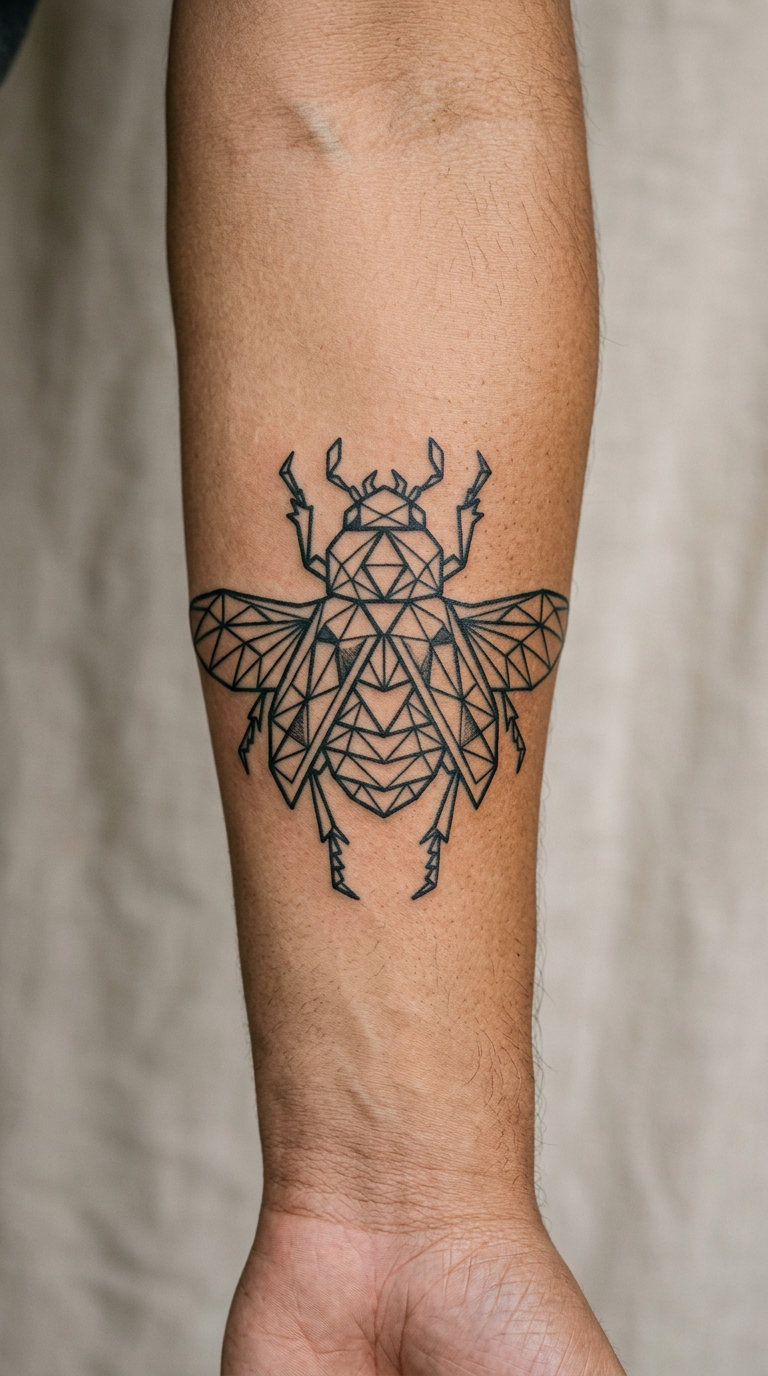
A mirrored beetle assembled from triangles, hexagons and straight lines, with the body split down the centre and the wings built from repeated angular segments. Symmetry does all the work that shading would do in a realistic version.
This is the modern direction: graphic, quiet, and readable from across a room without a single realistic detail. It also suits people who like math more than natural history.
Placement: outer forearm, running along the muscle. Size: 3 to 4 inches (7.5 to 10 cm) wide. Style: geometric linework. Pain: low, one of the easier places to sit through.
Geometric designs rely on straight lines staying straight, so arm movement and weight change show them more than an organic bug would. Make it yours by letting the repeat count mean something, such as one triangle for each person you are thinking about, and add a matching band on the opposite forearm.
9. Realistic Bombardier Beetle on the Thigh
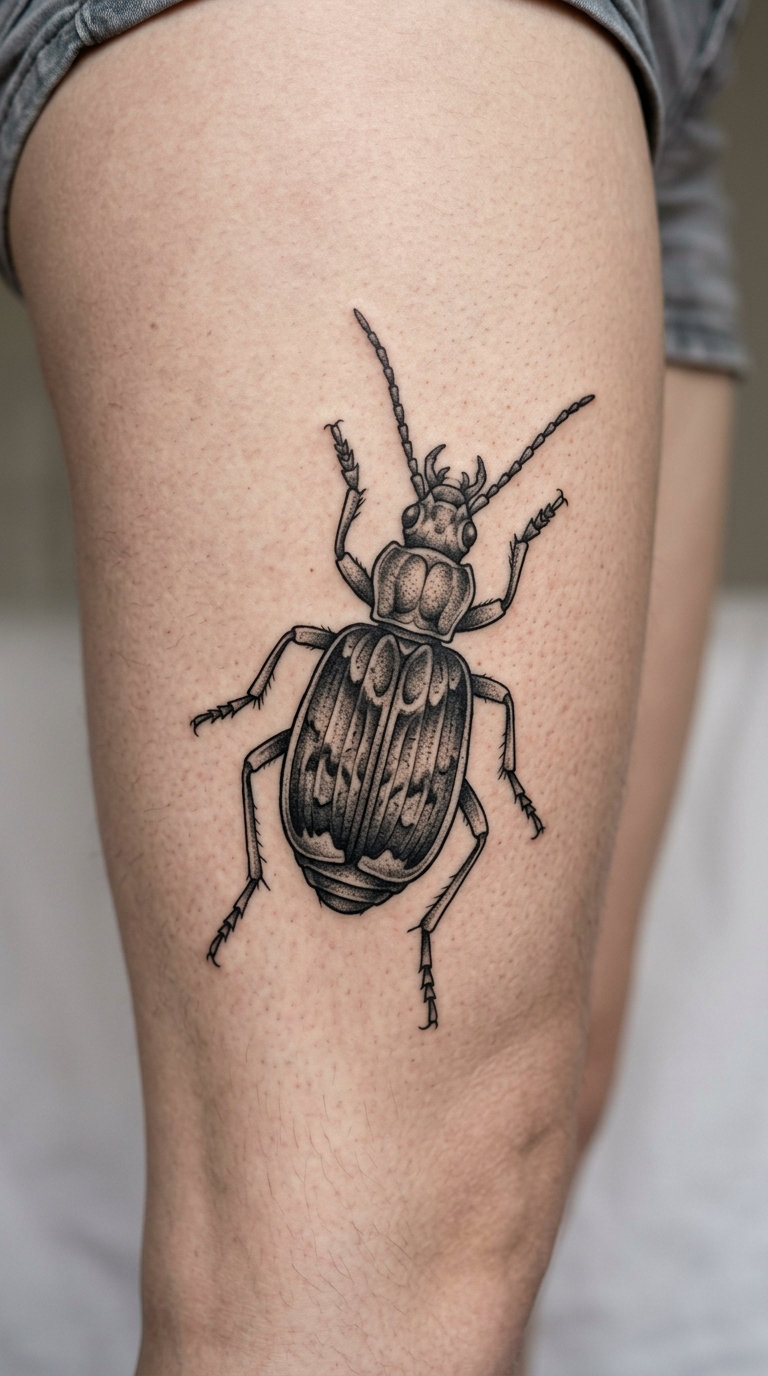
A bombardier beetle rendered large and true: layered gray shading across the elytra, a visible seam where the wing cases meet, segmented legs with small joints, and antennae that stop where they would naturally stop.
Big insects need a big canvas or the anatomy turns to mush, and the outer thigh gives you both the size and a flat surface. It is also one of the easier places to hide a tattoo when you need to.
Placement: outer thigh. Size: 4.5 to 5.5 inches (11 to 14 cm) long. Style: black and gray realism. Pain: medium; the thigh is fleshy but the session is long.
Realistic shading in the lower abdomen tends to fade first, so expect a refresh of the soft grays rather than the outlines. Ask the artist to exaggerate the elytra seam slightly so the beetle still reads at a distance in ten years, and make it yours with a small field-note caption under the specimen, the way a museum label carries one.
10. Minimal Weevil on the Ankle
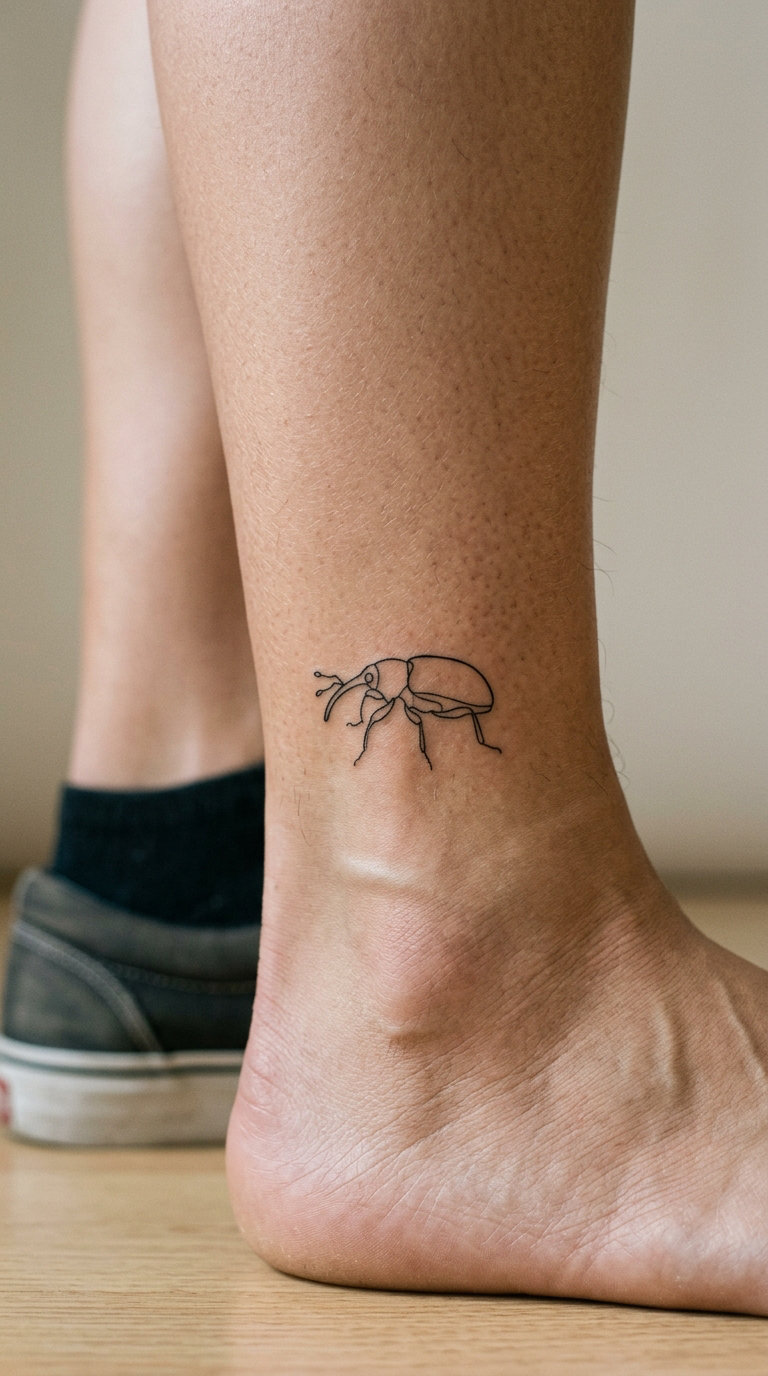
One continuous line from antenna to antenna, bending into the long snout, the rounded body and a single back leg. No shading, no fill, no second line. That is the design.
Weevils are the least showy beetle on this list and that is the appeal: it looks like a considered mark rather than a decorative bug, and it works for a first piece that still says something.
Placement: outer ankle, or above it on the lower calf. Size: 0.75 to 1 inch (2 to 2.5 cm) long. Style: minimal single line. Pain: medium; ankles are bony and sensitive.
Very fine single lines soften noticeably within a few years, and ankle footwear rubs the area more than most. Make it yours by having the snout curve follow the shape of the ankle bone rather than sitting straight.
11. Emerald Green Beetle on the Shoulder Blade
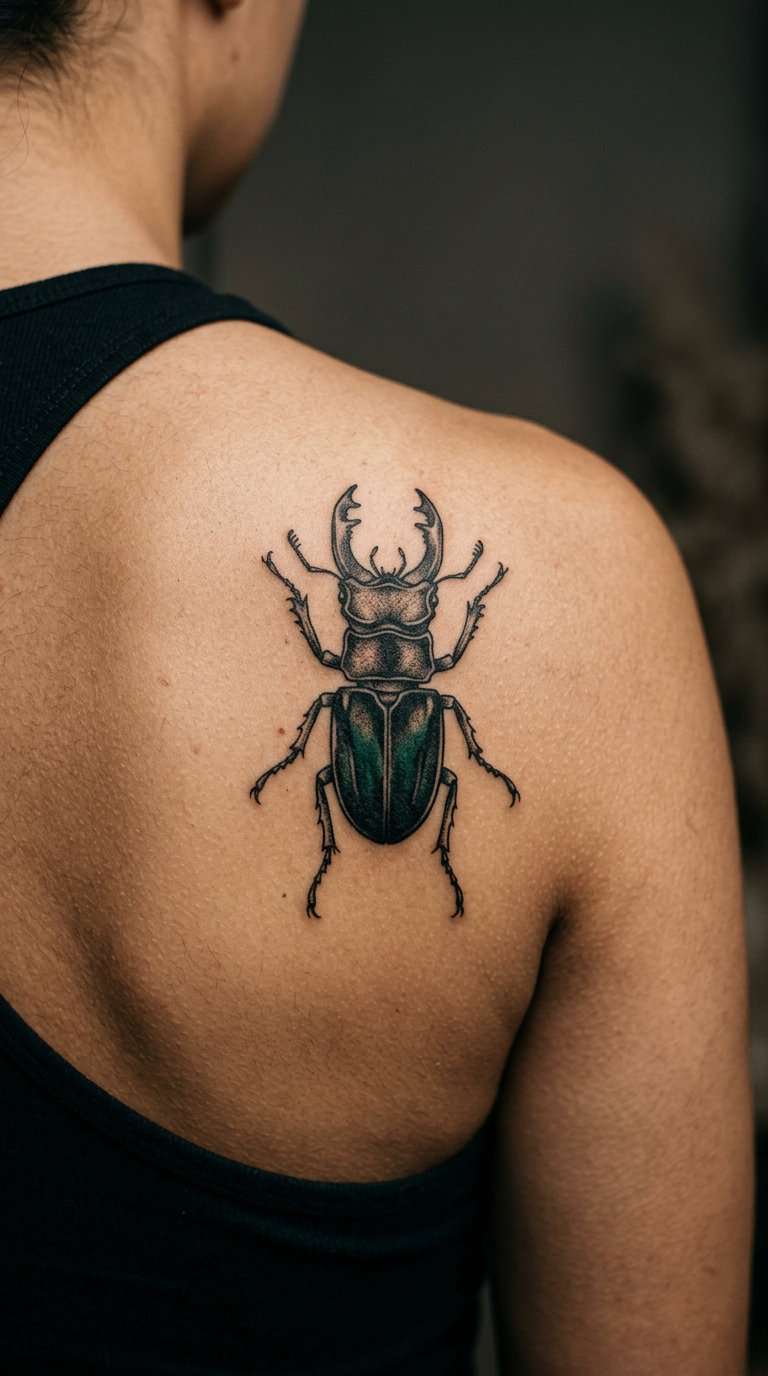
A realistic dark beetle with one decision: the elytra carry a restrained emerald green sheen instead of plain black. The legs and thorax stay monochrome so the color lands as an accent rather than a takeover.
Two or three colors are enough to make an insect look alive, and green on a beetle shell reads as iridescence without the commitment of full color realism. It bridges the blackwork and color camps.
Placement: shoulder blade, along the blade line. Size: 3.5 to 4.5 inches (9 to 11 cm) long. Style: realism with a color accent. Pain: low to medium, though the shoulder blade edge can be uncomfortable.
Bright green is one of the first hues to fade, so keep the accent light and let the black carry the design if you want it to last. A family color in the accent, or the green of a place that matters, personalizes it well.
12. Traditional Scarab on the Bicep
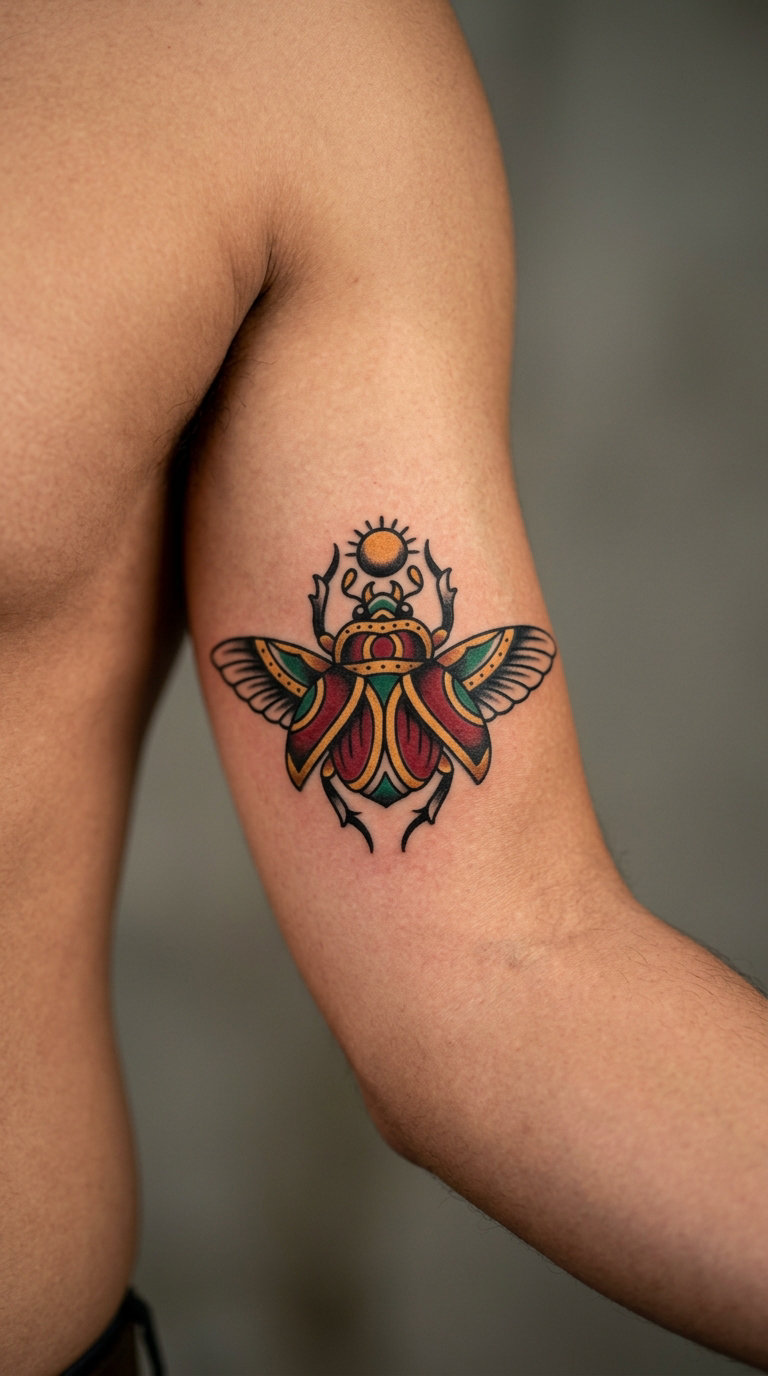
Heavy black outlines, a solid red body, gold detailing on the wing cases, and old school shading with a few bold highlight gaps. Built to read clearly from a distance, not to be examined closely.
The scarab is the most recognizable beetle in tattooing, and traditional rendering is what people choose when they want something legible and unapologetic. It is a solid tattoo for a solid piece.
Placement: inner bicep, which curves with the arm and keeps the shape visible in motion. Size: 3.5 to 4.5 inches (9 to 11 cm) long. Style: old school traditional. Pain: medium; the inner arm is thin but steady.
Gold ink is a pigment rather than a true metal and often needs refreshing sooner than the black. Add a personal element with a date in the traditional script style beneath the body.
13. Blue Morpho Butterfly Beetle on the Back
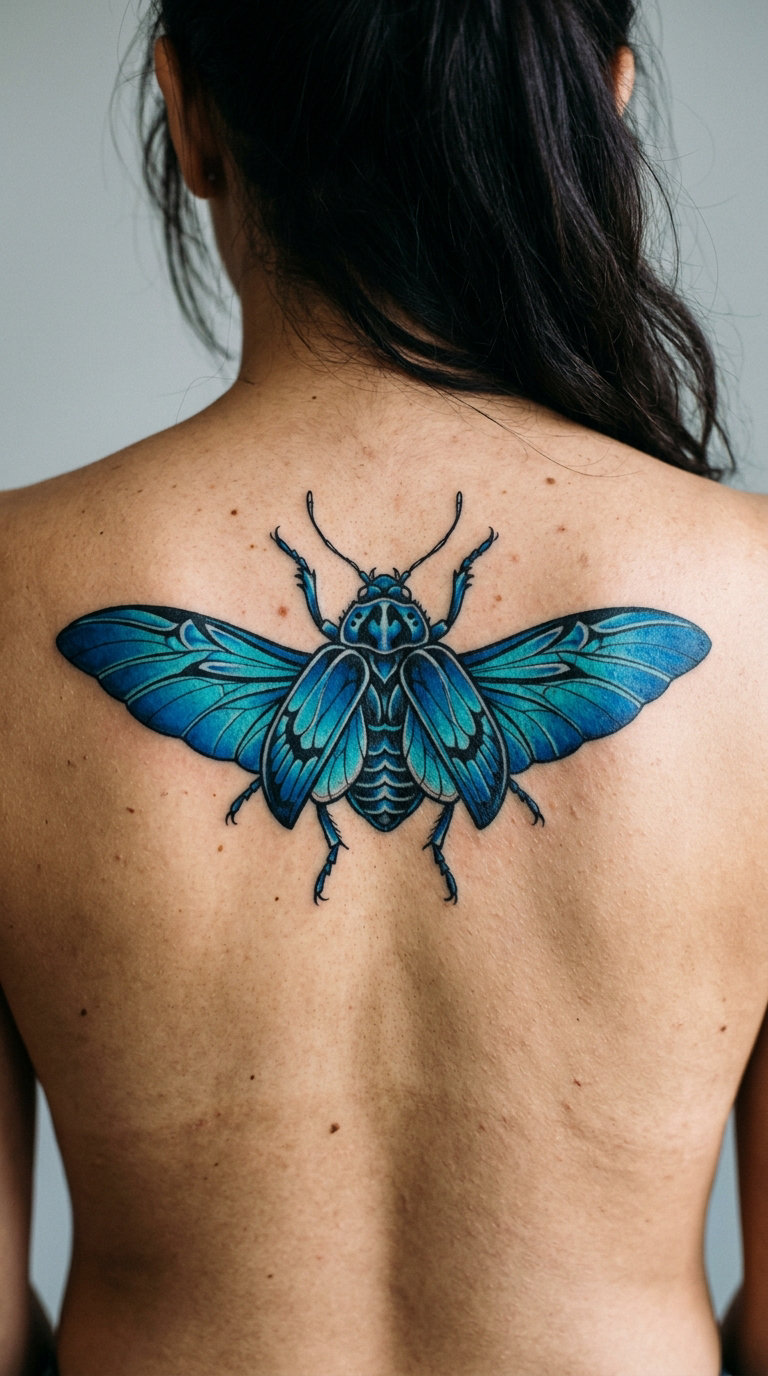
A beetle with wing covers built like morpho butterfly wings: layered cobalt into turquoise, with soft gradients and a dark border holding the shape. It is a beetle in silhouette and color, not a butterfly with beetle legs.
The appeal is the color rather than the entomology, and it suits anyone who wants a large back piece that still stays graphic. Getting the anatomy right keeps it from reading as a butterfly mistake.
Placement: upper back between the shoulder blades. Size: 4.5 to 5.5 inches (11 to 14 cm) wide. Style: color gradient. Pain: high on the back, and this will take most of a session.
Light turquoise gradients fade first, so the dark border matters more than it seems when you first design it. Add a few small stars or a moon shape in the negative space to tie the palette together.
14. Neon Firefly Beetle on the Forearm
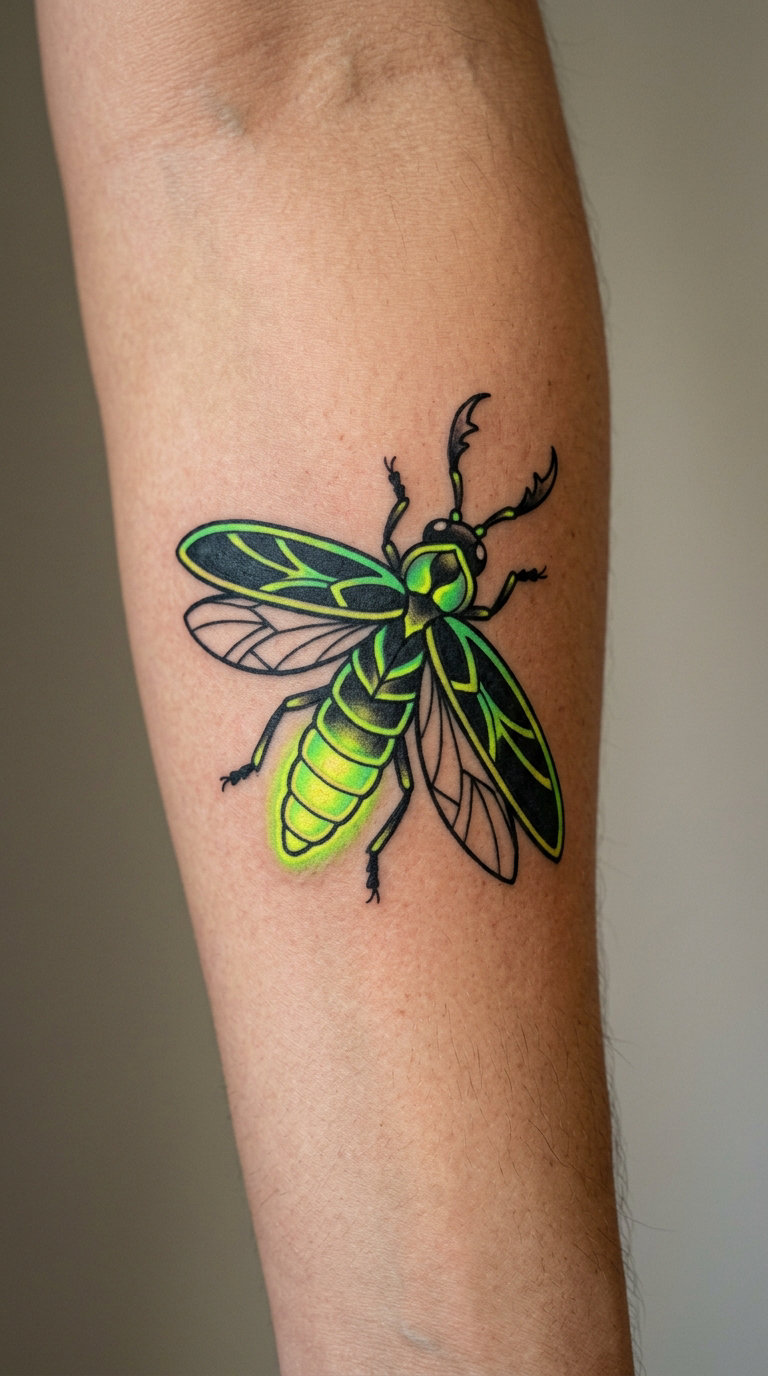
A stylized firefly beetle on a soft black base, with neon green and yellow glowing along the abdomen and a few drifting light dots around the body. Illustrative rather than accurate, and clearly meant to be.
Glowing insects are popular because the light effect reads as movement rather than pattern. It suits a design-forward style without needing realism skills from the artist.
Placement: inner or outer forearm, where the black base has a flat surface to sit on. Size: 3 to 4 inches (7.5 to 10 cm) long. Style: illustrative color. Pain: low on the forearm.
Neon yellows on black are high contrast and high visibility, which also means they show wear early. Keep the glow as gradient rather than flat fill so the fading is less obvious, and make it yours by holding it to two glow colors and adding one small mark of your own inside the black base.
15. Fine-Line Beetle Flight Path Behind the Ear
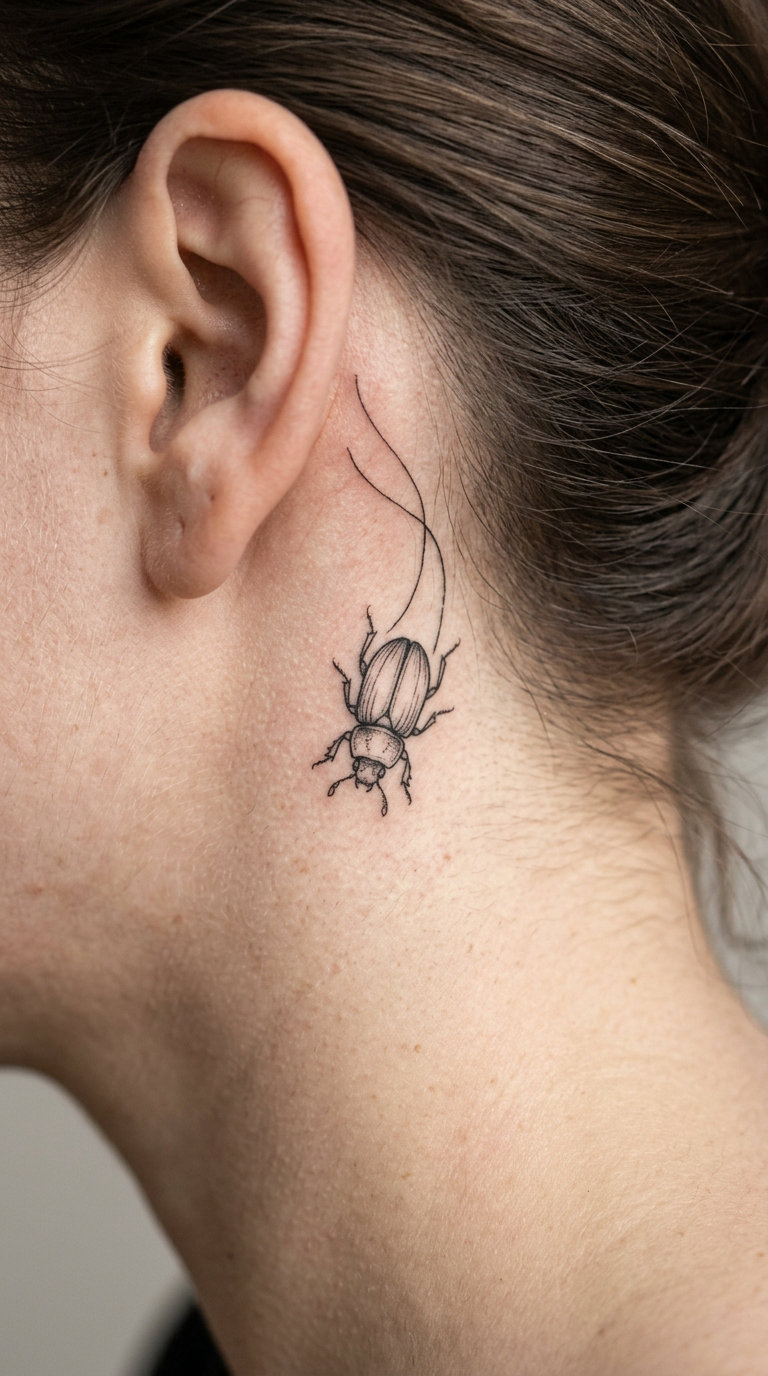
A small fine-line beetle with two or three curved motion lines trailing behind it, the whole composition about an inch and a half long. The lines give the piece movement that the size alone cannot.
Trailing lines are the cheapest way to make a tiny insect tattoo feel intentional rather than sparse. This one also sits in a spot where you only ever see it in a mirror.
Placement: behind the ear, above the neck. Size: 1.5 inches (4 cm) long including the lines. Style: fine line. Pain: medium, and the skin there is thin and bony.
Hair regrowth over the design and constant rubbing from collars are the main reasons small tattoos here soften early. Keep the line weight as heavy as you can stand, and make it yours by letting the number of flight lines stand for the people the piece is for, two or three being the practical limit at that size.
16. Blackwork Goliath Beetle on the Chest
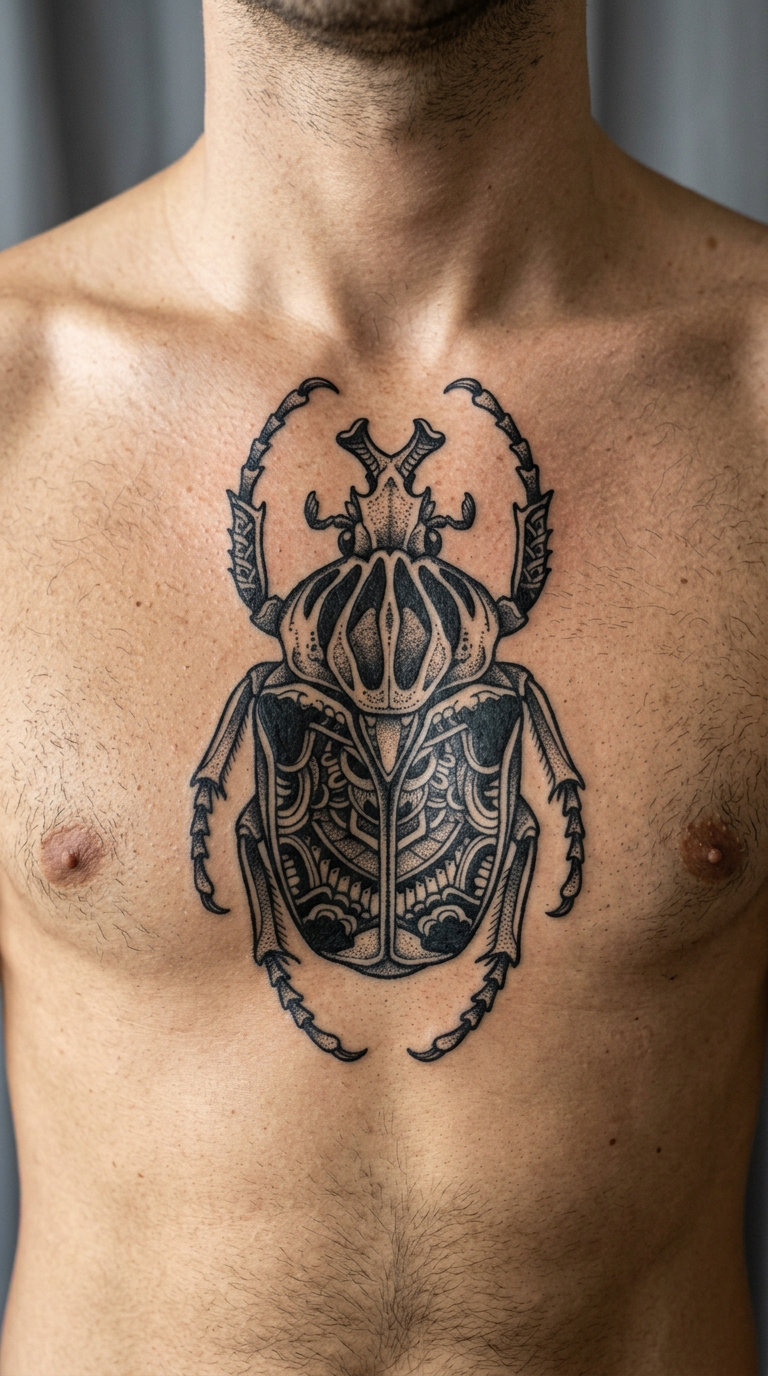
A goliath beetle at full size with heavy shell forms, thick black masses on the elytra and generous untouched skin between them. Oversized anatomy is the point: the beetle is built to fill a chest, not to sit politely on it.
Bugs designed for big flat areas are worth the session length because small versions lose their drama. This one only makes sense if you have room to let it breathe.
Placement: upper chest, centered or across the pectorals. Size: 5.5 to 6.5 inches (14 to 16 cm) wide. Style: blackwork. Pain: high; the sternum and collarbone area are among the most sensitive spots.
Large solid blacks stay crisp well, but chest skin moves with breathing and shoulders, so lines can drift over time. A single small element below it, like a date, keeps the composition from feeling cropped.
17. Rose Chafer Beetle in Color on the Thigh
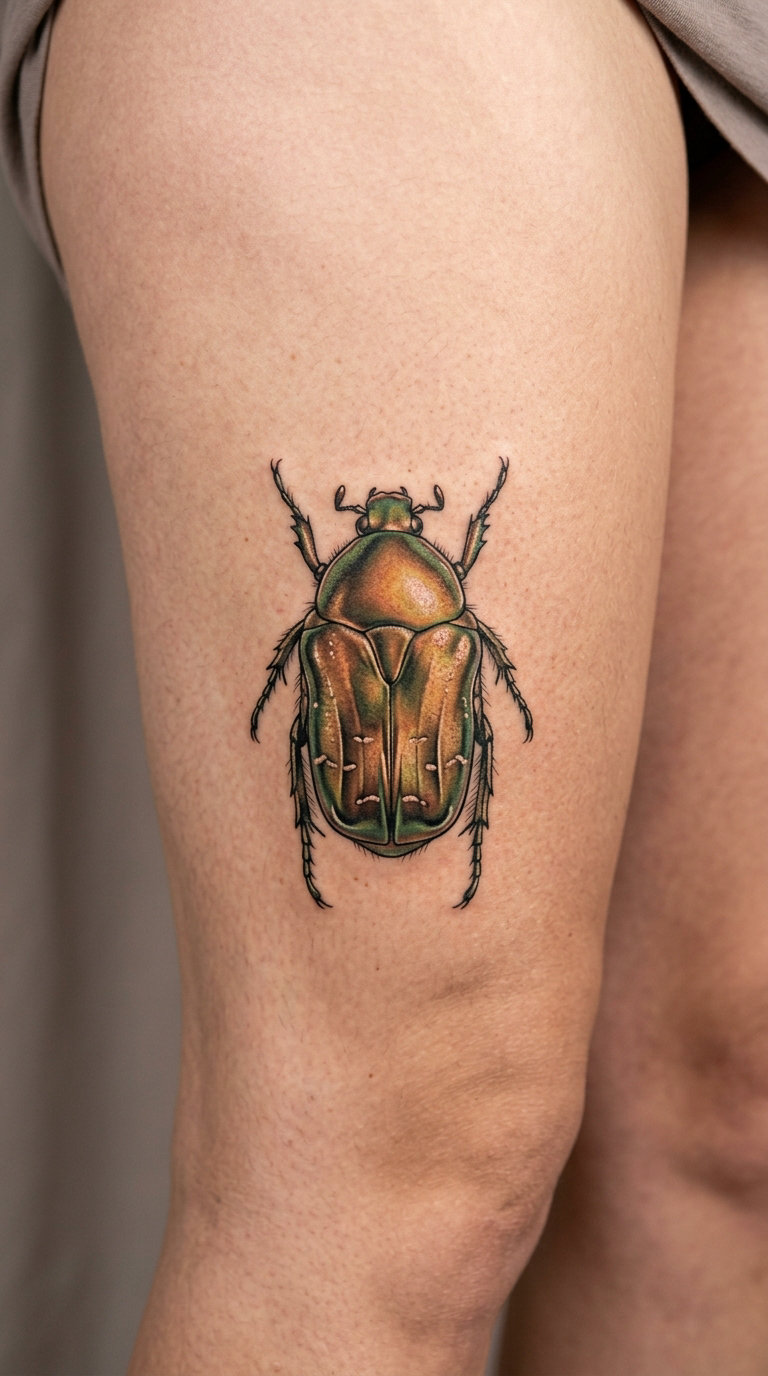
A rose chafer in warm color: bronze and metallic green across the elytra, a subtle red blush near the thorax, and soft shadow under the body so it sits on the skin rather than on top of it.
Color is what makes a naturalistic beetle tattoo dimensional, and warm metallic tones suit someone who wants realism without the coldness of a full gray piece. It also fills a flat area quickly.
Placement: outer thigh, or the back of the upper arm. Size: 3.5 to 4.5 inches (9 to 11 cm) long. Style: color realism. Pain: medium on the thigh, low on the upper arm.
Warm reds and greens shift with sun exposure more than black does, so this one benefits from covered legs more than most. Matching it with a small companion insect in the same palette is a common next step.
18. Engraving-Style Beetle on the Inner Arm
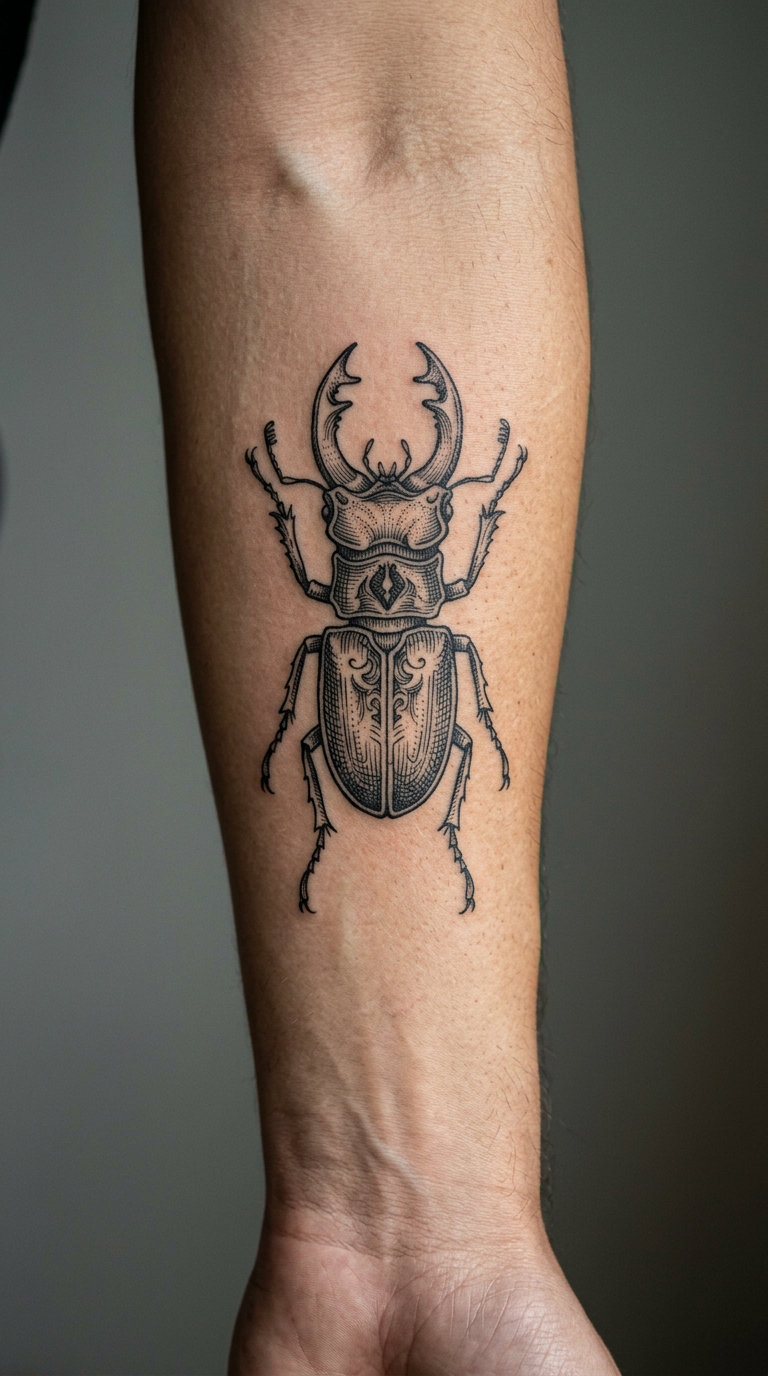
A beetle drawn like a plate from an old scientific book: fine crosshatching for shadow, thin contour lines, no color anywhere, and a slightly formal symmetrical pose. It should look printed rather than drawn.
The engraving look suits people who like antique natural history and want something scholarly rather than decorative. It also photographs unusually well in black and white.
Placement: inner arm, ideally where the design can sit straight along the forearm. Size: about 3 inches (7.5 cm) long. Style: vintage engraving. Pain: low, and the inner forearm is quick work.
Crosshatching at this scale is honest about its limits: individual lines will soften and the tone will even out. A touch-up every few years keeps it crisp, and keeping it away from direct sun helps more than anything. Make it yours by sitting the specimen next to an existing map or botanical tattoo so the two read as pages from one book.
19. Gold-Accented Beetle on the Collarbone
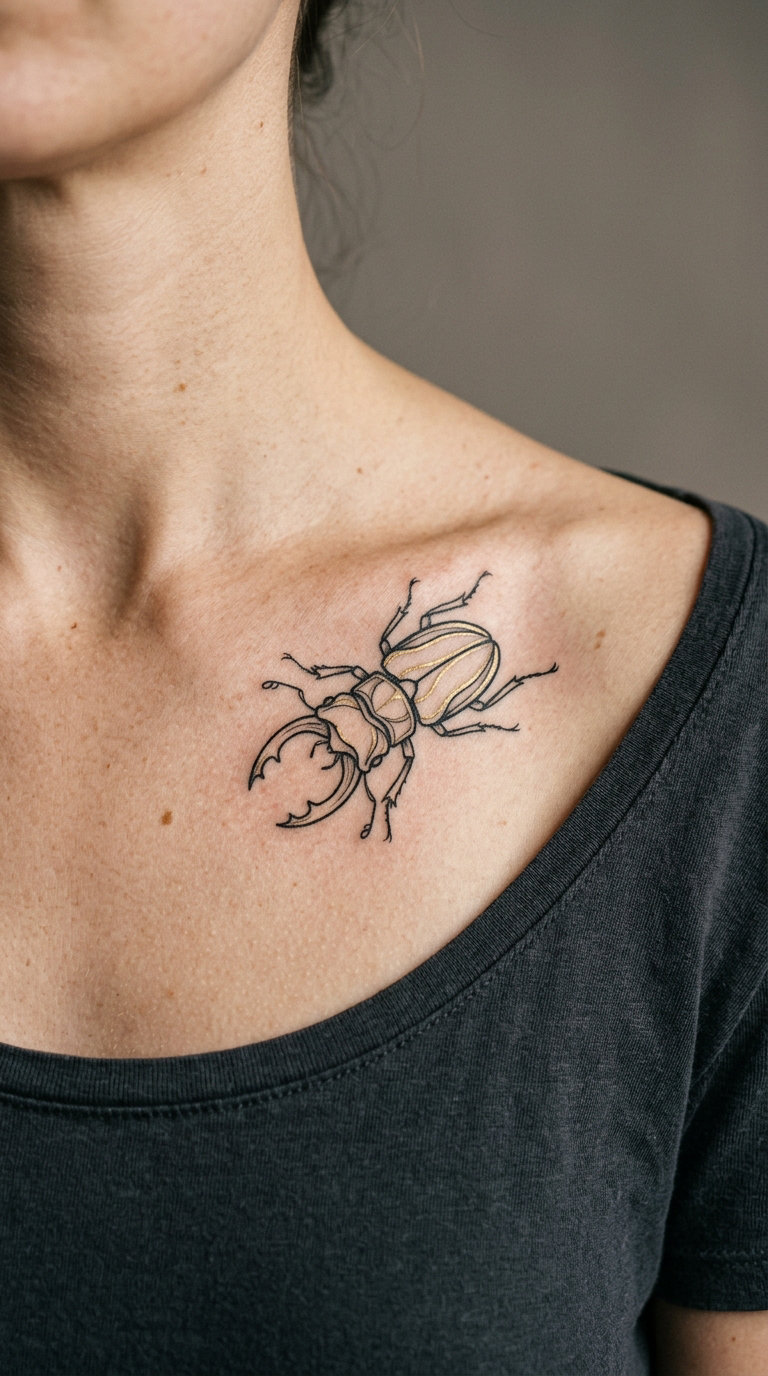
A clean black beetle outline with fine internal line work and small gold fills on the wing cases. Restrained rather than ornate, and drawn to follow the line of the collarbone.
Collarbone placements are visible without being loud, which is why they work for refined designs. A beetle here reads as jewelry-adjacent without being an actual ornament.
Placement: along the collarbone, following its curve. Size: 2.5 to 3.5 inches (6 to 9 cm) wide. Style: black line with gold accents. Pain: medium; the collarbone is thin skin over bone.
Gold is a pigment and will need refreshing sooner than the black work around it. Keeping the gold areas small means the refresh is quick and the design never looks half-empty. Make it yours by matching the gold to a piece of jewelry you already wear, which is usually the most convincing choice.
20. Tiny Beetle and Leaf Matching Pair
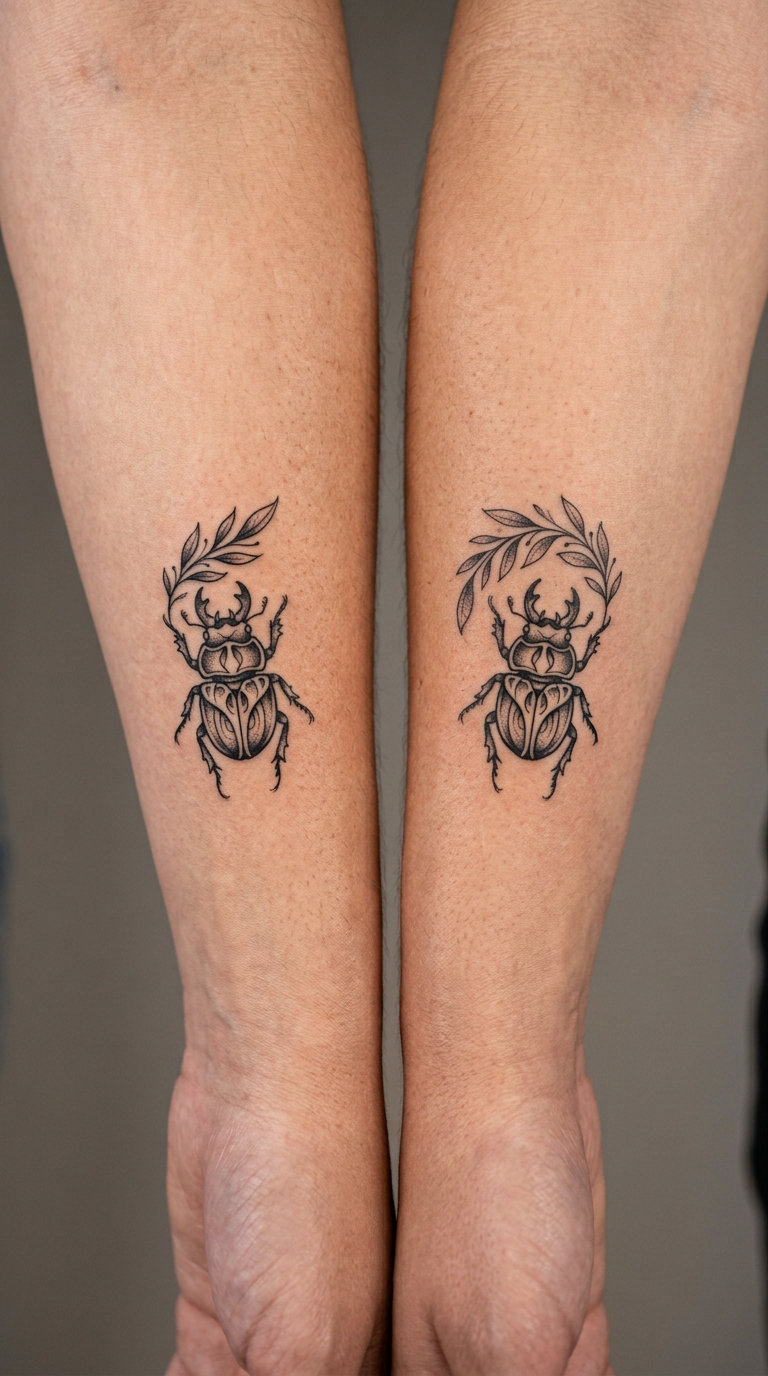
Two small beetles in the same line weight and the same leaf motif beneath each one, mirrored so they read as a set. Design one properly and the second copies easily, which keeps them genuinely matching.
Small pairs are the practical way to test a style you are not ready to commit to at full size, and they are easy to hide at work. The shared leaf gives them a link beyond being identical.
Placement: both inner forearms, or both behind the ears. Size: 1.5 inches (4 cm) each. Style: fine line. Pain: low on the forearm, medium behind the ear.
Two small pieces can drift apart over the years as skin changes differently on each side. If that bothers you, ask for a thicker line weight now rather than a thinner one that will fade at different rates, and make it yours by dating the leaf on one arm only, so the pair stays linked without being identical.
21. Abstract Beetle on the Sternum
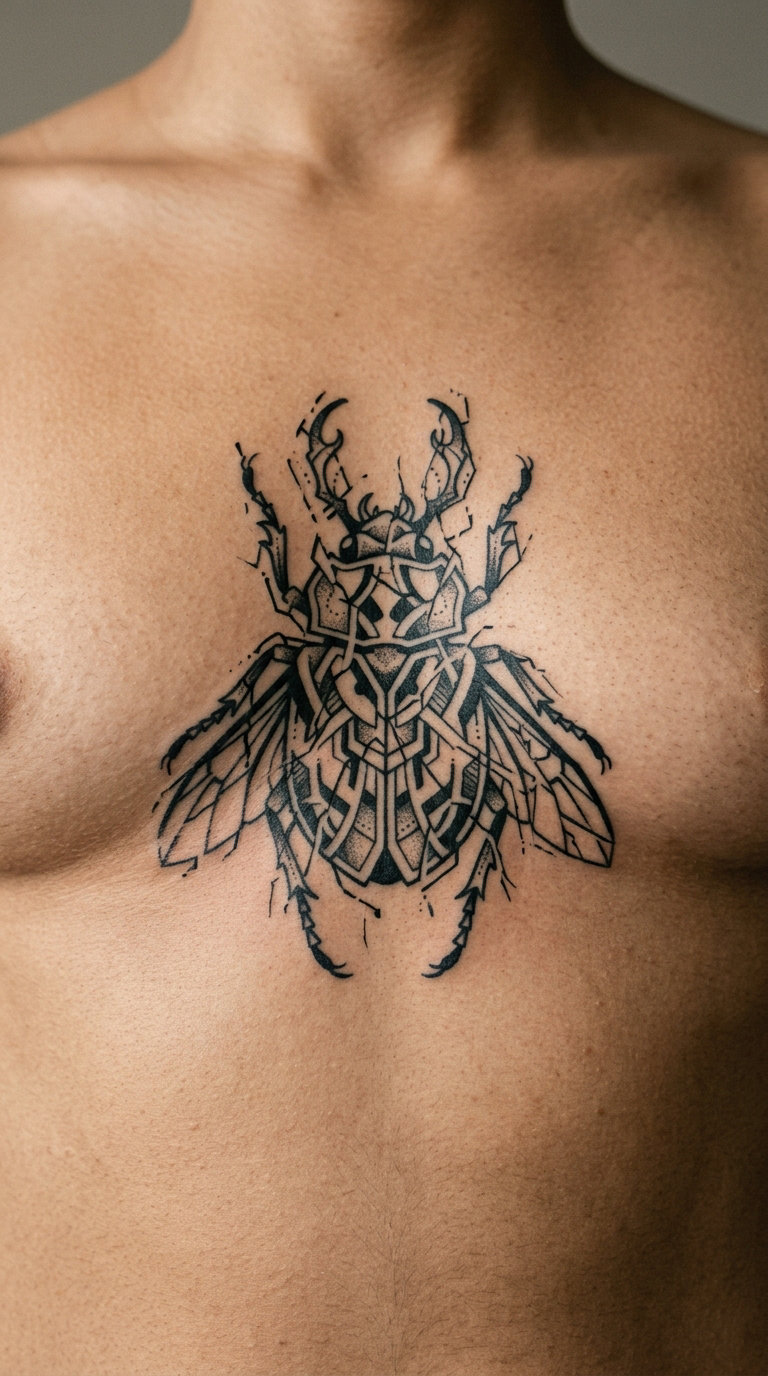
A vertical abstract beetle built from broken lines, mirrored shapes and deliberate gaps, arranged along the sternum so the symmetry of the body does half the composition work for it.
Sternum pieces are inherently symmetrical, and an abstract design uses that instead of fighting it. It is a strong choice when you want something graphic that still has real structure.
Placement: centered on the sternum, running vertically. Size: 3 inches (7.5 cm) tall. Style: abstract linework. Pain: high; the sternum is the most sensitive area on this list.
Broken linework depends on fine gaps staying open, so this style needs more frequent touch-ups than solid shapes. If the gaps matter to you, plan for a refresh at year three or four rather than year eight, and make it yours by letting one edge break the mirror, which keeps the design abstract instead of decorative.
22. Full-Color Atlas Beetle on the Back of the Arm
An atlas beetle in full color with a glossy patterned shell: green and bronze elytra with pale markings, layered highlights, and dark under-shadow so the insect has weight. This is the piece that rewards a whole session.
Atlas beetles have some of the most patterned shells in the family, which means a design that looks busy at thumbnail size and rich at arm’s length. It closes the list as the most detailed option here.
Placement: back of the upper arm, which is flat and rarely bumped. Size: 4.5 to 5.5 inches (11 to 14 cm) long. Style: color realism. Pain: low; the back of the arm is one of the more comfortable spots.
High-detail color work fades fastest in the pattern markings, so expect to refresh those before the outlines. If you want to keep the collection going, a matching small weevil from idea ten pairs naturally with this one.
How to Choose the Right Design
Most people read 22 beetle tattoo ideas in the wrong order: they fall for a picture first and try to fit it onto their body afterwards. Flip it. Decide the placement and the size you can live with, then find a design that fits inside that space.
Some questions worth answering before you book anything: How much detail do you want to look at up close? What color are you actually willing to maintain? Is this a first tattoo or one of many? And does the species mean something to you, or do you just like the shape?
How to pick from 22 beetle tattoo ideas without overthinking
If you are nervous about committing, pick a small fine-line piece first and a larger one later. A 1.5 inch weevil or ladybird teaches you what your artist does with your skin and what you are comfortable sitting through, and it costs less to be wrong about.
Match the species to the message you want. Stag, rhinoceros and goliath beetles carry weight and armor. Scarab designs lean rebirth and protection. Ladybirds read as light and good luck. If you cannot name why you chose the beetle, the design usually reads better when you simplify it.
Check the aging before you commit. Tiny line work on fingers, behind the ear and near the ankle softens fastest, solid blackwork lasts longest, and watercolor fades earliest of all. If you want your beetle to still be sharp in fifteen years, ask for heavier lines or filled shapes now. Our guide to 20 Mountain and Ocean Tattoo Ideas: Best Pairings covers the same longevity trade-off for landscape pieces.
Cost and Session Time
Most US studios charge by the hour, with a shop minimum that covers the smallest piece. Expect roughly $120 to $200 an hour depending on the city and the artist, and a shop minimum of around $100 to $150 for a small tattoo. Rates and minimums vary widely, so treat these as planning figures rather than a quote.
A 1 to 2 inch design like the ladybird, the weevil or the flight-path piece is usually a short single session. Anything in the 3 to 4 inch range often needs two sessions, and the large chest, upper back and thigh designs in this list can run three or more. Tell your artist the size you want in inches at the consultation so the session estimate is honest.
Detail costs time rather than size. A 3 inch realistic beetle with textured shell work can take longer than a 4 inch blackwork silhouette, because every shell marking is a decision the artist has to make slowly.
Aftercare Basics
Start with your artist’s aftercare instructions, since they know how deep and detailed your particular piece went.
- Follow the washing and moisturizing routine your artist gave you for the first couple of weeks, and do not swap in a different product mid-heal.
- Keep the new tattoo out of swimming pools, hot tubs and open water while the skin is still sealing.
- Do not pick at flaking skin. It will come off on its own, and pulling it is the fastest way to pull ink out with it.
- Wear loose clothing over the area for a few days, and change the covering if it gets soaked.
- Once fully healed, use sunscreen on exposed placements like the forearm, calf and shoulder. Sun is the main reason beetle shells lose their shine.
If something looks wrong to you during healing, call the studio before doing anything else. Your artist would rather hear from you early.
Frequently Asked Questions
What does a beetle tattoo mean?
A beetle tattoo usually stands for resilience, rebirth, protection and hard work, because the insect survives pressure, darkness and scarcity. Scarab designs lean toward rebirth and protection, horned stag and rhinoceros beetles toward strength, and ladybirds toward good luck. The meaning comes from what you bring to it, so decide yours before you pick the species.
How small can a beetle tattoo be?
A single-line beetle can be as small as three quarters of an inch and still read clearly. Anything with shell texture, mandible detail or color needs more like 1.5 inches minimum, and realistic species need 3 inches or more. Below that, anatomy turns to gray smudges within a few years.
Where is the least painful place to get a beetle tattoo?
The outer upper arm, the back of the upper arm and the outer calf are the calmest options for most people. Inner wrist, ankle, ribs, sternum and upper back all hurt more because of bone proximity, thin skin or nerve density. Pain also depends far more on the person than on the placement.
Do beetle tattoos fade badly?
Small fine-line beetles fade fastest, especially on fingers, behind the ear and near the ankle, where skin rubs, sun hits and hair grows through the design. Solid blackwork holds its edge longest, while watercolor and bright color fades earliest. Ask for a heavier line weight now if you want it sharp in ten years.
What is a good first beetle tattoo to get?
Start small and simple: a single-line weevil, a fine-line ladybird or an engraved beetle about 1.5 to 3 inches on the forearm or upper arm. You learn your artist’s line weight and your own sitting tolerance without committing to a large piece. Once you know how it heals on you, a bigger beetle is an easy next step.
Walking 22 beetle tattoo ideas should end in one choice, not twenty-two. If this is your first tattoo, the tiny ladybird or the single-line weevil is the honest one. You get a beetle, you learn how your skin heals, and nothing is lost if you want something bigger later. If you are already collecting insect pieces, the color-realism atlas beetle rewards the investment with detail you will keep finding years later. Start with the species you keep thinking about.