
20 Pinecone Tattoo Ideas: Best Botanical Designs (October 2026)
These 20 pinecone tattoo ideas run from a single fine-line cone the size of a thumbnail to a blackwork composition built for a full forearm. All of them work because the overlapping scales give an artist a repeating pattern that stays readable even when life, movement and sun have their way with it.
A pinecone is a small, unglamorous thing most of us only notice in autumn, which is a good background for a tattoo: it is not a trend shape and it does not date fast. Pick the one that matches how much detail you actually want to live with, then choose the placement before you fall in love with a drawing.
20 Pinecone Tattoo Ideas: Quick Guide
Everything below is a real, workable design rather than a flash sketch, and the table puts the twenty side by side so you can self-select fast. If you are planning something larger than a single motif, our 20 best pine forest tattoo ideas for the forearm gallery covers the wider nature compositions these cones sit well inside.
| Idea | Style | Best placement | Size | Pain |
|---|---|---|---|---|
| 1. Minimal single cone | Fine line | Inner forearm | 1.5-2 in | Low |
| 2. Cone with watercolour needles | Fine line and watercolour | Outer wrist | 2-2.5 in | Low |
| 3. Cone and mountain | Blackwork | Outer forearm | 4 in wide | Medium |
| 4. Vertical branch | Botanical fine line | Inner forearm | 5 in long | Low |
| 5. Traditional American | Neo-traditional | Upper arm | 3 in | Medium |
| 6. Geometric facets | Geometric blackwork | Below collarbone | 3 in | Medium |
| 7. Micro fallen cone | Micro-realism | Inner wrist | 1 in | Medium |
| 8. Circular badge | Illustrative blackwork | Upper inner arm | 2.5 in | Low |
| 9. Evergreen sprig element | Illustrative blackwork | Outer upper arm | 5 in | Medium |
| 10. Dotwork study | Dotwork | Inner forearm | 2.5 in | Low |
| 11. Red berry accent | Colour fine line | Outer wrist | 2 in | Low |
| 12. Three-cone gradient | Graphic blackwork | Inner forearm | 3 in across | Low |
| 13. Cone and acorn | Illustrative | Calf | 3 in across | Medium |
| 14. Sideways cone on the spine | Black and grey illustrative | Upper back | 2 in | Medium |
| 15. Behind the ear | Micro fine line | Behind the ear | 0.75-1 in | Medium |
| 16. Stippled hand piece | Blackwork realism | Inner hand | 2.5 in | High |
| 17. Compass background | Illustrative | Upper outer arm | 3.5 in | Medium |
| 18. Negative space | Abstract blackwork | Outer thigh | 3 in | Low |
| 19. Snow-dusted scales | Black and grey realism | Outer forearm | 3 in | Medium |
| 20. Cone and wildflowers | Botanical fine line | Outer arm | 4 in | Low |
1. Minimal Single Pinecone Linework
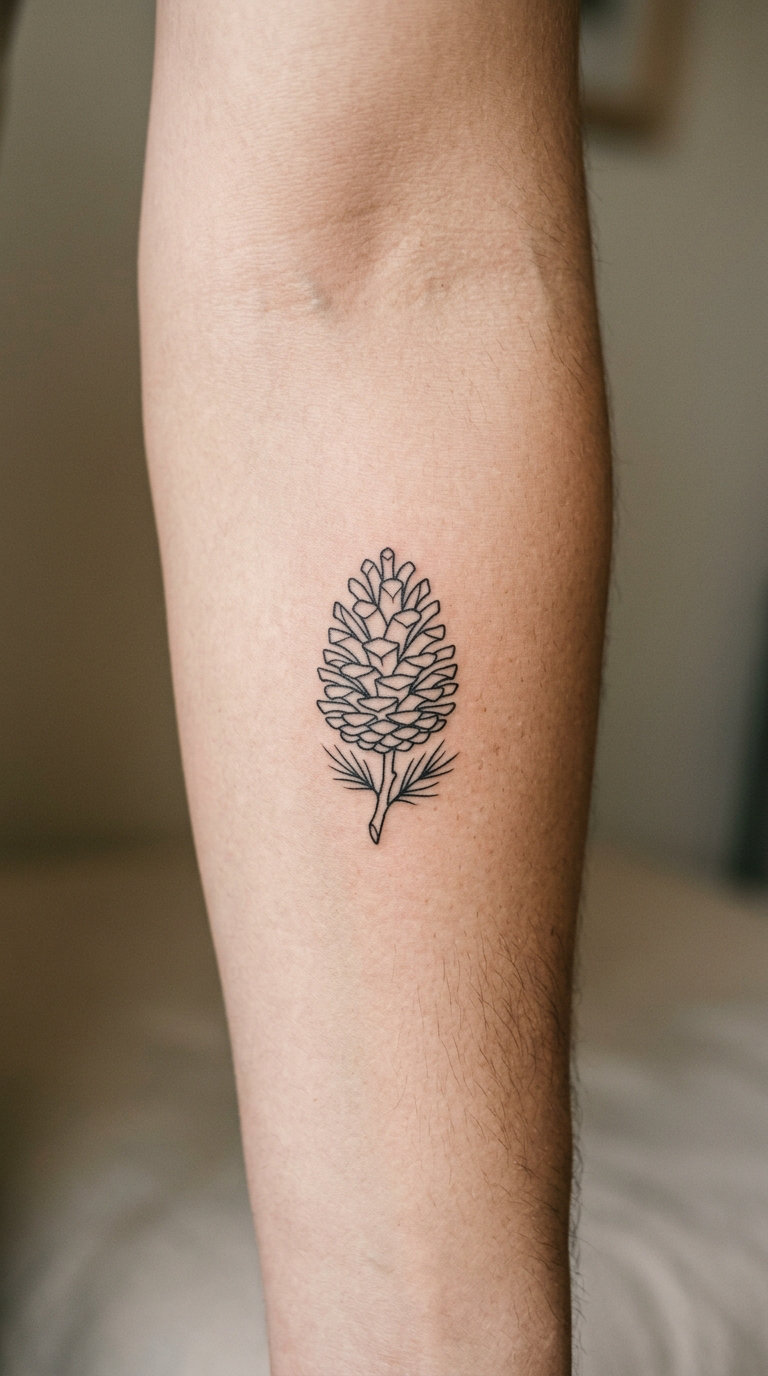
A single pinecone drawn in one confident line weight, the scales suggested with short curved marks and nothing else. There is no shading, no stem flourish, and no branch. Just the cone, slightly tilted, drawn loosely enough that it still looks botanical rather than mechanical.
People pick this one because it does the job without announcing itself. It reads as nature to anyone who looks twice, and it sits quietly under a shirt cuff or next to a watch band.
Placement: Inner forearm, wrist crease area or just above the elbow. Size: 1.5-2 inches (4-5 cm) tall. Style: Fine line, single needle, no shading.
Pain: Low. The forearm is forgiving. Ageing note: fine lines on hands and fingers lose definition fastest of anywhere on the body, so keep the cone on the forearm rather than the knuckles if you want it crisp in ten years.
Make it yours: Add a small date or coordinate in the same line weight tucked under the lowest scale.
2. Pinecone with Watercolour Pine Needles
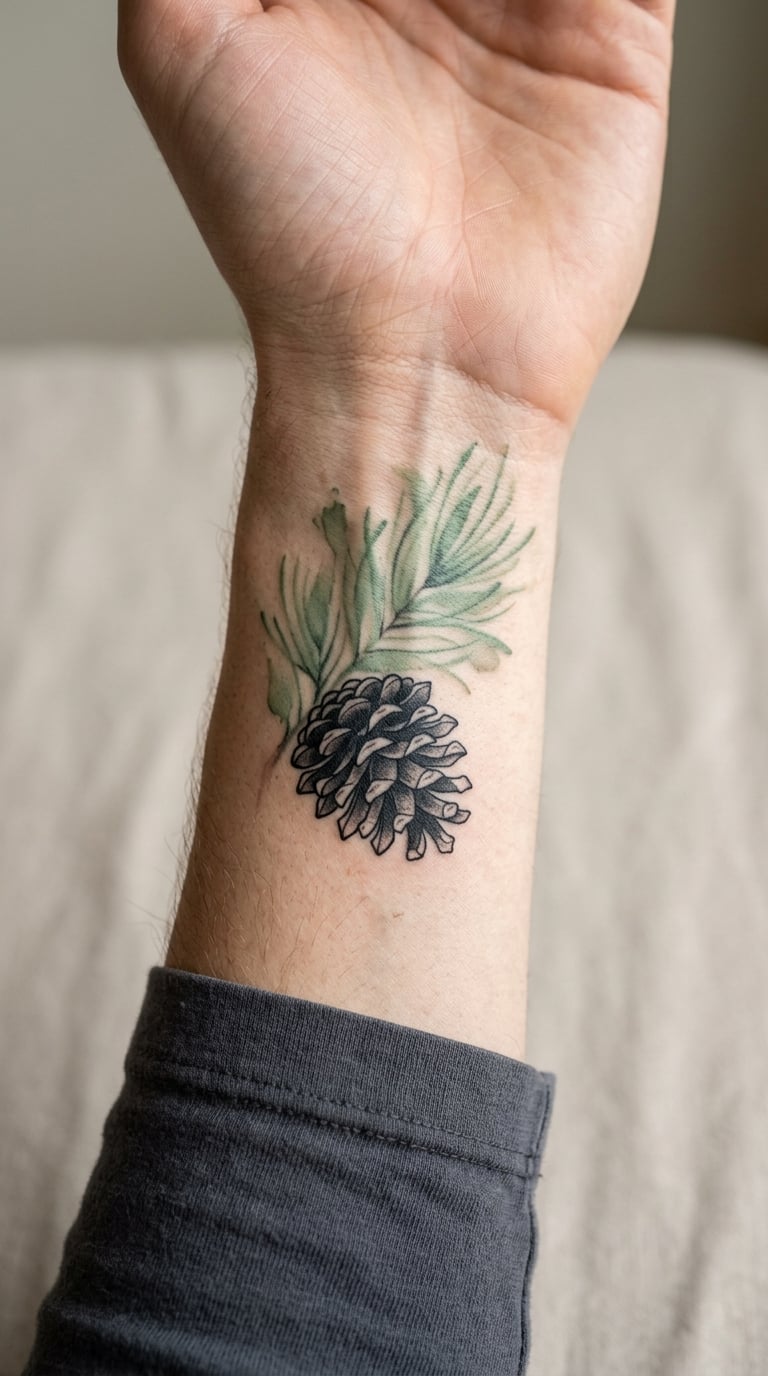
A black-and-grey pinecone, shaded in loose soft greys, with a few pine needles brushed in translucent sage green or dusty blue around it. The needles stay watery and unfinished at the edges while the cone itself stays crisp, so the two textures sit next to each other without fighting.
This is the version people choose when they want colour but not a colourful tattoo. One small wash of green is enough to make the piece feel alive, and the watercolour bleeds off into skin rather than sitting on top of it.
Placement: Outer wrist, above the elbow, or the top of the foot. Size: 2-2.5 inches (5-6 cm) tall. Style: Fine line and watercolour, one accent colour.
Pain: Low to medium; the wrist feels more than the forearm. Colour fades first, so expect the green to soften to a year or two after the black is done. A touch-up of just the wash is normal and worth budgeting for.
Make it yours: Pick the green from something real, a jacket, a forest trail you drove, the colour of your grandmother’s garden.
3. Blackwork Pinecone and Mountain
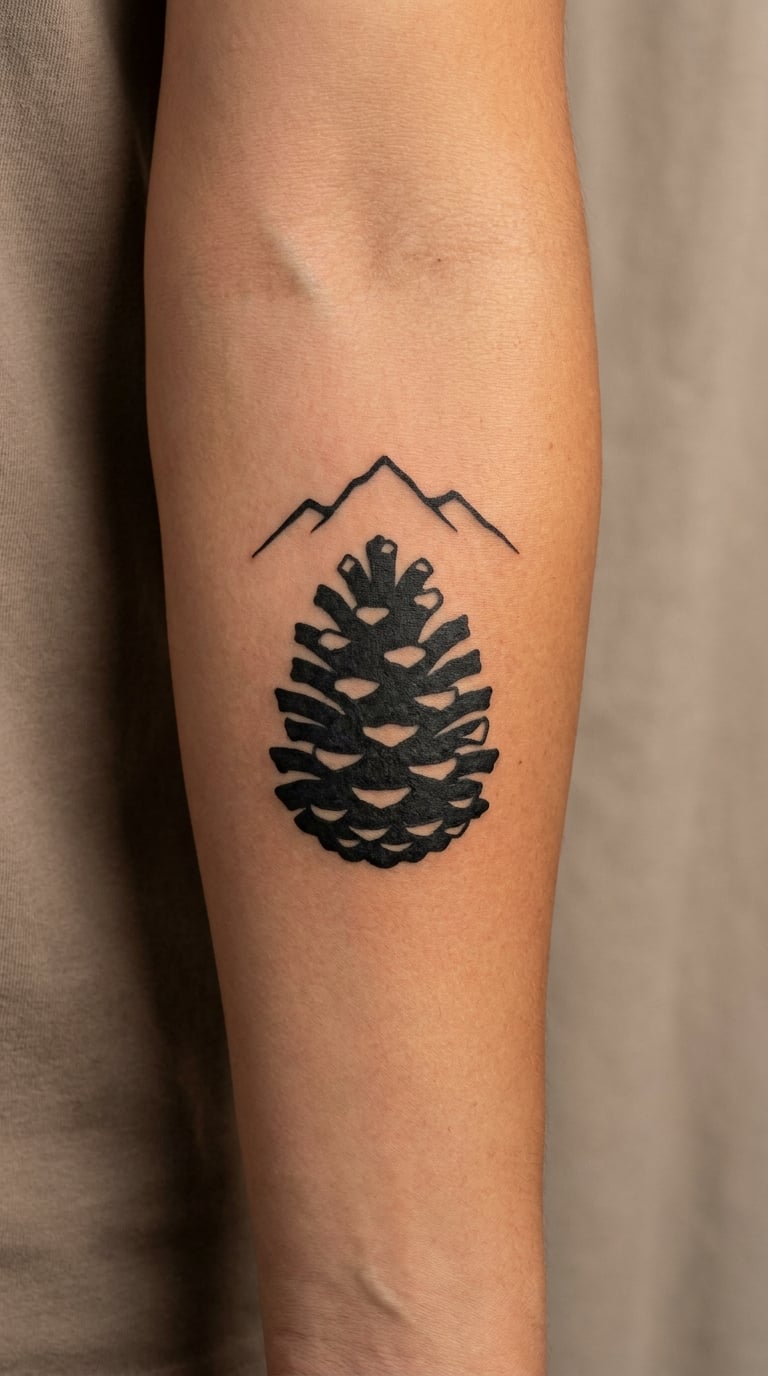
A heavy black pinecone, filled solid with only a few white gaps left for the scale pattern, sitting under a simple angular mountain ridge. The ridge is two or three peaks and nothing more. The contrast between the dense cone and the thin ridge line does all the work.
It is a scenery idea wearing botanical clothing, and it suits anyone who wants a piece with some weight to it rather than a small accent. The solid black holds up well and reads clearly across a room.
Placement: Outer forearm or outer upper arm, oriented with the ridge along the arm. Size: About 4 inches (10 cm) wide. Style: Blackwork with graphic line work.
Pain: Medium. Solid black over a wide area is a long, monotonous pass, usually 2-3 hours. Ageing note: filled areas can look slightly flat over a decade as the skin changes, and bold black in direct sun fades unevenly.
Make it yours: Have the ridge turned into a specific range, or have the mountain replaced by a single wave line for a coastal version.
4. Vertical Pinecone Branch Tattoo
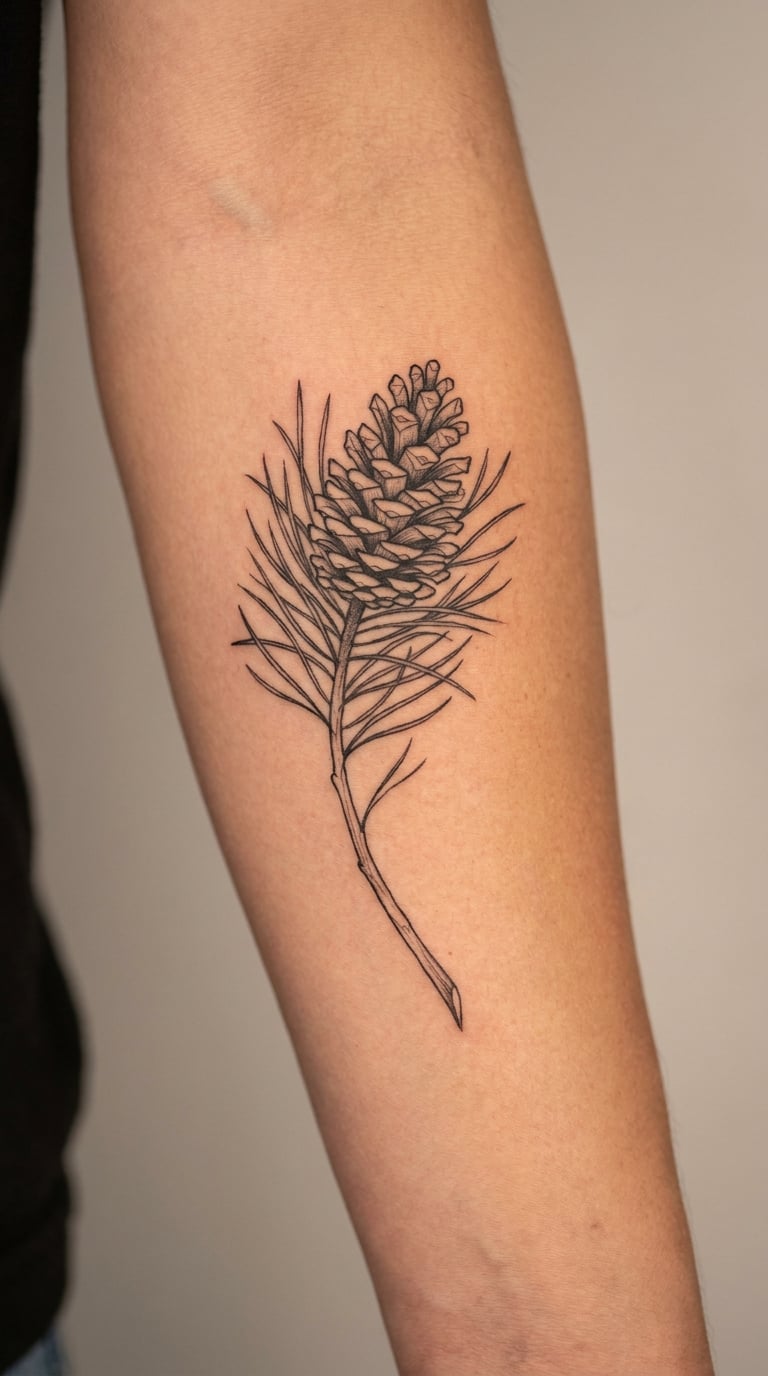
An elongated pinecone on a curved stem, a little over three times longer than it is wide, with a handful of needles spaced thinly along the top. The whole thing follows a gentle arc so it sits along the forearm rather than sitting on it like a sticker.
This is the shape people choose when they want a pinecone that works as a line rather than a shape. It fills a narrow strip of skin that a round cone would leave awkward, and it stacks easily with other botanical pieces later.
Placement: Inner forearm running lengthwise, or along the outer arm. Size: 5 inches (13 cm) long, about 1.5 inches wide. Style: Botanical fine line or light illustrative.
Pain: Low. Long designs in low-contrast areas can run two hours or so because the artist is not building density. Ageing note: a long thin shape loses the most to stretch, so the stem line along a joint will fade faster than the cone itself.
Make it yours: Angle it to follow the vein or tendon line on your forearm so it looks drawn onto your anatomy rather than applied to it.
5. Traditional American Pinecone
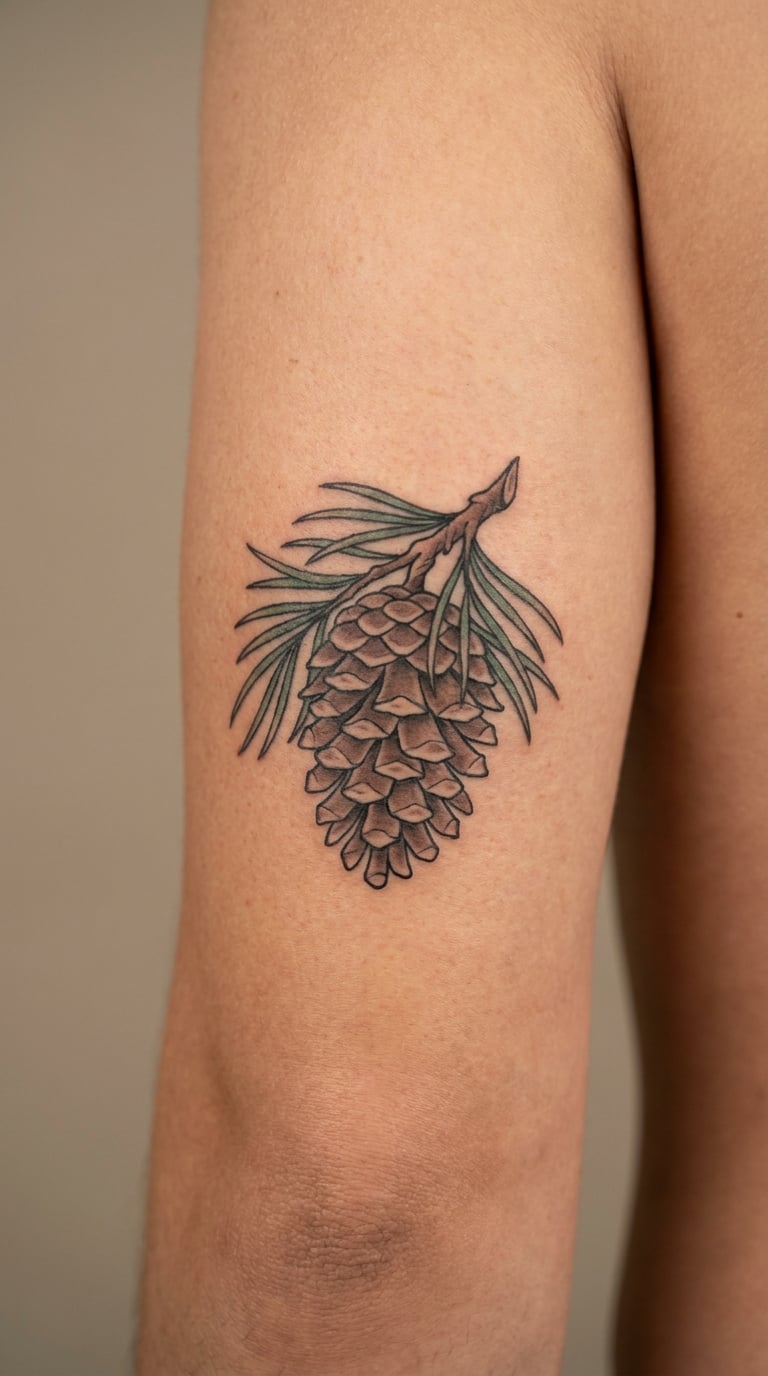
A pinecone in classic American traditional style: bold black outline, warm brown shading built from solid shadow blocks rather than soft gradients, and a couple of muted green needle clusters. The scale pattern is reduced to a few clean rows so it stays graphic at tattoo size.
Traditional work ages better than almost anything else in tattoos. Heavy line and flat colour are not delicate, so this is a good pick if you want a piece that looks essentially the same in fifteen years.
Placement: Outer upper arm, shoulder, or calf. Size: 3 inches (8 cm) tall. Style: Neo-traditional, black and brown with one green accent.
Pain: Medium. Solid colour needs repeated passes. The green will be the first thing to fade; keep it in a spot you can cover when you are out in strong sun if you care about the colour staying true.
Make it yours: Shift the palette entirely, a red pine cone for instance, or ask for a rope border if you are starting a themed piece.
6. Geometric Pinecone Facets
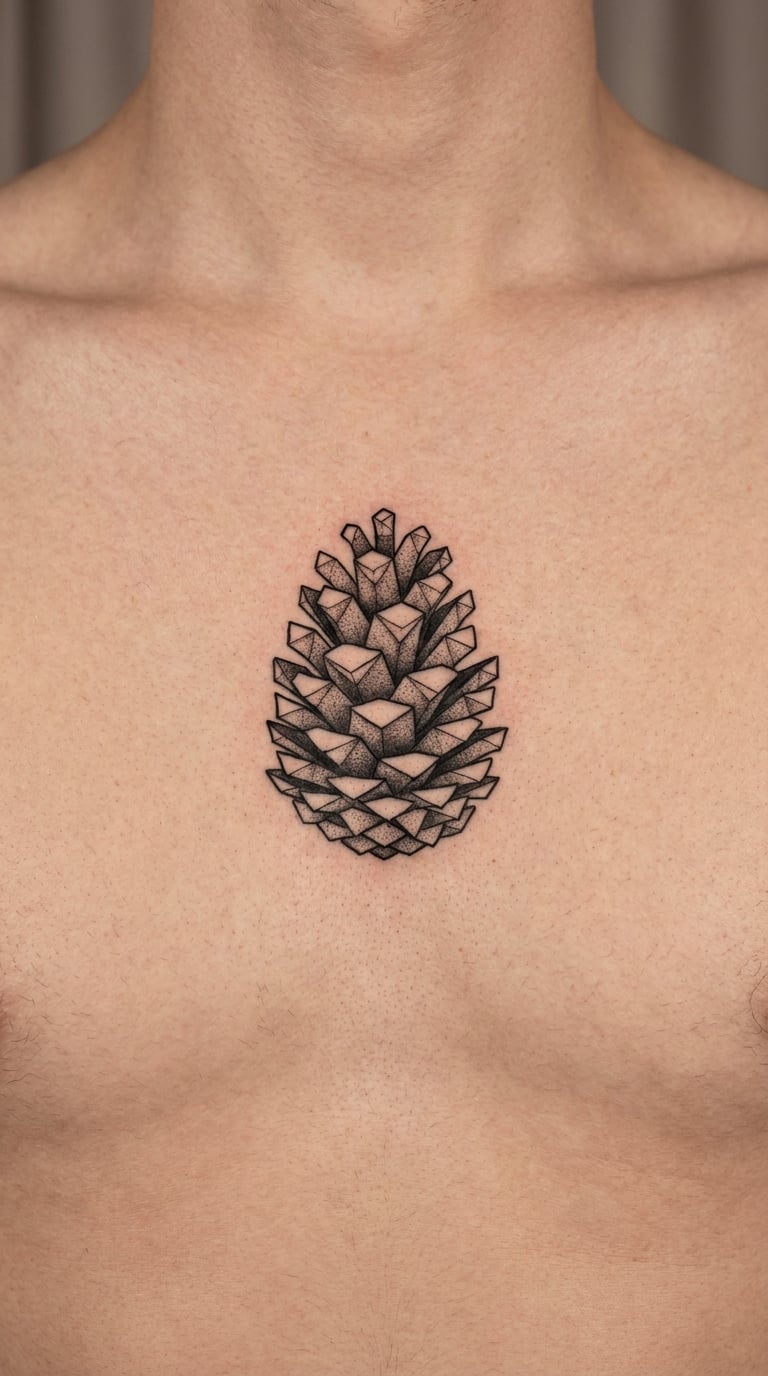
A symmetrical pinecone built from clean triangles and hexagons, each scale a flat black facet, with fine stippled shadows tucked into the lower half. It is precise and mirrored down the centre line, closer to a diagram of a cone than a picture of one.
People choose it when they like order. The same reason works for a design that sits in a body of geometric work already, and the triangular scale pattern is a satisfying shape to look at once you notice it.
Placement: Below the collarbone, sternum, outer thigh or the back of the upper arm. Size: 3 inches (8 cm) tall. Style: Geometric blackwork with stipple shading.
Pain: Medium; the collarbone is sensitive, the thigh is not. Ageing note: fine stipple is the first thing to soften, so expect the shaded half to read more evenly over time, which honestly suits this style.
Make it yours: Add a second cone in outline only, mirrored, so the pair frames a sternum line.
7. Micro-Realism Fallen Pinecone
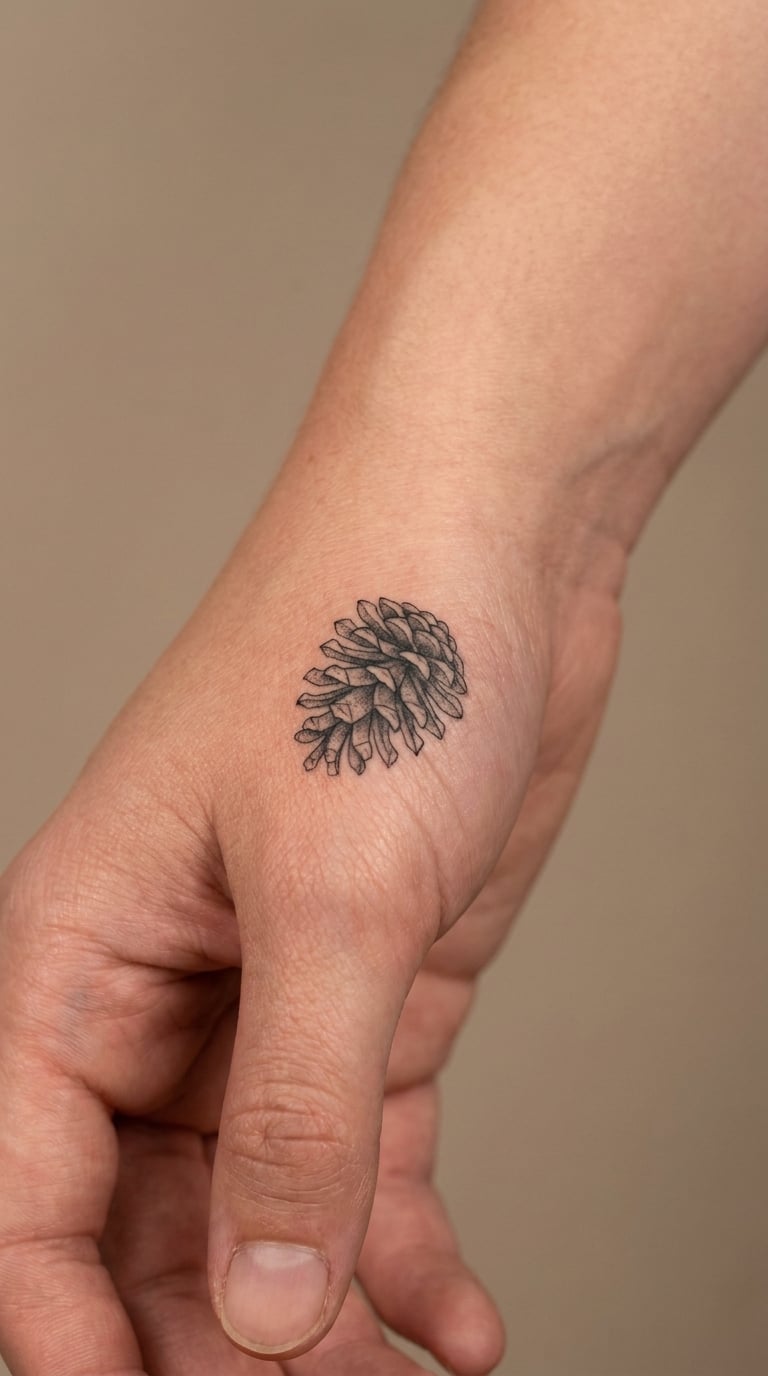
A tiny pinecone lying on its side, softly shaded black and grey, individual scales picked out with a small shadow underneath so it reads as found rather than drawn. No branch, no needles, nothing behind it. Just the object.
This is the one I would pick for a first tattoo. It has enough shading to feel finished and small enough to be a two-hour job in a single sitting, which matters more than people expect.
Placement: Inner wrist beside the thumb, or the top of the foot. Size: 1-1.5 inches (3-4 cm) long. Style: Micro-realism, single needle grey wash.
Pain: Medium on the inner wrist, mostly from the bony feeling rather than the needle. Ageing note: at one inch the internal scale detail will blur together over the years and you will end up with a soft grey cone, which is still handsome, just not the same drawing.
Make it yours: Base the shading on a real cone you gathered and dried, so the pattern matches something that actually existed.
8. Pinecone in a Circular Botanical Badge
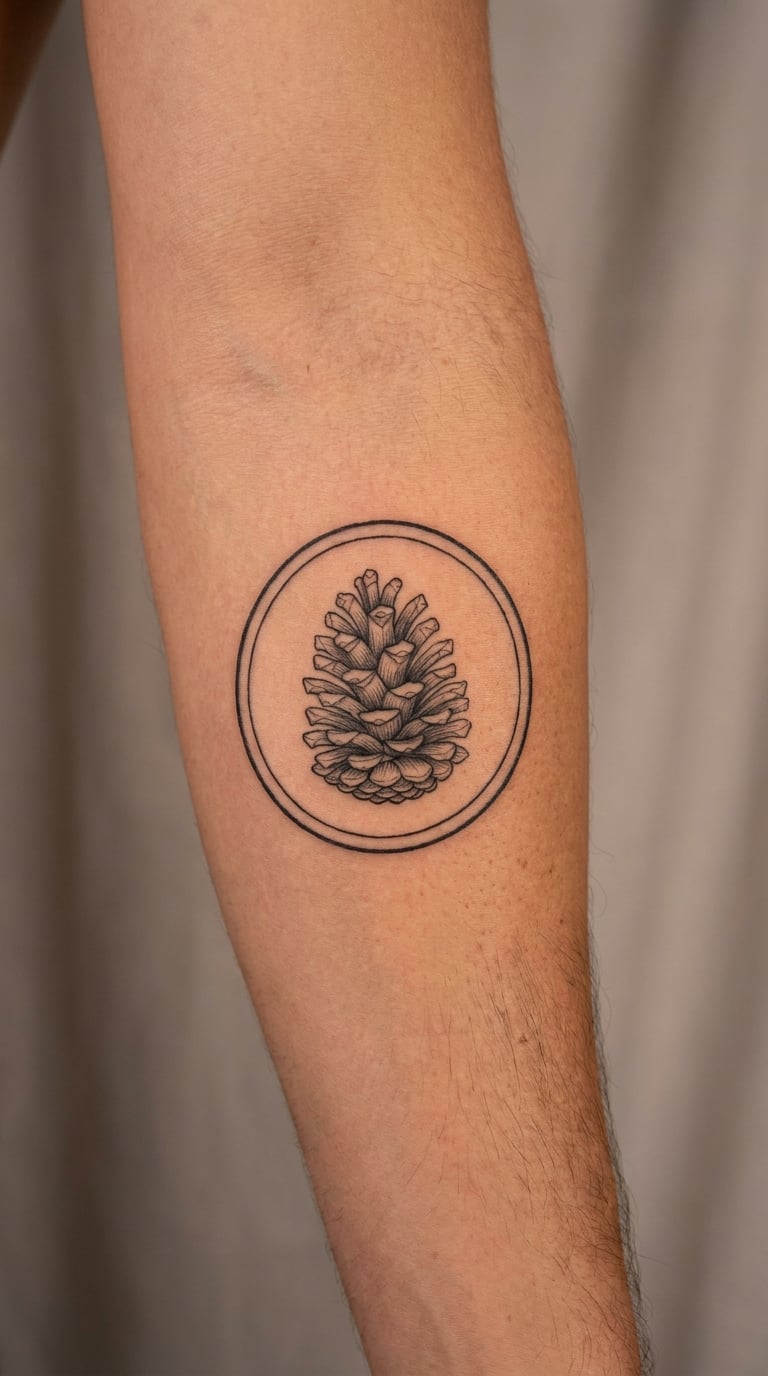
A pinecone centred inside a thin double circle, with two small leaves breaking the ring at opposite sides so it reads as a botanical seal rather than a target. Inside, the cone is shaded in even grey with a clean outline and a couple of loose needles.
The circle does the quiet work here. It turns a small motif into something that looks deliberately composed, which is why this is a popular first or second piece for someone who wants small but not incidental.
Placement: Upper inner arm, outer forearm, or the back of the shoulder. Size: 2.5 inches (6 cm) across. Style: Illustrative blackwork with light grey shading.
Pain: Low almost anywhere. Ageing note: the fine circular line is the vulnerable part, and it thins first on the inside arm where skin moves constantly. Slightly heavier line on the ring is the fix an artist can plan in from the start.
Make it yours: Put a year, an initial or a compass point inside the lower third of the ring.
9. Pinecone and Evergreen Sprig Sleeve Element
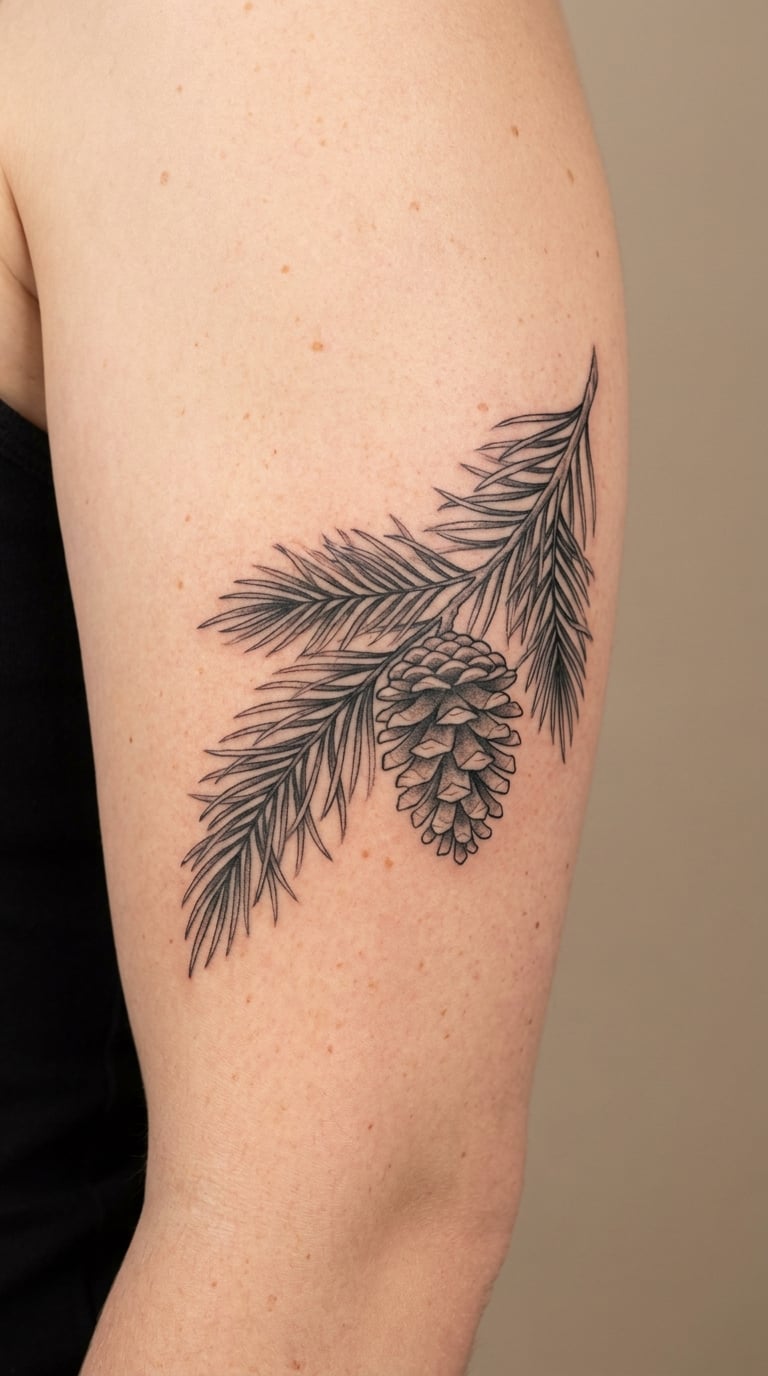
A shaded pinecone joined to a long, sweeping evergreen sprig, the needles getting smaller and sparser as the branch tapers away. Line weight is heavier at the cone and lighter at the branch tip, and the negative space between needles is kept clean rather than filled in.
This is the element to design if you already have a botanical sleeve in progress, or if you want to leave room for one. Artists who do gap-filling work treat a piece like this as a composition problem, not a flash problem.
Placement: Outer upper arm or thigh, designed to leave open skin on both sides. Size: 5 inches (13 cm) long. Style: Illustrative blackwork with soft grey shading.
Pain: Medium, and it is a long sitting. Ageing note: needles drawn thinner than the cone disappear first, so the sprig fades toward being a plain branch. Ask the artist to keep needle line at least as heavy as the cone outline if the sprig matters to you.
Make it yours: Bring your existing sleeve photo to the consultation and let the artist match line weight and grey value to what is already there.
10. Dotwork Pinecone Study
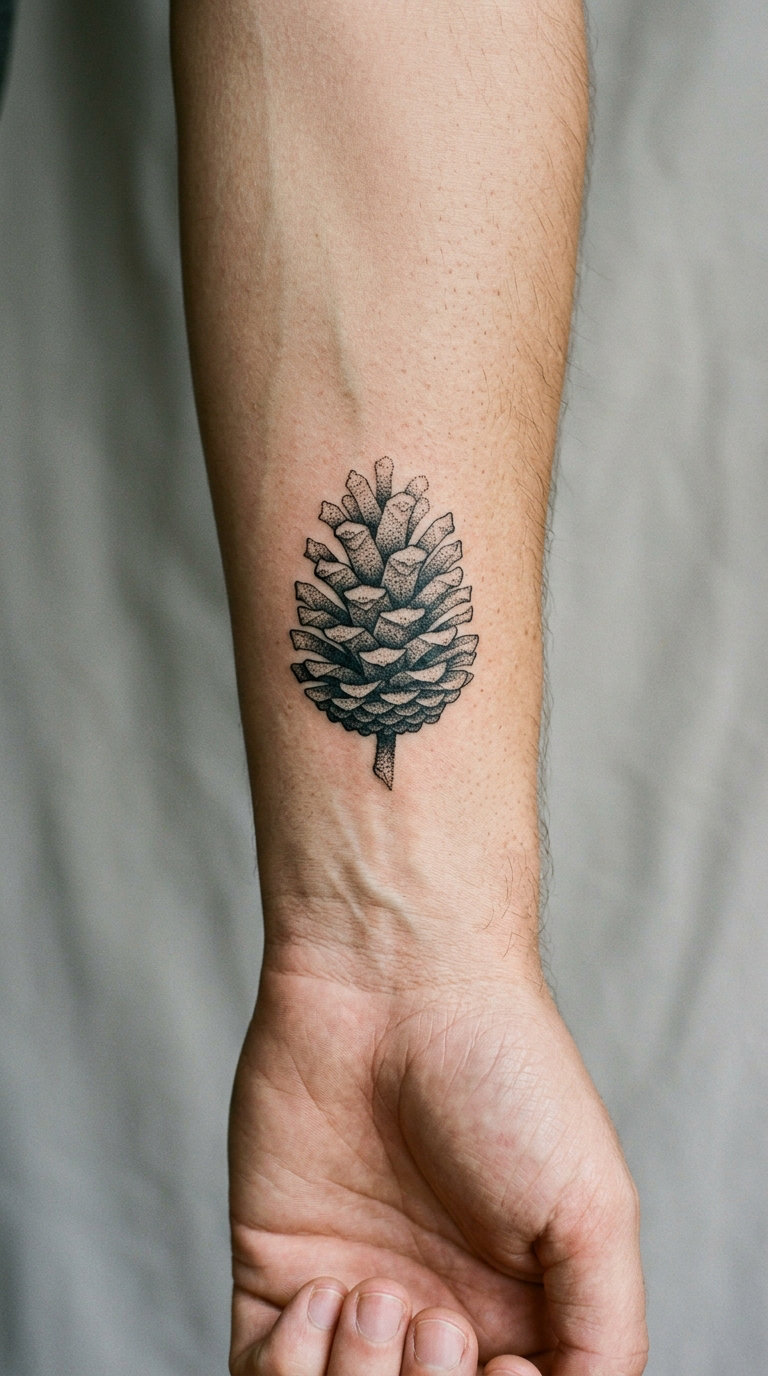
A single pinecone made entirely of black dots, the spacing graduated so the darkest areas are dense clusters and the highlight side is barely there. No lines at all in some versions, just tone built from point size and distance.
Dotwork rewards attention and it photographs well, which is a lot of why it travels in tattoo communities. You end up with a texture rather than an outline, and textures age more gracefully than thin contour lines do.
Placement: Inner forearm, upper arm, shoulder blade. Size: 2.5-3 inches (6-8 cm) tall. Style: Dotwork, single needle, graduated density.
Pain: Low, and oddly meditative. Ageing note: the smallest dots, the ones making up the highlight side, are the first to disappear, so ask for the density gradient to run a little darker than you think you want. It is hard to add dots later into healed skin.
Make it yours: Reverse the gradient so the dark side sits on the outside of the arm, or add a single line of coloured dots down the centre as a spine.
11. Pinecone with Red Berry Accent
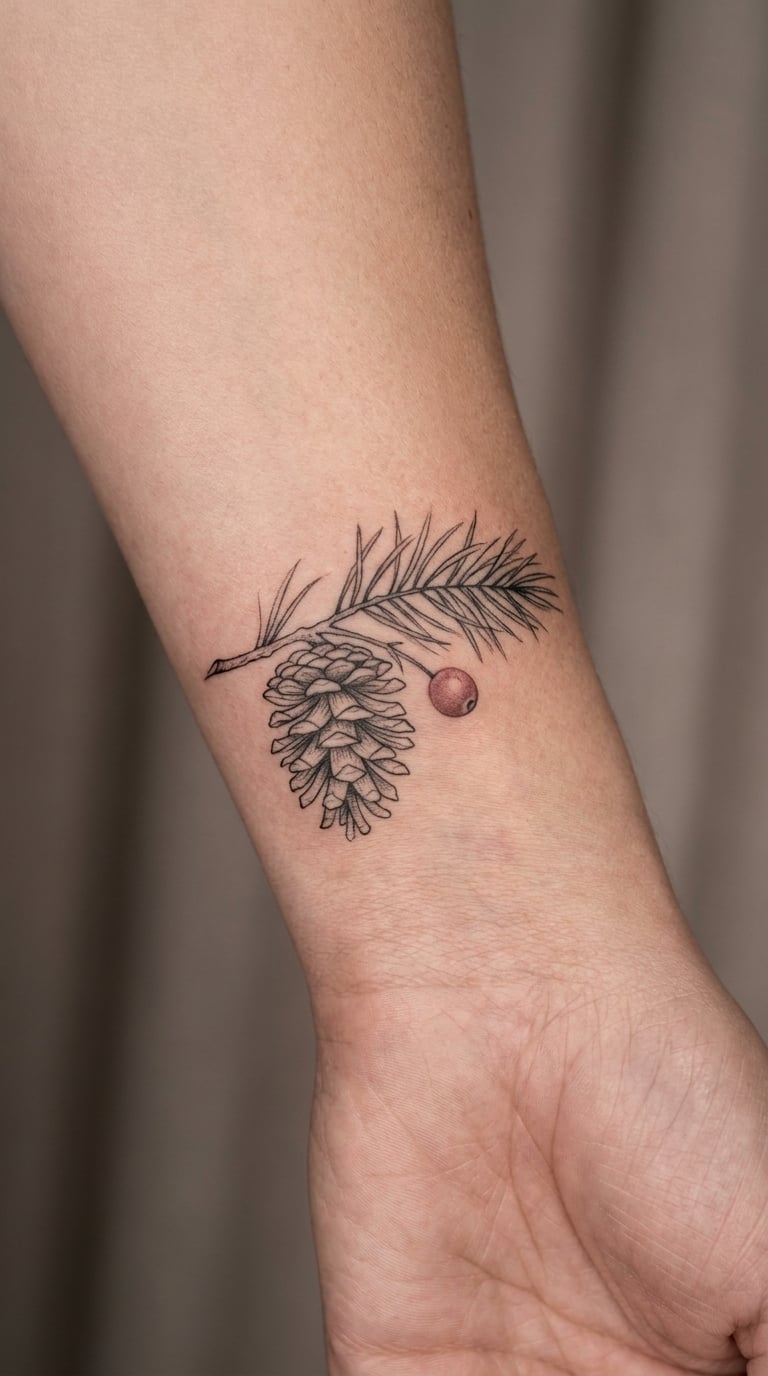
A fine-line pinecone in black on a short pine branch, with a single berry in muted brick red tucked at the base of the needles. One colour, one spot, about a fingertip of pigment in the whole design.
The small red note changes the temperature of the piece without turning it into a colourful tattoo. Plenty of people land here because they want something recognisable and warm but still quiet.
Placement: Outer wrist, inner arm above the elbow, or behind the ear. Size: 2 inches (5 cm) tall. Style: Colour fine line, one accent.
Pain: Low. Ageing note: the red will fade noticeably within a few years and go browner, while the black line stays, so the berry can look separated from the branch with time. Keeping the berry small limits how obvious that becomes.
Make it yours: Use a specific shade rather than pure red, a deep mulberry or a rust tone, and it ages more gracefully than bright red does.
12. Three Pinecone Gradient
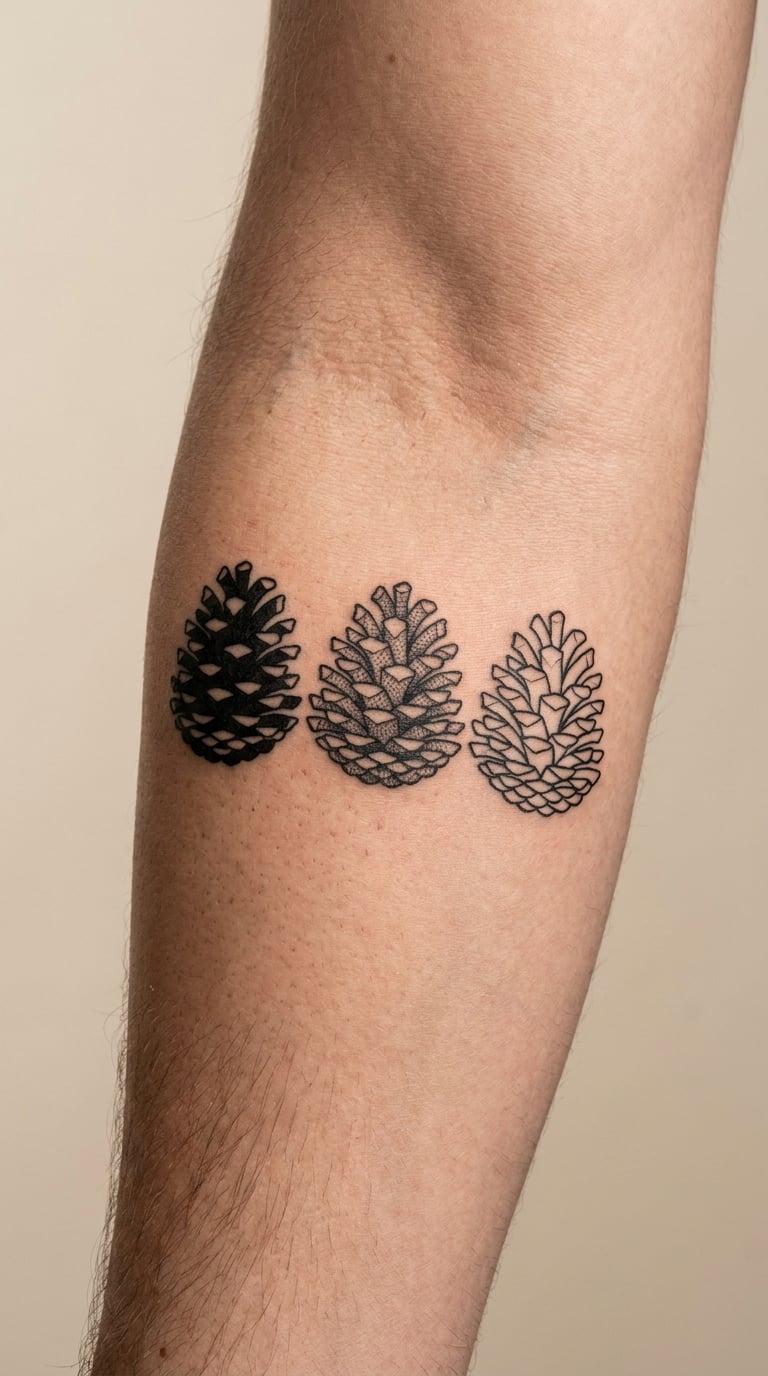
Three pinecones in a row, the first filled solid black, the second half-filled with grey shadow blocks, the third outline only. Each is about the same size and they are spaced evenly, so the row reads as one design rather than three separate tattoos.
Repetition does a lot of the personalising here. People often use it to mark three places, three people or three years, but it also works as pure composition if you would rather not attach a story to it.
Placement: Inner forearm running horizontally, or across the upper arm. Size: 3 inches (8 cm) across as a row. Style: Graphic blackwork, graduated fill.
Pain: Low to medium depending on how much solid black the first cone carries. Ageing note: the outline cone is the piece most likely to need a re-line in a decade, and re-working an outline is straightforward compared with re-doing shading.
Make it yours: Order the gradient around a real sequence, the year you moved, the year you finished something, the year now, and let the fills stand for it.
13. Pinecone and Acorn Woodland Pairing
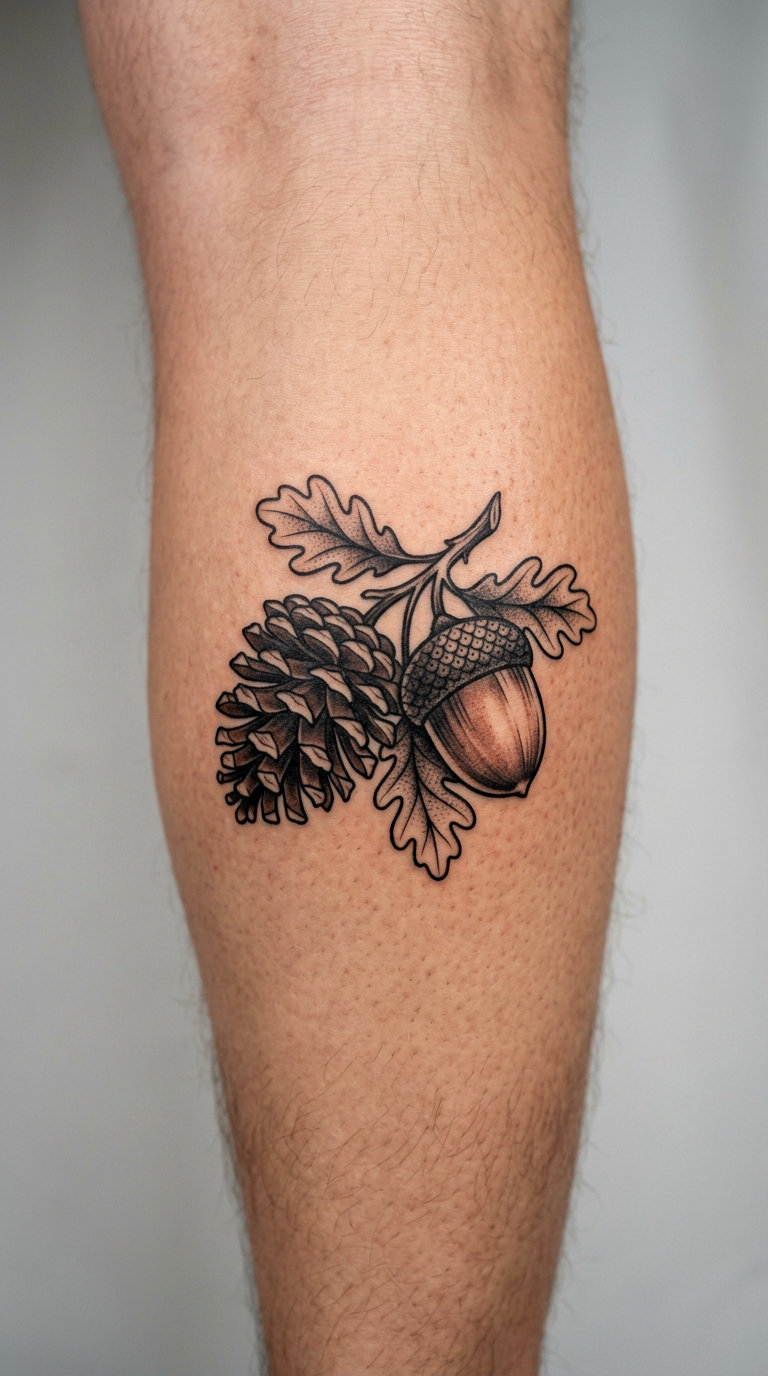
A pinecone and an acorn paired at different scales, the cone standing tall on the left and the smaller acorn tilted on its side to the right, with two loose leaves filling the gap between them. Shading is limited so the two objects stay distinct at a glance.
Mixing scales is what keeps a two-object design from looking like a sticker sheet. The size difference gives the composition a direction and stops the eye treating both motifs as equals.
Placement: Calf, inner arm, or the back of the calf near the knee. Size: 3 inches (8 cm) across. Style: Illustrative or neo-traditional, black and brown.
Pain: Medium; the calf is fleshy and sensitive in a dull way. Ageing note: the small acorn cap carries the finest detail and softens first, so ask for a slightly simplified cap if you want both motifs to survive evenly.
Make it yours: Use a native acorn from where you grew up, or swap it for a seed pod from a plant that means something specific.
14. Sideways Pinecone on the Spine
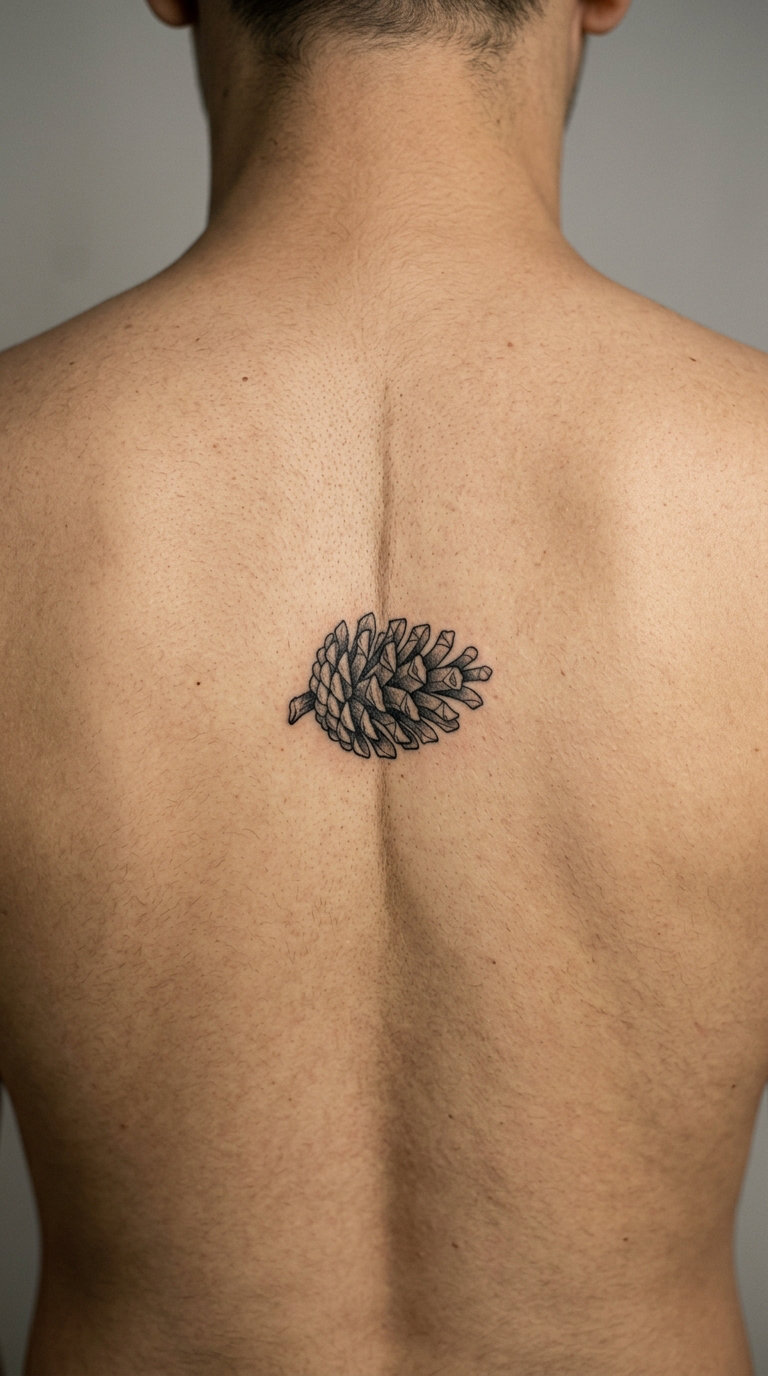
A compact pinecone turned on its side, positioned so its long axis runs across the back rather than down it, following the natural line of the spine at that height. Shading is soft grey, heavier on the underside, and the stem sits at the left edge.
Rotating the motif is the whole trick. A vertical cone on a spine would fight the body line, while a horizontal one sits in the gap between shoulder blades like it was always meant to go there.
Placement: Upper back between the shoulder blades, or the small of the back. Size: 2 inches (5 cm) long. Style: Black and grey illustrative.
Pain: Medium, and you will be face down or twisted. Ageing note: skin across the spine stretches constantly, and this is a spot where a perfectly healed tattoo can blur within a few years. Heavier outlines and less fine shading help a lot here.
Make it yours: Centre it between the shoulder blades and have a very small date placed just below, on the line, following the curve.
15. Pinecone Behind the Ear
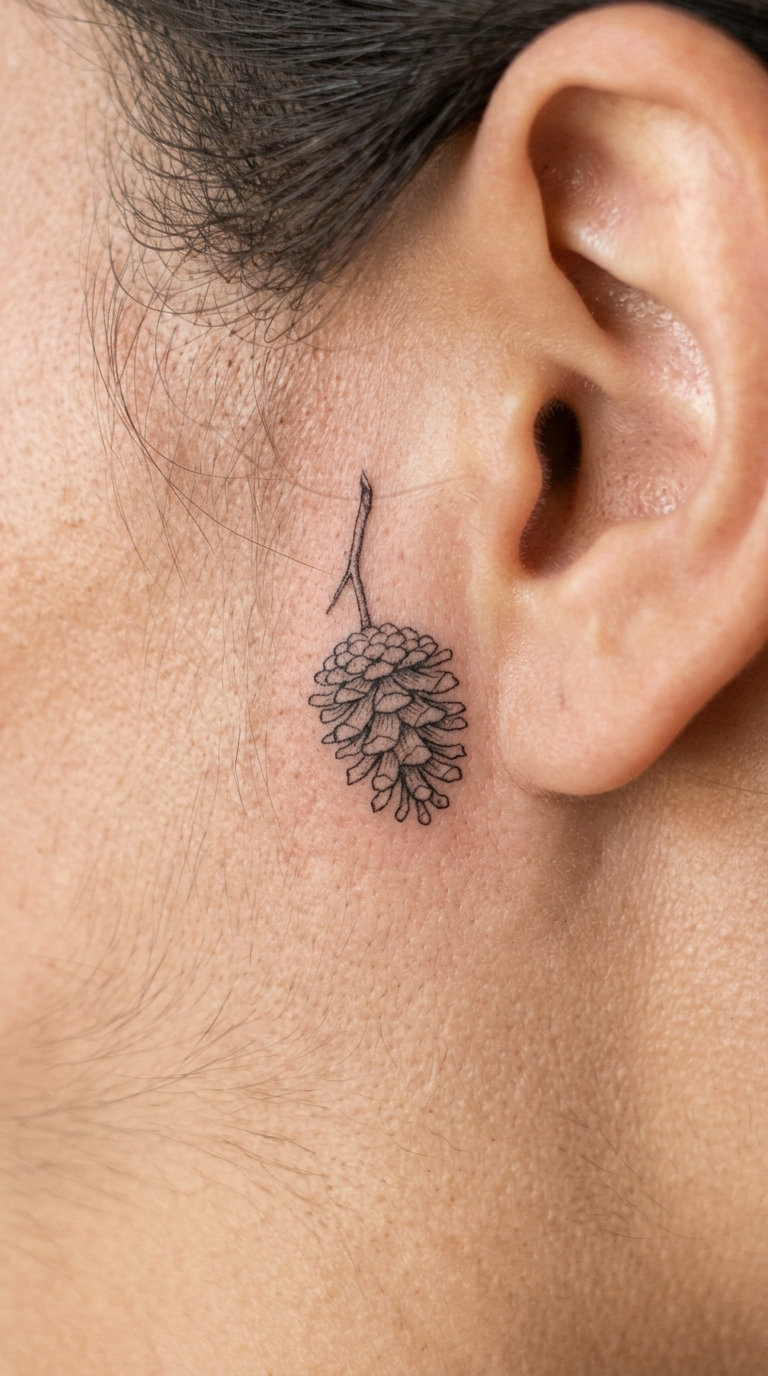
A tiny simplified pinecone peeking out from behind the ear, only the top two thirds visible, with a short stem and three needles above it. The scale pattern is reduced to three or four marks per row so it still reads as a cone at that size.
The appeal here is the silhouette. It is almost entirely hidden unless you turn your head or push your hair back, which is exactly the point for the people who get one.
Placement: Just behind the ear on the neck, or below the earlobe. Size: 0.75-1 inch (2-2.5 cm) tall. Style: Micro fine line, single needle.
Pain: Medium. The skin is thin, the bone is right under it, and the neck moves constantly. Ageing note: this is the least durable placement on this list. Hair, shampoo, sun and stretch all work on it, and ultra-fine lines here can soften noticeably within five years.
Make it yours: Let it peek rather than show, cropping it so only the top of the cone is visible, which reads as more considered than a full motif.
16. Stippled Pinecone on the Hand
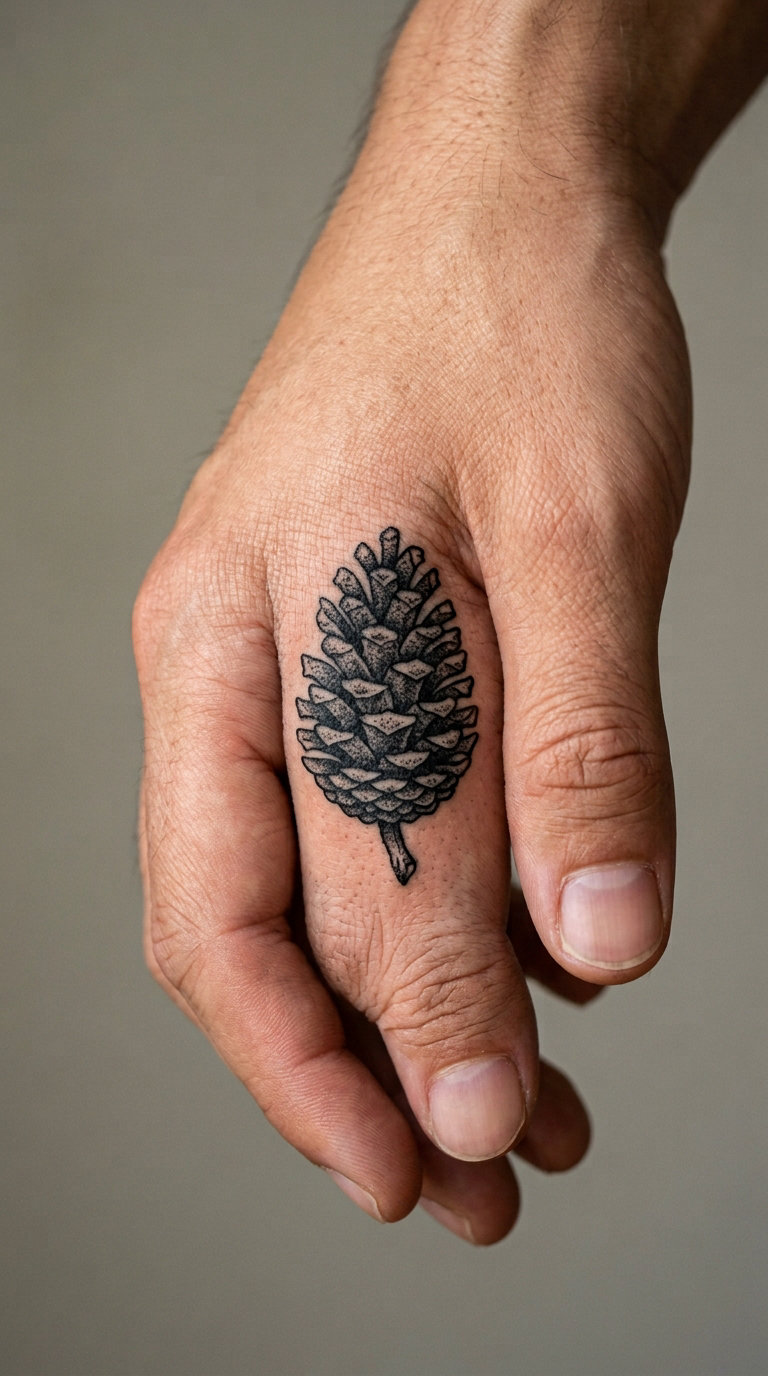
A bold black pinecone sitting on the inner hand between the thumb and index finger, built from solid shapes and fine stipple so the scale pattern stays readable across a wide surface. The outline is heavy and the internal detail is generous.
Hands need bold silhouettes because everything else on them is small and busy. A faint cone there would be lost, but a high-contrast one with real line weight stays obvious from across a room.
Placement: Inner hand, back of the hand, or the side of the index finger. Size: 2.5-3 inches (6-8 cm) tall. Style: Blackwork realism with stipple shading.
Pain: High. The hand is bony, the skin is thin in places, and knuckles and finger joints are genuinely uncomfortable. Expect to sit still for two to three hours. Ageing note: hands show age on the skin faster than anywhere else, so fine detail and fine line will change noticeably over the years. Bold shapes are the safer call here.
Make it yours: Run it along the hand rather than sitting it flat, following the line from wrist to knuckle, and it will wear like part of the anatomy.
17. Pinecone with Compass Background
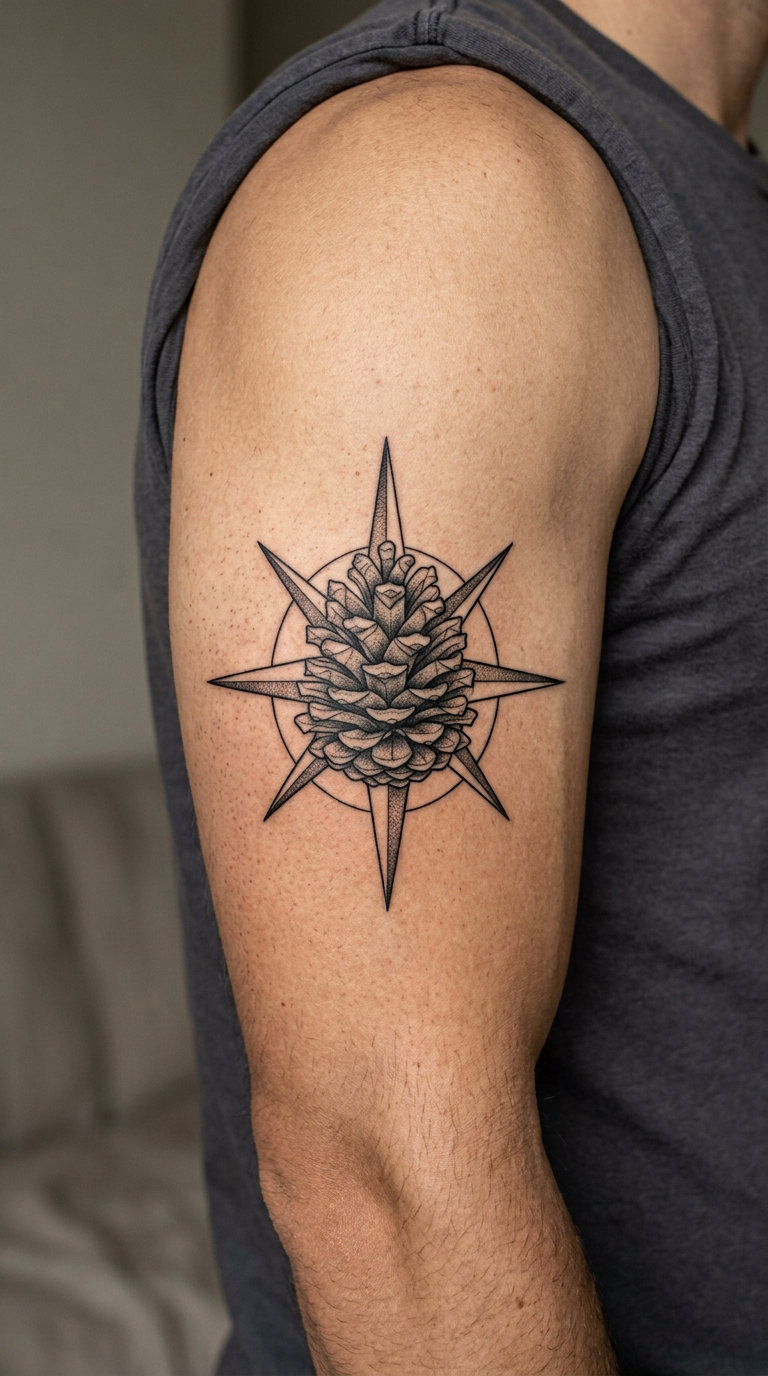
A detailed pinecone in black and grey with a restrained eight-point compass star sitting behind it, the star’s points extending just past the cone’s outline and nothing further. The compass is drawn thinner and lighter so the cone stays the subject.
Backgrounds like this can easily take over, and the discipline is the whole trick. A navigation motif supports a pinecone without competing with it, and the result reads as a finished emblem rather than two tattoos next to each other.
Placement: Outer upper arm, chest, or the upper back. Size: 3.5 inches (9 cm) across. Style: Illustrative or neo-traditional, two-tone.
Pain: Medium. Ageing note: the thin compass lines running behind the cone sit in the skin’s deeper layer and can soften while the cone’s black line holds, so plan for a single re-line session in a few years if the star is important to you.
Make it yours: Set the star’s needle to a real bearing, a direction that means something, without labelling it.
18. Abstract Pinecone Negative Space
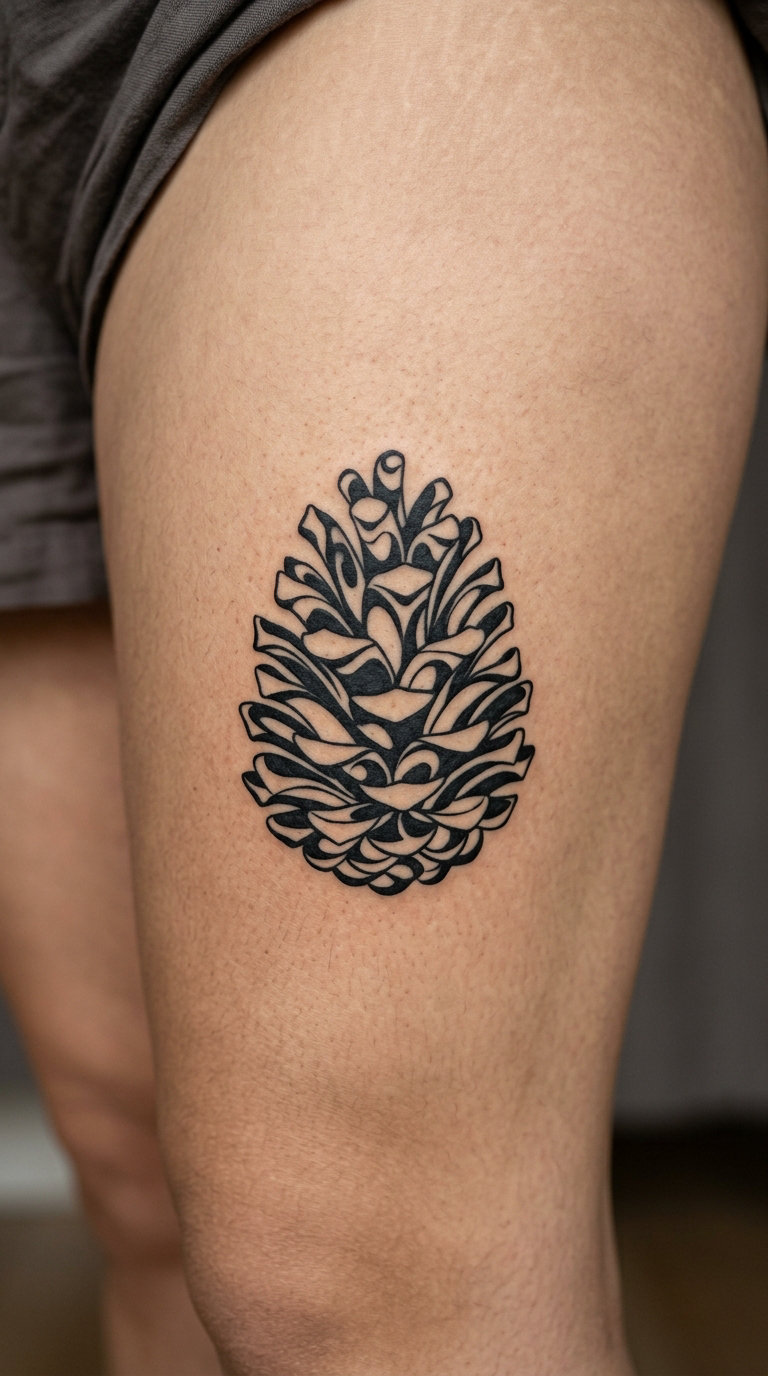
A pinecone reduced to curved black shapes separated by open skin, with the scales suggested by the gaps rather than drawn as individual marks. It is graphic and a little architectural, and it looks almost like a pattern rather than a plant.
Someone who wants a bold piece but not a detailed one tends to land here. The negative space carries the form, which also means the design holds together even if the outer edge loses a little crispness.
Placement: Outer thigh, calf, ribs, or the back of the upper arm. Size: 3-4 inches (8-10 cm) tall. Style: Abstract blackwork, negative space.
Pain: Low on the thigh, medium on the ribs. Ageing note: filled black areas stay solid much longer than fine line, so this style ages well. The open gaps do not fill in, but they can widen slightly as skin changes over decades.
Make it yours: Mirror the shape pattern so the same abstract cone appears twice, once as a forearm piece and once on the opposite side, at different sizes.
19. Pinecone with Snow-Dusted Scales
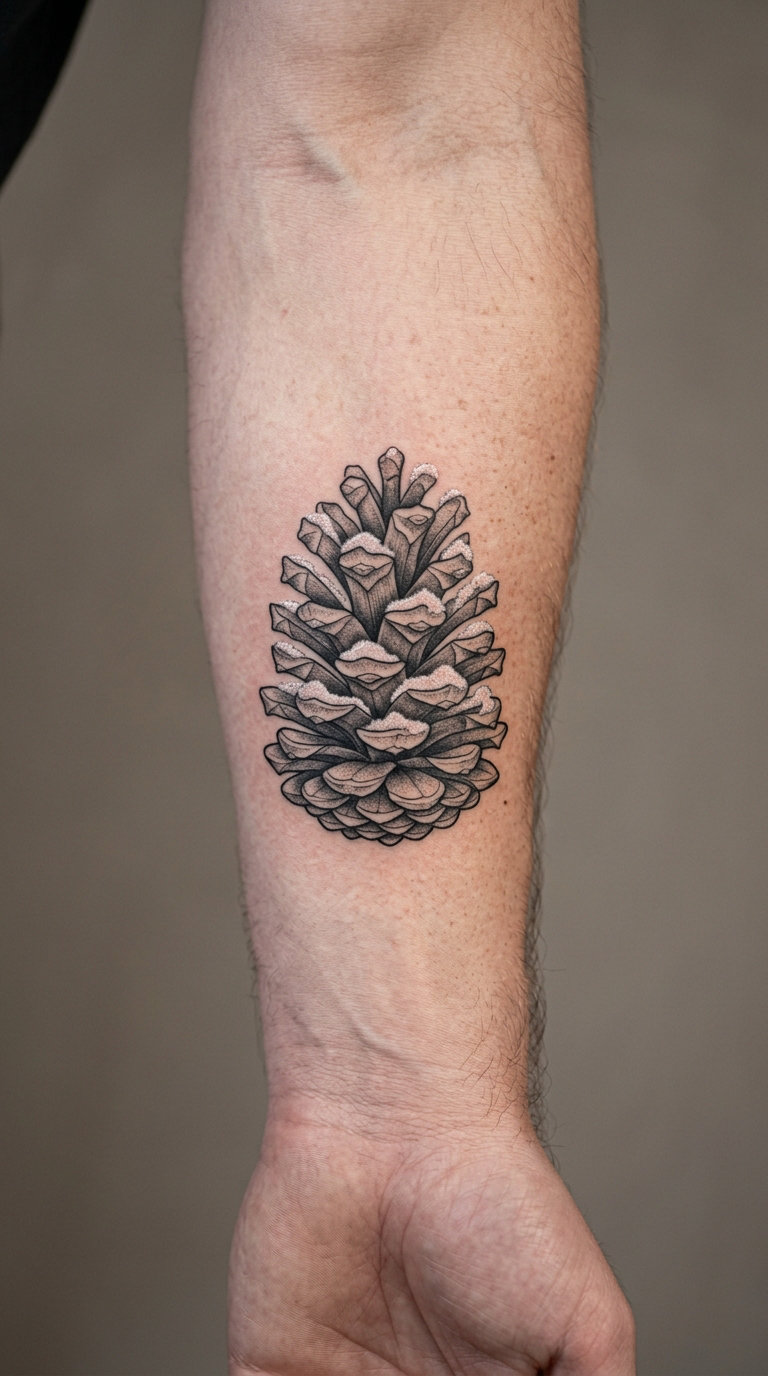
A dark pinecone in black and grey with pale stippled highlights scattered across selected scales, so the top and one side look dusted while the rest stays dark. The white is skin left untouched inside a stippled field, not white ink.
It reads as a winter object without adding a single scene around it, which keeps the composition tight. The tonal contrast also makes the cone look dimensional from a distance.
Placement: Outer forearm, upper arm, or the calf. Size: 3 inches (8 cm) tall. Style: Black and grey realism with negative-space highlights.
Pain: Medium; the black areas need patience. Ageing note: fine stipple highlights blend into the surrounding grey over the years, so the snow effect gradually flattens into general texture. Ten years in, it looks like an evenly shaded cone, which is a fine outcome.
Make it yours: Have the dusting follow one edge only, as if snow has settled on a single side, rather than spreading it evenly across the cone.
20. Pinecone and Wildflower Bouquet
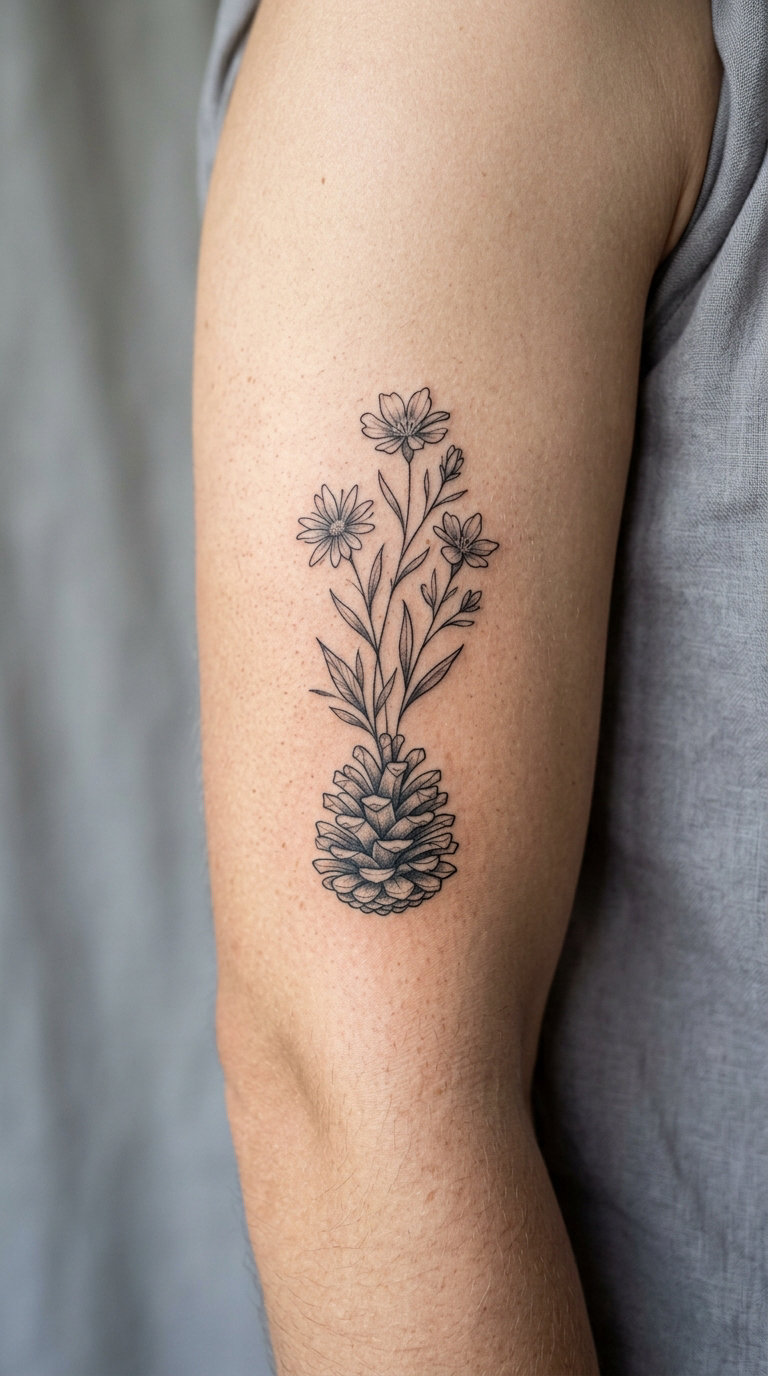
A compact pinecone in black and grey set against three delicate wildflowers with curved stems, the dense cone on one side and the airy petals rising on the other. The petals are drawn with almost no fill, just outline and a little grey at the base.
The pairing works because the two textures are opposites. A pinecone is all overlap and weight, so it needs something soft and open next to it, and it also gives a floral piece somewhere solid to sit.
Placement: Outer arm, thigh, or along the collarbone. Size: 4 inches (10 cm) tall. Style: Botanical fine line with light grey.
Pain: Low to medium, and thin petals over an arm are gentle work. Ageing note: the finest petal lines soften first while the cone holds, so over time the balance tips slightly toward the heavy motif. That usually looks fine, just worth knowing before you commit.
Make it yours: Use wildflowers that grew somewhere real to you, named on paper and sketched by the artist, rather than generic blooms.
How to Choose the Right Design
Most regret with this motif comes down to two decisions: how much detail you chose, and where you put it. Everything else is preference.
- Pick the style before the picture. Fine line gives you a soft, quiet piece that needs at least 1.5 inches. Blackwork and geometric styles carry further and read from a distance. Traditional work holds colour and line best over time. Watercolour and colour styles look best small but fade first, and realism needs the most room to avoid turning into a smudge.
- Match the size to the detail, not the other way round. Under 1 inch, work with a silhouette or a few rows of scales. Between 1.5 and 2.5 inches you can draw most of the pattern. At 3 inches and above you can shade it properly. If a design needs shading and you want it small, simplify the design instead.
- Let placement drive the composition. A round cone suits a round flat area like the outer upper arm. An elongated branch suits the forearm. A badge with a circular frame needs a flat, uninterrupted patch. Rotating a motif to follow a body line, as on the spine, changes the design as much as the location does.
- Think about what you will add later. A standalone cone can start a botanical collection. A single motif with no surrounding space is harder to extend. If you might build a sleeve, ask for the piece to be designed with open skin on both sides.
- Budget for fade honestly. Fine line on hands, fingers and behind the ear changes the most. Black and traditional styles change the least. If the design must look identical in fifteen years, choose line weight and style over tiny detail.
If you are starting out and want something small, our guide to tiny wrist tattoos covers the placements where a small piece still reads properly and the ones that turn into a smudge within a year or two.
Which of these 20 pinecone tattoo ideas ages least?
Number 5, the traditional American cone, and number 3, the blackwork cone with the mountain, both age well, because solid line and flat fill do not lose definition the way fine line does. The behind-the-ear and inner-hand pieces age worst, mostly for reasons that have nothing to do with the art: sun, hair, movement and washing.
Cost and Session Time
Nobody can quote a pinecone tattoo accurately without knowing the size, the detail level and the artist, so treat any figure you find online as a starting point for a conversation rather than a promise. Broadly, in the US, a tiny fine-line cone the size of a thumbnail tends to land somewhere around $80 to $150, a small two to three inch piece around $150 to $350, and a shaded or realistic three to four inch piece around $300 to $600. Colour, multi-element designs and blackwork passes sit at the higher end, and anything large usually gets split across two sessions.
What actually drives the number is time on the skin. A small fine-line cone, around an inch or so, is often a short single sitting. A two to three inch shaded or realistic piece is typically a two to three hour session. Anything four inches or wider, or anything with watercolour, traditional colour or three separate motifs, is usually a multi-hour piece and often gets split across two sessions so the artist can keep line weight even.
Three other things move the total: the artist’s hourly rate, which varies a lot by city and by experience; the shop minimum, which many studios set to cover a short booking and which is the reason a tiny design can still be priced like a medium one; and colour, since anything beyond black and grey adds setup time.
So ask for a quote after you have talked through size and placement with the artist, not before. The number that matters is the one you agree after they have seen your skin and your reference images.
Aftercare Basics
- Follow your artist’s aftercare instructions first. They know what they did in your skin, and their advice overrides anything general you read online.
- Wash gently with clean lukewarm water and mild unscented soap, then pat dry with a clean towel rather than rubbing.
- Keep it out of swimming pools, hot tubs and the sea while the surface is healing, and keep it covered from direct sun on the first weeks out.
- Do not pick, scratch, twist or peel the flaking skin. When it comes away on its own in a week or two, that is the process working.
- Moisturise only as your artist instructs. Too much ointment traps heat and lifts ink, and too little leaves the skin tight.
- Protect it for the first two weeks, including sleeping positions and sleeve cuffs that rub across the area.
Frequently Asked Questions
Are pinecone tattoos painful?
A pinecone is a small design, so pain depends almost entirely on where it goes. Forearms, outer arms and calves are low to moderate. The inner wrist, the bony inner hand and the area behind the ear sting more because the skin is thin and the bone sits right under it. Stitches are short, so the discomfort passes quickly. A two-hour session on the inner hand is a genuinely hard sit.
What is the best placement for a small pinecone tattoo?
The inner forearm and the outer upper arm are the easiest places to keep a small cone readable, because both are flat, well lit and easy to cover. The back of the hand works if the design is bold enough. Behind the ear and the inner wrist are popular but take the most care over the years, since movement, hair and sun all work on fine line there.
Will a fine-line pinecone tattoo fade?
All tattoos change, and fine line changes the most. The thinnest lines soften first, and the small scale details that make a pinecone recognisable blur together over time. Colour fades ahead of black, and a wash of watercolour or a single red berry will soften within a few years. Heavier line, black and traditional styles hold their shape longest.
What other flowers or plants pair well with a pinecone?
Pine needles and a short branch are the natural pairing, since the cone without them reads as a seed pod. Acorns, oak leaves and seed pods work for a woodland look. Wildflowers, thistles and poppies give contrast, because soft petals sit well against the cone’s dense scales. Sea holly and thistle are popular in the neotraditional botanical style.
How should I prepare for a pinecone tattoo consultation?
Bring references in the style you actually want, plus your own photos of the placement area in good light, and say which one detail you care most about. The 20 pinecone tattoo ideas here are a starting point for that conversation, not a finished brief. Talk through size, placement, whether it will join existing work, and how much fading you accept, then ask for a quote.
Conclusion
If this is your first tattoo, go with the minimal single pinecone in fine line. It is small, it is a short sitting, and it does not need to be complicated to be good. If you are adding to a nature collection, the blackwork pinecone and mountain or the cone and evergreen sprig give you room to build outward without the first piece looking stranded.
Settle placement and detail level before you book, bring your references to the consultation, and let the artist tell you what the skin in that spot can hold. That conversation is where a good pinecone tattoo is actually designed. Our 24 tattoo ideas that symbolize growth for first timers list is worth a look next if you are weighing this motif against other nature symbols.