
25 Hip to Thigh Tattoo Ideas for Women: Best (October 2026)
A hip to thigh tattoo is any design placed on the curve where the hip meets the upper thigh, and this roundup of 25 hip to thigh tattoo ideas for women covers every version of that zone. The area splits into six placements: hipbone, hip crease, outer thigh, front thigh, inner thigh and back of thigh. It suits anything from a small crescent moon to a full botanical wrap.
Two things decide whether a design looks good here: how it follows the curve of the hip crease, and whether the scale matches the amount of skin. Get those right and almost any motif works. Get them wrong and a beautiful drawing turns into something small and lost on a large thigh.
Booking ahead matters if the tattoo is tied to an event. Leave 30 to 45 days between the session and a wedding or holiday so the piece has settled instead of still peeling and flushing.
25 Hip to Thigh Tattoo Ideas for Women: Quick Guide
Here is every design in one table, ordered exactly as the sections below run. Use it to shortlist a style, a placement and a realistic size before you talk to an artist.
| Idea | Style | Best placement | Size | Pain |
|---|---|---|---|---|
| Fine-line botanical vine | Fine line | Outer hip | 8-12 in (20-30 cm) | Low |
| Watercolor peony | Watercolor | Upper outer thigh | 4-6 in (10-15 cm) | Low |
| Sun and moon pair | Fine line minimal | Outer hip | 3-5 in (8-13 cm) | Low |
| Blackwork butterfly | Blackwork | Outer hip | 7-10 in (18-25 cm) | Low-Medium |
| Rose and dagger | Neo-traditional | Outer thigh | 6-9 in (15-23 cm) | Medium |
| Fine-line mountain range | Fine line | Upper hip | 6-9 in (15-23 cm) | Low |
| Micro-realism rose | Micro-realism | Lower outer hip | 2-3 in (5-8 cm) | Low |
| Traditional rose and banner | Traditional | Upper thigh | 5-7 in (13-18 cm) | Medium |
| Minimalist crescent moon | Minimalist | Outer hip | 2-4 in (5-10 cm) | Low |
| Floral bridal bouquet | Illustrative color | Upper outer thigh | 5-7 in (13-18 cm) | Medium |
| Art Nouveau lily | Art Nouveau | Hip, vertical | 7-10 in (18-25 cm) | Low-Medium |
| Small compass rose | Fine line geometric | Upper outer thigh | 2-3 in (5-8 cm) | Low |
| Realistic red dragonfly | Realism | Hip, diagonal | 4-6 in (10-15 cm) | Low |
| Blackwork snake | Blackwork | Upper thigh | 9-14 in (23-36 cm) | Medium |
| Cherry and sun | Retro illustrative | Outer thigh | 3-4 in (8-10 cm) | Low |
| Floral lace panel | Fine line illustrative | Outer hip | 6-9 in (15-23 cm) | Low-Medium |
| Matching sparrows | Fine line illustrative | Both outer hips | 2-3 in each (5-8 cm) | Low |
| Lavender stems | Fine line botanical | Upper outer thigh | 4-6 in (10-15 cm) | Low |
| Greek key border | Geometric linework | Hip, horizontal | 5-8 in (13-20 cm) | Low-Medium |
| Lotus in watercolor | Watercolor | Outer hip | 4-6 in (10-15 cm) | Low |
| Serpent and rose | Illustrative | Upper thigh | 4-6 in (10-15 cm) | Medium |
| Star map | Fine line illustrative | Outer hip | 6-8 in (15-20 cm) | Low |
| Blackwork moth | Blackwork | Upper outer thigh | 5-7 in (13-18 cm) | Medium |
| Wisteria cluster | Watercolor illustrative | Hip to upper thigh | 8-12 in (20-30 cm) | Low-Medium |
| Ornamental hip flourish | Ornamental linework | Outer hip | 8-12 in (20-30 cm) | Medium |
1. Fine-Line Botanical Vine Around the Hip
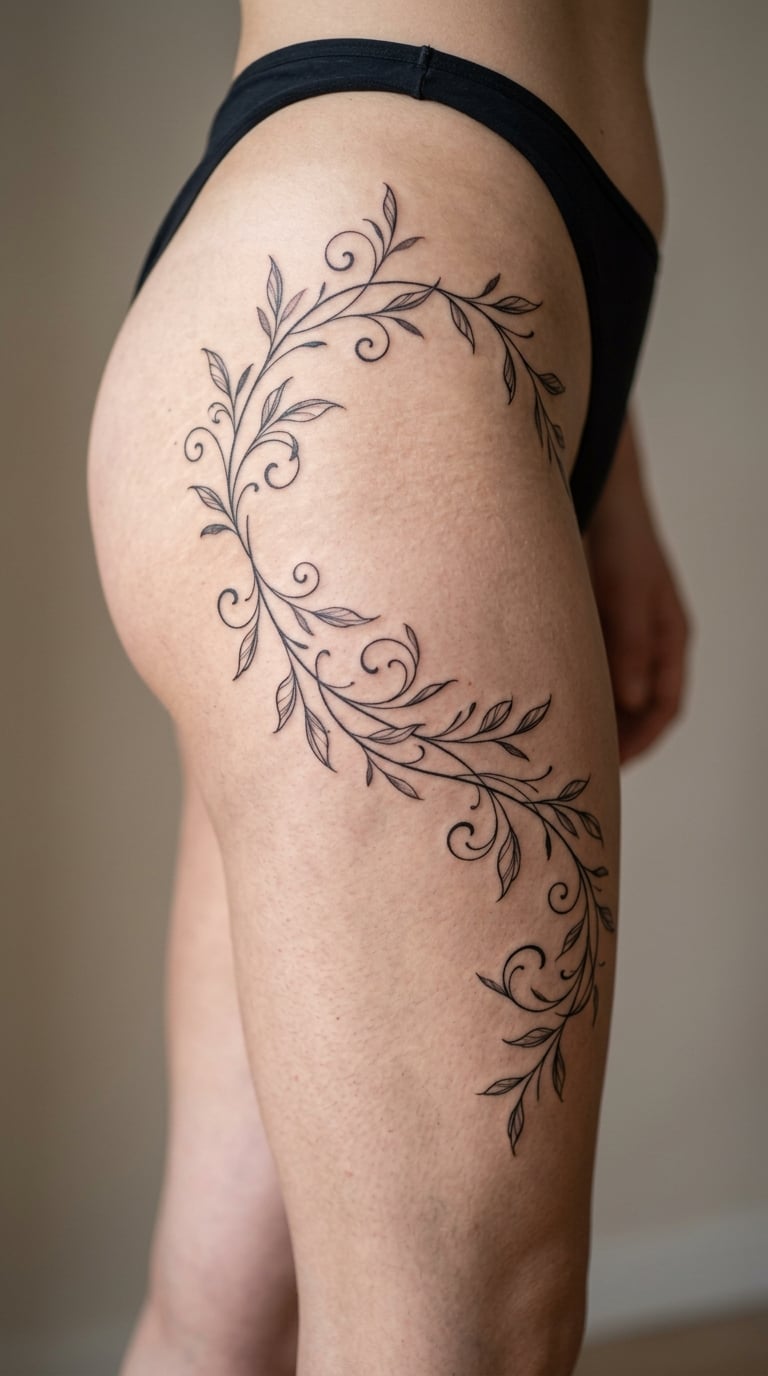
Slender leaves on curling stems, black ink, one continuous line that travels from the lower back around the hip and down the outer thigh. The line weight stays light and even, with small gaps left between leaves so the design breathes. This is the workhorse of the whole hip to thigh area because it follows the body instead of fighting it.
People usually choose it because it grows with the body, or hides a hip crease. It carries no fixed meaning, which is exactly why so many pick it.
Placement: outer hip, wrapping toward the back. Size: 8-12 in (20-30 cm) across the curve. Style: fine line. Pain: low, though the bony hipbone stings where the vine crosses it. One needle line blurs with sun exposure over the years, so expect a refresh every few years if it stays delicate.
Make it yours: swap two leaves for small berries, or add one tiny blossom at the point where the vine crosses the hip crease.
2. Watercolor Peony on the Upper Thigh
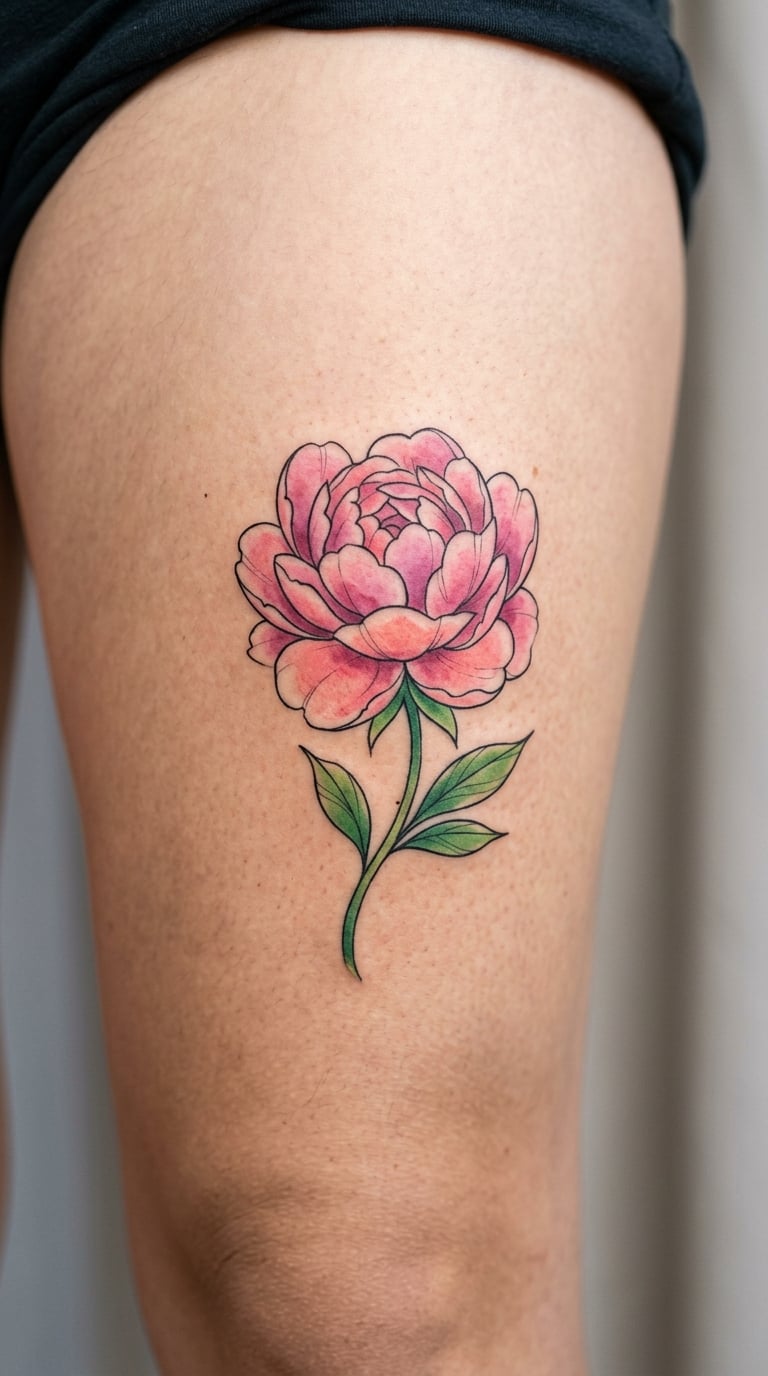
Loose washes of pink, a deeper magenta core and a short green stem, with edges left slightly unfinished so the color looks like it bled. Peony petals have enough layers to hold detail without turning fussy, which is why this flower keeps showing up on thighs. The pigment sits lightly, so the piece reads soft rather than heavy.
A peony is usually chosen for its fullness. Plenty of people also pair it with a date tucked into the stem.
Placement: upper outer thigh, where the thigh is widest. Size: 4-6 in (10-15 cm) across. Style: watercolor. Pain: low, and the thigh muscle absorbs most of it. Watercolor sits lighter in the skin than a saturated piece and can fade faster in summer if you do not cover it.
Make it yours: use two flowers instead of one, a bud beside a full bloom, which reads as growth rather than repetition.
3. Minimal Sun and Moon Pair
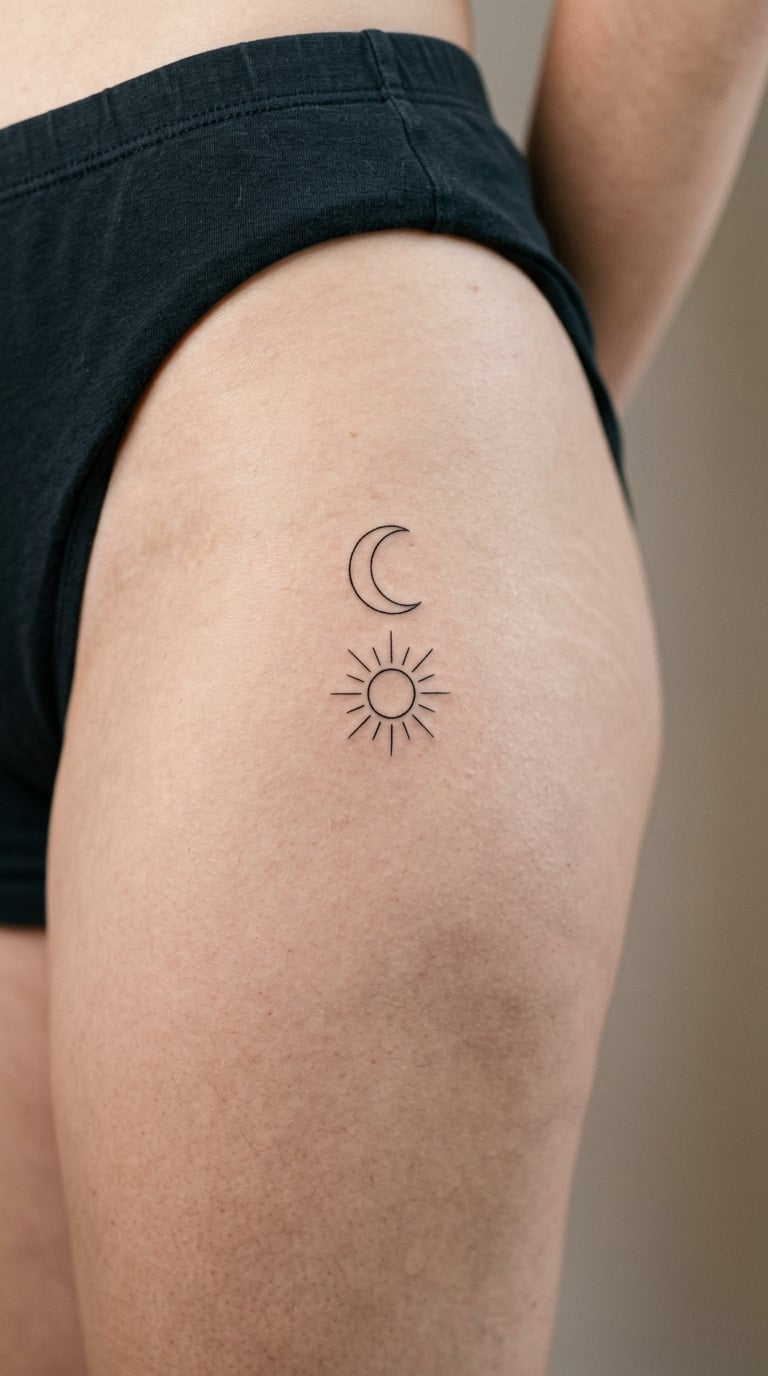
Two small shapes, one above the other: a simple sun with short straight rays and a crescent moon with a clean inner curve. Both in thin single-weight black line, with generous empty skin between them. The whole thing takes less than a palm and still reads clearly from a few feet away.
The pairing is about balance rather than a set meaning. People say sun and moon all the time; what it means is usually decided after the tattoo.
Placement: outer hip, stacked vertically along the natural line of the hip. Size: 3-5 in (8-13 cm) total. Style: fine line minimal. Pain: low. Small fine-line work blurs slightly as it ages, so a thicker sun disc holds up better than very thin rays.
Make it yours: add a tiny star between the two, or put the moon inside the sun disc as a negative-space cut.
4. Blackwork Butterfly Across the Hip
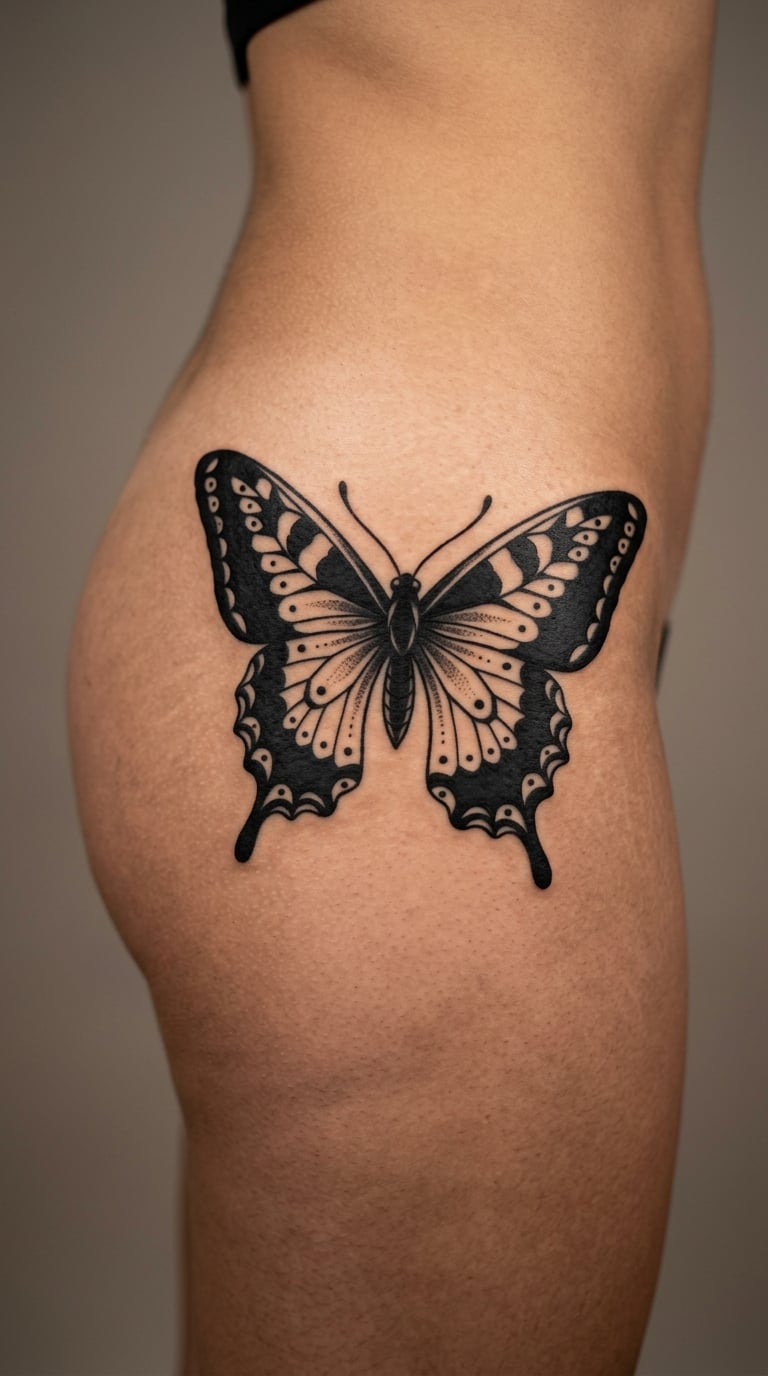
A symmetrical butterfly with upper and lower wings defined by solid black sections and clean white gaps between them. No gradients, no soft shading, just black shapes with sharp edges. The design sits across the widest part of the hip so the wingspan does the work.
Butterfly on a thigh usually means change, transformation or starting something new. It is one of the most requested motifs for this placement, and the blackwork version has the most visual weight of any butterfly layout.
Placement: outer hip, wings angled slightly downward so they follow the curve. Size: 7-10 in (18-25 cm) wing to wing. Style: blackwork. Pain: low to medium. Solid black fills take longer than line work and the hipbone area gets tender near the end of a session.
Make it yours: put real dates or initials inside the wing shapes as negative space instead of plain black.
5. Neo-Traditional Rose and Dagger
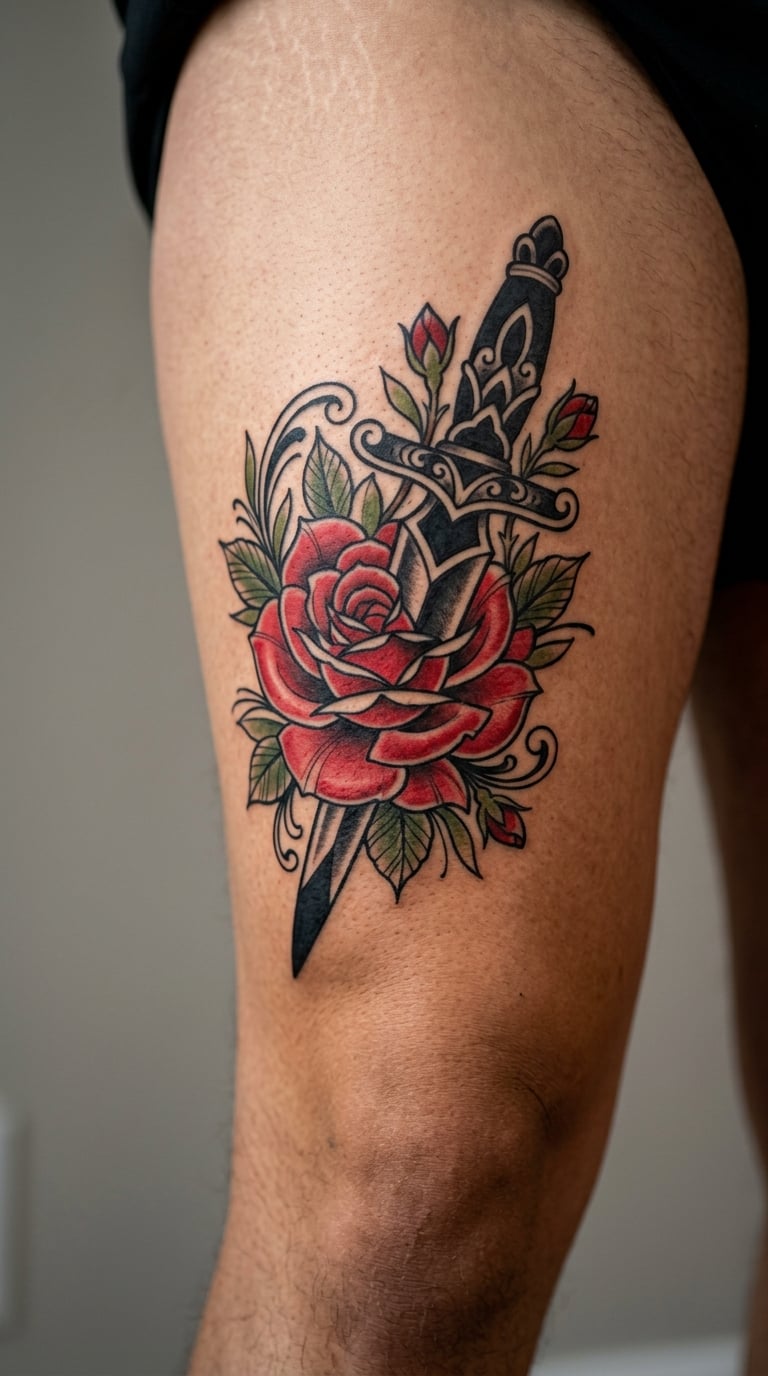
A red rose with saturated green leaves, a black dagger running through the stem, heavy black outlines and traditional shading in the petals. Neo-traditional work keeps the bold line of traditional American pieces but tightens the shading and often softens the palette. It is a louder design that holds up well on a large flat surface.
The rose stands for love or beauty, the dagger for strength or an ending. Plenty of people pick it as a classic piece with no symbolic plan at all.
Placement: outer thigh, held at a slight diagonal. Size: 6-9 in (15-23 cm) long. Style: neo-traditional. Pain: medium, since the colour packing in the petals is the heavy part. Bold outlines soften less over time than fine shading, so this ages more gracefully than a delicate piece.
Make it yours: change the dagger to a small knife or a fountain pen nib if you want something less sharp.
6. Fine-Line Mountain Range
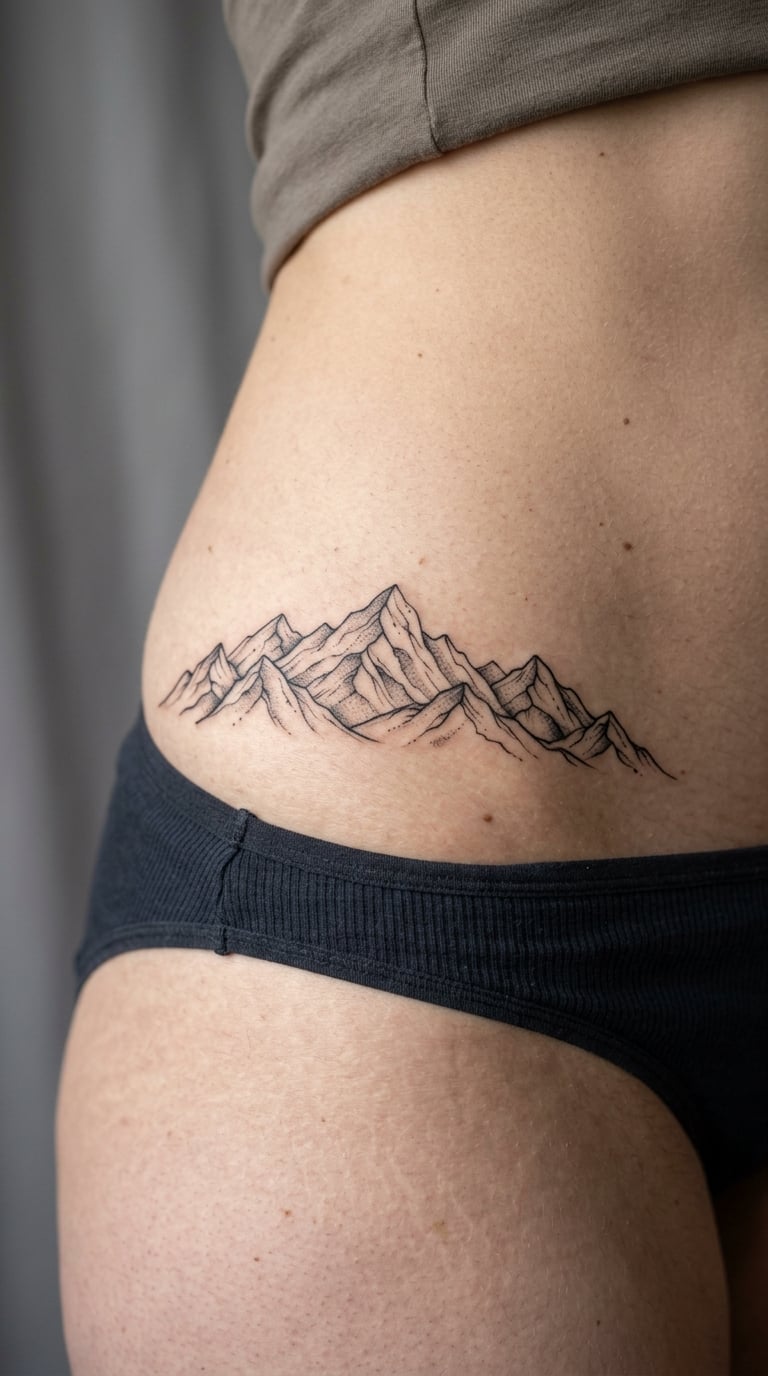
Three or four peaks in a row, each a slightly different height, with a single confident line for the ridge and thin hatching on one face. The peaks overlap so the range reads as depth rather than a row of triangles. Usually pure black with no colour at all.
It is a place tattoo, more often than not. A range means a trip or a stretch of home, and the horizontal line follows the hipbone nicely.
Placement: upper hip, running parallel to the hipbone. Size: 6-9 in (15-23 cm) across. Style: fine line. Pain: low, and the flat area above the hipbone is comfortable. Ridge lines stay crisp, but the smallest hatching can fade first, so keep the detail simple if you want it to last.
Make it yours: name the actual range, or add one tiny pine tree at the base of the tallest peak.
7. Micro-Realism Rose in Black and Grey
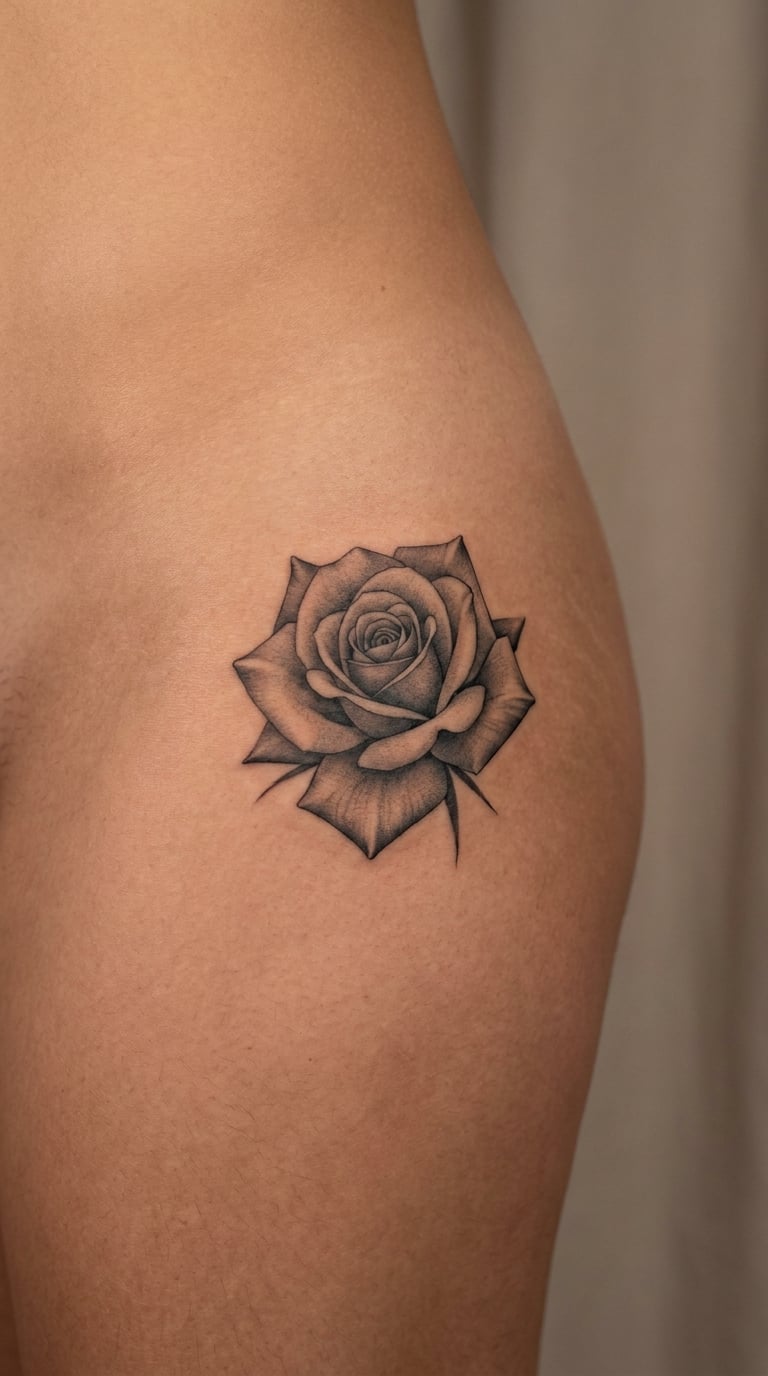
A single rose rendered with tonal shading rather than outline, petals built from soft grey gradients and one dark core. The detail sits inside a small size, which means the shading has to be economical. It looks like a photograph of a flower in miniature.
Black and grey roses usually get chosen for realism rather than symbolism. Ask the artist for a reference photo of a real rose if you want the shading to land.
Placement: lower outer hip, just below the hip crease where there is a flat plane. Size: 2-3 in (5-8 cm). Style: micro-realism. Pain: low. Small shaded work is fiddly rather than painful, and it asks for patience more than toughness.
Make it yours: add a faint grey shadow beneath the bloom, which makes a tiny piece look more three dimensional.
8. Traditional Rose and Banner
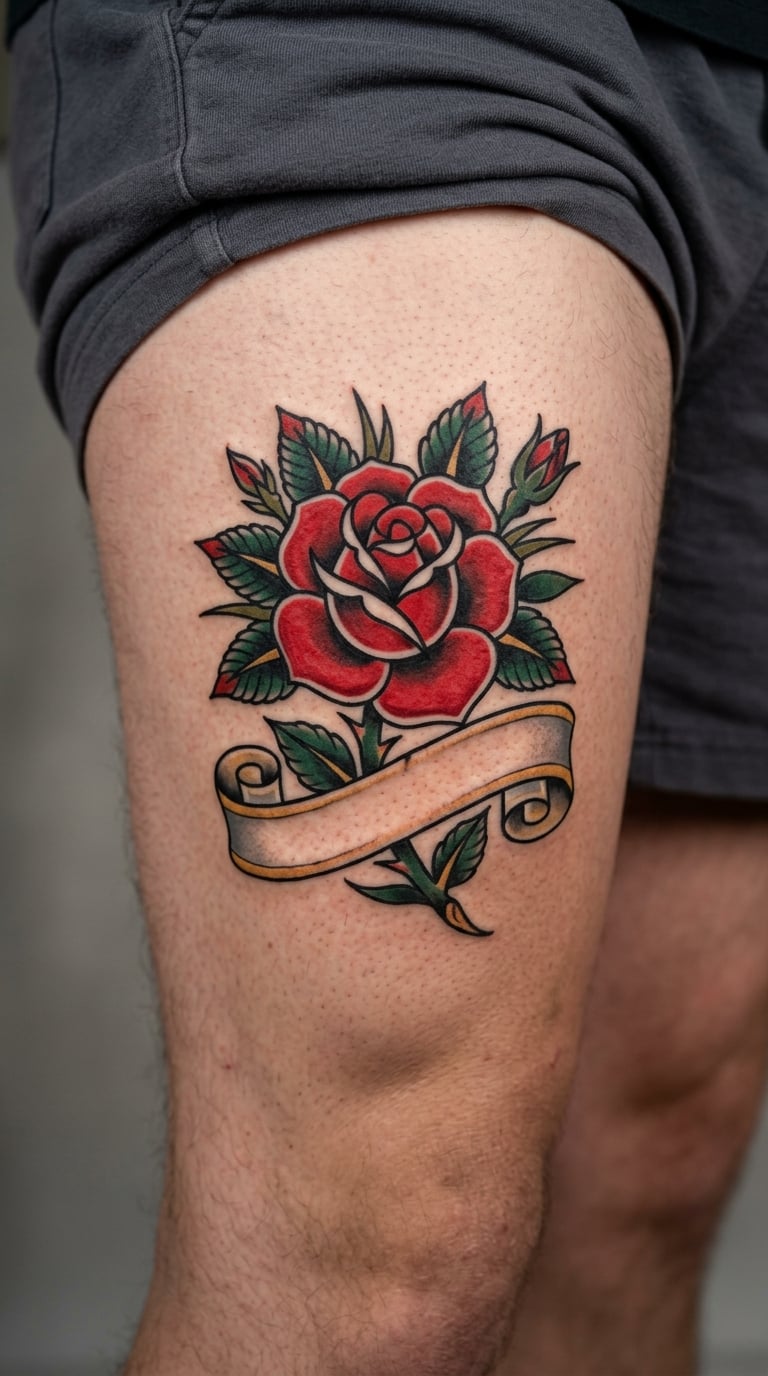
A classic American traditional rose with heavy black outlines, red petals shaded from light to dark, and a curved banner ribbon underneath carrying a name or date. This is the oldest tattoo layout in the book and it still holds its shape decades later because the line work is thick.
The banner usually carries the reason: a date, a name, a place. Without text the rose is simply a love or beauty motif.
Placement: upper thigh, vertical or slightly angled. Size: 5-7 in (13-18 cm) tall including the banner. Style: traditional American. Pain: medium. Saturated red packing takes passes, and traditional pieces tend to run longer than the drawing suggests.
Make it yours: have the banner lettering hand-drawn by your artist rather than typed, which is what makes the piece look bespoke.
9. Minimalist Crescent Moon
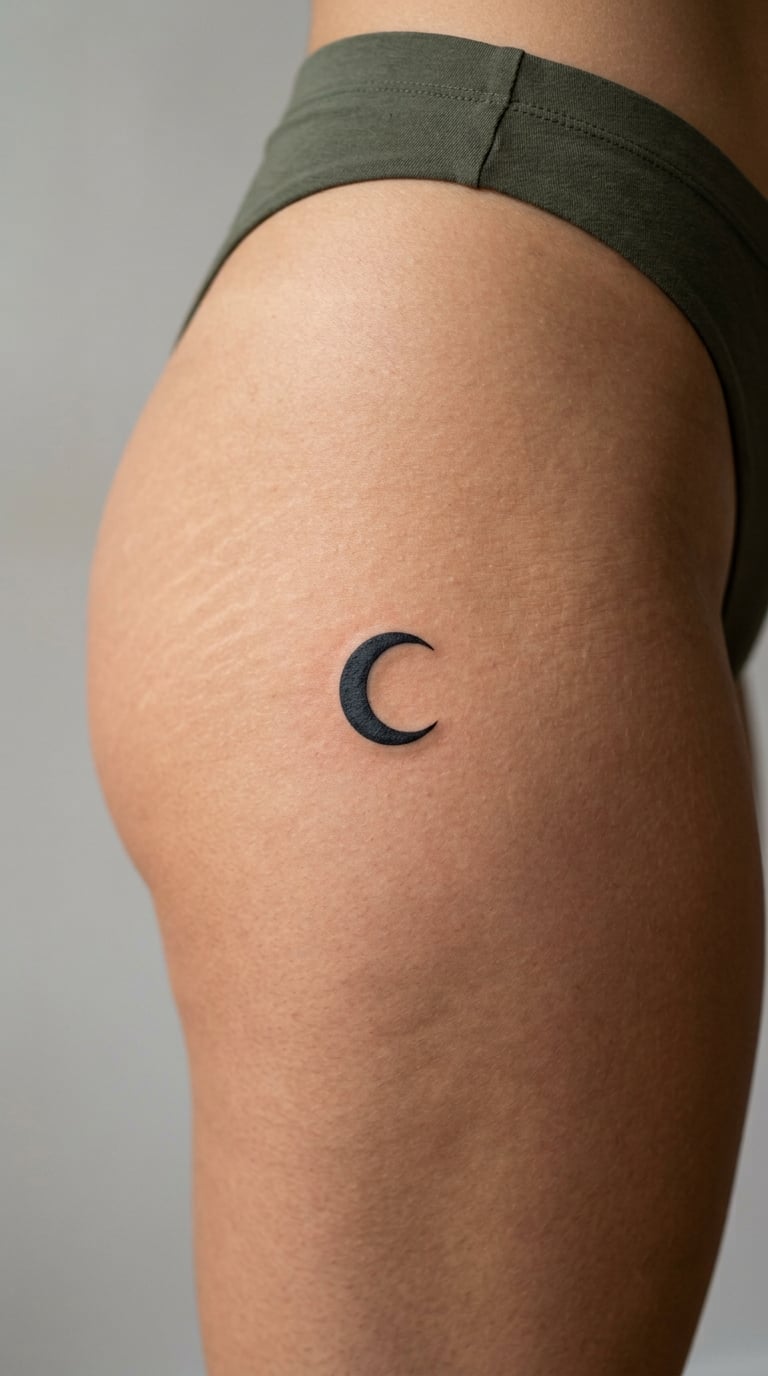
One crescent, drawn with a single bold line and a thinner inner curve, sitting alone in a lot of empty skin. There is no star, no chain, no moon face. The restraint is the whole design, and it looks most confident when it is small and slightly off-centre.
People describe it as calm, cyclical or protective. A crescent is the moon in a transitional phase, which is why it suits people who like that idea better than a full moon.
Placement: outer hip, above the top of the thigh. Size: 2-4 in (5-10 cm) tall. Style: minimalist. Pain: low and quick, one of the shortest sessions in this list. A thick single line is one of the few fine pieces that needs no touch-ups as it ages.
Make it yours: fill the hollow of the crescent with a single colour, so the shape reads as an object rather than an outline.
10. Floral Bridal Bouquet
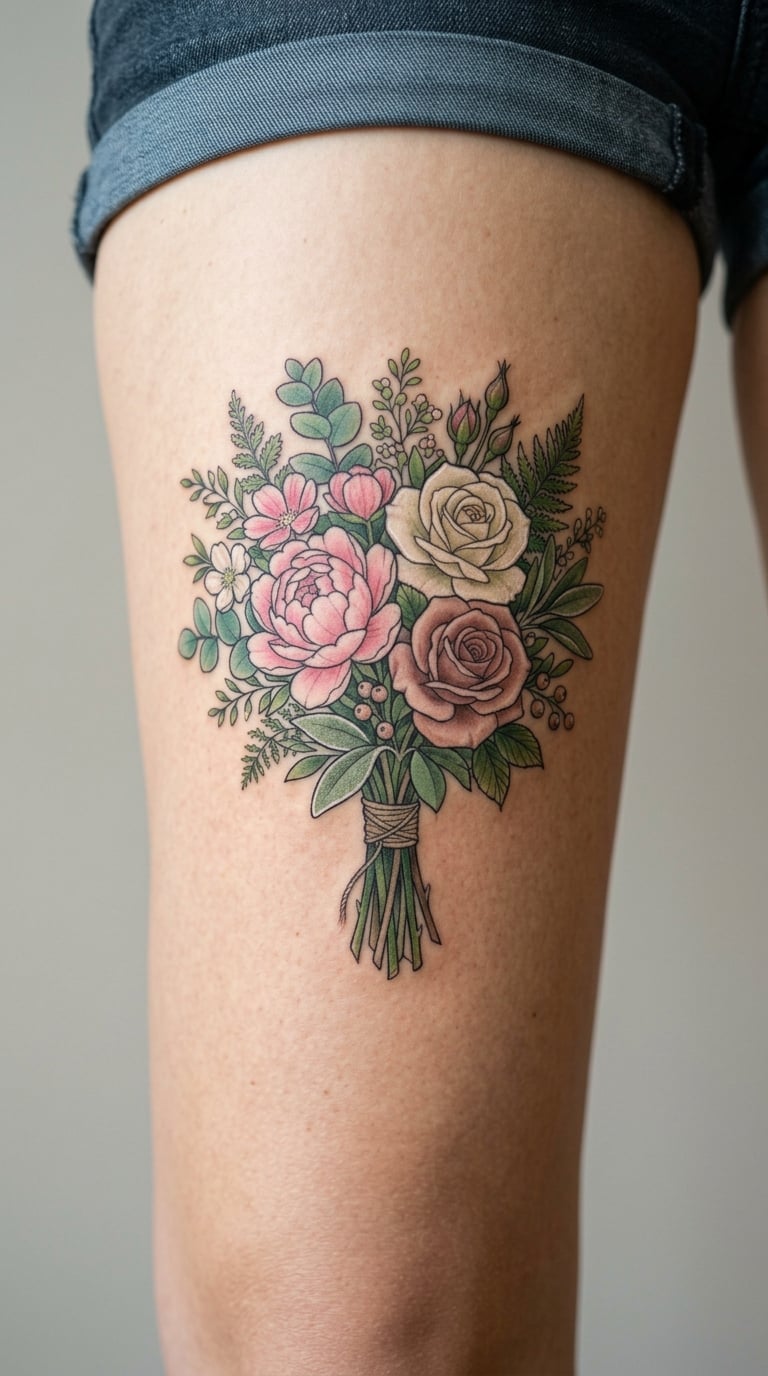
A tied bouquet of two or three blooms, roses and peonies with green leaves and a short bound stem, arranged in a round cluster about the size of a fist. Colour here is deliberate but limited: red, pink and green against clear skin. The stem ties the whole group into one shape rather than a scatter of flowers.
This one gets booked around a wedding, an anniversary or a birthday. It marks a person or a date rather than an idea.
Placement: upper outer thigh, or high on the back of the thigh for a bridal look. Size: 5-7 in (13-18 cm). Style: illustrative colour. Pain: medium, because several flowers in one small area means a lot of colour packing.
Make it yours: use your actual wedding flowers as the reference sheet, down to the leaves.
11. Art Nouveau Lily
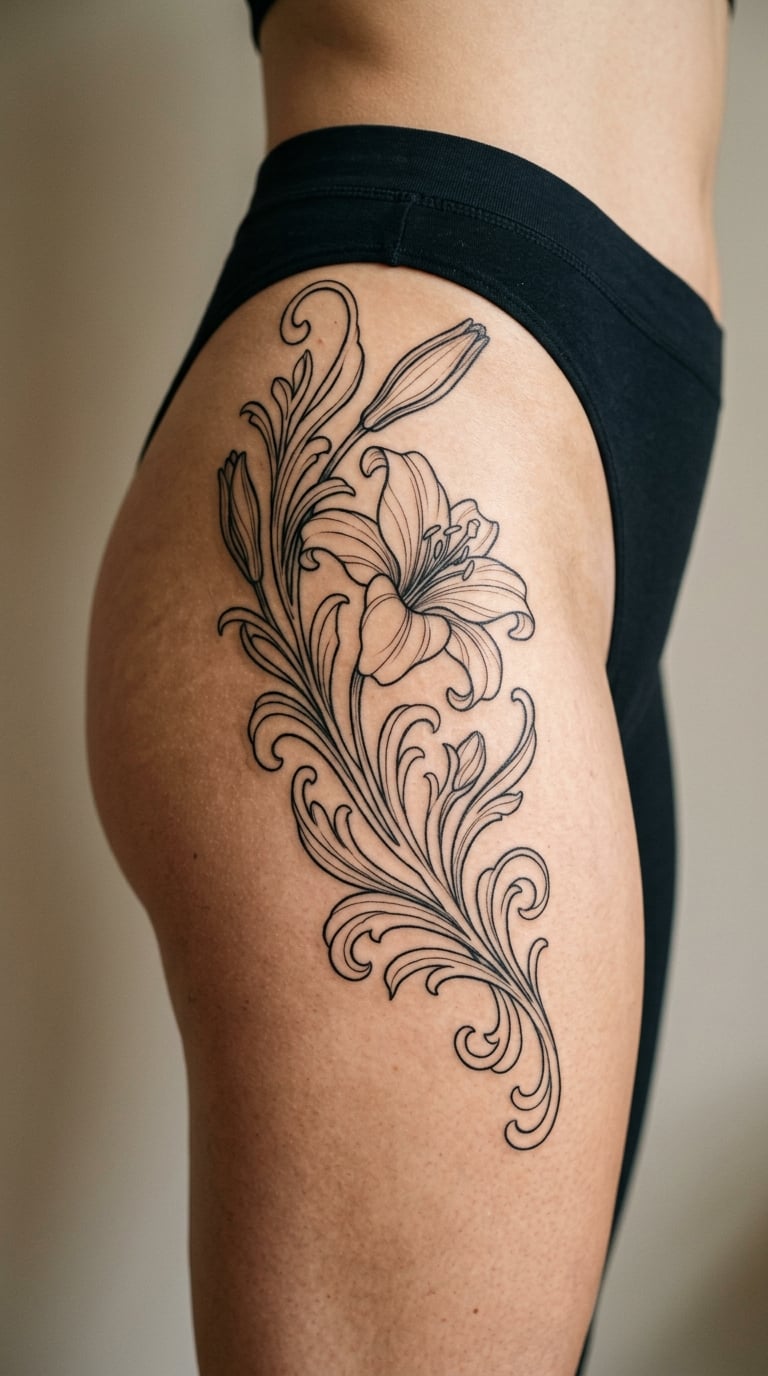
A lily with long curving petals that bend outward in smooth arcs, thin stems and decorative whiplash linework curling away from the flower. Thin black outlines with almost no fill, the way stained-glass and poster artists of the 1890s drew them. The shapes are asymmetric on purpose, which is what keeps it from feeling stiff.
The lily usually reads as purity or renewal. The style is the reason people choose it though: the flowing lines suit the hip because they follow the curve anyway.
Placement: hip, running vertically so the stem follows the body. Size: 7-10 in (18-25 cm) tall. Style: Art Nouveau linework. Pain: low to medium. Those thin decorative lines mean a longer session than they look like, especially near the hipbone.
Make it yours: trail the stem into two small initials at the bottom, hidden in the curve.
12. Small Compass Rose
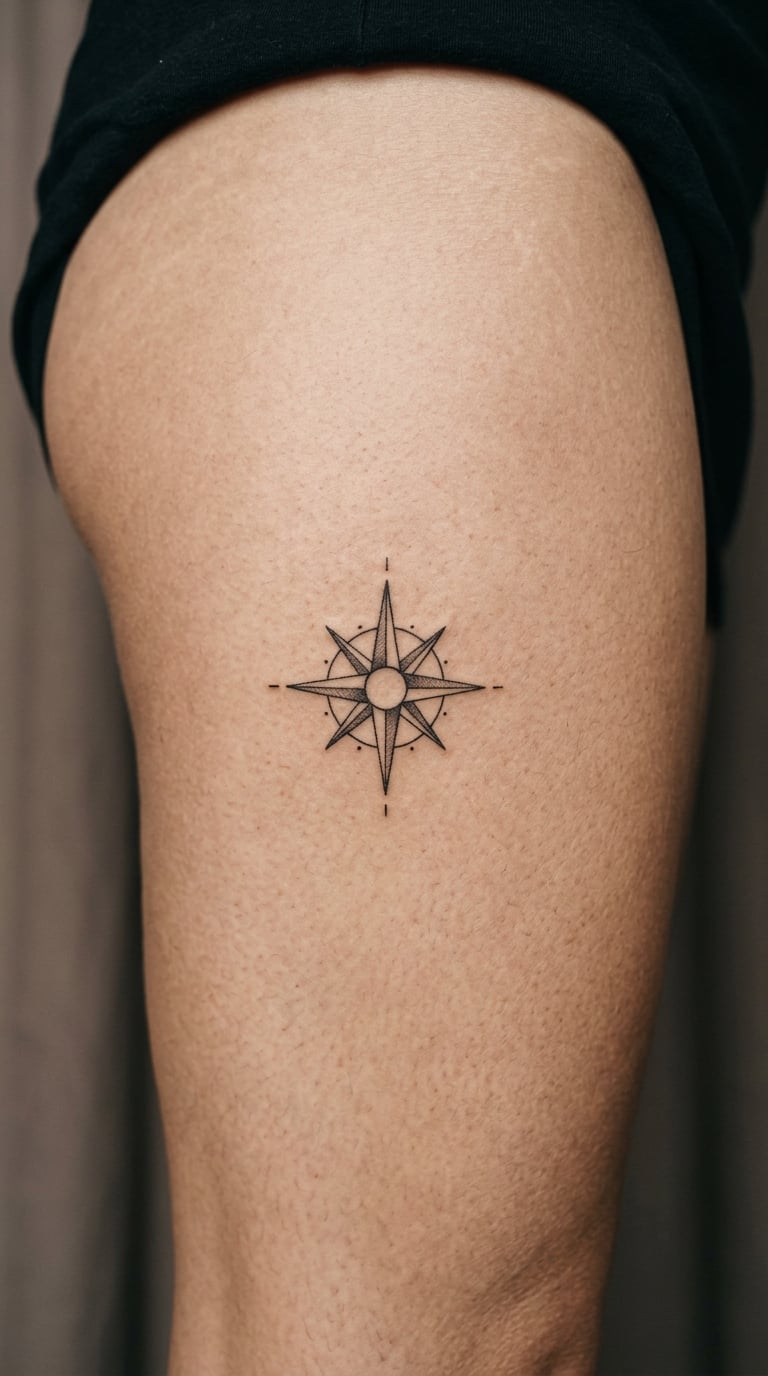
An eight-point compass rose built from thin straight lines, with a small clear diamond in the centre and one point filled solid black to break the symmetry. Nothing shaded, nothing ornamental. The geometry does all the work, and the piece stays crisp at a very small size.
It points somewhere: a hometown, a trip, a direction you were heading when you got it. A four-point version reads as a nautical star if you prefer that.
Placement: upper outer thigh, anywhere that suits a round shape. Size: 2-3 in (5-8 cm) across. Style: fine line geometric. Pain: low, and the thigh is one of the more forgiving spots. Small straight lines blur less than curved ones, so this ages well.
Make it yours: put the compass point that marks north at the exact latitude of your hometown.
13. Realistic Red Dragonfly
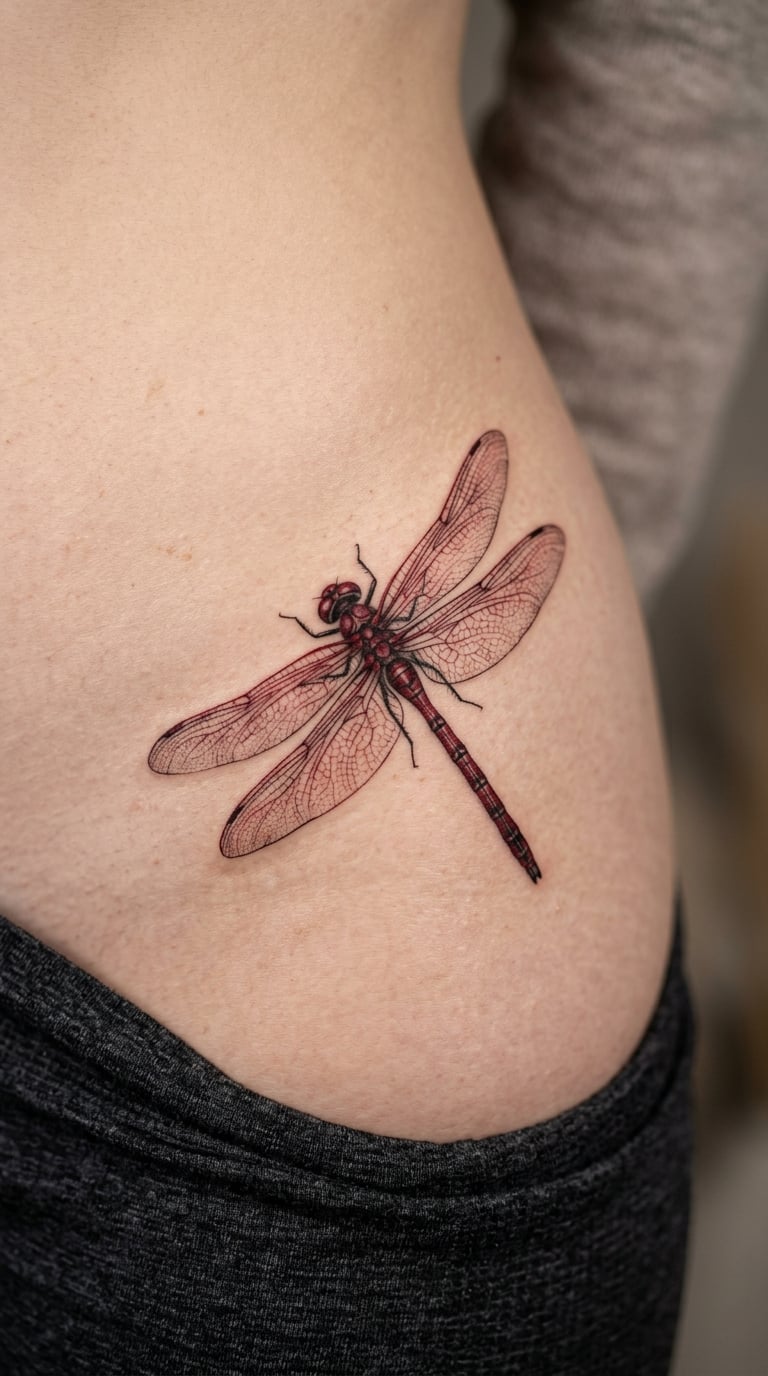
A dragonfly with a slim segmented body in deep red, four wings rendered so lightly they look almost transparent, and legs fine enough to disappear at a distance. The wings carry the most detail in the piece, usually as thin vein lines with a hint of grey.
Dragonflies are usually chosen for change and for being hard to catch. That is a common reading rather than a fixed one.
Placement: hip, laid on a diagonal so the body echoes the angle of the hipbone. Size: 4-6 in (10-15 cm) long. Style: realism. Pain: low. The wings are fiddly work, so expect a longer session rather than a more painful one.
Make it yours: tilt the dragonfly to match the line of a scar or an old tattoo you want to incorporate.
14. Blackwork Snake Winding Around the Thigh
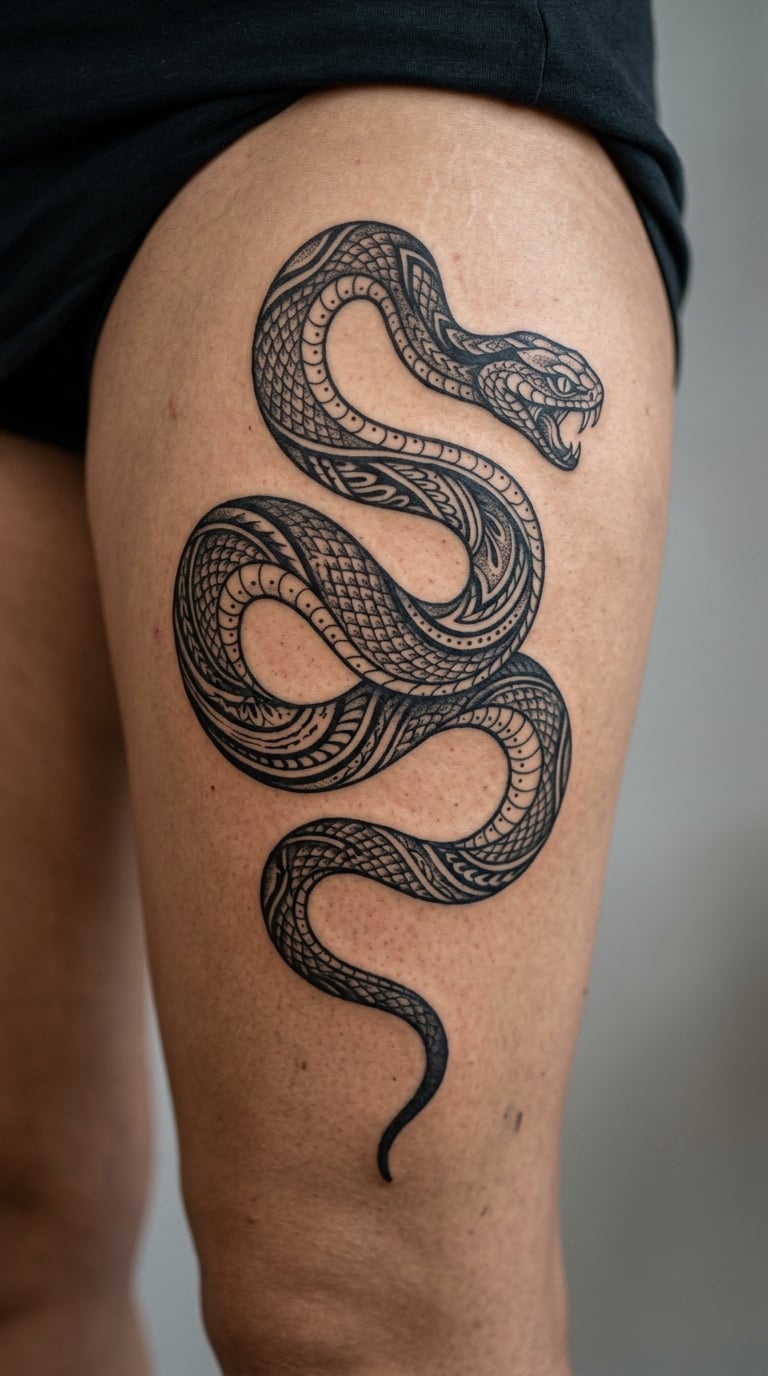
A snake drawn as a coiling body with clean scale rows, strong black sections and white negative space between the coils. It wraps rather than sits flat, following the round of the thigh so the whole piece looks like it grew around the leg. This is the boldest design in the list.
Snakes mean transformation, rebirth or protection, and a coiled snake often reads as holding something in place. It is one of the most-requested motifs for a thigh.
Placement: upper thigh, wrapped so the coils disappear around the back. Size: 9-14 in (23-36 cm) long. Style: blackwork. Pain: medium. Dense black over a large area is a long sitting, and most first-timers underestimate how tiring that gets rather than how much it hurts.
Make it yours: hide a small date inside one of the black coil sections.
15. Cherry-and-Sun Motif
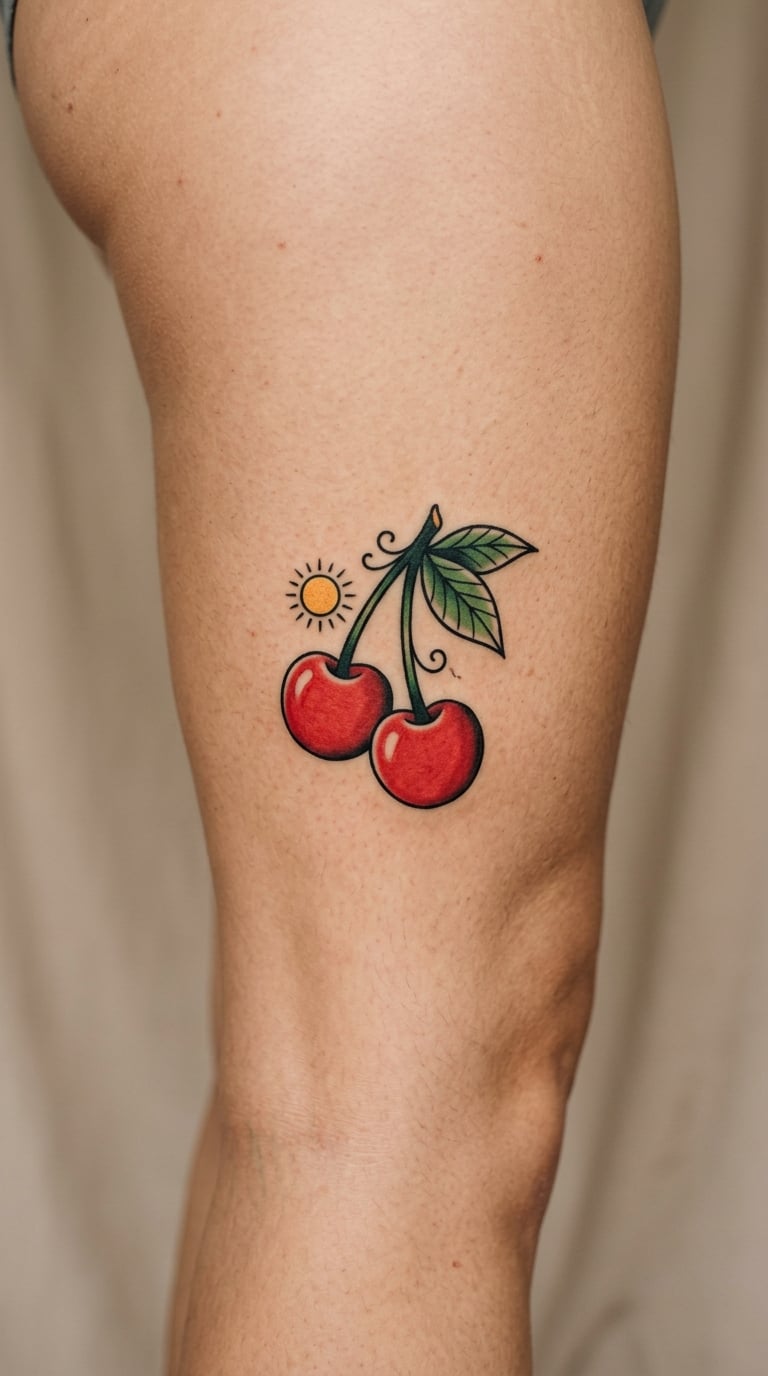
Two round red cherries on joined stems, a pair of green leaves, and a small yellow sun tucked behind one shoulder of the fruit. Heavy black outline with flat colour inside, which is what makes it read as retro rather than cute. Simple shapes, no shading tricks.
It is a nostalgic piece, often tied to a grandmother, a kitchen or a decade someone remembers clearly. Nobody claims a deep meaning for it, and that is the charm.
Placement: outer thigh or just above the knee. Size: 3-4 in (8-10 cm) tall. Style: retro illustrative. Pain: low. Bright red ink needs more saturation, so it takes a little longer than an outline-only piece.
Make it yours: change the sun into a small crescent, or add a second pair of cherries for a stacked vintage composition.
16. Floral Lace Panel
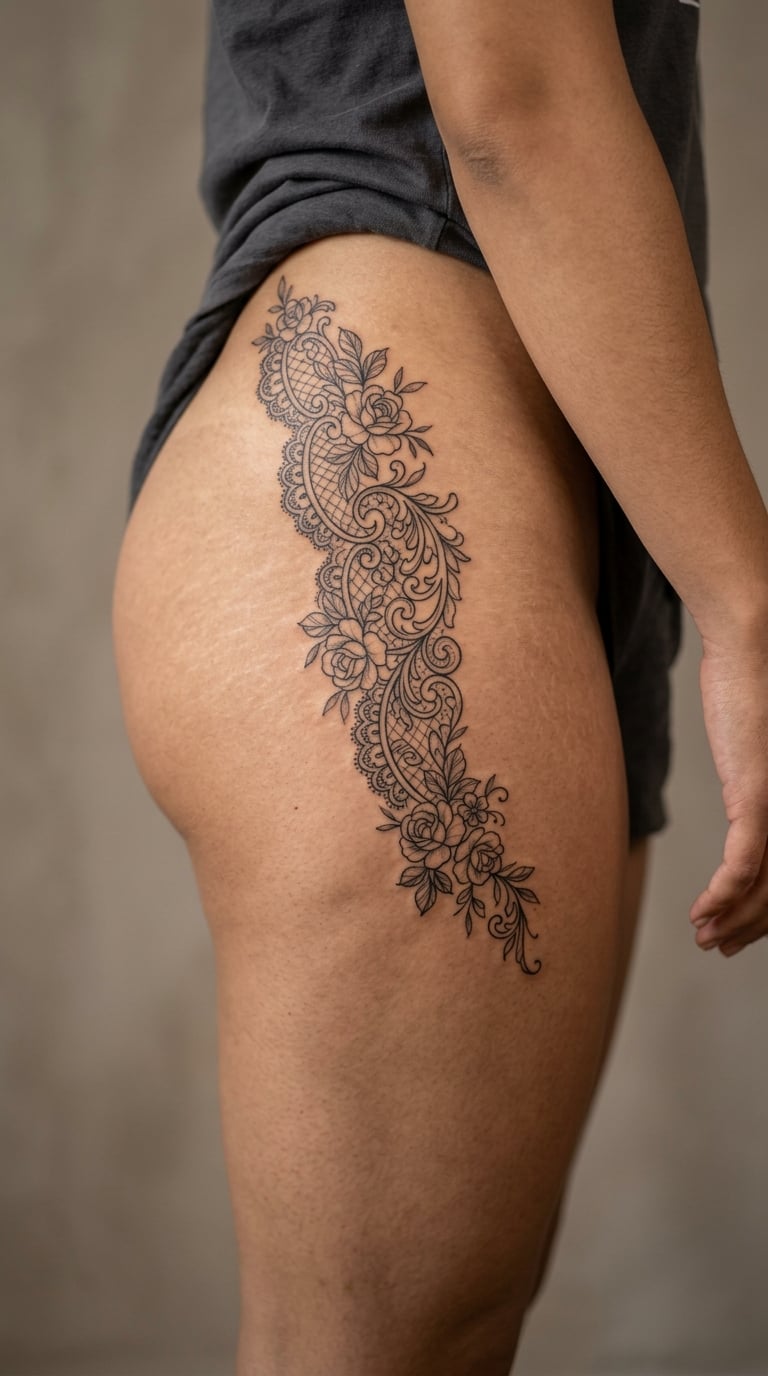
A vertical panel of lace-like patterning: tiny flowers, mesh sections and scalloped edges, all in very fine black line with plenty of skin showing through. The panel is shaped to the body, wider at the hip and narrowing downward, so it reads like fabric laid on skin.
It is chosen for texture rather than meaning. The panel form also works well for hiding a small area of uneven skin without drawing attention to it.
Placement: outer hip, running vertically toward the thigh. Size: 6-9 in (15-23 cm) tall. Style: fine line illustrative. Pain: low to medium, since the mesh sections need a lot of small precise passes.
Make it yours: have the scalloped top edge follow a real piece of lace, so the pattern matches something you own.
17. Matching Sparrow Pair
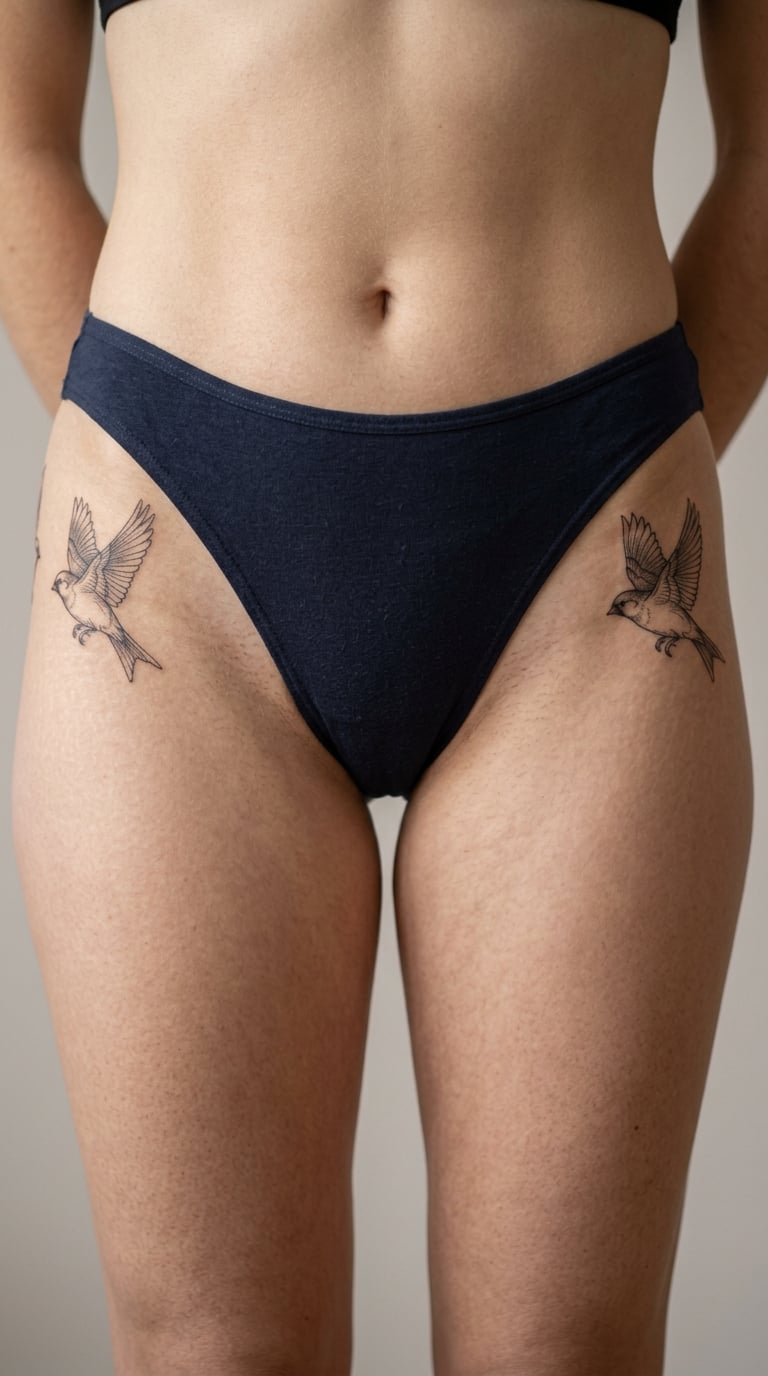
Two small sparrows drawn with clean outline and a few soft feather strokes, one on each outer hip in a mirrored or angled composition. Each bird is small and simple enough to read from across a room without any interior detail. Matching rather than identical, which keeps them from looking like a logo.
This one is for two people. Couples, friends and siblings all book it, and the matching format means the two tattoos can be split across years or across a long distance.
Placement: both outer hips, roughly level with each other. Size: 2-3 in each (5-8 cm). Style: fine line illustrative. Pain: low on both counts. Two small sessions beat one long one, and this is a good piece to split.
Make it yours: give each bird a different perch, a branch on one and a wire on the other.
18. Lavender Stems
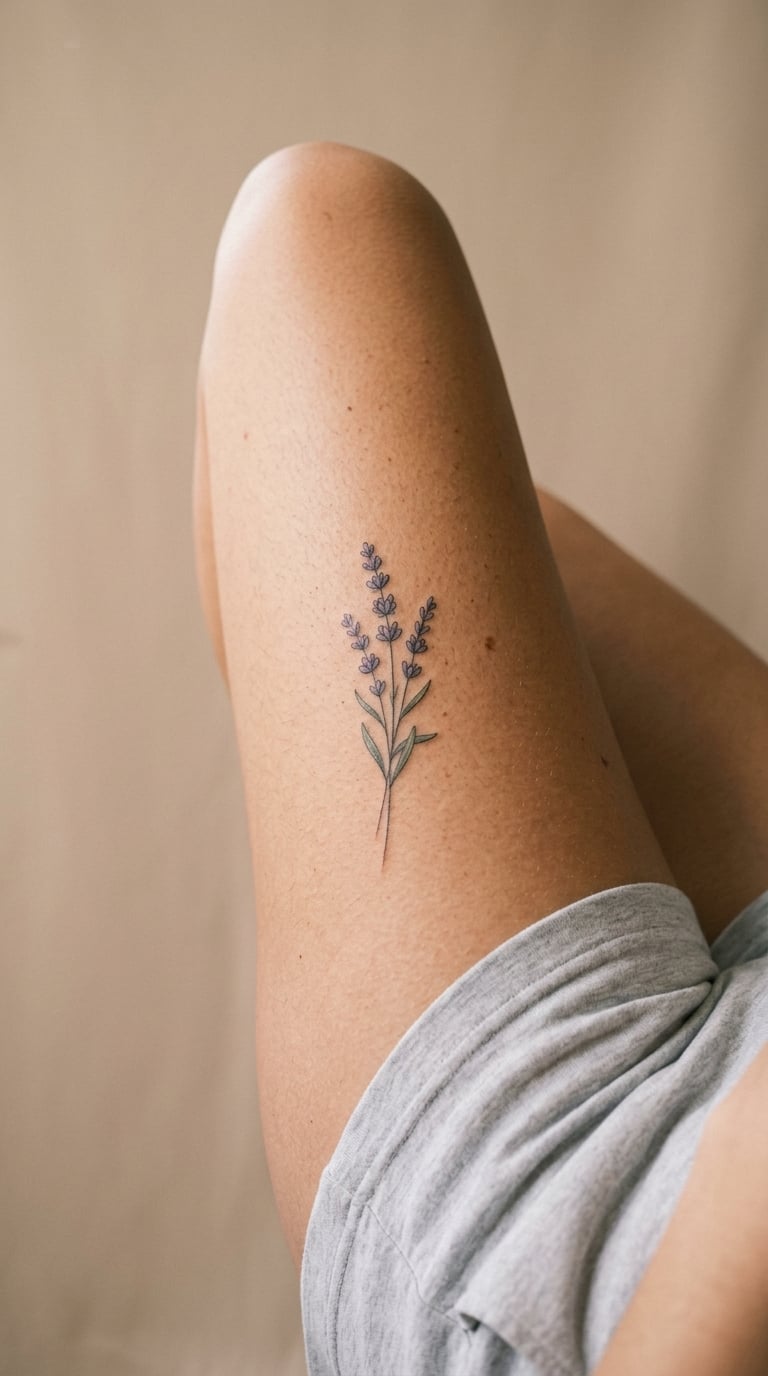
A small bunch of lavender stems in muted purple buds fading to grey-green, tied loosely near the base. The colour is deliberately soft, more dusty than bright, which keeps the piece from looking like a sticker on the leg. Buds are built as small stacked ovals rather than solid blobs.
Calm, rest, a favourite garden. It is a quiet design that people tend to add when they already have one bigger piece nearby.
Placement: upper outer thigh, angled along the muscle. Size: 4-6 in (10-15 cm) tall. Style: fine line botanical. Pain: low. Muted purple is a harder colour to heal cleanly than bold black, so follow the aftercare closely on this one.
Make it yours: add a single sprig of rosemary beside it, which reads as a small herb bundle.
19. Greek Key Border
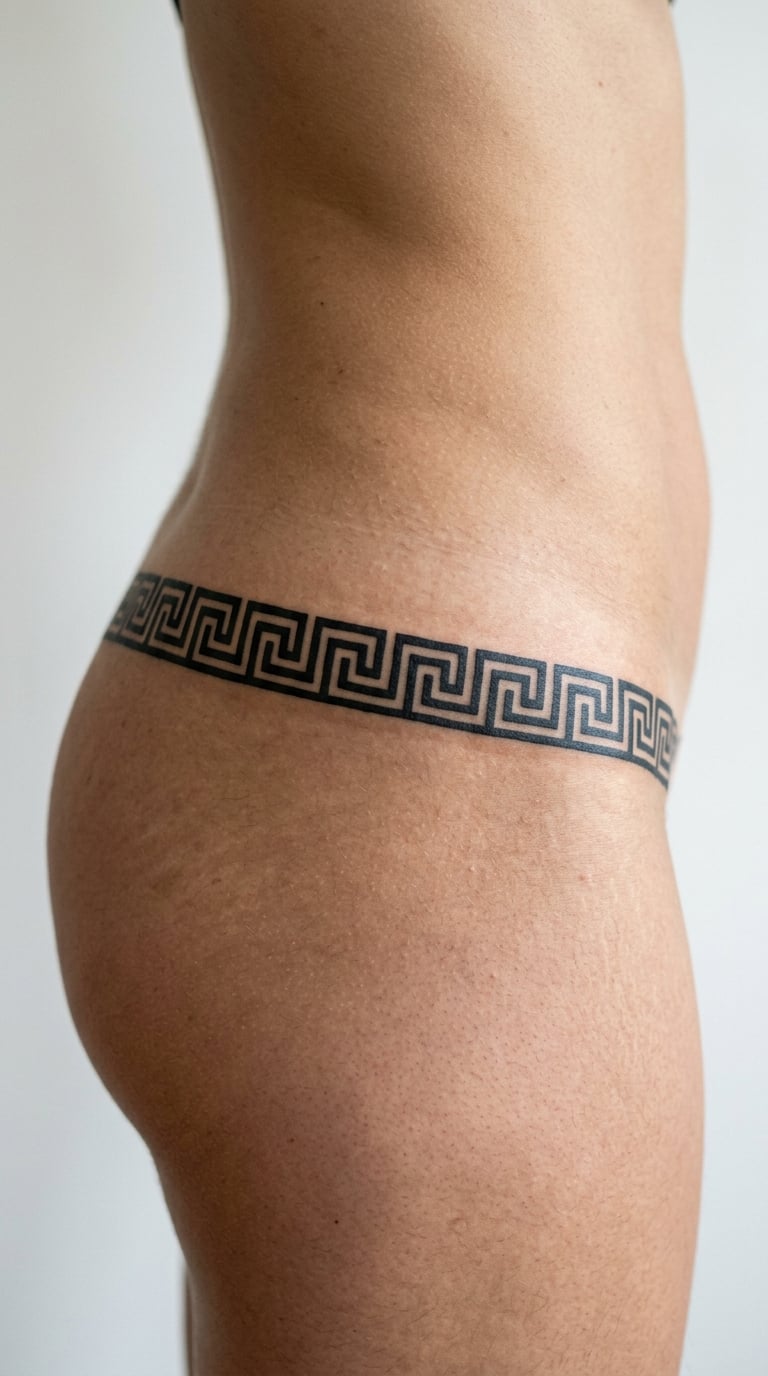
A repeating Greek key, or meander, pattern running as a band: right angles, a consistent line weight, tight repetition. Nothing figurative at all. The interest is in the rhythm, and the whole piece is one continuous band that can be as long as you want.
It carries no symbolism of its own, which makes it an easy piece to live with forever. Plenty of people use it as an underline for a name or a set of dates.
Placement: hip, horizontal along the hipbone, or as a band around the upper thigh. Size: 5-8 in long (13-20 cm) and about 1 in tall. Style: geometric linework. Pain: low to medium. Repetitive line work is quick per unit but adds up over a long band.
Make it yours: run a short name inside the band, lettered small enough to read only at close range.
20. Lotus in Watercolor
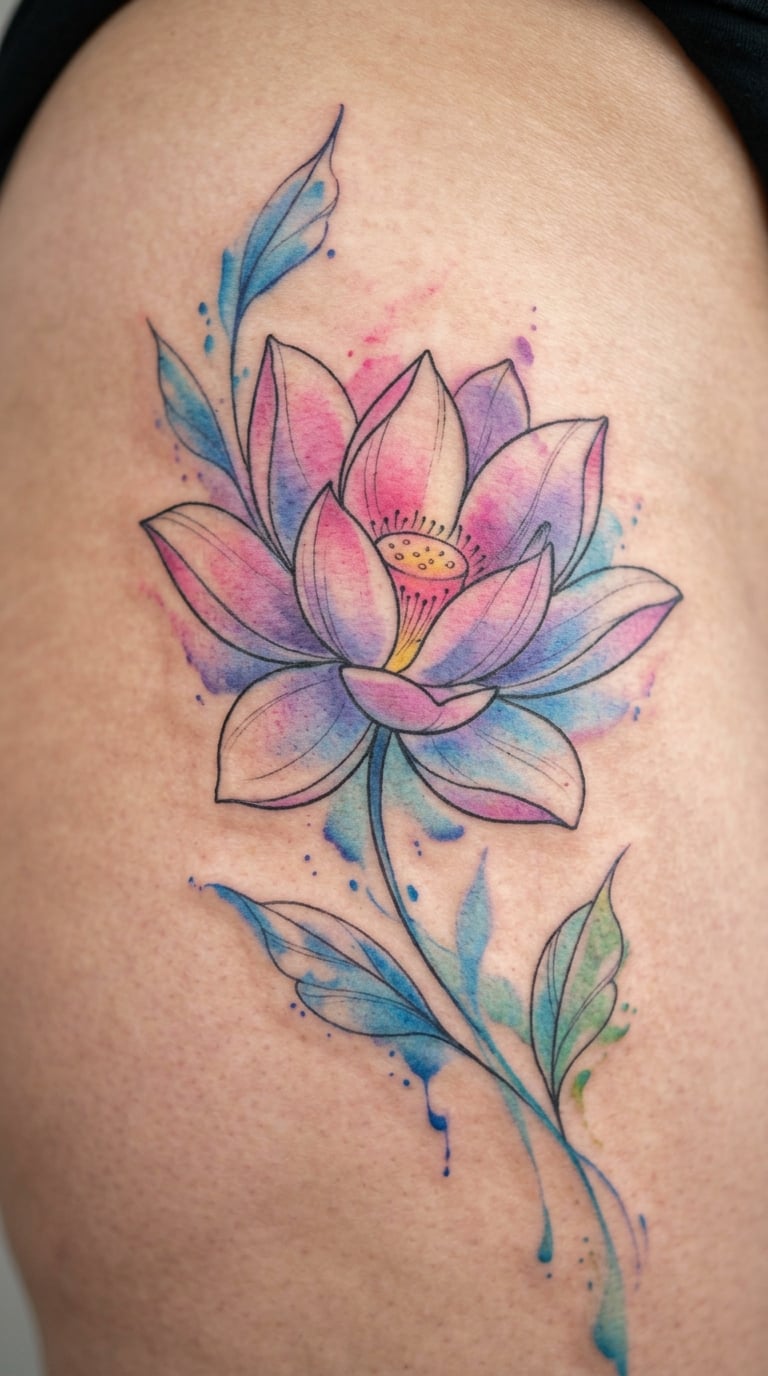
A lotus with layered petals in loose washes of pink, violet and a small amount of blue, with the edges broken off and some white skin showing through. The colour pools in the middle of each petal and thins toward the tips, which is what makes it look wet rather than printed.
The lotus generally points to calm, balance or starting again, and it comes with a spiritual reading in a lot of traditions. People take whichever part fits them.
Placement: outer hip beside the thigh, where there is a smooth surface. Size: 4-6 in (10-15 cm) across. Style: watercolor. Pain: low. Light colour washes are quick, so this is often a single comfortable sitting.
Make it yours: add a faint water line under the bloom, three or four pale strokes and nothing more.
21. Small Serpent and Rose
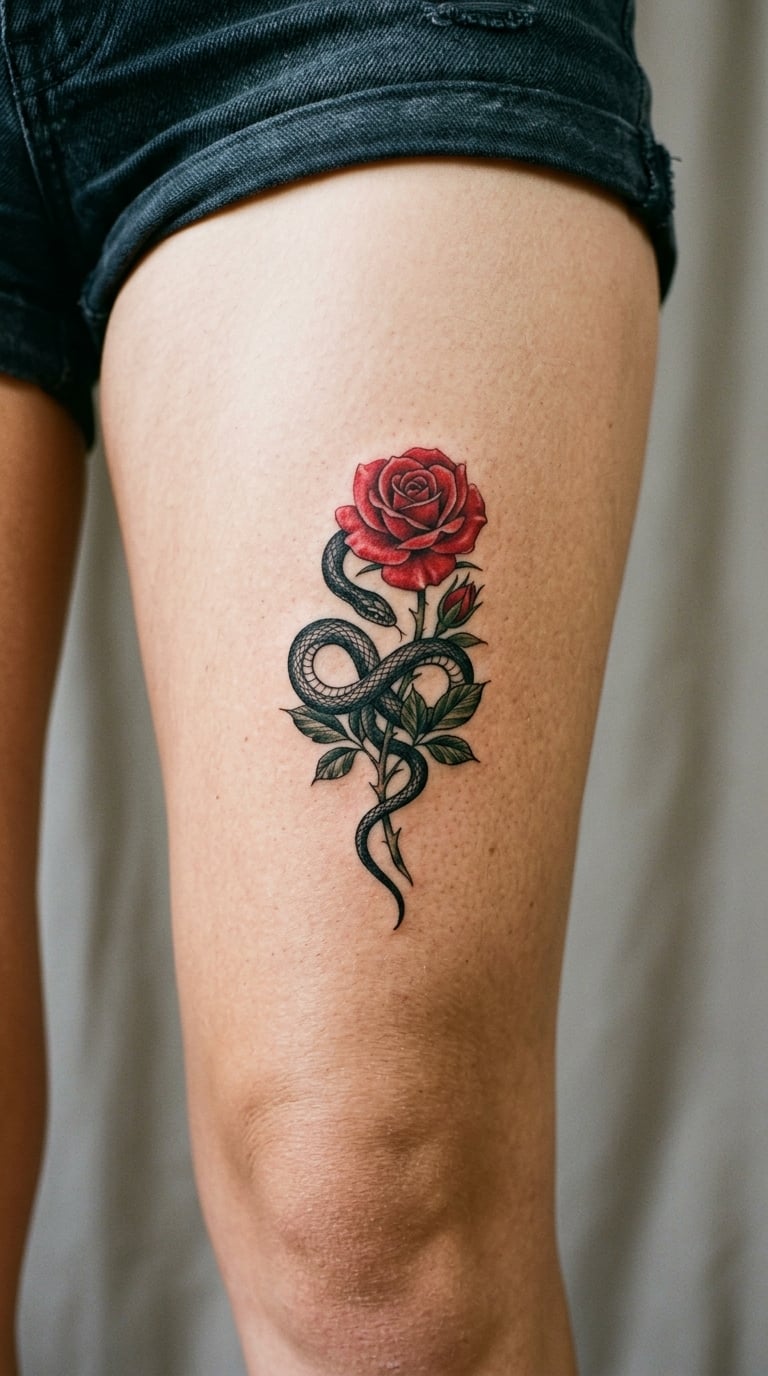
A slim black serpent looped around one red rose, the snake’s body a single clean line with minimal scale detail. Two elements, one colour each, and enough clear skin between them that neither disappears. The contrast is what makes a piece this small hold up.
The pairing is balance: the flower and the bite, softness next to something watchful. It is often described as being about two sides of one person.
Placement: upper thigh, with room around the bloom. Size: 4-6 in (10-15 cm) tall. Style: illustrative with limited colour. Pain: medium, mostly from the red packing in the rose.
Make it yours: make the serpent black and grey rather than outlined, so the rose becomes the only saturated element.
22. Star Map on the Hip
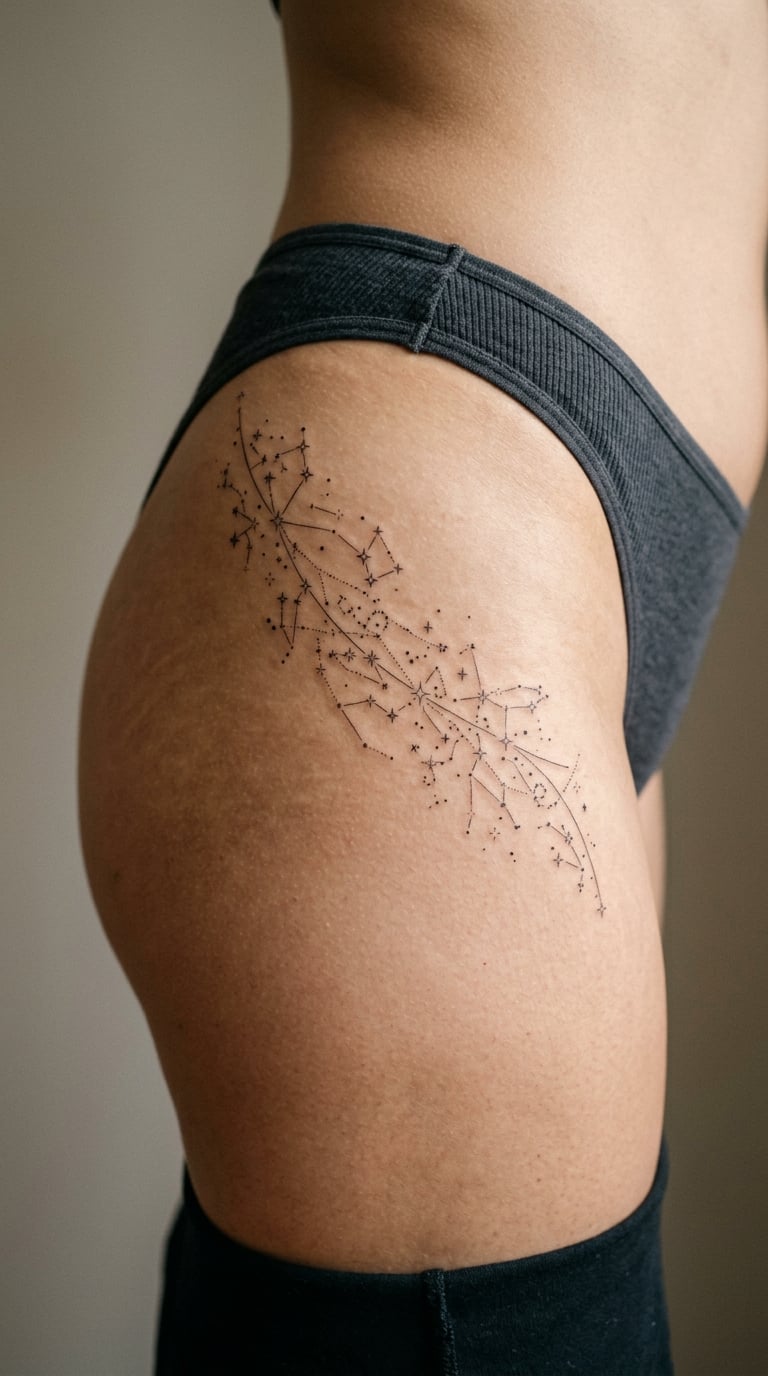
A patch of sky: small stars of different sizes joined by thin lines, arranged diagonally across the hip, with one brighter star and one circled star marking something specific. Each star is a dot with a tiny cross, and the connecting lines are barely there. The design is about the empty space between the points as much as the points themselves.
It is almost always a real sky: the night of something, or the view from a specific place. Most people work from an app and a date.
Placement: outer hip, laid on a diagonal. Size: 6-8 in (15-20 cm) across. Style: fine line illustrative. Pain: low. Very fine dots and hairline connections can need a session and a half, so plan the break.
Make it yours: circle the one star that marks the date, and leave the rest unlabelled.
23. Blackwork Moth
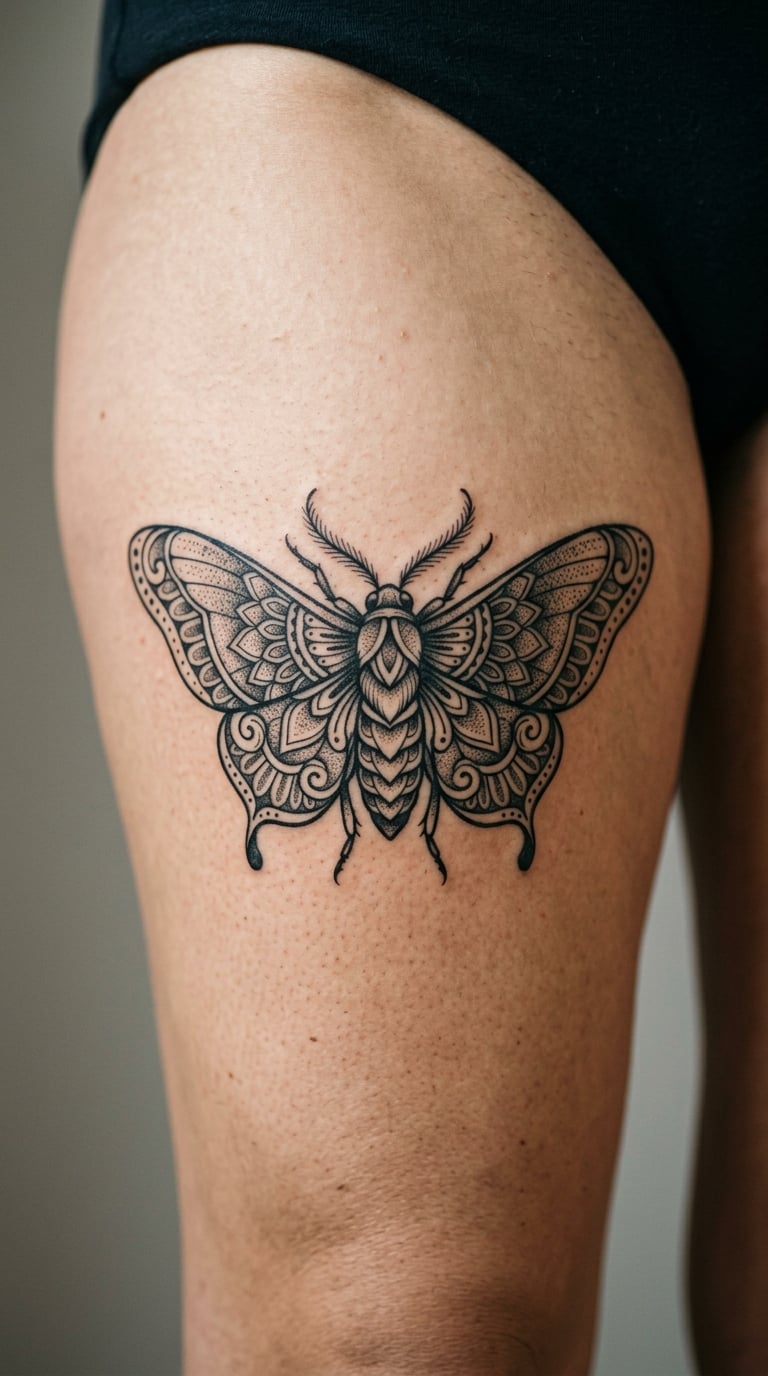
A moth with two pairs of patterned wings, symmetrical down the centre line, built from solid black sections broken by small white shapes that suggest eyespots and scales. Antennae curl outward from the head. The wings angle back rather than straight out, which makes the piece feel alive.
Moths are usually drawn as night creatures: attraction to something difficult, drawn to light anyway. It sits alongside the butterfly without copying it.
Placement: upper outer thigh, with the body vertical. Size: 5-7 in (13-18 cm) across. Style: blackwork. Pain: medium. Symmetrical blackwork means the second wing is redrawn to match, so the session runs long.
Make it yours: hide a small crescent in one wing as negative space, so the piece reads as one design rather than two shapes.
24. Single Wisteria Cluster
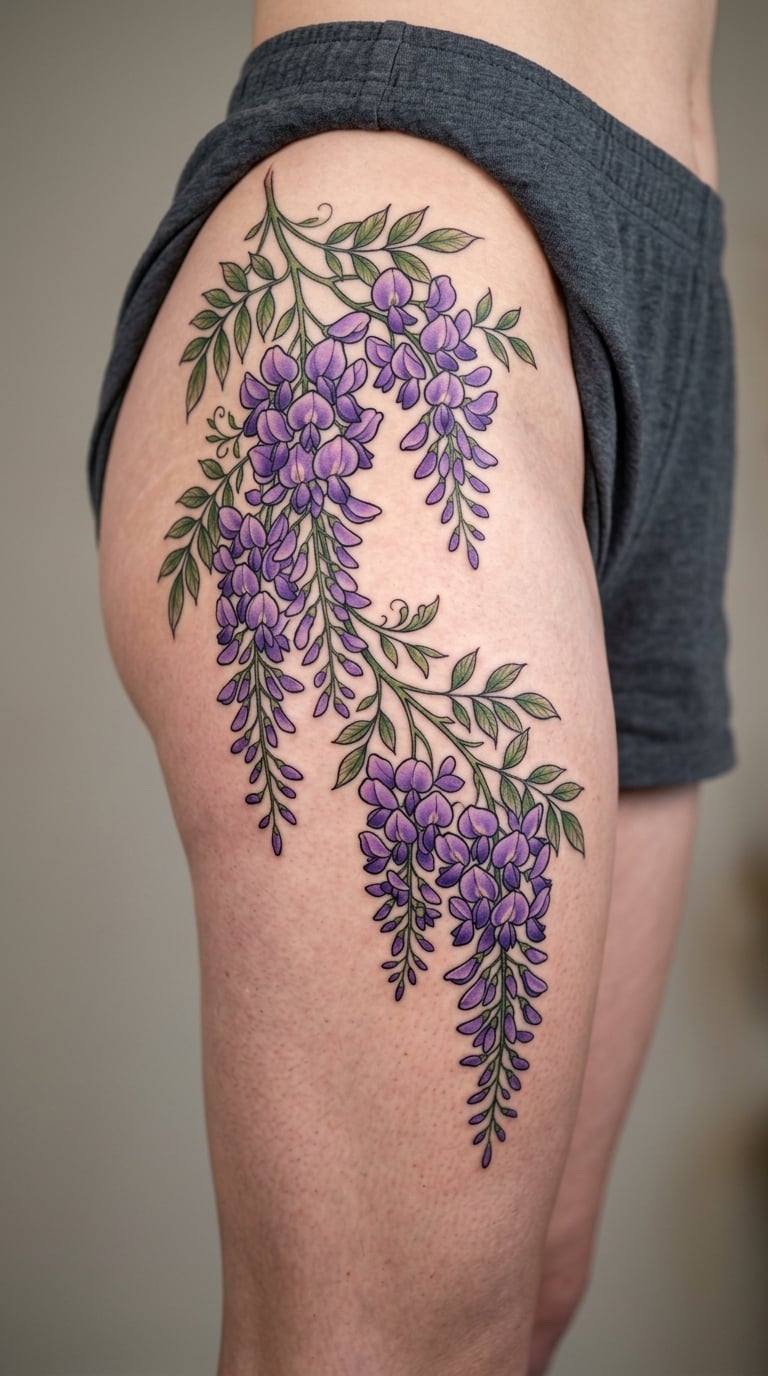
A hanging cluster of wisteria: long stems carrying rows of small purple blossoms that get paler toward the tips, with narrow green leaves behind them. The cascade falls downward along the hip and over the top of the thigh, which is what makes this motif work here rather than anywhere else on the body.
Wisteria is chosen for how it looks, mostly. The hanging shape suits the fall of the hip, and it is one of the few motifs that looks better placed there than on a flat forearm.
Placement: hip to upper thigh, following the drop of the crease. Size: 8-12 in (20-30 cm) tall. Style: watercolor illustrative. Pain: low to medium, spread across a long and fairly flat area.
Make it yours: choose one purple shade and stay with it, then let the tip of the cluster fade into unfinished colour.
25. Ornamental Hip Flourish
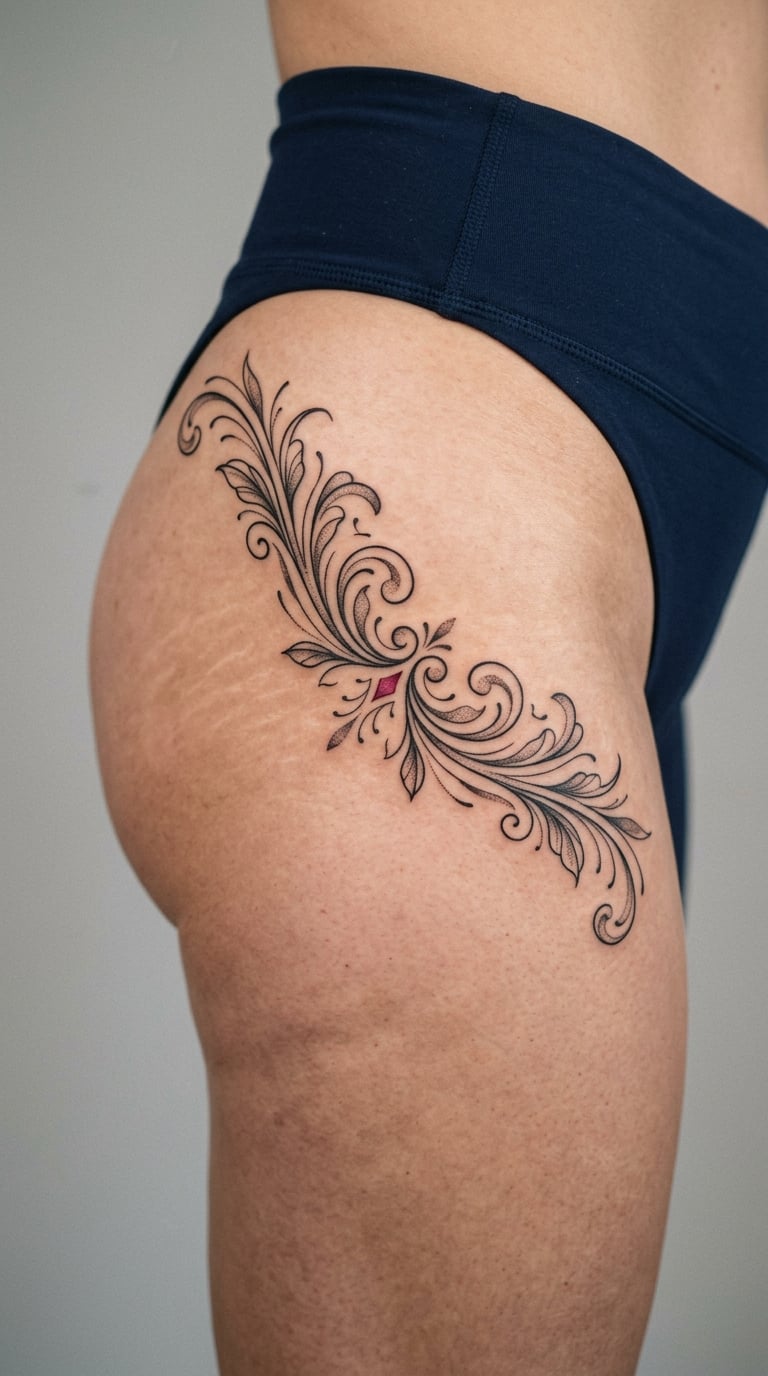
A wide ornamental composition: mirrored curves sweeping outward, small leaves branching off them, fine hatching in the negative space and one central accent, often a small red stone or dot. It is drawn to fit the shape of the hip, with the widest point of the design sitting exactly where the body is widest.
Ornamental work is chosen for how the body is framed by it. It is the piece in this list that most clearly changes if your shape changes later.
Placement: outer hip, centred on the hipbone. Size: 8-12 in (20-30 cm) across. Style: ornamental linework. Pain: medium. The fine hatching over the hipbone is the most sensitive part of the zone.
Make it yours: change the single central accent into a tiny date in two colours rather than a solid shape.
How to Choose the Right Design
Which hip and thigh placement flatters your shape?
Most people pick by what the design looks like and settle the placement later, then discover the placement was the harder decision. Choose the zone first and let the drawing follow it.
- Hipbone: a bony ridge that curves naturally, so shallow designs read well here. Best for fine line, small moons and anything horizontal.
- Hip crease: the fold between hip and thigh. Curves and vertical cascades follow it; straight horizontal bands fight it. It is also the zone most affected by waistband friction while healing.
- Outer thigh: the largest, flattest area and the most forgiving of a first session. Anything wrapping or horizontal fits here.
- Front thigh: visible in shorts and jeans, so a design here gets seen more often than one on the hip.
- Inner thigh: private and intimate, with thinner skin and more nerve endings. Small pieces sit well; large ones get uncomfortable fast.
- Back of thigh: a clean canvas that most clothing and swimwear reveal. Vertical designs look excellent here.
On pear-shaped hips and fuller thighs, elongated vertical designs follow the taper of the limb better than round compact ones. On athletic thighs you have more flat room, so wider pieces still work. The shape decides the scale, and our notes on 18 side thigh tattoo ideas for women go further on the outer and side angles.
What size should you actually get?
The most common regret in this area is going too small. A design that looked perfect as a phone-screen image reads as tiny and lost across a full thigh. As a rough guide, small work sits 2-4 in (5-10 cm), medium 5-9 in (13-23 cm), and anything wrapping the hip or thigh runs 10 in (25 cm) or more. Bring reference images at the size you want them to end up, not cropped tight around the design.
Can you tattoo over stretch marks on the thigh?
Artists do it, and it can work well, but go in knowing the trade-off. Stretch mark skin holds ink differently and the marks can soften and lighten over the first couple of years, so the piece may need more than one session. Black and grey and dense blackwork disguise texture better than fine line, which settles into the uneven surface. Expect the tattoo to be a little more raised for longer than normal.
What should you bring to the consultation?
Bring more references than you think you need, sorted into a clear top three. Then ask about total size in inches, how many sessions the piece needs, what happens if you gain or lose weight, and how the design will look when you are standing rather than sitting. Ask to see healed work from that artist, not fresh photos.
On sitting through a long session: it is the real concern more than pain. Book a short first sitting, take breaks before you need them, and ask whether numbing cream is fine with them. People are nervous to bring it up and most artists have a straightforward view on it.
Cost and Session Time
Tattoo pricing in the US is usually per hour rather than per design, so the total follows size and detail closely. These are realistic ranges to walk in with, not quotes.
- Small piece, 2-3 in (5-8 cm): 150 to 300 US dollars, often one sitting of 45 to 90 minutes.
- Medium piece, 5-9 in (13-23 cm): 300 to 700 US dollars, one or two sittings.
- Large wrapping piece, 10 in (25 cm) or more: 800 to 2,000 US dollars and up, usually split into planned sessions.
Shop minimums apply, so a tiny piece can cost the same as a small one. Artists charge more per hour for large blackwork, colour packing and fine detail, and travel or city changes rates more than style does. If a quote feels far off from these ranges, ask what the hourly rate is before you walk away.
Plan large work in sessions of two to three hours rather than one marathon. Nobody sits comfortably for six hours, and breaks cost you nothing but time.
Aftercare Basics
Follow your artist’s aftercare instructions first, because they know exactly what they did. These are the general points worth confirming before you leave the chair.
- Keep the area clean and let your artist tell you how long to leave any film or wrap in place before washing.
- Wash gently twice a day with unscented soap and lukewarm water, then pat dry rather than rubbing.
- Use a fragrance-free moisturiser once the skin is no longer raw, in thin layers rather than heavy coats.
- Expect swelling and tightness in the first 48 to 72 hours. The thigh holds gravity-driven swelling more than the arm does, so prop it up when you can.
- Keep waistbands and tight denim off a fresh hip or crease tattoo, and skip swimming pools, hot tubs and lakes until it is fully healed.
- Cover fresh work with clothing or a bandage in direct sun, since fading is fastest in the first months.
Surface healing takes two to four weeks, and a tattoo keeps settling for three to six months. Judge the colour at the six-month mark, not at week three.
Frequently Asked Questions
What is a good size for a hip to thigh tattoo?
For the outer thigh and hip, small pieces sit around 2-4 in (5-10 cm), medium work at 5-9 in (13-23 cm), and anything that wraps the body runs 10 in (25 cm) or more. The common mistake is going too small: a design that looks good on a phone screen often reads as tiny and lost on a full thigh. Bring references printed or saved at roughly the size you want them to end up.
How painful is a hip to thigh tattoo?
Most of the zone is low to medium. The outer thigh and the fleshy part of the hip are among the more forgiving places to be tattooed, with muscle absorbing a lot of the sensation. The bony ridge of the hipbone stings where a design crosses it, and the inner thigh is noticeably more sensitive. People are usually more tired than they are in pain after a long sitting.
Which hip and thigh placement flatters the most?
It depends on your shape. Elongated vertical designs suit pear-shaped hips and fuller thighs because they follow the taper of the limb, while wider pieces work on athletic thighs with more flat room. Shallow designs sit well on the hipbone, and vertical cascades follow the hip crease naturally. Straight horizontal bands sit badly across the crease, which curves the opposite way.
Do thigh tattoos change with weight gain or pregnancy?
Some change, and the honest answer is that nobody can predict exactly how. Skin on the hip and thigh stretches and relaxes, so a design built tightly to one shape may sit differently later on. Designs placed slightly higher on the outer thigh, or pieces that were scaled a little larger than the current shape, tend to age better than tightly fitted small work. Talk it through at your consultation.
Can you tattoo over stretch marks on your thigh?
Yes, artists do it regularly. Stretch mark skin holds ink differently and the marks often soften and lighten over the first couple of years, so the piece may need extra sessions or a colour boost. Dense blackwork and black and grey shading disguise the texture better than fine line, which settles into the uneven surface. Expect the area to feel more raised for longer than a tattoo elsewhere.
How long does a hip to thigh tattoo take to heal?
Surface healing takes two to four weeks, with a scab or peel that should not be picked at. The full settling process runs three to six months, and the colour you judge in week three is not the colour you end up with. Swelling and tightness are normal for the first 48 to 72 hours, and the thigh holds gravity-driven swelling more than other areas do.
Conclusion
If this is your first tattoo, start at the small end of this list. The minimalist crescent moon, the fine-line mountain range or the micro-realism rose all sit in a comfortable single sitting, heal quickly and give you a real piece on the hip without committing to a large sitting you have never done before.
If you are already building a collection, the blackwork snake, the wisteria cluster or the ornamental hip flourish are the ones that reward the area, because they use the curve and the space instead of sitting on top of it. Bring two or three of these 25 hip to thigh tattoo ideas for women to a consultation with an artist whose healed work you like, and let them tell you what your shape suits. If you want a wider pool to choose from, our 30 tattoo ideas for women on the thigh is worth a look before the appointment.