
24 Hourglass Tattoo Ideas for Time Lovers (October 2026)
An hourglass tattoo means the passage of time, and most people who get one want a permanent reminder to stop wasting the hours they have left. The shape is symmetrical, so it flatters almost any body panel, and the falling sand gives an artist room to add colour, shading or a second symbol. It sits comfortably at three levels: bare outline, illustrated detail, or solid black.
Below are 24 hourglass tattoo ideas sorted by style, placement, size and pain level, so you can find the one that matches how much detail you actually want to sit with for the rest of your life. Every size below is the real healed size, not a drawing. If you are planning a tattoo for autumn, most artists are booked four to eight weeks out, so send references now rather than in October.
24 Hourglass Tattoo Ideas: Quick Guide
| Idea | Style | Best placement | Size | Pain |
|---|---|---|---|---|
| 1. Minimal single-line wrist | Fine line | Inner wrist | 1.5 in wide | Low to medium |
| 2. Botanical with falling leaves | Fine line botanical | Inner forearm | 3 in tall | Medium |
| 3. Geometric straight lines | Geometric | Outer upper arm | 2.5 in tall | Medium |
| 4. Traditional shaded sand | Traditional | Forearm | 3 in tall | Medium to high |
| 5. Watercolour blue sand | Watercolour | Shoulder | 3.5 in tall | Medium |
| 6. Micro-realism loose sand | Micro-realism | Upper arm | 2 in tall | Medium |
| 7. Double-outline collar bone | Fine line | Collar bone | 2 in wide | Low to medium |
| 8. Blackwork hourglass shape | Blackwork | Outer forearm | 2.5 in tall | High |
| 9. Rose-shadow on the rib | Fine line floral | Rib area | 3 in tall | High |
| 10. Dotwork with starry interior | Dotwork | Inner bicep | 2 in tall | Medium |
| 11. Pulsing heartbeat line | Fine line | Forearm | 2.5 in tall | Medium |
| 12. Hourglass between two dots | Minimalist | Finger or wrist | Under 1 in | Medium to high |
| 13. Waves inside the glass | Fine line illustrative | Calf | 2.5 in tall | Medium |
| 14. Silhouette inside a circle | Blackwork minimal | Upper arm | 2 in wide | Medium |
| 15. Sand shifting to birds | Illustrative | Outer arm | 3 in tall | Medium |
| 16. Filled with Roman numerals | Neo-traditional | Forearm | 3 in tall | Medium |
| 17. Sun and moon on the hand | Fine line celestial | Back of hand | 2 in wide | Medium to high |
| 18. Infinity-style sand stream | Flowing line | Ankle | 2.5 in tall | Medium |
| 19. Gothic with ornate ends | Black and grey | Upper arm | 3.5 in tall | Medium |
| 20. Constellation lines | Fine line celestial | Shoulder | 3 in wide | Medium |
| 21. Stained-glass style | Colour illustrative | Thigh | 3 in tall | Medium |
| 22. Hand in the sand | Surreal fine line | Calf | 3 in tall | Medium |
| 23. Crescent moon frame | Fine line celestial | Behind the ear | 2 in tall | Medium |
| 24. Blackwork with a handwritten word | Blackwork and script | Inner forearm | 3 in wide | Medium |
1. Minimal Single-Line Hourglass on the Wrist
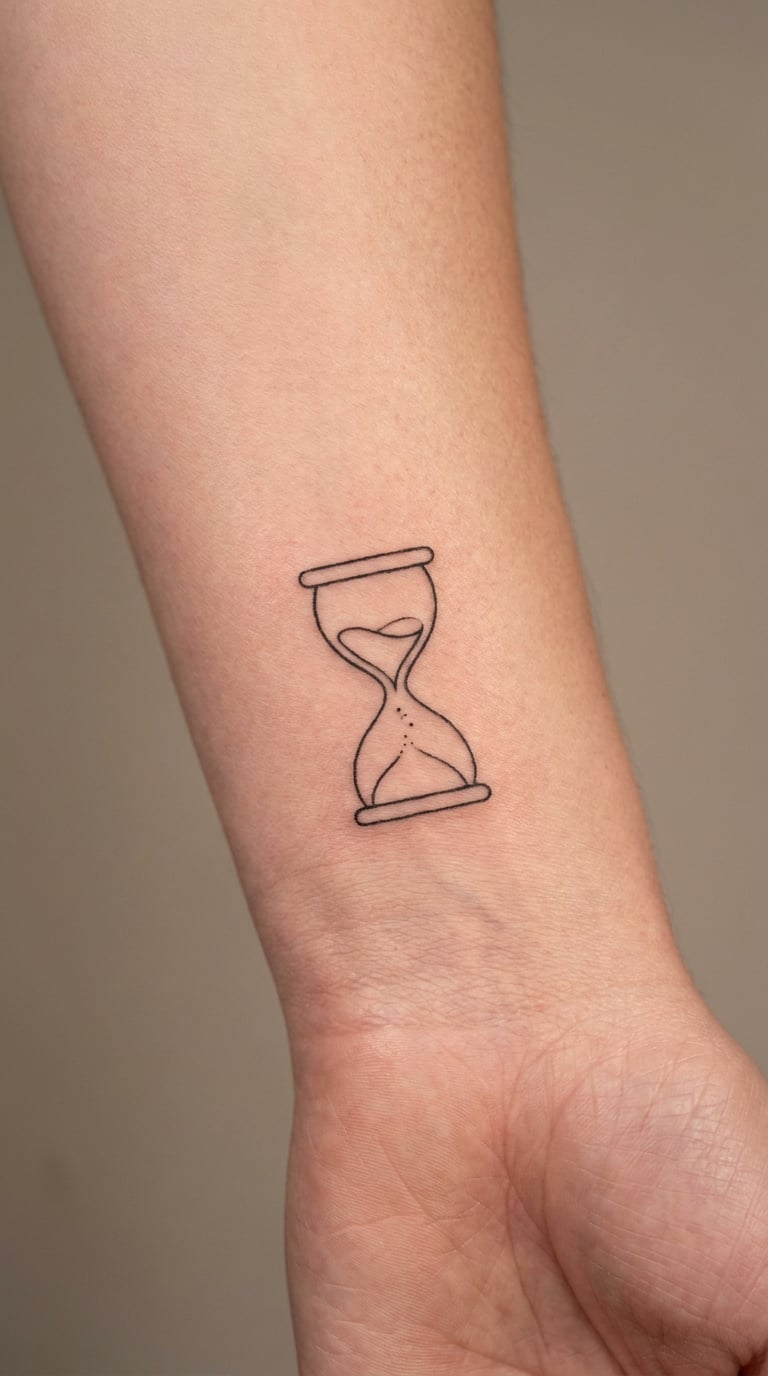
A minimal single-line hourglass tattoo is one unbroken outline with no frame, no sand texture and no ornament. Just two teardrop shapes meeting at a point, drawn in one thin weight. The whole thing works because the negative space does the shading. Most people choose it as a quiet reminder rather than a statement piece.
Placement: inner wrist, above the pulse point, or the outer wrist near the thumb joint. Size: 1 to 2 inches (2.5 to 5 cm) wide. Style: fine line, single needle. Pain: low to medium, and over in ten minutes. Fine wrist lines soften noticeably within a few years, so a slightly heavier line is worth asking for. Make it yours: add a single thin line of dotwork sand, or nothing at all.
2. Botanical Hourglass with Falling Leaves
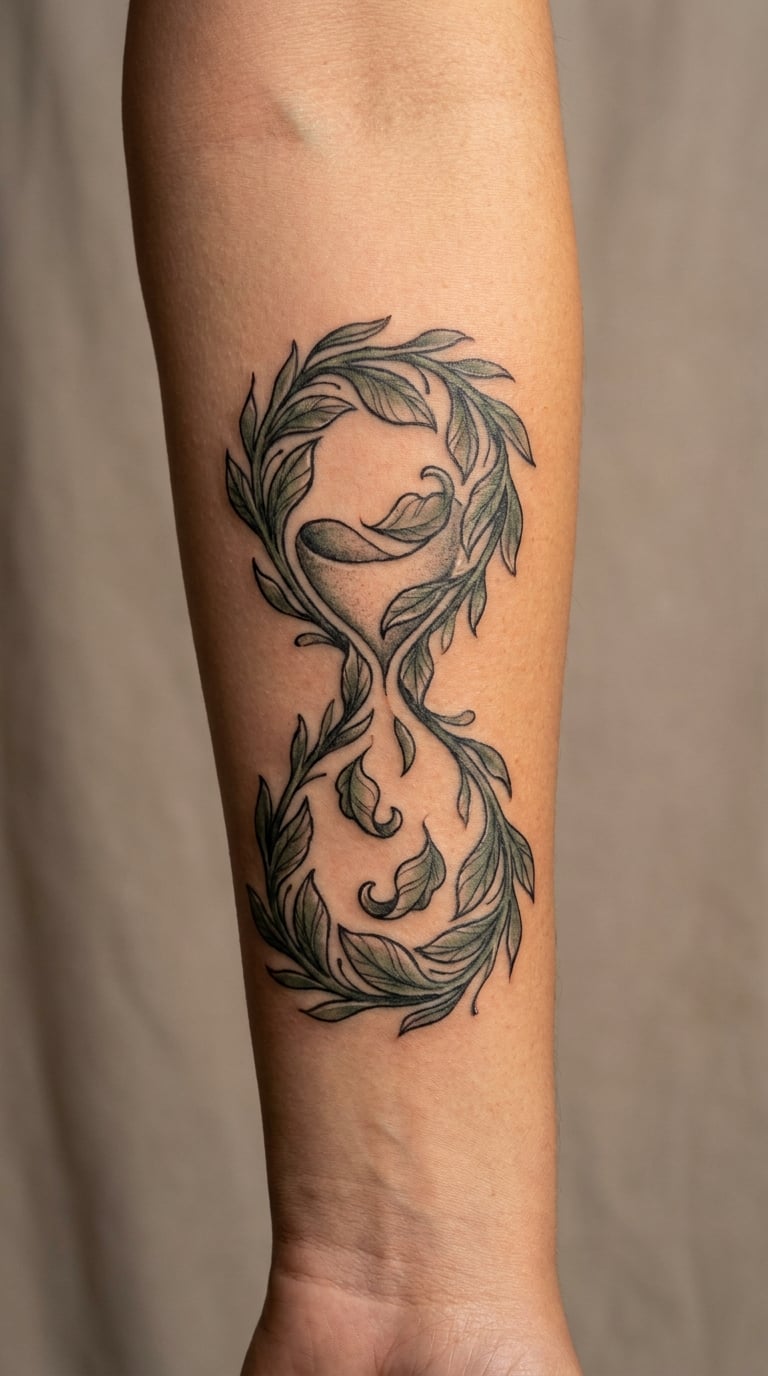
This design turns the sand stream into three or four falling leaves, each one outlined with a fine line and a pale green wash. The hourglass outline stays thin so the leaves read as the focal point. It suits people who like botanical work and want something warmer than a plain outline.
Placement: inner forearm running with the bone, or the outer bicep. Size: 2.5 to 3.5 inches (6 to 9 cm) tall. Style: fine line botanical. Pain: medium. Green pigment on a fine leaf usually softens before the black outline does, which is normal. Make it yours: swap the generic leaves for a species with history, such as laurel, olive or a local tree.
3. Geometric Hourglass Made from Straight Lines
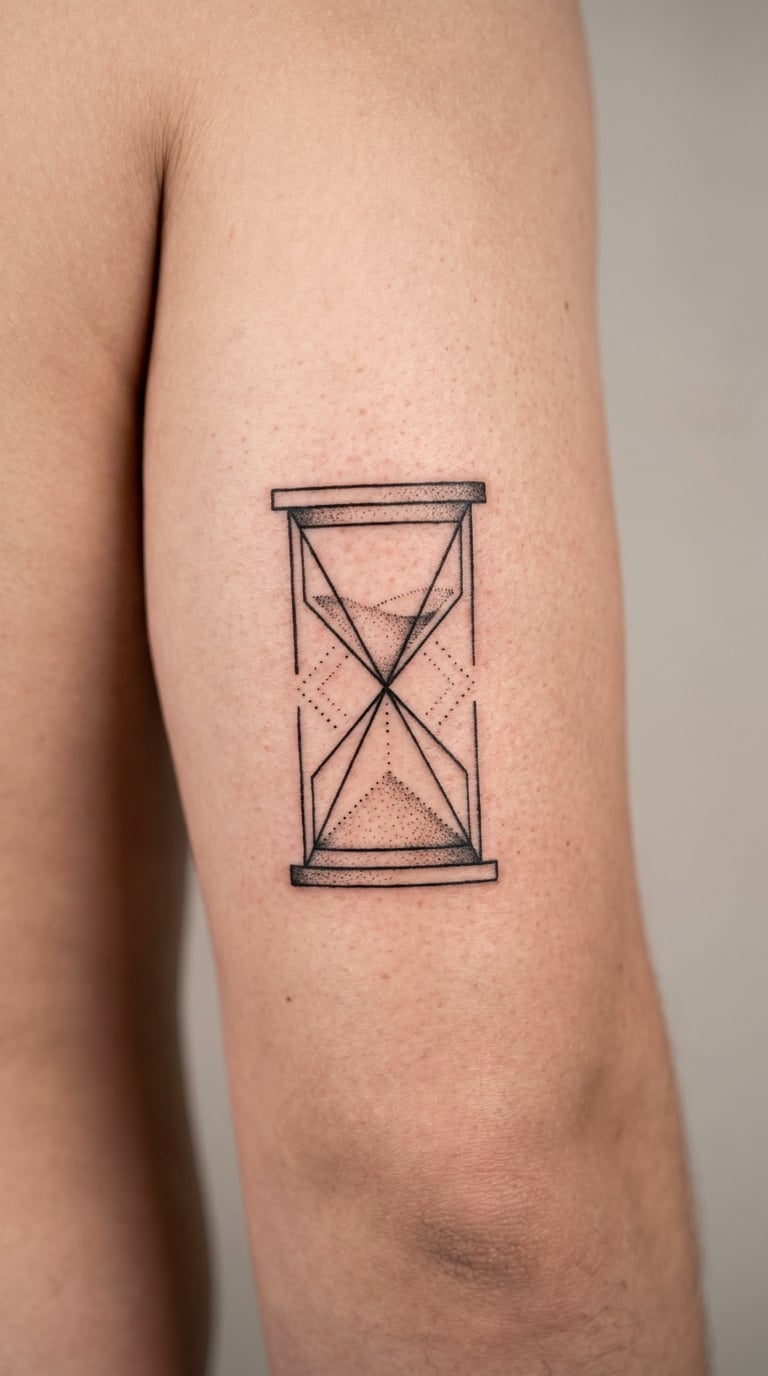
A geometric hourglass is built from clean triangular forms: two solid triangles pointing at each other, edges drawn with a ruler-like straightness, and a little dotwork shading tucked into one corner. The look is architectural rather than illustrative, and it carries no fixed meaning of its own.
Placement: outer upper arm, shoulder blade, or the flat panel of the thigh. Size: 2 to 3 inches (5 to 7.5 cm) tall. Style: geometric with restrained dotwork. Pain: medium, and geometric line work takes longer so the session stretches out. Make it yours: vary the line weight, heavier at the base and lighter at the neck, or change the dot spacing to a tighter field.
4. Traditional Hourglass with Shaded Sand
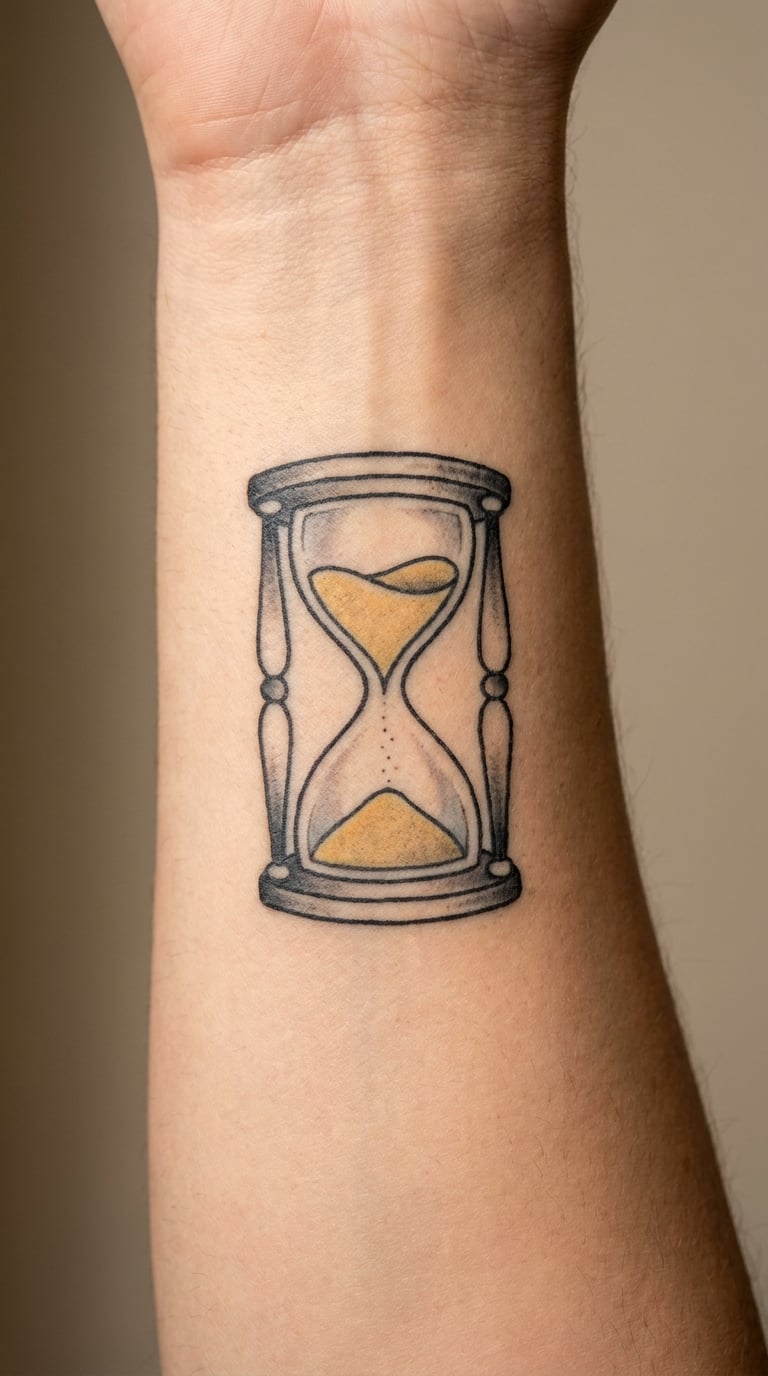
The traditional version does what old-school flash always did: heavy black outline, a wooden cap and base in warm brown, and a pile of yellow sand shaded with two or three tones. It reads instantly at any distance, which is the whole point of the style. Time symbolism is broad here, not fixed.
Placement: forearm, calf or upper arm, anywhere with room around the design. Size: 3 inches (7.5 cm) tall and up. Style: traditional. Pain: medium to high on the arm, and the shading passes over tender spots twice. Make it yours: run a scythe, a banner or a pair of banners through the frame, a common traditional add-on.
5. Watercolour Hourglass with Blue Sand
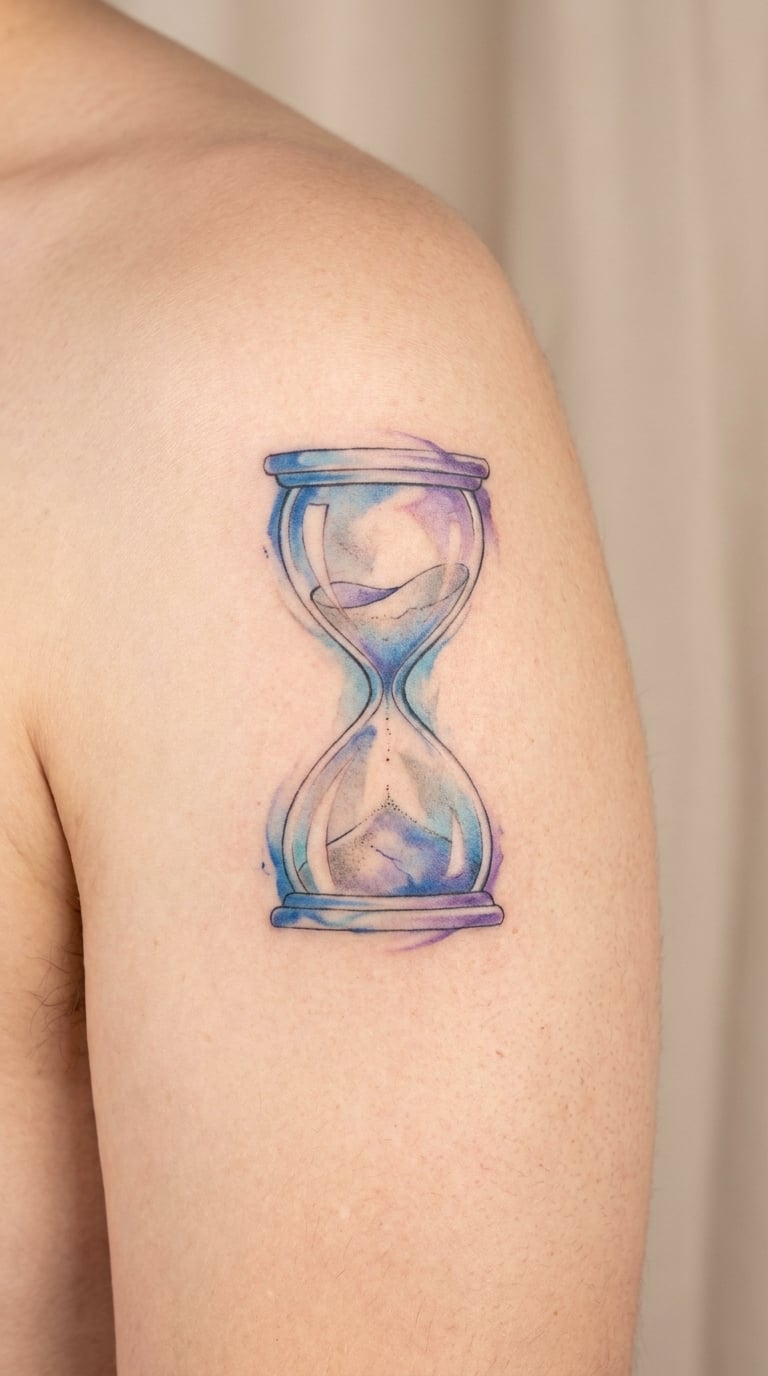
Watercolour hourglasses are loose washes rather than outlines, with blue and violet bleeding into soft grey where the glass would be. Edges stay slightly open, so the design looks like a painting that dried where the brush stopped. People usually choose it for the colour, not for a single message.
Placement: shoulder, upper arm or the back of the calf, anywhere with a flat-ish plane. Size: 3 to 4 inches (7.5 to 10 cm) tall. Style: watercolour. Pain: medium. Expect a lighter result after a few years, since light washes sit closer to the skin. Make it yours: pick two colours instead of three, or add a single dry-brush line to hold the composition.
6. Micro-Realist Hourglass with Loose Sand
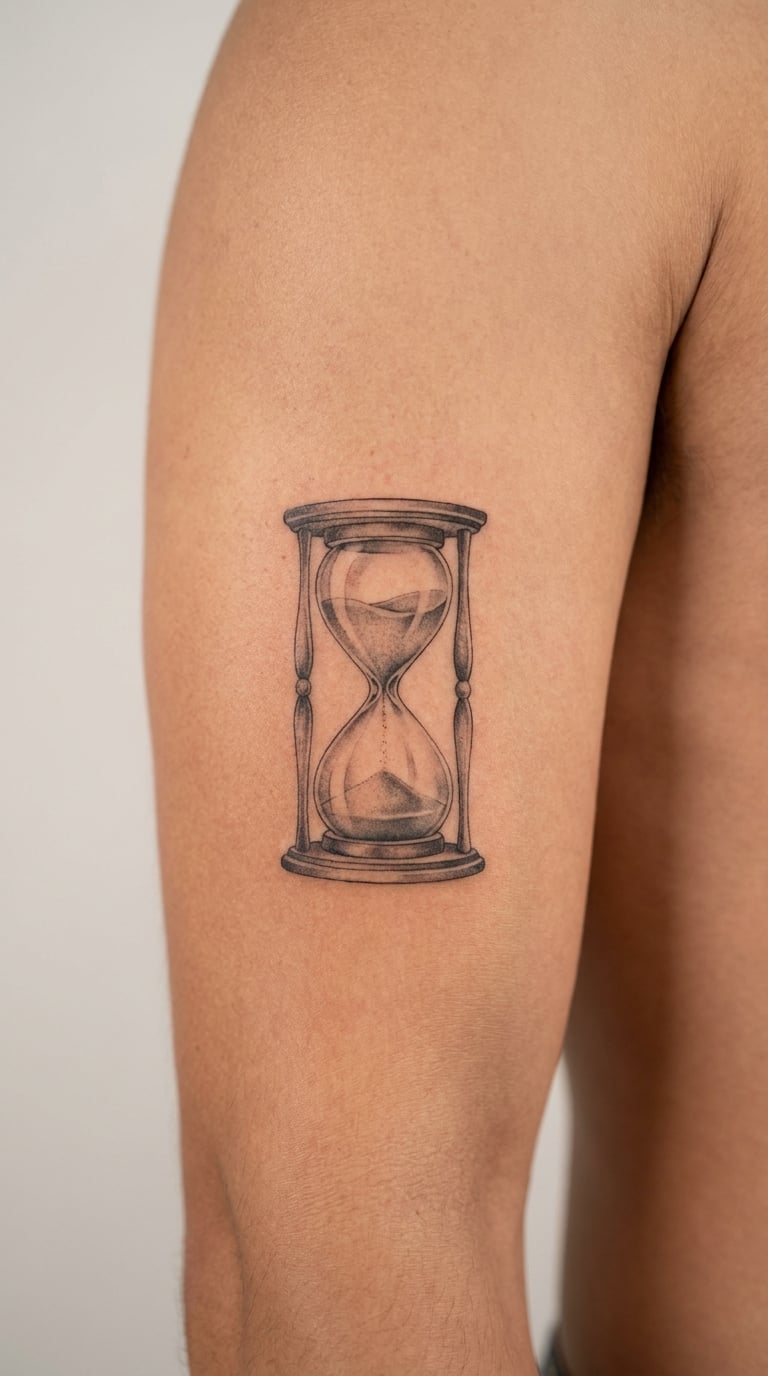
Micro-realism means the hourglass is drawn as an actual glass object, with a highlight down one bulb, grey shading opposite, and sand piled in a real curve at the base. It needs physical area to read properly. Below two inches the shading turns to grey mush within a few years.
Placement: outer upper arm, flat thigh or the back of the calf. Size: 2 to 3 inches (5 to 7.5 cm) tall minimum. Style: micro-realism. Pain: medium, and the session runs longer than the size suggests. Make it yours: engrave a date on the base plate, or tint the sand a single warm shade.
7. Double-Outline Hourglass on the Collar Bone
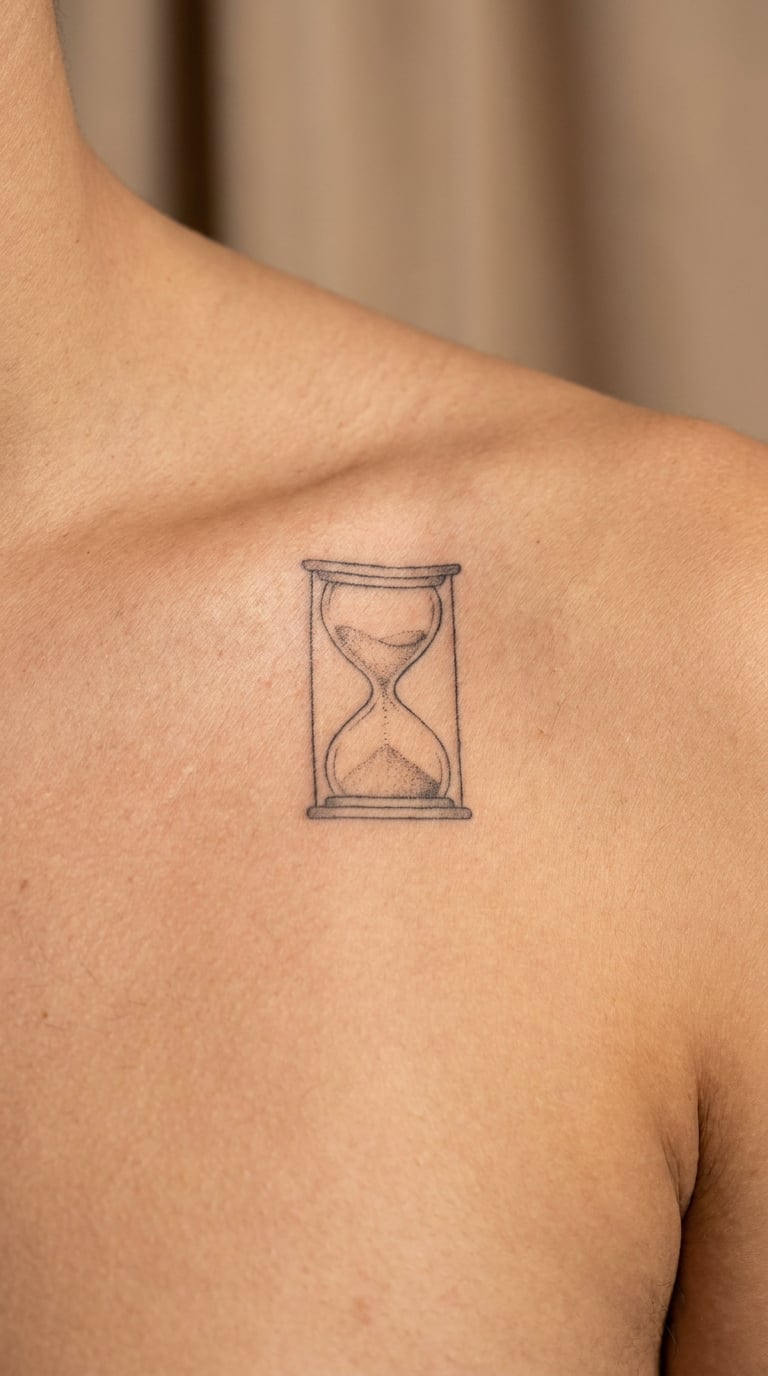
A double-outline hourglass traces two parallel lines around the whole shape, leaving a slim gap between them. The doubled edge gives the design a slight weight without shading, which is why it stays legible on skin that moves constantly. There is no accepted symbolism to worry about here.
Placement: centred on the collar bone, or offset along the shoulder line. Size: 1.5 to 2.5 inches (4 to 6 cm) wide. Style: fine line. Pain: low to medium, and collar bones bruise for a few days. Movement will flex the line slightly, so ask for a hair of extra weight. Make it yours: hide a single initial in the neck of the hourglass, or mirror it on the other side.
8. Blackwork Hourglass Filling an Hourglass Shape
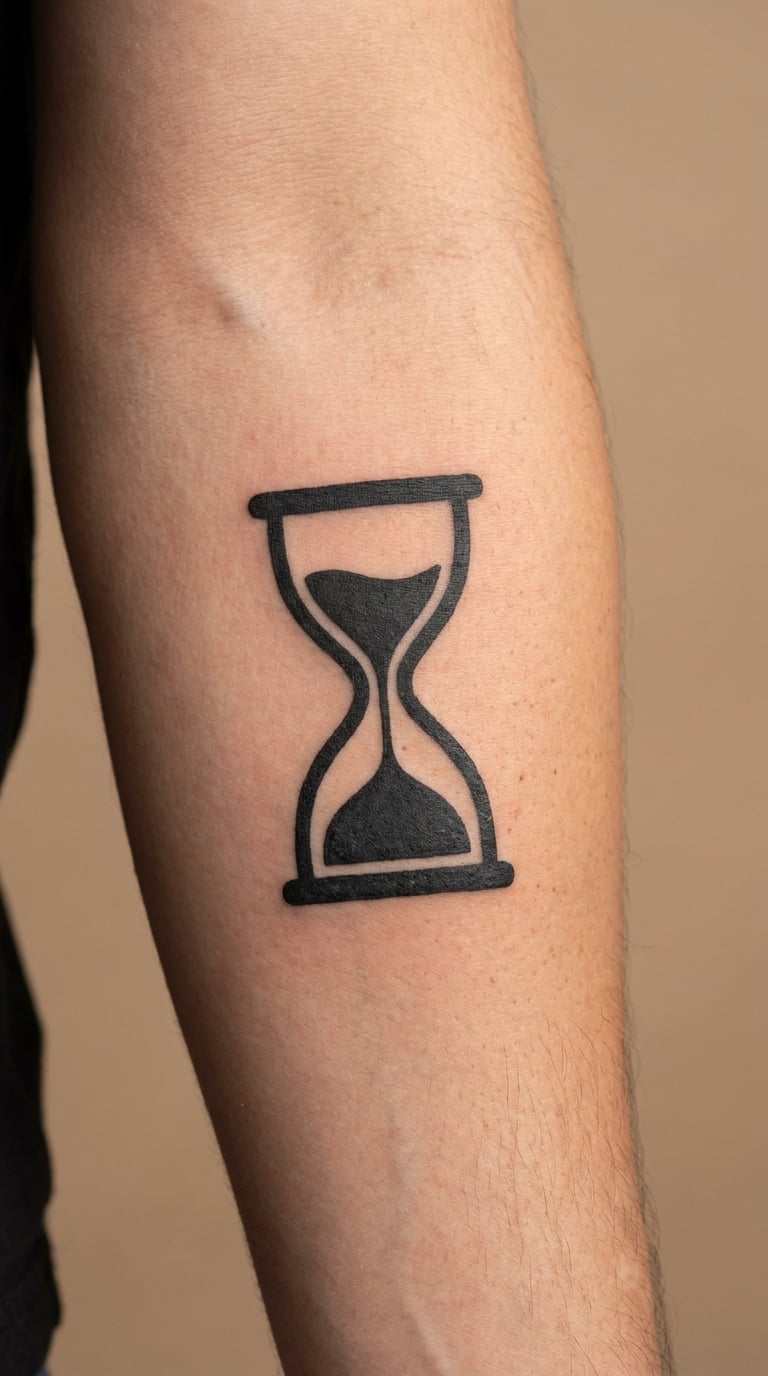
In this concept the tattoo itself is the hourglass, a solid black silhouette with one narrow opening cut through the middle. The negative space does the work, so there is no interior detail at all. It is bold from across a room and suits collectors who want weight rather than detail.
Placement: outer forearm, calf, or the side of the upper arm. Size: 2.5 to 4 inches (6 to 10 cm) tall. Style: blackwork. Pain: high, because solid black means long passes over the same skin. Solid fills can settle and look slightly patchy over a decade. Make it yours: add a thin white or gold line through the opening as a single accent.
9. Rose-Shadow Hourglass on the Rib
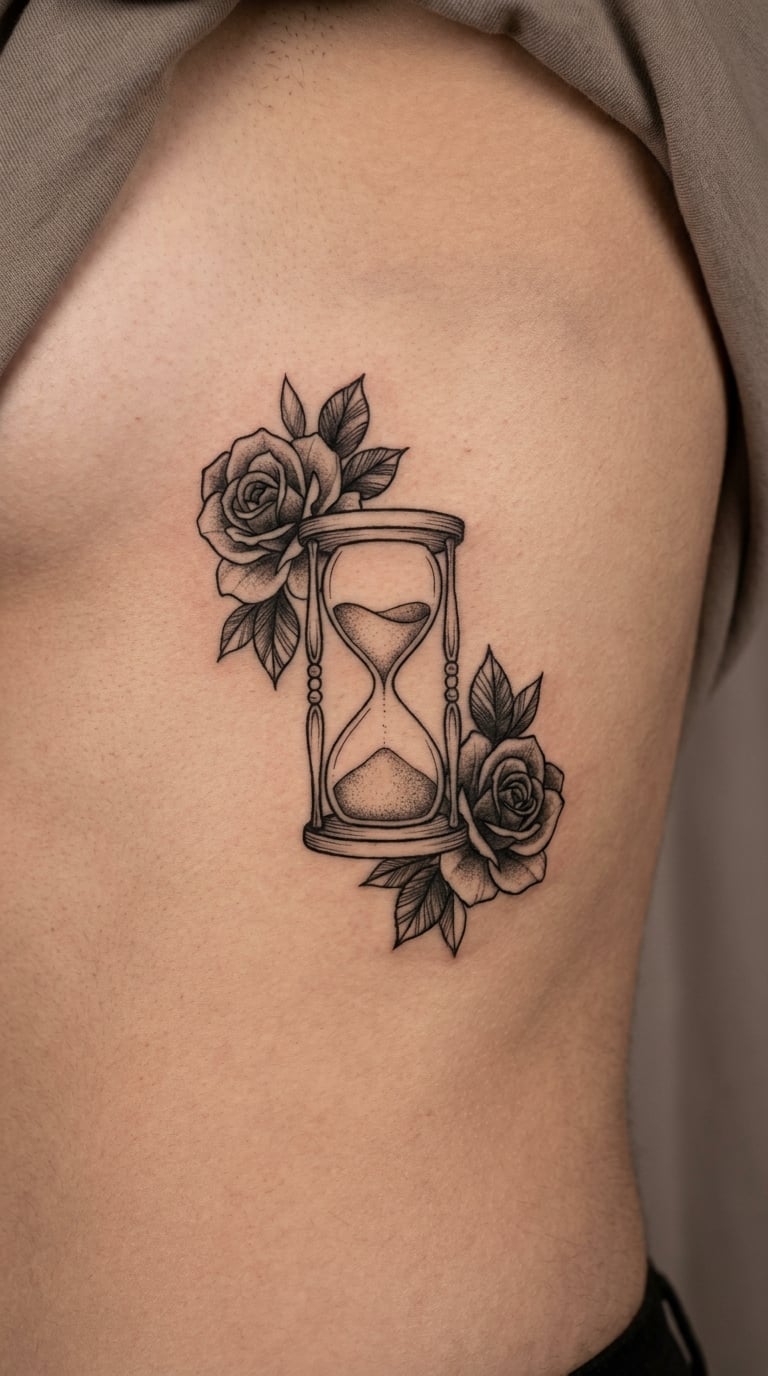
Two roses, one at the top of the glass and one at the base, drawn with a light pencil-shaded style rather than heavy petals. The hourglass between them stays a plain outline. Roses and hourglasses get paired often, but the combination reads as decorative before it reads as symbolic.
Placement: rib area, usually along one side rather than centred. Size: 2.5 to 3.5 inches (6 to 9 cm) tall. Style: fine line floral with grey shading. Pain: high. Ribs are the spot people most often describe as the worst, so plan a long sitting and a break. Make it yours: choose one rose variety and repeat it, or colour both the same deep red.
10. Dotwork Hourglass with a Starry Interior
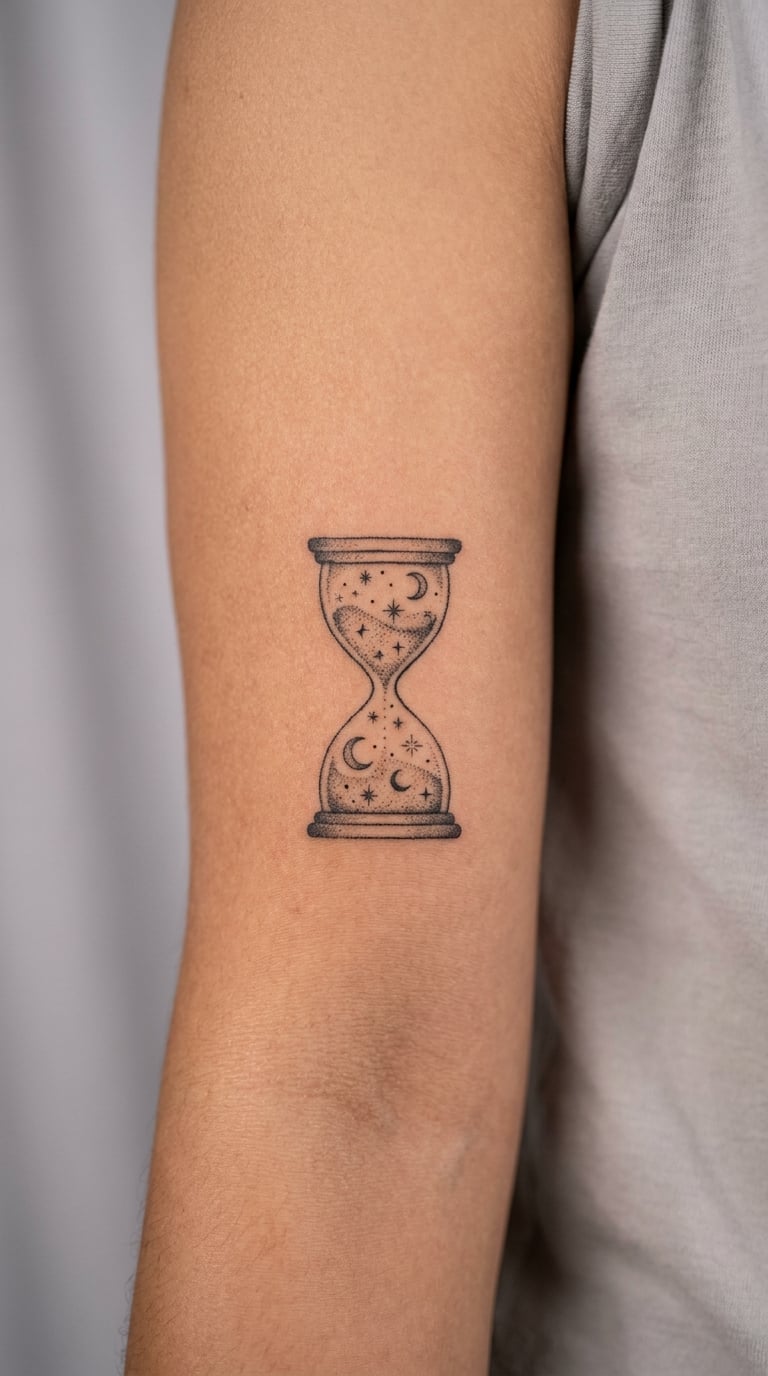
Here the hourglass outline is thin, and the space inside the upper bulb is filled with scattered dots that grow denser toward the corners, with a few small stars caught in the field. The gradient does the shading, so the whole thing stays quiet. Personal significance is whatever you bring to it.
Placement: inner bicep, outer forearm, or the shoulder. Size: 1.5 to 2.5 inches (4 to 6 cm) tall. Style: dotwork. Pain: medium, and dot sessions take their time. Dots spread and soften, which turns the gradient blurrier rather than lighter. Make it yours: tie the star pattern to a real constellation, or make the sand heavier than the sky.
11. Hourglass with a Pulsing Heartbeat Line
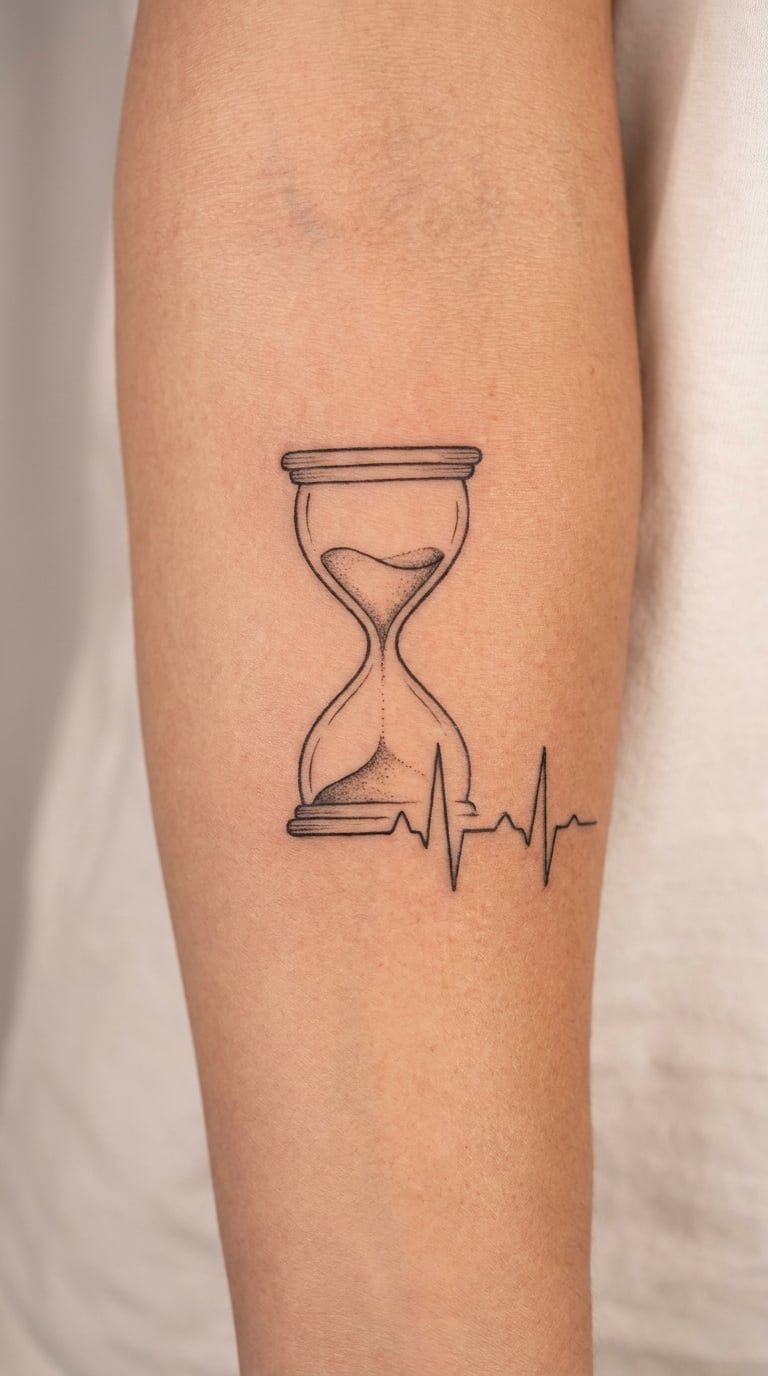
The sand stream leaves the neck of the glass and turns into a single flat heartbeat trace, the sharp spike and dip of a monitor reading. The line exits the outline and runs a short distance before stopping. It is graphic rather than sentimental, and a lot of wearers use it as a private reminder or a memorial piece.
Placement: inner forearm, following the line of the arm. Size: 2 to 3 inches (5 to 7.5 cm) tall plus the trailing line. Style: fine line with a bold accent line. Pain: medium. The single bold trace needs more passes and will outlast the thin outline. Make it yours: set the trace to a real reading, or add a handprint at the end of the line.
12. Minimal Hourglass Between Two Dots
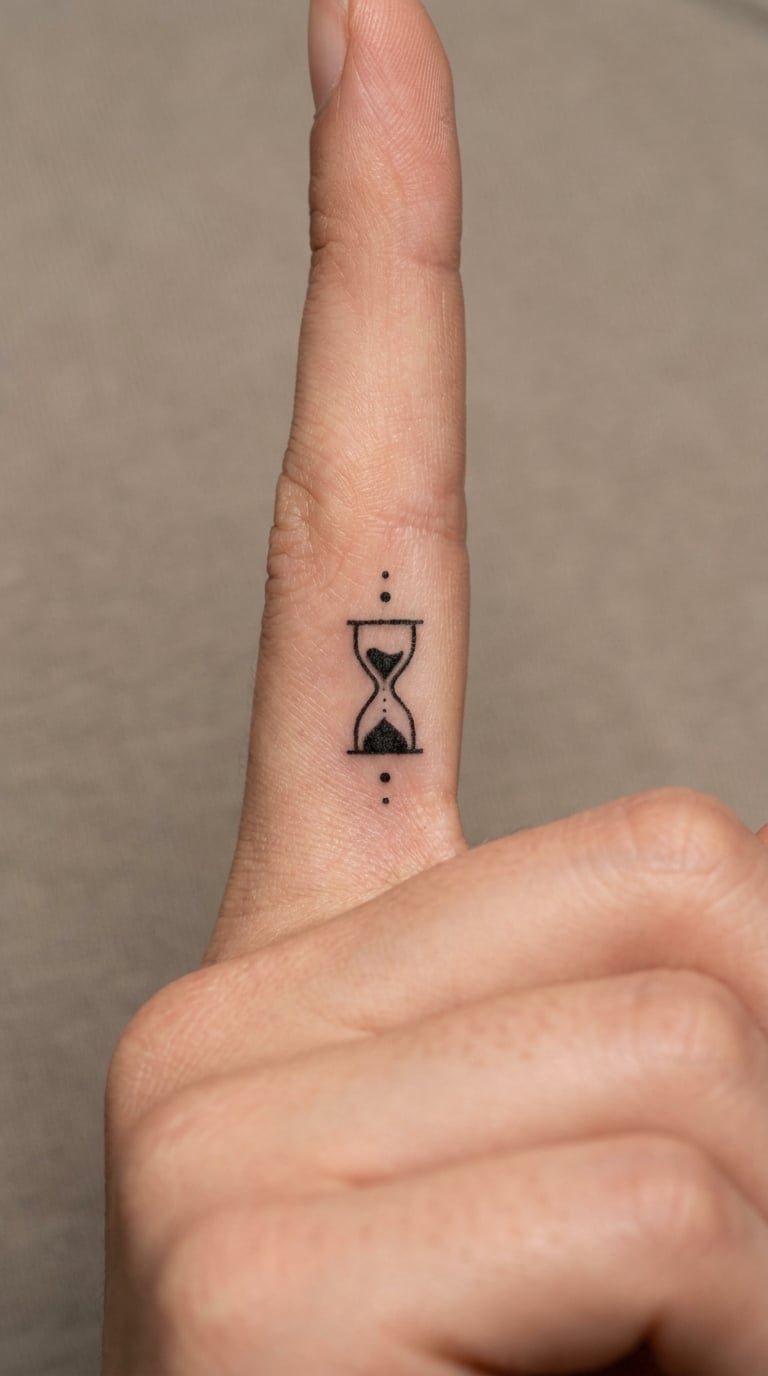
One small outline hourglass, two dots, one above and one below, and nothing else on the body. It is the smallest design in this list and the one people most often get as a first tattoo. Interpretation is entirely the wearer’s; nobody reads a specific message into two dots.
Placement: side of a finger, inner wrist, or behind the ear. Size: under 1 inch (2.5 cm) tall. Style: minimalist. Pain: medium to high, because fingers and wrists are sensitive and the nerve endings are close to the surface. Expect the detail to blur over a decade. Make it yours: add a hairline accent, such as a single fine line trailing from the base.
13. Hourglass with Waves Inside the Glass
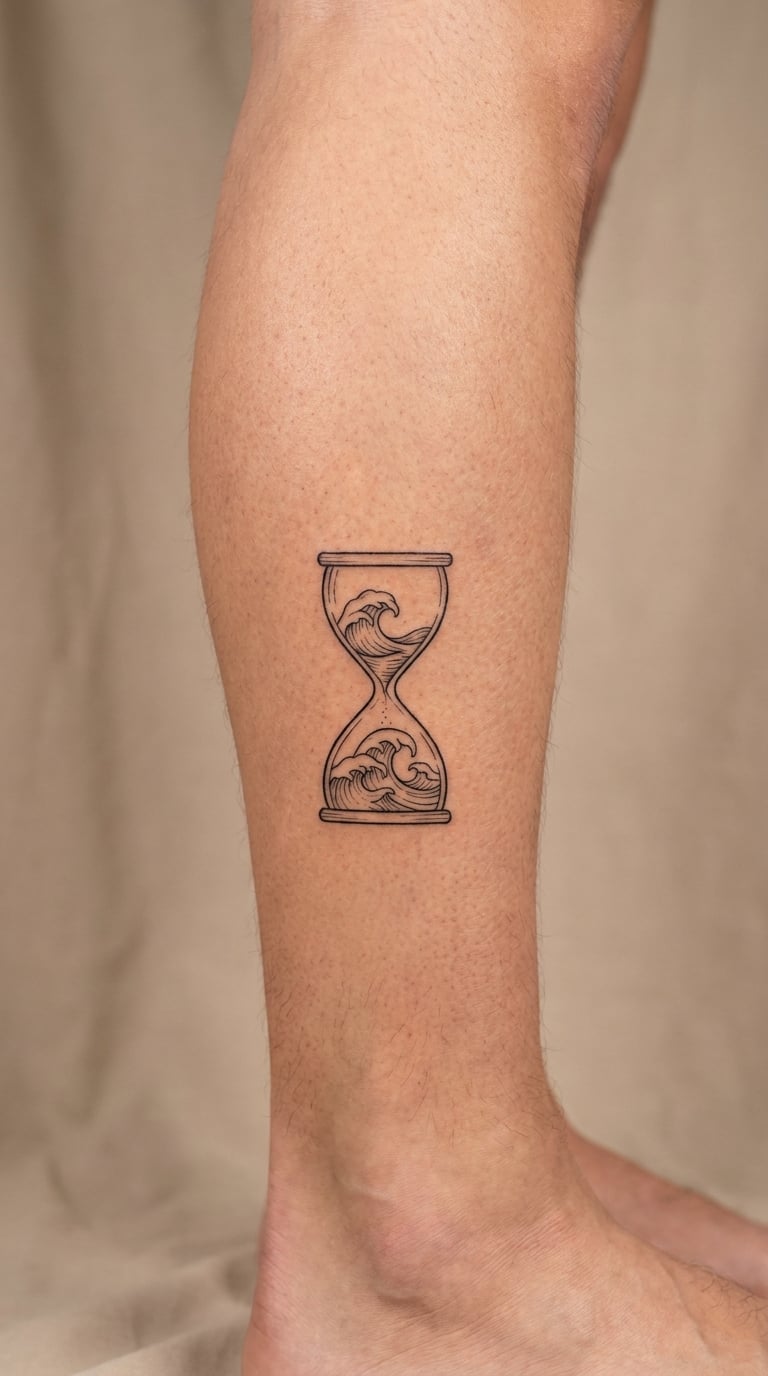
Instead of loose sand, the upper bulb holds two or three stylised wave lines with a small crest, and the lower bulb holds a shallow pool of the same water. The metaphor of water rather than sand is pleasant, but there is no single agreed meaning attached to it.
Placement: outer calf, inner forearm, or ankle. Size: 2 to 3 inches (5 to 7.5 cm) tall. Style: fine line illustrative. Pain: medium, and the calf is a curved surface so line placement needs care. Fine wave detail softens first as the line spreads. Make it yours: turn the waves to face one direction, or ink the pool a single deep teal.
14. Hourglass Silhouette Inside a Circle
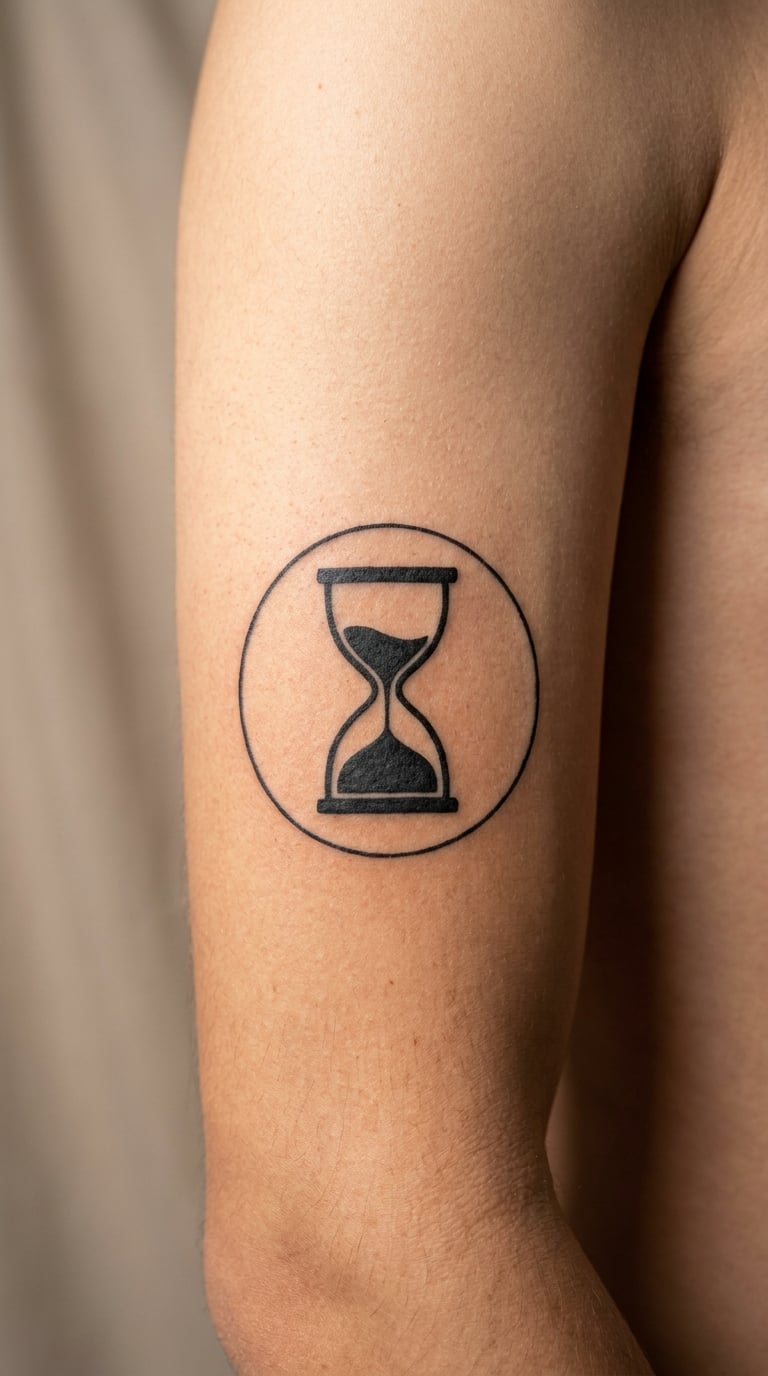
A small filled hourglass sits centred inside a thin circle, with a clear ring of empty skin between the two shapes. That gap is what makes the composition work; the artist has to keep the spacing even all the way round. It reads as balanced and graphic, with symbolism left open.
Placement: upper arm, outer thigh, or the back of the shoulder. Size: 1.5 to 2.5 inches (4 to 6 cm) wide. Style: blackwork minimal. Pain: medium. The fine circle edge is the first part to fade, so expect the ring to look slightly soft after several years. Make it yours: thicken the circle into a band, or add a single line of text curving along it.
15. Hourglass with Colorful Sand Shifting to Birds
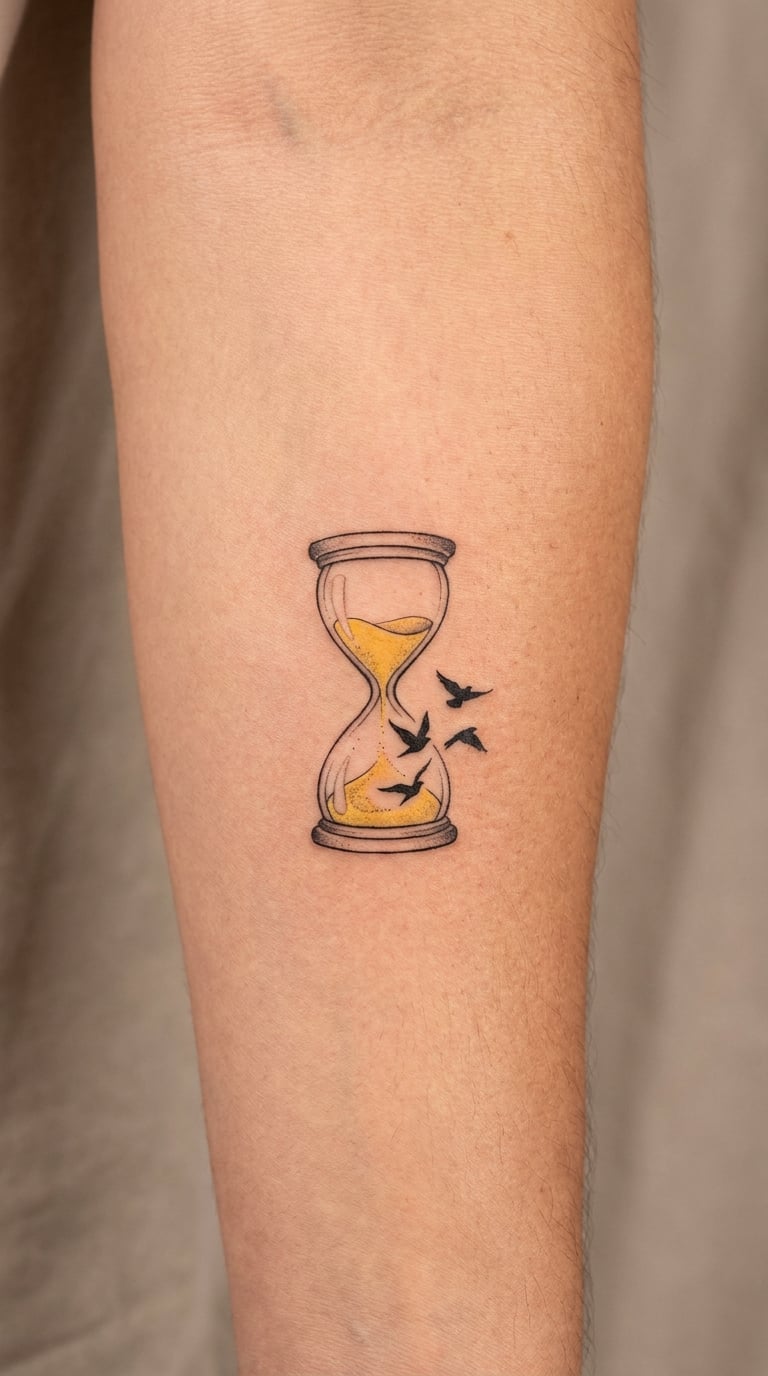
Coloured sand fills the lower bulb, and as it rises through the neck it breaks into three small outlined birds that lift away from the top. The colour stays in the sand and the birds stay black, which keeps the palette controlled. Wearers link it to freedom or transition, though that reading is personal rather than standard.
Placement: outer arm, calf or upper back. Size: 2.5 to 3.5 inches (6 to 9 cm) tall. Style: illustrative with light colour. Pain: medium. Bird wings are tiny shapes, and at smaller sizes they blur together within a few years. Make it yours: use a bird species from your own region, or keep the birds to two for a cleaner layout.
16. Hourglass Filled with Roman Numerals
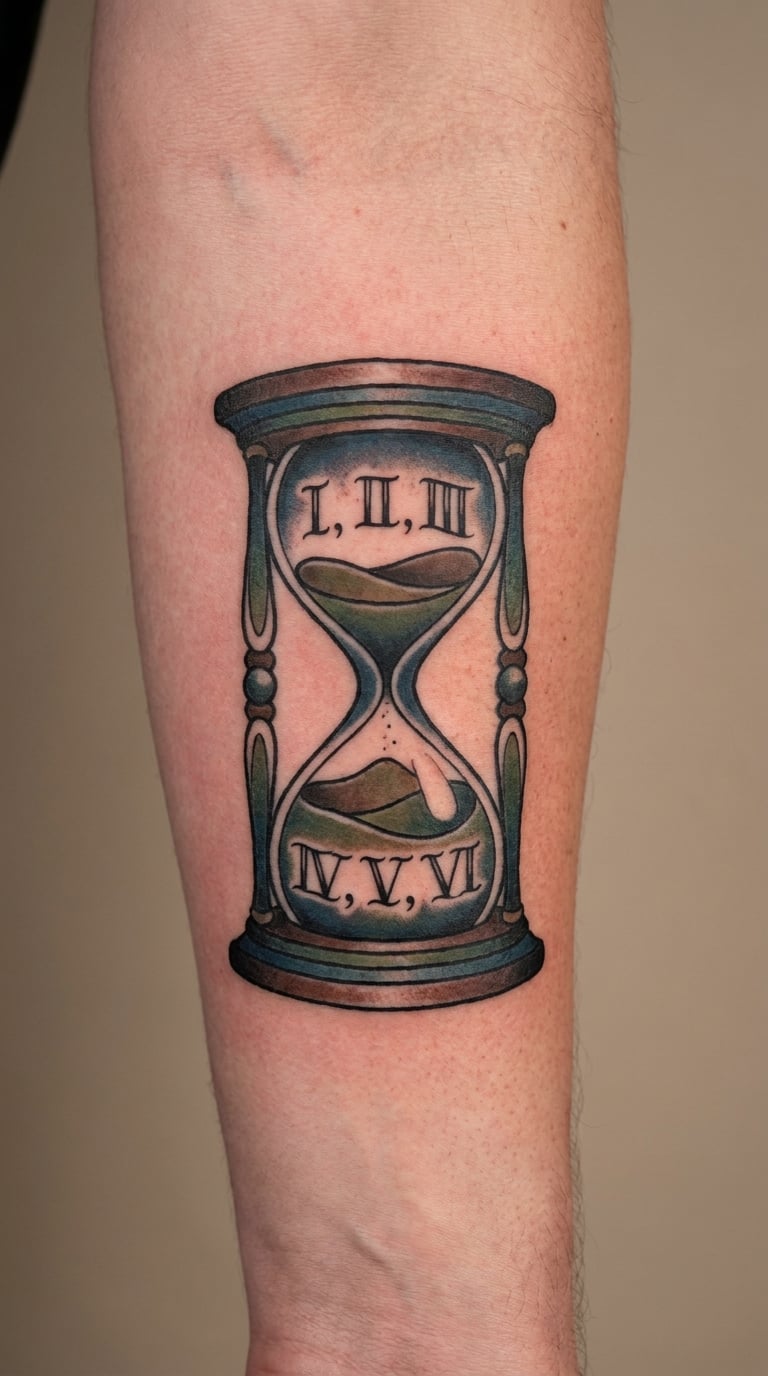
The frame is drawn in bold neo-traditional line work, and the space inside is divided into bands marked with Roman numerals, like a dial that has been opened up. Numerals tie the piece to a specific year or a run of important years, which is why this one tends to be chosen with a date in mind.
Placement: forearm, calf or upper arm. Size: 3 inches (7.5 cm) tall and up, since each numeral needs room. Style: neo-traditional. Pain: medium. Small numerals fade before the heavy outline does, so the reference should be drawn wide. Make it yours: list the years that matter, or work a single date such as a birth year into the base.
17. Sun-and-Moon Hourglass on the Back of the Hand
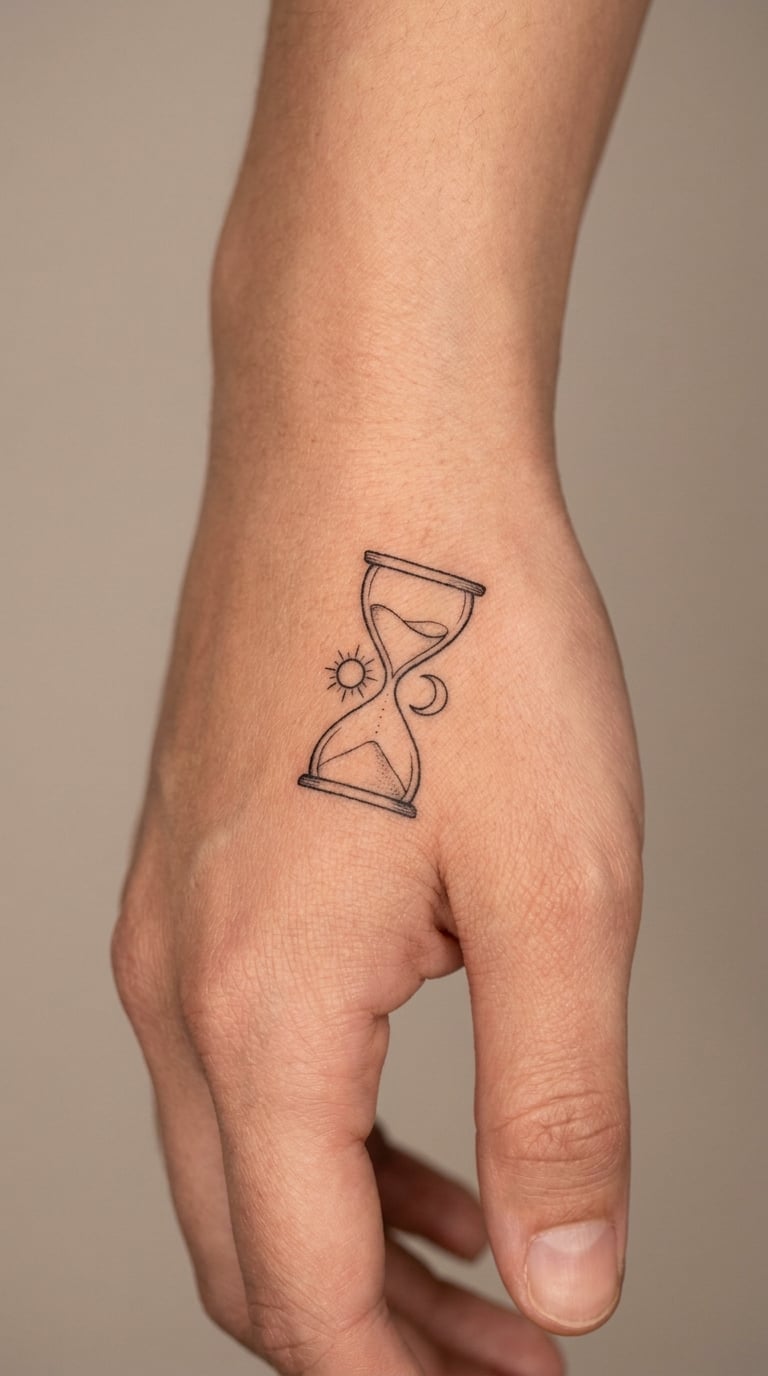
A fine-line hourglass sits between a small sun on one side and a crescent moon on the other, both drawn with a single weight and no rays or craters. Day and night sit either side of the same passage of time. The pairing is one of the most common celestial reads for the symbol.
Placement: back of the hand, usually between the knuckles and the wrist. Size: 1.5 to 2.5 inches (4 to 6 cm) wide. Style: fine line celestial. Pain: medium to high, and the hand shows the work constantly. Fine lines on hands fade fastest of anywhere, so this design needs a heavier needle than you might expect. Make it yours: add a small date beneath the wrist line, or one tiny star between the two bodies.
18. Hourglass with an Infinity-Style Sand Stream
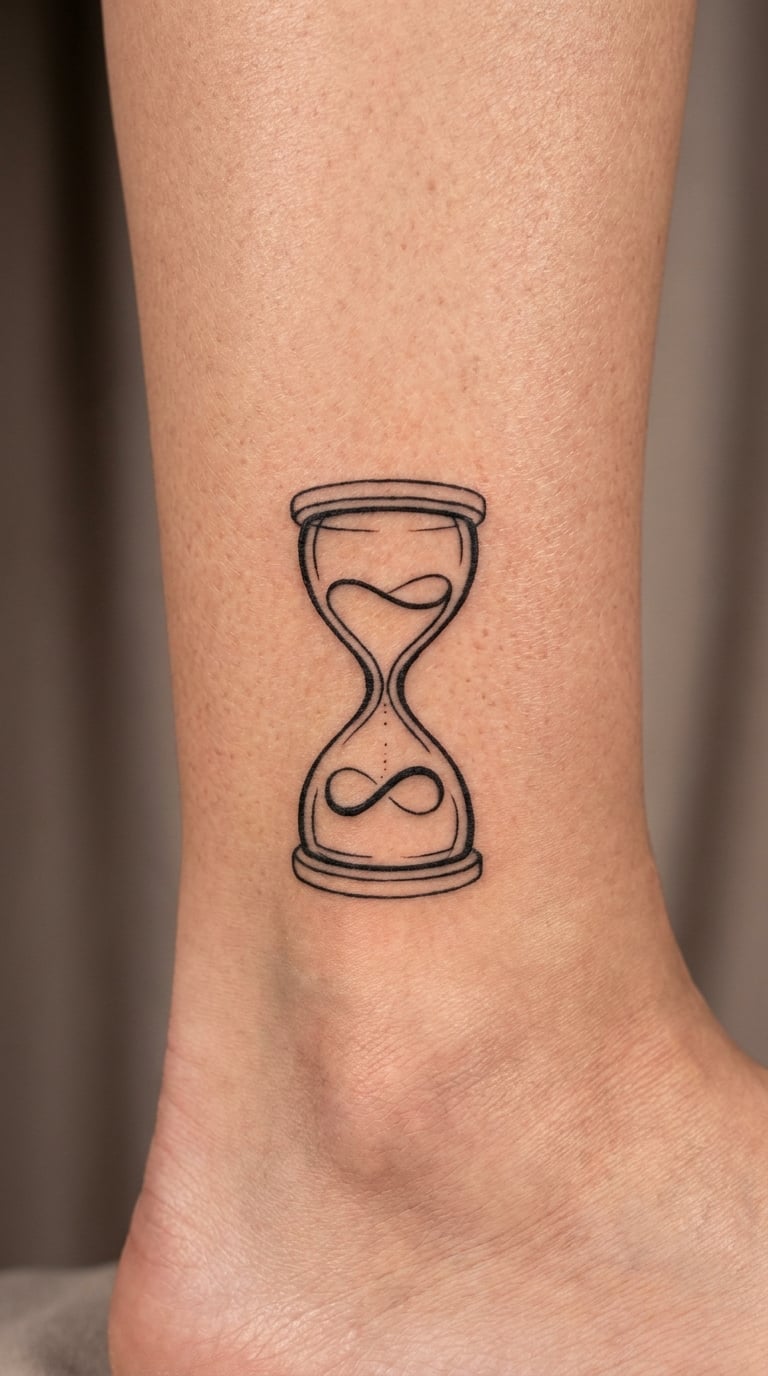
The sand stream in this design leaves the neck of the glass and follows a loose looping curve, reading as an infinity-inspired line before it reads as sand. The hourglass outline stays simple so the curve leads the eye. The looping stream is a personal statement, not a fixed traditional symbol.
Placement: ankle, inner wrist, or behind the ear. Size: 2 to 3 inches (5 to 7.5 cm) tall including the loop. Style: flowing line. Pain: medium, and the ankle is bony so the curve needs to be adjusted to the tendon. Ask for the loop to be refined in the design, since a sloppy curve is the one thing that ruins it. Make it yours: add a single colour accent to the stream, or repeat the loop on the other side.
19. Gothic Hourglass with Ornate Ends
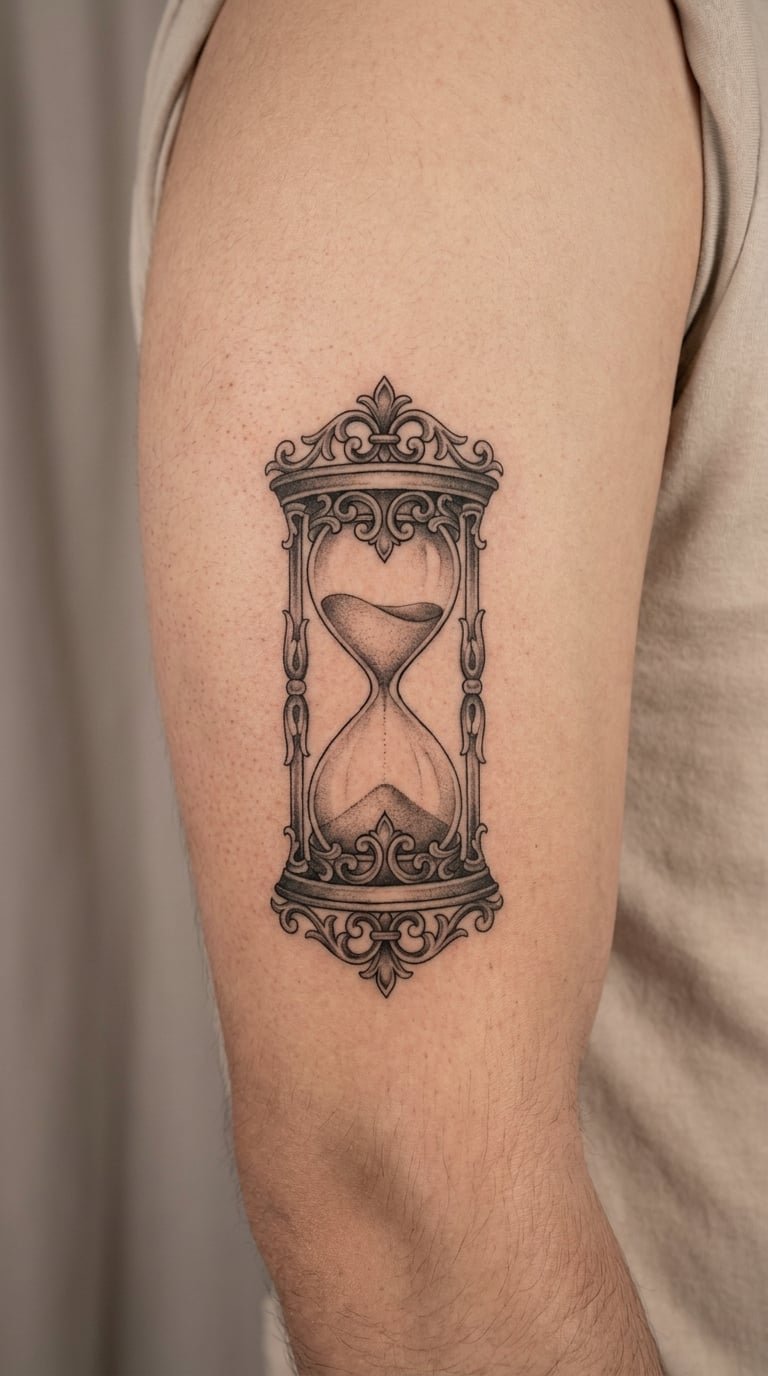
Black and grey throughout, with a slim hourglass capped by decorative filigree at the top and base, drawn in hairlines with soft grey shading behind. The detail is the point: a plain frame next to an ornate one on the same body is a classic look. There is no shared meaning attached to the filigree.
Placement: upper arm, back of the shoulder or the calf. Size: 3 to 4 inches (7.5 to 10 cm) tall so the ornament survives. Style: black and grey illustrative. Pain: medium, and the session will run long. Hairline ornament is the first thing to soften, so the caps need a slightly heavier line. Make it yours: choose the ornament style first, then let the artist build the frame around it.
20. Hourglass with Constellation Lines
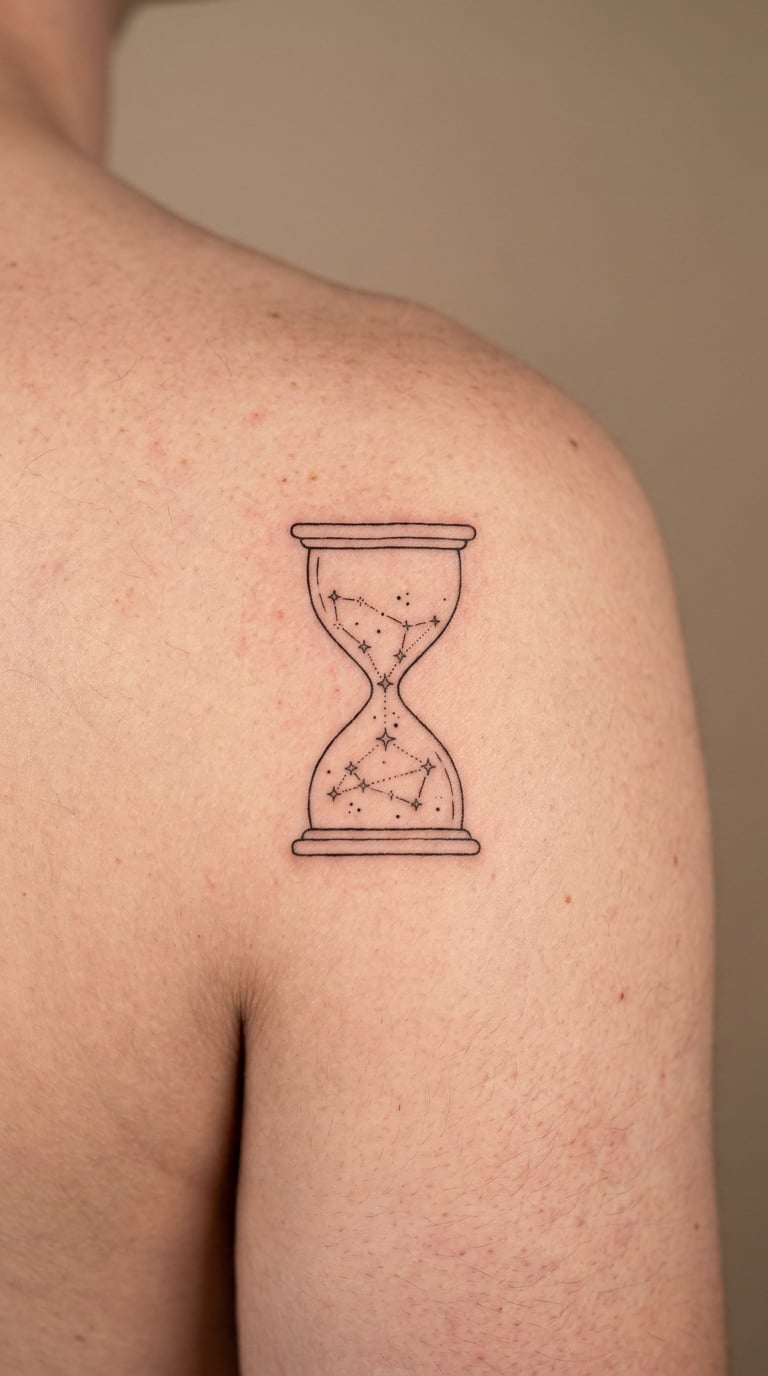
A thin hourglass outline with a sparse constellation placed around and slightly inside it, connected by hairlines between the brighter stars. A chosen constellation can hold real personal meaning, such as a sky view on a particular night. The connection lines are the fragile part.
Placement: shoulder, upper back, or the outer arm. Size: 2.5 to 3.5 inches (6 to 9 cm) wide. Style: fine line celestial. Pain: medium. Dots and hairlines both spread over time, so keep the connection lines at a workable weight from the start. Make it yours: use the constellation visible from the place or the night that matters, and mark the brightest star with a small solid dot.
21. Stained-Glass-Style Hourglass
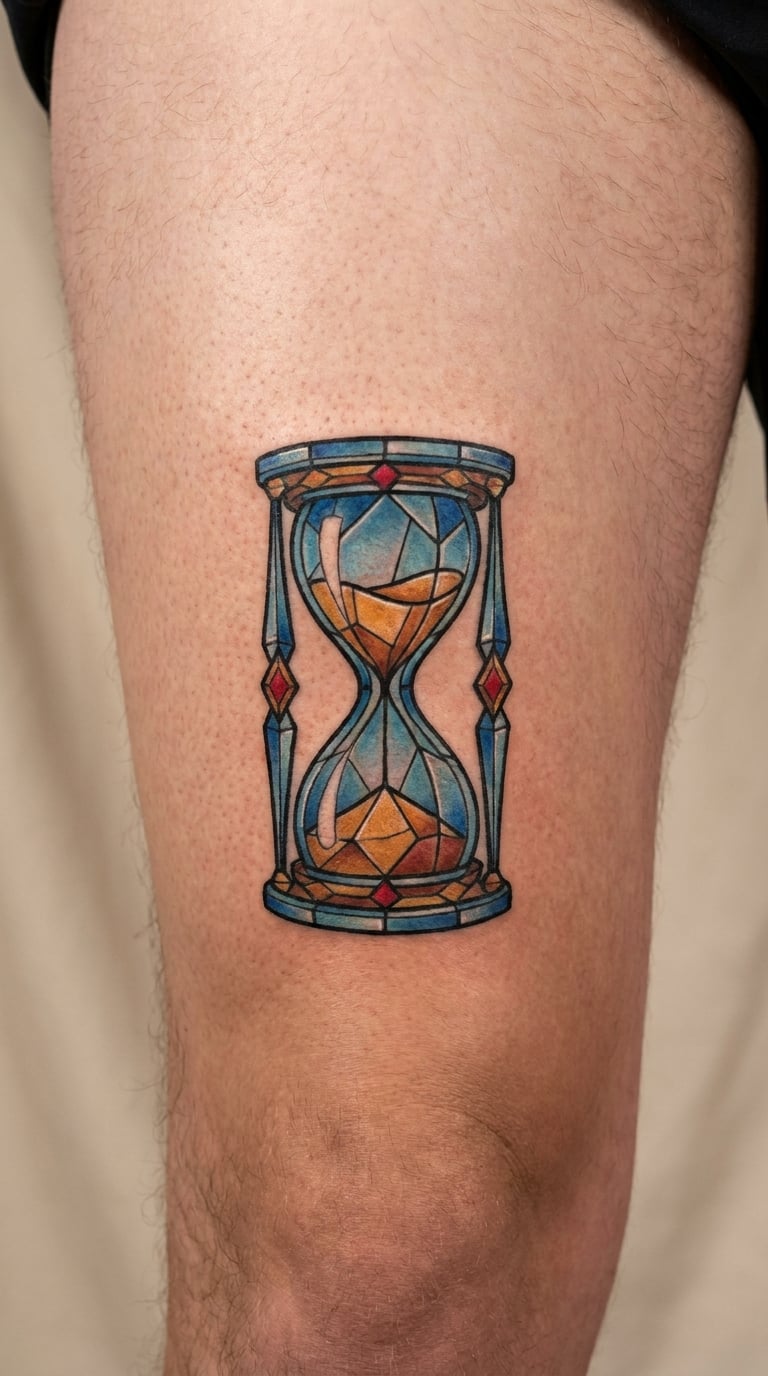
The hourglass is divided into bold sections by heavy black lead lines, each section filled with a flat jewel tone rather than a gradient. It looks like a window panel transplanted onto skin, and it holds colour far better than a soft wash because the fill is opaque. The palette choice is the personal part.
Placement: thigh, upper arm or the calf, where there is room for the grid. Size: 2.5 to 4 inches (6 to 10 cm) tall. Style: colour illustrative. Pain: medium, and the heavy lead lines make the outline more painful than usual. Bright pigments shift over the years, so expect some softening. Make it yours: build the palette from a birthstone colour, a team, or three colours you already wear.
22. Hourglass with a Hand in the Sand
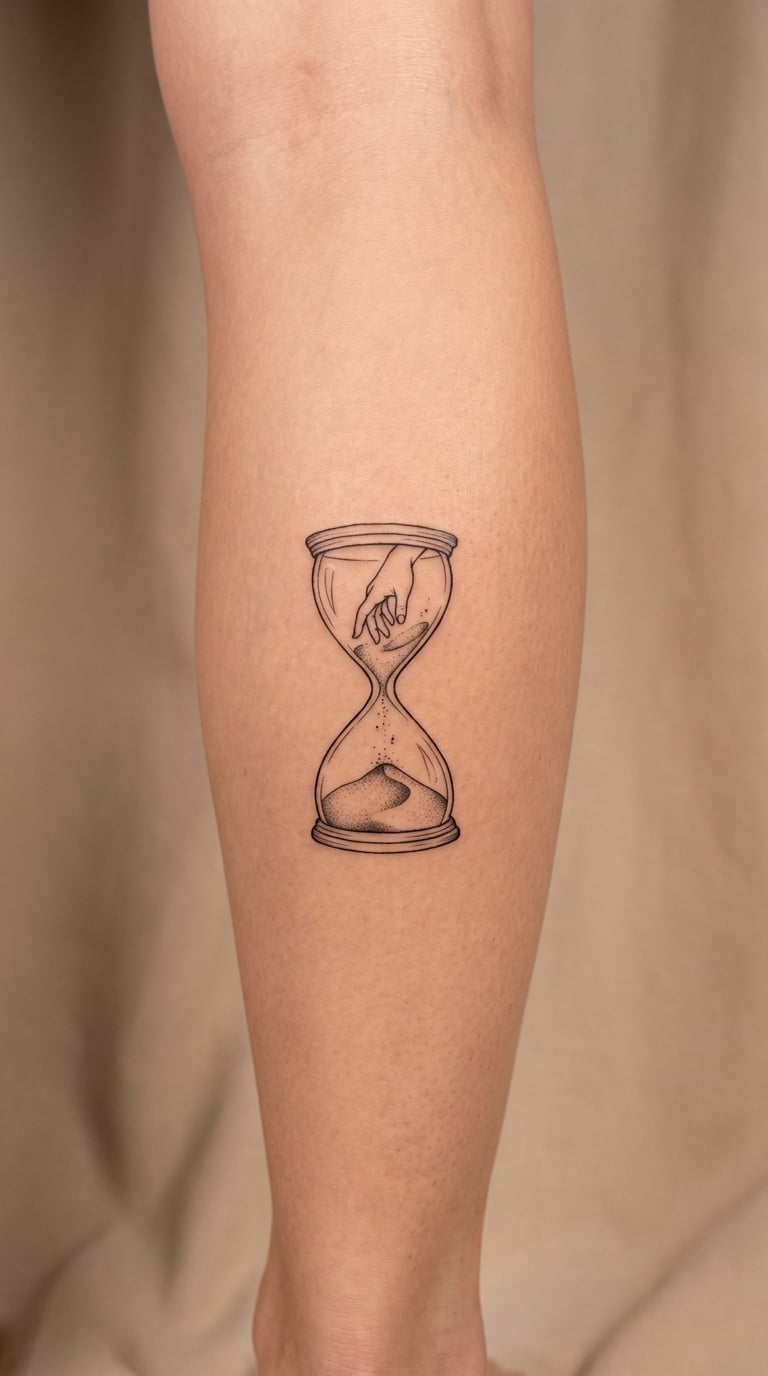
A small open hand reaches up into the falling sand inside the lower bulb, drawn in thin black line with the fingers slightly curled. It is an unusual image, and the meaning belongs to the person getting it. Some wearers read it as an attempt to hold on to something, others simply like the strangeness of it.
Placement: calf, outer arm, or the flat of the thigh. Size: 2.5 to 3.5 inches (6 to 9 cm) tall so the hand has room. Style: surreal fine line. Pain: medium. The hand is the smallest element in the design, and at anything under 2.5 inches the fingers merge together. Make it yours: turn the hand to reach downward instead, or fill the sand with one colour and leave the hand in black.
23. Hourglass with a Crescent Moon Frame
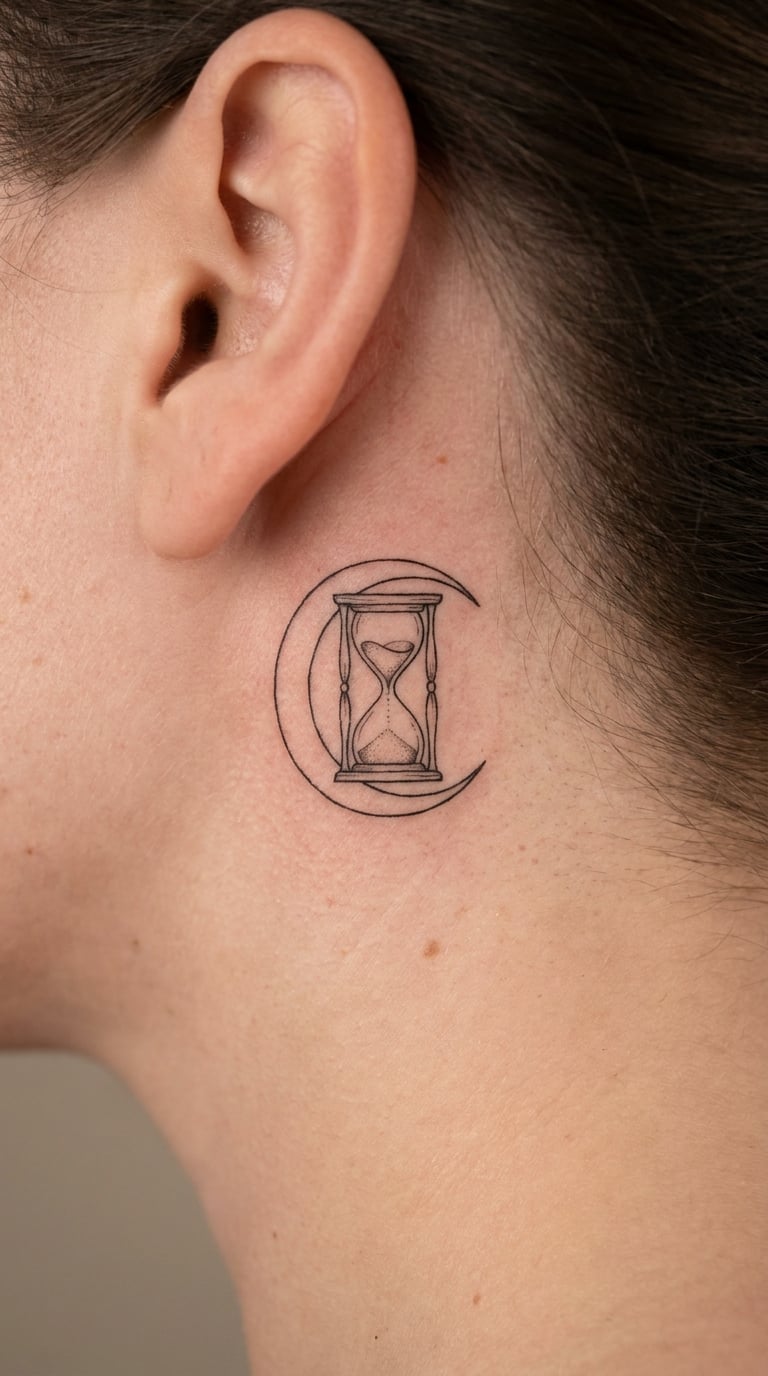
The hourglass sits inside the open curve of a crescent, nested in the hollow with clear space around both shapes. The moon and the hourglass have shared company in tattooing for a long time, and the pairing reads as cycles and passing time. The balance between the two shapes is what makes it work.
Placement: behind the ear, on the inner arm, or at the ankle. Size: 1.5 to 2.5 inches (4 to 6 cm) tall. Style: fine line celestial. Pain: medium, and the skin behind the ear is thin and sensitive. Both lines are hairlines, so they will need a touch-up sooner than a bolder design. Make it yours: add two or three small stars along the crescent, or fill the hourglass with a birthstone colour.
24. Blackwork Hourglass with a Handwritten Word
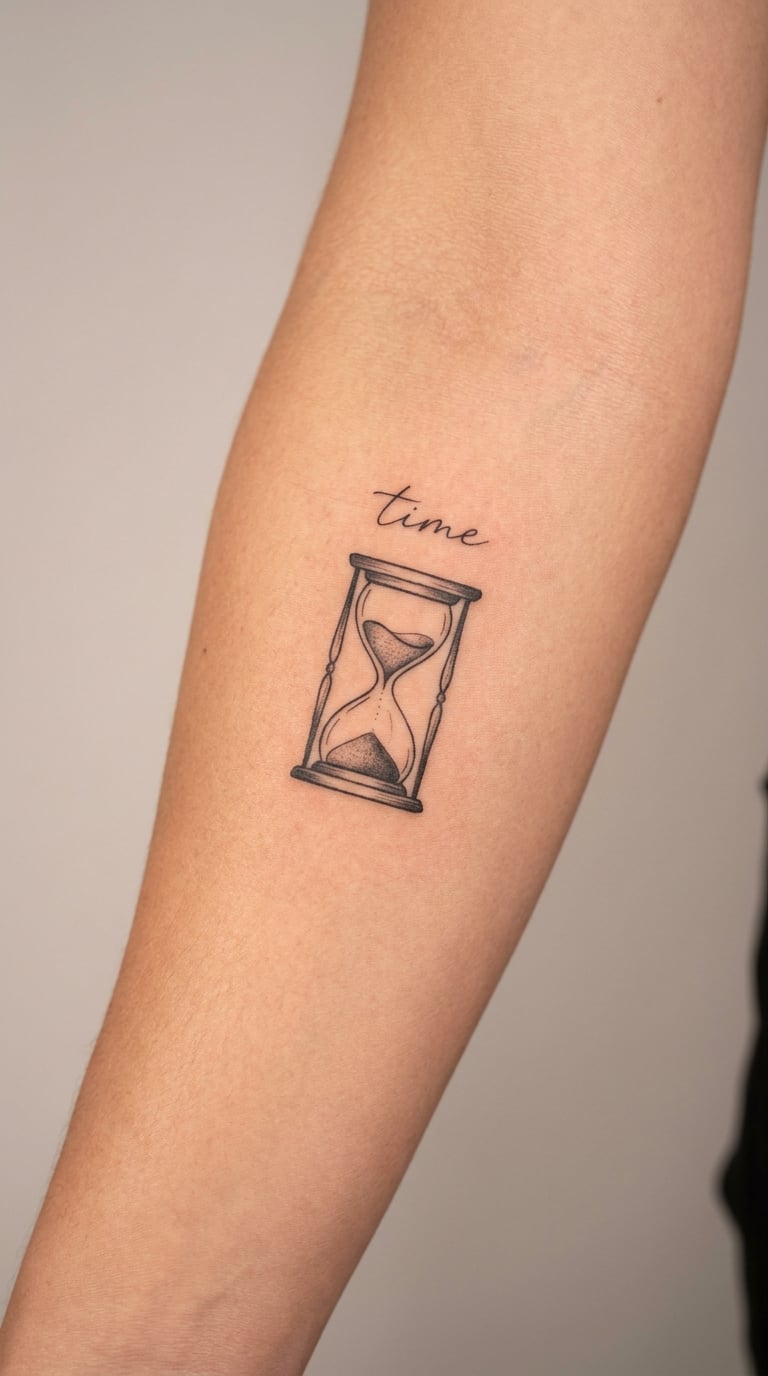
A solid or heavy-outlined hourglass sits beside one short word written in flowing script, kept to a single line so the two elements stay balanced. The word carries the message and the hourglass carries the reminder. Script lettering is where most of the ageing shows up, so the word should be short and simple.
Placement: inner forearm, so both elements can be read in one line. Size: 3 inches (7.5 cm) wide and about 1.5 inches tall. Style: blackwork with fine script. Pain: medium, and the contrast between heavy black and fine line makes the session uneven. Letters lose clarity long before the hourglass outline fades, so a bolder script is the safer route. Make it yours: use a word you can still say out loud, or run the script under the hourglass as a single underline.
How to Choose the Right Design
Five things decide whether a design works, and if you get them in the right order you will save yourself a redesign later.
Visual style. Decide whether you want a bare outline, an illustrated piece or solid black before you pick a shape. The style sets both the size you need and the number of sessions, and it is much harder to change later.
Detail-to-size ratio. Count the elements you can actually see in the healed photo, not the drawing. Anything with a hand, a wave crest or a numeral inside it needs at least 2.5 inches in its smallest dimension to stay legible.
Body placement. The hourglass is a vertical shape, so it wants a panel that has a clear top-to-bottom axis: forearm, calf, upper arm or the flat of the thigh. Curved or bony areas like the ankle and behind the ear need the design to be adjusted to the surface.
Longevity priorities. If you want it crisp in fifteen years, weight beats detail. Solid blackwork, traditional line work and thick outlines hold their shape, while single-needle hairlines, dotwork and script soften first. If you know you will want touch-ups, a fine line piece is a reasonable choice.
Connection to the message. Write down what the hourglass is for you in one sentence, then check which of the 24 designs supports that sentence. A memorial piece, a milestone and a daily reminder all want different supporting symbols.
Shortlist two designs before you book a consultation
Pick two, not twenty-four, and bring both to the consultation. Artists work much faster when the direction is already narrowed down, and you will get a better answer about detail and placement than you would with a folder of everything. If you are still building a first set of pieces, our pick of tattoo ideas that symbolize growth covers the companion designs people most often pair with a first hourglass.
Cost and Session Time
Tattoo pricing in the US works from either an hourly rate or a flat price per piece, and an hourglass usually falls into the second category. Four factors move the number: the size, the amount of detail, the style, and the shop you walk into.
Tiny outline pieces, like idea 12 or idea 1, sit at the cheap end of every shop’s range and usually take fifteen to thirty minutes. Small and medium pieces between 2 and 3 inches, which covers most of this list, take about an hour to an hour and a half. Anything from 3.5 inches upward with colour, ornament or dotwork, such as idea 19, idea 21 or idea 5, is a two to four hour sitting or a split across two sessions.
Two practical points. Most shops have a minimum charge that a tiny piece still has to meet, so the cheapest hourglass is often barely cheaper than a small one. And hourly rates vary more between cities than between styles, so a portfolio matters more than a headline rate. Ask for the total price of the whole design before the first session, not a per-hour estimate, so a second sitting is not a surprise.
Aftercare Basics
Healing is mostly common sense, and the list below covers the basics. Your artist’s own aftercare instructions always come first, since they know exactly what they did to your skin.
- Follow your artist’s aftercare instructions. The film or ointment they specify, and the timing they give you, matter more than anything generic.
- Wash gently. Clean water, unscented soap, clean hands, and no scrubbing or loofah for the first couple of weeks.
- Pat dry, don’t rub. A soft towel pressed against the skin is gentler than a towel dragged across it.
- Protect the area. Loose clothing over the tattoo for a few days, and avoid anything that rubs or presses against it.
- Stay out of water and sun. No swimming, baths, hot tubs or saunas while the tattoo is fresh, and no direct sun on it for several weeks.
- Watch it without fuss. Mild redness, itching and flaking are normal early on. Anything spreading, hot or unusually painful is worth a call to your artist or a doctor.
Frequently Asked Questions
What does an hourglass tattoo usually mean?
An hourglass tattoo usually stands for the passage of time, and it is often linked to memento mori, the reminder that life is finite. The turning sand also gives it a second reading: time changes direction, so a finished top bulb can mean a new beginning or a second chance. Beyond that, the meaning is personal, which is why people often add roses, numerals or constellations to make it their own.
Where is the least painful place to get a small hourglass tattoo?
For a small hourglass, the outer upper arm, the bicep and the calf are usually the calmer spots, with a low to medium rating. The inner wrist and the inner forearm are sensitive but bearable, and fingers, ribs, the back of the hand and the ankle tend to be the most uncomfortable. If you are nervous, the outer upper arm also has the most forgiving surface for a first sitting.
Will a fine-line hourglass tattoo fade over time?
A fine-line hourglass softens faster than a bold or blackwork one, mostly because single-needle lines hold less ink. Hands, fingers and ankles wear through fastest since they are exposed to sun, water and friction, while forearm and thigh lines hold up better. Ask for slightly heavier line weight at the start, keep it out of direct sun, and expect one or two touch-ups if you choose hairlines.
How much does a small hourglass tattoo cost in the US?
A small hourglass is priced by size, detail and how the shop bills its work. Tiny outline pieces are the quickest job on the menu and usually take under half an hour, while a 3-inch piece with colour or shading needs a full sitting. Most shops apply a minimum charge, so the very smallest design is not always much cheaper, and rates differ more by city than by style.
Can an hourglass tattoo work with a matching design?
Yes, and pairing is straightforward because the hourglass is a simple symmetrical shape. Ideas 11, 18 and 24 all end in a line, curve or word, which makes them easy to echo on the other forearm or on a matching wrist. Matching works best when the second piece is simpler than the first, so the pair reads as related rather than identical.
Which Hourglass Idea Is Right for You?
If this is your first tattoo, start with idea 1, the single-line outline on the inner wrist, or idea 12, the tiny hourglass between two dots on a finger. Both are small, both finish quickly, and both leave room to add a second piece later without crowding the area.
If you already collect tattoos, the ones in this list with the most room to develop your style are idea 5, the watercolour hourglass, idea 6, the micro-realist version, and idea 8, the solid blackwork silhouette. Whichever you pick from these 24 hourglass tattoo ideas, decide the detail level and the placement first. Get those two right and the meaning and the personal additions follow easily.