
20 Sweet Pea Tattoo Ideas (October 2026): Best Floral Designs
A sweet pea tattoo is a floral design built around the butterfly-shaped bloom of Lathyrus odoratus — ruffled, winged petals on a climbing stem with curling tendrils. In Victorian floriography the flower stood for joy and good wishes, gratitude and fond goodbyes, which is why it turns up in farewell cards, wedding posies and April birthdays. These 20 sweet pea tattoo ideas cover the range from a single fine-line sprig behind the ear to a full pastel sleeve.
Sweet peas are a soft, romantic flower, but nothing about the ink has to be. Most of the designs below work on any skin tone and any body, and a few of them suit a first tattoo better than almost anything else in the floral category. Read the quick guide first, then jump to whichever idea caught you. If you are planning around a season or an event, most studios book three to five weeks out, so spring bookings often open in winter.
20 Sweet Pea Tattoo Ideas: Quick Guide
| Idea | Style | Best placement | Size | Pain |
|---|---|---|---|---|
| 1. Fine-line sprig | Fine line | Behind the ear | 1.5-2.5 in | Low to medium |
| 2. Watercolor bouquet | Watercolor | Inner forearm | 4-6 in | Medium |
| 3. Blackwork stem | Minimal blackwork | Inner wrist | 3-4 in | Medium |
| 4. Realistic lavender cluster | Realism | Outer shoulder | 4-5 in | Medium |
| 5. Collarbone boutonniere | Fine line botanical | Collarbone | 2.5-3.5 in | High |
| 6. Full-colour cluster | Traditional | Outer forearm | 4-5 in | Medium |
| 7. Dotwork vine | Dotwork | Outer ankle | 6-8 in wrap | High |
| 8. Botanical wreath | Blackwork | Outer upper arm | 4-5 in | Low |
| 9. Pastel sleeve | Pastel realism | Upper arm | Full sleeve | Medium |
| 10. Micro-realism bloom | Micro-realism | Rib | 1.5-2 in | High |
| 11. Single-line wrist piece | Line art | Inner wrist | 2-3 in | Medium |
| 12. Vertical lavender spray | Muted realism | Back of the arm | 5-7 in | Low |
| 13. Red ink outline | Minimal line | Back of the hand | 2-3 in | High |
| 14. Black-and-grey branch | Black and grey | Outer calf | 5-7 in | Medium |
| 15. Half-moon geometric | Geometric | Outer elbow | 3-4 in | Medium |
| 16. Pastel rainbow pair | Pastel + fine line | Upper chest | 2-3 in each | Medium |
| 17. Initial stem | Minimal fine line | Behind the ear | 1.5-2 in | Low to medium |
| 18. Stippled bouquet | Stippling | Outer thigh | 5-7 in | Low |
| 19. Monochrome half-sleeve | Blackwork + grey | Forearm | Half sleeve | Medium |
| 20. Embroidered patch | Illustrative / satin | Outer bicep | 4-5 in | Low |
1. Fine-Line Sweet Pea Sprig Behind the Ear
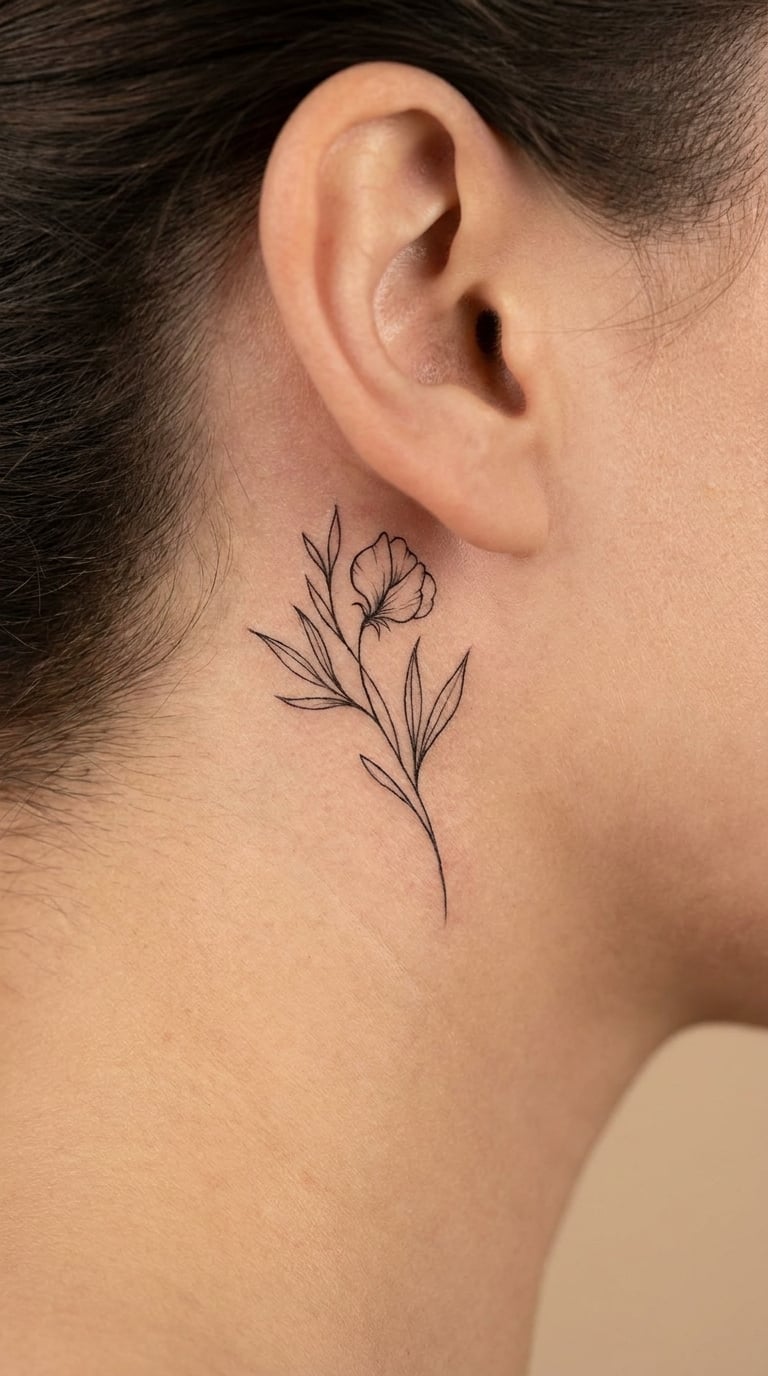
This is the sweet pea tattoo most people picture first: one thin stem, one open bloom, two small leaves, drawn in a single needle weight so the whole thing reads as a whisper. The line tapers as it travels, which keeps it from looking like a diagram. Behind the ear, only the top of the flower shows above the lobe when your hair is down.
It carries the goodbye and gratitude side of the flower, and it doubles as an April birth-flower marker if that fits your story.
Placement: Behind the ear, or trailing down the neck from behind the lobe · Size: 1.5 to 2.5 inches (4 to 6 cm) tall · Style: Fine line, single-needle black
Pain: Low to medium. The skin is thin and the nerve endings are close, so it stings more than it aches, and the neck near the jaw feels more than the ear itself.
Make it yours: Tuck a small birth year into the leaf, or add a second bloom on a longer stem that curves toward the jaw.
2. Watercolor Sweet Pea Bouquet on the Forearm
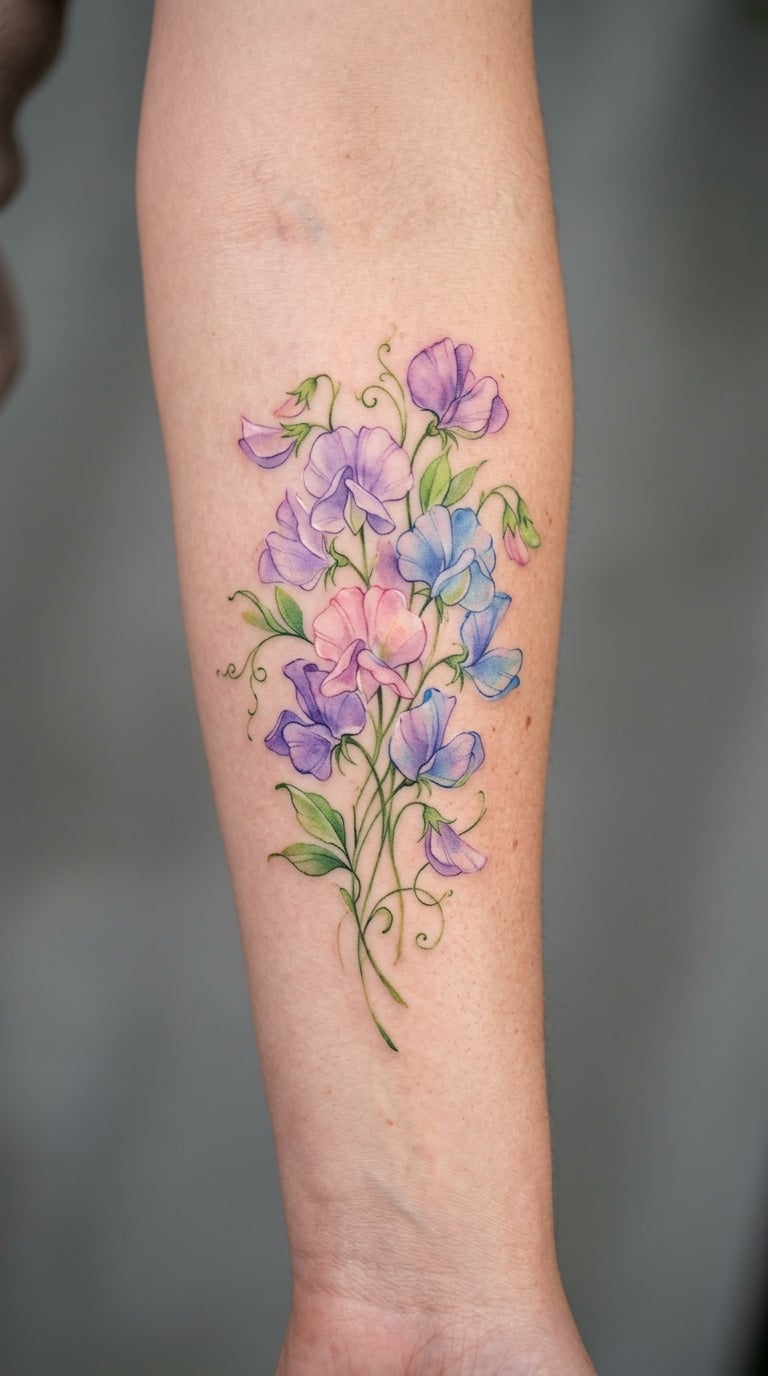
Watercolor suits a sweet pea better than almost any other flower, because the bloom already looks painted. Your artist lays translucent washes that pool at the petal edges and leave the skin showing through, so the colour sits light on top of the arm instead of under it. Some bloom edges are drawn crisply, others dissolve.
People pick this one for the movement in it. A cluster reads as a small celebration rather than a single specimen.
Placement: Inner forearm for a readable, upward-facing piece, or outer forearm if you want it visible in short sleeves · Size: 4 to 6 inches (10 to 15 cm) · Style: Watercolour, loose botanical
Pain: Medium. The inner forearm is fleshy but sensitive, and colour work takes longer, so the session stretches out.
Ageing note: Pale pinks and lilacs fade faster than deep roses. Ask for a slightly deeper mix in the first pass and touch-ups are cheaper than a redo.
Make it yours: Add one flower in a colour that means something to you, or a handwritten name hidden under the wash.
3. Minimal Blackwork Sweet Pea Stem
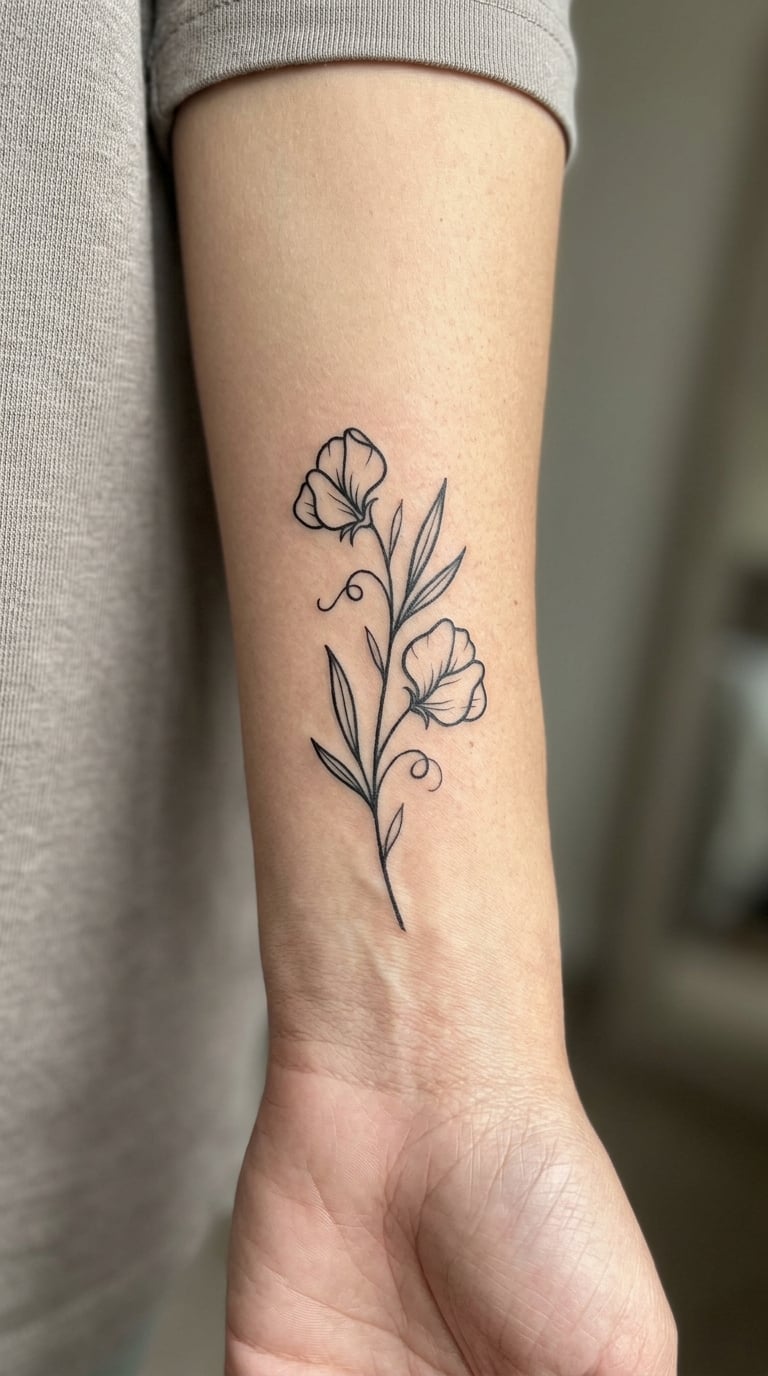
Blackwork is the opposite of soft, and that is the point. Each petal becomes a solid shape, the stem a clean bar, the leaves cut from solid black. Nothing is shaded and nothing fades gracefully, so the design survives on contrast alone rather than on fine detail.
It suits anyone who likes florals but does not want something that reads as delicate. The same bloom that looks fragile in a realistic style looks graphic and a little severe here.
Placement: Inner wrist, forearm, or along the outer bicep · Size: 3 to 4 inches (8 to 10 cm) long · Style: Minimal blackwork
Pain: Medium. Solid black fills take repeated passes, so it is a scratchy, sustained feeling rather than a sharp one.
Make it yours: Mark an April birth with the flower alone, or run the stem through a date in a matching hand.
4. Realistic Lavender Sweet Pea on the Shoulder
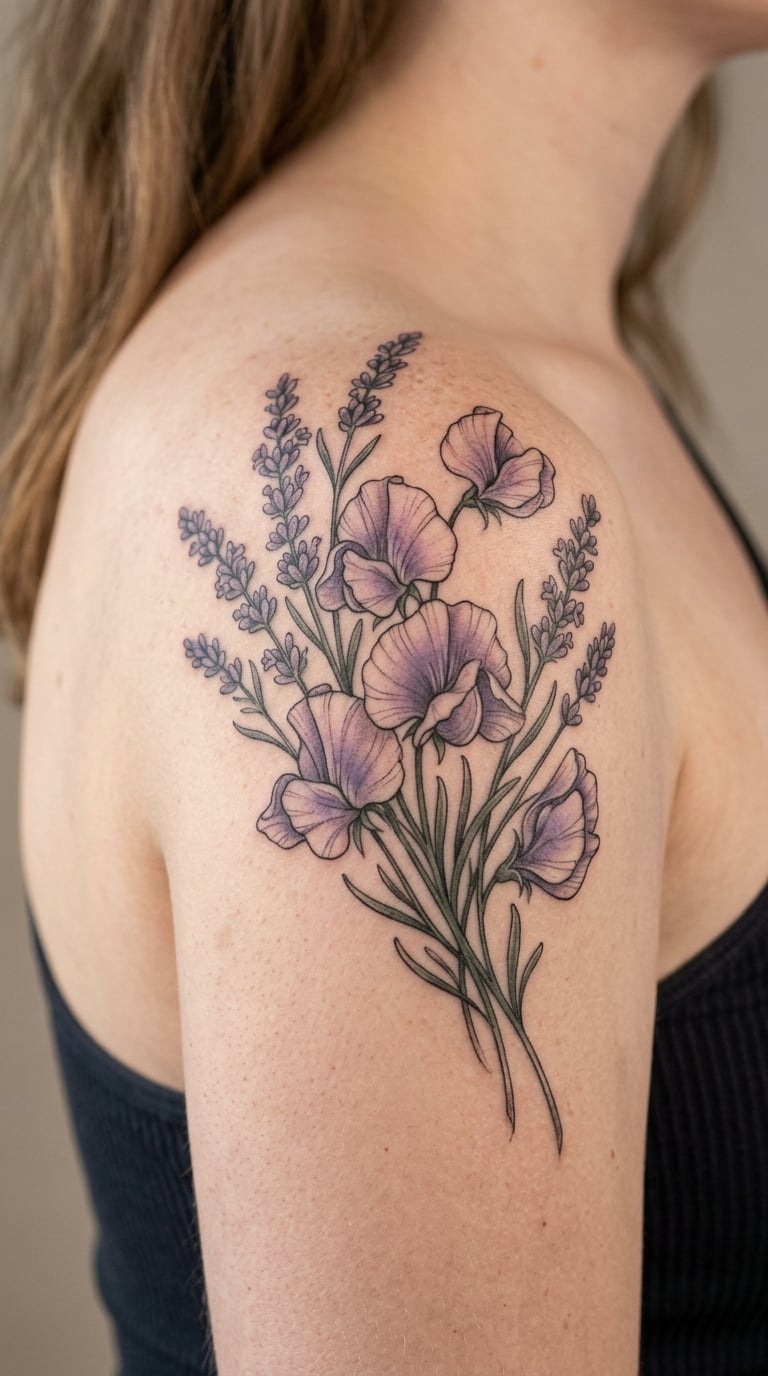
This version gets botanical: overlapping petals with visible veining, a papilionaceous wing petal curving over the banner, a stem with a tendril still curled at the tip. Shading is built from small grey and violet patches rather than smooth gradients, which is what gives it depth at close range.
The shoulder is where a realistic cluster stops looking like clip art, because the ink follows the curve of the muscle instead of fighting it.
Placement: Outer shoulder, upper chest, or back of the shoulder · Size: 4 to 5 inches (10 to 13 cm) across · Style: Colour realism, soft shading
Pain: Medium. The shoulder has thick muscle over bone, so it is a pushing, achy feeling that fades quickly once you relax.
Ageing note: Fine tonal work softens with age, especially in high-friction zones like the shoulder seam and the collarbone. A refresher every few years keeps the shading crisp.
Make it yours: Combine two or three blooms at different stages, from tight bud to full open, to show the whole life of the plant.
5. Small Sweet Pea Boutonniere on the Collarbone
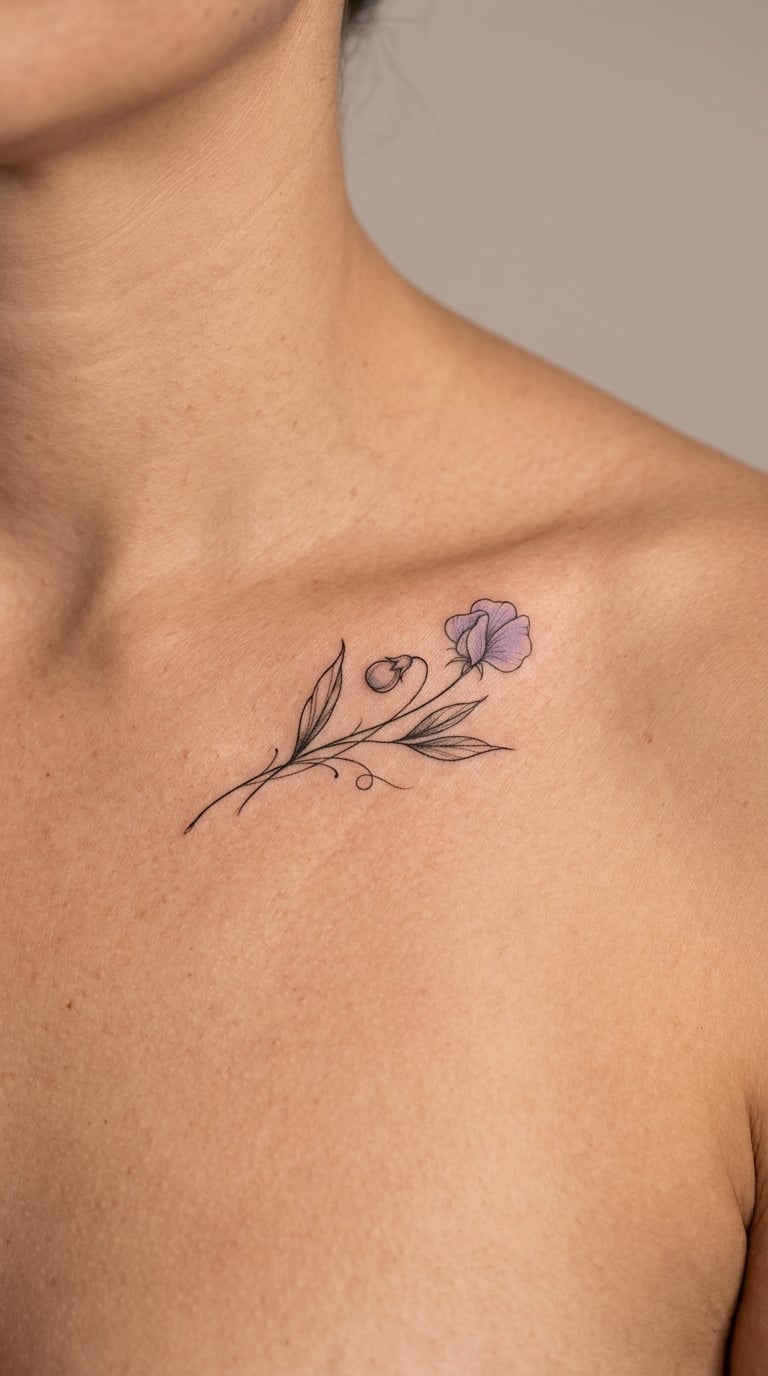
A boutonniere layout is just one main flower, one bud and a couple of leaves, arranged along a diagonal or a gentle horizontal line. Kept small and drawn in clean botanical line, it looks like something pinned on for a wedding that has not happened yet. That is not an accident — sweet pea posies were standard wedding flowers for decades.
Collarbone placement makes a small piece look deliberate rather than undersized.
Placement: Along the collarbone, on the sternum, or at the base of the throat · Size: 2.5 to 3.5 inches (6 to 9 cm) · Style: Fine line botanical
Pain: High. Bone sits directly under the skin here and the collarbone is one of the most commonly named sensitive spots, alongside ribs and the inner arm.
Make it yours: Tint the single main bloom in one soft colour so the piece has a point of interest, or match it to a bridesmaid’s design.
6. Traditional Sweet Pea Cluster in Full Colour
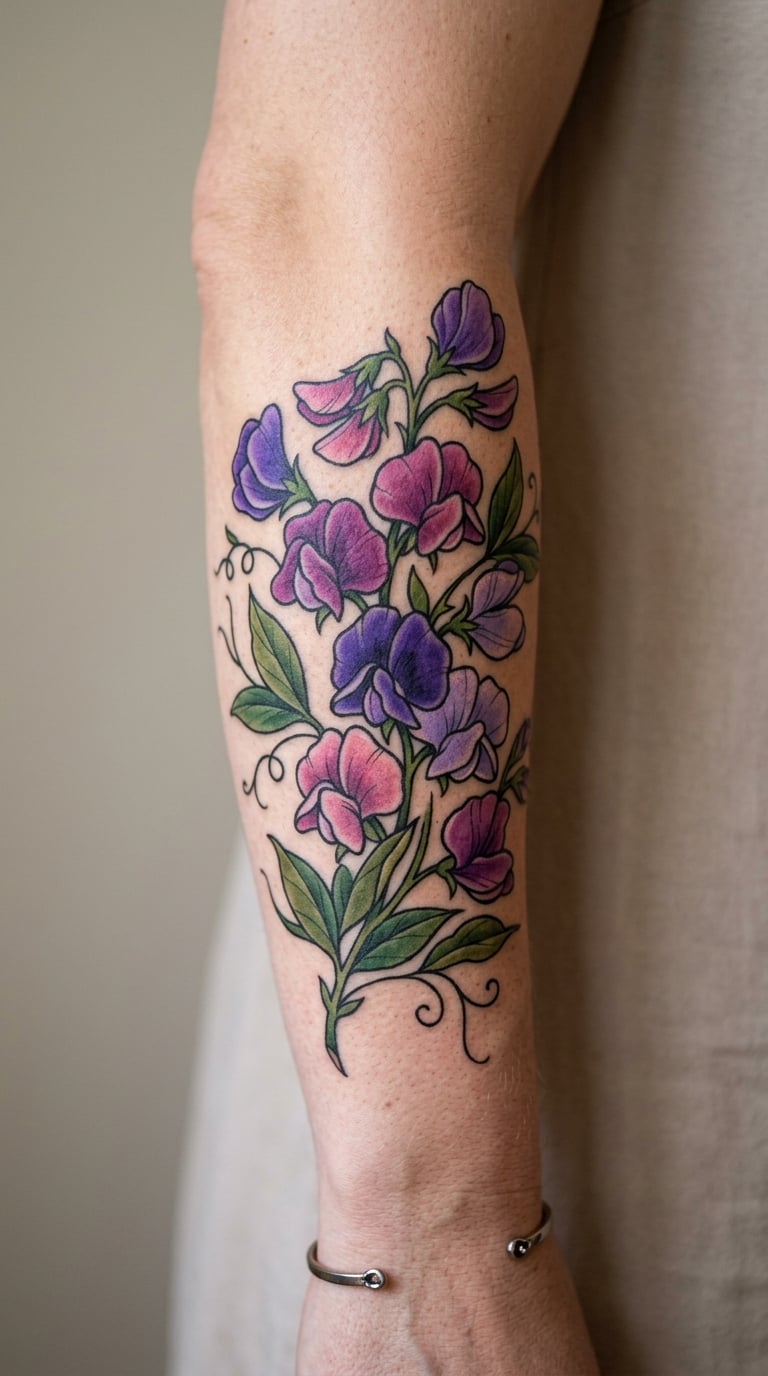
Traditional botanical work means bold dark outlines, saturated colour, dimensional petals and leaves built from flat blocks of green. The flower becomes decorative rather than accurate: petals get a highlight line, the stem gets a highlight, and everything reads clearly from across a room.
Pick this when you want colour that holds its shape. Saturated pigment in a bold outline ages better than pale washes in thin lines.
Placement: Outer forearm, upper arm, calf or back of the calf · Size: 4 to 5 inches (10 to 13 cm) across · Style: Traditional / neo-traditional
Pain: Medium to high. Colour packing is the long, repetitive part, and the forearm is a moderate area that gets uncomfortable near the end of a session.
Make it yours: Add a second flower in a contrasting hue, or drop a ribbon or banner beneath the cluster for an old-school look.
7. Dotwork Sweet Pea Vine Wrapping the Ankle
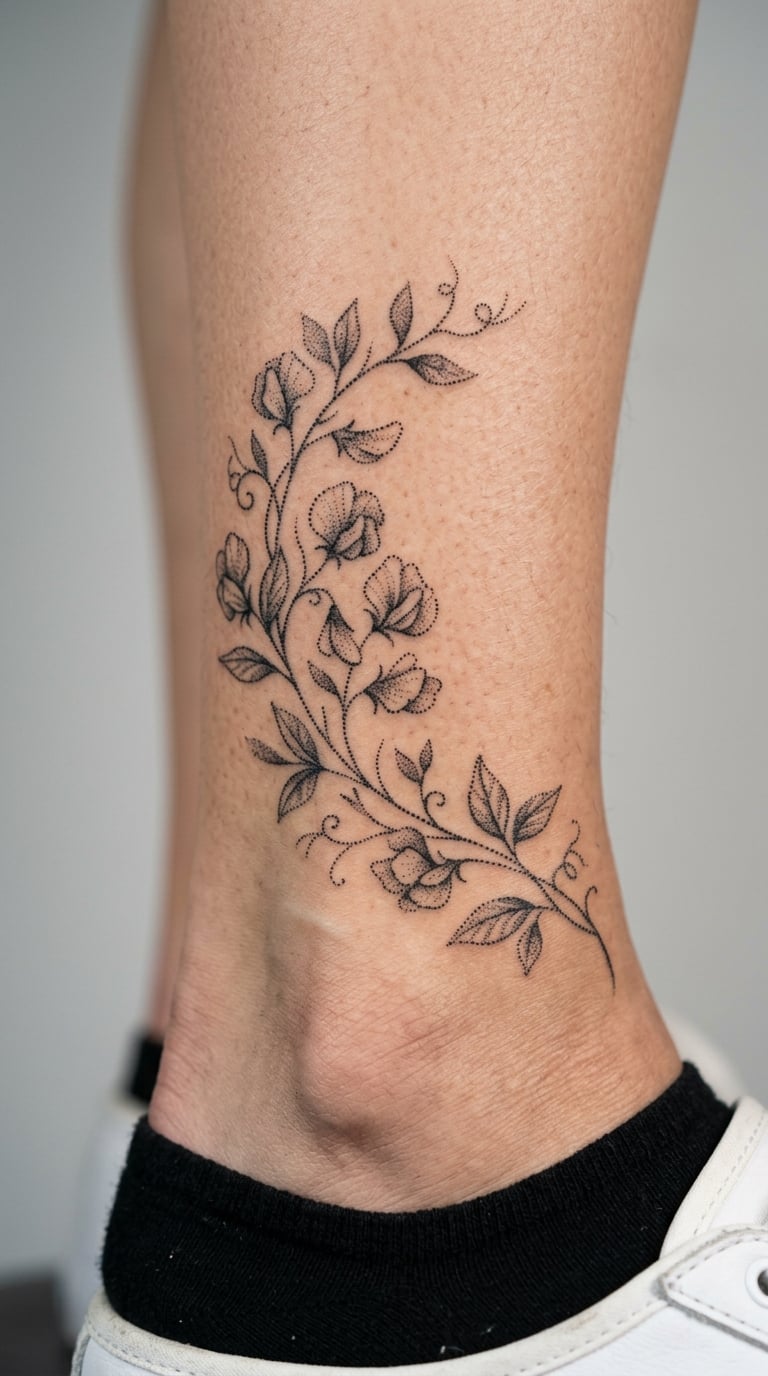
The vine curves around the ankle bone and climbs, with blooms built from rings of dots rather than outlines. Dot size and spacing do all the work here: evenly spaced medium dots keep the texture readable, and any tight clustering tends to fill in over the first couple of years.
It reads like ornament, and it uses the ankle’s shape instead of covering it.
Placement: Outer or inner ankle, wrapping 6 to 8 inches (15 to 20 cm) around the leg · Style: Dotwork, black ink
Pain: High. The ankle is bony and the wrap means the needle works around a curve in a sensitive area.
Ageing note: Dots spread and soften as skin ages, so ask for slightly larger dots and steady spacing rather than a dense field.
Make it yours: Tuck a tiny symbol into the negative space near the ankle bone, a small key, date or initial.
8. Sweet Pea Wreath on the Upper Arm
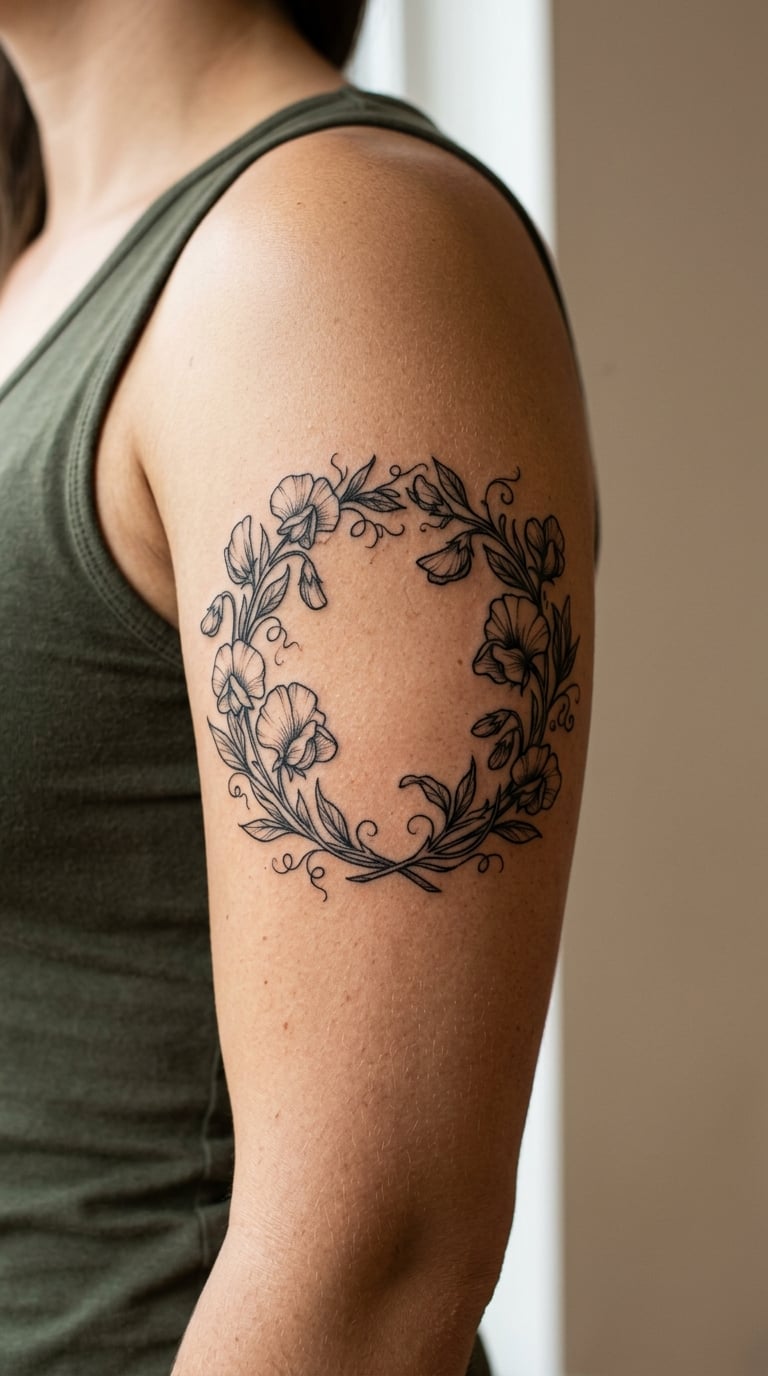
A wreath is several blooms arranged around an open circle, with leaves and tendrils filling the gaps. Keep the blooms at different stages — one wide open, one half open, two tight buds — and the circle stops looking mechanical. The open centre can hold a date, an initial, or nothing at all.
Round compositions sit well on the upper arm because the muscle already curves that way, so the wreath wraps instead of floating.
Placement: Outer upper arm, thigh, or mid-back · Size: 4 to 5 inches (10 to 13 cm) diameter · Style: Blackwork botanical
Pain: Low. The outer upper arm is one of the more forgiving spots, with plenty of flesh under the ink.
Make it yours: Put a date in the open centre in a small hand, or leave the middle empty for a lighter, more decorative read.
9. Pastel Sweet Pea Sleeve on the Upper Arm
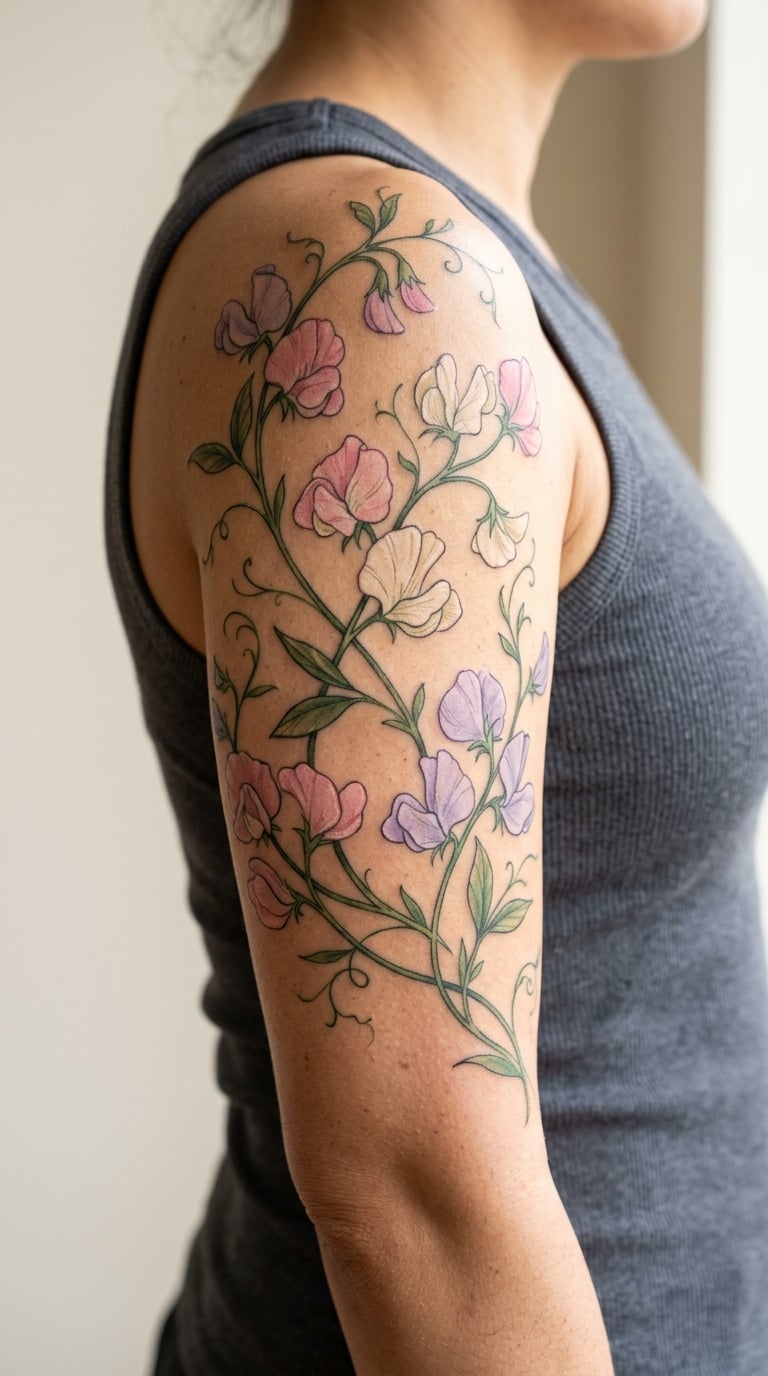
A pastel sleeve is a full botanical composition in soft colour: pink, cream, lavender and muted green, with winding stems that carry the eye around the arm. Blooms sit at different depths and sizes so the sleeve has a front and a back rather than repeating the same cluster all the way around.
Pastel is a commitment. It is the palette that shows wear fastest, and it needs a colourist who works in washes rather than filling.
Placement: Upper arm, from shoulder to elbow or to mid-bicep · Size: Full sleeve, roughly 14 to 18 inches (35 to 45 cm) of coverage · Style: Pastel realism
Pain: Medium overall, done across several sessions. Nothing about it is sharp, but a long session on a curved area gets tiring.
Session maths: Plan on multiple appointments. A sleeve in this density is rarely done in one sitting, and stopping at a natural break gives cleaner lines than pushing through.
Make it yours: Add oat stalks, lavender sprigs or small seed heads between the sweet peas so the sleeve has a second texture.
10. Micro-Realism Sweet Pea on the Rib
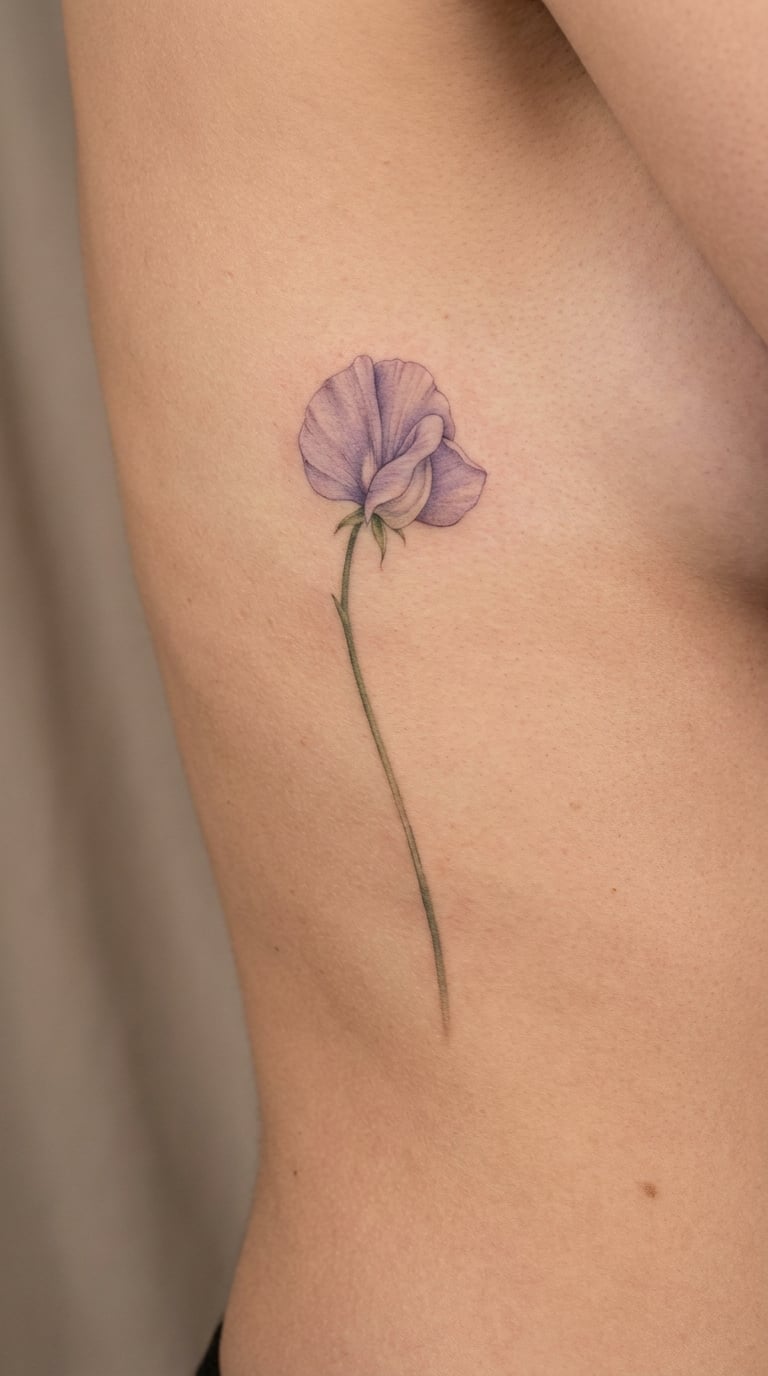
One bloom, painted rather than drawn: tonal shading, soft edges where purple turns to grey, a fine stem trailing down. At two inches or smaller it holds an amount of detail that would look busy at full size, and the rib area gives it a long vertical line to sit along.
Micro-realism is a style for someone who has had a tattoo before. It is a lot of tiny decisions packed into a small space.
Placement: Along the rib, on the inner forearm, or behind the ear · Size: 1.5 to 2 inches (4 to 5 cm) · Style: Micro-realism
Pain: High. Ribs are thin, movement is constant, and a detailed piece means slow work in exactly the wrong place. Take a break before the session, not during the difficult hour.
Make it yours: Have the stem curl toward the hip so the piece follows the body’s line, or add a single small leaf on the far end.
11. Sweet Pea Line Art on the Wrist
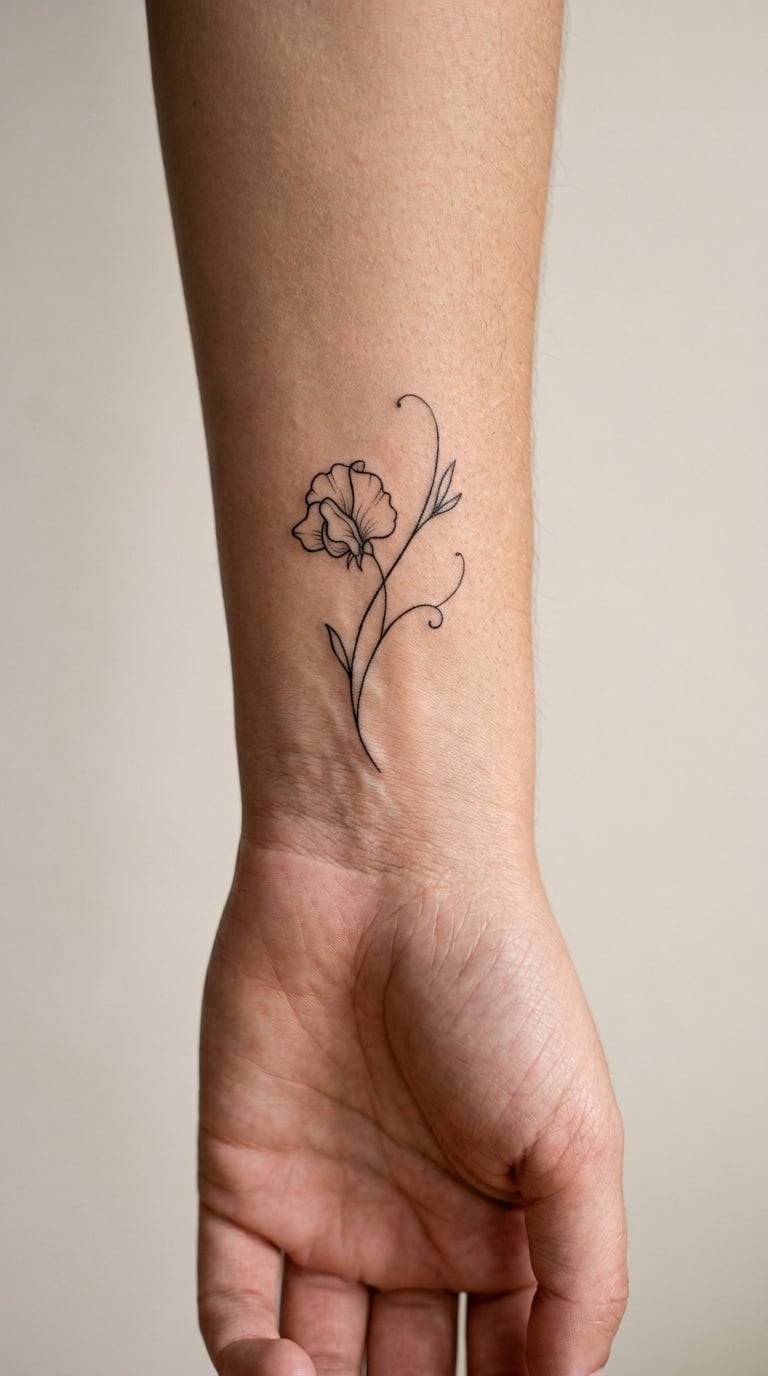
One continuous line. The stem curves out from under the bloom, the leaves branch off, and the whole thing closes without a break. Line art is the tidiest of the fine styles and the least likely to need a rescue session, because there is no shading to muddy.
It is a strong first tattoo. The piece is small, the session is short, and the shape is simple enough that a nervous first-timer can sit still for it.
Placement: Inner wrist, wrist crease offset slightly, or the inside of the forearm · Size: 2 to 3 inches (5 to 8 cm) · Style: Line art, fine line
Pain: Medium. Wrist skin is thin and the veins sit close, so expect a burning, restless feeling that comes and goes.
Make it yours: Curve the stem to follow the line of the wrist, or split it into a front-and-back pair so the flower appears to wrap when you turn your arm.
12. Lavender Sweet Pea Spray on the Back of the Arm
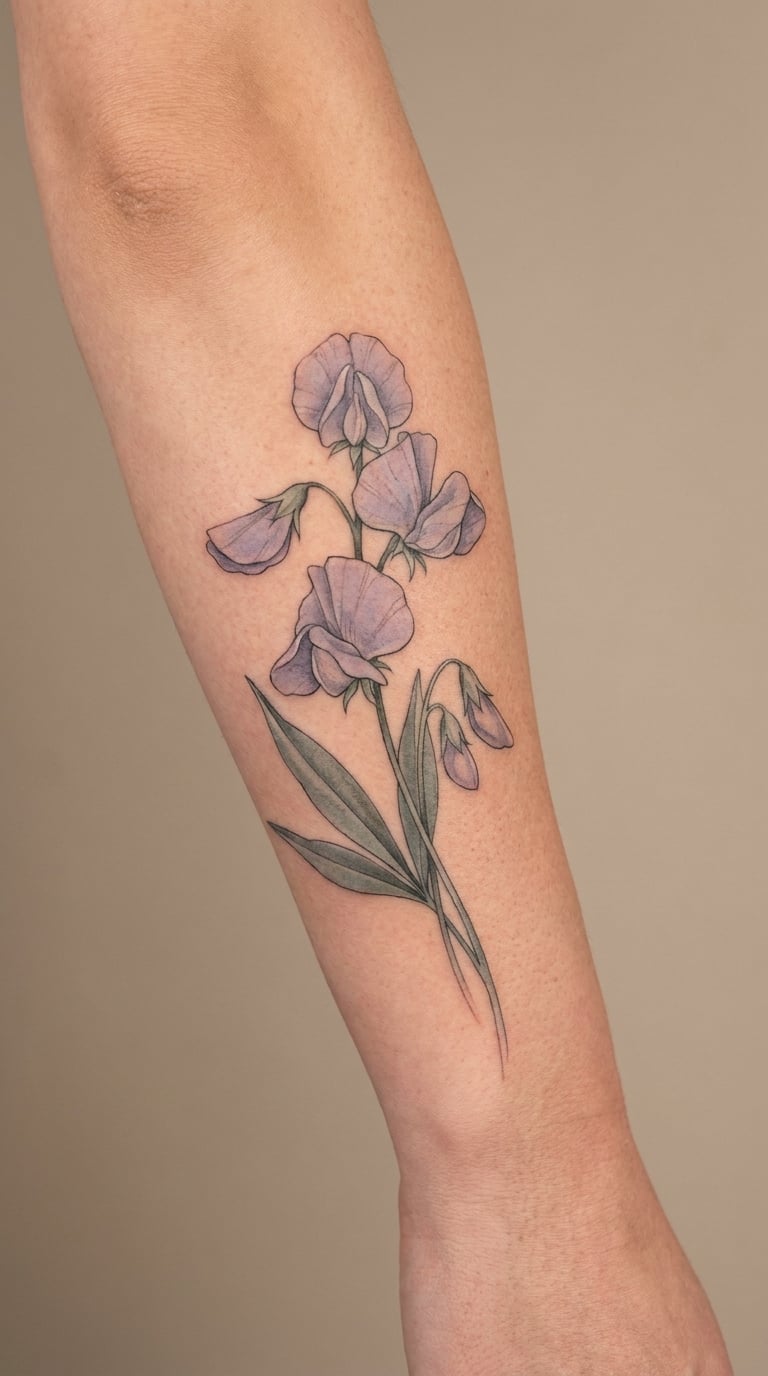
A spray is an elongated arrangement: three open flowers, a couple of buds, and long leaves running up the arm. Drawn in muted, realistic colour, it has a gathered-then-released look, as if the stems were held at the base and let go at the top.
The back of the arm is an easy hiding place, which makes the spray a good pick if you want something people only see when they are standing behind you.
Placement: Back of the upper arm, outer forearm, or the back of the hand at a larger size · Size: 5 to 7 inches (13 to 18 cm) · Style: Muted colour realism
Pain: Low. The upper arm’s outer and rear surfaces are meaty and easygoing, even for a piece this size.
Make it yours: Pair it with a small matching bloom on the wrist so the composition reads as one piece from two angles.
13. Red Ink Sweet Pea Outline on the Hand
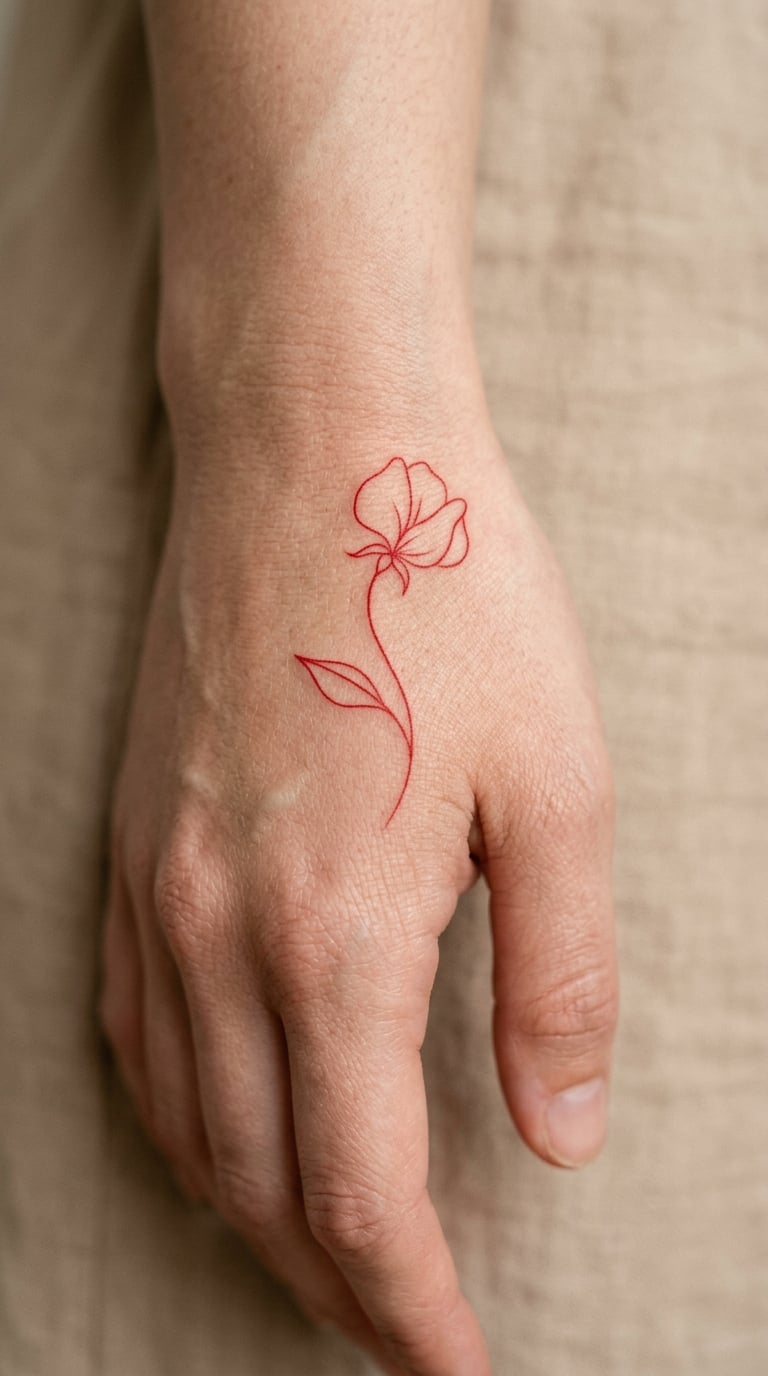
Red line work reads warm and graphic. A single bloom with a curved stem and one leaf, drawn in clean red without any black underlayer, is about as restrained as a floral gets. It suits a person who wants a flower tattoo and nothing else.
Hand placement is the least forgiving spot on the body. Skin there stretches, creases and gets washed dozens of times a day, and any thin line in red will soften faster than black.
Placement: Back of the hand, between the knuckles, or the inner wrist · Size: 2 to 3 inches (5 to 8 cm) · Style: Minimal red line
Pain: High. The back of the hand is bony with a dense nerve network, and knuckle areas are the sharpest part of it.
Ageing note: Fine red on hands fades noticeably within a few years. Choose this for a design you would be happy to refresh rather than one that has to last untouched.
Make it yours: Add a second smaller stem beside the first, or a thin black outline in the same places if you want more punch than pure red gives.
14. Black-and-Grey Sweet Pea Branch on the Calf
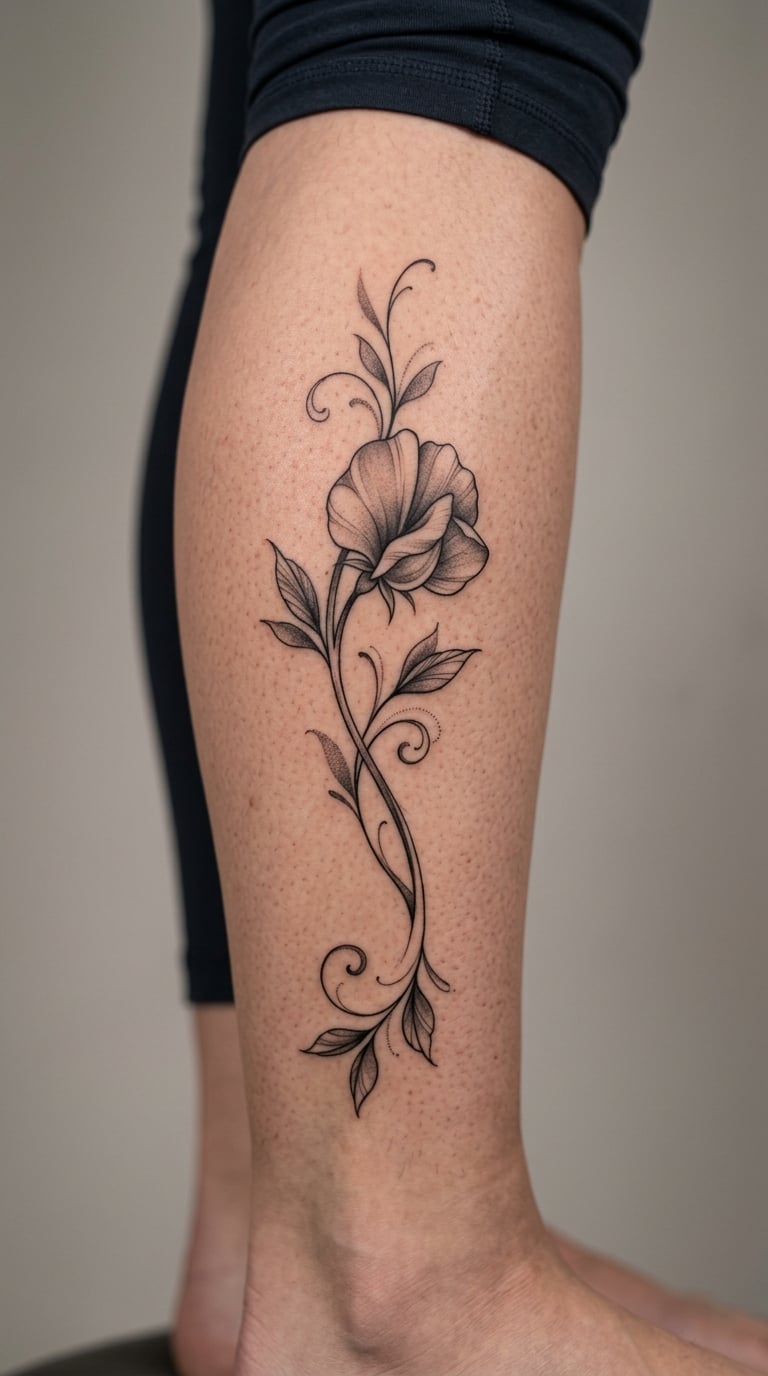
A single branch running vertically up the calf, with one bloom shaded in charcoal grey and a stem that curls once at the base. Monochrome botanical work lives or dies on tonal contrast, so the petals get a dark core fading to soft grey, and the leaves get a visible rib line.
Black and grey ages better than pale colour and costs less to touch up, which makes it a sensible middle ground between a fine line and a full colour piece.
Placement: Outer calf, inner calf, or the back of the lower leg · Size: 5 to 7 inches (13 to 18 cm) · Style: Black and grey realism
Pain: Medium. The calf has substantial muscle, but the shin-side edges are closer to bone and read more sharply.
Make it yours: Add a light wash of one colour behind the greys, or build a small wrap of leaves and buds around the main stem.
15. Geometric Sweet Pea Half-Moon on the Elbow
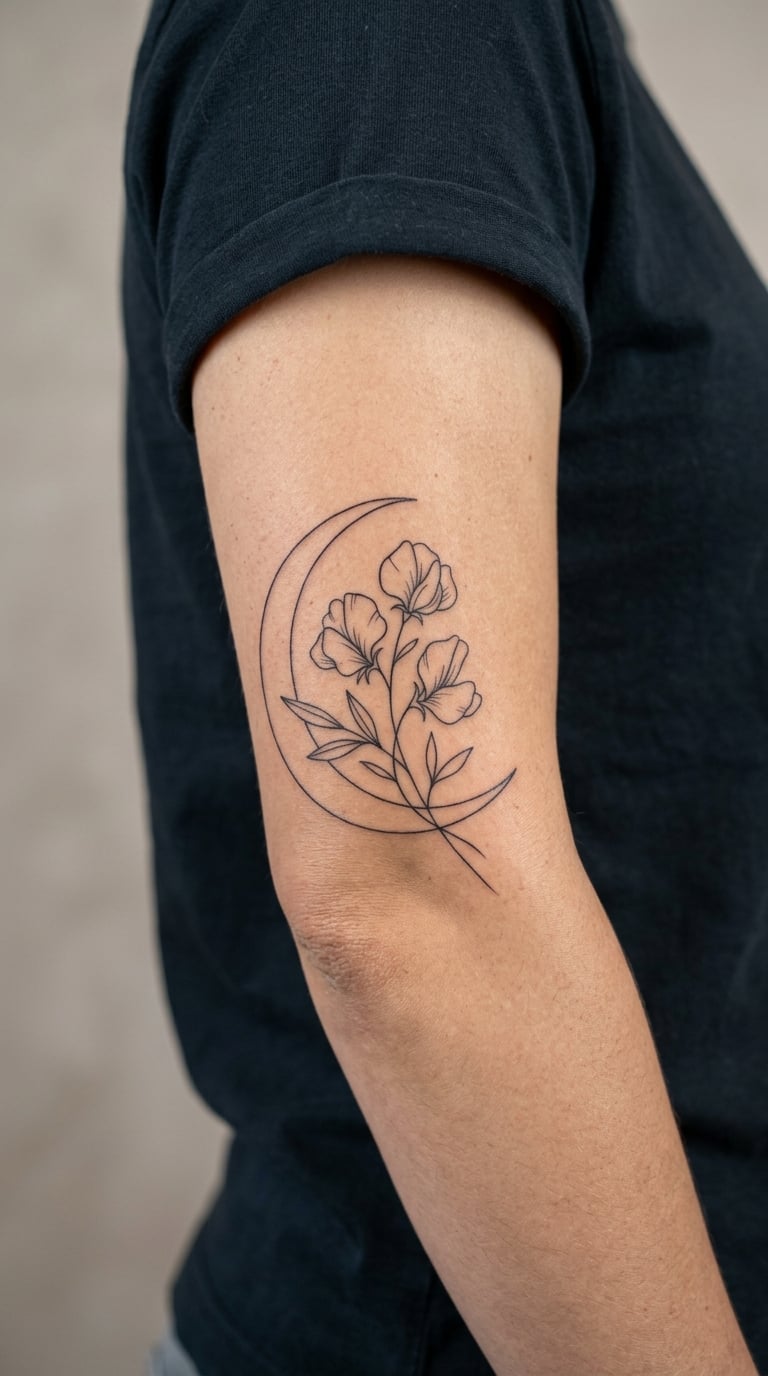
A half-moon frame curves around the elbow with simplified stems and three blooms contained inside it. The trick is contrast: the frame is a bold even line, the flowers inside are reduced to clean shapes, and the open space between them does the decorating.
The elbow is a curved surface that naturally interrupts a design, so framing it with a shape works. It also takes longer, because the artist is working around a joint that bends.
Placement: Outer elbow, inner elbow, or the crease above the joint · Size: 3 to 4 inches (8 to 10 cm) · Style: Geometric linework
Pain: Medium. The elbow itself is fleshy, though the crease and the inner side are tender and the skin pulls tight when the arm bends.
Make it yours: Put a birth date along the flat edge of the half-moon, or mirror the whole frame on the other elbow.
16. Pastel Rainbow Sweet Pea Pair on the Chest
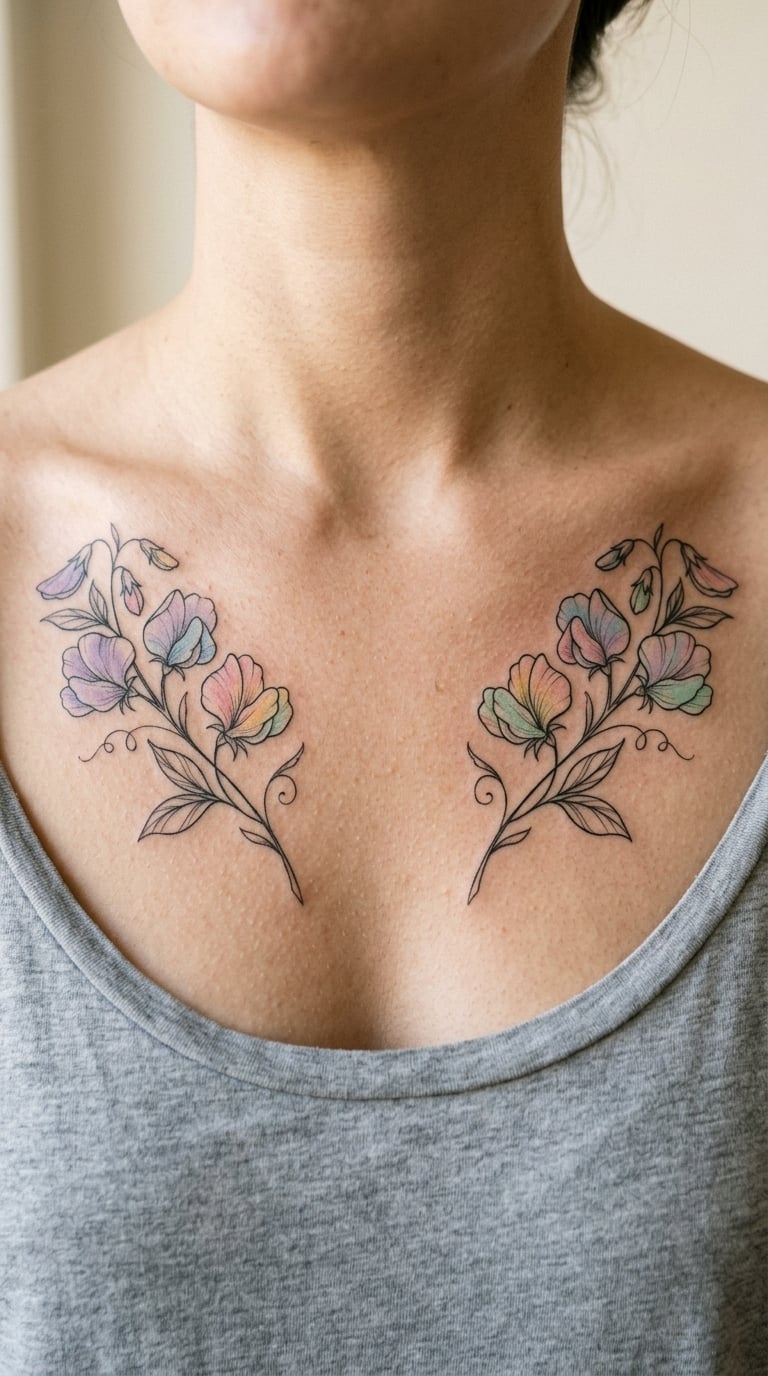
Two flowers, one over each side of the upper chest, drawn in matching black line with soft pastel colour. Symmetry is the whole design here: same bloom shape, same size, same colour family, placed at an equal distance from the sternum so the piece reads as a pair rather than two tattoos.
Chest and collarbone work for a paired design because the symmetry is already built into the body.
Placement: Upper chest, near the collarbones, or along the sternum · Size: 2 to 3 inches (5 to 8 cm) each · Style: Fine line with pastel colour
Pain: Medium to high. Upper chest skin is thin over bone, and the collarbone area is consistently rated as one of the more sensitive placements.
Make it yours: Give each flower a different accent colour from a rainbow of four or five tones, or add a small connecting element between them so the pair reads as one composition.
17. Minimal Sweet Pea Initial Behind the Ear
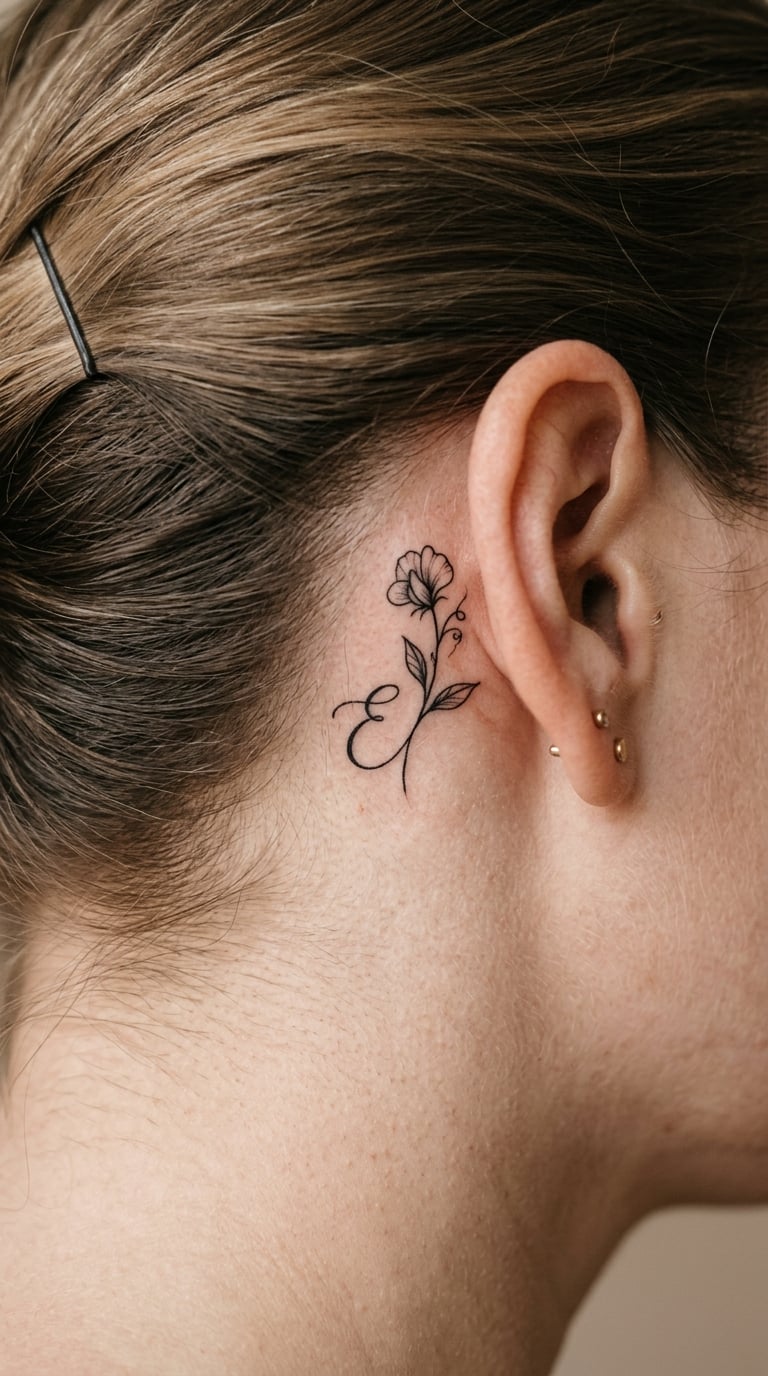
One initial, one stem, one bloom, and nothing else in the frame. The letter sits at the base of the stem as though it grew out of it, which turns a private piece of information into part of a drawing. Very little detail, very deliberate placement.
Behind the ear is where people put tattoos they want to mean something to them and nobody else.
Placement: Behind the ear, or just below the lobe at the start of the neck · Size: 1.5 to 2 inches (4 to 5 cm) tall · Style: Minimal fine line
Pain: Low to medium, similar to idea one. The area is small and the work is quick.
Make it yours: Pick an initial with straight, stable strokes. Curved, thin-script letters lose their shape fastest at this size.
18. Stippled Sweet Pea Bouquet on the Thigh
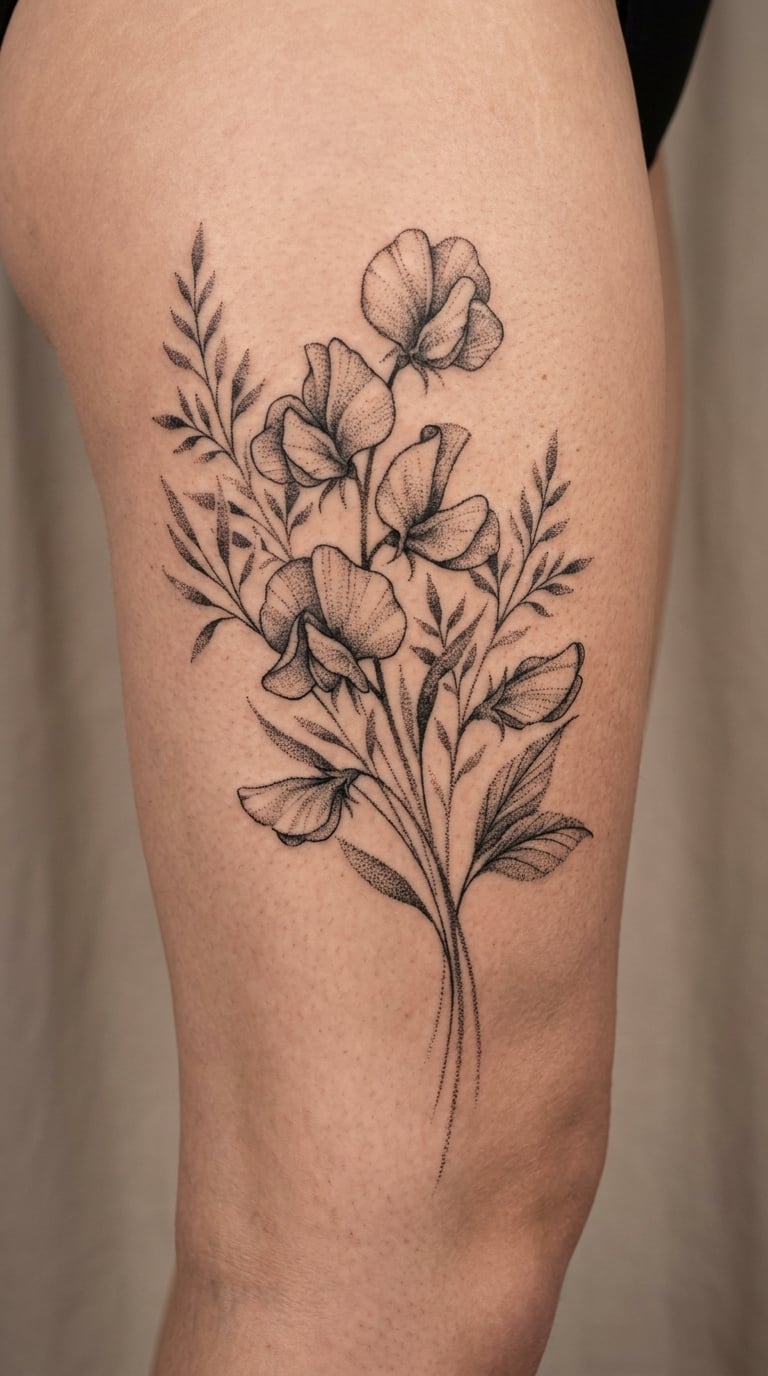
Stippling builds tone out of individual dots, so the petals shade gradually and the whole bouquet has a soft, grainy depth. It is more time-consuming than solid black and needs a steady hand, which is why it usually costs more per square inch. In return, it does not go flat and blocky as it ages.
The thigh has the space to do a bouquet properly, and outer-thigh skin is one of the more comfortable places to sit through a long session.
Placement: Outer thigh, hip, or the back of the thigh · Size: 5 to 7 inches (13 to 18 cm) · Style: Stippling, black and grey
Pain: Low to medium. Well-fleshed and mostly nerve-free, though the inner thigh is a different conversation and this placement is not it.
Make it yours: Fade the lower edge of the bouquet into scattered dots so the composition dissolves rather than ending in a hard line.
19. Monochrome Sweet Pea Half-Sleeve on the Forearm
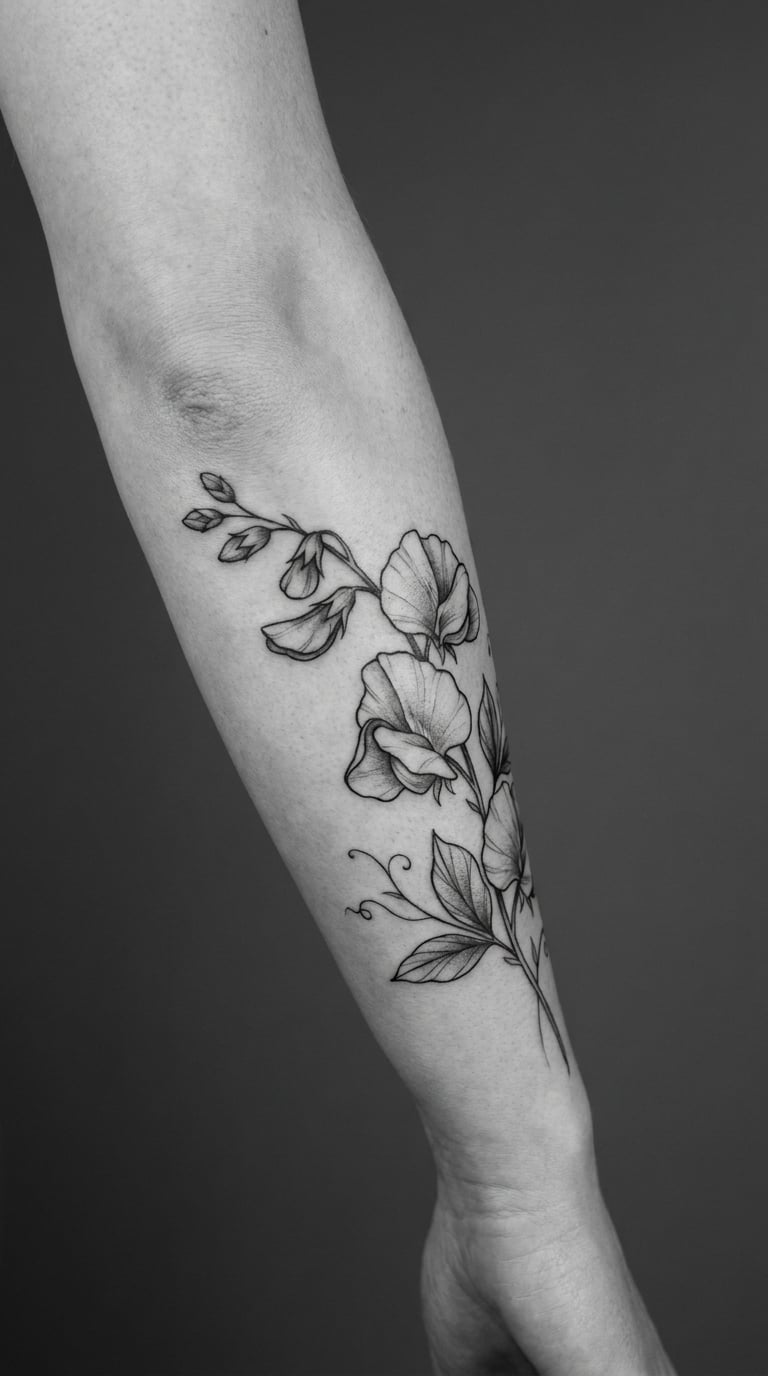
This one tells a story as it travels: closed buds near the elbow, half-open flowers in the middle, fully open blooms and trailing leaves at the wrist. Drawn in blackwork and grey shading, the growth pattern gives the forearm movement without adding a single competing image.
Progressions like this work because the eye follows the sequence, and the forearm gives it a natural start and end point.
Placement: Forearm, from elbow to wrist · Size: Half sleeve, around 10 to 12 inches (25 to 30 cm) of coverage · Style: Blackwork with grey shading
Pain: Medium. Grey shading means repeated passes, and the inner forearm section is sensitive even when the outer is not.
Make it yours: Reverse the sequence, open flowers at the elbow and buds at the wrist, so the piece reads as closing rather than blooming.
20. Embroidered-Look Sweet Pea Patch on the Bicep
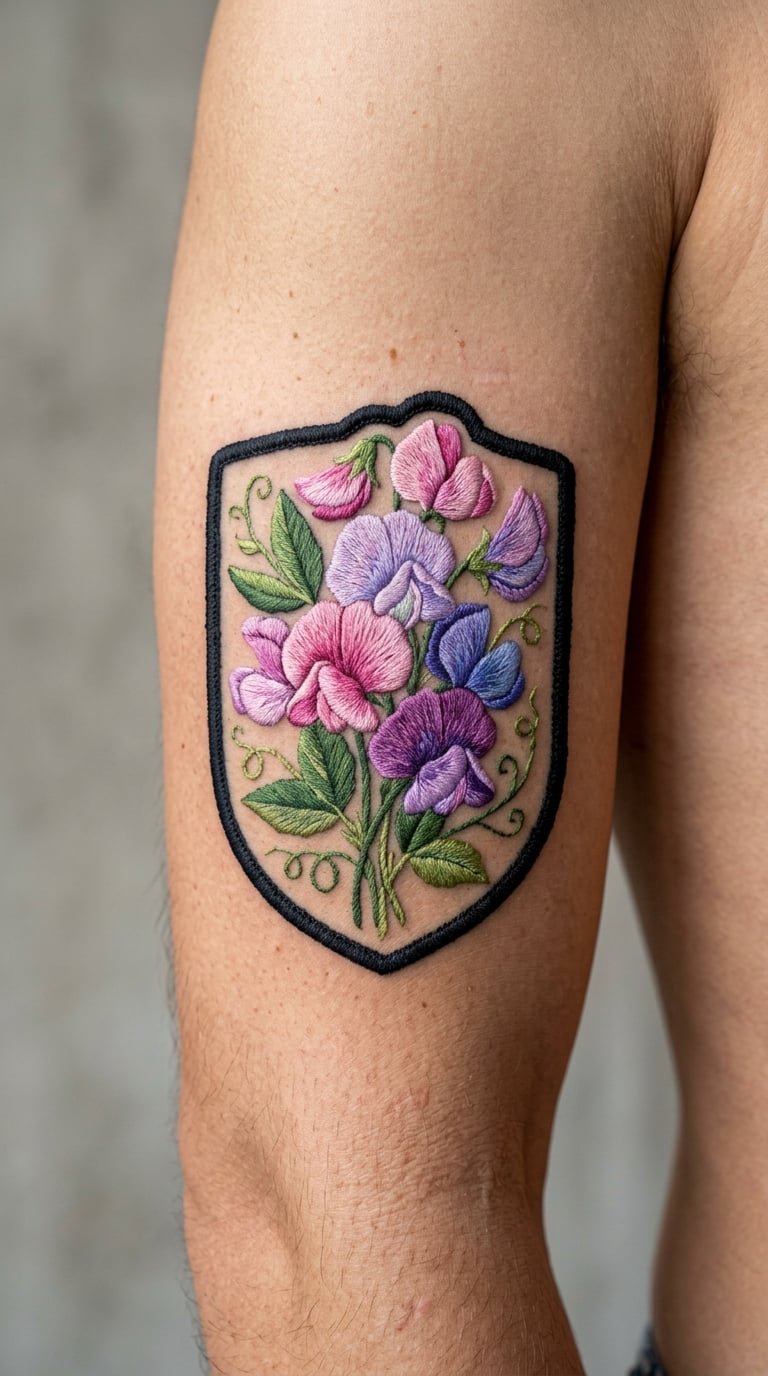
Satin shading is the technique that makes a tattoo look stitched: you lay bands of highlight and shadow side by side so the surface appears glossy and turned, the way a thread catches light. Add a defined border, dimensional flowers and green leaves and the whole thing reads like a patch on a jacket sleeve.
It is the boldest idea on this list and the one that reads clearly from a distance, which is a good change of pace after seventeen soft designs.
Placement: Outer bicep, upper arm, or the outer shoulder · Size: 4 to 5 inches (10 to 13 cm) · Style: Illustrative, satin shading
Pain: Low. The outer bicep is meaty and takes the repeated passes satin shading needs without getting sensitive.
Make it yours: Put a single colour accent inside the border, a small solid shape in a colour that means something, so the patch is recognisably yours from a distance.
How to Choose the Right Design
Start with the placement, not the picture. A design that looks generous on a phone screen can turn into a crowded patch once it is wrapped around an ankle, and the reverse is just as common. Use the quick guide above to match size to body part, then work outward from there.
- Pick the detail level you will actually maintain. Fine line looks soft in year one and needs a touch-up pass later, usually once every few years. Blackwork, dotwork and satin shading hold their shape with far less maintenance. If you would rather not book touch-ups, choose the heavier styles.
- Match size to the flatness of the spot. Curved and bony areas — ankle, elbow, wrist, ribs — compress a design. Anything with a lot of internal detail gets tighter there. Flat, fleshy areas such as the outer forearm and upper arm give detail more room.
- Count what is already on the skin. If there is existing work nearby, a matching style makes the addition look deliberate. A fine line piece next to a heavy blackwork sleeve will read as an afterthought, however much you like it on its own.
- Decide how visible you want it to be. Wrist, hand and collarbone pieces are seen constantly. Behind the ear, the rib and the inner upper arm appear only when you choose to show them.
- Check the artist’s floral work, not their flash sheet. Look for healed photographs of delicate pieces at the size you want, taken months after healing, not the fresh work posted the same week. If a portfolio has no small, detailed florals, that is the piece they are least practised at.
- Bring references, not instructions. Two or three saved images and a note on what you like about each one gets a better result than a long description. Artists translate pictures faster than words.
One last thing, since it comes up constantly: nothing about a flower tattoo is gendered. Sweet peas read soft because of the bloom, not because of who is wearing it, and the styles in this list run from whisper-fine to heavy blackwork for exactly that reason.
Cost and Session Time
Tattoo pricing is hourly, so cost tracks time, and time tracks size and detail. Most studios set a shop minimum, which is the smallest piece they will do and often sits near the equivalent of a hundred dollars in many US cities. Prices climb from there with the artist’s rate, your location and how much of the day the piece takes.
What do 20 sweet pea tattoo ideas cost by size?
- Small pieces (under 2 inches, 1-2 hours): a single fine-line sprig, a wrist outline or an initial stem. These are the easiest to book and the hardest to hide, so plan the placement carefully.
- Medium pieces (2-5 inches, 2-4 hours): realistic clusters, boutonnieres, dotwork wreaths and traditional bouquets. Most of the ideas in this guide sit in this band.
- Large pieces (5 inches and up, 4-8 hours): stippled bouquets, vertical sprays, calf branches and half-sleeves. Anything past about five hours is usually split across two appointments, and that split usually improves the result.
Shop minimums and hourly rates vary widely by region and by artist, so treat any figure you see as a starting point rather than a quote. Fine line work also tends to need a thickening session after healing, which most artists either include or charge at a reduced rate. Ask about that when you book, not after.
Aftercare Basics
Start with your artist’s aftercare instructions, because they match the way that artist works and the inks they use. The general routine is straightforward:
- Follow the aftercare your artist gave you, including how long they want the piece covered. Instructions differ on this point, and theirs is the one that applies.
- Keep it clean. Wash gently with unscented soap and lukewarm water, then pat dry with something that is not a rough towel.
- Do not soak it. No baths, pools, hot tubs or swimming in the sea for a couple of weeks, and keep it out of the shower’s direct spray for the first stretch of healing.
- Protect it from sun. A new tattoo should stay covered or shaded for weeks, and a pale pink or lilac piece benefits from sunscreen on that spot for the rest of its life.
- Do not pick at scabs or peel flakes. That is the main cause of patchy colour and scarring in a healing floral piece.
- Watch for anything unusual. Redness that spreads, heat, swelling, discharge or a fever is a reason to contact the studio and then a clinician, not something to wait out.
For pastel florals specifically, colour is the first thing to go. Deep pinks hold far better than pale lilacs, and if a piece is going to sit in sun or friction, ask for one shade deeper at the start.
Frequently Asked Questions
What does a sweet pea tattoo symbolize?
A sweet pea tattoo usually stands for joy and good wishes, gratitude, fond goodbyes, new beginnings and spring renewal. The flower carried those meanings in Victorian floriography, the language of flowers, and it is one of the April birth flowers. People also choose it for the scented trailing stem and the butterfly-shaped bloom, so personal associations sit alongside the traditional ones.
Do fine line sweet pea tattoos fade and need touch-ups?
Yes, and it is worth planning for before you book. Thin single-needle lines blur first as skin ages, and pale pinks and lilacs lose saturation faster than saturated colour. Most fine line clients come back once for a thickening pass, usually within the first year. Blackwork, dotwork, stippling and satin shading hold their shape much longer and need far less maintenance over time.
Where is the least painful place to get a small sweet pea tattoo?
The outer upper arm, outer thigh and upper bicep are the most forgiving spots, with plenty of flesh cushioning the needle. The wrist, inner forearm, collarbone, ribs, ankle and the back of the hand are consistently more sensitive because the skin is thinner or the bone sits close. Pain varies a lot between people, and staying relaxed and well-rested makes more difference than any placement choice.
How big should a first sweet pea tattoo be?
Two to three inches (5 to 8 cm) is the sweet spot for a first floral piece. It gives the artist enough room for petal shapes and a stem without turning into a long session, and it sits well in a small, easily hidden spot. Under one inch on a wrist or rib means very little detail, and fine detail is exactly what tends to soften first as the years pass.
Can I get a sweet pea tattoo if I am not a woman?
Yes. A flower has nothing to do with the wearer’s gender, and the styles in this guide range from a 1.5 inch fine-line sprig to a bold blackwork sleeve. Plenty of people choose botanical tattoos for the meaning rather than the flower. If you want a softer, less obviously floral look, blackwork, black and grey and geometric linework all read as graphic rather than decorative.
How long does a sweet pea tattoo take to heal?
Initial healing, meaning the surface is scabbed or peeling, takes about two to three weeks. The deeper settling of ink into the dermis continues for another month or two, which is why fresh colour looks slightly different once it settles. Plan sun protection for the whole period, and leave any colour decisions to after three months rather than judging a pastel piece in week one.
Conclusion
For a first tattoo, the sweet pea line art wrist piece or the fine-line sprig behind the ear is the shortest session and the least to regret. If you already collect work and want a statement piece, the monochrome half-sleeve or the embroidered-looking bicep patch gives you the most to look at without needing a full colour palette.
Compare the quick guide against your own placement, talk to an artist about their healed floral work, and pick the design that suits the spot you actually want. That is the whole decision. Everything else is detail work, and the artist handles that part.