
22 Desert Cactus Tattoo Ideas: Best Designs (October 2026)
These 22 desert cactus tattoo ideas cover every route into the motif, from a single fine-line saguaro on the inner forearm to a full ankle scene. A desert cactus tattoo works because the silhouette is unmistakable: a tall ribbed column, a round spined ball, a flat paddle cluster. Drawn well, it reads as a plant that stores water, defends itself and keeps growing in hard ground, and a lot of people choose it for exactly that reason.
Pick the one that matches your spot and your patience. Saguaros want vertical room on a forearm or calf, barrel cacti sit well on a round joint like the elbow, and prickly pear pads suit a horizontal line such as the collarbone. If you are still narrowing the field, the [82 beautiful cactus tattoo ideas](https://thewe.cc/cactus-tattoo/) round-up covers softer and smaller variations.
22 Desert Cactus Tattoo Ideas: Quick Guide
Every design below is a distinct plant or a distinct way of drawing one, with a different silhouette, placement and ageing profile. Here is the whole set at a glance so you can mark the ones worth taking to a consultation.
| Idea | Style | Best placement | Size | Pain |
|---|---|---|---|---|
| 1. Minimal saguaro | Fine line | Inner forearm | 3-5 in | Medium |
| 2. Barrel cactus with rose | Illustrative realism | Inner forearm, calf | 2-3 in | Low to medium |
| 3. Flowering cholla | Fine line | Wrist, forearm | 2-4 in | Medium |
| 4. Prickly pear bouquet | Botanical fine line | Collarbone | 3-5 in | Medium |
| 5. Golden column cactus | Blackwork | Outer forearm, calf | 4-6 in | Medium |
| 6. Organ pipe cactus | Micro-realism | Inner biceps, forearm | 2-3 in | Medium |
| 7. Jumping cactus | Illustrative linework | Forearm, calf | 3-4 in | Medium |
| 8. Desert hood | Minimalist | Wrist, behind ear | 1-2 in | Low to medium |
| 9. Two matching saguaros | Fine line | Wrist, inner arm, ankle | 2-3 in | Low to medium |
| 10. Chain fruit | Blackwork | Outer forearm, shoulder, calf | 3-5 in | Medium |
| 11. Desert aloe and barrel pair | Botanical linework | Forearm, ankle | 2-4 in | Medium |
| 12. Teddy bear cactus | Watercolor | Wrist, forearm, calf | 2-3 in | Low to medium |
| 13. Ariocarpus geometric | Geometric fine line | Wrist, shoulder | 1.5-2.5 in | Low to medium |
| 14. Night-blooming cereus | Illustrative realism | Forearm, shoulder | 2-4 in | Medium |
| 15. Foxtail cactus | Illustrative | Forearm, calf, rib | 2-3 in | Medium |
| 16. Century plant spiral | Fine-line botanical | Forearm, calf, shoulder | 3-5 in | Medium |
| 17. Two-color saguaro | Illustrative color | Outer forearm, calf, shoulder | 3-5 in | Medium |
| 18. Stippled old West cholla | Illustrative realism | Outer arm, calf | 3-5 in | Medium |
| 19. Mini cactus bouquet | Fine line | Behind ear, side neck | 1.5-2.5 in | Medium |
| 20. Barrel cactus elbow | Blackwork | Inner or outer elbow | 2.5-4 in | Medium to high |
| 21. Monstera and cactus | Mixed botanical linework | Thigh, calf, forearm | 3-5 in | Medium |
| 22. Full desert scene | Illustrative realism | Outer or inner ankle | 3-5 in | Medium to high |
1. Minimal Saguaro Forearm Tattoo
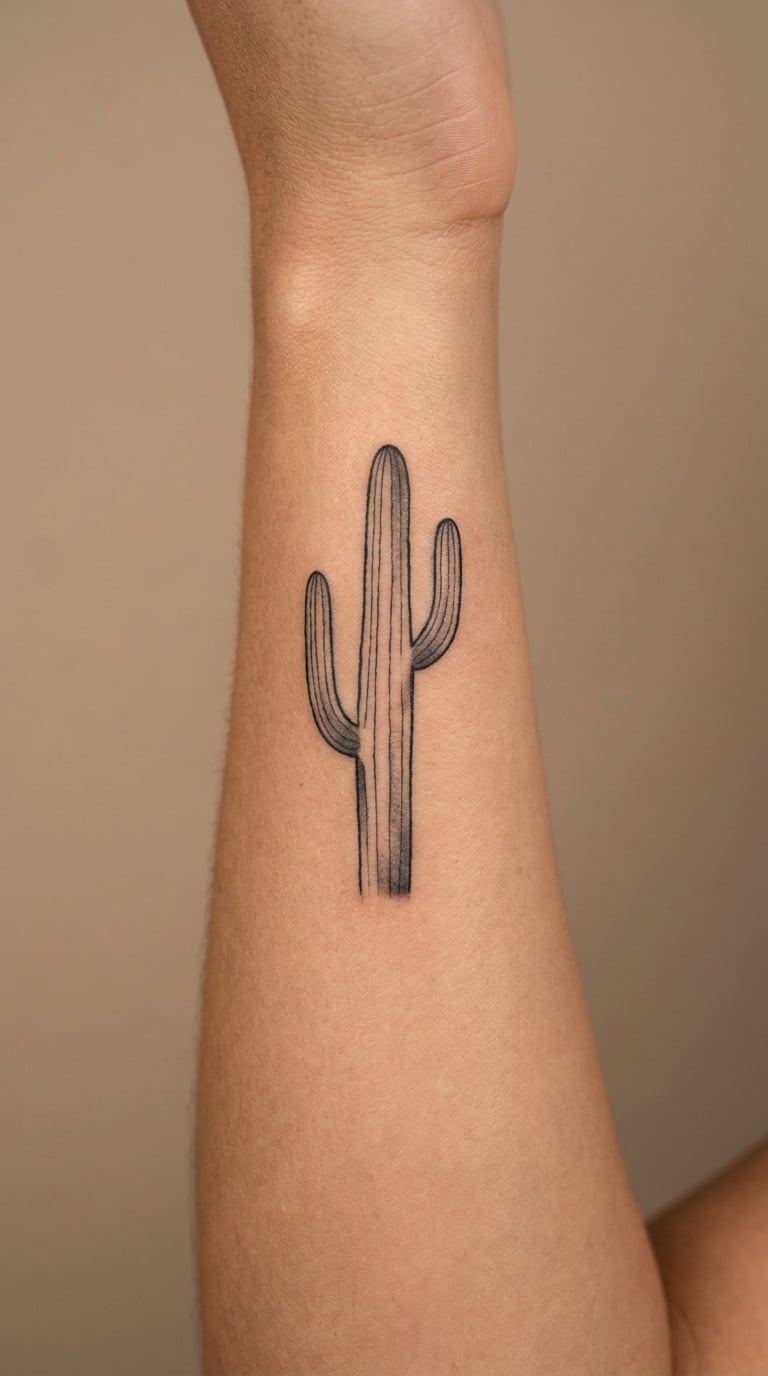
A single upright saguaro with clean black contours, faint needle-pen shading and one narrow arm, held in a 3-5 inch vertical composition. The extra arm is what separates it from a plain trunk.
People pick this because the saguaro is the most direct desert signal there is, and a spare line drawing of it does the job without shouting.
Placement: inner forearm or outer biceps, running along the muscle · Size: 3-5 inches tall · Style: fine line · Pain: medium, more of a steady scratch than a sharp one. Inner forearm lines catch sun and can soften with time, so keep the outline slightly heavier than feels necessary.
Make it yours: change the arm height and direction, or add a single tiny flower at the crown. More plant and tattoo examples sit in the [small cactus round-up](https://thewe.cc/cactus-tattoo/).
2. Barrel Cactus Rose Patch
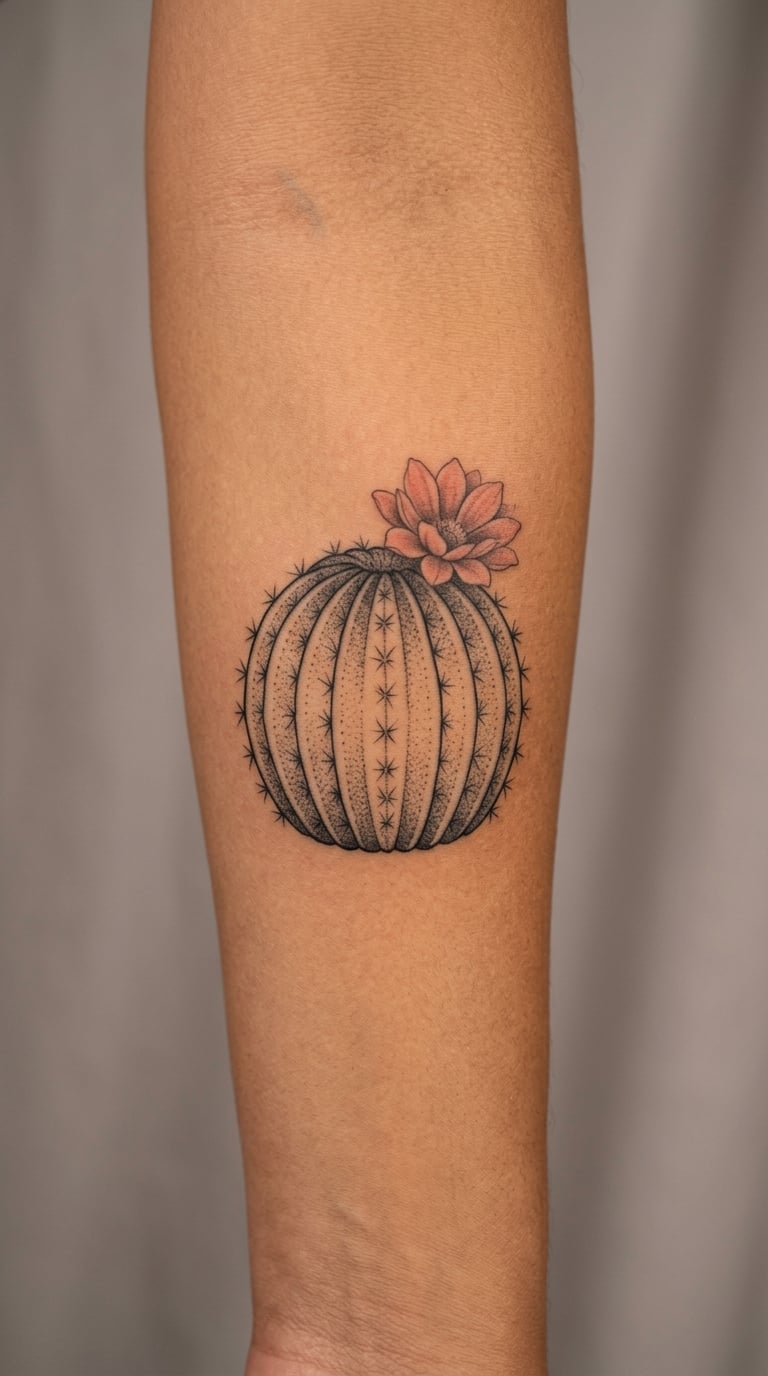
A compact round barrel cactus built from segmented ribs that curve around the form, dotted spines set into the gaps, and one muted desert-rose bloom at the crown. The bloom is the only colour in an otherwise black piece.
It is a good pick for anyone who wants a dense, textured plant that still fits in a small area. Whether it means anything specific is up to you.
Placement: inner forearm, upper arm or calf · Size: 2-3 inches wide · Style: illustrative realism · Pain: low to medium, since the area is fleshy and the design sits shallow.
Make it yours: use the real colour of a bloom that meant something to you, even if it was never a desert flower.
3. Flowering Cholla Minimal Design
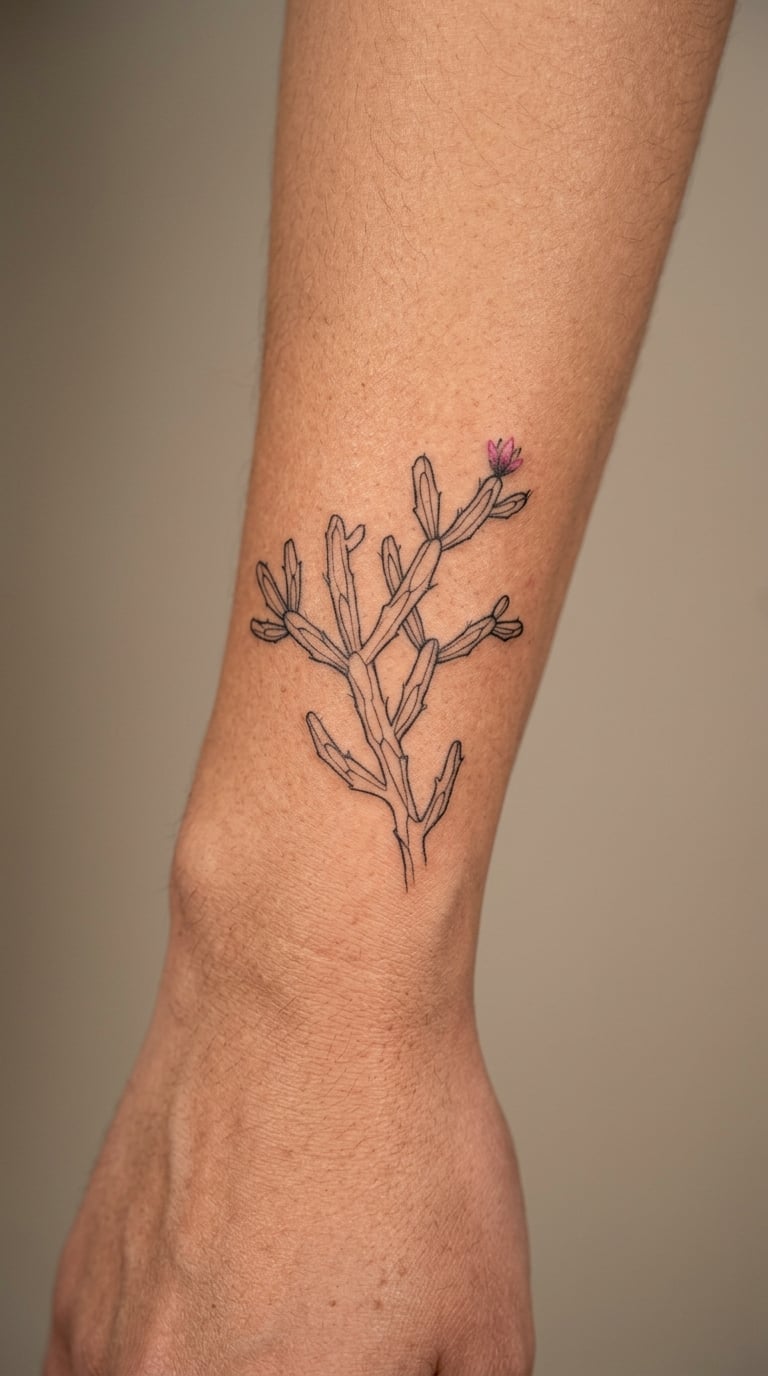
A sparse cholla with angular branching joints, open negative space between the arms, and a single pink flower near the top. The gaps are the point; a cholla drawn solid loses its character.
The branching joints read as toughness, and some people simply have an affection for the desert. Treat any fixed meaning as your own interpretation, not a rule.
Placement: wrist or inner forearm · Size: 2-4 inches · Style: fine line · Pain: medium on the wrist, where bone sits close under the skin.
Make it yours: date the bloom by matching its colour to something worn on a real date.
4. Prickly Pear Bouquet Collarbone Tattoo
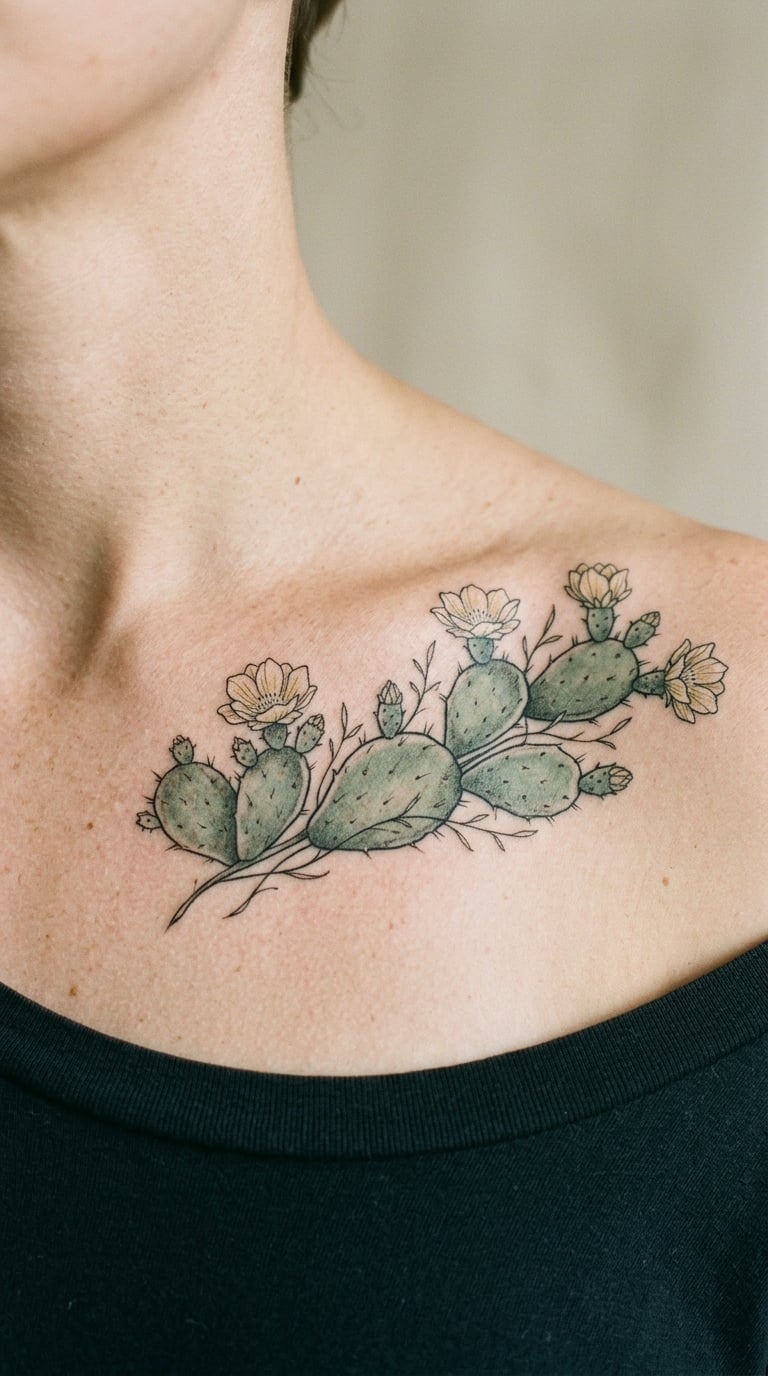
Three connected prickly pear pads with restrained green-black shading, tiny pale blossoms on thin stems, and a layout stretched horizontally rather than stacked. The stems are what make it read as a bouquet.
It suits people who like a botanical piece that feels gathered rather than wild. There is no universal symbolism attached to it, and that is fine.
Placement: collarbone, following the bone, or the top of the chest · Size: 3-5 inches across · Style: botanical fine line · Pain: medium; collarbone skin is thin and the bone is close.
Make it yours: swap the blossoms for a family flower in the same ink style.
5. Golden Column Cactus Blackwork
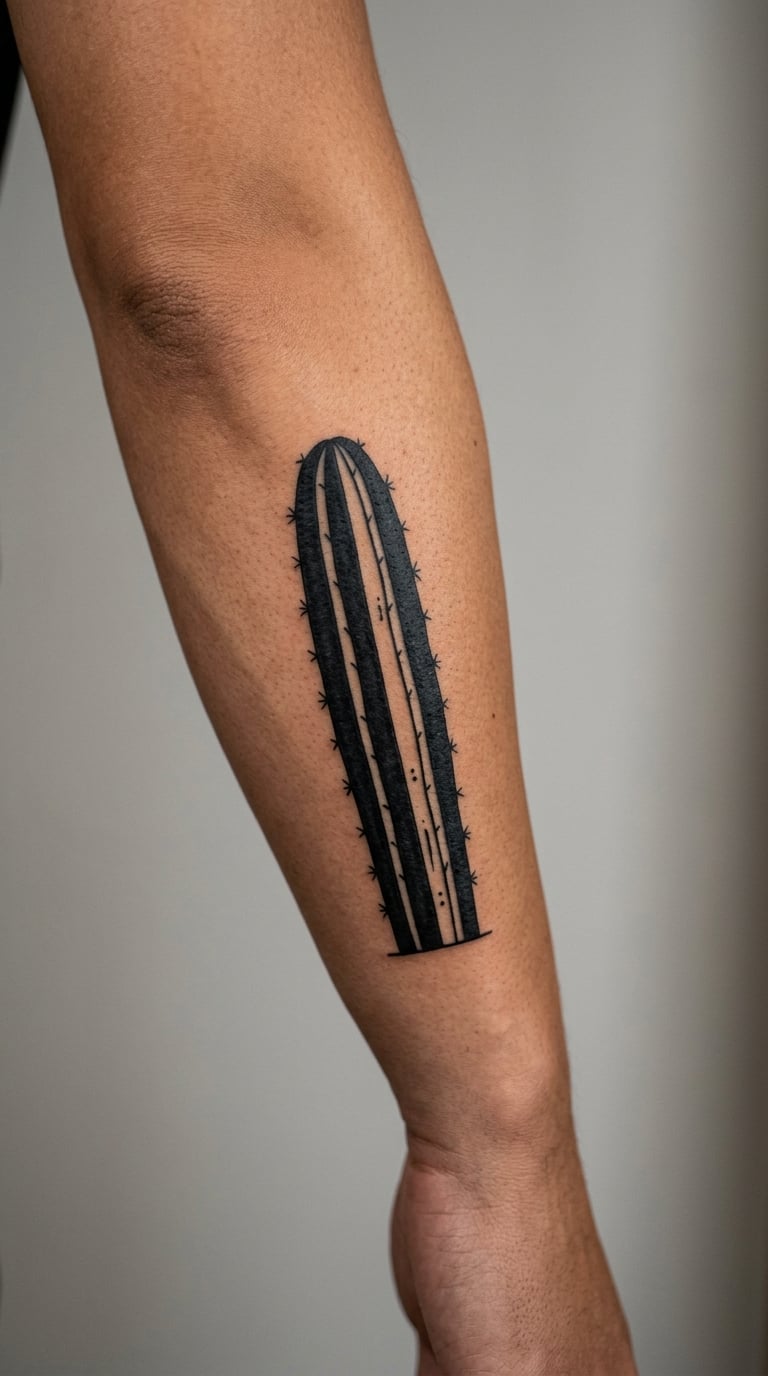
A tall golden column cactus rendered as solid black contours with tapered ribs and sparse needle marks, no background, no gradient. Heavy shapes survive the move to skin better than soft ones.
This is the option for someone who wants a statement piece without a lot of internal detail. The work is in the silhouette, and a bold silhouette ages slowly.
Placement: outer forearm or calf, vertical · Size: 4-6 inches tall · Style: blackwork · Pain: medium across a flat muscle; a solid black fill takes longer than the outline alone suggests.
Make it yours: add one low ground line or a single coloured spine accent to keep the block from feeling empty.
6. Micro-Realism Organ Pipe Cactus
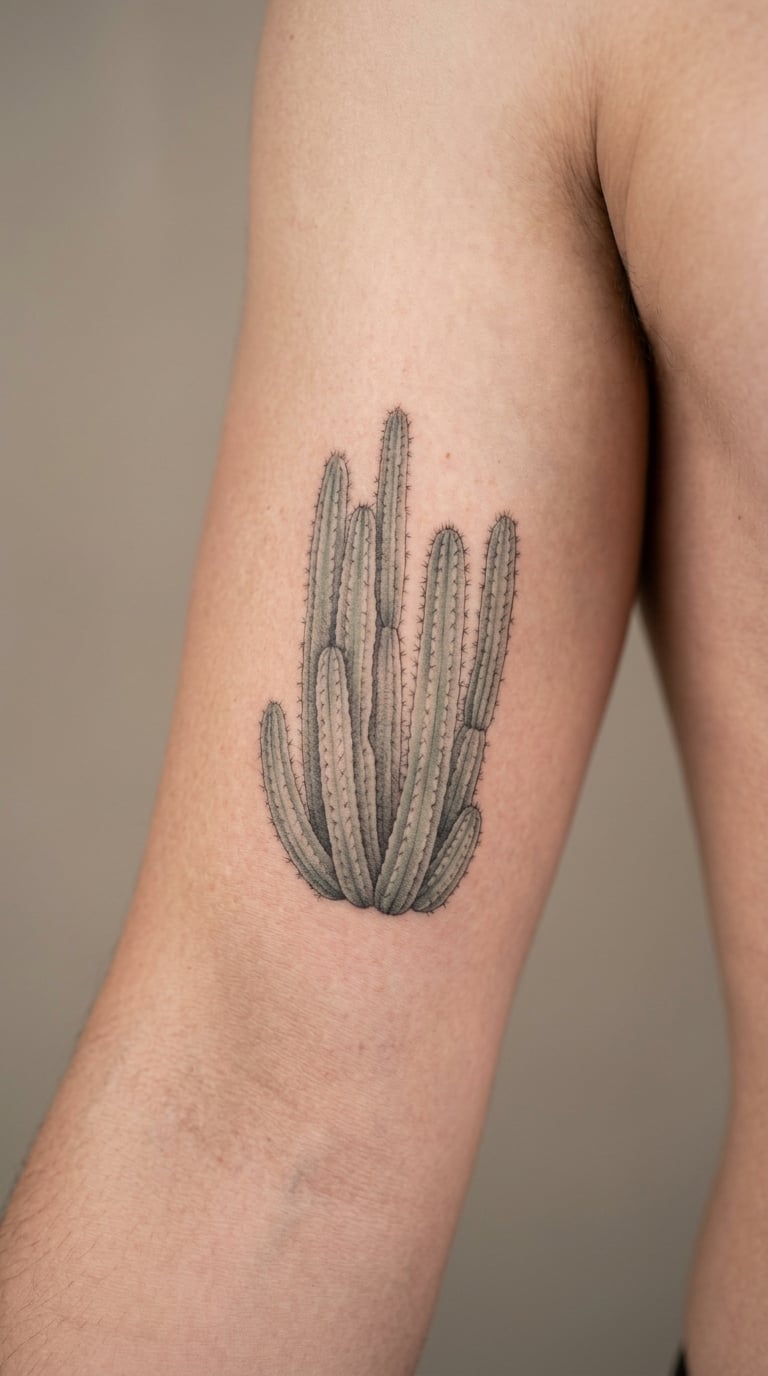
Several narrow upright stems of different heights clustered from one base, with soft grey-green gradients, faint rib texture and thorns spaced carefully enough to stay visible.
Most people choose this because the organ pipe form is instantly recognisable as a Sonoran Desert plant. It is a plant-recognition tattoo more than a message.
Placement: inner biceps or forearm · Size: 2-3 inches tall · Style: micro-realism · Pain: medium. Thorns sit close together, so the session takes longer than the size suggests.
Make it yours: add one small coordinate of a place that mattered to you beneath the cluster.
7. Twisted Jumping Cactus Linework
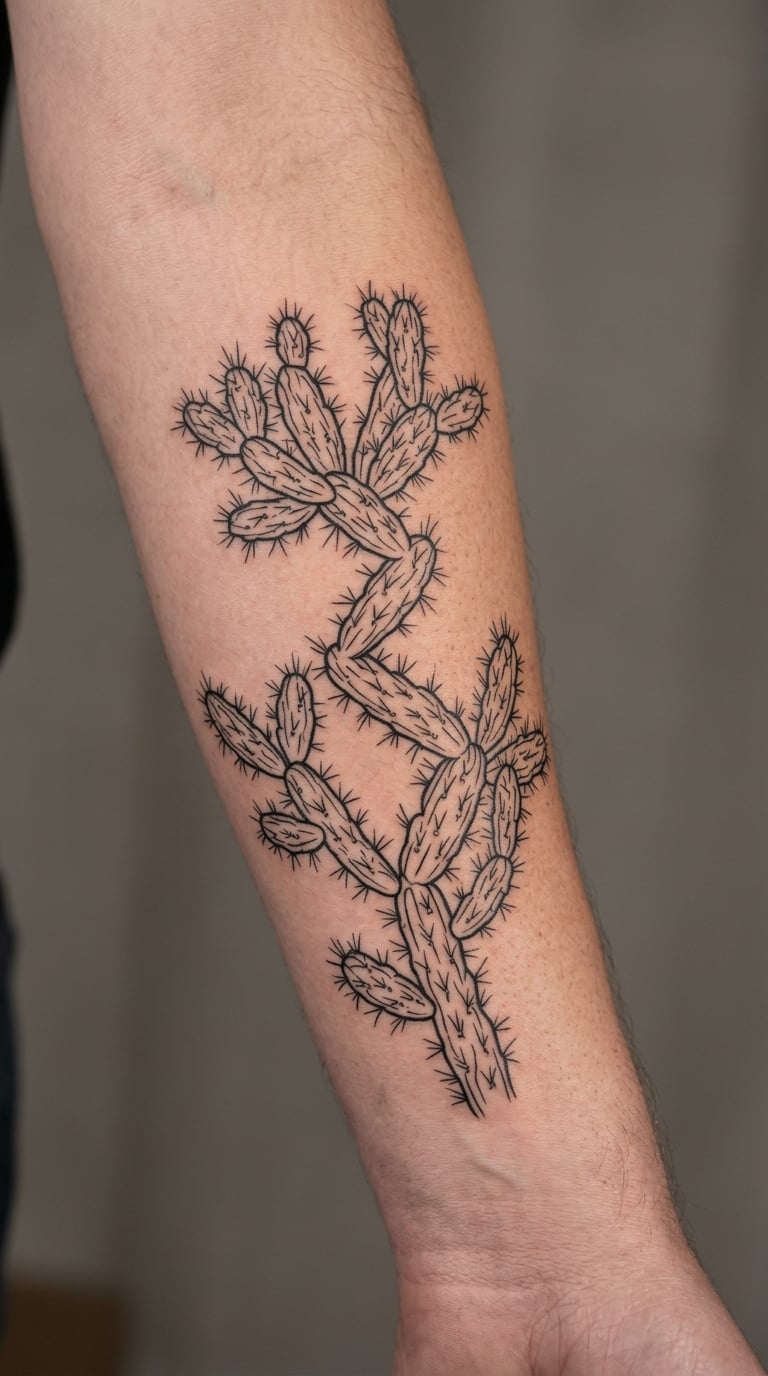
A single jumping cactus with an irregular zigzag trunk, small paddle segments and hand-drawn lines that wobble slightly instead of ruling straight. The movement is what makes it different from every static columnar design here.
It reads as a plant that moves, which is unusual to see inked. People tend to choose it for the character rather than a set meaning.
Placement: forearm or calf · Size: 3-4 inches · Style: illustrative linework · Pain: medium.
Make it yours: tattoo a miniature version of the same cactus for a friend, with the paddle count changed.
8. Desert Hood Micro Tattoo
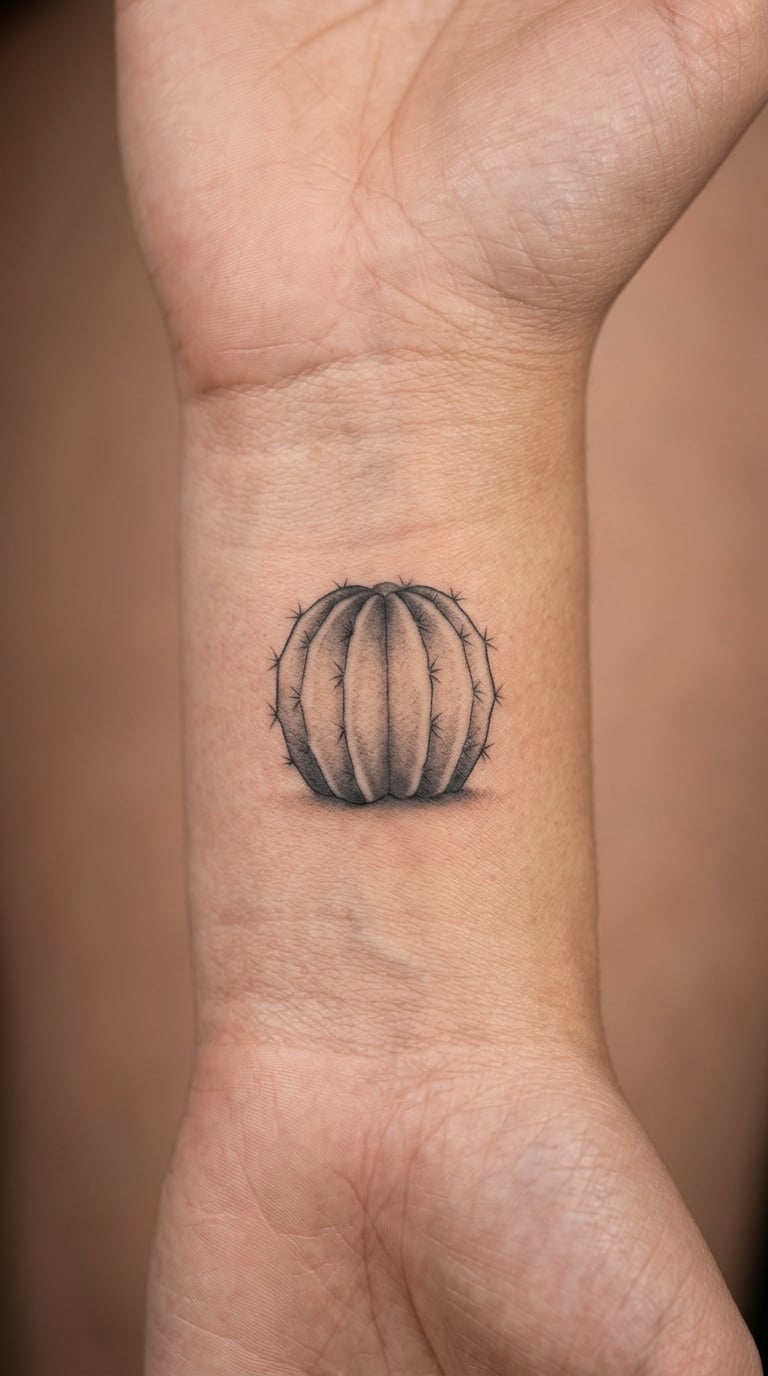
A very small desert hood: one squat central pad with two lower side pads, shaded in three values of grey instead of a detailed rib pattern. No spines, no background.
The compact shape works well for a first piece or a first small piece. It is quick to tattoo, though nothing on the wrist is painless, and it is better to expect that than be surprised.
Placement: inner wrist or behind the ear · Size: 1-2 inches · Style: minimalist · Pain: low to medium.
Make it yours: place a single healed-scar dot nearby and let the two read as one composition.
9. Two-Saguaro Matching Pair
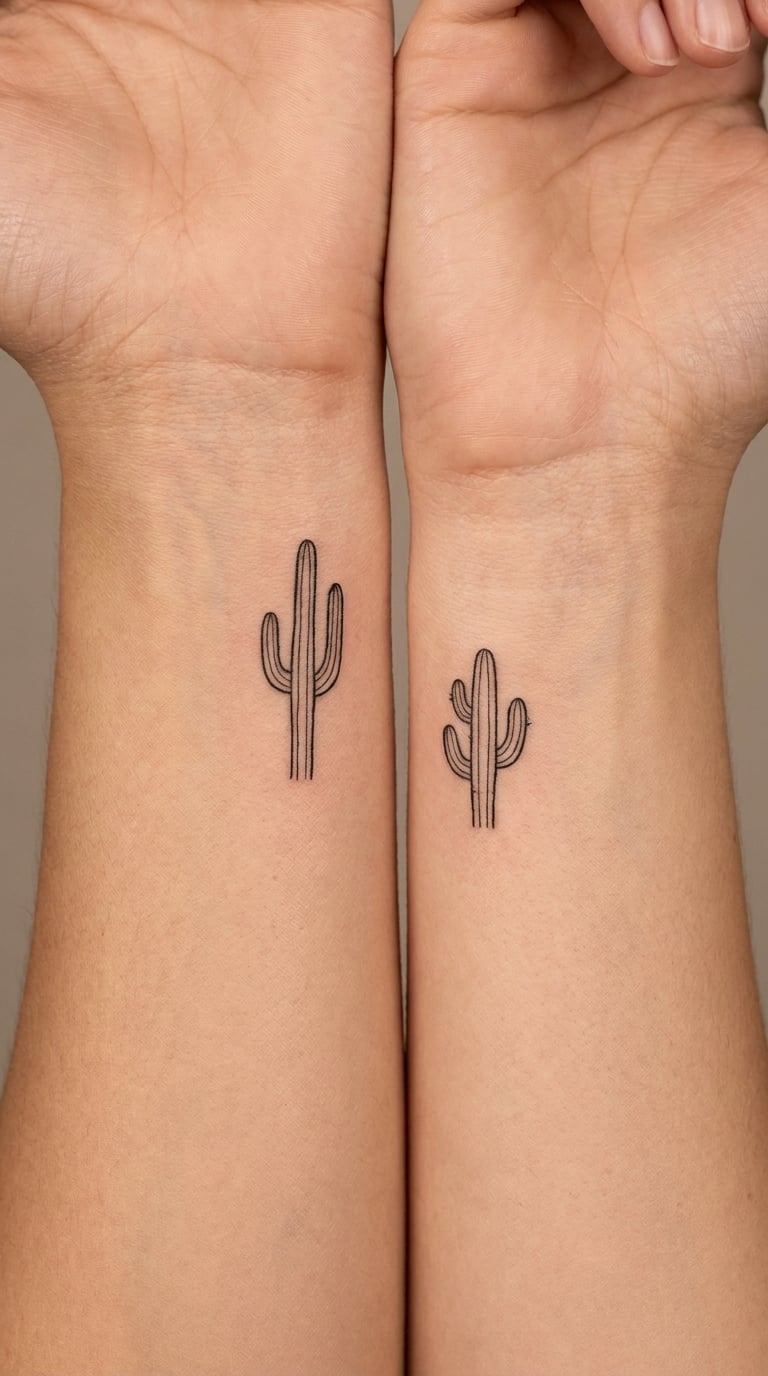
Two saguaros drawn as a matching pair rather than a copy, with different heights and different arm arrangements but the same line weight. One can face out, one can face in.
This suits partners, friends or siblings who want related pieces that still belong to the person wearing them.
Placement: wrist, inner arm or ankle, one each · Size: 2-3 inches tall · Style: fine line · Pain: low to medium on the inner arm; ankles and wrists sting more.
Make it yours: give each cactus one meaningful shape change, such as an added arm or a flower on one side only.
10. Chain Fruit Blackwork Piece
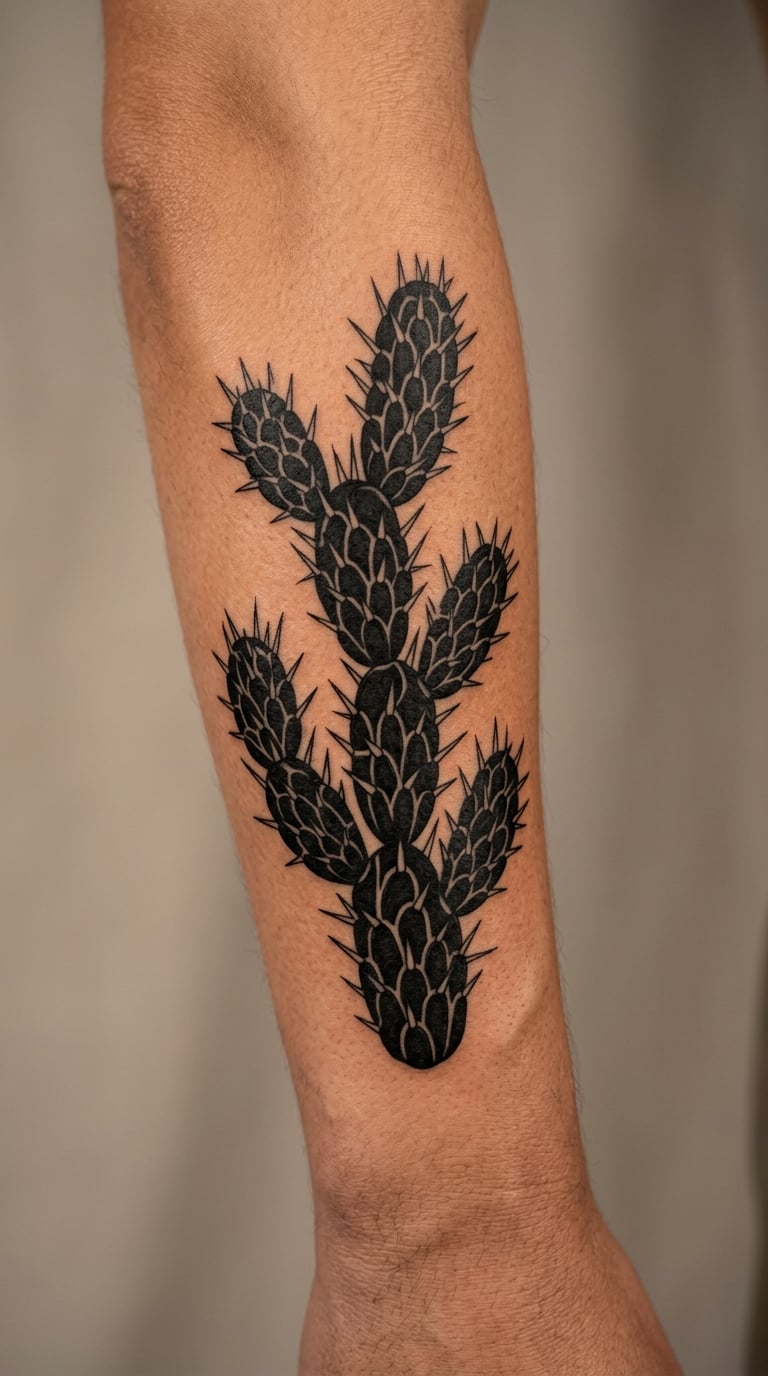
A dense blackwork chain fruit built from interlocking oval bodies with a branching spine network and deliberate gaps that keep the silhouette readable. Density here is a choice, not an accident.
It is the boldest option in this set and suits people who like graphic contrast over botanical delicacy.
Placement: outer forearm, shoulder or calf · Size: 3-5 inches · Style: blackwork · Pain: medium. Very fine gaps between spines can blur over the years, so ask for slightly wider spacing than the reference shows.
Make it yours: add one muted fruit-colour accent to break up the black.
11. Aloe-Inspired Desert Botanical Pair
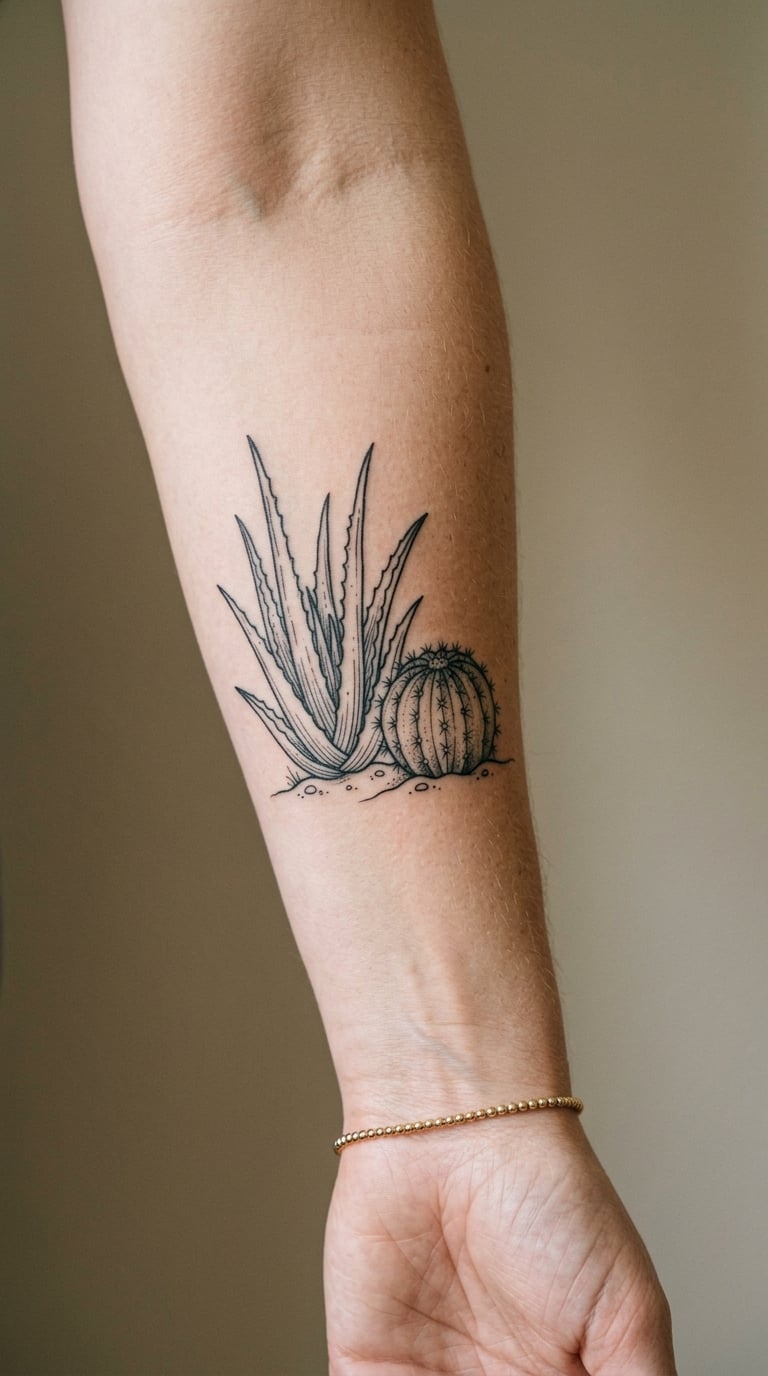
A simplified desert aloe rosette with narrow pointed leaves set beside a miniature barrel cactus, balanced as one composition with shared line weight and light botanical shading.
Most people here are after a modern Southwestern or botanical look, not a cultural statement. Presenting this as a specific traditional symbol would be overclaiming.
Placement: forearm or ankle · Size: 2-4 inches · Style: botanical linework · Pain: medium.
Make it yours: work a real favourite colour into the leaves instead of keeping the whole pair black.
12. Teddy Bear Cactus Watercolor
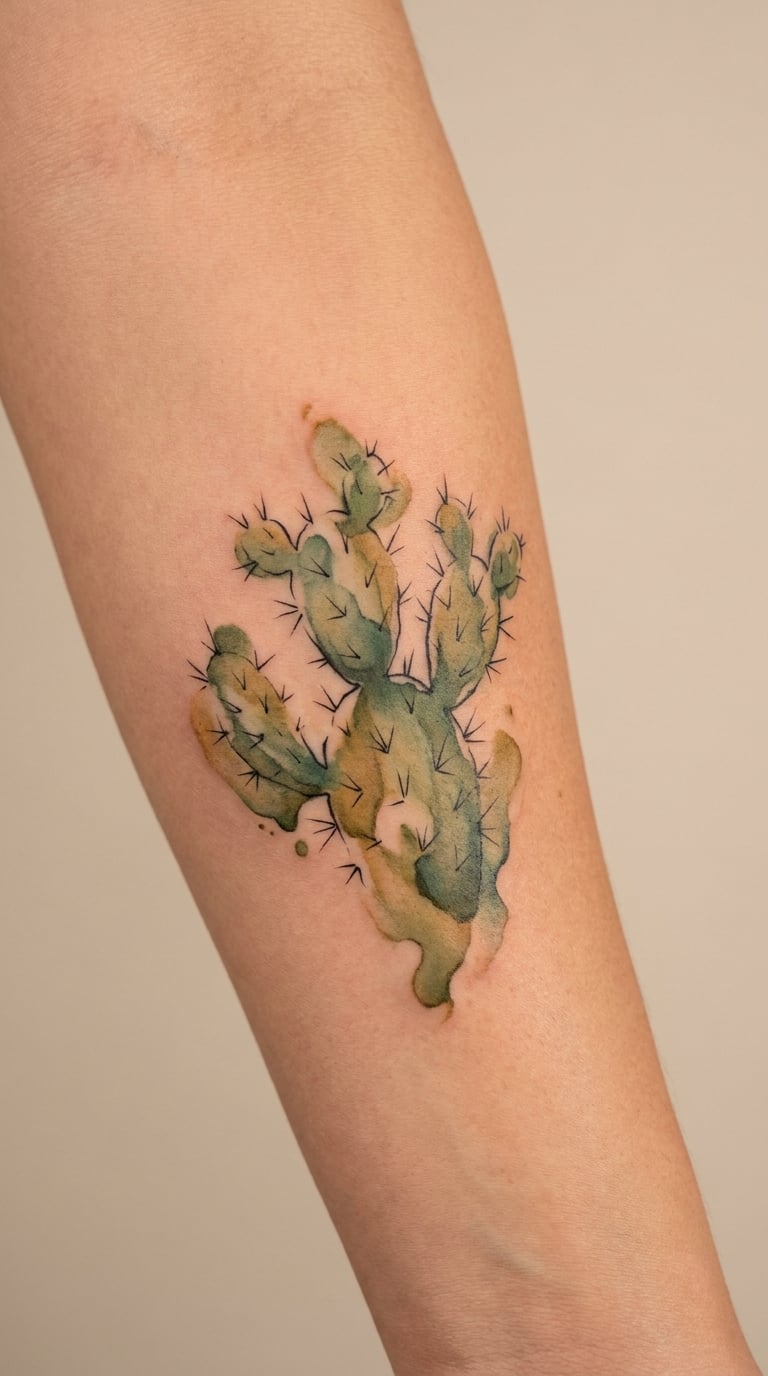
A teddy bear cactus with two paddle arms, loosely rendered cactus-green and golden washes, and darker pigment gathering at the edges where the water pooled. The imperfection is the charm.
People choose it for a playful hand-painted quality. There is no fixed symbolic claim attached to a cheerful cactus.
Placement: wrist, forearm or calf · Size: 2-3 inches · Style: watercolor · Pain: low to medium, usually a shorter session since there is less linework.
Make it yours: use two ink colours that mean something specific rather than matching greens by default.
13. Ariocarpus Geometric Micro Design
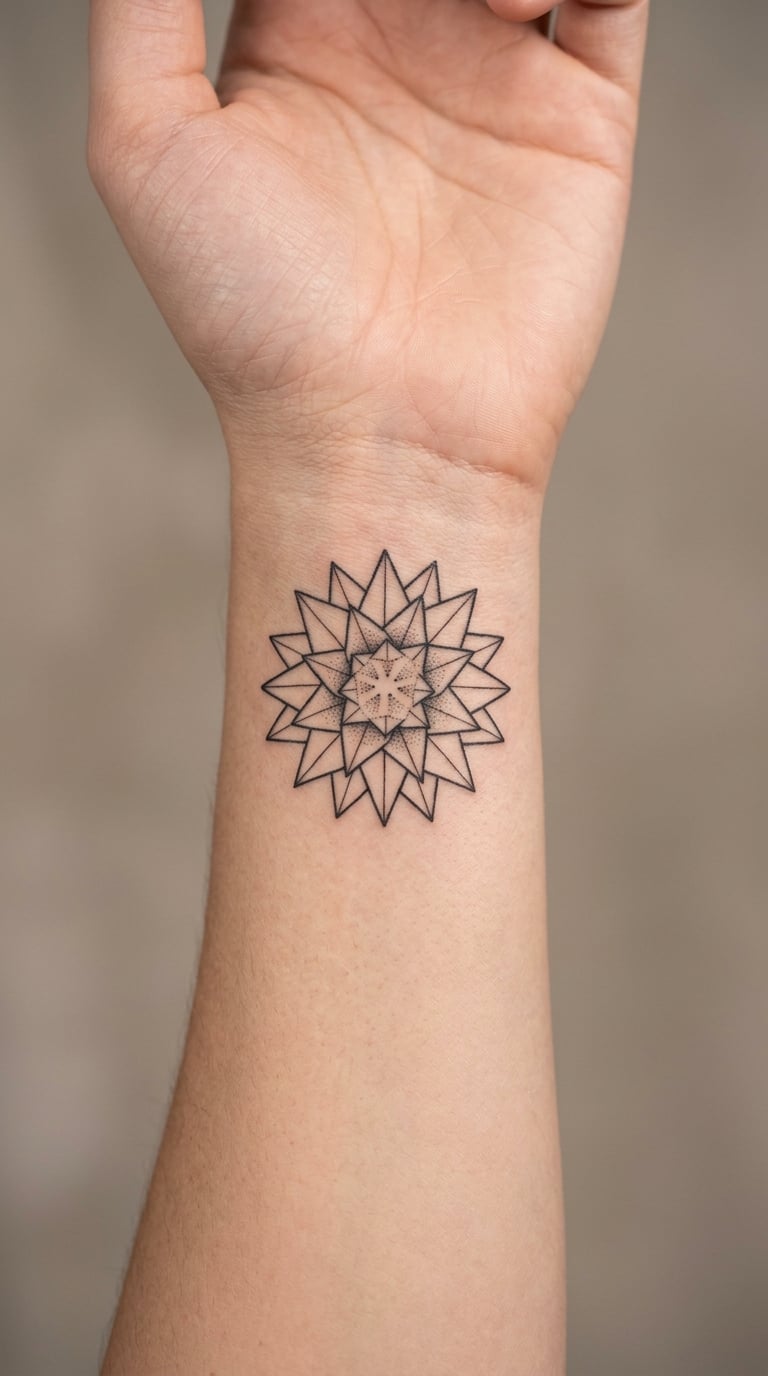
An ariocarpus seen from directly above, built as a radial geometry of pointed triangular leaves with a dotted centre and clean symmetry. It looks like graphic art that happens to be a plant.
This one appeals to people who want a cactus that does not read as a Western motif at all. Nobody is announcing a home state with this one.
Placement: wrist or shoulder · Size: 1.5-2.5 inches · Style: geometric fine line · Pain: low to medium. Minute internal dots soften noticeably over the years, so keep the centre marks a touch larger.
Make it yours: use a birthstone colour in the centre dot.
14. Night-Blooming Cereus Flash Tattoo
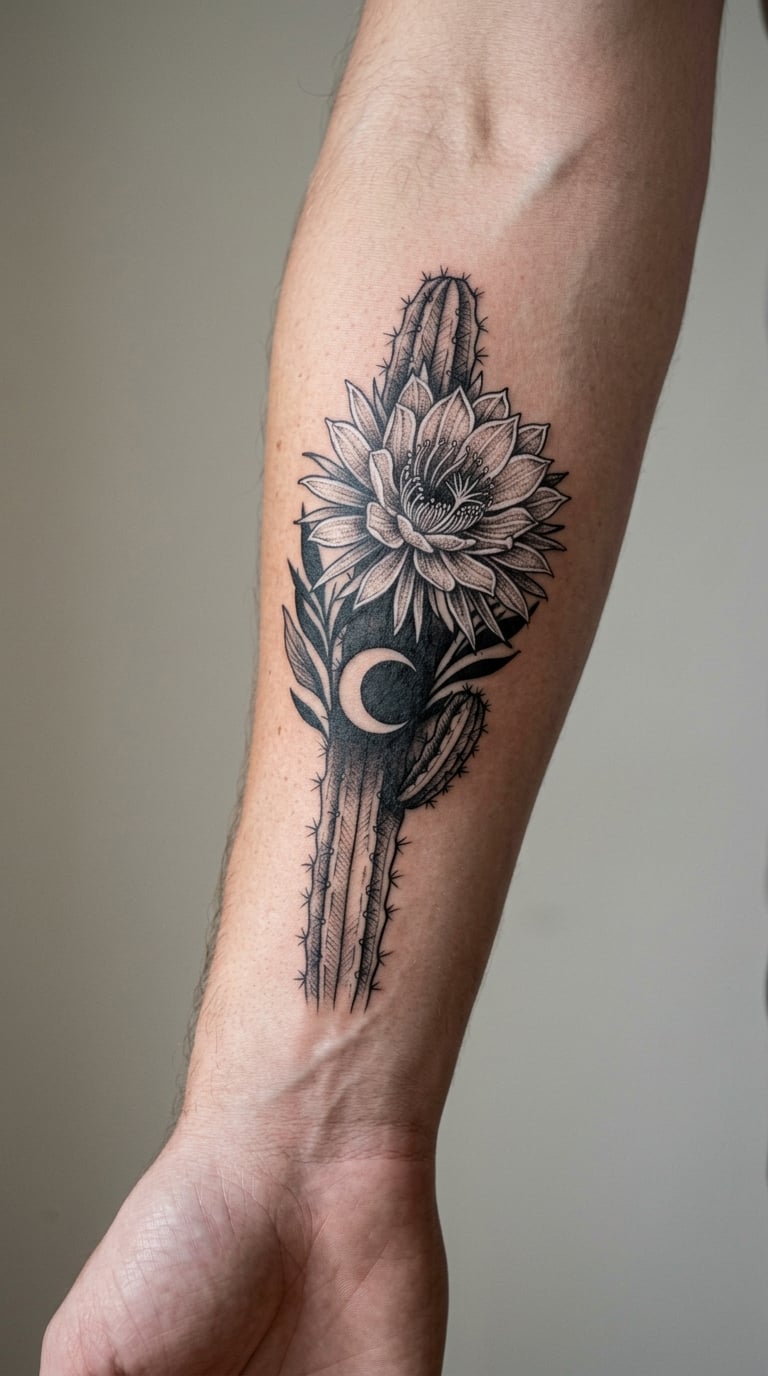
A compact cereus cactus topped by one large white night-blooming flower, with dark leaves below and a small crescent of negative space beside it. No stars, no literal night scene; the crescent does the work.
The design is usually picked for the idea of staying up to catch a bloom that only opens briefly. That is a personal reading, not a universal one.
Placement: forearm or shoulder · Size: 2-4 inches · Style: illustrative realism · Pain: medium, and shading the flower petals takes time.
Make it yours: tint the background crescent with the deep colour of a real night sky you remember.
15. Foxtail Cactus Curved Spine Tattoo
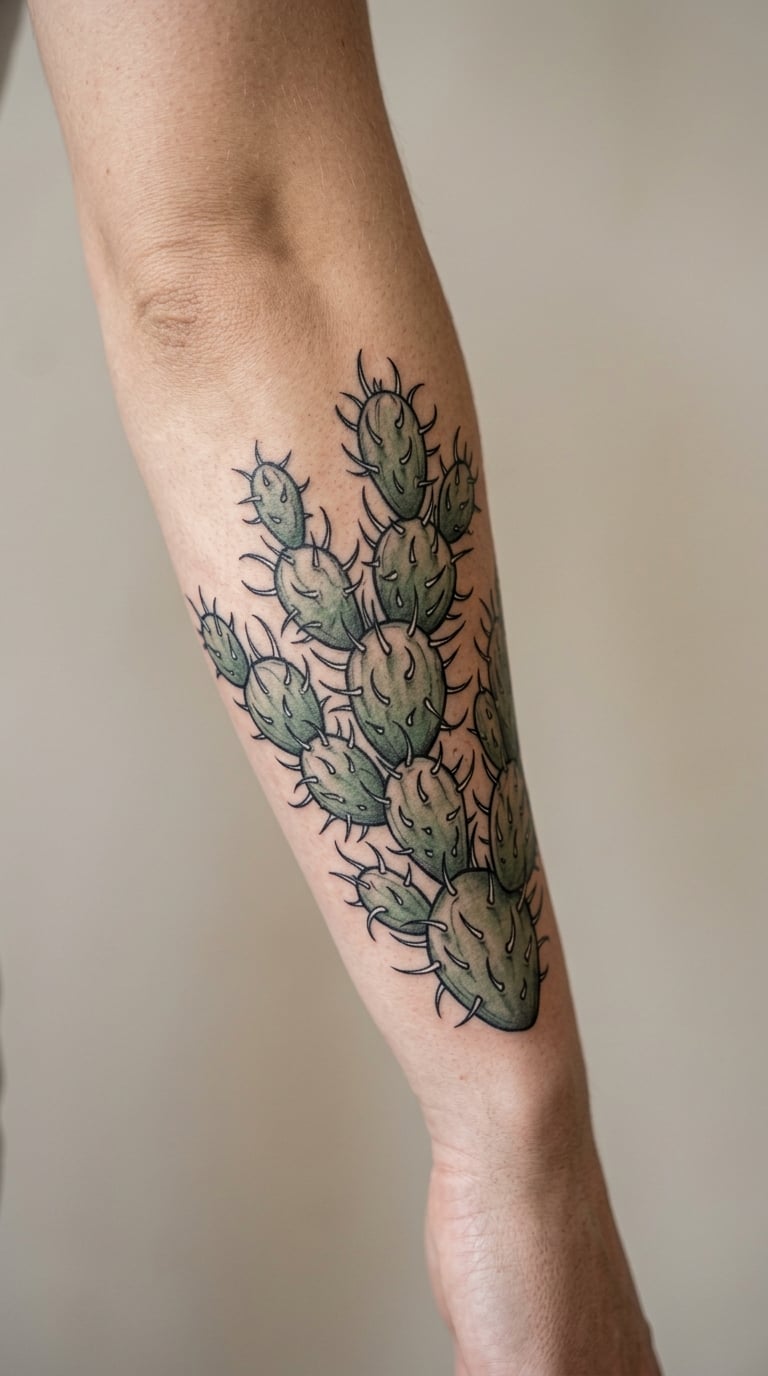
A compact foxtail cactus made from clustered teardrop segments with repeated hooked spines, all curving in the same direction to follow the body’s line. The repetition gives a small design its rhythm.
That hook direction is what separates it from every branching type in this list. It reads as texture rather than structure.
Placement: forearm, calf or along a rib · Size: 2-3 inches · Style: illustrative · Pain: medium; ribs are sensitive and the needle sits shallow there.
Make it yours: form initials subtly from three of the spine clusters rather than adding a separate letter.
16. Century Plant Spiral Design
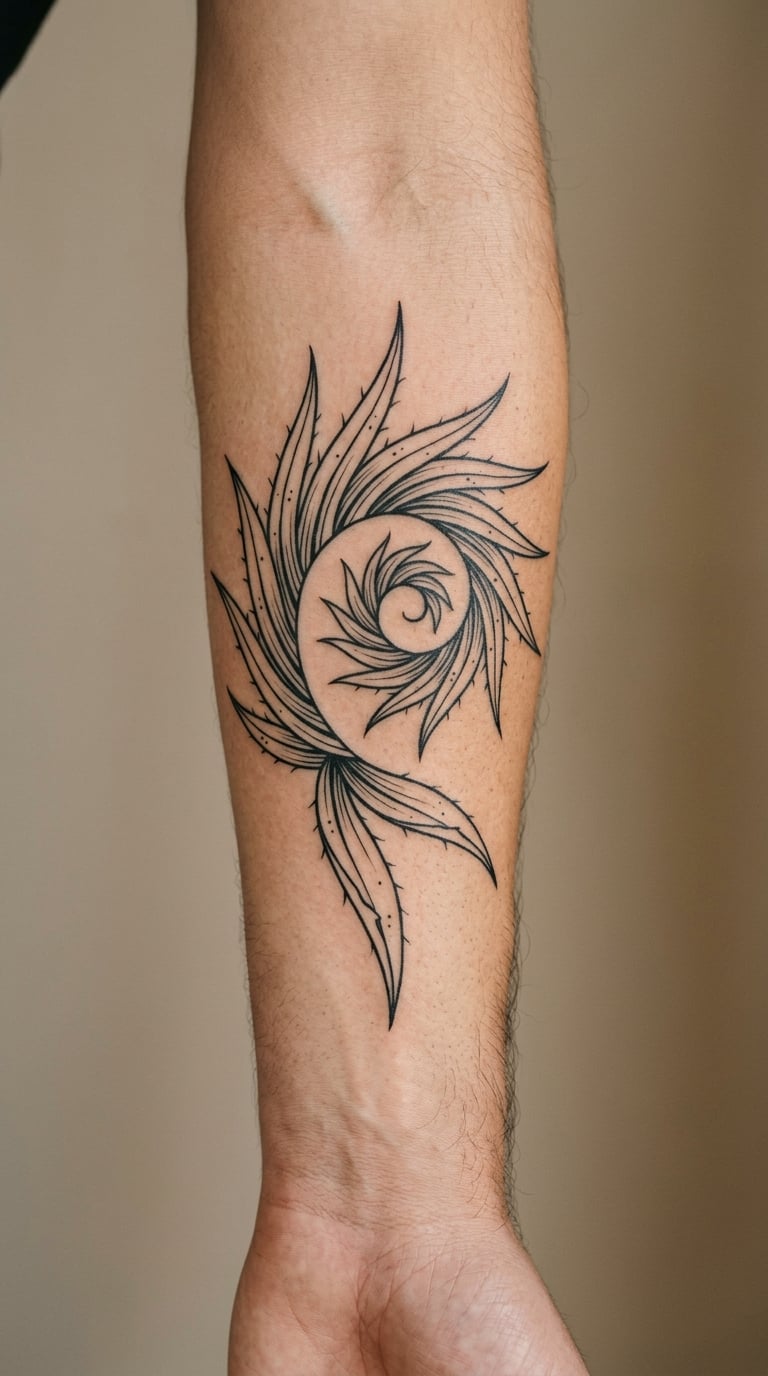
A century plant curling out from a compact base, with tapered leaves alternating around a spiral and only a few needle dots for texture. The spiral organises the whole composition.
It is worth being honest about the spiral: here it is a compositional device, not a guaranteed cultural symbol. Ask your artist what their own reference points are before you assume one.
Placement: forearm, calf or shoulder · Size: 3-5 inches · Style: fine-line botanical · Pain: medium.
Make it yours: add one small marker shape for a year you want to keep pointing at.
17. Two-Color Southwestern Saguaro
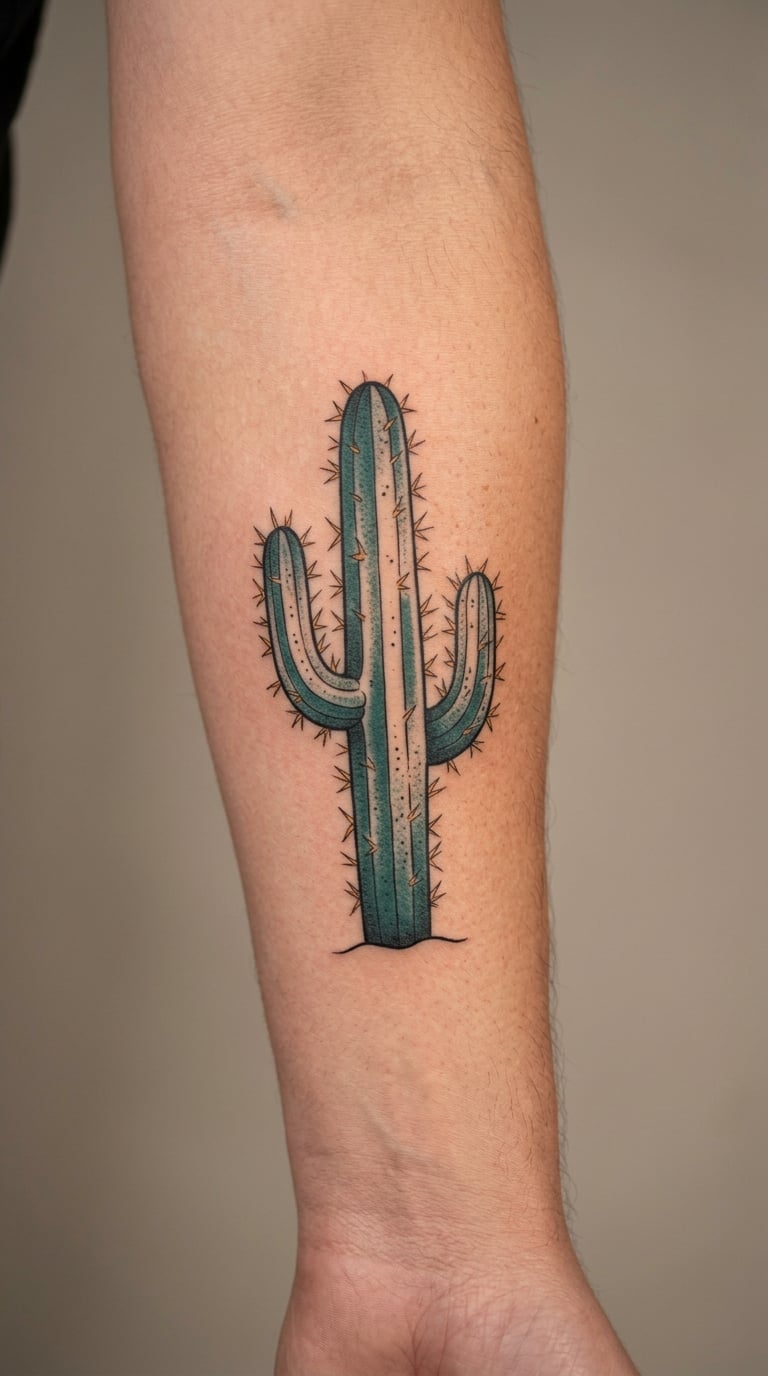
A saguaro with a deep teal-green body, warm ochre spines and simple sunbaked shading, limited to two inks. The restraint is the whole point, and the palette is original to your reference rather than copied from any existing composition.
Two colours give you a retro, playful feel without the saturation of a full colour piece. It fits a collection that already has some black work in it.
Placement: outer forearm, calf or shoulder · Size: 3-5 inches · Style: illustrative colour · Pain: medium.
Make it yours: build the palette from a sunset you actually liked, using those two hues.
18. Old West Stippled Cholla
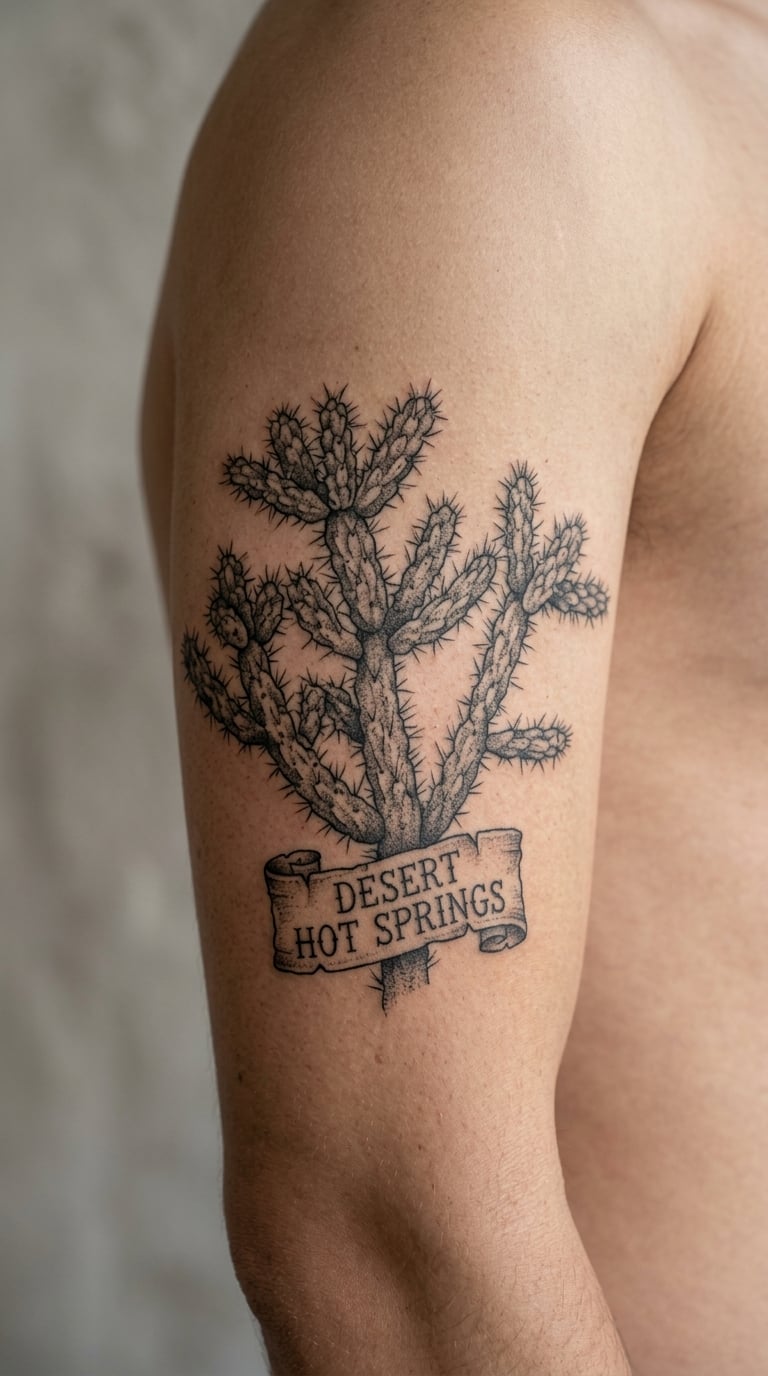
A vertically oriented cholla in black-and-grey stippling, with irregular branching and dots building the shadows. A sun-faded background wash is optional and should sit behind the plant, not merge with it.
The stipple treatment gives it an old printed look, so it works for someone drawn to vintage Western imagery rather than a modern botanical look.
Placement: outer arm or calf · Size: 3-5 inches tall · Style: illustrative realism · Pain: medium. Stipple shading means more passes and a longer sitting.
Make it yours: add a small weathered banner with a place name that matters, kept narrower than the cactus so it does not take over.
19. Mini Cactus Bouquet Behind the Ear
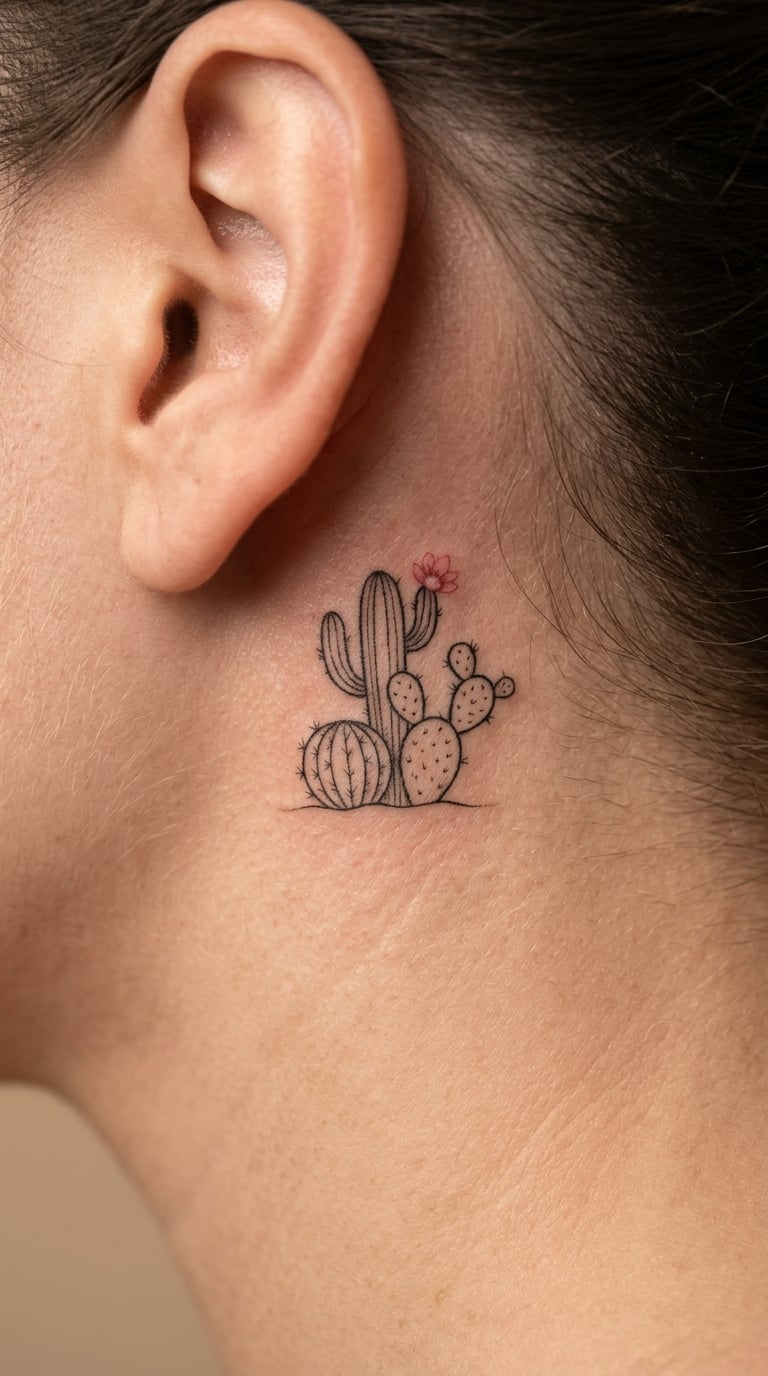
Three tiny cacti at different heights, each with a distinct silhouette, one small flower, and a fine desert-ground line that disappears behind the ear and reappears at the neck.
It is mostly decorative, though it can quietly mark a desert place from your own life. I would not attach fixed symbolism to it.
Placement: behind the ear or on the side of the neck · Size: 1.5-2.5 inches · Style: fine line · Pain: medium; the neck is sensitive even for a small piece. Ultra-fine hand and neck details often need touch-ups.
Make it yours: use your birth flowers in place of the single bloom.
20. Barrel Cactus Elbow Blackwork
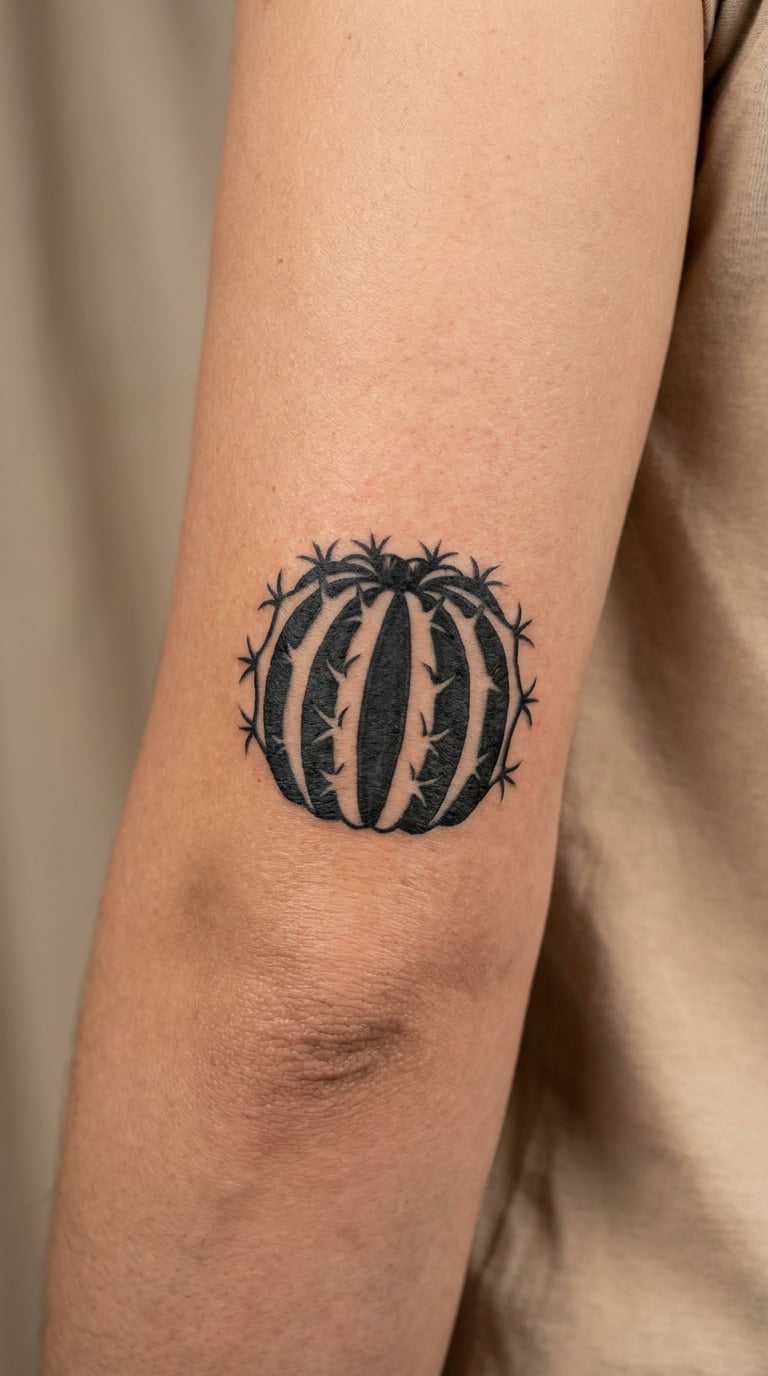
A barrel cactus built for the elbow’s curved surface, with heavy outer ribs and a lighter centre so the round form wraps the joint instead of fighting it. No background, so the joint stays the frame.
Bold shapes stay readable on a difficult curved area where fine detail disappears. This is a practical design choice as much as an aesthetic one.
Placement: inner or outer elbow · Size: 2.5-4 inches · Style: blackwork · Pain: medium to high, and elbow ink can soften and broaden as it ages.
Make it yours: add a single coloured crown-flower ring at the top of the cactus.
21. Monstera and Cactus Layered Botanical Design
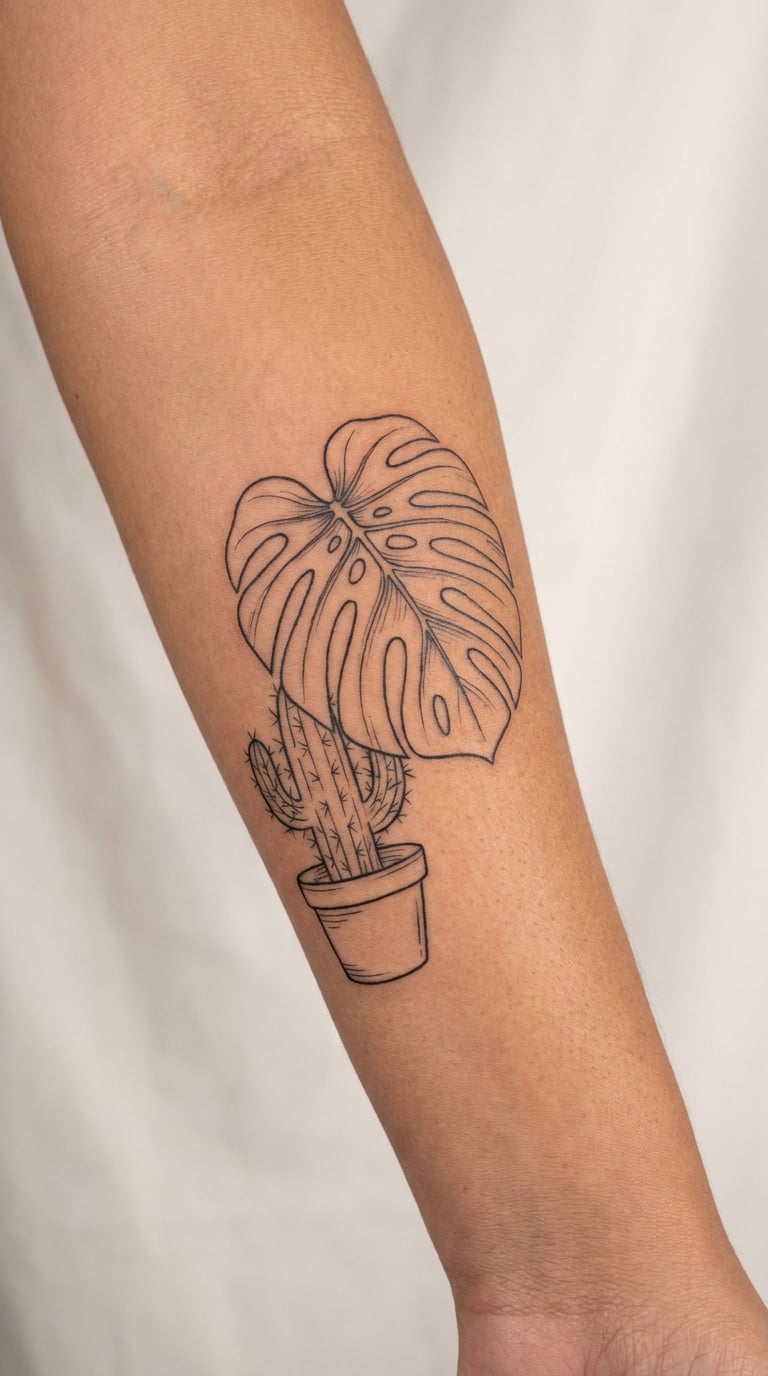
A small desert cactus placed partly behind a broad monstera leaf, with the two overlapping and drawn in contrasting styles so the composition has depth. It avoids the flat clip-art look that pairing two plants usually produces.
It suits botanical collectors who want a mixed plant piece rather than a single specimen, and it is a good fit if you are mixing these 22 desert cactus tattoo ideas into a wider plant set. If you are still building a shortlist, the [24 tattoos that symbolize growth](https://thewe.cc/tattoo-ideas-that-symbolize-growth/) picks pair well with this one.
Placement: thigh, calf or forearm · Size: 3-5 inches · Style: mixed botanical linework · Pain: medium.
Make it yours: shape the monstera leaf after a real plant you have kept, so the piece points at something specific.
22. Full Desert Scene Ankle Tattoo
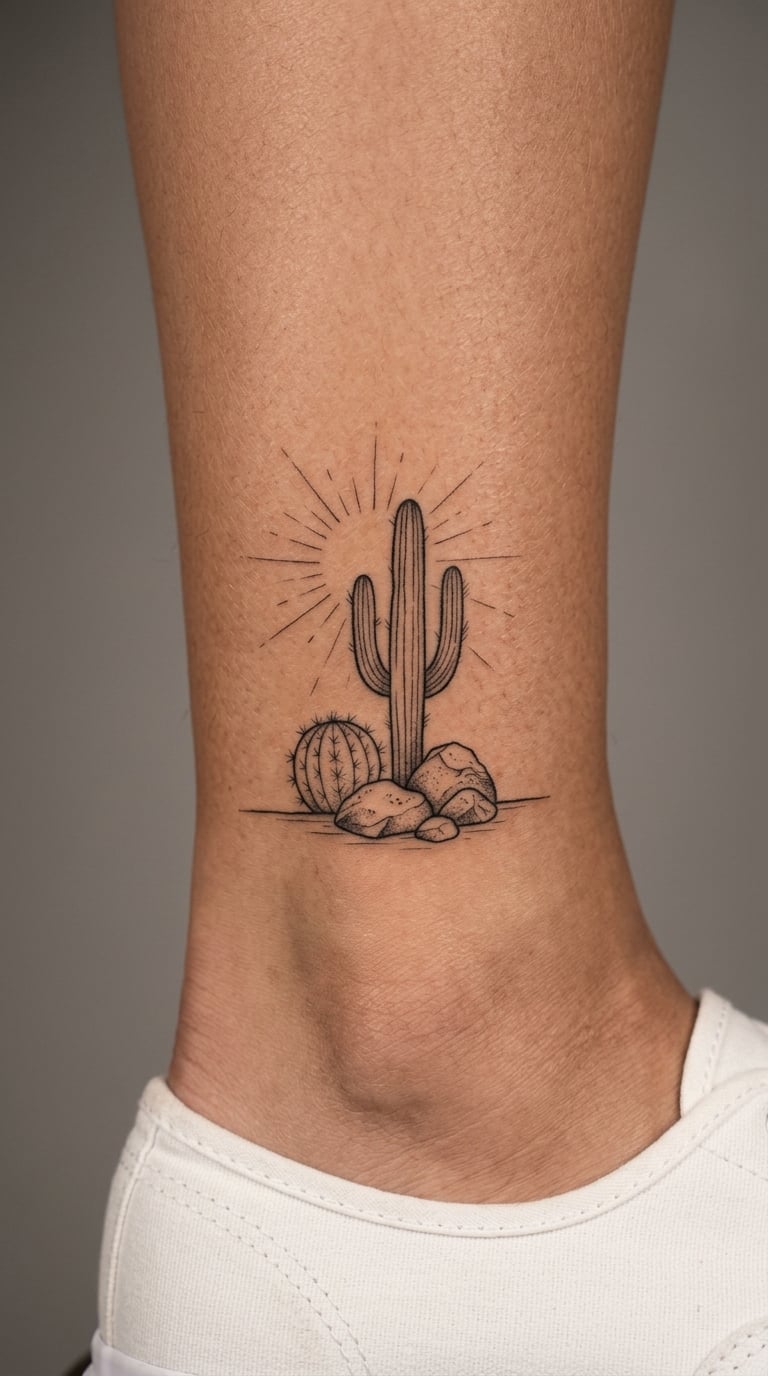
The most detailed option here: one saguaro, one barrel cactus, three small rocks, sparse sun rays and a low horizon line, composed vertically for the ankle. Every element is deliberately small so nothing competes.
A scene like this works when it is read as one composition rather than as separate plants. Viewed as a collection of icons, it falls apart.
Placement: outer or inner ankle · Size: 3-5 inches · Style: illustrative realism · Pain: medium to high, since ankle skin is thin and bony. Tiny scene details soften with age, so keep the rocks and rays simple.
Make it yours: mark a desert coordinate you have actually stood in, formatted small and low in the composition.
How to Choose the Right Design
Most disappointing cactus tattoos are not bad drawings. They are good drawings in the wrong place, or at a size the detail cannot survive. These five checks narrow the field fast.
- Line visibility. Check that the design still reads as a cactus at the size it will be, not just on the reference screen. Squint at it from arm’s length.
- Body contour. Tall vertical subjects suit the forearm, calf and outer arm. Round forms suit joints and the elbow. Horizontal clusters follow the collarbone.
- Minimum size for detail. Spines, ribs and flowers each need room. Below about 1.5 inches, drop the spines or the blossom and keep the silhouette.
- Colour or blackwork. Colour needs a lighter touch and more fading acceptance. Blackwork holds its shape longer and covers old ink more easily.
- Personal meaning. A plain saguaro reads as a home state to some people and as decoration to everyone else. If that matters, a species or arrangement other than the obvious one solves it.
Bring a clear visual reference, ideally two, and choose an artist whose portfolio already contains the style you want rather than the subject you want. The [mountain and ocean pairing ideas](https://thewe.cc/mountain-and-ocean-tattoo-ideas/) follow the same logic: landscape work is about composition, not subject.
Cost and Session Time
Custom tattoo pricing in the US varies more by artist and shop than by subject, but size and detail are the two levers you actually control. Most artists charge by the hour, and shops set a minimum that a small piece still has to meet.
- Micro work, 1-2 inches, simple linework: usually the shortest session, often under an hour.
- Small work, 2-3 inches, some shading or colour: commonly one to two hours.
- Medium work, 3-5 inches, layered detail: often two to four hours, sometimes split across two sessions.
- Large or scene pieces, 5 inches and up: commonly booked as a full day or as multiple sessions.
Complexity matters more than inches. A solid blackwork fill and a stippled background can take far longer than a larger outline-only design. Hourly rates, geography, shop minimums and consultation policies all vary, so treat any range you read, including this one, as a starting point for a conversation rather than a quote. Book the consultation first and let the artist give you a real number for your design.
Aftercare Basics
- Follow your artist’s aftercare instructions first. They know what went into your skin, and general advice can conflict with the specific work.
- Wash gently, using clean water and a mild unscented soap, and pat dry rather than rubbing.
- Keep the area clean and dry as directed, and let any film your artist describes form rather than picking at it.
- Avoid swimming, heavy friction and unnecessary sun exposure while the tattoo heals. Sun is the fastest way to fade a coloured cactus, and desert weather is not going to help.
- Contact your artist or a qualified clinician if a concerning reaction occurs, such as spreading redness, heat or discharge that does not settle.
Frequently Asked Questions
Are cactus tattoos suitable for a first tattoo?
Yes, and a minimal saguaro is one of the easier first subjects. It has a strong, simple silhouette that works at small sizes, needs little shading and usually takes a single short session. Pick an artist whose portfolio shows clean fine-line work, and skip the spines and flowers if this is your first piece.
What is the smallest useful size for a cactus tattoo?
Around 1.5 to 2 inches is the practical floor for most cactus designs. Below that, ribs, spines and flowers blur together during healing and the plant stops reading as a cactus. If you want something smaller, choose a simple silhouette such as a single saguaro or barrel and leave out the fine detail.
Do cactus tattoos hurt more on the wrist or ribs?
Ribs usually hurt more. The needle bounces off bone with little soft tissue to absorb it, and the spot stays tender for days. Wrists sting sharply and quickly because the skin is thin and the radius sits close underneath, but the pain passes faster. Forearms, biceps and calves are the comfortable middle ground for most people.
Should I choose a colored or black-and-grey cactus tattoo?
Go black and grey if you want the design to hold its shape for years or to cover an older piece. Coloured ink looks softer and more alive when fresh, and shaded colour fades faster, especially with sun exposure. A two-colour design is a good middle ground: enough warmth to be playful, not enough to fade obviously.
Can I use a real cactus as a tattoo reference?
A photograph of a real plant works well, and clear daylight photos give an artist the most usable detail. Photograph the plant from the side as well as from above, and bring a scale reference such as a coin so proportions are clear. A real cactus cannot be pressed flat like a flower, so a photo is more practical than the plant itself.
Conclusion
If this is your first tattoo, start with the minimal saguaro: one clear outline, one arm, no background, and a size you can afford to keep. If you are adding to a collection, the two-saguaro matching pair gives you a reason to keep the style consistent, and the two-color Southwestern saguaro adds colour without going loud.
Save the two or three designs from these 22 desert cactus tattoo ideas that you actually want to see healed, take those references to a consultation, and let the artist tell you which ones will still read in ten years. That is the version of this decision that tends to work out well.