
20 Snowdrop Tattoo Ideas: Best Botanical Designs (October 2026)
A snowdrop is the small white bell-shaped flower of Galanthus nivalis, and it is one of the first plants to push a bloom through frozen ground at the end of winter. That single fact is why people keep choosing it, and these 20 snowdrop tattoo ideas cover everything from a whisper-fine stem behind the ear to a full floral piece on the thigh.
It is also the January birth flower, which makes it a common gift for someone born at the start of the year, and a quiet marker for grief, recovery or a fresh start. If you are planning a piece, remember that floral bookings fill up in spring, so allow 30 to 45 days before the occasion you have in mind.
20 Snowdrop Tattoo Ideas: Quick Guide
Every design below appears in the same order as the detailed write-ups, so you can scan the table first and jump to the one that matches your placement and pain tolerance.
| Idea | Style | Best placement | Size | Pain |
|---|---|---|---|---|
| 1. Fine-line behind the ear | Fine line | Behind the ear, nape | 1.5-2.5 in (4-6 cm) | Low to medium |
| 2. Mini wrist bloom | Minimalist fine line | Inner wrist | 1-1.5 in (2.5-4 cm) | Medium |
| 3. Watercolor sleeve detail | Watercolor | Forearm, ribs | 3-4 in (8-10 cm) | Medium |
| 4. Blackwork bouquet | Blackwork | Upper arm, thigh | 4-5 in (10-13 cm) | Medium to high |
| 5. Collarbone line art | Fine line | Collarbone | 3-4 in (8-10 cm) | Medium to high |
| 6. Realistic ankle bloom | Soft realism | Outer ankle | 2-3 in (5-8 cm) | Medium to high |
| 7. Snowdrop and moon | Fine line | Forearm, calf | 2.5-3.5 in (6-9 cm) | Low to medium |
| 8. Traditional green leaves | Traditional | Shoulder, upper arm | 3-4 in (8-10 cm) | Medium |
| 9. Micro-realism finger | Micro-realism | Side of a finger | 0.5-0.8 in (1.5-2 cm) | High |
| 10. Rib sprig | Soft realism | Rib area | 3-4 in (8-10 cm) | High |
| 11. Dotwork snowdrop | Dotwork | Upper arm, calf | 2-3 in (5-8 cm) | Medium |
| 12. Forearm bouquet | Fine line and colour | Inner forearm | 3-5 in (8-13 cm) | Medium |
| 13. Gothic blackwork | Blackwork | Upper arm, back | 4-6 in (10-15 cm) | Medium to high |
| 14. Shoulder outline | Outline | Shoulder, back | 3-4 in (8-10 cm) | Medium |
| 15. Pastel color study | Pastel realism | Arm, calf | 2.5-3.5 in (6-9 cm) | Low to medium |
| 16. Back wreath | Fine line | Upper back | 8-10 in (20-25 cm) | Medium to high |
| 17. Snowdrop and fern | Fine line | Inner arm, calf | 2-3 in (5-8 cm) | Low to medium |
| 18. Remembrances date | Fine line with type | Inner forearm | 2.5-3.5 in (6-9 cm) | Medium |
| 19. Sternum minimal | Minimalist | Sternum | 2-3 in (5-8 cm) | High |
| 20. Large floral piece | Colour realism | Thigh, back | 8-12 in (20-30 cm) | Medium to high |
1. Fine-Line Snowdrop Behind the Ear
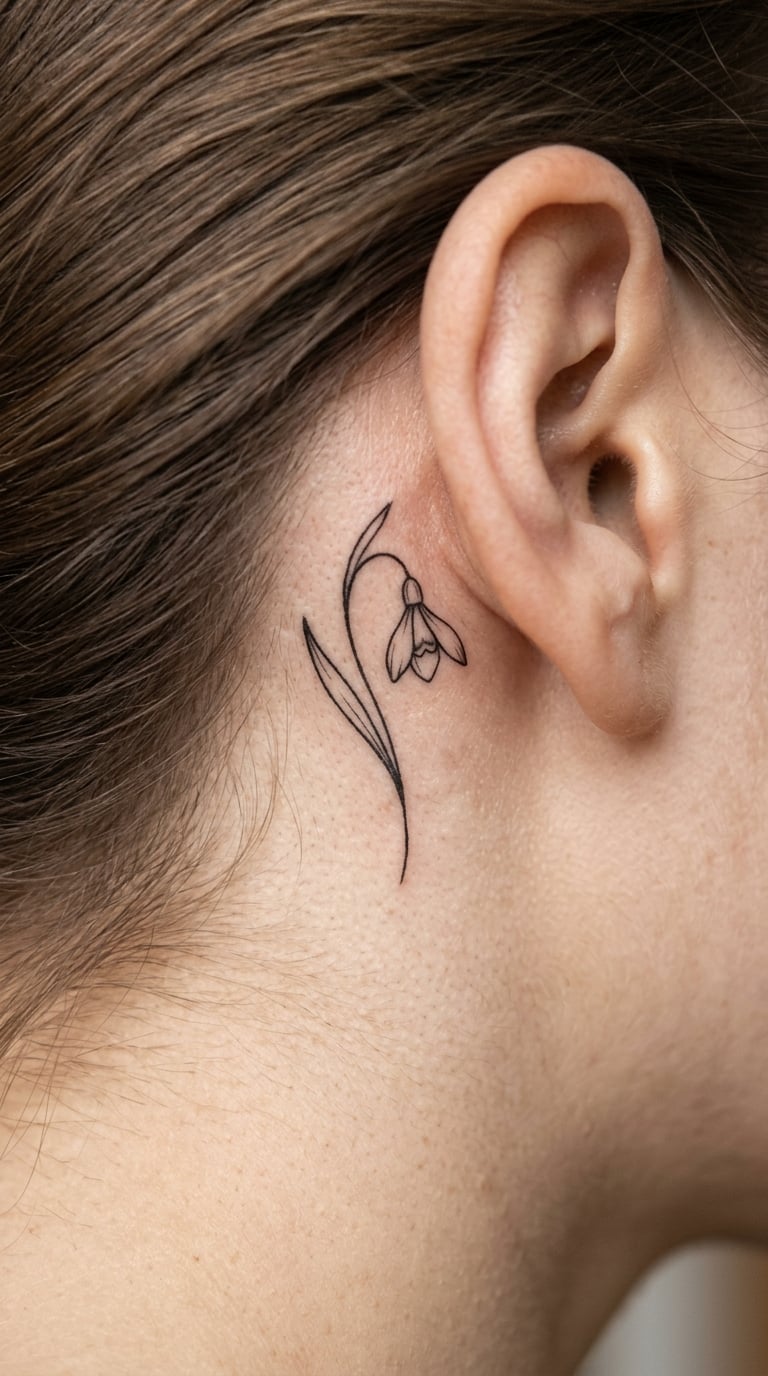
A single nodding bell on a curved stem, drawn in one clean line weight with a tiny leaf near the base, and nothing else. The restraint is the point. Fine line work behind the ear reads as a private detail rather than a statement, and most people only notice it when you tilt your head.
It suits January-born people marking their birth flower, and it works just as well for someone who wants a small piece that never competes with an outfit. Placement sits behind the ear on the neck, though the nape just below the hairline is a quieter option.
Size: 1.5 to 2.5 inches (4-6 cm) from bloom tip to stem end. Style: fine line, single-needle black. Pain: low to medium, since the skin there is thin but the area is small.
Make it yours: add the year of something that mattered, tucked under the stem in the same line weight.
2. Mini Snowdrop on the Wrist
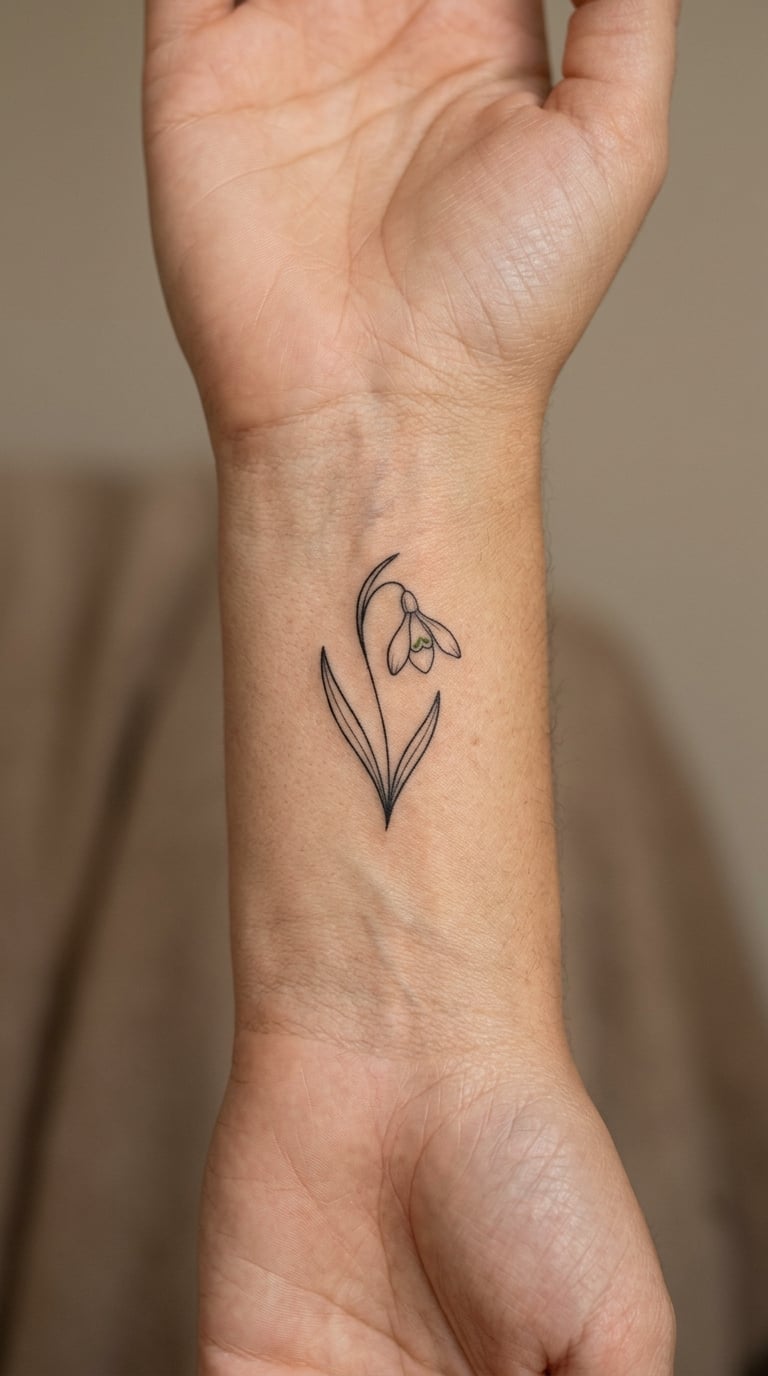
The smallest useful version of the design: one bloom, two narrow leaves, a stem no longer than your thumb, all in hairline black. On the inner wrist it sits where you can see it when you turn your hand, which is why so many people pick this spot for a first floral tattoo.
People choose it for the meaning rather than the decoration. A snowdrop is a reminder that something survives a hard stretch, and a small quiet mark suits that better than a bouquet would.
Size: 1 to 1.5 inches (2.5-4 cm). Style: minimalist fine line. Pain: medium. The wrist is bony and the veins sit close to the surface, so expect more sensation than the size suggests.
Make it yours: keep it single-colour, or add one small green wash on the leaves if you want the piece to read slightly warmer as it heals.
3. Watercolor Snowdrop Sleeve Detail
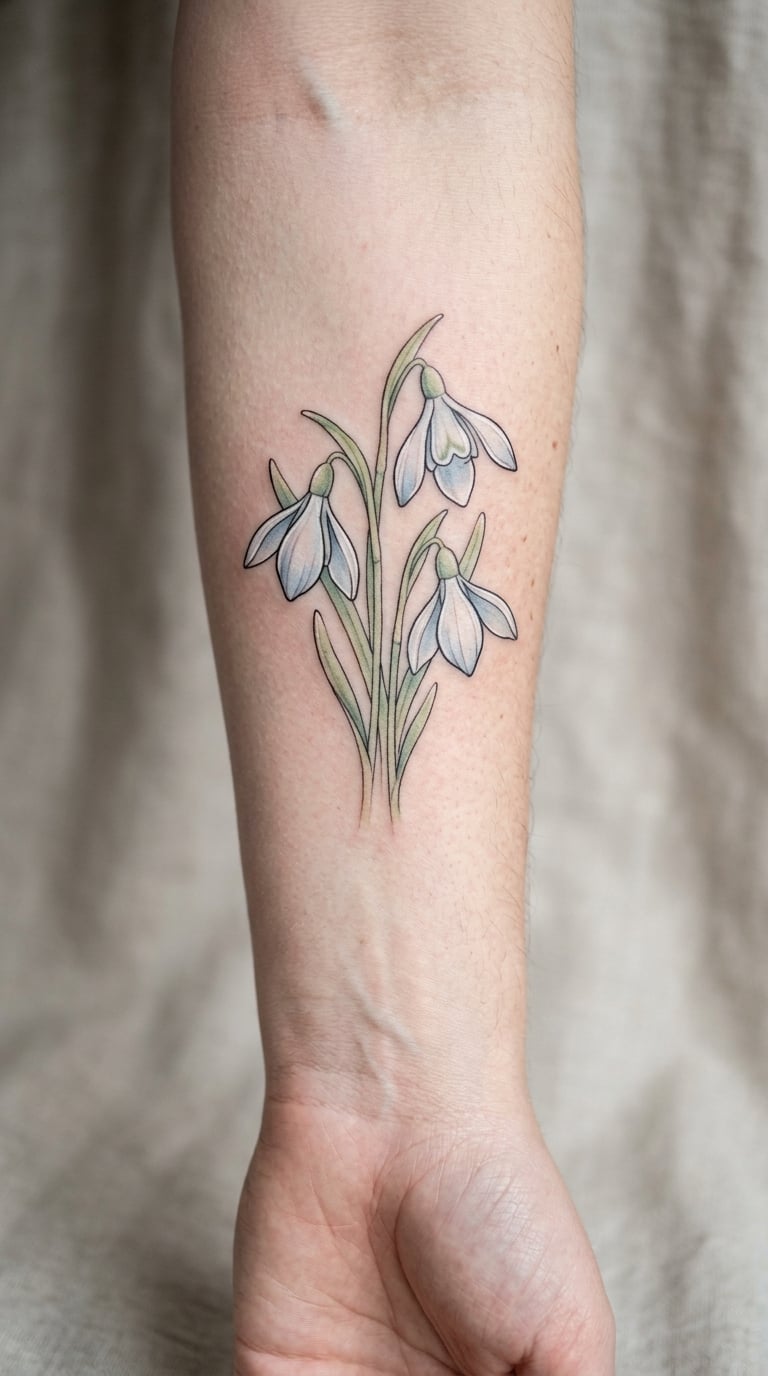
Three bells with soft blue-grey and pale green washes bleeding outward from the petals, edges deliberately soft so the cluster looks wet rather than drawn. It works on its own as a self-contained piece, and it is equally good as the first element in a botanical sleeve, sitting low on the inner forearm or beside the ribs with room left above.
It suits people who find flat black line work too severe but still want softness. A snowdrop rendered this way reads as memory-like, which is a common pull for memorial pieces.
Size: 3 to 4 inches (8-10 cm) as a cluster. Style: watercolor realism. Pain: medium, and the forearm is one of the more forgiving spots on the body.
Make it yours: add a forget-me-not or a sprig of lavender in the same wash style to widen the colour range without breaking it.
4. Blackwork Snowdrop Bouquet
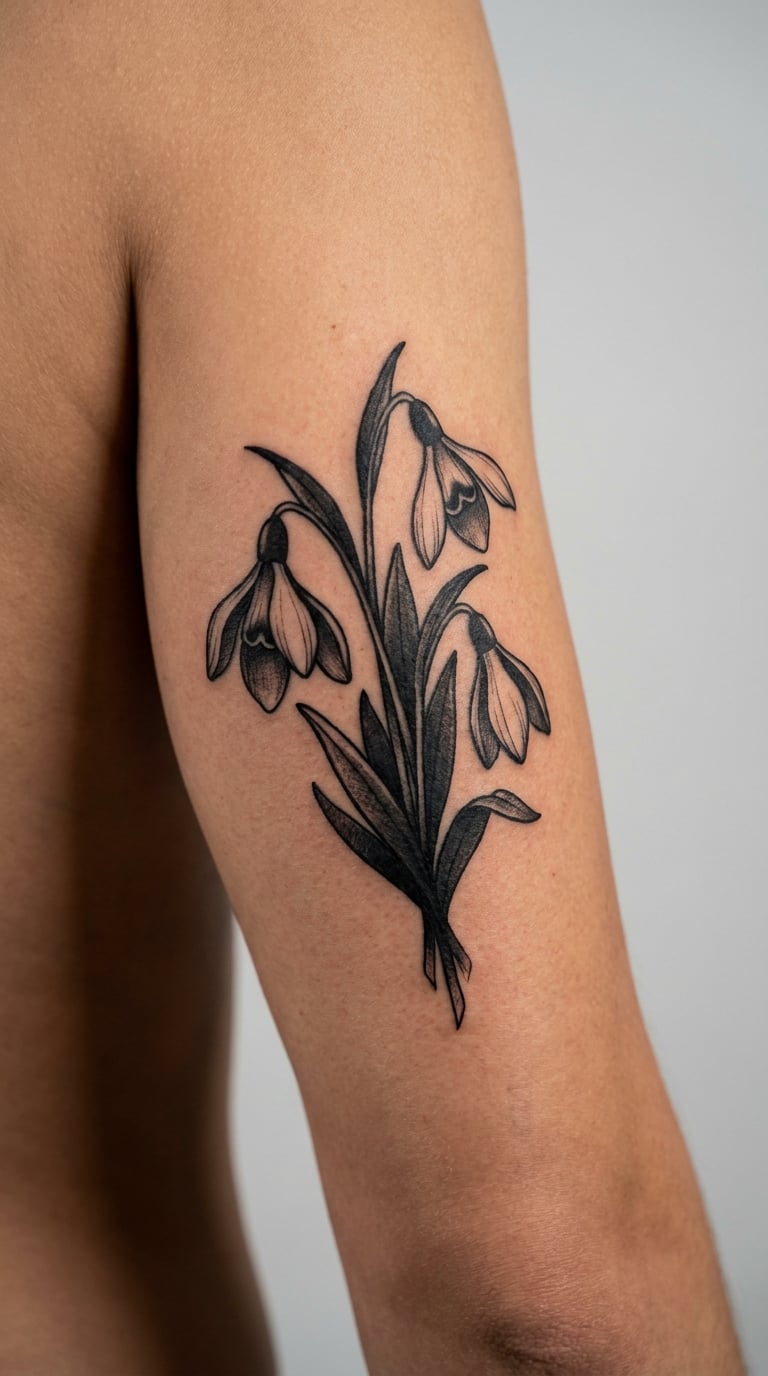
Blackwork changes the snowdrop completely. Instead of a faint white bell, you get heavy petal shadows, solid black leaves and a thick outline that gives the flower real weight on the skin. Three stems bound low read best, with the tallest bloom about twice the height of the lowest.
It suits people who want the snowdrop idea without the dainty look, and it fills a flat, broader area of skin better than a single stem ever could. Upper arm and outer thigh are the classic homes for this shape.
Size: 4 to 5 inches (10-13 cm) tall. Style: blackwork. Pain: medium to high, because solid black filling needs a few passes and the upper arm is a large canvas.
Make it yours: trade the solid black leaves for a grey-wash gradient so the bouquet keeps its weight but softens over the years.
5. Snowdrop Line Art on the Collarbone
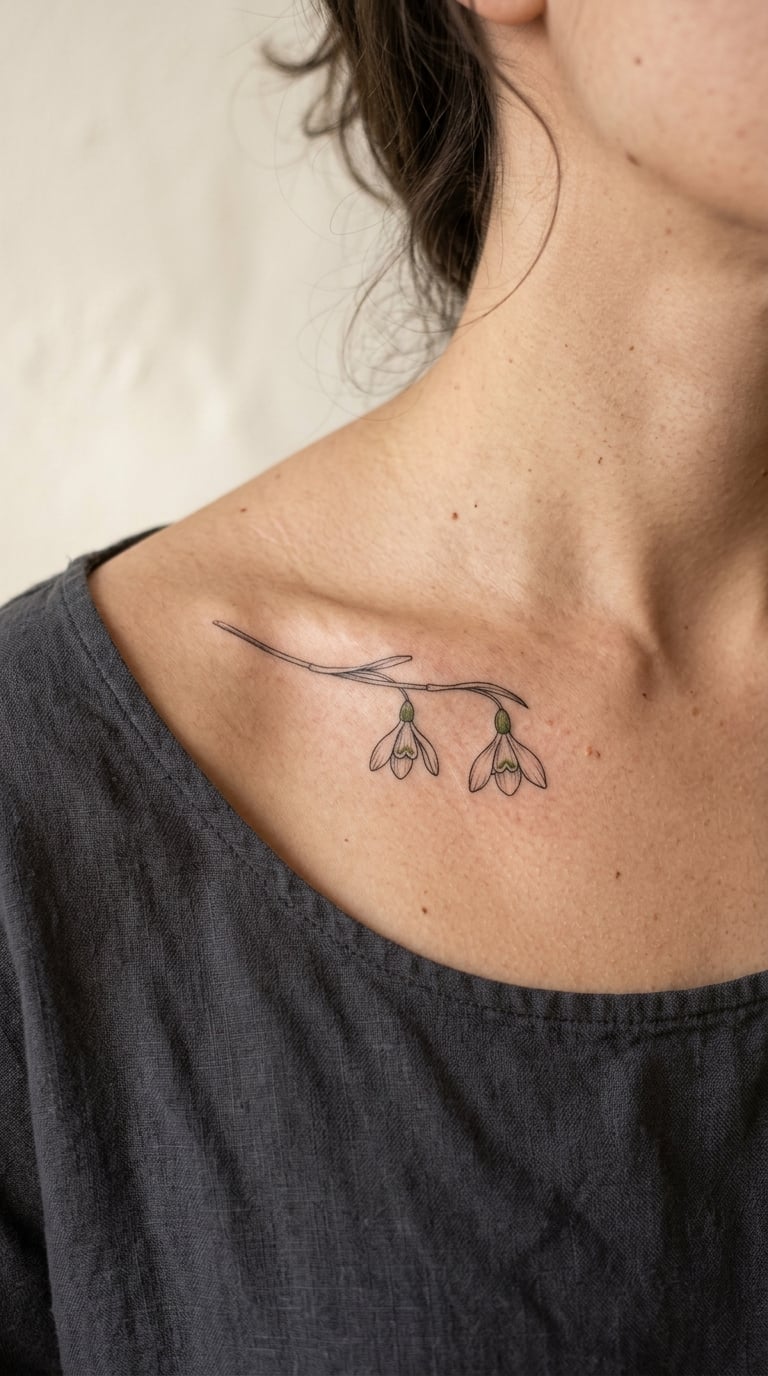
A single stem laid along the collarbone with two blossoms hanging off it and plenty of empty skin between the lines, so the bone itself supplies the curve. The composition looks like something resting on the shoulder, which is why it photographs so well flat against the collarbone line.
It suits anyone who wants a floral piece with presence but no colour. The horizontal spread also makes it easy to pair with a second stem running parallel a year later.
Size: 3 to 4 inches (8-10 cm) across. Style: fine line with open negative space. Pain: medium to high. The collarbone area is thin and the bone sits right under the skin.
Make it yours: run the stem along one collarbone and finish with a single bud just under the notch, so the piece follows the body rather than sitting on top of it.
6. Realistic Single Snowdrop on the Ankle
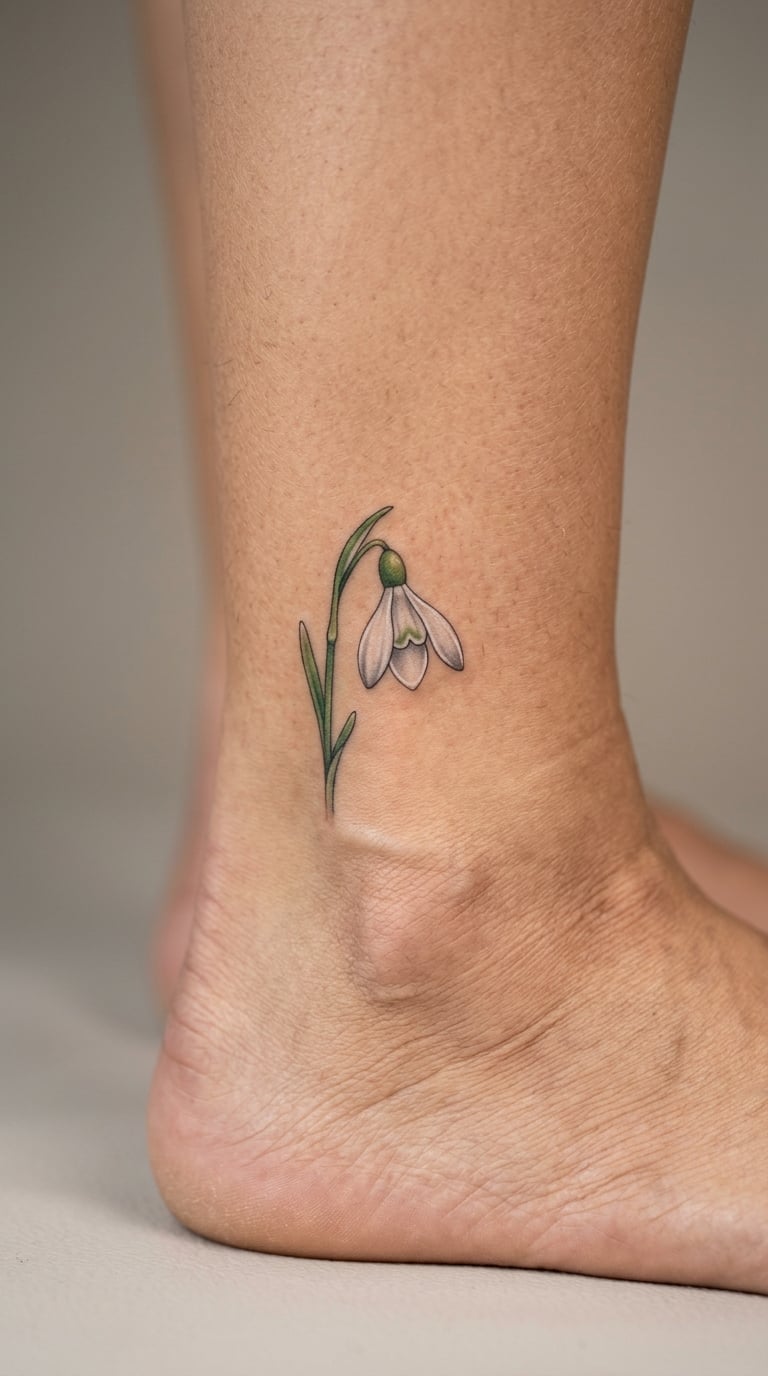
One bloom at a natural angle, petal edges drawn with faint grey shading, the small green markings at the base of the bell kept in. Ankle placement makes the piece look native to the body, almost like something growing out of the skin near the bone.
It suits people who want softness but not sweetness, and the realism reads clearly at small scale. Outer ankle and instep are both workable.
Size: 2 to 3 inches (5-8 cm). Style: soft realism with light grey wash. Pain: medium to high, since ankle skin is thin and often bony, and the nerve endings near the bone are noticeable.
Make it yours: mirror the piece onto the other ankle so the two flowers sit at the same height and read as a pair.
7. Snowdrop and Moon Fine-Line Design
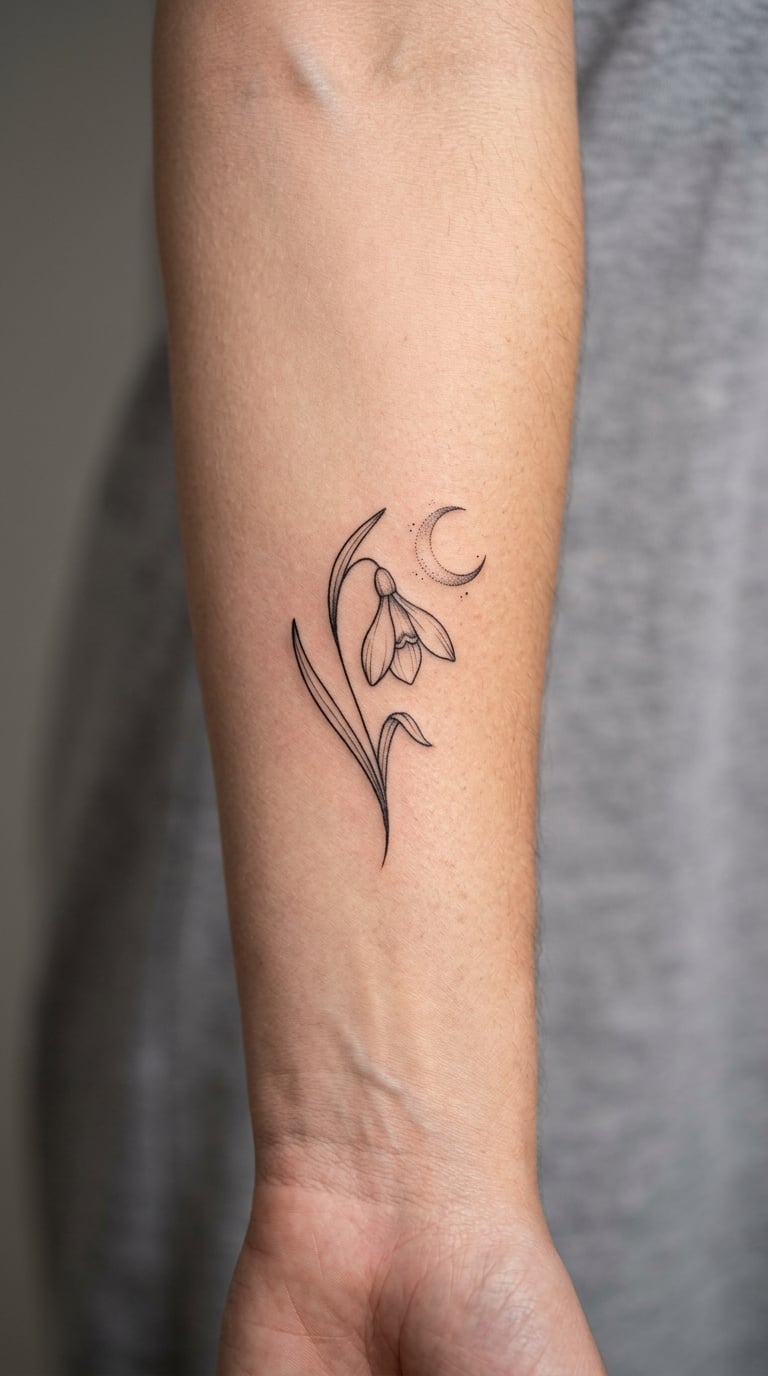
A fine-line snowdrop leaning toward a small crescent, with a few sparse dot accents scattered around the two shapes like distant stars. The composition is simple and the contrast between the organic flower and the geometric moon is what carries it.
People choose the pairing for the seasonal read: a winter bloom next to the moon that shows during winter. It suits a memorial piece as easily as a birthday one, and it works at almost any scale.
Size: 2.5 to 3.5 inches (6-9 cm). Style: fine line with dot work accents. Pain: low to medium on the inner forearm or the calf.
Make it yours: add your own birth moon phase as a small filled or open disc beside the crescent to make the pairing specific rather than generic.
8. Traditional Snowdrop with Green Leaves
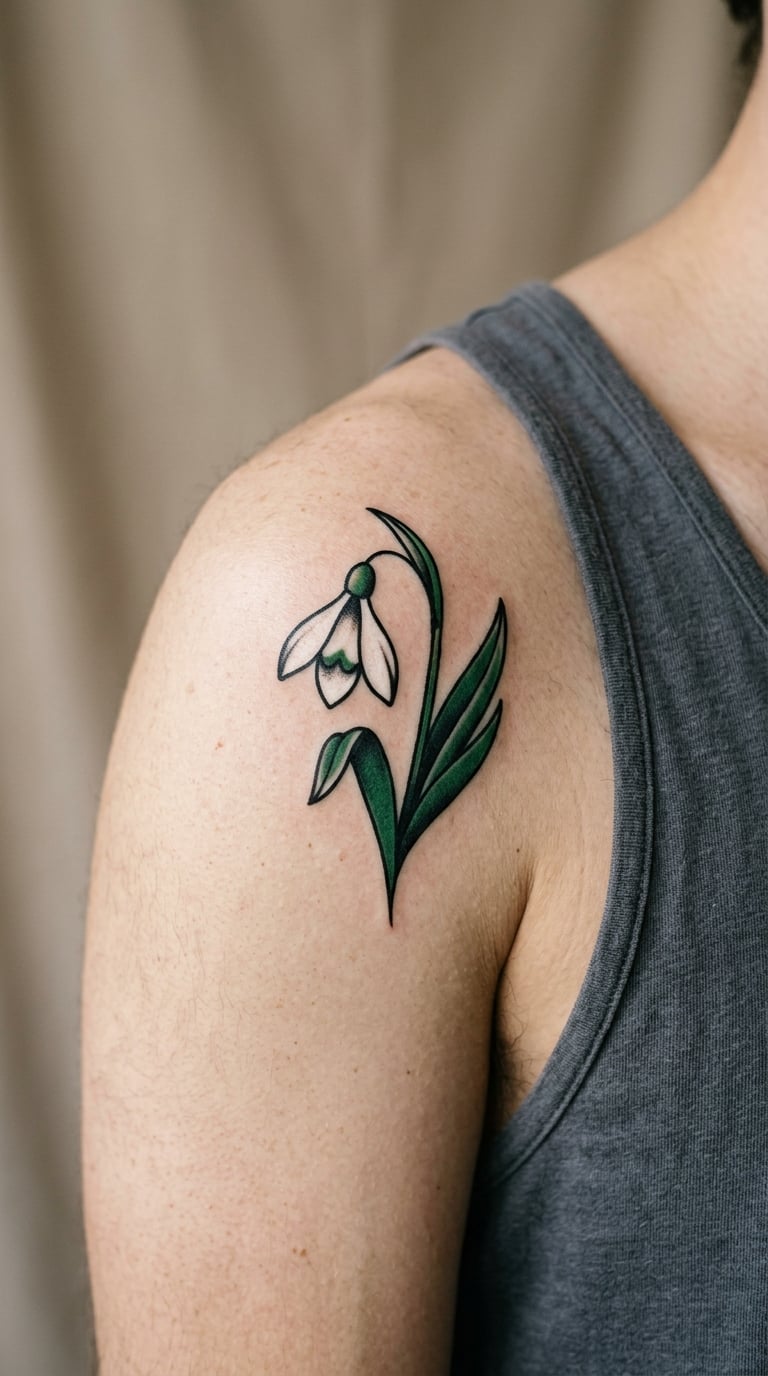
Traditional styling gives a snowdrop a bold outline, white petals filled with a small amount of shadow, and saturated green leaves with visible vein lines. A snowdrop does not look wrong in this style. It just becomes the quietest flower in a traditional sleeve, which is a nice contrast next to a rose or a peony.
It suits collectors who like a clearly tattooed flower rather than a whisper. Shoulder and upper arm handle the bold outline better than the wrist does.
Size: 3 to 4 inches (8-10 cm). Style: traditional or neo-traditional. Pain: medium, and the larger colour areas take longer to work.
Make it yours: add a small bee hovering at the bloom in the same bold outline, which fills the empty space above the flower nicely.
9. Micro-Realism Snowdrop on the Finger
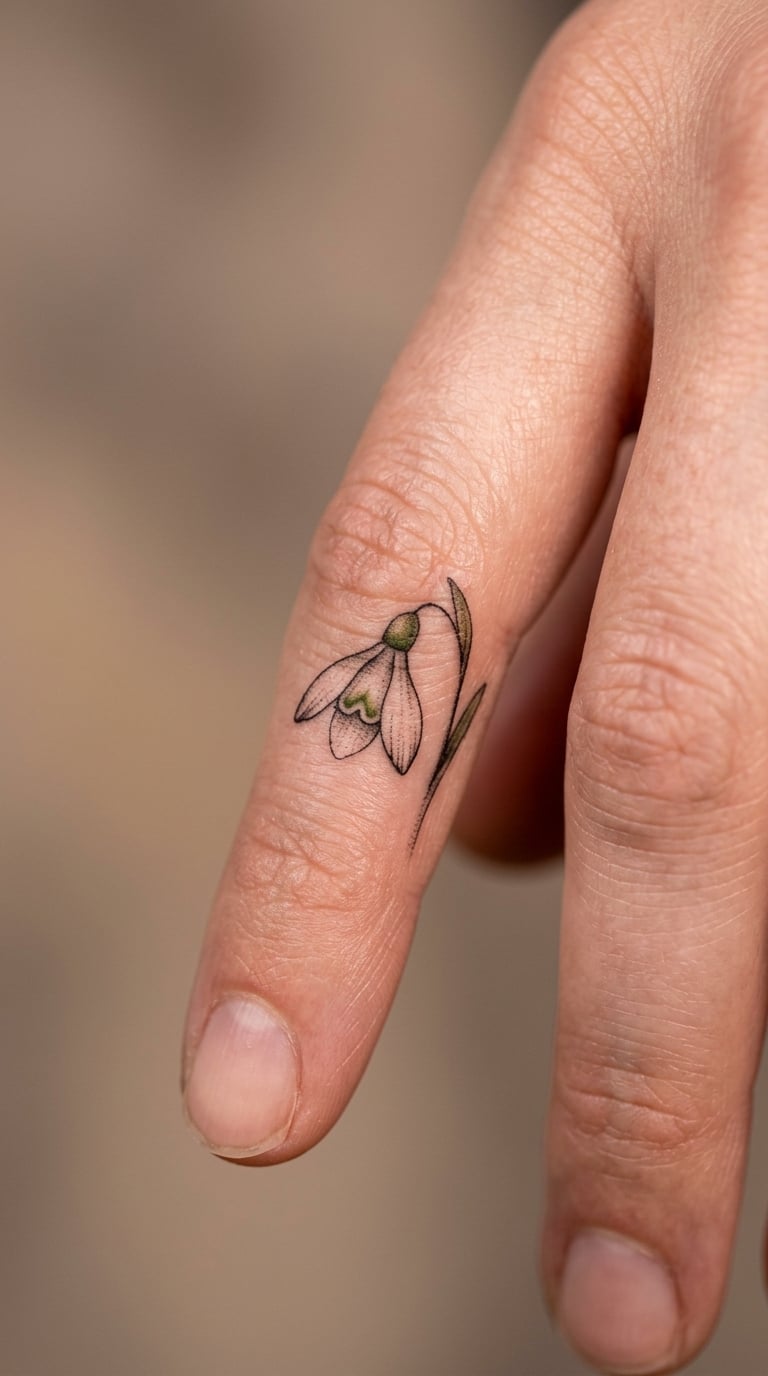
A fully rendered bell with petal texture and shading, small enough to fit along the side of a finger. The detail is the reason this one is worth planning carefully. Your artist needs steady hands and a reference photo of the actual plant, because at this scale there is nowhere to hide inaccurate work.
It suits people who collect tiny pieces and enjoy a quiet surprise on their own hand. It also carries the same meaning as the larger versions, just compressed into a very small space.
Size: half an inch to just over three-quarters of an inch (1.5-2 cm). Style: micro-realism. Pain: high. The side and underside of a finger are among the most sensitive places to be tattooed.
Make it yours: pair it with a matching micro bloom on the other hand, ideally done in the same sitting so the two pieces stay level.
10. Snowdrop Sprig on the Rib
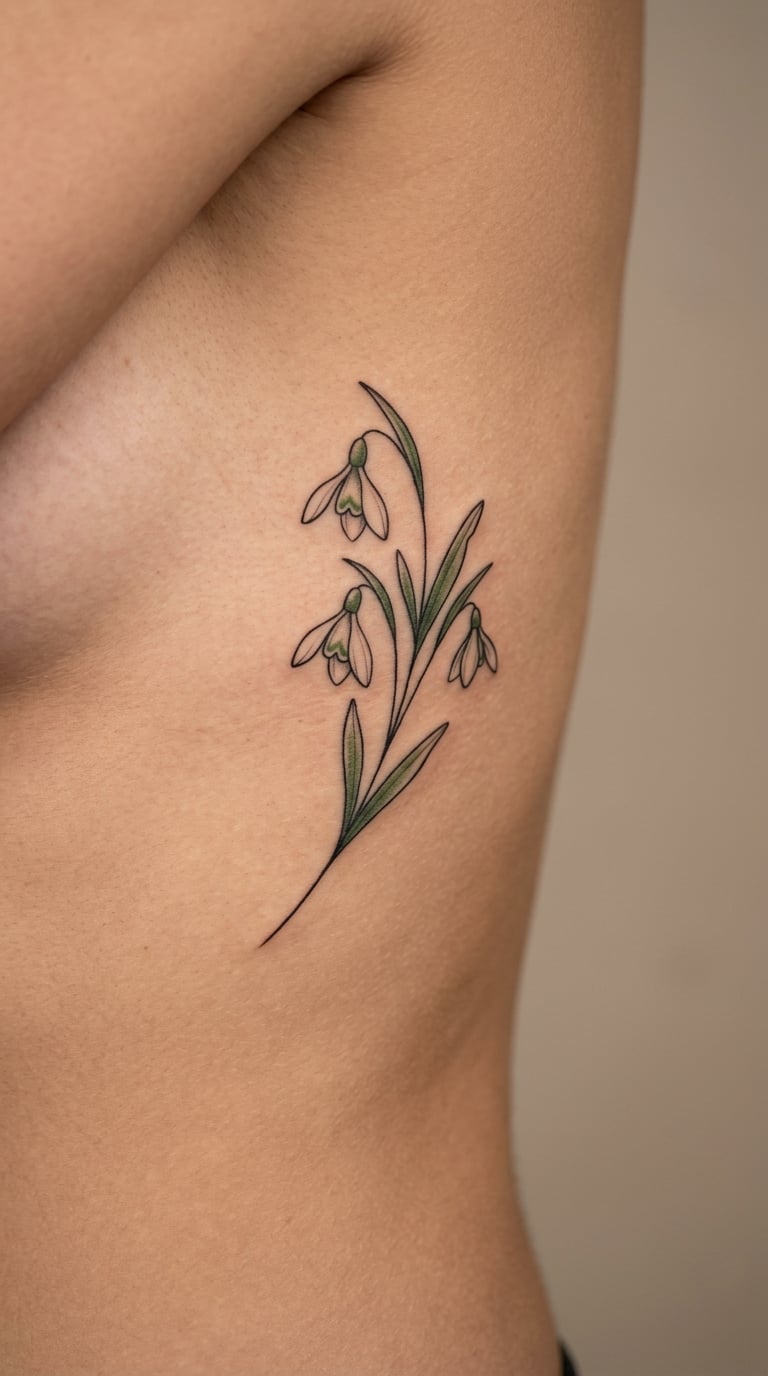
A longer sprig with several leaves and two or three blooms set at different heights, angled so the stem follows the rib cage rather than fighting it. The gentle curve is what makes rib florals work. A straight stem on a curved body looks like it was stamped on.
It suits people who like a piece with a bit of movement and are comfortable with a longer session. Floral ribs often get revisited a few months later, and that is normal for the placement.
Size: 3 to 4 inches (8-10 cm) long. Style: soft realism or fine line with muted green. Pain: high, and the ribs are one of the more talked-about placements for a reason.
Make it yours: angle the sprig away from the spine so it sits along the outer rib line, then add one tiny bud at the far end to draw the eye along the length.
11. Minimal Snowdrop Dotwork Design
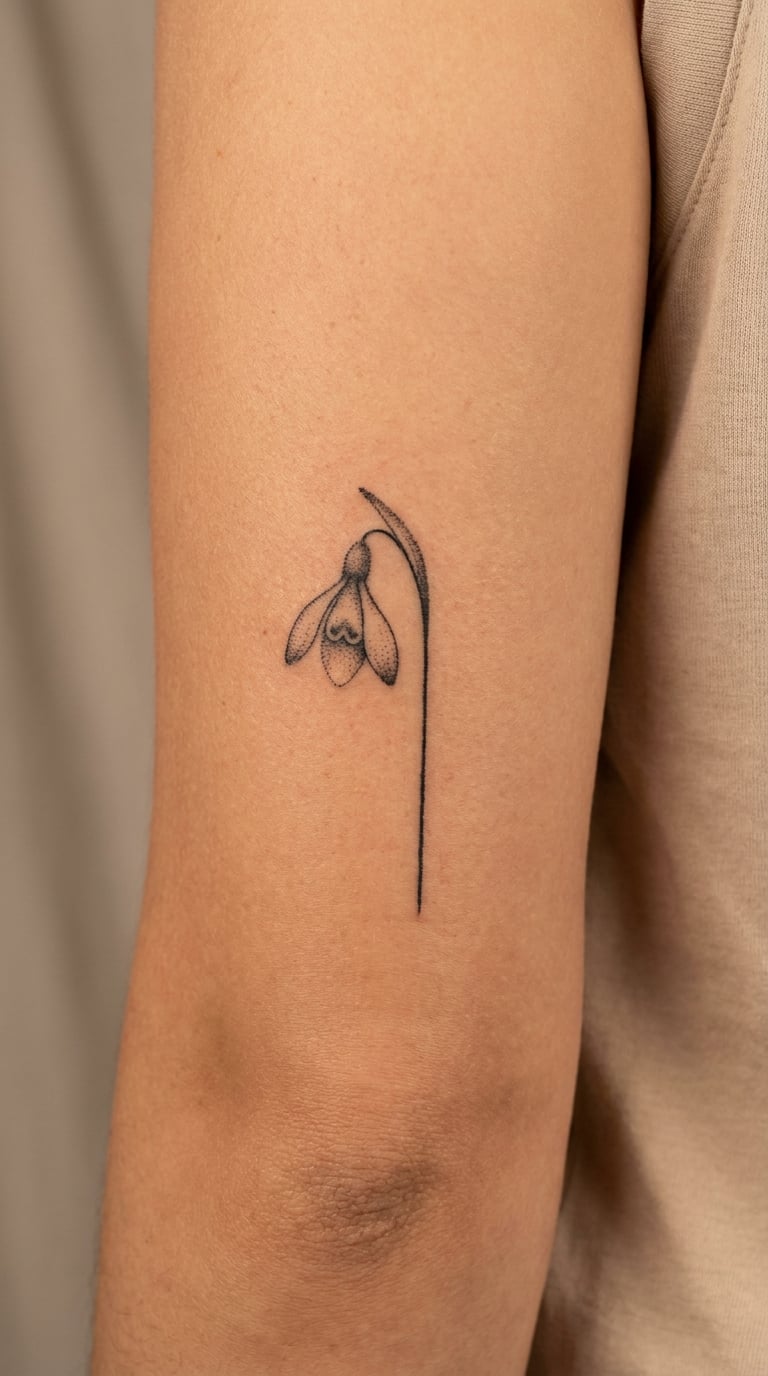
Dotwork builds the flower out of graduated dots, darkest at the base of the bell and open at the petal tips, with a single clean stem line underneath. The texture is the interest here, and it holds together better than solid black in a small size because there is no large block of ink to flatten out.
It suits people who want a snowdrop that reads as graphic rather than botanical, and it sits well next to other dotwork or constellation pieces without competing.
Size: 2 to 3 inches (5-8 cm). Style: dotwork. Pain: medium, since dotwork takes patience rather than force.
Make it yours: fade the dots out into a scattering trail below the stem, so the flower looks like it is dissolving into the skin.
12. Snowdrop Bouquet on the Forearm
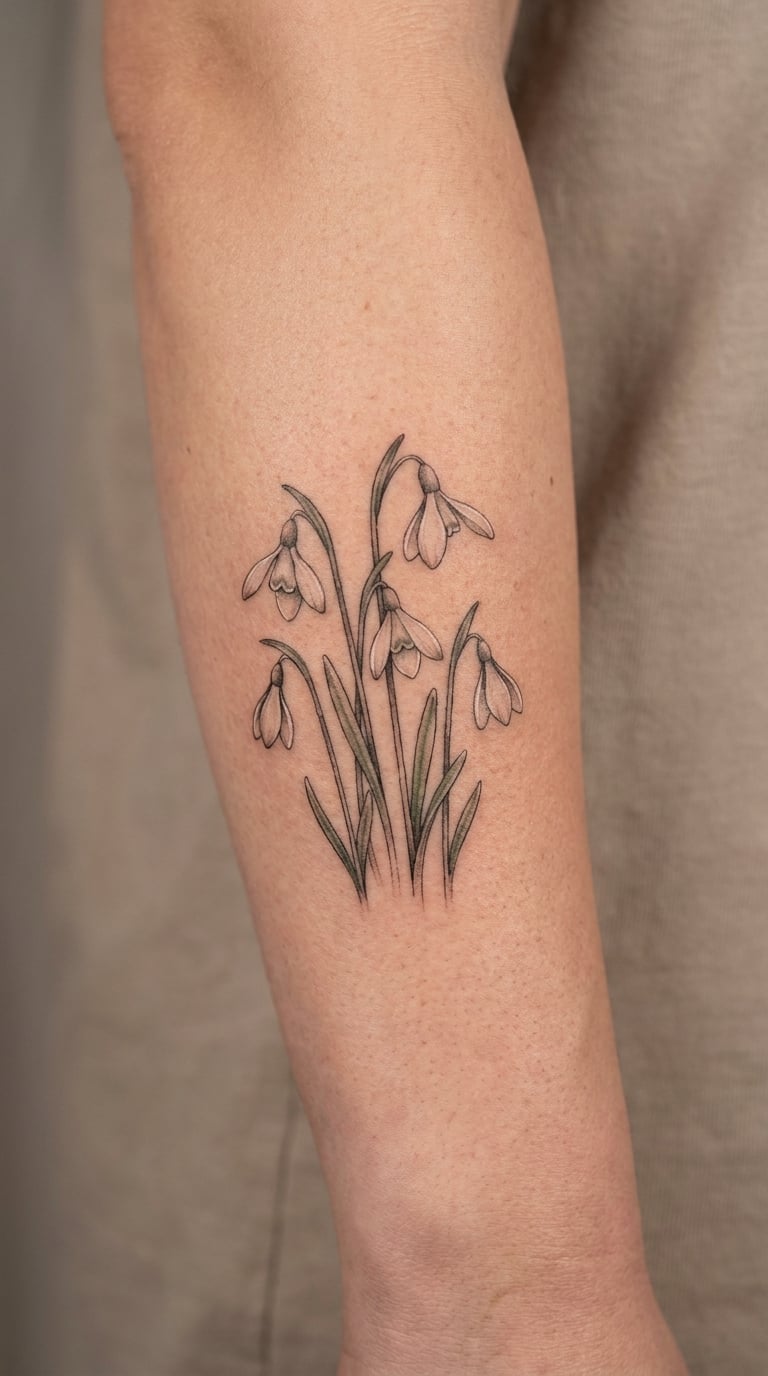
Five blooms of varied height gathered into a loose vertical cluster, with the leaves filling the gaps so no stem looks stranded. Varying the height is the whole craft here. Five blooms at the same size read as a pattern, not a bouquet.
It suits people who want more than a single flower but still want a piece they can live with at work. The inner forearm takes the composition well and keeps the reading direction natural.
Size: 3 to 5 inches (8-13 cm) tall. Style: fine line with soft colour. Pain: medium, usually completed in one session for this size.
Make it yours: tie the arrangement with a small ribbon or a thin band of leaves, which turns a loose cluster into a deliberate composition.
13. Gothic Snowdrop in Blackwork
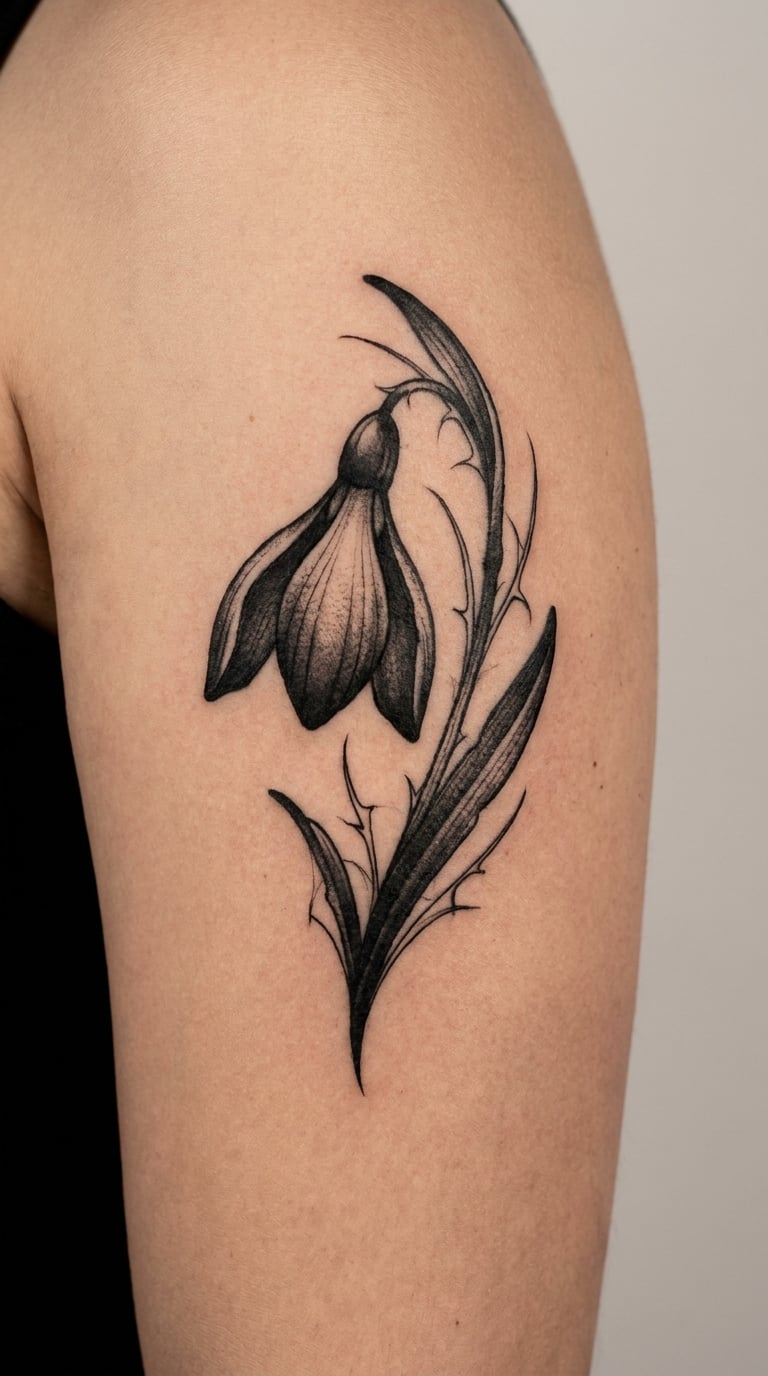
Dense black shading across the petals, heavy black leaves and a few fine curling tendrils that push the flower toward a darker, more ornamental look. The snowdrop shape stays readable underneath all of it, which is what keeps the design from becoming generic dark floral work.
It suits people who want a floral piece with an edge to it. The restrained gothic mood comes from the shading density rather than from skull or motif clichés.
Size: 4 to 6 inches (10-15 cm) tall. Style: blackwork with ornamental detail. Pain: medium to high, since layered shading over a large area takes a long sitting.
Make it yours: keep the blooms pale and let the black concentrate on the leaves and the curls, so the flower still reads as a snowdrop at a distance.
14. Snowdrop Outline on the Shoulder
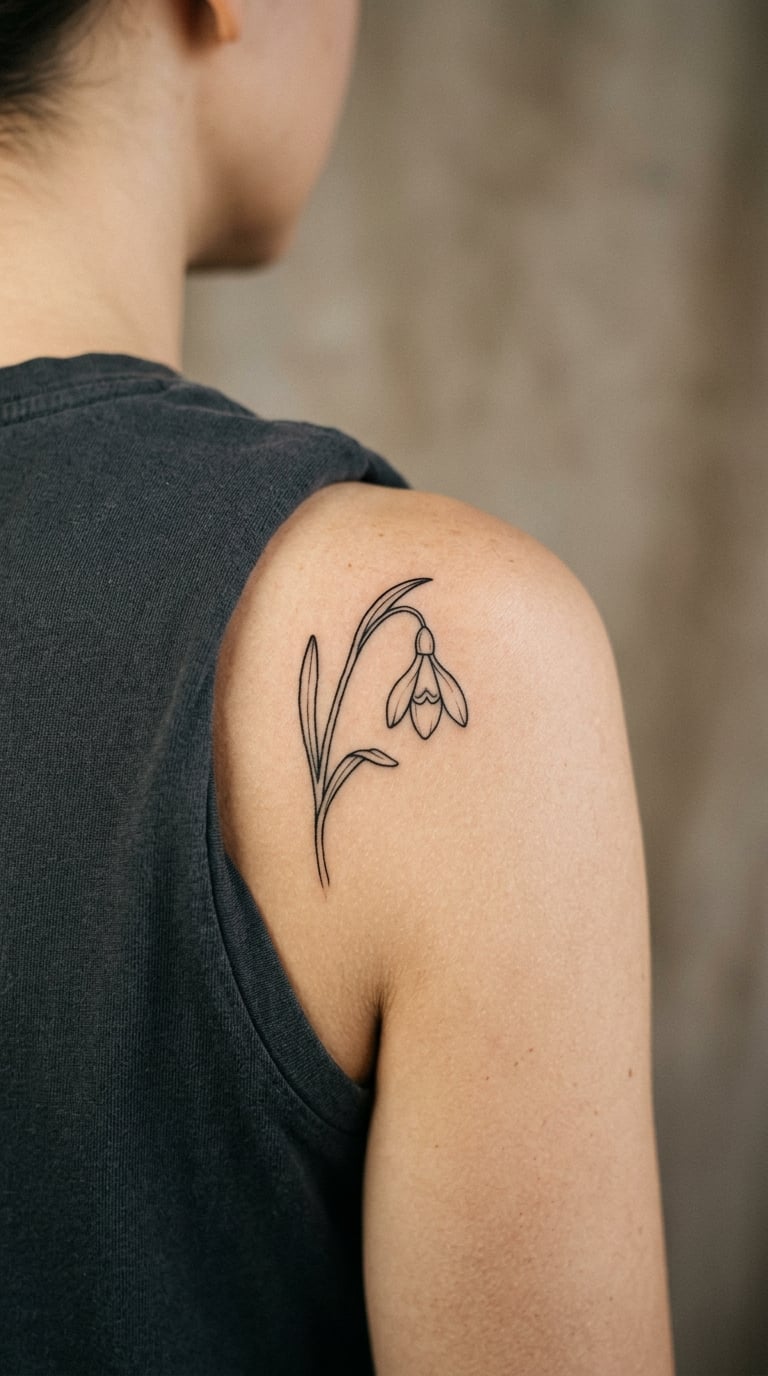
A single black outline, no fill and no shading, of one flower on a curved stem. Outlines are the most reliable way to keep a small design legible, because there is no grey to spread or thin line to blur. On the shoulder you have enough flat area to run the stem long and curved.
It suits people who like graphic simplicity and want something that will still look sharp in ten years. It is also a good first tattoo, since the session is short and the finish is forgiving.
Size: 3 to 4 inches (8-10 cm). Style: single-weight outline. Pain: medium, and the shoulder gives you a curved surface the stem can follow.
Make it yours: draw the stem long and bare, with leaves only near the bloom, and the design reads as a study rather than a sticker.
15. Pastel Snowdrop Color Study
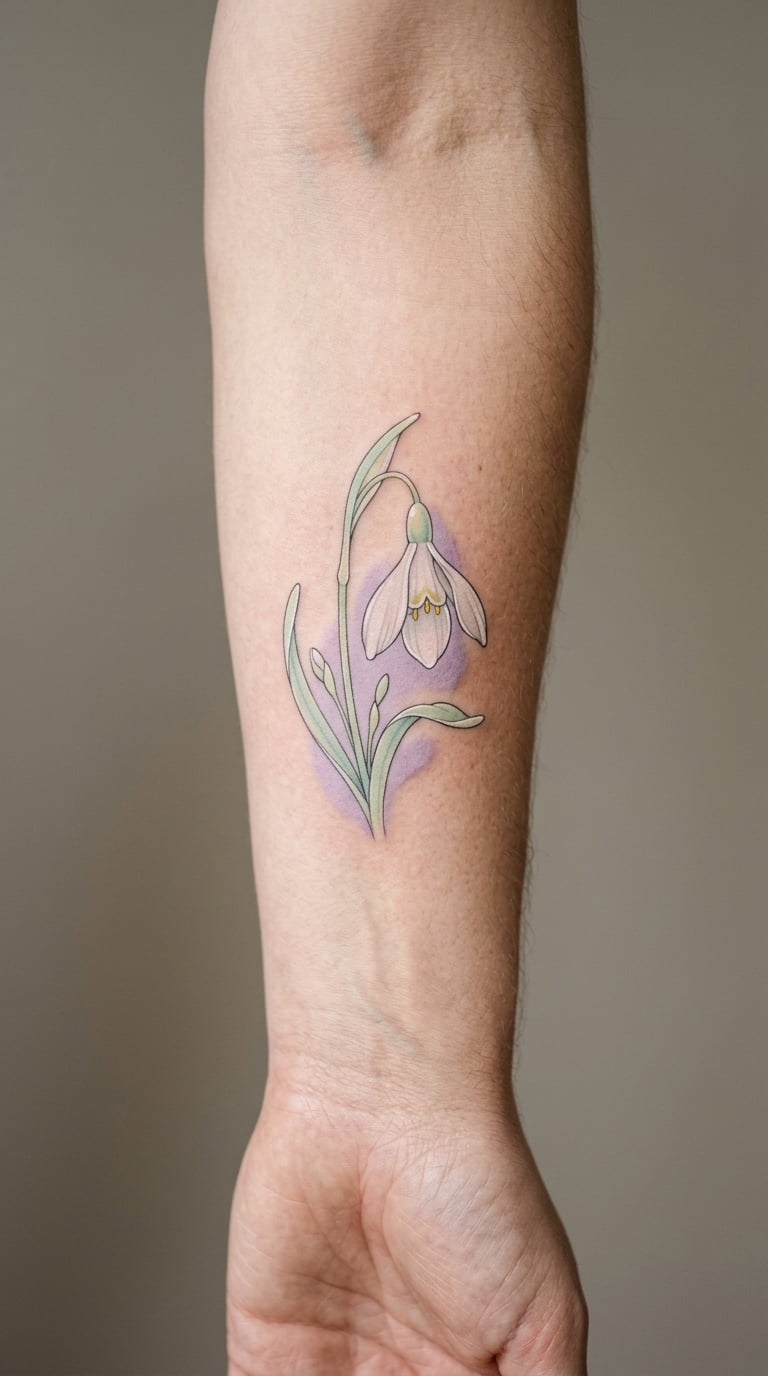
White petals with a faint lavender shadow underneath and pale green leaves, all kept light so nothing saturates. The palette is restrained on purpose. Pastel work reads as calm, and the cool tones suit a flower that belongs to the tail end of winter.
It suits people who want colour but not a bright tattoo, and it is a good option if you already have one bold piece and want something quieter beside it.
Size: 2.5 to 3.5 inches (6-9 cm). Style: pastel realism. Pain: low to medium on the arm or calf.
Make it yours: pick two accent shades rather than one, so the shading has somewhere to travel and the piece does not wash out.
16. Snowdrop Wreath on the Back
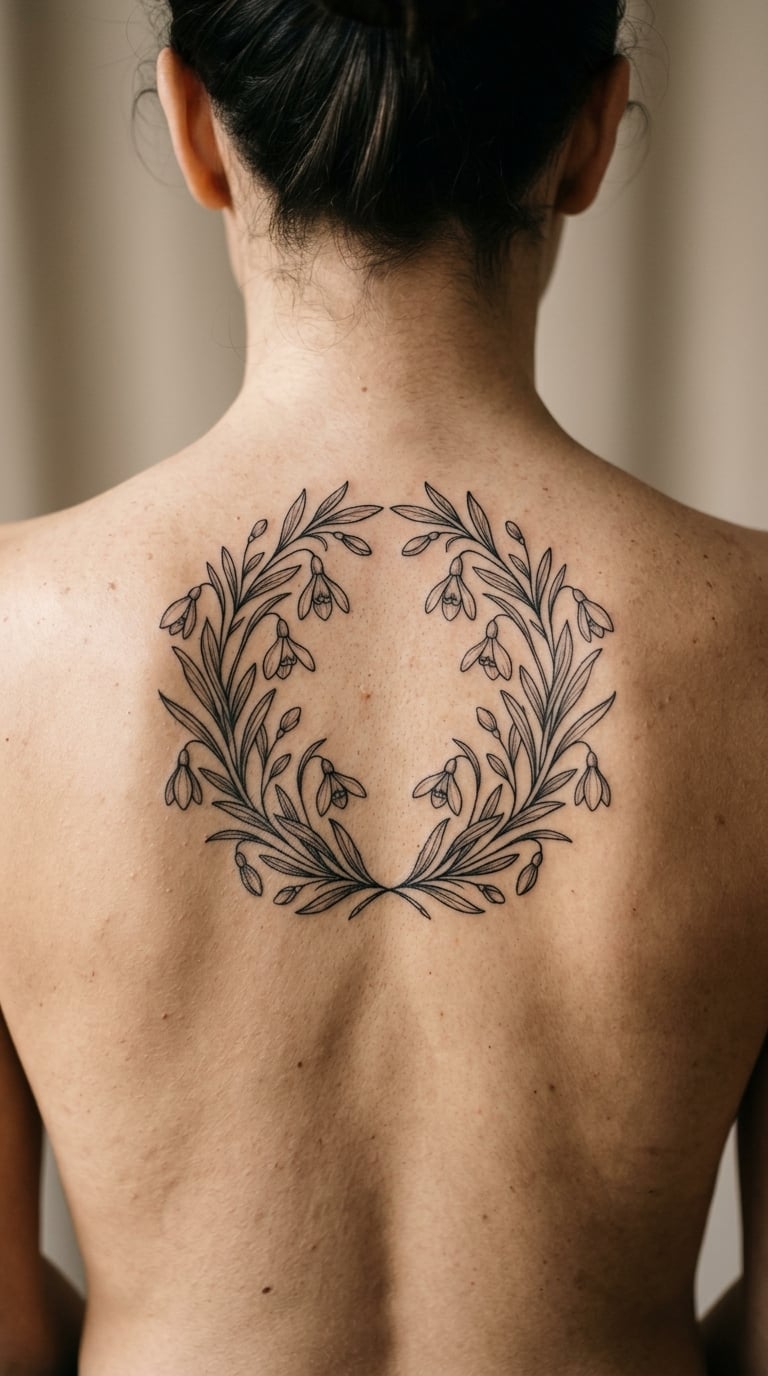
A circular wreath of fine-line snowdrops and slender leaves, closed or open at the bottom, centred between the shoulder blades. Symmetry is the whole brief here, and it needs a wide, flat area to sit properly without the curve of the ribs pulling the circle out of shape.
It suits people with a larger back area who want one design rather than a collection. Wreaths also work well as memorial pieces, since the circle reads as something continuing.
Size: 8 to 10 inches (20-25 cm) across. Style: fine line botanical. Pain: medium to high, and expect the session to run long.
Make it yours: leave the wreath open at the base and add a small date beneath the opening, which keeps the circle from feeling closed off.
17. Snowdrop and Fern Matching Piece
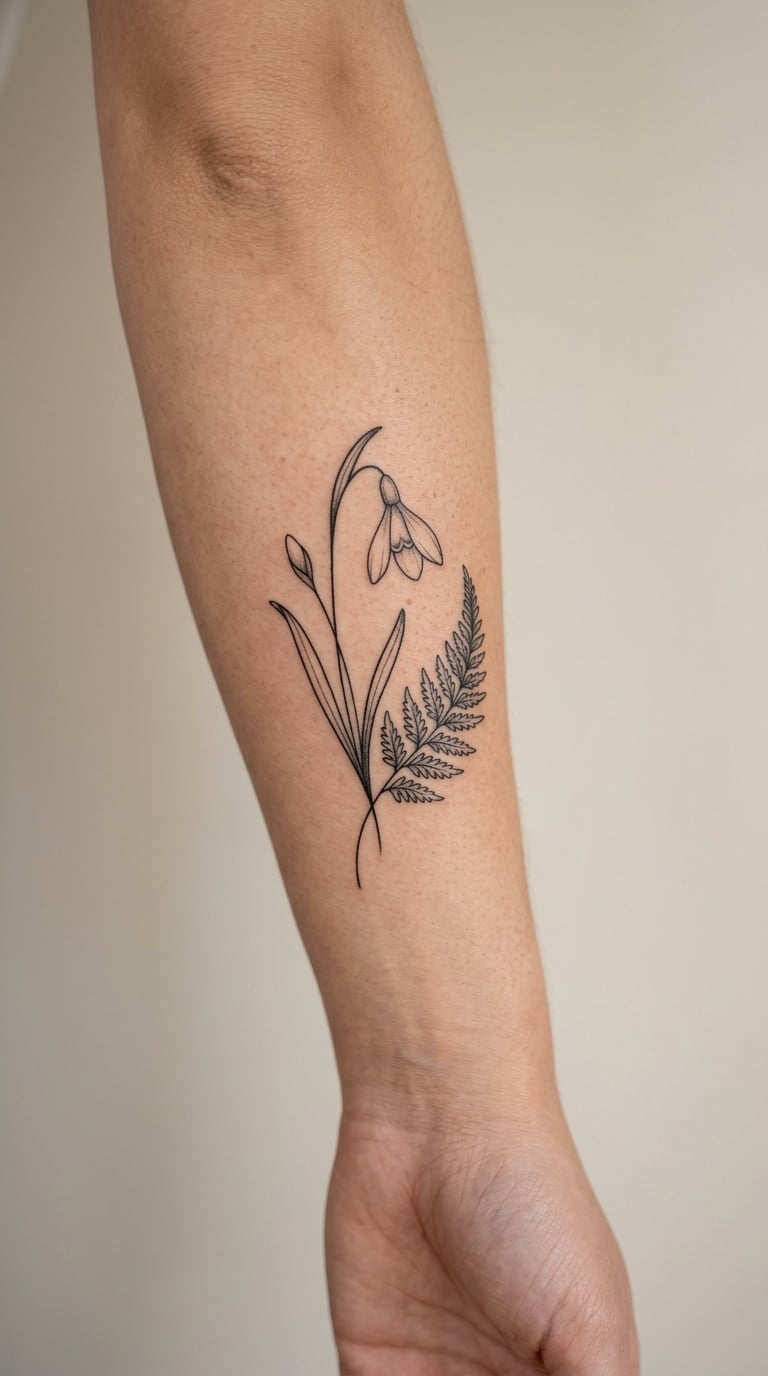
A snowdrop and a small fern branch at the same scale, drawn in matching line weight so neither dominates. Pairings like this are popular because both flowers carry understated meanings, and the composition looks considered rather than decorative.
It suits couples, siblings or friends matching a piece, and it works for anyone who wants two flowers without the visual weight of a full bouquet. The inner arm, calf and behind the ear all take a pair like this well.
Size: 2 to 3 inches (5-8 cm) per piece. Style: fine line. Pain: low to medium on the arm.
Make it yours: place the pair about an inch apart on the same side, so the two flowers read as one composition until you look closely.
18. Snowdrop with Remembrances Date
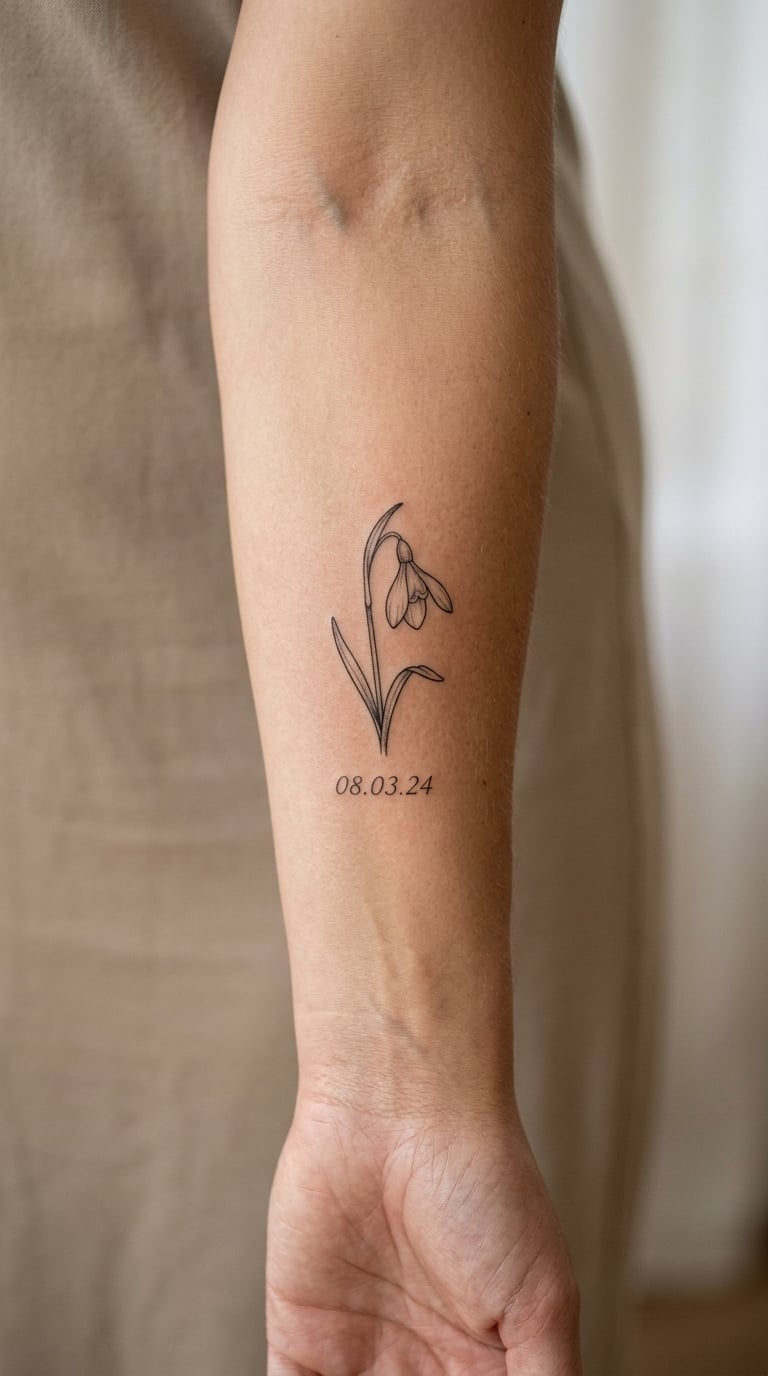
A fine-line snowdrop with a small date set beneath the stem in a thin, plain hand, kept small enough that the flower is still the first thing you notice. A date turns a botanical piece into a memorial one, and most people who get it say the combination is what makes it feel personal rather than decorative.
It suits anyone marking a loss, an anniversary or a difficult year. Keep the type small and simple, since ornate lettering on a small floral design competes with the flower.
Size: 2.5 to 3.5 inches (6-9 cm) including the type. Style: fine line with simple typography. Pain: medium on the inner forearm.
Make it yours: keep the date in plain numerals rather than a script face, and leave enough gap between stem and numbers that both stay readable.
19. Minimal Snowdrop on the Sternum
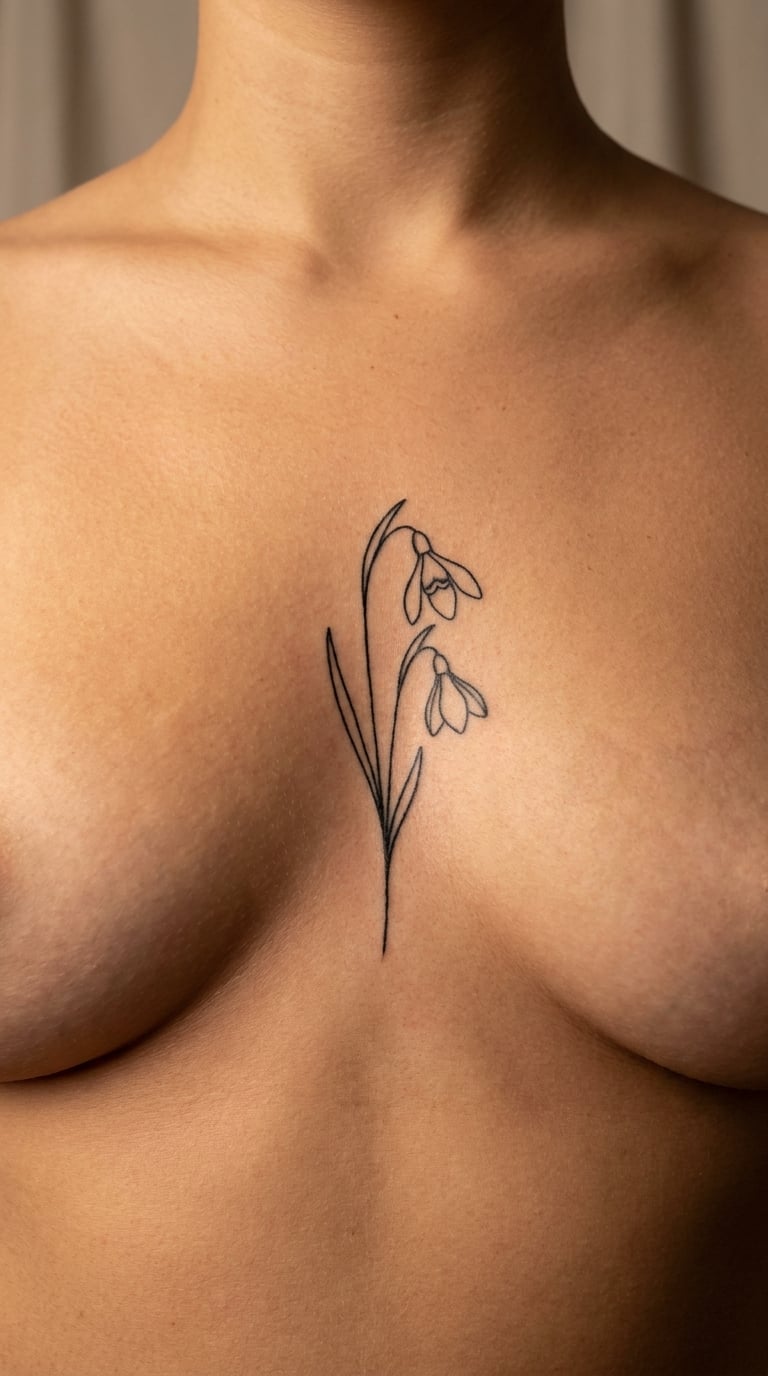
Two small blossoms set one above the other on a short vertical stem, centred between the collarbones, with clear space above and below. The arrangement is deliberately narrow so it follows the sternum instead of sitting across it.
It suits people who want a vertical floral piece and are prepared for a placement that catches attention. Vertical florals also stack naturally, so a second stem can be added lower down years later.
Size: 2 to 3 inches (5-8 cm) tall. Style: minimalist fine line. Pain: high. The sternum is sensitive and the bone sits right beneath the skin.
Make it yours: put the larger bloom at the top and the smaller bud below it, so the piece tapers downward along the bone.
20. Large Snowdrop Floral Design
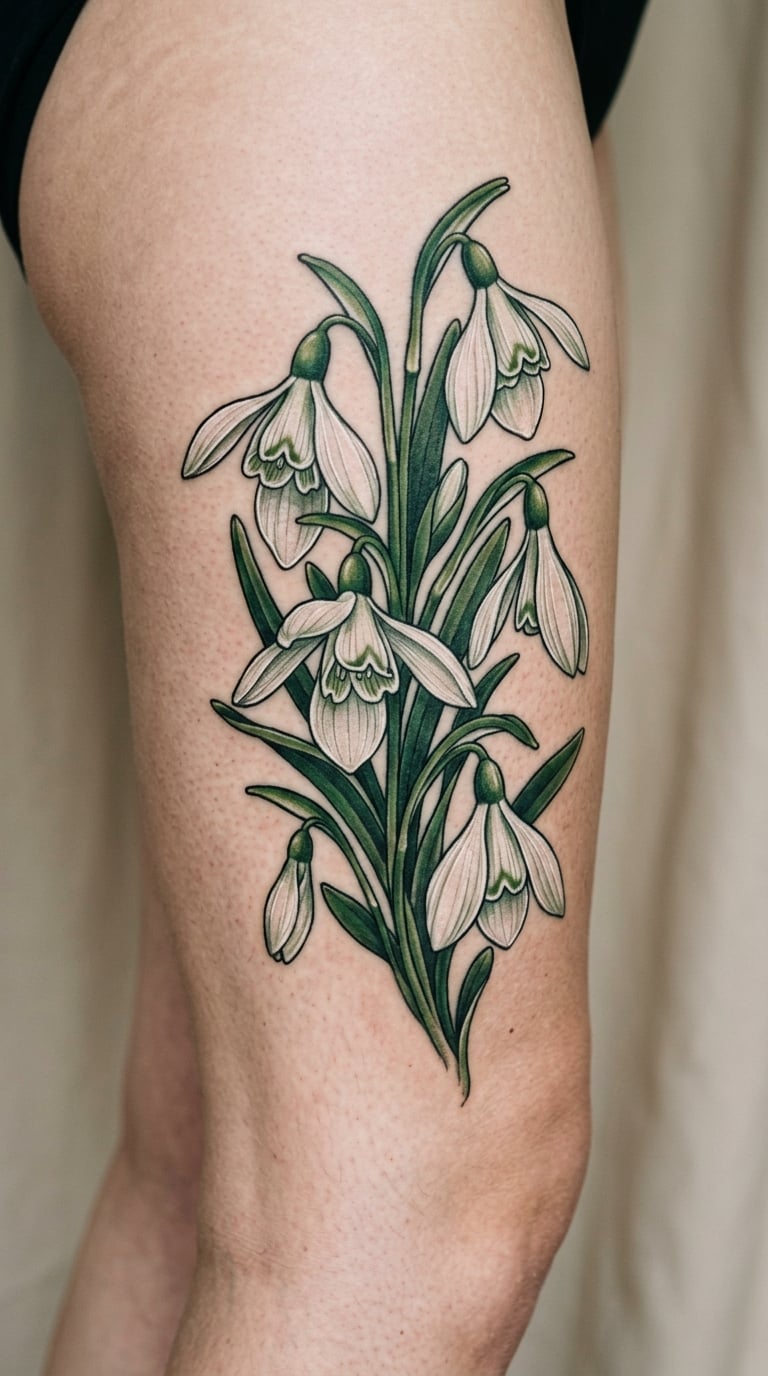
Layered petals, real green leaves with visible veins, and stems long enough to fill a large area of skin. At this size the artist can render the tiny markings at the base of each bell and build real depth, which is what separates a large floral piece from a scaled-up small one.
It suits people who want a statement piece or a main floral tattoo they can build a sleeve around later. Thigh, back and outer upper arm give the design enough flat area to breathe.
Size: 8 to 12 inches (20-30 cm) across. Style: colour realism. Pain: medium to high, and a piece this size is usually split across two or three sittings.
Make it yours: work with the artist on where new pieces will join later, so the stems meet cleanly instead of meeting halfway.
How to Choose the Right Design
Most disappointing floral tattoos are not badly drawn. They are the wrong scale, or the wrong style for how much detail the skin can hold. These five questions narrow the choice faster than browsing another twenty references.
Which style matches the amount of detail you want to live with?
Fine line and single-weight outline are the most forgiving and the most likely to stay sharp. Blackwork, dotwork and colour realism all hold more detail, but they take a longer sitting and they carry more weight on the body. Pick the style that matches the piece you will still want in ten years, not the flash you liked once.
How big should the design be?
Match the size to the placement rather than the reference photo. Snowdrops are naturally tiny flowers, and a design drawn at arm’s length on a screen has to shrink considerably before it fits a collarbone or a finger. Anything under one inch needs extra care, because a single petal has almost no room for shading.
Which placement suits your daily life?
Decide how visible you want it to be. Wrist, collarbone, sternum and finger tattoos are noticed by strangers. Upper arm, back, thigh and ankle are easier to cover. The same design can feel entirely different depending on whether it shows up every morning at work.
What does it mean to you?
Write the meaning down before you browse. A snowdrop can stand for hope, for a January birthday, for a person you have lost, or for a hard winter you got through. Knowing which one it is will make the design choices obvious, and it is much easier to explain to an artist.
How will it age?
Fine line on the hands, fingers and anywhere with a strong bone structure fades and softens fastest, and tiny detail blurs over the years. If you want crisp detail for a long time, aim slightly larger and slightly bolder than the reference, and ask your artist how they plan the line weight for the placement.
Cost and Session Time
Tattoo pricing depends on the artist’s hourly rate, the size of the piece and the time it takes to finish, so two identical snowdrop designs can cost very different amounts. Most shops charge by the hour, and many set a minimum that covers a short piece, so a small fine line bloom and a small blackwork flower can come out close to the same figure.
As a rough guide in the US, small fine line or outline florals often sit in the low hundreds, soft realism and pastel work in the mid range, and blackwork or colour realism pieces at the higher end. A large piece like idea 20 is usually quoted per sitting, and a shop minimum still applies to each one.
Session time follows the same curve. A tiny wrist or finger bloom is a short sitting of well under an hour, a mid-size composition runs one to two hours, and anything large gets split. Ask your artist for a session estimate at the consultation, and book the piece early if you are working toward a date.
Aftercare Basics
Follow your artist’s aftercare instructions first, since they know exactly what they did in your skin. Everything below is general guidance rather than a substitute for what you were told on the day.
- Wash the area as instructed, usually with clean lukewarm water and unscented soap, and pat it dry rather than rubbing.
- Keep a thin layer of whatever ointment or balm your artist recommended, and reapply as directed rather than overdoing it.
- Protect fresh ink from clothing rubbing it, which is the fastest way to wear a fine line design down in the first weeks.
- Avoid sun exposure on the area while it settles and during healing, because UV hits colour and light line work harder than it hits thick black.
- Wash your hands before touching the tattoo and leave the moisturiser off the day the piece was done if your artist asked for it.
- Send a photo to your artist once it has settled, so any early fading is caught before it becomes permanent.
Frequently Asked Questions
What does a snowdrop tattoo symbolize?
A snowdrop tattoo usually stands for purity and innocence, hope and new beginnings after a hard winter, quiet resilience, or remembrance of a loved one who has passed. Snowdrops are among the first flowers to bloom through frozen ground, so they are chosen for what survives difficult conditions, not just for how delicate they look. Many people also get one as the January birth flower.
Is a snowdrop the January birth flower?
Yes. The snowdrop is one of the two recognised January birth flowers, alongside the carnation, and both often appear together in a birth-flower set. That is why the pairing of a snowdrop with a carnation is so common in tattoo requests. If the meaning matters to you, it is worth telling your artist, since a single snowdrop on its own also reads clearly on its own.
Do fine line snowdrop tattoos fade?
They can, and it depends where they are. Fine line work on the fingers, hands and bony areas such as the wrist softens fastest, because those areas move and stretch constantly. Placed on the forearm, thigh or upper arm, fine line snowdrops hold their line much longer. Ask your artist to build the line weight for the placement, and expect a free or low-cost touch-up check once the piece has settled.
Are snowdrop tattoos painful?
Mostly it is more uncomfortable than sharp. The ribs, sternum, collarbone, ankle and fingers are the sensitive spots, and the ribs and sternum are the worst of those. Upper arm, forearm and calf tend to be easier. Size matters less than placement: a small piece on a bony spot can hurt more than a larger one on a fleshy area. Expect a short sitting to feel quick but intense rather than slow.
What size snowdrop tattoo should I get?
For most placements, one to three inches is the working range that keeps petal detail readable. Finger tattoos need to be under an inch to fit the surface. Collarbone, shoulder and rib designs usually look best between three and four inches across. Anything smaller than an inch leaves almost no room for shading, so a tiny design is better rendered as a clean outline than as soft realism.
Conclusion
For a first tattoo, idea 2, the mini wrist bloom, or idea 14, the shoulder outline, give you the shortest sitting and the most forgiving finish. If you are adding to an existing collection, the larger and more technical options sit better: the blackwork bouquet in idea 4, the gothic piece in idea 13, or the colour realism cluster in idea 20.
Before booking, decide on the meaning, the placement and the scale, then bring references to a consultation and ask your artist what they would change. A short conversation at the consult saves a lot of guessing later, and it is the fastest way to end up with a snowdrop that still looks like a snowdrop in ten years.