
20 River Tattoo Ideas: Best Nature Designs (October 2026)
A river tattoo is body art built around flowing water, usually chosen to stand for a life in motion: change, resilience, and the way a journey keeps going regardless of what the banks look like. These 20 river tattoo ideas cover everything from a thin single line that fits behind an ear to a cartographic piece built for a full back panel.
Water is a hard thing to describe to an artist, which is exactly why these designs are worth studying before a consultation. Rivers look completely different in fine line, in blackwork, in colour realism and in watercolour, and the style you pick decides how much detail the skin can actually hold. If you are also planning a second nature piece, the 20 mountain and ocean tattoo ideas we collected here pair naturally with anything on this list. Most people save three or four of these and bring the folder to their appointment.
20 River Tattoo Ideas: Quick Guide
Every design below appears in this table in the same order as the details that follow, so you can scan it, then jump to the ones worth your time. Sizes are honest healed dimensions, not the size of a flash drawing.
| Idea | Style | Best placement | Realistic size | Pain |
|---|---|---|---|---|
| 1. Fine-Line Winding River Map | Fine line, single line | Inner forearm | 4-7 in (10-18 cm) | Low |
| 2. Realistic River Bend with Pebbles | Micro-realism, black and grey | Lower calf | 2-3 in (5-8 cm) | Low |
| 3. Traditional Blue Waterfall | Traditional, bold colour | Outer upper arm | 3-5 in (8-13 cm) | Medium |
| 4. Watercolour River Scenery | Watercolour | Shoulder blade | 4-6 in (10-15 cm) | Low |
| 5. Blackwork River Snake | Blackwork | Forearm | 5-8 in (13-20 cm) | Medium |
| 6. Minimal Mountain River | Minimal fine line | Upper arm | 3-4 in (8-10 cm) | Low |
| 7. Japanese River and Willow | Japanese, black and red | Outer arm | 6-10 in (15-25 cm) | Medium |
| 8. Geometric River Lines | Geometric blackwork | Forearm | 3-5 in (8-13 cm) | Low |
| 9. River Through a Mountain Compass | Fine line illustration | Chest | 4-6 in (10-15 cm) | Medium |
| 10. Flowing River Wave Sleeve Element | Black and blue realism | Shoulder to upper arm | 8-12 in (20-30 cm) | High |
| 11. River and Evergreen Forest | Blackwork, high contrast | Outer calf | 5-7 in (13-18 cm) | Medium |
| 12. Small River Bend Behind the Ear | Fine line, minimal | Behind the ear | 1-2 in (2.5-5 cm) | Low |
| 13. River Encircling a Date | Fine line, monoline | Wrist | 1.5-2.5 in (4-6 cm) | Medium |
| 14. Catfish Beneath River Water | Micro-realism, black and grey | Thigh | 3-5 in (8-13 cm) | Low |
| 15. River Stones and Dotwork Current | Dotwork | Lower back | 4-6 in (10-15 cm) | Medium |
| 16. Monoline River with Wildflowers | Monoline, fine line | Inner arm | 4-6 in (10-15 cm) | Low |
| 17. Stormy River with Lightning | Traditional, black and grey | Upper back | 6-9 in (15-23 cm) | High |
| 18. River Crossing a Bridge | Fine line, illustrative | Forearm | 3-4 in (8-10 cm) | Low |
| 19. Colourful River Reflection | Colour realism, soft wash | Lower leg | 3-5 in (8-13 cm) | Low |
| 20. Large River Map with Tributaries | Cartographic linework | Upper arm and back | 10-16 in (25-40 cm) | High |
1. Fine-Line Winding River Map
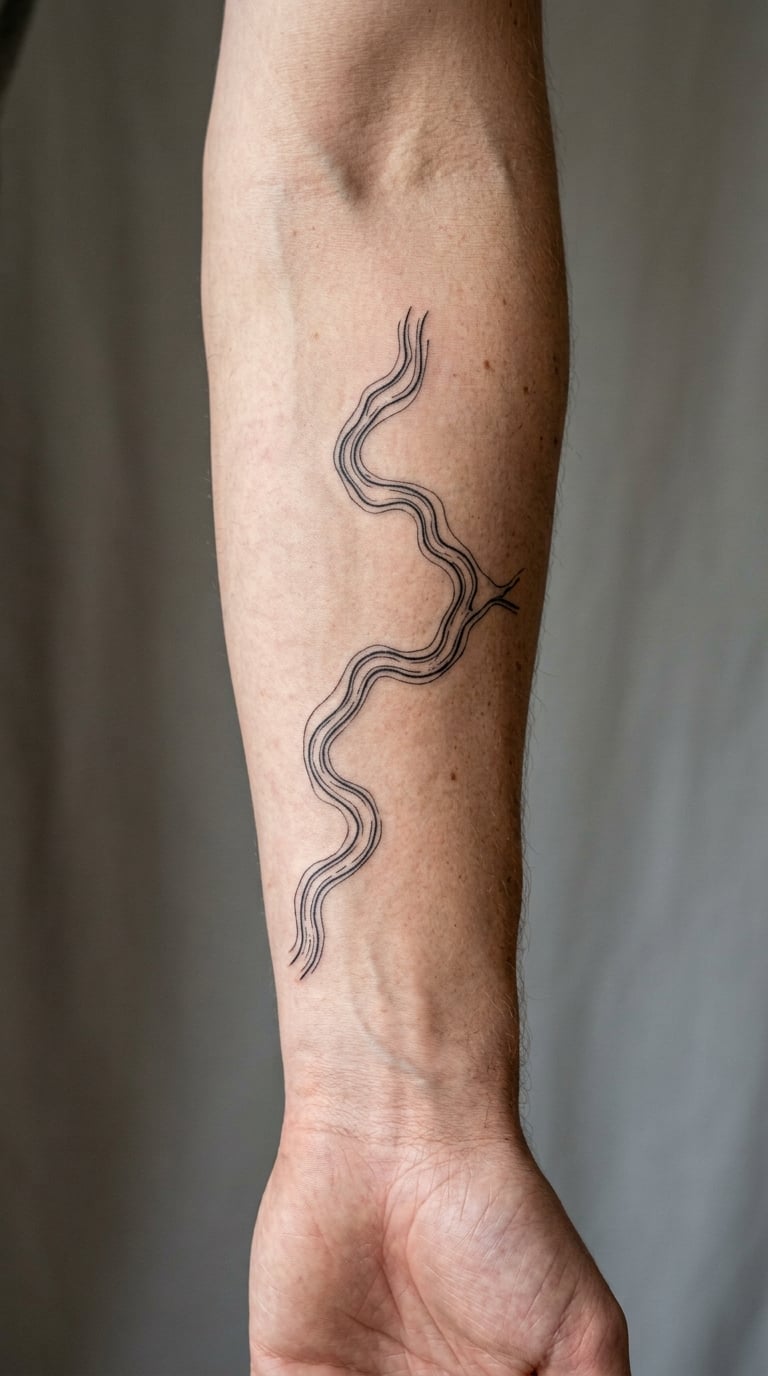
A single unbroken line enters at the wrist, crosses the inner forearm, and exits past the elbow, with a few faint contour marks around it. That is the whole design. Nothing shaded, nothing filled, one weight of line doing all the work.
People choose this because it reads as travel without ever spelling out a place. A version of this same idea works well next to the pine forest forearm tattoos we wrote about, since both rely on line rather than colour.
Placement: Inner forearm, wrist to elbow, or along the outer forearm. Size: 4-7 in (10-18 cm) long. Style: Fine line, single line.
Pain: Low to medium. Forearm skin is meaty but the inner arm near the wrist is thin and sensitive. Fine line fades fastest on sun-exposed outer arms, so ask about a heavier line weight if this is going outside.
Make it yours: Give the artist your actual route, or your home river, and have them trace it as the centre line.
2. Realistic River Bend with Pebbles
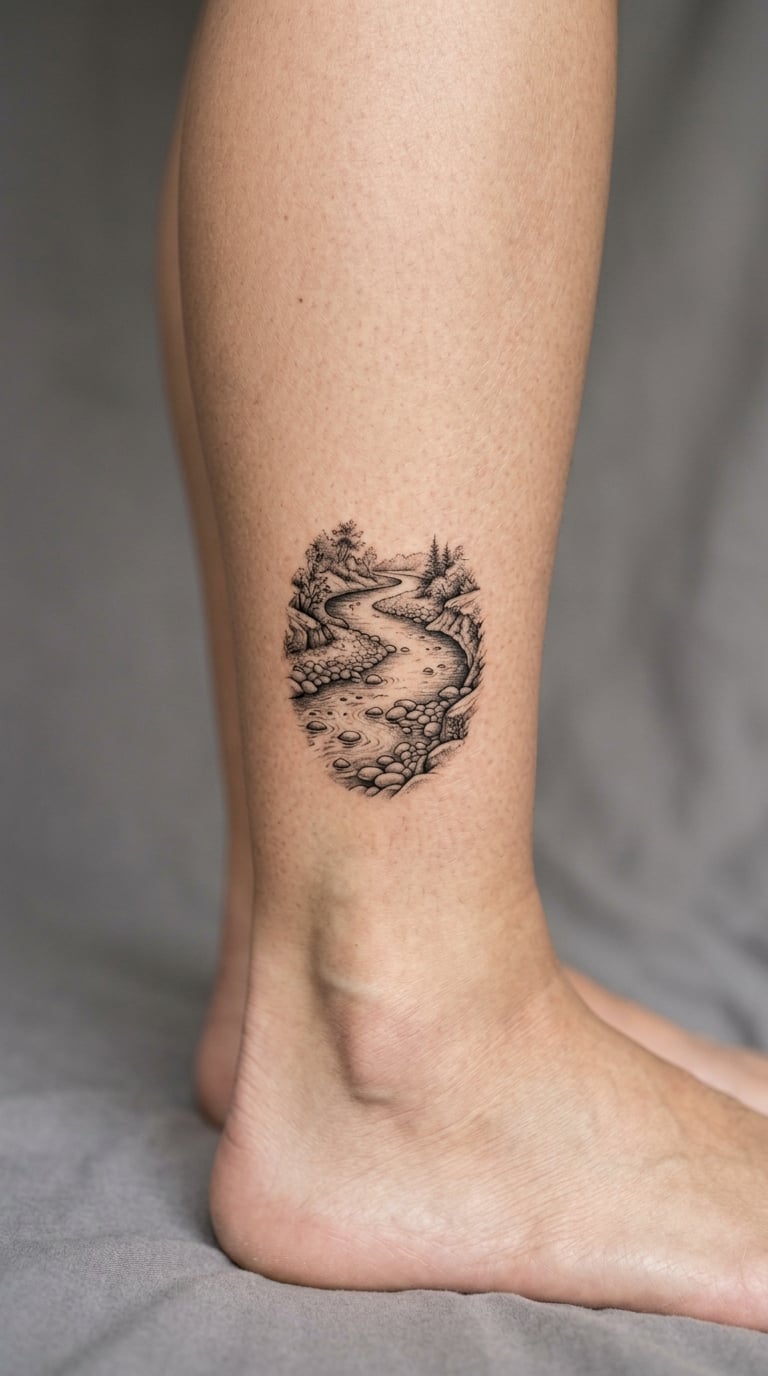
A small S-curve of water, shaded dark in the deepest part of the bend and pale at the edges, with three or four rounded pebbles sitting in the shallows. Grey-only, so it ages quietly instead of asking for attention.
It usually turns up on people who hike, fish or grew up near moving water, and it reads as a quiet marker rather than a statement piece. The compact composition suits anyone who wants nature on skin without a scene around it.
Placement: Lower calf, inner thigh, or the outside of the forearm. Size: 2-3 in (5-8 cm) across. Style: Micro-realism, black and grey.
Pain: Low. Calves and outer forearms are relatively forgiving spots. The risk here is not pain, it is detail: pebble shading smudges into grey if the artist rushes, so book someone with a fine needle and a steady hand.
Make it yours: Add one pebble in a colour that matters, or use the silhouette of a real bend you have walked.
3. Traditional Blue Waterfall
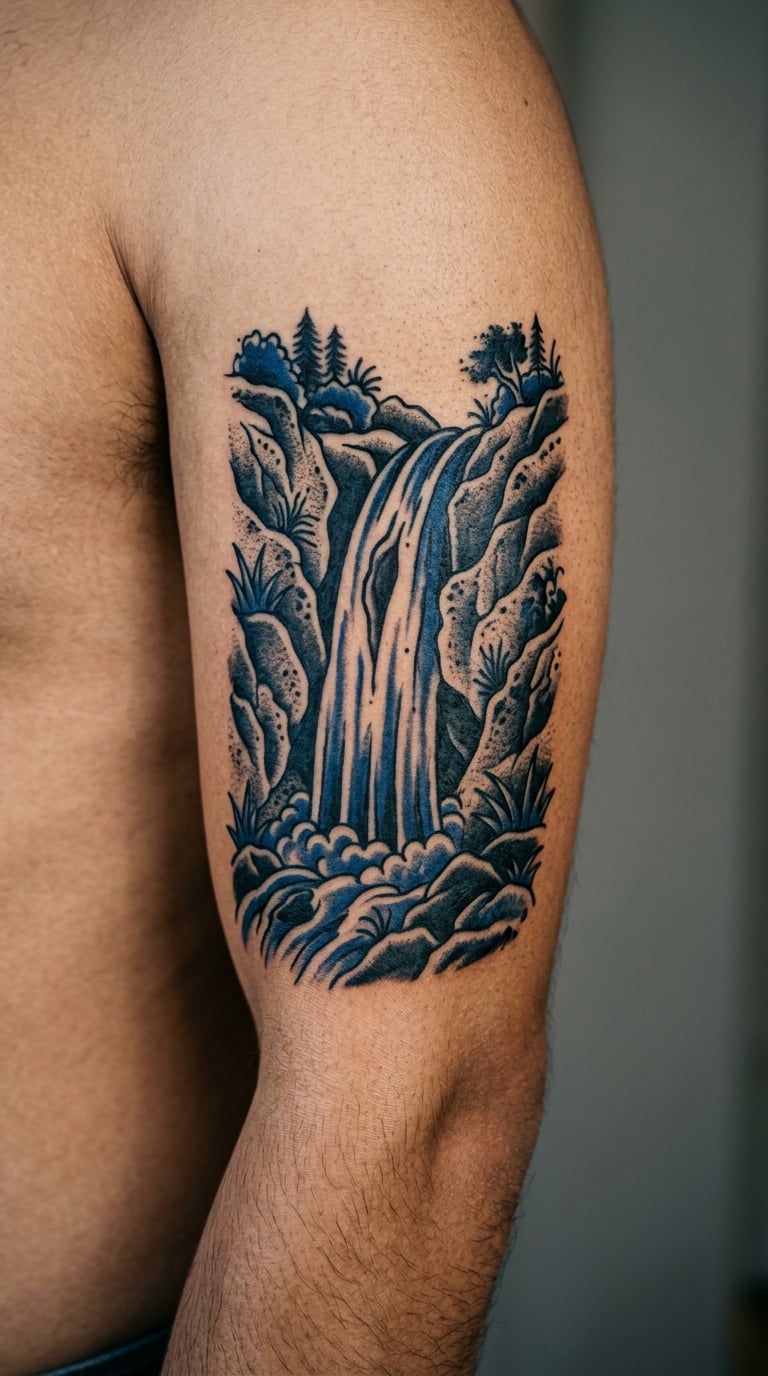
Bold black outlines, flat blue water, white foam breaking into dots at the base, and two banks of rock framing the fall. This is the old-school vocabulary: saturated colour, heavy line, no gradient work trying to look clever.
Waterfall scenes are usually about force and release, and a river reads as the calm stretch before and after the drop. Traditional styles hold their colour well, which makes this a safer bet than a pale watercolour if you want the piece to still look right in ten years.
Placement: Outer upper arm, shoulder, or calf. Size: 3-5 in (8-13 cm). Style: Traditional.
Pain: Medium. The upper arm is a common landing spot, and the boulder shading is where the sting concentrates because the needle bounces off curved areas. Expect an annoying but manageable session.
Make it yours: Swap the blue for a deeper teal and add your birth month as small numerals hidden in the foam.
4. Watercolour River Scenery
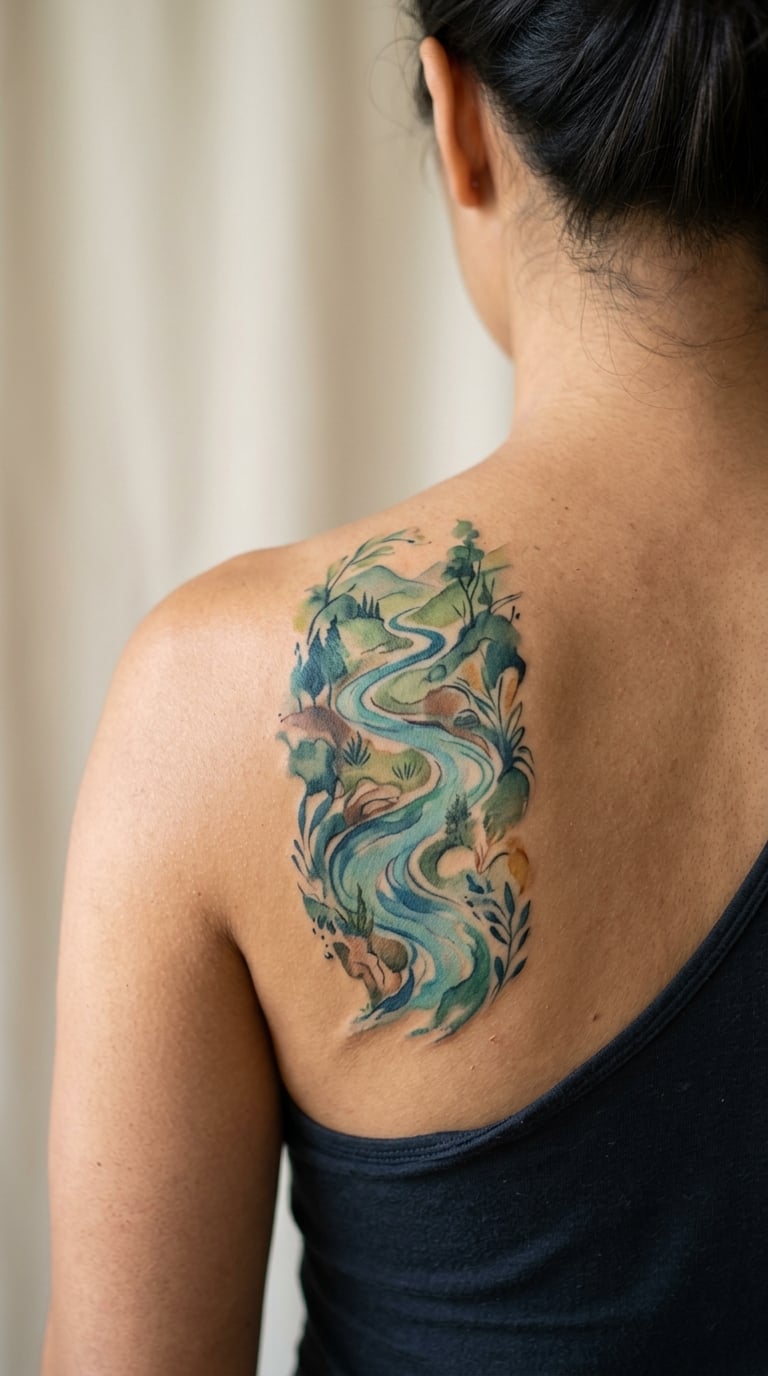
Loose washes of blue and green bleed past their own outlines, with banks suggested rather than drawn. Some areas are left bare skin. The unfinished edges are the point, since they give the piece the look of a wet-on-wet painting.
People pick this when the memory is about atmosphere rather than geography: a summer trip, a season, a stretch of water seen once. It is also the least permanent style here, so it suits people who would rather enjoy a tattoo and change their mind later.
Placement: Shoulder blade, upper arm, or along the ribs. Size: 4-6 in (10-15 cm). Style: Watercolour.
Pain: Low to medium. Shoulder blades bruise for a couple of days afterwards, which surprises people. Colour washes need several passes, so the session runs longer than the size suggests.
Make it yours: Ask for the palette of a specific photograph, and leave the outer edge genuinely unfinished rather than outlined.
5. Blackwork River Snake
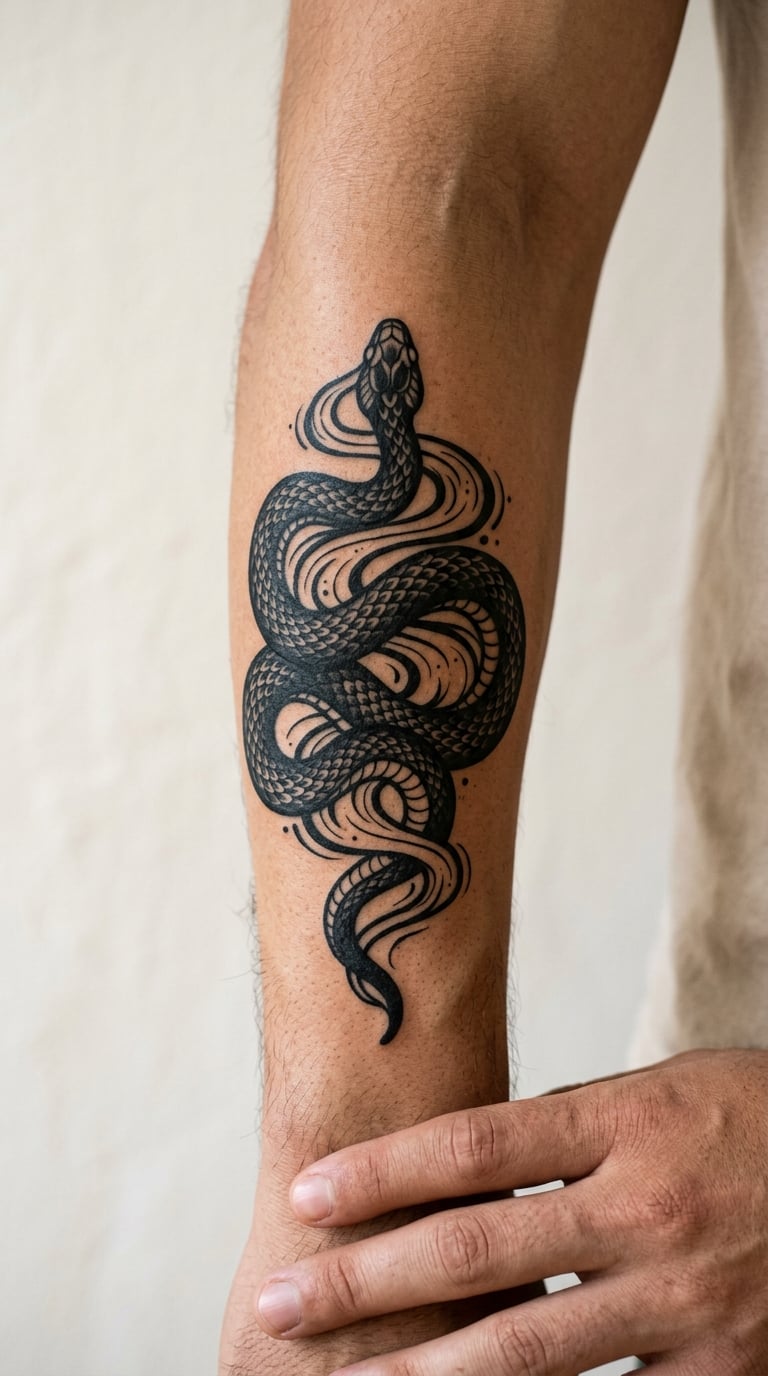
A solid black river shape loops through the frame, and a snake body follows the same curve, separated from the water by a thin line of white skin. Two areas of dense black, one clean gap between them, and the eye is the only small detail in the piece.
Two motifs that both mean change, wrapped around one another. Clients usually arrive with a personal story about a move, a recovery or a person who changed their direction, but the symbolism is theirs to claim rather than something the design dictates.
Placement: Forearm, thigh, or calf. Size: 5-8 in (13-20 cm). Style: Blackwork.
Pain: Medium. Solid black fills are long sessions, and the forearm sits over bone at the elbow, so ask the artist to break the piece into two sittings if it runs past six inches.
Make it yours: Give the snake a species from your region, and reverse the flow direction so the river reads left to right across the arm.
6. Minimal Mountain River
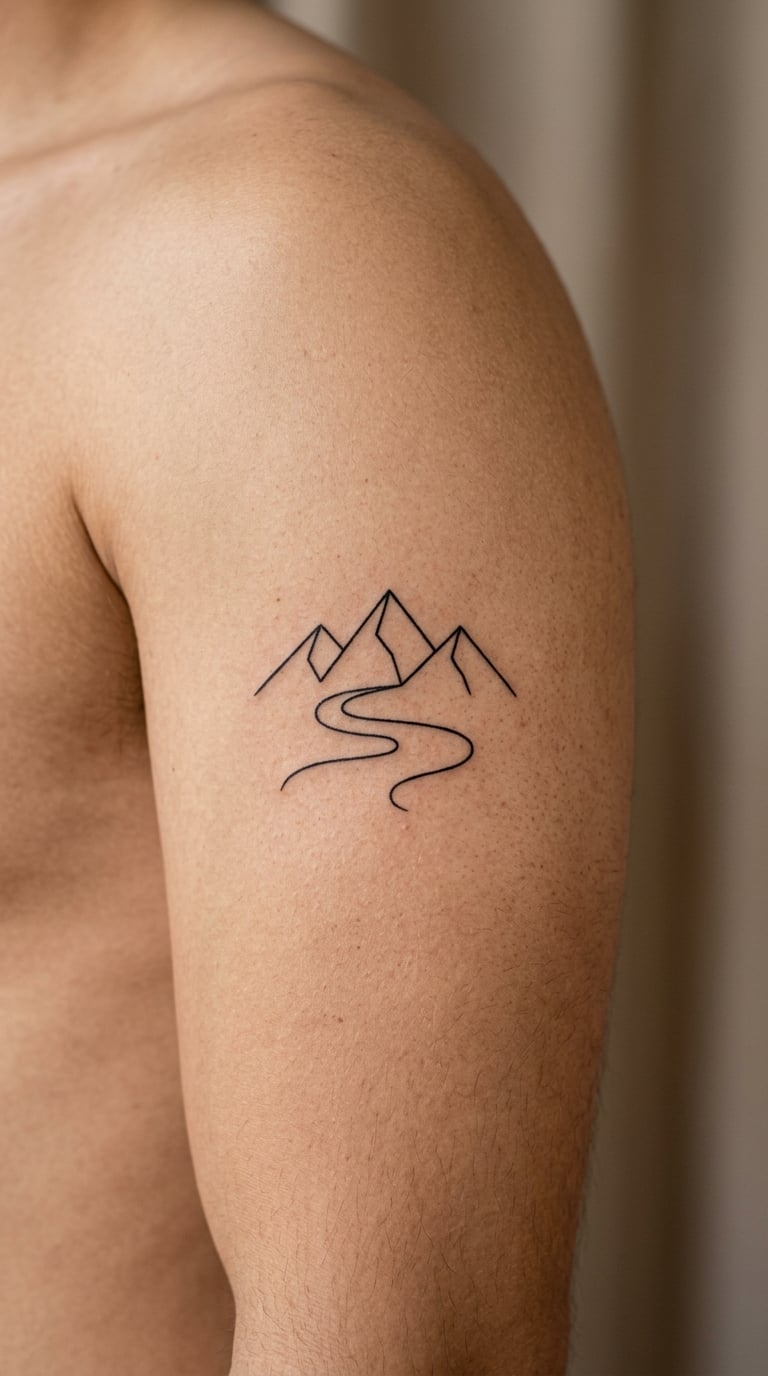
Three triangular peaks in simple outline, one river line passing in front of them, and nothing else. No trees, no shading, no texture. It is about as simple as a landscape composition can get and still read as scenery.
This is frequently the first tattoo in a set, and it is the one I recommend to people who are nervous. Nothing about it is hard to hide at a desk job, and it scales up later into idea 20 if you decide you want more.
Placement: Outer upper arm, forearm, or shoulder. Size: 3-4 in (8-10 cm). Style: Minimal fine line.
Pain: Low. Straight lines and clean edges are quick work. The only caution is sun: thin black lines on an outer arm will grey out in a few summers unless you keep them covered or use a heavier line weight.
Make it yours: Swap the generic peaks for a real ridgeline you have stood on, or add your birth year in the negative space under the river.
7. Japanese River and Willow
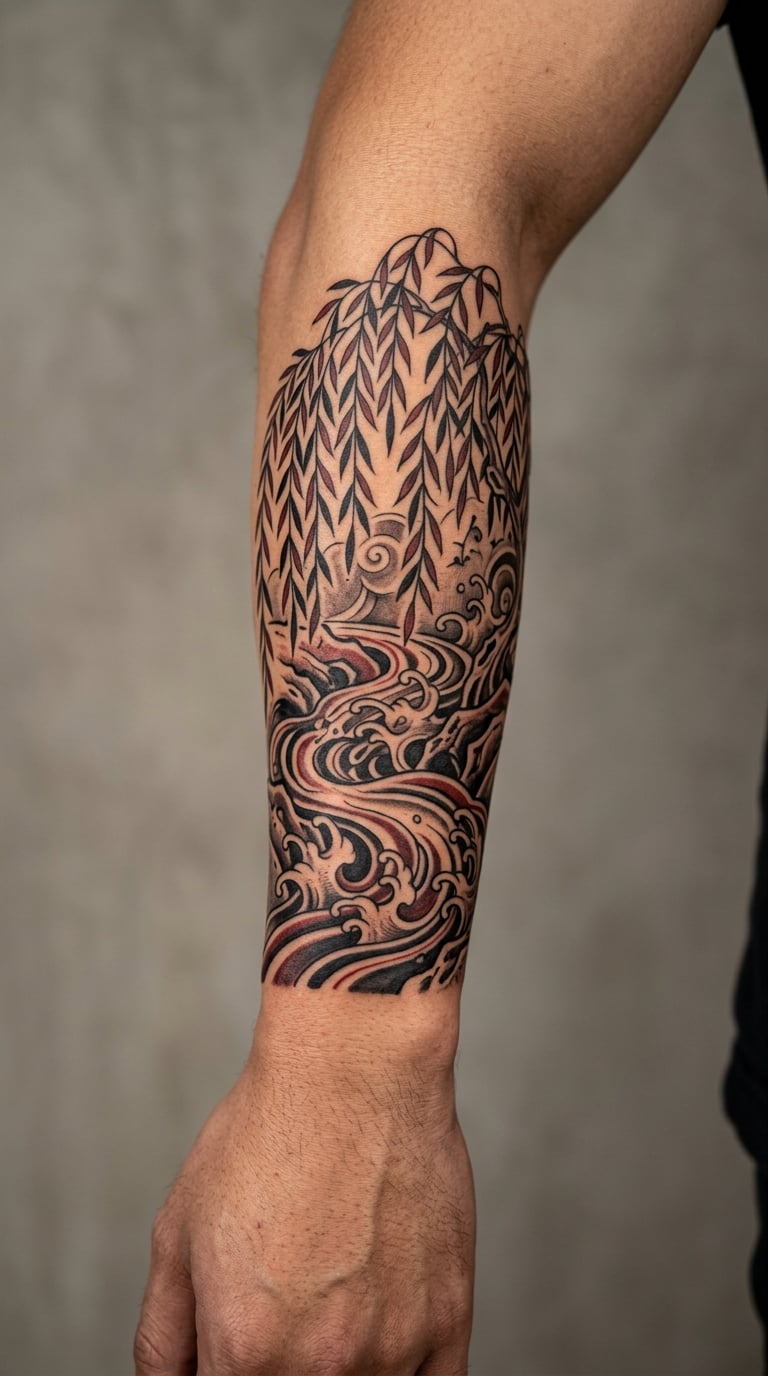
A wide band of water with defined current lines, drooping willow branches arching over from one side, and a single red accent such as a petal or a small sun disc. The composition borrows from Japanese woodblock prints, where flat areas of tone do the work.
Willow over water reads as quiet rather than dramatic, so it works for people who want a traditional-looking piece without the full armour sleeve. It also scales: one arm now, and a second piece carrying the river onto the back later.
Placement: Outer arm or back of the hand for a smaller version. Size: 6-10 in (15-25 cm) for a full composition. Style: Japanese, black with red accent.
Pain: Medium to high. The dense branch work and the wide water band take hours, and the outer arm is a bony surface. Most artists will book this as a two-session piece.
Make it yours: Choose the plant honestly, since it carries meaning in that tradition, and keep the red accent to one small element rather than scattering it.
8. Geometric River Lines
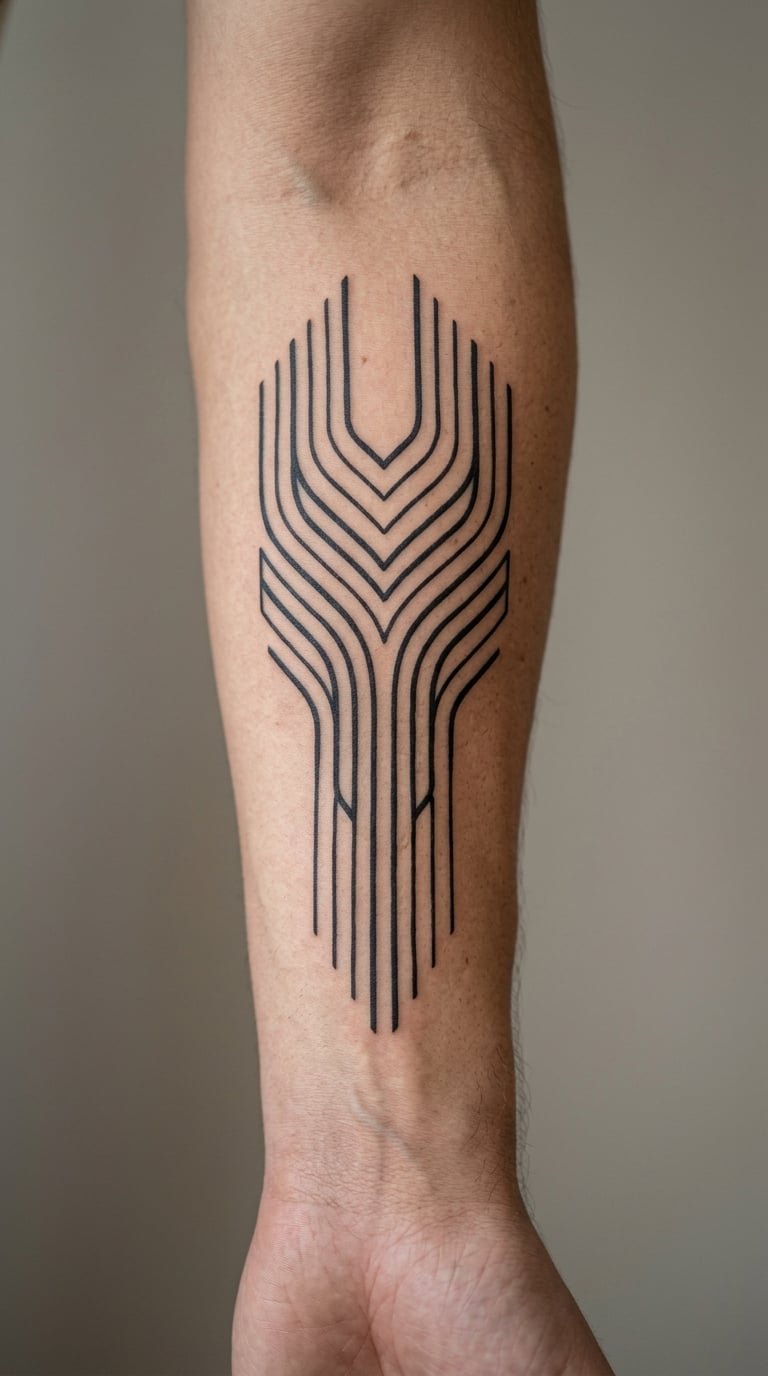
A stack of parallel black lines running the length of the design, bending together at consistent angles, with everything mirrored top to bottom. The gaps between the lines are measured and equal, so the eye reads pattern rather than scenery.
Geometric work is chosen for order, and the river is a good excuse for it because the bends give the pattern somewhere to go. It is the least literal design on this list, and the one that pairs most easily with existing body jewellery or a solid black piece.
Placement: Forearm, calf, sternum, or ribs. Size: 3-5 in (8-13 cm). Style: Geometric blackwork.
Pain: Low, unless you place it on ribs. Geometric line work is fast and repetitive, which is why most sitters handle it easily. The rib version is a completely different conversation.
Make it yours: Use the number of lines for a date, and change the bend angles to match the actual curve of your favourite stretch of water.
9. River Through a Mountain Compass
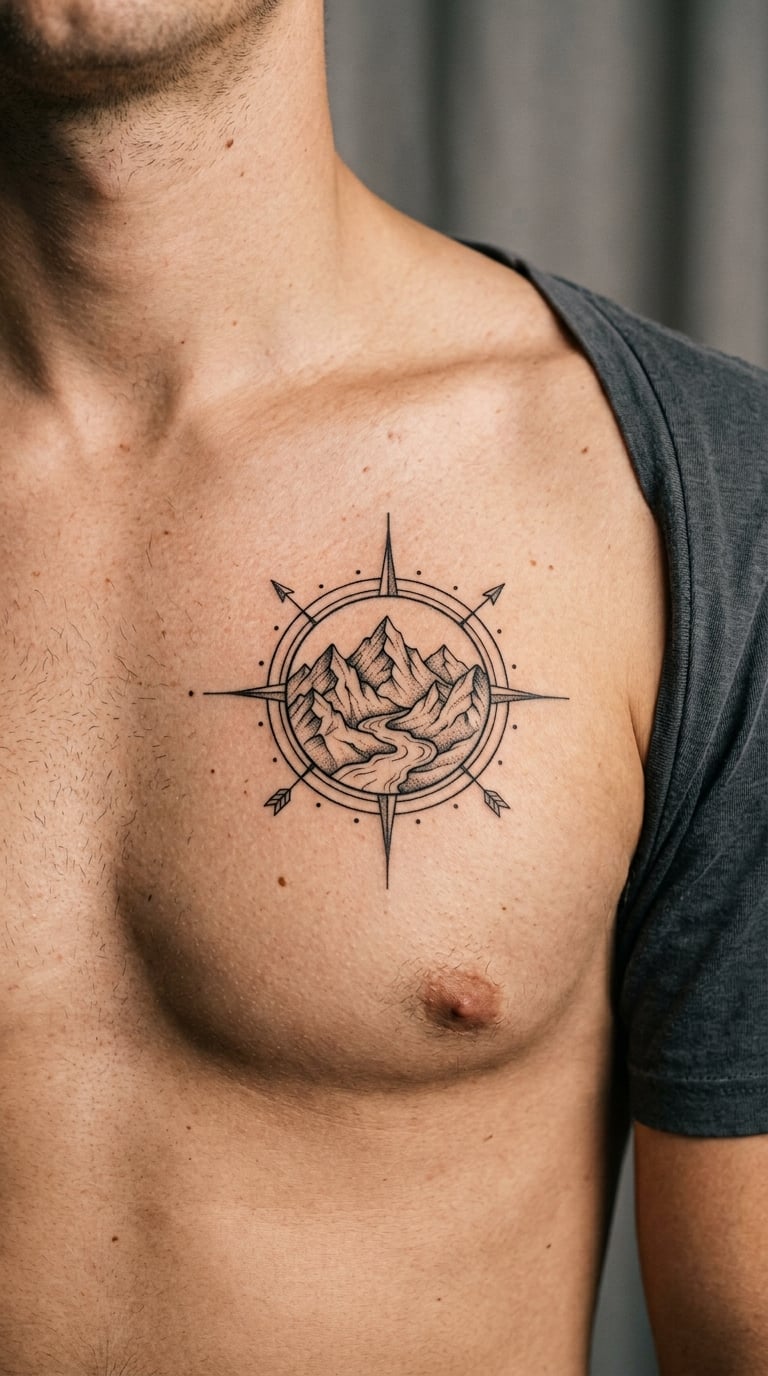
A compass rose drawn in thin straight lines, mountain peaks tucked into two opposite points of it, and a river running straight through the centre and out the bottom. Everything is separated by clear white space so no shape turns into mud.
It is a travel design for people who move: the compass carries direction, the river carries the route, the peaks carry where it started. The trick is restraint, because three symbols in one frame will fight each other if the sizes are not staggered.
Placement: Chest, upper back, or forearm. Size: 4-6 in (10-15 cm). Style: Fine line illustration.
Pain: Medium. Sternum and chest are sensitive, especially the bony centre line, while the forearm version is easy. Ask the artist to place the compass off-centre if you want the chest to hurt less.
Make it yours: Add real coordinates for a place that mattered, tucked into one compass point, and let the river double as the needle.
10. Flowing River Wave Sleeve Element
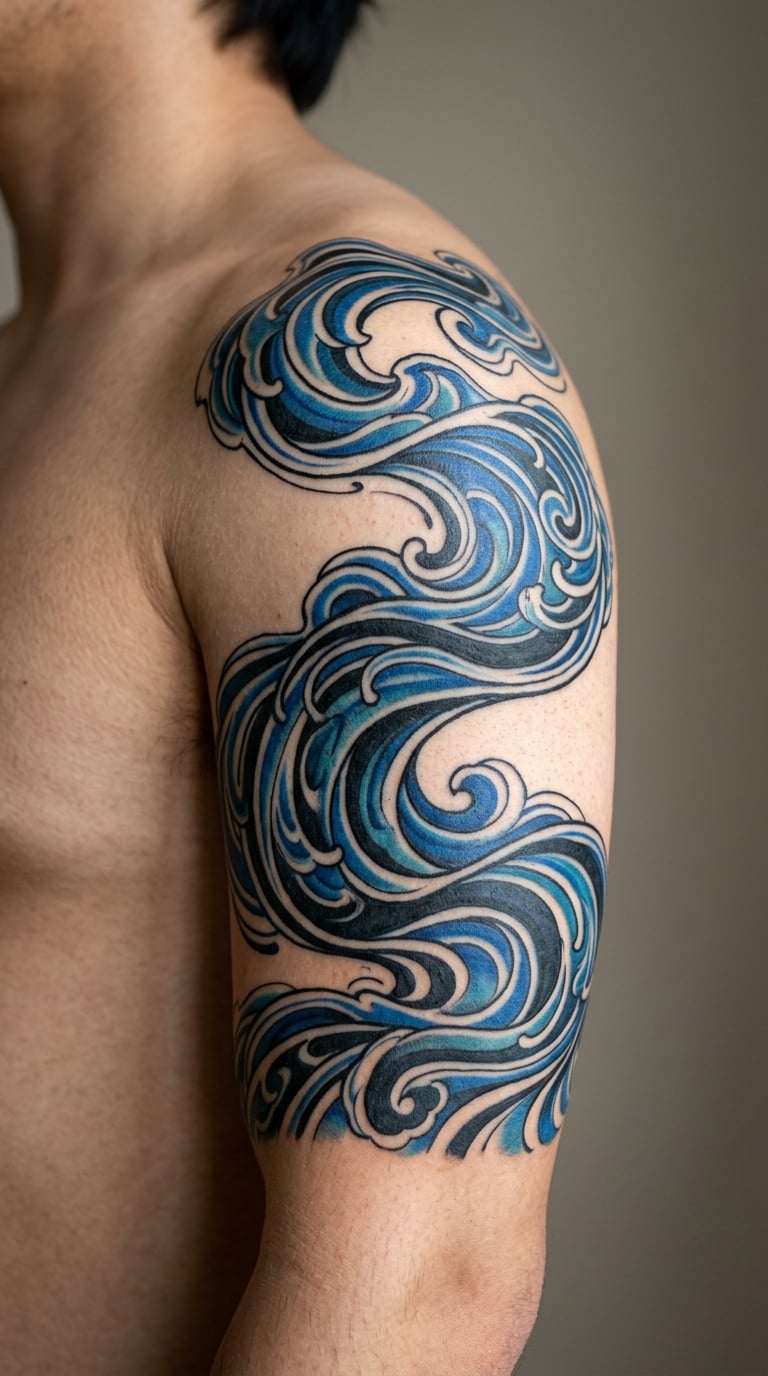
Layered wave shapes stacked into a current, each one bending in the same direction, with black on the shadow side and blue through the middle. Directional linework does the movement rather than any single image, so it works as one element of a bigger sleeve.
People choose this when the river is part of a larger nature sleeve rather than the whole story. If you are already planning a marine piece, our coral reef tattoo ideas sit well beside this waterwork.
Placement: Shoulder wrapping to upper arm, or a full forearm piece. Size: 8-12 in (20-30 cm) as a sleeve element. Style: Black and blue realism.
Pain: High, mostly from duration. The shoulder cap is sensitive and you will be in the chair for hours. Plan for breaks, bring food, and do not schedule anything important the next day.
Make it yours: Have the wave direction follow your arm’s own line, and add one white foam highlight as the only pure white in the piece.
11. River and Evergreen Forest
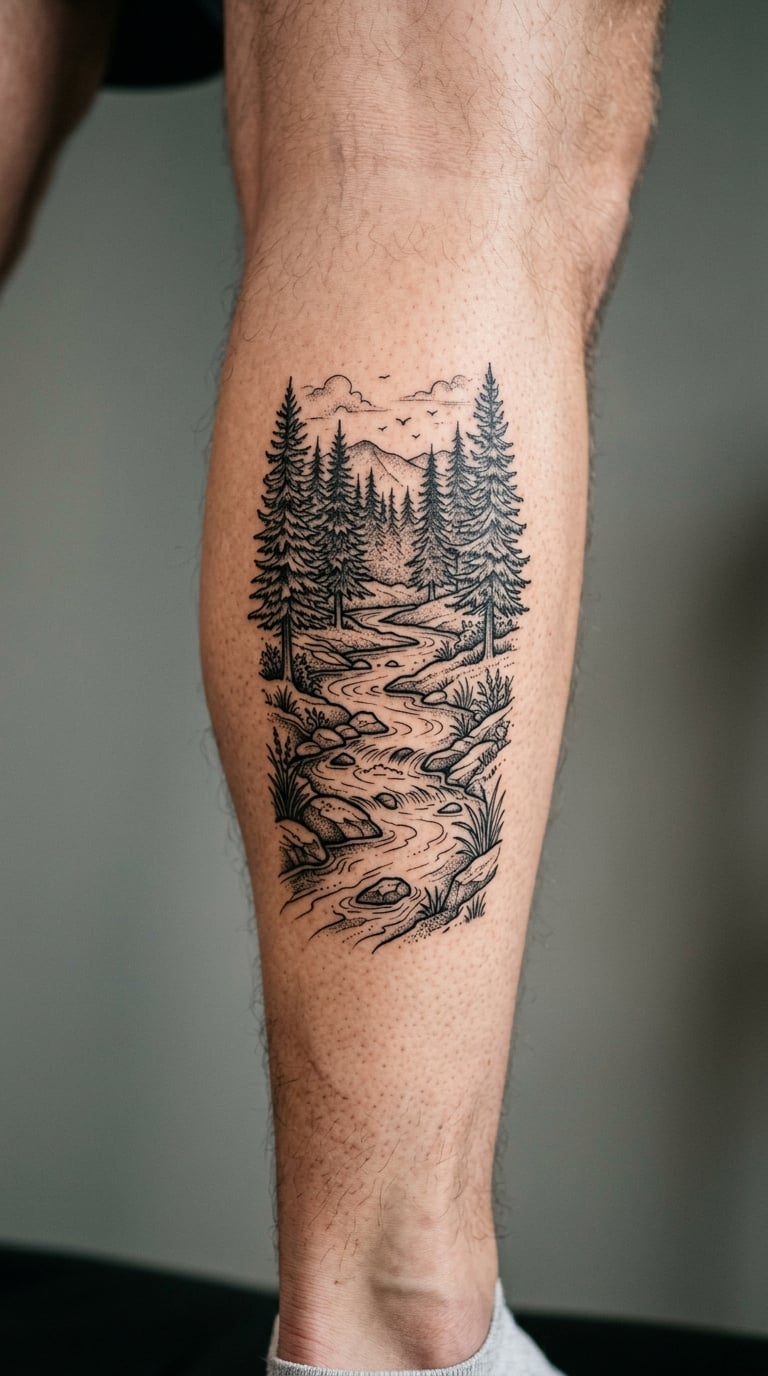
Tall dark tree silhouettes forming a corridor, a narrow pale river running down the middle to the viewer. The trees are almost solid black with a few broken branch lines, and the water is left as bare skin so it stays the brightest thing in the frame.
Negative space is doing the work here: the river only reads because the trees beside it are so dense. Clients often connect it to a specific forest road or a place they used to walk, and it is popular with people who hunt, camp or just grew up inland.
Placement: Outer calf, thigh, or back of the forearm. Size: 5-7 in (13-18 cm). Style: Blackwork, high contrast.
Pain: Medium. Solid black tree fills are slow going, and the outer calf has very little fat under the skin, so the needle feels every stroke. Two shorter sessions beat one long one.
Make it yours: Use the tree species that actually grows where you are from, and narrow the river slightly so it reads as a trail rather than a road.
12. Small River Bend Behind the Ear
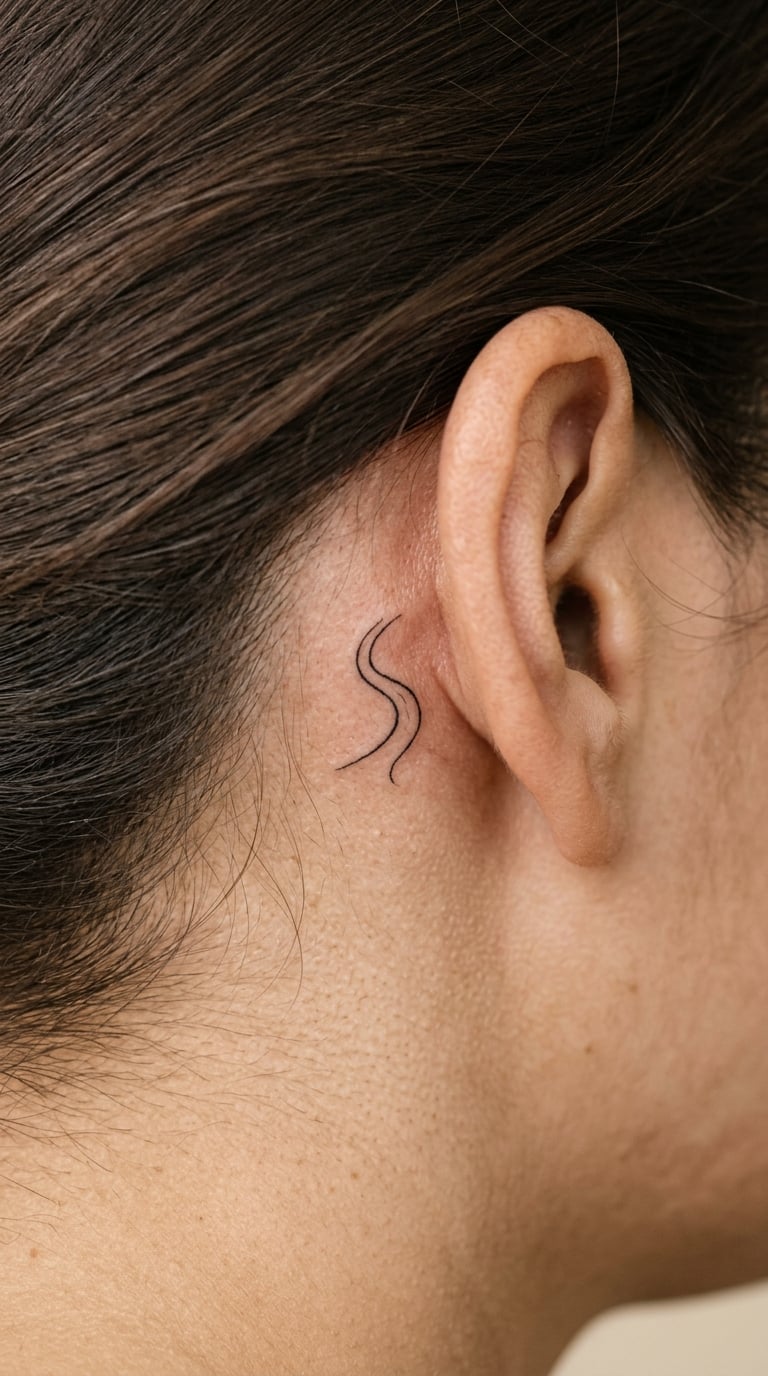
One shallow curve, about the length of a thumb joint, tapering at both ends. That is the design. The skin behind the ear is soft and mobile, so the line reads as a quiet private mark rather than something the room can see.
It is the smallest idea on this page and the one most often chosen as a first tattoo, because there is very little to regret and nothing that announces itself at work. The usual reason is a person or a place, kept private.
Placement: Behind the ear, or in the crook behind the ear along the neck. Size: 1-2 in (2.5-5 cm). Style: Fine line, minimal.
Pain: Low, though it is a fiddly spot. Bone is close to the surface and the artist is working on a curve that keeps moving when you talk. Take breaks and keep your jaw still.
Make it yours: Give the artist the bend in your head, not the one on paper, and ask for a line that fades to nothing at both ends.
13. River Encircling a Date
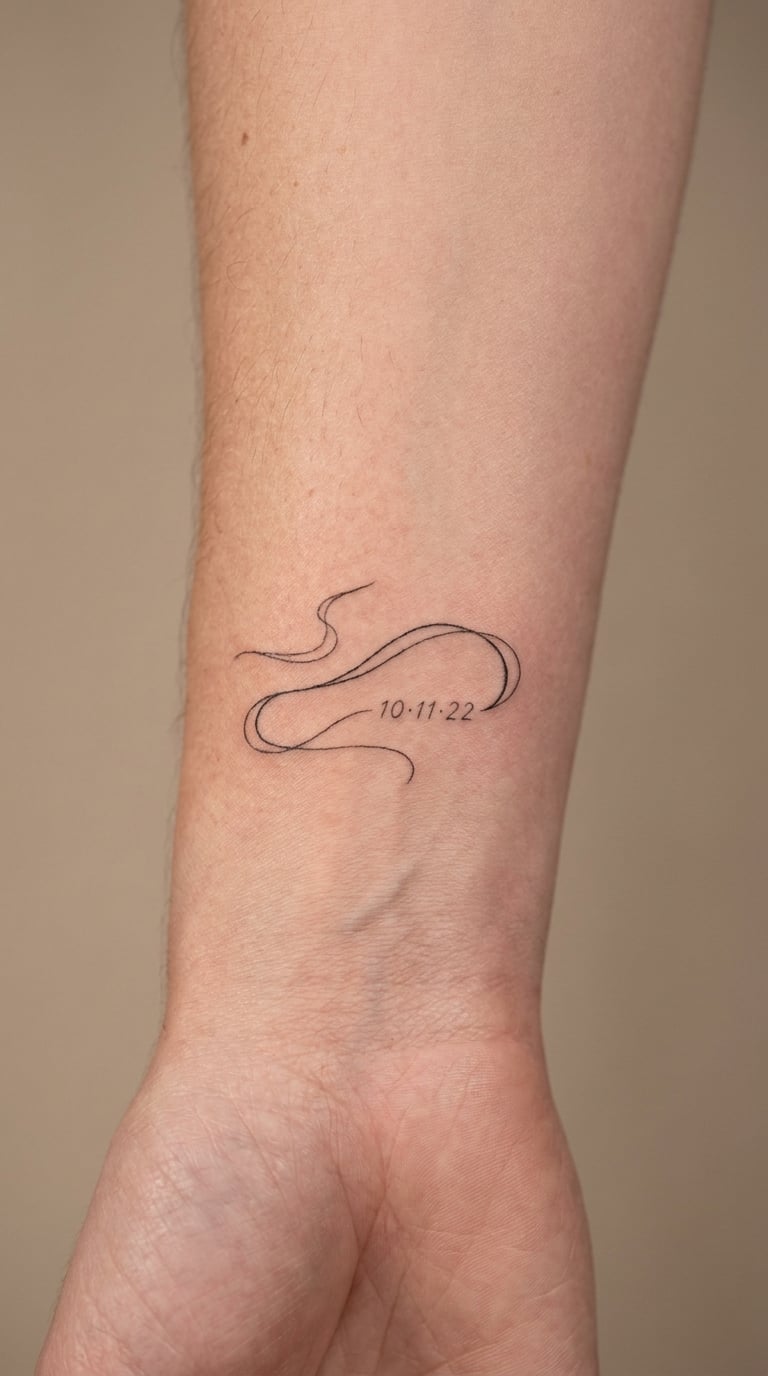
A looping line of water that runs once around the numbers and closes near where it started, with the current line thickening slightly at the loop’s tightest point. One colour, one weight, no decoration competing with the digits.
This is the practical personalised option. A river looping back on itself does the visual work of holding something, which lets the date stay small and legible instead of being spelled out in script.
Placement: Inner wrist, behind the forearm, or ankle. Size: 1.5-2.5 in (4-6 cm) across. Style: Fine line, monoline.
Pain: Medium. The inner wrist hurts in a way people consistently underrate, because the skin is thin and the nerves are close. Short session, but you will feel it for the rest of the day.
Make it yours: Use a date that means something to you, and decide before the session whether the loop stays open or closes, because that choice changes the reading completely.
14. Catfish Beneath River Water
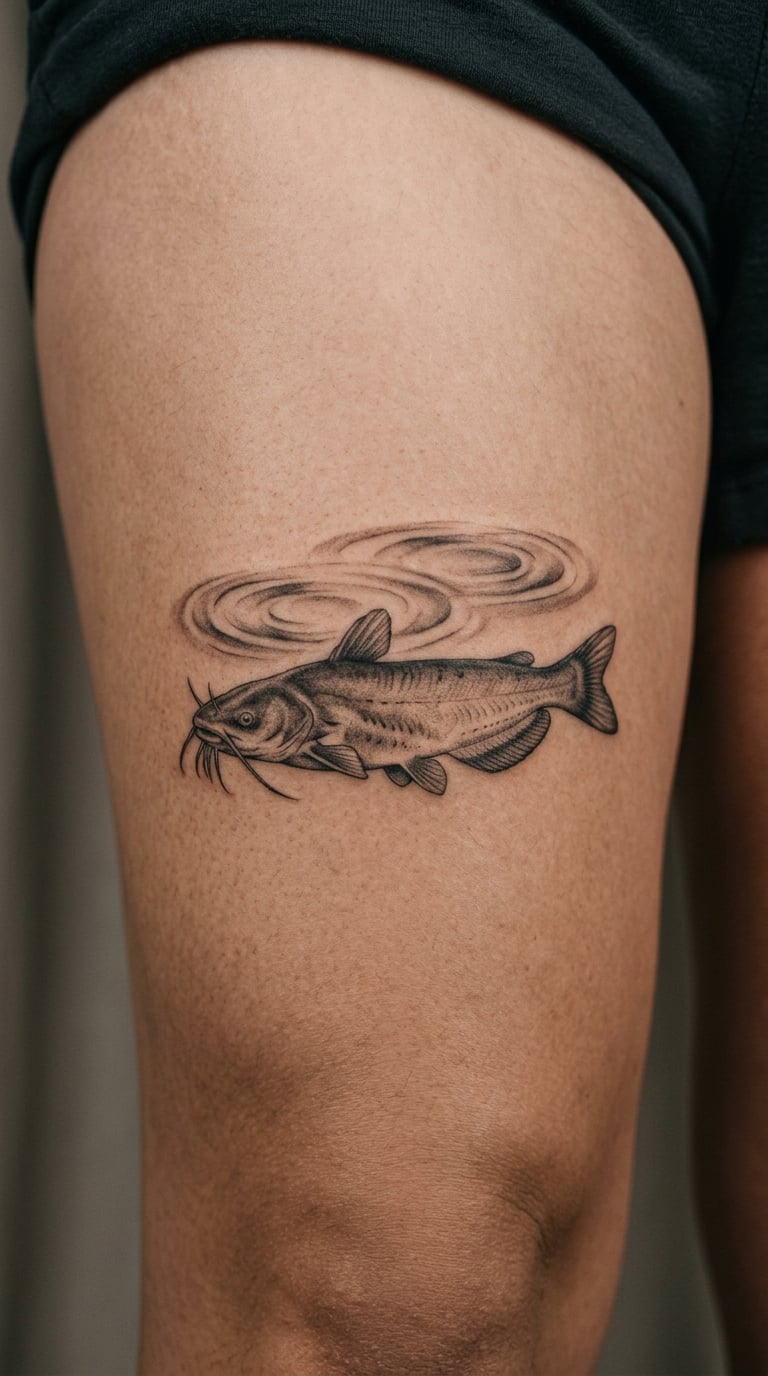
A catfish rendered in smooth grey shading, barbels and eye included, swimming under two clean horizontal ripple lines. The water above the fish is barely suggested; the animal carries the whole piece.
Catfish sit at the bottom of rivers, so this reads as something steady and unhurried that most people only notice once it is already there. It is a strong pick if you fish, and a better one than a jumping fish because the composition stays calm.
Placement: Thigh, calf, or rib. Size: 3-5 in (8-13 cm). Style: Micro-realism, black and grey.
Pain: Low on the thigh, higher over ribs. Shading a curved body takes patience rather than force, so it is a long-but-easy sitting. Greys will soften with sun, so colour in the eye helps it hold attention.
Make it yours: Ask for the barbels drawn as two fine lines that run into the water and become the ripples, tying animal and river together.
15. River Stones and Dotwork Current
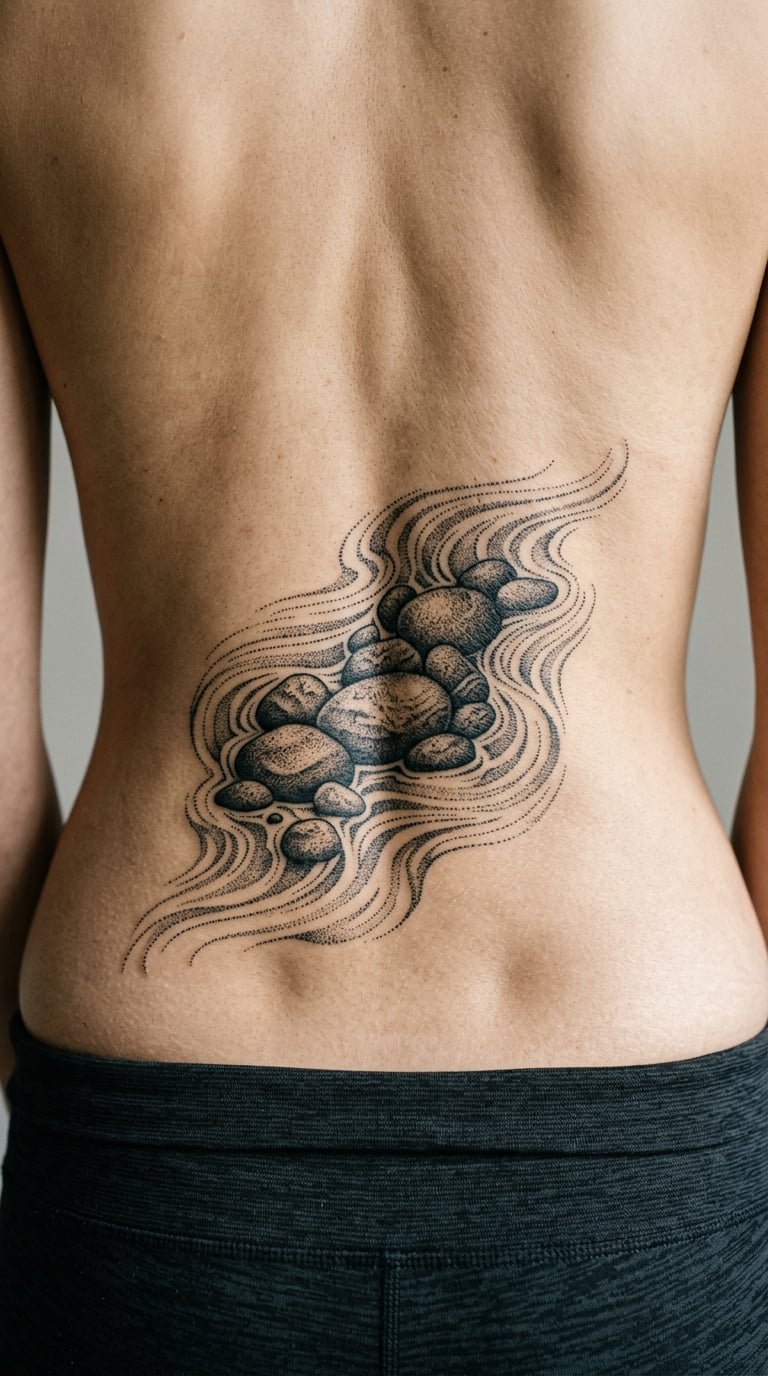
Three or four rounded stones in the centre, each shaded with tight dots, surrounded by fields of dots that curve around them in the direction of a current. The dots thin out toward the edges so the design dissolves rather than stopping.
Dotwork rewards a medium or large placement because the pattern needs room to build density gradually, and the dissolving edges give a design like this a soft fade you control rather than one the sun decides.
Placement: Lower back, upper arm, or along the spine. Size: 4-6 in (10-15 cm). Style: Dotwork.
Pain: Medium. Thousands of single taps mean a long session, and the lower back is hard to sit through for hours. Book a morning appointment, and expect a good stretch of discomfort during the densest areas.
Make it yours: Add one solid black stone among the grey ones, and let the dot density around it drop away, so the current breaks around that one shape.
16. Monoline River with Wildflowers
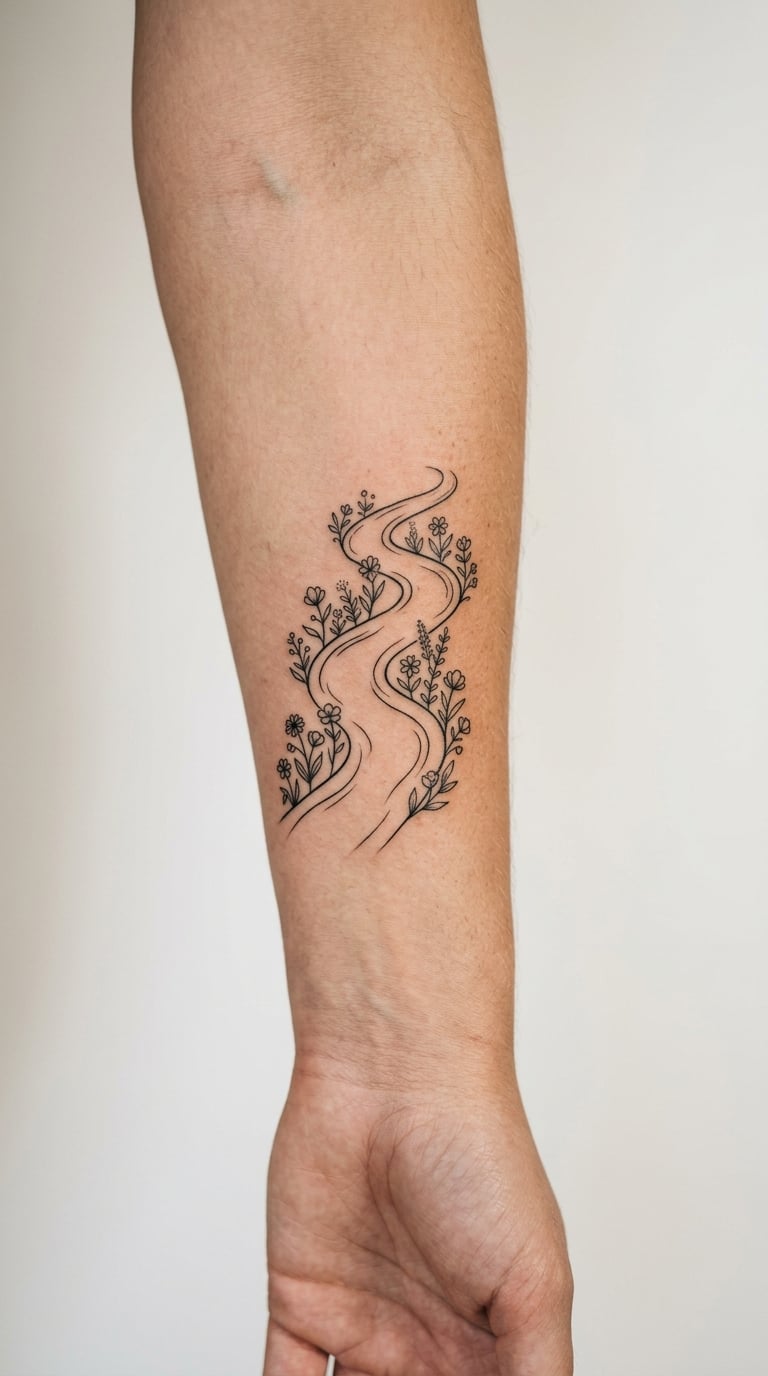
One continuous line makes the river, runs along both banks, and grows into small five-petal wildflowers as it reaches the top of the design. The line never lifts off the skin, so the whole piece is genuinely unbroken.
It is a softer, less stoic river than most on this list, which is why it does not read as macho even when the flowers are small. People choose it for a place, usually somewhere green that no longer has anything to do with them.
Placement: Inner arm, ribs, or along the leg. Size: 4-6 in (10-15 cm) tall. Style: Monoline, fine line.
Pain: Low on the arm, moderate on ribs. A single unbroken line keeps sessions short and the mood of the piece calm. Thin lines soften over the years, so keep the out-of-sleeve version thicker than you think you need.
Make it yours: Name the actual plants that grow where you grew up, and let the line end in a single stem rather than a symmetrical pair.
17. Stormy River with Lightning
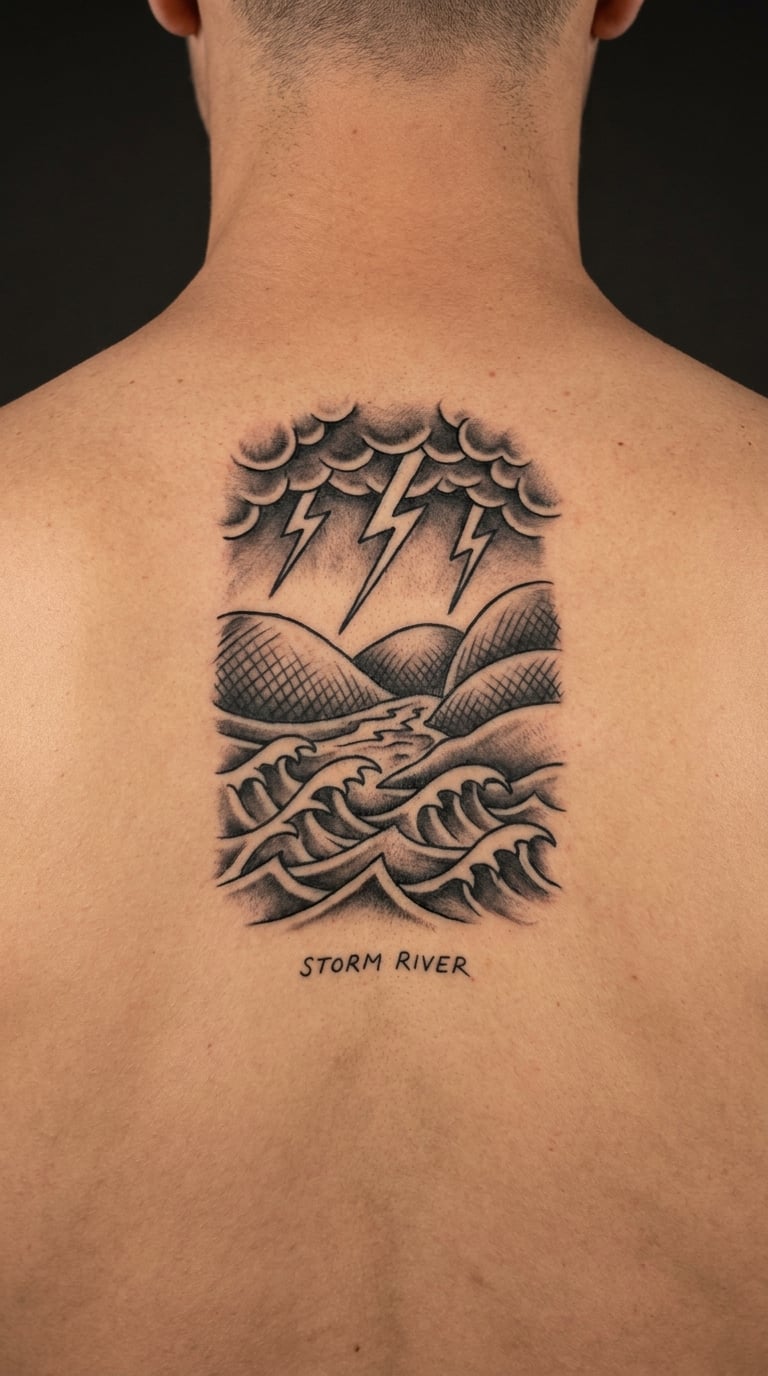
Heavy grey clouds stacked across the top of the frame, a jagged bolt cutting through them, dark hills on the horizon, and a choppy river running out toward the viewer. High contrast throughout, with white foam as the only bright note.
This is the dramatic option, and it carries a different reading from the calm pieces: weather, pressure, something clearing out. It tends to pair well with an existing black-and-grey sleeve because the value range matches.
Placement: Upper back, shoulder blade, or thigh. Size: 6-9 in (15-23 cm). Style: Traditional, black and grey.
Pain: High. Large pieces plus the upper back means hours in an uncomfortable position, and the storm cloud shading takes a lot of passes. Two sessions, three hours each, is a sensible plan.
Make it yours: Base the hills on somewhere you have actually stood, and put the bolt slightly off centre so the composition stays unbalanced.
18. River Crossing a Bridge
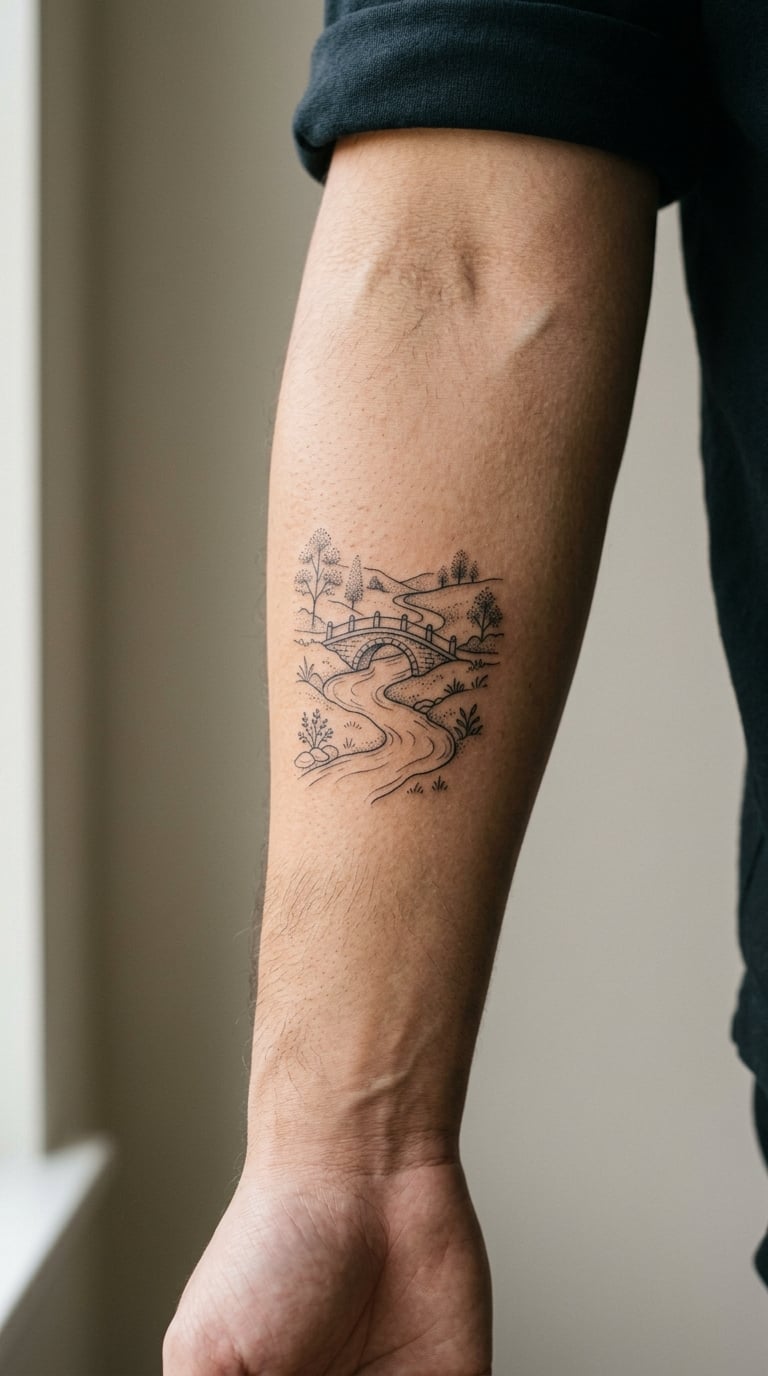
A simple arched bridge drawn with a handful of straight and curved lines, sitting over a river that widens as it passes underneath. The geometry of the bridge is precise and the water below it is loose, and that contrast is the whole effect.
Crossing points carry their own associations, and this design gives the river a destination instead of letting it run out of frame. It is compact, architectural enough to look intentional, and easy to place on a curved surface.
Placement: Forearm, calf, or upper arm. Size: 3-4 in (8-10 cm). Style: Fine line, illustrative.
Pain: Low. Straight lines and open spacing mean short passes with a light hand. Keep the bridge rails simple, because thin parallel lines in a small area are the first thing to blur over time.
Make it yours: Use the shape of a bridge you have crossed often, and let the water colour bleed faintly past the black line in one spot.
19. Colourful River Reflection
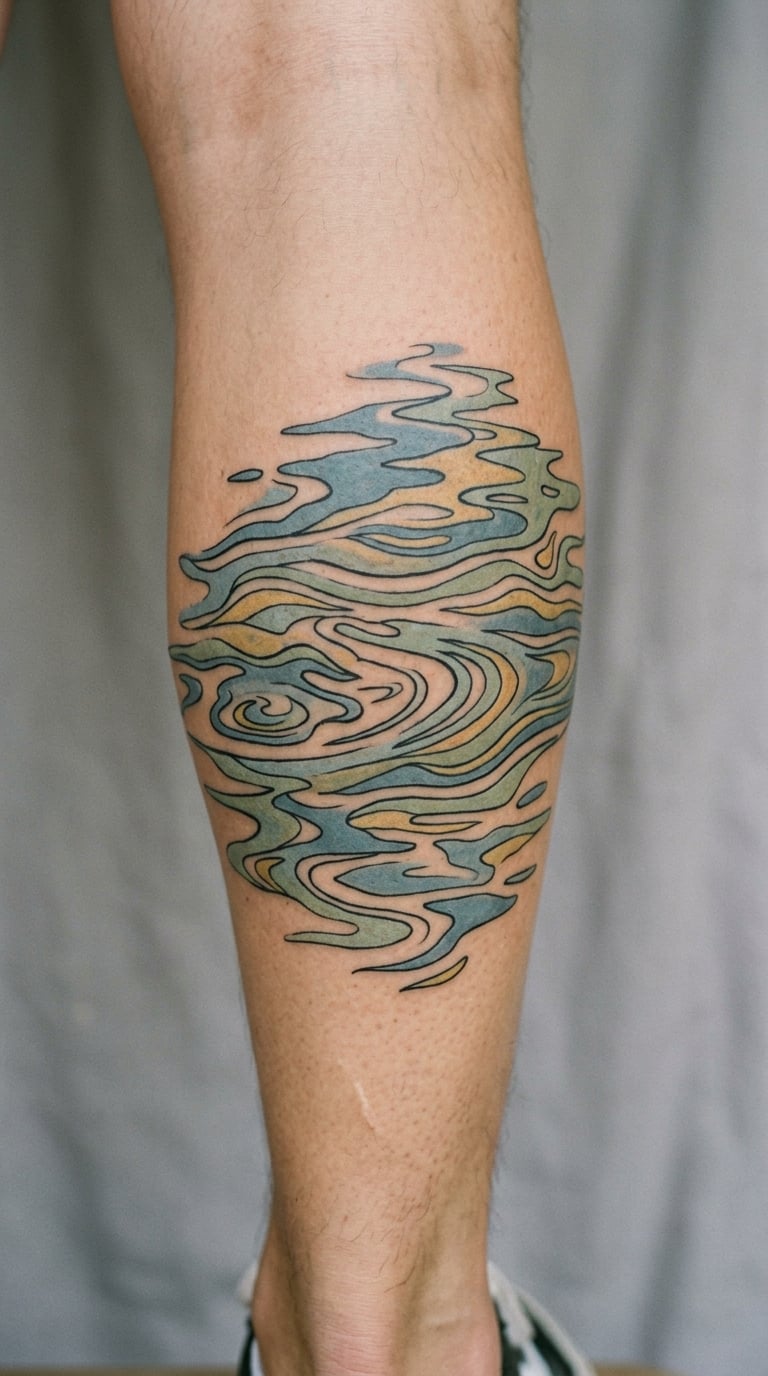
Horizontal bands of muted blue, olive green and soft yellow laid side by side across the water, with the boundaries slightly broken rather than ruled. Above them, a loose dark line suggests the far bank, deliberately unfinished.
Reflections are the version of river tattooing for people who like colour without the saturation of traditional work. The palette does the work, so the composition stays simple and heals well even when the edges are soft.
Placement: Lower leg, calf, or forearm. Size: 3-5 in (8-13 cm). Style: Colour realism with soft wash.
Pain: Low. The lower leg is one of the easier canvases, though full-colour work adds passes and time. Muted tones hold better than bright ones, which is exactly why this palette does not go chalky as fast.
Make it yours: Sample a photograph of water at golden hour and hand it to the artist as the colour reference, then let the bands follow the real reflection pattern.
20. Large River Map with Tributaries
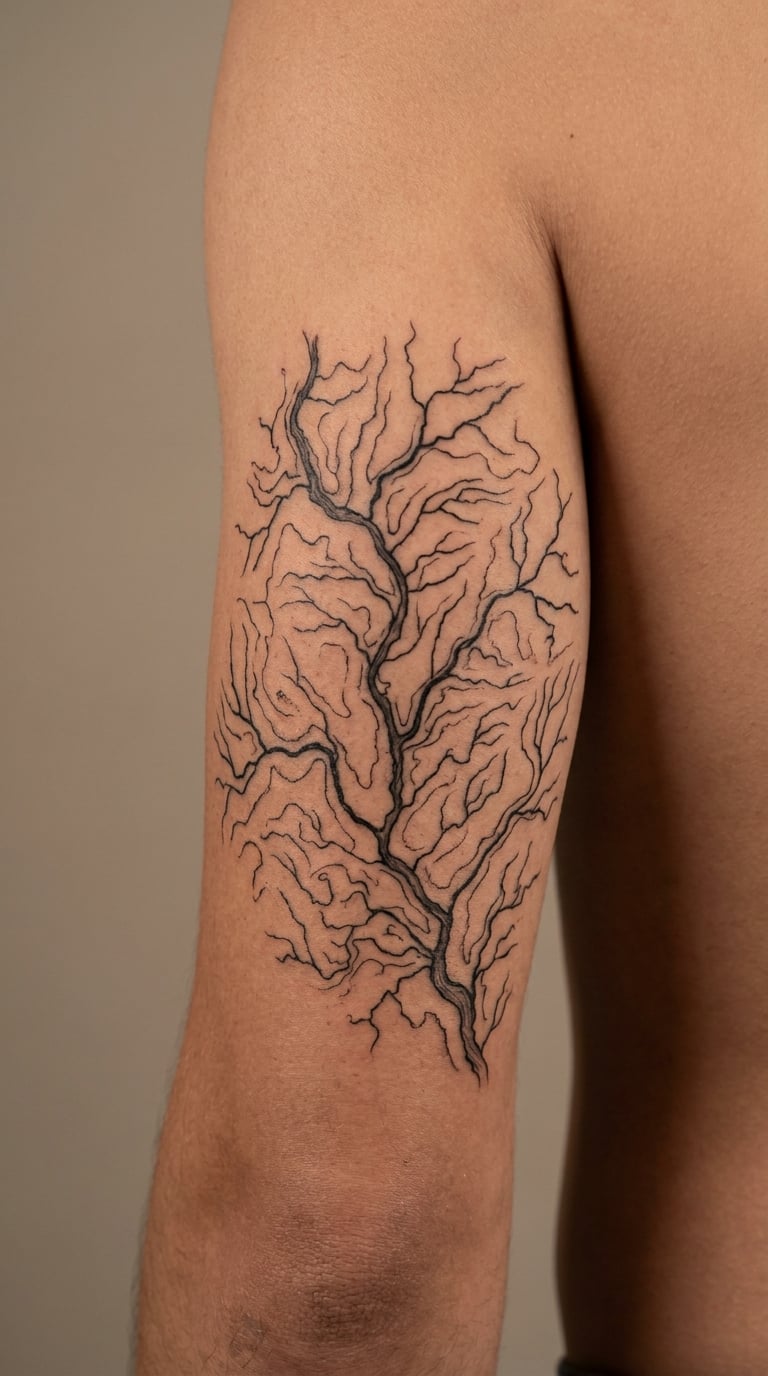
A main channel running the length of the design with smaller tributaries feeding into it, drawn as continuous contour-style linework with no fill. The branching structure follows a real watershed, so the piece looks like a map even though nobody needs a legend to read it.
This is the one to plan for, and the one that most often starts a collection. A specific river, mapped accurately, is a tattoo nobody else has, and it pairs naturally with coordinates added years later.
Placement: Back of the upper arm, shoulder to shoulder across the upper back, or along the spine. Size: 10-16 in (25-40 cm). Style: Cartographic linework, black ink.
Pain: High, from duration rather than sensitivity. Expect three or more sessions, and book breaks every hour or so. Get the drawing finished and healed first, because chasing a moving line across a large area is where big pieces go wrong.
Make it yours: Use the actual course of a river connected to you, and ask the artist to include the point where your route met it, marked with one small filled dot.
How to Choose the Right Design
Pick the style first, the placement second, and the size last. That order matters because the same river drawing behaves very differently as a thin single line and as a shaded black-and-grey piece, and the placement is what decides how much detail the skin can hold.
- Match the style to the skin you are using. Fine line and monoline suits flat, low-detail areas like the inner arm. Blackwork with heavy fills wants a larger canvas such as the outer thigh or upper arm. Micro-realism and colour work both need a place with enough surface area to breathe.
- Be honest about how much detail will survive. Very fine shading at under two inches will blur within a few years. If the design only makes sense small, simplify the shading rather than shrinking the whole thing.
- Use the body’s line, not against it. A river running down an arm or along a spine reads as flow. The same design placed horizontally across a narrow wrist reads as a squiggle. Ask the artist to rotate the stencil on the spot before anything is committed to skin.
- Decide what it is for before you decide how big it is. A private, personal piece can stay small and subtle. A piece meant to represent a place to other people needs enough scale that the shape is readable from across a room.
- Think about sun exposure before colour. Watercolour and soft colour washes fade on forearms, outer arms and lower legs far faster than blackwork in the same spot. If the placement is sun-exposed, lean black and grey.
- Bring references even when they feel wrong. Water is hard to photograph as a tattoo, and clients regularly arrive with images that are not what they want. Artists are used to that. A folder of ten loose references, plus a sentence about what you like about each one, is a better brief than a single finished drawing.
One last practical note from people getting their first piece: you are allowed to go to a consultation without being certain you want the tattoo. In fact, that is what a consultation is for, and the single most common worry from first-timers is turning up with a half-formed idea and wasting the appointment. Bring the ideas you have saved here, mark the two you like most, and let the artist fill in the gaps.
Cost and Session Time
Tattoo pricing is built from an hourly rate plus a shop minimum, so a small piece and the first hour of a large piece can cost nearly the same. That is why shop minimums matter more than size when you are working out what a session will run.
- Small pieces, 1-2 inches: usually finished in a single sitting of roughly 30 to 60 minutes.
- Medium pieces, 3-6 inches: commonly one to two hours, depending on how much colour or grey shading is involved.
- Large pieces, 8-16 inches: realistically split across three to five sittings, since no artist tattoos a full back or a whole sleeve in one go.
Hourly rates and shop minimums vary a lot by artist, by city and by how much detail the piece needs, so the only reliable number comes from a consultation where the artist has seen your design. Ask what the minimum is before you sit down, and ask whether the drawing needs to be finished and healed first on a larger piece. Expect to leave a tip proportional to the work if the session goes well.
Aftercare Basics
Start with your artist’s own aftercare instructions, because they know what they did to your skin. The general advice below covers what most people are told, and it is not a substitute for the sheet you get at the studio.
- Keep it clean. Wash gently with clean water and unscented soap, then pat dry. Many artists prefer a thin layer of ointment for the first stretch while the skin settles, after which they switch to whatever lotion they recommend.
- Protect it for the first couple of weeks. Loose clothing, no swimming or soaking, and no baths, hot tubs or saunas while the skin is still settling. Do not soak the tattoo.
- Do not pick at flaking skin. Some flaking in the first two weeks is normal. Let it come away on its own.
- Watch the sun. Fresh tattoos and healed tattoos both fade faster on exposed skin. This matters most for watercolour and colour pieces, which lose their soft edges years before blackwork does.
- Know what is normal and what is not. Redness, swelling and tenderness in the first days are ordinary. Increasing pain after the first few days, spreading redness, heat, or discharge from the tattoo is not, and it is worth contacting your artist or a healthcare professional promptly.
Frequently Asked Questions
What does a river tattoo symbolize?
Most people choose a river tattoo for movement and continuity. Water that keeps moving is a common stand-in for a life in progress: change, resilience, and the idea that you cannot step into the same water twice. Rivers also stand for a specific place, a route travelled, or a person who shaped the direction of things.
What is a good first river tattoo design?
A minimal mountain river or a thin winding line on the inner forearm is the most forgiving option, because the composition is simple, the session is short, and it is easy to cover at work. A single small bend behind the ear is the most discreet. All three are meaningful without being difficult to hide while you are still new to being tattooed.
How big should a river tattoo be?
Small river designs work down to about one inch, but any heavy shading will blur over the years at that size. For a medium detailed piece, plan on three to six inches along the limb. Map and sleeve designs need ten inches or more, which always means several appointments. Deciding the size before the design saves redrawing later.
Are river tattoos painful?
Most are low to medium, because the work is mostly line work and the placements people choose are on the arm, calf or thigh. The exceptions are ribs, sternum and the inner wrist, which hurt noticeably more. Sleeve-scale water pieces hurt mostly from sitting still for hours rather than from sensitivity at the spot itself.
Can an artist work from a vague idea?
Yes, and this is normal practice. Water is genuinely hard to find references for, so artists build river designs from a style name, a placement and a mood rather than from a picture. Bring a folder of ten loose references and note what you like about each one. That is a better brief than a single drawing that is nearly right.
Conclusion
If you have never been tattooed, start with idea 6, the minimal mountain river, or idea 12, the small bend behind the ear. Both are quick, both are honest, and both leave the door open to adding more later without anything looking out of place.
If you already have a nature piece and want the next one to carry real weight, idea 20, the large river map with tributaries, is the one worth planning around. Book the consultation early, bring the coordinates, and let the artist draw it properly first. Whichever direction you go, save the two or three designs that made you stop scrolling and take those to the studio.