
30 Tattoo Ideas for Women on the Thigh: October 2026 Fresh Edit
The thigh is the easiest large canvas on the body. The skin is flat across a wide area, it hides under a skirt or a pair of jeans, and there is enough room for everything from a two-inch sprig of lavender to a blackwork panel that runs hip to knee. That is why tattoo ideas for women on the thigh keep coming back: the placement works for a first small piece and for a serious large one.
Below are 30 tattoo ideas for women on the thigh, each with the style, the spot it suits best, a realistic size, what it feels like, and one idea for making it personal. If you already know your zone, jump to the side thigh tattoo ideas or browse the upper thigh designs first. Booking up for autumn gives the ink time to settle before summer, and shorts season is when a thigh piece gets its first real workout.
30 Tattoo Ideas for Women on the Thigh: Quick Guide
| Idea | Style | Best placement | Size | Pain |
|---|---|---|---|---|
| Fine-line wildflower stem | Fine line | Outer thigh | 2-3 in | Low to medium |
| Peony bouquet black-and-grey | Black-and-grey realism | Outer thigh | 4-5 in | Medium |
| Minimal butterfly, open wings | Fine line | Upper outer thigh | 2-3 in | Low to medium |
| Red rose with watercolor splashes | Illustrative colour | Outer thigh | 4-6 in | Medium |
| Ornamental moon and stars | Ornamental fine line | Outer thigh | 4-6 in | Low to medium |
| Snake wrapped around a flower | Illustrative blackwork | Outer thigh | 5-7 in | Medium |
| Sunflower in golden shades | Illustrative realism | Outer thigh | 5-7 in | Medium |
| Small rose made from dots | Dotwork | Upper or inner thigh | 1-2 in | Low to medium |
| Japanese-style koi in water | Illustrative colour | Outer thigh | 6-9 in | Medium |
| Geometric mountain range | Geometric blackwork | Outer thigh | 5-8 in | Low to medium |
| Pigeon with floral branch | Traditional | Upper or outer thigh | 4-6 in | Medium |
| Blue watercolor wave | Watercolour | Outer thigh | 4-6 in | Low to medium |
| Realistic fox portrait | Micro-realism | Outer thigh | 5-8 in | Medium |
| Moth with delicate antennae | Illustrative realism | Upper thigh | 2-4 in | Low to medium |
| Heart-shaped line of daisies | Minimalist line art | Inner or upper thigh | 2-3 in | Low to medium |
| Black swan with ink feathers | Black-and-grey realism | Outer thigh | 5-7 in | Medium |
| Laurel branch in fine line | Fine line | Outer or inner thigh | 2-4 in | Low to medium |
| Bold abstract brushstroke | Abstract blackwork | Outer thigh | 7-10 in | Medium |
| Hummingbird in flight | Illustrative realism | Outer thigh | 2-4 in | Low to medium |
| Ornate hand with fine details | Illustrative blackwork | Outer thigh | 5-7 in | Medium |
| Small turtle with shell pattern | Minimalist blackwork | Upper or inner thigh | 1-2 in | Low to medium |
| Cherry blossom branch in colour | Illustrative colour | Outer thigh | 4-6 in | Medium |
| Continuous-line elephant | Continuous fine line | Outer or inner thigh | 3-4 in | Low to medium |
| Crescent floral ornament | Ornamental fine line | Inner or upper thigh | 2-4 in | Low to medium |
| Bold dragonfly in blackwork | Bold blackwork | Outer thigh | 3-5 in | Low to medium |
| Whisper-line face profile | Continuous fine line | Outer thigh | 3-5 in | Low to medium |
| Botanical branch curving around thigh | Illustrative realism | Outer thigh | 6-10 in | Low to medium |
| Glowing gradient rose | Illustrative colour | Outer thigh | 4-6 in | Medium |
| Small star map constellation | Fine-line celestial | Inner or upper thigh | 2-4 in | Low to medium |
| Olive branch in one-colour shading | Illustrative realism | Outer thigh | 3-5 in | Low to medium |
1. Fine-Line Wildflower Stem
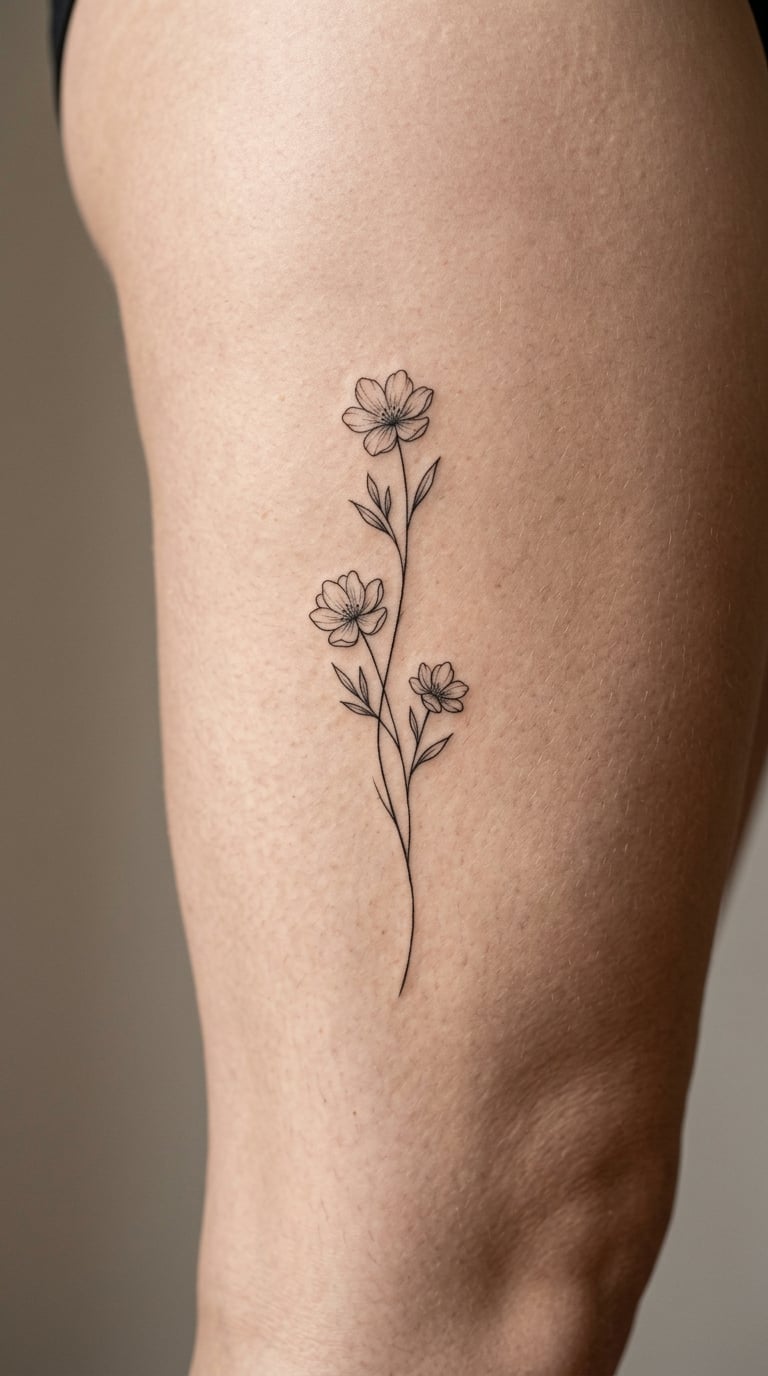
One thin stem, three small flowers left unpainted so the skin shows through the petals, and a single hairline that fades where the stem ends. It is the quietest design in this list and the easiest to place well on a leg. Plenty of people choose it because a plant is easy to make personal without a date or a name attached.
Placement: outer thigh, running vertically, or angled along the side of the leg. Size: 2-3 inches tall. Style: fine line. Pain: low to medium, and the outer thigh is a forgiving spot.
One honest note: a hairline stem on a thigh that sees summer sun will soften faster than a filled-in design. Make it yours: add three small blooms matching a plant from a specific garden or season.
2. Peony Bouquet in Black-and-Grey
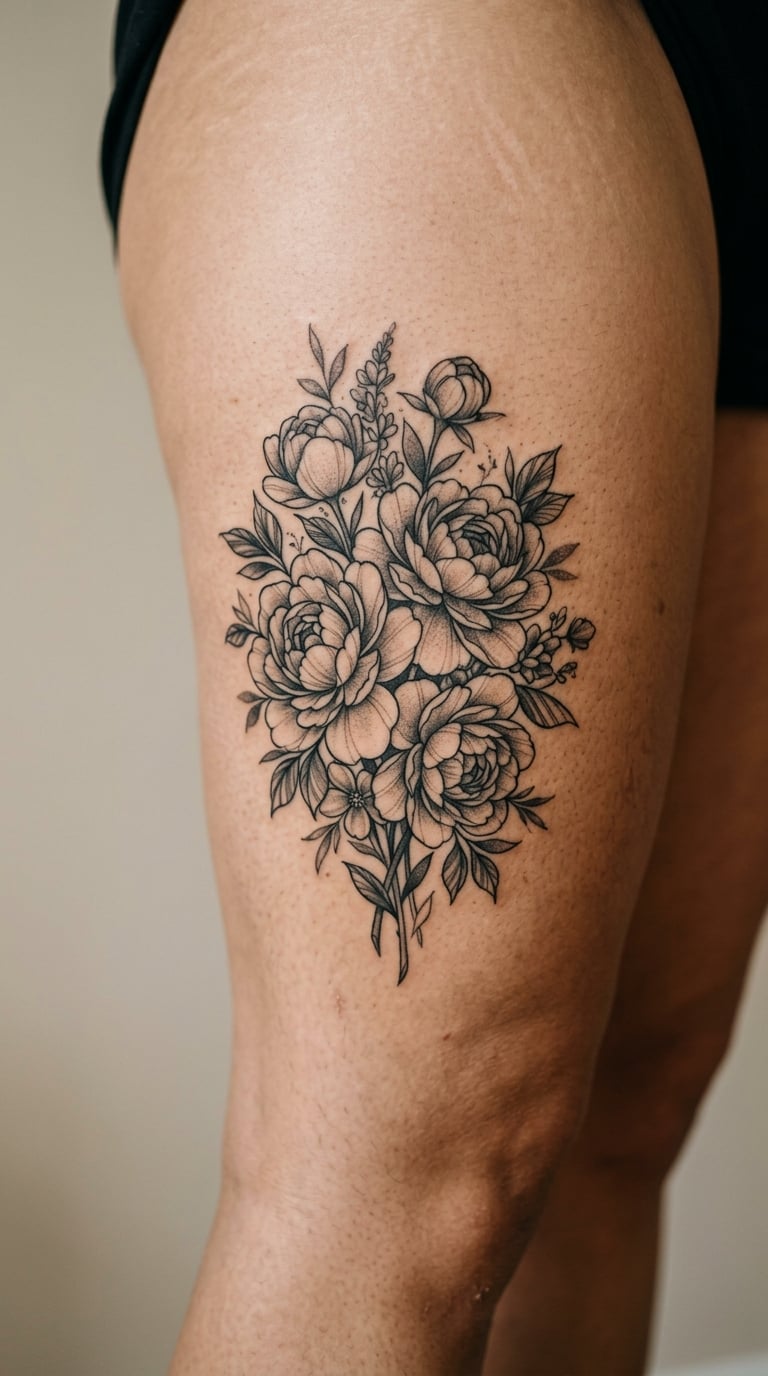
A peony drawn as a cluster of three or four blooms, each petal edge defined and the shadow built from soft grey wash rather than heavy black. Grey shading is what gives a bouquet depth without colour, and it suits a thigh because the leg is big enough to hold the tonal range. Many people pick peonies over roses because the ruffled petals feel generous rather than formal.
Placement: outer thigh, angled slightly with the leg. Size: 4-5 inches. Style: black-and-grey realism. Pain: medium, mostly the shaded areas.
Fine grey transitions are the part that softens first, so expect a touch-up on the lightest petals. Make it yours: tuck one eucalyptus sprig behind the bouquet in a muted green. See also our seashell tattoo ideas if you want a piece that fades gently in the same way.
3. Minimal Butterfly with Open Wings
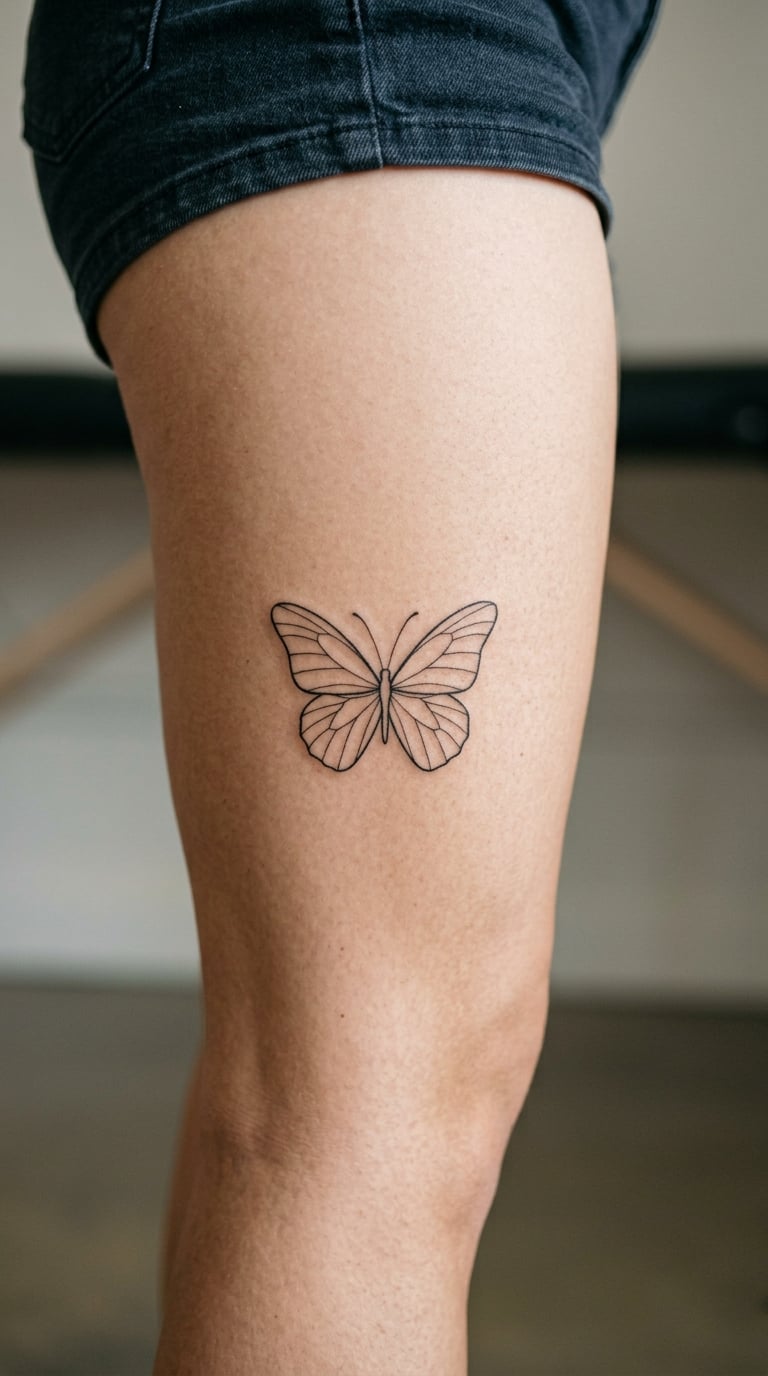
Two symmetrical wings, a slim body, a couple of antennae, nothing else. The whole thing sits inside a two-inch space and still reads clearly from across a room. Butterflies show up constantly on thighs because the shape flatters the curve of the leg, and the symmetry sits comfortably on a vertical surface.
Placement: upper outer thigh, just below the hip, or higher on the side thigh. Size: 2-3 inches across. Style: fine line. Pain: low to medium.
Wing outline lines blur a little faster than filled shapes, so keep the design at a size where the line has real weight. Make it yours: have the artist add a faint wash of colour inside the upper wings in one tone only.
4. Red Rose with Loose Watercolor Splashes
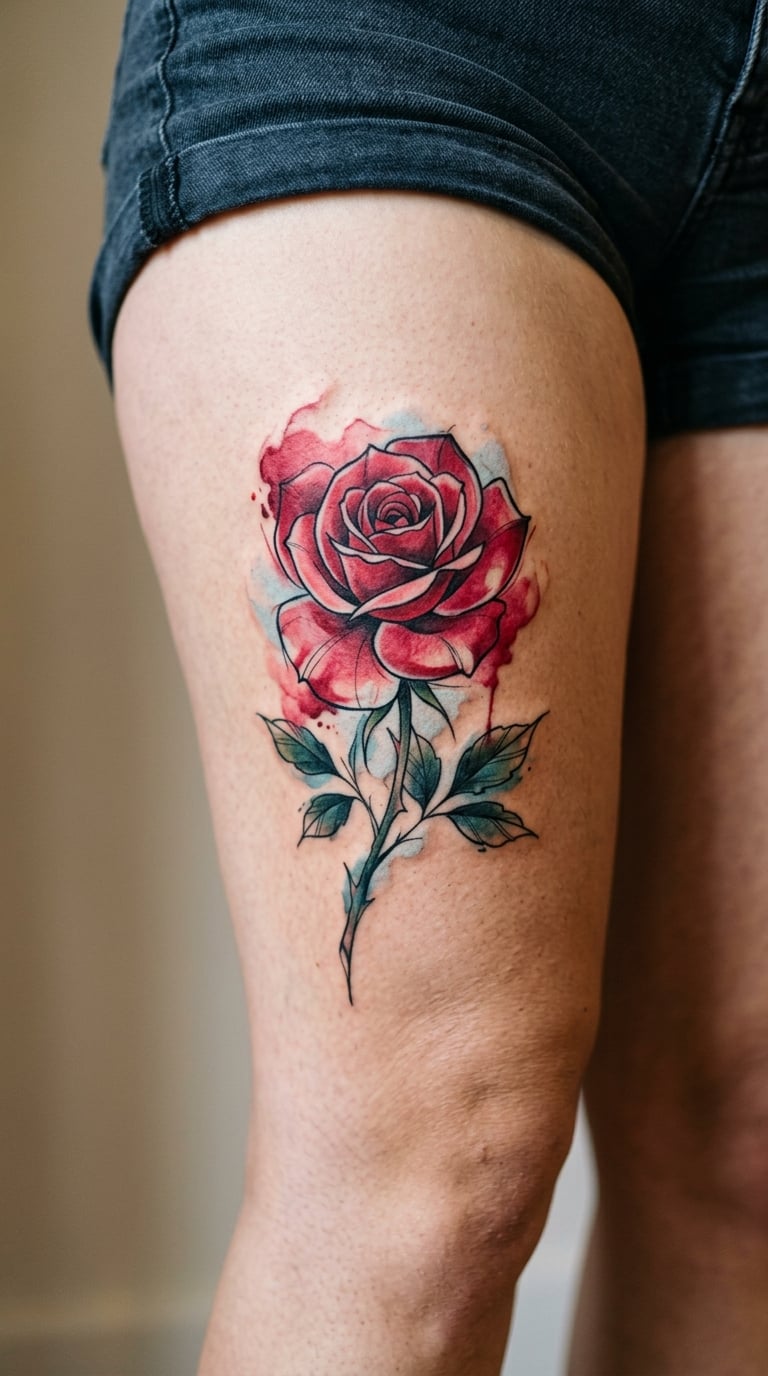
A single rose rendered in warm red, with pigment bleeding away from the flower in loose washes that stop without a hard edge. The splash is what makes it feel painted rather than drawn. People choose this one when they want a floral piece that looks spontaneous on a leg that is never still.
Placement: outer thigh, large enough for the washes to have room. Size: 4-6 inches including the splashes. Style: illustrative colour. Pain: medium, longer sitting because of the shading work.
Colour retouch is normal here, especially for the light blue. Make it yours: bring a photo of the actual rose you want and let the artist match its red rather than a generic one.
5. Ornamental Moon and Stars
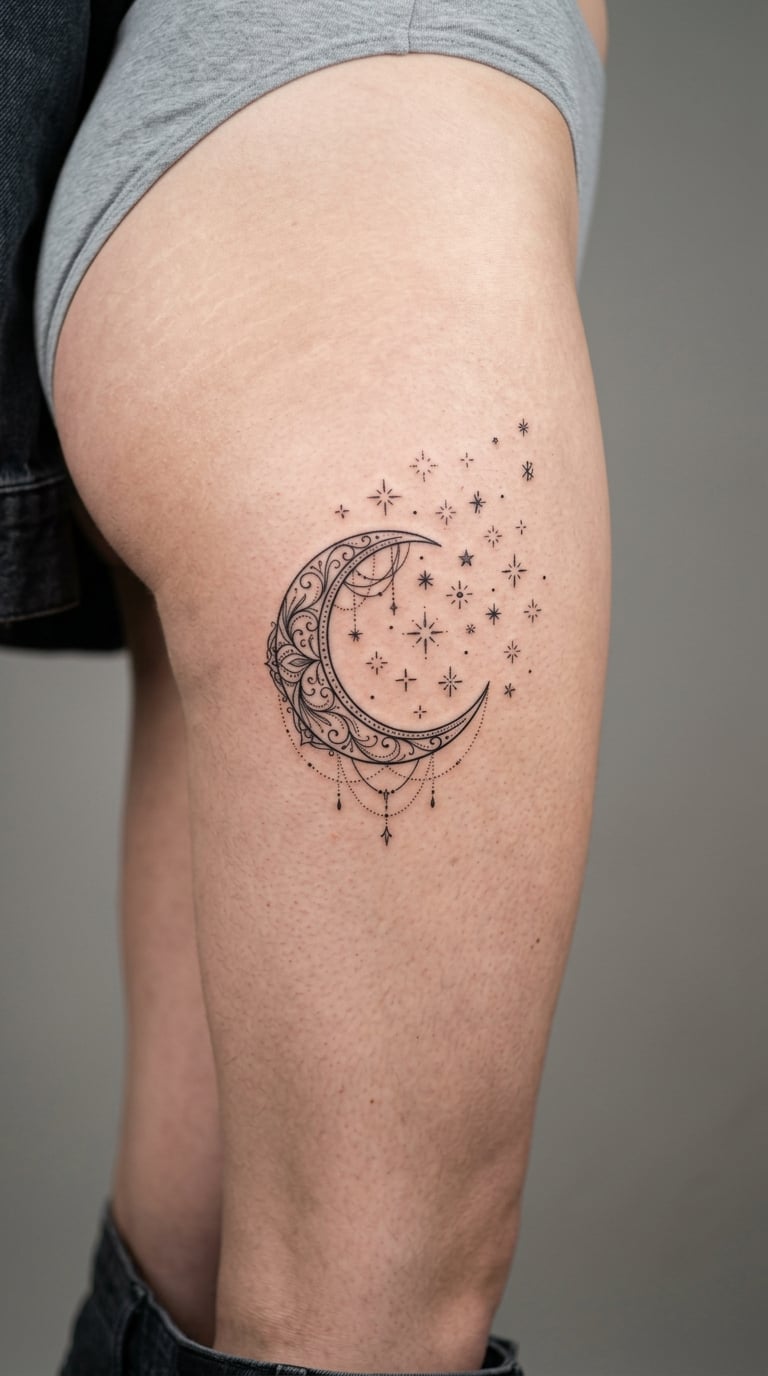
A slim crescent with a thin line of dots running inside its curve, then a scatter of small stars in varying sizes around it. That mix of outline and dot work is what makes it read as ornamental rather than as a plain moon. Plenty of people choose the shape for how it looks on the body, not because of anything fixed it is meant to mean.
Placement: outer thigh, vertical, with the crescent at the top. Size: 4-6 inches tall. Style: ornamental fine line. Pain: low to medium.
The smallest stars are the first to go soft, so ask for them slightly larger than a reference image shows. Make it yours: place the crescent over a real date, with the stars marking the individual digits.
6. Snake Wrapped Around a Flower
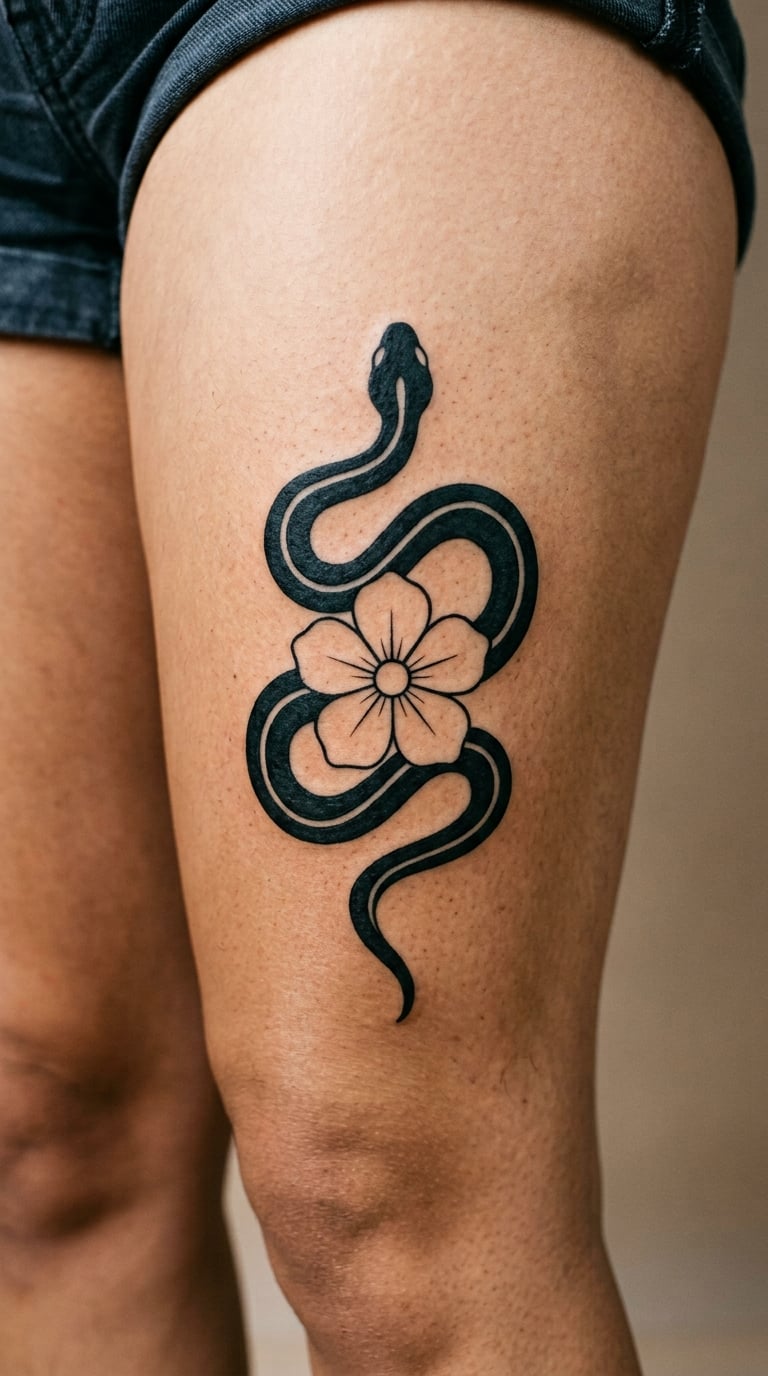
A solid black snake with no shading at all, curving in an S-shape around one unshaded five-petal flower. The contrast is the whole design: a flat, heavy silhouette holding something small and delicate. That tension between fierce and soft is the reason people keep coming back to it.
Placement: outer thigh, running diagonally so the body follows the leg. Size: 5-7 inches. Style: illustrative blackwork. Pain: medium, longer on the filled body.
Solid black holds its shape well and ages more evenly than thin line. Make it yours: swap the flower for a thistle or a poppy that means something to you.
7. Sunflower in Golden Shades
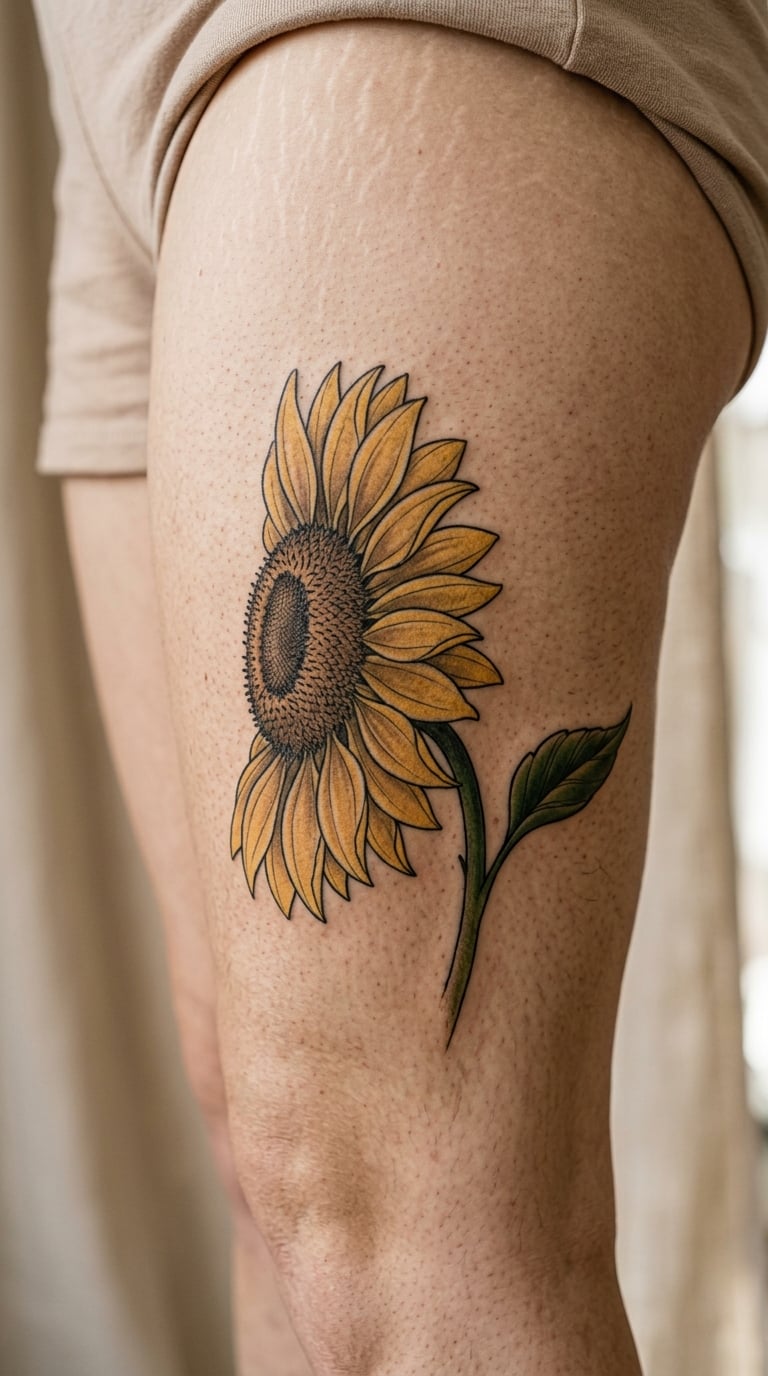
A sunflower in side view, petals shaded through ochre and warm yellow, with a stippled brown seed head that carries the texture. The head is built from hundreds of small dots, which is what stops the flower from looking flat. This motif works best on a bigger canvas because the petal layering needs space to separate.
Placement: outer thigh, stem angled down toward the knee. Size: 5-7 inches. Style: illustrative realism. Pain: medium.
Yellow on skin is a brighter pigment and usually wants one retouch sooner than black. Make it yours: run two or three smaller buds down the stem below the main bloom.
8. Small Rose Made from Dots
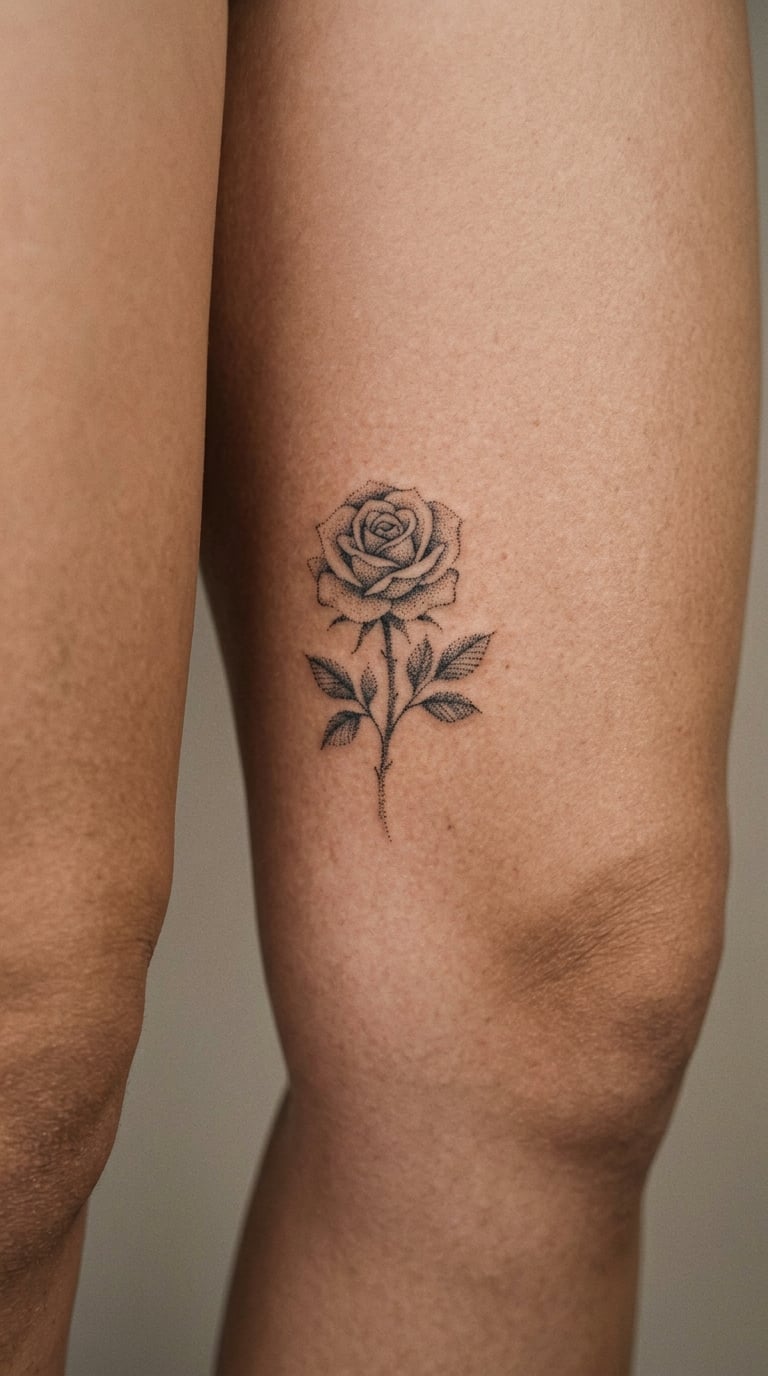
A rose built from dots, arranged so the spiral of the bloom reads as a shape rather than a scatter. The appeal is restraint: it looks like one small mark from a distance and a completely different drawing up close. It is a good pick if you like a design that rewards people who notice it.
Placement: upper inner thigh or the discreet area of the outer thigh. Size: 1-2 inches. Style: dotwork. Pain: low to medium.
Dots stay readable for a long time, though the outer rows can fade first. Make it yours: add a few loose dots trailing away from the stem, like spatter.
9. Japanese-Style Koi Swimming in Water
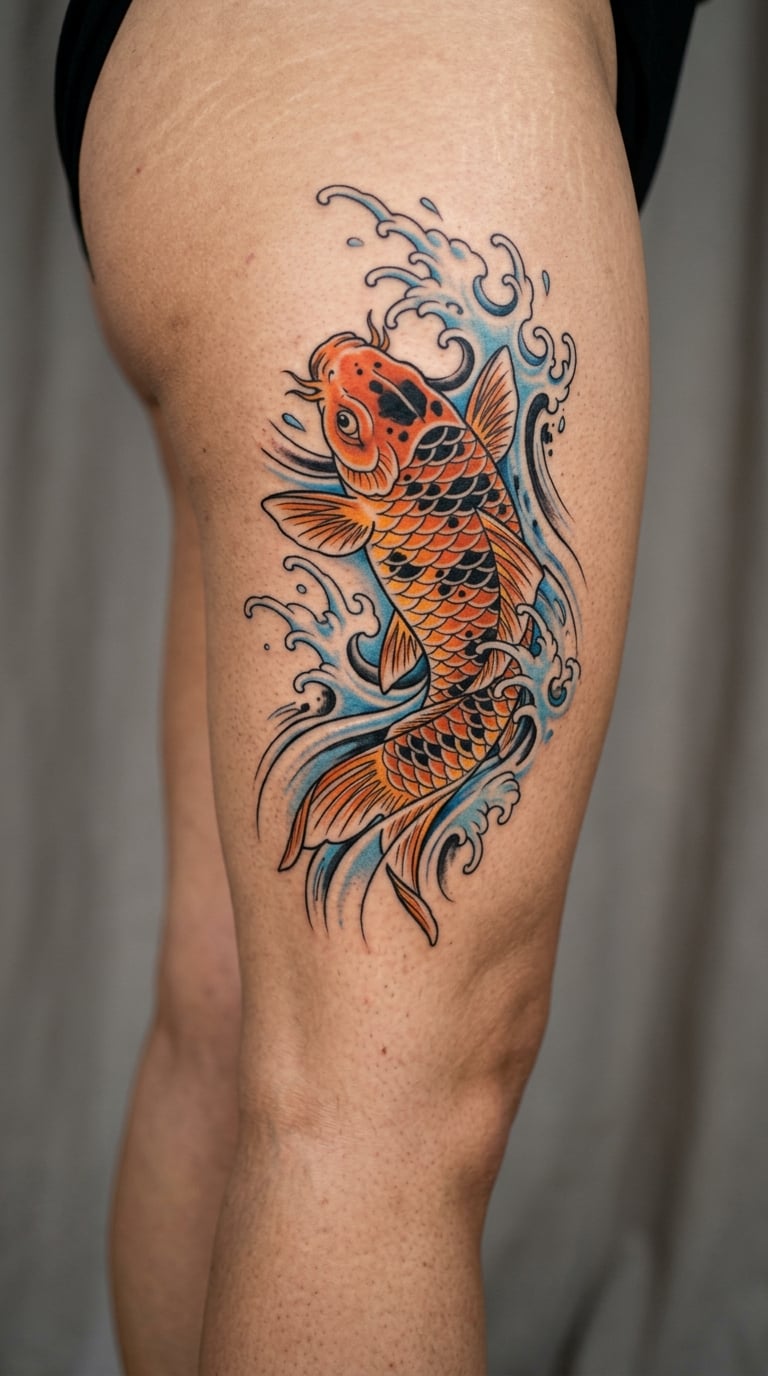
A koi with individually drawn scales, a fanned tail and soft grey-blue water lines moving behind it. The scales are the part that takes time, and they are also the part that suffers if the piece is shrunk. The composition works because the fish is diagonal, so it uses the length of the thigh rather than sitting on it.
Placement: outer thigh, larger panel, fish angled head-up. Size: 6-9 inches. Style: illustrative colour. Pain: medium, and expect a long sitting.
Each scale needs to be at least a couple of millimetres across or the detail muddies together. Make it yours: have the artist reduce the water to a few thin lines so the koi stays the only focal point.
10. Geometric Mountain Range
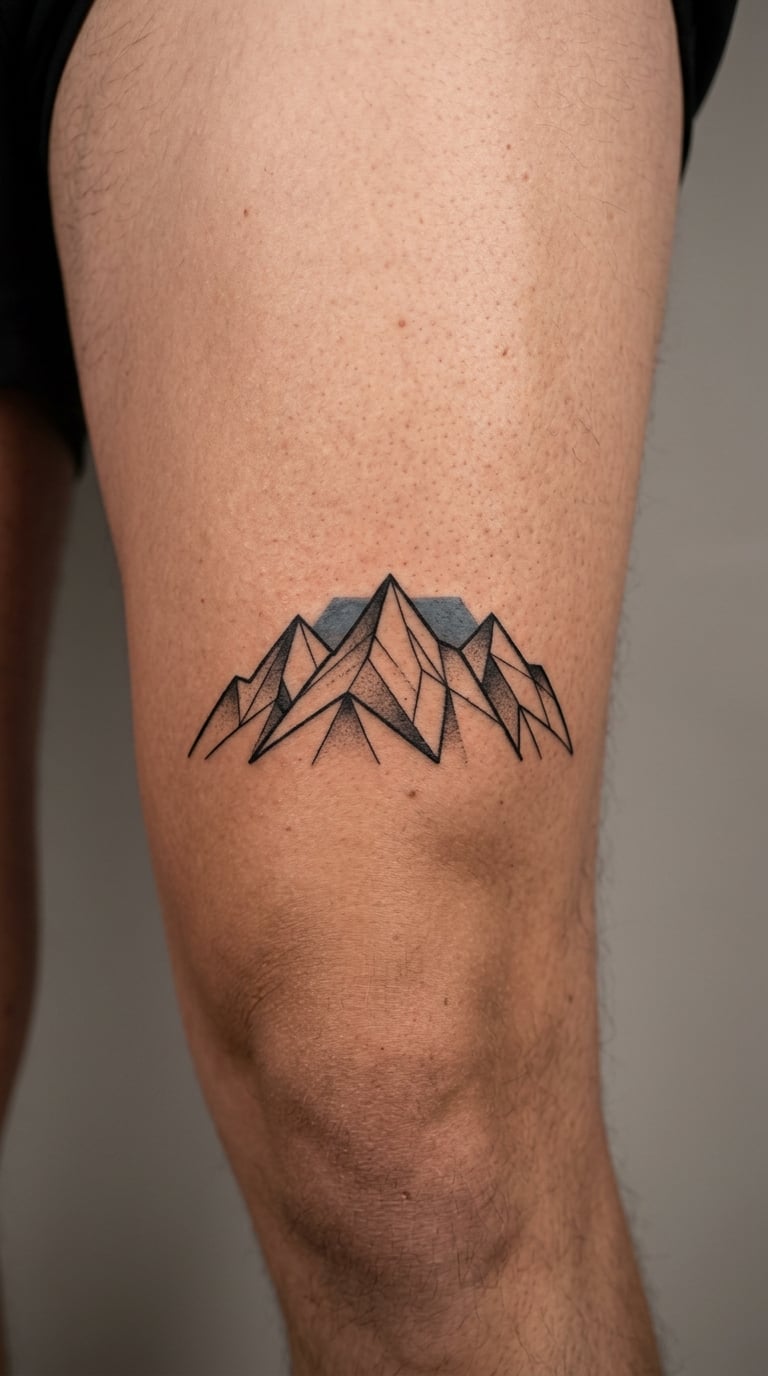
Three angular peaks drawn as straight-edged facets, most of them solid black, with a small band of muted blue above. The geometry means no soft edges anywhere, so it photographs cleanly and hides under clothing without bunching. Landscape geometry tends to get chosen for the shape of the place it came from.
Placement: outer thigh, sitting horizontally across the leg. Size: 5-8 inches. Style: geometric blackwork. Pain: low to medium, since there is little shading.
Solid facets stay crisp longer than stippled ones. Make it yours: use the outline of a hike you have actually done, and keep the blue sky line thin.
11. Pigeon with Floral Branch
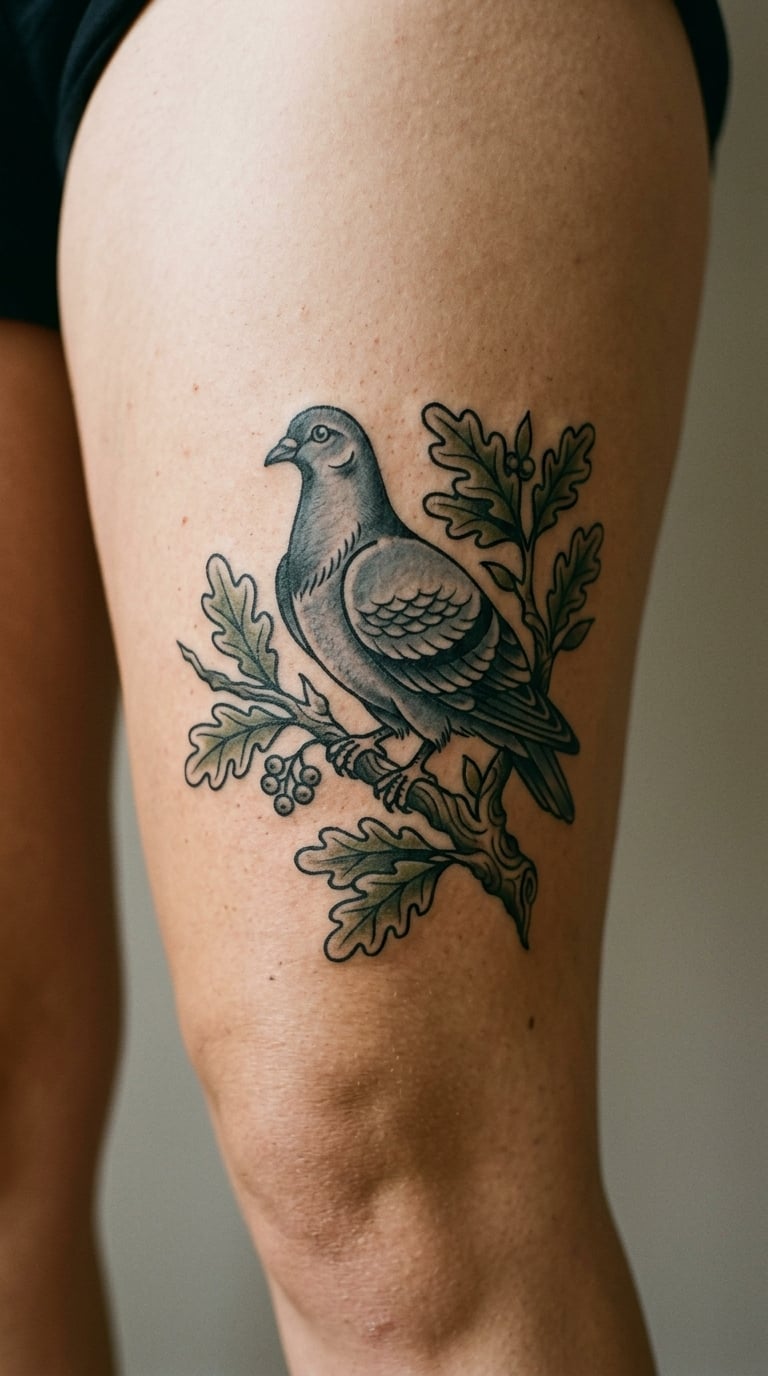
A pigeon in traditional style: black outline, grey body shading, a small highlight in the eye, perched on a branch with leaves and a couple of small berries. Traditional work suits the thigh because the bold outline gives the design a hard edge that reads at a distance. It has the balanced, slightly old-fashioned character people look for in bird pieces.
Placement: upper or outer thigh. Size: 4-6 inches. Style: traditional. Pain: medium.
Bold outlines age well, but the small eye highlight fills in over time. Make it yours: add a single ribbon or a small banner beneath the branch carrying a name.
12. Blue Watercolor Wave
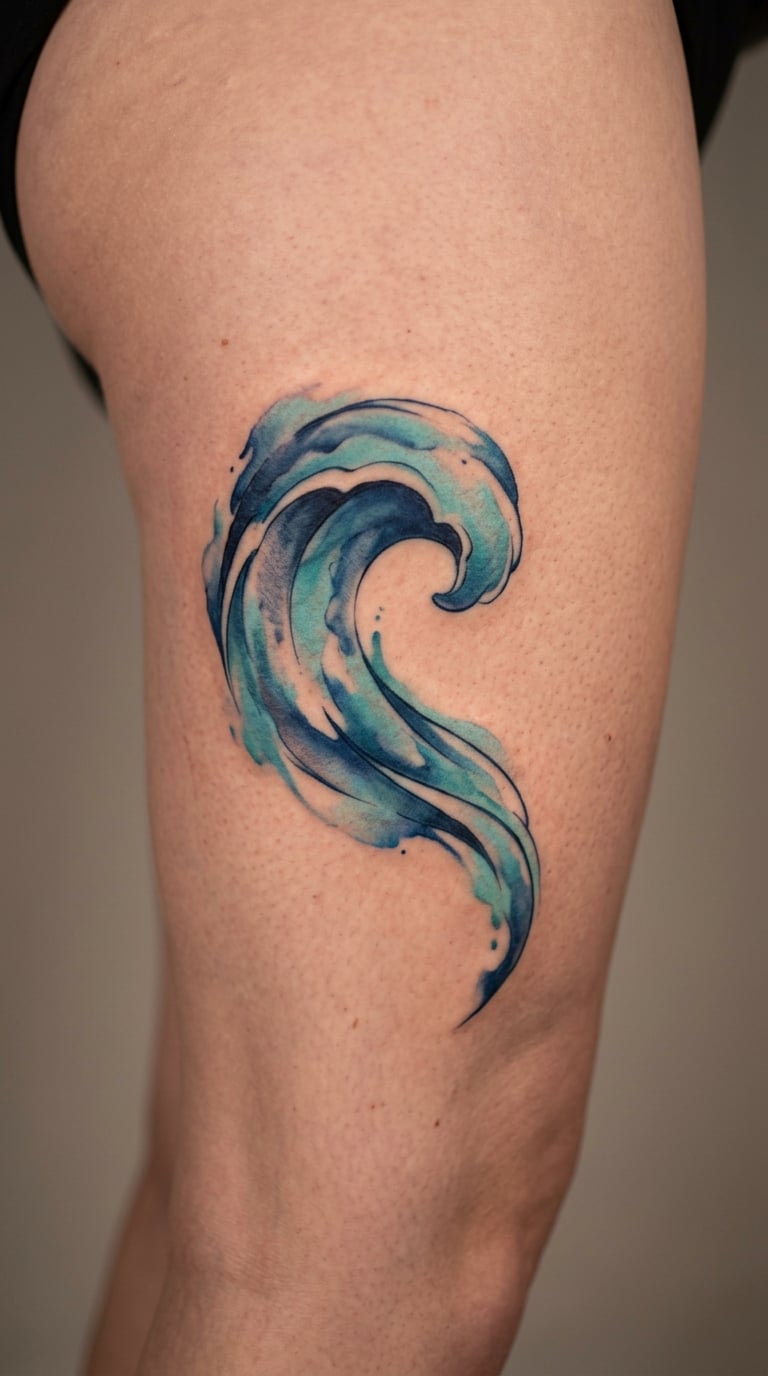
A single wave built from a few sweeping brush lines in navy and turquoise, with pigment thinning out where the artist lifted the needle away. The airiness of it is the point: it fills a large area without filling it completely. If you want a big thigh piece that still feels light, this is one of the easiest to live with.
Placement: outer thigh, running with the length of the leg. Size: 4-6 inches. Style: watercolour. Pain: low to medium, because coverage is patchy.
Light turquoise is the first colour to fade on exposed skin. Make it yours: keep a white highlight band along the crest of the wave so it does not flatten out.
13. Realistic Fox Portrait
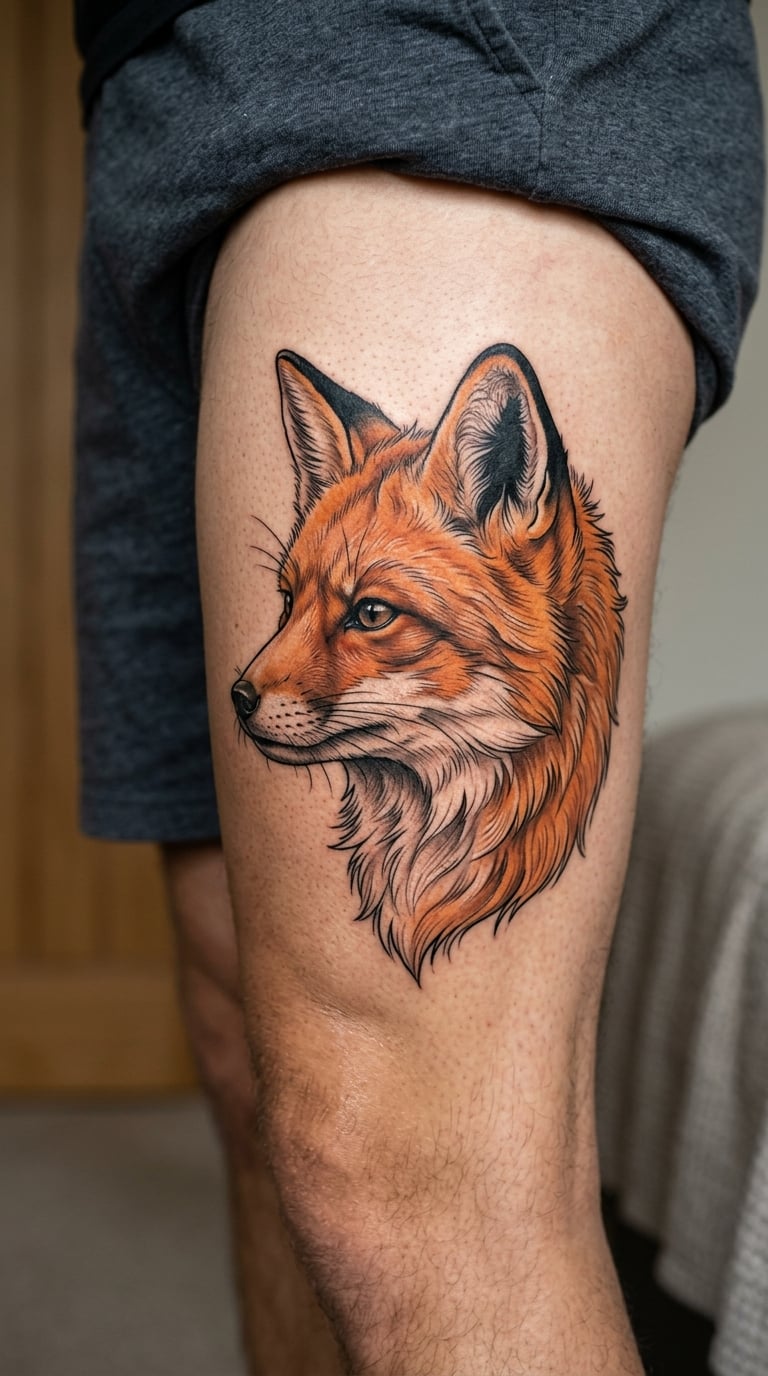
A fox head in side profile with fur built from short directional strokes, black ear tips, and an amber eye. The detail lives in the fur direction, which is exactly the part that gets soft. It suits someone who wants a portrait they can keep looking at rather than a symbol that says one thing.
Placement: outer thigh, larger panel. Size: 5-8 inches. Style: micro-realism. Pain: medium, and a long sitting for fine shading.
Fur detail softens noticeably over the years, so expect a retouch every few years if you want it sharp. Make it yours: for a smaller canvas, drop the full ruff and tattoo just the eye and ear line.
14. Moth with Delicate Antennae
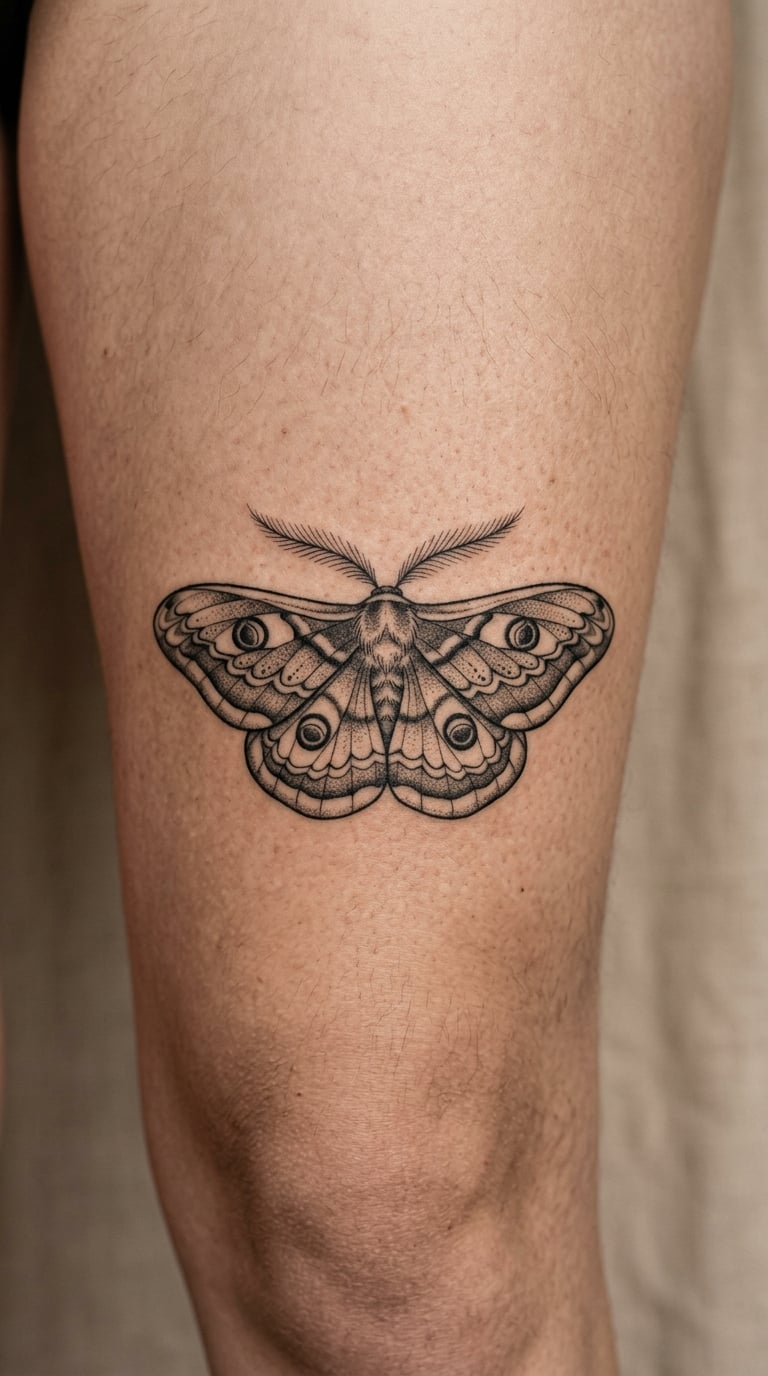
A symmetrical moth with patterned wings in cream and black, and long antennae feathered with tiny strokes. Moths get chosen far more often than people expect, usually because the wing pattern allows a real design in a small space. The symmetry also settles well on a vertical stretch of leg.
Placement: upper thigh, wings level. Size: 2-4 inches across. Style: illustrative realism. Pain: low to medium.
The feathered antennae are the first detail to disappear. Make it yours: have the wing pattern follow a real species from your region rather than a generic insect.
15. Heart-Shaped Line of Daisies
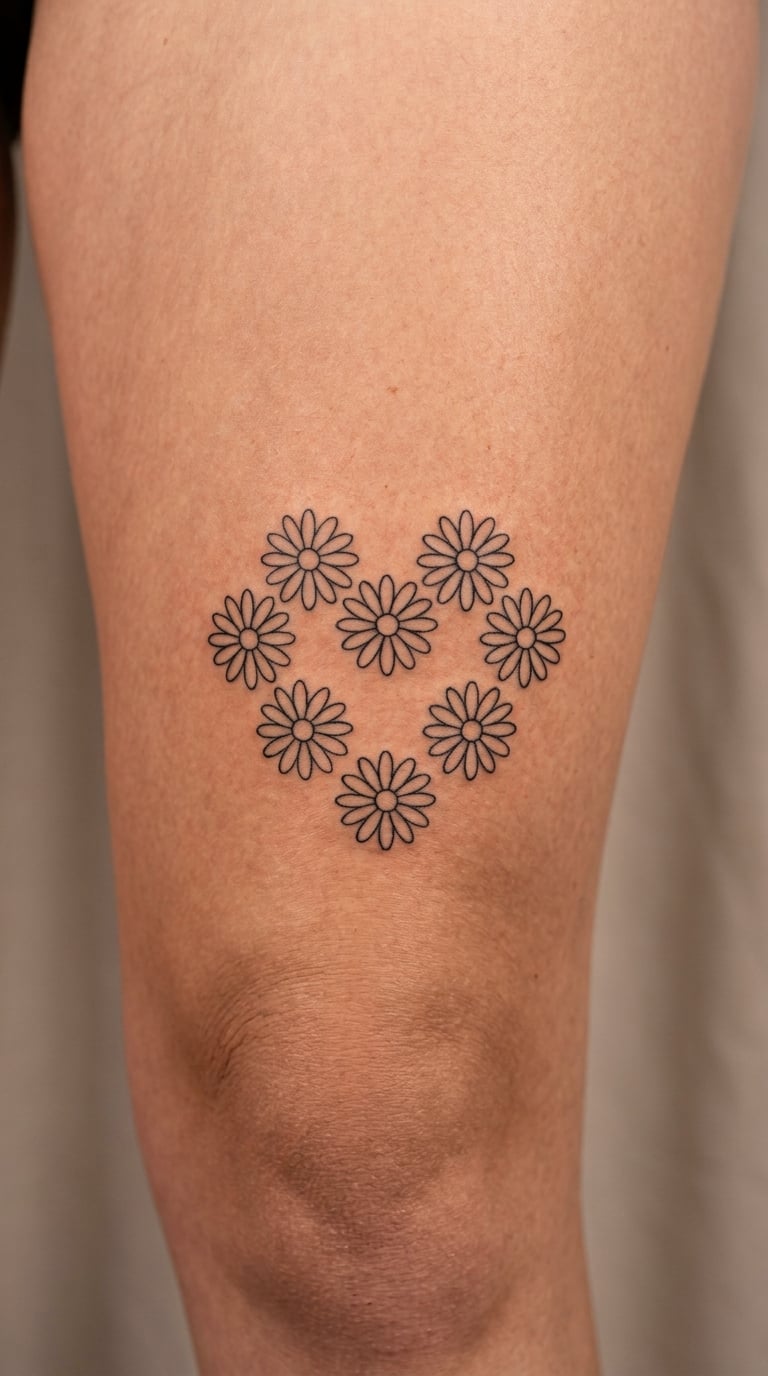
Seven or nine daisies, each a simple circle with a small centre and short petals, arranged so the gaps between them draw the outline of a heart. It is a good design for a first tattoo because the parts are simple while the overall shape reads instantly. The look is playful without being loud.
Placement: inner or upper thigh. Size: 2-3 inches. Style: minimalist line art. Pain: low to medium.
Thin outline flowers are among the first designs to need a refresh on sun-exposed legs. Make it yours: use your birth flower and your birth month, one daisy for each.
16. Black Swan with Ink Feathers
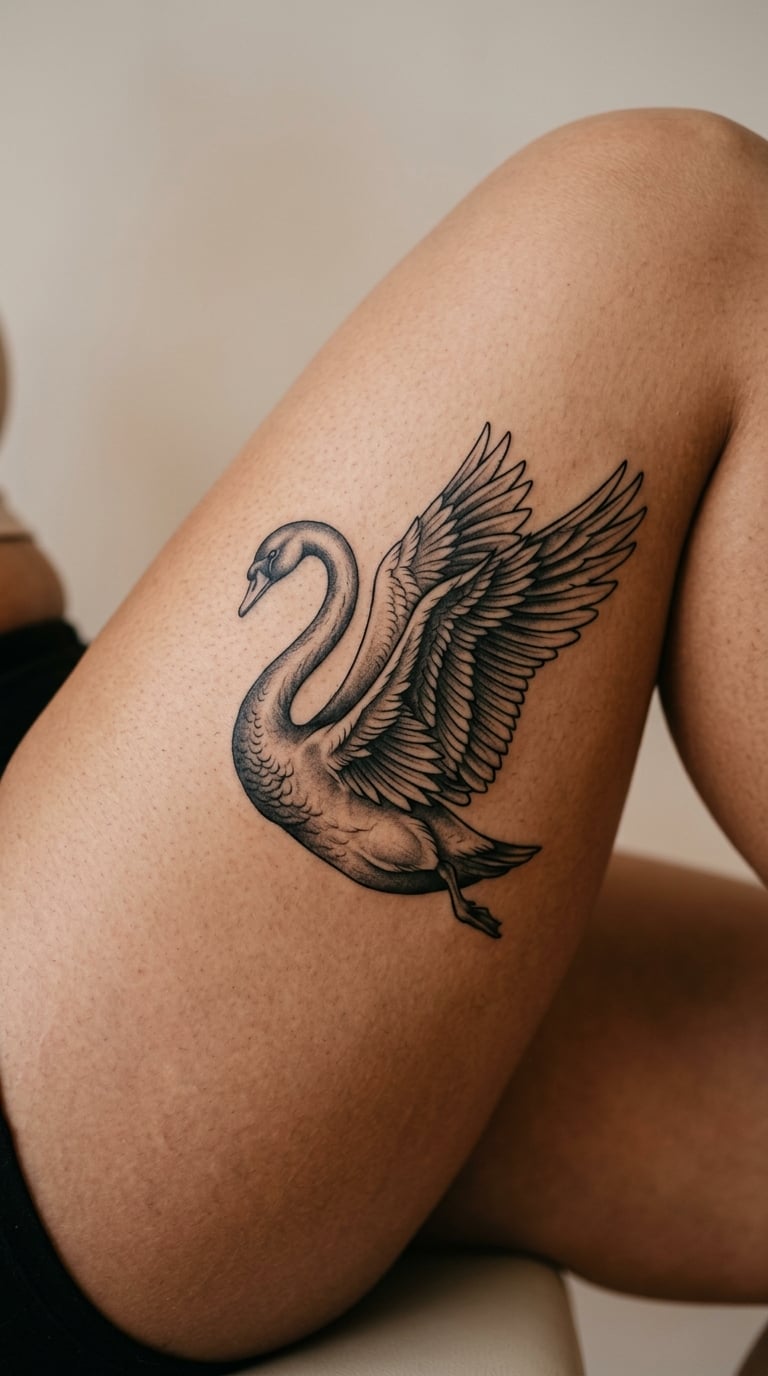
A swan with the neck curved back over the body, feathers separated by thin white gaps carved out of solid black, and a soft grey wash under the wing. The carved highlights are what keep a black bird from turning into a solid blob. People tend to choose it for the shape rather than a fixed meaning.
Placement: outer thigh, vertical. Size: 5-7 inches. Style: black-and-grey realism. Pain: medium.
Carved-out white lines are permanent absence of ink, so they hold up better than white pigment. Make it yours: place two thin water lines beneath the body for balance.
17. Laurel Branch in Fine Line
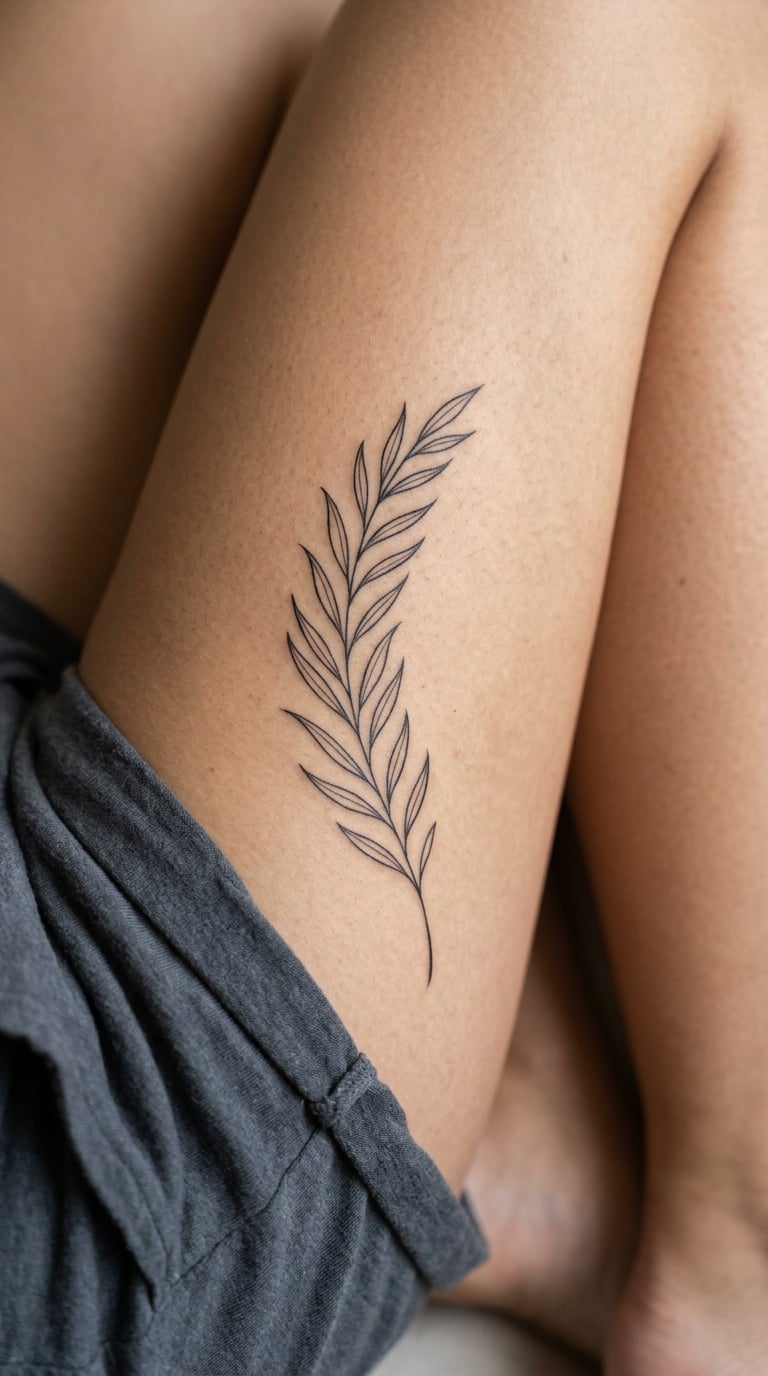
A single curved stem with narrow leaves spaced evenly on both sides, each one a filled shape rather than an outline. The even spacing is the whole craft here: a laurel looks balanced when the leaves march at regular intervals along the arc. It is a botanical piece with a slight classical feel and no colour at all.
Placement: outer or inner thigh, angled along the leg. Size: 2-4 inches. Style: fine line. Pain: low to medium.
Even spacing keeps the design readable after several years. Make it yours: pair it with a matching branch on the opposite thigh at the same height.
18. Bold Abstract Brushstroke
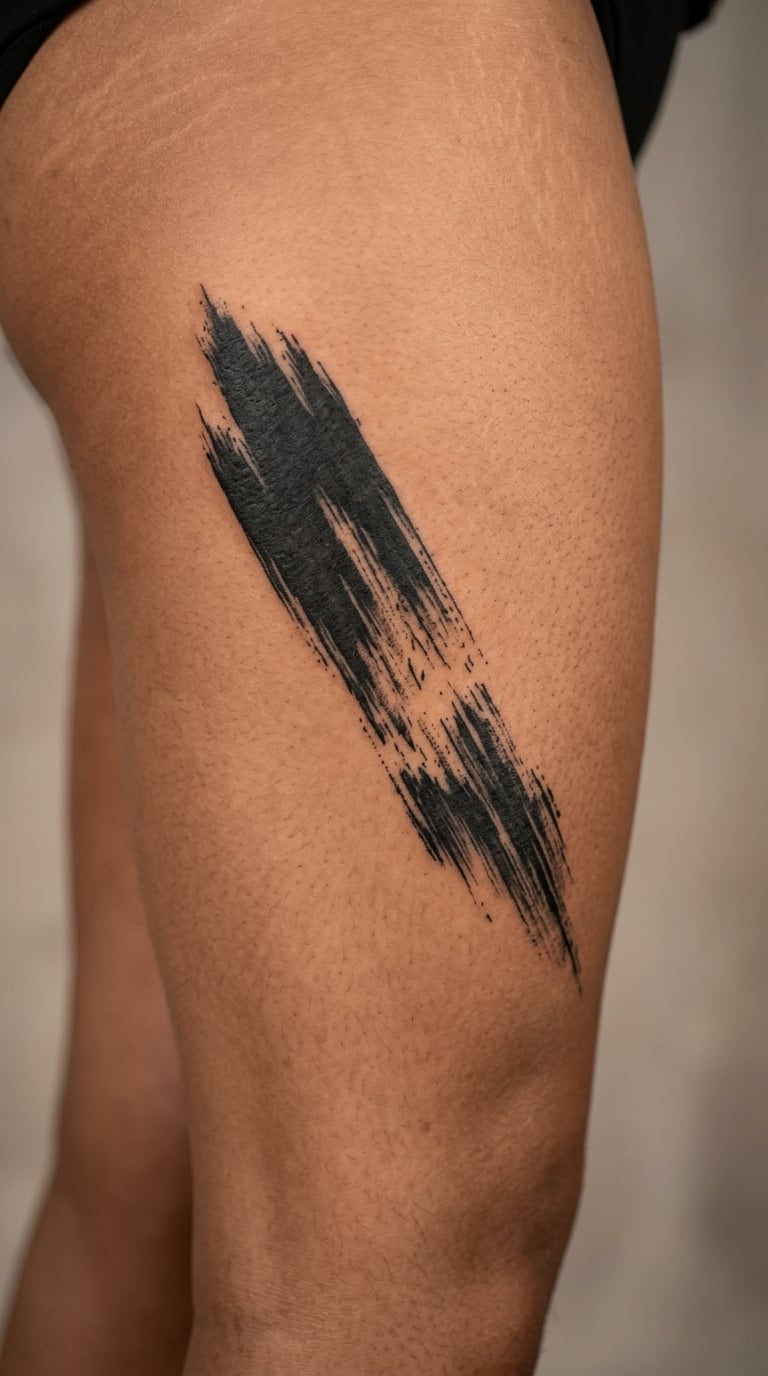
One thick black gesture across the thigh, dry-brushed so the edge breaks up and the middle opens into raw skin. It is not a picture of anything, which is exactly why it works as a first large piece: there are no wrong details to argue about. It suits anyone who wants commitment without choosing a subject.
Placement: outer thigh, diagonal across the leg. Size: 7-10 inches. Style: abstract blackwork. Pain: medium, because the coverage is heavy.
Solid black needs a full outline and a later session to make the density even. Make it yours: let the artist shift the stroke to follow your actual leg curve rather than drawing it straight.
19. Hummingbird in Flight
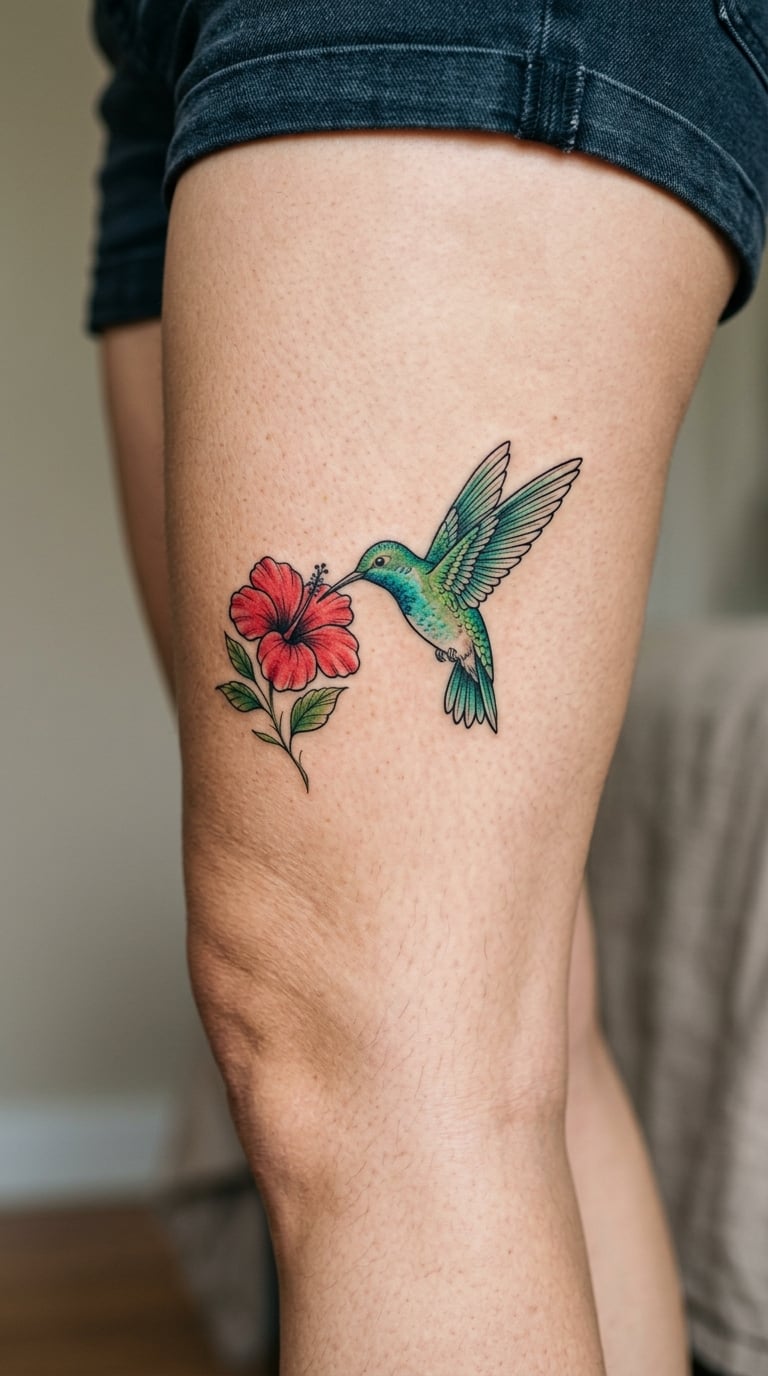
A hummingbird body in green with a long straight beak, wings stretched out and blurred with quick short strokes, facing a single flower. The blur is what makes it read as motion rather than a bird at rest. Plenty of people pick it for the sense of movement in a small, compact piece.
Placement: outer or upper thigh. Size: 2-4 inches. Style: illustrative realism. Pain: low to medium.
Wing blur made of tiny strokes is the first thing to blur further. Make it yours: point the bird toward a specific flower and use that exact colour as the only accent.
20. Ornate Hand with Fine Details
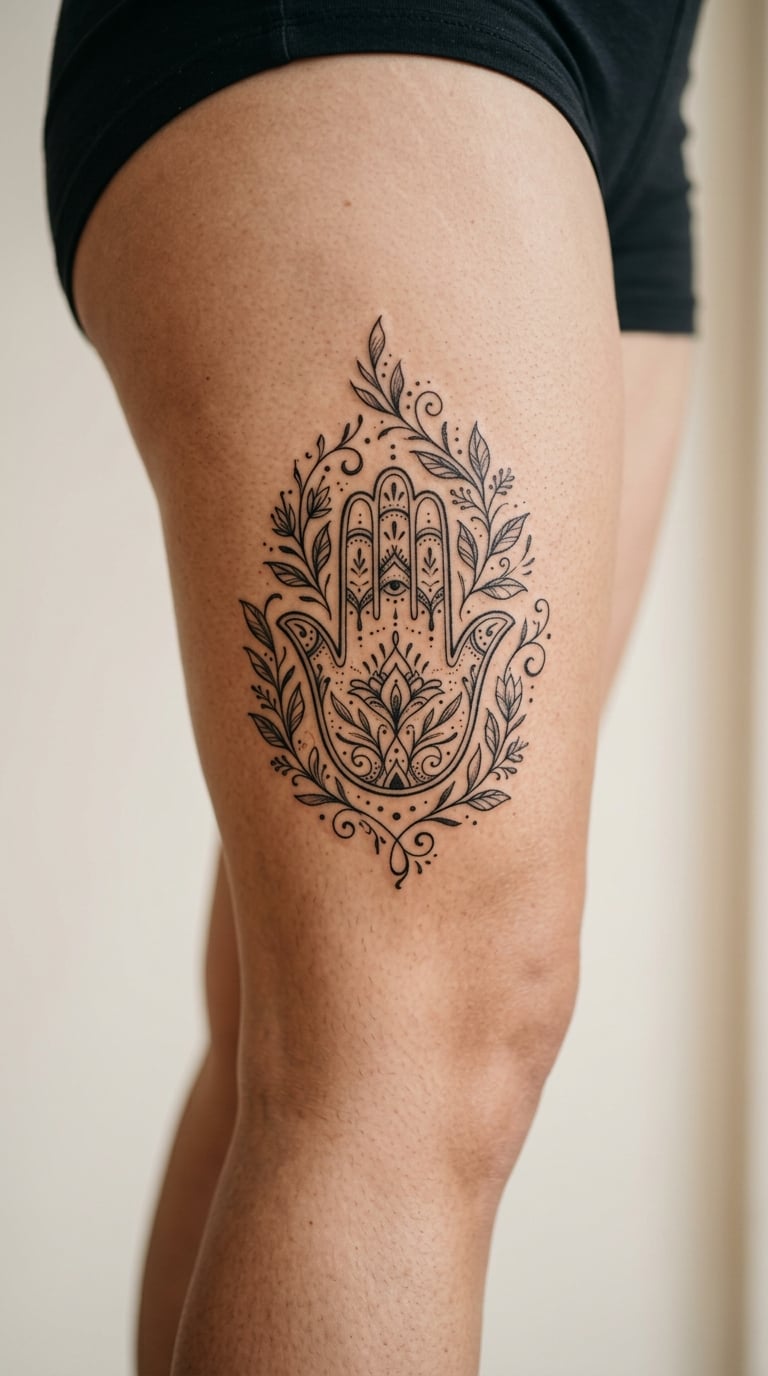
An open hand drawn in black with the fingers slightly spread, the palm decorated with filigree and small dot accents, and a few leaves running along the wrist. Ornamental hand pieces carry the most fine detail of anything in this list, so scale is the deciding factor. It works on a thigh precisely because the leg is big enough to hold the pattern work.
Placement: outer thigh, fingers pointing up the leg. Size: 5-7 inches. Style: illustrative blackwork. Pain: medium.
Be honest with yourself about the smallest elements: the filigree in the palm will soften with time. Make it yours: have the artist simplify the palm pattern while keeping the finger lines crisp.
21. Small Turtle with a Shell Pattern
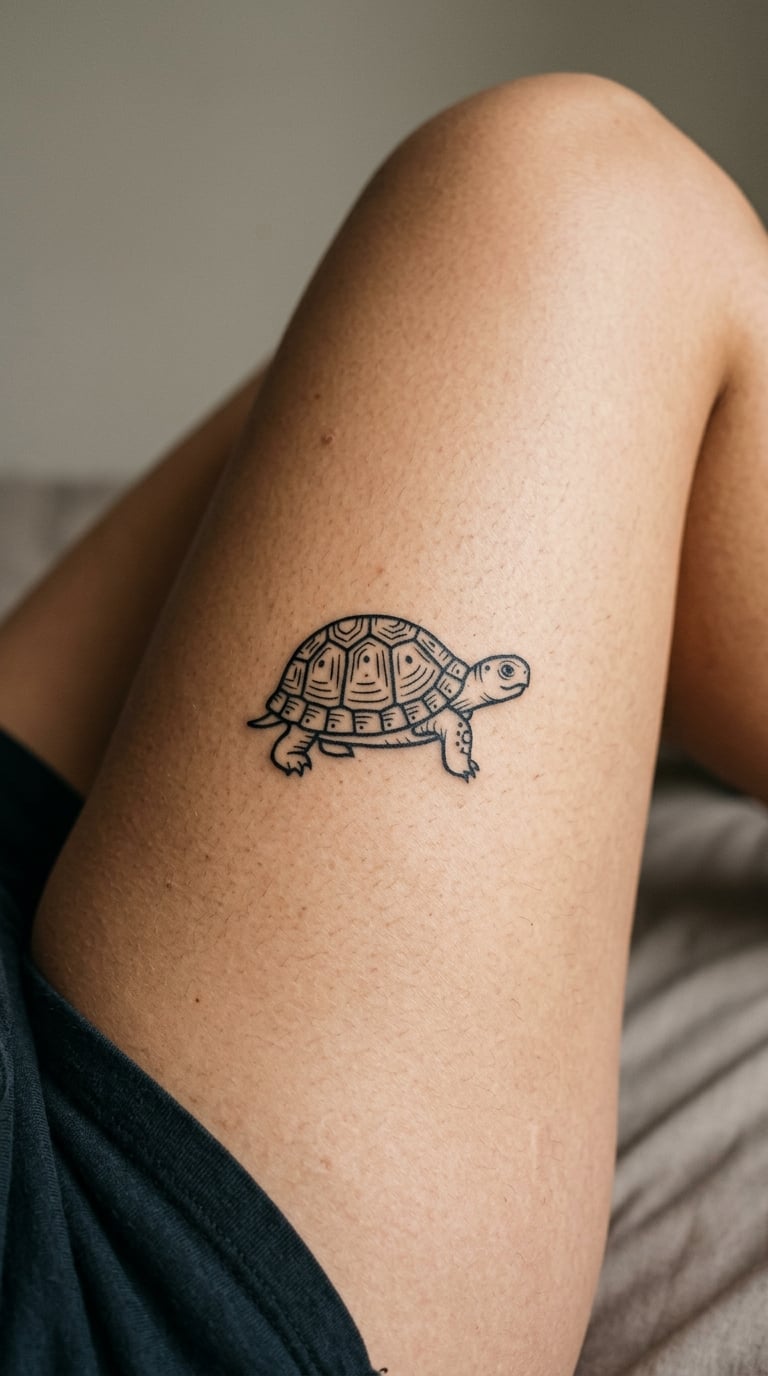
A turtle in side view with a clean single-weight outline, the shell divided into a few hexagons with two or three filled for contrast. There is no shading and no colour, so it reads as a small confident mark rather than an illustration. The calm, slow-moving subject appeals to people who want something low-key.
Placement: upper or inner thigh for a discreet spot. Size: 1-2 inches. Style: minimalist blackwork. Pain: low to medium.
Keeping the shell sections large is what makes a tiny turtle stay readable. Make it yours: fill the shell pattern in your birthstone colour and leave the rest black.
22. Cherry Blossom Branch in Colour
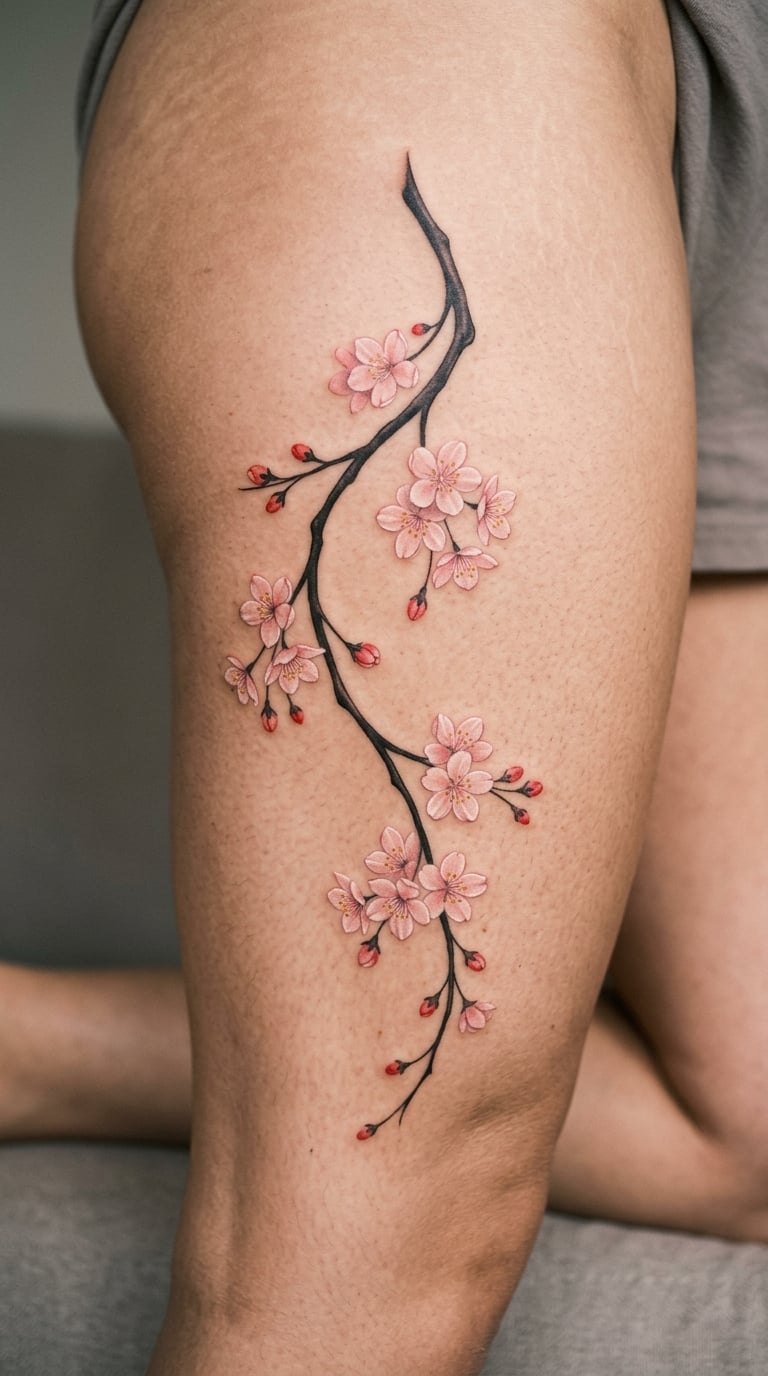
A dark curved branch carrying clusters of pale pink blossoms, each flower with a small red bud at the centre, and a few petals falling below. The falling petals are optional and they change the composition more than any other detail. It is a seasonal image people book in winter for the following spring.
Placement: outer thigh, angled upward. Size: 4-6 inches. Style: illustrative colour. Pain: medium.
Pale pink is a light pigment and will need refreshing sooner than the branch. Make it yours: have the falling petals land on a specific initial rather than at random.
23. Elephant Made from One Continuous Line
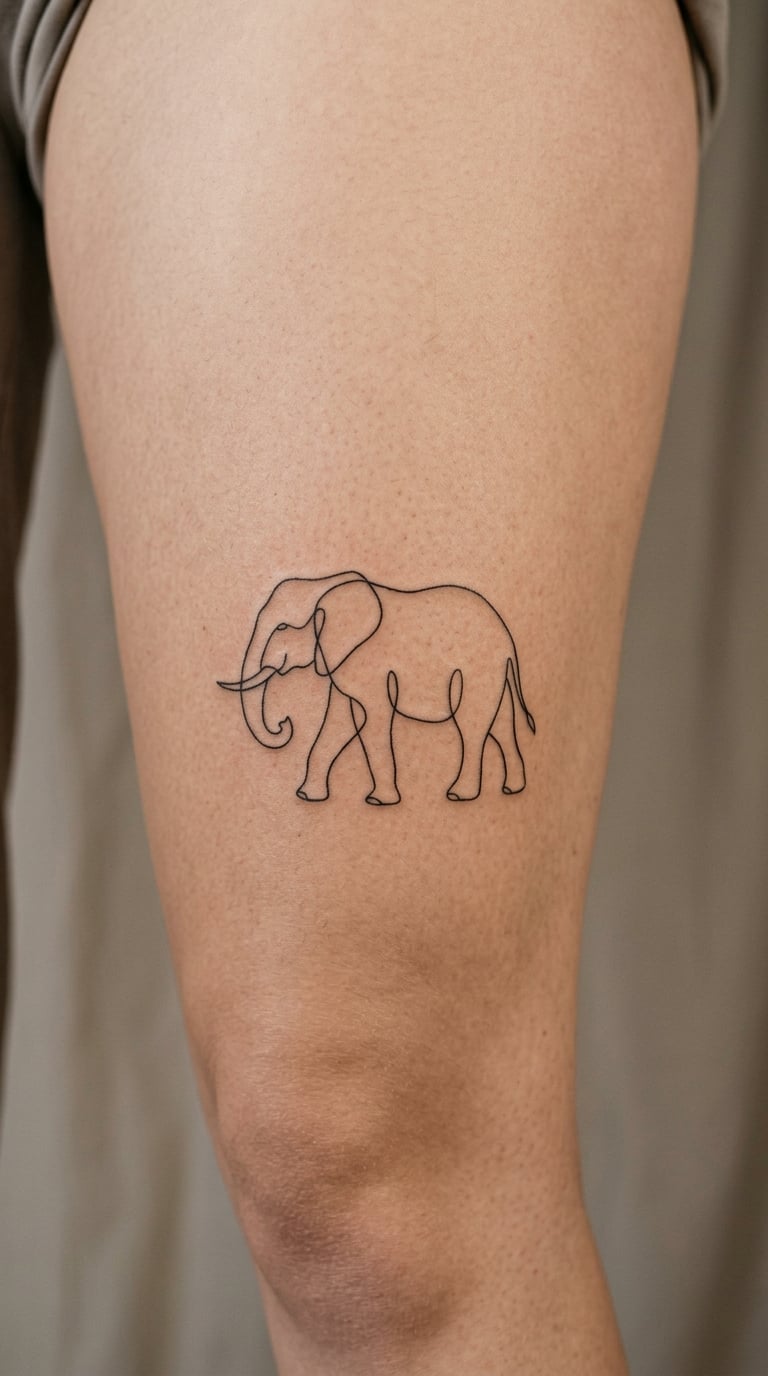
A side-view elephant drawn in one unbroken line: the trunk curves up, the back line runs straight, and the interior detail is limited to a single ear and eye. Continuous line work is only possible because the design never has to cross itself, and the whole animal stays readable at three inches. The simplicity is what makes it look considered rather than unfinished.
Placement: outer or inner thigh. Size: 3-4 inches. Style: continuous fine line. Pain: low to medium.
A single unbroken line is more fragile than a filled shape, so plan for a refresh. Make it yours: have the artist hide a small date in the curve of the trunk.
24. Crescent Floral Ornament
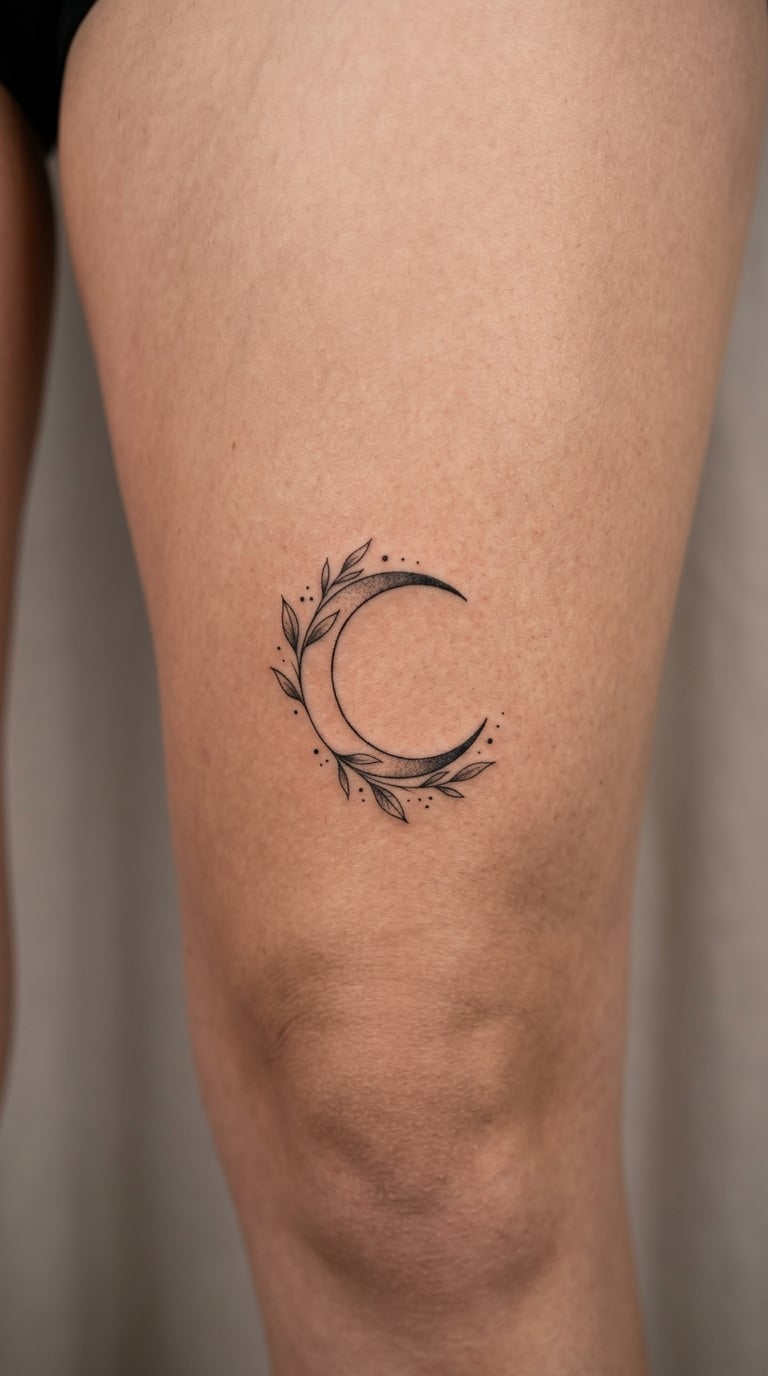
A thin crescent with a stem of small leaves running along the outer curve and a few dots scattered in the open space around it. It reads as a piece of jewellery rather than a picture, which is a different mood from the bigger florals here. The restrained leaf count is what keeps it delicate.
Placement: inner or upper thigh, where the curve of the leg frames it. Size: 2-4 inches. Style: ornamental fine line. Pain: low to medium.
Fewer, larger leaves hold their shape better than many small ones. Make it yours: add one coloured leaf in a single tone while everything else stays black.
25. Bold Dragonfly in Blackwork
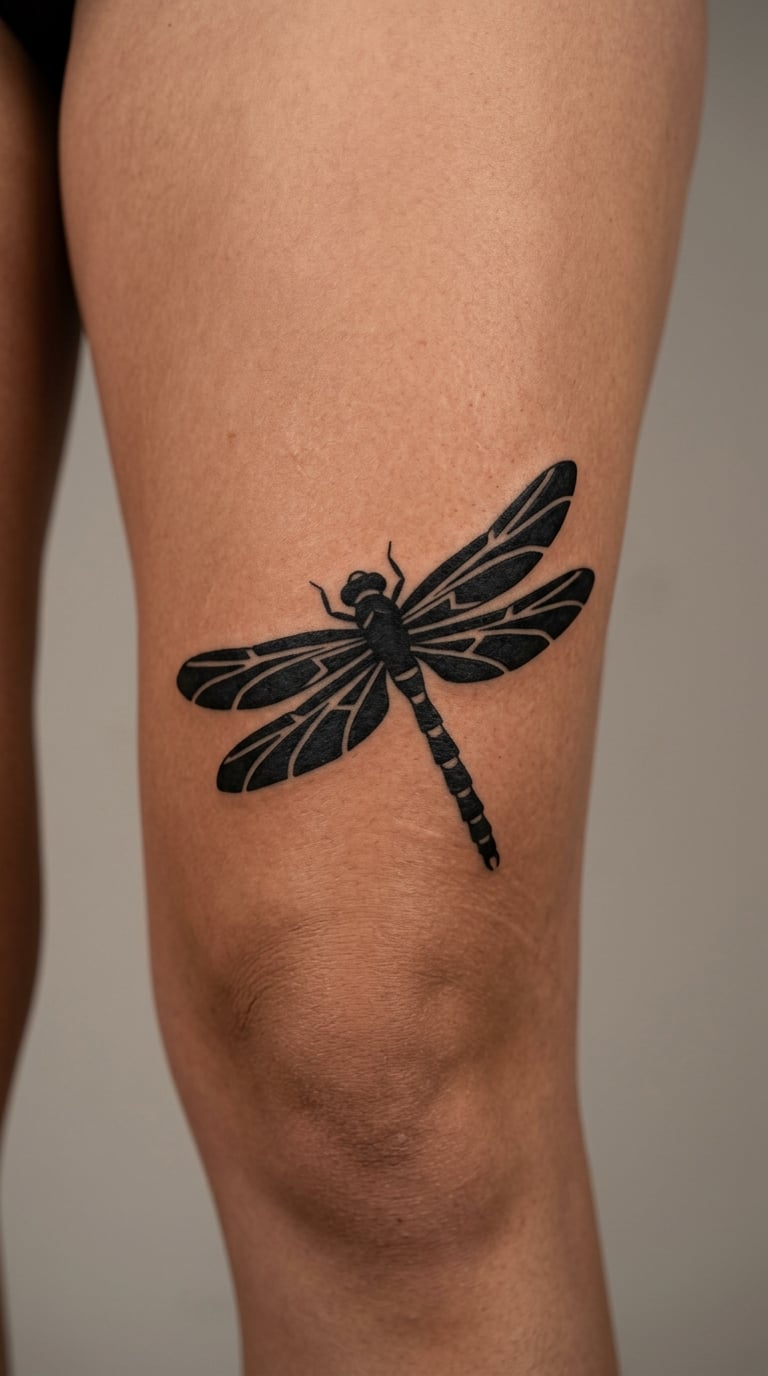
A dragonfly laid out horizontally with solid black wings divided by narrow negative-space veins, a segmented body, and nothing in the background. The empty space around it does as much work as the ink, and it is why a bold design can still feel light on a large thigh. It is a graphic choice more than an illustrative one.
Placement: outer thigh, horizontal across the leg. Size: 3-5 inches across. Style: bold blackwork. Pain: low to medium.
Wings kept at three or four segments each will still read in ten years. Make it yours: have the wing veins follow a pattern from a real wing rather than evenly spaced lines.
26. Whisper-Line Face Profile
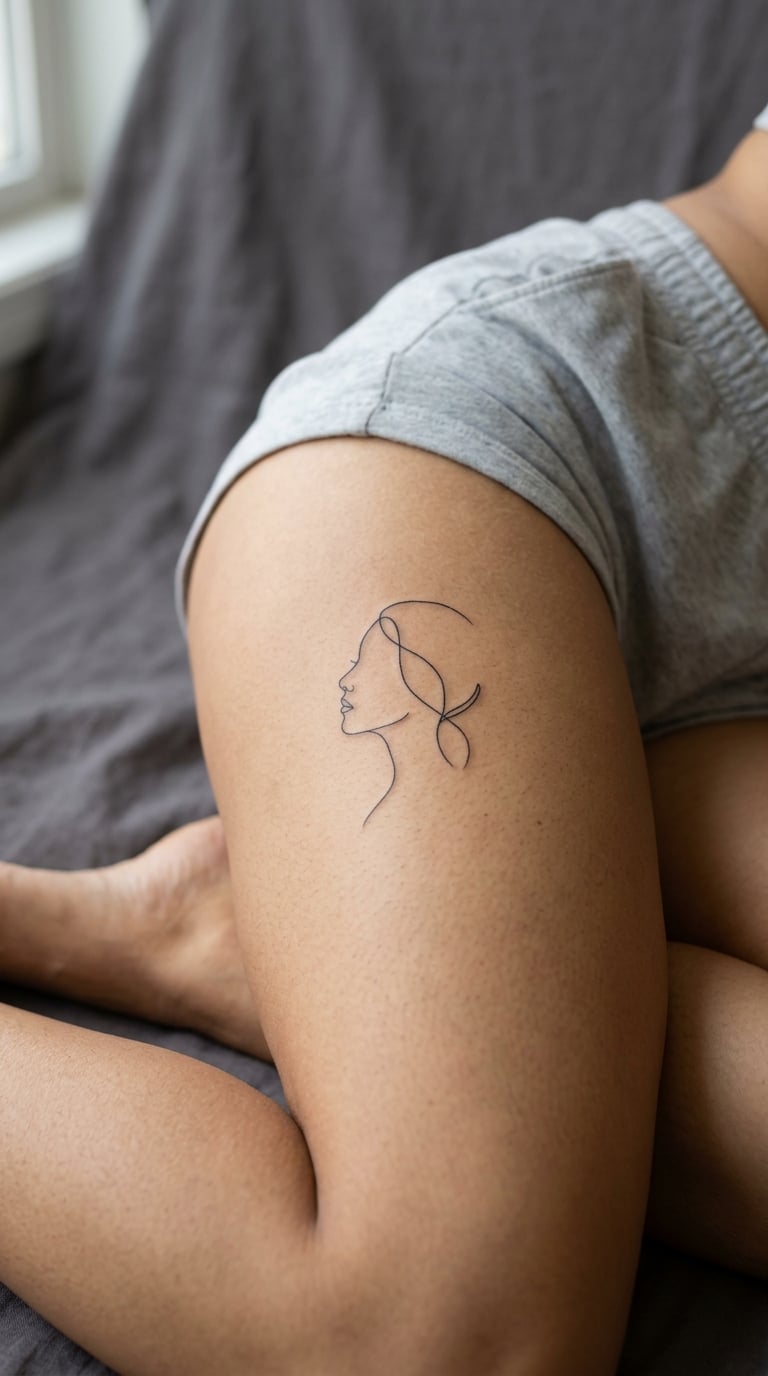
A side profile in one thin line: forehead, nose, lips, chin, and then back up into the hair with the barest suggestion of a neck. Very little interior detail, so the shape carries the whole design. Portraits tend to get chosen for personal reasons, and the quietest version of one is usually the one people keep.
Placement: outer thigh, facing forward. Size: 3-5 inches. Style: continuous fine line. Pain: low to medium.
The lip line is the detail that softens fastest, so ask for it slightly firmer than looks right in a drawing. Make it yours: bring your own reference photo and work with the artist on the profile angle.
27. Botanical Branch Curving Around the Thigh
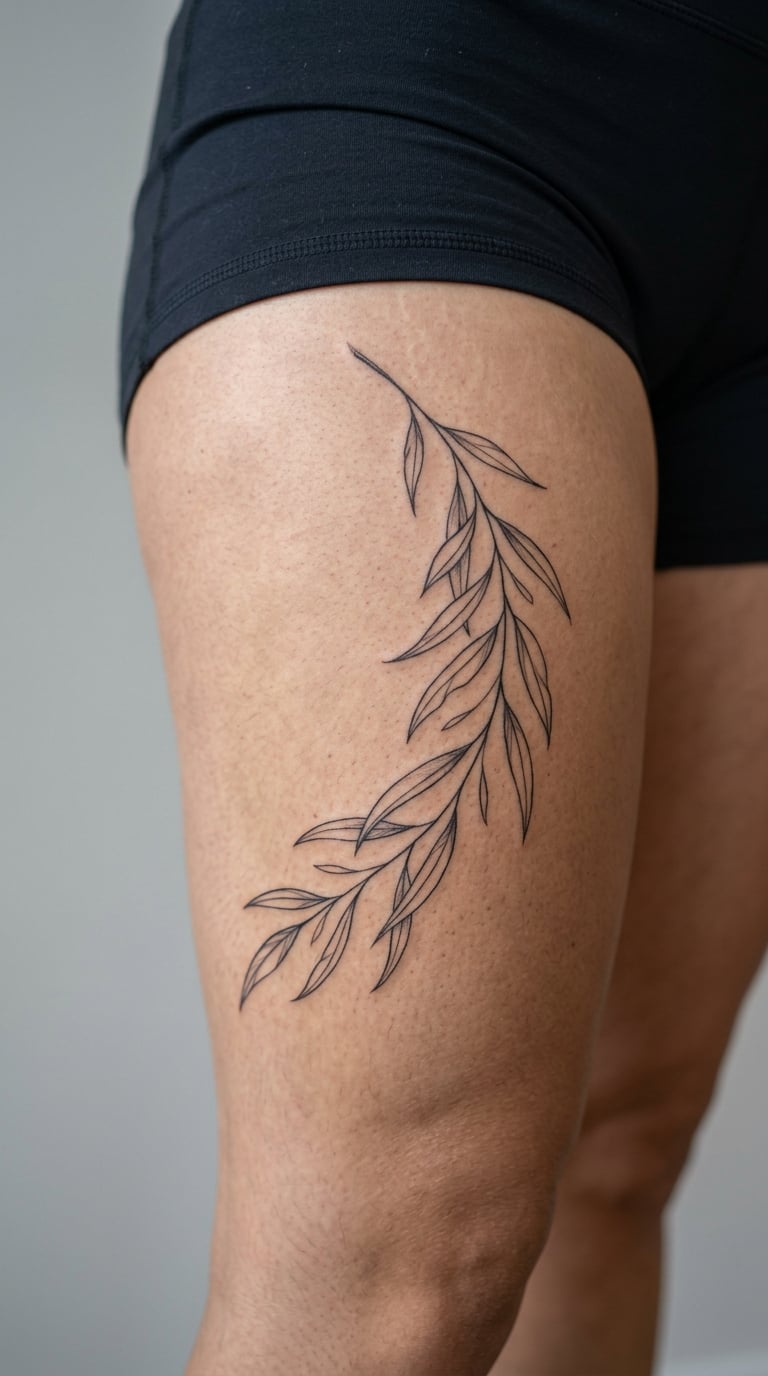
A long stem with alternating leaves that starts narrow at the hip, thickens across the middle of the thigh, and tapers again near the knee. Because it follows the leg rather than sitting on it, the design looks like it grew there. A gradient of leaf size along one branch is the detail that makes it work.
Placement: outer thigh, wrapping along the leg’s curve. Size: 6-10 inches. Style: illustrative realism. Pain: low to medium.
A tapering stem hides future skin changes better than a solid block of colour. Make it yours: have the leaves be one real species from a place you have been.
28. Glowing Gradient Rose
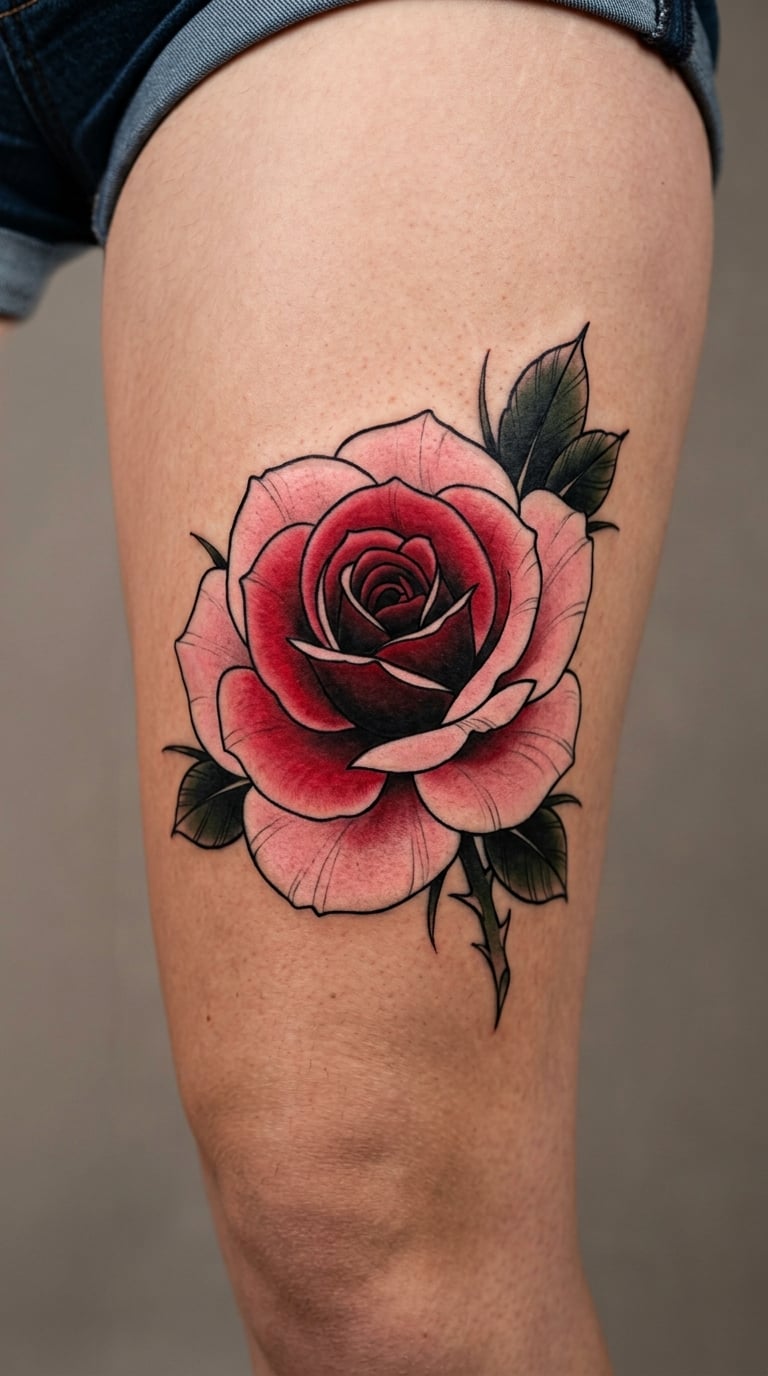
A rose that goes from near-solid black in the centre out to soft red and then pale pink at the outer petals, so the flower appears to be lit from inside. The effect depends on a smooth transition, which takes longer in one sitting. It is a contemporary look and it needs a canvas with room for the fade to breathe.
Placement: outer thigh, centre of the leg. Size: 4-6 inches. Style: illustrative colour with gradient shading. Pain: medium, often split over two sessions.
Gradients need a planned second pass to even out the density. Make it yours: for a simpler version, keep the black centre and drop the outer petals to outline only.
29. Small Star Map Constellation
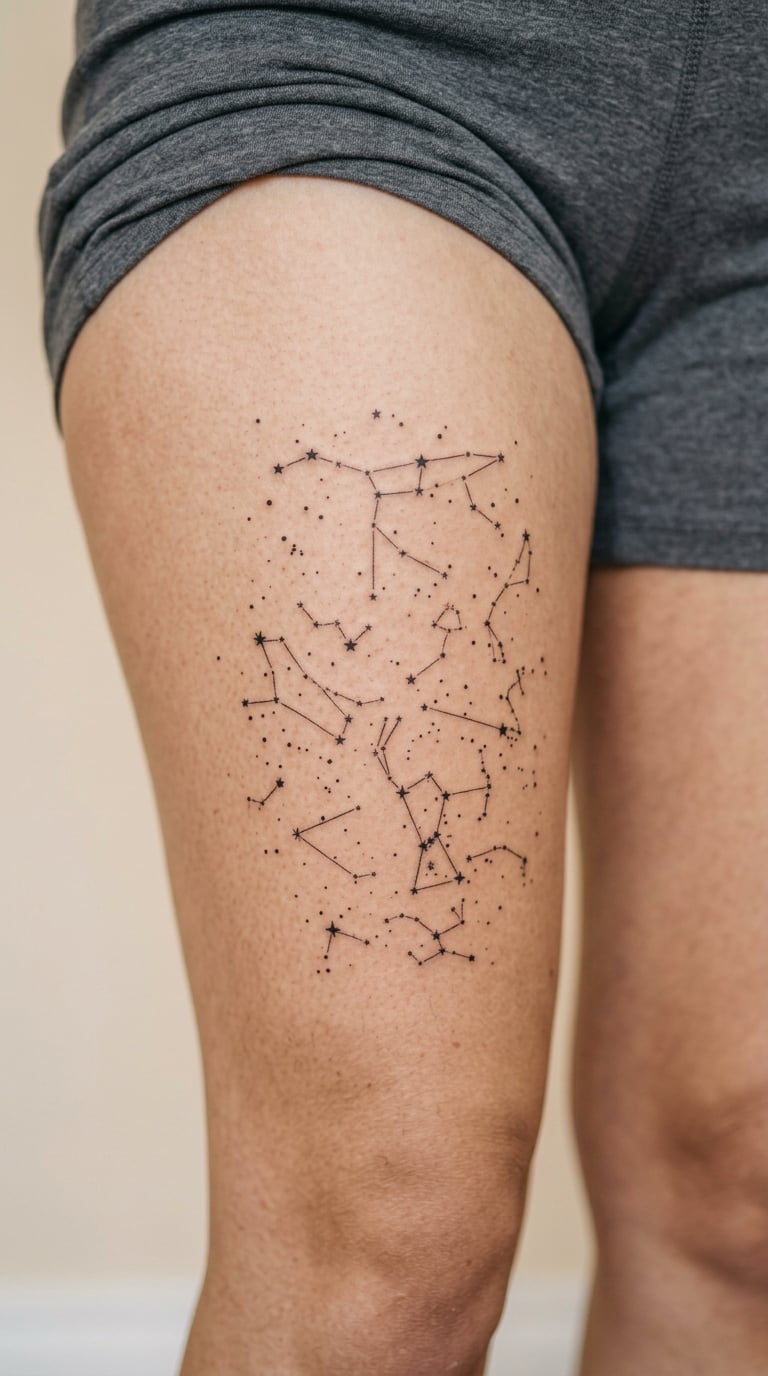
A patch of night sky with stars in different sizes connected by very fine lines, plus a scattering of smaller dots for the fainter stars. Real star maps make the design personal without a word or a date. It is quiet from a distance and rewarding up close.
Placement: inner or upper thigh, in a discreet spot. Size: 2-4 inches. Style: fine-line celestial. Pain: low to medium.
The connecting lines are the fragile part, so ask for them at a consistent weight. Make it yours: have the artist plot the sky from one night in one place you have actually been.
30. Olive Branch in One-Color Shading
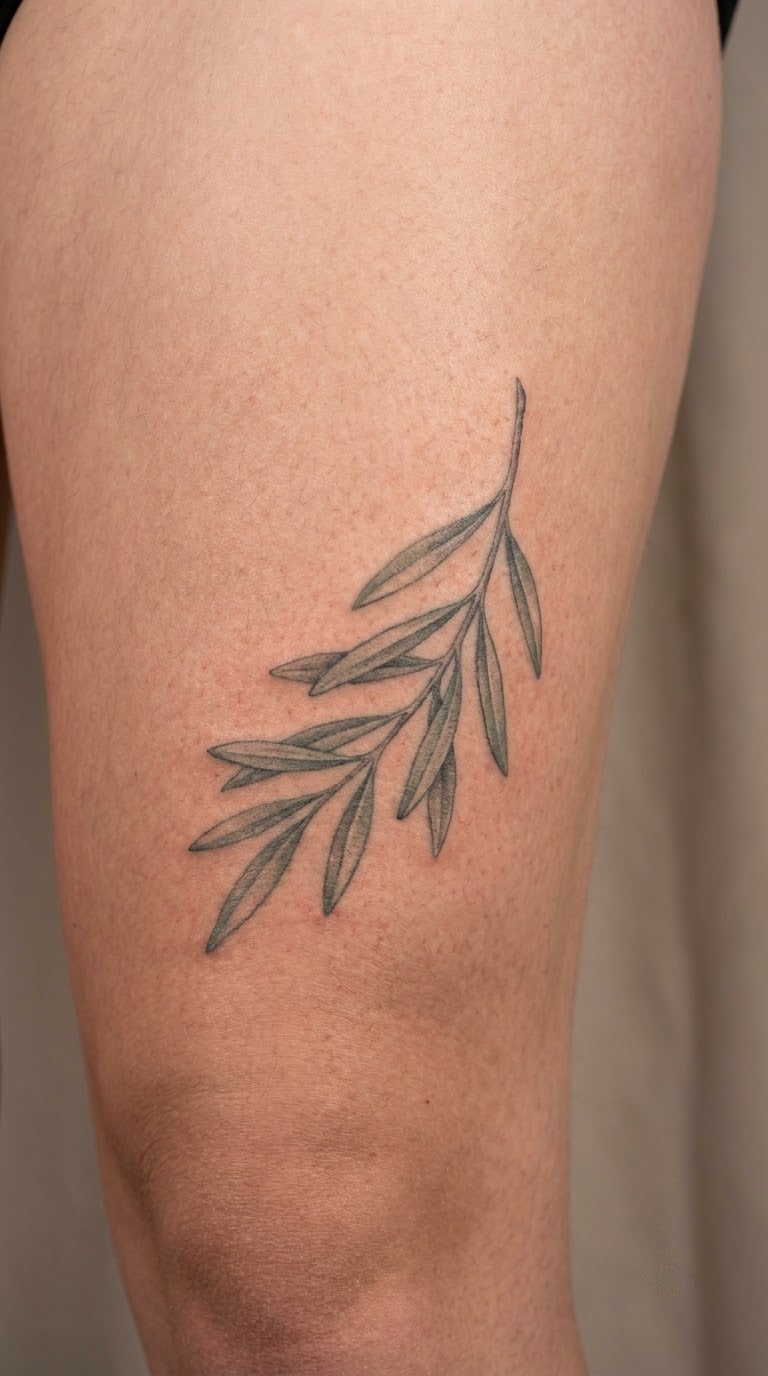
An olive branch rendered in one muted green-grey, with each leaf shaded on one side so it looks dimensional without any outline. Working inside a single colour family is harder than mixing two and it is what gives the piece its quiet look. The narrow leaves pack neatly along a curved stem.
Placement: outer thigh, medium placement with room for the stem to arc. Size: 3-5 inches. Style: illustrative realism. Pain: low to medium.
Subtle grey-greens are among the first to lose contrast. Make it yours: add three olives at the joints, which gives the branch weight and a focal point.
How to Choose the Right Design
Most of these 30 tattoo ideas for women on the thigh fall apart or come together on five practical questions, and the order you ask them in saves a lot of money.
- Start with the style, not the motif. If you want fine line, halve the reference size you saved. Fine line reads at a certain weight and anything thinner than the artist can hold consistently will blur.
- Match the size to the canvas, honestly. A 5-7 inch motif needs a thigh that has a flat 7 inches on it. Ask the artist to measure the area with you standing and sitting, not just standing.
- Pick the zone by how much you want it seen. Outer thigh shows when you walk and in shorts, inner thigh shows less, above the knee is mostly hidden until you sit down.
- Think about the leg, not just the skin. The thigh stretches, bends and changes with weight over the years. Block-shaped blackwork and tapering stems both hold up better than a heavily shaded round shape.
- Account for what is already there. If you have an existing piece nearby, tell the artist before the consultation so the new design can either complement it or leave it alone.
- Look at a full healed portfolio. Ask to see healed work, not just the fresh photographs from the same day. That single check tells you more about an artist than any style label.
If you are still torn, the side thigh ideas and the upper thigh roundup split these designs by position, which is usually the decision that stalls people longest.
Cost and Session Time
Thigh tattoos are priced by detail and coverage rather than by placement, and no two artists price the same design the same way. Most shops set a shop minimum, then charge per hour on top of it, so the numbers below are the range most US clients actually see.
- Micro pieces (under 2 inches): roughly 100 to 200 dollars for a simple outline or dotwork design, usually 20 to 40 minutes.
- Small pieces (2 to 4 inches): roughly 200 to 400 dollars, 45 to 90 minutes.
- Medium pieces (4 to 7 inches): roughly 400 to 800 dollars, two to three hours, and this is the range most of the ideas in this list sit in.
- Large panels (7 inches and up): roughly 800 to 1500 dollars across two or three sessions, which is where koi, koi-scale detail and gradient roses land.
Black-and-grey shading and colour realism push a design toward the top of its range even at a modest size, because the work is measured in passes rather than lines. A single session usually covers a small or medium piece, while a full blackwork panel with a gradient needs a second sitting for density. Location, the artist’s rate, the shop minimum and how much custom drawing your design needs all move the final number, so treat these as a starting range and ask your own artist for a written estimate before booking.
Aftercare Basics
- Follow your artist’s aftercare instructions first, above anything written here. They know exactly what they did in your session.
- Wash the area gently with lukewarm water and unscented soap, then pat it dry with a clean towel rather than rubbing it.
- Use the ointment or aftercare product your artist recommends, in a thin layer, and change it as they instruct.
- Wear loose clothing for a few days. Tight denim and elastic waistbands rub a fresh thigh tattoo exactly where it does not need rubbing.
- Keep the area out of direct sun once the tattoo is healed, and skip tanning beds entirely if you want the colour to last.
- Watch for anything your artist told you to watch for, and contact the studio, not a forum, if you have a question about how it is healing.
Most thigh tattoos are surface-healed within about two weeks, with the deeper settling taking another few months. The leg is one of the easier places to keep clean, but it is also one of the most exposed in summer, so sun protection matters more here than almost anywhere else.
Frequently Asked Questions
Are thigh tattoos suitable for small or delicate designs?
Yes, a thigh is a good home for a small design because the skin is flat and stable over a wide area. Most artists ask that a fine-line piece be at least two inches across so the line has enough weight to hold its shape. Below that, the detail tends to blur within a few years. Placed on the outer or upper thigh, a small piece also sits under a skirt or a pair of jeans, which makes it easy to keep private.
Will a small thigh tattoo distort as the leg moves?
A well-placed design will move with the leg rather than distort. Artists map the tattoo to the shape of the thigh while you stand, sit and bend, so the line follows the muscle instead of fighting it. The risk comes from placing a circular or heavily shaded design in the crease behind the knee or at the hip crease, where skin folds repeatedly. A tapering stem or an angular shape handles that movement better than a solid round one.
Do thigh tattoos fade faster than tattoos on the arms?
Not inherently, but the outer thigh often sees more sun than an arm that stays under a sleeve, and UV exposure is the main reason colour tattoos lose intensity. That matters most for pale pinks, light blues and bright yellows. Black line work and black-and-grey shading hold their value far longer. Once healed, keeping the thigh covered or in sunscreen when you are out makes a noticeable difference over five to ten years.
Can these designs be adapted for the inner thigh?
Almost all of them, with a few adjustments. Inner-thigh skin is softer and stretchier, so a design with strong directional lines, like the botanical branch, the wave or the geometric peaks, sits better there than a small round motif. Scale down slightly, because the inner thigh narrows as it goes down, and expect a placement that is more private than the outer thigh by a wide margin. Shade-heavy realism is the other thing to reconsider there.
How should I discuss scaling and placement with a tattoo artist?
Bring your reference images, then ask the artist to tell you which one they can make work at the size your thigh actually offers. Say how big you want it to be in inches, show how you stand and sit, and mention any existing tattoos nearby. Ask what the artist would change about the design for this placement, and let them adjust line weight rather than squeezing a small reference onto a large canvas. Good artists push back on scale, and that conversation is the consultation.
If this is your first tattoo, the fine-line wildflower stem or the small dotwork rose is the safest starting point: both are quick, both hide easily, and neither locks you into a look for the next thirty years. If you are adding to an existing collection, a black-and-grey peony or a curving botanical branch will hold its own next to pieces you already have. Pick the one that suits how much of your thigh you are happy to show, then talk it through with the artist before you commit to a size.