
How Much to Tip a Tattoo Artist: Simple Guide (October 2026)
How much to tip a tattoo artist? The usual answer is 15% to 20% of what you actually paid for the session, with 20% as the benchmark for good work. Anything under an hour of work still deserves something, so treat roughly $20 as a floor.
Tipping a tattoo artist is customary, not required. No shop can bill it as a fee, and no artist should make you feel guilty for asking questions about the total. What the tip does is pass through the money the artist never saw in the first place.
That last part surprises people. The artist rarely keeps the full price on the receipt. Booth rent or a shop commission comes out first, then inks, needles, machines, stencil paper and the sterilization equipment that has to be replaced. Taxes come out of what is left.
This guide covers tattoo tipping etiquette in practical terms: what to give for a small flash piece versus a full sleeve, what to do when 20% of a large project feels steep, and how to hand it over without making the last five minutes of your appointment weird.
How Much to Tip a Tattoo Artist: Quick Guide
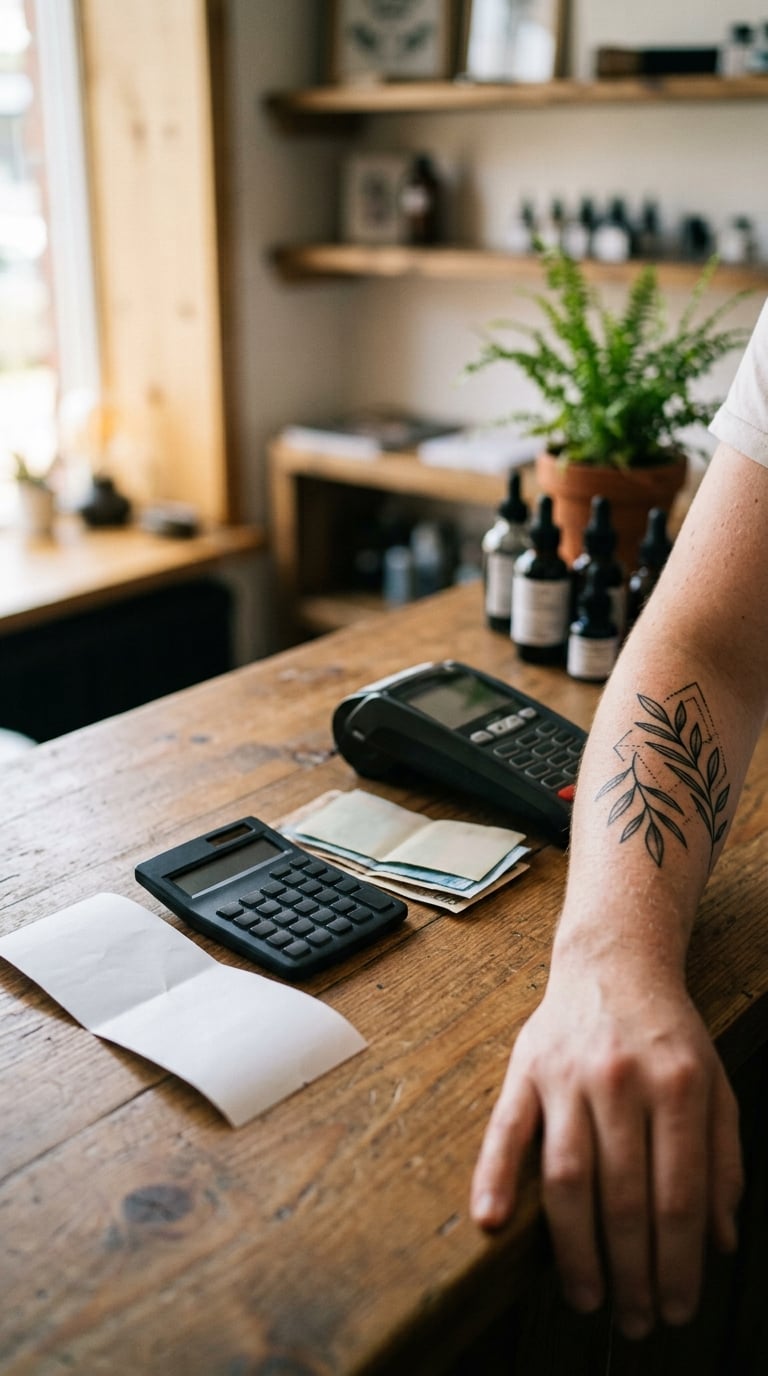
Start at 20% of the final session price. Move down toward 15% for simple, straightforward work where the artist pulled a design straight off the flash wall. Move up toward 25% for a custom design, a long session, or a difficult placement that took real time to hold steady.
Then apply the one-hour minimum. A tiny fine-line piece that took 25 minutes should still get about $20, because percentages on small numbers get silly fast. On a $60 flash tattoo, 20% is $12, and $12 does not read as a thank you.
There are three practical methods, and clients mix them constantly.
- Percentage: 15% to 20% of the final session price. Best for a single ordinary appointment.
- Flat rate per session: a set amount per session regardless of the total project price. Common for multi-session work like sleeves.
- Per hour: a fixed hourly amount on top of the artist’s rate. This is the approach longtime clients tend to use on long days.
Worked example. A $200 session at 20% comes to a $40 tip and a $240 total. The same session at 15% is a $30 tip and a $230 total. A $1,000 day at 20% would be $200, which is where a lot of clients decide the percentage rule has stopped being useful.
How Much to Tip a Tattoo Artist for Different Tattoos?
For a tiny tattoo, roughly an inch or two of fine line or a single small symbol, give the $20 to $30 range regardless of percentage math. For a small tattoo under $100, a flat $20 usually lands better than $12 to $18.
For a tattoo in the $100 to $300 range, the percentage rule works cleanly. That is 15 to 60 dollars depending on the size and how difficult the placement was.
For a large piece over $300, split the difference between percentage and flat rate. A $300 tip on a $1,500 sleeve is 20% but probably more than you meant to hand over on day one. A flat $75 to $100 per session is generous, easy to repeat, and keeps the relationship even across the whole project.
For a multi-session project, tip each session separately. Paying a percentage on the full project total at the final appointment puts an awkward lump sum in front of the artist and can make a good client look like they miscalculated.
For a free touch-up, tip anyway if the work was good, and a flat $20 to $30 is normal. Artists often absorb touch-ups as part of their own quality control, and the same economics apply to a free hour of work.
Tattoo Pricing Models and How to Calculate the Tip
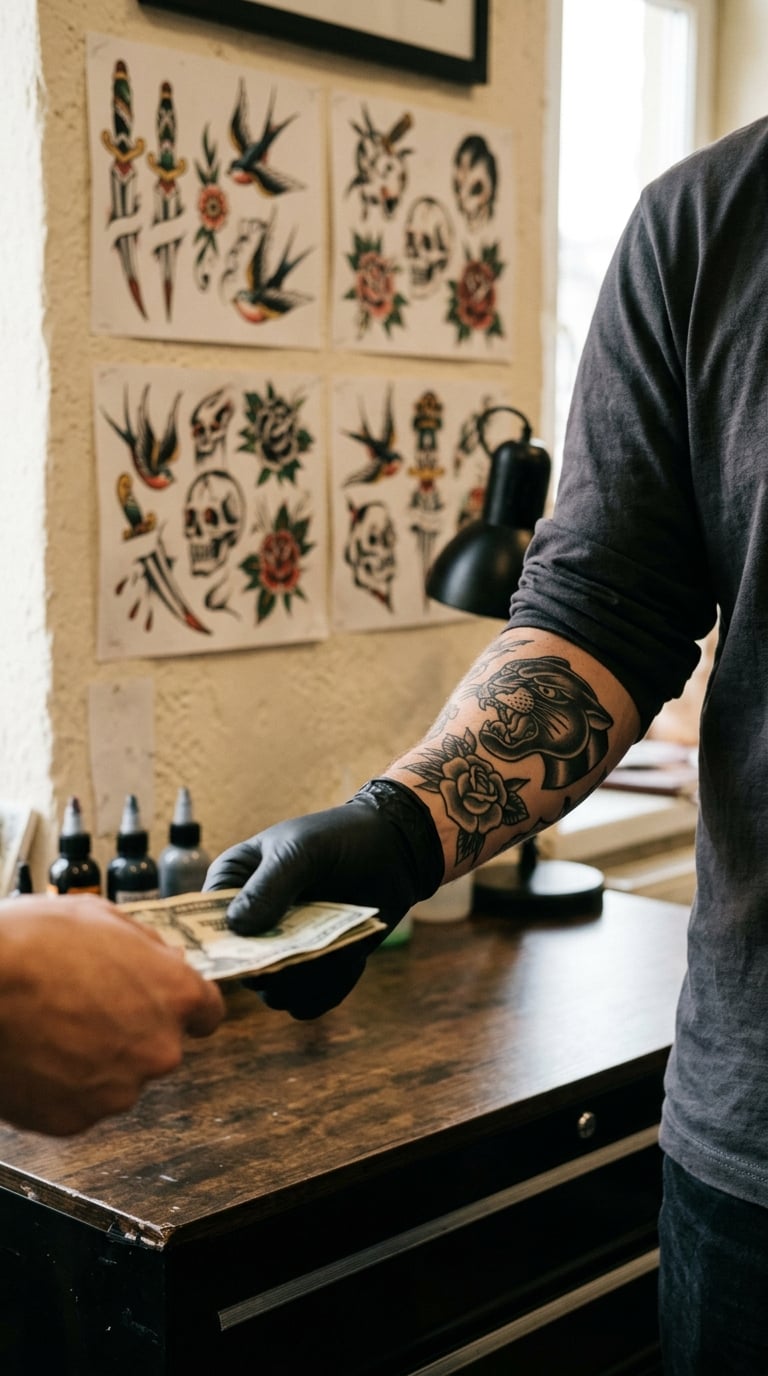
Tattoos get priced four main ways, and the tip follows whichever one you were charged under.
Hourly rate. Common for sleeves, back pieces, cover-ups and anything that runs past two hours. Tip on the final bill, not on the estimate. If the artist started at noon and the itemised receipt says four hours, tip on four hours of actual work.
Flat project price. The artist quotes the whole piece, broken into sessions, at a set total. Here the percentage applies to the total, but the tidy move is to split it into equal per-session tips so nothing feels lopsided at the finish.
Shop minimum. Most studios have a floor, commonly somewhere around $80 to $150, covering the chair time regardless of how small the tattoo is. When your $40 piece turns into a $100 minimum, tip on the $100 you actually handed over, not the $40 you expected to pay.
Deposit. Deposits are not tips. They are credited against the final bill, and the money leaves your account months before the artist does any work. See the mistakes section below for why tipping a deposit creates real problems.
One more model worth knowing: a guest artist or apprentice working in someone else’s chair. The shop takes a cut before anyone sees the money, which is exactly the situation where a tip lands hardest.
What Factors Can Change the Right Tip?
Session length is the biggest lever. A six-hour day and a one-hour appointment are not the same service, and a percentage alone can under-reward the long one.
Difficult placement matters. Ribs, collarbones, the spine, the tops of hands, kneecaps and the inner arm take longer, need more breaks, and demand more steady hand work for the same design size.
Custom design work justifies more than flash. Time spent on your consultation, drawing revisions and stencil prep happens before the machine ever starts, and it is rarely itemised on the receipt.
Extra sessions and touch-ups are worth acknowledging. If the artist came back to fix a line that faded early, that is unpaid time on your behalf.
Transparent pricing nudges things up, not down. An artist who quoted clearly, explained the hourly rate and did not spring a surprise minimum at checkout has done something most service workers cannot.
Shop ownership cuts the other way, and this one is genuinely debated. An owner who sets a $300 hourly rate and keeps all of it has a different situation from an artist paying a percentage of every hour to a shop owner. Plenty of owners still welcome a tip, plenty do not need one, and the cleanest move is simply to ask about the policy when you book.
Budget counts too. See the last section for what to do when the percentage genuinely does not fit.
Tattoo Price and Tip Examples by Size
These are typical US ranges for a mid-cost city shop. Coastal cities and high-profile artists run much higher, and shop minimums can push a small piece up regardless of its size.
| Size | Typical price range | Tip at 15% | Tip at 20% |
|---|---|---|---|
| Tiny, under 1 inch | $60 to $100 | $20 minimum | $20 to $25 |
| Small, 1 to 2 inches | $100 to $200 | $15 to $30 | $20 to $40 |
| Medium, 2 to 4 inches | $200 to $400 | $30 to $60 | $40 to $80 |
| Large, 4 to 8 inches | $500 to $900 | $75 to $135 | $100 to $180 |
| Half sleeve | $1,200 to $2,500 | $75 to $125 per session | $100 to $150 per session |
| Full sleeve | $2,500 to $6,000 | $100 to $150 per session | $150 to $200 per session |
For sleeve work, read the tip column as a per-session figure, not a percentage of the sleeve total. A half sleeve often takes three sessions, so a flat $100 each time is a clear, generous habit that the artist can plan around.
The pattern across the table is worth noticing: the percentage is most natural in the middle rows and least useful at the top, where one session can be a five-figure day.
Does Tattoo Pain Affect What You Should Tip?
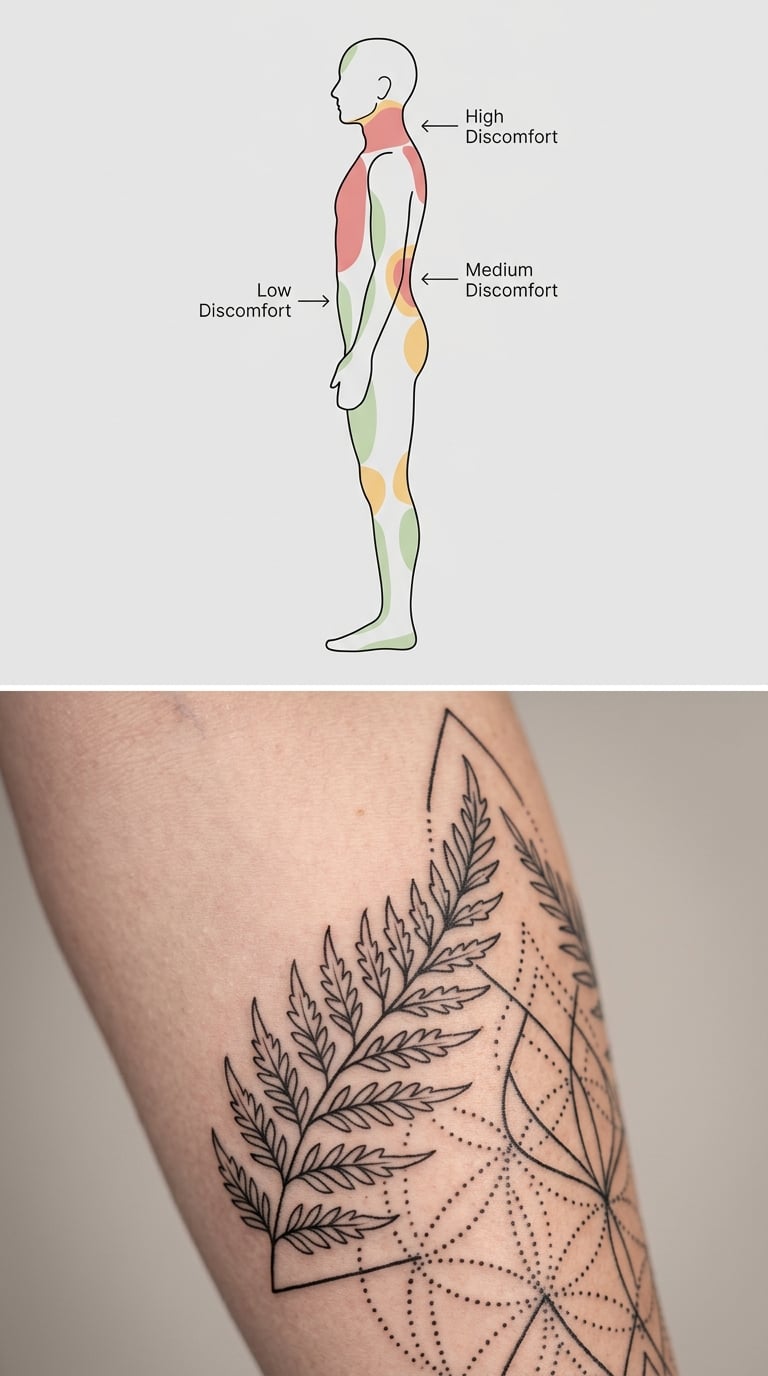
Short answer: no. Pain should not set your tip, and it is not a test of commitment that earns you credit.
Placement does correlate with how hard a session is, which matters for a different reason. It affects how long the artist spends working, not what the work is worth to you.
| Placement | Typical discomfort | Session notes |
|---|---|---|
| Outer upper arm, calf | Low | Long sessions are common here |
| Inner arm, thigh | Medium | Veins can slow the artist down |
| Collarbone, sternum | Medium to high | Skin moves, so sessions run shorter |
| Ribs, spine | High | Often split into several sessions |
| Knees, hands, feet | High | Lots of small detail over bony areas |
If a rib piece runs long because of the placement, that is a session-length factor and it counts. How much it hurt you is a separate question, and it is not a billing category.
Worth saying plainly: sitting through an eight-hour session is not loyalty, and no artist will think less of you for booking smaller sittings with breaks. It is a health decision, and it also tends to produce a better tattoo.
Should You Tip Before or After the Tattoo?
Tip at the end, at checkout, not before the work starts. Handing over money early puts the artist in the position of owing you something, and it makes the session transactional from minute one.
The usual flow: the artist finishes, wraps or bands the piece, walks you to the front desk, and the front desk or the artist takes your payment. Tipping happens there, either added to your card total or handed over directly.
When more than one person worked on you, ask the front desk how tips get split. A two-artist session often has an assistant who prepped, stenciled and cleaned up, and a tip given to the wrong person does not travel. Mentioning the names out loud is normal and not awkward in a studio.
Card tipping has one practical trap: the machine’s daily or transaction limit. A $240 total on a card that caps at $200 fails at the counter, which is the worst possible moment to discover it. Splitting across two cards or keeping cash in the same envelope as your ID is the fix.
If the final price is higher than the estimate, ask for the breakdown before you tip. A $200 estimate turning into $280 on a five-hour day is normal and worth thanking the artist for. A $200 estimate turning into $280 with an unexplained line item is worth asking about, and you are allowed to tip on the price you actually agree to pay, not the one you were handed first.
Shop Policies, Gratuities, and Cash or Card
A service charge and a tip are different things. A service charge is added by the shop, appears on your receipt, covers the business itself, and is non-negotiable. A tip goes to the individual, is never printed on a receipt, and is entirely your call.
Ask about the policy when you book, not at the counter. One question covers it: does the shop take a gratuity, and do they prefer cash or card? Studios are used to the question and most answer plainly. A few shops share tips with the front desk or pool them for the team, which is a reasonable arrangement as long as you know it exists.
Cash reaches the artist directly. Card tips are usually run through the shop’s system and take a processing cut, and in many cases the artist is treated as a tipped worker for tax purposes on that portion, which can matter at the end of a year. That is the practical argument for cash, and it is a real one rather than a rule about manners.
Digital tipping through an app on the counter is a newer option some studios use. Treat it like a card tip, with the same processing reality, and never feel cornered into using a phone at the desk if you did not bring cash.
Non-cash thanks carry weight too. An honest written review naming the artist, a referral to friends, and showing up on time for a reschedule are things shop owners notice and clients often forget.
Tattoo Healing Timeline by Week
The tip conversation usually happens while the tattoo is still bandaged, so here is a rough sense of what the next few weeks look like. Follow your artist’s aftercare instructions above anything on this list.
| Time after the session | What you are seeing | What your artist is watching |
|---|---|---|
| Days 1 to 3 | Red, tender, slightly raised | Signs of irritation or an allergic reaction |
| Week 1 to 2 | Itching, flaking, dry skin | That you have not picked or scratched it |
| Week 2 to 4 | Peeling finishes, design looks dull and cloudy | Nothing much; this is normal |
| Week 4 to 8 | Lines settle, colour deepens | Whether a touch-up is needed |
| Month 3 onward | Final healed result | Optional free touch-up window |
Keep the artist’s card or handle. If you want to tip for a touch-up later, that is far easier than trying to track down a stranger’s payment details.
Mistakes to Avoid
Tipping the deposit. The money was a booking commitment, not payment for work. Wait until the session is done.
Assuming the tip is mandatory. It is not, and any shop presenting it as a required charge has mislabelled it. Ask what the total is before the work starts.
Not confirming the final total. A tip calculated on a price that later changes causes a scramble at the desk. Settle the bill first, tip second.
Hitting a card limit. The failure happens in the worst spot. Know your limit or bring a backup.
Talking about cost during the session. Discussing money mid-appointment puts the artist in a working state where they are trying to concentrate. Talk pricing at booking and at checkout.
Using a big tip to smooth over poor communication. Money does not fix a misunderstanding about the design, and the artist usually leaves not knowing anything went wrong. Say something at the desk instead.
Never tipping because it felt awkward. Nobody is going to chase you down. If you plan to see the artist again, the tip matters more to that relationship than the awkwardness of the first one.
Frequently Asked Questions
Do I tip on a tattoo deposit?
No. A deposit is a booking commitment that gets credited against your final bill, not payment for tattooing that has happened. Tip at the end of the first session, based on what you actually pay that day. If your artist takes a deposit and does not mention how tipping works, that is a reasonable thing to raise at the front desk when you arrive.
Should I tip before or after my tattoo is finished?
After. Wait until the session is done and you are at the front desk paying the final bill, then calculate your tip on the amount you actually paid. Tipping beforehand puts the artist in your debt for the whole session and makes the appointment feel transactional. If you have cash, hand it over with the payment.
Can I tip a tattoo artist by card?
Yes, most studios take card tips and plenty of clients do it that way. Just know that card tips usually pass through the shop’s system and lose a processing cut, and the artist may be treated as a tipped employee on that portion for tax purposes. Cash gets the full amount to the artist. Check your card’s transaction limit before a large session.
How do I tip when more than one artist worked on my tattoo?
Ask the front desk how tips are handled rather than guessing. Studios either pool tips for the team, split them between named artists, or let the artist who did the tattoo distribute them. Name the people who worked on you out loud, including any assistant who did prep and cleanup, so the money lands where the work happened.
What if I cannot afford the recommended tattoo tip?
Then do not stretch your budget, and do not treat it as a moral failure. Tip what is genuinely comfortable, and remember that plenty of tattoo artists treat a well-behaved client who always shows up and always refers friends as worth more than a percentage. Be honest rather than performing a tip that leaves you short for rent.
Conclusion
The default is simple: 20% of the final session price, with a $20 floor for short appointments and a flat per-session amount once projects get expensive. Ask the shop about its policy when you book, settle the final bill before you tip, and base the amount on the quality of the work and what you can comfortably give.