
20 Best No Rain No Flowers Tattoo Ideas (October 2026)
No rain no flowers tattoo ideas usually mean one of two things: either the words themselves in fine-line script, or the idea translated into a cloud, a stem and a bloom. If you have been scrolling for months and still cannot decide, the problem is usually that the phrase is too vague on its own and nobody has shown you what it looks like on real skin. This list gives you twenty versions with the details that actually matter: line weight, size in inches, where it sits, and how it ages.
What the phrase means is simple. Flowers need water before they open, so the hard season is not the enemy, it is the requirement. Most people who choose it want a daily reminder that the difficult stretch is doing something for them, and that growth is earned rather than handed over. The designs below suit people who want a small, quiet piece first, and people adding a second or third tattoo who want the concept without a wall of text.
If your taste runs to symbol work rather than words, you may like our 20 sun moon and rising sign tattoo ideas. If you are planning around a birth or a child, the 20 best child birth flower tattoo ideas for moms covers the floral side in more detail.
No Rain No Flowers Tattoo Ideas: Quick Guide
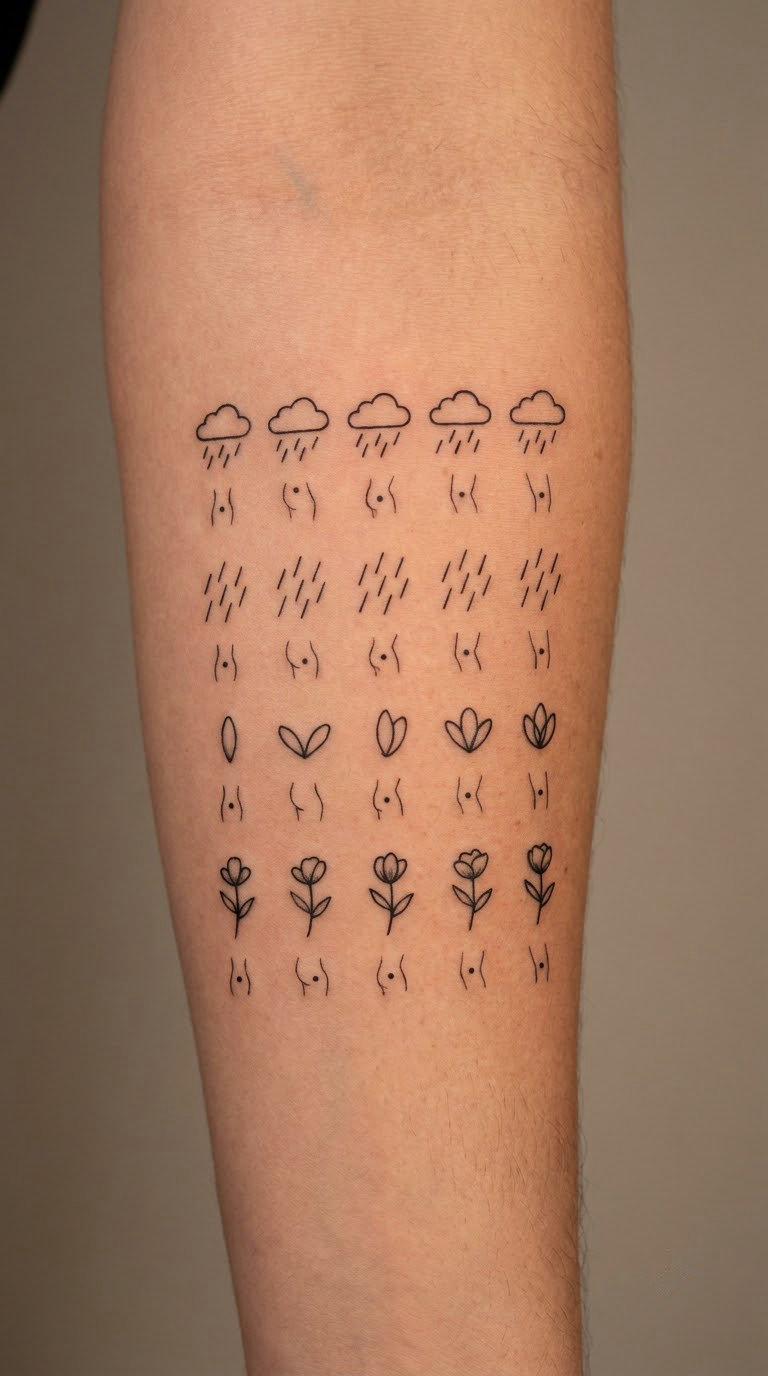
Here is the whole list on one page, with the practical columns next to each design so you can narrow it down fast.
| Idea | Style | Best placement | Realistic size | Pain |
|---|---|---|---|---|
| 1. Rain cloud and single stem | Fine line | Inner forearm | 2-3 in | Low to medium |
| 2. Blackwork rain cloud | Blackwork | Outer forearm | 2.5-4 in | Medium |
| 3. Floral raindrop | Fine line | Wrist | 0.75-1.5 in | Medium |
| 4. Two flowers beneath a cloud | Fine line | Forearm | 2-3.5 in | Low to medium |
| 5. Falling petals | Line art | Upper arm | 2-3 in | Low |
| 6. Storm bloom | Black and grey | Calf | 3-4.5 in | Medium |
| 7. Rain lines and leaf | Minimal line | Side of forearm | 1.5-2.5 in | Low |
| 8. Micro-realism wet flower | Micro-realism | Wrist | 1-2 in | Medium |
| 9. Dotwork rain cloud | Dotwork | Shoulder | 2-3 in | Medium |
| 10. Rose and rainfall | Fine line | Inner arm | 2-3 in | Low to medium |
| 11. Watercolor cloud and flower | Watercolor | Shoulder | 2-3.5 in | Medium |
| 12. Geometric rain and flower | Geometric | Forearm | 2.5-4 in | Medium |
| 13. Cherry blossom in rain | Fine line | Upper arm | 2.5-4 in | Low |
| 14. Cloud and tulip | Fine line | Behind the ear | 1-2 in | Medium |
| 15. Script with raindrop | Script lettering | Wrist or ribs | 2-4 in wide | Medium |
| 16. Stippled cloud and wildflower | Stippling | Forearm | 2-3 in | Medium |
| 17. Red ink rain flower | Colour, one hue | Collarbone | 1.5-2.5 in | Low to medium |
| 18. Cloud and fern | Botanical line | Ankle | 1.5-2.5 in | Medium |
| 19. Blackwork flower drip | Blackwork graphic | Outer arm | 2.5-4 in | Medium |
| 20. Negative-space cloud and bloom | Negative space | Rib | 2-3 in | Medium to high |
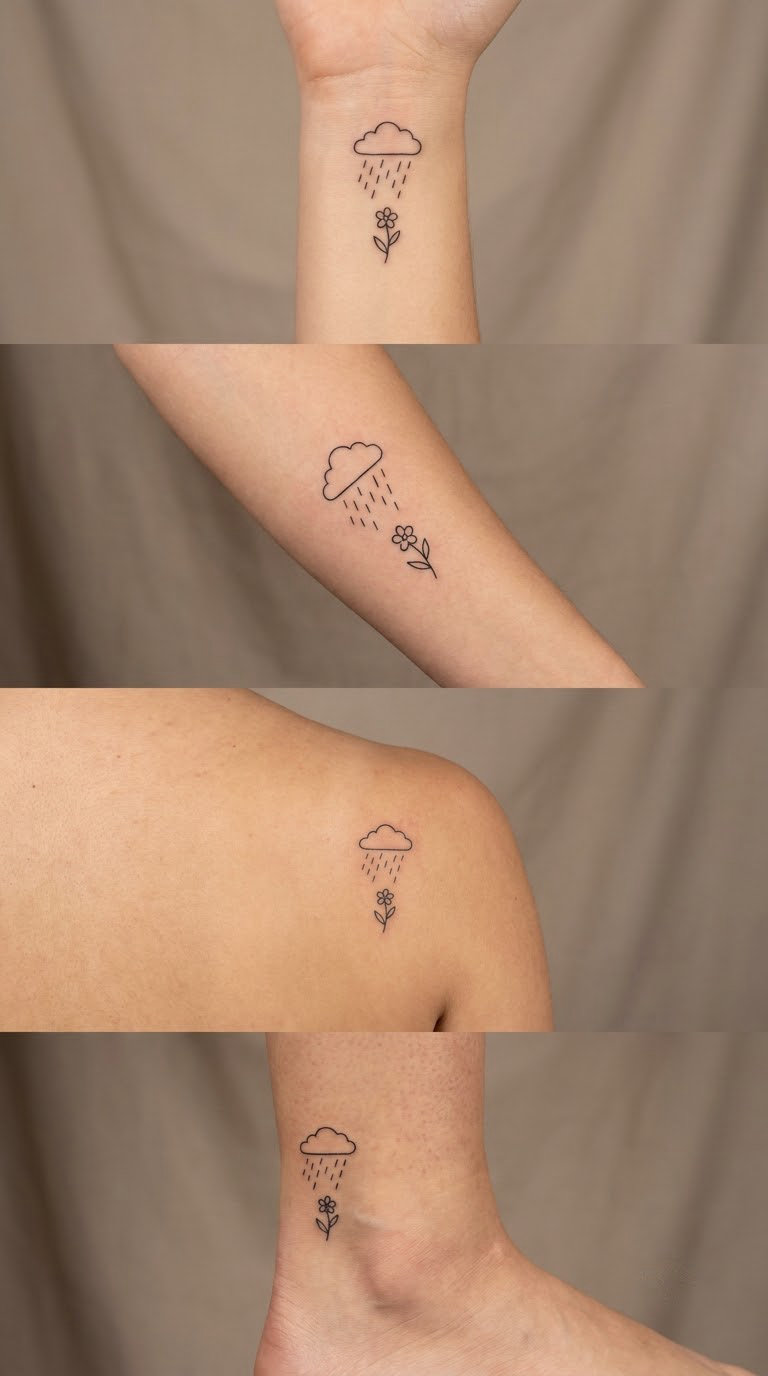
1. Fine-Line Rain Cloud and Single Stem
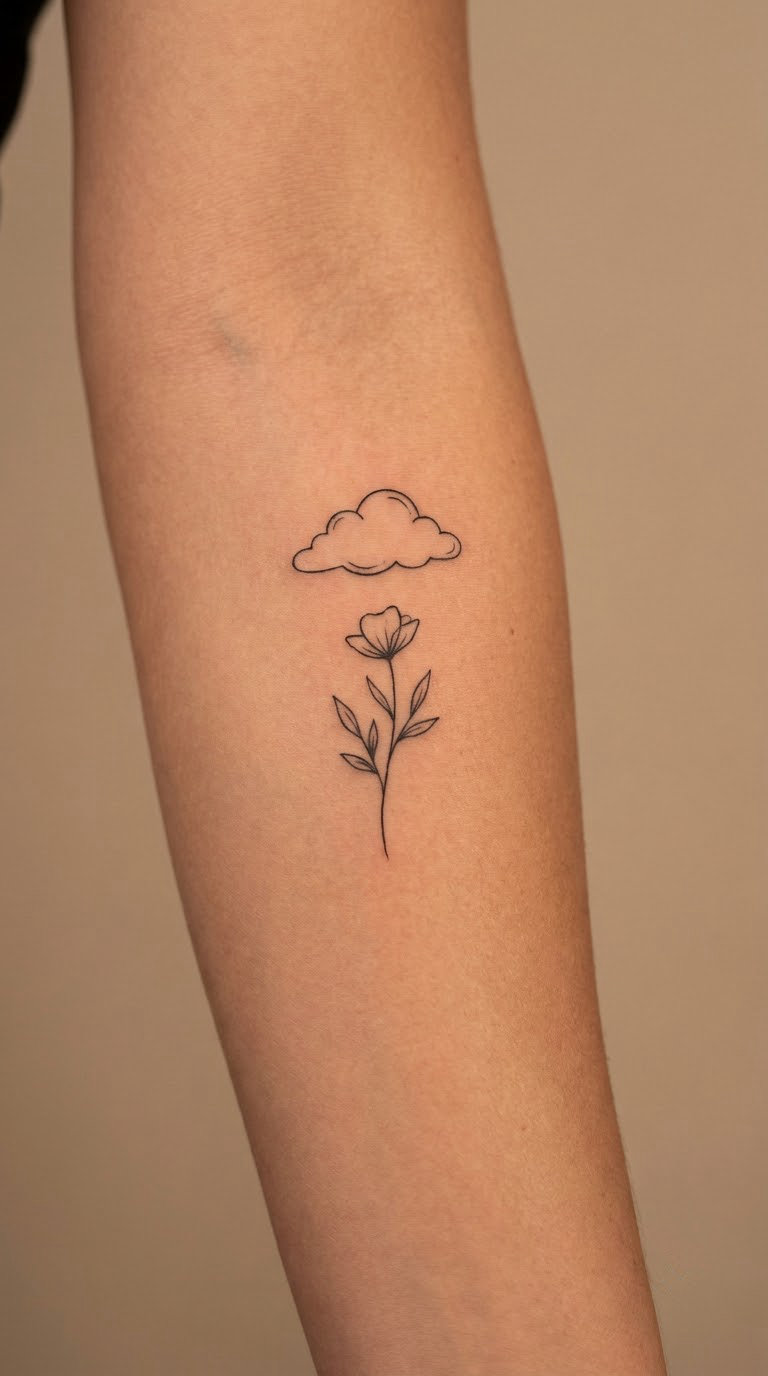
This is the version most first-time clients sketch in a notes app: a soft scalloped cloud drawn in one thin line, three short rain strokes beneath it, and one thin stem rising below the rain with a small bud. No fill, no outline weight, no color. The whole thing is one or two single-needle passes.
It works because the gap between the cloud and the stem does the work. You read rain above and growth below without anyone explaining it.
Placement: inner forearm, just above the wrist crease, or the flat of the upper arm. Size: 2-3 inches (5-7.5 cm) tall. Style: fine line, single needle. Pain: low to medium on the inner forearm. The thin lines blur with age, so plan on a refresh after several years.
Make it yours: add a single leaf halfway up the stem so the growth reads as a process rather than a snapshot.
2. Minimal Blackwork Rain Cloud
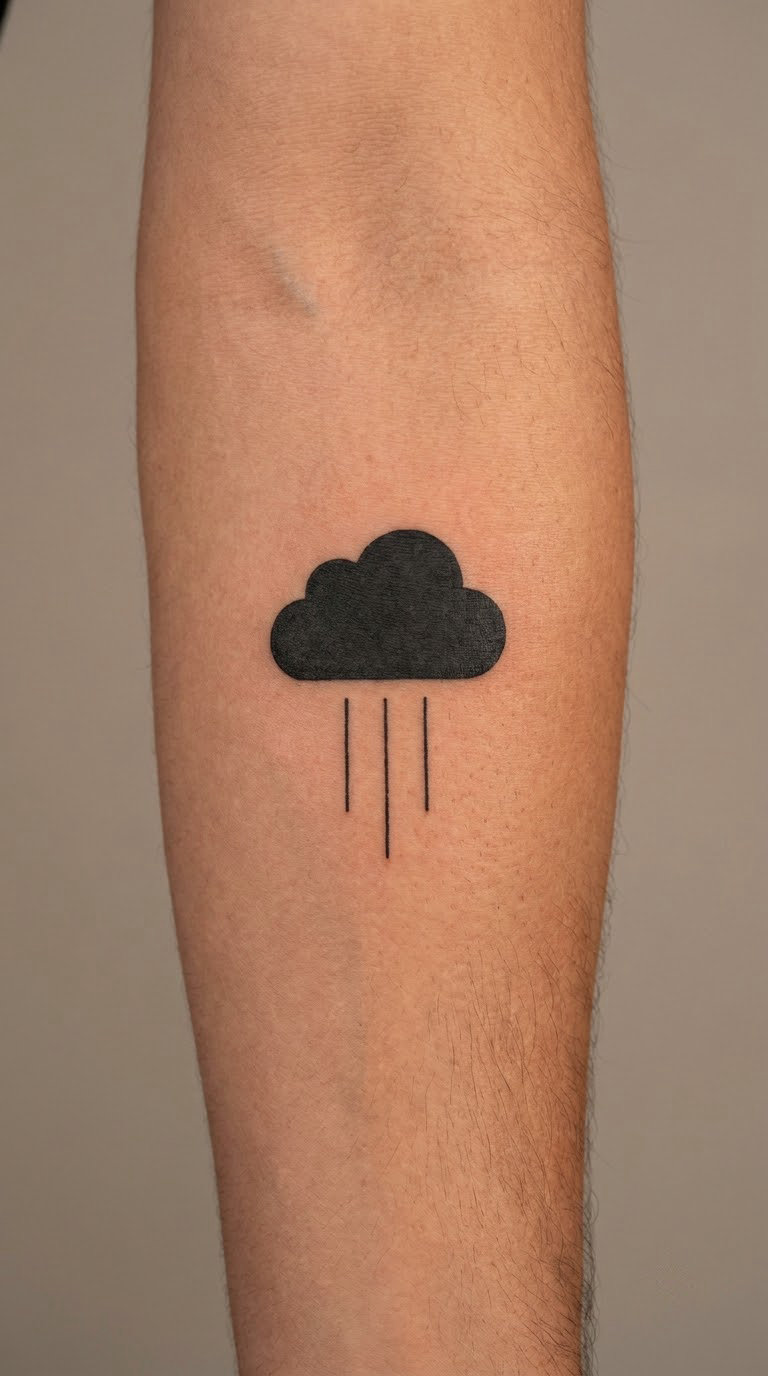
Same motif, opposite approach. The cloud is filled in solid black with a smooth, rounded edge, and the rain is three narrow negative cuts left open in the ink or drawn as thin gaps below it. Because the body of the cloud carries all the visual weight, the piece can be large without turning busy.
Most people who pick this say they wanted the concept but not the delicacy. It reads from across a room and it photographs well on a healed arm.
Placement: outer forearm, outer upper arm, or calf. Size: 2.5-4 inches (6-10 cm). Style: blackwork, bold outline and solid fill. Pain: medium, and the solid fill takes longer so it burns more. Solid black on the forearm holds colour far better than single-needle line.
Make it yours: ask for the rain to be shaped rather than straight, small teardrop forms instead of bars.
3. Small Floral Raindrop Tattoo
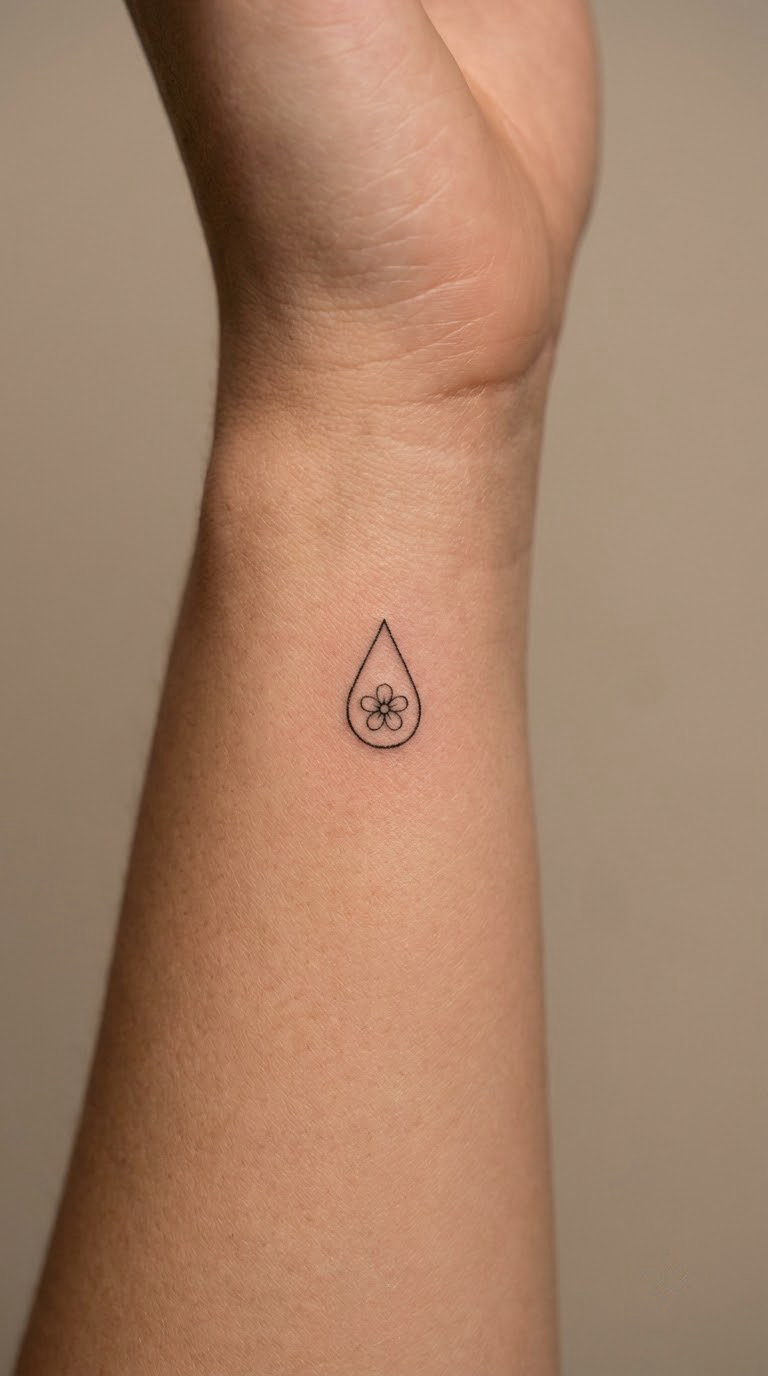
A single teardrop outline in black, and inside it one tiny five-petal flower filling most of the space. The flower is the only part with any detail: a few short strokes at the centre. Everything else is one clean line.
This is the quietest way to wear the idea, and the container keeps it from reading as random florals. It works as a standalone first piece and it stacks well with a date or a small initial.
Placement: inner wrist, ankle, behind the ear, or the finger. Size: 0.75-1.5 inches (2-4 cm). Style: fine line. Pain: medium on the wrist and ankle, which have thin skin and lots of nerve endings. At this size the inner detail can soften noticeably over the years, so keep the flower simple.
Make it yours: swap the five-petal flower for a six-petal one, or use a botanically real small bloom from your own garden.
4. Two Flowers Beneath a Cloud
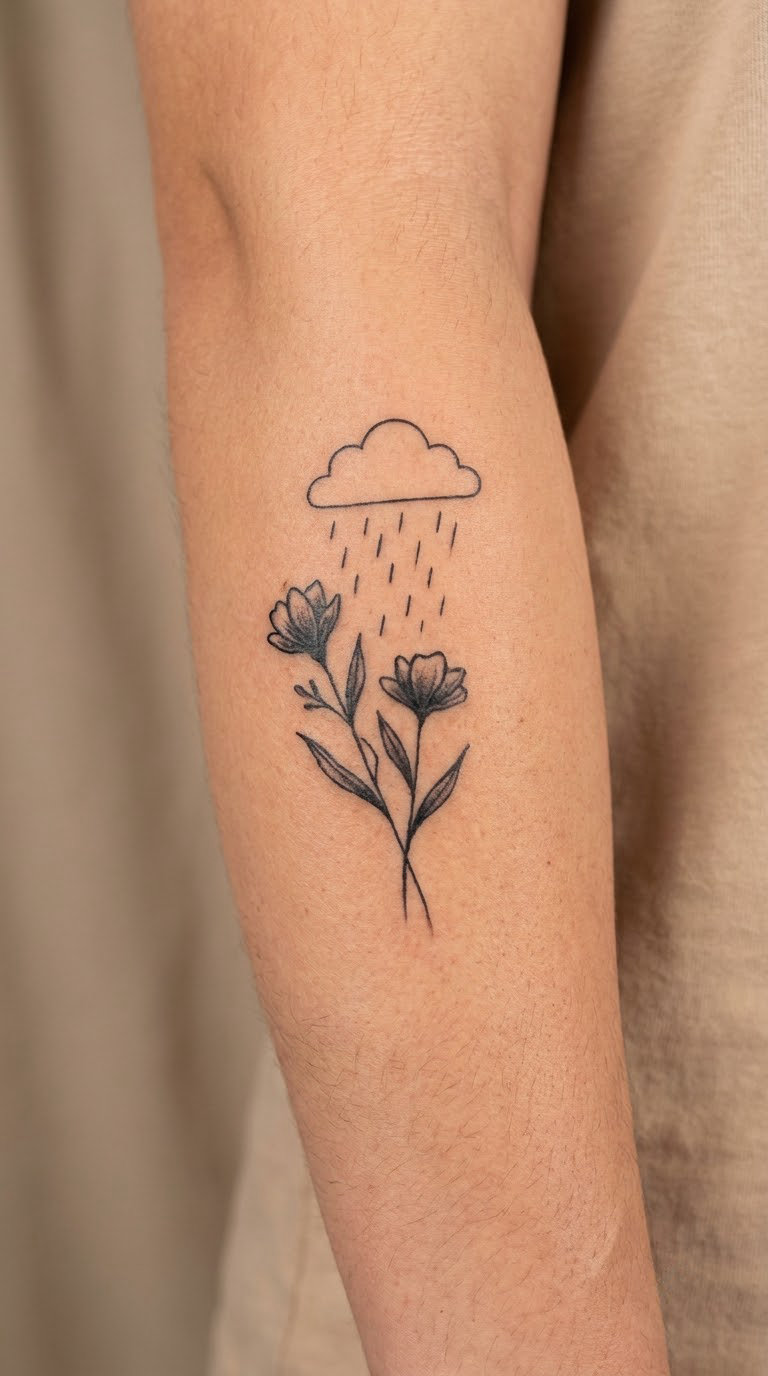
Two small flowers, one slightly taller than the other, sit under a sparse cloud with a few rain lines falling between them. The spacing matters: leave a real gap between the rain and the petals so the design does not turn into a dense floral piece.
It suits people who want a little more presence than a single bloom without committing to a floral sleeve. The uneven height is what makes it look hand-drawn rather than stamped.
Placement: forearm, upper arm, or the outer calf. Size: 2-3.5 inches (5-9 cm). Style: fine line with light stippled shading in the petal centres. Pain: low to medium over a flat area. If you want the two flowers in color, expect a longer session and more aftercare attention.
Make it yours: make one flower wilted and one open, which turns the pair into a before-and-after.
5. Line-Art Cloud with Falling Petals
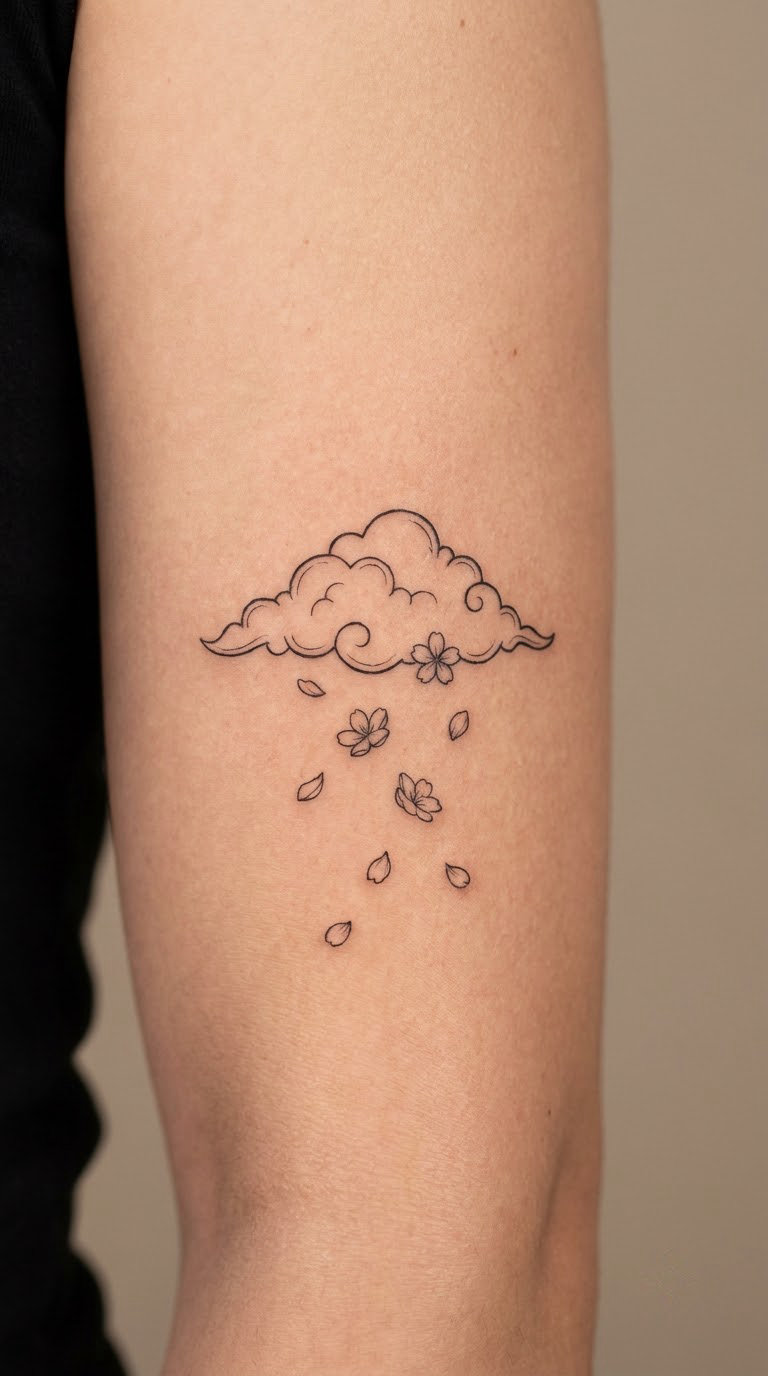
Here the rain is rendered as petals. A soft outlined cloud sits at the top and beneath it fall five or six small, loose petal shapes, each one slightly rotated, drifting down and outward. No stems, no leaves, no color.
It is the gentlest reading of the phrase and it slides between weather and florals without committing to either. Artists like it because petal shapes are forgiving at small sizes.
Placement: upper arm, shoulder, or the back of the forearm. Size: 2-3 inches (5-7.5 cm). Style: line art, minimal. Pain: low, the least demanding design in this list. Petal edges blur first, so keep them as solid shapes rather than thin outlines with interior detail.
Make it yours: have the petals follow the curve of your arm, fanning toward the elbow rather than falling straight down.
6. Black and Grey Storm Bloom
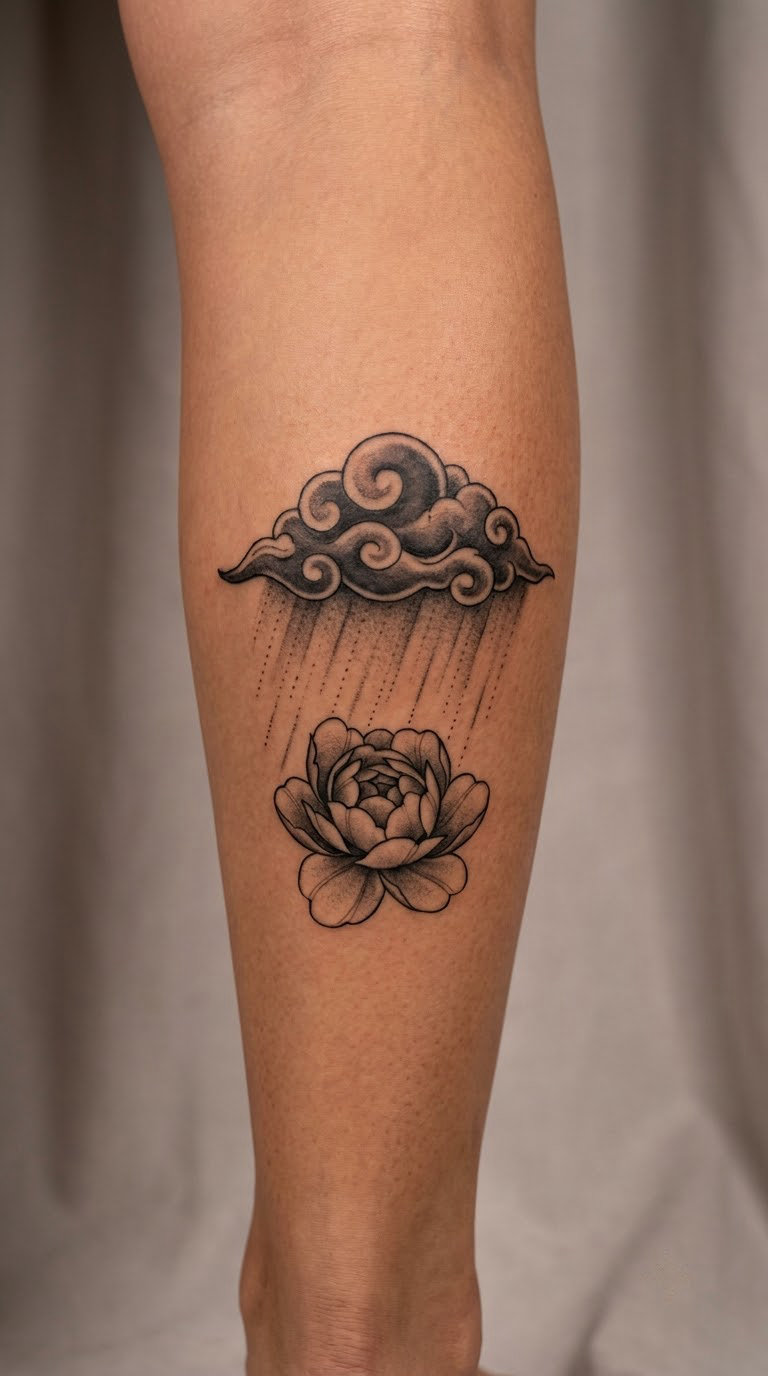
A heavier, more atmospheric version. The cloud is built from layered grey wash rather than solid black, rain is suggested with soft vertical gradient, and a single bloom sits below it with shaded petals. The palette stays entirely in blacks and greys.
Pick this if you want the phrase to feel like a memory rather than a motto. It is the most pictorial design here and the most dramatic.
Placement: calf, thigh, or across the back of the shoulder. Size: 3-4.5 inches (7.5-11 cm). Style: black and grey realism shading. Pain: medium. Grey wash means many light passes, which stings more than a single line and takes longer to settle. A calf placement is a long sit in one position.
Make it yours: add a single color only to the bloom, keeping the storm in grey so the flower reads as the reward.
7. Minimalist Rain Lines and Leaf
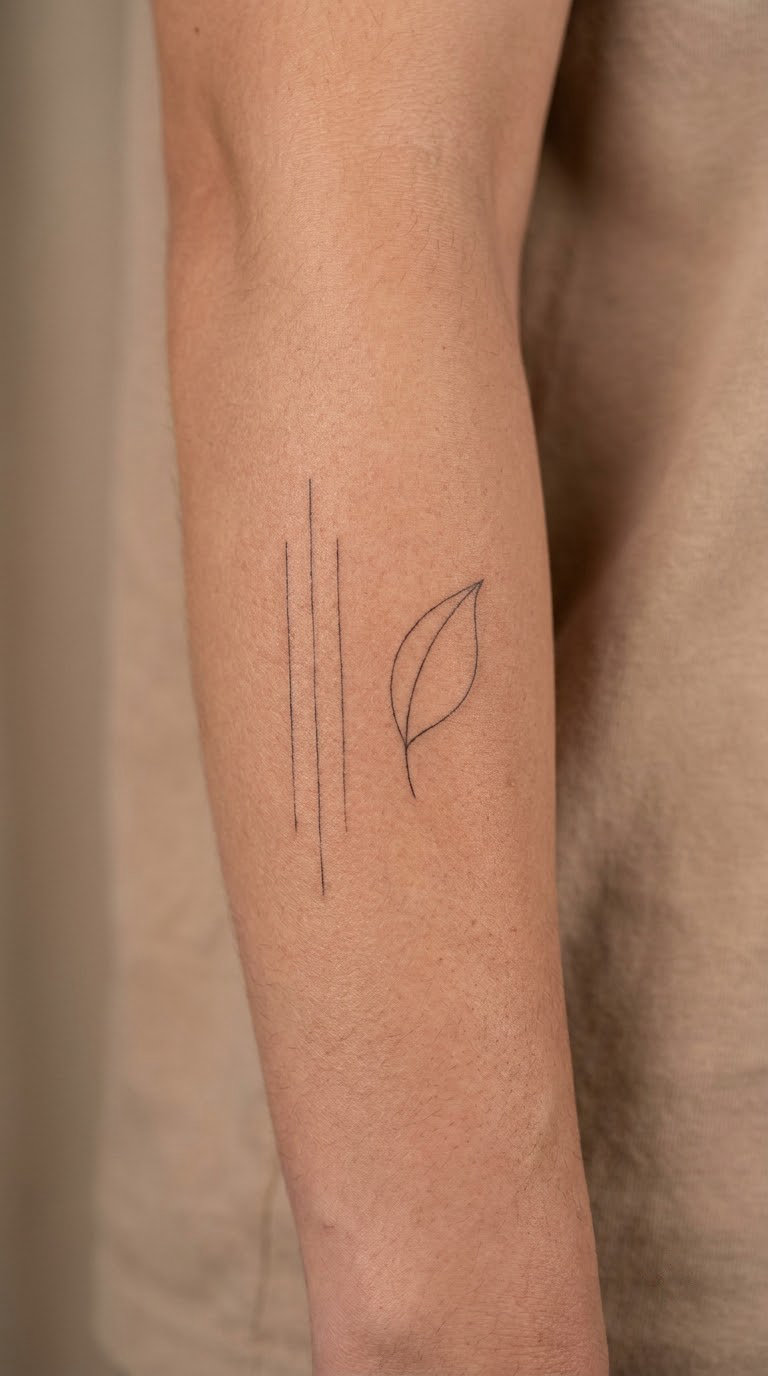
No cloud at all. Just three or four short vertical rain lines and one clean leaf outline, slightly angled as if the rain is landing on it. Two elements, nothing more.
Some people love the phrase and hate cloud drawings, or they already have a cloud piece and want a companion. This is the version that fits a second or third tattoo without crowding the skin.
Placement: side of the forearm, rib, or along the collarbone. Size: 1.5-2.5 inches (4-6 cm). Style: minimal single-needle line. Pain: low on the forearm, medium on the ribs. Tiny line work on the rib fades faster than on the arm, so this is worth a touch-up plan.
Make it yours: use a leaf from a plant that means something specific, and have the artist trace the real outline from a pressed sample.
8. Micro-Realism Wet Flower
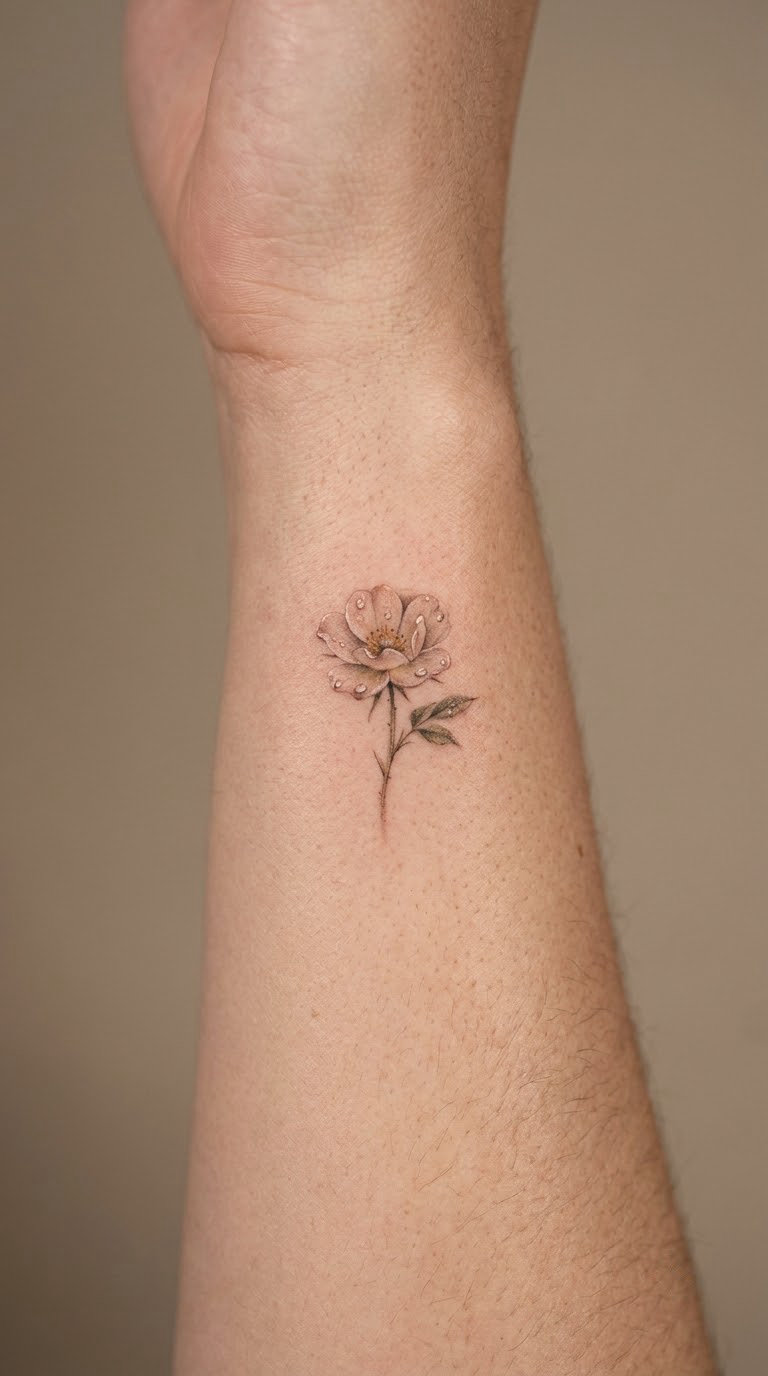
A realistic flower, not a symbol of one, with tiny water beads sitting on the petals. The droplets are the whole design: a handful of small circles with a highlight left open inside each one. Everything else is soft petal shading.
Rain gets folded into the flower rather than placed beside it, which makes this read as a quiet moment after weather. It is a favourite for a first tattoo that people want to look like art rather than a diagram.
Placement: inner wrist, forearm, or the sternum area. Size: 1-2 inches (2.5-5 cm). Style: micro-realism. Pain: medium. Realistic petals need hundreds of tiny hits, and the wrist is a sensitive spot. Fine droplet circles are the first thing to blur, so ask your artist how they plan for that.
Make it yours: bring a photo of a real wet flower from a garden or a rain-heavy week and let the artist work from it rather than from a generic one.
9. Dotwork Rain Cloud
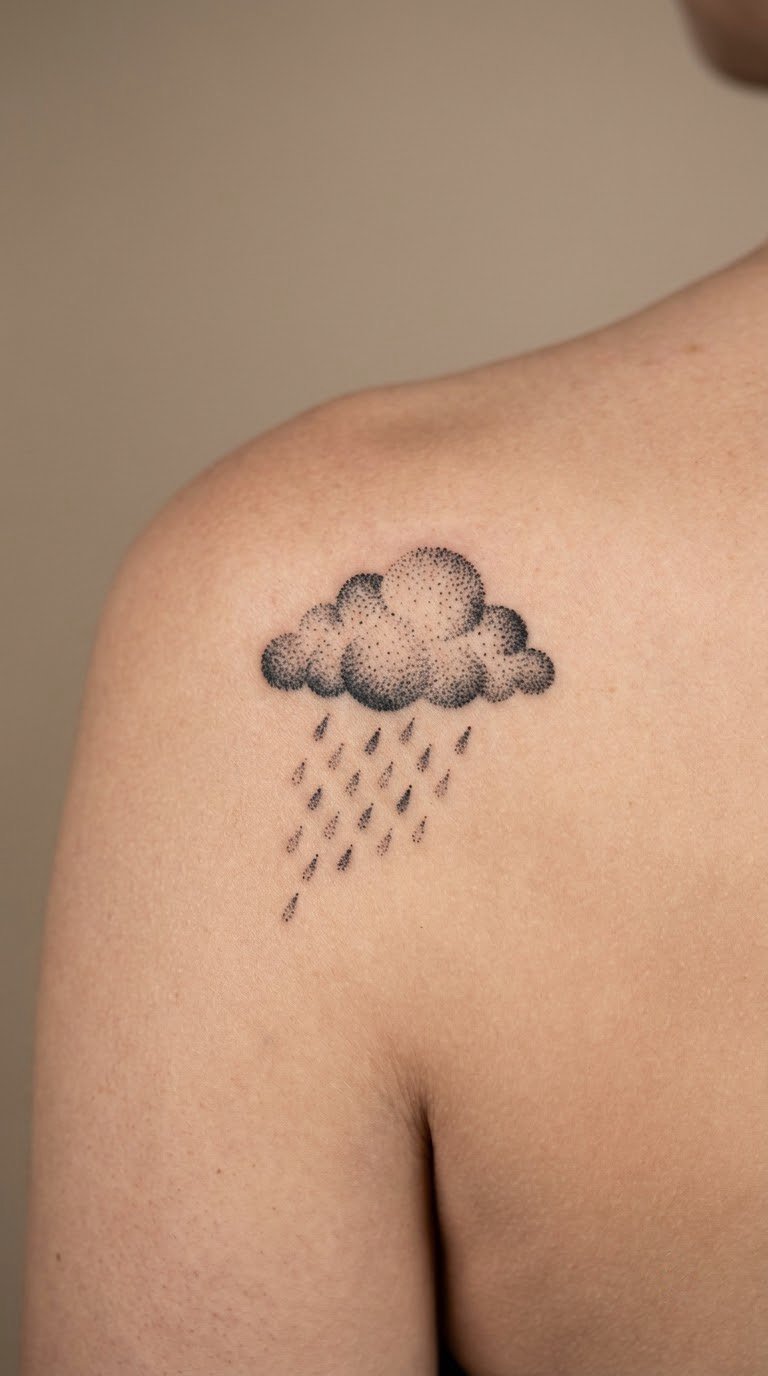
The cloud is built entirely from dots: dense in the shadowed underside, sparse along the top edge, with a short trail of single dots beneath it standing in for rain. No outline at all. Tone alone defines the shape.
Dotwork is a good answer for curved surfaces because the density does the shaping, and it hides a slight line wobble that a hairline outline would expose. It is more forgiving than it looks.
Placement: shoulder, upper arm, or along the spine. Size: 2-3 inches (5-7.5 cm). Style: dotwork. Pain: medium, and expect a long session because dots cannot be done quickly. The shoulder is a deep, curved surface where leaning forward gets uncomfortable.
Make it yours: have the rain trail fade out rather than stop, so the dots get smaller and smaller into the skin.
10. Minimal Rose and Rainfall
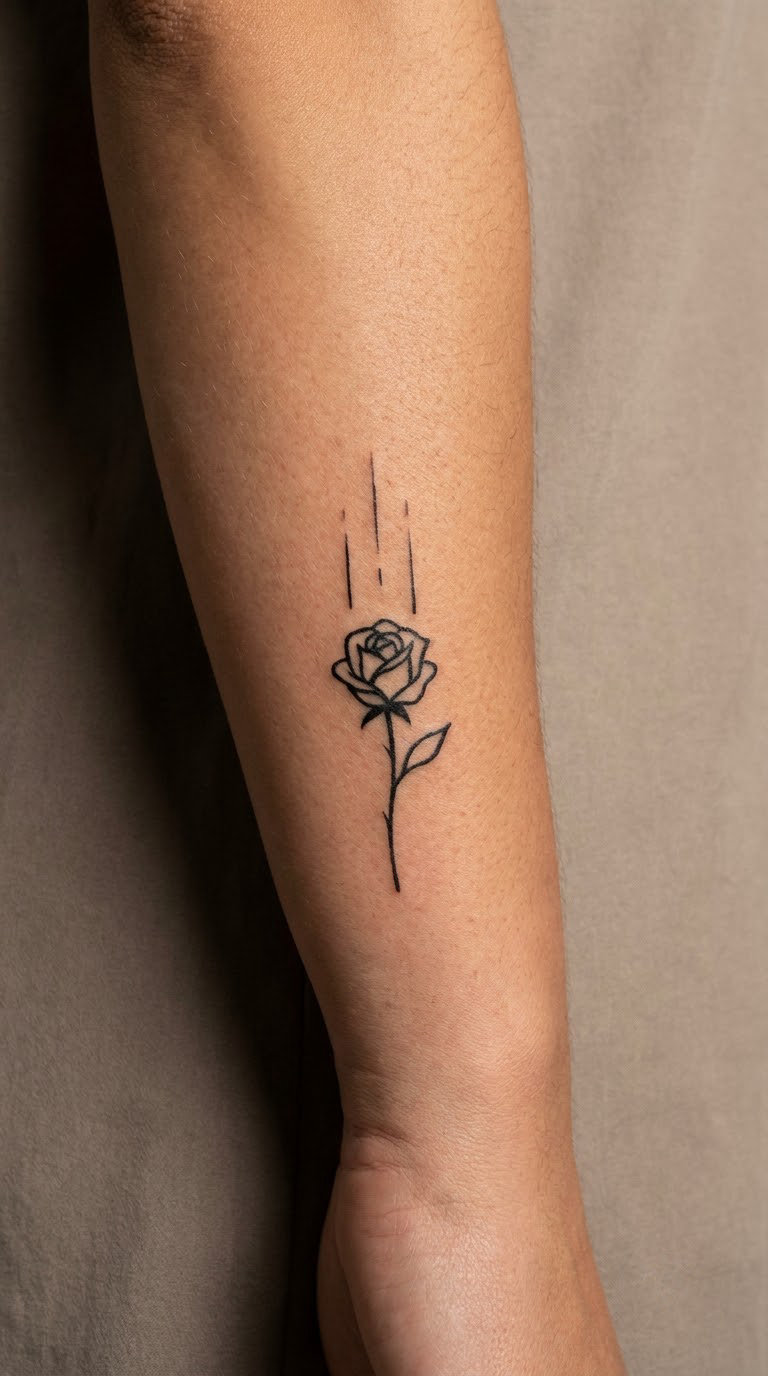
A small modern rose drawn in clean outline, not shaded, with three fine rain lines falling above it into empty space. The rose is the focal point and the rain is only a hint above it.
Rose plus rain is the most requested pairing in this theme, and the modern outline style keeps it from tipping into traditional. If you like floral work generally, our 20 best child birth flower tattoo ideas for moms goes deeper on choosing a flower with a real reason behind it.
Placement: inner arm, wrist, or the rib. Size: 2-3 inches (5-7.5 cm). Style: fine line outline. Pain: low to medium. Outlined petals have a lot of close line work, so this takes longer than its size suggests.
Make it yours: have the rain lines land on the outer petals only, leaving the centre dry, so the bloom looks like it is holding off.
11. Watercolor Cloud and Flower
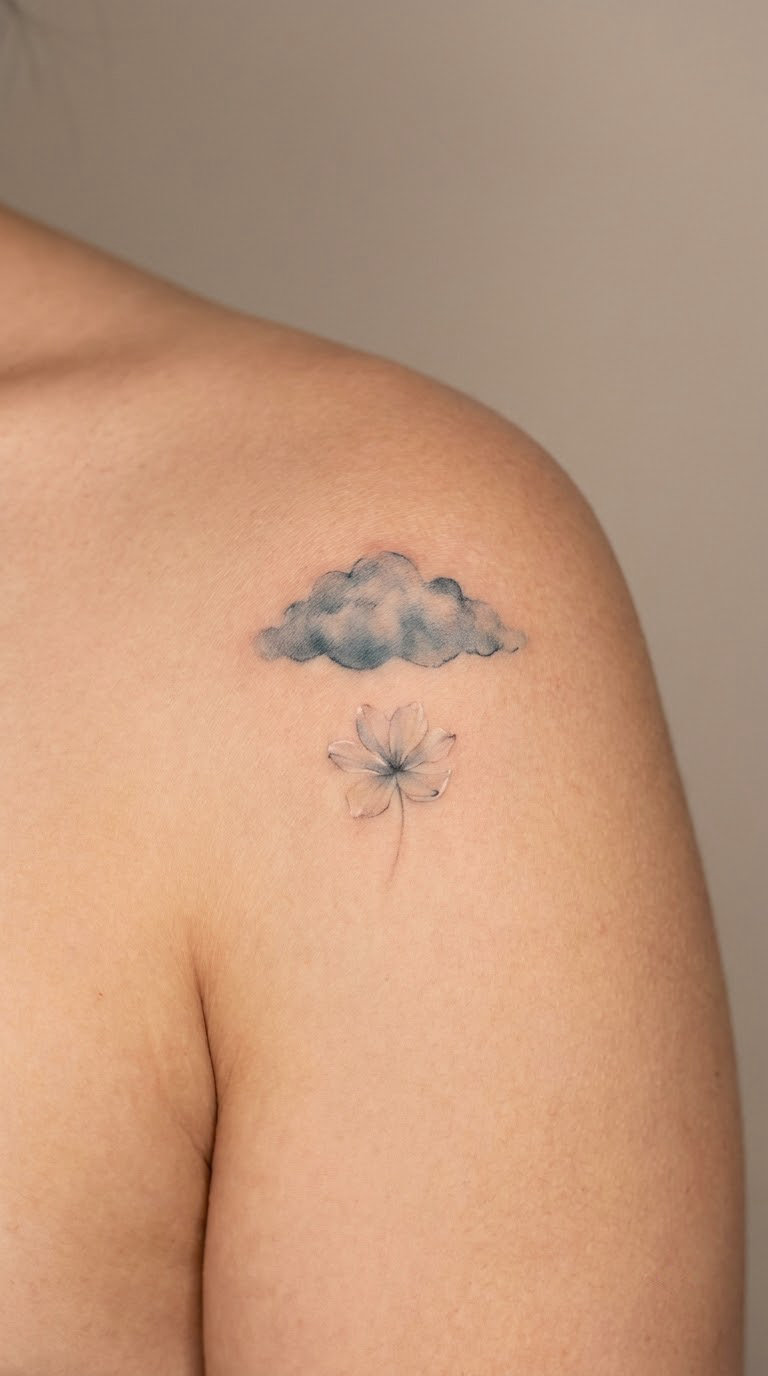
A soft cloud built from diluted blue-grey wash bleeding slightly past the line work, with a pale flower below it in a second diluted tone. Edges are loose and a little uneven on purpose.
Watercolor is the most expressive style in this list and also the least forgiving. Small forms turn muddy if the artist overworks them, so the design needs to be drawn slightly larger than the size you eventually want.
Placement: shoulder, upper arm, or thigh. Size: 2-3.5 inches (5-9 cm). Style: watercolor, two tones. Pain: medium. Washes mean many light passes over the same skin. Color tattoos on the shoulder fade unevenly without a sun line, so placement matters more here than for blackwork.
Make it yours: bring a color reference rather than a name. Artists work far more accurately from a photo of a sky or a flower you actually like.
12. Geometric Rain and Flower
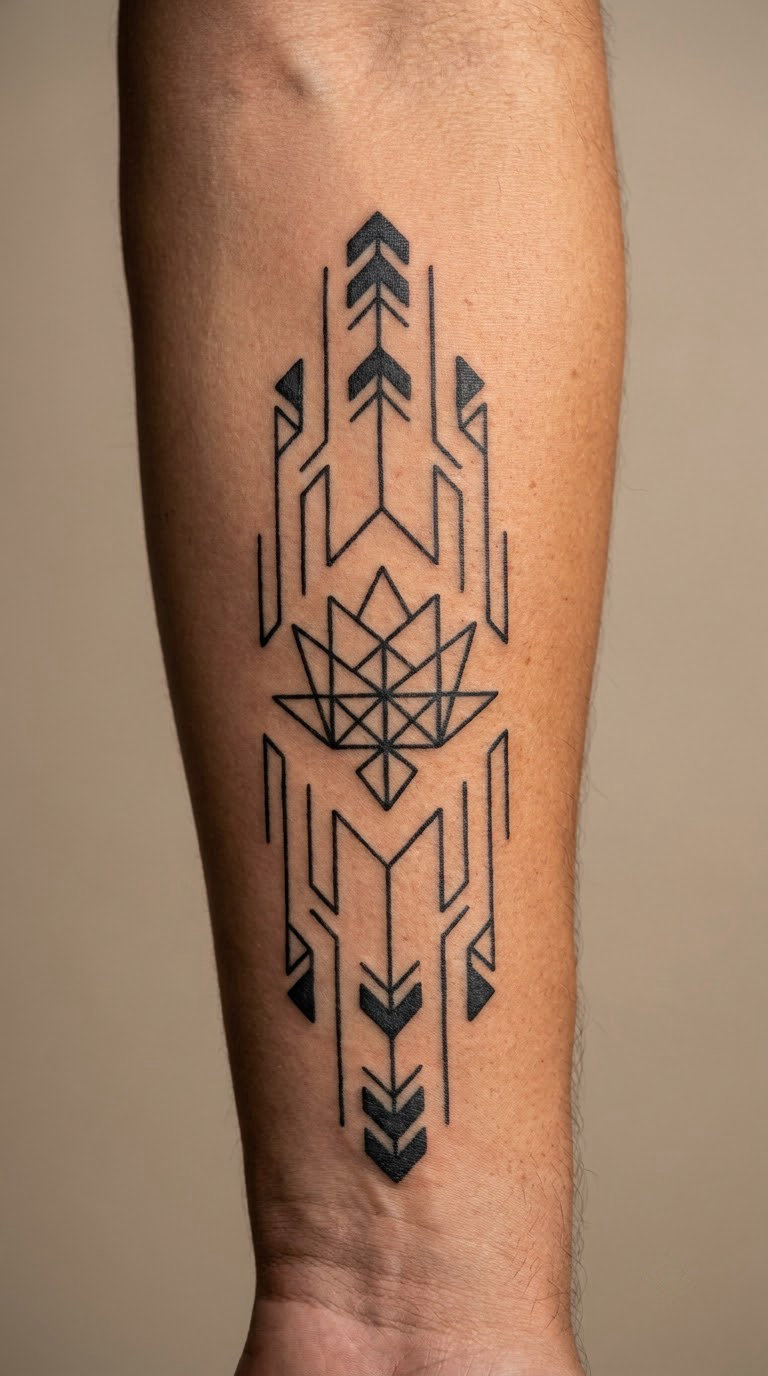
Everything is built from straight lines and sharp angles. Rain is a row of narrow triangles pointing down, the cloud is a polygonal outline, and the flower is a symmetrical set of triangles meeting at one point.
It is the graphic answer to an organic idea, and it suits people who like design that looks constructed. A symmetry line down the centre is usually built in first, then the shapes are mirrored from it.
Placement: forearm, calf, or along the outer arm. Size: 2.5-4 inches (6-10 cm). Style: geometric line work. Pain: medium. Straight-line freehand work takes steady concentration, and a shaky pass on a long edge is hard to hide.
Make it yours: build the rain from a repeating triangle pattern, then change one triangle into a petal to make the bloom the hidden element.
13. Fine-Line Cherry Blossom in Rain
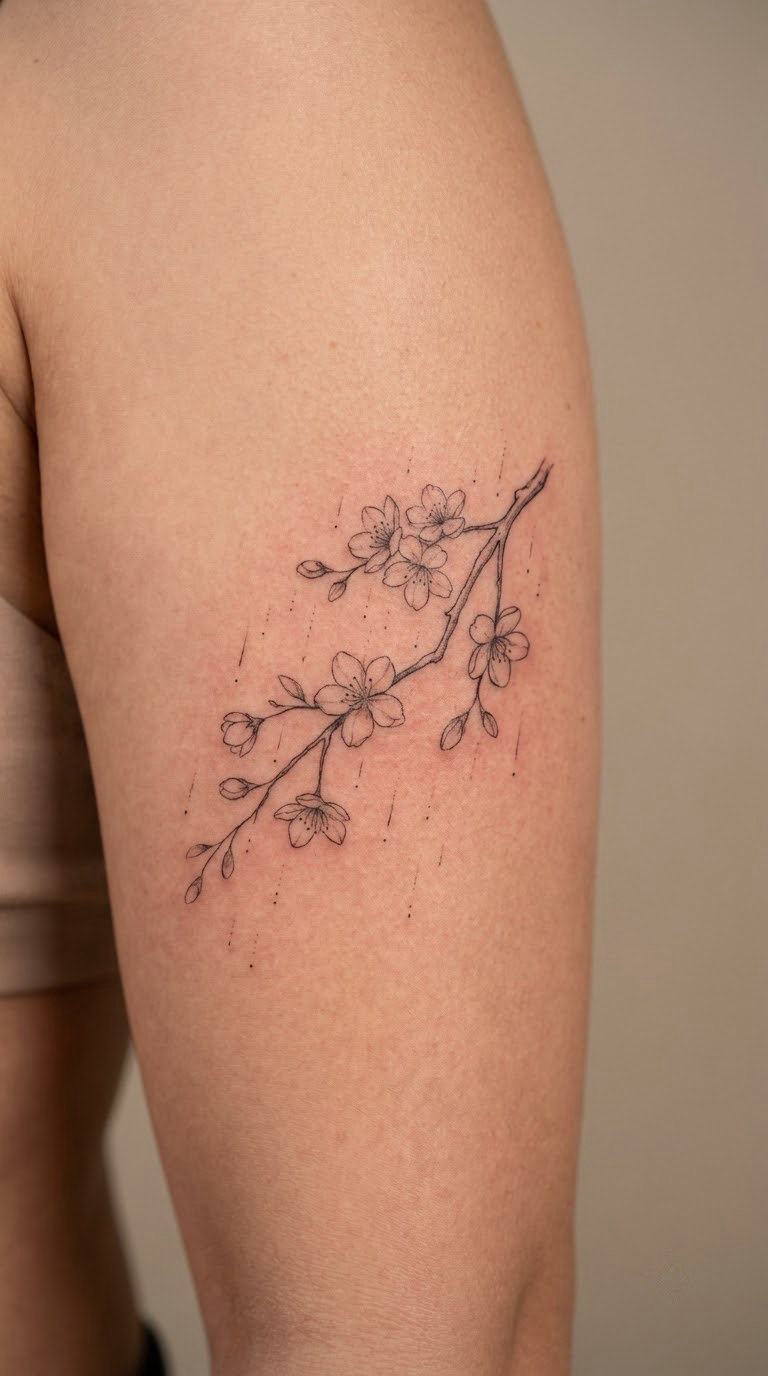
A slim branch with a few small blossoms, each one five petals with a tiny centre, and short rain lines falling through and behind it. Sparse, airy, and more botanical than the cloud versions.
Blossom reads as renewal more than resilience, which makes this the softer option in the set. It also gives you a natural companion piece for later, since a bare branch alone works as a second tattoo.
Placement: upper arm, shoulder, or the back of the forearm. Size: 2.5-4 inches (6-10 cm). Style: fine line with light pink or no color. Pain: low, one of the most comfortable areas for line work. Petal centres are the first detail to soften, so keep the stamens as simple dots.
Make it yours: have the number of blossoms match a count that matters to you, and let the rain fall only between the open flowers.
14. Small Cloud and Tulip Outline
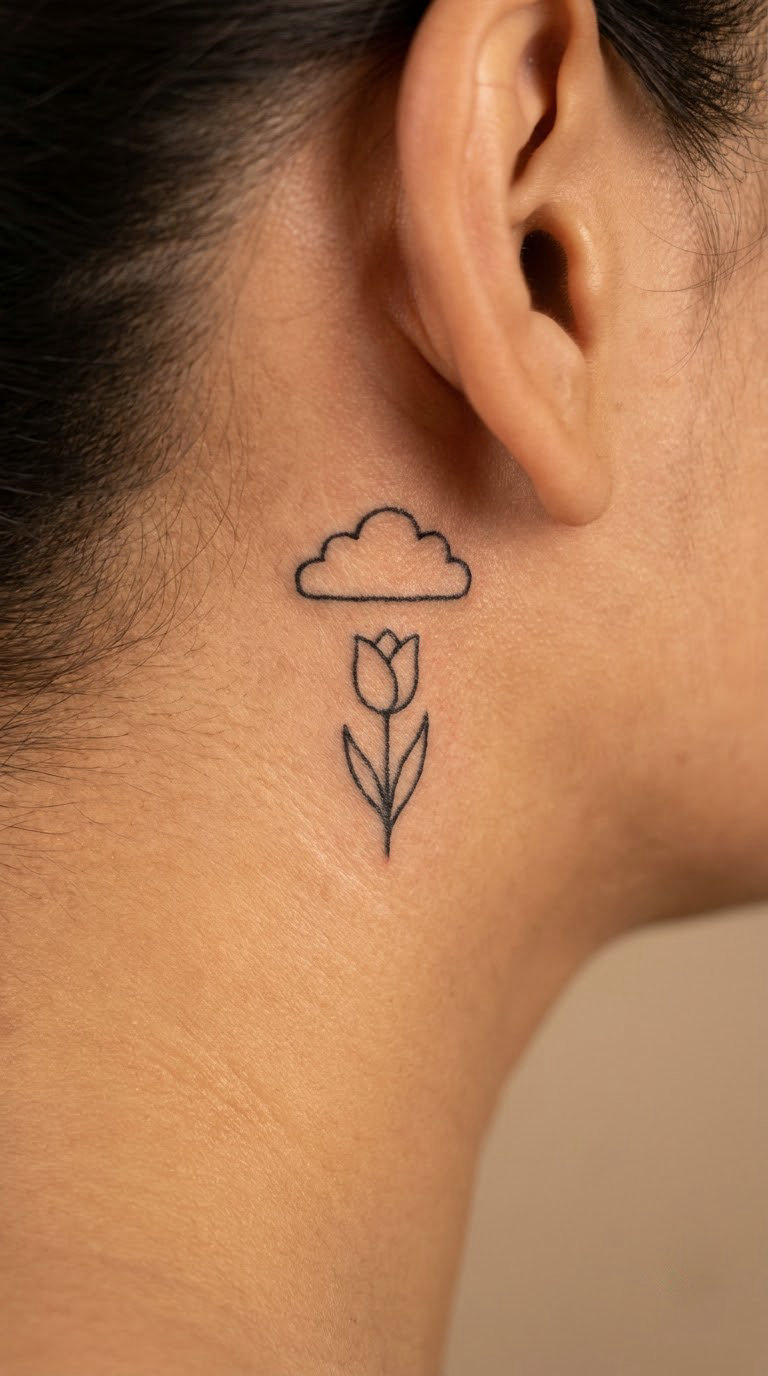
A very small outlined cloud with a few rain dashes, and beneath it a single tulip outline drawn with a simple cup shape, two leaves and a straight stem. Nothing shaded, nothing colored.
Tulips are a good pick here because the shape is unmistakable even at 1.5 inches, where a peony or a rose would turn to mush. The whole design is often finished in under an hour.
Placement: behind the ear, on the rib, or on the ankle. Size: 1-2 inches (2.5-5 cm). Style: fine line outline. Pain: medium, and the area behind the ear is a common spot for people to move through. Skin there is thin, so the line will look crisp and will also fade sooner than the same design on the arm.
Make it yours: use the tulip as a colour block, one flat shade inside the outline, and leave the cloud in black line only.
15. Minimal Script With Raindrop
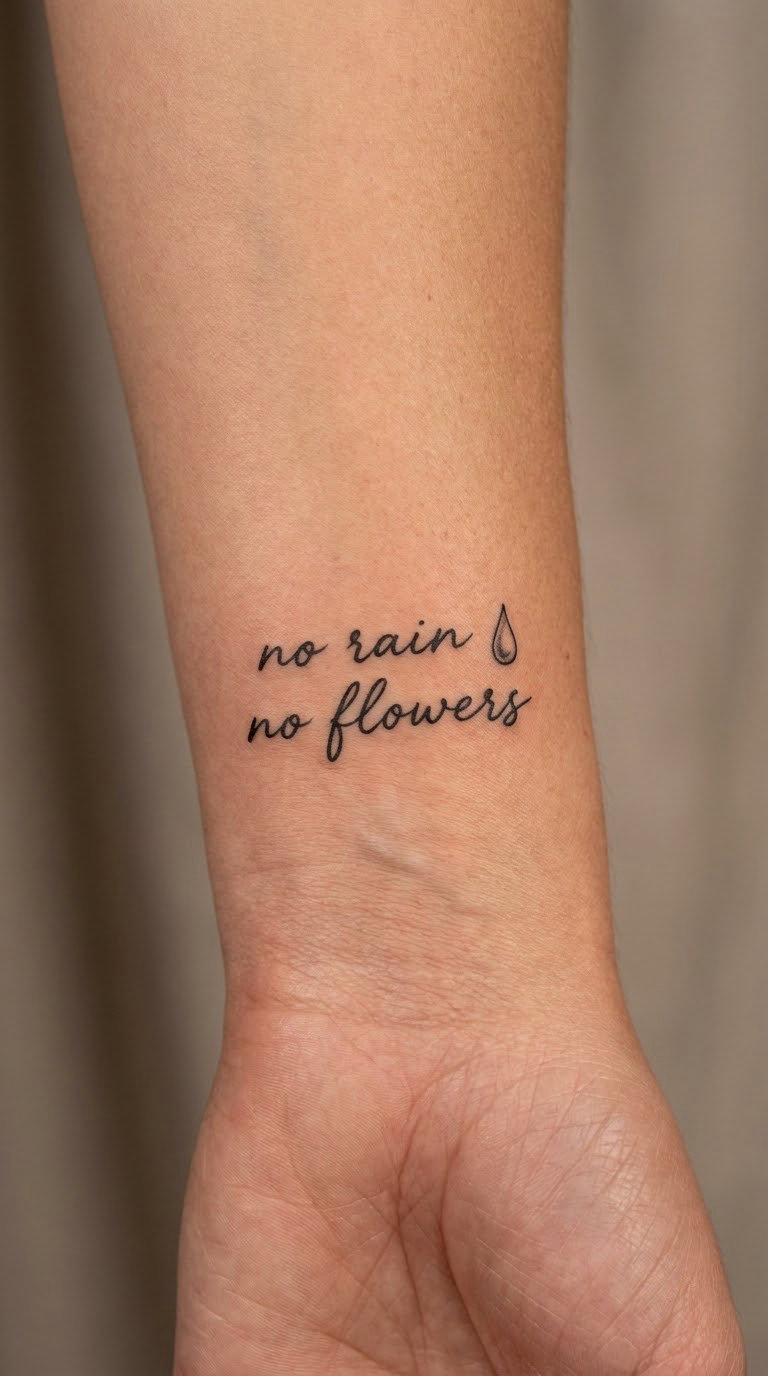
The phrase itself in a single line of hand-lettered script, with one small raindrop tucked at the end or sitting in the gap between words. The letters are thin, slightly uneven, and spaced loosely enough to stay readable at a small size.
Script is what most people picture when they search this phrase, and it is the hardest version to age well. Thin hairlines soften, and softened script turns into a squiggle. Ask your artist for a slightly heavier line weight than feels right when they are drawing it.
Placement: inner wrist, inner forearm, ribs, or the back of the arm. Size: 2-4 inches (5-10 cm) across. Style: fine-line script, single needle. Pain: medium on the wrist and ribs. A longer word set in script is many more passes than it looks like, and the wrist holds tension badly.
Make it yours: shorten the phrase to your own wording, or set just three words in script and let the raindrop carry the rest.
16. Stippled Cloud and Wildflower
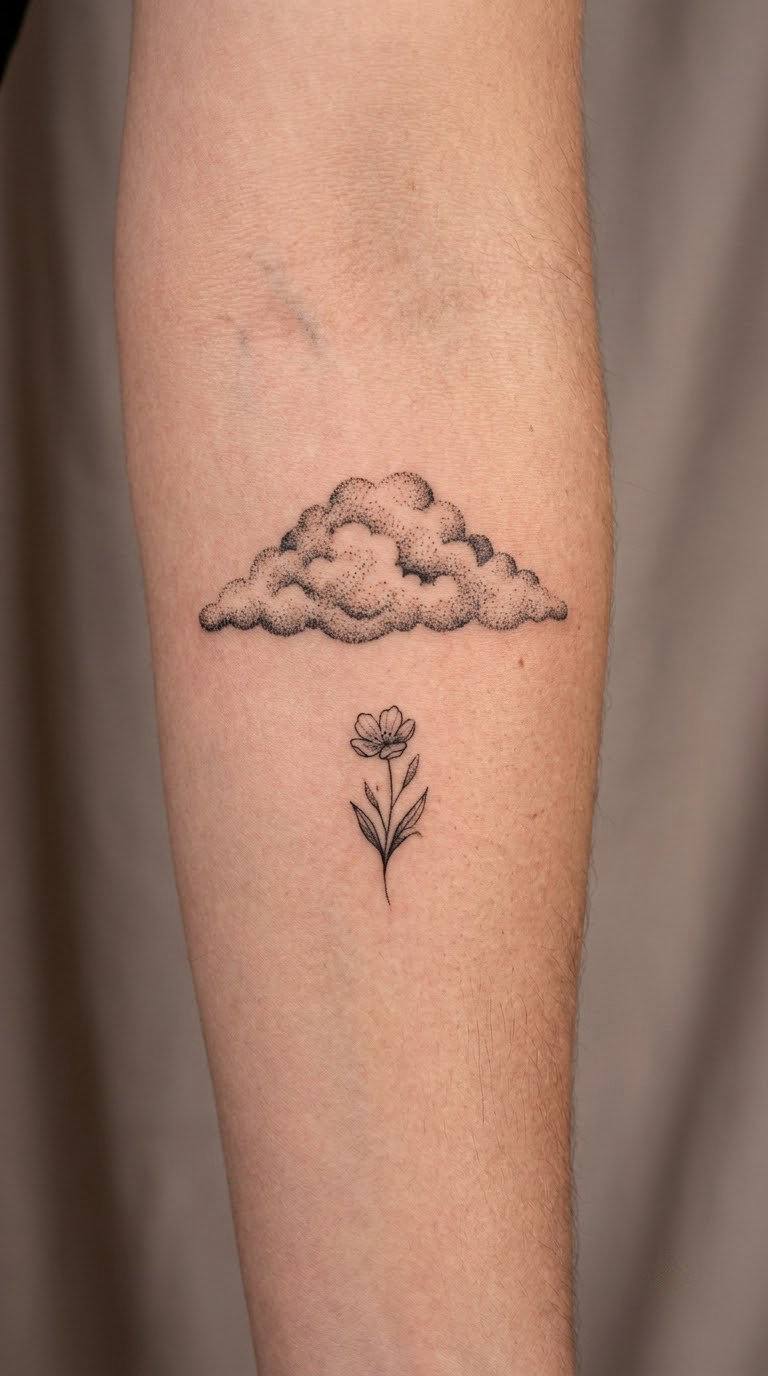
A small storm cloud built from fine stippling, denser underneath and lighter at the top, with one wildflower below it on a bent stem. The flower is loose and slightly uneven, like something actually growing rather than a garden bloom.
Stippling gives texture and softness at the same time, which suits this phrase better than a flat outline. It is a good middle ground between a first line-only piece and something much denser.
Placement: inner forearm, calf, or the back of the upper arm. Size: 2-3 inches (5-7.5 cm). Style: stippling. Pain: medium. Thousands of individual dots take a long session, and dot work tends to feel more insistent than line work over a long sit.
Make it yours: use a wildflower that grows where you grew up, and have the artist place the stem bend to follow your vein line.
17. Red Ink Rain Flower
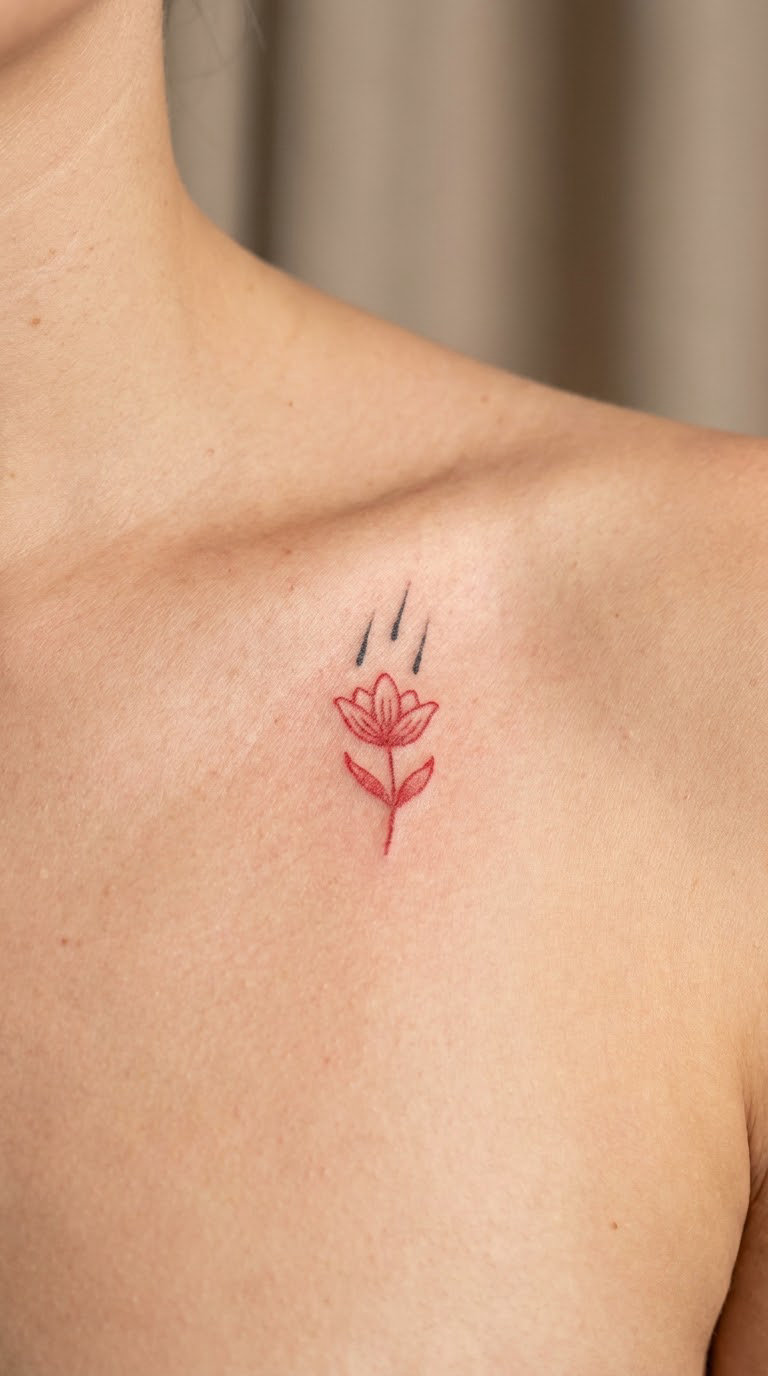
One flower in a single saturated red, with the rain drawn in three dark lines above it. One color, no shading, no second flower. Red does the emotional work that black line usually carries in the other designs.
It is the least likely to be mistaken for someone else’s tattoo, which matters if the trend concern is part of why you are hesitating. A red line-only version also reads fine at a distance, where black hairline script disappears.
Placement: collarbone, wrist, or the ankle. Size: 1.5-2.5 inches (4-6 cm). Style: single-colour line work. Pain: low to medium. Solid color fills are more forgiving to heal than hairline detail, but a bright red on a warm skin tone needs a patch test first, because reds are the least predictable ink in a palette.
Make it yours: keep the rain in black and the flower in red so the two elements read as separate pieces of the sentence.
18. Minimal Cloud and Fern
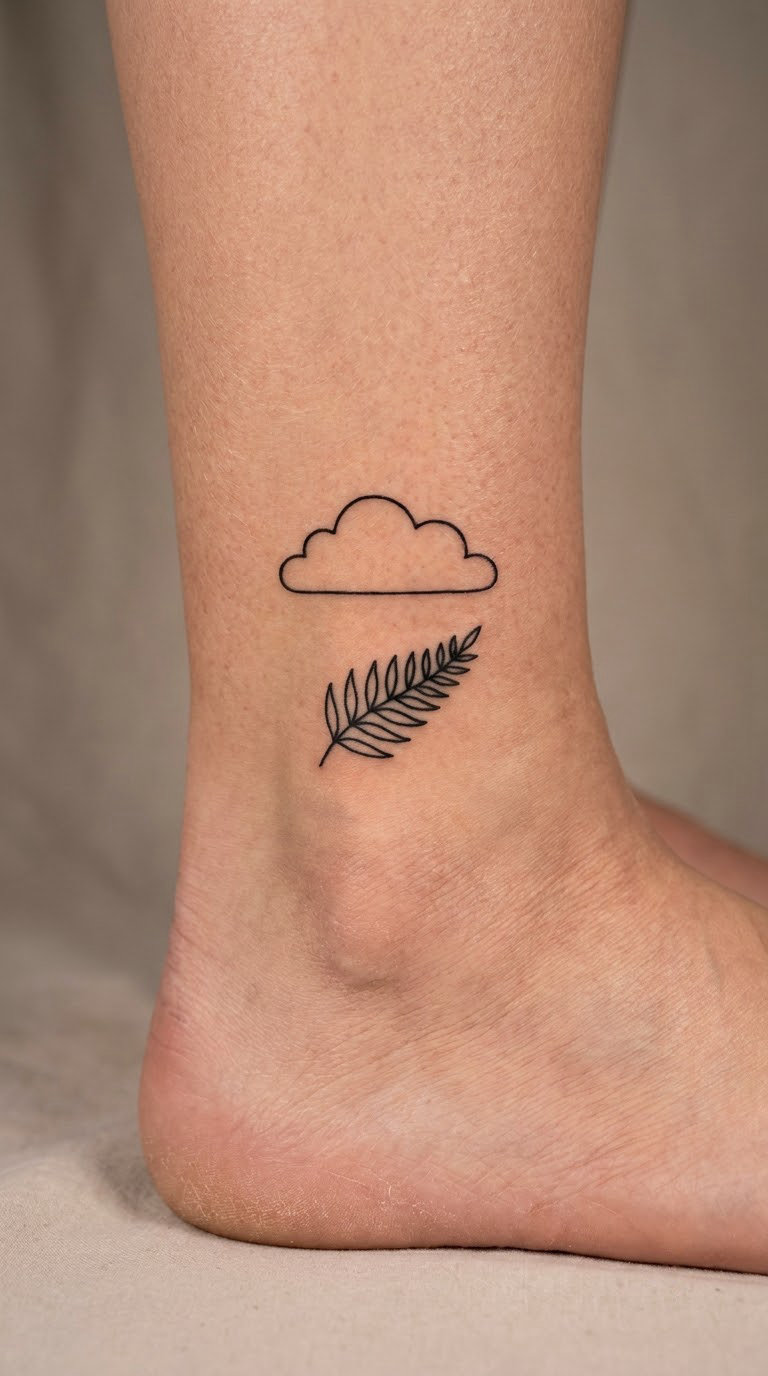
A simple outlined cloud with a handful of rain dashes, and below it a small fern with a central stem and paired leaflets climbing upward. Botanical, tidy, and the least weather-heavy design in the set.
Ferns are forgiving to tattoo because the repeating leaflet pattern hides small inconsistencies. It also gives the piece a longer vertical shape, which suits the ankle and the side of the calf nicely.
Placement: ankle, inner calf, or along the rib. Size: 1.5-2.5 inches (4-6 cm). Style: botanical line work. Pain: medium, and the ankle is a bony spot that most people feel more strongly than expected. The lower leg also ages faster, so plan on a refresh if you choose it.
Make it yours: pair it with a second fern on the other leg in a different size, or add two small dots of green to the centre stem only.
19. Blackwork Flower Drip
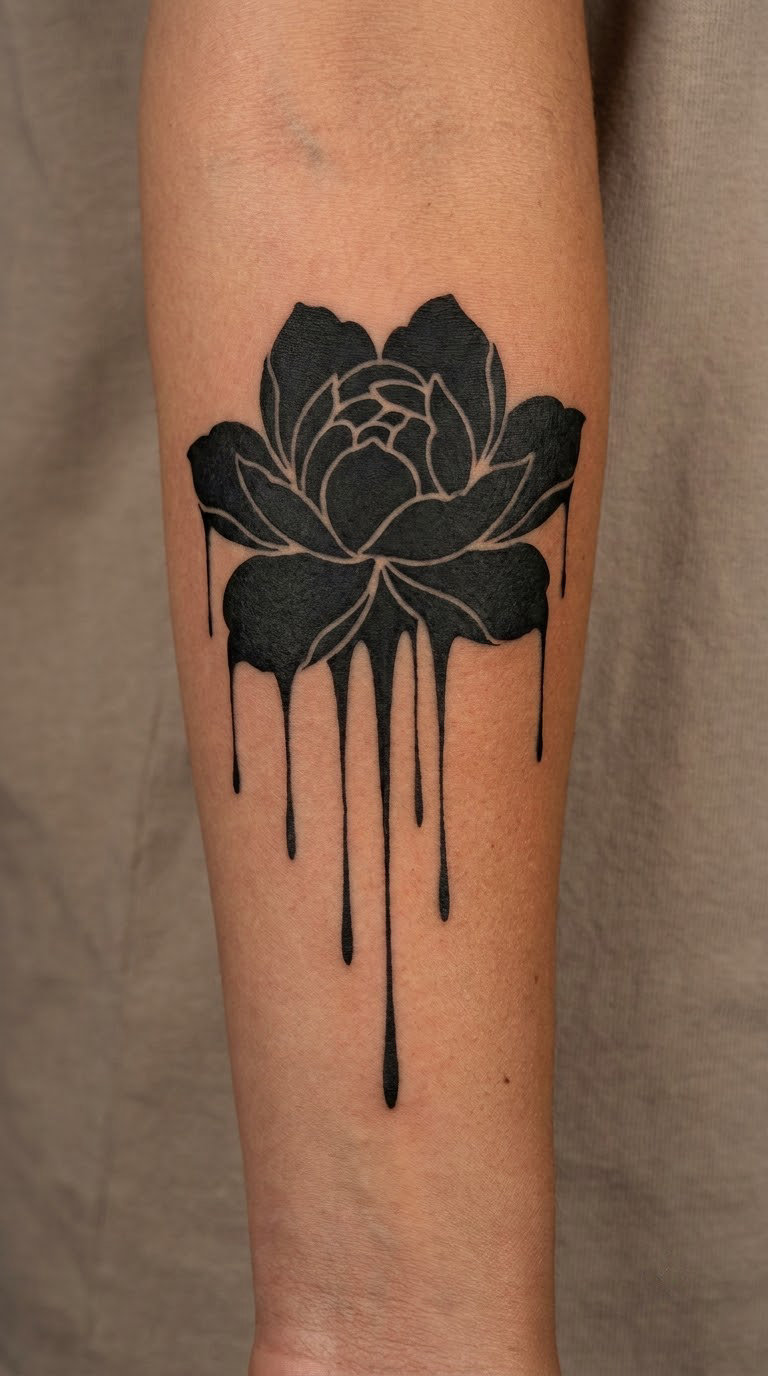
A high-contrast flower filled in solid black, with tapered drips running down from the lower petals as if the ink were still wet. The drips are the rain, and the effect is graphic rather than illustrative.
This is the boldest option here and the least literal. It reads as a graphic design first and a phrase second, which is exactly why it does not feel like the version everyone already has.
Placement: outer arm, outer thigh, or the calf. Size: 2.5-4 inches (6-10 cm). Style: bold blackwork with graphic drips. Pain: medium, and the solid areas take a long time on one patch of skin. Blackwork holds its weight and edges well, so this is the option that stays legible longest.
Make it yours: vary the drip lengths so they read as falling rather than arranged, or add three tiny drips beneath an otherwise blank area to balance the composition.
20. Minimal Negative-Space Cloud and Bloom
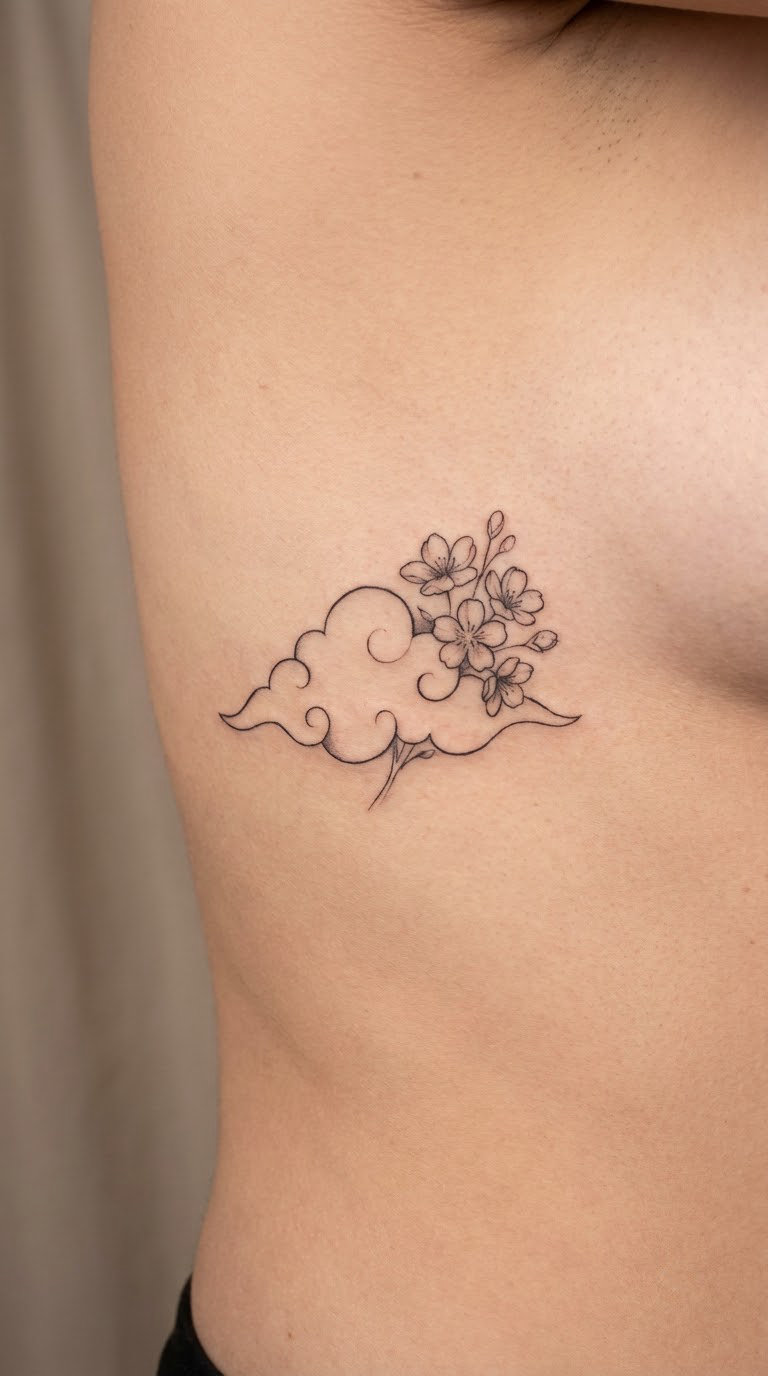
The cloud and the flower are described by thin outlines while the space between them is kept completely empty. A few rain dashes run through the gap. The design is mostly the skin you did not tattoo, which is the point.
It is the most technically demanding idea in this list and the most distinctive. Negative space needs an exact stencil and very steady line work, so pick an artist who has done it before rather than one who will try it for the first time on you.
Placement: ribs, inner arm, or the upper back. Size: 2-3 inches (5-7.5 cm). Style: negative space, single needle. Pain: medium to high. The rib is one of the more sensitive areas on the body, and you will be in one position for a long time. If the ribs are not for you, the inner arm gives the same effect with a much easier sit.
Make it yours: swap the flower for a single leaf so the design stays abstract, and let the rain dashes be the only filled marks in the piece.
How to Choose the Right Design
Start from the body, not the picture. A design that looks right flat on a phone screen often fails once it follows the curve of an ankle or a rib, and a composition built for a flat forearm gets stretched over a shoulder. Most regret comes from a good drawing in the wrong place.
- Fine line and script suit flat, forgiving areas like the inner forearm and upper arm, and they need a line weight that can survive a decade of sun.
- Blackwork is the reliable choice for a small, visible placement. Solid black holds its edges and it stays legible at a distance.
- Dotwork and stippling curve well over shoulders and spines, and they soften a composition without adding weight.
- Watercolor needs a bigger starting block than you want as the final result, and it ages faster than black on sun-exposed skin.
- Negative space and geometric work both depend on a precise stencil, so the artist’s hand matters more than the reference image.
- Lettering should be sized so the phrase reads at arm’s length, not just in a photo. Bring a printed sample of the letterforms.
Choosing a style that suits your placement for no rain no flowers tattoo ideas
Match the detail level to the surface. Fine detail needs a flat, larger area, and bold simple shapes need small or awkward ones. Ribs and ankles have thin skin and visible bone, so single-needle line looks delicate there and blurs faster than the same line on the outer arm.
If you want the text version specifically, treat placement as a readability decision. An inner wrist reads clearly but curves sharply and will distort the middle words, while a flat section of the outer forearm or the upper arm keeps the letters straight. Any placement that sees regular sun will need a touch-up sooner, and an artist will tell you which areas on your body need it.
Ask for a stencil, put it on in daylight, and look at it from the distance you will actually be seen from. Photography and mirrors are close-range, and that is not the same test.
Cost and Session Time
Artist rates and shop minimums vary widely, and nobody can quote your design accurately without seeing it in person. Hourly rates differ a lot by city, by shop and by how booked the artist is, and most shops set a shop minimum that applies even to a very small piece. A tiny fine-line drop at the low end of that range might take 30 to 45 minutes. A two-inch fine-line cloud with a stem is usually an hour to an hour and a half.
Blackwork, dotwork and stippling take longer than their size suggests because the artist cannot work fast on solid or dotted areas. A three-inch blackwork cloud can be a two-hour sitting. A full stippled composition can run three or more, and most artists will split anything past two hours into a second session so the work stays sharp.
Color and watercolor add time and sometimes money, since diluted washes need drying between layers. Tattoos that cross a joint, such as a piece that wraps from the forearm onto the hand, often cost more because the artist is working across a moving surface.
Aftercare Basics
- Follow your artist’s aftercare instructions first. They have seen your specific skin and this specific session, so their advice overrides anything general.
- Keep the area clean and wash it gently as directed, then pat it dry rather than rubbing it with a towel.
- Let the tattoo rest under loose clothing while it settles, and avoid soaking, swimming pools, hot tubs or swimming in the sea for as long as you are told to.
- Do not soak the fresh tattoo, scrub it, or pick at flaking skin, even when it itches. Itching is part of healing and picking pulls ink out with it.
- Keep it out of direct sun while it heals, and once it is healed use sunscreen on exposed placements such as forearms, arms and lower legs.
- Book a free touch-up check with the same artist once the surface has settled, and ask what they would recommend for the areas you are worried about.
Frequently Asked Questions
What does a no rain no flowers tattoo mean?
It means hardship is a requirement for growth rather than something to escape. Flowers need water before they open, so the difficult season is what makes the bloom possible. People who choose it usually want a daily reminder that the hard stretch is doing work for them, and that what they are building is earned, not given.
Is a no rain no flowers tattoo considered cliche?
It is one of the most requested phrases in fine-line work right now, mostly because artists post the same cursive version repeatedly. The way around it is to change one element: swap the lettering style, use a symbol version such as a cloud and stem, or set the words in a print block. A design that matches your actual experience matters more than whether others have the same one.
Where did the phrase no rain no flowers come from?
The line circulates widely in English motivational writing and tattoo culture, and it is often described as a Chinese or Japanese proverb without a confirmed source. It gained wide visibility through social posts and artist reels rather than a single book or poem. If you are getting it as a reminder, the meaning matters more to you than the attribution, but avoid presenting it as a translated proverb.
What size should the lettering be?
Most wearers of the script version keep the phrase between 2 and 4 inches across. Anything under 1.5 inches wide makes the individual letters too small and they blur together within a few years. Whatever the size, ask for slightly heavier line weight than looks right in the drawing, because hairline script softens faster than almost anything else you can tattoo.
What arm placement is most visible for this design?
The outer forearm and outer upper arm are the most visible, because they are seen from most angles in daily life. The inner forearm reads clearly to the wearer but is usually hidden by a sleeve. The inner wrist is popular and legible, though the sharp curve distorts the middle of the phrase. The elbow crease fades fastest of the arm areas, so avoid it for fine line.
Can I test the design before getting it permanently?
Yes, and most artists recommend it. Ask the shop for a paper or transfer stencil of the actual size and mirror it on your skin in daylight, or look at the design at home for a full day before booking. A temporary decal is another option for checking the size and the curve, though it will not show you exactly how the line weight will heal.
Where to Start With These No Rain No Flowers Tattoo Ideas
For a first tattoo, the fine-line rain cloud with a single stem is the safest starting point: forgiving, quick, and easy to place on a flat area. If this will be your second or third piece, the blackwork flower drip or the negative-space version reads as a deliberate design rather than a trend, and it holds up better as you add to the collection over the years.
Before anything else, get the stencil placed at the real size and look at it in daylight. The design is not the decision, the placement is.