
20 Best Choose Joy Tattoo Ideas for First Timers (October 2026)
Choose joy tattoo ideas work best when the design is simple enough to read at a glance and bold enough to survive on skin for decades. A first-timer usually wants something cheerful without a lot of fine detail, and that is exactly what this roundup delivers: 20 designs that carry the optimism of the phrase without turning it into a crowded, over-detailed piece.
Below each design you get a real tattoo style, the placement it actually suits, a realistic size in inches and centimetres, and an honest pain estimate. Nothing here is traced from an existing design; every entry is written so an artist could sketch it from the description. If you are still deciding, skip straight to the quick guide table.
Choose Joy Tattoo Ideas: Quick Guide
The table below lists all 20 designs in the order they appear, with the style that suits each one best, the placement I would pick, a realistic size and an honest read on discomfort.
| Idea | Style | Best placement | Size | Pain |
|---|---|---|---|---|
| Fine-line sun with open rays | Fine line | Inner forearm | 2 in (5 cm) wide | Low |
| Handwritten Choose Joy phrase | Script | Inner forearm | 3 in (7.5 cm) wide | Medium |
| Grinning sun in retro linework | Traditional | Outer upper arm | 3.5 in (9 cm) across | Medium |
| Laughing Buddha in soft watercolor | Watercolour | Upper arm | 4 in (10 cm) tall | Medium |
| Tiny rainbow arc | Fine line | Outer wrist | 1.5 in (4 cm) wide | Medium |
| Dandelion seeds into birds | Fine line | Forearm | 3 in (7.5 cm) wide | Low |
| Wildflower bouquet | Colour realism | Outer forearm | 4 in (10 cm) tall | Medium |
| Joy in bubble lettering | Traditional | Outer forearm | 3 in (7.5 cm) wide | Medium |
| Spinning globe with confetti | Illustrative | Upper arm | 3.5 in (9 cm) tall | Medium |
| Smiling face with a flower crown | Fine line | Forearm | 2.5 in (6.5 cm) wide | Low |
| Popcorn heart | Traditional | Calf | 3 in (7.5 cm) wide | Medium |
| Hot air balloon with a flag | Neo-traditional | Outer arm | 4 in (10 cm) tall | Medium |
| Dancing figure in blackwork | Blackwork | Outer calf | 4 in (10 cm) tall | Medium |
| Cherry pair with a leaf | Traditional | Inner wrist | 2.5 in (6.5 cm) wide | Medium |
| Music notes from a heart | Fine line | Forearm | 2.5 in (6.5 cm) wide | Low |
| Coffee cup with a steam heart | Illustrative | Inner forearm | 2.5 in (6.5 cm) tall | Low |
| Shooting star with a face | Retro traditional | Wrist | 2 in (5 cm) wide | Medium |
| Hand-painted rainbow wave | Illustrative | Forearm | 5 in (13 cm) wide | Medium |
| Painted party bunting | Illustrative | Above the elbow | 3 in (7.5 cm) wide | Low |
| Figure holding a star | Fine line | Upper arm | 3.5 in (9 cm) tall | Low |
1. Fine-Line Sun With Open Rays
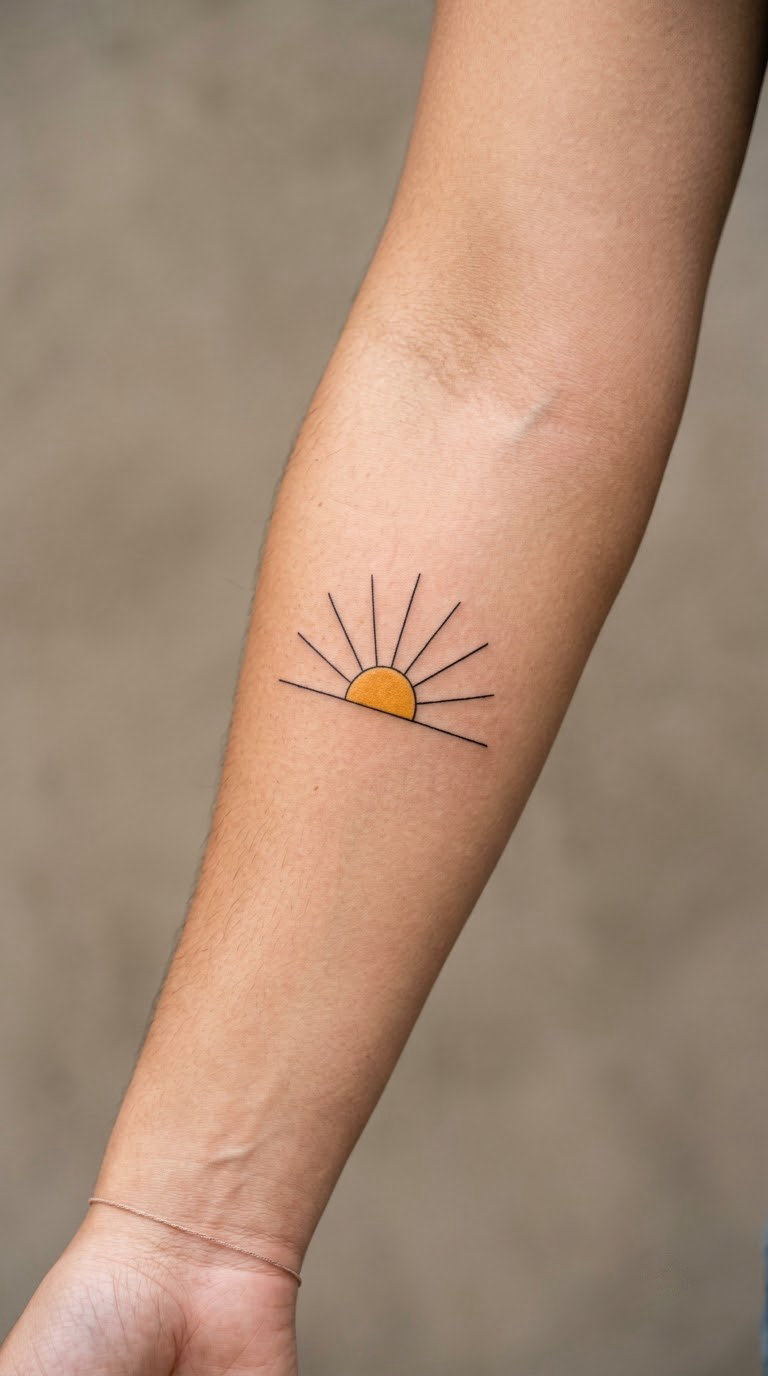
A rising sun built from delicate black linework: a half circle with long open rays, each one a single tapered stroke rather than a filled shape. Most people add one golden-yellow wash behind the rays, though a pure black version holds up just as well.
Plenty of people pick this as a visual cue to welcome optimism rather than to chase constant happiness. There is no single agreed meaning, and that freedom is part of why it works as a first tattoo.
Placement: inner forearm, outer forearm or just above the elbow. Size: 2 inches (5 cm) wide, 1.5 to 2 inches (4 to 5 cm) tall. Style: fine line, single-needle. Pain: low on the forearm; the inner wrist side is more sensitive. Fine lines on fingers and hands wear down faster, so keep it on an area with stable ink. Make it yours: add a small date beneath the rays, or pick a sun colour that matches something you already own.
Choosing a Choose Joy Tattoo at the Right Scale
Scale is where most first tattoos succeed or quietly fail. Tiny lettering, thin outlines and anything built from dots need a minimum of about 1 inch (2.5 cm) of width or the lines close up when the tattoo settles. A design drawn at two inches (5 cm) and then reduced to half size will not survive healing. When you are browsing choose joy tattoo ideas, check the stated size against the body area rather than against the picture. Icon-based pieces scale up comfortably, script scales up a lot, and anything with a face needs more room than its reference image suggests.
2. Handwritten Choose Joy Phrase
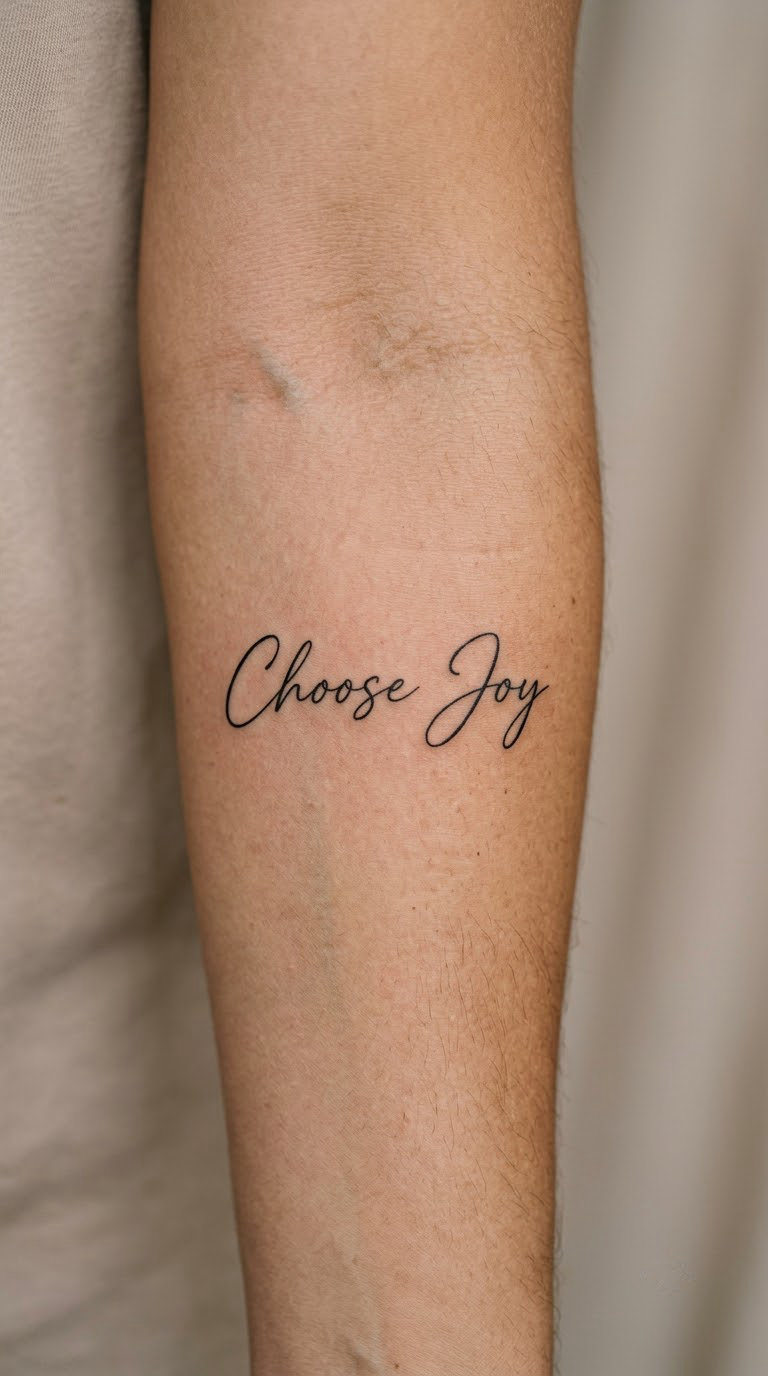
The phrase set in flowing black script, with careful negative space between the two words and a long exit stroke off the final letter. It reads as a personal affirmation rather than a slogan, and the looseness of the handwriting is what makes it feel like yours rather than a font pulled off a template.
The forearm, the wrist and the space between the ribs are the three placements people ask about most. The forearm gives the script a straight run; the ribs let it follow the curve of the body; the wrist keeps it private.
Placement: inner forearm, inner wrist or along the ribs. Size: 2.5 to 3.5 inches (6.5 to 9 cm) wide. Style: hand-lettered script. Pain: medium on the forearm and low-to-medium on the ribs; script takes time because line work is constant. Make it yours: add the date you decided to live differently, or copy the handwriting style of someone you have always admired.
3. Grinning Sun in Retro Linework
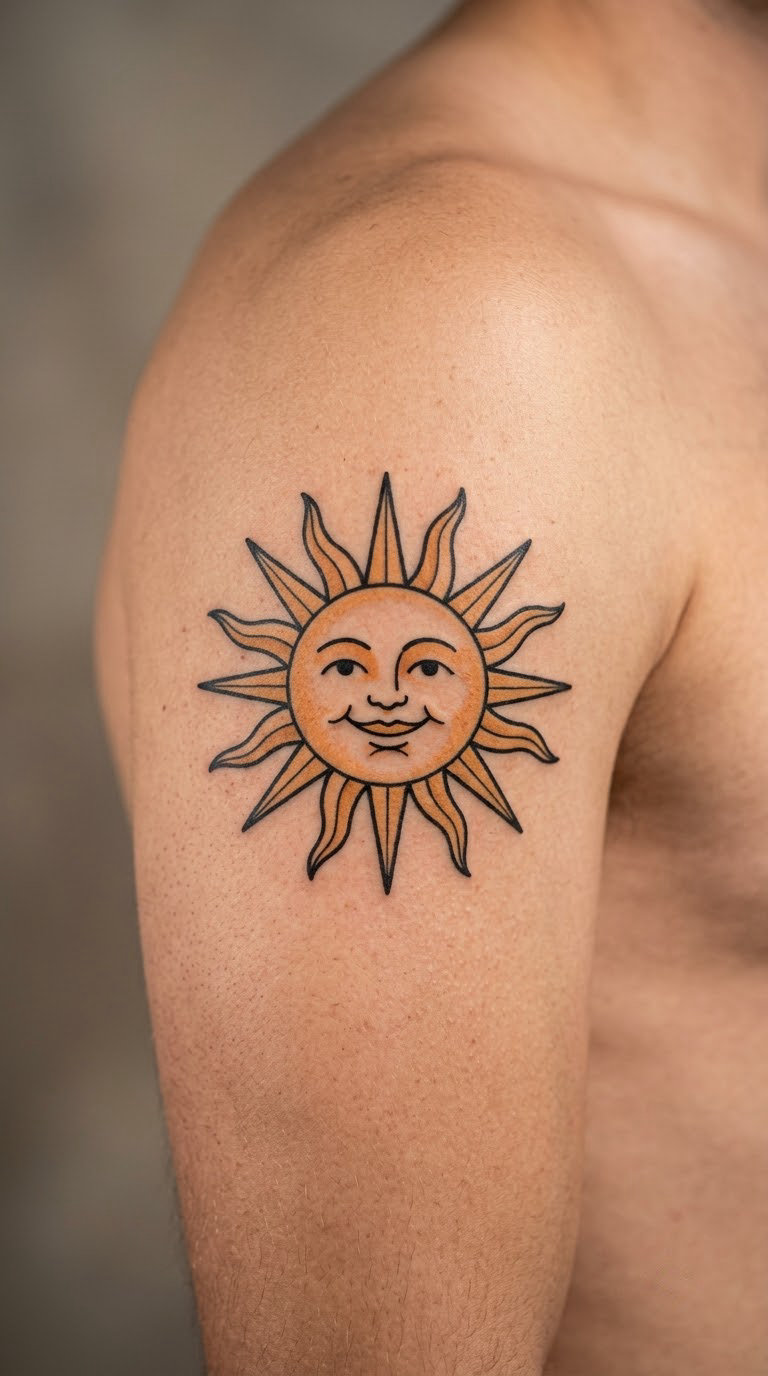
A cheerful sun with a simple curved smile, a bold black outline and restrained retro shading in either black or a single warm colour. Old-school American tattoo books used faces like this constantly, which is why it reads as vintage rather than as a trend that arrived last season.
It gets picked for its upbeat character. The joke is doing most of the work, and nobody is relying on a symbol dictionary to explain it.
Placement: calf, upper arm or shoulder. Size: 3 to 3.5 inches (7.5 to 9 cm) across. Style: traditional or neo-traditional. Pain: medium; the upper arm is a forgiving area, the calf feels more at the end of a long sitting. Make it yours: shift the shading to a single colour you actually wear, or add a thin banner of text underneath. Small faces soften with age, so keep the eyes simple and open.
4. Laughing Buddha in Soft Watercolor
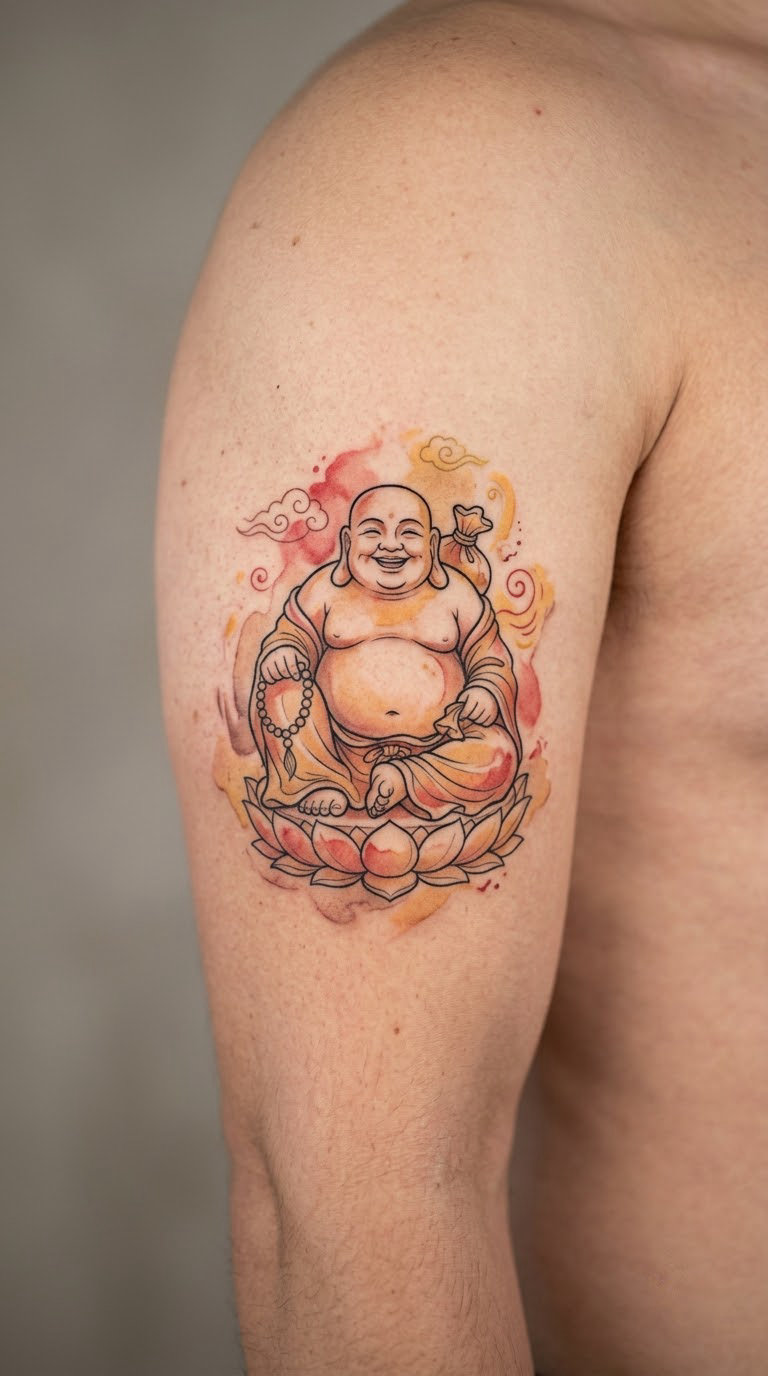
A compact laughing Buddha figure with loose watercolour edges, warm red and ochre washes, and enough dark detail through the face and robe to hold the figure together. The bleed in the colour is intentional, so a small gap in the wash reads as part of the style rather than as a mistake.
People usually choose it for the expression, the wide belly and the closed-eye laugh. It carries Buddhist imagery, so a conversation with an artist who works in that tradition is worth having before the stencil goes on.
Placement: upper arm, outer calf or the back of the shoulder. Size: 3.5 to 4.5 inches (9 to 11 cm) tall. Style: watercolour. Pain: medium; broad colour passes cover a lot of skin in a short time. Make it yours: request a specific wash palette, or have the robe hem trimmed to follow the shape of the arm rather than sitting flat.
5. Tiny Rainbow Arc
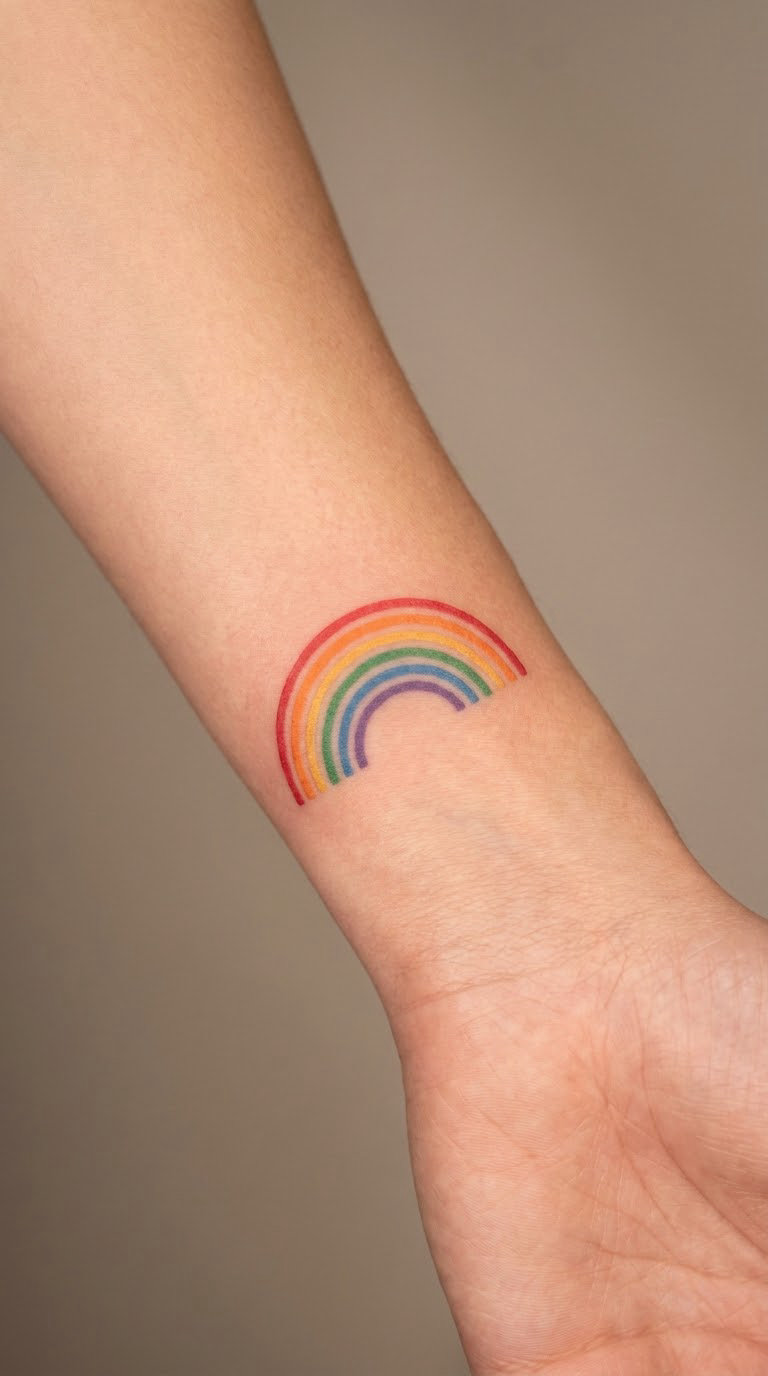
A small arc made from six clean bands, filled in colour or reduced to a black-and-grey gradient. The bands are equal width with a flat top edge, which is what keeps it reading as a rainbow instead of a smear.
Rainbows carry a happiness association in almost every culture, so this is a visual choice rather than a design with one accepted meaning. It suits people who want the sentiment without the words.
Placement: outer wrist, ankle or collarbone. Size: 1.5 to 2 inches (4 to 5 cm) wide. Style: fine line or colour pop. Pain: medium on the wrist because of the bone proximity, low at the collarbone. Make it yours: order the colour sequence to match a birth-month flower palette, or ask for a two-tone version if you need the tattoo to stay discreet for work.
6. Dandelion Seeds Turning Into Birds
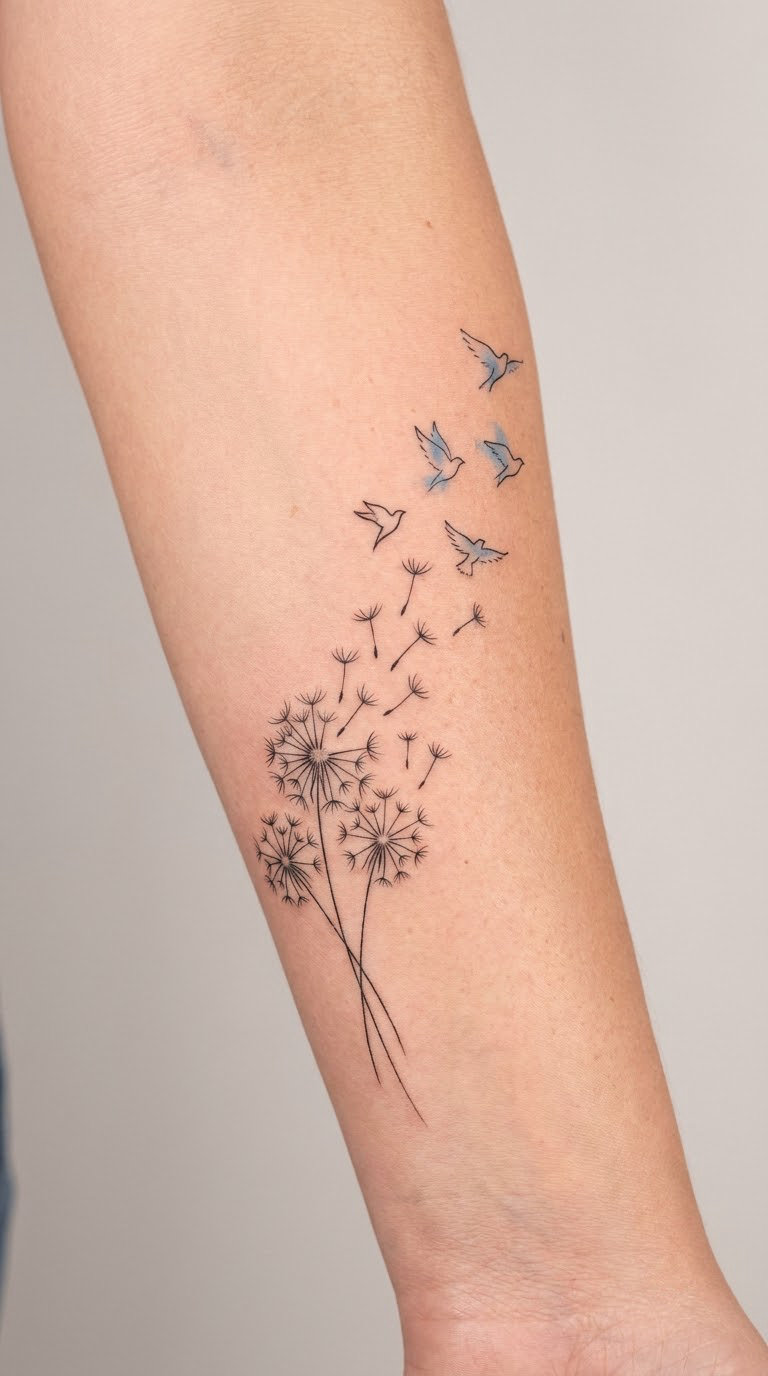
A dandelion head on the left, its seeds loosening on the right and becoming three or four small birds in flight. Black fine line does most of the work, with an optional pale-blue wash on the birds alone so the eye follows the movement.
People often choose the transformation for what it suggests about possibility and letting go. It is a reading the wearer brings to it, not a fixed translation.
Placement: forearm, shoulder blade or behind the ear. Size: 2.5 to 3.5 inches (6.5 to 9 cm) wide. Style: fine line with light watercolour. Pain: low on the forearm and shoulder blade. The seeds and beaks are the parts most likely to blur together after a decade, so ask the artist to widen them slightly. Make it yours: ask for a specific bird species, or add one extra seed drifting back toward the flower for a fuller composition.
7. Bouquet of Joyful Wildflowers
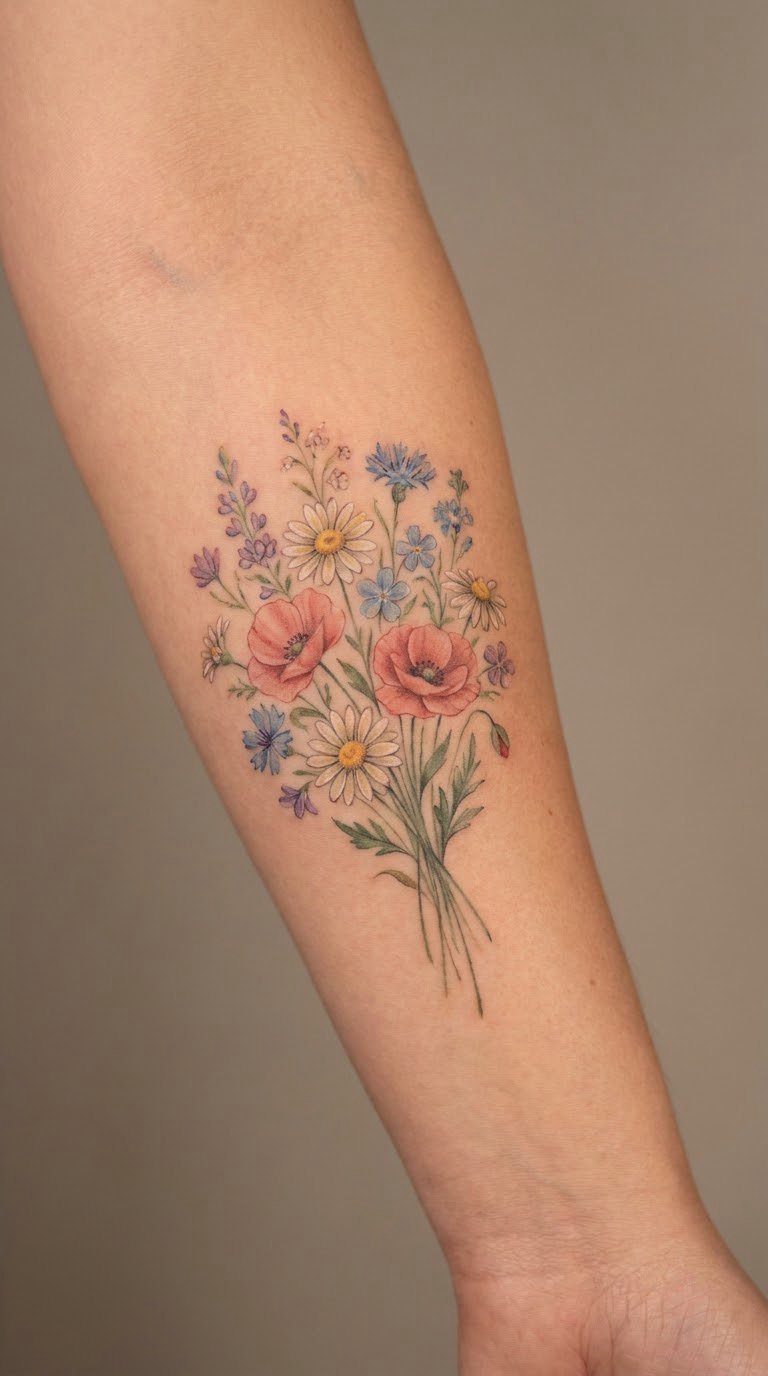
Three or four flowers tied loosely, mostly daisies and poppies, with small leaves and a few wandering stems that stop short of neat. Soft colour or loose black-and-grey shading both work, and the slightly untidy outline is what gives it movement.
It appeals to collectors who want botanical work but not a formal arrangement. The liveliness of the composition is the reason, more than any symbolic reading.
Placement: outer forearm, thigh or along the ribs. Size: 3.5 to 4.5 inches (9 to 11 cm) tall for three blooms; more if you add stems. Style: colour realism or loose black-and-grey. Pain: medium; the ribs sting more than the thigh. Fine petal detail softens over time, so a bolder petal edge is more durable. Make it yours: work your birth-month flower into the bunch, or add a small ribbon at the stems.
8. Joy Word in Bubble Lettering
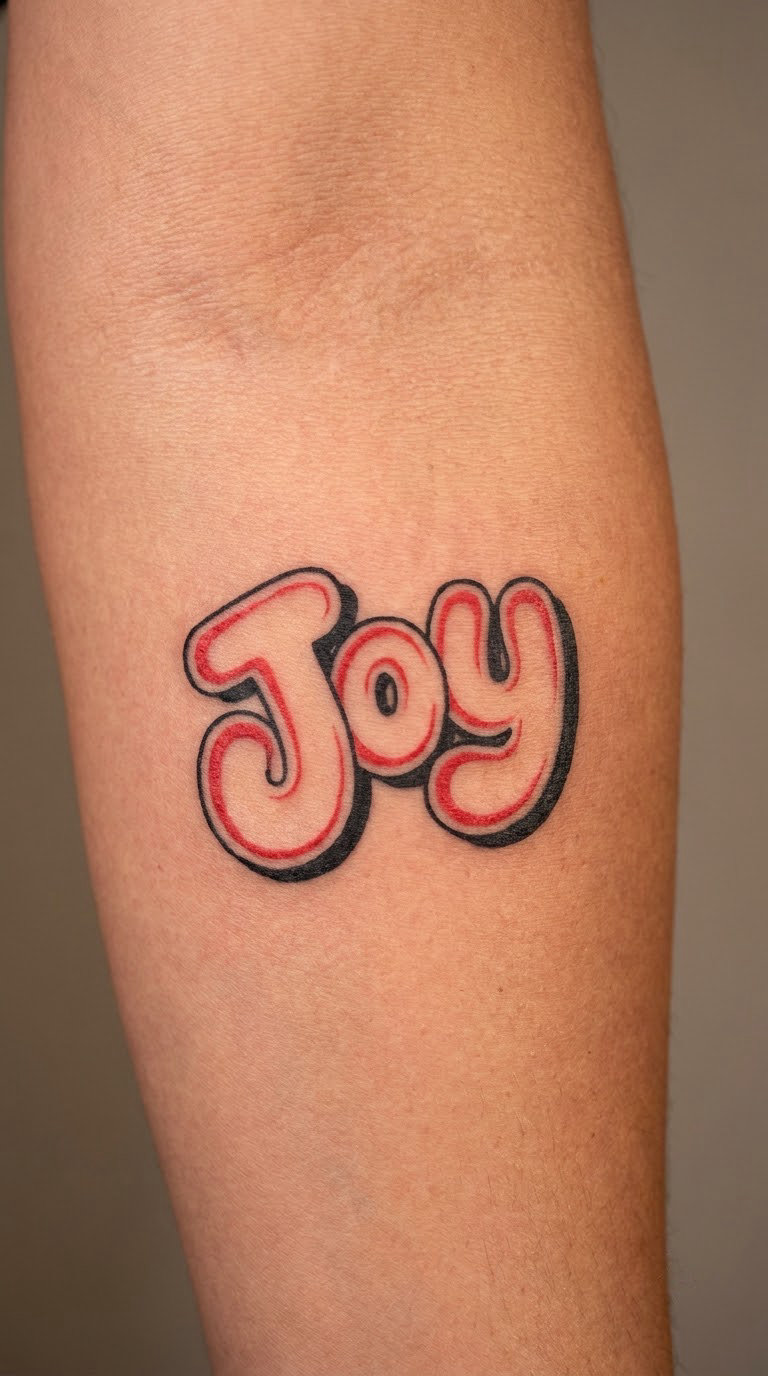
A single word set in rounded retro bubble letters, with thick black outlines, strong negative space inside the counters and a limited palette. One shadow colour behind the letter faces is enough; more colours and the word starts to lose its shape at a distance.
It is a direct statement, and the meaning comes entirely from the word you picked. That makes it a good choice if you like lettering but not script.
Placement: outer forearm, calf or shoulder. Size: 2.5 to 3.5 inches (6.5 to 9 cm) wide. Style: traditional or neo-traditional bubble lettering. Pain: medium; bold fills cover skin quickly but take passes. Make it yours: pick a shadow colour that matches a birthstone, or place a small initial behind the letter for a matching pair with a friend.
9. Spinning Globe With Confetti
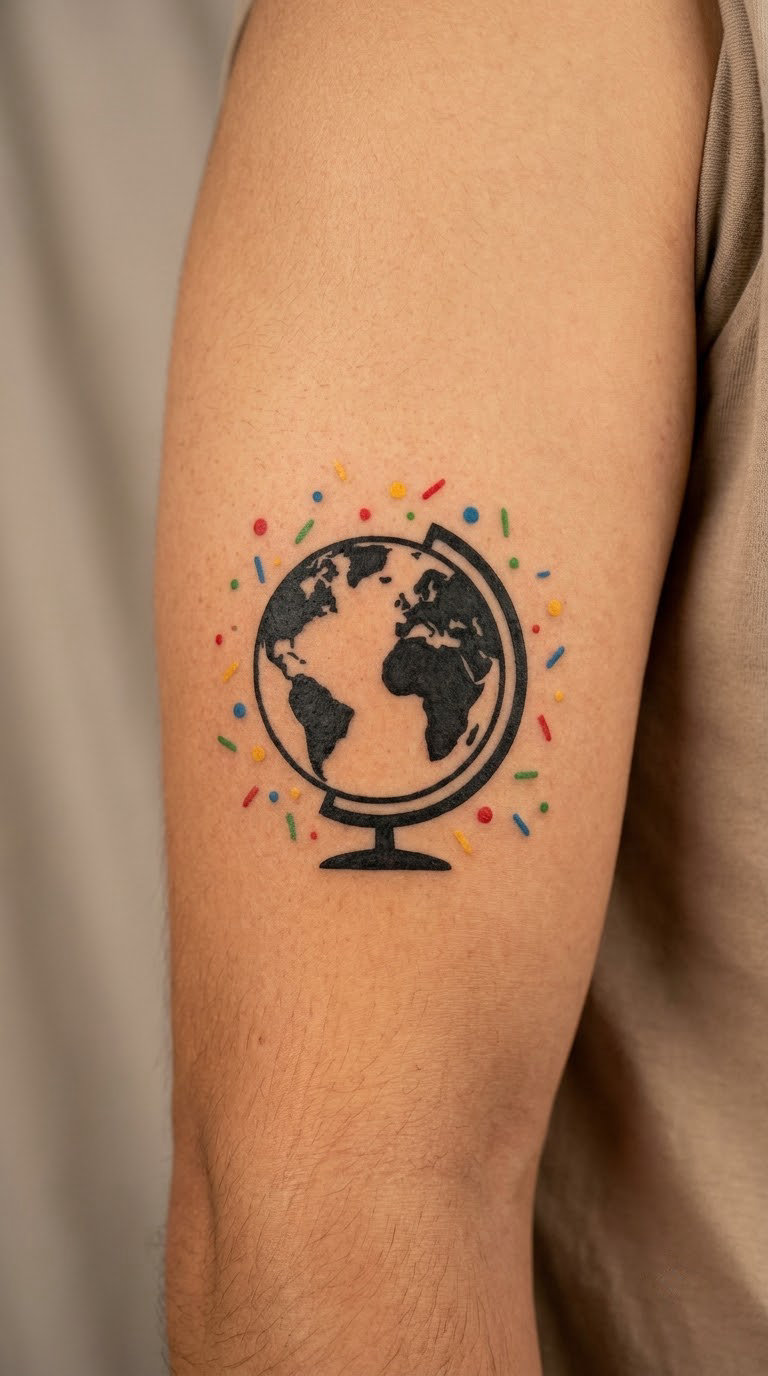
A globe drawn with a black outline, a few curved meridian lines and no shading, ringed by small geometric confetti marks in several bright colours. The scatter of marks is what stops the piece feeling like a geography lesson.
It reads as a celebration of being alive and getting out into the world, not as a fixed emblem with a dictionary entry.
Placement: upper arm, ribs or calf. Size: 3 to 3.5 inches (7.5 to 9 cm) tall including the confetti. Style: illustrative, bold line. Pain: medium; rib placement runs into a longer sitting. Make it yours: use the colours of a country you have actually visited, or ask for a small coordinate pair tucked under the globe.
10. Smiling Face With a Flower Crown
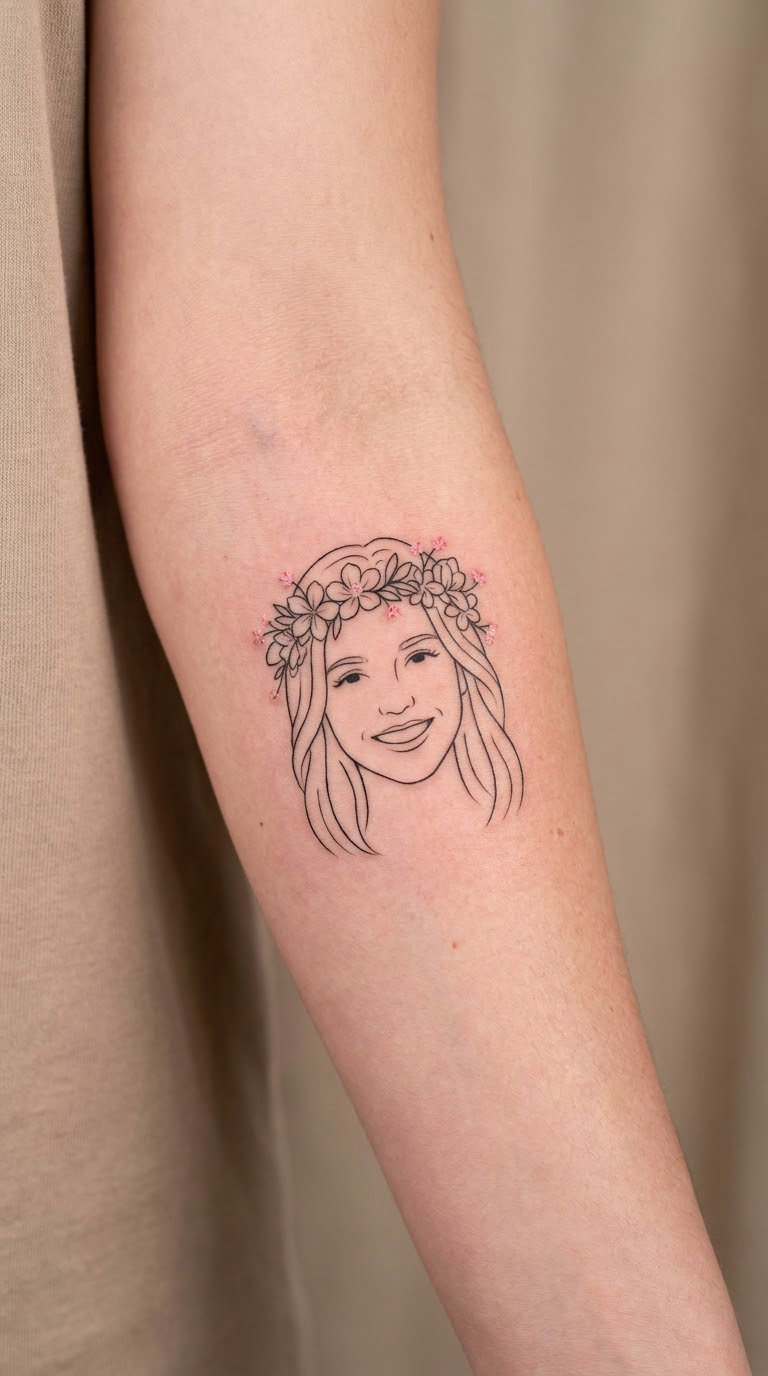
A single continuous line that loops up into a smiling face wearing a small crown of flowers, with restrained colour on the petals and clear, uncomplicated features. Keep the eyes to two short marks and the mouth to one curve; anything more detailed will not survive the scale.
People like the friendly expression on it. There is no symbolism to decode, which is exactly the appeal for a first tattoo.
Placement: forearm, upper arm or ankle. Size: 2 to 2.5 inches (5 to 6.5 cm) wide. Style: continuous line with light colour. Pain: low. Facial features are the first thing to blur on a tattoo this size, so ask for slightly heavier line weight than looks right on paper. Make it yours: add your birth flowers to the crown, or simplify the whole thing to a black outline when you want it quieter.
11. Popcorn Heart
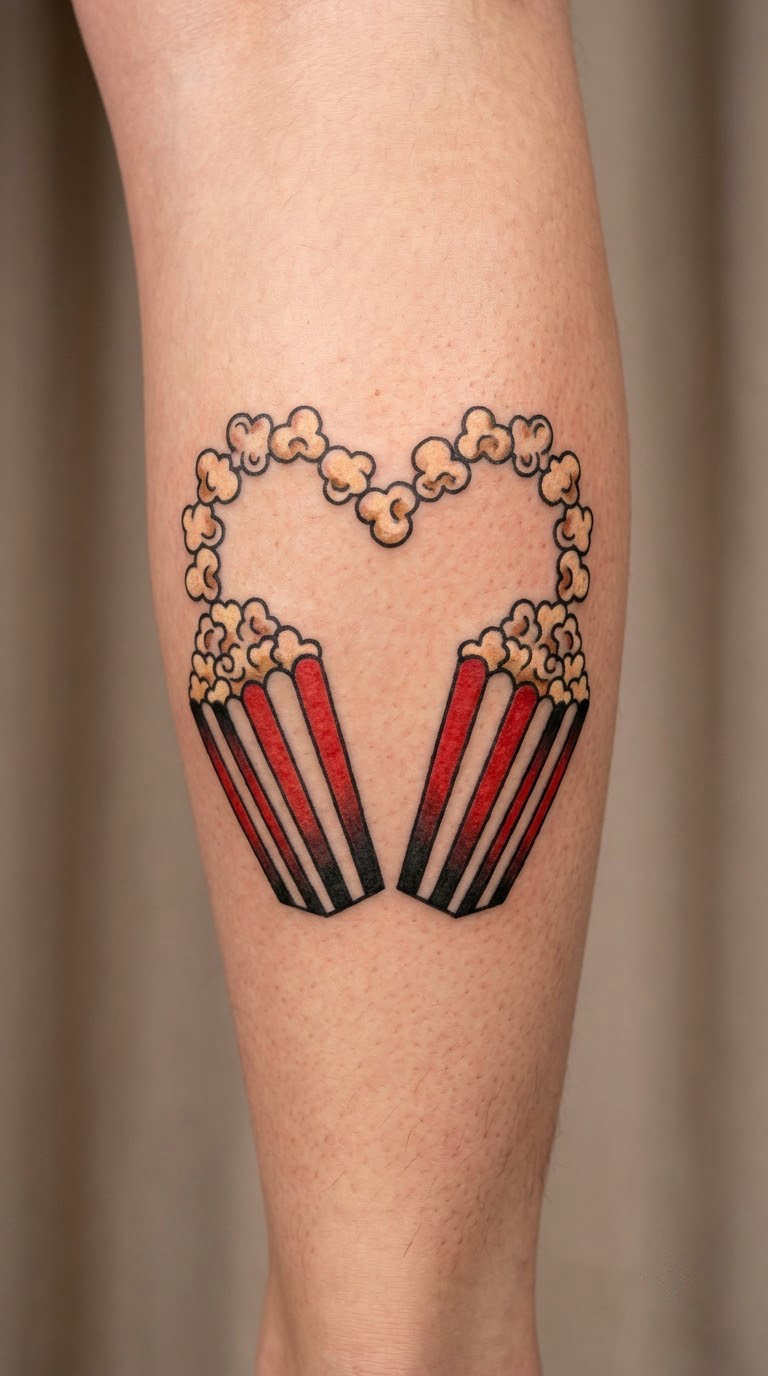
A heart built from two mirrored halves of a striped popcorn box, with a few kernels spilling out of the seam at the top. Bold red, black and cream keep it graphic, and the mirrored symmetry is what makes the shape read as a heart before it reads as a snack.
It is a pop-culture-flavoured image chosen for how cheerful it looks. Nothing about it commits you to a claim about relationships.
Placement: calf, thigh or upper arm. Size: 2.5 to 3 inches (6.5 to 7.5 cm) wide. Style: traditional. Pain: medium; the calf is fleshy but sensitive near the shin. Make it yours: use the colours of a specific cinema, or get it as a matching pair with a date underneath the bottom point.
12. Hot Air Balloon With Tiny Flag
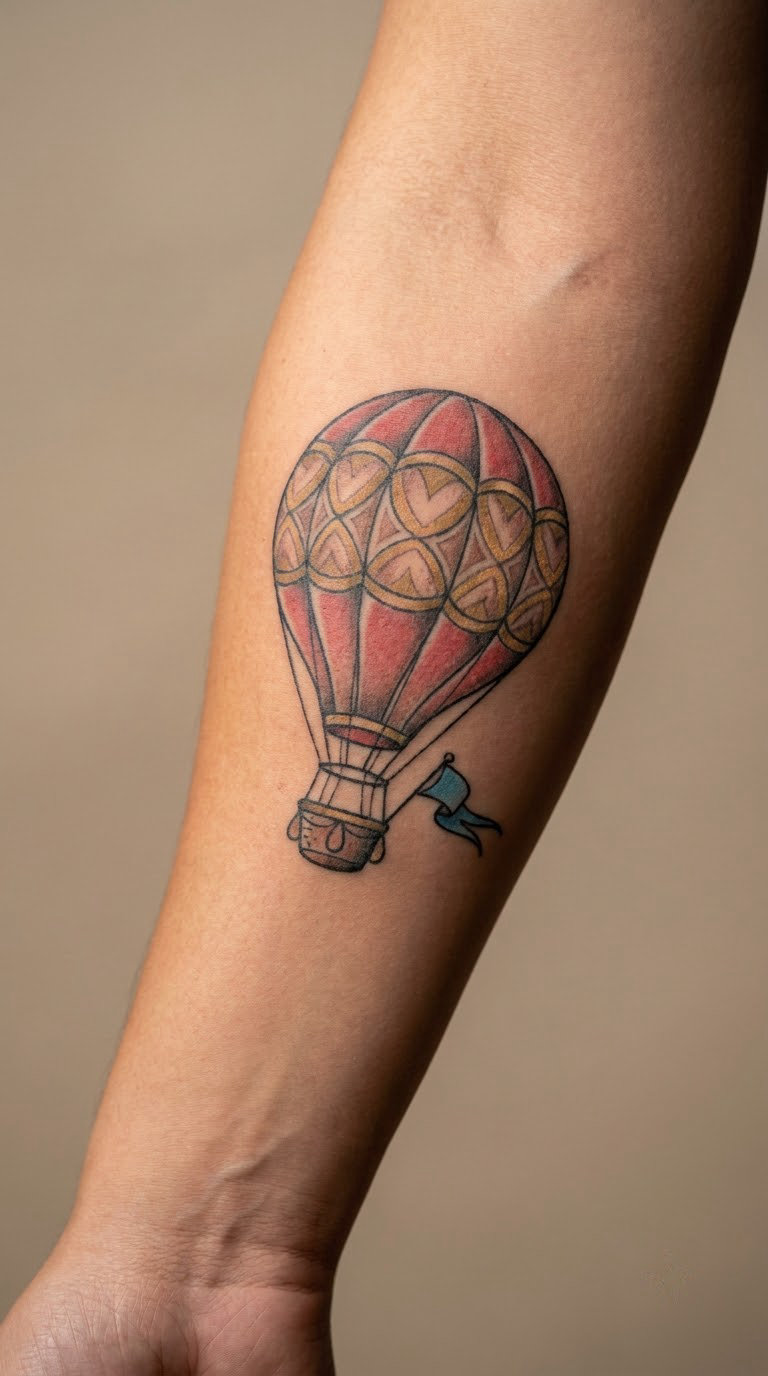
A vintage-inspired balloon with a rounded envelope, vertical panels, a small basket and one small pennant flying from the top. Black outlines with muted colour and restrained stippling in the shadow side give it an aged poster feel rather than a bright cartoon one.
The upward movement is the reason most people choose this composition. It feels celebratory without needing a message attached.
Placement: outer arm, upper arm or calf. Size: 3.5 to 4.5 inches (9 to 11 cm) tall including the flag. Style: neo-traditional or vintage illustrative. Pain: medium. The basket is the fiddly part, and stipple shading takes extra passes. Make it yours: set the pennant in the colours of a flag that matters to you, or tuck a latitude and longitude pair into the basket weave.
13. Dancing Figure in Blackwork
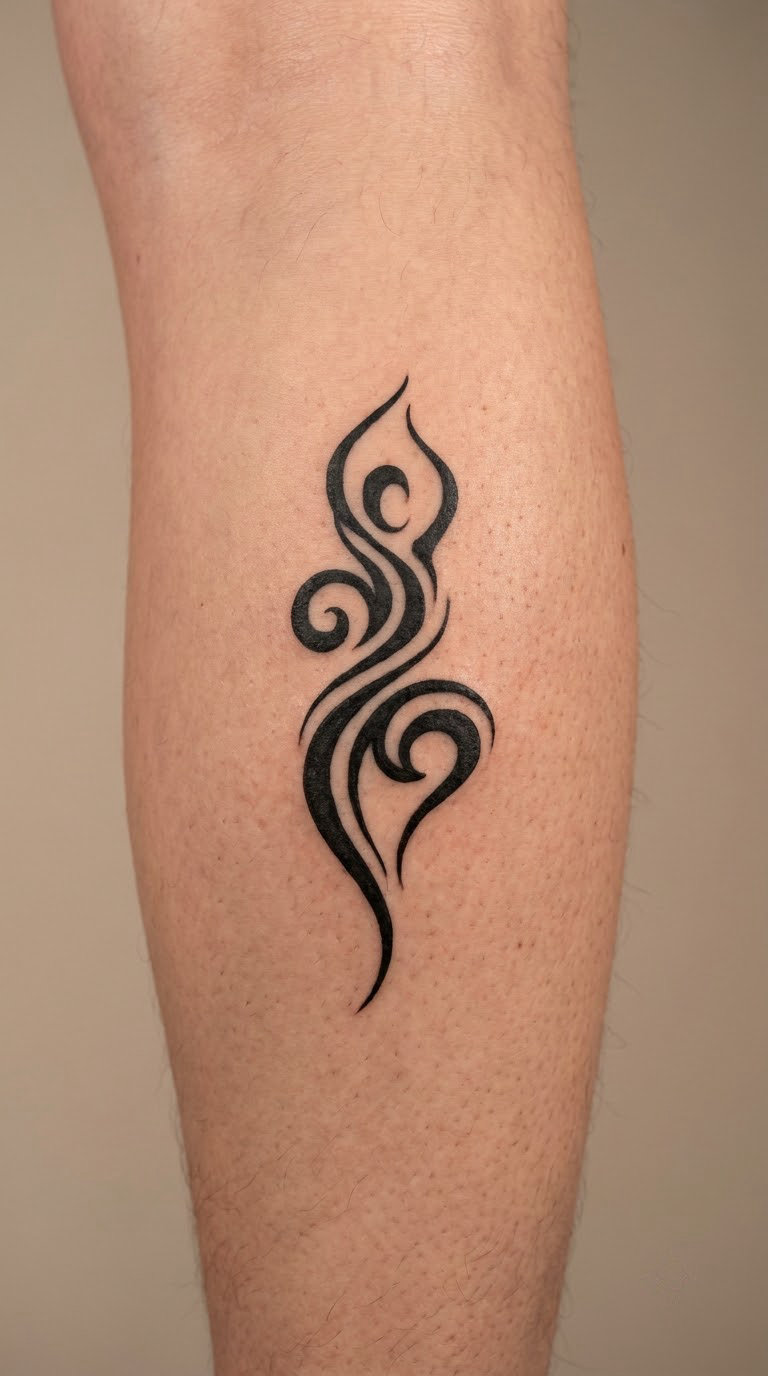
A single abstract figure built from confident black curves: an arched back, one raised arm and a skirt of a few thick strokes, with enough open space around the pose to keep it readable at small sizes. The gaps between the shapes matter as much as the lines.
People choose it for movement, for confidence, or to mark a good day they do not want to forget. It does not need a shared interpretation to work.
Placement: outer calf, thigh or upper arm. Size: 3.5 to 4.5 inches (9 to 11 cm) tall. Style: blackwork. Pain: medium; large black areas take a while and the sensation builds rather than spikes. Make it yours: have the pose adjusted to mirror a dance you did, or keep just the arm and shoulder curve if you want a smaller piece.
14. Cherry Pair With Leaf
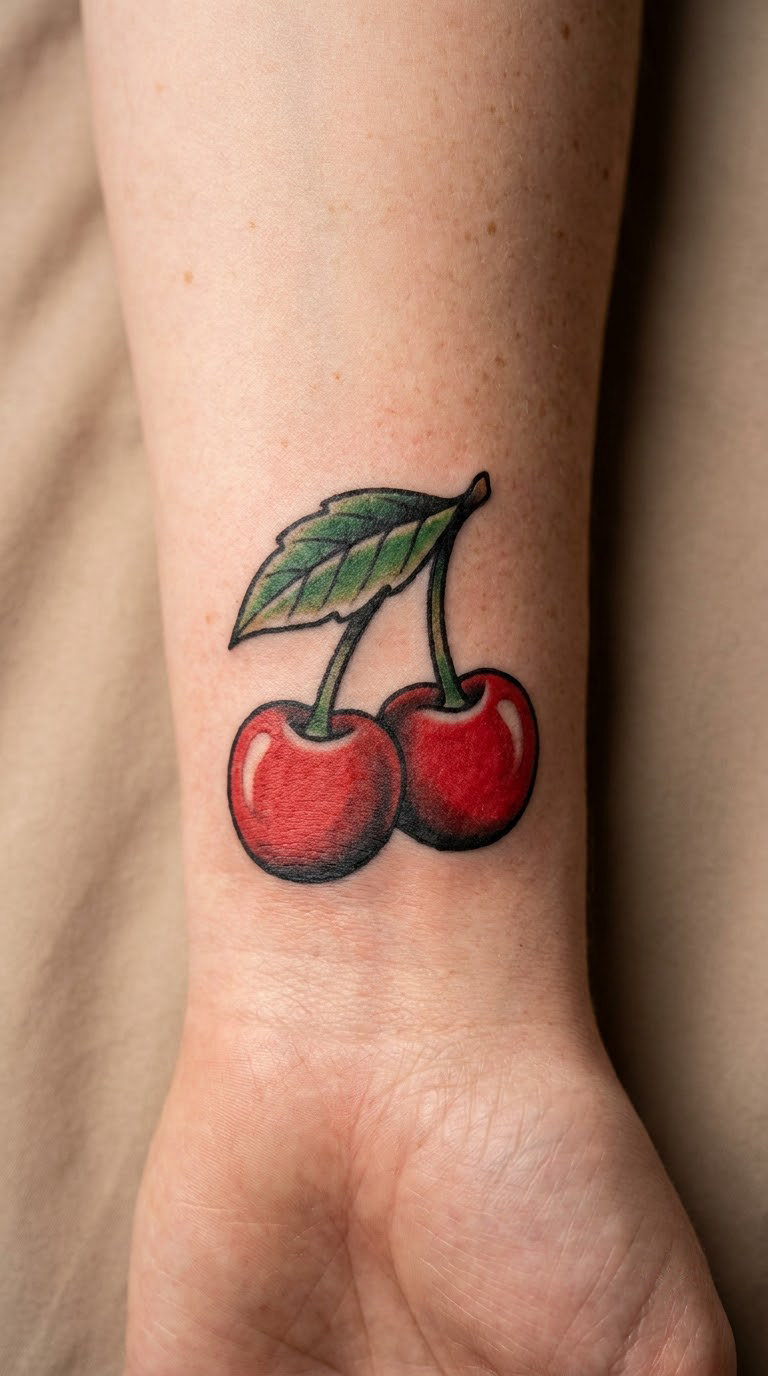
Two glossy cherries joined by one curved stem, with a single leaf and a highlight on each fruit. Traditional red and green is the classic version, and a black-and-grey realism take works just as well if you want it quieter.
The playful, graphic character is the draw. It is a cheerful image that happens to look like fruit, not a statement you have to defend.
Placement: inner wrist, forearm or ankle. Size: 2 to 2.5 inches (5 to 6.5 cm) wide. Style: traditional or micro-realism. Pain: medium on the inner wrist, low on the ankle. Make it yours: match the two cherries to a colour pair, or ask for the leaf to point in the direction of a place that matters.
15. Music Notes Escaping a Heart
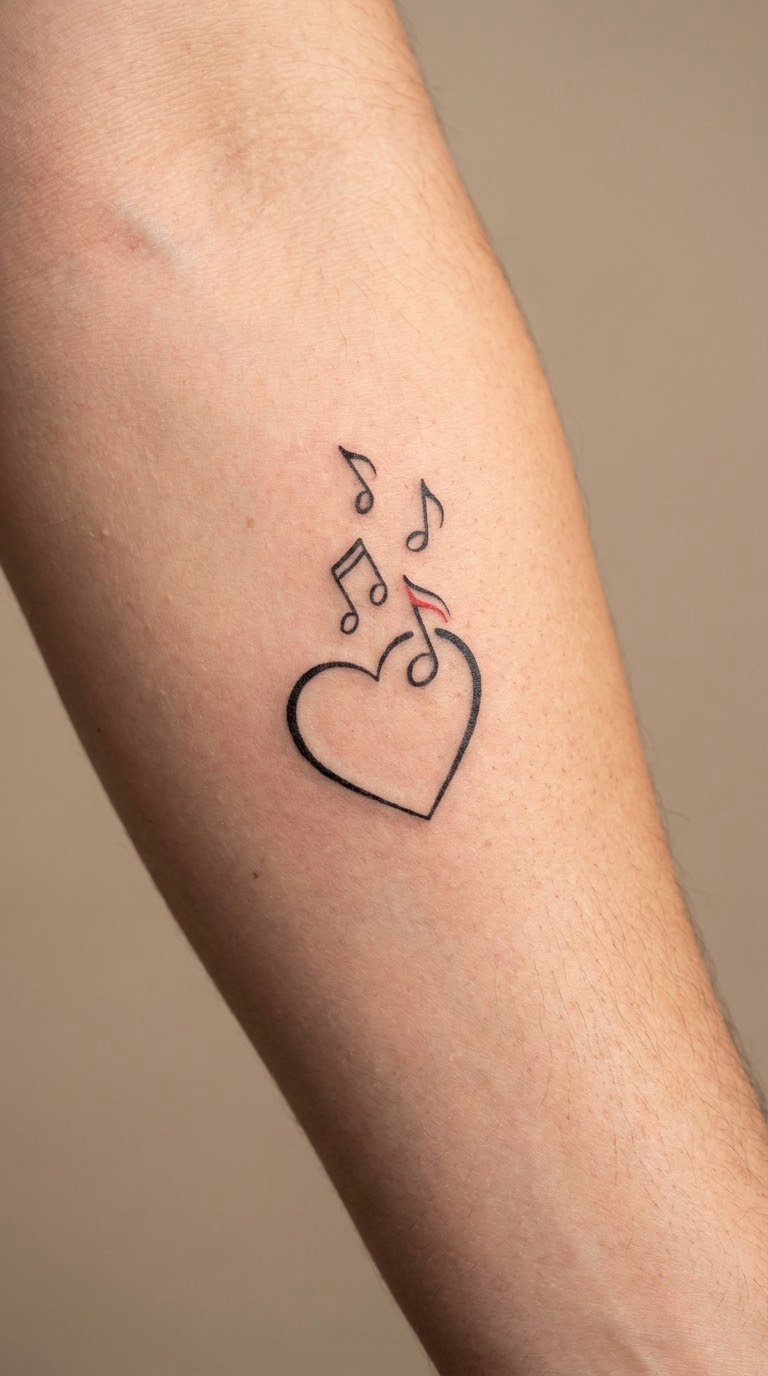
A simple heart outline with three or four notes lifting out of it in a loose upward curve, drawn in bold black line with one bright colour accent on the heart or the notes. Keeping the count low stops the composition turning into a musical score.
Some people pick it because music is where their happiness lives. The personal meaning stays open to whoever wears it.
Placement: forearm, rib or behind the ear. Size: 2 to 2.5 inches (5 to 6.5 cm) wide. Style: fine line with one colour accent. Pain: low on the forearm and behind the ear, medium on the ribs. Note heads and small flags blur over time, so ask for filled-in note heads. Make it yours: add the initials of a song or band that got you through something, or use the band colours in place of the accent.
16. Coffee Cup and Tiny Steam Heart
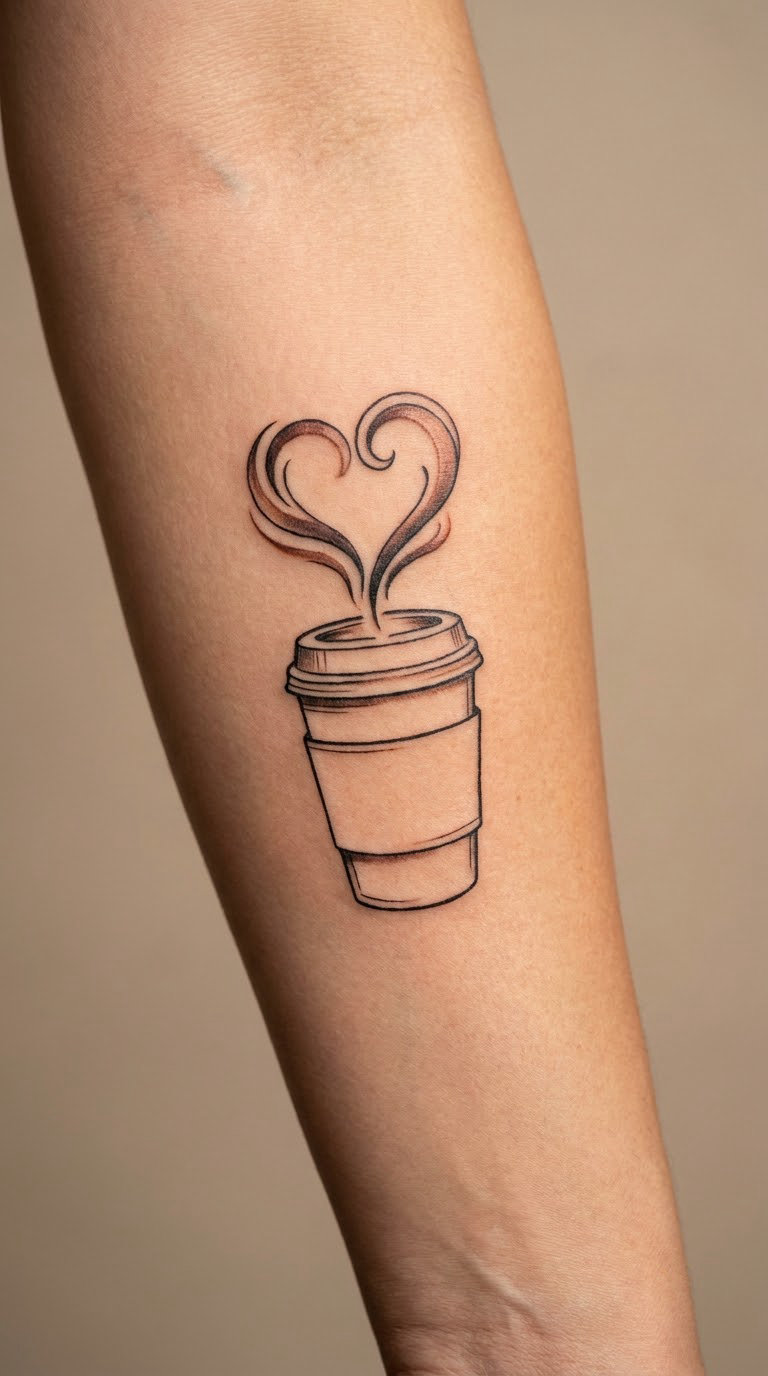
A takeaway cup with a sleeve, drawn in warm brown and black, and steam that curls upward and closes into a small heart at the top. The heart should be the same weight as the steam lines; making it larger unbalances the whole thing.
It often marks a daily ritual, or a person, a place or a morning connected with coffee. There is no single reading it has to match.
Placement: inner forearm, calf or the inside of the upper arm. Size: 2 to 2.5 inches (5 to 6.5 cm) tall. Style: illustrative with two inks. Pain: low. Make it yours: add the date of a first cup somewhere meaningful, or have the cup sleeve carry a band of colour tied to a favourite roast.
17. Shooting Star With a Smiling Face
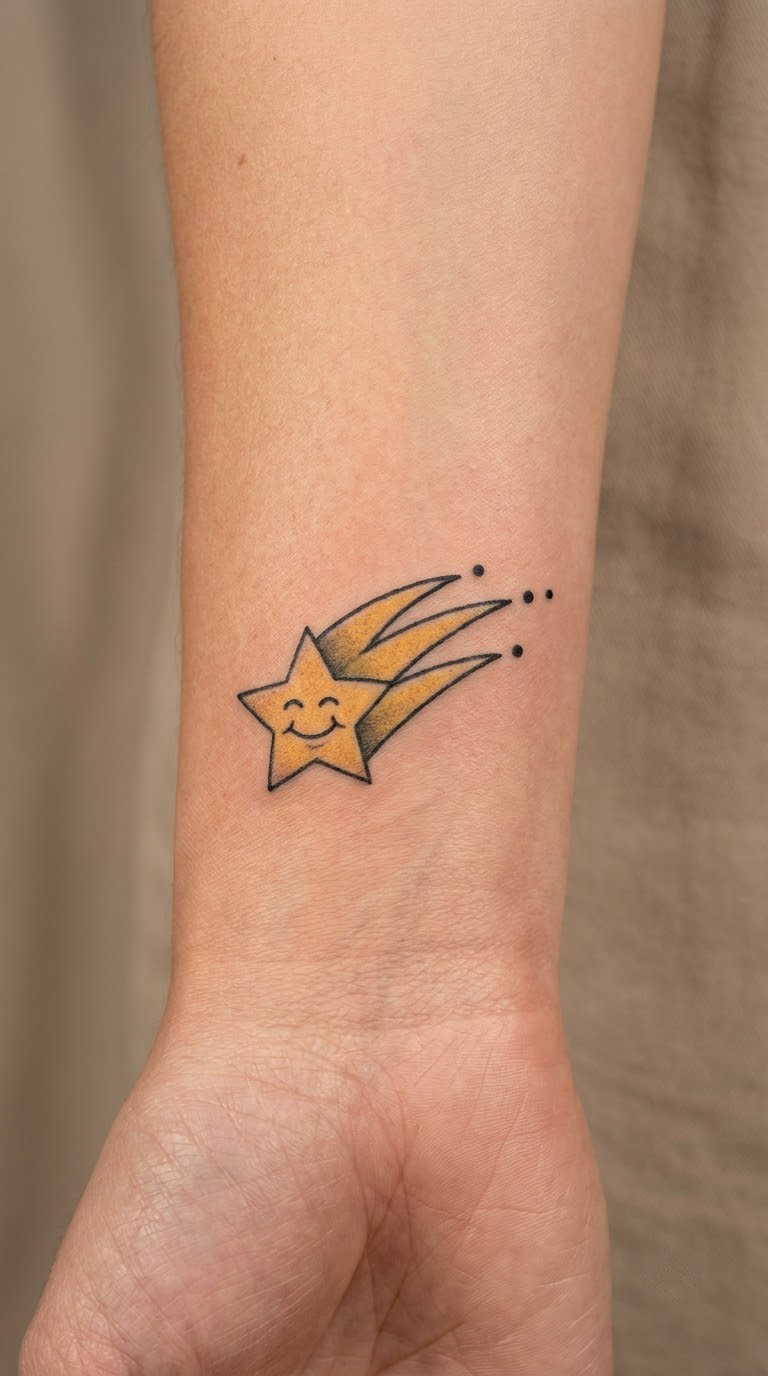
A five-point star with a tiny smiling face at its centre, retro yellow shading on the points and a short trail of three black dots behind it. It is deliberately lighthearted and small, which makes it an easy first piece.
There is no deeper symbolism to uncover here, though a wish, a lucky number or a date can give it personal relevance.
Placement: wrist, behind the ear or the ankle. Size: 1.5 to 2 inches (4 to 5 cm) wide. Style: retro traditional. Pain: medium on the wrist, low behind the ear. The face is the part that fades first, so keep the eyes and mouth to short marks. Make it yours: change the trail to three stars instead of dots, or set the yellow to a shade that matches your birthstone.
18. Hand-Painted Rainbow Wave
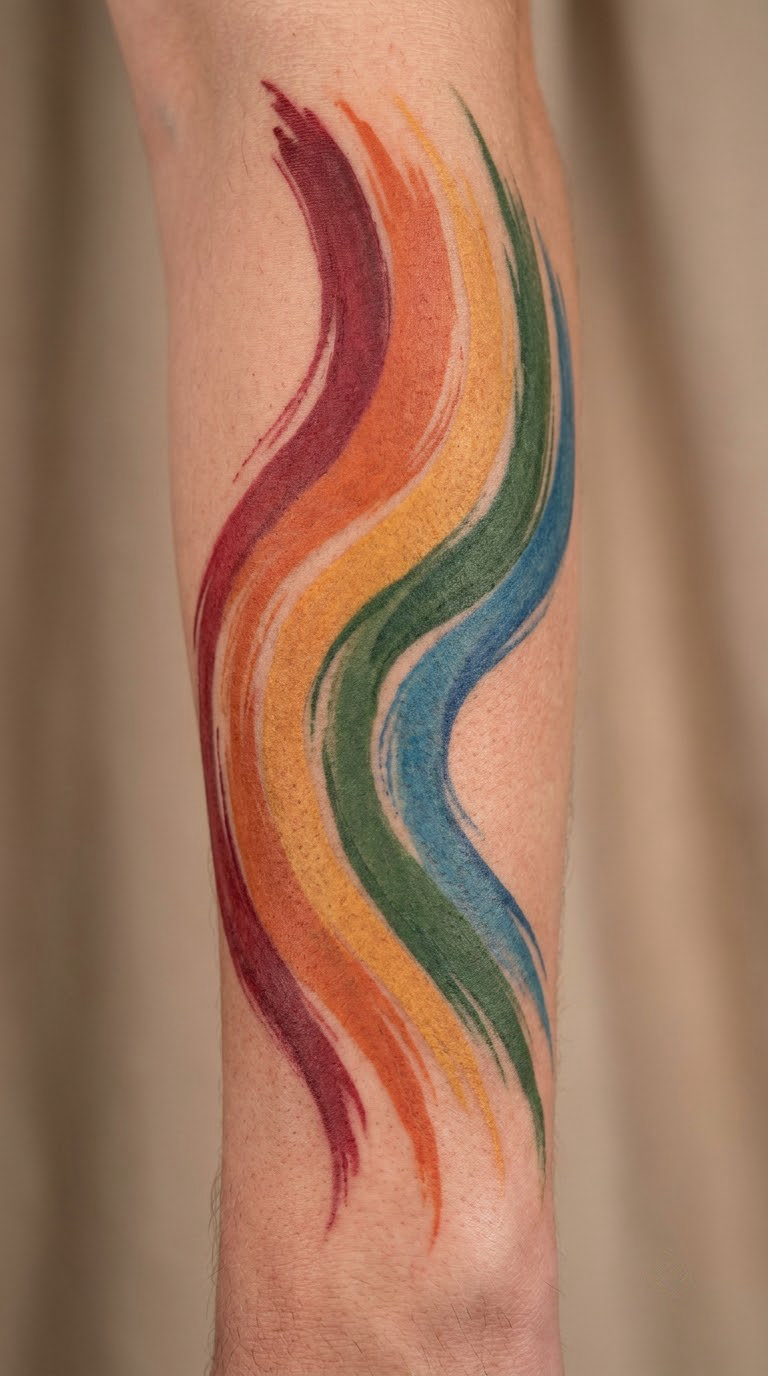
A flowing wave in broad red, orange, yellow, green and blue bands, painted loosely with an unfinished edge on one side so it looks brushed rather than printed. The wave rolls along the forearm instead of sitting as a flat block of colour.
Some people read it as optimism, others as a decision they made for themselves. Both readings work without anyone having to be right.
Placement: forearm, ribs or calf. Size: 4.5 to 5.5 inches (11.5 to 14 cm) wide. Style: illustrative watercolour. Pain: medium; broad colour passes cover ground steadily, and forearm work runs toward the end of a sitting. Make it yours: hand the artist your own palette so the wave uses your colours, or place a matching wave on the other arm.
19. Painted Party Bunting
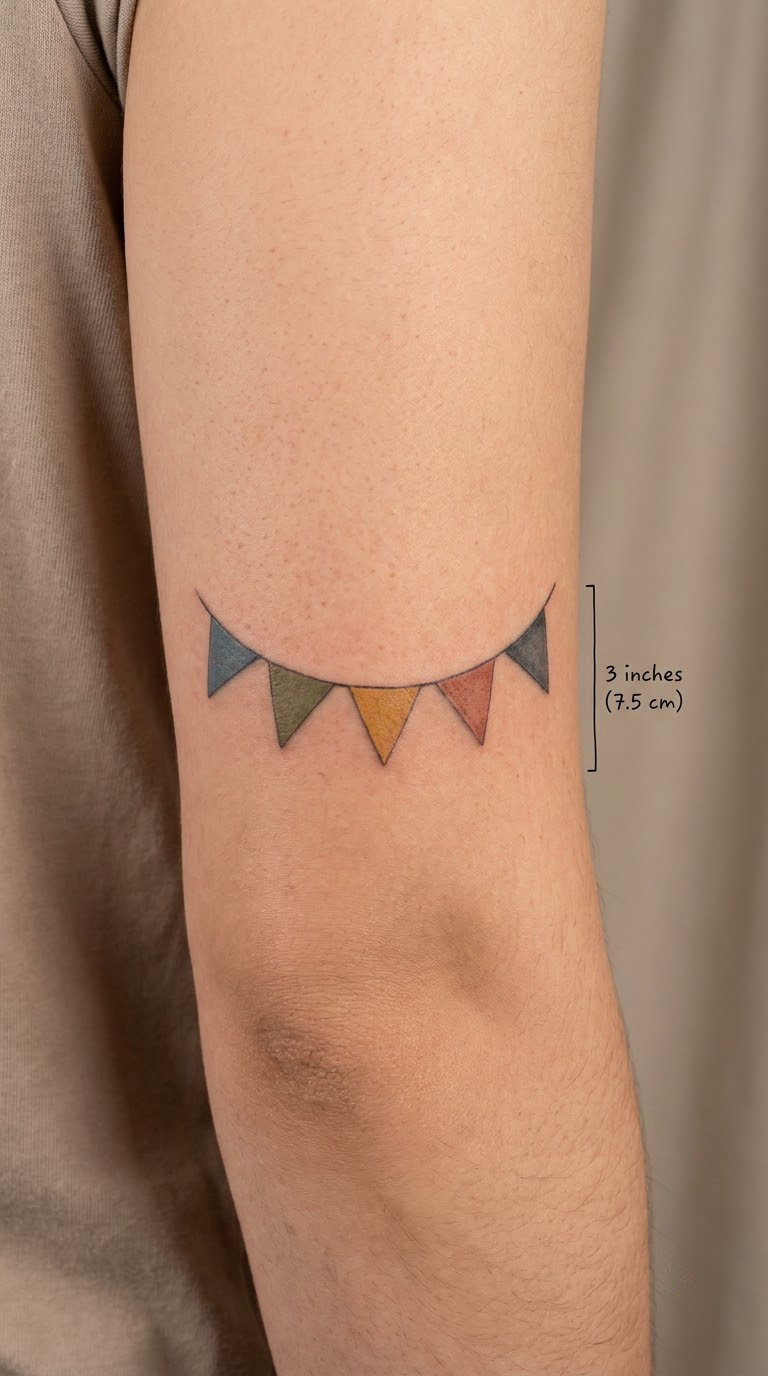
A short string of triangular flags curving gently across the skin, alternating muted colours with a bit of brush texture along the string. Five flags is the sweet spot; more turns it into a pattern and the curve flattens out.
People choose it for a celebration, for a thank-you, or just because the composition looks festive at a glance.
Placement: above the elbow, upper arm or across the shoulder. Size: 2.5 to 3.5 inches (6.5 to 9 cm) wide. Style: illustrative or neo-traditional. Pain: low; a shallow curve on a fleshy part of the arm is an easy sitting. Make it yours: use the colours of an event you are marking, or add a single small charm at the end of the string.
20. Minimalist Figure Holding a Star
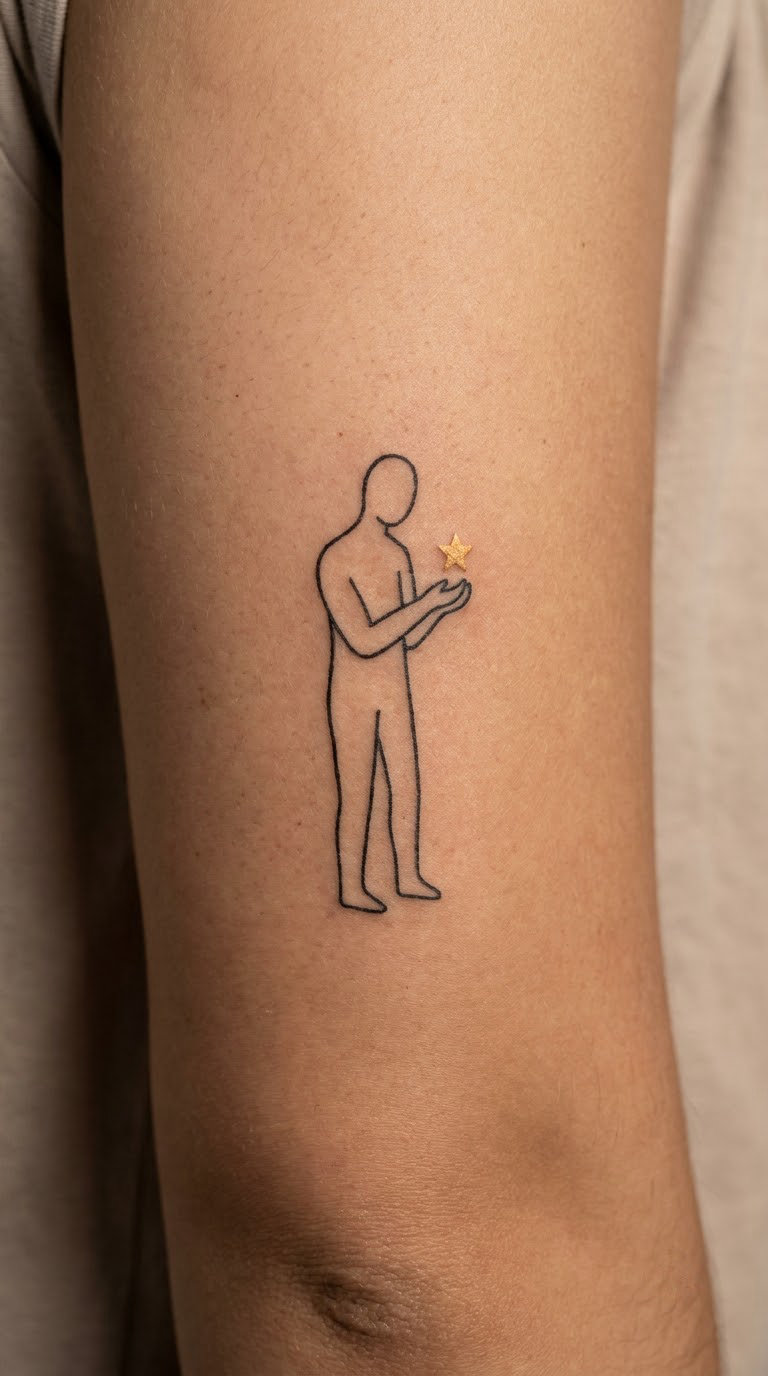
A simplified human figure with warm black linework, one arm reaching up to hold a small five-point star, and a single gold accent filling the star. Keep the body to simple shapes: head circle, torso line, two limb lines. That restraint is what lets it hold together at small sizes.
It can carry a memory, an aspiration or a person, without leaning on a fixed tattoo dictionary for its meaning.
Placement: upper arm, calf or the back of the hand. Size: 3 to 3.5 inches (7.5 to 9 cm) tall. Style: fine line with one accent colour. Pain: low on the arm and calf, medium on the back of the hand because the skin moves constantly there. Make it yours: use a meaningful colour for the star, or have the figure hold a tiny matching star in a second piece somewhere else.
How to Choose the Right Design
The best choose joy tattoo ideas are the ones whose scale and contrast suit the body area you have picked. Work through these five points before you book anything.
- Style first. Decide whether you want script, fine line, blackwork or colour before you start picking images. It narrows the search faster than browsing everything.
- Read it from across the room. Squint at the design at final size. If you cannot make out the main shape, the detail is too fine and will blur.
- Match size to placement. Anything on a flat surface like the outer forearm or calf supports more detail than a wrist, rib or finger.
- Think about the next twenty years. A 1 inch (2.5 cm) design on an inner wrist is visible every time you reach for something and will soften faster than the same design on the upper arm.
- Ask for a custom sketch. Request a drawing at the exact size and on the exact body area instead of asking an artist to copy saved art. Scaling is where most disappointing tattoos come from.
If a design is a strong personal statement, it may also be worth testing with a temporary or press-on version first. Wearing it for a week shows you how it sits with your work, your family and your posture before the ink is permanent.
Cost and Session Time
Tattoo pricing in the US depends far more on the artist and the shop minimum than on the design itself. What follows is a relative guide, not a price list. Check the current rate directly with the studio before you commit.
| Size | Typical cost band | Session time | Notes |
|---|---|---|---|
| Tiny (under 1 inch) | Low | 10 to 20 minutes | Often covered by the shop minimum rather than billed per hour |
| Small (1 to 2 inches) | Low to moderate | 30 to 60 minutes | Most first-timer designs sit here; shop minimums commonly apply |
| Medium (2 to 4 inches) | Moderate | 1 to 2 hours | Colour and watercolour push this toward the longer end |
| Larger (4 inches and up) | Moderate to high | 2 to 4 hours, sometimes split | Large pieces are usually quoted per project rather than per hour |
Artists quote either an hourly rate or a flat price for a design, and plenty of shops set a minimum charge that a tiny tattoo still has to meet. Colour complexity adds passes and therefore time, and a fully custom drawing adds design time before the first hour of tattooing starts. Travel costs money too, and a well-known or award-winning artist is priced differently from one early in their career. None of this is fixed, so treat any figure you hear as a starting point and get a quote for your specific design.
Aftercare Basics
- Follow your artist’s aftercare instructions first. Whatever your tattooer tells you on the day outranks anything written on a website, including this list.
- Wash gently. Clean with lukewarm water and a mild, unscented soap, then rinse off residue and pat the area dry with a clean towel. Do not scrub.
- Protect the area. Keep it away from direct sun while it heals, and choose loose clothing over anything that rubs against fresh ink.
- Let it rest. Skip swimming pools, hot tubs and saunas until your artist says the tattoo has settled. Most studios give you a clear timeline at the end of the appointment.
- Do not add products on your own. Lotions, powders and ointments are personal choices, and the wrong one can clog the ink. If you want something, ask your artist first.
If anything about the tattoo looks unexpected during healing, call the studio rather than searching for advice. They would much rather hear from you early.
Frequently Asked Questions
What is the meaning of a Choose Joy tattoo?
A Choose Joy tattoo carries whatever meaning the wearer gives it, since the phrase has no single official tattoo meaning. It is most often chosen as an affirmation: a daily reminder to actively pick optimism rather than wait to feel happy. The wording is widely traced to the theologian Henri Nouwen, who wrote that joy does not simply happen to us and has to be chosen again each day. People also choose it after a hard period such as illness, loss or burnout.
Are Choose Joy tattoo ideas suitable for a first tattoo?
Yes, and several of the designs here are built specifically with first-timers in mind. The fine-line sun, the small rainbow arc and the shooting star all work at 1.5 to 2.5 inches (4 to 6.5 cm), which keeps line weight strong and the sitting short. Pick something with a clear silhouette rather than fine interior detail, and ask your artist to draw it at the exact size you want it tattooed. That single step prevents most first-tattoo disappointments.
What size should a small joy-themed tattoo be?
For a symbol or icon-based design, 1.5 to 2.5 inches (4 to 6.5 cm) is a realistic minimum that keeps detail readable. Script and lettering need more room, usually 3 inches (7.5 cm) wide for two short words, and more if the lettering is thin. Anything with a face needs room above and below it. The most common mistake is picking a reference image and shrinking it, so ask for the design to be drawn at final size on your body before the stencil goes on.
Where is the least painful placement for a fine-line joy design?
The outer forearm, the upper arm and the calf are the easiest places to sit through, mostly because there is soft tissue and little bone nearby. The outer wrist and the collarbone are moderate, while the inner wrist, the ribs and the back of the hand tend to be the most sensitive. Placement and size also change how a sitting feels: a 2 inch (5 cm) forearm piece often finishes faster than a 2 inch (5 cm) inner-wrist piece. Your artist will give you a realistic read on it.
Should I use colour or black-and-grey ink for a joyful tattoo?
Colour suits playful, celebratory designs such as the rainbow, the popcorn heart or the balloon, and it holds attention better on a flat surface like the forearm. Black and grey is easier to hide at work, photographs cleanly in black and white, and usually needs less healing time. Blackwork also ages more predictably, while small colour details in yellow and orange fade first. There is no wrong answer here, only a question of how visible and how bold you want it to be in ten years.
Which Joy Tattoo Is Right for You?
If you are getting your first tattoo, start with the fine-line sun. It is small, it has a clear silhouette, it needs no colour to work, and an artist can draw it at 2 inches (5 cm) without sacrificing a single detail. It is also forgiving if you later want to build a small collection around it.
The handwritten Choose Joy phrase is the better pick if personal meaning matters more to you than ease. It takes longer, it needs more width, and you will read it every time you turn your wrist. Choose it when the words are the point rather than the decoration.
Here is what to do next: save two or three references from this list, compare each one against the body area you are actually thinking about, and take those to a tattoo artist for a conversation about custom scaling before anything is stenciled.