
20 Best Ocean Sleeve Tattoo Ideas for Stunning Arms in 2026
Ocean sleeve tattoo ideas come down to one thing: a scene that has to work from every angle, not just the one you saw on a flash sheet. An ocean sleeve is a continuous marine design covering the arm or leg, layering waves, coral and sea creatures so the composition still reads when the limb bends, rolls and moves. Below are 20 named designs with real sizes, placements, pain notes and ways to make each one yours.
If you are planning your first large piece, adding to an existing nautical set, or covering older work, the practical details matter more than the imagery. How big it is, where it sits, how many sessions it takes and how the ink ages all change the outcome. Start with the ideas that catch you, then check how the design behaves on skin. If you want a broader look at single marine pieces before you commit to a full arm, our ocean tattoo ideas gallery is a good warm-up. Sleeve-scale planning starts with the shape, though, and that is what each section below covers.
Ocean Sleeve Tattoo Ideas: Quick Guide
Here is the full list at a glance, in the same order as the sections below, so you can scan for the style and placement that suit you before reading the detail.
| Idea | Style | Best placement | Size | Pain |
|---|---|---|---|---|
| Realistic full-length ocean | Realism / micro-realism | Wrist to shoulder | 20–24 in (51–61 cm) | Medium to high |
| Orca and iceberg | Blackwork | Outer arm, full length | 18–22 in (46–56 cm) | Medium |
| Octopus and coral | Fine line | Inner bicep or full sleeve | 14–20 in (36–51 cm) | Medium |
| Traditional turtle and wave | Traditional | Outer forearm, shoulder cap | 8–14 in (20–36 cm) | Medium |
| Watercolour reef | Watercolour | Outer arm, full forearm | 16–20 in (41–51 cm) | Low to medium |
| Dotwork jellyfish | Dotwork | Outer upper arm | 5–8 in (13–20 cm) | Low to medium |
| Mermaid and scales | Illustrative | Inner forearm, full sleeve | 16–22 in (41–56 cm) | Medium |
| Hammerhead shark | Blackwork | Shoulder to elbow | 10–16 in (25–41 cm) | Medium |
| Wave and dolphin | Traditional, Japanese-influenced | Outer arm, shoulder cap | 12–18 in (30–46 cm) | Medium to high |
| Turtle hatchling life cycle | Micro-realism | Full sleeve | 20–24 in (51–61 cm) | Medium to high |
| Minimal line-art ocean | Minimal fine line | Inner or outer forearm | 10–16 in (25–41 cm) | Low |
| Nautilus and geometric current | Geometric linework | Outer upper arm, full sleeve | 12–18 in (30–46 cm) | Medium |
| Sunken ship and treasure | Illustrative realism | Shoulder cap, upper arm | 10–16 in (25–41 cm) | Medium |
| Orca and moonlight | Blackwork | Full outer arm | 18–22 in (46–56 cm) | Medium |
| Parrotfish and kelp | Illustrative | Outer arm, full sleeve | 16–22 in (41–56 cm) | Medium |
| Microscopic plankton | Dotwork and micro-realism | Wrist to bicep | 16–20 in (41–51 cm) | Medium |
| Coral skull | Illustrative | Outer arm, shoulder | 12–18 in (30–46 cm) | Medium to high |
| Axolotl and river stone | Illustrative / watercolour | Inner forearm, full sleeve | 10–16 in (25–41 cm) | Low to medium |
| Bioluminescent deep sea | Blackwork with colour | Full sleeve, shoulder to elbow | 18–22 in (46–56 cm) | Medium to high |
| Seashell spiral nature | Fine line | Full sleeve, outer arm | 14–20 in (36–51 cm) | Low to medium |
1. Realistic Full-Length Ocean Sleeve
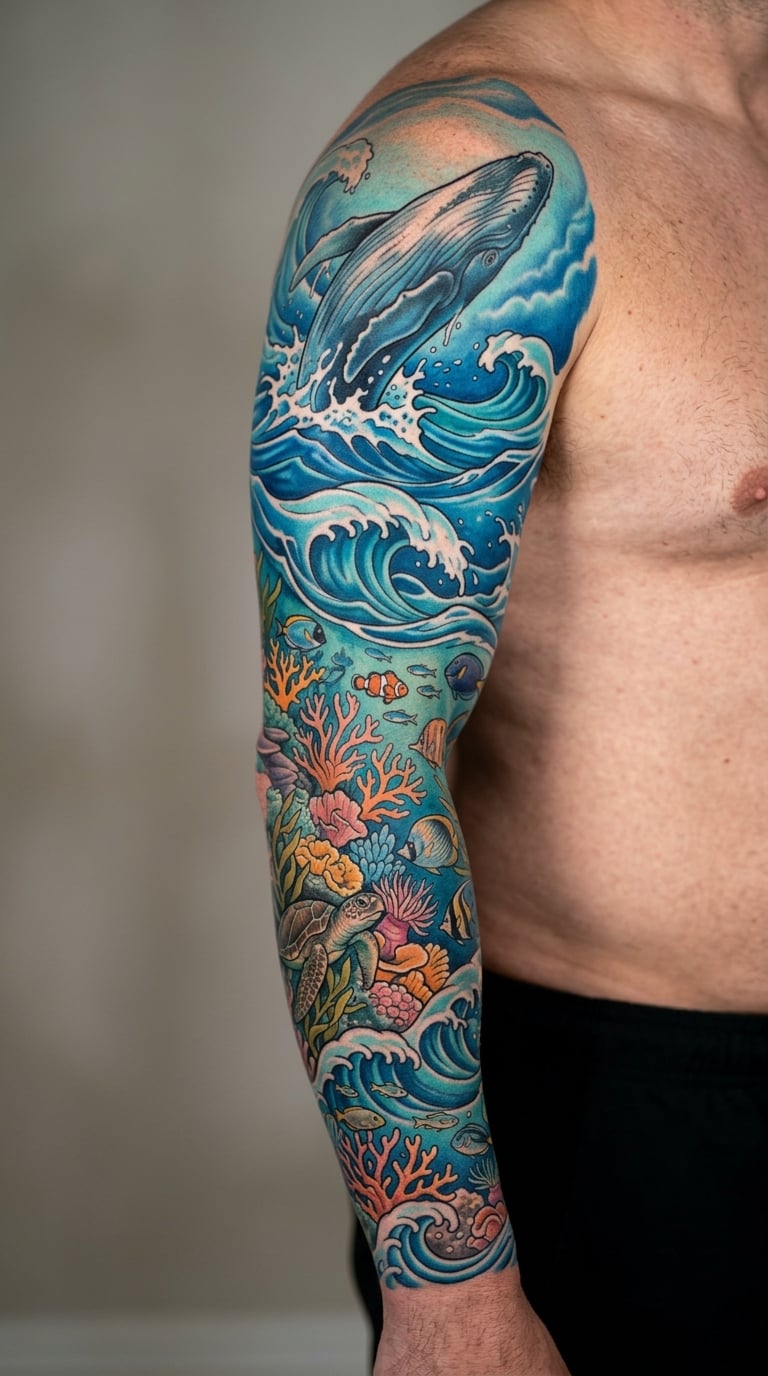
This is the design most people picture when they say ocean sleeve tattoo. The scene builds from small waves and foam near the wrist up to larger animals, a breaching whale or a big reef, across the bicep and over the shoulder. Colour runs deep blue with lighter turquoise breaking through, and the linework stays tight enough to hold up at a distance.
People choose it because it looks like one continuous window rather than a stack of separate animals. The reason is usually tied to the sea itself: diving, growing up near a coast, a family that boats. Composition is the hard part, and the artist has to plan it so the whale still reads when the arm is rolled.
Placement: Wrist to shoulder, or shoulder to elbow if you want a lighter commitment · Size: 20–24 in (51–61 cm) of coverage · Style: Realism or micro-realism
Pain: Medium to high, with the elbow and inner bicep the roughest zones. Wide colour washes sit deeper than linework, and the blue will soften noticeably over the years if the arm gets regular sun.
Make it yours: Add one specific species from your own water, a local fish or the exact ray that swims past at your favourite reef.
2. Blackwork Orca and Iceberg Sleeve
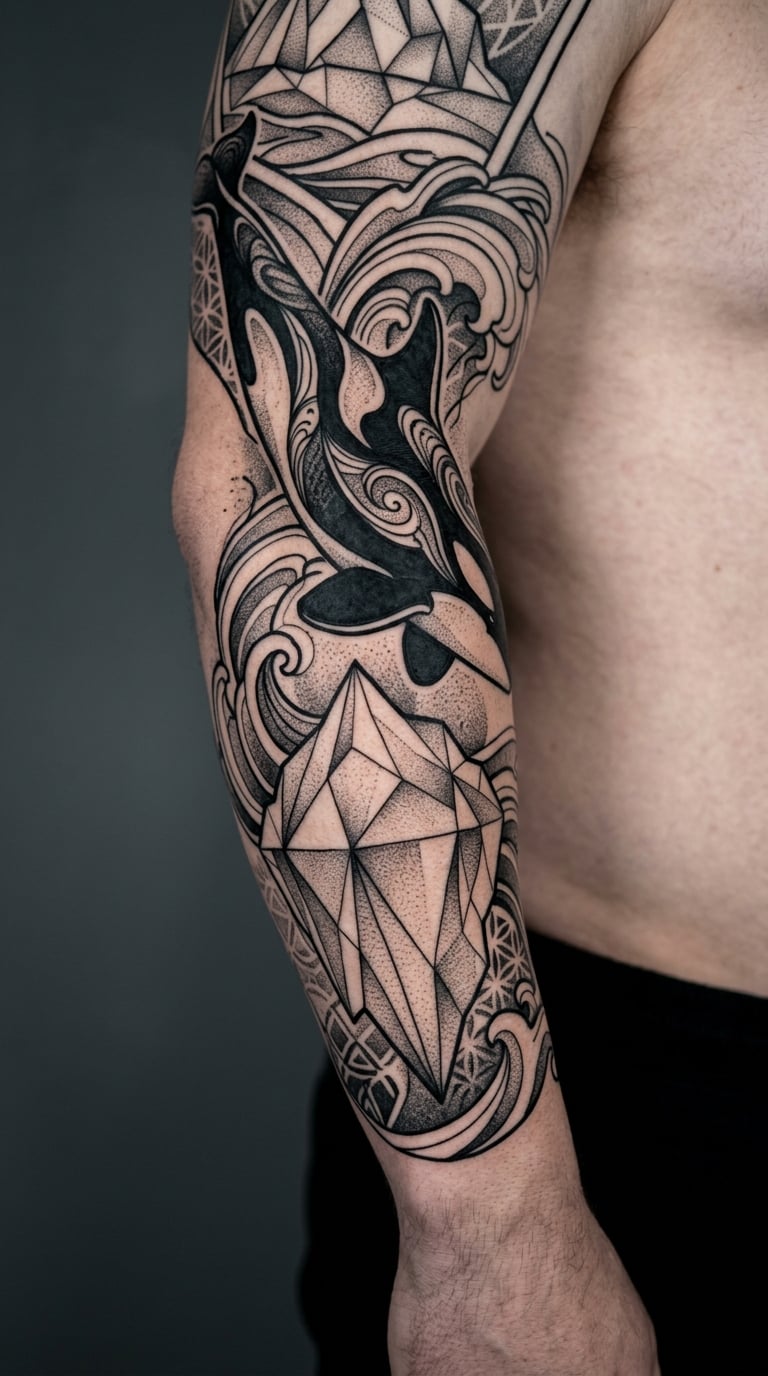
A black orca pushing up through angular ice forms is one of the strongest high-contrast sleeves you can get. Solid black masses break into white water, and the iceberg planes give the design structure so it does not feel like a single heavy shape sliding down the arm. Optional grey wash adds depth behind the animal without softening the impact.
It suits people who want an ocean sleeve that reads as bold and graphic rather than soft or illustrative. Orcas also carry a well-earned reputation for intelligence and family bonds, which is often why they come up in a consultation.
Placement: Outer arm, full length, or split across forearm and upper arm · Size: 18–22 in (46–56 cm) · Style: Blackwork
Pain: Medium. Filling large solid black is a long, heavy pass rather than a sharp one. The thin cracks of white between ice faces are the first to blur as the piece settles into the skin.
Make it yours: Work a latitude and longitude into the ice, or the date of a trip that mattered, in small clean lettering.
3. Fine-Line Octopus and Coral Sleeve
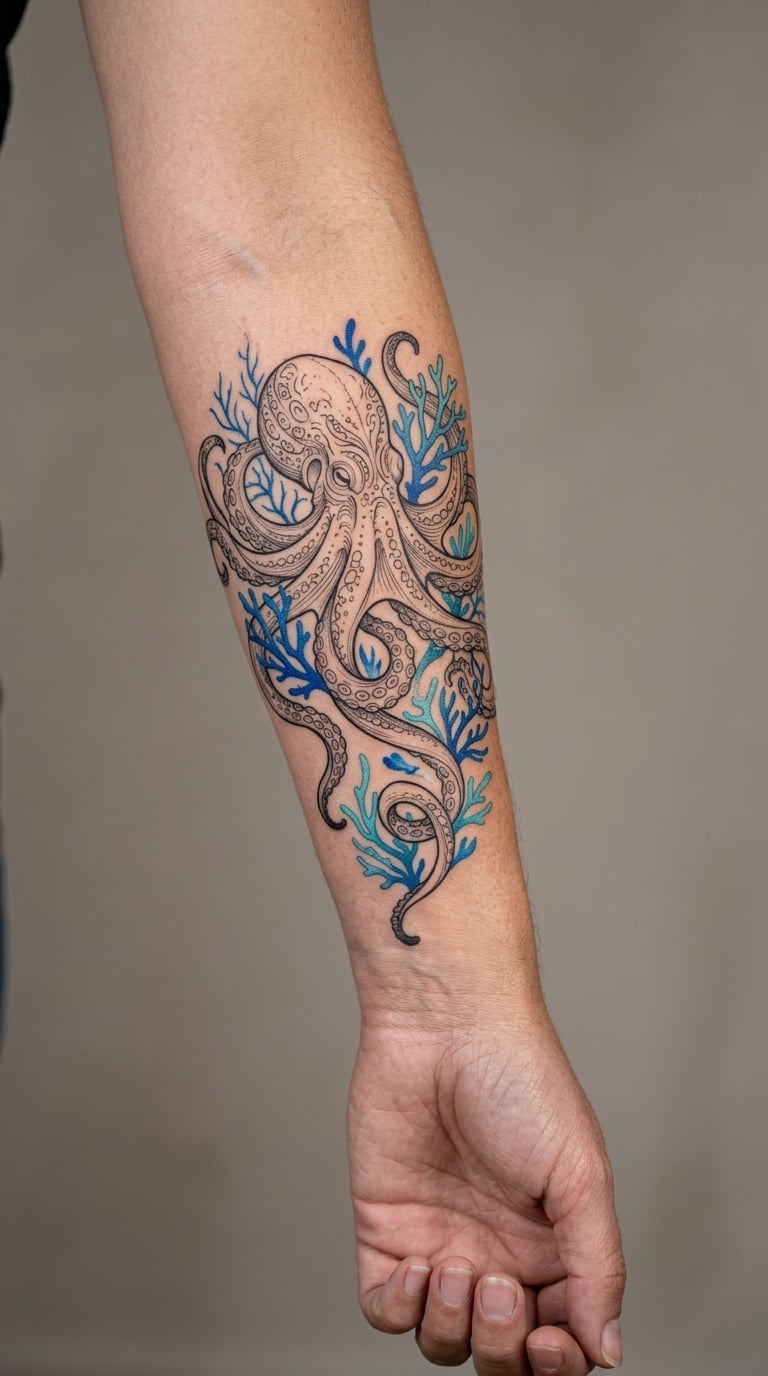
Thin, even linework is the whole point here. An octopus sits with its head on the outer upper arm and its tentacles travel down and around the forearm, each one ending in a small sucker, then branching into coral shapes. A restrained touch of teal or blue on the coral keeps it from feeling flat without turning it into colour realism.
People usually land here because they like octopus anatomy and the way the arms can be made to follow any limb contour. The composition is the challenge: too many tentacles and the sleeve turns to noise, so a good artist limits the number and varies the length.
Placement: Inner bicep to wrist, or a full sleeve with the head high on the outer arm · Size: 14–20 in (36–51 cm) · Style: Fine line
Pain: Medium. Fine lines mean more passes over the same skin, which stings more than a single heavy line. Exposed forearms take a hit from sun and friction, so expect the thin coral branches to need a touch-up sooner.
Make it yours: Base the coral on the reef you first dived, using the species you actually saw rather than a stock image.
4. Traditional Turtle and Wave Sleeve
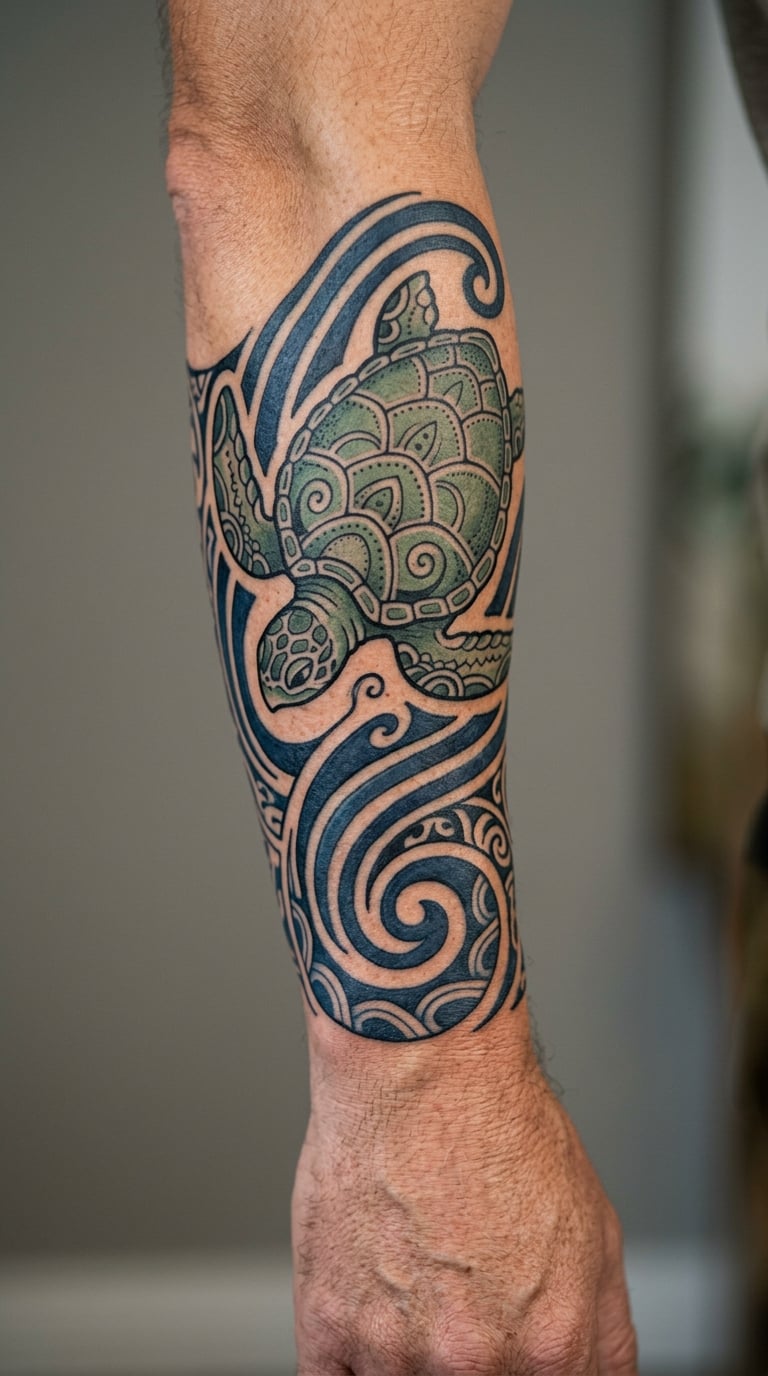
Old-school tattoo language: thick black outlines, flat colour, a shell in muted green and water in deep navy. Traditional wave forms with hard edges and white foam do most of the visual work, and the turtle sits inside the curve rather than floating on top of it. That outline-first approach is why the design keeps its shape for decades.
Sea turtles are one of the most requested marine animals, usually without any assigned message beyond longevity and steady movement. The boldness works well on a forearm or as a shoulder cap, and it hides older faded work surprisingly well because the shapes are so solid.
Placement: Outer forearm, shoulder cap, or elbow to shoulder · Size: 8–14 in (20–36 cm) per band, scalable to a full half sleeve · Style: Traditional
Pain: Medium. Colour packing across the shell is the long part. Fine shading inside the shell plates softens first, but the heavy outlines stay crisp, which is the appeal.
Make it yours: Add a small birth-year script tucked into the foam, or repeat the wave shape on a matching piece later.
5. Watercolour Reef Sleeve
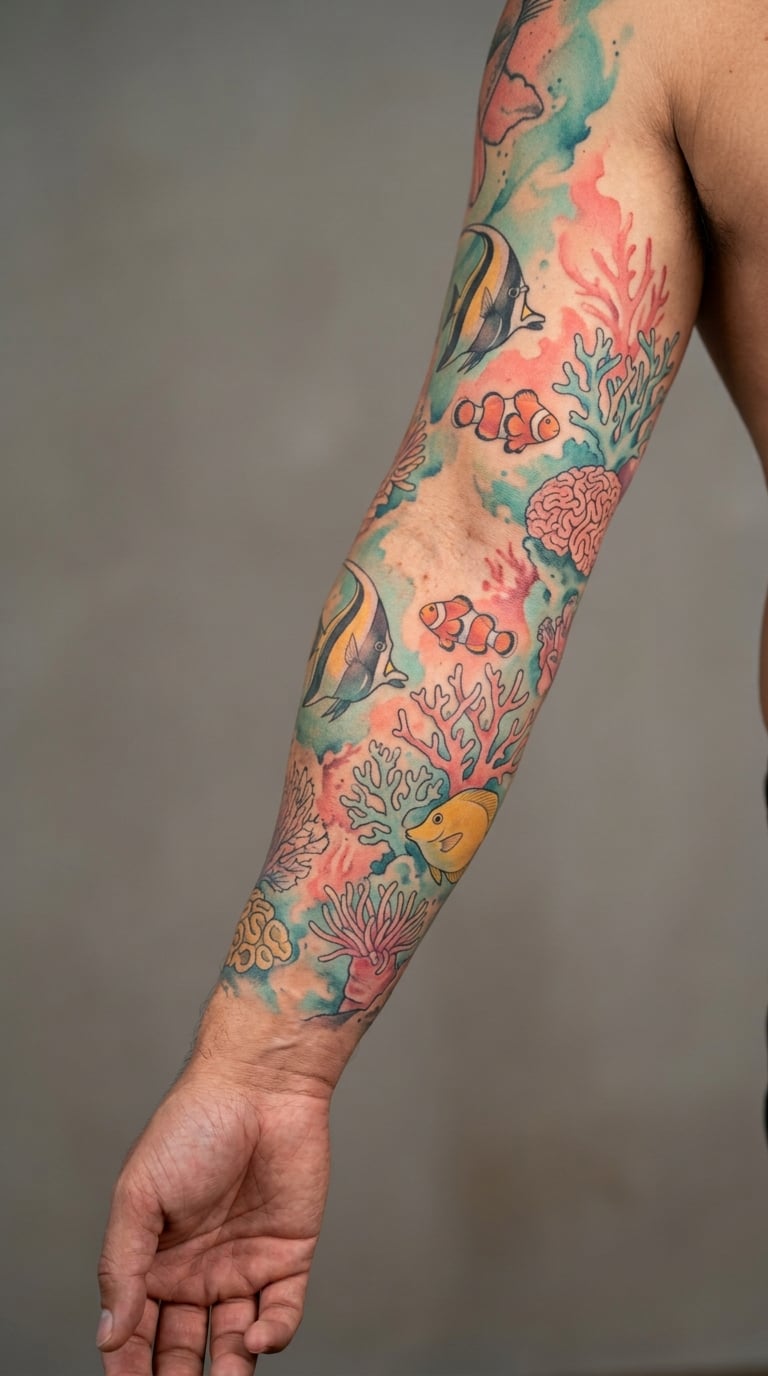
Loose pigment, hard edges nowhere. This sleeve uses translucent washes in teal, coral pink and yellow, with fish and coral fans suggested rather than fully outlined. The negative space does the drawing, so the arm can carry a lot of colour without looking crowded or heavy.
It is the right call for someone who wants an ocean sleeve full of colour but not full of realism. Watercolour reads well from a distance and forgives a slightly busy arm better than linework does. Just accept that it is a soft, low-contrast look rather than a punchy one.
Placement: Outer arm, full forearm to elbow, or lower leg · Size: 16–20 in (41–51 cm) · Style: Watercolour
Pain: Low to medium, since the work is mostly light washes. The pale yellows and soft pink edges fade the fastest, and pale colour on light skin needs a touch-up sooner than you would expect.
Make it yours: Pull the palette from somewhere personal, a team colour, a favourite swimsuit, a sunset you actually saw.
6. Dotwork Jellyfish and Current Sleeve
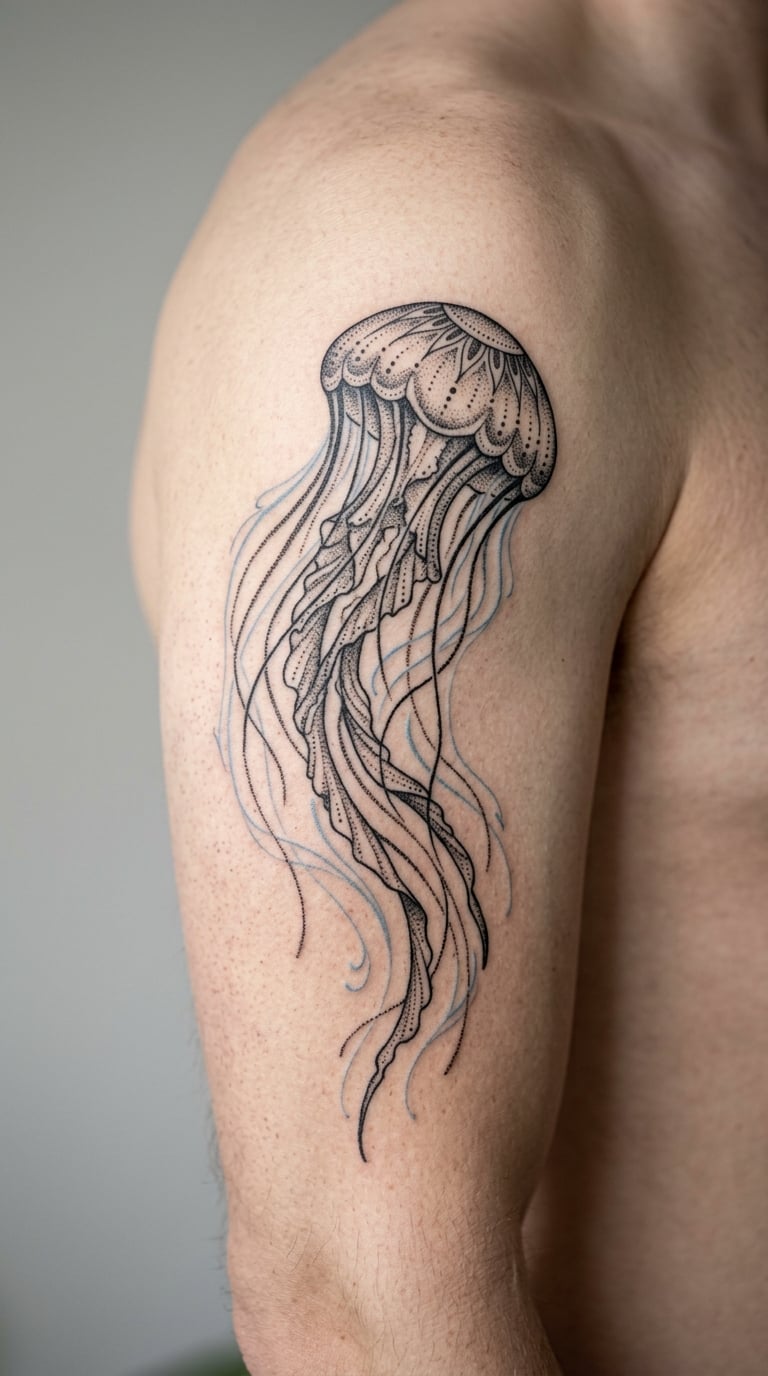
Stippling builds the bell of the jellyfish from dense dots at the top to scattered ones at the tendrils, and sweeping current lines carry the eye down the arm. A small amount of pale blue in the water keeps it from reading as a flat black-and-grey piece. The dot density is what gives it depth, so the artist controls the gradient carefully.
It works well as one panel in a bigger sleeve or as a shoulder piece on its own, and jellyfish are a calm, drifting subject that suits an arm you want to look elegant rather than aggressive. It is also a common filler subject once a main scene is done.
Placement: Outer upper arm, shoulder cap, or as a panel inside a full sleeve · Size: 5–8 in (13–20 cm) per jellyfish · Style: Dotwork
Pain: Low to medium. Stippling is repetitive rather than sharp, though it takes time and the skin gets warm. Microdots in the tendrils soften noticeably within a few years, so the design needs a plan for touch-ups.
Make it yours: Set the dot count to a number that means something, a date, a distance, a dive count.
7. Mermaid and Scale Sleeve
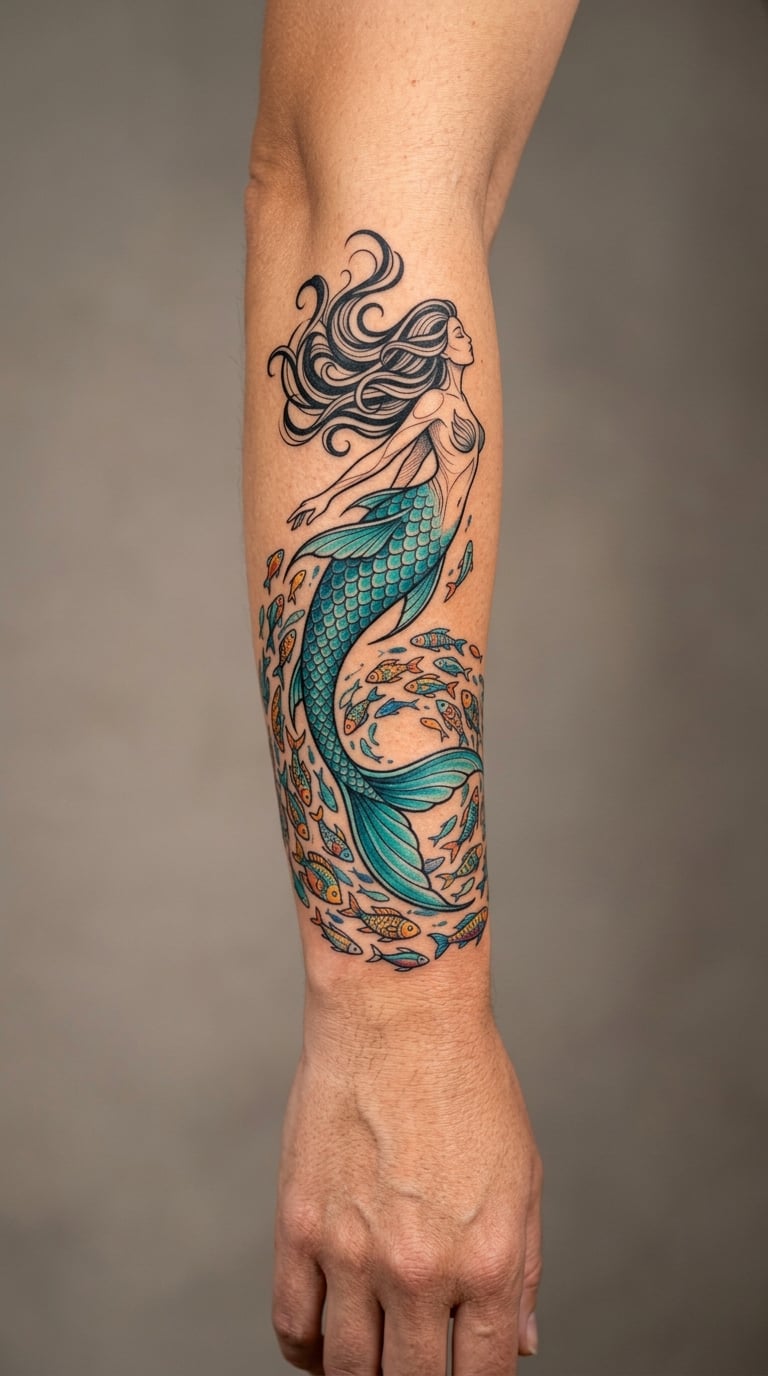
Illustrative rather than photoreal. The mermaid’s hair sweeps across the arm in a long curve, her tail breaks into patterned scales that wrap the forearm, and small fish fill the gaps so the composition never has a dead patch. Teal and sea green scales with warm skin tones keep it bright without becoming cartoonish.
This is one of the more requested concepts in ocean-themed sleeve tattoos, and the reason is usually the movement: a figure that follows the arm reads differently every time you turn your wrist. Artists can vary the scale pattern and the direction of the hair to suit almost any body shape.
Placement: Inner forearm for a full figure, or a full sleeve with the head near the shoulder · Size: 16–22 in (41–56 cm) · Style: Illustrative or neo-traditional
Pain: Medium. The face and hair take the most time and the least forgive of sloppy linework. Individual scale edges soften with sun exposure, so the pattern needs a refresh sooner than the bold outlines do.
Make it yours: Shape the hair silhouette around a real person, a partner or a child, so the flow of the design carries the meaning.
8. Blackwork Hammerhead Shark Sleeve
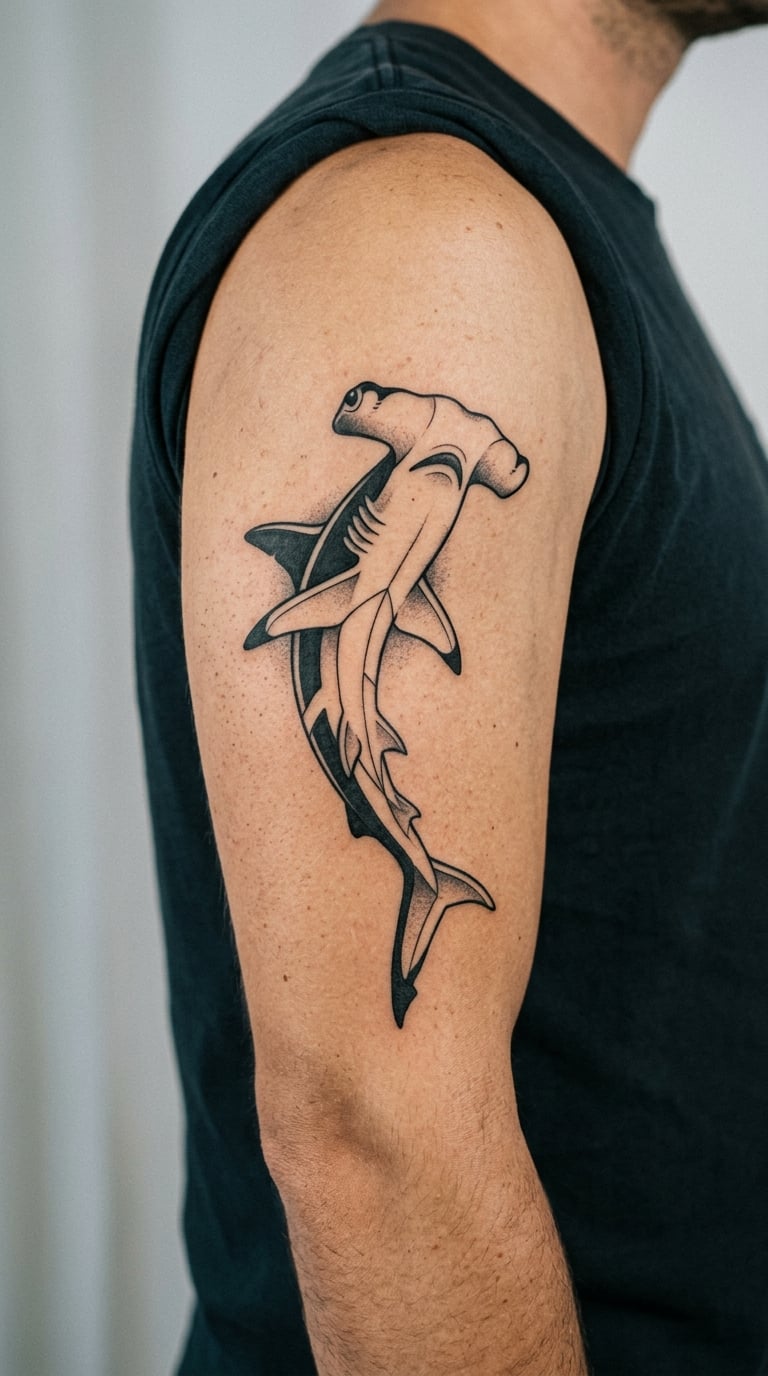
A hammerhead drawn in heavy black contour with a little grey shading for depth, floating in water that is implied rather than inked. The negative space does the work, so the arm still looks like skin between the animal and the edges of the piece. Fewer elements, more weight on the silhouette.
It suits people who want a marine sleeve that is legible and slightly menacing without the visual noise of a full reef scene. Sharks get chosen for a lot of different reasons, and most of them are personal rather than symbolic, which is worth saying out loud at a consultation.
Placement: Shoulder to elbow on the outer arm, or a large forearm panel · Size: 10–16 in (25–41 cm) · Style: Blackwork
Pain: Medium. Bold black over a wide area is a deep, sustained sensation rather than a sharp one. The eye and gill slits are the details that blur first, so the artist builds them larger than you might want them on paper.
Make it yours: Repeat the shark outline smaller as a second, matching piece, or align it so the head points toward a meaningful direction.
9. Japanese Wave and Dolphin Sleeve
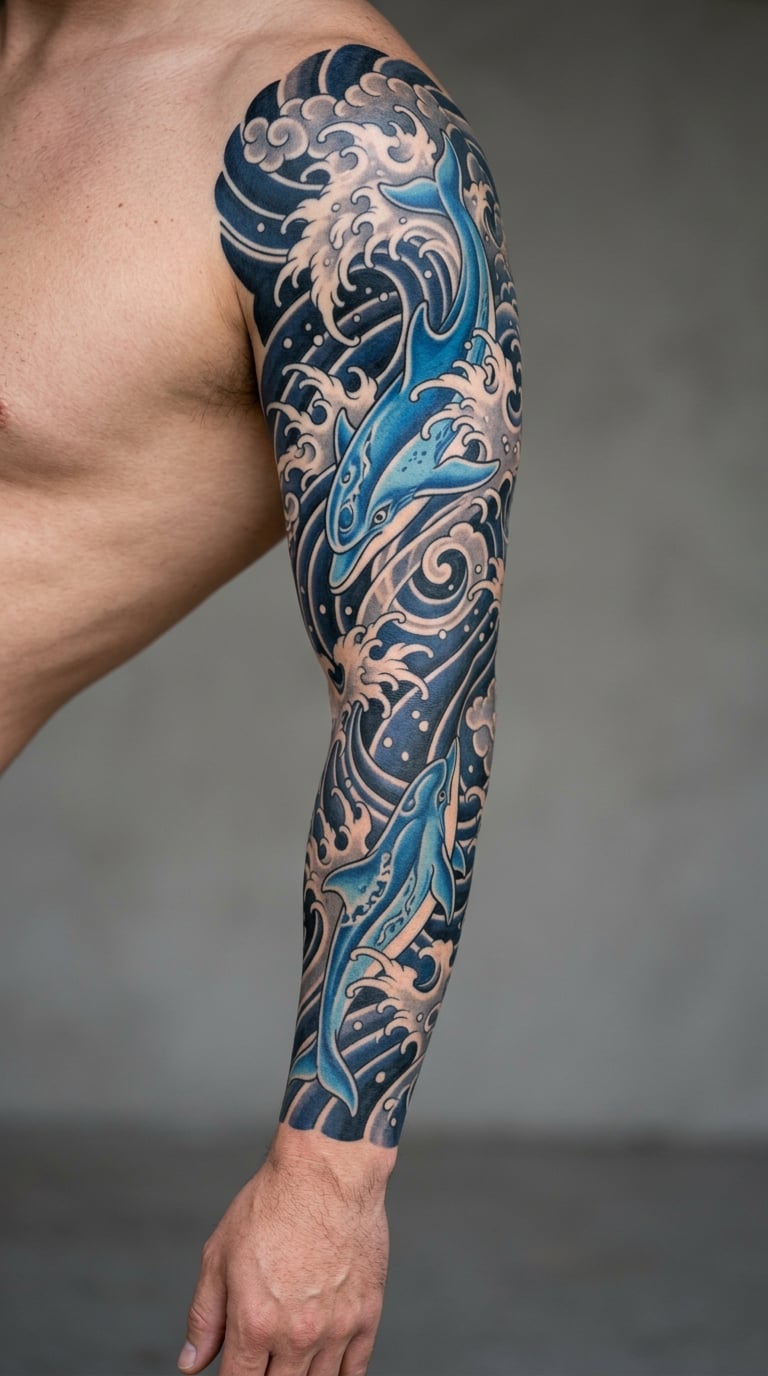
Structured and rhythmic, with large wave forms stacked so the eye moves along the arm rather than stopping anywhere. Dolphins arc through the foam in clean blue, and the water separates into hard-edged navy and white shapes. That colour separation is the hard part, and it is what makes the piece look clean rather than muddy.
The wave language here comes from traditional Japanese tattooing, and the composition has to be planned as a whole rather than filled panel by panel. People choose it for the motion and the strong shapes, and many pair it with a nautical element elsewhere on the body.
Placement: Outer arm or shoulder cap, scaled up to a full half sleeve · Size: 12–18 in (30–46 cm) · Style: Traditional, Japanese-influenced
Pain: Medium to high, since saturated colour over large areas means long passes. Pale blue and white foam fade first, and you should plan on a colour refresh within the first few years if the arm sees sun.
Make it yours: Tuck a small dolphin silhouette in the foam at the wrist, matching a piece someone close to you already has.
10. Sea Turtle Hatchling Life-Cycle Sleeve
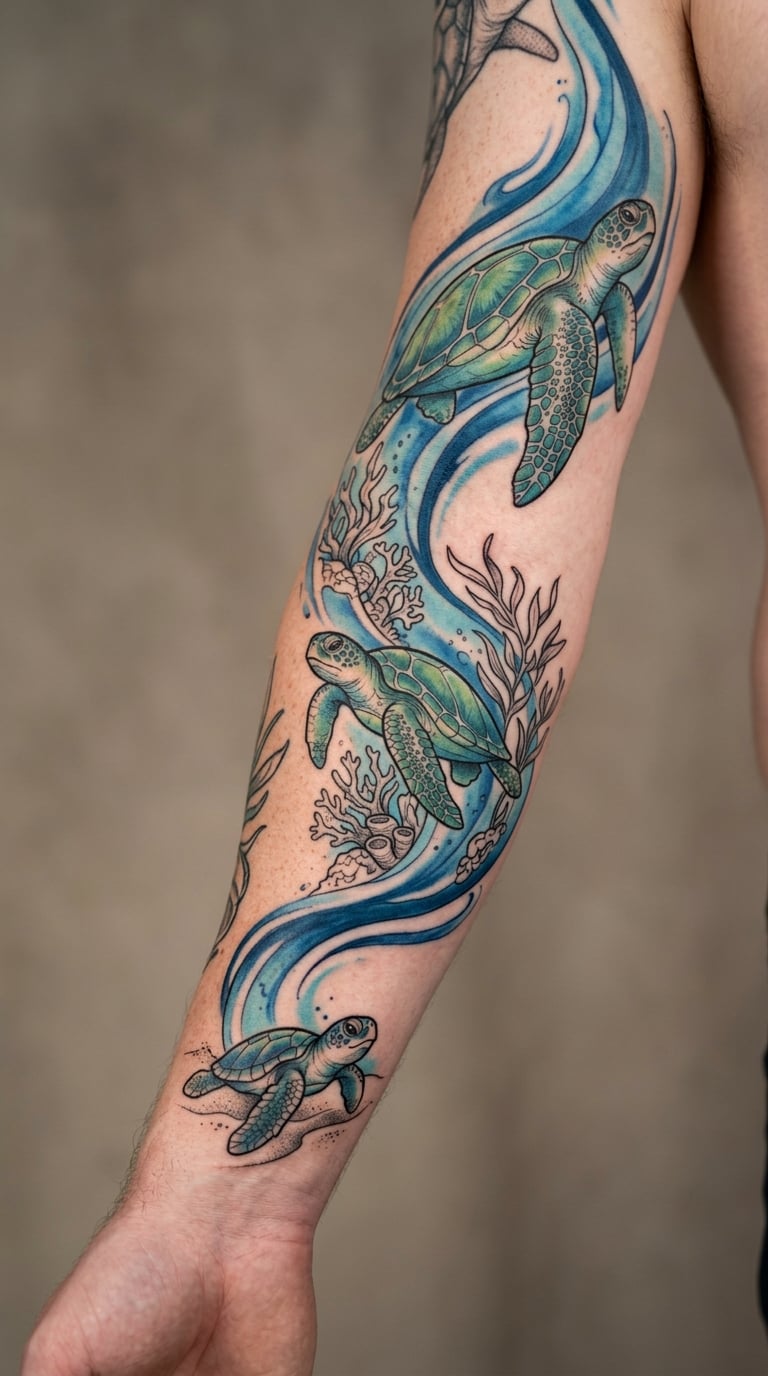
Three stages of the same animal placed along a continuous current: a hatchling heading for the water at the wrist, a juvenile mid-forearm, and a full adult turtle across the upper arm. The realism has to stay consistent across the whole run, which means matching scale and colour intent from one session to the next.
It is a narrative design, and people tend to choose it when the turtle means something specific, often a conservation connection or a childhood spent near a nesting beach. The storytelling is the reason the composition has to be laid out in a fixed order before the first session.
Placement: Full sleeve, wrist to shoulder · Size: 20–24 in (51–61 cm) · Style: Micro-realism
Pain: Medium to high across a long session area. The hatchling at the wrist is the least forgiving spot, with thin skin over bone. Tiny scale details on the hatchling fade first, so the artist sizes them for the years ahead, not for today.
Make it yours: Add a small conservation mark, like a release tag, as a detail only you would recognise.
11. Minimal Line-Art Ocean Sleeve
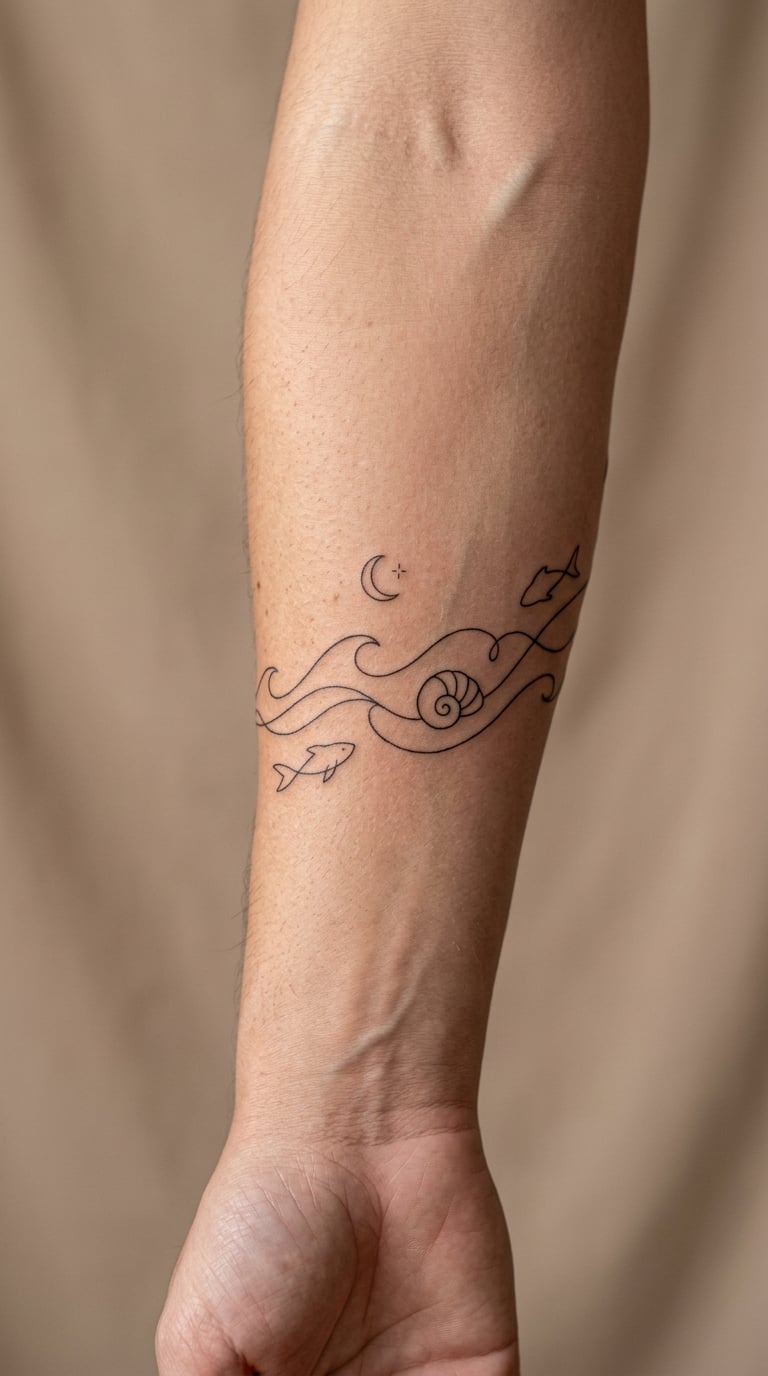
Mostly skin, mostly line. A few fish, a shell, a wave and a crescent moon sit apart from each other with generous space between them, all drawn in one consistent weight of line. Sparse colour, maybe a single blue accent on the wave, keeps it light. The restraint is the design.
It works for someone starting a large piece who is not ready for a dense scene, and for anyone who wants an ocean sleeve that suits an office. The trade is honest: minimal linework is the fastest-fading category on the arm, because there is so little colour and weight holding the lines.
Placement: Inner or outer forearm, easiest to extend later · Size: 10–16 in (25–41 cm) · Style: Minimal fine line
Pain: Low, and easy to sit through. Single-needle lines fade faster than any other ocean style on exposed arms, so plan a colour refresh every few years and consider darkening the line weight at the start.
Make it yours: Set the fish positions using real coordinates from a place that matters, wrist to shoulder reading as a map.
12. Nautilus and Geometric Current Sleeve
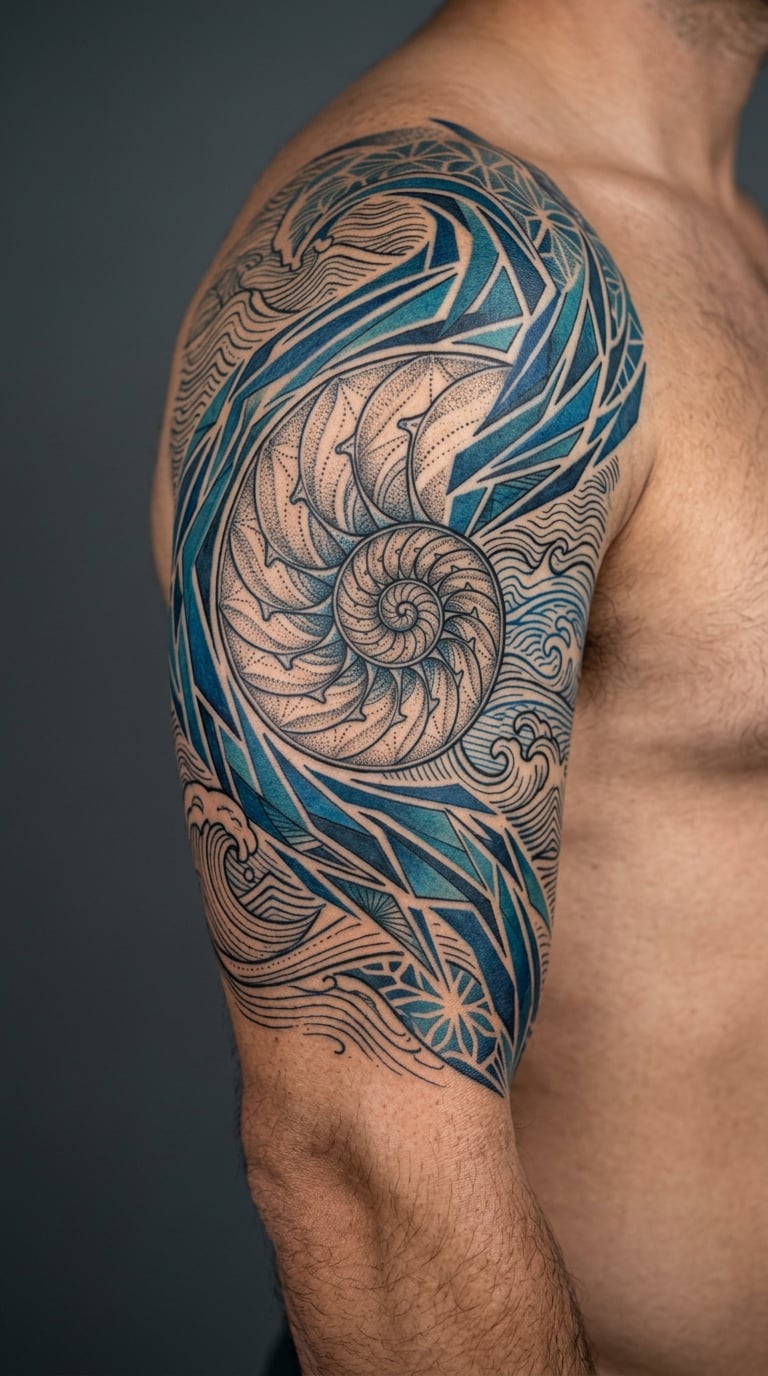
The nautilus spiral is drawn carefully and set into a network of angular currents, straight wave lines and hard-edged flow patterns. The contrast between the organic shell and the geometric lines around it does the work. Colour stays limited, usually two or three blues plus black.
It is a modern take that reads as structured rather than busy, and the angular background gives the artist a way to fill space that still looks designed. The shell is usually the focal point, so it goes where the arm is most visible and least distorted.
Placement: Outer upper arm as a single panel, or expanded to a full sleeve · Size: 12–18 in (30–46 cm) · Style: Geometric linework
Pain: Medium. Long straight lines across the bicep curve noticeably, so alignment takes longer and the artist marks the flow first. The spiral’s thin interior ribs soften faster than the surrounding geometry.
Make it yours: Repeat the spiral shape as a small matching piece, or inside the geometry.
13. Sunken Ship and Treasure Sleeve
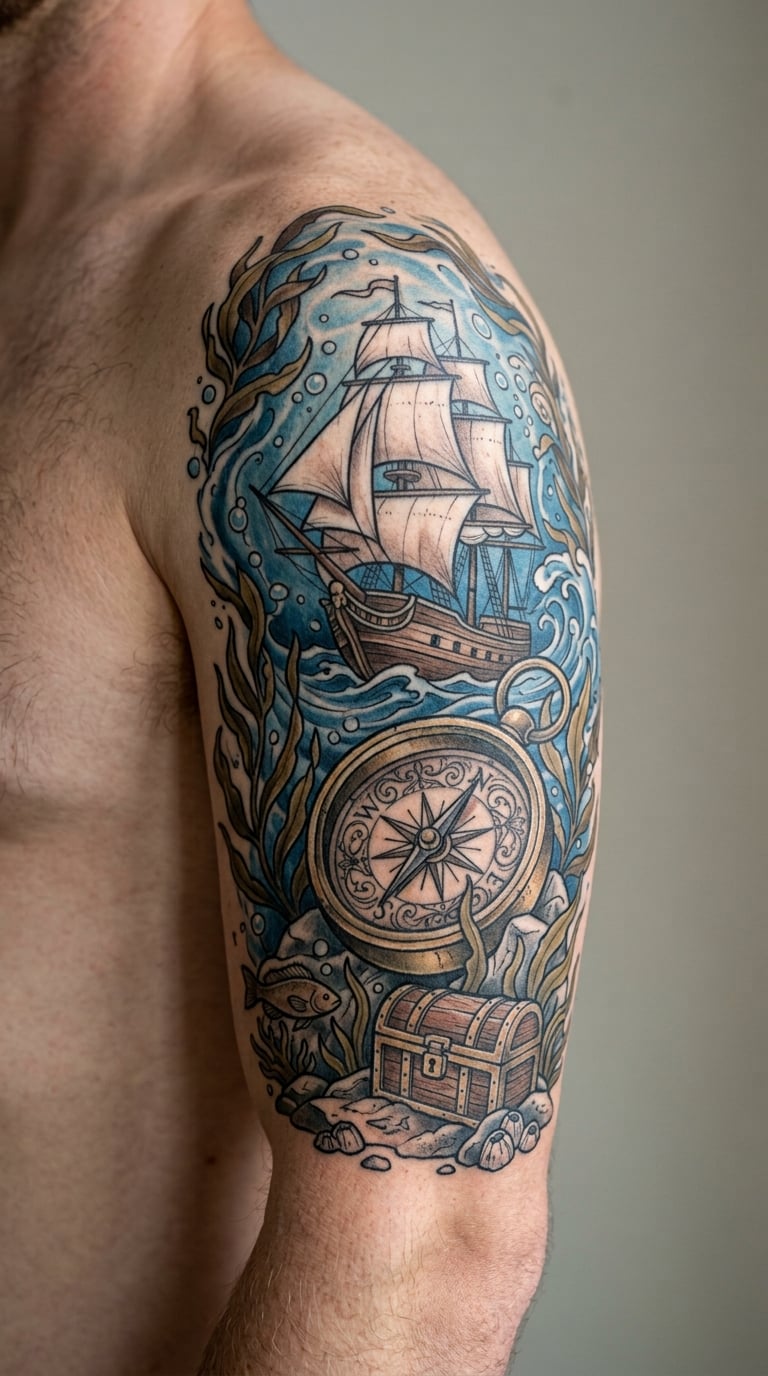
A half-sunken vessel listing at an angle, seaweed rising around the hull, a compass and a small chest worked into the composition in muted blue, brown and dull gold. Illustrative realism with restrained colour keeps it from turning into a bright storybook scene. The listing angle is what gives the sleeve its energy.
Shipwrecks and lost objects are a common choice for people who like the sea and the story attached to it, whether that is exploration, loss, or a family connection to sailing. It also fills a sleeve well, because the hull gives the artist a large shape to build outward from.
Placement: Shoulder cap or upper arm, scaling to shoulder to wrist · Size: 10–16 in (25–41 cm) · Style: Illustrative realism or neo-traditional
Pain: Medium, and the gradient shading in the water column takes patience. Small map details, rope texture and the compass lettering are the first to blur, so the artist keeps them larger and simpler than a reference photo suggests.
Make it yours: Have the compass face modelled on an heirloom piece, or engrave a real heading on the hull.
14. Orca and Moonlight Blackwork Sleeve
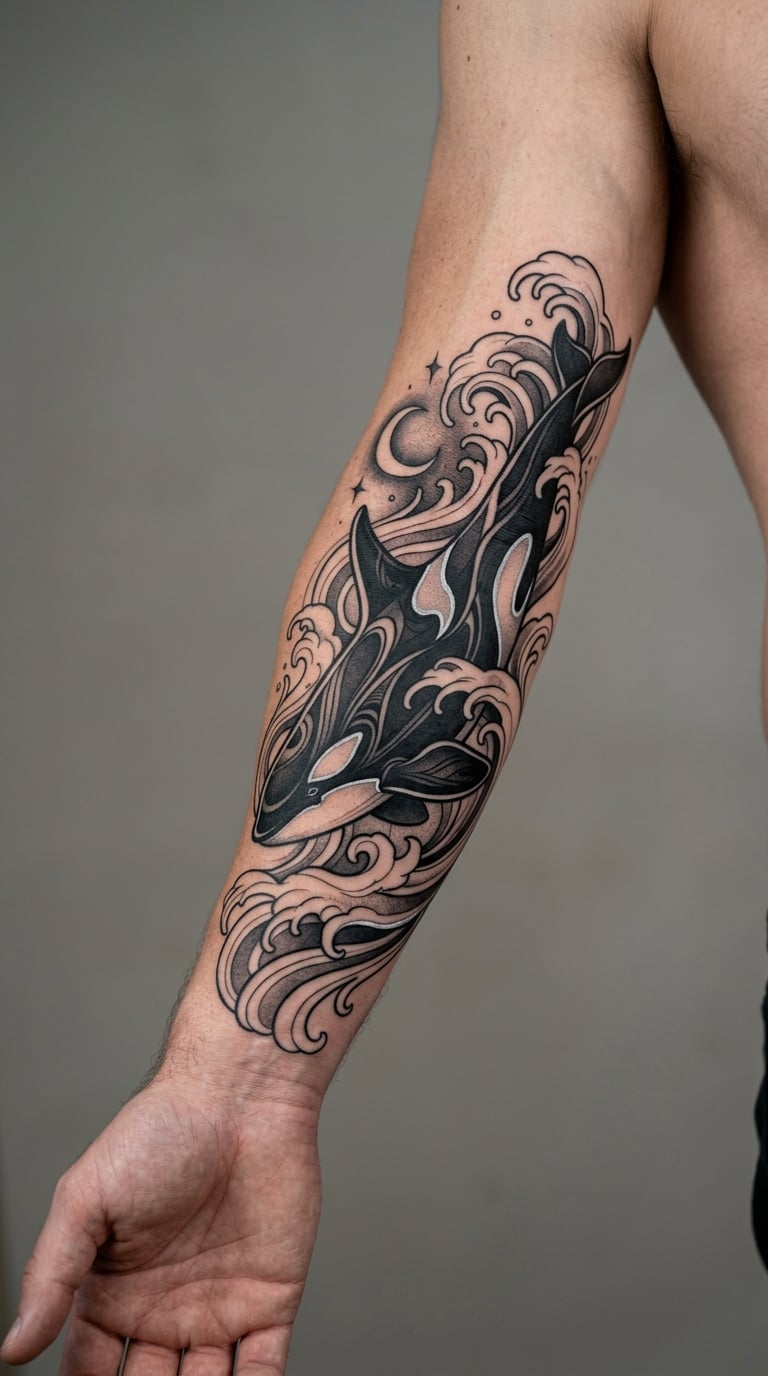
A black orca gliding through stacked bands of water, where moonlight is suggested by layers of white and pale silver-grey rather than by a drawn moon. The contrast between solid black animal and open water is what carries the piece, and the wave bands give it rhythm from elbow to shoulder.
It has a quieter mood than the iceberg version, which makes it a good fit for someone who wants an ocean sleeve that feels calm rather than aggressive. The silvery tones are worth discussing honestly at the consultation, because they are among the first pigments to change.
Placement: Full outer arm, or a long panel from elbow to shoulder · Size: 18–22 in (46–56 cm) · Style: Blackwork with grey
Pain: Medium. The solid black sections are the long passes. Narrow silver-grey separations between the wave bands are the first thing to lose definition as the ink settles and as sun reaches the outer arm.
Make it yours: Set the moon phase to the one that mattered, rendered as a band of light rather than a literal moon.
15. Colourful Parrotfish and Kelp Sleeve
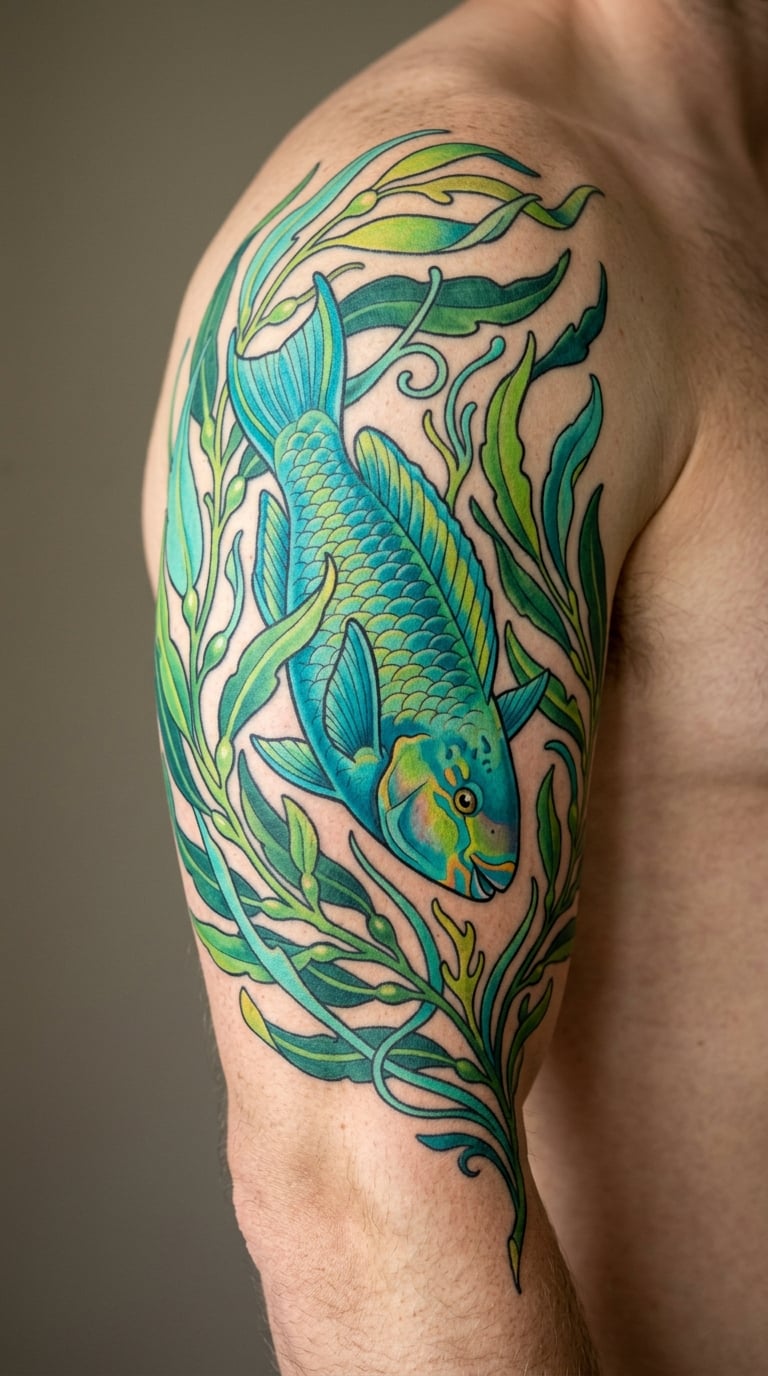
Saturated, high-energy and warm. The parrotfish is the hero, built from turquoise, lime, yellow and deep green with visible scale patterning, and tall kelp fronds move behind it to give depth. The fish scales need careful blending, and that blending is what separates a good version from a flat one.
This is the sleeve for someone who wants their arm to be the most colourful thing in a room. It is a bigger commitment than a black-and-grey piece because the colour work takes longer and shows every imperfection. Tropical and coastal clients lean this way more often than not.
Placement: Outer arm, forearm to shoulder, or on the calf · Size: 16–22 in (41–56 cm) · Style: Illustrative or neo-traditional
Pain: Medium, with the saturation meaning more passes and more open skin time. Turquoise and lime shift fastest in sun, so the sleeve will want a colour refresh sooner than a black-and-grey one, especially on the outer arm.
Make it yours: Pick the palette from a single place, the exact blue of a specific bay, so the whole sleeve reads as one memory.
16. Microscopic Plankton Sleeve
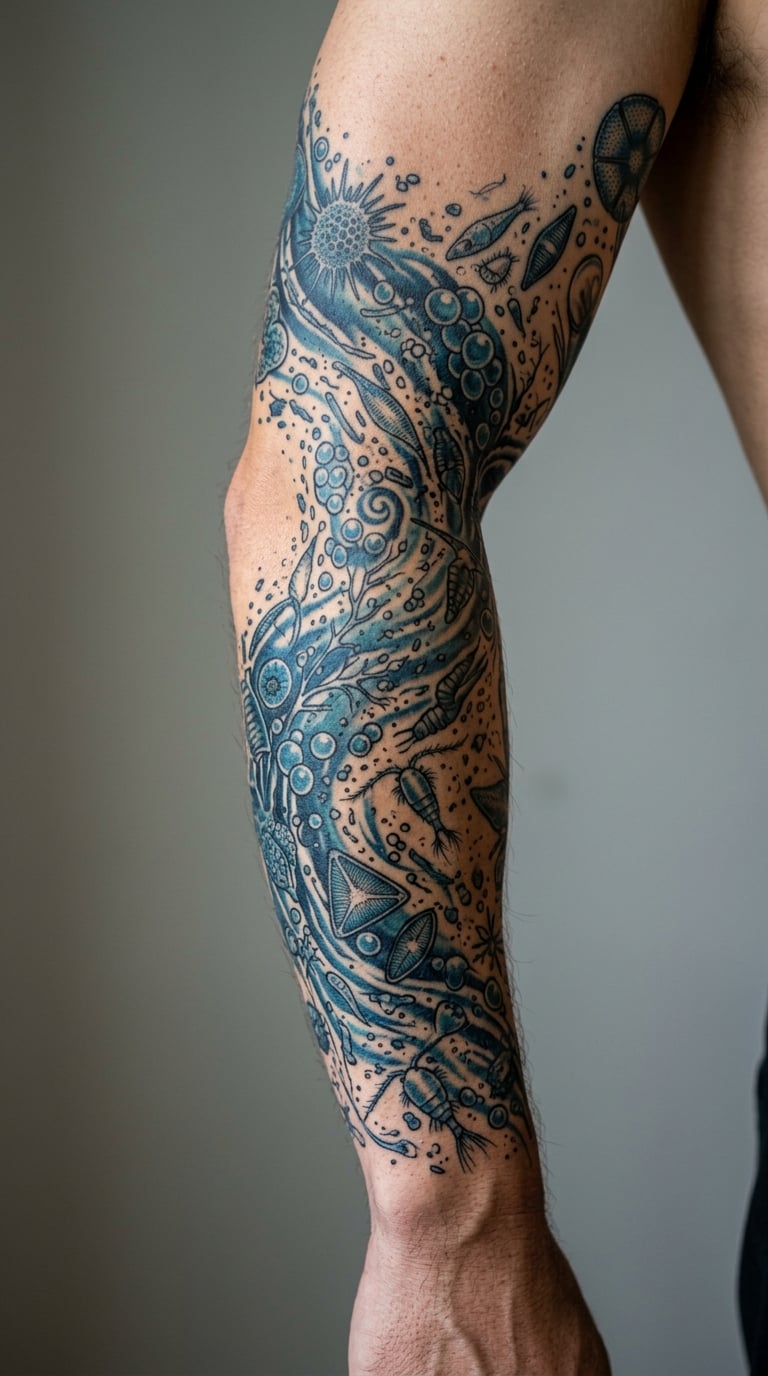
Part science plate, part art. Plankton forms, bubbles and drifting particles run the length of the arm, with tiny marks near the wrist gradually resolving into clearer, more recognisable shapes toward the bicep. Dot density and soft gradients carry the whole composition, and the effect is genuinely different every time you move.
People tend to pick it for the strangeness of it. It is also one of the few ocean concepts that suits almost any arm shape, because there is no single large form that can distort. Slower and more meditative to tattoo than most sleeves here.
Placement: Forearm to bicep, or the lower leg from ankle to calf · Size: 16–20 in (41–51 cm) · Style: Dotwork and micro-realism
Pain: Medium, mostly from repetition rather than depth. The smallest particles are the first to disappear, so the design is built with a slightly heavier hand near the wrist where sun and friction hit hardest.
Make it yours: Base it on a real sample or a specific survey, and date the piece in the negative space where a caption would sit.
17. Coral Skull and Ocean Growth Sleeve
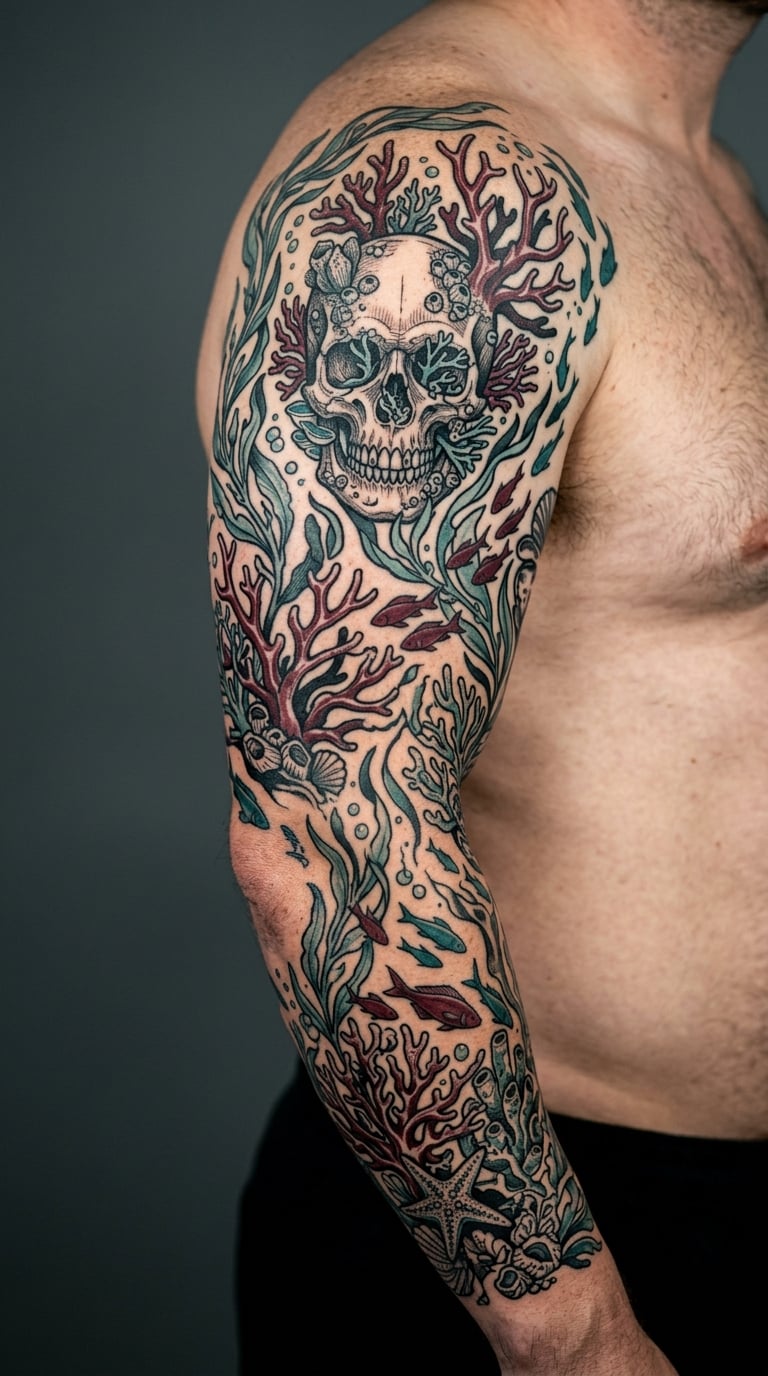
A human skull where coral has taken over: branching growths push out of the eye sockets, seaweed fills the jaw, and small fish occupy the negative space around the head. Linework stays clean with a muted teal and deep red palette, which keeps it from tipping into horror. The balance between a recognisable skull and living growth is the whole design.
It is a bigger emotional piece than most, and people choose it for different reasons: mortality handled sideways, a love of diving, or simply that it looks good. The branching coral gives the artist natural filler shapes, which helps if the sleeve is being extended later.
Placement: Outer arm or shoulder, scaled to a half or full sleeve · Size: 12–18 in (30–46 cm) · Style: Illustrative
Pain: Medium to high over the skull, where the arm is bony and unforgiving. Small coral branches are the first to fade and blur, so they need more depth than the flat red areas beside them.
Make it yours: Add a small protective or family symbol in one of the eye sockets, where the negative space is already doing work.
18. Axolotl and River Stone Sleeve
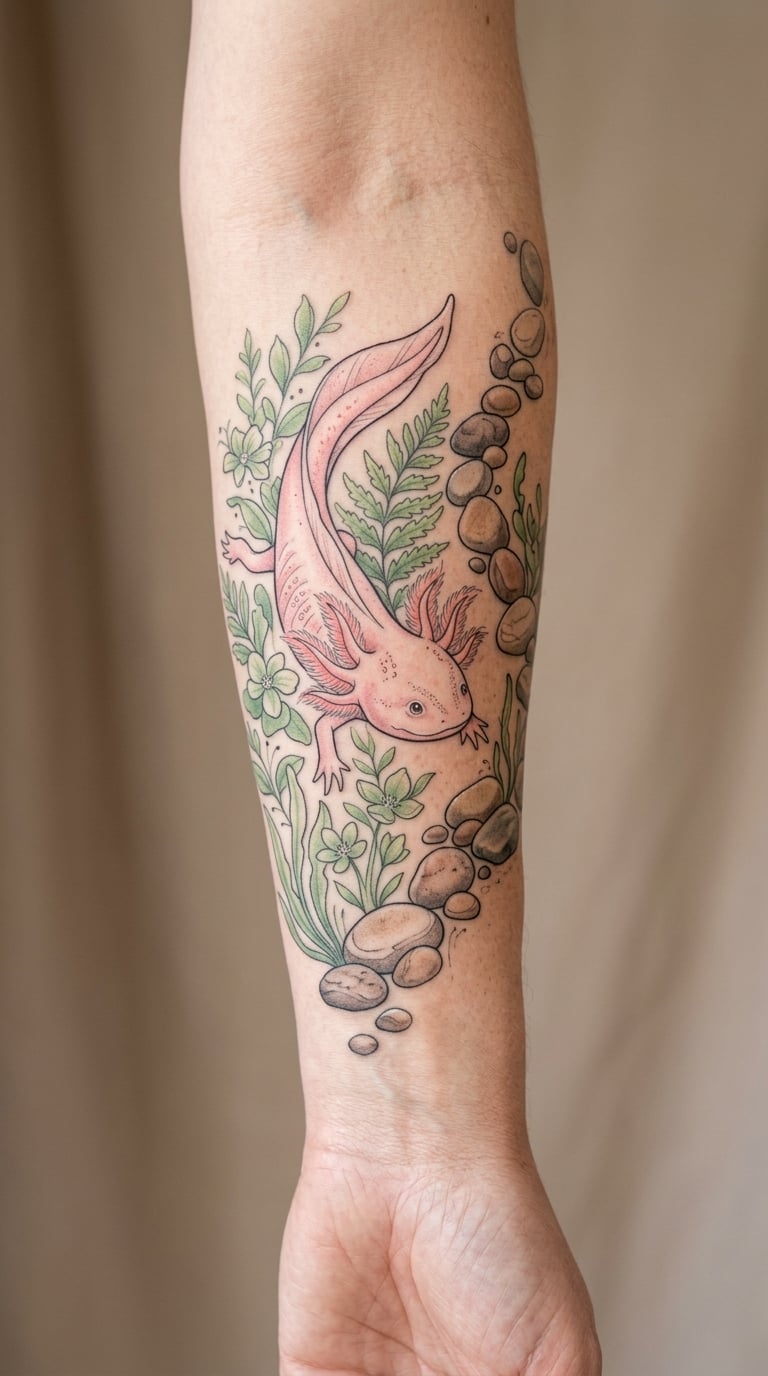
Freshwater rather than open sea, and much quieter. A soft-rendered axolotl rests along the inner forearm among rounded river stones and quiet current lines, in muted pink and green with very little contrast. The anatomy is the interest: the external gills give you natural frills to draw and soft shapes to fill the space with.
It suits people who like freshwater ecology or grew up near a river, and it is one of the calmer designs here, which makes the inner forearm placement very practical. The soft palette also hides small imperfections better than a high-contrast piece would.
Placement: Inner forearm, or a full sleeve with the animal at the elbow · Size: 10–16 in (25–41 cm) · Style: Illustrative realism or watercolour
Pain: Low to medium. The inner forearm is sensitive but flat, which makes long sessions easier. Light pink is the first colour to fade and the first to look tired, so keep the palette muted rather than pastel-bright.
Make it yours: Shape the largest river stone after a landmark from your hometown, or the river you grew up on.
19. Bioluminescent Deep-Sea Sleeve
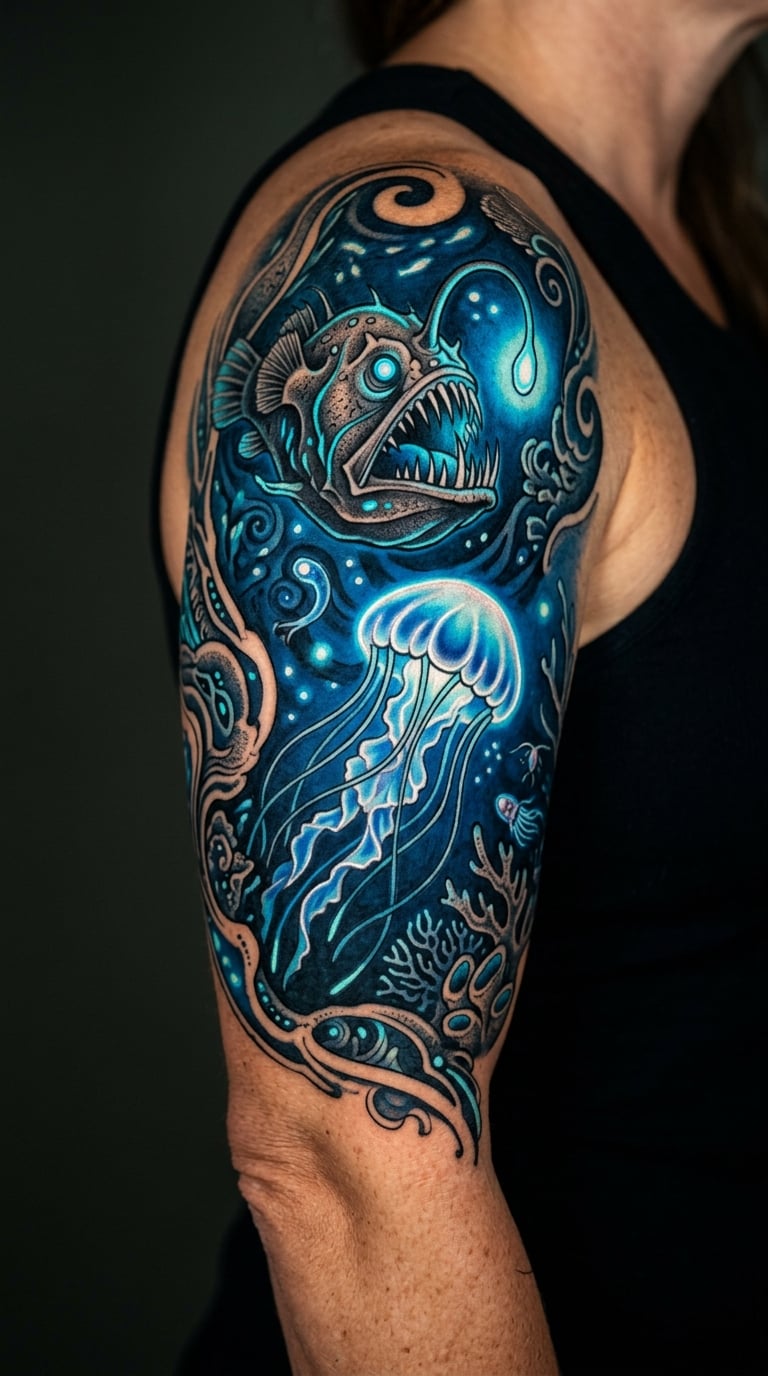
A black background carrying an anglerfish, drifting jellyfish and small glowing accents that suggest light without drawing beams. Negative space is minimal here, so the sleeve reads as deep water, and the colour is used sparingly on purpose: an electric blue that pulls the eye to the lure and the bell edges.
It is dramatic in a quiet way, and it works well on someone who wants a dark sleeve that still has movement in it. Deep-sea pieces hide older faded work extremely well, since the background does the covering.
Placement: Full sleeve, or shoulder to elbow for a darker, heavier look · Size: 18–22 in (46–56 cm) · Style: Blackwork with colour accents
Pain: Medium to high, because a full black background is a lot of continuous coverage and the arm heats up fast. The tiny luminous details blur early, so the artist makes them larger and fewer than a photo would suggest.
Make it yours: Choose one accent colour, usually blue, and use it for anything you want the eye to find first.
20. Seashell Spiral Nature Sleeve
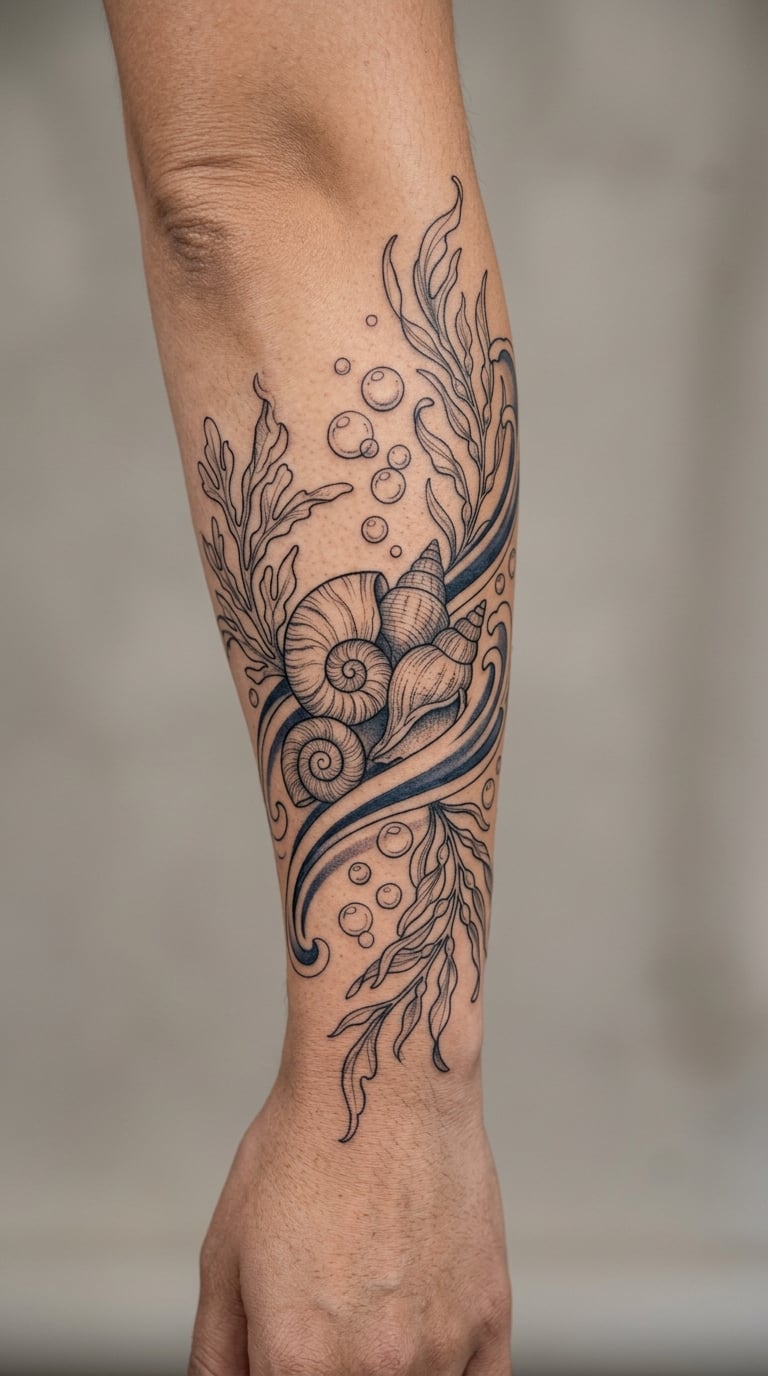
Spiral shells, seaweed fronds, rising bubbles and a repeated wave rhythm that carries the eye up the arm, all in fine line with restrained colour, perhaps navy on the wave accents and nothing else. The natural forms give the sleeve its character, and the wave rhythm is what keeps it from feeling like a list of separate objects.
It appeals to people who want the ocean in a gentler register than a realism piece delivers, and it is an easy sleeve to add to later because shells and bubbles work as filler between bigger elements. The calm look suits smaller arms better than a heavy black piece does.
Placement: Full sleeve or outer arm, wrist to shoulder · Size: 14–20 in (36–51 cm) · Style: Fine-line nature
Pain: Low to medium. Fine detail over a long area takes patience rather than endurance. Hands, wrists and anything near a cuff fade fastest, so the artist weights the lines slightly heavier low on the arm.
Make it yours: Add the coordinates of a beach that matters, or repeat one shell shape as a matching piece elsewhere.
How to Choose the Right Design
A few questions narrow twenty options down to one quickly. Work through them before you book anything, because changing direction after the first session is expensive in time and money.
- Pick the style first. Blackwork and realism hide old work best and fade slowest. Watercolour and fine line look softer and lighter but need colour refreshes sooner.
- Match the size to the session. Anything past about 8 x 8 in rarely fits in one sitting. Decide whether you want a marathon session or a slow build over months.
- Look at the arm rolled, not flat. Ask your artist to check the design from a straight-on view and with the arm turned. That check catches more sleeve layouts than anything else.
- Plan the negative space now. The most common question in tattoo communities is what goes in the gaps at the end of a sleeve. Bubbles, seaweed and small fish are standard filler; decide where they sit before session one.
- Account for what is already there. Existing tattoos, sun damage and scar tissue change the design. A tattooer can work around them, but only if they see the arm in person.
- Be honest about pain tolerance. Inner forearm, inner bicep, elbow and rib-adjacent shoulder areas are the rough ones. A full arm is several hours of moderate pain rather than one sharp stretch of it.
Bring reference images in a folder, not on a single phone screen, and be clear about what you like about each one: the linework, the colour, the movement. An artist can adapt a composition to your body shape far better when the brief is about direction than about copying. One warning: do not hand over artwork you found online to be reproduced exactly. Most artists will not do it, and it is not worth pushing.
Ocean Sleeve Tattoo Ideas by Style and Size
Grouping the same 20 concepts by approach makes the trade-offs obvious. Size here is indicative coverage, and every one of them scales up or down.
| Style | Concepts | Indicative size | Suits best on |
|---|---|---|---|
| Realism and micro-realism | Realistic full-length, turtle life cycle | 20–24 in (51–61 cm) | Wrist to shoulder, calf |
| Blackwork | Orca and iceberg, hammerhead, orca and moonlight, bioluminescent | 10–22 in (25–56 cm) | Outer arm, shoulder, areas with old work |
| Traditional | Turtle and wave, wave and dolphin | 8–18 in (20–46 cm) | Outer forearm, shoulder cap |
| Illustrative | Mermaid, parrotfish and kelp, coral skull, sunken ship, axolotl | 10–22 in (25–56 cm) | Any arm zone, inner forearm included |
| Watercolour | Watercolour reef, axolotl | 10–20 in (25–51 cm) | Inner forearm, lower leg |
| Fine line and dotwork | Octopus and coral, dotwork jellyfish, minimal line art, seashell spiral, plankton, nautilus | 5–20 in (13–51 cm) | Forearm, upper arm, easy to extend later |
There is more to browse if you want to widen the search. These bold sleeve tattoo ideas cover the heavier, darker end of the spectrum, and this collection of sleeve tattoos women love leans the other way, with more colour and softer linework. Both help when you are still deciding how much visual weight you want on the arm.
Cost and Session Time
Tattoo pricing is hourly in most US shops, so the honest way to talk about an ocean sleeve is by the hour and the total. Rates commonly run from about 80 to 250 an hour depending on the city and the artist, and most shops set a minimum charge that a small piece still has to meet. That minimum is often the same number a first session costs.
Working from that hourly range, a small ocean piece under 3 x 3 in usually lands in the low hundreds, a medium piece around 5 x 5 in in the mid hundreds, and a large detailed panel pushes into the high hundreds or low thousands. A half sleeve commonly runs into the mid thousands, and a full arm sleeve with heavy colour realism sits in the low to mid thousands before touch-ups. Highly detailed custom work and multi-session projects can cost more, sometimes considerably.
Session length matters as much as price. Most artists cap a session at four to five hours because skin stops taking ink well after that, and a full ocean sleeve is rarely finished in one. Expect a half sleeve to run three to five sittings and a full arm five to eight, spread over several months. Add an eight-week wait between sessions, since tattooing over fresh skin is a bad trade, and a realistic timeline for a full sleeve runs six months to over a year.
What moves the number: shop minimums, the artist’s hourly rate, your location, how much colour is involved, whether the work is custom or adapted from existing art, and whether you plan a revision session at the end. Get the session count and the hourly rate in writing at the consultation, along with what a touch-up window includes.
Aftercare Basics
Follow your artist’s aftercare directions first, since they know exactly what they did. As a general guide for a large sleeve:
- Wash the area as instructed, usually a gentle clean with unscented soap and cool water, twice a day for the first few days.
- Use the ointment or aftercare product your artist gave you, in a thin layer, and follow their timing on when to switch to a heavier moisturiser.
- Keep it covered with a clean wrap or loose clothing for the first stretch. Loose sleeves beat tight cuffs, which rub and lift the healing skin.
- Skip swimming, soaking and long hot showers while the skin is open, and stay out of direct sun on the arm until the sleeve is fully healed.
- Contact your artist if you see spreading redness, a hot feel, heavy swelling, yellow build-up, or a line that suddenly looks blurred. They can tell you whether it needs a look.
Frequently Asked Questions
Do ocean sleeve tattoos fade quickly?
It depends almost entirely on style and placement. Blackwork and black and grey realism hold up best, with solid black barely changing over a decade. Watercolour, fine line and dotwork fade faster, especially on outer arms, forearms and wrists where sun and friction hit hardest. Pale blues, yellows and pinks shift first. Ask your artist to weight fine lines a little heavier than the reference art, and plan a colour refresh every few years for the lighter styles.
How painful is an ocean sleeve tattoo?
Most people describe a full arm sleeve as medium, made duller by length rather than sharper. The roughest zones are the inner forearm, inner bicep, elbow and the bony top of the shoulder. Wrist and outer upper arm are noticeably easier. Large colour fills and long black areas feel deeper and more sustained than fine linework. Eating well, sleeping, and keeping the session to four or five hours all make it more manageable.
How many sessions does a full ocean sleeve take?
Plan on five to eight sessions for a full arm sleeve, and three to five for a half sleeve. Artists rarely work longer than four or five hours in one sitting because skin stops accepting ink well beyond that. Sessions are usually spaced six to eight weeks apart, which puts a full sleeve on a six-month to one-year timeline. A final touch-up session is commonly built into the plan for any areas that healed light.
Where is the best placement for an ocean sleeve?
The outer arm from wrist to shoulder gives the most surface area and the least distortion, and it reads clearly from across a room. The inner forearm is the most sensitive but flattest, so fine line and illustrative work stays true there. A shoulder cap suits heavy black designs, and a leg sleeve from knee to ankle takes the largest scenes. Ask to see the design on your arm rolled, not just held flat.
How should I prepare reference images for an ocean tattoo?
Gather a folder of ten to fifteen images and mark what you like about each: line weight, colour, composition, realism level. Say which elements you want rather than handing over one image to copy, since most artists will not reproduce artwork they did not draw. Avoid anyone else’s finished tattoo as the target. Bring your own photos of the sea, reefs and light that you want the piece to feel like, and let the artist translate them.
Conclusion
If you are starting small and want a large-scale look that is forgiving, the minimal line-art ocean sleeve is the practical first option. It is quick, low on pain and easy to extend later with shells or a second panel when you are ready. If you already have several tattoos and want the ocean to be the centrepiece, the realistic full-length ocean sleeve is the stronger choice, and the artist who draws it should be planning the whole arm before touching the first session.
Either way, decide three things in this order: which body area, which style, and what direction you want the design to move in. Then take those decisions, plus a folder of references, to a tattooer who works in the style you picked and whose healed work you have actually seen. A sleeve is not a piece of flash that happens to be large, and the consultation is where the difference gets decided.