
20 Best Quarter Sleeve Tattoo Ideas for Men (September 2026)
Quarter sleeve tattoo ideas for men fall into a narrow band of real estate, and that constraint is exactly why the good ones look good. A quarter sleeve runs from the shoulder cap to roughly the middle of the upper arm, the same span as a standard T-shirt sleeve. It can also sit on the forearm instead, running from the elbow toward mid-forearm. Twenty designs below are mapped to that exact span.
These are the pieces that suit the shape best: strong contrast, one clear focal point, and artwork that was drawn for a curved surface rather than a flat page. Some read from across a room, some only work up close, and that is a deliberate split. Every entry here covers placement, a realistic size, the style name, an honest pain note, and one way to make it yours. Budget and aftercare come after the list, because those are the two things people regret getting wrong.
If your plan goes past the elbow eventually, start reading the 100 bold sleeve tattoo ideas for men first. If you are still deciding between upper arm and forearm, the forearm band tattoo ideas for men roundup covers the lower arm in more detail.
Quarter Sleeve Tattoo Ideas for Men: Quick Guide
| Idea | Style | Best placement | Size | Pain |
|---|---|---|---|---|
| Fine-line paper plane | Fine line | Outer deltoid | 4 in (10 cm) | Low to medium |
| Blackwork mountain range | Blackwork | Deltoid into bicep | 6 in (15 cm) | Medium |
| Traditional koi | Traditional / black and grey | Upper arm, wrapping | 5 in (13 cm) | Medium |
| Geometric compass point | Geometric linework | Outer upper arm | 4 in (10 cm) | Low to medium |
| Flowing botanical branch | Botanical realism | Deltoid to upper bicep | 6 in (15 cm) | Medium |
| American traditional rose | American traditional | Outer upper arm | 4 in (10 cm) | Medium |
| Japanese-style rising wave | Japanese-influenced | Upper arm, wrapping | 5 in (13 cm) | Medium |
| Geometric snake | Blackwork / dotwork | Outer upper arm, curling | 6 in (15 cm) | Medium to high |
| 3D-effect arrow | Blackwork with negative space | Deltoid toward bicep | 6 in (15 cm) | Medium |
| Nautical compass rose | Illustrative with navy | Wrapping upper arm | 5 in (13 cm) | Medium |
| Minimalist pine trio | Minimalist silhouette | Outer upper arm | 4 in (10 cm) | Low |
| Blackwork eagle | Blackwork | Across deltoid | 6 in (15 cm) | Medium to high |
| Celtic knot band | Interlace linework | Bicep, below deltoid | 3 in (8 cm) wide | Medium to high |
| Ornamental mountain-and-wave scene | Ornamental blackwork | Wrapping upper arm | 7 in (18 cm) | High |
| Micro-realistic wolf | Micro-realism | Outer upper arm | 4 in (10 cm) | Medium |
| Traditional lighthouse | Traditional colour | Outer upper arm | 5 in (13 cm) | Medium |
| Dotwork constellation | Dotwork | Scattered upper arm | 5 in (13 cm) | Medium |
| Blackwork rose, negative-space stem | Blackwork | Outer upper arm | 4 in (10 cm) | Medium |
| Phoenix in blackwork and red | Blackwork with red accents | Wrapping upper arm | 7 in (18 cm) | High |
| Circuit-board motif | Technical linework | Curving across upper arm | 6 in (15 cm) | Medium |
1. Fine-Line Paper Plane Quarter Sleeve
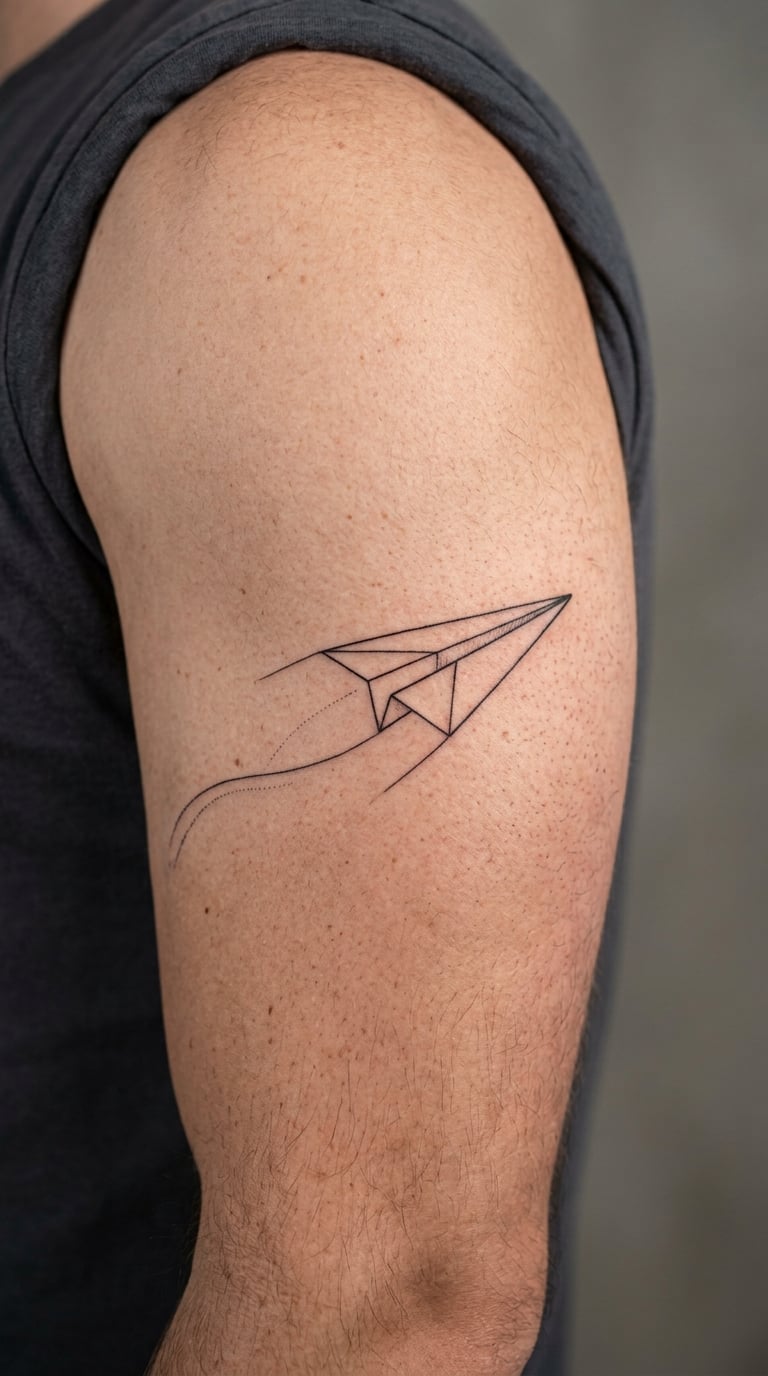
A single thin-line paper plane, drawn with one confident stroke weight, plus two sparse lines trailing off behind it. No shading, no border, no banner. The whole thing can sit in a 4 inch (10 cm) block and still feel finished, because the empty skin around it does the work.
People usually pick this one for the way it points somewhere. Travel, movement, getting on with things, that kind of reading. The meaning is yours to set, not the design’s to dictate.
Placement: Outer upper arm just below the shoulder, or the inner bicep if you want it visible only when you roll a sleeve.
Size: 3 to 4 inches (8 to 10 cm) wide, angled slightly with the arm rather than square to it.
Style: Fine line, single-needle weight.
Pain: Low to medium on the deltoid. Honest ageing note: this line weight softens and spreads with sun exposure, so plan on a refresh every few years and skip the beach gun for the first weeks.
Make it yours: Trace a route you actually took, or add one tiny coordinate line under the plane in the same weight.
How This Fine-Line Design Fits a Quarter Sleeve
Sparse fine line looks thin on paper and thin on a big arm, which is why artists scale it up. On a quarter sleeve the trick is placement: the design follows the deltoid curve, and the trailing lines break the outline of the shoulder so the piece reads as deliberate rather than small. Most of the quarter sleeve stays skin. That negative space is what makes the composition feel complete, and it leaves genuine room to grow the piece into a half sleeve later if you want.
2. Blackwork Mountain Range
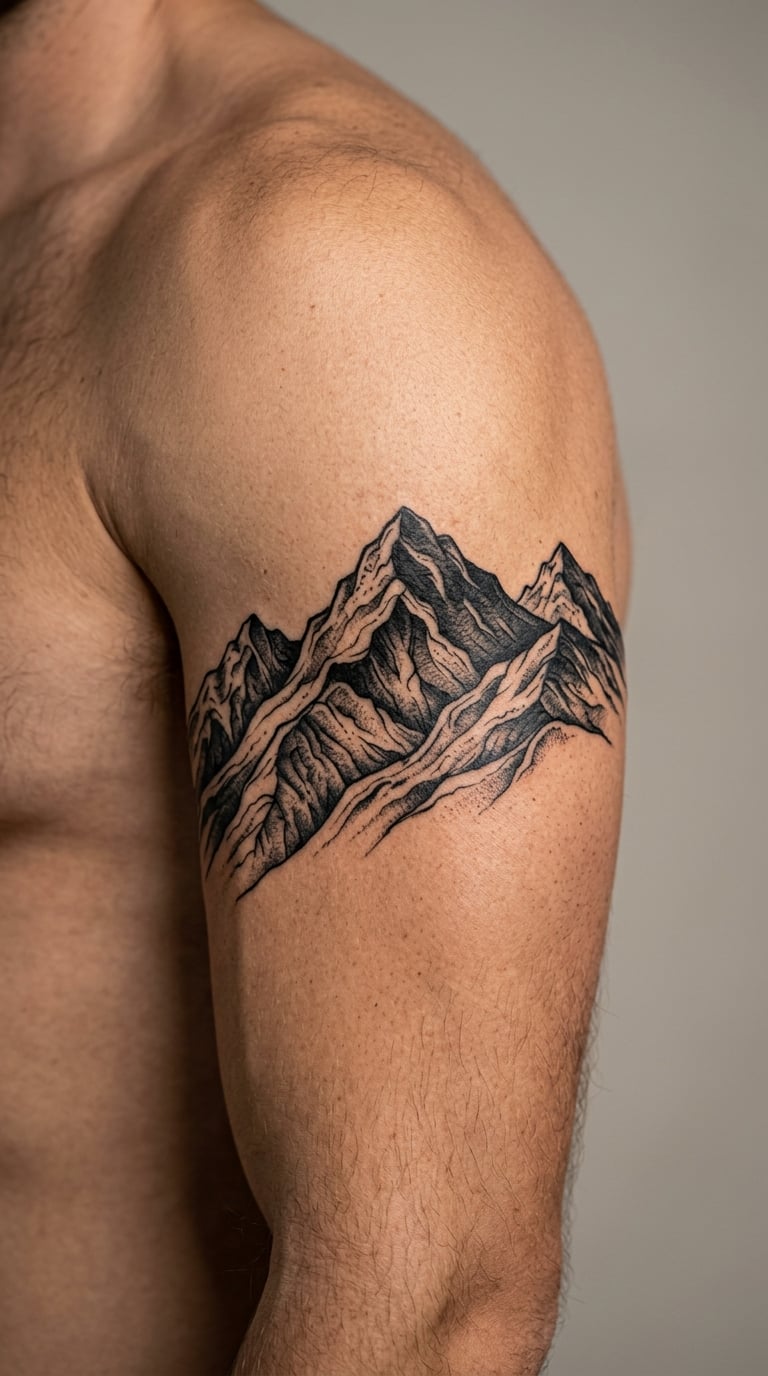
A solid black silhouette of three layered peaks, the nearest one filled in flat, the ones behind it broken by a few thin contour lines to suggest depth. Enough black mass that it registers from a distance, which is the whole point of the style.
Endurance, aspiration, a specific range you have actually stood in. Half of my favourites in this category turn out to be a real place with coordinates, not an abstract idea.
Placement: Deltoid flowing down and back along the outer upper arm. The shoulder cap is the natural home for a ridgeline.
Size: 5 to 6 inches (13 to 15 cm) across, tall enough that the peaks are not competing for the same line.
Style: Blackwork, solid fills with light line detail.
Pain: Medium. The shoulder cap is fleshy and sore after the first hour, and the deltoid tightens as you tense up. Ageing note: black holds its own line, but sun bleaching on the front of the shoulder shows faster than the outer arm.
Make it yours: Put the range where you have been, or add a single pine at the base to mark the elevation.
3. Traditional Koi in Motion
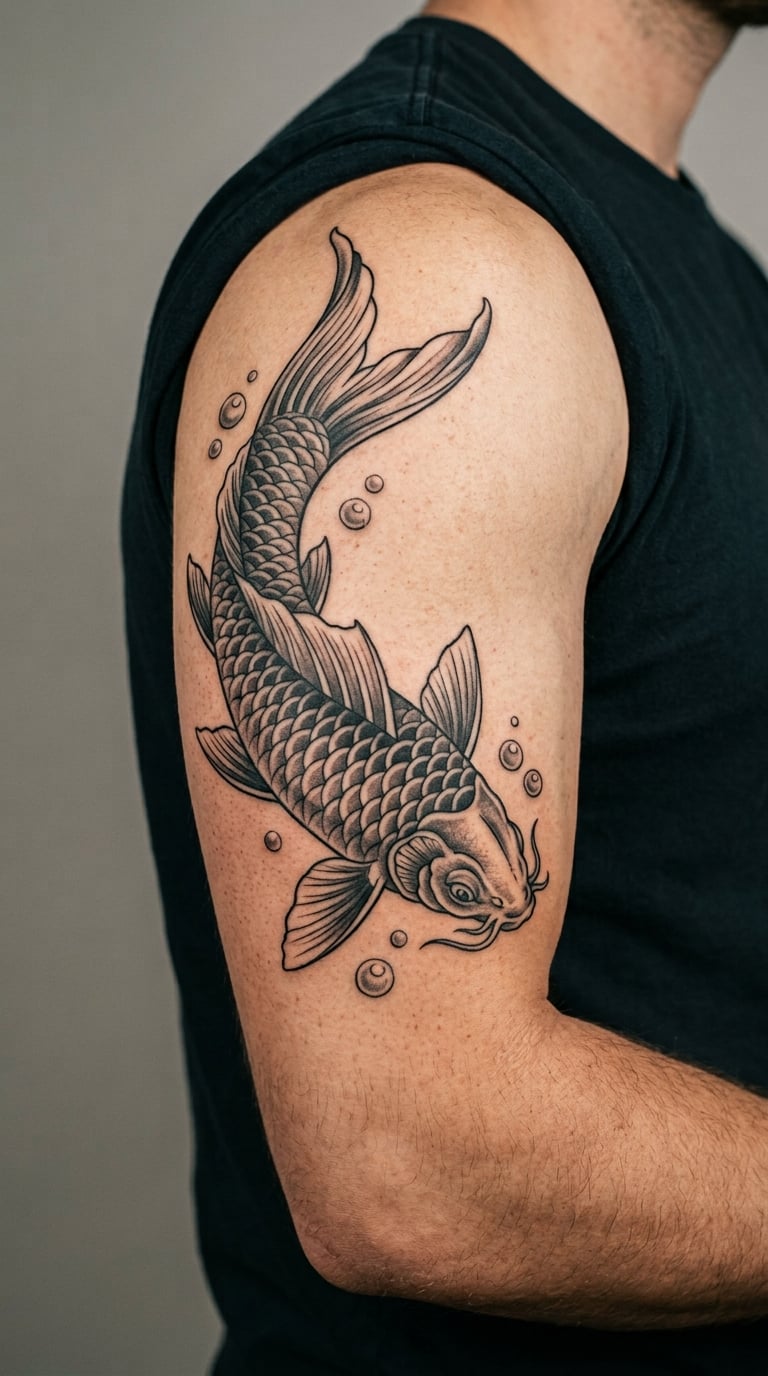
A koi built with defined scales, trailing fins and three small bubble accents, rendered in black and grey or with one limited colour such as orange. The body curves along the arm so it looks like it is swimming around the bicep rather than pasted onto it.
Perseverance, transformation, strength come up constantly, and men choose it for the flow of the composition as much as the symbolism. Some pick it because of a koi they saw at a shop years ago and never forgot.
Placement: Upper arm, starting at the outer deltoid and curving toward the biceps, so the tail disappears around the back of the arm.
Size: 5 inches (13 cm) long is enough for readable scales without crowding.
Style: American traditional or black and grey realism.
Pain: Medium, longer under the bicep where the skin is thinner. Ageing note: saturated orange softens toward yellow over the years, so ask for a deeper starting tone than you think you want.
Make it yours: Add a wave pattern or a small water plant beneath it, and leave the bubbles in a pattern that means something.
4. Geometric Compass Point
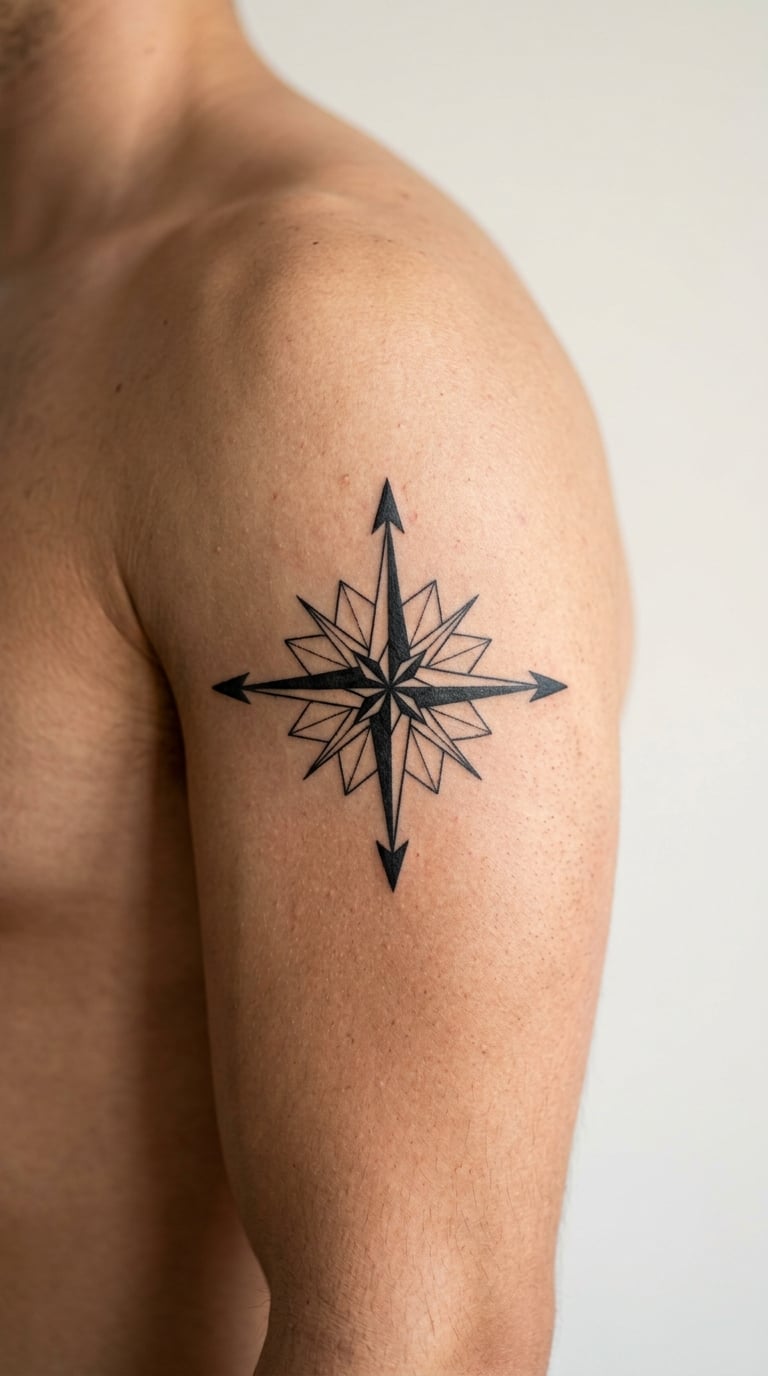
A compass built from restrained straight lines: four sharp cardinal points, a small central star, and a clean circle. No filigree, no scrollwork, no shading. The restraint is what keeps it from looking busy at arm scale.
Direction and finding your way show up constantly in this category, though plenty of men simply like the geometry and have never attached a story to it.
Placement: Outer upper arm, centred a couple of inches below the shoulder so it stays clear of the deltoid curve.
Size: 4 inches (10 cm) wide. Anything larger and the linework starts to look thin.
Style: Geometric linework, black ink only.
Pain: Low to medium, mostly needle-prick discomfort on the outer arm. Ageing note: this is one of the few designs that can hold micro-line detail for years if it is not sun exposed, but the sharpest points blur first.
Make it yours: Replace one cardinal point with a small letter or set the inner star as a date in numerals.
A word of caution: resist the urge to add micro-detail. Compass designs that combine eight points, dotted rings and tiny text usually look muddy once healed, because the artist has to draw thinner lines to fit. Four clean points will still be sharp in ten years.
5. Flowing Botanical Branch
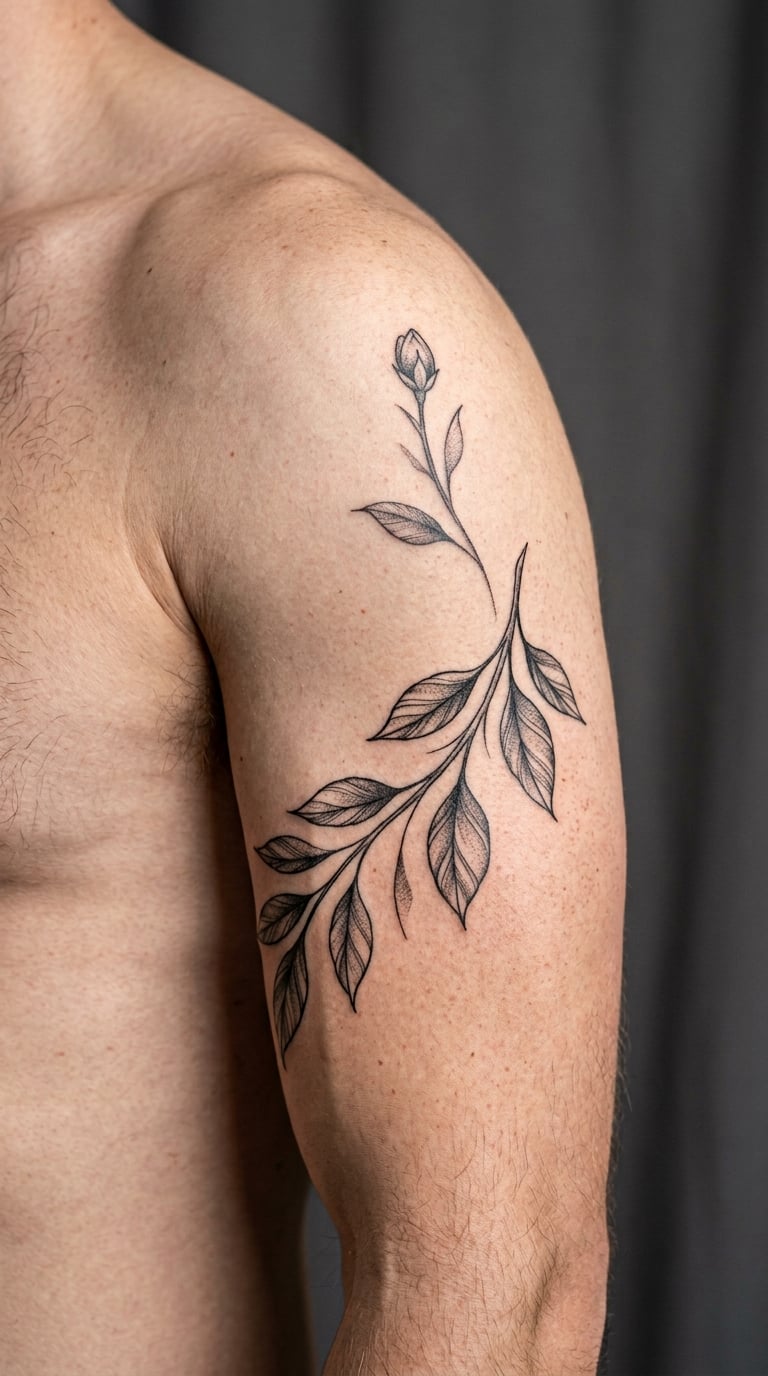
A single branch with individually shaded leaves, following the upper-arm curve from the deltoid toward the bicep, with one small bud left unfinished at the end. Botanical realism shades every vein; ornamental linework leaves the leaves as open shapes. Pick one and stay in it.
Plants get chosen for personal associations far more often than any fixed meaning. A branch from a specific tree, or the species someone grew up around, is the usual reason.
Placement: Deltoid to upper bicep along the front-outer curve, where the branch has natural room to arc.
Size: 6 inches (15 cm) long, tapering from fuller leaves near the deltoid to a single bud.
Style: Botanical realism or ornamental linework.
Pain: Medium, with the upper inner arm more sensitive than the outer. Ageing note: fine vein detail is the first thing to disappear, so an artist who simplifies the veins will be doing you a favour.
Make it yours: Use a species with a reason behind it, and add one small leaf in a single colour so the piece has one point of contrast.
6. American Traditional Rose
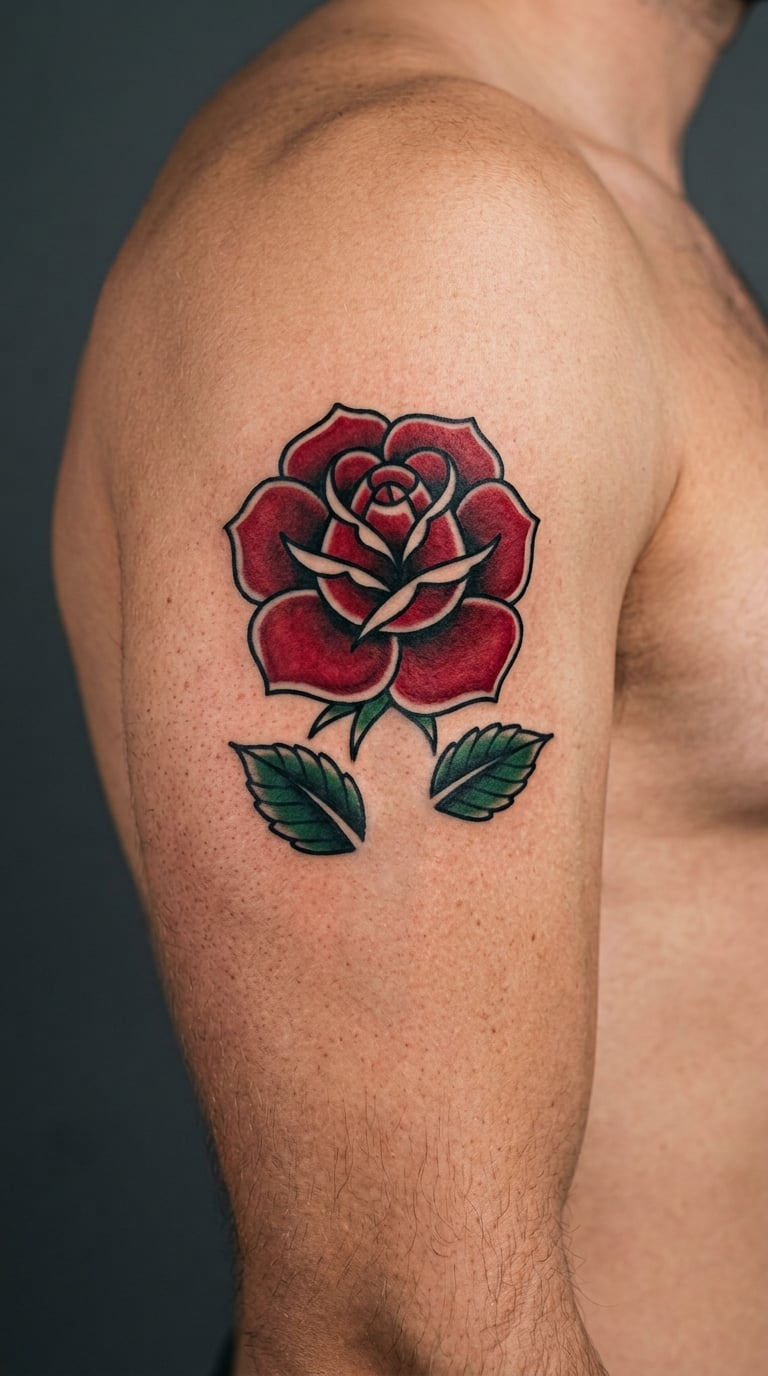
A bold red rose with heavy black outlines, deep petal shading and two green leaves, sitting on a clean traditional silhouette with nothing else crowding it. The heavy outline is the signature: it is what makes old-school pieces still readable at a distance.
Its appeal is mostly visual rather than symbolic, though love, grief and balance all get attached to it depending on the colour. Men who came up around traditional flash tend to reach for it first.
Placement: Outer upper arm, centred. The round bloom suits the broad deltoid better than a narrow forearm.
Size: 4 inches (10 cm) wide, with petals that still have room to breathe.
Style: American traditional, heavy-line colour.
Pain: Medium and steady, one of the easier shapes to sit through. Ageing note: red is the first colour to shift, going orange-pink, and the green leaves yellow. A touch-up every three or four years keeps it sharp.
Make it yours: Change one petal to a different colour, or add a stem that wraps once around the bicep.
7. Japanese-Style Rising Wave
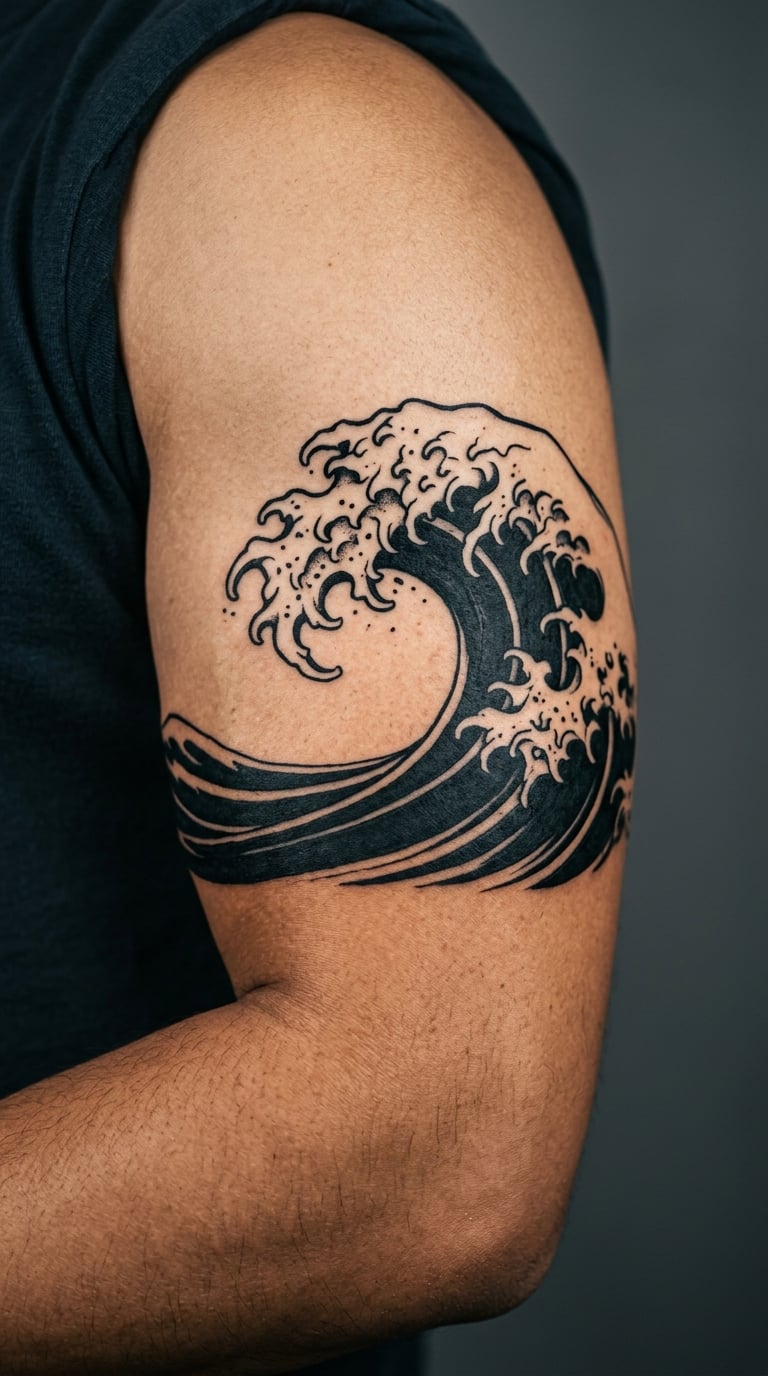
A bold black wave with crisp white foam cut out of it and a small claw-shaped crest, composed with plenty of empty space around the curl. The influence is Japanese in structure, so keep the composition balanced and avoid tracing any existing artwork.
Water imagery reads as resilience or constant motion to most people who choose it, and it simply looks good moving around the arm. Both reasons are fine.
Placement: Upper arm, wrapping so the crest breaks over the outer bicep.
Size: 5 inches (13 cm) wide with breathing room above and below the foam.
Style: Japanese-influenced black ink with negative space.
Pain: Medium, and the inner bicep is where you will feel it. Ageing note: fine white foam lines are thin and soften faster than the solid black, so keep the foam shapes fairly broad.
Make it yours: Add a small sun disc behind the crest, drawn as a simple circle rather than a detailed sun.
8. Geometric Snake
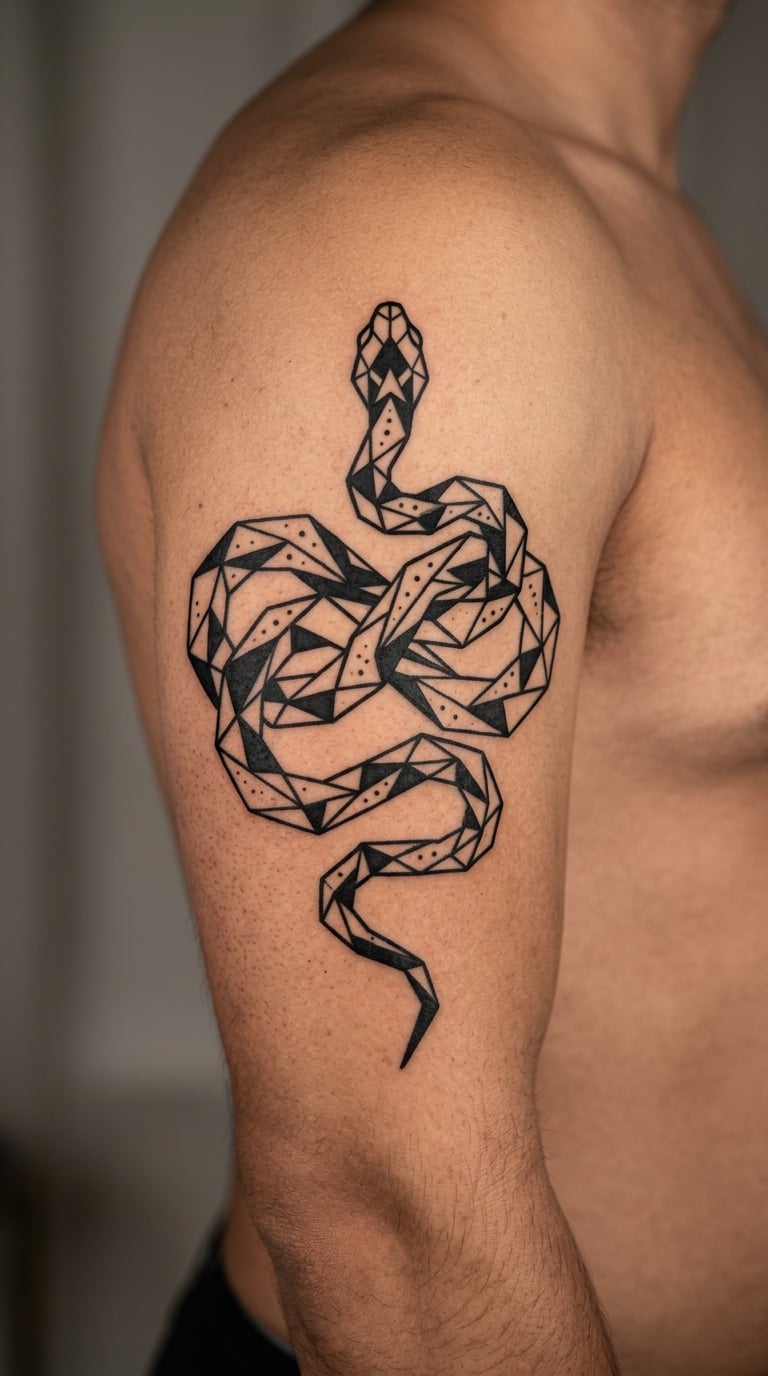
A snake broken into angular interlocking body sections, each one a flat plane, with a scatter of dotwork scales along the spine. The body curls around the outer upper arm, so the shape changes as the arm turns.
Transformation, instinct, protection are the usual associations, and they are personal rather than fixed. The geometric treatment is less literal than a traditional serpent and reads more like an abstract form.
Placement: Outer upper arm curling toward the back, or wrapped as a partial band if you want it to read as a ring.
Size: 6 inches (15 cm) long, tightening as it wraps.
Style: Blackwork geometry with dotwork accents.
Pain: Medium to high. A long thin design means the needle crosses the same skin over and over, which stings more than a solid black area. Ageing note: the tightest curves distort first as the arm moves, so ask for slightly wider joins.
Make it yours: Give the head one distinguishing detail, or run the tail into a small geometric knot at the back.
9. 3D-Effect Arrow
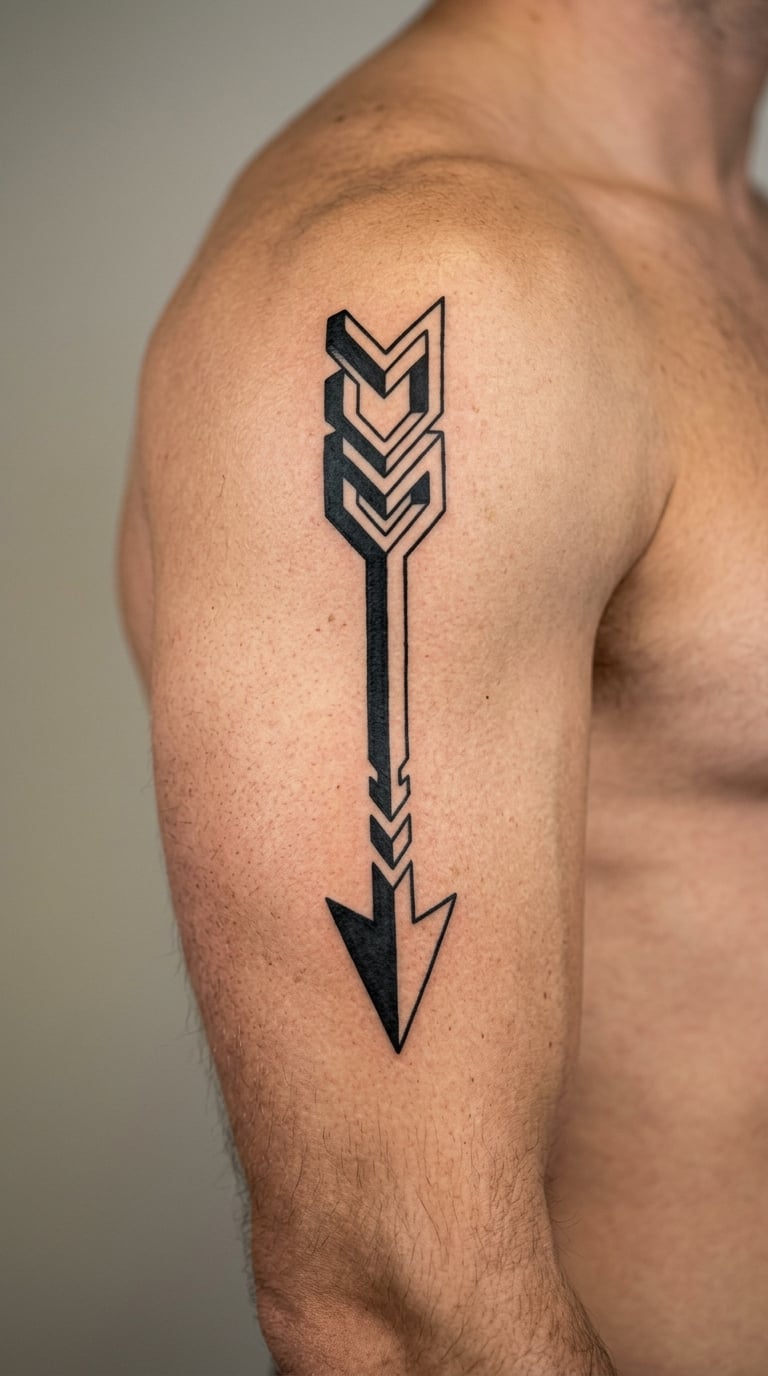
A long arrow built from solid black, with negative-space notches cut into the shaft to imply depth and a bevel. The illusion works because the notch spacing follows the curve of the arm rather than sitting in a flat plane.
Direction and momentum are the reasons this motif keeps coming back. A few men use it as one half of a matching pair across both arms.
Placement: Deltoid down toward the upper bicep, angled so the head points up the arm.
Size: 6 inches (15 cm) long, which is the minimum for the depth illusion to hold together.
Style: Blackwork with negative-space shading.
Pain: Medium. Placement matters more here than for most designs, because a badly mapped arrow will look flat or bent no matter how well it is drawn. Ageing note: notches in white skin will soften and read as grey, so the effect becomes subtler rather than worse.
Make it yours: Put a set of coordinates or a short date along the shaft in the same bold weight.
10. Nautical Compass Rose
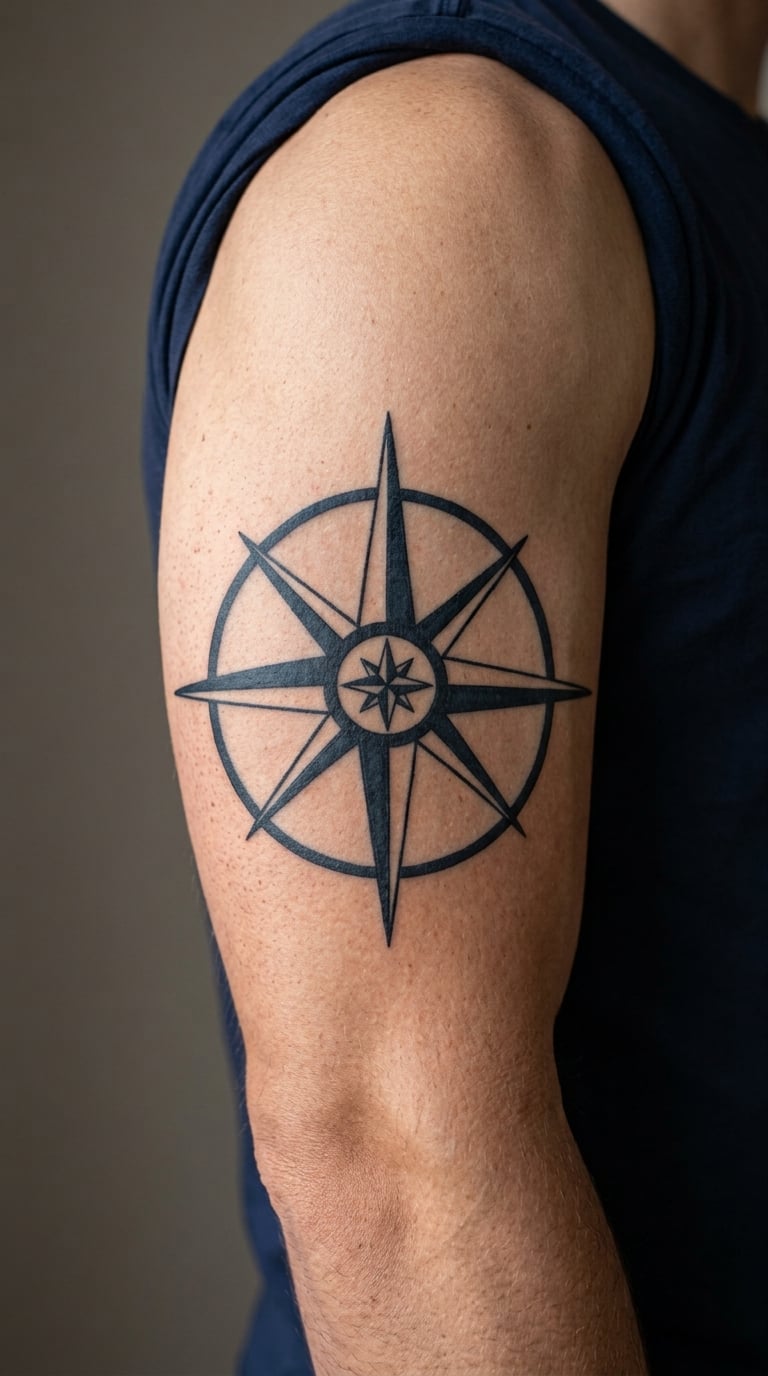
A balanced compass rose with eight tapered points radiating from a clear central axis, rendered in black with navy on alternating points. The symmetry is the hard part, and it needs an artist who is comfortable drawing straight freehand lines.
Sailing, navigation and travel sit underneath most picks. If you have never been on a boat, the same design works as a general directional motif.
Placement: Upper arm, wrapped so the left and right points disappear toward the back.
Size: 5 inches (13 cm) wide. Eight points on a small arm turn into a starburst, so resist going under 4 inches.
Style: Illustrative linework with a restrained nautical palette.
Pain: Medium, and the symmetry means the work is spread evenly, which helps in a long sitting. Ageing note: navy sits next to black visually, so if it fades it just reads as a slightly softer black. Less of a problem than it sounds.
Make it yours: Add a small banner with a single word, or switch the eight points to four and gain a lot of breathing room.
11. Minimalist Pine Tree Trio
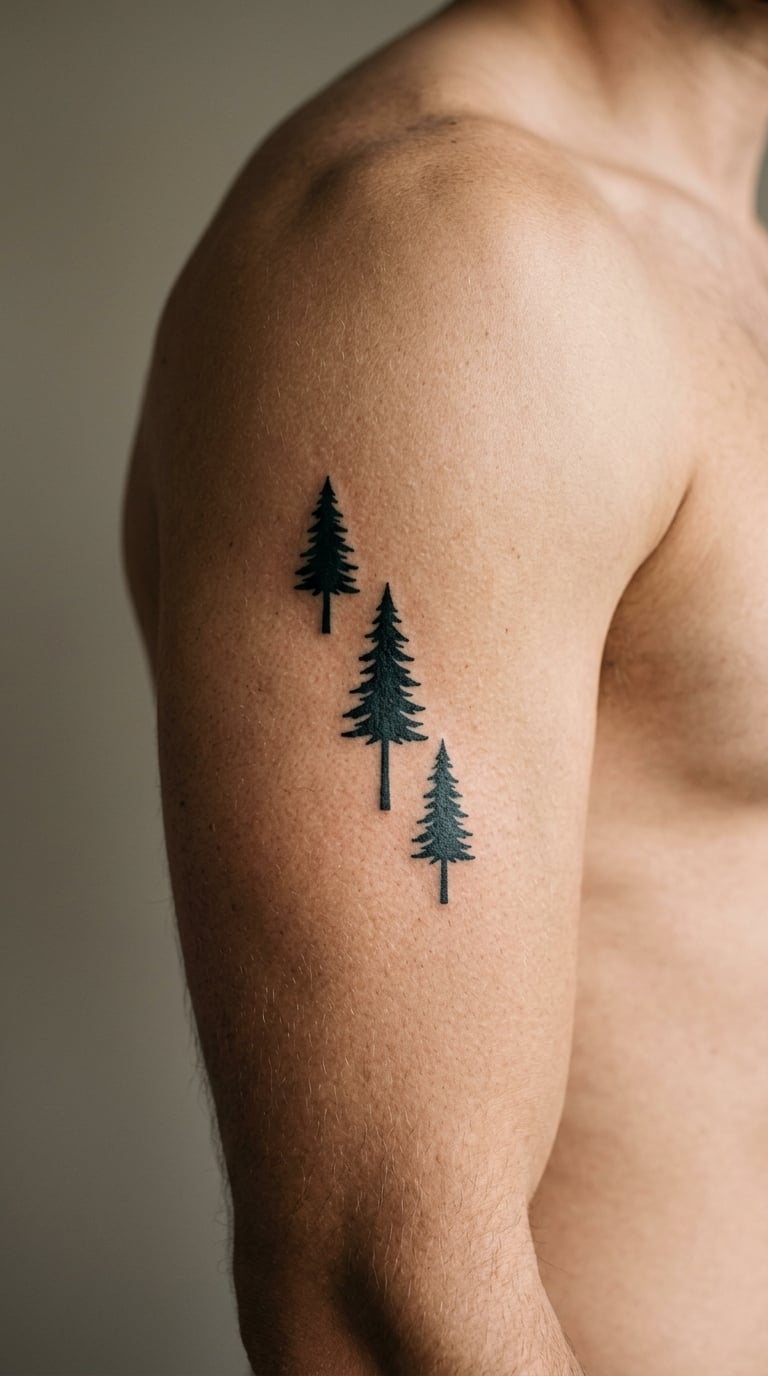
Three pine silhouettes in staggered heights, tallest at the back, each one a flat black shape with two or three branch lines. No shading, no trunk texture, no ground line. It is the quietest option in this whole list.
Outdoors, winter, cold water, a place you used to go. Clean enough that it works at the office and bold enough to notice when your sleeve is down.
Placement: Outer upper arm in a horizontal row, or stacked diagonally from the deltoid down.
Size: 4 inches (10 cm) tall for the tallest tree, the others slightly less.
Style: Minimalist silhouette.
Pain: Low, the shortest session of any design here at roughly an hour for the full trio. Ageing note: solid silhouettes age better than almost anything else because there is nothing thin to spread.
Make it yours: Order the three trees by height to match three people, or put a small mountain line behind them.
12. Blackwork Eagle
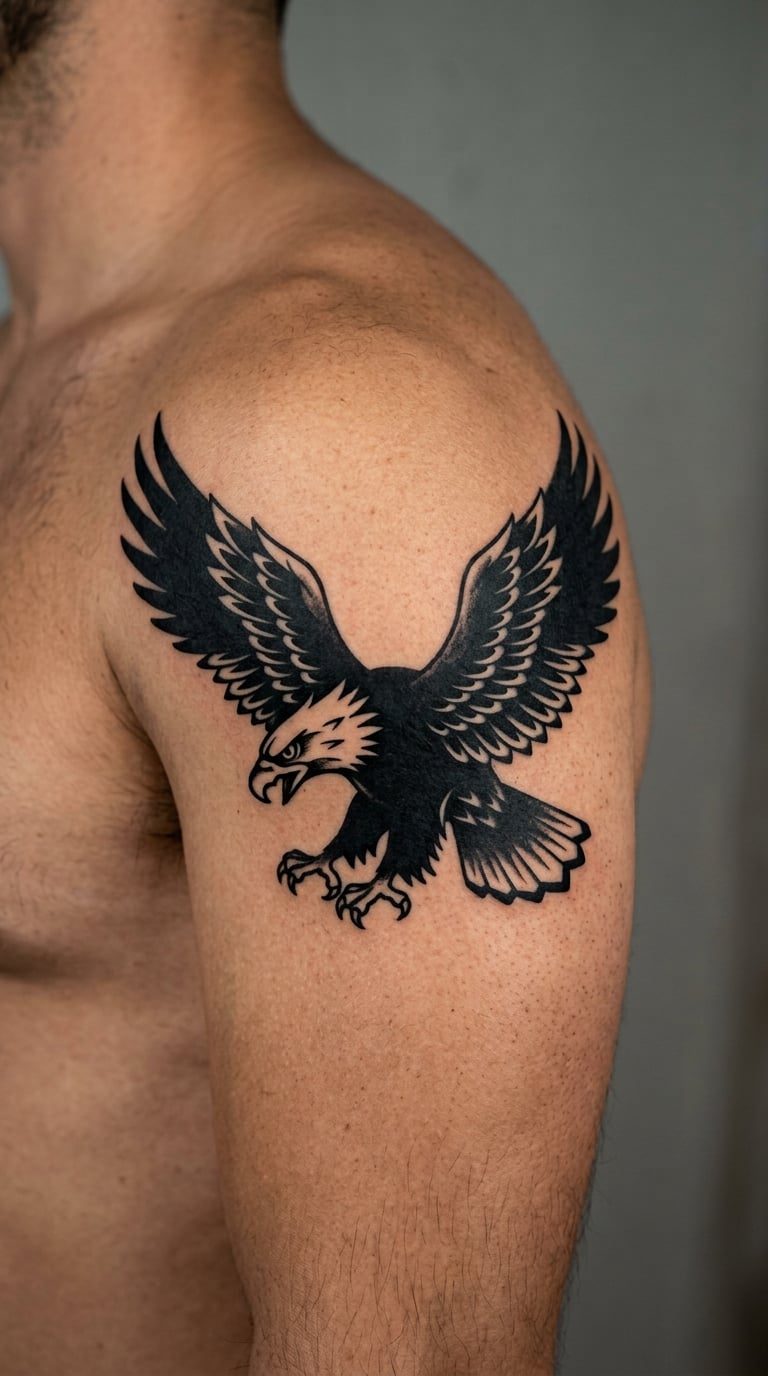
A high-contrast eagle with broad wings, one strong central silhouette, and a handful of negative-space cuts separating the primary feathers. Restraint here is everything: an eagle with every feather drawn turns to grey mush within a few years.
Freedom, strength and focus are the associations people name, and they are chosen symbolism rather than a fixed code. Plenty of men pick it simply because the shape fits a shoulder.
Placement: Across the deltoid, wings running front to back, so the span matches the shoulder width.
Size: 6 inches (15 cm) across the wings.
Style: Blackwork with negative-space feather detail.
Pain: Medium to high. The deltoid caps on both sides of the shoulder are sensitive, and a wide piece means long needle passes over moving muscle. Ageing note: heavy black stays sharp, and the white feather cuts are what soften first.
Make it yours: Angle the wings slightly down so the bird reads as perched rather than hovering, or add one small banner in a single colour.
13. Celtic Knot Band
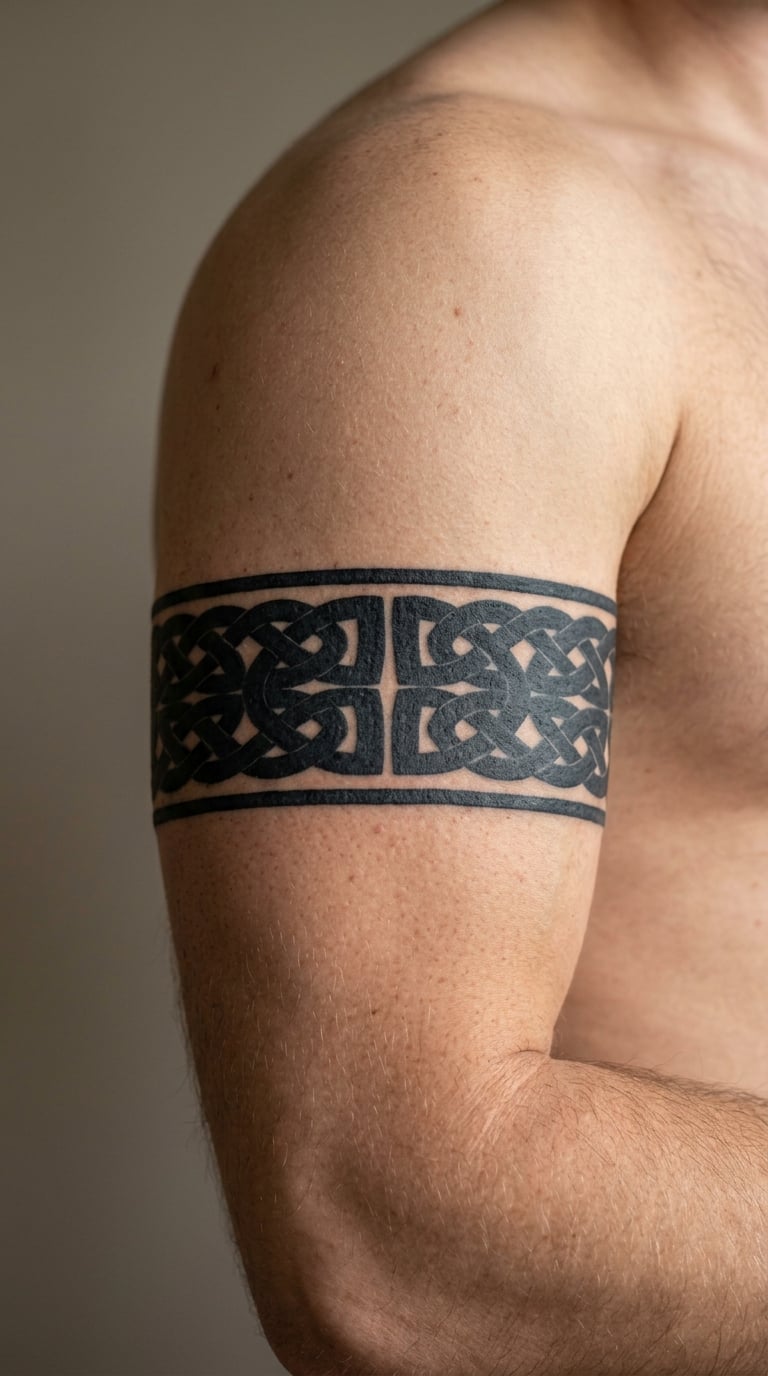
A continuous interlaced knot with evenly woven ribbon lines, each strand passing over and under with consistent spacing. Authentic traditional knot construction keeps the weaves running edge to edge. Generic ornament that just looks vaguely woven has uneven over-under crossings and shows it.
Meanings here depend entirely on the wearer and the cultural context, and it is worth asking the artist where the pattern comes from rather than assuming.
Placement: Bicep, sitting just below the deltoid as a band that circles the arm.
Size: 3 inches (8 cm) wide, with enough band height that the individual strands are not cramped.
Style: Interlace linework.
Pain: Medium to high, because the pattern forces the needle back over the same areas constantly. Ageing note: thin interlace lines are the definition of fine detail, so expect a touch-up every three years and keep it covered in summer.
Make it yours: Extend the band into a full bicep wrap on one side only, leaving the other side clear for a future piece.
14. Ornamental Mountain-and-Wave Scene
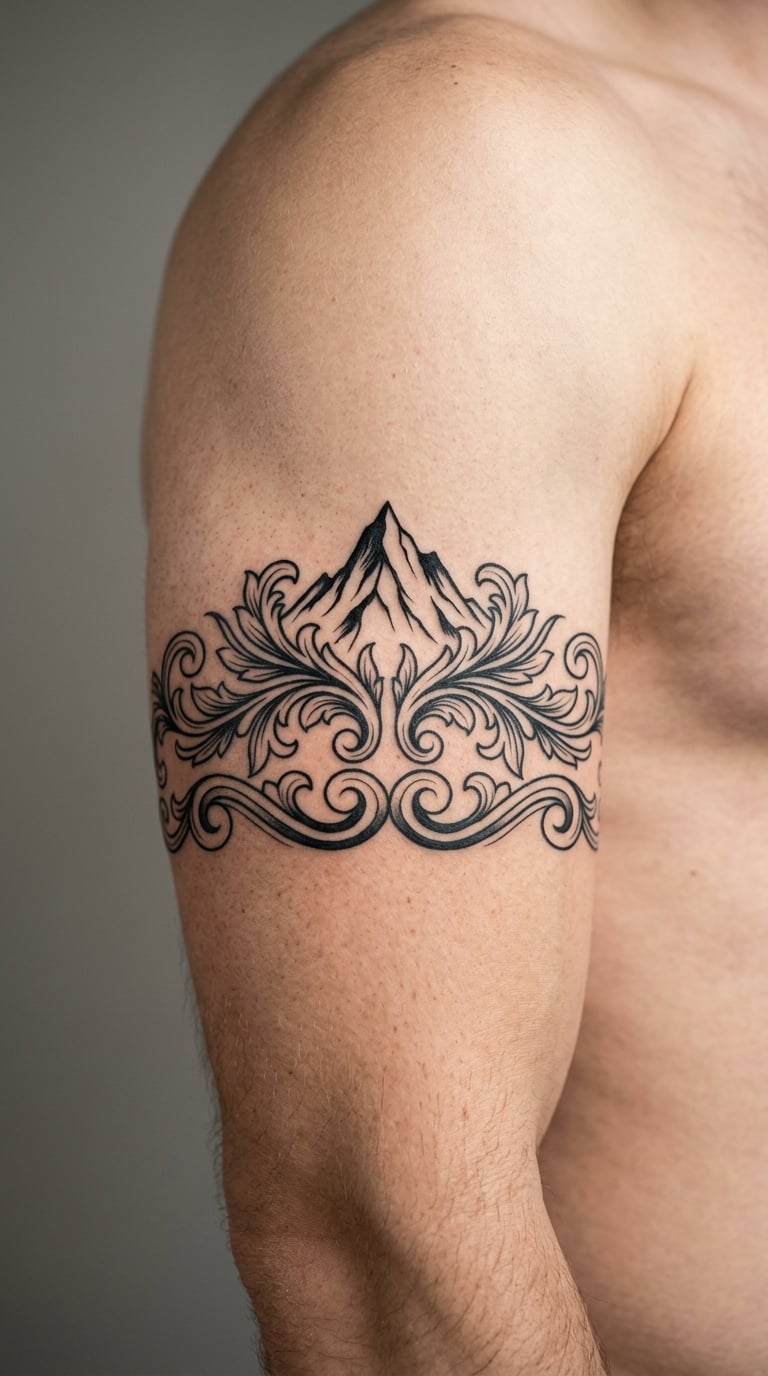
A balanced ornamental composition: one central peak, symmetrical leafy flourishes on either side, and a single flowing wave or river along the base. Symmetry is what makes it read as ornamental rather than as a nature scene, and it is also what makes it fill a quarter sleeve without tipping into full-arm territory.
Balance, growth, a place you keep coming back to. The three-part structure, land, foliage and water, gives an artist room to build density without adding a fourth competing subject.
Placement: Wrapping the upper arm, with the peak centred on the outer face so the flourishes balance front and back.
Size: 7 inches (18 cm) wide. This is one of the larger entries and the one most likely to run past a single session.
Style: Ornamental blackwork.
Pain: High, and the long sitting is real. A quarter sleeve at roughly T-shirt-sleeve length commonly runs six to seven hours, with artists offering a two-day split. Ageing note: dense fine foliage softens noticeably, so keep the darkest areas as solid black and let the detail sit in the mid-tones.
Make it yours: Swap the wave for a river and put a name along the base in the same weight as the foliage.
15. Micro-Realistic Wolf
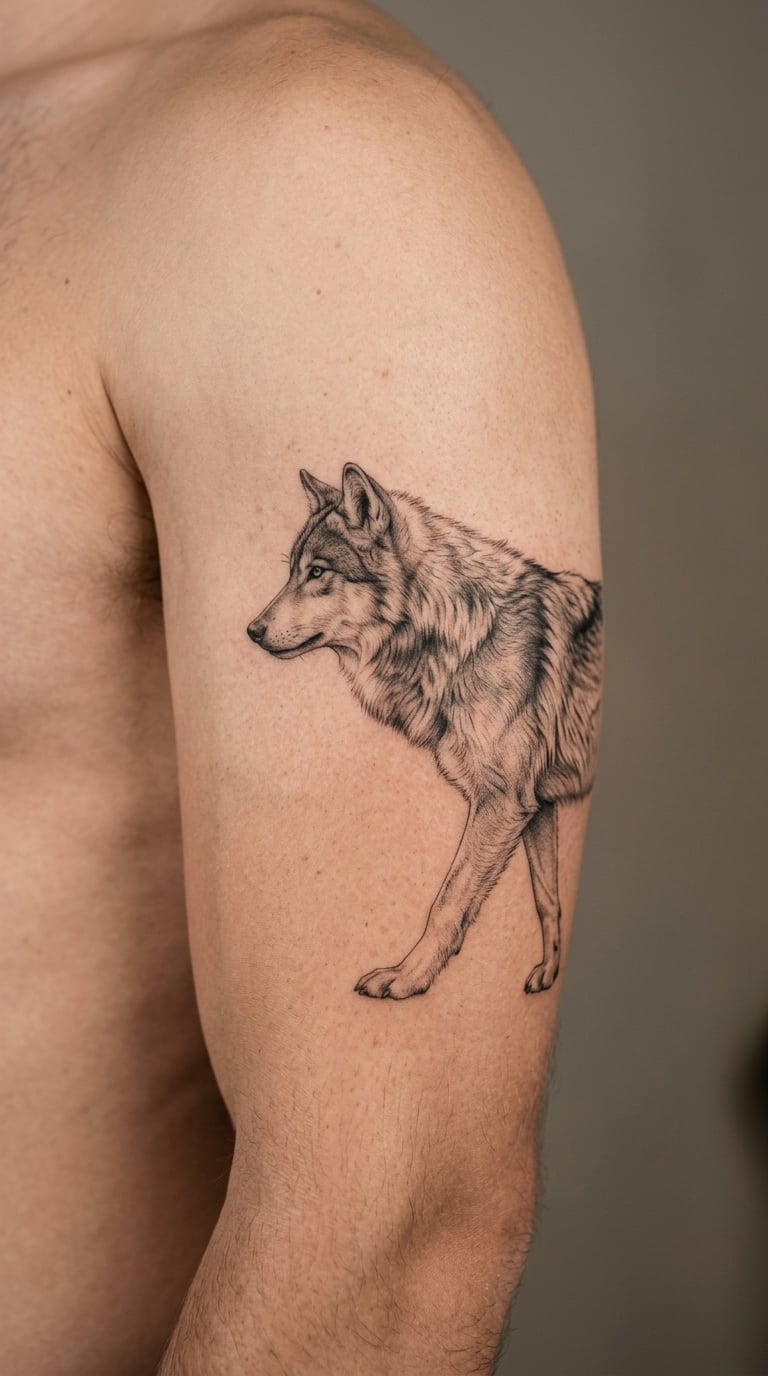
A wolf in side profile with small-scale fur texture, controlled grey shading and a clear silhouette against untouched skin. The silhouette does the heavy lifting. If the profile is weak, the fur work cannot rescue it.
Loyalty, instinct, independence, family. It is a common pick in the north and gets chosen for very personal reasons, so it is not really a design with one meaning.
Placement: Outer upper arm, head angled slightly up so the profile stays clear.
Size: 4 inches (10 cm) long, the point where fur texture still resolves.
Style: Micro-realism or black and grey realism.
Pain: Medium, and grey shading passes over the same skin many times. Ageing note: soft grey gradients bloom outward over the years, so the artist should build the fur with slightly darker values than you want healed.
Make it yours: Put the profile of a specific dog or wolf in place of the generic animal.
16. Traditional Lighthouse
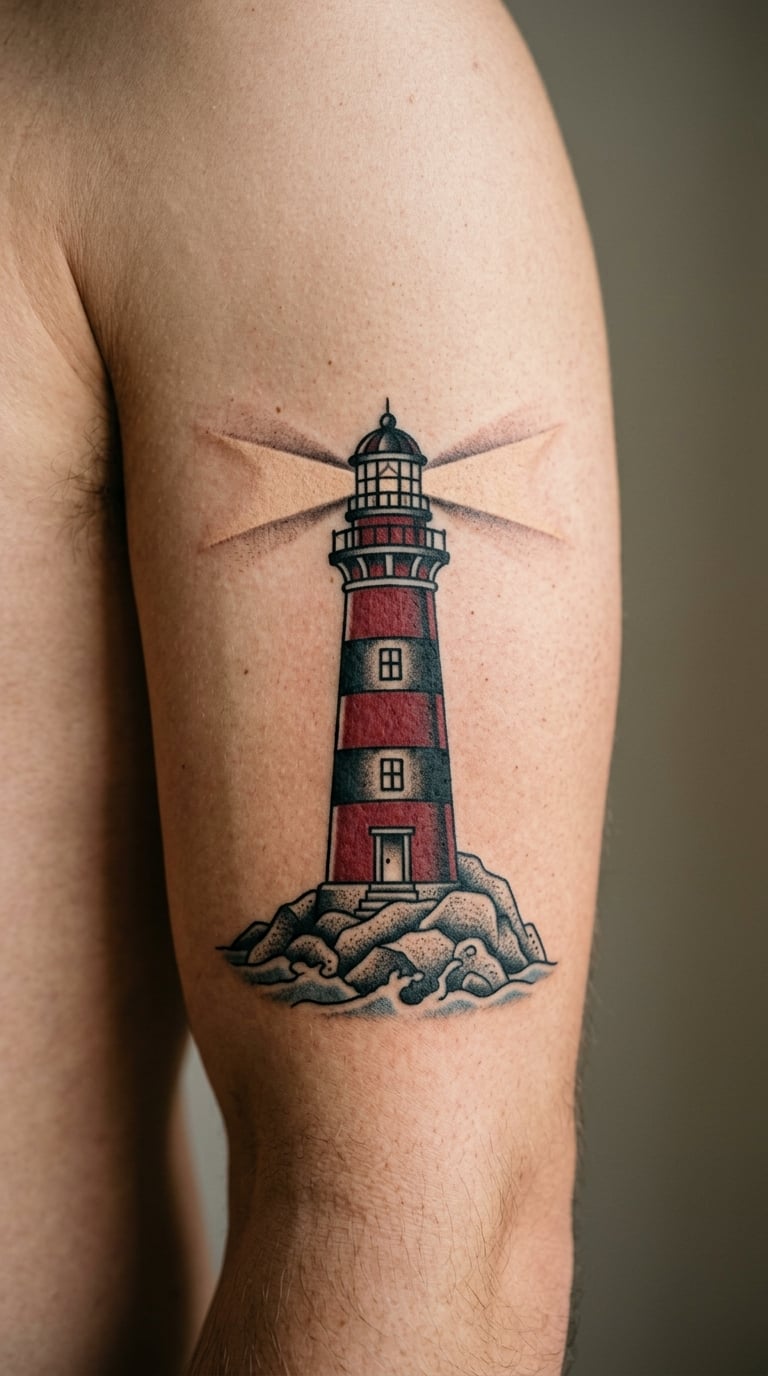
A red-and-black lighthouse with two cream beams angling out above a small grey rock base, drawn in traditional bold line with clean colour breaks. The vertical tower shape is the practical part: it gives the composition a spine the upper arm rarely gets from scenery.
Coastlines, guiding light, a stretch of water that matters to you. It is a quiet piece that gets asked about more than the flash suggests it should.
Placement: Outer upper arm, tower running vertically with the beams at the top. It also works well standing on the shoulder cap.
Size: 5 inches (13 cm) tall, which is tall enough for the beam angles to read.
Style: American traditional colour.
Pain: Medium and predictable, since the outline does most of the work. Ageing note: cream and light grey fade the fastest, so ask for deeper tones in the beams and rock than looks right fresh.
Make it yours: Name the lighthouse you grew up near, or set the beams at a specific angle to match a real coastline.
17. Dotwork Constellation
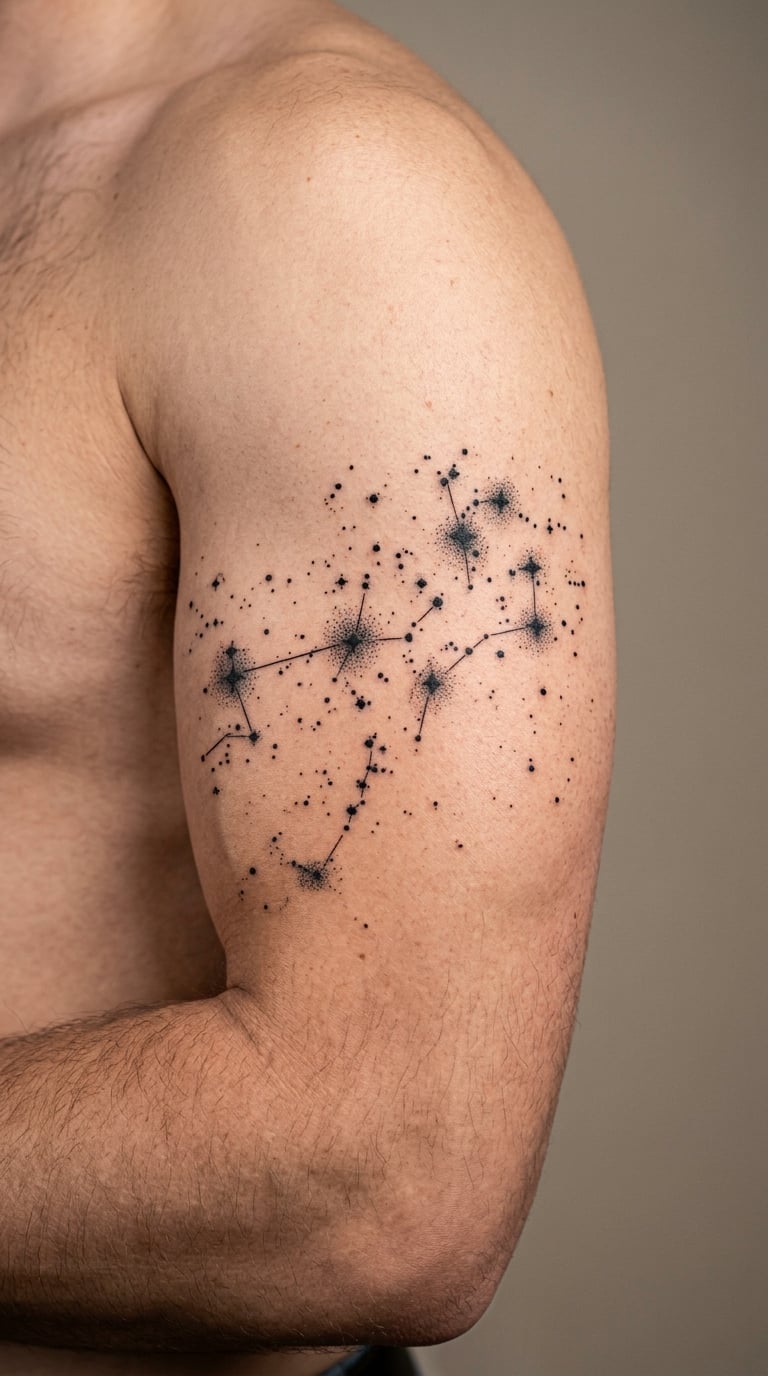
A real or invented constellation built from graduated dots, with fine connecting lines and open spacing between clusters. Dot density is the whole craft: even spacing reads clean, uneven spacing looks like a rash.
The night sky on a specific date, a family constellation, or a set of coordinates for a place that matters. Invented constellations give you complete freedom over the shape.
Placement: Scattered across the outer upper arm, with clusters following the deltoid curve rather than sitting in a square.
Size: 5 inches (13 cm) wide, using uneven cluster sizes to avoid a grid feel.
Style: Dotwork with fine line connections.
Pain: Medium and slow, because dotwork is many small passes. It can easily double your session time over an equal solid area. Ageing note: fine dots soften and the pattern can look smudged after a decade, particularly in sun, so keep the dot size generous.
Make it yours: Plot a real sky map for one date and location, which is the version people rarely regret.
18. Blackwork Rose with Negative-Space Stem
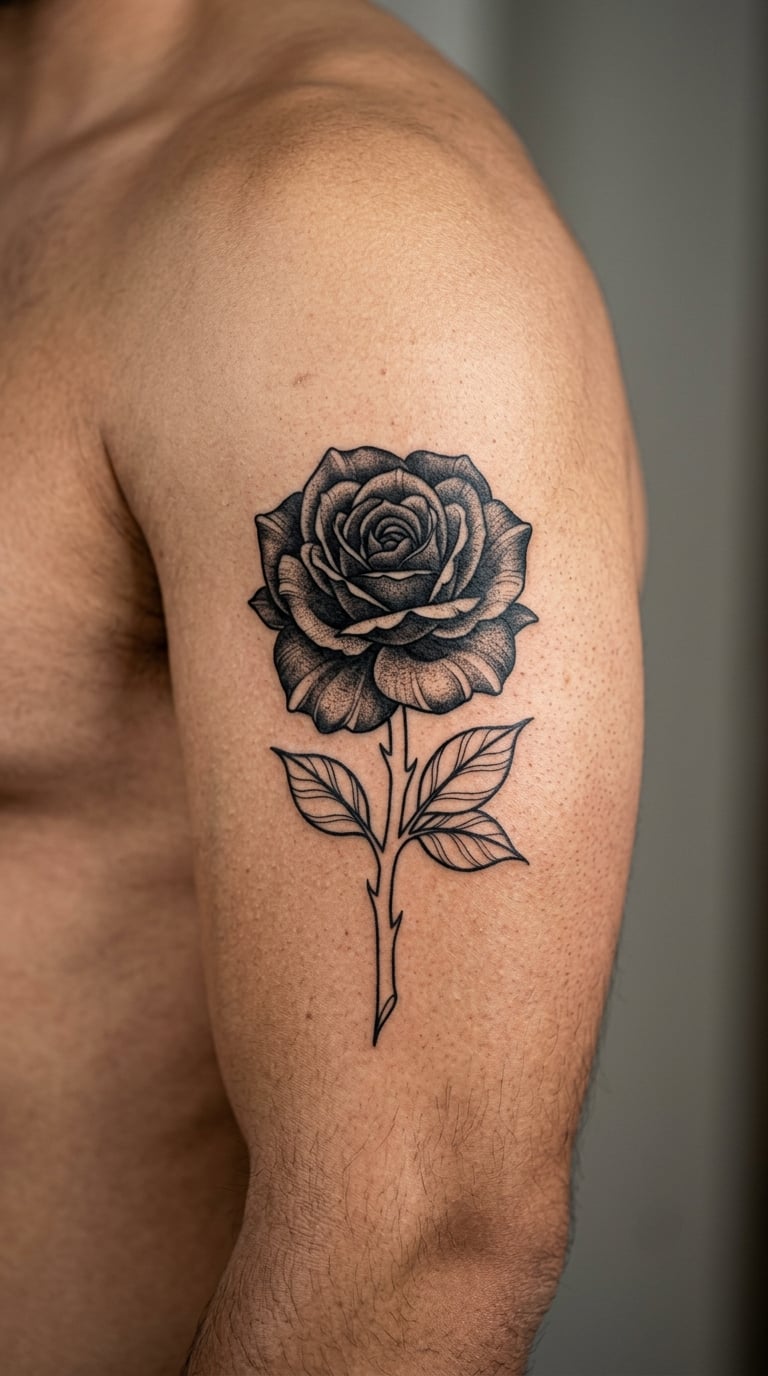
A rose with a densely shaded bloom in solid black, while the stem and leaves are formed partly from the bare skin around them. The contrast between the heavy flower and the open stem is the entire effect.
Consider it a stylistic choice rather than a message. Plenty of men prefer the all-black version of a motif over colour, and the negative space keeps the piece from looking heavy on a large arm.
Placement: Outer upper arm, centred, with the stem angling down toward the elbow.
Size: 4 inches (10 cm) wide.
Style: Blackwork with negative space.
Pain: Medium, and the dark bloom is quick work while the stem line is slow. Ageing note: pure black on skin tends to soften to charcoal over time, which looks better than most people expect. The white gaps between petals will fill in slightly, so avoid hairline separations.
Make it yours: Add three small thorns along the stem, or wrap the stem once around the bicep so the plant continues past the flower.
19. Phoenix in Blackwork and Red
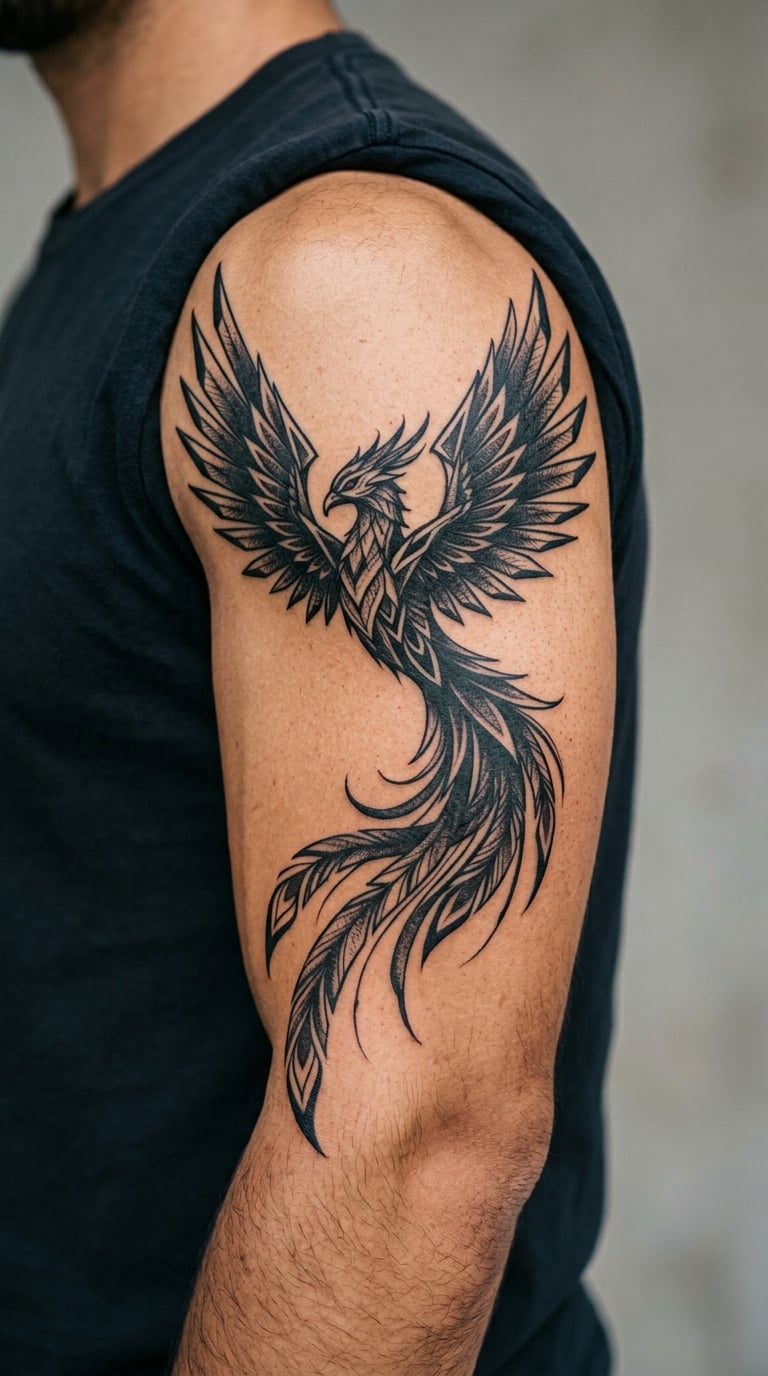
A rising phoenix with angular spread wings and a long sweeping tail, built on black ink foundations with crimson restricted to the tail feathers and the eye. The colour has to stay restrained or the black stops doing the work.
Renewal and change after a difficult stretch is the reason most people land on a phoenix. It is heavy-handed imagery and it works, mostly because the silhouette is genuinely good.
Placement: Wrapping the upper arm with the wings spanning front to back and the tail trailing toward the elbow.
Size: 7 inches (18 cm) wide, among the largest in this list and the most likely to need two sessions.
Style: Blackwork with red accents.
Pain: High, and long. Wrapping a detailed piece all the way around the upper arm in one sitting is where most first-timers underestimate. Ask about splitting it, and expect a red touch-up sooner than black, since crimson fades faster. Ageing note: the reds will need refreshing every two to three years to stay tight against the black.
Make it yours: Change the eye colour, or have the tail break into a scattering of separate feathers rather than tapering to a point.
20. Circuit-Board Motif
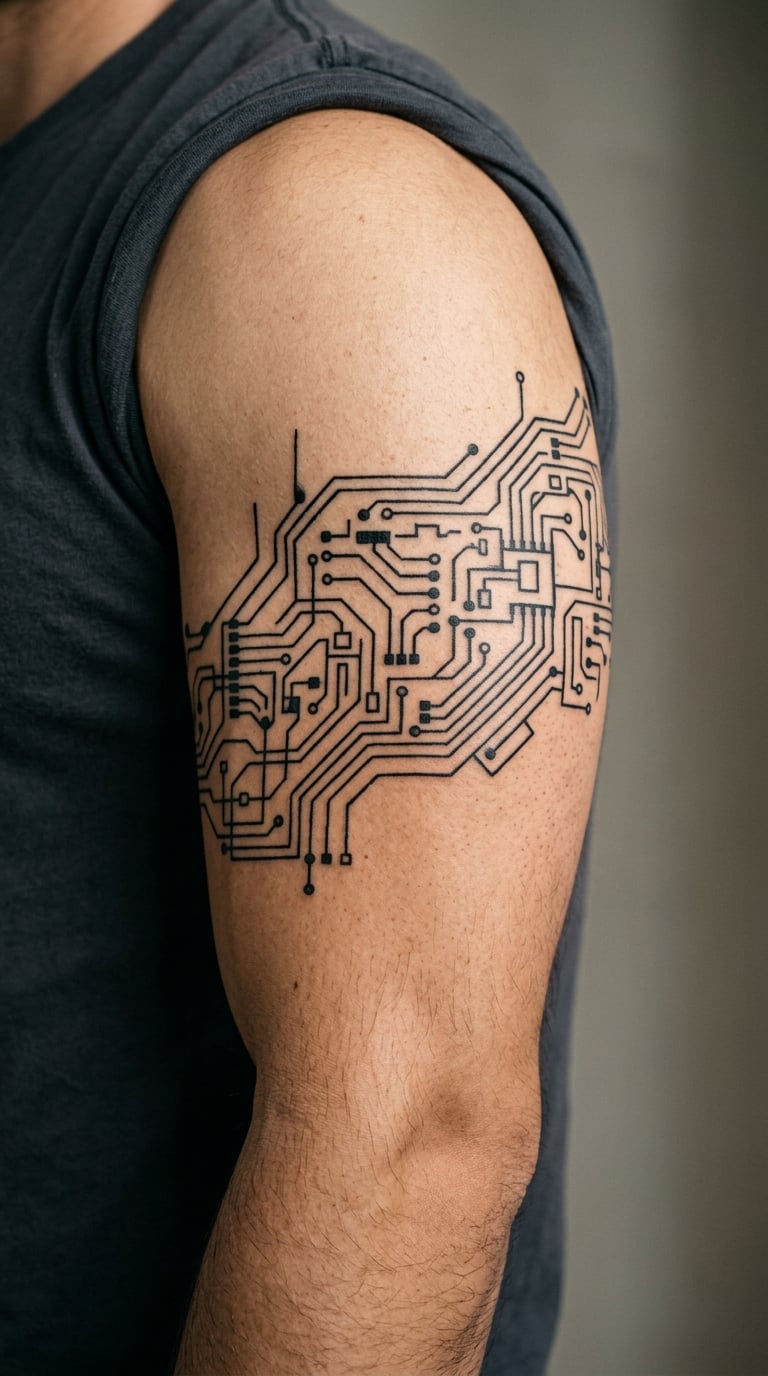
Controlled black linework branching like a simplified circuit board, with small nodes at the junctions and pathways that route around the arm’s contours. Real electronics references work; copied board layouts from a specific device do not, and any good artist will redraw it anyway.
Engineering, IT, service work, a hands-on job. The reason is practical rather than poetic, which is fine. It suits a man who wants the piece to look like something he does rather than something he feels sentimental about.
Placement: Curving across the upper arm so the pathways follow the bicep and shoulder, rather than sitting as a flat rectangle.
Size: 6 inches (15 cm) wide, with line weight scaled up so the traces stay visible.
Style: Technical linework, black ink.
Pain: Medium, and slower than the area suggests because the needle follows lots of short segments. Ageing note: this is a fading design. Fine traces disappear within a few years, so ask for the heaviest weight your references will allow and plan on a refresh.
Make it yours: Use the layout of a board you have actually worked on, with one route highlighted in red.
How to Choose the Right Design
Pick the design that fits the arm, not the flash that fits the trend. Six things decide most of it:
- Style before subject. Decide fine line, blackwork, traditional or realism first. Your arm, your sun exposure and how much detail you enjoy looking at close up will rule out half the options before you get to the motif.
- Visual weight against arm size. A quiet upper arm handles fine detail well. Bold motifs, eagles and phoenixes, need more canvas than people expect, and a small piece of a bold design tucked near the shoulder usually looks cut short.
- Size honestly. Measure the span from shoulder to mid-bicep before you commit to references. Most disappointments trace back to picking artwork drawn for a much larger area.
- Placement for the life you live. The outer upper arm shows in a short sleeve and hides under a long one. The inner bicep is only visible when you lift your arm. The shoulder cap is the most exposed spot and the least practical one for a work environment.
- Existing tattoos. If there is already work on that arm, ask whether the new design can be composed around it. Starting fresh on a covered arm is cheaper and cleaner than a cover-up later.
- The artist’s portfolio in that exact style. A blackwork artist and a micro-realism artist produce completely different results from the same reference. Look for healed work in the style you want, not fresh pieces posted the same week. Most studios will also tell you honestly if your idea is outside what they do well.
- How it will age. Solid black and heavy traditional line hold up for years. Hairline detail, fine dots and light colour do not. If you can accept a refresh every few years, anything works. If you cannot, ask for bolder line weight now.
One more thing worth deciding before the consultation: whether this is a finished piece or the first section of a larger one. Artists can leave negative space on the edges of a quarter sleeve so a half sleeve can grow out of it later. That is much easier than adding a forearm sleeve later and trying to make it look related.
Cost and Session Time
Cost varies more by city and artist than by design, so the ranges below are typical US figures rather than quotes. Session time is the more reliable indicator of what you are getting.
| Size | Typical session time | Typical US cost | Common in |
|---|---|---|---|
| Small, 2 to 3 inches | 1 to 2 hours | $150 to $400 | Fine-line pieces, silhouettes, single motifs |
| Medium, 4 to 5 inches | 2 to 4 hours | $300 to $800 | Most of the designs in this list |
| Large, 6 to 8 inches | 4 to 7 hours | $600 to $1,500 | Wrapping pieces, fine detail, full compositions |
Complex fine detail routinely needs two sessions, and that is normal rather than a problem. One common report is linework alone taking five hours in the first sitting and another five in the second, with the comment that size matters more than most people expect.
Four things move the total. Shop minimums mean a small piece can cost more than the hourly rate suggests. Location swings rates enormously between a small town and a major city. Artist experience matters more than style, and the flash artist down the street is usually cheaper for a reason. Finally, ask whether the quote is hourly or flat for the whole design, what the deposit covers, and whether a tip is expected, since a long session is a big chunk of someone’s day.
Set aside a small reserve for a touch-up. On colour-heavy work it is often needed within the first year, and on blackwork a free or discounted session in the first months is common at many studios.
Aftercare Basics
- Follow your artist’s aftercare instructions first. Every studio has a specific protocol for how long to leave the wrap on and what products to use, and it overrides anything general you have read online, including this list.
- Wash it gently. Clean lukewarm water, a fragrance-free soap, and clean hands. Pat dry with a clean towel or paper rather than rubbing.
- Keep friction and sun off it while it heals. Skip tight sleeves, rucksack straps, gym bags resting against the arm, and long days in direct sun. Loose shirts win for the first couple of weeks.
- Do not swim while it is healing. Pools, lakes and hot tubs are all off limits until the new skin has sealed over and your artist says so.
- Ask the artist, not the internet, about anything placement-specific. If a specific area of the piece looks different from the rest, or a question about that exact spot comes up, contact the studio directly. Your artist has seen your skin and knows what they did.
Frequently Asked Questions
How much of the arm should a quarter sleeve tattoo cover?
A quarter sleeve runs from the top of the shoulder to about the midpoint of the upper arm, roughly the same span as a T-shirt sleeve. A half sleeve continues to the elbow and a full sleeve reaches the wrist. Quarter sleeves are also sometimes placed on the forearm instead, running from the elbow toward the middle of the forearm. Both placements work, and the difference comes down to visibility and how much room the design needs.
Are quarter sleeve tattoos painful?
Most people rate a quarter sleeve as medium on the upper arm. The deltoid cap is the sorriest part, especially late in a long session, and the inner bicep is sensitive because the skin there is thin. The outer upper arm and the upper forearm are easier going. A small fine-line piece may be over in an hour, while a detailed wrap can run four to seven hours, and pain builds the whole time you are in the chair.
What is the best size for a first quarter sleeve tattoo?
For a first piece, aim for something around four inches (10 cm) wide rather than filling the whole quarter-sleeve span. You get a real composition on your arm without committing to a six or seven hour session, and it is much easier to grow into a larger piece later. A solid silhouette or a single motif in heavy line will also hold up better on a first go than fine detail or a wrapping composition.
Will a detailed quarter sleeve tattoo fade quickly?
It depends almost entirely on line weight and sun exposure. Solid black and bold traditional outlines hold their shape for years, while hairline detail, fine dots, thin geometric lines and light colour soften noticeably within a few. Cover the arm in summer, use sunscreen on it once healed, and expect a refresh every three to four years on detailed colour work. Ask the artist to scale your line weight up before you start.
Can a quarter sleeve be added to an existing arm tattoo?
Yes, though it is easier than a cover-up and harder than starting on clean skin. A new piece can be composed around existing work so the two read as one, or an artist can add background and negative space to blend old work into a larger composition. Bring your old piece healed to the consultation and expect to pay a design fee for the new composition. Quarter sleeve tattoo ideas for men that use negative space are the easiest to fit around existing work.
Conclusion: Where to Start
Pick one focal design and get the scale right before you fall in love with a reference. The fine-line paper plane or the minimalist pine trees are the safest first quarter sleeve tattoo ideas for men when your anatomy and session tolerance allow something quiet. If you are already building a bold collection, the phoenix, the koi or the blackwork mountain range will sit alongside it far better than anything delicate.
Check the size against the placement guide, bring a clear set of references, and walk into the consultation with one question: does this artwork fit this arm, at this size, in one session. If the answer is no, you want to hear that before the chair, not after. For ideas that go past the elbow, our half sleeve tattoo roundup covers the next stage.