
20 Best Tattoo Ideas for Horse Lovers: Small & Bold (September 2026)
Horse tattoos fall into two families: small symbols that read as a private thing between you and your horse, and bigger pieces that announce it to a room. Both work. The difference is whether the artist has drawn a horse that actually looks like a horse, with the right length of muzzle, the right angle of fetlock, the right shape of hoof.
These tattoo ideas for horse lovers run from a one-inch hoof print to a full equestrian sleeve, and every entry includes placement, a realistic size, style, pain and one way to make it yours. If you are booking around a show season, leave a gap of four to six weeks before you need the area to be healed and covered by long sleeves. Riders plan a tattoo the way they plan a season.
Tattoo Ideas for Horse Lovers: Quick Guide
Here is the whole list at a glance, in the order it appears below. Scan the table, then jump to the design that catches you and read that entry properly.
| Idea | Style | Best placement | Size | Pain |
|---|---|---|---|---|
| 1. Fine-line horse head in profile | Fine line | Inner forearm, neck, behind the ear | 2-3 in (5-8 cm) | Low to medium |
| 2. Minimal running horse | Minimalist silhouette | Calf, shoulder, upper arm | 2.5-4 in (6-10 cm) | Medium |
| 3. Horse and rose | Blackwork with colour accent | Upper arm, shoulder, thigh | 3-4 in (8-10 cm) | Medium |
| 4. Micro-realism horse portrait | Micro-realism | Forearm, inner arm | 2-3 in (5-8 cm) | Medium |
| 5. Jumping horse in blackwork | Blackwork | Outer arm, shoulder, thigh | 4-6 in (10-15 cm) | Medium to high |
| 6. Horse hoof print | Minimalist | Wrist, ankle, collarbone | 0.75-1.5 in (2-4 cm) | Low |
| 7. Horse skull fine line | Fine line | Side of neck, forearm | 2-3 in (5-8 cm) | Low to medium |
| 8. Western horse and horseshoe | Traditional | Inner forearm, shoulder, back of arm | 3-5 in (8-13 cm) | Medium |
| 9. Watercolor horse in motion | Watercolour | Shoulder to upper arm | 4-6 in (10-15 cm) | Low to medium |
| 10. Horse and jockey silhouette | Silhouette | Outer forearm, calf | 3-4 in (8-10 cm) | Medium |
| 11. Equestrian ribbon and horse | Fine line with colour | Wrist, collarbone, rib | 2-3 in (5-8 cm) | Medium |
| 12. Barn and horse scene | Illustrative | Thigh, upper arm, back | 3-4 in (8-10 cm) | Medium |
| 13. Brushstroke horse | Brushwork | Shoulder, calf, back of arm | 4-6 in (10-15 cm) | Medium |
| 14. Matching horse and cat pair | Fine line | Both wrists, or wrist and ankle | 1.5-2 in (4-5 cm) each | Low |
| 15. Horse portrait with floral frame | Blackwork with colour | Upper arm, back | 4-5 in (10-13 cm) | Medium |
| 16. Horse neck and saddle detail | Realistic detail | Forearm, calf | 2.5-3.5 in (6-9 cm) | Medium |
| 17. Geometric horse portrait | Geometric blackwork | Thigh, calf, upper arm | 3-4 in (8-10 cm) | Medium |
| 18. Tiny horse and paw print pair | Minimalist | Inner ankle, wrist | 1.5-2 in (4-5 cm) total | Low |
| 19. Horse head in dotwork | Dotwork | Outer forearm, shoulder, back | 3-4 in (8-10 cm) | Medium to high |
| 20. Full equestrian sleeve | Composite | Arm or leg, one limb | 10+ in (25 cm+) | High, multi-session |
Tattoo Ideas for Horse Lovers by Style
Styles matter more than motifs here. Fine line gives you a delicate single-needle drawing that reads well small. Blackwork and black and grey realism give weight, contrast and permanence. Traditional and neo-traditional give you bold outlines and a red-and-green palette. Watercolour gives movement and softness but fades fastest. Micro-realism, dotwork, brushwork and geometric work sit between the extremes, and minimalist designs strip back to pure shape.
Riders tend to split pretty cleanly: most people who spend their days in a barn want something that survives sun, sweat and a grooming brush, which is why blackwork keeps showing up in barn-side portfolios. Tell the artist which style you actually want, and ask to see healed work in that style, not just fresh photos.
1. Fine-Line Horse Head in Profile
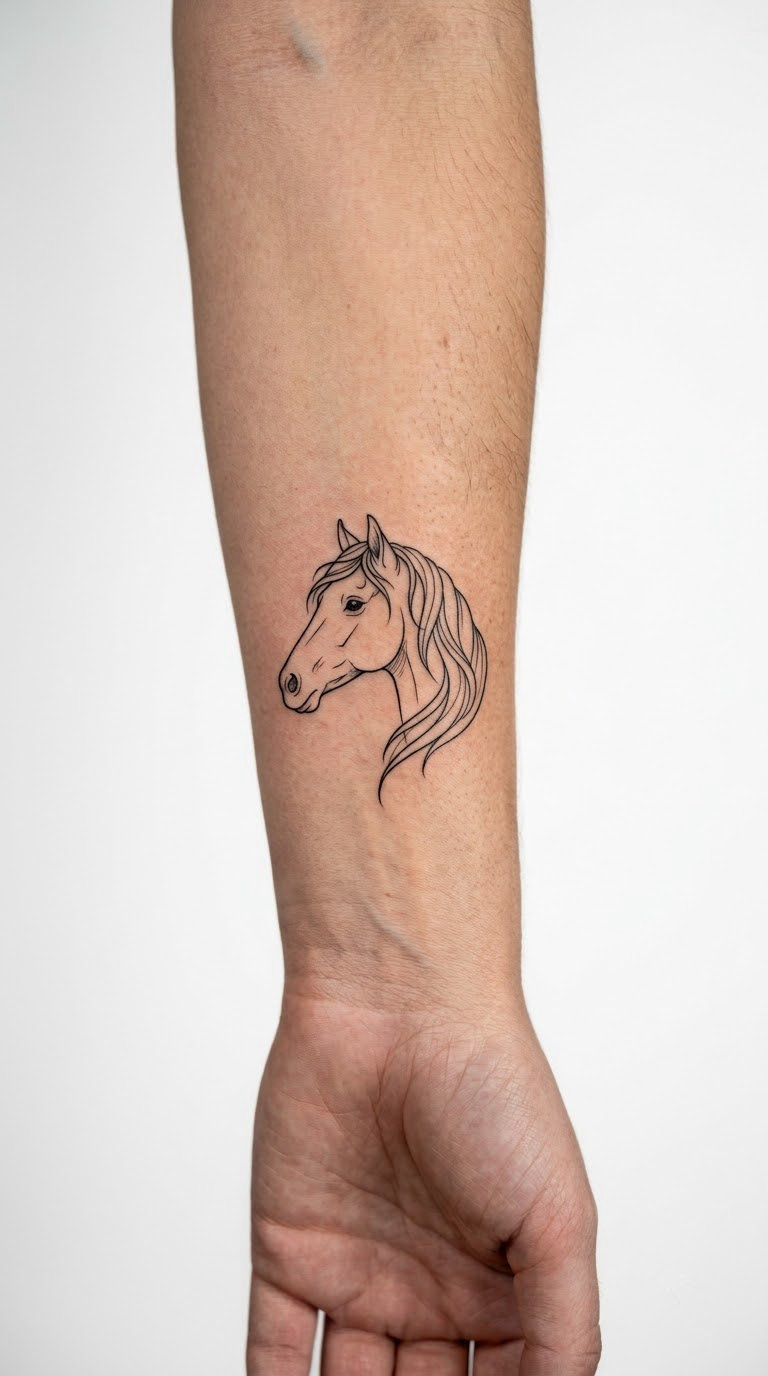
A fine-line horse head in profile is a single continuous line for the jaw and neck, one or two tapered strokes for the ear, and a suggested eye. The mane can be left as a few loose strands or a wash of grey shading. People choose this because it is quiet and recognisable, and because a profile reads correctly even when it is small.
People also choose it for the horse it is drawn from, which is the single best personalisation in this whole list. Placement: inner forearm, side of the neck, behind the ear, wrist. Size: 2-3 in (5-8 cm). Style: fine line. Pain: low to medium, rising to medium on the neck. Fine line softens with sun and age, so plan for a line weight your artist can hold. Make it yours: match the exact blaze pattern and ear position of your horse.
2. Minimal Running Horse
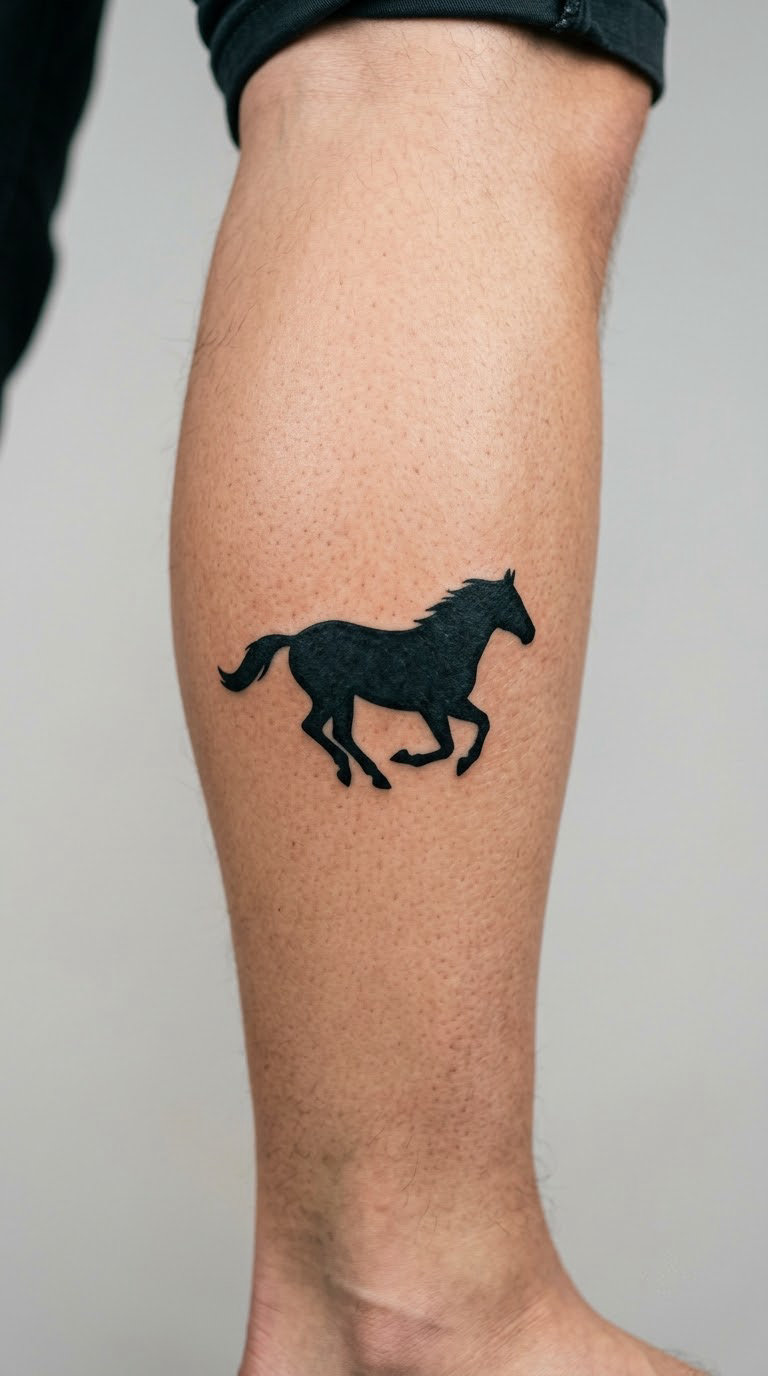
A minimal running horse is all shape: neck extended, one foreleg reaching, hind legs gathered, tail streaming. No mane detail, no shading, no eye. What sells it is proportion, so pick an artist whose healed silhouettes still look like horses at a glance rather than generic four-legged shapes.
It suits anyone who wants energy rather than a portrait. Placement: outer calf, shoulder, upper arm, ankle. Size: 2.5-4 in (6-10 cm). Style: minimalist silhouette. Pain: medium on the calf, medium-high on the shoulder cap. Calf skin stretches when you flex, so a bolder line weight ages better than a hairline one. Make it yours: have the gallop pose copied from a photo of your own horse mid-stride.
3. Horse and Rose Combination
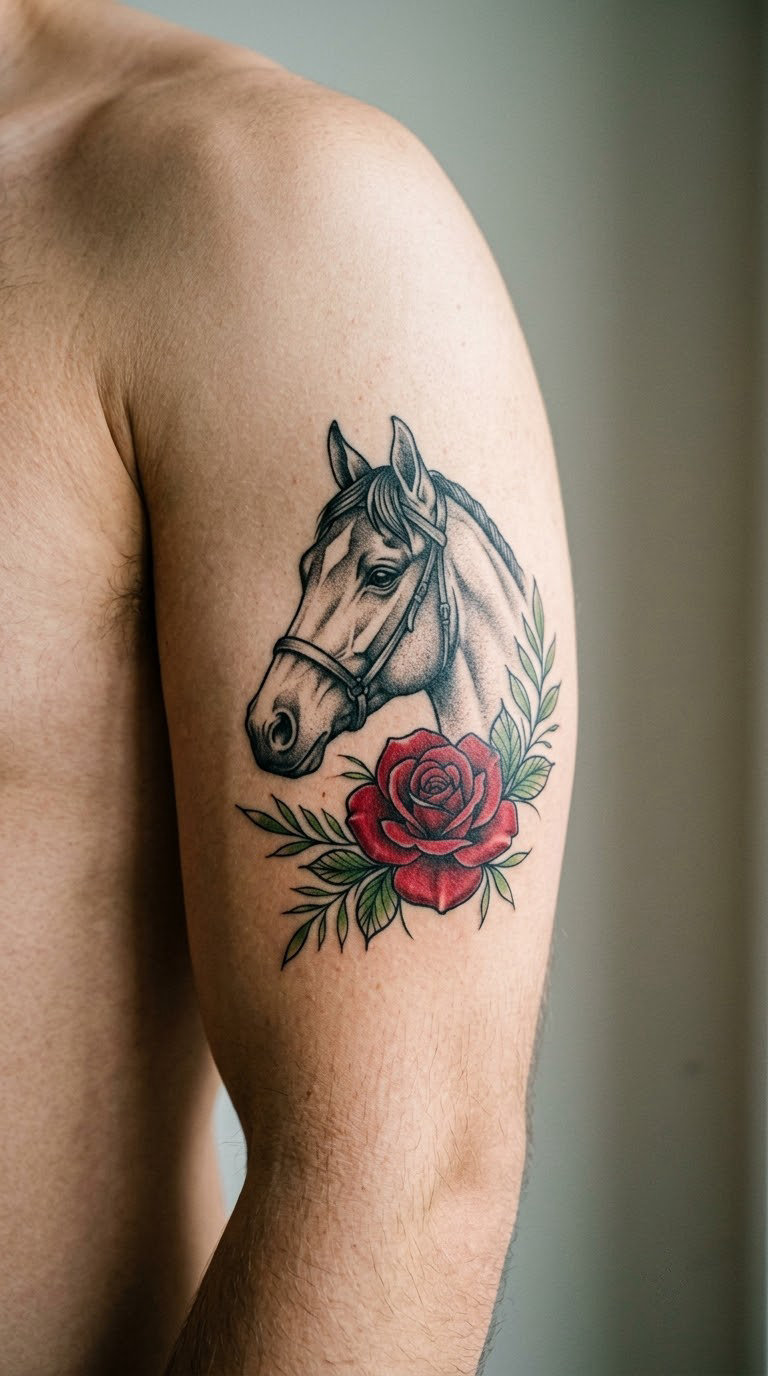
A horse-and-rose pairing is a horse head or bust in black and grey with a rose, sprig of lavender, or a spray of wildflowers tucked under the jaw or behind the ear. A single red rose is the most common choice, with green leaves left as thin outlines.
The flower softens the piece and gives it somewhere to sit, which is why this reads well on a first tattoo. Placement: upper arm, shoulder, thigh, back of the forearm. Size: 3-4 in (8-10 cm). Style: blackwork with a colour accent. Pain: medium. Colour in the flower will soften first, so the black horse should hold the composition. Make it yours: pick a flower with its own meaning, a birth flower or one from a garden you both knew.
4. Micro-Realism Horse Portrait
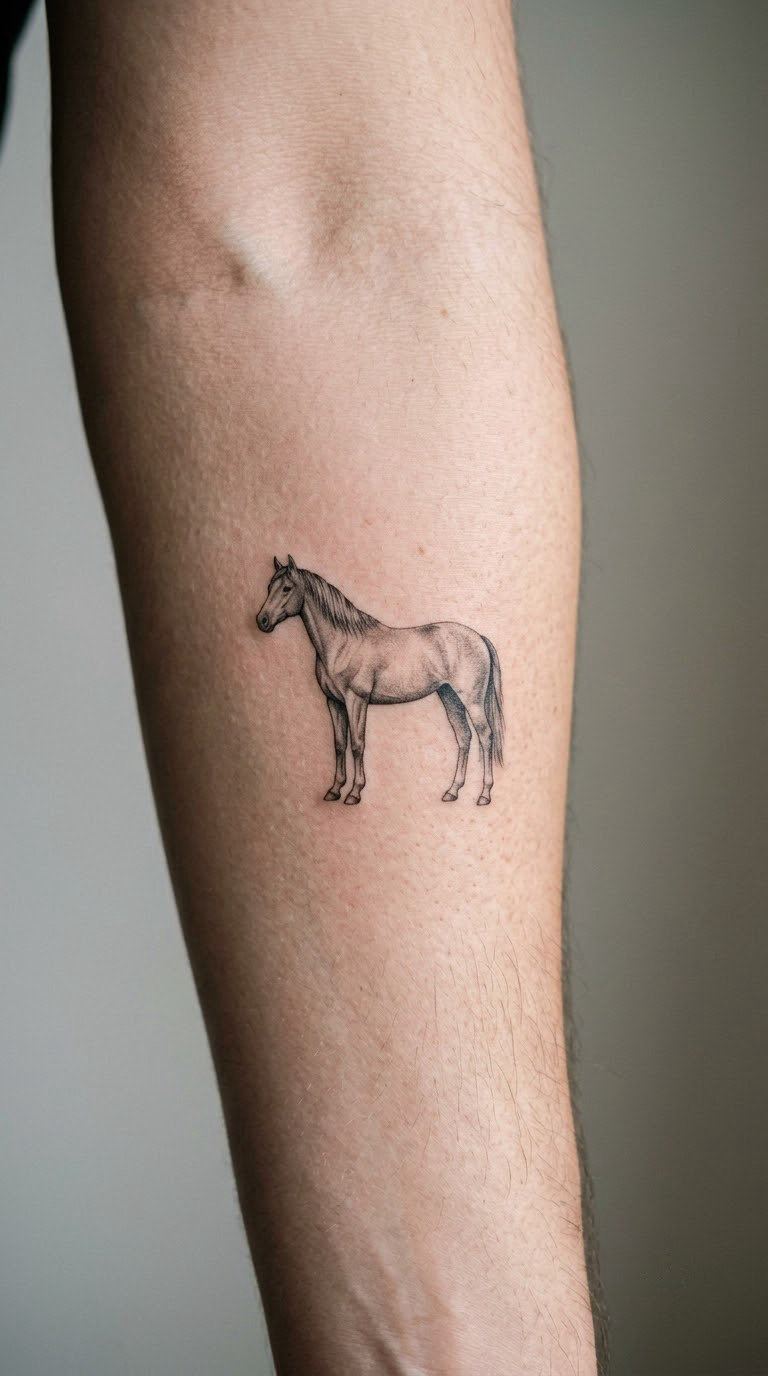
A micro-realism portrait is a small head-and-neck study with selective shading, dark at the eye and nostril, fading out along the cheek. The artist keeps the anatomy accurate rather than illustrative, so it reads as a specific horse rather than a horse-shaped idea.
This one rewards a good eye more than a big budget. Placement: inner forearm, outer forearm, inner bicep. Size: 2-3 in (5-8 cm). Style: micro-realism. Pain: medium, since the shading passes over bone. Under 2 in, facial features blur into a smudge within a few years, so do not go smaller. Make it yours: send photos of your horse’s head in flat light so the shading matches the real coat.
5. Jumping Horse in Blackwork
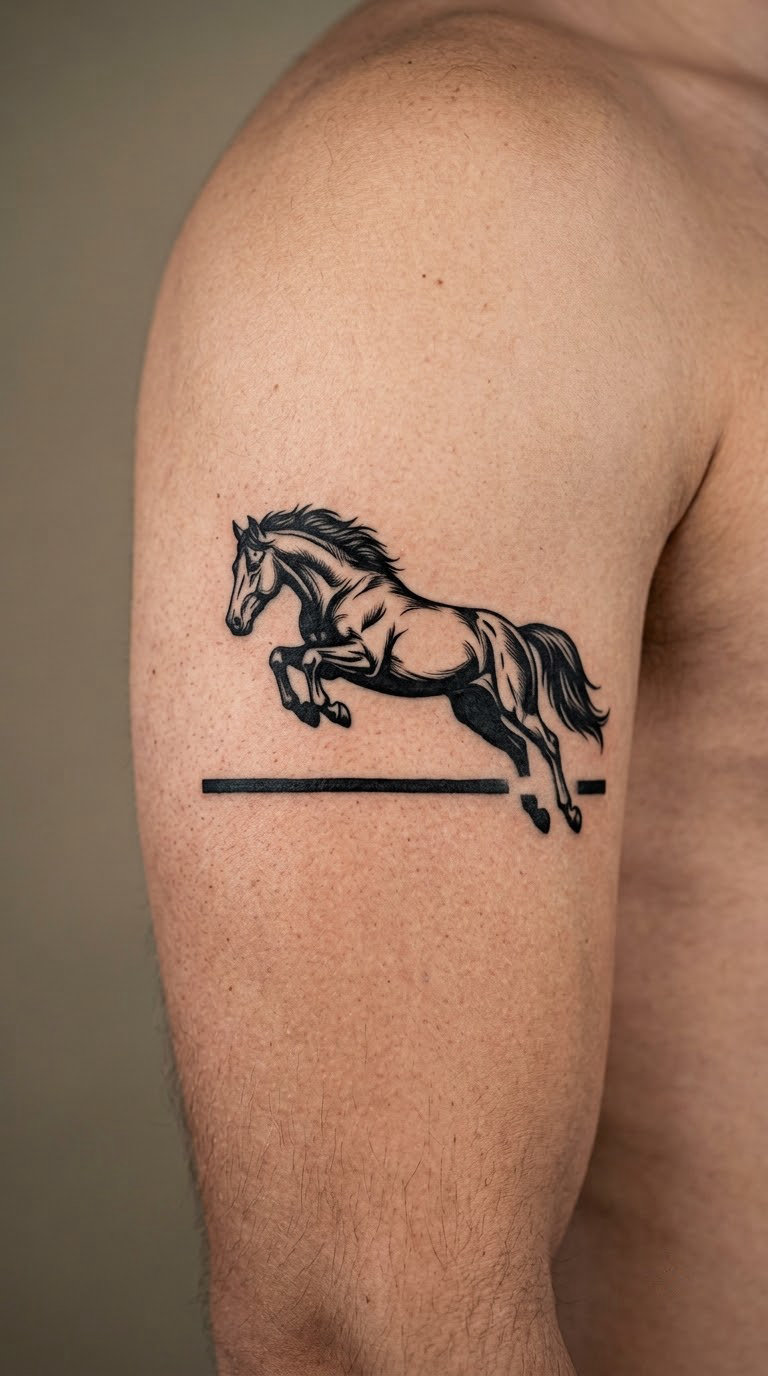
A jumping horse in blackwork is a solid black silhouette with a few white gaps carved out for the eye, the fetlock and the bend of the back. Negative space does the work, so the design looks bold without being heavy. A single line under the hooves can read as a jump rail or a ground line.
It is the horse tattoo most connected to a competitive life. Placement: outer upper arm, shoulder, thigh, forearm. Size: 4-6 in (10-15 cm). Style: blackwork. Pain: medium to high over larger areas, especially the shoulder cap. Solid black holds up better than grey wash. Make it yours: copy the horse’s actual jumping form from a photo, including how it folds at the knee.
6. Horse Hoof Print
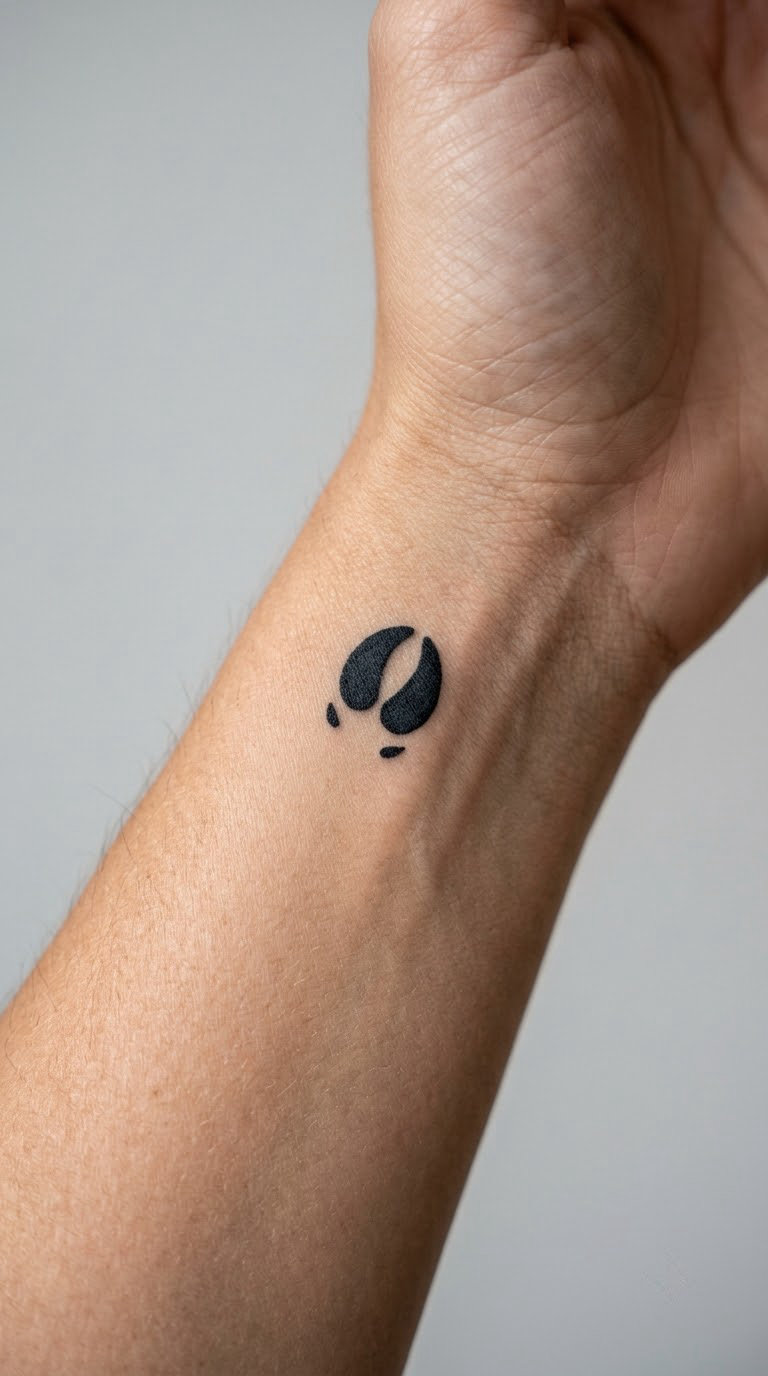
A hoof print is a rounded triangular or heart-shaped hoof with a soft hollow at the centre, sometimes doubled or in a trail. It is the most discreet horse symbol there is, and it looks like a stamp rather than a picture of a horse.
It works as a marker for the person who already knows why it is there. Placement: inner wrist, outer wrist, ankle, collarbone, behind the ear. Size: 0.75-1.5 in (2-4 cm). Style: minimalist. Pain: low on the wrist and collarbone, medium on the ankle bone. Solid black keeps the shape legible at small sizes. Make it yours: use a print from your own horse, or line up four of them along a collarbone.
7. Horse Skull Fine-Line Design
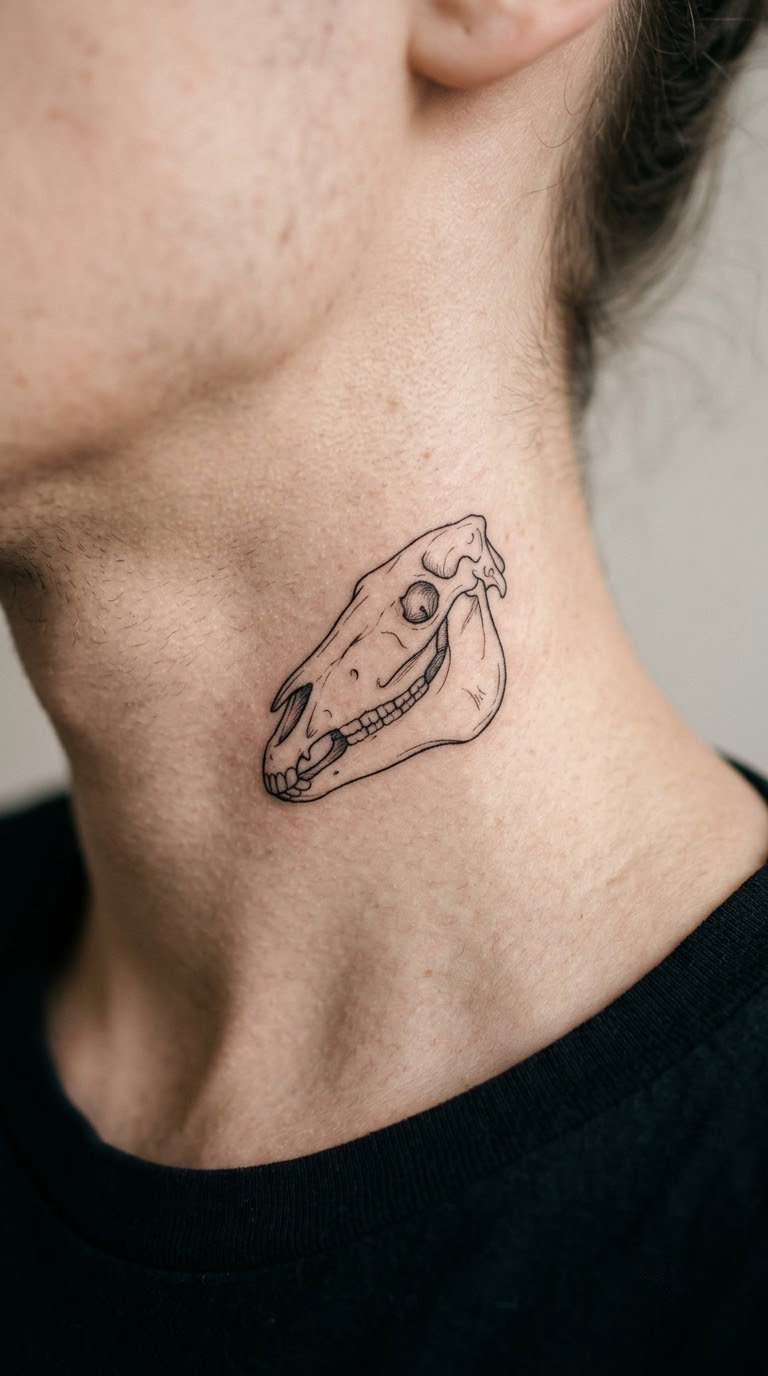
A fine-line horse skull is a quiet anatomical drawing: the long nasal bone, the large eye socket left as open space, the cheekbone, the jaw. Ornamental wraps and flowers are optional, and leaving them out keeps the piece restrained.
It carries weight without volume, which appeals to people who like equestrian imagery but not the romantic portrait style. Placement: side of the neck, forearm, back of the shoulder. Size: 2-3 in (5-8 cm). Style: fine line. Pain: low to medium, and the neck bruises visibly for a week. The eye socket needs open space around it or it fills in. Make it yours: have the artist add a single date beneath the jaw.
8. Western Horse and Horseshoe
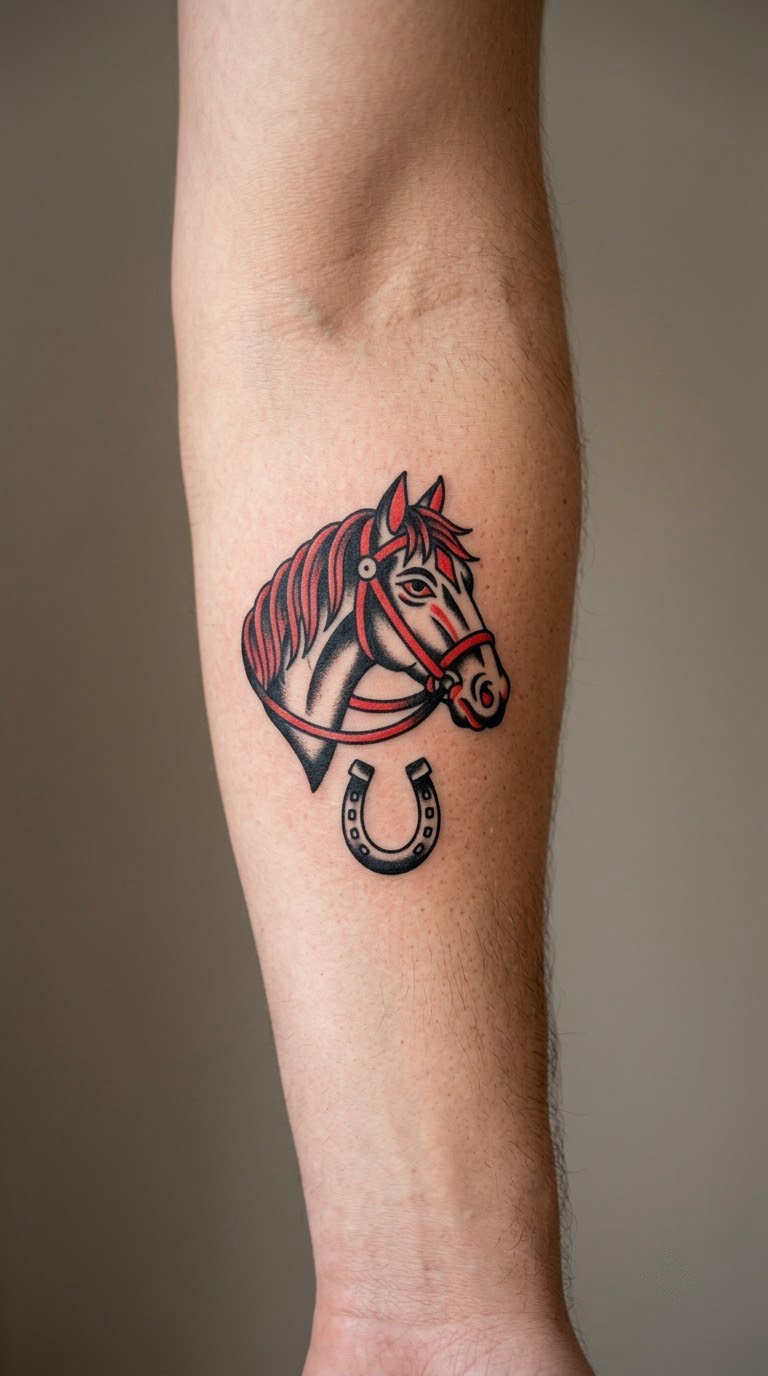
A western horse and horseshoe design is a bold outlined horse head in black and red, sometimes with a rope, star or tooled-leather detail, paired with a horseshoe set at a slight angle. Decorative linework fills the space around the head, so this is a design that grows as you size it up.
It suits people who ride western, but the style travels. Placement: inner forearm, shoulder, thigh, back of the arm. Size: 3-5 in (8-13 cm). Style: traditional or neo-traditional. Pain: medium, higher as the piece gets detailed. Red ages toward orange over the years, so the black linework has to carry the design. Make it yours: engrave a real brand or hoof number in the banner beneath.
9. Watercolor Horse in Motion
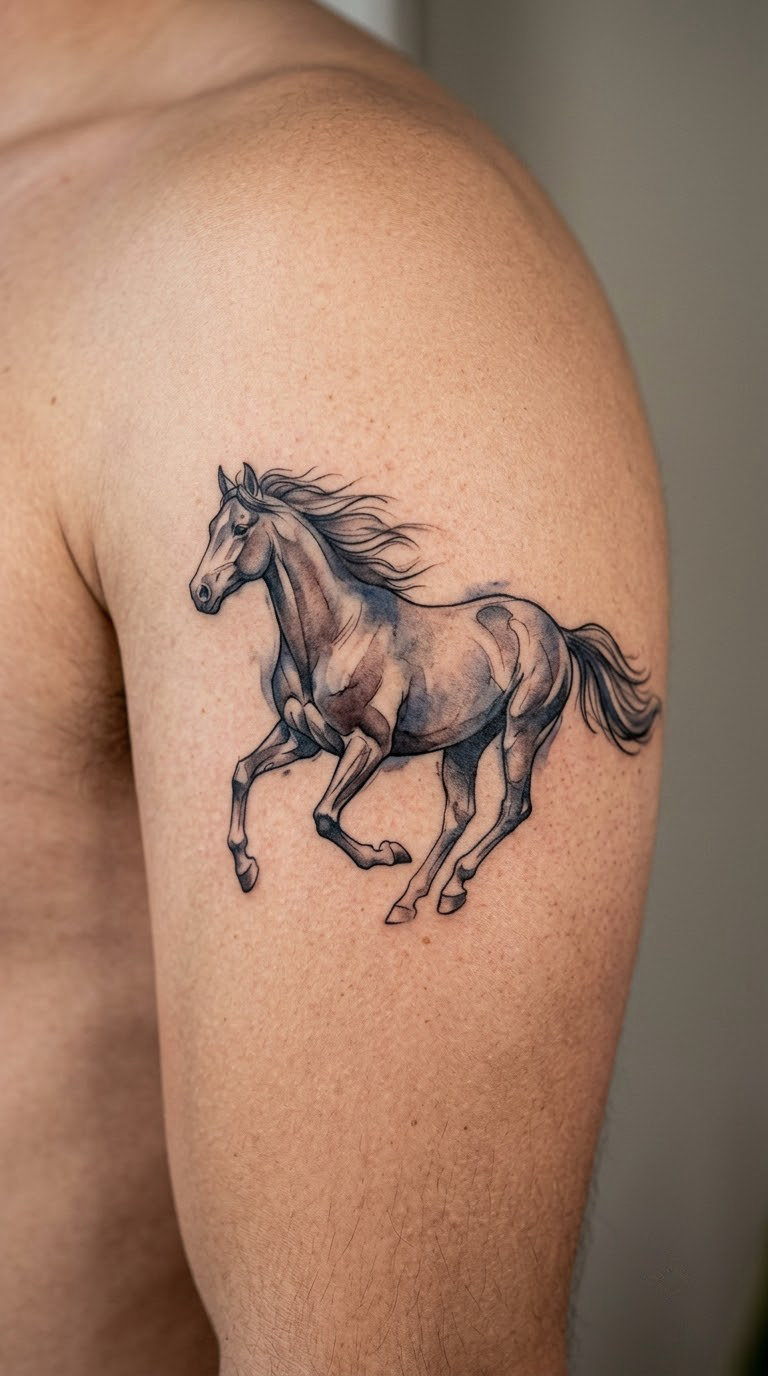
A watercolour horse is a soft galloping or standing figure built from translucent washes in grey, brown, blue or purple, with pigment drifting off the edges of the legs and mane. Loose edges and a few speckles of colour are what make it feel like paint rather than a faded photograph.
It is a cheerful choice and it suits a shoulder, where there is room for the wash to spread. Placement: shoulder, upper arm, back, thigh. Size: 4-6 in (10-15 cm). Style: watercolour. Pain: low to medium, since shading passes are light. Watercolour fades faster than blackwork, so expect it to soften within a few summers. Make it yours: ask for the wash colours to be pulled from your horse’s actual coat.
10. Horse and Jockey Silhouette
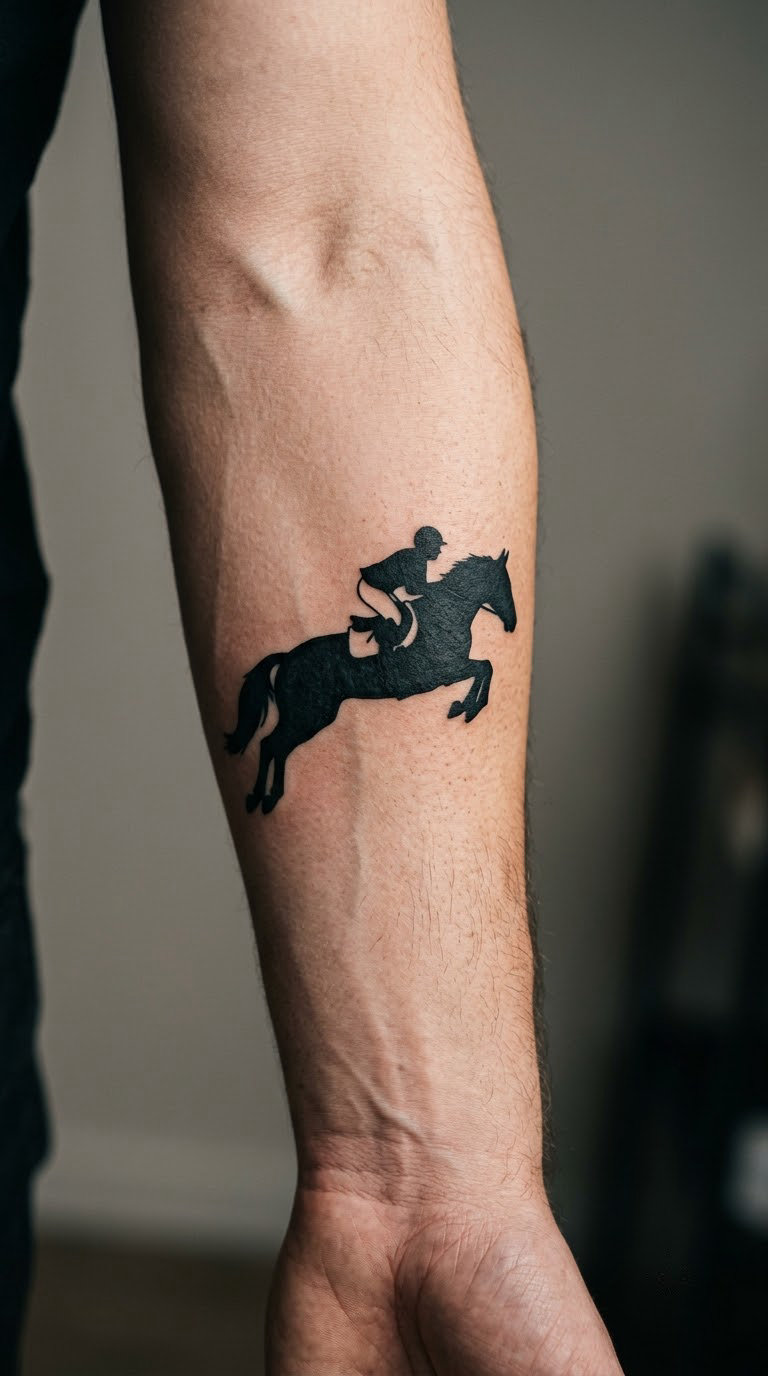
A horse-and-jockey silhouette shows both figures as one solid black shape, usually in a jumping or forward-moving pose. The composition is tight: rider folded forward, hands on the neck, horse’s legs extended. The whole thing has to be tall enough to keep the three figures separate.
It reads as a specific discipline rather than a general horse lover symbol. Placement: outer forearm, calf, upper arm. Size: 3-4 in (8-10 cm). Style: silhouette, solid black. Pain: medium. Below 3 in the rider merges into the horse’s neck, so size matters more here than with a head design. Make it yours: have the tack drawn accurately, since a jumping horse without a bridle looks wrong to anyone who rides.
11. Equestrian Ribbon and Horse
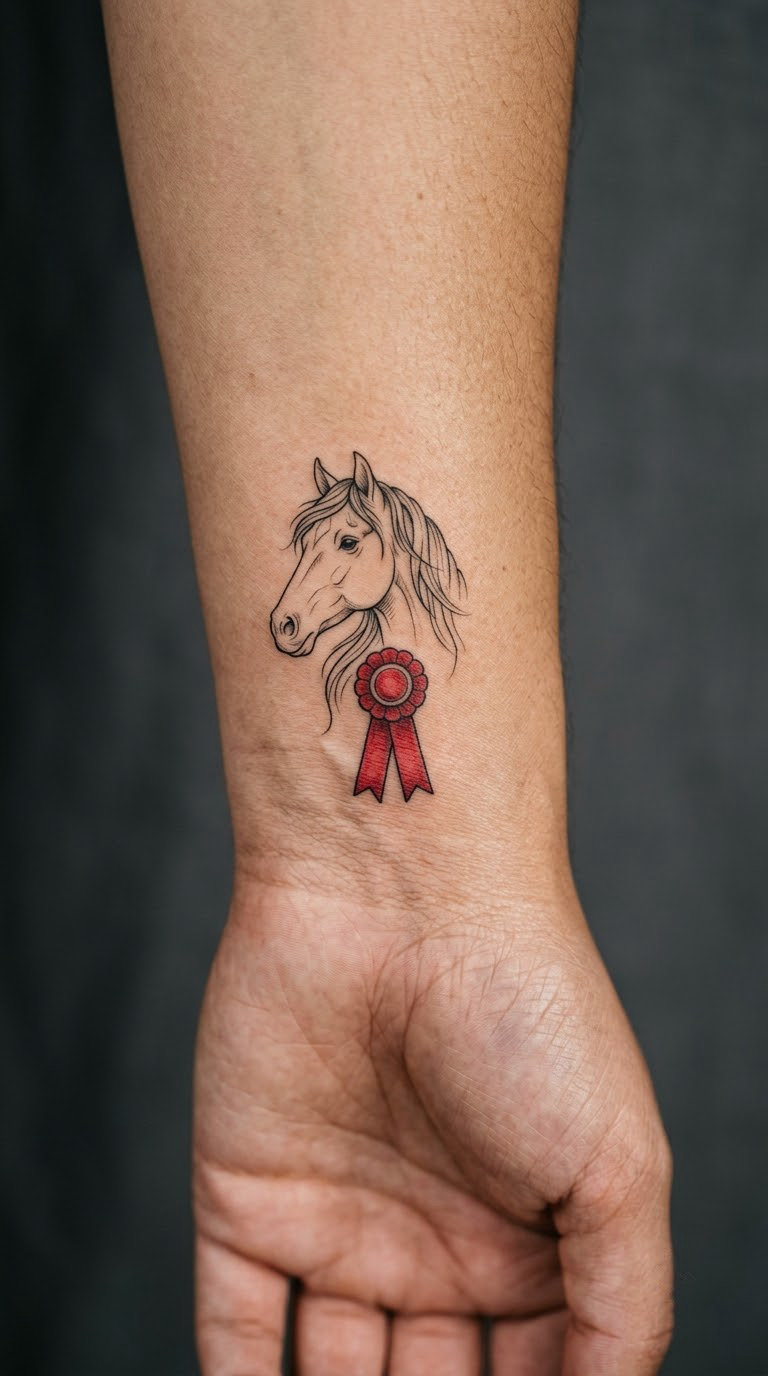
An equestrian ribbon and horse design stacks a small horse head over a rosette, a numbered ribbon, or a hanging medal shape. The ribbon is usually the colour element: red, navy or pink, with a number or a division letter worked into the tail.
It is an achievement tattoo, and riders often add the season and the horse’s name. Placement: wrist, collarbone, rib, inside of the arm. Size: 2-3 in (5-8 cm). Style: fine line with one colour. Pain: medium on the rib, lower on the wrist. Make it yours: put the year, the class name, or a short nickname in hand-lettered script under the ribbon.
12. Barn and Horse Scene
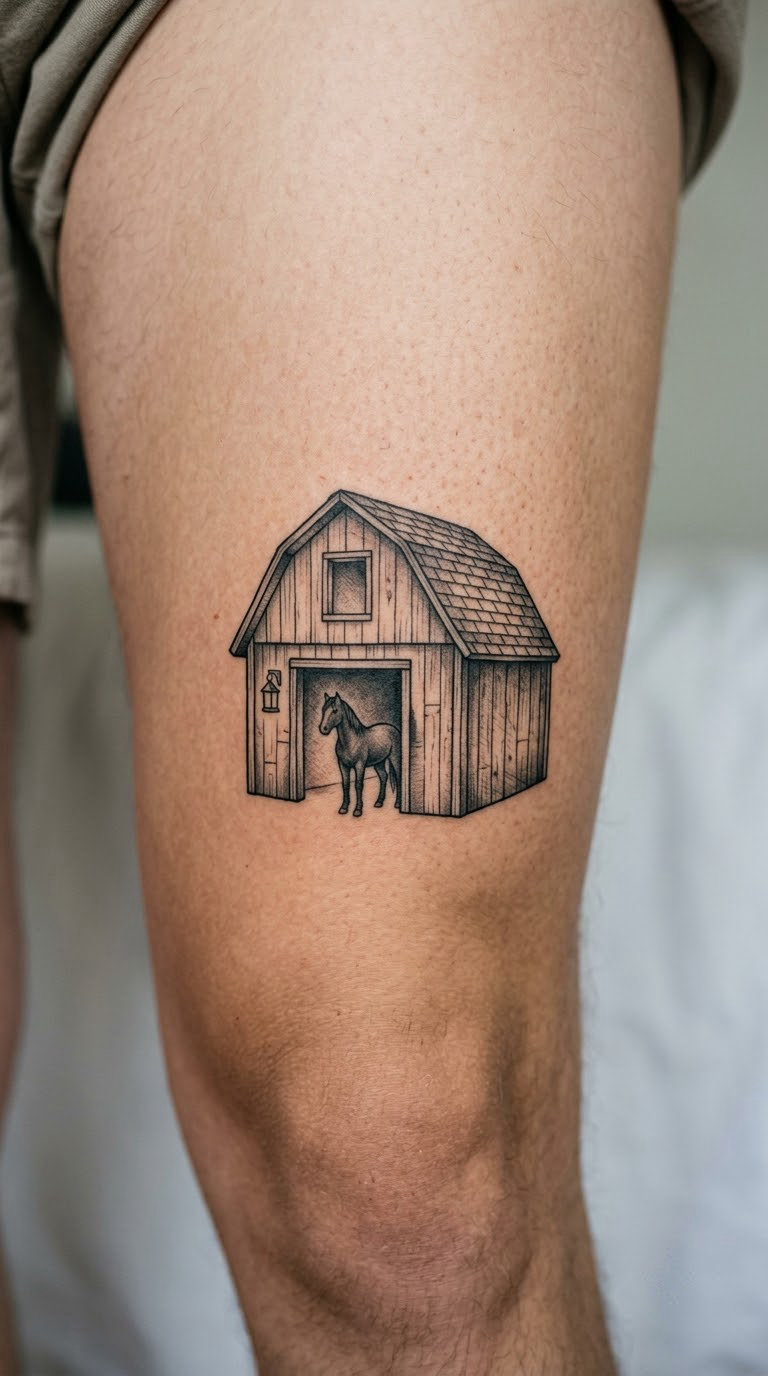
A barn and horse scene draws a small barn with a peaked roof, a doorway, and a horse standing in it or in the field beside it. Windows, roof lines and a fence give the piece its setting, and they are exactly the details that need room.
It is the most narrative of the small designs, and it suits a larger flat area. Placement: thigh, upper arm, back, lower back. Size: 3-4 in (8-10 cm). Style: illustrative, black and grey. Pain: medium. Keep the background to two or three architectural lines; a full yard of fencing turns into noise at this scale. Make it yours: model the barn on the one you actually ride at, down to the door colour.
13. Horse Drawn with Brush Strokes
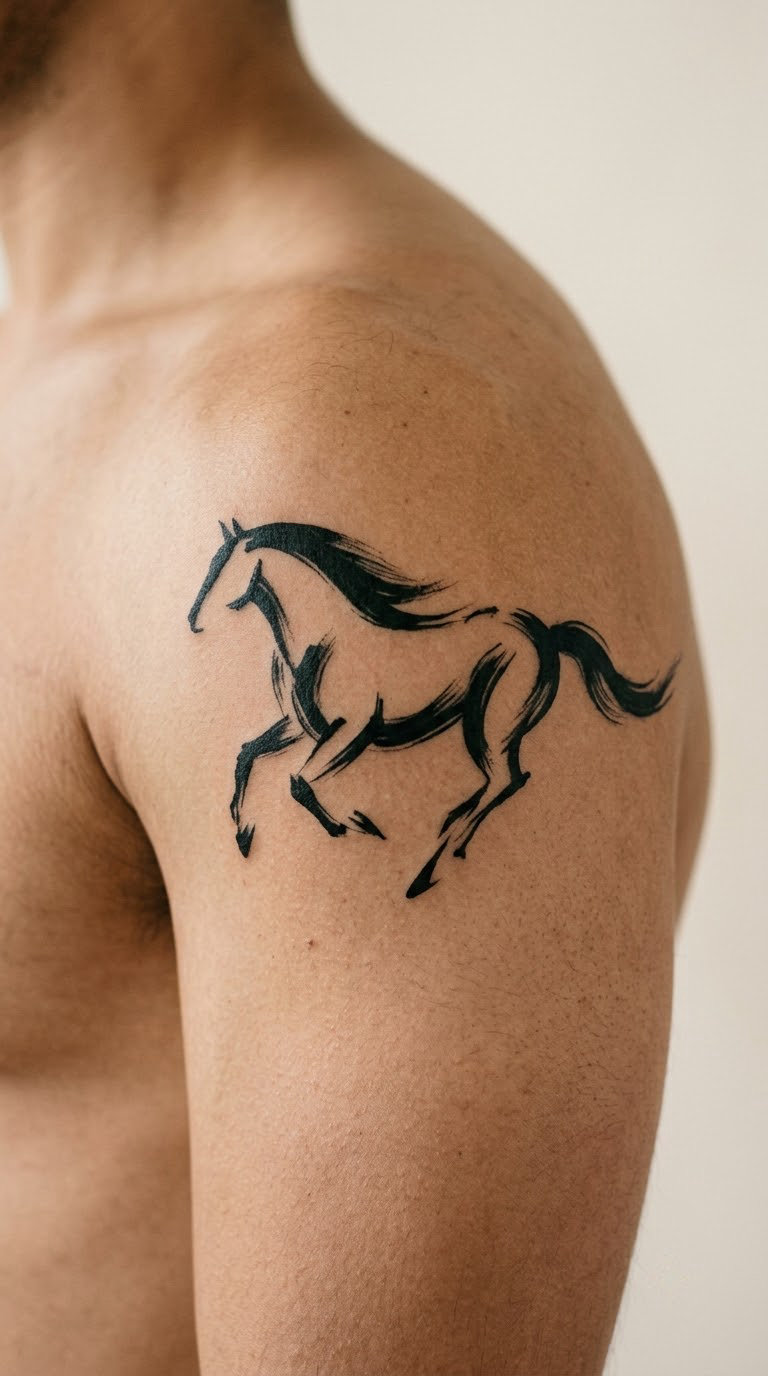
A brushstroke horse is built from a handful of confident tapered strokes rather than an outline. The body is one long stroke, the legs are quick flicks, and the negative space between them does most of the work. It is a modern look with a lot of personality in very few lines.
It is forgiving at small sizes, which makes it a good first tattoo. Placement: shoulder, back of the arm, calf, forearm. Size: 4-6 in (10-15 cm). Style: brushwork. Pain: medium. The line weight is generous, so it ages better than a fine line. Make it yours: ask the artist to vary the stroke thickness so the mane breaks up as it moves.
14. Matching Horse and Cat Tattoos
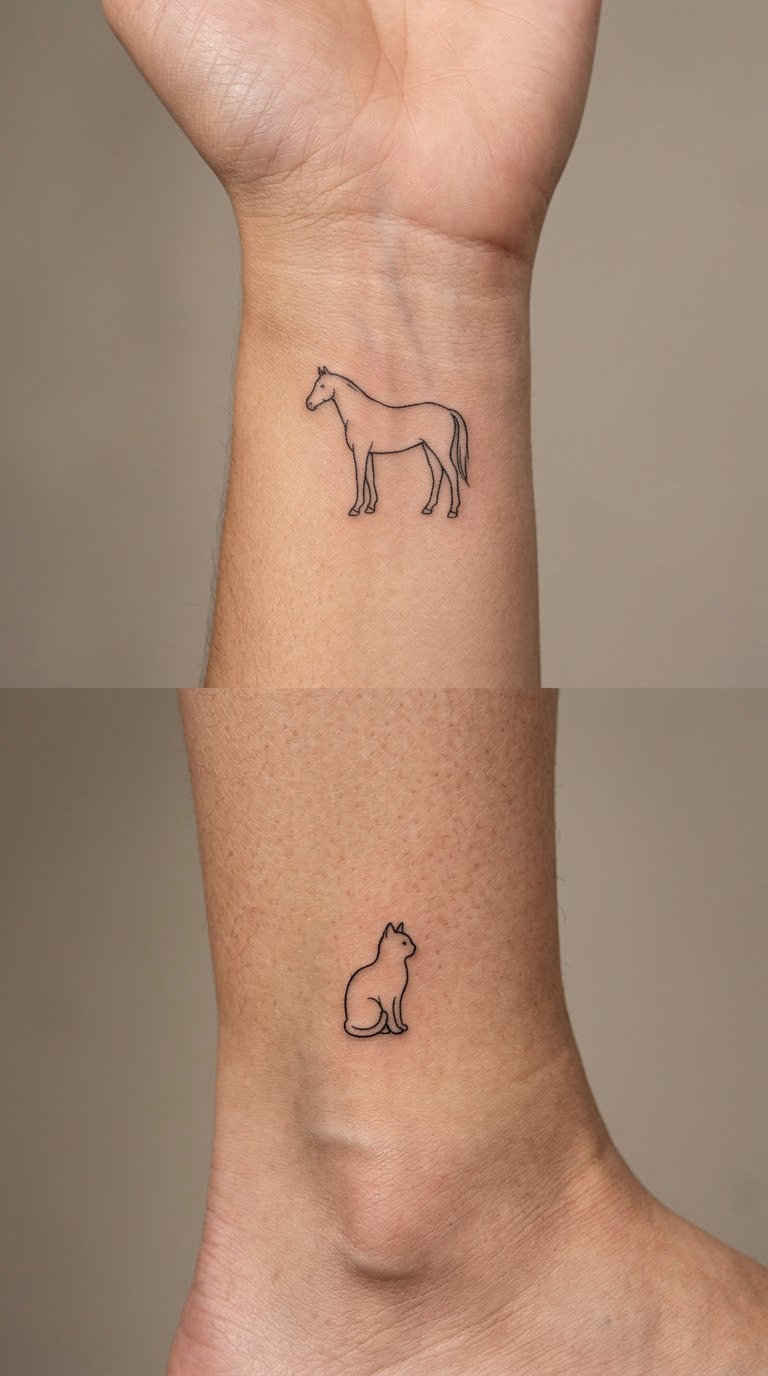
A matching horse and cat pair gives each animal its own small piece, one for each person or each wrist. Both need the same line weight and the same level of detail or the pair looks accidental. Simple, rounded shapes age better than delicate ones here.
If you are planning two animals rather than one, decide the sizes together before either appointment. Placement: both wrists, or one wrist and one ankle. Size: 1.5-2 in (4-5 cm) each. Style: fine line or minimalist. Pain: low on the inner wrist, medium on the ankle bone. Make it yours: use each animal’s actual posture, curled or mid-stretch. If you collect small animal pieces, our 20 best cat silhouette tattoo ideas for minimalists has shapes that pair well in scale with these.
15. Horse Portrait with Floral Frame
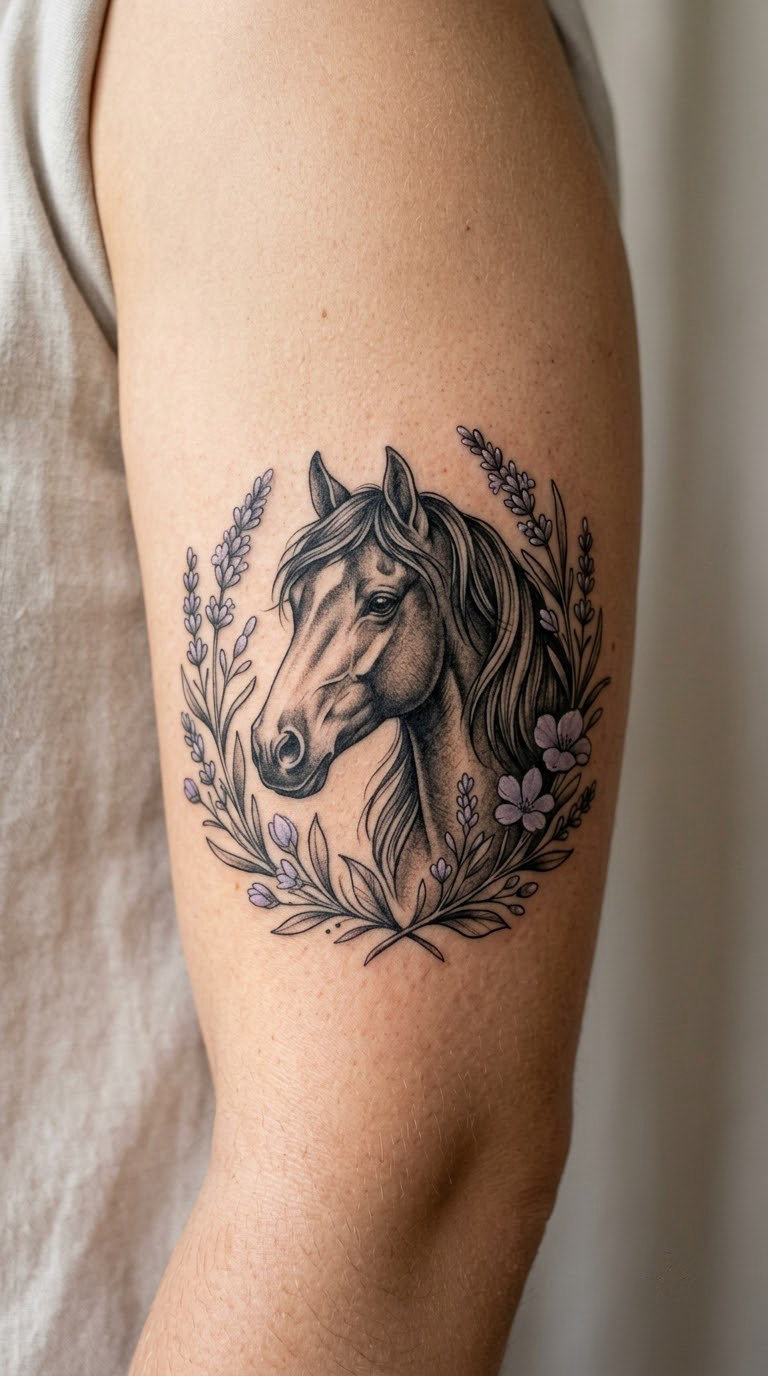
A floral-framed horse portrait is a realistic or illustrative head set inside a wreath of lavender, wildflowers, wheat, or a mane-inspired line that curls around the jaw. The frame gives the composition an edge, which makes it look finished rather than floating.
This is the one people most often build a whole arm around later. Placement: upper arm, back, shoulder blade. Size: 4-5 in (10-13 cm). Style: blackwork with colour florals. Pain: medium, and the flower stems add time. The plant should not be so fine that it disappears in a year. Make it yours: grow the flower yourself, or use the weeds from your horse’s favourite paddock.
16. Horse Leg and Saddle Detail
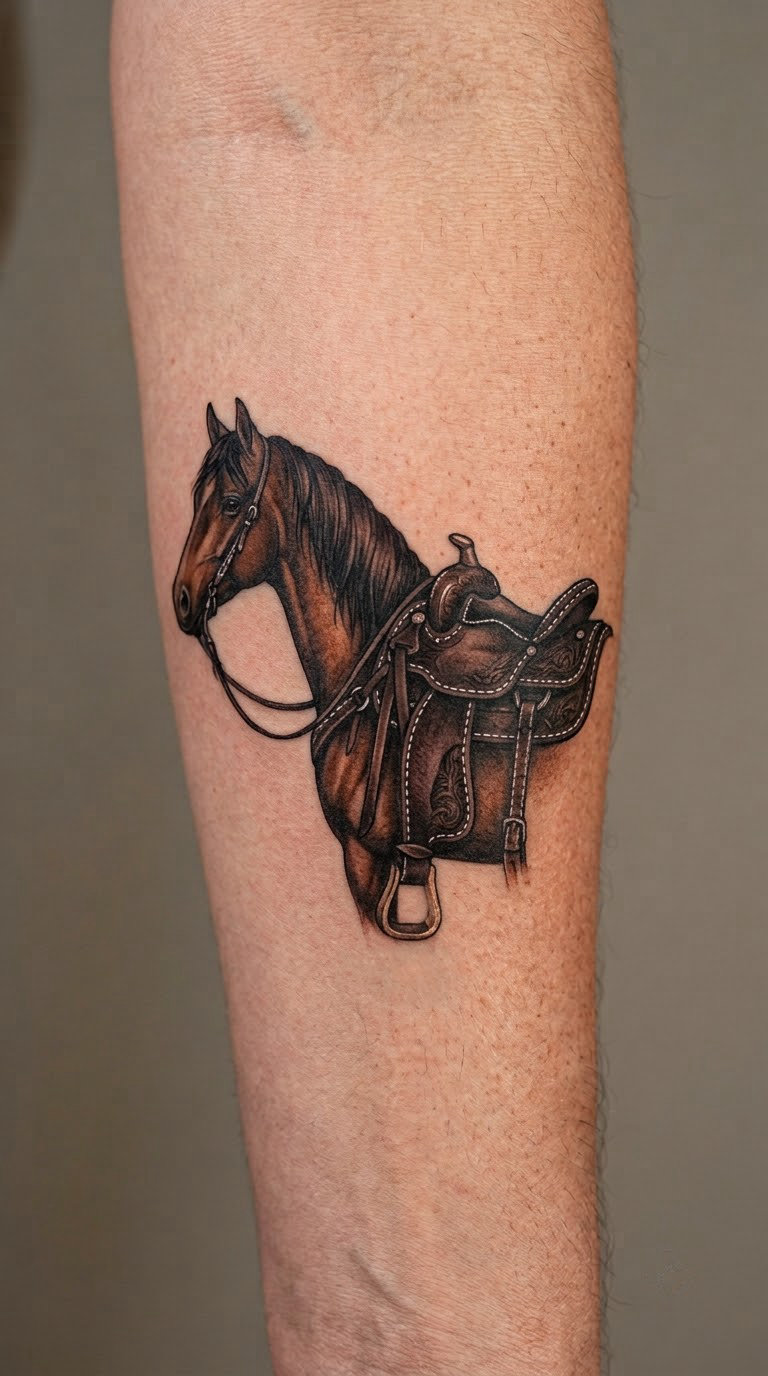
A leg and saddle detail is a cropped study rather than a whole horse: a neck rising out of the frame, a saddle with visible stitching and a cinch, maybe a rein running through the crop. It reads like a piece of tack photography, which is why it works so well at forearm scale.
It suits people who care more about the gear than the portrait. Placement: forearm, calf, inner arm. Size: 2.5-3.5 in (6-9 cm). Style: realistic detail, black and grey with brown. Pain: medium. Keep the stitching lines thick enough to hold; hairline stitch marks vanish fast. Make it yours: use the pattern on your own saddle pad, or the exact horn shape of your western saddle.
17. Geometric Horse Portrait
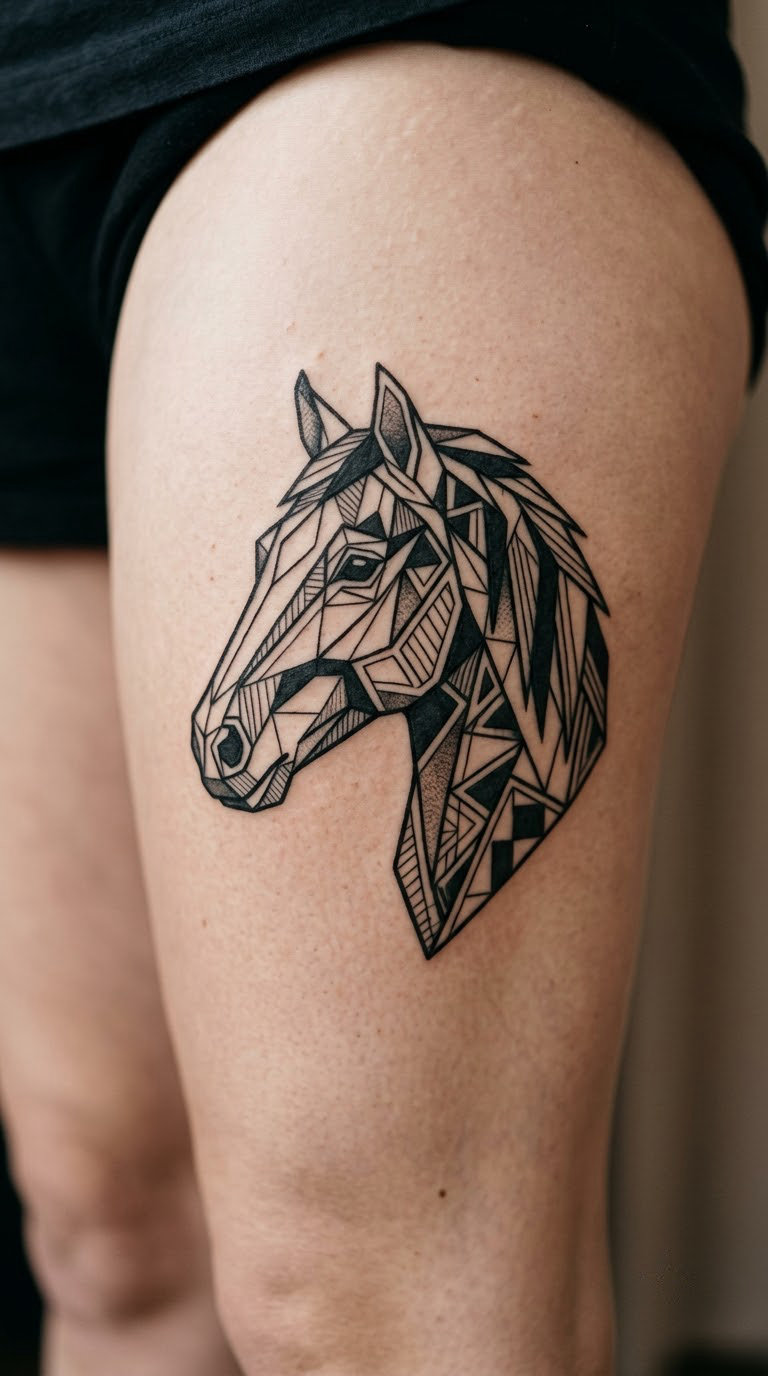
A geometric horse portrait divides the head into angular or flowing sections, each filled with solid black, dotwork, or fine parallel lines. Straight geometry feels architectural and sharp; curved geometry flows better over a rounded muscle like the shoulder or calf.
It is a strong choice when you already own softer, more organic tattoos. Placement: outer thigh, calf, shoulder, upper arm. Size: 3-4 in (8-10 cm). Style: geometric blackwork, optionally with dotwork fill. Pain: medium, and higher where the dotwork is dense, since every dot is its own pass. Make it yours: keep the eye inside one clear panel so the horse still reads, and let the line directions follow the muscle beneath rather than running flat across it.
18. Tiny Horse and Paw Print Pair
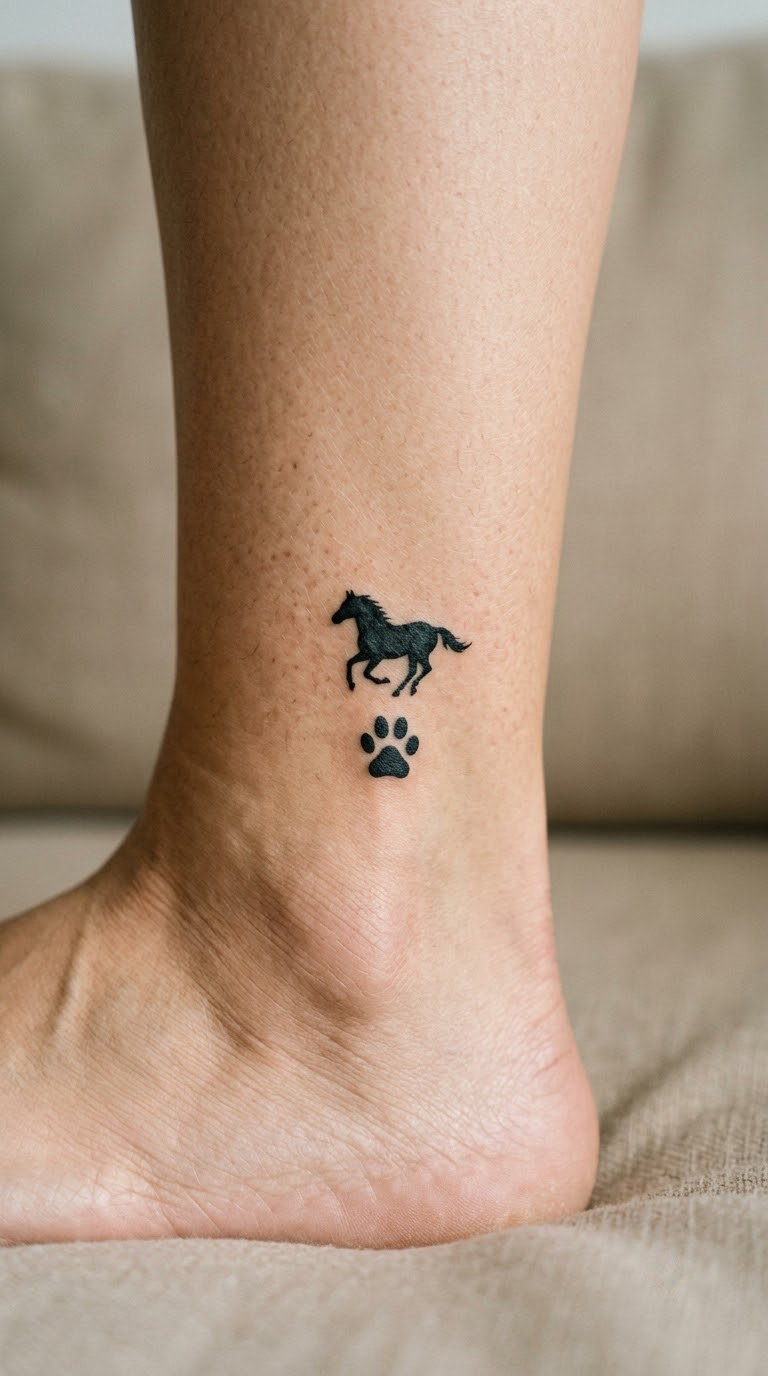
A tiny horse and paw print pair stacks a small horse silhouette above or beside a matching paw print, both in the same solid black. It works for anyone whose horse lives alongside a dog, which is most barn households I know.
Keep both elements simple, because small is the hardest size to draw in. Placement: inner ankle, wrist, rib, behind the ear. Size: 1.5-2 in (4-5 cm) total. Style: minimalist. Pain: low on the inner wrist, medium on the rib, medium on the ankle. The paw print needs to be scaled up slightly or it reads as a smudge. Make it yours: use your own dog’s paw shape rather than a generic print.
19. Horse Head in Dotwork
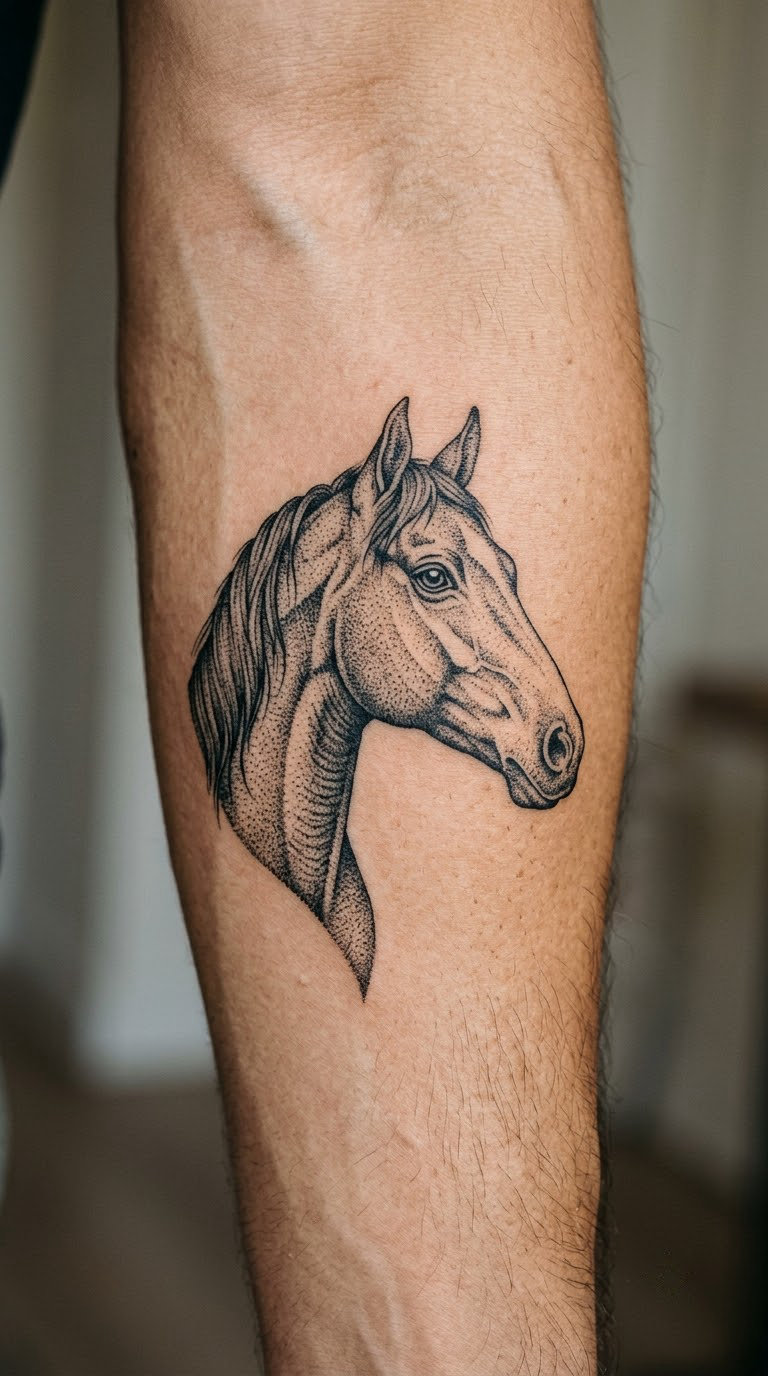
A dotwork horse head builds the whole portrait from dots, dense and dark at the eye and along the jaw, opening out across the neck and mane. The gradient is what creates the shading, so dot spacing has to be planned rather than filled in afterwards.
Dotwork rewards patience and a larger area than you might expect. Placement: outer forearm, shoulder, thigh, back. Size: 3-4 in (8-10 cm). Style: dotwork. Pain: medium to high, because it is many shallow passes rather than one. Dots soften and spread over the years, so the design reads softer, not lighter. Make it yours: keep one feature solid black within the dots, so there is still an anchor point.
20. Full Equestrian Sleeve Concept
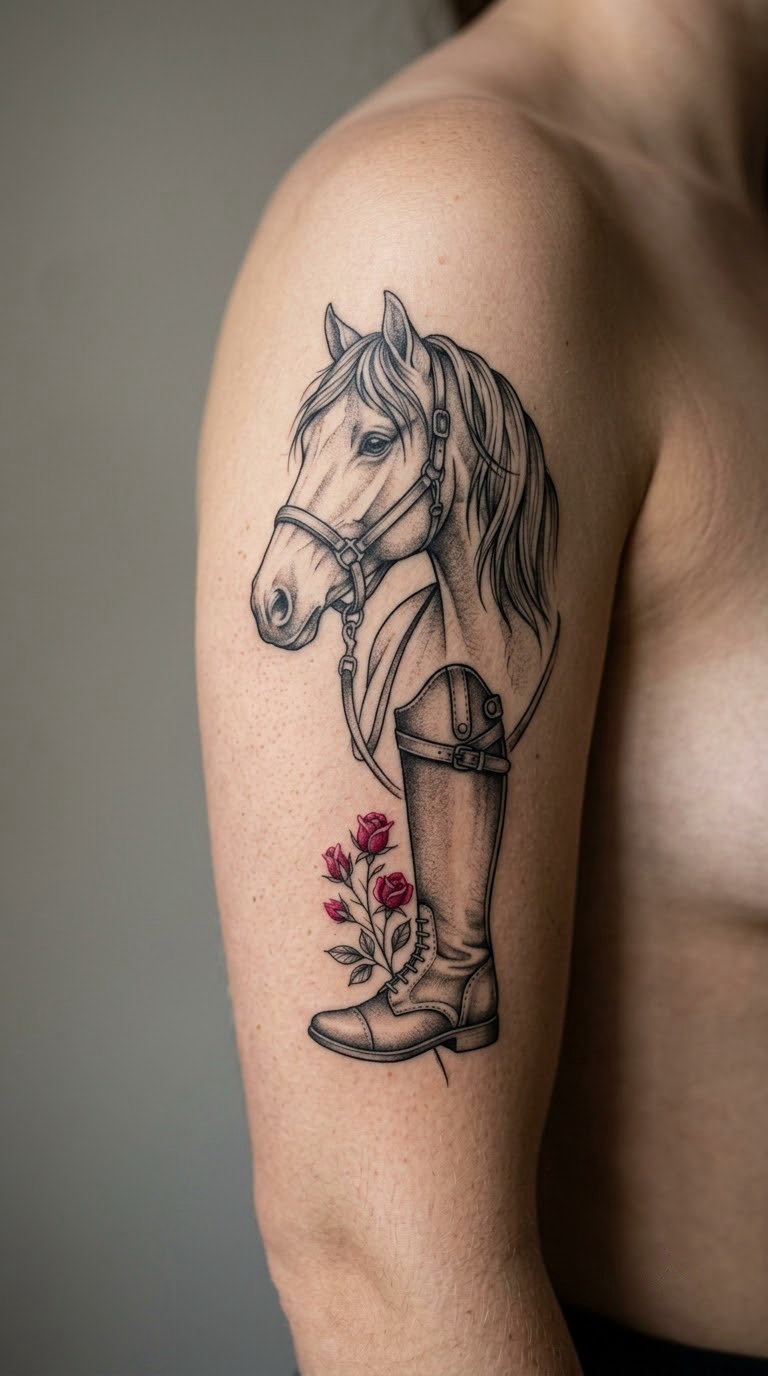
A full equestrian sleeve composes several motifs along one limb: a horse head or portrait, riding boots, a saddle, tack, jumping fences, flowers, horseshoes, or a herd of silhouettes moving around the arm. Each element is designed to sit in a specific zone rather than scattered.
This is a planning project, not a single sitting, and the design has to follow the arm or leg as it moves. Placement: one full arm or leg, inside or outside. Size: 10 in (25 cm) and up, worked over several sessions. Style: composite, usually blackwork with a limited colour palette. Pain: high, and sessions are long. If you are still deciding about the basics, our 24 armpit tattoo ideas for women covers a curved placement that needs the same kind of planning. Make it yours: brief the artist with the full story of your riding life and let the composition be designed around one strong image.
How to Choose the Right Design
The right horse tattoo is the one that still looks right in ten years, which is a different question from the one that looks best today. Six checks help.
1. Check the anatomy, not just the style. A horse with a short muzzle, a hoof pointing the wrong way, or a leg bending backwards is the giveaway of an amateur drawing. Ask to see healed portfolios, and if you are commissioning from your own horse, insist the reference photo is used.
2. Match the design to the size honestly. A full-body galloping horse needs 4 in (10 cm) or more to read. A horse head works at 2 in (5 cm). Below 2 in, anything with an eye, a nostril, or stitching will blur within a few years.
3. Think about your body, not just the drawing. Forearms and ribs change shape if your riding does. Wrists, ankles, and the upper arm stay more stable. Skin that stretches with muscle movement distorts straight lines first, so ask your artist to curve the design with the muscle.
4. Consider where your tack goes. A design on the inner forearm sits under a rein, and one on the inside of the upper arm can be covered by a saddle flap. The outer forearm, outer calf, and shoulder are usually clear of gear in most disciplines.
5. Choose ink for how you live. Blackwork holds best in sun and sweat. Watercolour and fine colour work fade faster, which matters if you ride or work outdoors six days a week.
6. Decide what it is for. An identity piece about horses in general and a memorial piece for one horse are different jobs, and they need different designs. If it is a memorial, a specific horse with its own markings, a date, or its name will mean far more than a generic silhouette.
If you want your own horse in the design, send the artist three good photographs: one square-on of the head, one full-body in standing, and one in motion, all in even light with no halter shadow across the face. Add a note of the blaze shape, the socks, and the brand. That short brief saves a revision.
Cost and Session Time
Most tattoo studios charge by the hour, so the bill is driven by how long the design takes to ink, and that depends on detail level, size, and the number of colours. A single-line or small minimalist horse is usually the fastest job in this list. A micro-realism portrait, a watercolour piece, or a dotwork design takes far longer because shading is many separate passes.
For US rates, treat these as the range most riders actually pay rather than a quote. A tiny piece under 2 in (5 cm) often lands between $150 and $350. Small designs around 2 to 3 in generally run $250 to $600, and a 4 to 6 in (10 to 15 cm) piece with shading sits somewhere between $600 and $1,500. A full sleeve is planned across three to six sessions, and the total commonly lands between $2,000 and $5,000 depending on the artist and how much detail is in it. Most studios work on an hourly rate somewhere between $80 and $250, and many set a shop minimum of $50 to $150, which is why even a quick line drawing can add up.
Size scales it further. Anything around six inches or larger often needs a split, and a full sleeve is planned as a series of sessions with breaks so the ink settles. Ask whether the studio has a shop minimum, and whether custom design work is billed separately from the session, because most studios do charge for the drawing time before the first line goes in.
Travel, revisions, and touch-ups are the other variables. If you are travelling to a convention or a specialist artist, the trip and accommodation add to the total. Some shops also offer a free or low-cost adjustment within the first few months, so it is worth asking what their policy is before you book rather than after.
Aftercare Basics
1. Follow your artist’s aftercare instructions first. They know what they did in your session, and their advice overrides anything general you have read.
2. Wash gently, twice a day. Clean water and unscented soap, patted dry with something clean rather than rubbed. Moisturise with a thin layer of whatever your artist recommends.
3. Protect it from the sun. Fresh tattoos and healed ones both fade faster in direct sun, which is worth thinking about if you spend your days in a field or at a show. Cover up while it is healing, and use sunscreen on exposed areas once healed.
4. Choose clothing carefully in the first weeks. Loose, soft fabric over the area, and avoid anything that rubs. Ride-wear like a shirt collar or a boot top is a real friction point once you are back in the saddle, so give it extra healing time before it sits against skin.
5. Hold off on pools, swimming, and soaking. Chlorine and standing water are not good for a healing tattoo, and a soaked boot is not good for a fresh ankle piece either.
6. Know when to ask. If redness, swelling, heat, or discharge turns up beyond what your artist described, contact the studio, and if it spreads or is painful, see a qualified clinician rather than waiting it out.
Frequently Asked Questions
What is the best small tattoo for a horse lover?
A fine-line horse head in profile, around 2 to 3 inches (5 to 8 cm), is the strongest small horse tattoo because a profile still reads at that size. A single hoof print works if you want something only you will recognise. Avoid anything with a face, an eye, or stitching under 2 inches, since those details blur within a few years. Inner forearm, wrist, and behind the ear suit small pieces best.
Are horse tattoos better in black ink or colour?
Black holds up better if you ride, work outdoors, or swim often, and fine line black is what most artists recommend for a first piece. Colour gives you a coat-accurate portrait or a watercolour piece that catches light, but reds and yellows soften first. A good compromise is a black horse with one colour accent, such as a rose or a ribbon, so the design still reads when the colour fades.
Where is the least painful placement for a horse tattoo?
The inner forearm, inner wrist, and the area behind the ear are usually the least painful, because the bone sits close under thin skin and the nerve endings are fewer. The outer thigh, upper arm, and calf sit in the middle. Ribs, the spine, the elbow crease, the kneecap, and the sternum are the ones people remember for the wrong reasons, so if you are sensitive, choose a spot higher up the arm.
How small can a detailed horse tattoo be?
A simplified horse head can work at 2 inches (5 cm) if the artist reduces the shading to a few tones. A full-body galloping horse needs 4 inches (10 cm) or more, because the legs need room to separate. Anything with an eye, a nostril, a stirrup, or stitch lines should stay at 2.5 inches and above. Below 2 inches, the honest answer is that the detail will not survive the years.
What can I add to personalise a horse tattoo?
Start with the horse itself: a photograph of your horse’s blaze, socks, brand, or profile will make the piece specific in a way a stock design never is. Beyond that, add a date, a season and class name, the horse’s barn name in hand lettering, a ribbon or rosette, a horseshoe, or a flower with its own meaning. Riders often pair a small symbolic mark on one wrist with a portrait on the forearm.
Will fine-line horse tattoos fade quickly?
They soften, more than they fade. Fine line relies on a single needle, so the lines are thinner than in blackwork and gradually spread and grey over the years, especially with sun exposure. Ask your artist for a line weight they can hold rather than the thinnest possible, avoid the fingers and hands, and cover the area when you are out in strong sun. Dotwork softens in a similar way, which some people prefer.
Where to Start
If this is your first tattoo, the fine-line horse head in profile gives you the most meaning in the least space, and a horseshoe or bridle mark reads clearly to anyone who knows. If you are adding to an existing collection, the brushstroke or geometric portrait gives you something with real presence that still fits the arm you have already worked.
Whichever one you choose, bring photographs of your own horse to the consultation. That single decision is what separates a horse tattoo from a horse-shaped tattoo.