
20 Best Tattoo Ideas for Cat Lovers 2026: Small & Simple
A cat tattoo usually symbolizes something personal rather than a fixed idea: independence, quiet affection, luck, or a specific animal you loved. Cat tattoos range from realistic portraits of your own pet to single-line drawings, paw prints and black cats.
Everything below is written for real skin, not a flash sheet: what each design looks like, where it sits best, how big it can honestly be, how it feels, and how it changes after five or ten years. If you are booking now, most people plan a few months ahead, and autumn and winter are the comfortable seasons for anything on the ribs or the side of the neck.
Several of these designs are also collected in our cat silhouette tattoo ideas gallery if you want to see the shapes before you commit to a style.
Tattoo Ideas for Cat Lovers: Quick Guide
Here is every design in this list at a glance, with the style that suits it, the placement it was drawn for, a realistic size, and how the session usually feels. Use it to narrow your shortlist before you talk to an artist.
| Idea | Style | Best placement | Size | Pain |
|---|---|---|---|---|
| 1. Peeking cat | Fine line | Behind the ear | 1 to 1.5 inch tall | Low |
| 2. Sleeping cat | Fine line, single needle | Inner wrist | 1.5 to 2 inch long | Low to medium |
| 3. Heart-shaped cat face | Minimal line art | Wrist, finger, ankle | About 1 inch wide | Low |
| 4. Seated silhouette | Blackwork | Outer forearm | 2.5 to 4 inch tall | Medium |
| 5. Watercolor portrait | Watercolor, black and grey | Upper shoulder | 3.5 to 5 inch long | Medium |
| 6. Lucky cat | Traditional | Outer upper arm, calf | 2.5 to 3.5 inch tall | Medium |
| 7. Cat eye | Micro-realism | Inner forearm | 1 to 1.5 inch wide | Medium |
| 8. Cat and moon | Fine line | Outer ankle | 2 to 2.5 inch tall | Medium |
| 9. Paw print trail | Fine line, solid black | Collarbone | Four prints, 0.75 inch each | Low to medium |
| 10. Kissing cats | Line art | Upper chest, sternum | 2 to 2.5 inch wide | Medium to high |
| 11. Dotwork cat | Dotwork, geometric | Upper arm | 2 inch circle | Medium |
| 12. Flower crown cat | Fine line, botanical | Back of the neck | 2 to 2.5 inch wide | Low to medium |
| 13. Stretching cat | Fine line with light shading | Side of the ribs | 3.5 to 4.5 inch long | High |
| 14. Finger cat and heart | Micro fine line | Side of the index finger | 0.6 to 0.75 inch tall | High |
| 15. Climbing cat | Blackwork and botanical | Outer calf, inner forearm | 3 to 3.5 inch tall | Medium |
| 16. Cat ears pair | Minimalist outline | Wrists, behind the ears | 0.75 to 1 inch each | Low |
| 17. Cat and fish | Japanese-inspired, illustrative | Shoulder, upper back | 3 inch wide | Medium |
| 18. Cat in a moon | Line art with solid crescent | Outer hip, thigh | 3.5 to 4 inch tall | Medium |
| 19. Whisker mark | Micro fine line | Behind the ear | 1.5 inch wide | Low to medium |
| 20. Geometric cat | Geometric, blackwork | Forearm, calf | 2 to 2.5 inch wide | Medium |
1. Fine-Line Cat Peeking Behind the Ear
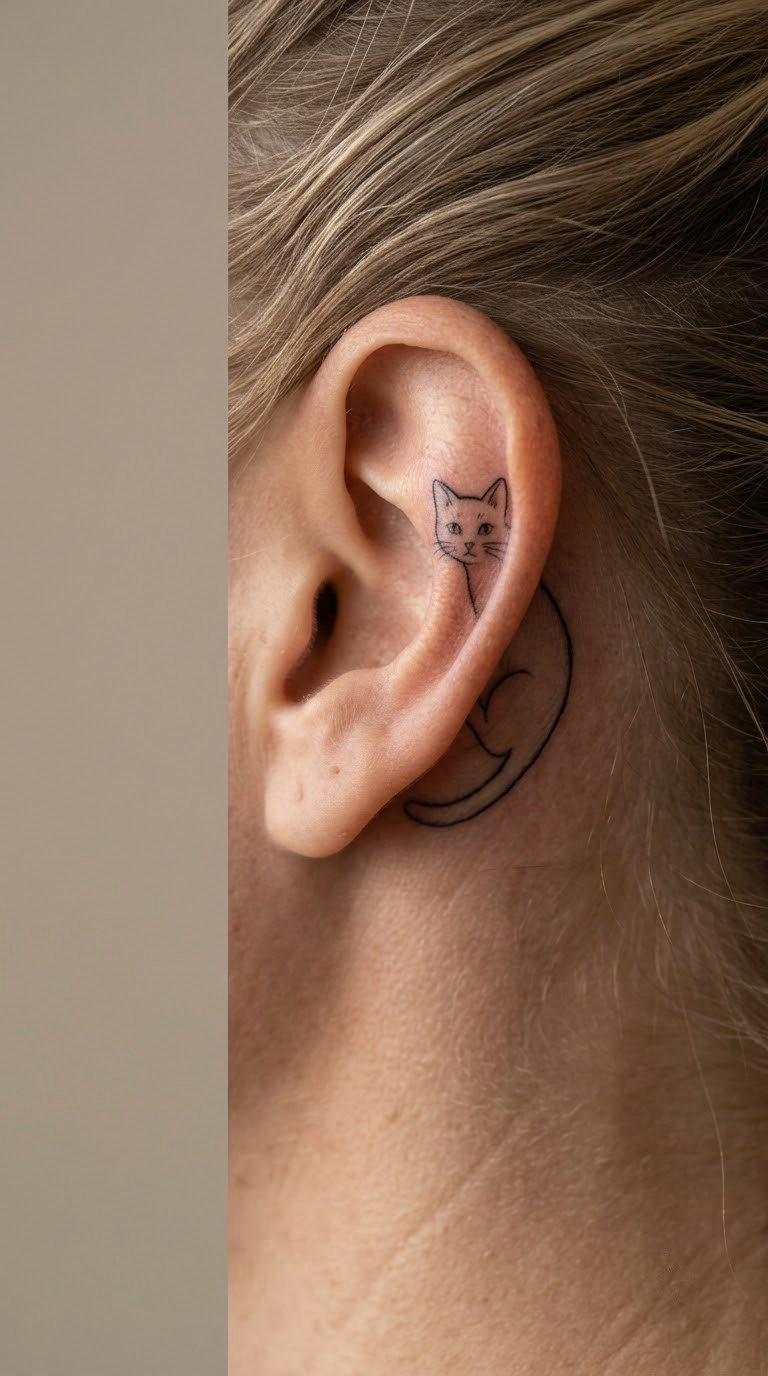
This cat tattoo idea is the simplest thing on the list: a single continuous line draws the top of a cat’s head, two ears, and the curve of a back that disappears behind the ear. No shading, no whiskers, no fill. The whole thing can sit in the space between your ear and the edge of your hairline without crowding either one.
People choose it because a cat is genuinely good at hiding, and the design keeps that joke intact. It reads as a small secret rather than a statement, which is why it suits first-timers and anyone working in an office.
Placement: behind the ear, or just under the earlobe where the cartilage meets the jaw. Size: 1 to 1.5 inch tall, about 1 inch wide. Style: fine line, single-needle work.
Pain: low. The skin here is thin and the nerve density is modest, though the edge of the cartilage feels sharper than the lobe. Fine lines fade first, so ask your artist to run the line slightly heavier than looks right on paper.
Make it yours: add one or two whiskers on the visible side, or use your cat’s real ear notching if the shape suits the size.
2. Tiny Sleeping Cat on the Wrist
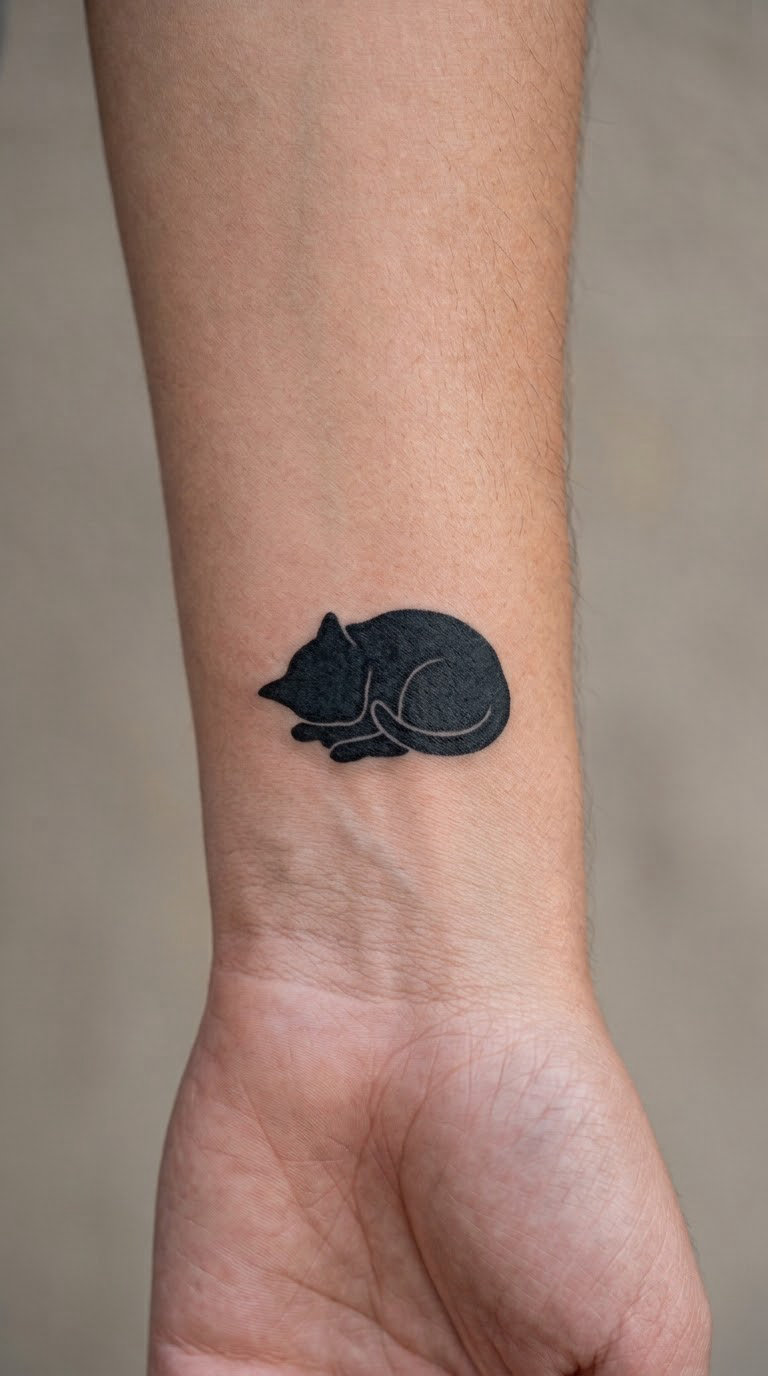
A curled cat with closed eyes and a tail tucked around the body fits the curve of the inner wrist better than almost any other animal design. The artist draws a soft oval, adds the suggestion of a head and two ear triangles, and finishes with a single tail line that follows the forearm. At 2 inches it still reads clearly from across a room.
It is the one most people ask for as a first tattoo: small, quick, low stakes, and it sits where you can watch it heal. Sleeping poses are also forgiving, because there is less anatomy to get wrong than in a sitting cat.
Placement: inner wrist, just above the wrist crease, or mirrored on the outer wrist. Size: 1.5 to 2 inch long. Style: fine line or one-line art.
Pain: low to medium. The wrist pulses, and a few people feel the bone more than the skin. Expect a faint grey look after a few years, which is normal for single-needle work and can be refreshed with a touch-up.
Make it yours: add a small date under the curve in a thin hand, kept no larger than a quarter of the cat.
3. Minimal Cat Face Made from a Heart
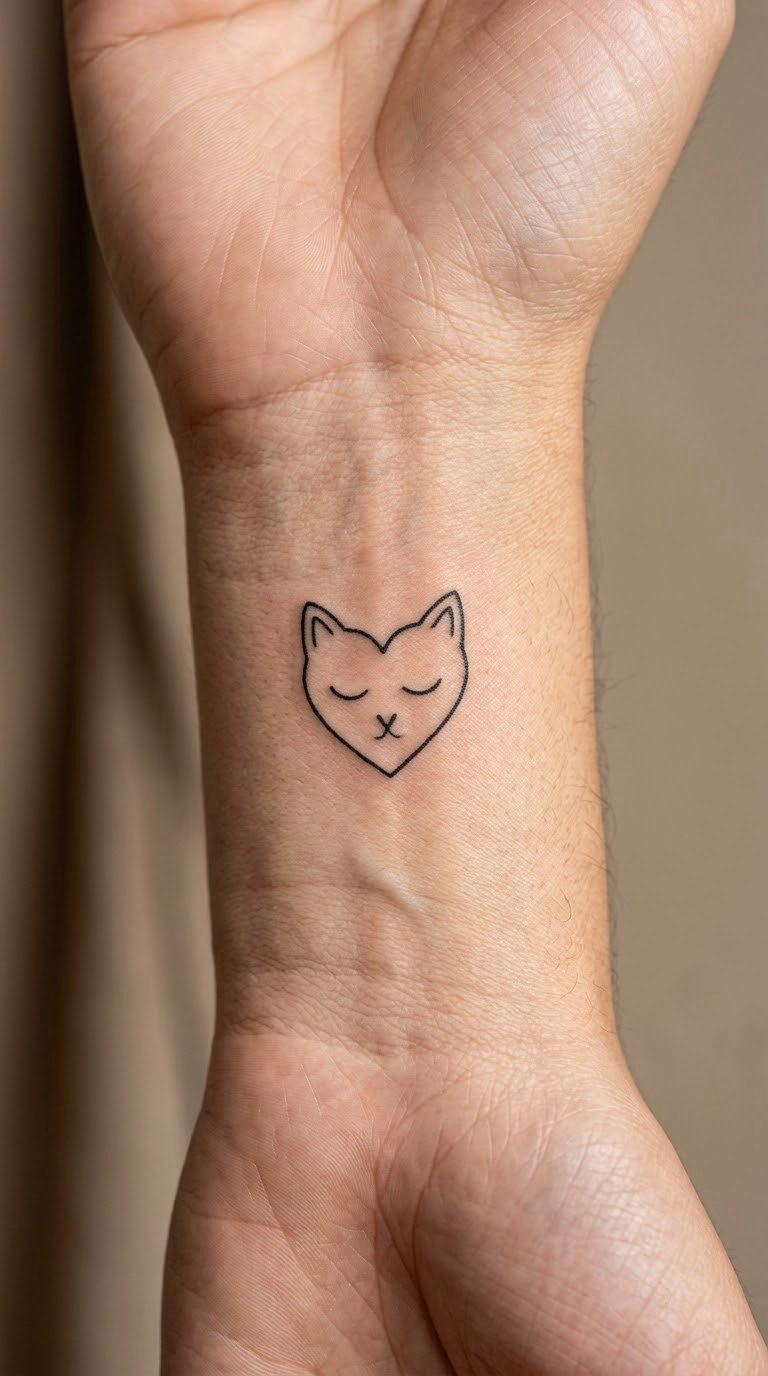
Here the heart is not a decoration around the cat; it is the cat. The two upper dips of the heart become ears, the point becomes the chin, and a small closed-eye pair plus a tiny nose sit in the middle. With one line weight and no fill, it stays a design rather than a valentine card.
Couples, friends and siblings get matching versions, and it works well as a companion to a pet portrait elsewhere on the body. The same shape can carry a first name inside the point if the lettering stays small.
Placement: inner wrist, ring finger, behind the ear, or the ankle bone. Size: about 1 inch wide, 0.9 inch tall. Style: minimal line art.
Pain: low on the wrist, high on the finger. Fingers swell for a day or two and the ink looks darker while it settles. Hairline strokes here blur fastest, so keep it simple on purpose.
Make it yours: swap the closed eyes for open ones, or put your cat’s birth year inside the heart in tiny numerals.
4. Blackwork Cat Silhouette on the Forearm
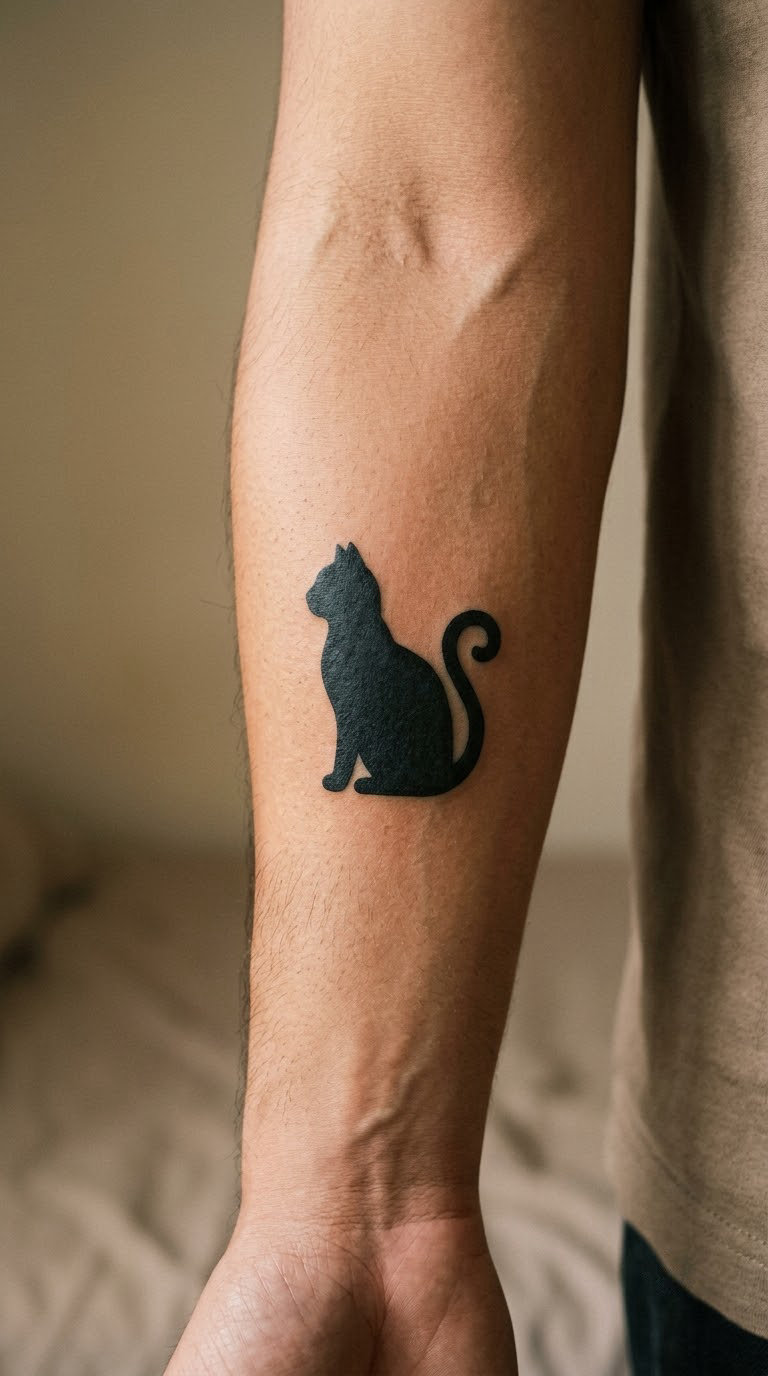
A solid black seated cat is the highest-contrast design in this list. The artist blocks in one flat black shape, then cuts the ears, chest and tail curl out of it with skin left untouched. Because there is no shading to fade, this style holds its edges longer than any fine-line option here.
It is a good first choice if you want something that reads as a shape rather than a picture, and it scales up well, so you can add a moon, stars or a second cat later without the composition falling apart.
Placement: outer forearm between wrist and elbow, or the outer upper arm. Size: 2.5 to 4 inch tall. Style: blackwork or solid silhouette.
Pain: medium. The forearm is fleshy and easy, but a solid fill takes longer and you feel more of each pass. The line stays crisp for years, with only the sharpest edges softening at the corners.
Make it yours: leave one small white notch in the chest for a patch, or have the tail curl around a thin ring of negative space.
5. Watercolor Cat Portrait on the Shoulder
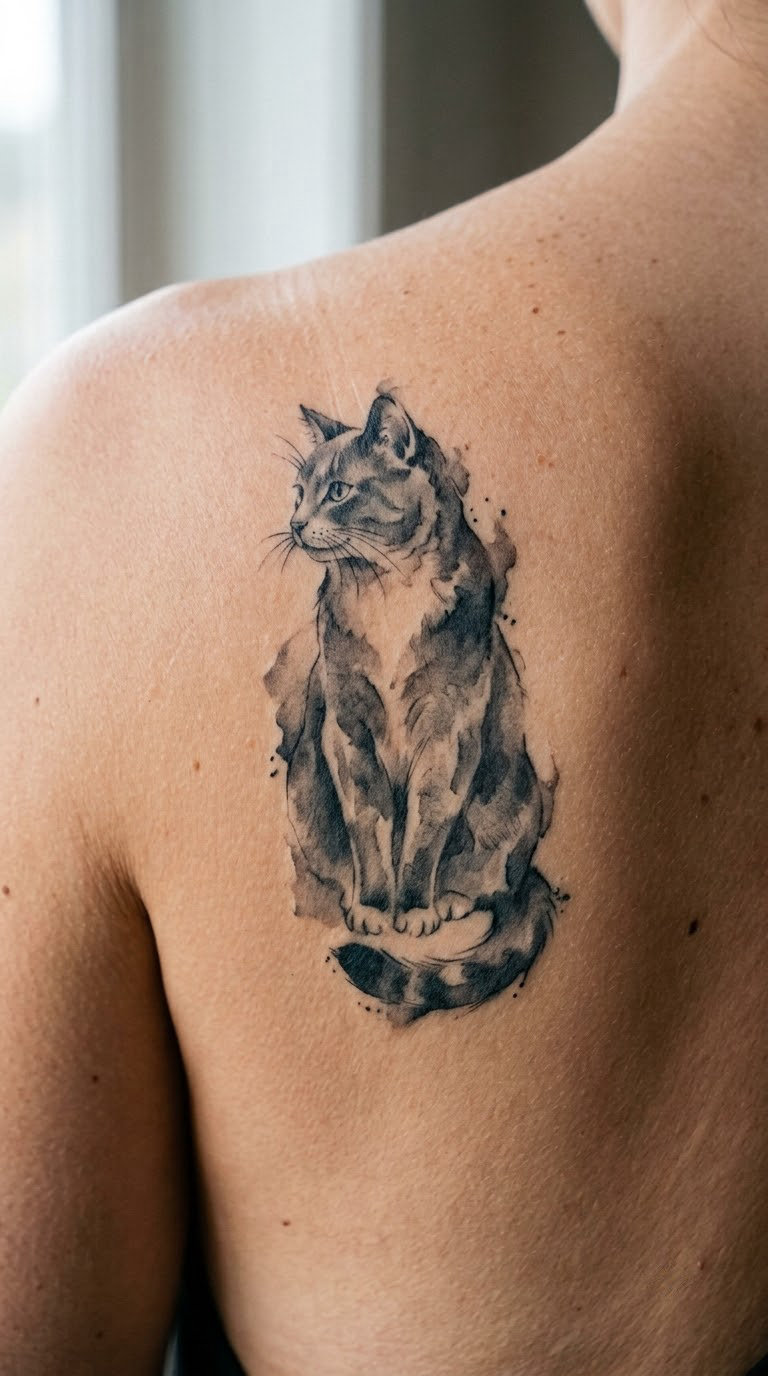
Watercolor portraits drop the outline entirely. The artist lays translucent washes in loose grey, warm brown or a single accent colour, lets the edges bleed a little, then adds a few darker strokes for the eyes and nose. The result looks painted rather than drawn, and the soft edges hide small anatomical errors that would show under a hard line.
It suits people who want a recognisable cat but not a photograph, and it works well for a living pet whose markings change with the seasons. Ask for the eye colour to be the sharpest element, since that is what makes the face readable at a distance.
Placement: upper shoulder, upper arm, or along the spine. Size: 3.5 to 5 inch long. Style: watercolor with black and grey detail.
Pain: medium. The shoulder is sensitive near the collarbone and the session runs long because of the shading. Light washes lose intensity over time, so plan on a refresh every few years if you want the colour back.
Make it yours: bring a daylight photo of your cat’s face and let the artist use the exact eye colour, or add a single loose watercolour flower beneath the chin.
6. Traditional Lucky Cat with a Collar
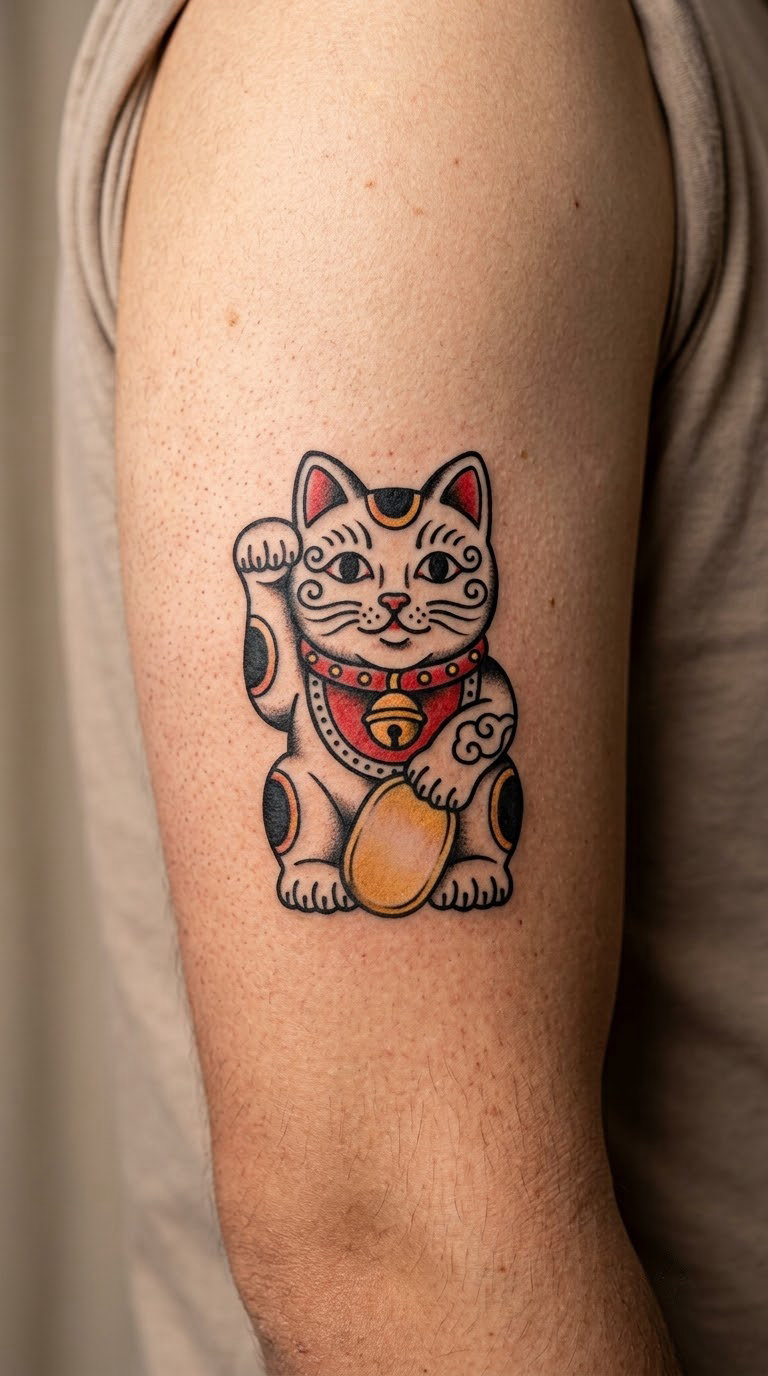
The beckoning cat, often called maneki-neko, is the Japanese figure shown with one paw raised. A traditional tattoo version gives it heavy black outlines, flat colour, a bell collar and a small coin or tablet in the other paw. Bold edges and no gradient shading are what make it read as traditional rather than illustrative.
It is one of the better choices for a first larger piece because the design is stylised by definition, so nobody is measuring it against a real cat. Check that your artist draws the figure well, since poor versions look flat and cartoonish rather than bold.
Placement: outer upper arm, outer calf, or the back of the shoulder. Size: 2.5 to 3.5 inch tall. Style: traditional with bold line work and flat colour.
Pain: medium, and the colour filling is the slow part. Traditional line work holds up well, though solid red and yellow over time can shift slightly towards orange.
Make it yours: change the bell colour to match a real collar your cat wore, or have the tablet engraved with a short name rather than a word.
7. Micro-Realism Cat Eye on the Inner Arm
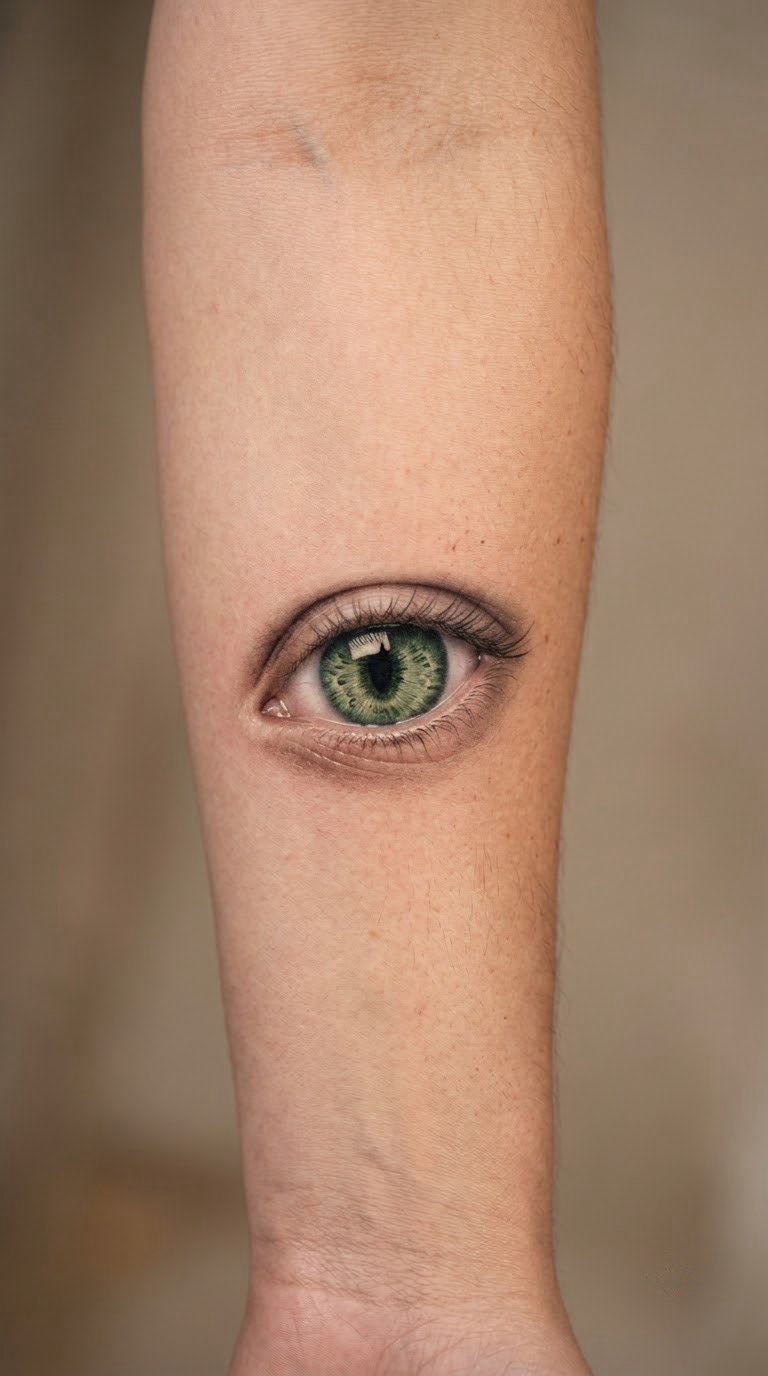
This design takes one feature and renders it properly. The iris gets radial fibre detail, the pupil stays glossy, the lid line is thicker at the outer corner, and a handful of fine lashes sit above it. Done well, at 1.5 inches, it is more convincing than a lot of full faces.
It is a strong option if your cat has one very distinctive eye colour or a permanently scarred or squinting eye, and it works well as a quiet memorial for a cat you have lost. Many people in r/TattooDesigns pick something like this over a full portrait precisely because it suggests the animal rather than attempting a snapshot.
Placement: inner forearm, inner upper arm, or the sternum. Size: 1 to 1.5 inch wide. Style: micro-realism, black and grey.
Pain: medium. The inner arm is a fleshy area but the shading means many short passes. Very fine lashes blur after several years, so a heavier upper lash line is the part worth protecting.
Make it yours: use the exact eye colour of your cat, or crop the design so a few whiskers run off the edge of the design and off the skin.
8. Cat and Moon on the Ankle
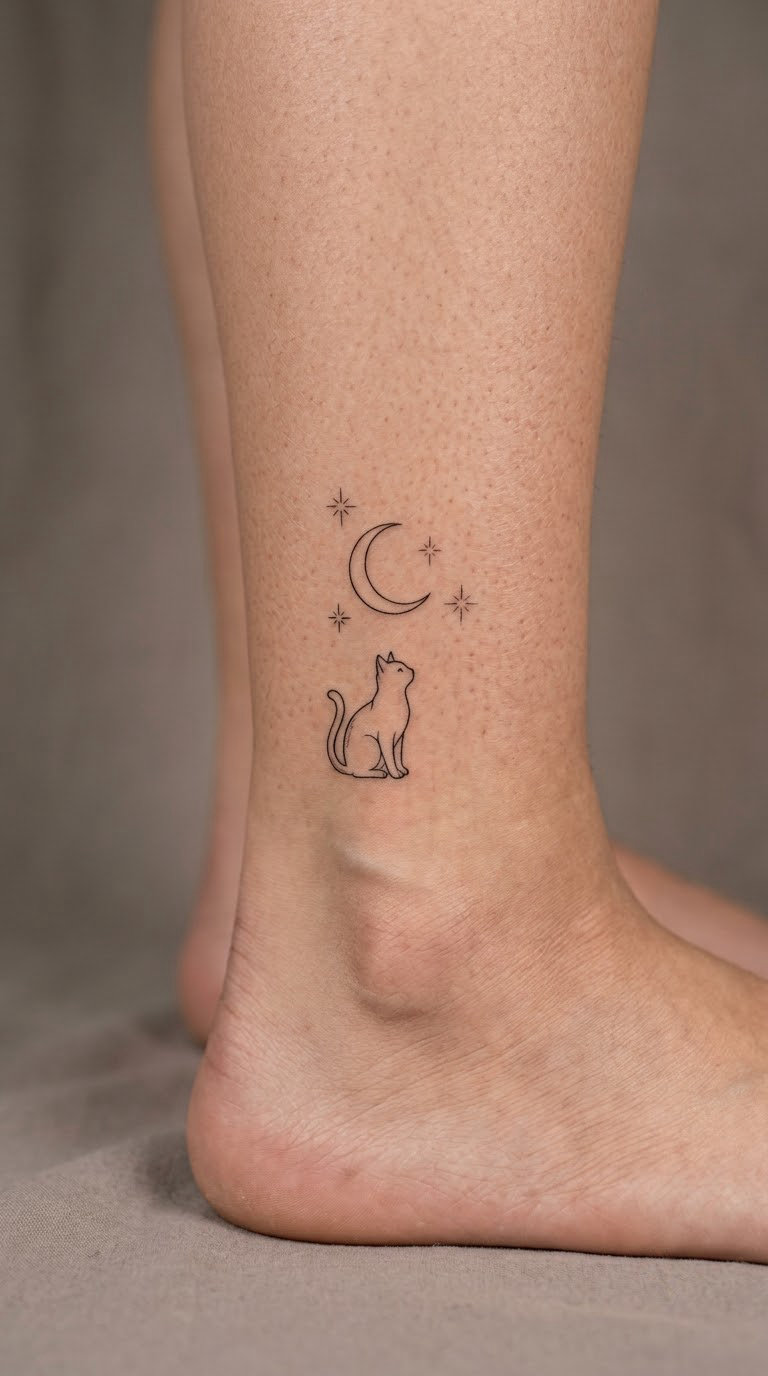
A seated cat under a crescent moon is a compact composition that still has two distinct parts to it: the cat drawn in outline, and the moon drawn as a solid or double-lined crescent floating above. Three dots for stars finish it. The contrast between the outline and the filled moon is what keeps it readable at ankle size.
Celestial framing is a common way to signal a memorial without writing a name, and the moon shape also gives you somewhere to put a date later. A cat under a moon is also a gift that never needs explaining to somebody who knows cats.
Placement: outer ankle above the bone, inner ankle, or the back of the calf. Size: 2 to 2.5 inch tall. Style: fine line with a solid crescent.
Pain: medium. Ankle bone feels intense even on a small design, and the skin there is thin. Ankle work shows wear from shoes, so keep the line weight up if you wear boots often.
Make it yours: add the year your cat came home inside the crescent, or use a three-quarter moon and a small star for each cat you have had.
9. Paw Print Trail Across the Collarbone
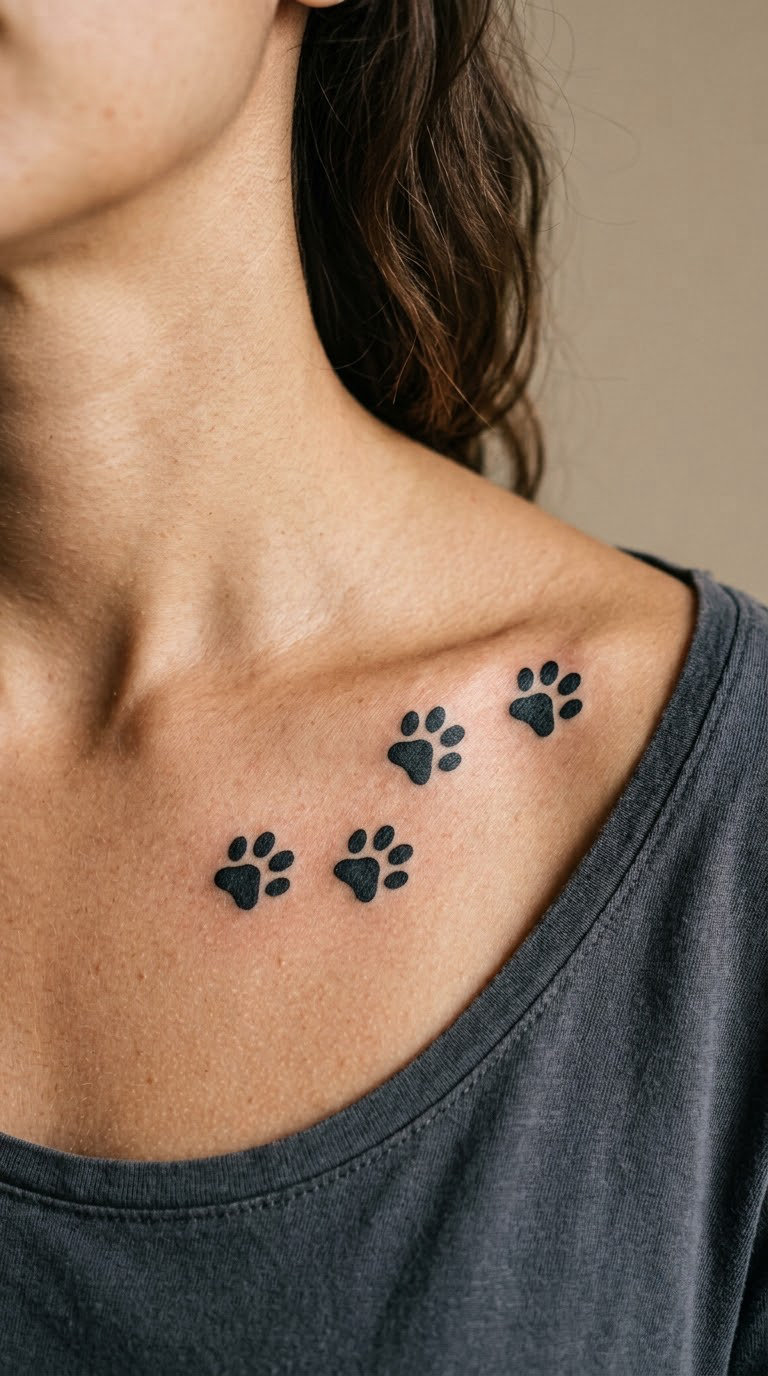
A paw print trail is a sequence rather than a single image. The artist draws one main pad with four toe beans, then repeats it along a line, varying the size slightly and letting the prints rotate a little so the trail looks like it is walking. Four prints usually fill a collarbone line without touching the sternum notch.
People pick this when the cat is alive and the tattoo is about companionship rather than loss, and it is the easiest cat tattoo idea to extend: another print can be added years later when the next cat arrives. Owners with several cats often build the trail one at a time, and it stays legible because nothing depends on the prints touching.
Placement: collarbone, inner arm, or a line down the side of the ribs. Size: four prints of about 0.75 inch each, spread over 3 to 4 inches. Style: solid black or fine line.
Pain: low to medium. The collarbone is bony, and near the sternum the feeling gets sharp fast. Solid pads hold up better than outlined ones, which is worth choosing on the ribs where shirts rub.
Make it yours: have the trail start at a paw print from your own cat using ink or stamp pad, or curve the trail around the elbow like the cat is walking up the arm.
10. Kissing Cats on the Chest
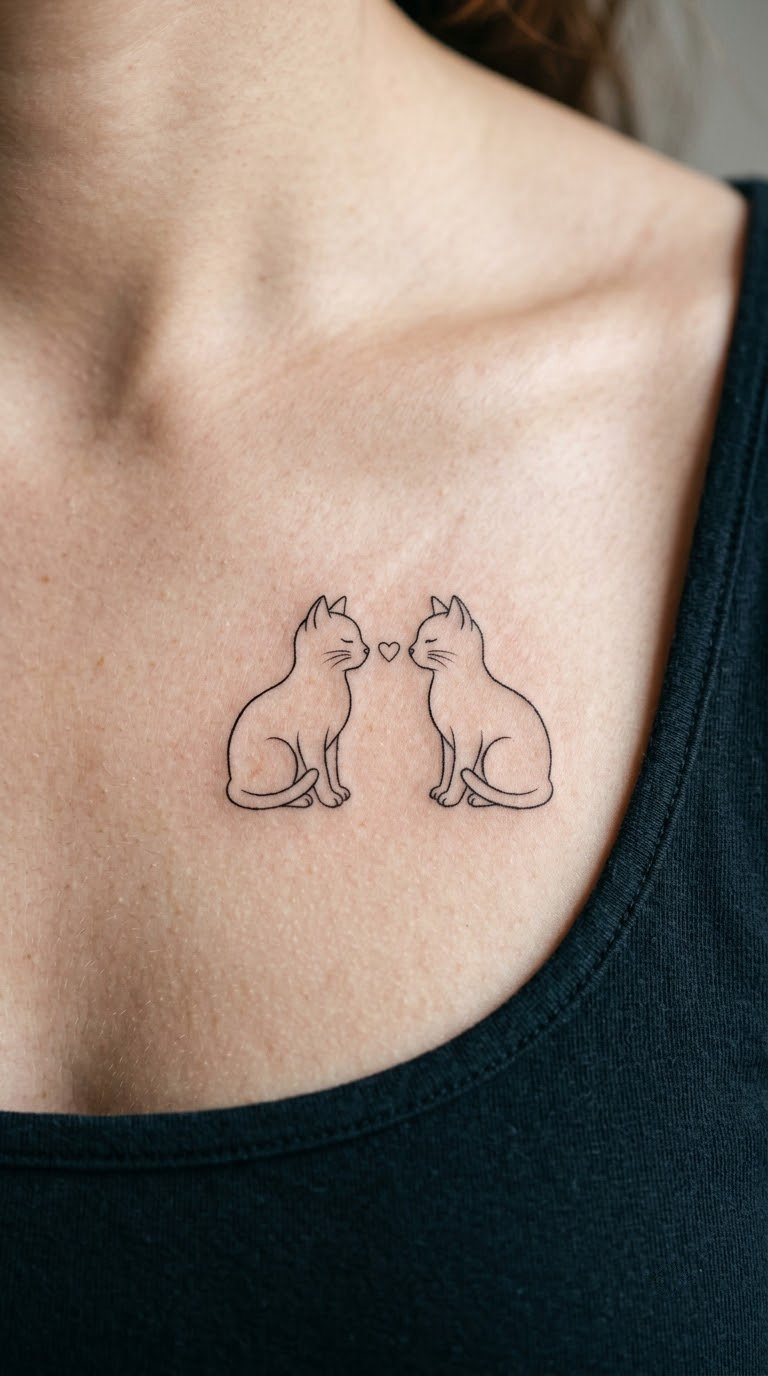
Two simplified cats facing each other, eyes closed, noses nearly touching, is one of the most requested designs on cat tattoo boards. The trick is symmetry without stiffness: each cat is a simple outline with a curved back and two ear triangles, and the pair is balanced around a small heart or a few crossing whisker lines.
It works for two cats in one home, for a couple with matching placements, or for a single cat treated as a companion. Keep the animals simplified rather than realistic, because two detailed faces at this size turn to mush quickly.
Placement: upper chest, sternum, or the centre of the back of the neck. Size: 2 to 2.5 inch wide. Style: line art, or matching fine line.
Pain: medium to high. The sternum and chest are among the more sensitive spots on the body, and the session feels long in one position. If you are nervous, ask your artist to break it into two shorter appointments.
Make it yours: give each cat a different ear notch or tail marking so they are recognisable, or curve the pair into a heart shape.
11. Dotwork Cat in a Circular Frame
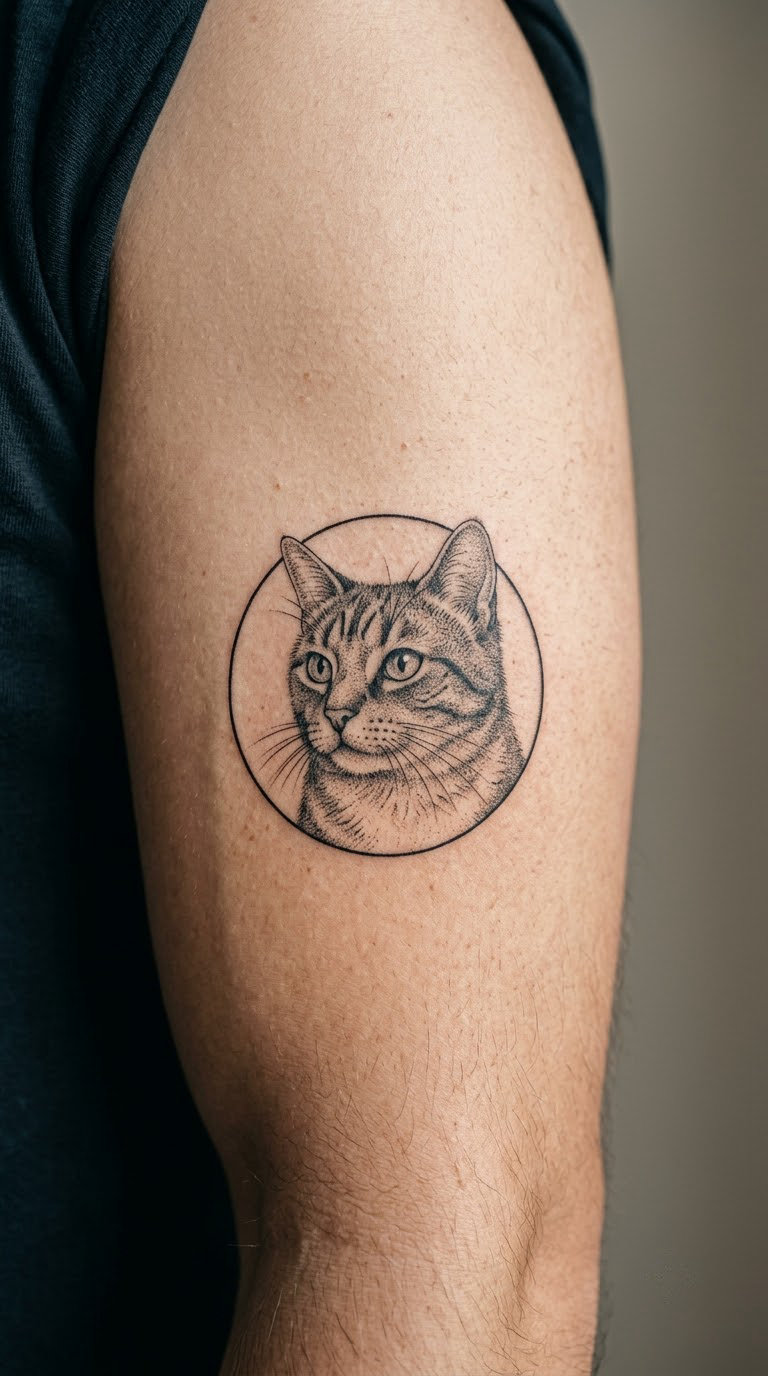
Dotwork builds an image out of dots of varying size: dense in the shadow under the chin and around the eyes, sparse along the cheeks, and left as bare skin for the highlight. A thin ring border holds the composition together and gives it a stamped, medallion feel. The dots do the shading work, so the cat still reads clearly when it is small.
It is a good middle ground between a plain line drawing and a full blackwork piece, and it suits people who want depth without colour. Ask to see healed dotwork in the artist’s portfolio, because uneven dot density shows up a few months after healing, not on day one.
Placement: upper arm, outer forearm, or the calf. Size: about 2 inch in diameter. Style: dotwork with geometric border.
Pain: medium. Each dot is a separate pass, so expect a slow session and an early finish on a restless sitter. Dot work softens more than solid black, and the lightest areas can wash out over time.
Make it yours: break the ring at the bottom for a name in thin script, or fill the negative space around the head with a faint constellation.
12. Cat Head with Flower Crown on the Back of the Neck
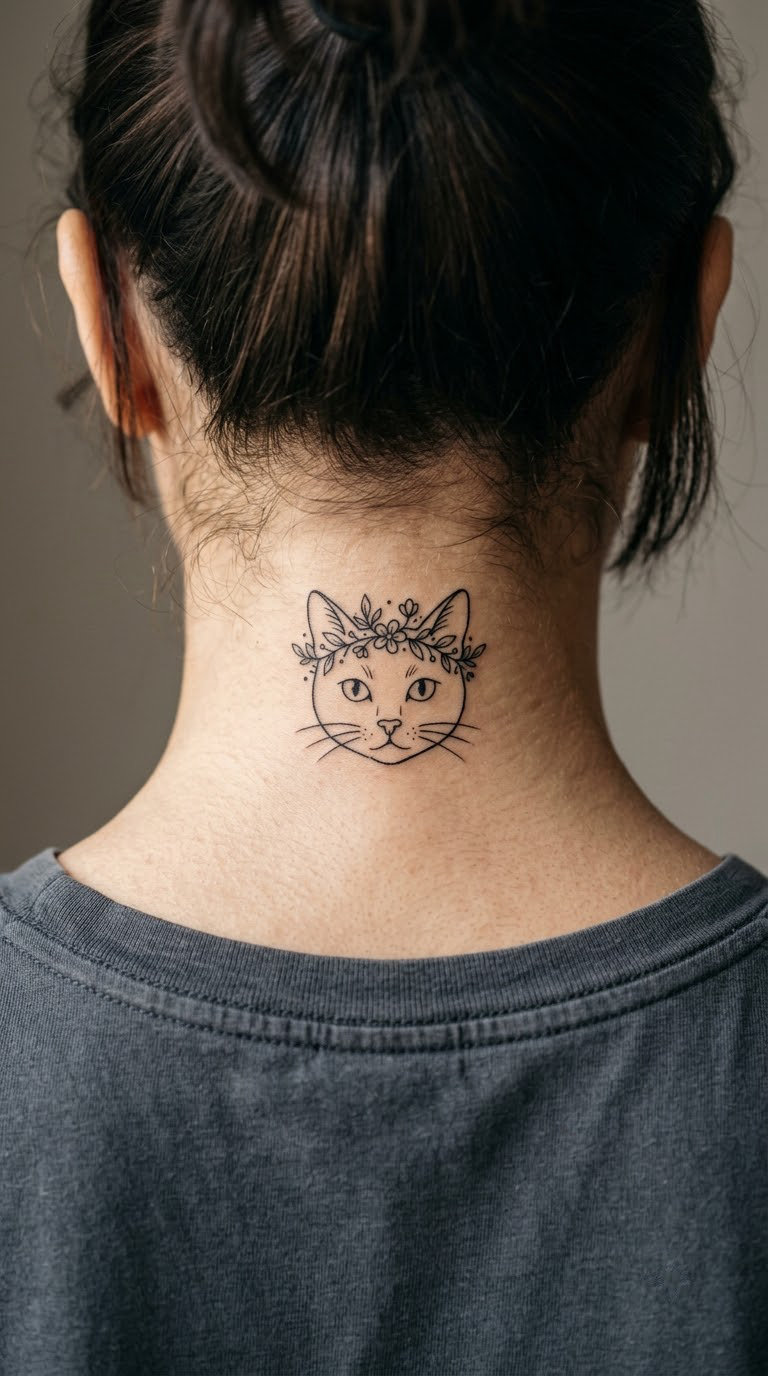
A simple cat face sits under a crown of small botanical shapes: a few rounded blossoms, some narrow leaves, tiny stems. The cat itself is drawn with a clean outline, two ears and minimal features, and the flowers carry most of the detail. The contrast keeps the face legible when the composition is small.
Floral framing is how a lot of people say they love a cat without making it a portrait. It reads decorative rather than sentimental, and it sits well on the back of the neck where a low collar or an updo frames it.
Placement: back of the neck, upper back, or behind the ear. Size: 2 to 2.5 inch wide. Style: fine line with botanical detail.
Pain: low to medium. The back of the neck is reachable and quick, though it can tickle uncomfortably near the hairline. Fine stem lines are the first to disappear, so fewer and bolder flowers age better than many small ones.
Make it yours: use your cat’s real colouring as a guide for the blossoms, or have the crown built from the plants that grow in your garden.
13. Stretching Cat on the Side of the Ribs
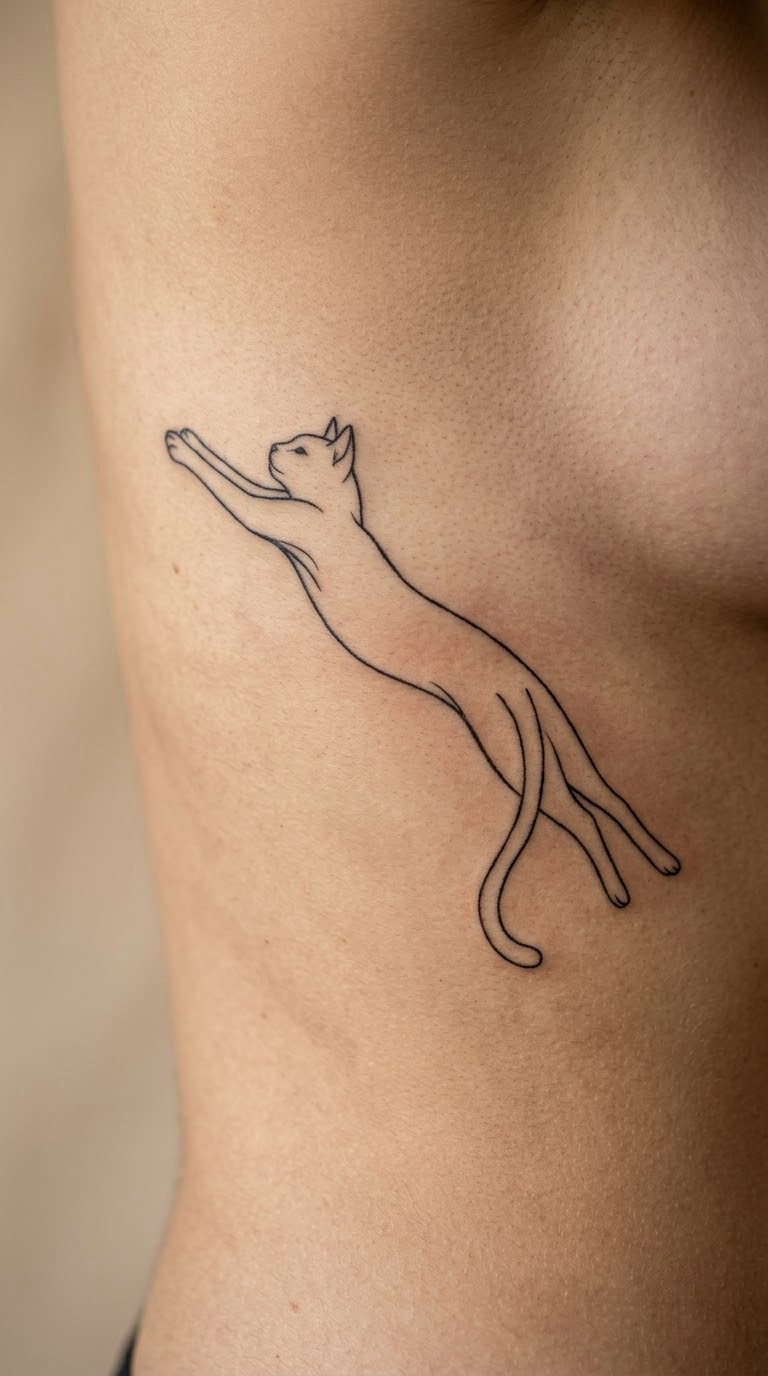
This design uses the body as the frame. The cat is drawn mid-stretch, back arched, front legs extended, tail flowing behind, and the whole shape follows the curve of the ribs from the armpit down toward the hip. The arched back gives the artist a natural line to follow instead of forcing a flat drawing onto a curved surface.
The mid-stretch pose is also one of the most recognisable cat behaviours, so the tattoo reads instantly even with no face detail. It is a strong choice for a bigger piece and looks well as the centre of a half sleeve later.
Placement: side of the ribs, lower back, or the outer thigh. Size: 3.5 to 4.5 inch long. Style: fine line with light shading along the spine.
Pain: high. Ribs and the side of the torso are the most commonly reported difficult spots, and the position is hard to hold. Take a break before the shading rather than pushing through, and expect a long appointment.
Make it yours: set the cat on a real stretched pose, or extend the tail into a line that curls around your arm when the design reaches your side.
14. Cat with a Small Heart on the Finger
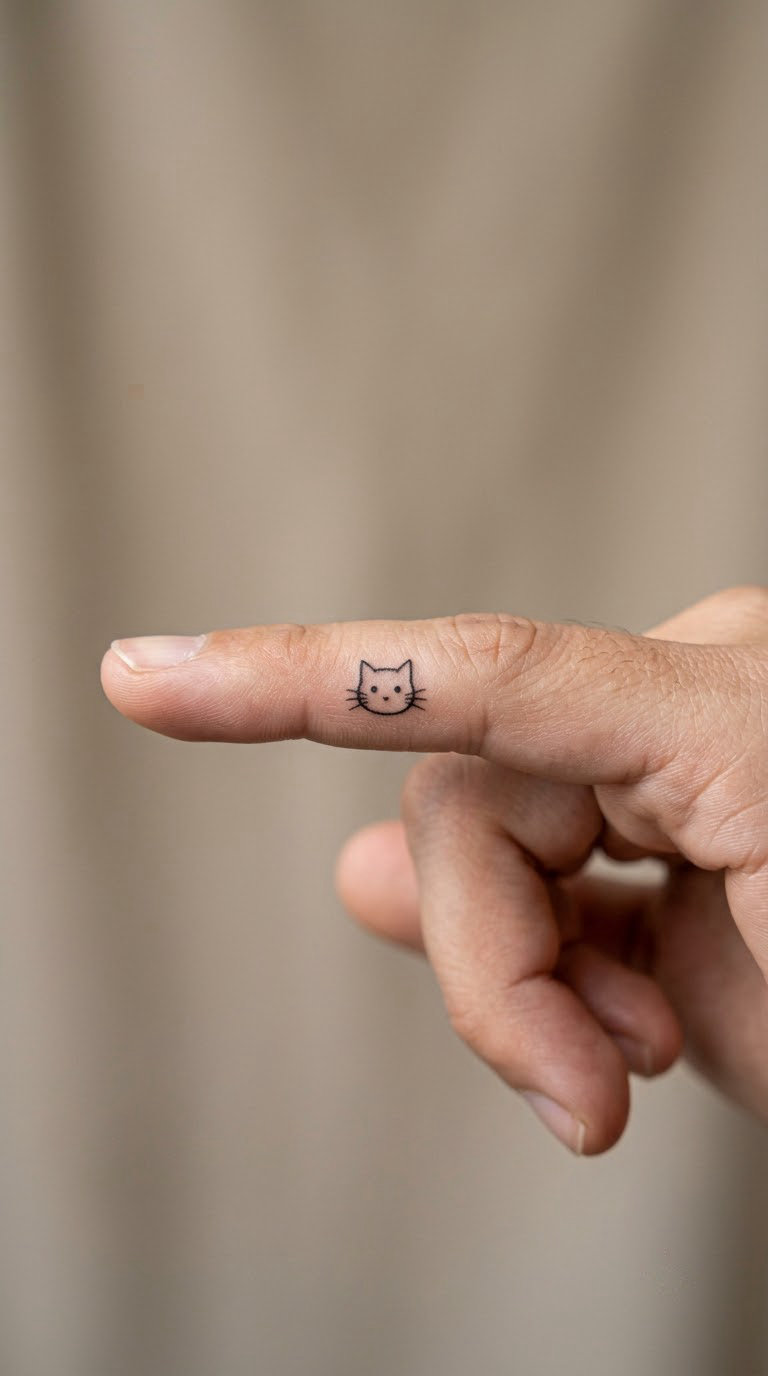
Finger tattoos live or die by simplicity. A cat head with two triangle ears, two dot eyes and a small heart underneath is about as much as stays readable at three-quarters of an inch. Anything more, and a hand-washing habit will soften it into a grey smudge within a couple of years.
It is a discreet choice, since the design reads mostly to people standing close, and it pairs naturally with a matching set on the other hand. The heart can be a plain shape or a tiny solid one; anything with more detail becomes noise at this scale.
Placement: side of the index or ring finger. Size: 0.6 to 0.75 inch tall. Style: micro fine line.
Pain: high, and not because of the size. Finger skin is thin over bone and the nerves sit close to the surface, so even a quick pass is intense. Your hand swells, and the ink looks darker than it will settle to.
Make it yours: have the cat wear a collar tag with a single initial, or make it your cat’s face cropped from a photo, kept as plain as possible.
15. Blackwork Cat Climbing a Vine
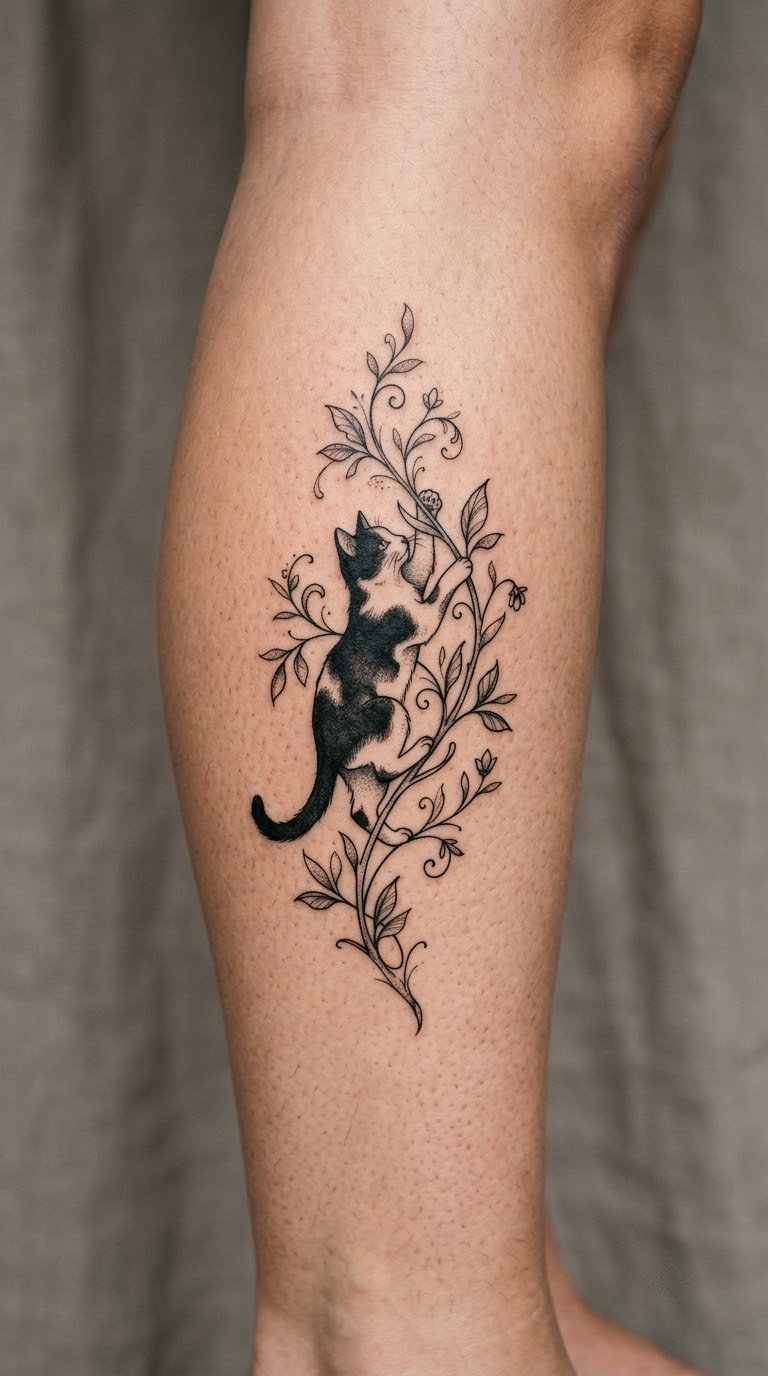
Solid black paws, a white chest and winding botanical lines make a design that is part blackwork and part line drawing. The vine gives the composition movement and stops the cat from sitting in the middle of the limb looking static, and the negative space between the leaves keeps the piece light.
Botanical growth suits a design meant to age well, since stems and leaves can be thickened later as the fine lines fade. It also lets you build a piece: a second vine with a butterfly, or a separate cat, can follow the same visual language whenever you are ready.
Placement: outer calf, inner forearm, or the outer thigh. Size: 3 to 3.5 inch tall. Style: blackwork with botanical line work.
Pain: medium. The calf is one of the easier places to sit through for a long stretch. Solid black patches heat up the skin and feel scratchier than line work, and the calf is more exposed while healing.
Make it yours: have the vine built from a plant that matters to you, or mirror the cat upside down so it reads as climbing down the leg.
16. Two Cat Ears in a Minimalist Matching Pair
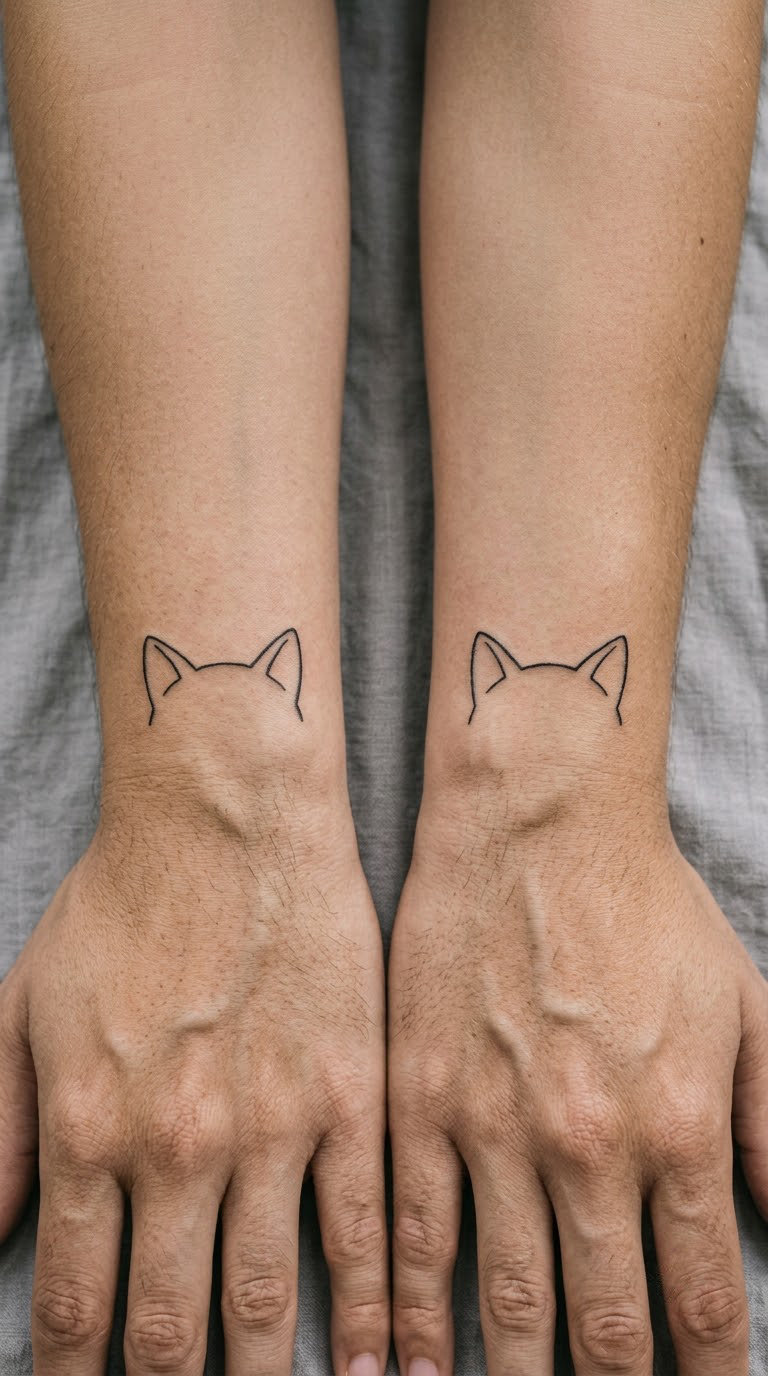
Two cat ears drawn as a pair of simple triangular arcs are the most minimal of the tattoo ideas for cat lovers who want a reference rather than a picture. Each ear is a soft V with a rounded base, and the pair can be identical, mirrored, or drawn with a small notch in one to suggest a real cat’s ear.
This is where matching sets live, whether it is a partner, a sibling or a group chat of friends. If you are planning something wider than a pair, our matching family tattoo ideas for four page has layouts that scale without every piece turning into the same full design.
Placement: inner wrists, behind both ears, or across the knuckles. Size: 0.75 to 1 inch per ear. Style: minimalist outline.
Pain: low. Wrists and behind the ears are quick, small areas. Fingers and knuckles fade fastest, so wrists are the better home for a design you want to keep readable.
Make it yours: have one ear carry a notched tip and the other left plain, so the pair quietly reads as two different cats.
17. Cat and Fish in a Japanese-Inspired Style
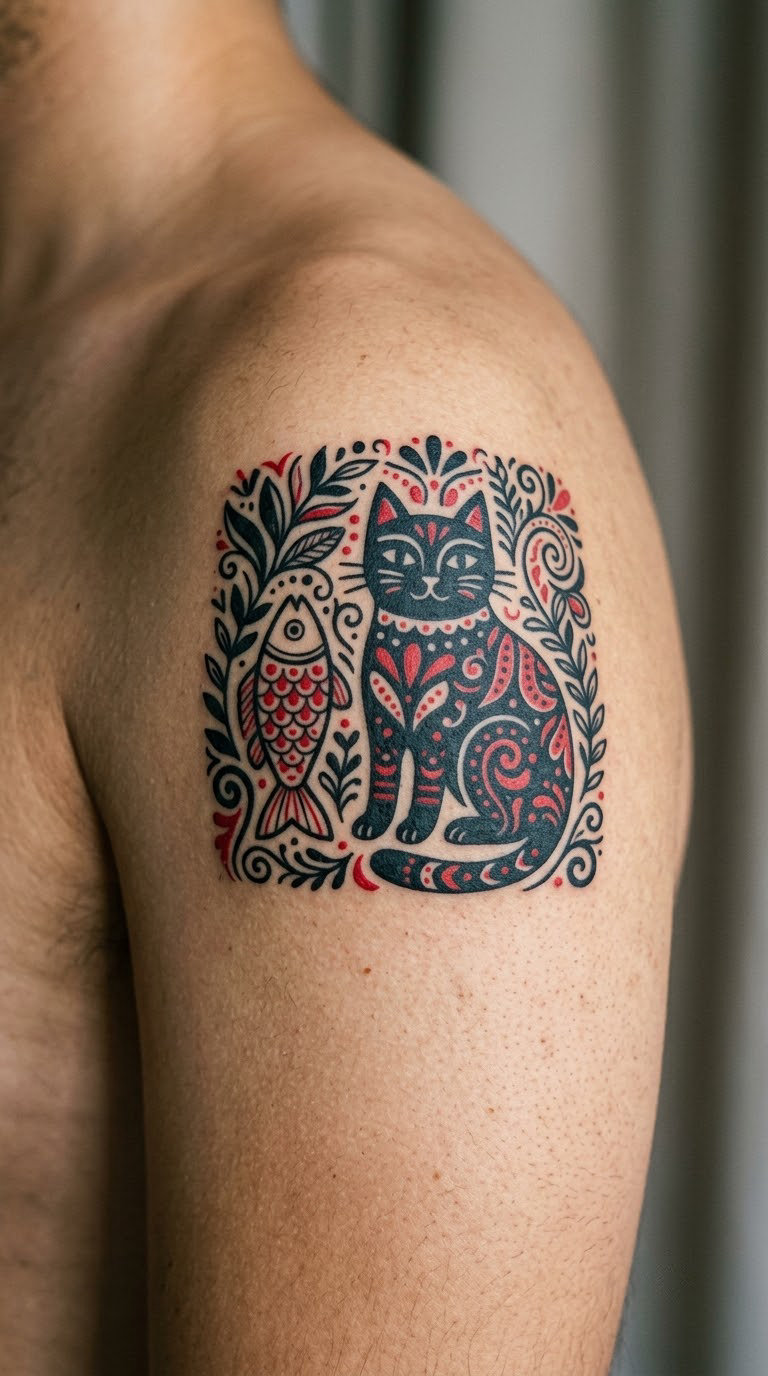
A cat beside a fish, drawn with clean outlines, flat colour and a decorative background of small repeated shapes, gives a compact composition with a lot going on. The cat is usually red or black, the fish simplified to a few lines, and the background filled with a small repeating motif rather than left empty. That background is what stops it looking like two clip-art animals stuck together.
It works as a celebration design for a cat who is endlessly interested in the fish bowl, and it fills a shoulder or upper back well because the shape is roughly square. Ask for a modern illustrative take rather than anything copied from an existing print, and check the artist’s background pattern work before booking.
Placement: shoulder, upper back, or the outer upper arm. Size: about 3 inch wide. Style: illustrative with clean outlines and flat colour.
Pain: medium. The shoulder is sensitive near the collarbone and the patterned background needs a needle change for every shape. Fine background lines blur first, so a bolder motif suits a design you want to keep.
Make it yours: use your cat’s actual coat colours as the palette, or add a koi instead of a goldfish and give it a different colour.
18. Sleeping Cat in a Crescent Moon on the Hip
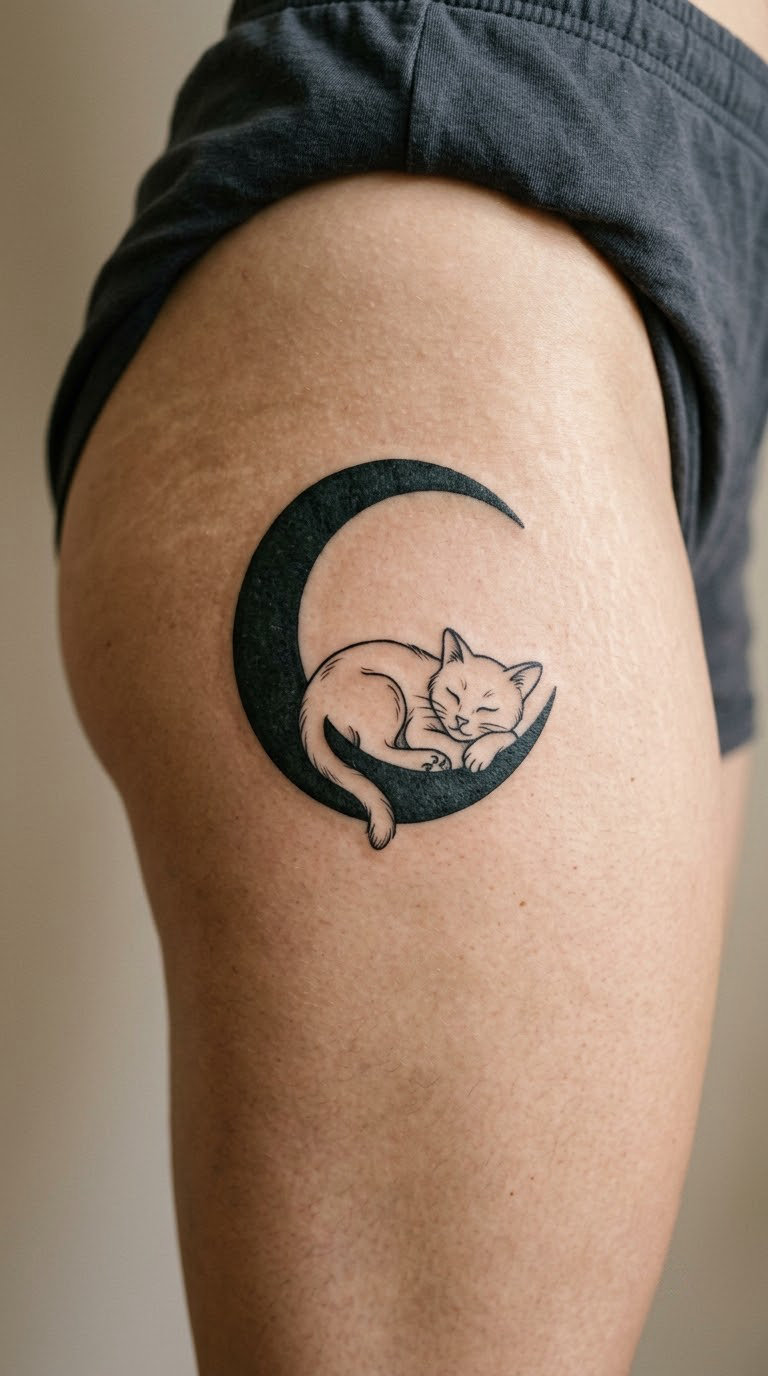
The trick to this one is proportion. A large solid crescent moon takes most of the shape, and the cat is drawn small inside it, curled with its tail wrapped and its eyes closed. The solid moon gives the piece weight, and the cat’s outline stays readable because it sits against clean black rather than empty skin.
It is a popular memorial layout for a cat who lived a full life, since the moon reads as night and rest without anyone having to explain it. The negative space inside the crescent is what makes it look like a drawing rather than a solid block, so avoid designs that fill that gap.
Placement: outer hip, outer thigh, or the upper back. Size: 3.5 to 4 inch tall. Style: line art with a solid crescent.
Pain: medium. The hip is a fleshy area that tolerates a long session well. The solid crescent takes time and the skin gets warm, but the outer thigh is one of the more comfortable places to sit for a piece this size.
Make it yours: curve the cat’s tail around the inner edge of the crescent so the two shapes interlock, or add small stars in the empty corner beside the moon.
19. Cat Whisker Mark Behind the Ear
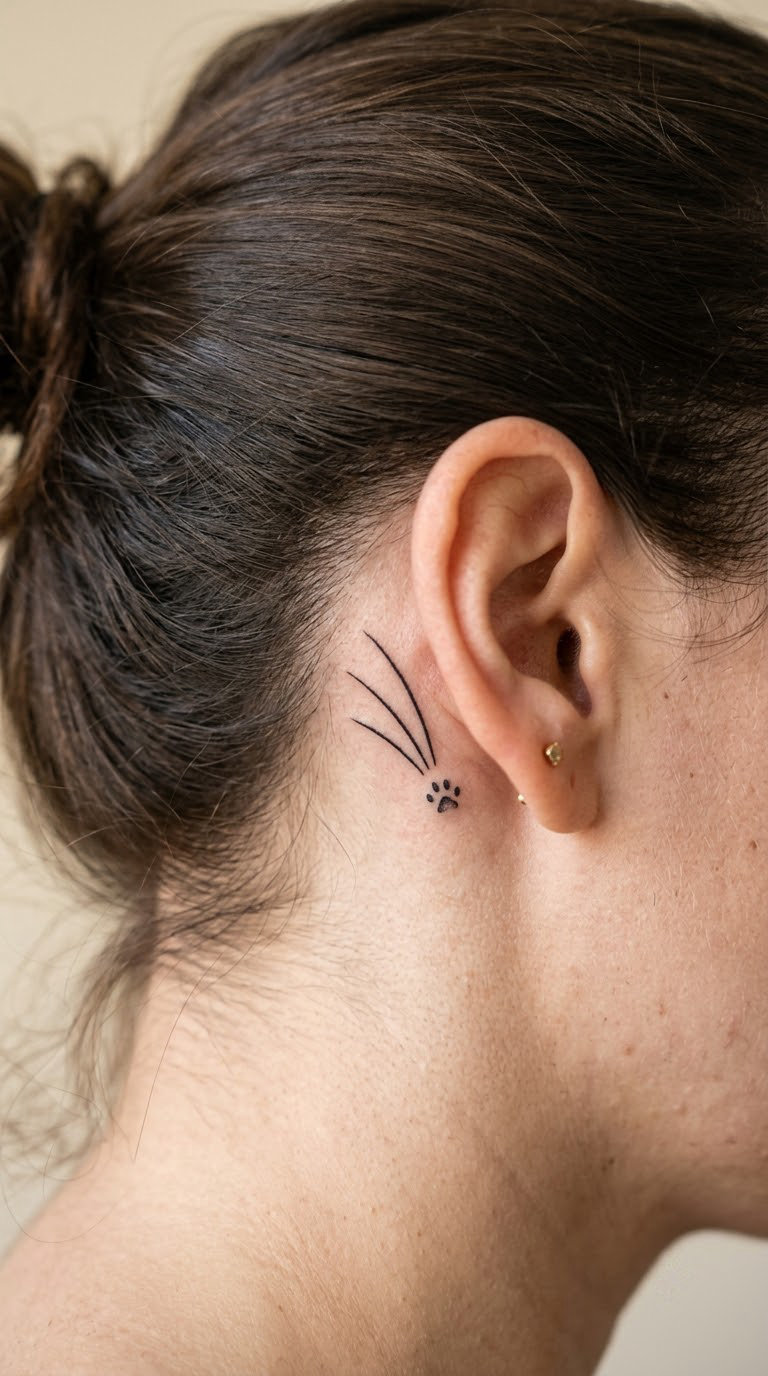
Three lines and a tiny paw is about the least ink you can get away with and still be legible. The whiskers are drawn with a single needle at slightly different angles, and a small paw or a minimal nose sits at the base. From the front it reads as almost nothing, which is the entire point.
This is the design for someone who wants a cat tattoo nobody at work can see. It also suits a first session, since the appointment is short and the healing is quick, and it is easy to add to later with a name in fine script below it.
Placement: behind the ear, or the nape of the neck where hair covers it. Size: 1 to 1.5 inch wide. Style: micro fine line.
Pain: low to medium. Behind the ear is quick but the skin moves when you talk, so the artist will ask you to keep still and avoid chewing. Three hairline strokes are among the first things to blur, so a slightly heavier pressure here is not a bad idea.
Make it yours: count your cat’s actual whiskers and use that number, or add a tiny date in the same line weight underneath.
20. Cat Portrait Made from Geometric Shapes
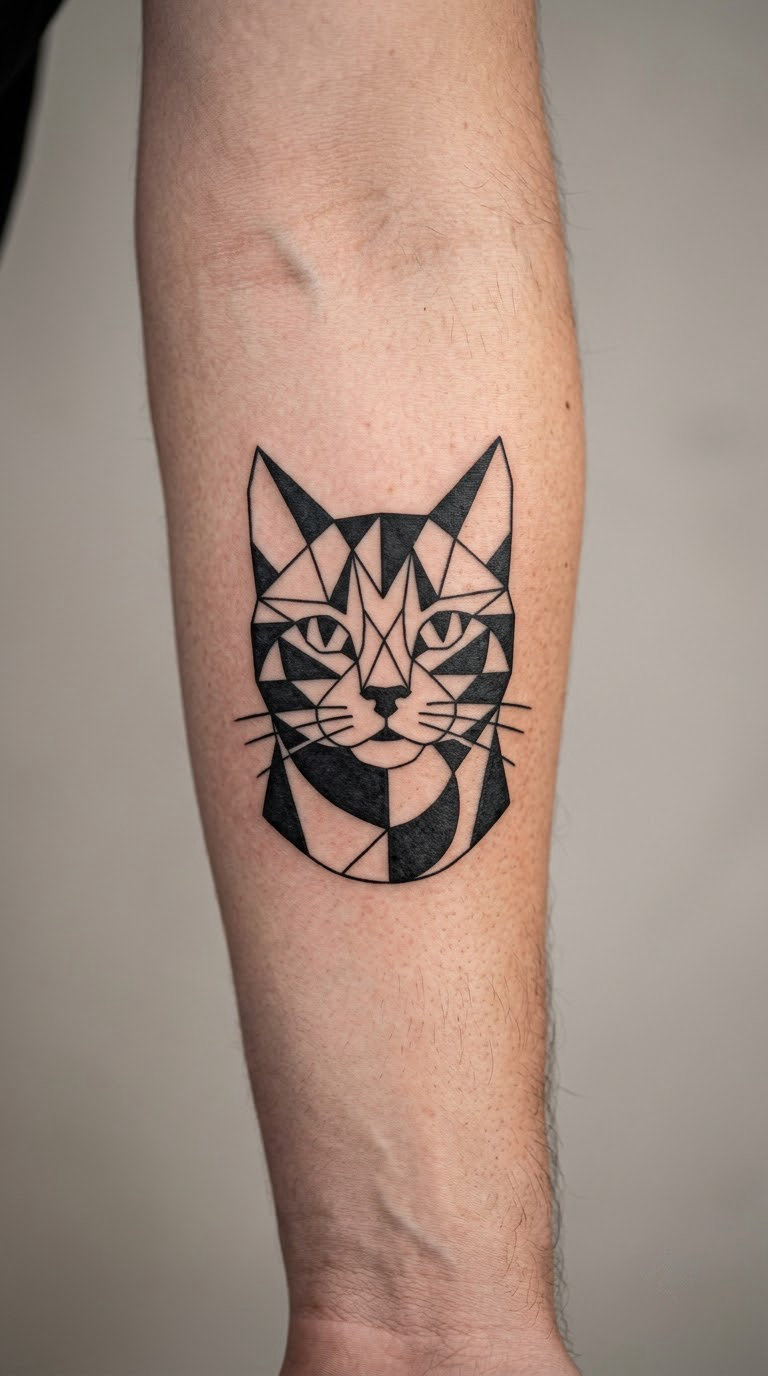
This design assembles a cat from flat shapes: triangles for the ears, a half-circle for the head, angular blocks for the shoulders, straight lines for the whiskers. Some parts are solid black, some are left as skin. The cat is instantly recognisable, and none of it depends on fine detail, which is why it ages well.
It suits people who like cats but not the sentimental portrait treatment, and it fits neatly into a geometric or blackwork sleeve built later. Faceted, origami-style and low-poly versions are the three flavours, and they are quite different in mood, so look at a few before choosing.
Placement: forearm, calf, or the outer arm. Size: 2 to 2.5 inch wide. Style: geometric blackwork.
Pain: medium. Solid blocks take a while, and the forearm curves so the artist works in stages. Geometry holds its edges better than shading, so this is one of the designs that still looks sharp years later.
Make it yours: build the blocks from your cat’s real coat pattern, or keep three solid shapes and leave the rest as bare skin for a much lighter result.
How to Choose the Right Design
Choose by size first, then style, then meaning. A design that looks right on a flash sheet can be a poor match for a one-inch placement, and that is the mistake most first-timers make.
Start Small: Tattoo Ideas for Cat Lovers Getting Their First Ink
If you have never been tattooed, the wrist, the ankle or behind the ear are the sensible starting points. The peeking cat, the heart-shaped face, the whisker mark and the ear pair are all comfortable, quick and easy to hide. A first cat tattoo that you can cover is far easier to commit to than a chest piece.
Pick something with a clear silhouette. Cats have very readable outlines, so almost any of the smaller designs here stays recognisable without heavy detail.
Match the style to the skin and the size
Fine line and single-needle work need an artist with steady hands and thin line control, and they fade faster than anything else on this page. Blackwork and geometric styles are the most forgiving over a decade. Micro-realism rewards a portfolio of healed animal work, since a photograph and a healed tattoo look nothing alike.
Watercolor and traditional work are both colour-forward, which is worth thinking about if you want the piece to hold its colour. Light washes and pastels are the first to fade.
Keep the design readable in ten years
Ask yourself what the design still says once the fine detail softens. Solid shapes, silhouettes and clear outlines survive; thin whiskers, tiny script and pale shading do not. If a name and a date matter to you, give the lettering at least a third of the piece’s height and use one clean font.
Cluttered memorial tattoos are the most common regret in this whole category. A portrait, a name, a date, a halo, a wreath and a paw print in a two-inch space is five designs fighting each other, and the ones people are proudest of are usually the simplest.
It also helps to think about whether the piece should leave room to grow. Owners who add cats to a pet tattoo over the years tend to design something that can be extended, rather than a single crowded composition that has nowhere to go.
Cost and Session Time
Most studios price by the hour, and the size of the piece matters less than how long it takes to finish. Tiny single-line designs on the wrist or behind the ear are often the shortest bookings and sit at the low end of a shop’s range, while a solid blackwork or detailed portrait on the forearm or ribs can run into a full day.
As a rough guide, single-needle work usually takes under an hour, small solid pieces with two or three colours take one to two hours, and a larger portrait or a piece with a botanical background runs three to five. A design that needs a second session for shading is common, and some artists will book a deliberate break rather than push through a long sitting.
Shop minimums, artist rates and hourly pricing vary widely by city, and the same design can cost very different amounts in different parts of the country. Most artists will give you a firm estimate at a consultation once they have seen the placement and the reference. Numbing cream is widely available, and a few people on r/Tattoo_NYC say they feel very little with it, though everyone still books the first session around the same level of discomfort.
Aftercare Basics
Follow your artist’s aftercare instructions first, because they will match the ink and technique they used. The general routine looks like this.
- Wash the area gently with lukewarm water and a mild unscented soap for the first few days, then pat it dry rather than rubbing it.
- Keep the tattoo covered and out of direct sun while it heals, and avoid swimming, hot tubs and saunas until the skin has closed over.
- Wear loose clothing over the placement for the first week. A cotton shirt over a collarbone or chest piece saves a lot of friction.
- Apply a thin layer of whatever ointment or balm your artist recommends, and do not pick at scabs or flakes.
- Contact the studio if you see spreading redness, heat, swelling, a feverish feeling, or discharge that is not ink and blood. It is normal to be red, tender and slightly swollen for the first few days.
- Once healed, keep fine line and pastel work out of prolonged sun where you can, since fading is mostly light damage.
Frequently Asked Questions
What does a cat tattoo symbolize?
There is no single fixed meaning, so the symbolism depends on the design and the person. Cats commonly stand for independence, mystery, intuition and quiet loyalty. A black cat or gothic cat can suggest superstition or protection, a maneki-neko or lucky cat figure is associated with good fortune, and a paw print, moon or sleeping pose often marks a specific bond with a pet rather than an abstract idea.
Where is the best place to put a small cat tattoo?
The inner wrist, outer ankle and behind the ear are the easiest first placements: they are small, heal quickly and are easy to cover at work. Collarbone, sternum and the inner forearm take slightly longer and are more sensitive. Ribs and the side of the torso hurt most and suit only a larger design. Match the size of the piece to the flat area available.
Do fine line cat tattoos fade and need touch-ups?
Yes, and that is expected rather than a mistake. Single-needle lines hold their darkest tone for a few months, then settle into a soft grey and slowly blur. Solid blackwork and geometric work keep their edges far better. If you want the fine line crisp, book a refresh every few years, and accept lighter line weight in the design from the start.
Can I get a tattoo of my own cat?
Yes, and send clear photos in good light plus a few reference images of the look you want. Photorealistic versions are the hardest to get right, and people in r/TattooDesigns often choose a stylised or symbolic design instead so the tattoo captures their cat rather than attempting a snapshot. A line drawing or silhouette based on your cat’s markings is usually the most reliable.
How painful is getting a cat tattoo?
Most people describe cat tattoos as moderate rather than extreme, and the placement matters far more than the subject. Wrist, ankle and behind the ear areas are the least uncomfortable. Finger, knuckle, rib and sternum placements rank highest for discomfort. Sessions for small pieces are often over quickly, and a break is a normal thing to ask for.
What size should a small cat tattoo be?
Match the design to the space rather than shrinking a detailed drawing. A wrist or ankle piece works at one to two inches, a forearm or shoulder portrait needs three to five inches, and anything on a finger has to stay under an inch to stay readable. Below roughly three-quarters of an inch, keep the design to an outline, a silhouette or a face with minimal features.
Conclusion
If this is your first tattoo, the peeking cat behind the ear or the sleeping cat on the wrist gives you the most comfortable session and a design that is easy to live with. If you already collect ink and want something that will still look sharp in ten years, the blackwork silhouette on the forearm or the geometric cat is the sturdier bet.
Whichever tattoo ideas for cat lovers you pick, bring your references and your pet photos to a consultation, ask to see healed animal work in the artist’s portfolio, and settle the size before you settle the detail. The design that survives is the one your artist drew for that exact spot on your body, not the one that looked best in a gallery.