
20 Best Heartbeat Tattoo Ideas With Meaning (September 2026)
A heartbeat tattoo is a line of ink built from the shape of an electrocardiogram trace: the flat run, the sharp spike, the small dip, then stillness again. People choose heartbeat tattoo ideas with meaning for very different reasons, and the design only tells the story properly if the reason is clear before the drawing is.
Some wear it for a person who is gone, some for a child who just arrived, some because their own heart did something frightening a few years ago. Others just like that a line this quiet says something to one person and nothing to the rest of the room. The twenty designs below cover all of those, and each one comes with placement, sizing, pain and ageing notes so you can picture it on skin before you talk to anyone.
If you are still working out what a symbol should say about a person, these meaningful tattoo ideas that help you deal with anger are worth a look too. Planning well ahead of a session in autumn means you are not rushing a decision you will live with for decades.
Heartbeat Tattoo Ideas With Meaning: Quick Guide
Here are all twenty at a glance. The pain column assumes you are getting the design at the placement listed, not the same design somewhere else on the body.
| Idea | Style | Best placement | Size | Pain |
|---|---|---|---|---|
| 1. Minimalist single line | Fine line | Inner forearm | 2-3 in | Low to medium |
| 2. Two connected heartbeats | Fine line | Inner wrist | 2.5-3.5 in | Medium |
| 3. Heartbeat with a birthdate | Fine line with script | Inner forearm | 3-4 in | Medium |
| 4. ECG line with a small heart | Fine line, minimal shading | Upper forearm | 3-4 in | Medium |
| 5. Heartbeat merging into a rose | Fine line with red accent | Forearm | 3-4 in | Medium |
| 6. Broken heartbeat line | Minimalist | Inner wrist | 2.5-3.5 in | Medium |
| 7. Heartbeat in a circle | Fine line, geometric | Inner upper arm | 2.5-3 in diameter | Low |
| 8. Matching heartbeats | Fine line, coordinated | Both inner wrists | 2.5-3 in each | Medium |
| 9. Behind the ear | Micro fine line | Behind the ear | 1.5-2.5 in | Medium to high |
| 10. Around the finger | Fine line band | Middle finger | 0.5 in wide | High |
| 11. On the sternum | Fine line | Upper sternum | 2-3 in | Medium |
| 12. With coordinates | Fine line with numerals | Inner forearm | 3-4 in | Medium |
| 13. Watercolor | Watercolor | Outer forearm | 4-6 in | Medium |
| 14. Blackwork mountain | Blackwork | Forearm or calf | 4-5 in | Medium to high |
| 15. With a compass rose | Fine line with detail | Upper arm | 3-4 in | Medium |
| 16. Collarbone wave | Fine line | Above the collarbone | 3-4 in | Medium to high |
| 17. Neon line | Bright colour linework | Outer forearm | 3-4 in | Medium |
| 18. With a handwritten initial | Fine line with script | Inner wrist | 3 in | Medium |
| 19. Dotwork pulse | Dotwork | Forearm | 3-4 in | Medium |
| 20. Heartbeat to infinity | Fine line, continuous | Inner forearm | 3.5-4.5 in | Medium |
1. Minimalist Single-Heartbeat Line
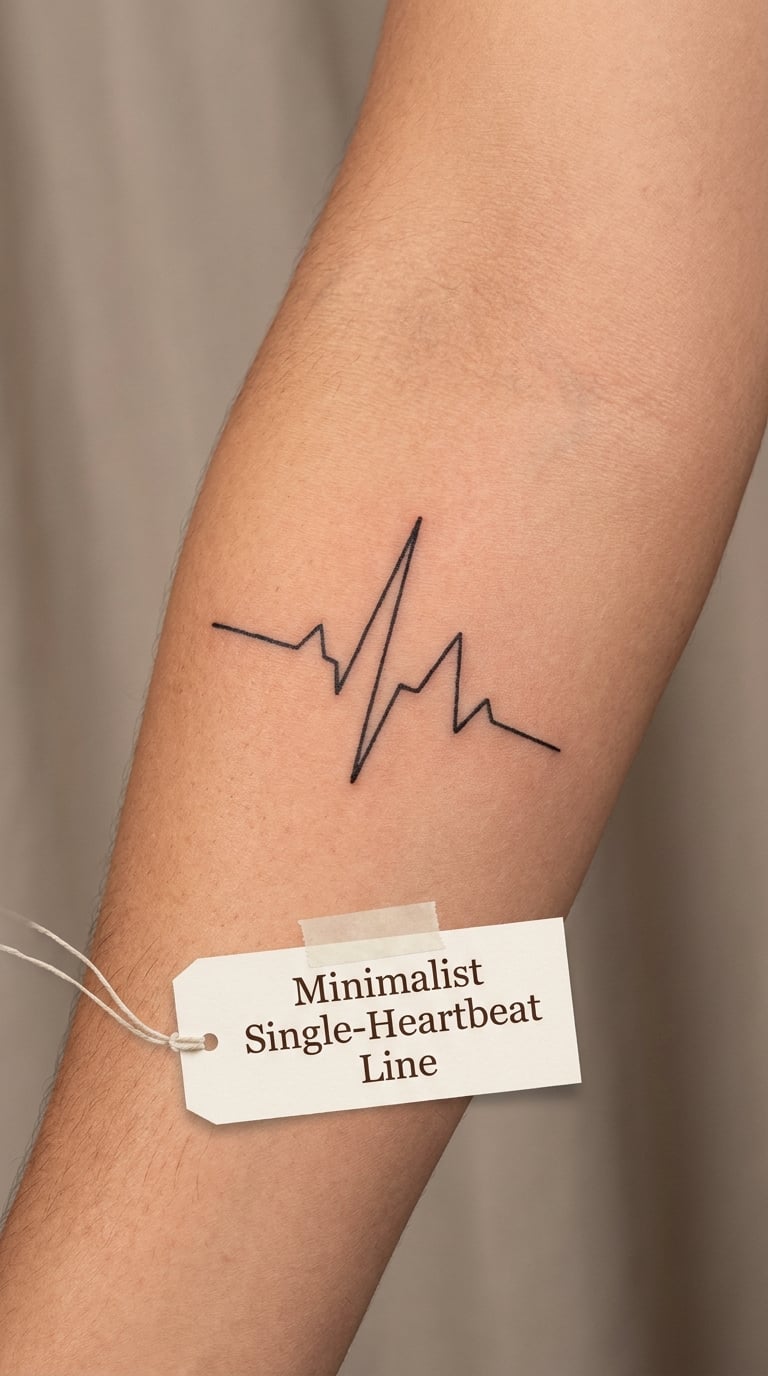
A single trace, one spike, one small dip, then a flat run out to the right. That is the whole design, and it is the version most first-timers actually want once they strip away everything else. No heart shape, no script, no flowers, nothing competing with the line.
People choose it because the shape already says what it says. If you are marking your own life, a recovery, or simply that you are still here, the restraint is the point.
Placement: Inner forearm, or the inside of the upper arm if you want it out of sight at work. Size: 2 to 3 inches wide (5 to 7.5 cm), line weight no thinner than a single-needle pass. Style: Fine line, single-needle black.
Pain: Low to medium on the inner forearm. A thin single-line pass goes faster and shallower than most first-timers expect. The one ageing note: the flat horizontal runs are the first part to soften and fade, so keep it out of long daily sun exposure.
Make it yours: Add the date that started the story underneath in small numerals, kept narrower than the trace itself so it reads as a caption rather than a second design.
2. Two Heartbeats Connected by a Fine Line
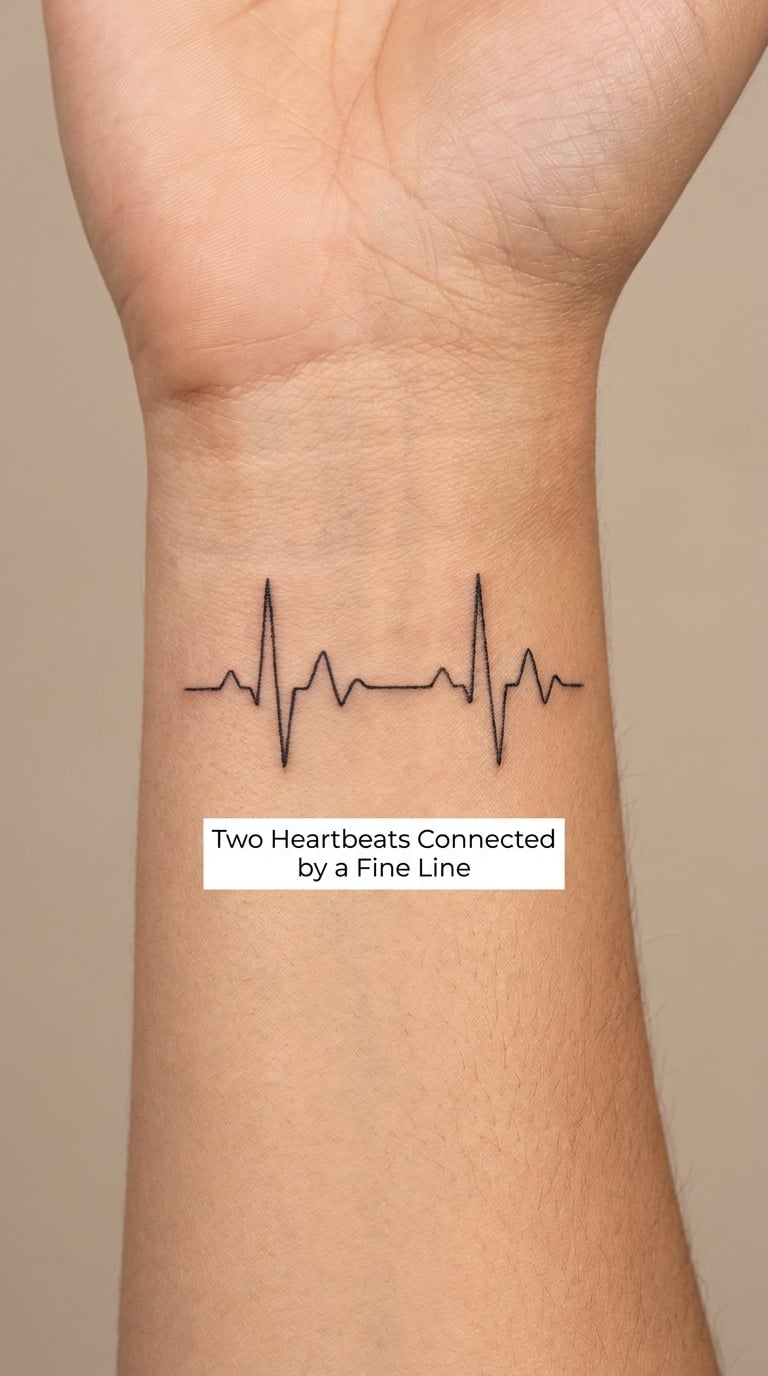
Two separate traces, each with its own rhythm, joined by a short connecting line. Because every real pulse is slightly different, the two shapes never quite match, and that small difference is usually the point of the design.
It is the go-to version for a relationship, a parent and child, or two people who went through the same thing. Nothing about it is fixed symbolism, so it wears well as a tribute rather than a memorial.
Placement: Inner wrist, or opposite inner forearms if you want both visible. Size: 2.5 to 3.5 inches wide (6.5 to 9 cm) for the pair of traces plus the connector. Style: Fine line.
Pain: Medium on the wrist, where skin is thinner and the bone sits close. Wrist lines also move a lot with the hand, so the artist will ask you to angle your wrist. Fine detail here softens faster than the same line on an upper arm.
Make it yours: Trace your own pulse with a cheap pulse oximeter on a phone app, print both strips, and let the artist redraw them as clean single-line shapes rather than copying the medical grid.
3. Heartbeat with a Birthdate
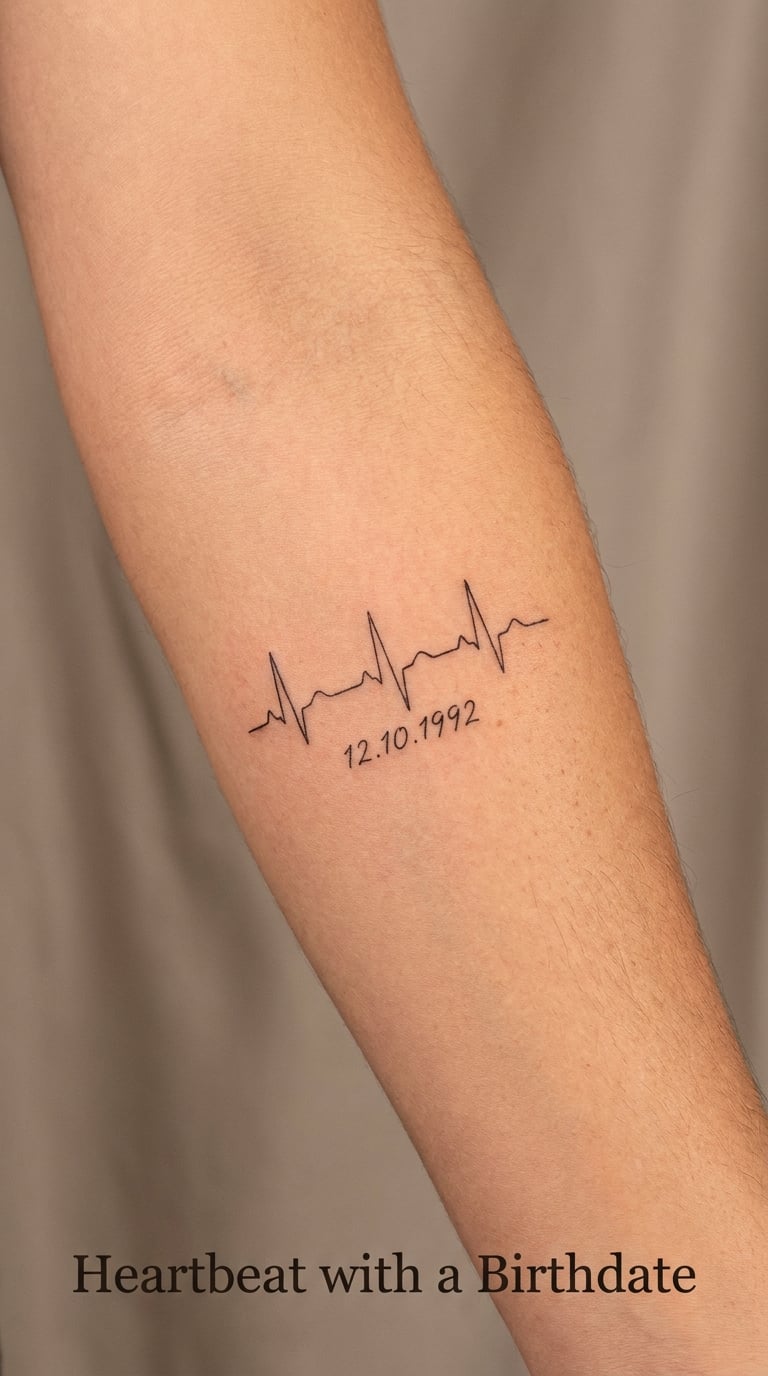
A clean pulse line running horizontally, with a short date tucked underneath in small plain lettering. The date does most of the talking. Whether it marks a child’s birth, a parent’s, or a date something in your own life started, the combination reads as a beginning.
If the child is a boy and the person getting it is a father or mother, this sits alongside plenty of father son tattoo ideas that show deep love, and it is often the quieter option of the two.
Placement: Inner forearm for the full composition, or rib side if you want it longer. Size: 3 to 4 inches wide (7.5 to 10 cm) so the numerals have room to stay legible. Style: Fine line with small simple numerals, not ornate script.
Pain: Medium on the inner forearm. Two lines of work means a longer sitting, usually 30 to 60 minutes. Ageing note: the numerals are the vulnerable part. Below about a quarter inch tall they blur within a few years, so ask your artist to size them up rather than delicate.
Make it yours: Use the birth weight or the time of birth in place of the date if the numerals are already too crowded underneath the line.
4. ECG Line With a Small Heart
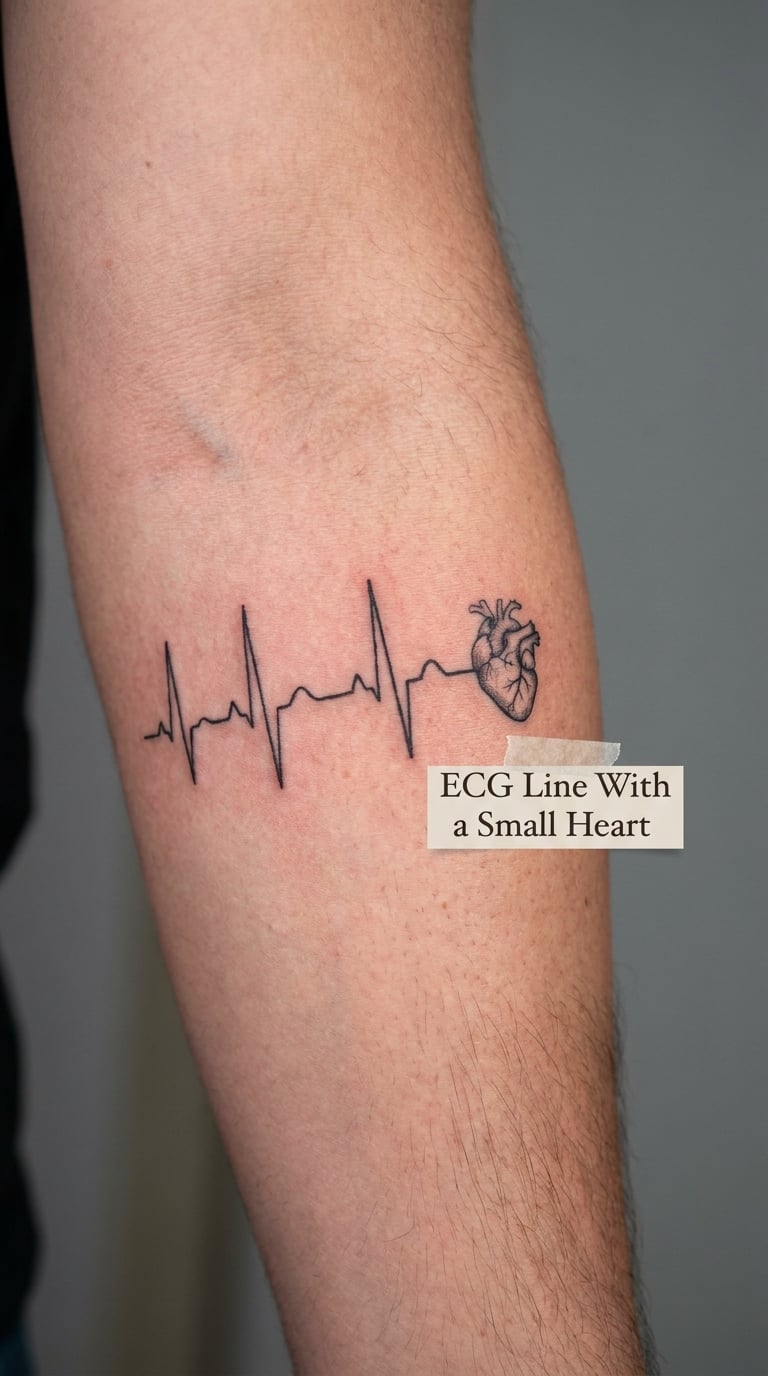
A proper monitor-style trace, with the small calibration hump at the left and a repeating pattern, ending in a single small heart. Anatomical is the version that works here, with light line shading for the chambers, rather than the smooth red valentine shape.
It is the most literal of the twenty. Some people love that, because there is nothing to decode. Others find a heart shape makes the piece read as sentimental and steer toward number one instead.
Placement: Upper forearm or inner upper arm, where there is flat skin for the full trace. Size: 3 to 4 inches wide (7.5 to 10 cm) for the line, plus roughly half an inch for the heart. Style: Fine line with micro-realism shading on the heart.
Pain: Medium. The heart detail adds time rather than depth. The frequent pattern needs even spacing, and repetition is where straight lines wobble, so check the stencil before anything permanent starts.
Make it yours: Let the last beat in the pattern be a slightly larger spike than the rest, ending the line on the strongest mark instead of a flat run.
5. Heartbeat Merging Into a Rose
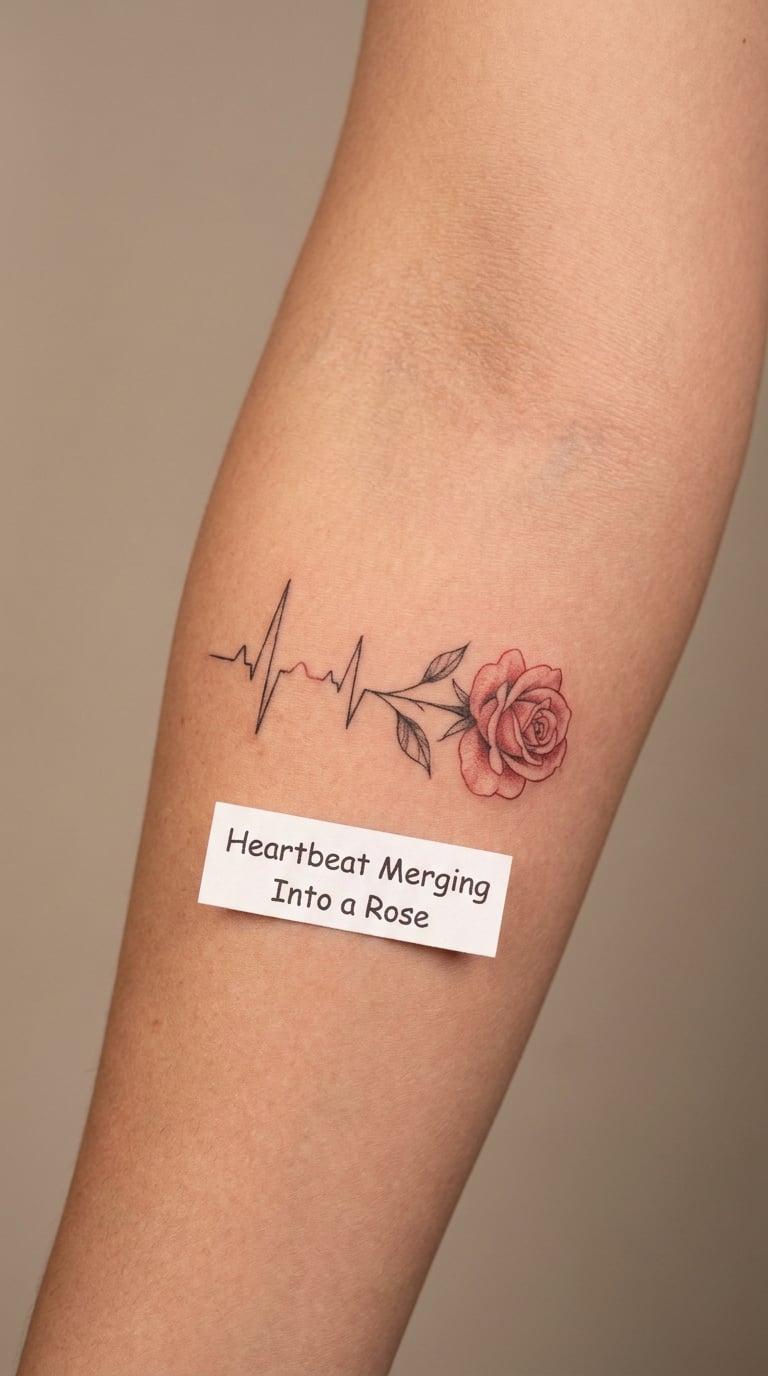
The trace runs flat, spikes, and then the line keeps going as a stem. Small leaves branch off, and the stem ends in a single rose. One continuous line does the whole transition, so nothing looks pasted on.
It usually shows up as growth rather than a specific person, often after a hard stretch where the person wanted the ending of the line to be something living. A few people add a name to the stem instead of a date.
Placement: Forearm, running lengthwise, or the outer bicep. Size: 3 to 4 inches wide (7.5 to 10 cm); the rose itself about 1 inch across (2.5 cm). Style: Fine line botanical with one red bud or a red wash inside the bloom.
Pain: Medium. Petal shading is the fiddly part and takes time. The red accent is a second pass and will fade faster than the black, so expect a touch-up on the bloom and not on the line.
Make it yours: Choose the stem leaves to match a real plant that mattered to the person, drawn from a photo you bring to the session.
6. Broken Heartbeat Line
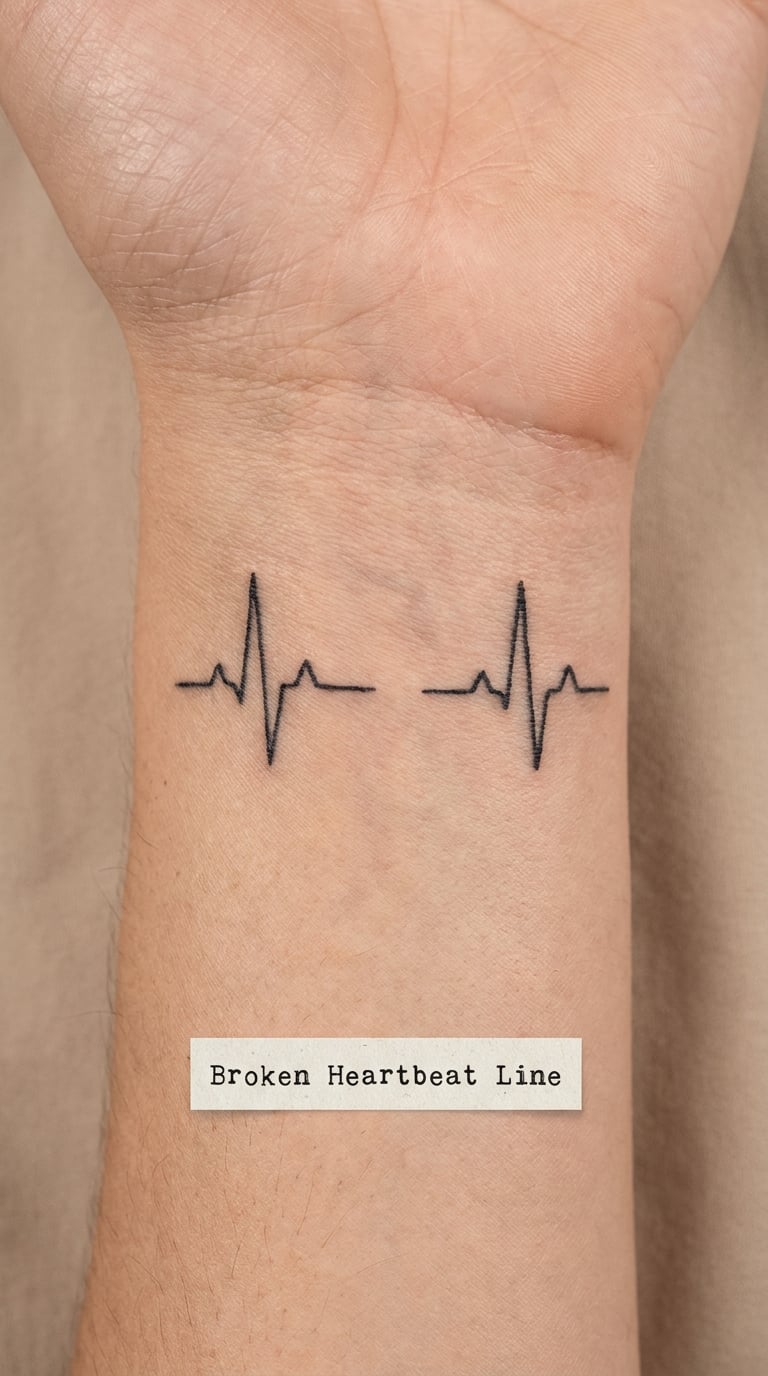
A normal pulse trace interrupted by a clean gap of about a quarter inch, then resuming. The gap is the design. Depending on who asks, it can be read as a pause, a break, or a stretch of silence, and the wearer decides which.
It is not a fixed memorial or recovery symbol, and I would treat anyone who tells you it definitively means one thing as overselling. What it does well is hold a contradiction without explaining it.
Placement: Inner wrist or inner forearm. Size: 2.5 to 3.5 inches wide (6.5 to 9 cm), with the gap kept to a quarter inch or under so the eye still reads one line. Style: Minimalist, single line, no fill.
Pain: Medium on the wrist. The gap has to be positioned where the line either side of it stays straight, which takes a little planning. Ageing note: gap edges are sharp features and they soften faster than a continuous run.
Make it yours: Put one word or one short date in the gap at a smaller size, so the break explains itself to you and not to anyone else.
7. Heartbeat in a Circle
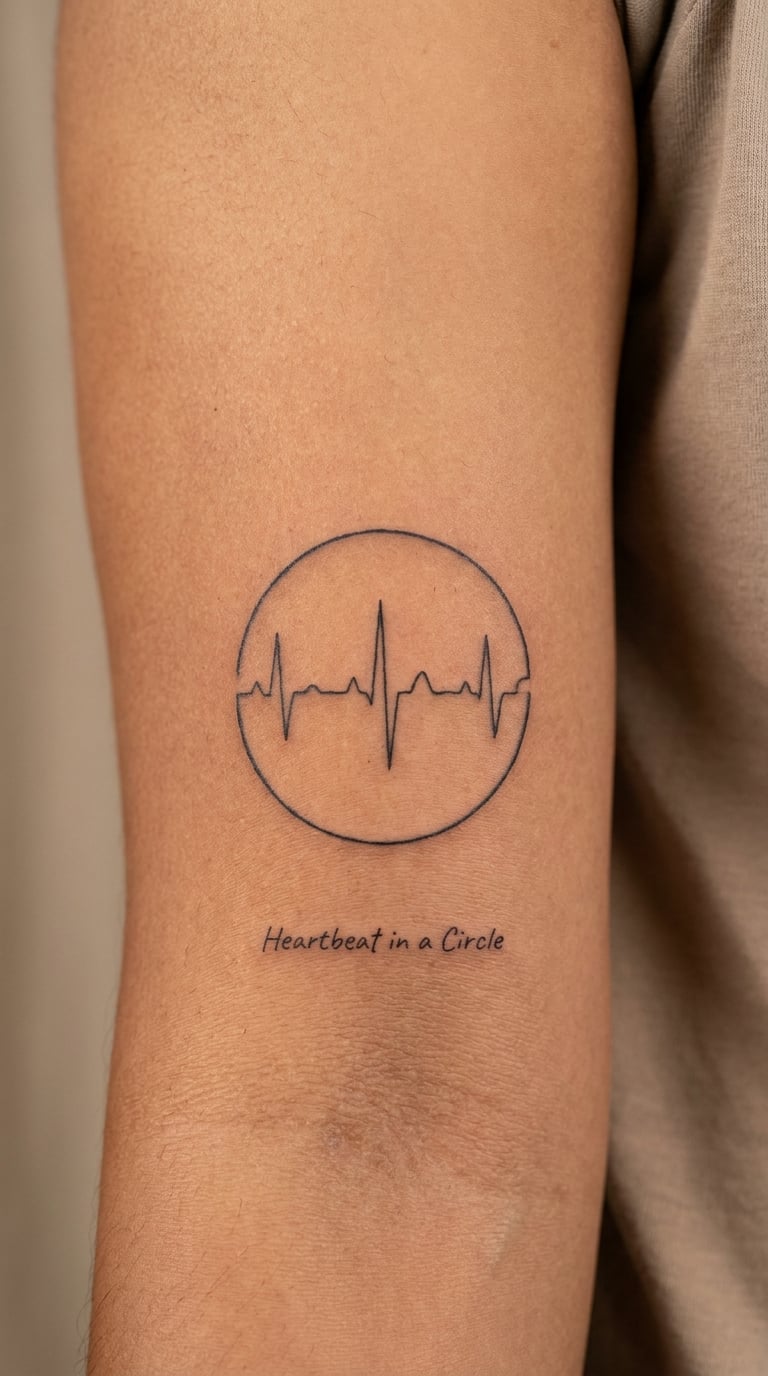
A pulse trace that starts and ends inside a thin, unbroken circle, so the line appears to have no beginning. The circle is usually one even line weight with the trace, not a shaded disc or a filled band.
It reads as contained and complete, which is why people choose it for a life that has come back into order after a chaotic stretch, or simply because a round shape suits the space better than a line running off the body.
Placement: Inner upper arm, or high on the forearm. Size: 2.5 to 3 inches in diameter (6.5 to 7.5 cm). Style: Fine line geometric.
Pain: Low to medium. The inner upper arm is fleshy and reasonably forgiving, and a circle gives the artist a stable frame to build the trace inside. Two thin concentric curves meeting the trace is the detail most likely to need a touch-up.
Make it yours: Break the circle at one point where the trace passes through, so the pulse reads as entering and leaving the circle rather than being trapped inside it.
8. Matching Heartbeat Tattoos
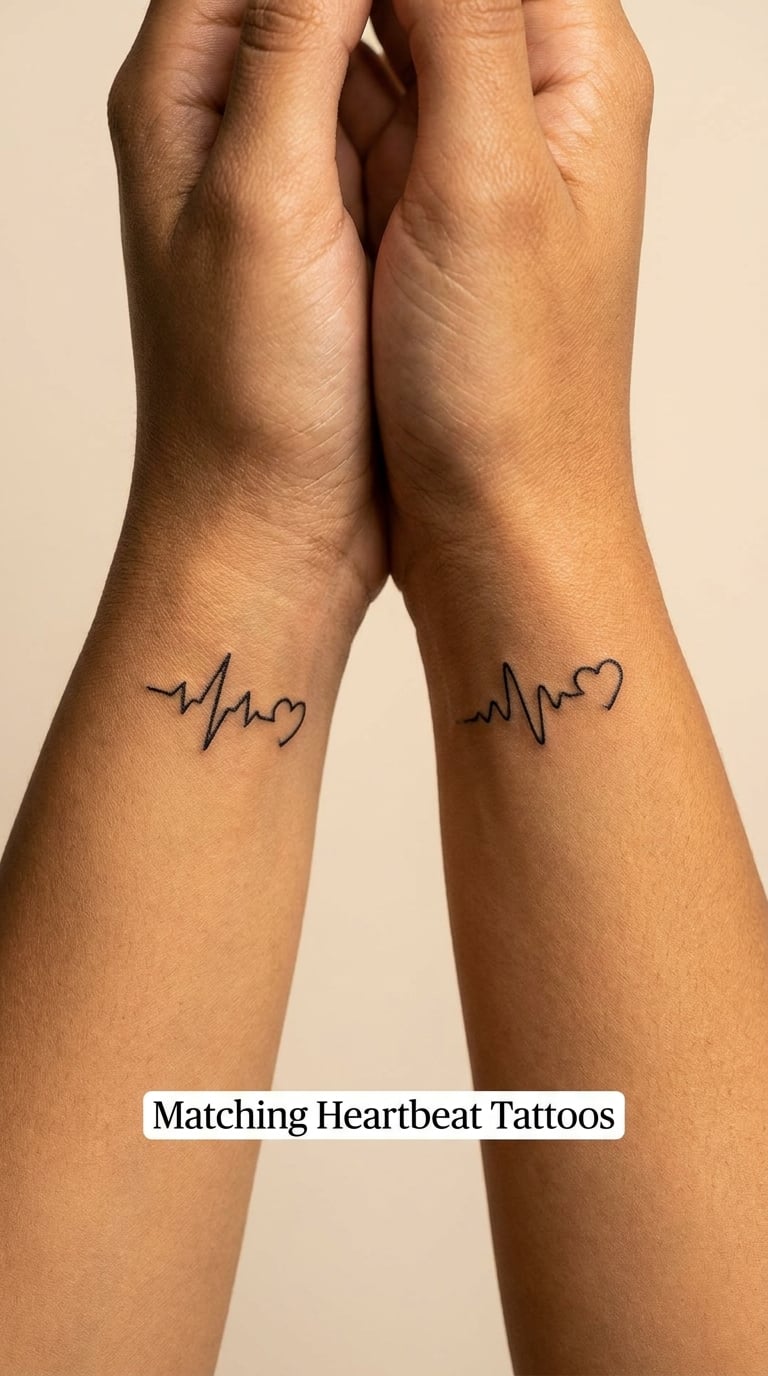
Two tattoos, same line weight, same size, same style, placed on matching body parts. The pulse shapes themselves are different, because two real heartbeats are. Coordination comes from the treatment, not from copying the drawing twice.
Friends, siblings, partners and parents all do this. If the pair is a best-friend thing, there is a wider set of matching tattoos you can get with your best friend to compare it against.
Placement: Both inner wrists, both inner forearms, or one on each rib. Size: 2.5 to 3 inches wide (6.5 to 7.5 cm) each, and identical between the two. Style: Fine line, same single-needle weight on both.
Pain: Medium on the wrists and forearms. Two sessions, one each, and they will never heal at exactly the same rate, so expect one to look slightly crisper for a few weeks. Getting both done on the same day is fine but means two sore spots at once.
Make it yours: Send both artists the same reference file and the same size on paper. Two different artists working from memory will produce two different line weights.
9. Heartbeat Behind the Ear
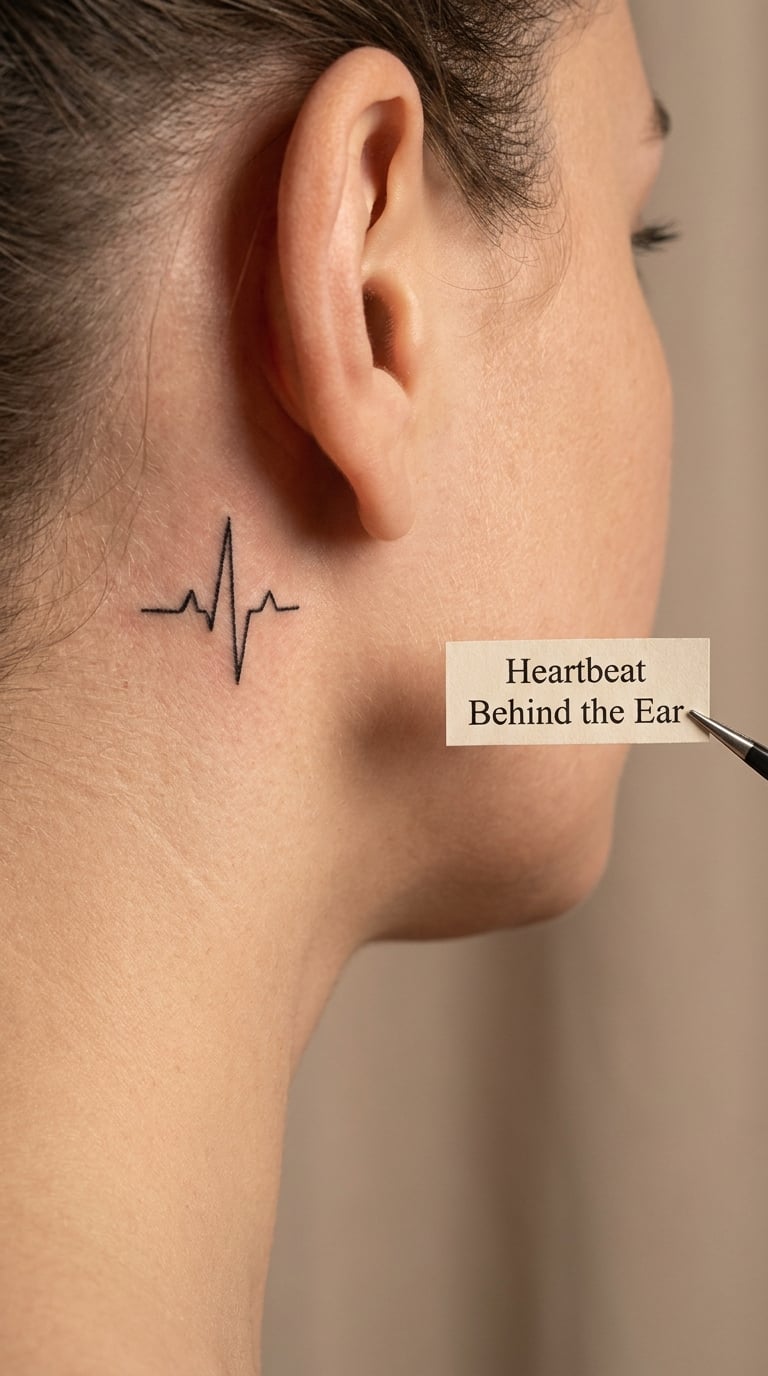
One short trace, often just two beats, tucked into the hollow behind the ear where the skin curves away from the skull. The line follows that curve, so it arcs rather than sitting flat. Hair usually covers it completely, which is half the appeal.
It suits people who want a meaningful tattoo nobody at work ever sees. The downside is equally clear: you will not see it either unless you hold a mirror at the right angle.
Placement: Behind the ear, following the curve from the lobe area upward. Size: 1.5 to 2.5 inches wide (4 to 6.5 cm). Style: Micro fine line, minimal beats, no extra elements.
Pain: Medium to high, and honestly on the higher side. The skin there is thin, the nerve supply is close, and the position is awkward for both you and the artist. A short session is worth booking. Ageing note: this is the first place to lose definition, since sun hits it whenever your hair is tied back.
Make it yours: Use a first name initial at the very end of the trace, small enough to read as part of the line rather than a separate mark.
10. Heartbeat Around the Finger
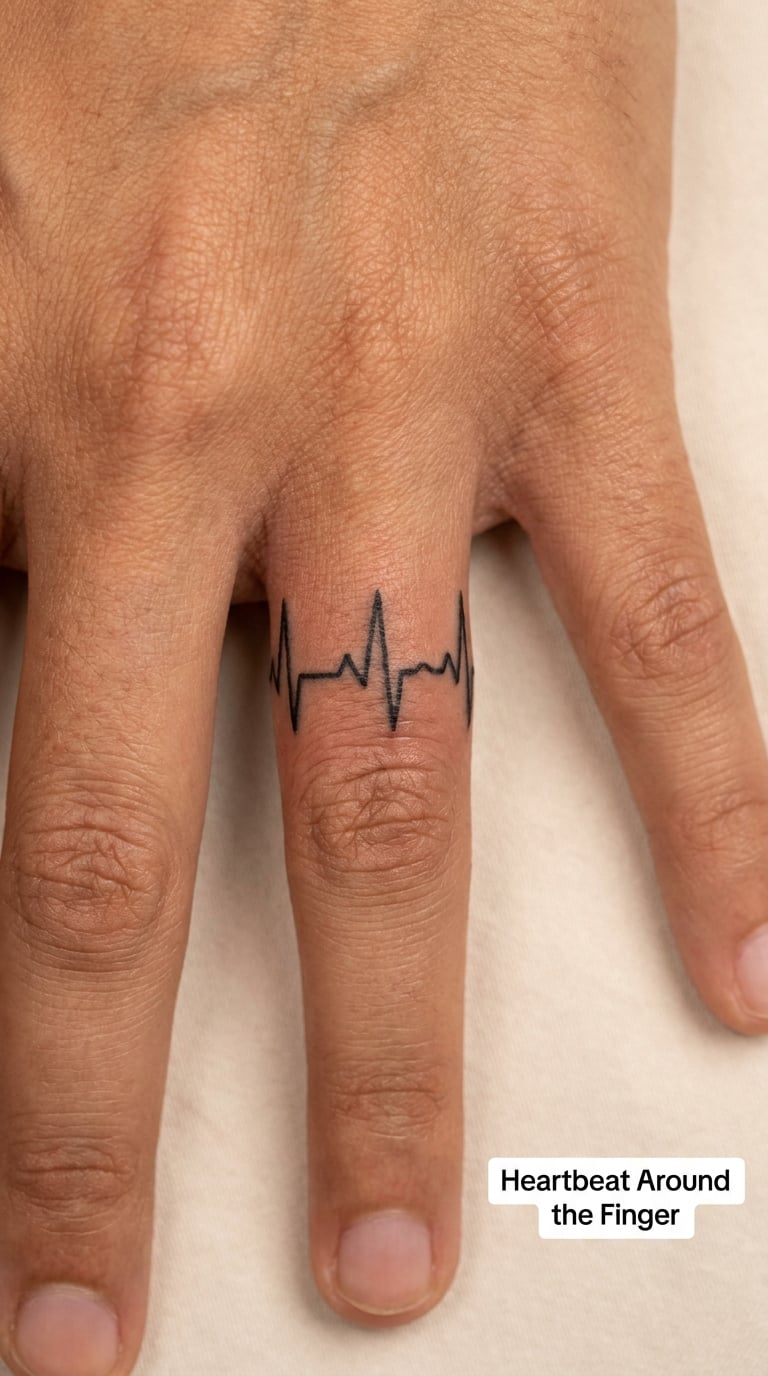
The trace runs right around the finger as a continuous band, so from one angle it disappears and from another it is fully visible. The band is usually about half an inch tall and the beat pattern repeats once or twice around the finger.
It works as a ring you did not lose, and it stacks with nothing else on that hand, which is the appeal for a lot of people.
Placement: Middle or ring finger, sitting above the knuckle. Size: Around 0.5 inch tall (1.2 cm), running the full circumference. Style: Fine line band.
Pain: High, and there is no way around saying so. Finger skin is bony, the nerve endings sit close to the surface, and you will feel every pass across the knuckle. Ageing note: this is the fastest-fading placement on the list. Hands get washed, sun and abrasion, and the fine line will soften noticeably within a couple of years, sooner on the side that faces outward when you grip things.
Make it yours: Add a single small solid dot on the underside of the finger, hidden from view, carrying a date in Morse-style spacing or just one meaningful year.
11. Tiny Heartbeat on the Sternum
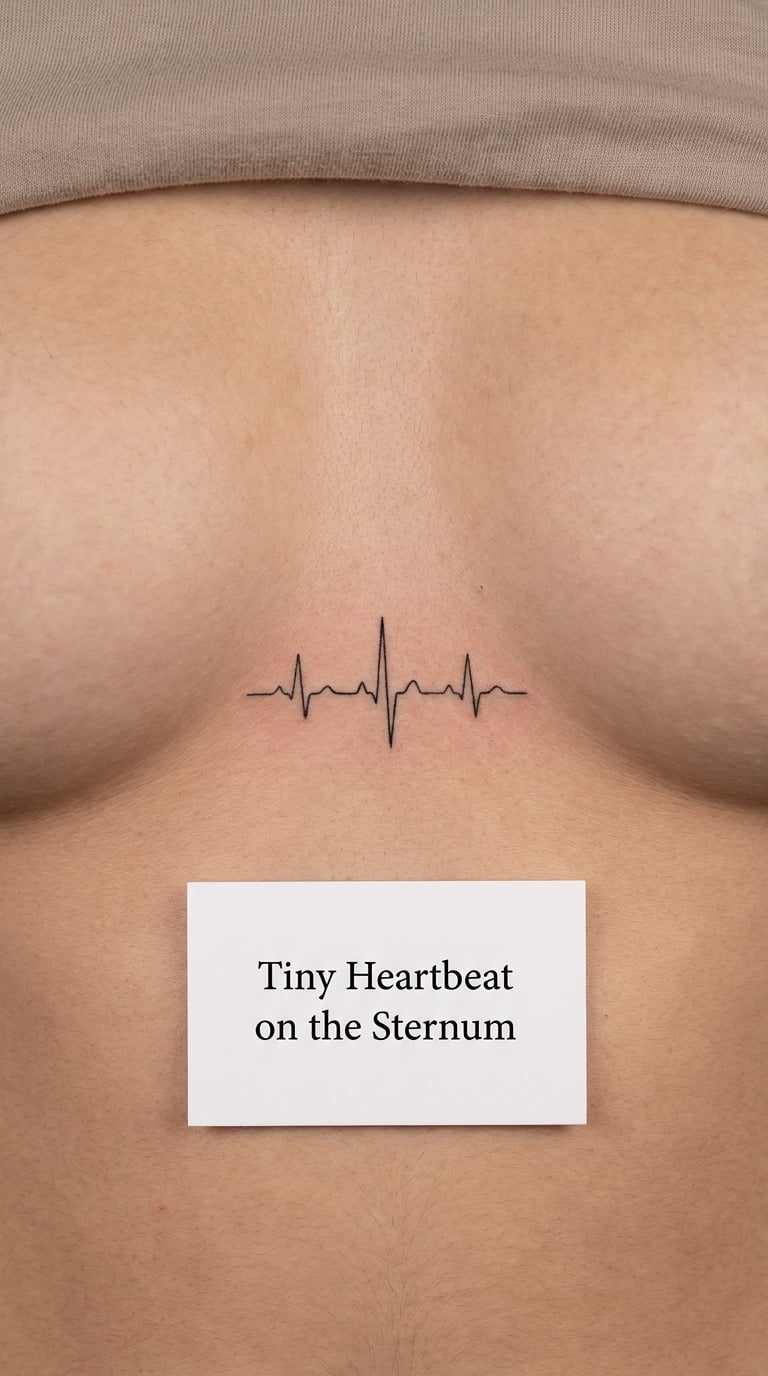
A short trace centered between the collarbones, or set slightly off-centre. Centred reads as deliberate; off-centre reads more casual. Either way the line sits on skin that moves and rises with every breath.
Placing a pulse line over the actual heart is the symbolism people are usually after, whether or not they say it that way. It is a small, quiet piece that stays visible in a shirt with a lower neckline.
Placement: Upper sternum, between and just below the collarbones. Size: 2 to 3 inches wide (5 to 7.5 cm). Style: Fine line.
Pain: Medium, with a specific character rather than a specific intensity. The skin is thin and sensitive, and you will feel the line stretch and shift as you breathe and as your chest expands. A lying-down position keeps the movement smaller and the line straighter.
Make it yours: Set the trace a half inch below the notch of the sternum rather than dead centre, so clothing with a lower neckline either covers it or frames it cleanly.
12. Heartbeat With Coordinates
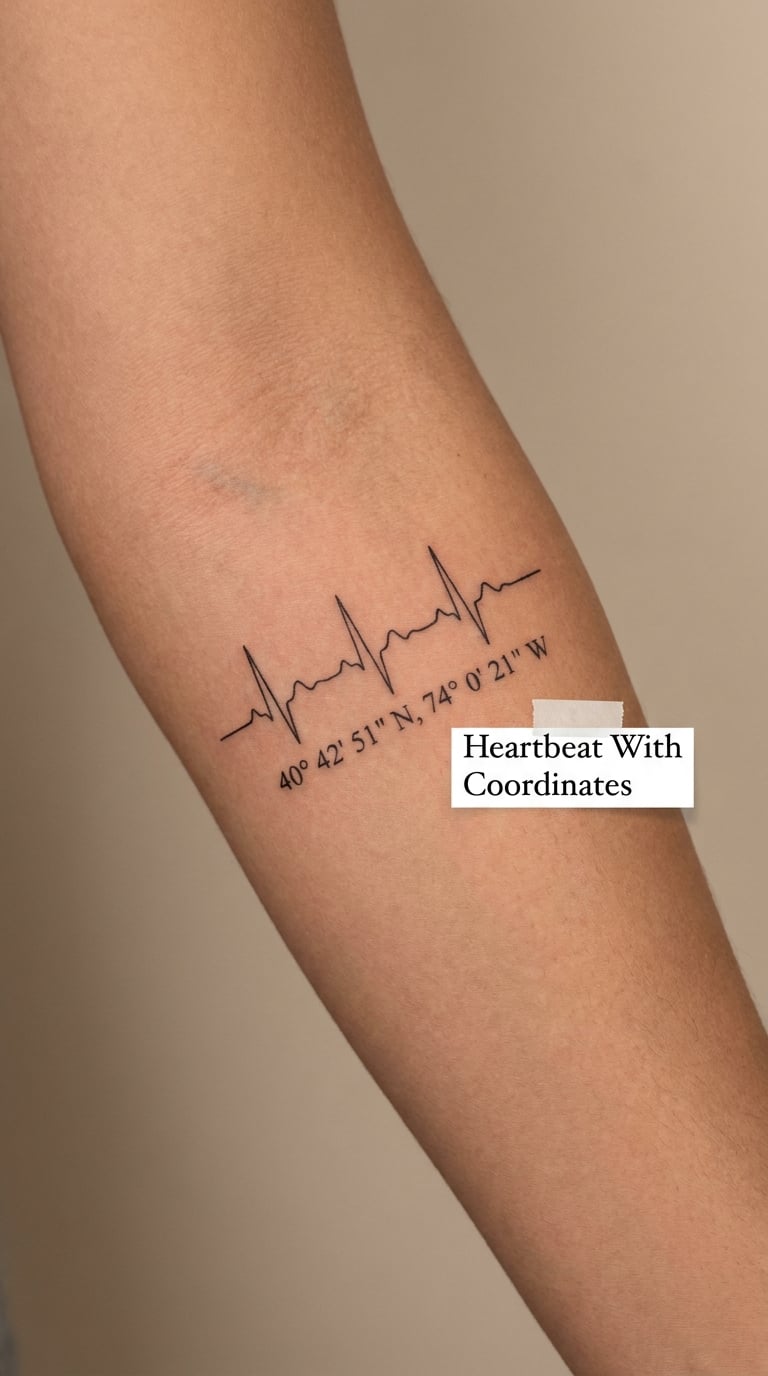
A pulse trace with a line of small numerals beneath or beside it, in decimal degree format. It is the geographic version of the same idea: a specific place, expressed in the least romantic and most permanent way available.
Common choices are a birth hospital, the spot on a map where something important happened, or the coordinates of a house that no longer exists. People who travel a lot tend to add more than one set.
Placement: Inner forearm, laid out under the line. Size: 3 to 4 inches wide (7.5 to 10 cm) total, with the numerals at least a quarter inch tall. Style: Fine line with plain block numerals.
Pain: Medium, and it needs a longer sitting than the line alone, usually 45 to 90 minutes. Ageing note: the numerals are the first casualty. This is a design that has to start slightly larger than feels right, or the coordinates turn to mush while the line stays crisp.
Make it yours: Write the coordinates in your own handwriting and have the artist trace that script instead of typing them, so the numbers carry the same association as number eighteen.
13. Colorful Watercolor Heartbeat
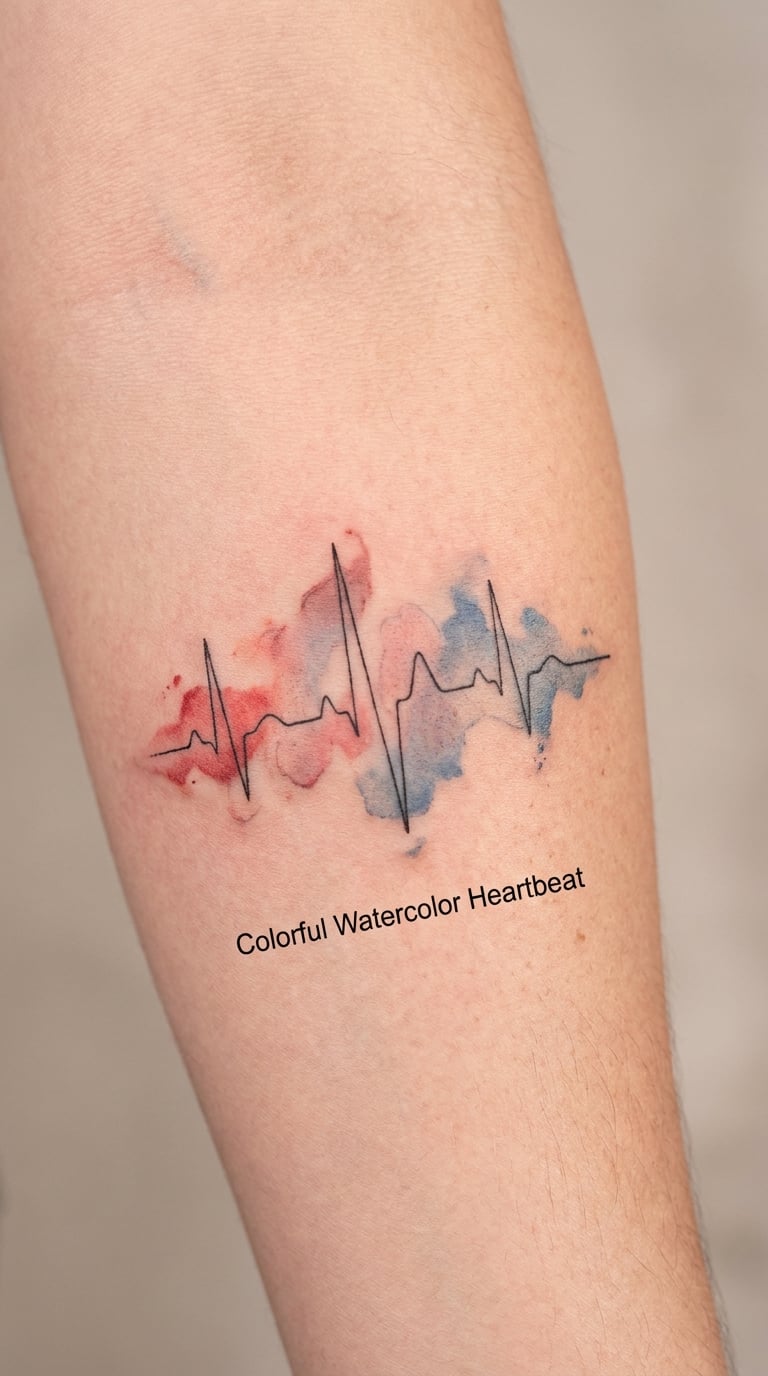
The trace is drawn in black or dark grey, then flooded with translucent colour that bleeds slightly past the lines. Muted red, dusty pink and soft blue are the ones that stay tasteful. A full saturated rainbow is a different commitment.
It reads as softer and more emotional than the black-only versions, and it is the design people pick when the black line alone feels too clinical for what they are marking.
Placement: Outer forearm, upper arm, or the back of the shoulder where there is a large flat area. Size: 4 to 6 inches wide (10 to 15 cm). Watercolour needs room or the washes collapse into each other. Style: Watercolour over a fine line foundation.
Pain: Medium. The line work is shallow, but colour saturation takes a second pass and the piece runs long, often two hours or more. Ageing note: expect the pale blue to shift and the red to warm over the first couple of years, and expect a touch-up or two on the washes even if the line never needs one.
Make it yours: Use the exact shade of one colour from something that belongs to the person, matched on a printed reference before the session.
14. Blackwork Heartbeat Mountain
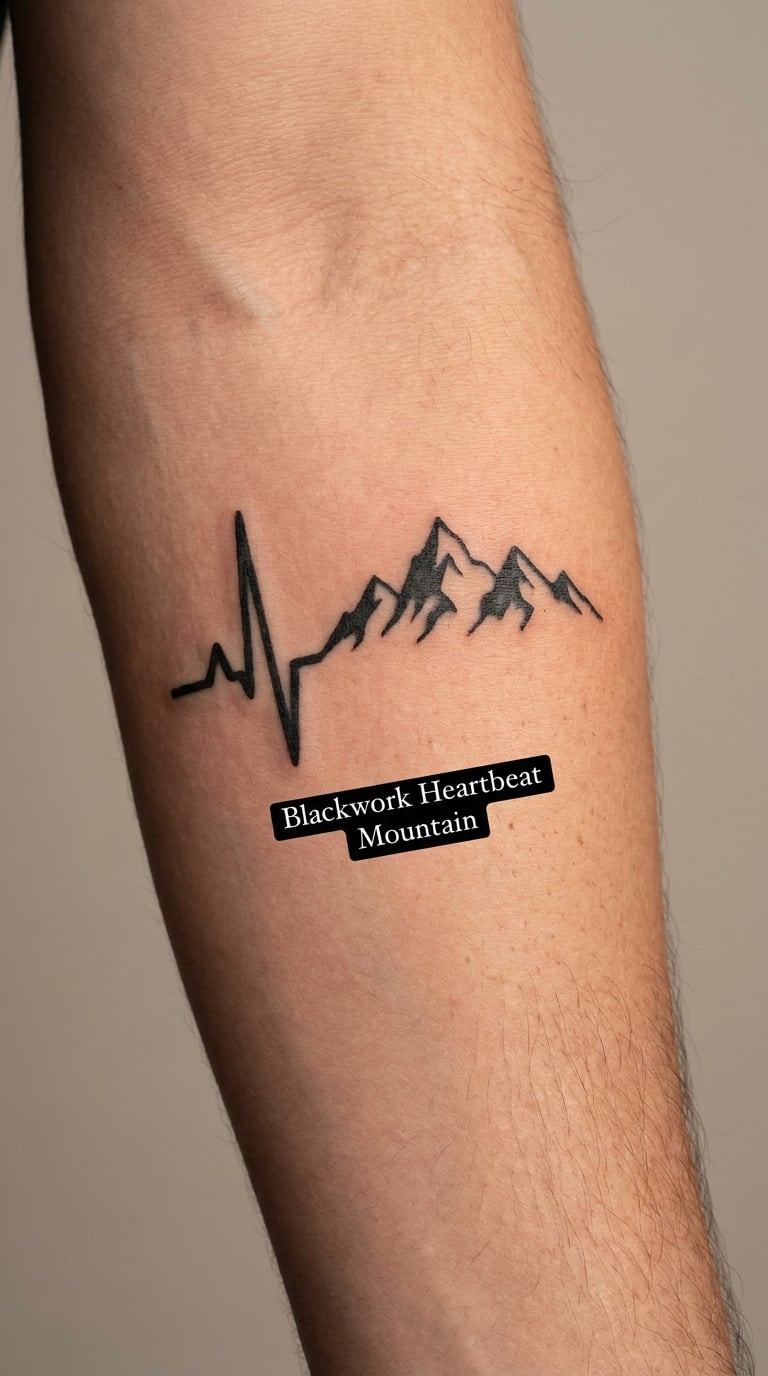
A heavier, solid black line that does one pulse and then becomes a range of mountain peaks filled in with solid black. Nothing delicate anywhere. It has the weight of a small band rather than a hairline detail.
This is the version to look at if the galleries you have been scrolling lean feminine and you want something that reads as solid instead. The mountains usually stand for a place, a summit, or a stretch of difficult ground already behind you.
Placement: Forearm, calf, or outer upper arm. Size: 4 to 5 inches wide (10 to 12.5 cm). Style: Blackwork, solid fill, heavy line.
Pain: Medium to high. Solid black fill means repeated passes over the same area, which is the part that wears you out rather than the depth. Ageing note is the strongest on this list in your favour: bold fills and thick lines hold their shape for decades, and small line changes stay readable long after a hairline trace would have blurred.
Make it yours: Cut the peak line so its lowest notch is exactly the height of the tallest pulse spike, tying the two halves of the image together.
15. Heartbeat With a Compass Rose
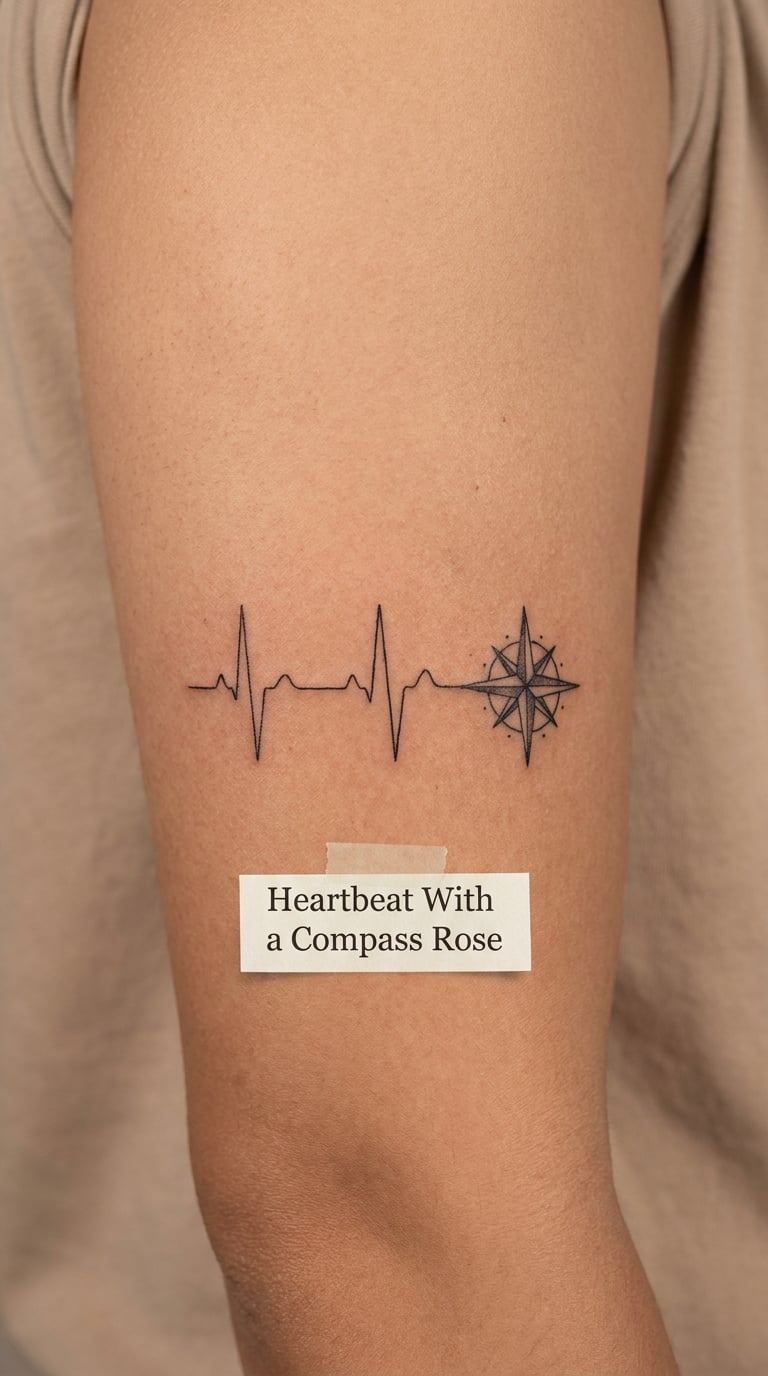
A pulse trace that runs along the arm and finishes at a small four-point compass rose, usually drawn as clean line work with a hairline cross through the middle. The line often passes straight through the centre point, so the two elements feel joined rather than stacked.
Direction is the usual reading, either where someone is going or a decision they made. Compass tattoos are a well-worn symbol, and the pulse trace is what keeps this one from being entirely generic.
Placement: Outer or inner upper arm, where a round motif sits well. Size: 3 to 4 inches wide (7.5 to 10 cm), with the compass roughly 1 to 1.25 inches across (2.5 to 3 cm). Style: Fine line with geometric detail.
Pain: Medium. The compass has radiating points, and each one has to stay straight, which is time-consuming rather than painful. Ageing note: the thin radiating lines and the small ring around the centre are the two details most likely to need a touch-up within five years.
Make it yours: Point one of the four spikes at a real bearing, calculated from a place that matters, and ask the artist to mark that single spike longer than the other three.
16. Heartbeat Wave on the Collarbone
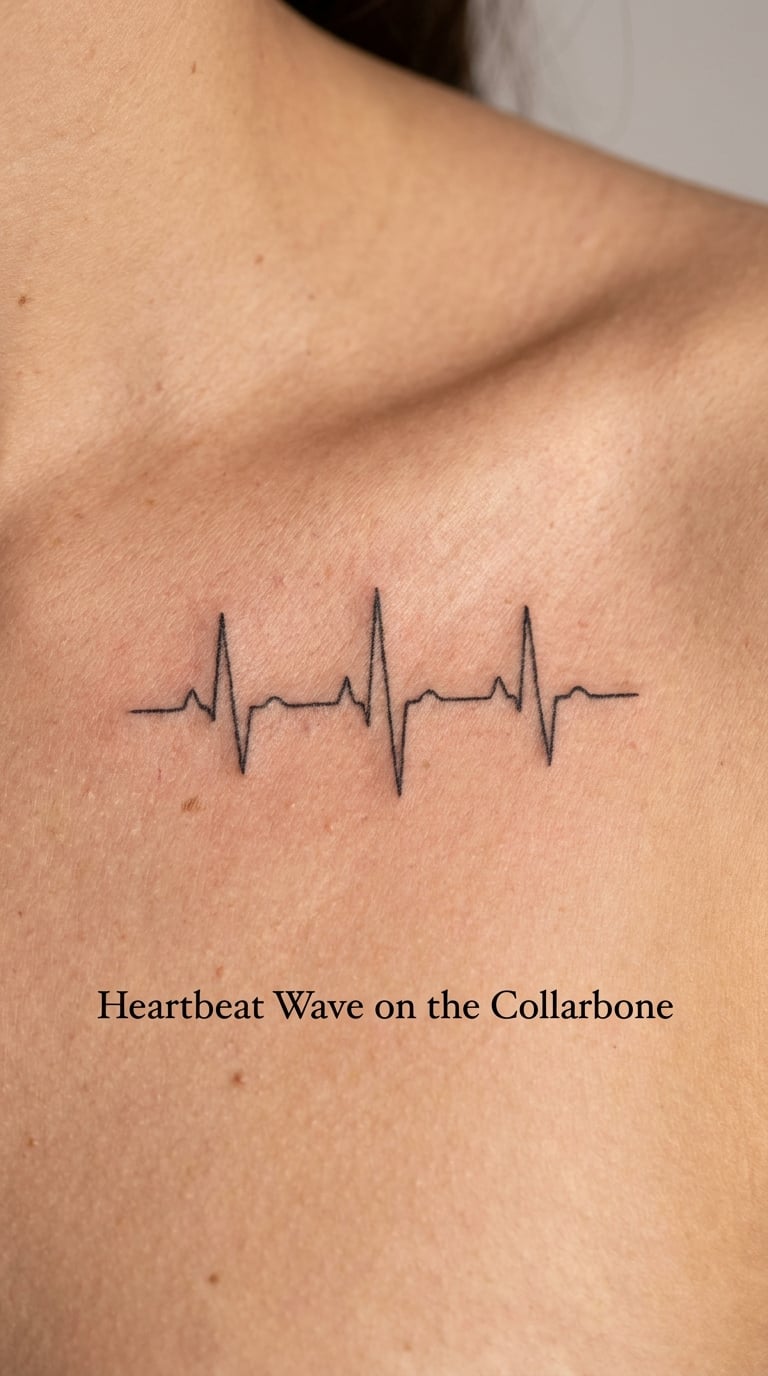
The trace follows the line of the collarbone, one long flat run, a spike, then stillness, laid along the bone rather than across the chest. Symmetry matters here more than anywhere else in this list, because any uneven spacing shows against a straight edge.
A horizontal pulse along the collarbone reads as steady and open, and it shows in a wide neckline without shouting. It also works well as a companion piece to a sternum tattoo, though you would be choosing between the two on the same general area.
Placement: Just above one collarbone, or split so a short segment sits on each side. Size: 3 to 4 inches wide (7.5 to 10 cm). Style: Fine line.
Pain: Medium to high. Collarbone skin is thin over bone and very sensitive, and the artist is working on a curve while you breathe and talk. Ageing note: lines along the collarbone catch sun constantly through open necklines and shirts, so this fades sooner than the same design on an upper arm.
Make it yours: Have the trace mirror the actual length of your own collarbone, measured with a tape before the stencil is cut, so the flat runs end where the bone ends.
17. Neon Heartbeat Line
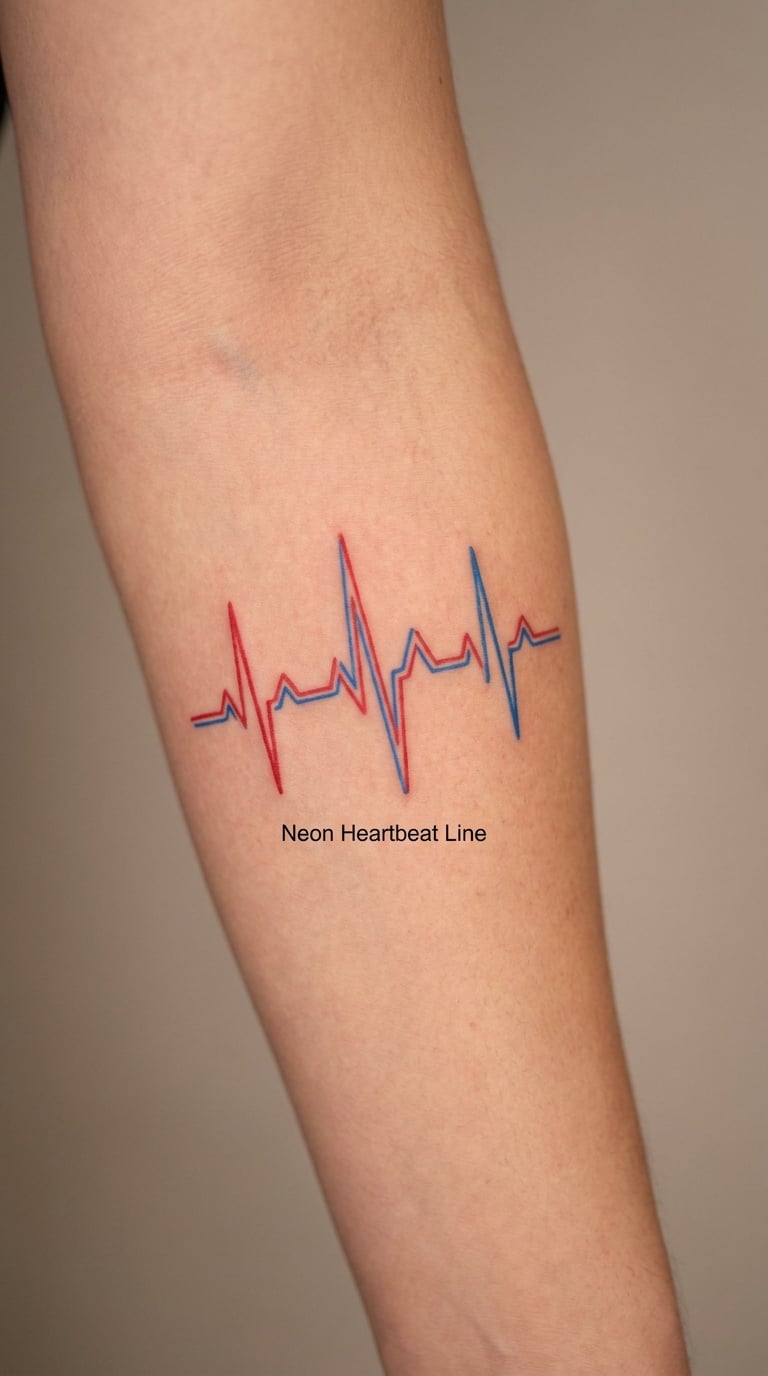
A clean trace drawn in a saturated red or electric blue, sometimes with the two colours alternating beat to beat, on a line with no shading. The effect is closer to a graphic print than to traditional tattooing, and it holds up at a small size because the colour is doing the work.
It is the one design here that people tend to pick for how it looks rather than for what it means, though plenty of them add a date or an initial and end up with both.
Placement: Outer forearm, upper arm, or calf, anywhere with flat skin and regular visibility. Size: 3 to 4 inches wide (7.5 to 10 cm). Style: Bold colour linework, minimal or no fill.
Pain: Medium. Saturated colour is not automatically deeper than black, but red and blue usually need more passes to hold. Touch-up note: bright colour is the first thing to fade, and a red line on a forearm will need refreshing noticeably sooner than a black one, often within two or three summers.
Make it yours: Alternate the two colours so that the beat nearest your pulse point is the stronger of the two, and let the rest of the trace be the lighter one.
18. Heartbeat With a Handwritten Initial
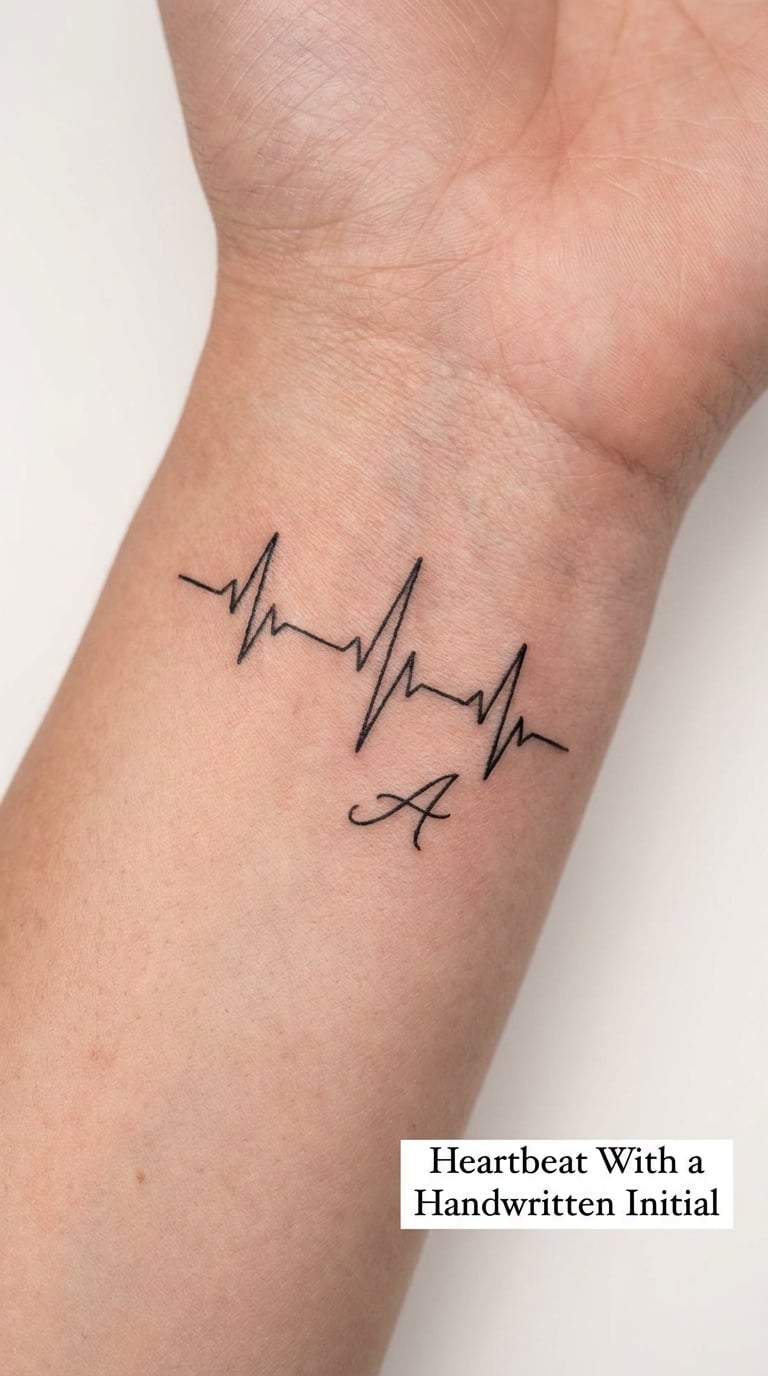
A pulse trace with a single capital letter underneath, drawn in the actual handwriting of the person it refers to. A traced signature, a note written on a card, a name in the margin of a photograph, all of these work as the source.
One letter instead of a full name is the middle path. It is unmistakably personal and it is not a name that can read as an ex years later, which is a real concern for anyone marking a partner.
Placement: Inner wrist, with the letter directly under the trace. Size: Around 3 inches wide (7.5 cm) for the line, with the initial roughly a third of that in height. Style: Fine line with traced script.
Pain: Medium on the wrist. Traced script is slower than freehand lettering, so book more time than you think. Ageing note: script loses its thin upstrokes first, and an initial has very few strokes to lose. Get the line slightly heavier than the reference handwriting looks.
Make it yours: Photograph the original writing flat and in even light, in focus, with a ruler in frame, so the artist can scale the letter to match the trace instead of guessing at it.
19. Dotwork Heartbeat Pulse
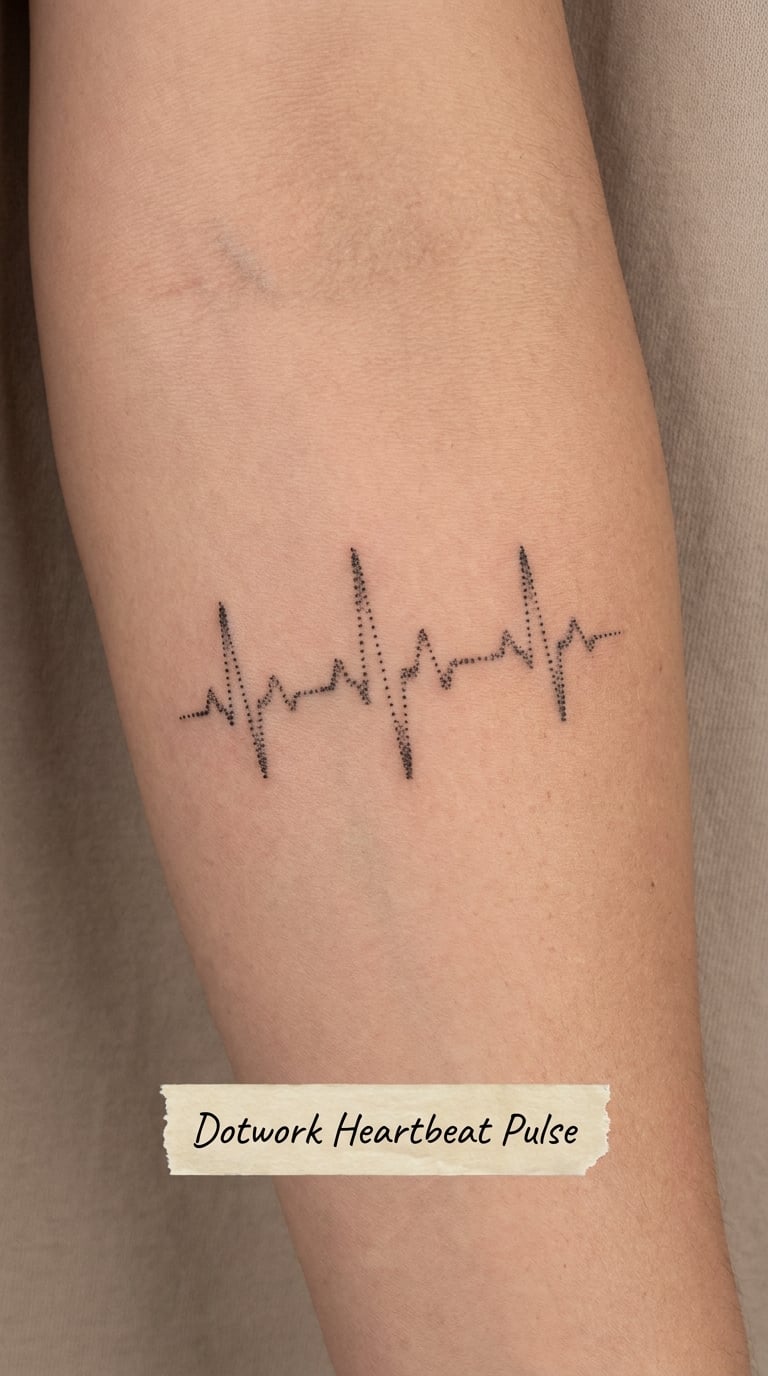
The pulse drawn in dots rather than lines, with dot size varying to build the spike and the flat runs reading as denser and lighter areas. Some versions go fully black dots, some fade the dots out along the flat line so it seems to emerge from nothing.
There is no fixed meaning attached to it, and it is worth saying that plainly. People tend to choose it because the texture is softer than a hard line and because dotwork suits a patch of skin that has no obvious shape to follow.
Placement: Forearm, upper arm, or calf. Size: 3 to 4 inches wide (7.5 to 10 cm), with dots no larger than about 1.5 mm for the outline. Style: Black dotwork.
Pain: Medium, and it is a long sitting. Dotwork is thousands of individual punctures, usually one to two hours, sometimes more. The pain stays at a moderate level the whole time rather than spiking. Ageing note: individual dots can spread and blur into each other over time, so a dotwork pulse gradually loses its sharp spikes and turns into a soft grey band.
Make it yours: Set the dot size to change once along the trace, tighter and darker at the beat and more open at the flat runs, so the pulse has an actual shape rather than a uniform texture.
20. Heartbeat to Infinity Design
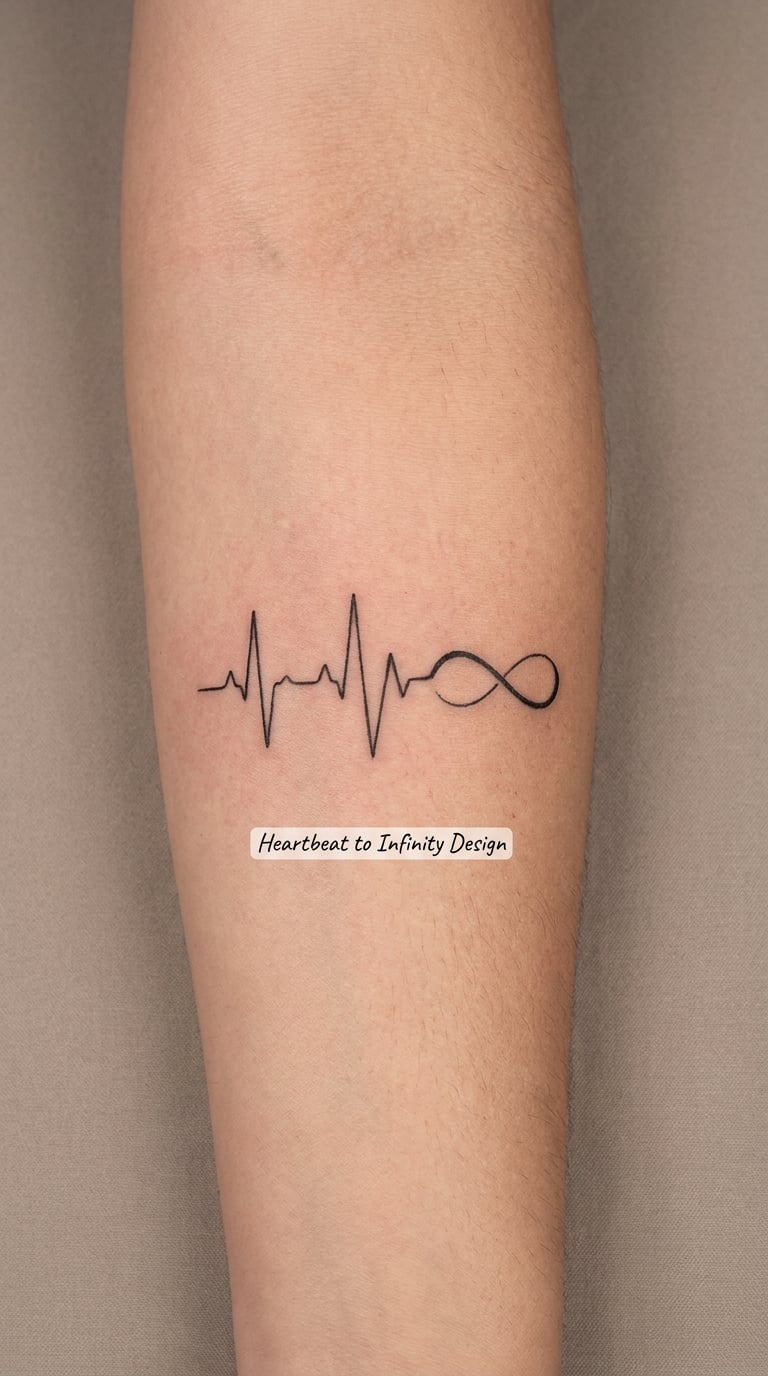
A pulse trace that runs along, then loops through a small infinity symbol at the end, so the line appears to have no ending. Some versions go the other way, starting at the loop and becoming a trace. The infinity is usually about half an inch across and drawn in the same line weight as the trace.
Permanence and continuation are the common personal readings, and it is often chosen for an anniversary, a vow or a promise rather than a memorial. If the meaning is a person rather than a principle, adding their initials inside the loop makes it unambiguous.
Placement: Inner forearm, positioned so the loop sits in a comfortable open area rather than at a joint. Size: 3.5 to 4.5 inches wide (9 to 11.5 cm). Style: Fine line, continuous.
Pain: Medium, and the loop is the fiddly part. The line has to cross over itself cleanly, which requires a clean stencil and a steady hand, and it takes longer than the same line without the loop. Ageing note: the two crossing points in an infinity are fine detail that softens, and once they merge the shape stops reading as an infinity.
Make it yours: Put one date inside the loop, small enough to sit in the negative space without touching the line, so the commitment is dated rather than open-ended.
How to Choose the Right Design
Work through these in order, and the design usually makes itself obvious before you get to the gallery stage. Rushing this step is how people end up with a beautiful tattoo that says nothing to them in five years.
Start with the meaning, not the drawing
Say the reason out loud in one sentence, without any design words in it. If the sentence needs a heart shape, a rose or an infinity symbol to make sense, that symbol is doing the work and the pulse line is decoration. If it does not need anything else, the single line on your forearm is the honest version.
Match the line weight to the placement
Inner forearm and upper arm can carry a hairline single-needle trace. Collarbone, sternum and especially fingers cannot. If a design is fixed to a sensitive spot, agree the line weight with the artist before the stencil rather than after, because they will know what their needle held in that skin will still look like in ten years.
Check the line still reads at small size
Print or sketch your design at the size you intend, then shrink it to half. If the flat runs and the spike disappear when it is small, the design is too detailed for the placement. A heartbeat line has very little to work with, and losing the spike turns it into a plain straight line.
Look at healed work, not fresh photos
Every tattoo looks sharp in the first week. Ask to see healed photos from three to twelve months out, in daylight, before you commit to anyone. You are judging how their lines hold up, not how steady their hand is on day one.
Decide about lettering before the session
Any design with a date, a name, a coordinate or a letter should be sized up on purpose. If you want it small, cut a second element instead of shrinking the script, and be honest with yourself about whether you would want the same tattoo without the words in ten years.
Cost and Session Time
Prices vary a lot by city, shop and artist, so treat these as realistic US ranges for line work rather than quotes. A single small fine-line pulse on the inner forearm usually sits somewhere between 80 and 200 dollars for the session. A version with a birthdate, coordinates or a second element tends to land between 150 and 300 dollars, since the extra detail is where the time goes.
Expect 30 to 60 minutes for a simple line, 45 to 90 minutes once lettering or a rose is added, and two hours or more for the watercolour and dotwork designs, which are the two that cannot be rushed. Blackwork fills run fast but need repeated passes, so a four-inch mountain design is often an hour and a half of solid colour.
Two things shift the number more than size does. Shop minimums are common, so a small design that should take half an hour can still be priced at the shop floor, and a custom trace cleaned from a real printout takes consultation time before anyone touches a machine. If the quote feels far above the range, ask whether the design is being drawn from scratch or redrawn from your reference, because that is a meaningful difference in labour.
Aftercare Basics
Follow your artist’s aftercare instructions first, since they will know exactly what ink and skin you are dealing with. The general points below are what most tattooers will tell you anyway.
- Leave the wrap on for the time your artist specified, then wash with lukewarm water and a fragrance-free soap, and pat dry with a clean towel rather than rubbing.
- Keep the area clean and dry for the first few days. Loose clothing over it beats tight fabric, which catches the scab and pulls the line as it forms.
- Do not soak it. No baths, pools, hot tubs or swimming in the sea until the tattoo is fully healed, usually around two weeks.
- Once healed, use sunscreen on exposed areas year-round. This is the single biggest factor in how long a fine line stays crisp, and it matters most for the collarbone, finger and behind-the-ear designs.
- Moisturise with a plain, unscented product if the skin gets dry. Scented creams and heavy oils are not worth the risk on fresh ink.
- Book a free touch-up check with the artist once healed, usually inside the first year, and go back to the person who did the work rather than to whoever is closest.
Frequently Asked Questions
What does a heartbeat tattoo usually mean?
Usually life, memory or both. The line is borrowed from an electrocardiogram trace, so a steady pulse reads as vitality and survival, and a line that flattens out at the end reads as a person honoured. Most wearers add one element, a date, a name, a birth time, to narrow it to their own story. The symbol itself is not fixed, and what it means to the person wearing it is usually the only accurate reading.
Are heartbeat tattoos better as a small fine-line design or a larger detailed piece?
It depends on where it goes. A single-needle fine line reads beautifully on the inner forearm or upper arm and needs almost no space. On the collarbone, behind the ear or a finger, the same line will blur or fade quickly and a bolder treatment holds up better. Larger detailed versions, watercolour, dotwork and blackwork, suit the upper arm and calf where there is room and the skin is stable.
Where is the least painful placement for a heartbeat tattoo?
The inner upper arm and the outer forearm are the gentlest, because both have some soft tissue and few nerve clusters. The inner forearm sits in the middle. The sternum and collarbone are sensitive over bone, and the finger and the area behind the ear are the two most painful on this list, with the finger ranking highest for anyone who wants honest advice before booking.
Will a small heartbeat tattoo fade quickly?
Small is not the same as fragile. What fades first is line weight and exposure, so a single-needle trace on an upper arm can stay readable for years, while the same trace on a finger or a collarbone softens noticeably within two or three. Keep sun off it, use sunscreen on exposed skin, and expect the flat horizontal runs to soften before the spike does. Going slightly bolder than you want costs nothing now.
Can I add a date, name or coordinates to a heartbeat design?
Yes, and most people end up doing it, but size the lettering up on purpose. Dates, coordinates and script initials are the first details to blur, so ask for numerals at least a quarter inch tall and a line weight heavier than the reference handwriting. If it feels crowded underneath the trace, remove an element rather than shrinking everything. Bring a clear, in-focus reference photo and let the artist scale the lettering to the line.
How much does a heartbeat tattoo cost in the US?
A simple fine-line pulse on the inner forearm usually runs 80 to 200 dollars. Adding a birthdate, coordinates or a small rose pushes it toward 150 to 300 dollars because the session gets longer. Watercolour, dotwork and blackwork versions need two hours or more and often cost more again. Shop minimums can price a small design higher than its size suggests, and city and artist rates move these numbers noticeably.
Conclusion
If this is your first tattoo, start with the single fine-line pulse on the inner forearm. It is quick, it is low to medium on the pain scale, it ages more gracefully than anything else here, and it leaves room to add to it later if you decide you want more.
If you are already collecting, the blackwork mountain or the dotwork pulse give you a completely different texture from a first piece and are the two most likely to still look sharp in twenty years. Whichever way you go, pick the meaning first and the artist second, and ask to see healed work before you book.