
24 Mother Daughter Matching Tattoo Ideas Small (September 2026)
Mother daughter matching tattoo ideas small enough to disappear under a sleeve are the ones people keep for years. A fine-line arrow on one inner forearm and the same arrow pointing back on the other says the whole thing without a single line of script.
Compact designs suit matching tattoos best because the same motif can be repeated on two different bodies, at two different scales, and still read clearly. The trick is that matching does not mean identical. The strongest pairs are coordinated: one open heart and one closed, one arrow pointing right and one pointing left.
Most people plan this a season ahead of a birthday, a wedding or Mother’s Day, then book two slots close together. If you are starting a small collection rather than a first tattoo, the notes at the end of each idea cover realistic size, what fades first, and how to personalise the design.
Mother Daughter Matching Tattoo Ideas Small: Quick Guide
| Idea | Style | Best placement | Size | Pain |
|---|---|---|---|---|
| 1. Arrow pair | Fine line, single stroke | Inner forearm, wrist | 0.6-1 inch (1.5-2.5 cm) | Medium |
| 2. Sun and moon | Blackwork or fine line | Inner wrist, behind ear | 0.5-0.8 inch (1.2-2 cm) | Low to medium |
| 3. Heart outlines | Minimal line art | Inner wrist, finger | 0.4-0.7 inch (1-1.8 cm) | Medium |
| 4. Leaf pair | Fine line botanical | Ankle, inner arm | 0.7-1 inch (1.8-2.5 cm) | Low |
| 5. Wave lines | Fine line, curved | Wrist, calf | 1-1.5 inch (2.5-4 cm) | Medium |
| 6. Star constellation | Dotwork | Shoulder, ankle | 1-1.5 inch (2.5-4 cm) | Low to medium |
| 7. Rainbow flash | Line art with one colour | Inner arm, wrist | 0.6-1 inch (1.5-2.5 cm) | Low |
| 8. Birds in flight | Fine line silhouette | Wrist, ankle | 0.8-1.2 inch (2-3 cm) | Low |
| 9. Four-petal flower | Outline, accent centre | Finger, inner wrist | 0.3-0.5 inch (0.8-1.2 cm) | Medium to high |
| 10. Compass | Minimal black line | Inner forearm, ankle | 0.8-1.2 inch (2-3 cm) | Medium |
| 11. Musical notes | Blackwork or colour accent | Wrist, behind ear | 0.4-0.7 inch (1-1.8 cm) | Low to medium |
| 12. Infinity | Fine line symbol | Inner wrist, finger | 0.4-0.6 inch (1-1.5 cm) | Medium |
| 13. Mountain peaks | Line art or shaded | Arm, ankle | 1-1.5 inch (2.5-4 cm) | Low to medium |
| 14. Cherry pair | Fine line with red accent | Inner wrist, forearm | 0.7-1 inch (1.8-2.5 cm) | Medium |
| 15. Daisy line art | Fine line outline | Wrist, ankle | 0.5-0.8 inch (1.2-2 cm) | Medium |
| 16. Folded paper heart | Geometric line | Inner arm, wrist | 0.5-0.8 inch (1.2-2 cm) | Low to medium |
| 17. Turtle | Fine line, simple shell | Ankle, forearm | 1-1.5 inch (2.5-4 cm) | Low to medium |
| 18. Crescent moon | Line or dotwork | Wrist, inner arm | 0.5-0.9 inch (1.2-2.2 cm) | Low |
| 19. Key | Minimal geometric | Inner wrist, ankle | 0.6-1 inch (1.5-2.5 cm) | Medium |
| 20. Butterfly wing | Abstract fine line | Shoulder, wrist | 1-1.5 inch (2.5-4 cm) | Low to medium |
| 21. Raindrops | Outline with dot accent | Finger, near wrist | 0.3-0.5 inch (0.8-1.2 cm) | Medium to high |
| 22. Coffee cup | Simple line art | Wrist, inner arm | 0.4-0.7 inch (1-1.8 cm) | Medium |
| 23. North star | Minimal star and dot | Inner arm, wrist | 0.4-0.7 inch (1-1.8 cm) | Medium |
| 24. Initial sprig | Script plus leaf | Wrist, inner arm | 1-1.5 inch (2.5-4 cm) | Low to medium |
1. Tiny Matching Arrow Motifs
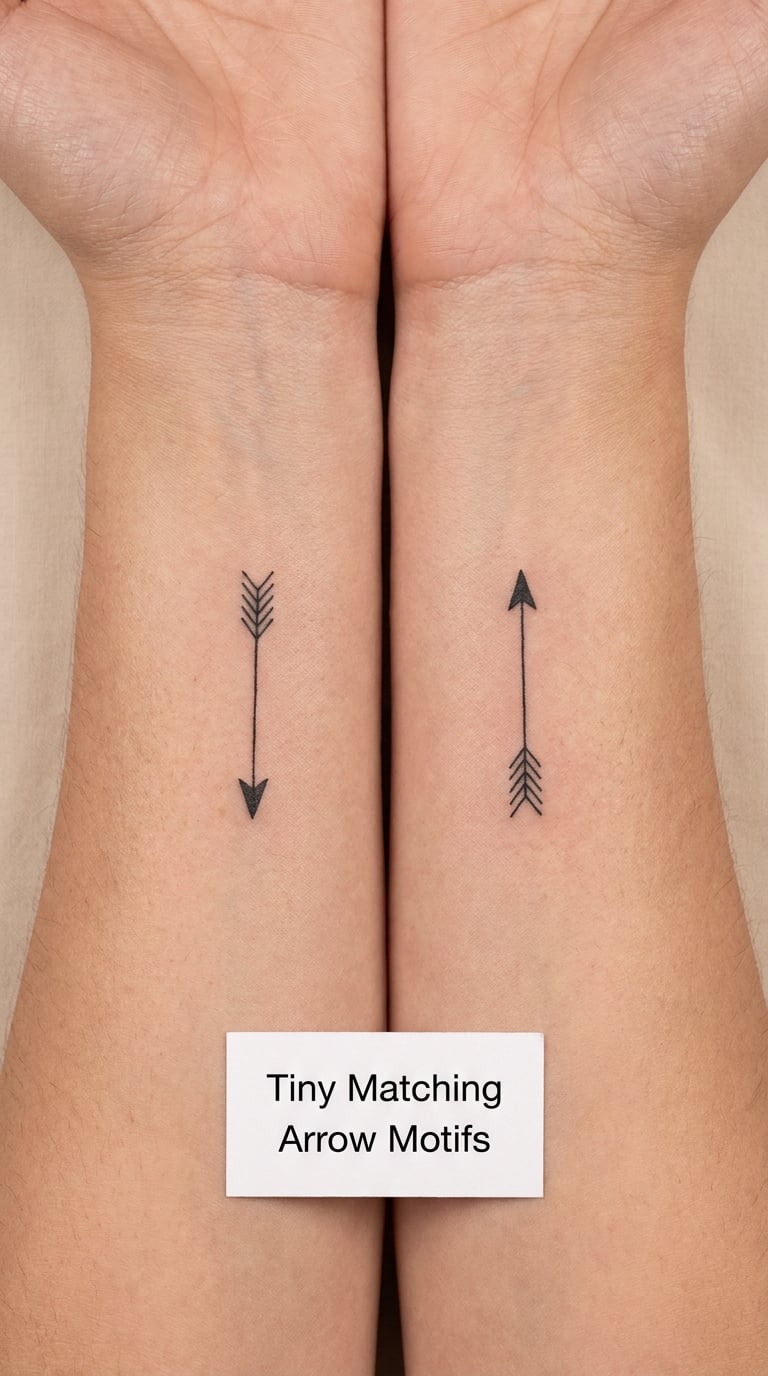
The design is a single black line that narrows to a point, with two short fletching strokes at the tail. Keep the line weight around 1.5 to 2 mm so the arrow still reads at thumbnail size.
Arrows usually get chosen for direction and forward motion, and plenty of people tie them to a specific move, a shared trip or simply the idea of both of you going your own way and still heading the same way.
Placement: inner forearm above the wrist crease, outer wrist, or the side of a rib. Size: 0.6 to 1 inch (1.5 to 2.5 cm) long. Style: fine line, single-needle blackwork.
Pain: medium on the inner forearm, and thinner skin means a sharper scratch than the same line on an upper arm. Fine line arrows on wrists lose their tail detail first, so ask for a slightly heavier line than feels right.
Make it yours: point the arrows in opposite directions, or add a real compass bearing from a place you both know.
2. Mini Matching Sun and Moon
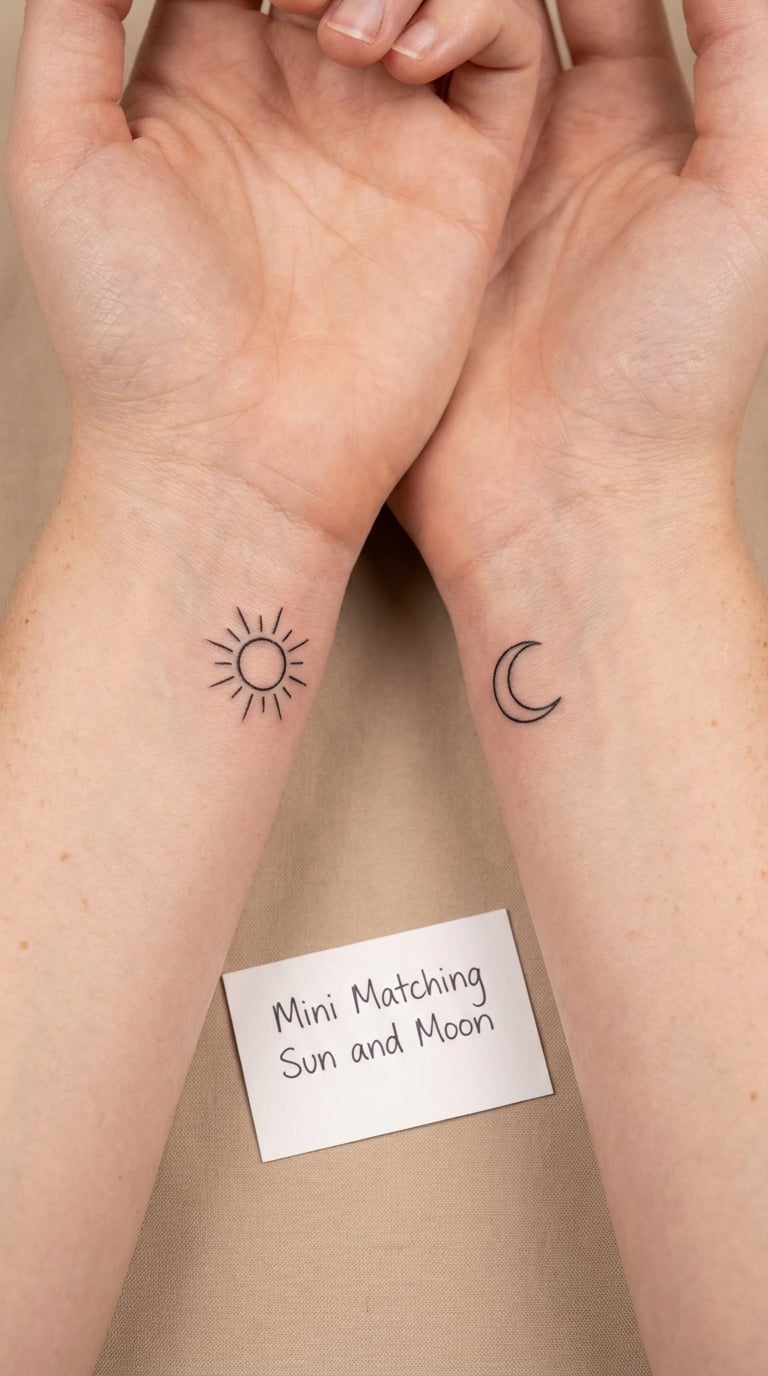
This is two different drawings that belong to each other. One person takes a small sun with short straight rays, the other takes a crescent with a clean inner curve. Neither is a duplicate, which is what makes the pair feel grown rather than ordered.
The sun and moon pairing is one of the most requested in mother and daughter work, usually read as complementary roles rather than a fixed claim about personality.
Placement: inner wrist, behind the ear, or the ankle bone. Size: 0.5 to 0.8 inch (1.2 to 2 cm) across. Style: fine line for the crescent, small blackwork for the sun.
Pain: low to medium, though behind the ear is closer to medium than most people expect. Ray detail on a small sun can close up as it heals, so a larger sun at 0.8 inch holds up better than a tiny one.
Make it yours: keep the sun in black and give the moon a thin white highlight instead, or swap the drawing sizes so the sun sits slightly larger on one wrist.
3. Tiny Matching Heart Outlines
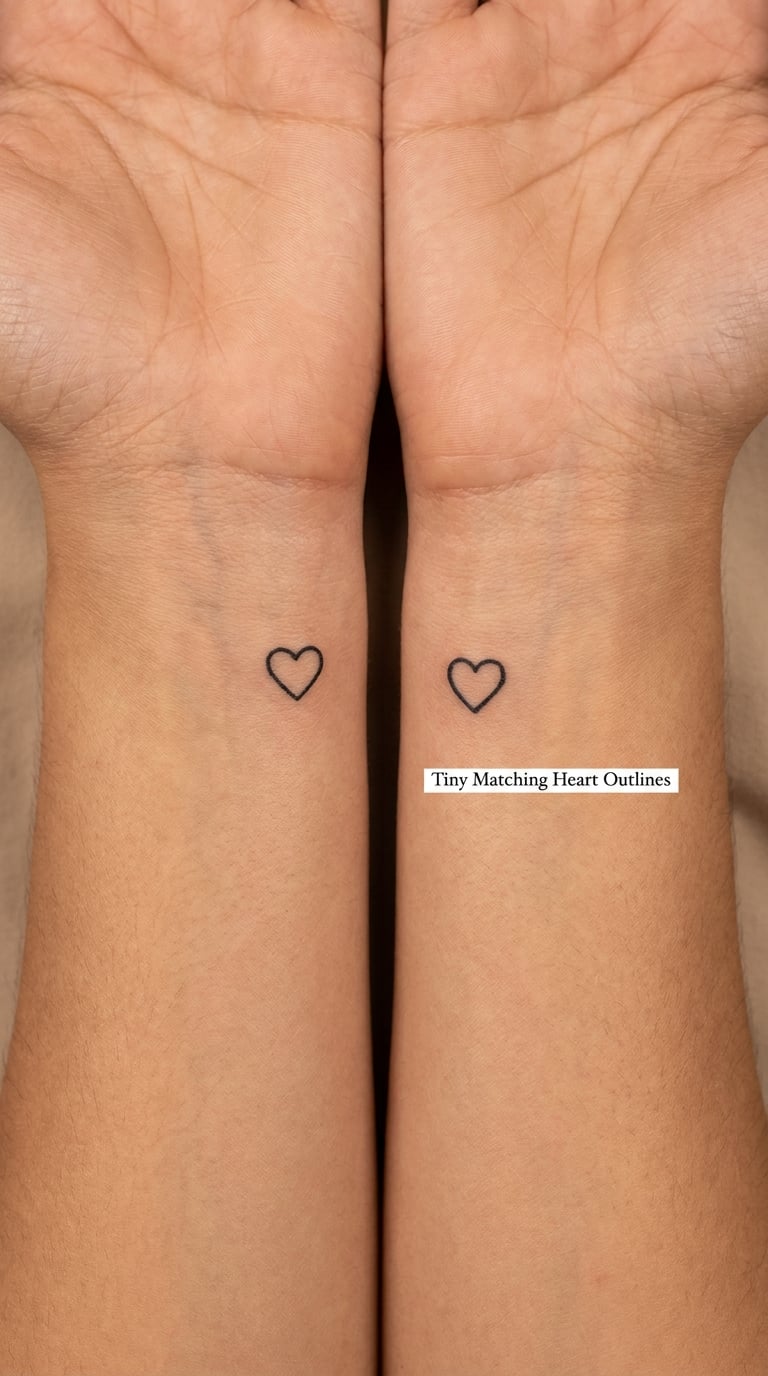
A heart outline does not have to be a valentine. At under half an inch it reads as a clean geometric shape rather than a sentiment, and the difference between an open and a closed line is enough to make two tattoos clearly related but not stamped from the same stencil.
Most people pick this one when they want something readable that a stranger still gets instantly, which is rare with tiny script.
Placement: inner wrist, back of the hand, or a finger knuckle. Size: 0.4 to 0.7 inch (1 to 1.8 cm) tall. Style: minimal line art, single outline, no fill.
Pain: medium on the inner wrist, and knuckle skin is stretchy, so the first line of an outline can feel sharper than the rest. Fine line hearts on fingers and hands fade fastest of any placement in this guide.
Make it yours: one heart closed, one heart open at the top, or the same outline in slightly different sizes across two wrists.
4. Mini Botanical Leaf Pair
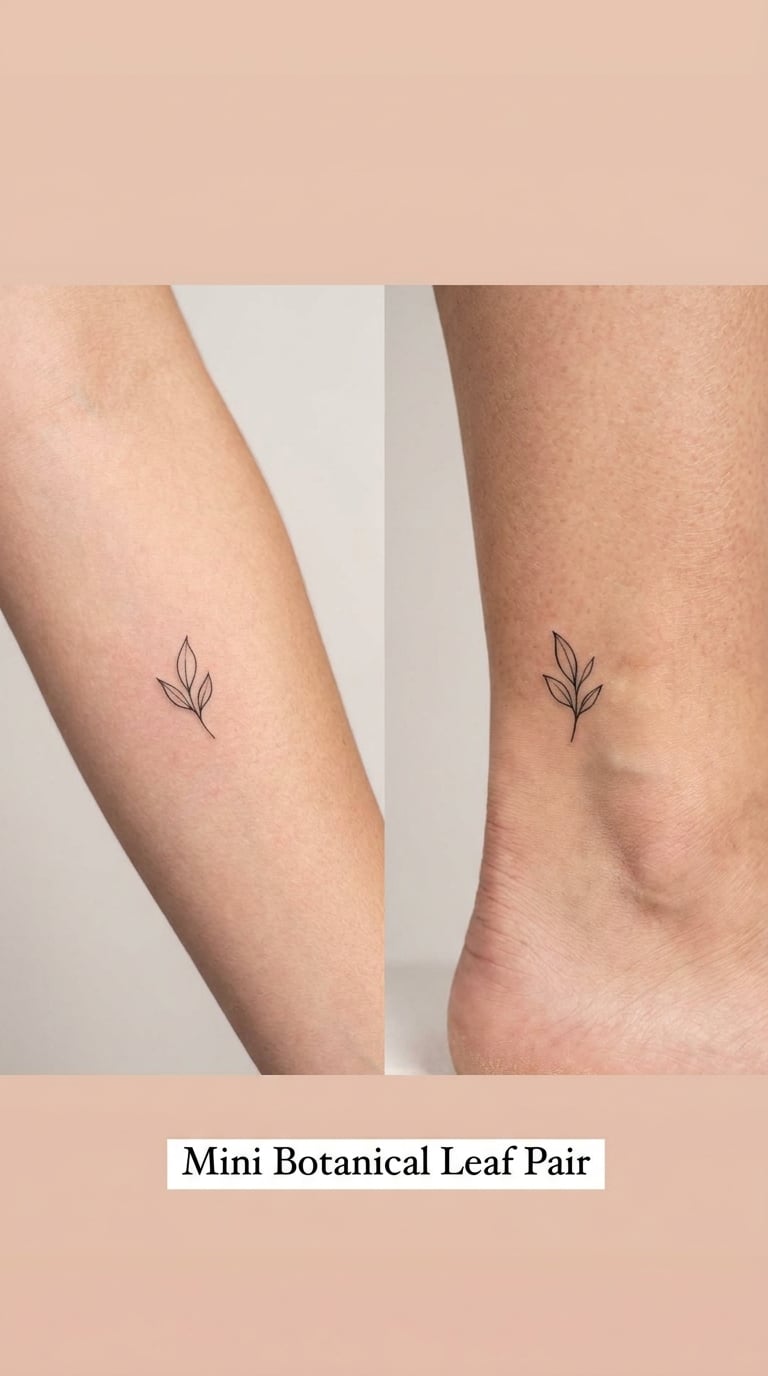
One leaf each, drawn with a centre vein and two or three side veins, no outline weight. Botanical line work is forgiving at small scale because a leaf still looks like a leaf when a vein or two softens.
Leaves get picked for a specific plant rather than a general idea of growth: a birth flower, a plant from a grandmother’s garden, or a eucalyptus stem from a wedding.
Placement: ankle bone, inner arm, or behind the ear. Size: 0.7 to 1 inch (1.8 to 2.5 cm) long. Style: fine line botanical, or a heavier black outline for a bolder result.
Pain: low on the ankle and outer arm, since both have some give. Vein detail is the first thing to blur, so fewer veins and a slightly thicker line age better.
Make it yours: give the mother a fuller stem with three leaves and the daughter a single leaf from the same branch.
5. Small Matching Wave Lines
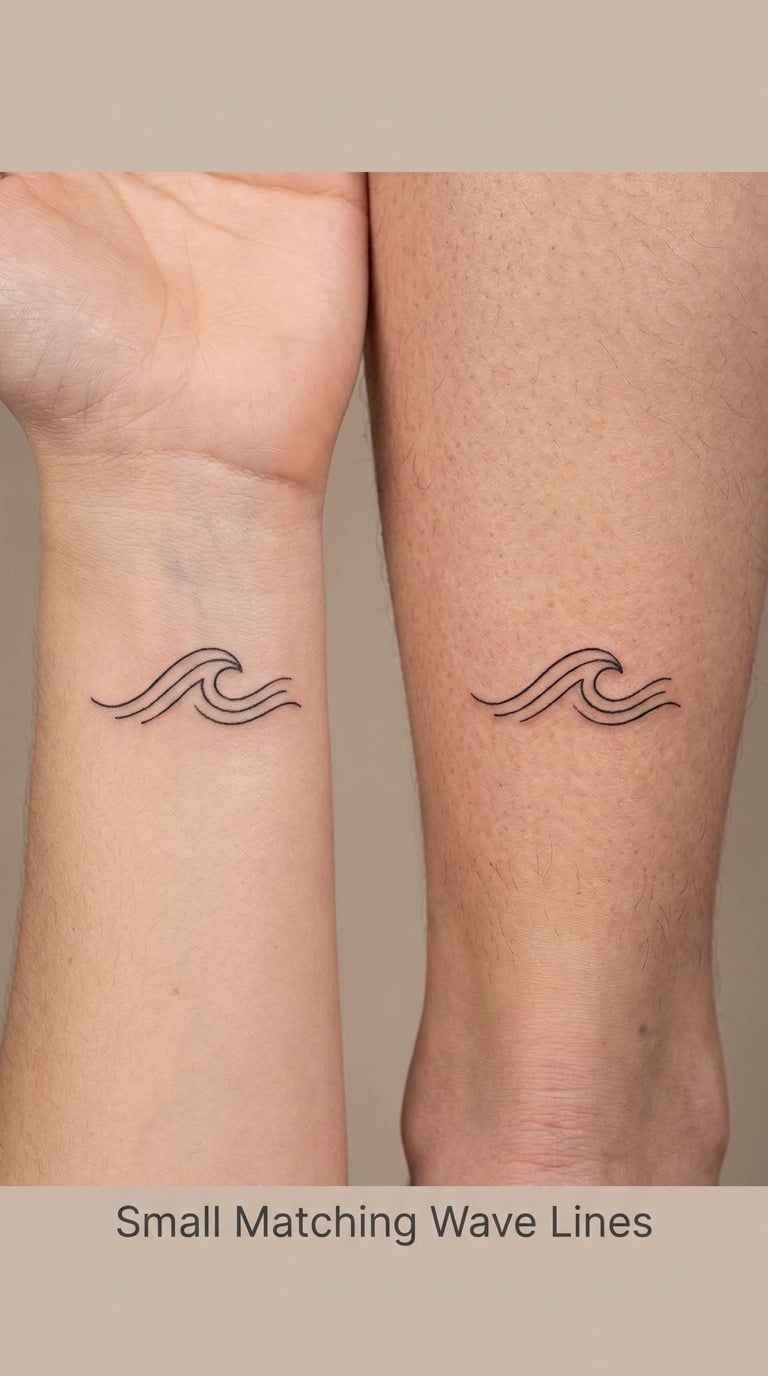
Two or three unbroken curved lines that rise and fall, drawn as a rhythm rather than a picture of water. Waves often work as a complementary pair instead of a straight copy, so one tattoo carries three lines and the other carries two with one open end.
People tend to connect waves to a shared ocean, a lake house or a coast that mattered to both of them, but plenty choose them just for how the lines sit on a curved part of the body.
Placement: inner wrist, calf, or over the collarbone. Size: 1 to 1.5 inches (2.5 to 4 cm) wide. Style: fine line, curved.
Pain: medium on the wrist, lower over the calf. Long unbroken lines are harder to keep even, so expect the artist to build the curve in two passes rather than one.
Make it yours: run one line in a single muted blue and leave the other in black, or curve each set of lines along the natural line of the wrist or rib.
6. Mini Matching Star Constellations
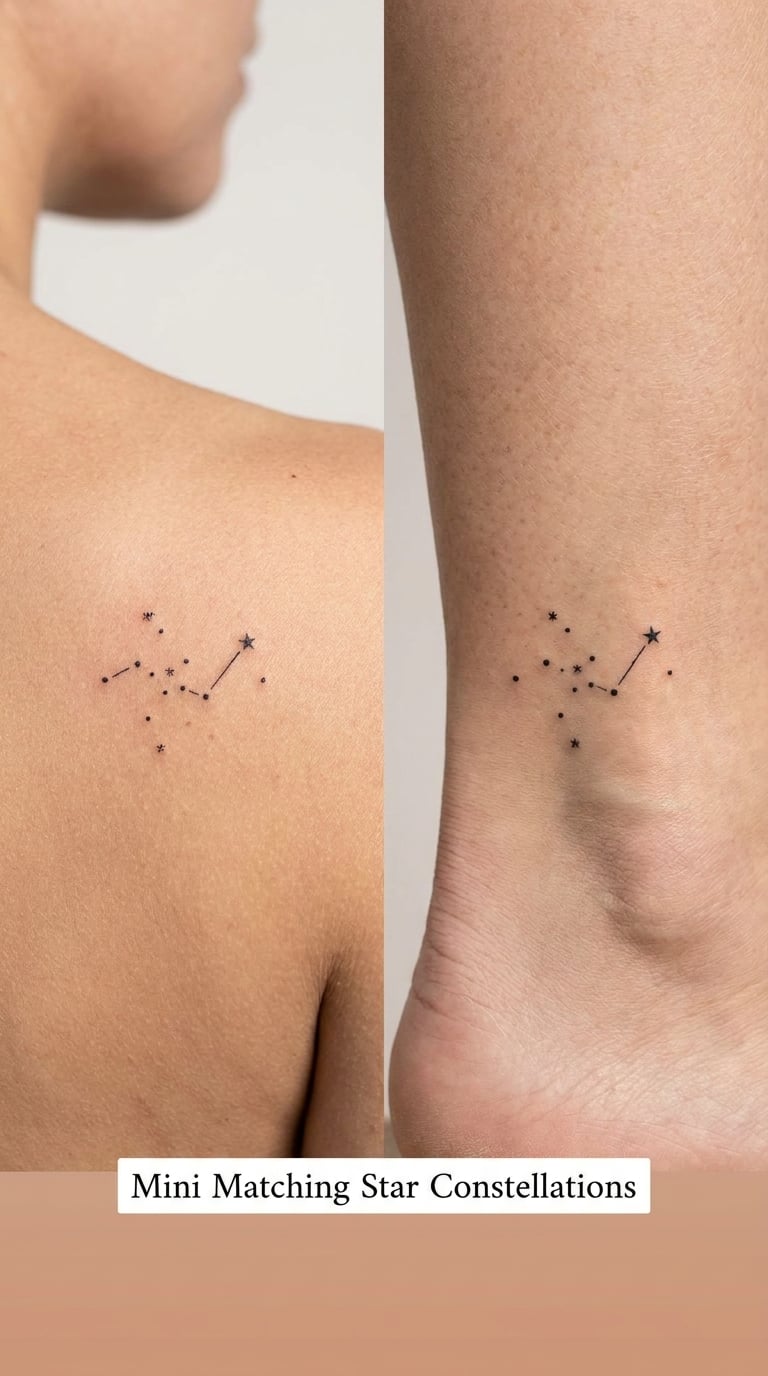
Small dots joined by hairline segments in a loose shape, with one star slightly larger or ringed so it is obvious which point the pair shares. This is a dotwork design first and a picture second, which is exactly why it survives being small.
Constellations get chosen for a sky that mattered rather than a named star sign, often the night sky over a hospital, a first house or a holiday that gets mentioned every year.
Placement: shoulder, upper back, ankle, or hip. Size: 1 to 1.5 inches (2.5 to 4 cm) across. Style: dotwork with fine connecting lines.
Pain: low to medium. Dots are quick and shallow, but the connecting segments are real needling. A six-point constellation stays legible in a decade; a fifteen-point one tends to turn into a smudge.
Make it yours: add the actual date in tiny numerals under one version only, so the pair still matches at a glance but the detail is hers.
7. Tiny Matching Rainbow Flash
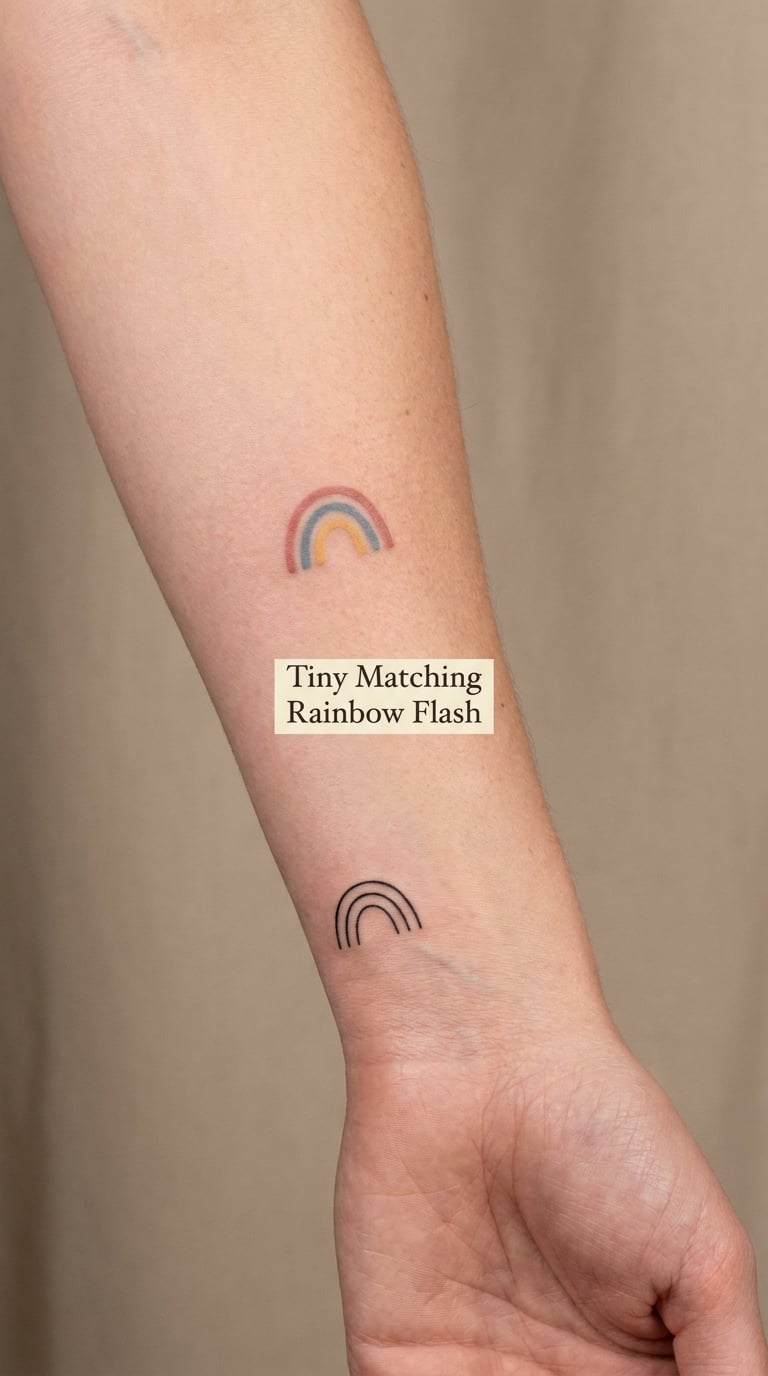
A small arch made of three bands, with the band colours kept soft rather than fully saturated. Flash-style rainbows come with no clouds and no faces, which keeps the drawing to a few rectangles of colour.
It is a good one to tie to a specific moment, a trip to a rainbow beach or a niece’s third birthday party, so the meaning stays with you rather than being generic.
Placement: inner arm, wrist, or the outer rib. Size: 0.6 to 1 inch (1.5 to 2.5 cm) wide. Style: line art with one muted colour accent.
Pain: low on the upper arm, medium on the rib if you breathe shallowly. Colour on a small design sits closer to the surface, so fading happens sooner than with black work. Expect the pale band to disappear first and the darker outline to stay.
Make it yours: colour one arch fully and leave the other as a black outline, or add a single small star at one end of the arch on one version only.
8. Mini Matching Birds in Flight
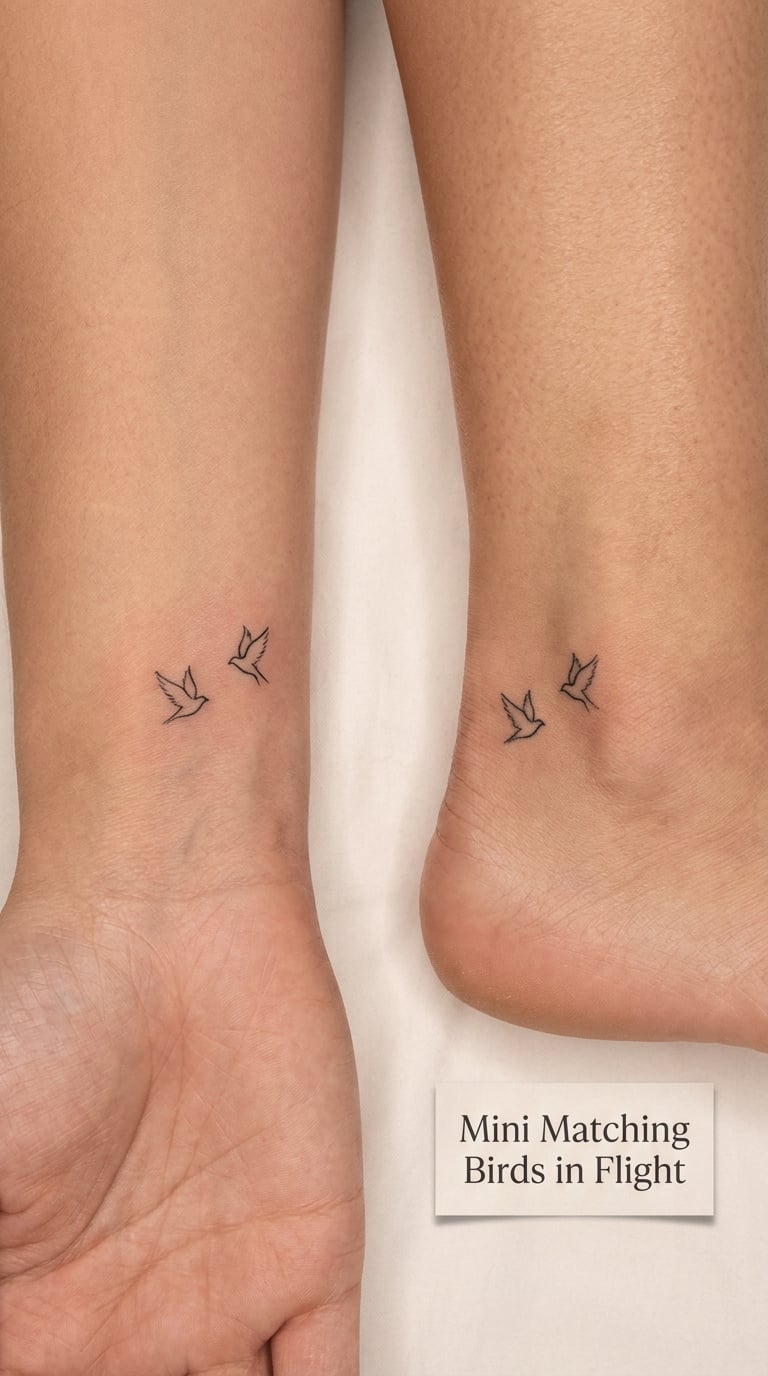
A tiny bird in profile with one wing raised, drawn as an outline with two or three feather strokes rather than a full illustration. Keeping the background empty is what makes the pair read as small instead of as the start of a bigger scene.
Small birds in pairs are usually read as companionship and the habit of checking in on each other, and they show up often in matching work between women who talk every day.
Placement: inner wrist, ankle, or the side of the neck. Size: 0.8 to 1.2 inches (2 to 3 cm) long. Style: fine line silhouette or minimal blackwork.
Pain: low to medium, and a wrist bird sits on top of veins, so it is more tender than the size suggests. Feather strokes are the detail that softens first, so ask for two rather than five.
Make it yours: have one bird drawn facing left and the other facing right, or add a tiny beak line in a warm colour on the smaller version.
9. Small Matching Four-Petal Flowers
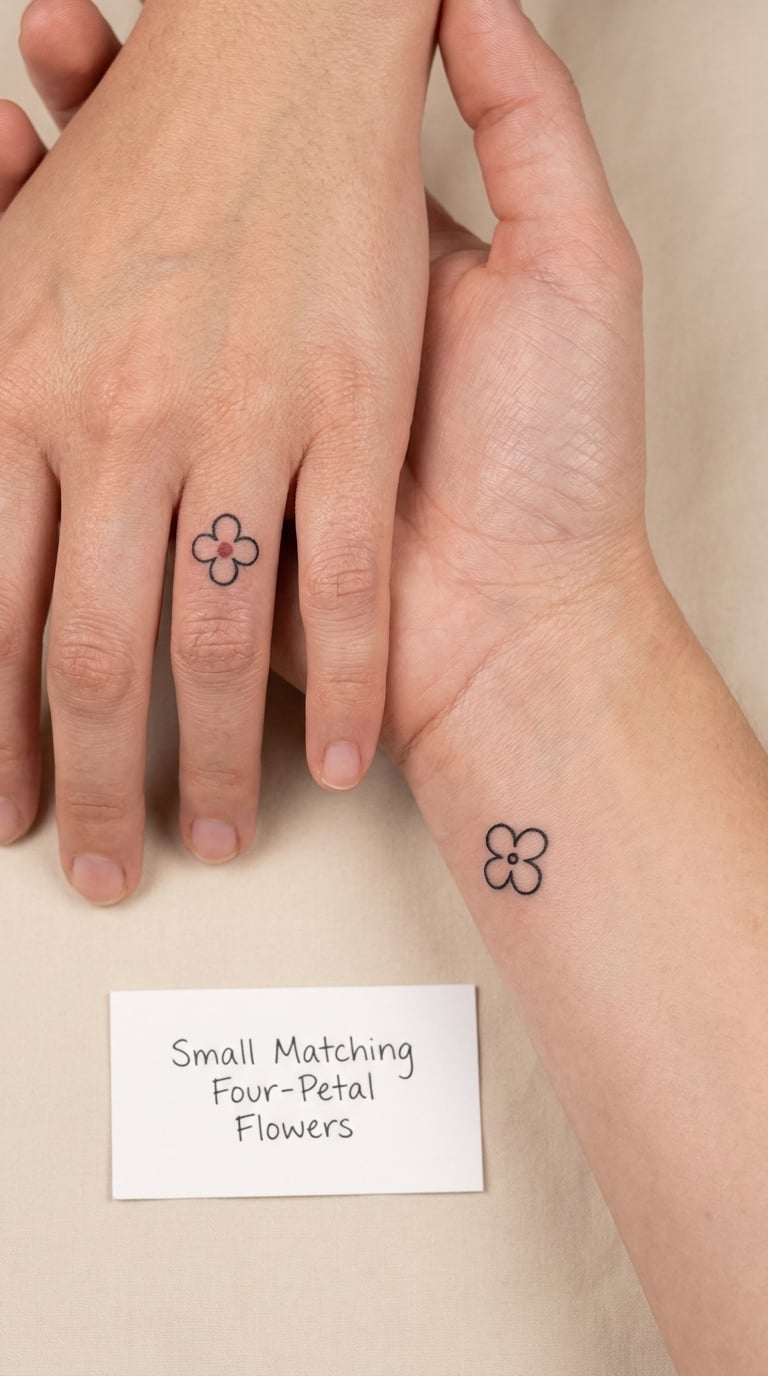
Four simple petals drawn as teardrop outlines around a small centre, no leaves, no stem. Petal count is the whole design, so the artist can keep every line even and the shape stays recognisable at finger size.
This is the one to pick when the daughter is a child or a teenager, because a four-petal outline has no age attached to it and still works as an adult tattoo. The small central dot gives you somewhere to put colour without adding detail.
Placement: finger, inner wrist, or behind the ear. Size: 0.3 to 0.5 inch (0.8 to 1.2 cm) across. Style: outline with a single filled centre.
Pain: medium to high on fingers, where the bone sits close to the surface. Finger tattoos are the first thing to need a touch-up because skin rubs against skin all day.
Make it yours: keep the same outline on both and fill the centre in a different muted colour on each, or add a fifth petal later as a grown-up version of the same tattoo.
10. Mini Matching Compass Points
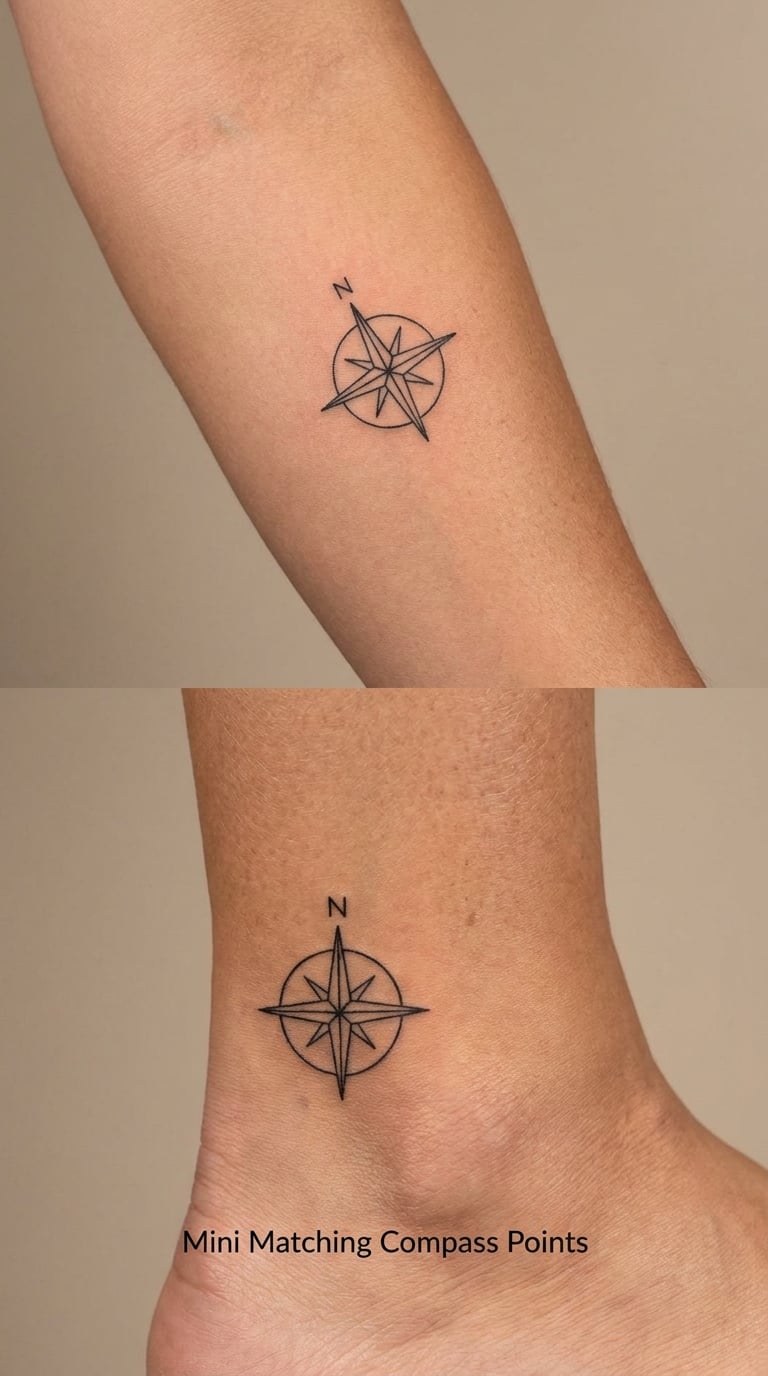
A circle with four short ticks instead of letters, or a small arrow needle across an open circle. Leaving out N, S, E and W is what lets this stay sharp at tiny sizes, since block letters are the part that fills in.
Direction and guidance are the usual reasons people choose it, and it also works for a shared origin point rather than a metaphor, a town, a house or a stretch of coast.
Placement: inner forearm, outer ankle, or the back of the hand. Size: 0.8 to 1.2 inches (2 to 3 cm) across. Style: minimal black linework.
Pain: medium on the inner forearm, low on the hand and ankle. A thin circle on a hand or finger will thin out over time, so a slightly heavier ring keeps the shape for longer.
Make it yours: angle the needle to a real bearing, or rotate each compass in the same direction on both bodies so they line up when your arms rest side by side.
11. Tiny Matching Musical Notes
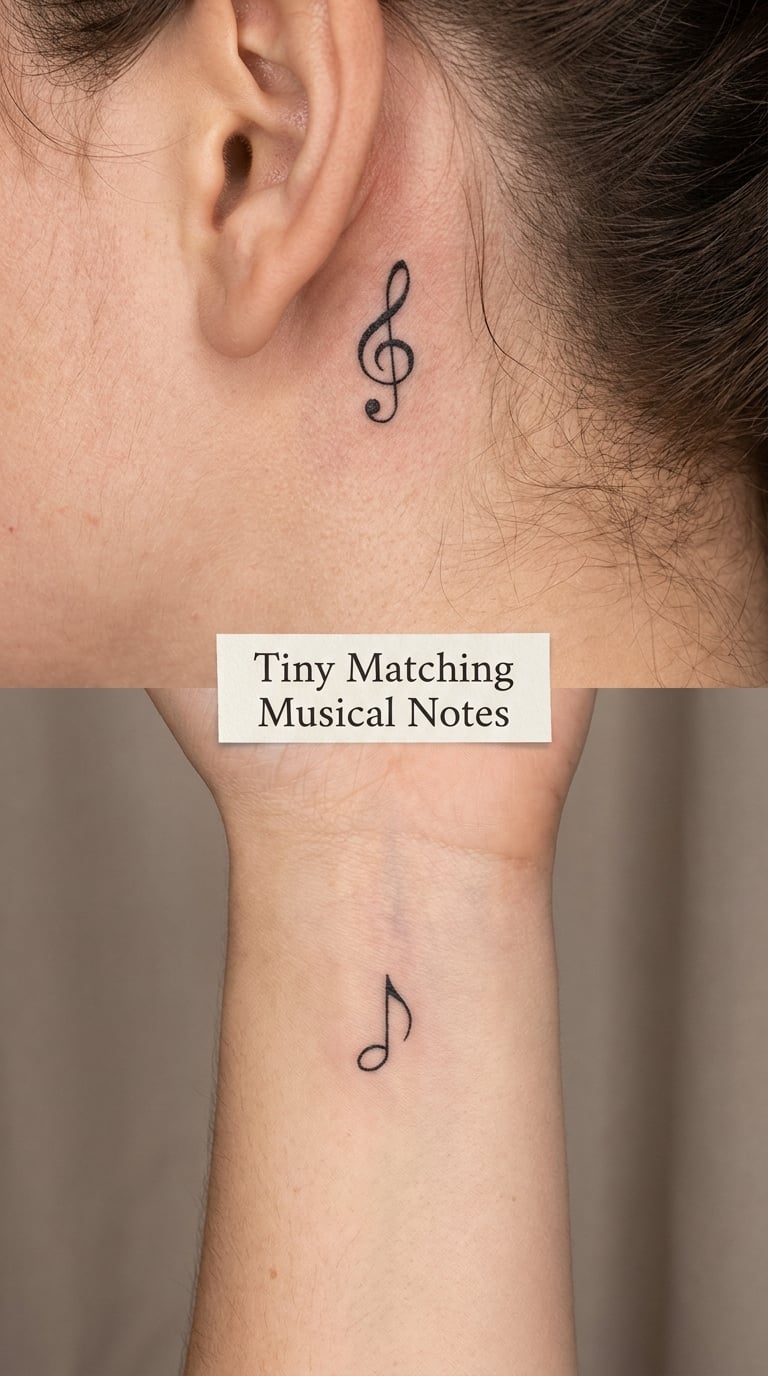
One or two notes drawn as open outlines, a filled note head and a stem with a flag, no stave and no sheet music. It is the difference between a symbol and an instrument that keeps this workable at small scale.
Two people who share an instrument, a choir or a song get the most out of this one, and it works just as well for a parent and child who learned the same three songs at the kitchen table.
Placement: inner wrist, behind the ear, or the outer arm. Size: 0.4 to 0.7 inch (1 to 1.8 cm) tall. Style: simple blackwork or fine line with one colour accent.
Pain: low to medium, and behind the ear is a thin, sensitive area even for a small mark. Flag and beam detail fills in fast, so a single note with a clean flag beats a treble clef at this size.
Make it yours: have one note in black and one in a deep red, or add a tiny bar line so the two notes read as half of one short phrase.
12. Mini Matching Infinity Symbols
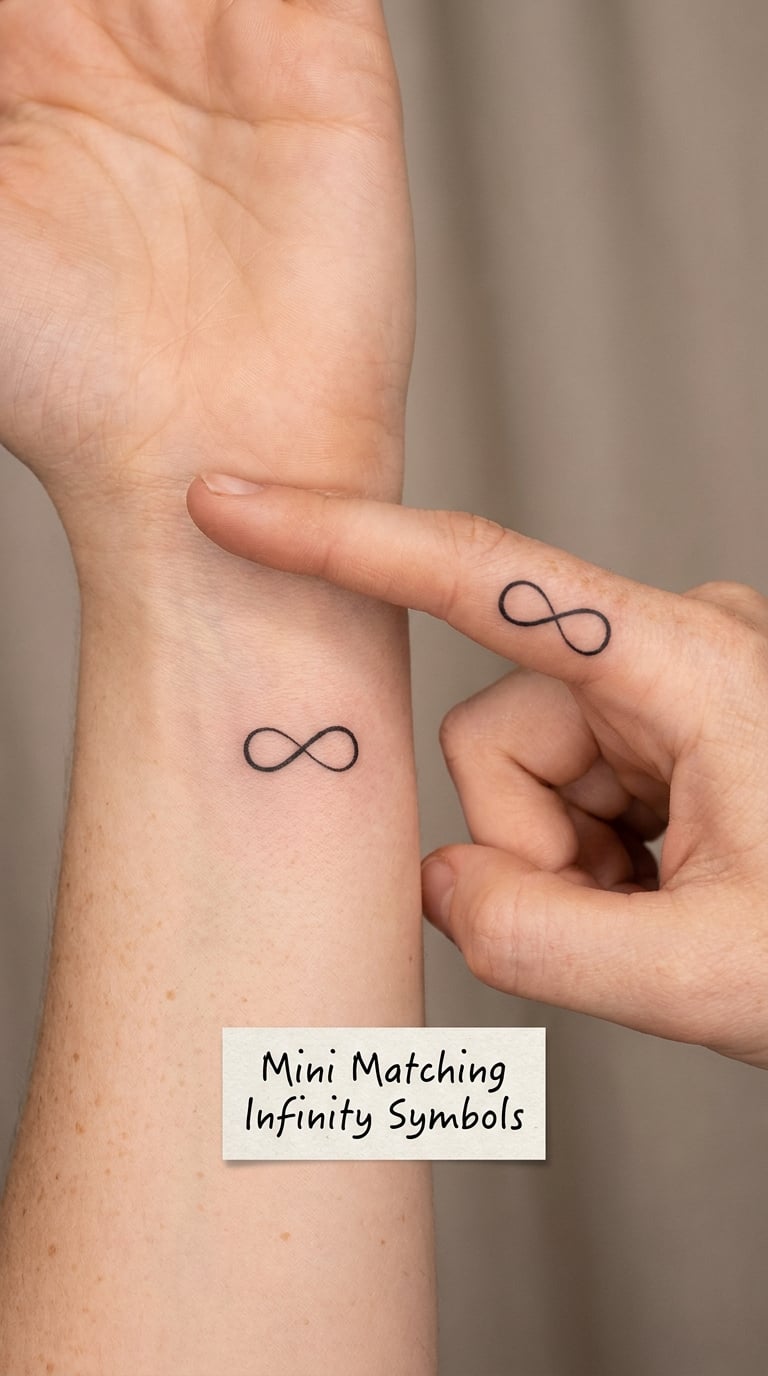
A single even loop, drawn with the same line weight across the whole shape rather than thick on one side. The crossing point is where this design lives or dies, so it needs two passes and a steady hand.
It is the most common lasting-affection symbol in matching work, and people who dislike sentimentality in tattoos still choose it because the shape is abstract rather than a picture of something.
Placement: inner wrist, finger, or the ankle. Size: 0.4 to 0.6 inch (1 to 1.5 cm) wide. Style: fine line symbol.
Pain: medium on the wrist and fingers, where skin is thin. Infinity on a finger will need a touch-up more often than any other design here, because the crossing fills in as the skin relaxes and stretches.
Make it yours: give one version a slightly thicker line, or tilt one to the wrist angle and the other to the finger angle so the pair looks like it grew with each of you.
13. Tiny Matching Mountain Peaks
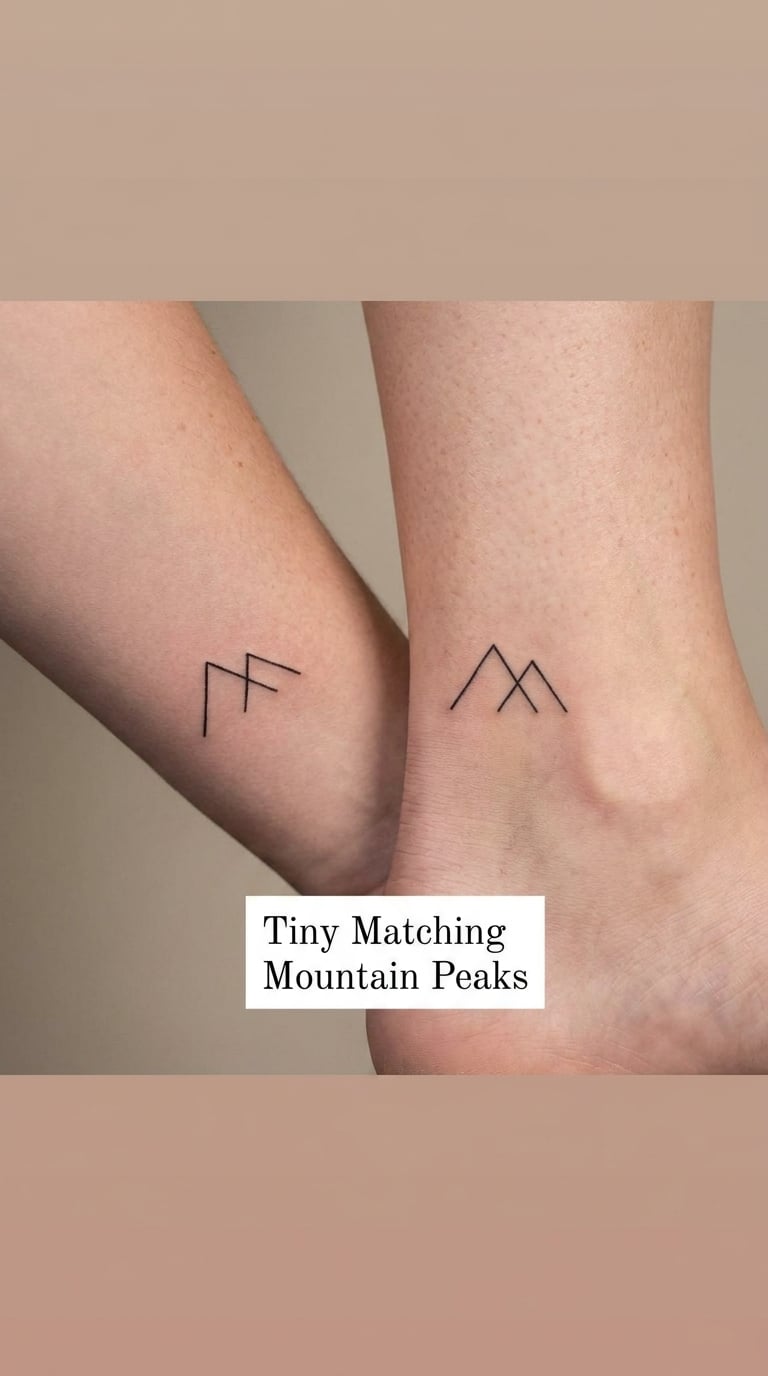
Two or three triangular peaks joined by a single ridgeline, with no trees, no sun and no reflection. Stripping the scenery back keeps the drawing readable and stops it from turning into a scene that needs more room.
Mountains are almost always a real place, a trip you took together or a view from a house, and that specificity is usually the whole reason the pair works.
Placement: inner arm, outer ankle, or the calf. Size: 1 to 1.5 inches (2.5 to 4 cm) wide. Style: line art, or lightly shaded with dotwork below the ridge.
Pain: low to medium. Shading a small peak means a lot of short passes, so a clean outline version is genuinely quicker and often looks better once healed.
Make it yours: add a real date in tiny numerals under one peak, or give the mother’s version one extra ridge so the silhouette is that of a place you both know from a different angle.
14. Mini Matching Cherry Pair
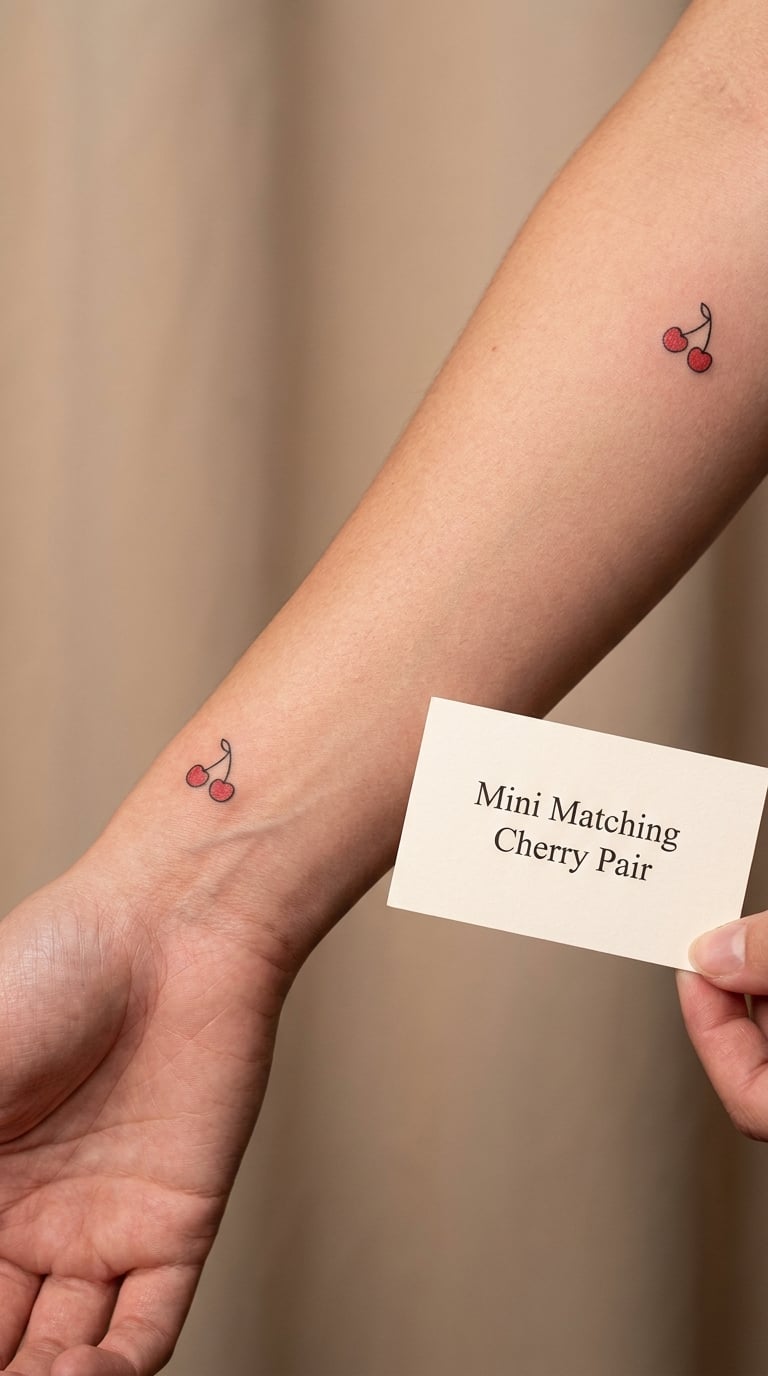
Two round fruits on joined stems with one small leaf, drawn either in black outline or with a soft red fill. The leaf is optional, and dropping it keeps the drawing to three shapes.
Cherries are a shared-thing motif, paired with the word mother, a nickname or a name, so a lot of people attach the design to a family joke or a garden that grew them.
Placement: inner wrist, forearm, or the collarbone. Size: 0.7 to 1 inch (1.8 to 2.5 cm) tall. Style: fine line with red accent, or plain blackwork.
Pain: medium on the wrist, lower on the forearm. Red fill on a small cherry dulls noticeably in a few years, so the black outline matters more than the colour. Ask for a slightly deeper red than a swatch looks.
Make it yours: have one cherry pair in red and the other in black only, or connect both stems into a small loop that reads as a shape rather than two fruit.
15. Small Matching Daisy Line Art
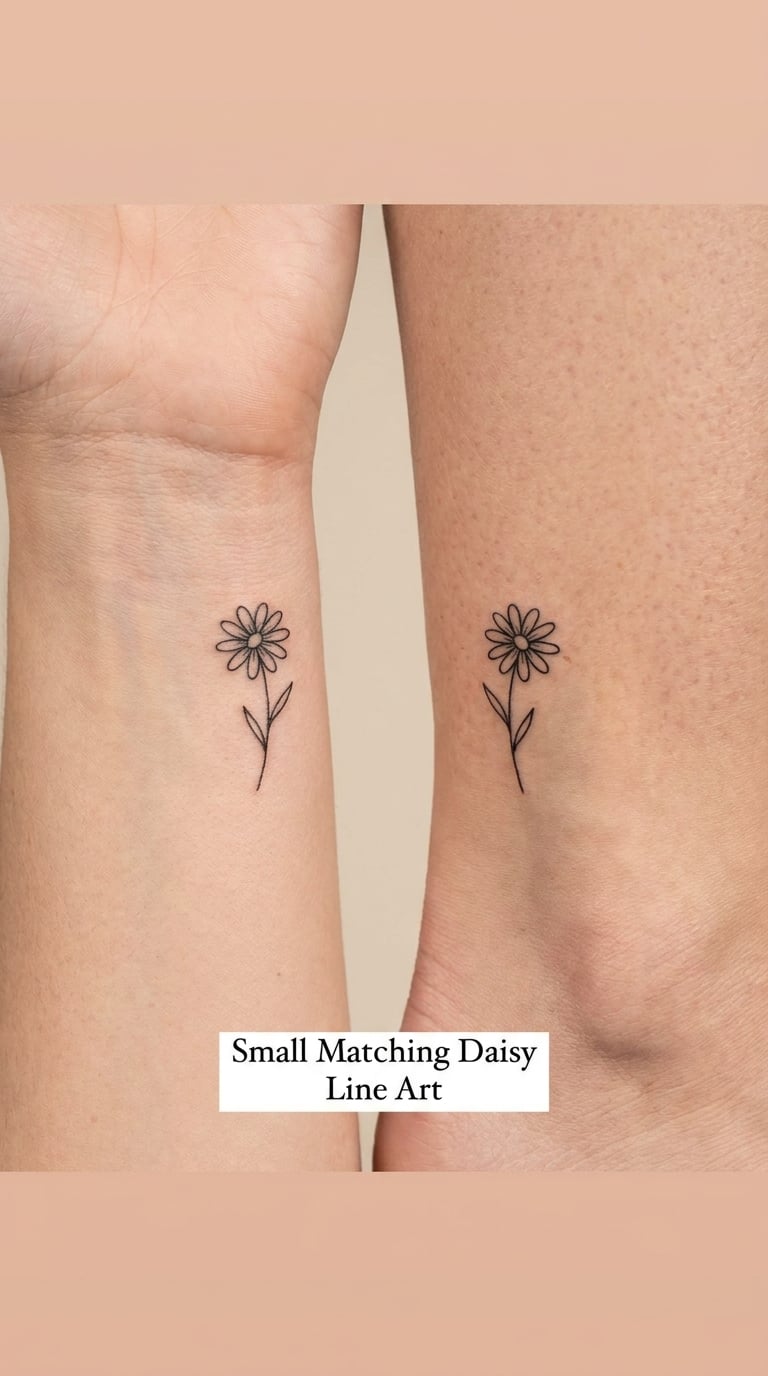
A ring of narrow petal outlines around a small filled centre, with one short stem and no leaves. Six or eight petals is the practical number here, because each extra petal is one more line to fill in as it heals.
It reads as cheerful rather than sentimental, which is why it works well for a pair who wants a match that does not look like a tribute, and it is a common birth-flower choice.
Placement: wrist, ankle, or the inner arm. Size: 0.5 to 0.8 inch (1.2 to 2 cm) across. Style: fine line outline with a solid centre.
Pain: medium, and the stem on the inside of a wrist sits over a tendon. Petal lines fill in first, so a slightly larger daisy holds its shape better than a very small one.
Make it yours: give the daughter’s version one petal in yellow and leave the rest black, or add a small leaf to the mother’s stem only so the two read as related rather than stamped.
16. Tiny Matching Paper Hearts
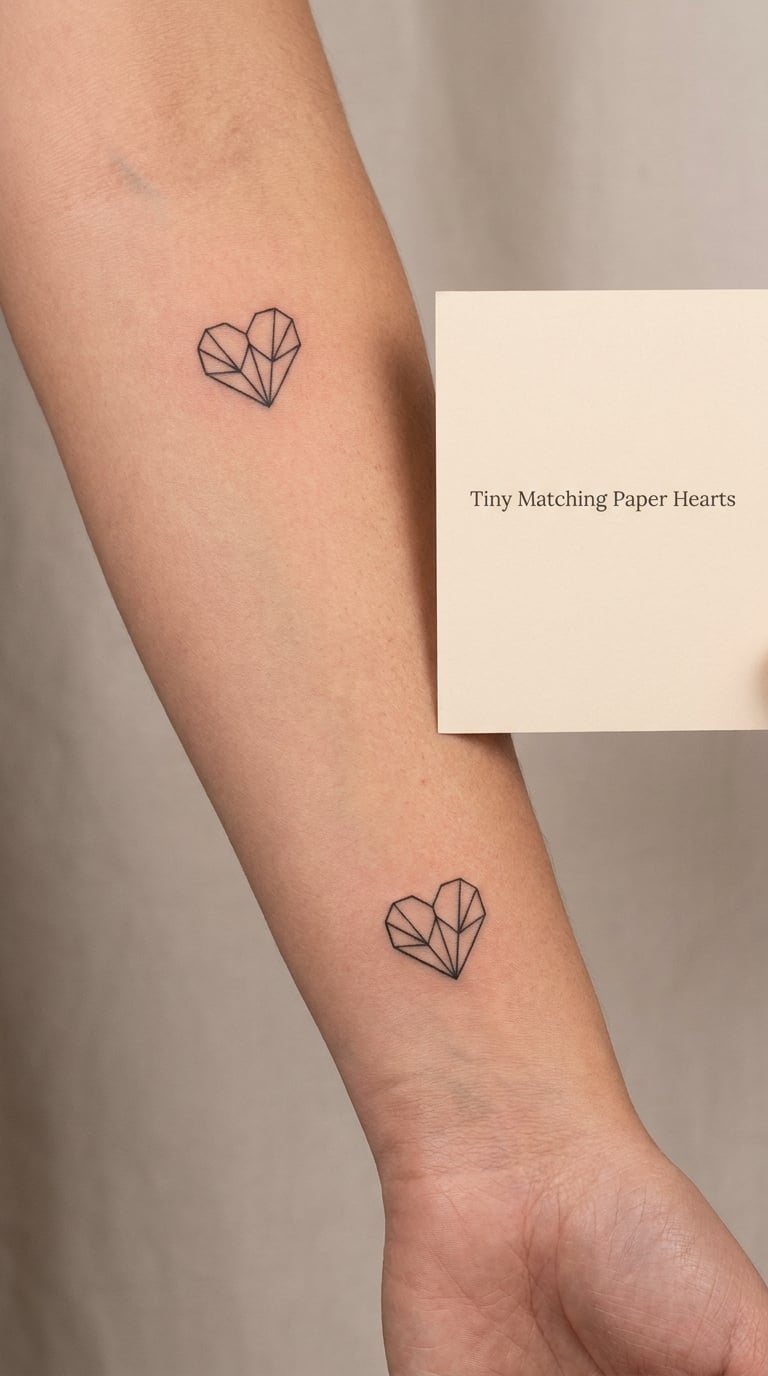
A folded paper heart reduced to four or five straight creases, drawn as a geometric shape rather than a valentine. Straight lines and sharp corners are far more forgiving at small scale than a curved outline.
It is the option for a pair who finds a soft heart a bit sentimental, and the folded version reads as craft and care rather than as a greeting card.
Placement: inner arm, wrist, or the rib. Size: 0.5 to 0.8 inch (1.2 to 2 cm) across. Style: geometric line work.
Pain: low to medium, and no area of this design is especially tender. Crease lines need a heavier weight than curves to stay sharp, so ask the artist to build them at 2 mm.
Make it yours: fold the shape in opposite directions on the two versions, so one heart opens upward and the other downward, or add a single hairline crease in a warm colour.
17. Mini Matching Turtle Pair
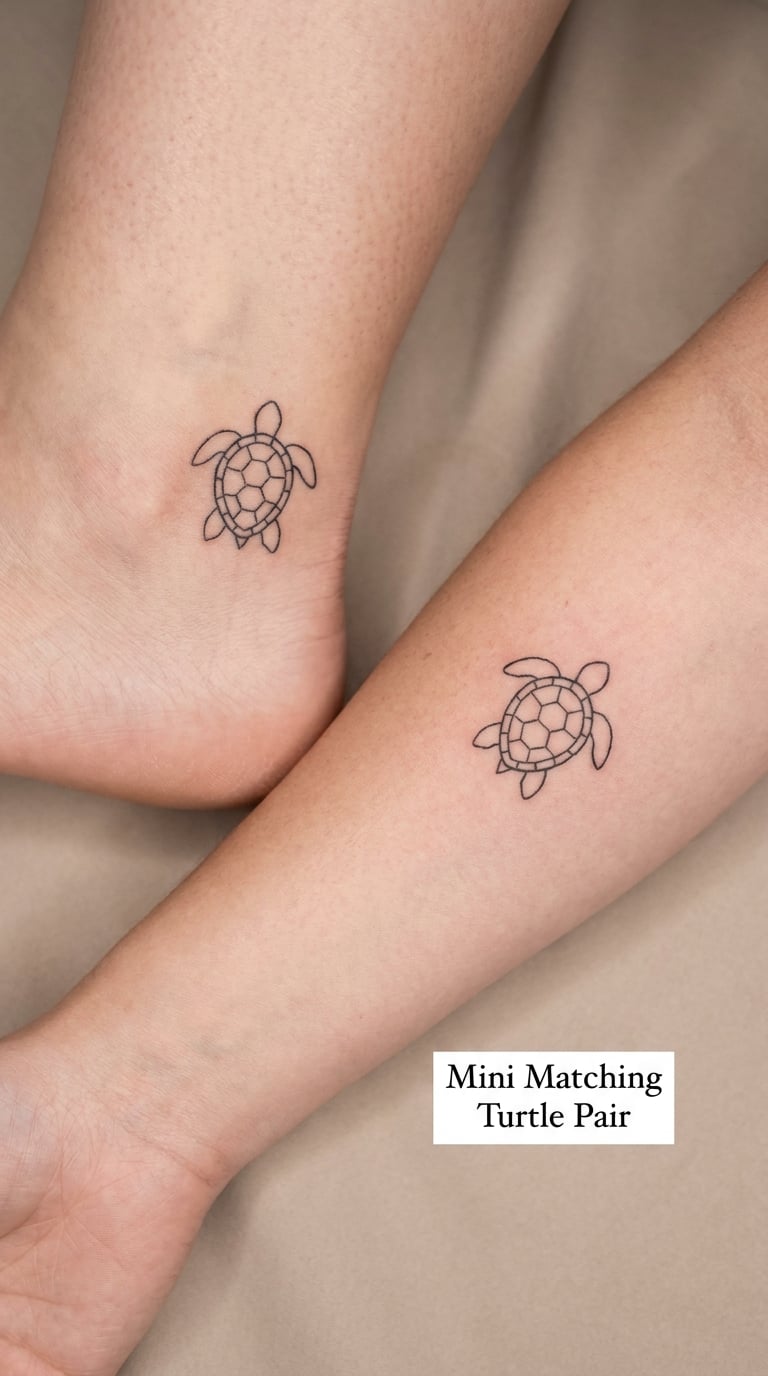
A side-view turtle with a domed shell divided into four or five clean plates, four short legs and a small head. That is the most detail this design can carry before the shell turns to mush.
Turtles are usually described as slow, steady and long-lived, and the shell pattern gives you an easy way to make one version yours without changing the silhouette.
Placement: ankle, forearm, or the back of the hand. Size: 1 to 1.5 inches (2.5 to 4 cm) long. Style: fine line, simple shell plates.
Pain: low to medium. Keep it to four or five shell plates, because six or more per row is detail that softens into a grey block within a few years. Ask the artist to line the shell in one pass.
Make it yours: fill one shell in solid black and leave the other as line art, or add a small wave line under the turtle on one version to tie it to a beach memory.
18. Small Matching Crescent Moons
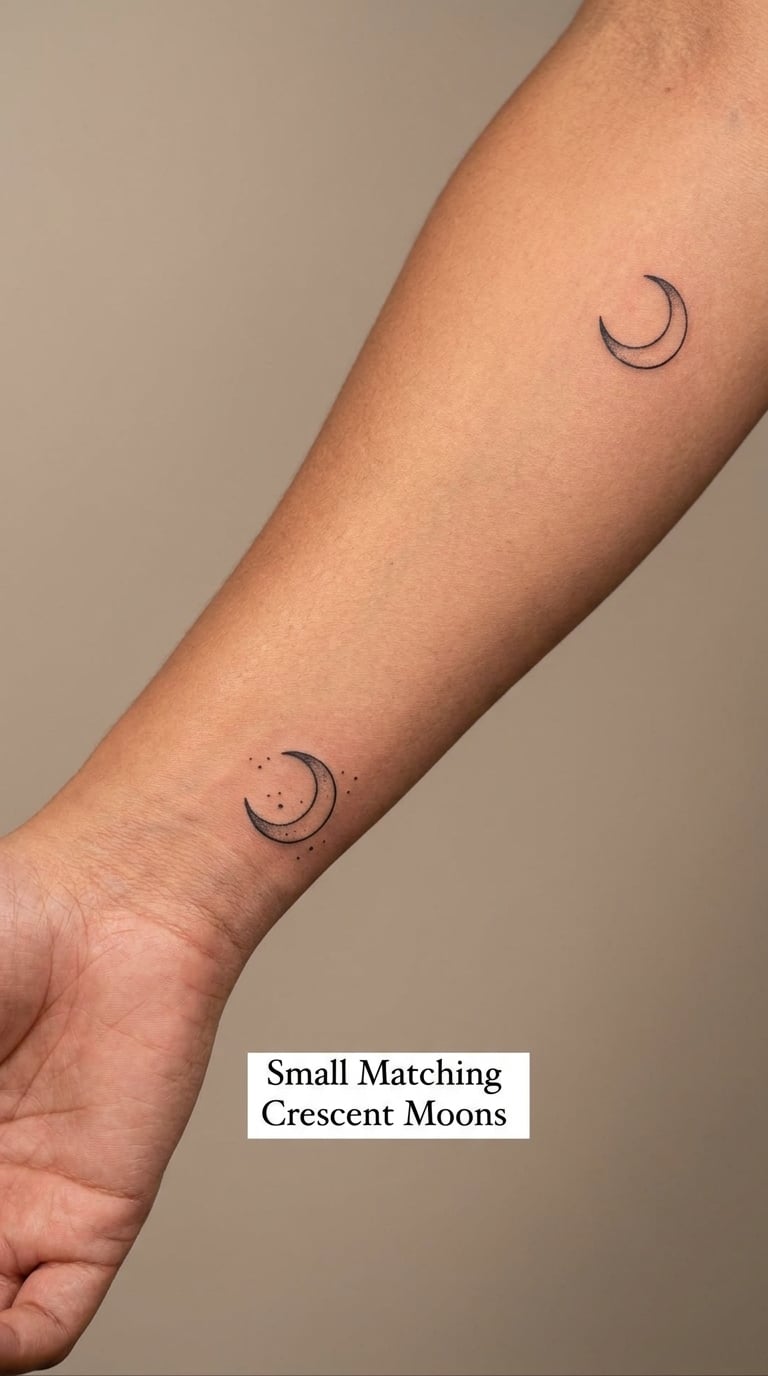
Two crescents drawn slightly differently, one with a thicker outer curve and one with a thinner line, each with a few small dots along the inside edge. Coordination rather than duplication is the point here.
A crescent usually works for a pair connected by the moon, a birth month, or just a night-time routine, and dots add a texture that survives scale better than a face ever would.
Placement: inner wrist, inner arm, or behind the ear. Size: 0.5 to 0.9 inch (1.2 to 2.2 cm) tall. Style: line art or dotwork crescent.
Pain: low on the arm, medium behind the ear. Dots are shallow and quick, and a dotted crescent keeps more of its texture over time than a shaded one does.
Make it yours: add a different number of dots to each crescent, or set a small star at the open end of the curve on one version only.
19. Tiny Matching Key Shapes
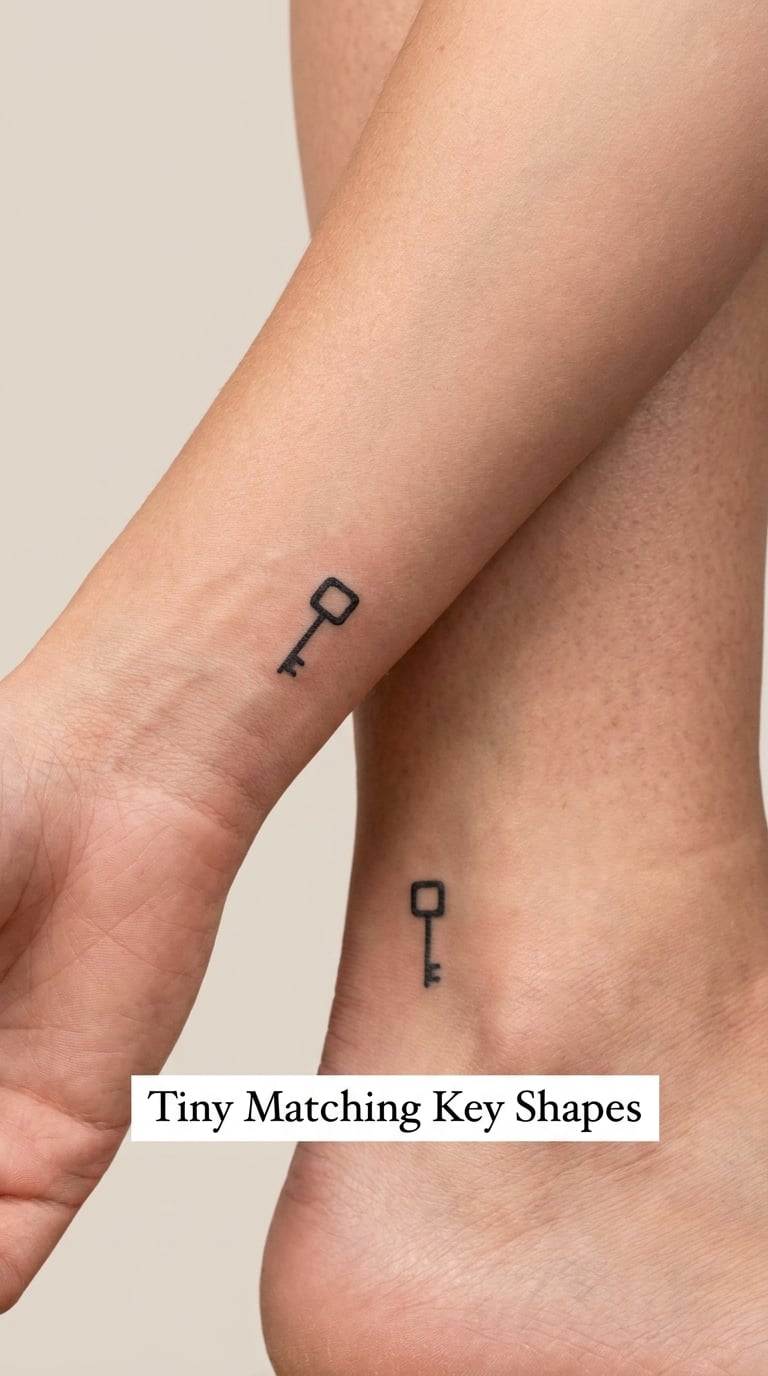
A geometric bow, a short shaft and two simple teeth, drawn with clean straight lines and no ornament. The shape is recognisable at three quarters of an inch, which is where most keys start to lose their teeth.
People tend to attach personal meaning to it themselves, often home, trust or access, and plenty choose it because it says something without ever having to be explained.
Placement: inner wrist, ankle, or behind the ear. Size: 0.6 to 1 inch (1.5 to 2.5 cm) long. Style: minimal geometric blackwork.
Pain: medium on the inner wrist, low on the ankle. Keep the teeth to two, because smaller teeth fill in within a couple of years and the key starts to look like a stick.
Make it yours: make the bow round on one and square on the other, or add a single small tag hanging from the bow with an initial on it.
20. Mini Matching Butterfly Wings
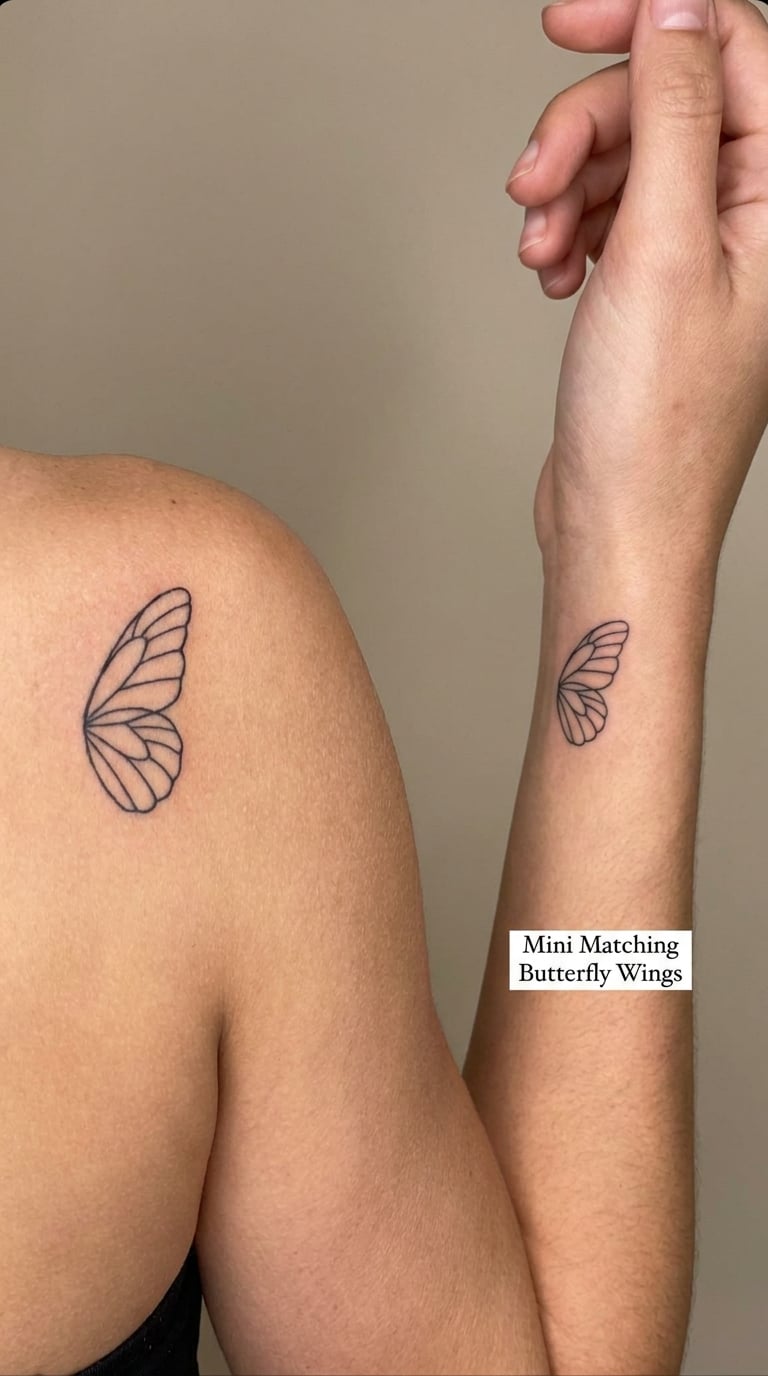
One upper wing with three or four curved segments and a straight inner edge, no body, no second wing. An abstract wing lets the two of you sit on completely different parts of the body without the design looking wrong.
Wings get chosen for change and for things growing, and the half-wings version is a common way to make a matching pair when one of you has more flat skin available than the other.
Placement: shoulder, wrist, hip, or the upper back. Size: 1 to 1.5 inches (2.5 to 4 cm) tall. Style: abstract fine line or minimal blackwork.
Pain: low to medium, and the shoulder is one of the easiest small-tattoo spots on the body. Curved segment lines soften over time, so three segments will read better than six in ten years.
Make it yours: fill the outer segment in a muted tone on one wing only, or draw the two wings mirrored so they mirror each other when you stand side by side.
21. Small Matching Raindrops
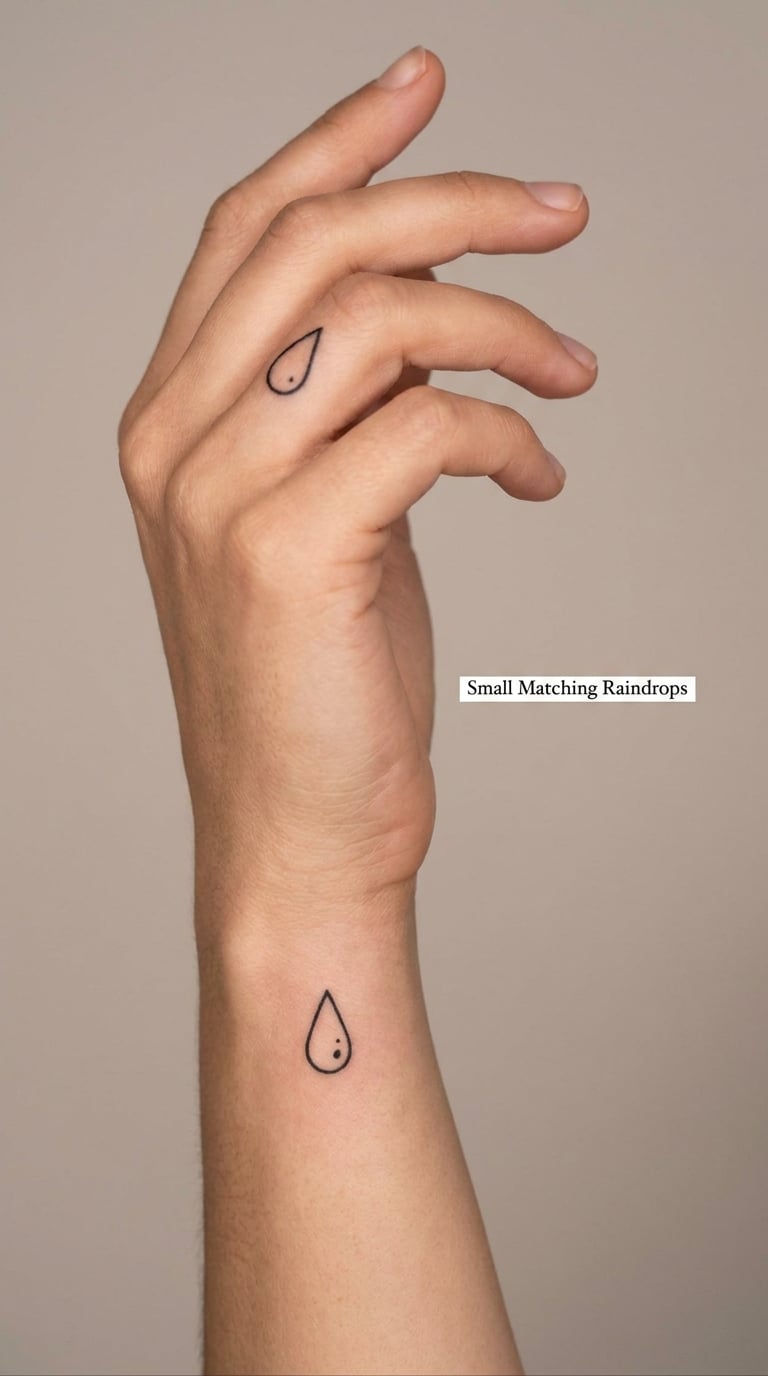
A simple teardrop outline with a rounded bottom and a tapered top, drawn in one line, with a single small dot inside on one version. Two of these look like a set rather than a repeat, which is helpful on fingers where space is tight.
Rain works as a memory motif, the trip where the weather was part of the story, and it also gives a mother and daughter who are not sentimental a matching design with room to breathe.
Placement: finger, near the wrist, or the outer ankle. Size: 0.3 to 0.5 inch (0.8 to 1.2 cm) tall. Style: single-line outline with a dot accent.
Pain: medium to high on fingers, lower near the wrist. A one-line drop is quick, but the tip is the bit that wobbles, so ask for a slightly rounded top rather than a sharp point.
Make it yours: put one dot inside each drop but a different number of them, or add three small drops in a row on the wrist version to make it the fuller half of the pair.
22. Tiny Matching Coffee Cup Marks
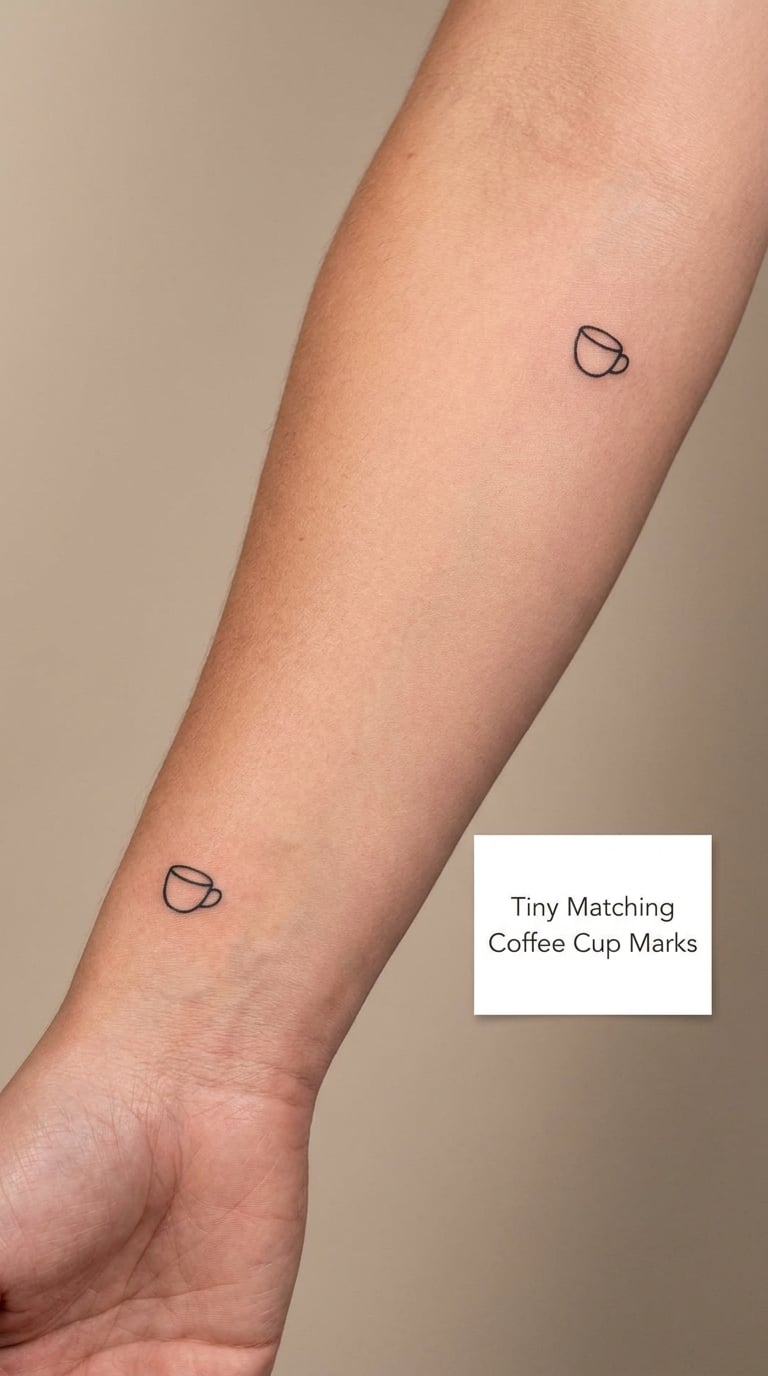
A small cup and saucer in outline, with a handle and no steam, no text and no beans. Removing the steam is the important call, because those tiny curls are the first lines to disappear.
It is a shared-ritual design, a morning coffee or tea habit the two of you did together, and it is one of the more common motifs in matching pairs who do not want anything sentimental at all.
Placement: inner wrist, inner arm, or the outer arm. Size: 0.4 to 0.7 inch (1 to 1.8 cm) tall. Style: simple line art.
Pain: medium, and the wrist version crosses the vein cluster. The saucer ellipse is the fiddly part, so let the artist simplify it to a single curve if the cup is going under half an inch.
Make it yours: draw one as a mug with a squared handle and the other as a teacup with a round one, or add a single small heart as the steam mark on one version.
23. Mini Matching North Star Dots
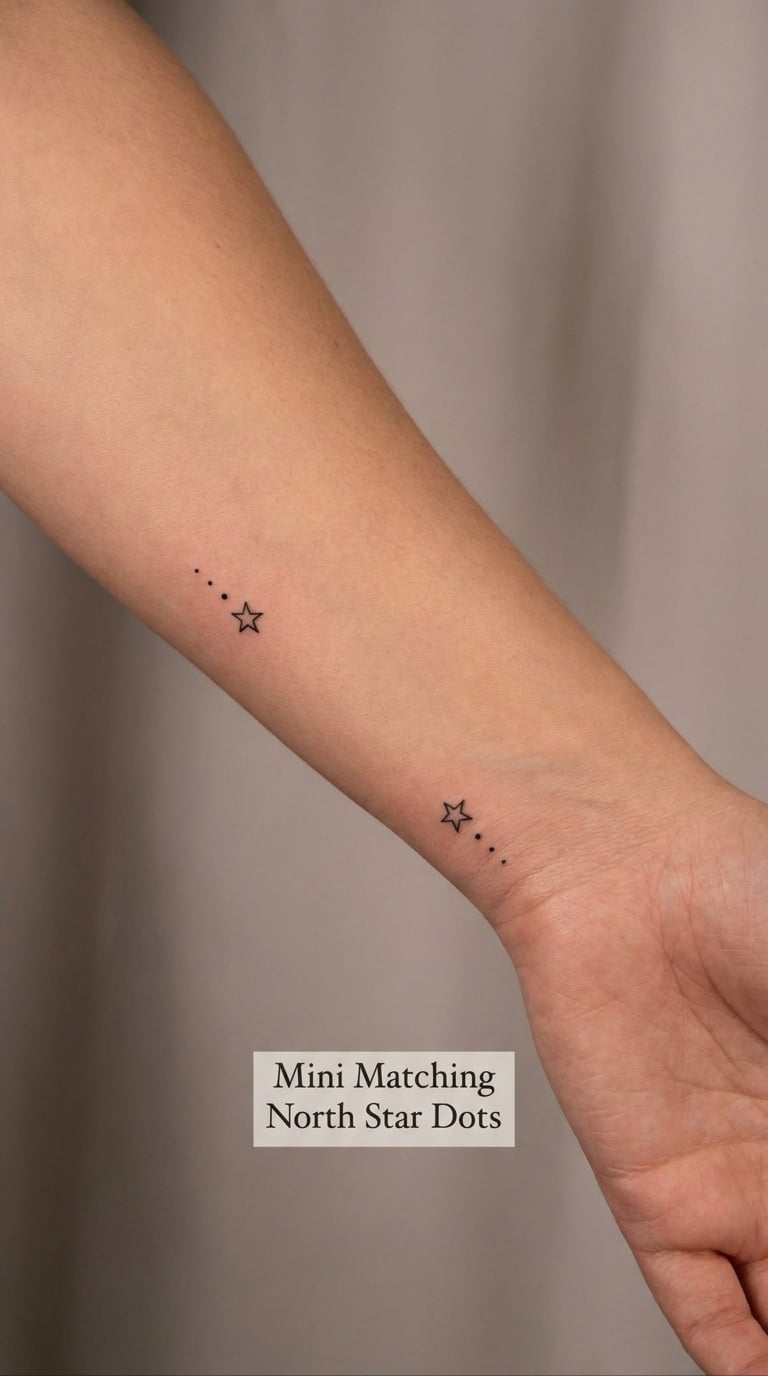
A small four-point star with a short trail of three dots behind it, drawn with sharp points and no shading. Four points stay crisp where a five-point star starts to close up at this scale.
A single guiding star is a common choice for a pair who describes one person as steady and the other as the one who follows, and the dot trail leaves room to add a date later.
Placement: inner arm, wrist, or the finger. Size: 0.4 to 0.7 inch (1 to 1.8 cm) long including the trail. Style: minimal blackwork with dotwork trail.
Pain: medium, and a four-point star has several sharp corners to negotiate. Dots are quick, so the trail adds maybe a minute to the session rather than any real time.
Make it yours: point both trails the same way even if the tattoos sit on opposite wrists, or add a tiny date in numerals to one trail as a three-dot extension.
24. Small Matching Initial Sprigs
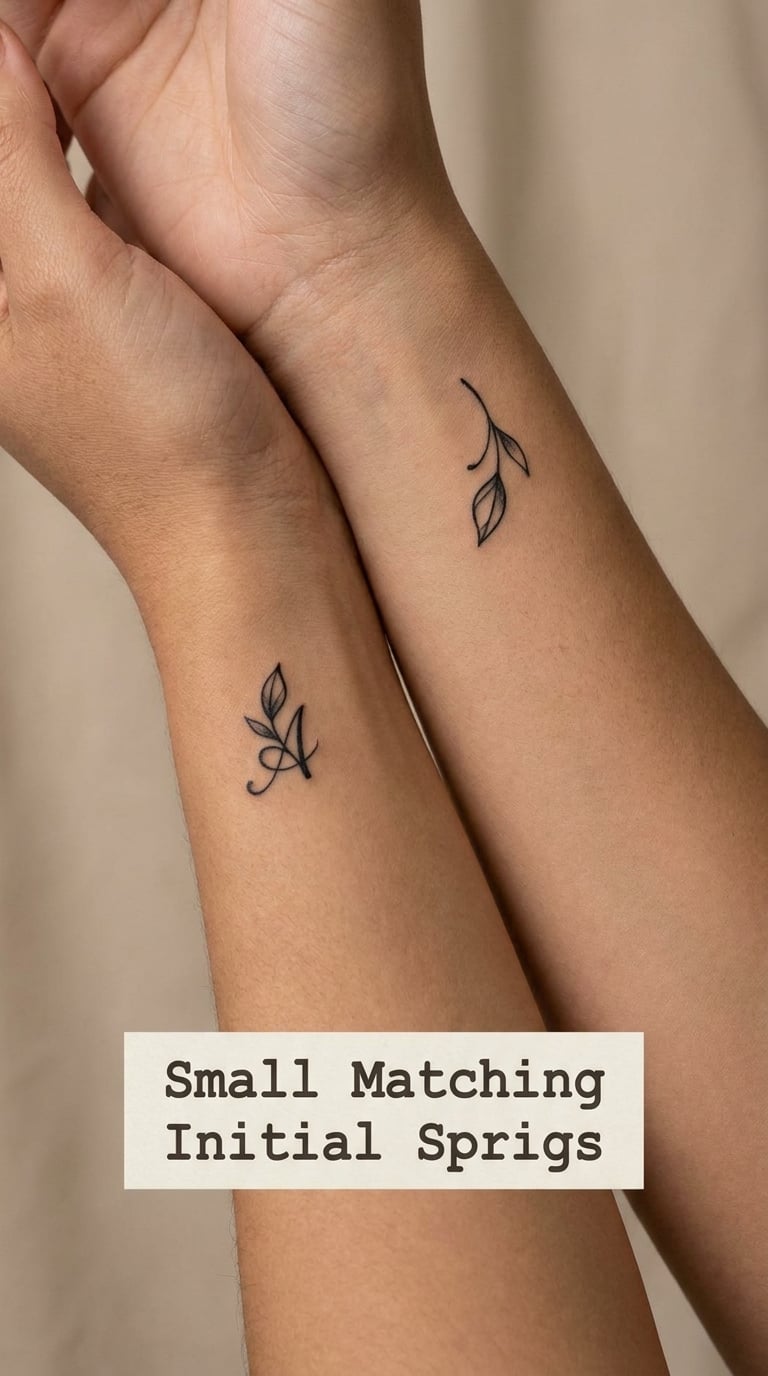
A single letter in a plain script or a clean serif, set beside one small leaf and a short stem. One letter and one leaf is the limit here, since a whole word in script at this size is the design that fades fastest.
The letter is usually a shared initial, a family surname or a first letter of a shared word, and the sprig keeps it from looking like a piece of monogram stationery.
Placement: wrist, inner arm, or behind the ear. Size: 1 to 1.5 inches (2.5 to 4 cm) tall. Style: script or serif letter with fine line botanical detail.
Pain: low to medium, and the wrist depends on the angle. Script letters need more line changes per square inch than any other design in this list, so a serif with flat terminals holds its shape considerably longer.
Make it yours: use the same letter on both and vary the leaf, or give one version a serif letter and the other the matching script so the pair is clearly two hands rather than one template.
How to Choose the Right Design
Pick the style before the motif
Decide between black-only, fine line with a single colour accent, and something with light shading before you fall for a drawing. Style is what decides whether the pair still reads in five years, and the motif is easy to change later in the appointment.
Match the size to the placement, not to the reference image
A design copied from a phone screen is usually drawn for a completely different scale, and that is where over-detailed small tattoos come from. Ask the artist to simplify rather than to shrink, and keep anything with more than about six interior lines above 0.8 inch (2 cm).
Decide how similar the two should be
True fifty-fifty matches look best on the same body part. If one of you is going on a wrist and the other on an ankle, complementary designs work better: the same motif, different line treatment, one with colour and one without.
Where small mother daughter matching tattoo ideas hide best
Inner wrists, ankles, behind the ear and the inner arm all sit under ordinary clothing, which matters if you work somewhere visible. The collarbone and the side of the finger show, so they suit a pair who wants the match noticed and talked about.
Book both appointments in one trip where you can
Two adjacent slots mean you go through the nerves together and the artist can copy the line weight directly from the first healed-looking example on the second piece of skin. Book conservatively if the first person has never been tattooed before, since first sessions run long.
Cost and Session Time
Prices for tattooing vary a lot by city, artist and shop, so treat any figure as a starting point for a conversation rather than a quote. The ranges below cover typical US pricing for small custom work as a general guide, written out so you can compare what your local shop tells you.
- Micro work, under half an inch, simple outline: roughly forty to one hundred dollars, and fifteen to thirty minutes in the chair.
- Small work, half an inch to one inch, one or two line details: roughly eighty to two hundred dollars, and twenty-five to sixty minutes.
- Slightly detailed work, over one inch, colour or dotwork: roughly one hundred fifty to three hundred fifty dollars, and forty-five minutes to ninety.
- Custom designs drawn from a reference you bring: many shops add a custom design fee on top, often in the region of fifty to a couple hundred dollars, and the tattoo quote stays separate from that.
Shop minimums are the thing that catches people out, because a small design is still billed at the shop minimum, which in many places is a couple hundred dollars. Hourly rates are common too, and those usually run from about one hundred fifty dollars an hour in less expensive areas to well over three hundred in major cities and for well-known artists.
My own rule is to ask for the total for both pieces in one message before travelling anywhere. It saves an awkward conversation at the counter, and it makes it obvious whether the shop is quoting per piece or per session.
Aftercare Basics
- Follow your artist’s aftercare instructions first. Every artist has their own method and the aftercare sheet they hand you beats anything written on a website, including this one.
- Wash the area gently with unscented soap and lukewarm water, then pat it dry with clean hands rather than rubbing it with a towel.
- Keep it covered with a clean, non-stick dressing for the first few days, and change it if it gets damp or lifts.
- Wear loose clothing over the tattoo while it heals, and avoid tight waistbands, straps and cuffs rubbing across the line.
- Leave scabs and flakes alone. Do not pick, soak, shave or scrub the area, and do not switch to a new product mid-heal without asking your artist.
- Wait until the skin has fully healed before covering a small wrist or finger tattoo with a long bracelet or a ring, since jewellery resting on a fresh line leaves a mark.
Frequently Asked Questions
Do mother and daughter matching tattoos have to be identical?
No, and the best pairs usually are not. Coordinated designs read as matching even when one tattoo has a different line weight, a different size or a small added detail. True fifty-fifty copies only look right when both land on the same body part, so if one of you is choosing a wrist and the other an ankle, go complementary instead. Pick the same motif and vary the treatment rather than the drawing.
Where should we get a small matching tattoo so it hides well?
Inner wrists, ankles, the inner arm and behind the ear all sit under everyday clothing, which makes them the easy choices for work and for family occasions. The collarbone and the side of the finger are visible placements that tend to start conversations. Avoid putting a tiny design on a hand or finger unless you are comfortable explaining it, because skin there rubs daily and needs touch-ups more often.
Do tiny fine-line tattoos fade quickly?
Small black work fades a little over time, and thin lines fade faster than heavier ones. Hands, fingers and inner wrists take the most wear, so designs there usually need a touch-up within a few years. Choosing a heavier line weight and fewer interior details when you are under half an inch makes a real difference. A design with two or three simple lines will hold up far better than a detailed drawing scaled down.
How small is too small for a matching tattoo?
Under a quarter inch there is very little room for an artist to work, and most designs turn into an unreadable smudge at that scale. Half an inch is a practical floor for an outline, and one inch gives you space for petals, plate lines or a small letter. If the reference you like is highly detailed, ask the artist to simplify it rather than to shrink it, and keep it above three quarters of an inch.
What does getting a matching tattoo hurt like?
Most small fine-line work feels like constant scratching rather than sharp pain, and the level depends far more on placement than on size. Wrists, fingers, ribs and collarbones are the tender spots, and the inner forearm is usually moderate. Ankles, upper arms and shoulders are among the easiest. Book both appointments together if one of you is nervous, since the second person usually relaxes once they have watched the first one finish.
How do we choose designs when we are different ages and styles?
Start with a motif both of you actually like rather than a design picked for one person, then let each person choose the placement and the scale. An abstract shape such as a crescent, a leaf or a bird works at almost any age, while script and handwriting suits adults better. If the daughter is young, an outline motif with no fine detail can be started small now and added to as she grows.
Conclusion
For a first tattoo, the four-petal flower outline or the single arrow is the safest starting point. Both are simple shapes an artist can draw cleanly at under half an inch, both hold their line, and neither carries a meaning you have to explain to anyone.
For someone building a small collection, the sun and moon, the leaf pair and the arrow work as a loose set, since each is distinct but clearly from the same family of black fine-line work. Add the mountain peaks later and the four sit together without looking like a copied set.
Whatever you choose, settle the design, the size, the placement and the artist before you book, and take a healed photo of any reference you like to the appointment. Small mother daughter matching tattoo ideas look best when both of you agree on what the drawing is before it goes on skin.