
20 Sun Moon and Rising Sign Tattoo Ideas (September 2026)
Sun moon and rising sign tattoo ideas come down to one design decision most people never think about: three marks, not one. Your sun sign is the version of you that walks into a room, your moon sign is the one that stays up at 2am, and your rising sign is the coat you put on before anyone sees you. Millions of people share a sun sign. Far fewer share the exact same three-part combination, which is why the big three tattoo keeps showing up in studios right now.
Below are twenty designs, from a fine-line glyph row on the inner forearm to a full traditional sun and moon across the chest. Each one lists the placement that suits it, a realistic size in inches, the style name your artist will recognise, and an honest note on pain and how it ages. If you have never been tattooed, start with something small in the middle of this list and let the first one teach your skin something boring before you commit to anything large.
Quick Guide: 20 Big Three Designs at a Glance
Scan this before you scroll. If a row already looks wrong to you, that is useful — it saves you a consult.
| Idea | Style | Best placement | Size | Pain |
|---|---|---|---|---|
| 1. Fine-line glyph row | Fine line | Inner forearm | 2.5-3.5 inch wide | Low to medium |
| 2. Sun centred, moon and rising flanking | Fine line | Collarbone | 3-4 inch wide | Medium |
| 3. Vertical column of three | Minimalist | Spine | 1-1.5 inch wide, 6-9 inch tall | Medium to high |
| 4. Micro-reality sun, phases, ascendant | Micro-realism | Upper arm | 3-4 inch | Medium |
| 5. Cybersigilism glyph stack | Cybersigilism | Outer arm | 2-3 inch tall | Medium |
| 6. Blackwork sun and moon yin-yang | Blackwork | Calf or thigh | 4-6 inch | Medium |
| 7. Watercolour sun and moon | Watercolour | Shoulder | 3-4 inch | Medium |
| 8. Dotwork constellation trio | Dotwork | Upper back | 4-5 inch | Medium to high |
| 9. Neo-traditional sun, moon and animals | Neo-traditional | Thigh | 5-7 inch | Medium to high |
| 10. One-line continuous stroke | One line | Behind the ear | 1.5-2 inch | Low |
| 11. Moon phase arc with rising glyph | Fine line | Ribcage | 3-4 inch wide | High |
| 12. Elemental triptych | Illustrative | Calf | 3-4 inch | Medium |
| 13. Finger stack across three fingers | Micro fine line | Fingers | 0.5-0.75 inch each | High |
| 14. Matching couple interlock | Fine line | Inner wrist | 2-2.5 inch | Low to medium |
| 15. Natal chart wheel, three glyphs lit | Illustrative | Forearm or back | 4-6 inch | Medium |
| 16. Traditional American sun and moon | Traditional | Upper chest | 6-8 inch | High |
| 17. Negative space horizon | Blackwork | Wrist | 2-3 inch | Medium |
| 18. Wave line along the ribs | Fine line | Ribs | 4-5 inch | High |
| 19. Botanical celestial trio | Botanical | Ankle | 2.5-3.5 inch | Medium |
| 20. Ascending trio up the arm | Fine line | Outer arm | 4-5 inch tall | Low to medium |
1. Fine-Line Glyph Row on the Inner Forearm
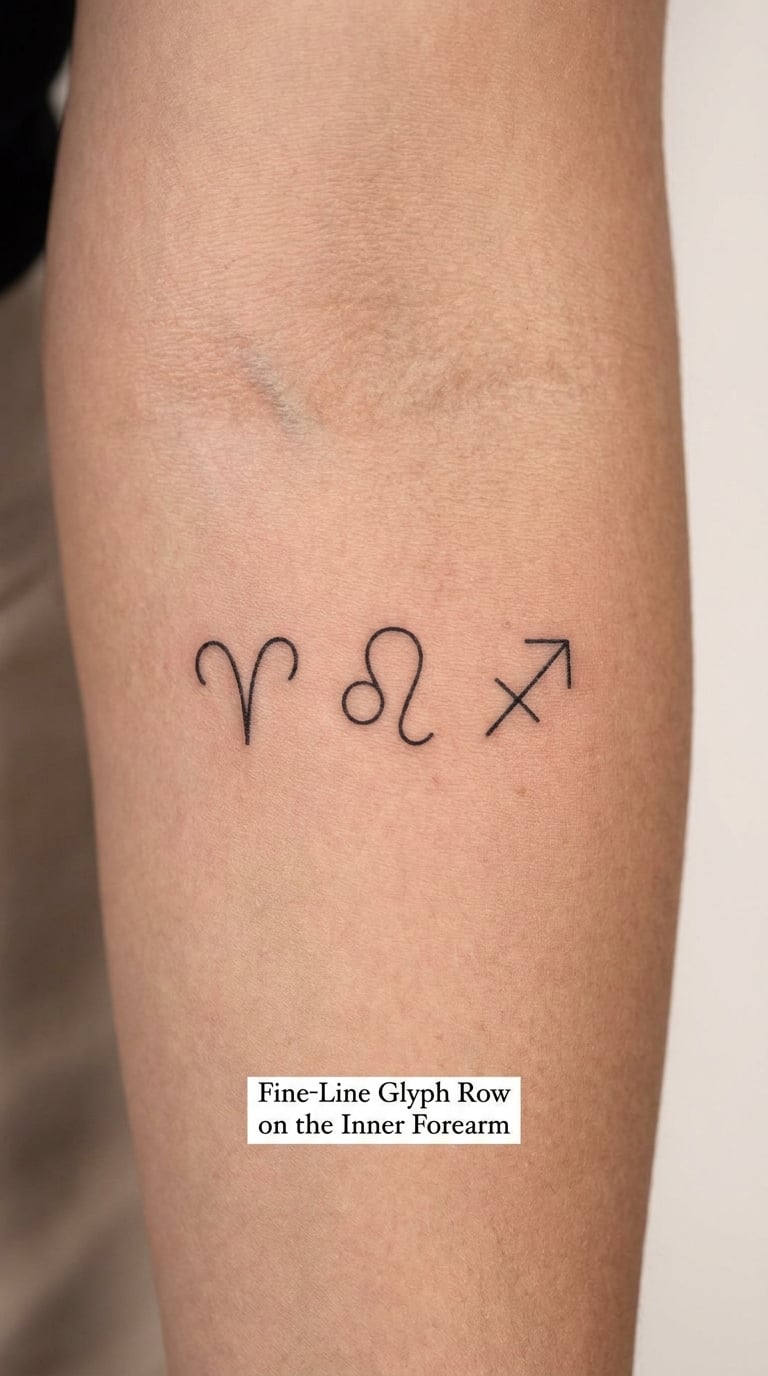
Three glyphs in a straight horizontal row, evenly spaced, each the same height. Nothing else — no stars, no arrows, no banner. This is the cleanest way to read all three placements at a glance, and the row format is the one tattooers sketch most often because it fits almost any limb.
It works as a quiet record of you: identity, feeling, and the face you wear. Nobody will clock what it means unless they ask, which is exactly why a lot of people pick it.
Placement: inner forearm, parallel to the wrist crease, or on the outer arm just above the elbow. Size: 2.5 to 3.5 inch wide overall, each glyph roughly 0.6 inch tall. Style: fine line, single-needle weight.
Pain: low to medium on the inner forearm, and quick. The honest catch: fine line on the hands and inner arm fades fastest, so ask for a slightly heavier weight than feels necessary. Make it yours: engrave your actual Sun, Moon and Rising degrees as microtext beneath the row.
2. Sun Centred With Moon and Rising Flanking
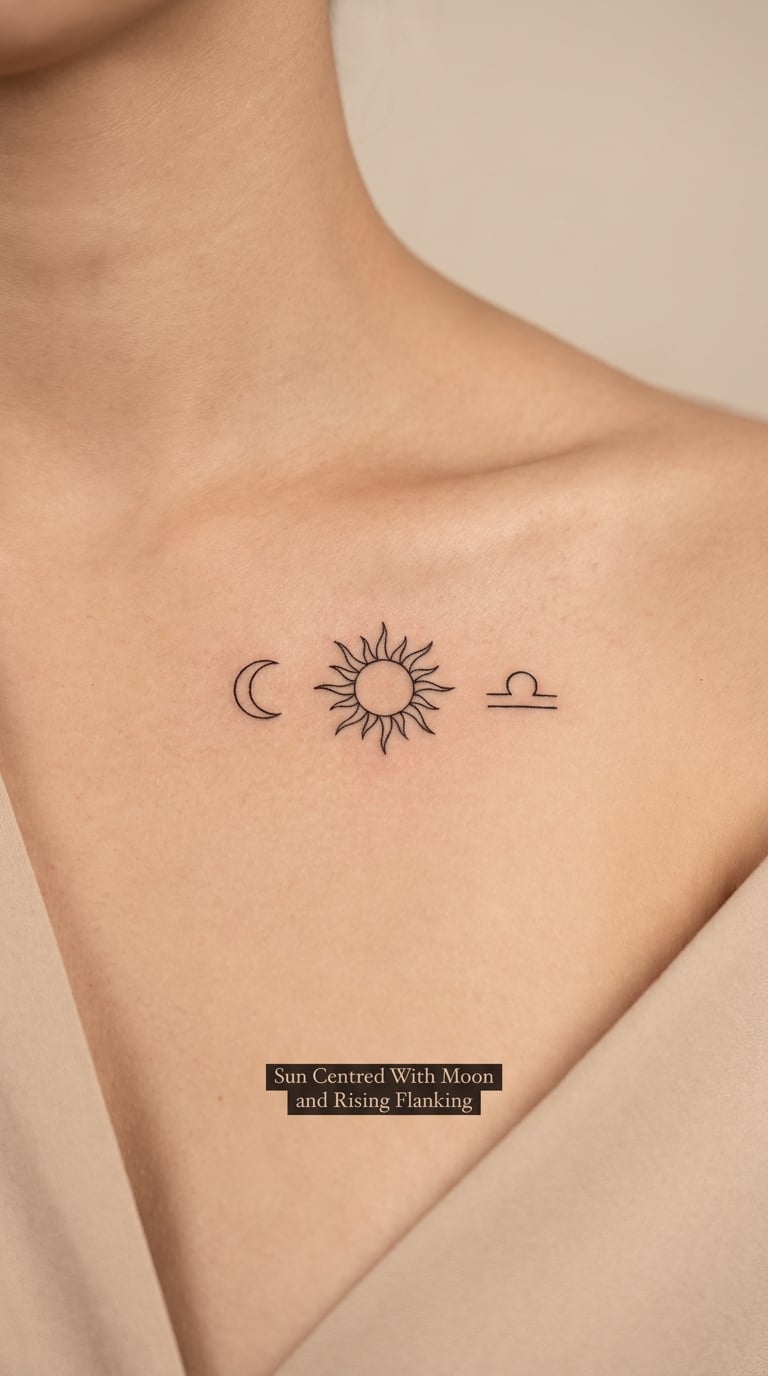
The sun glyph takes the middle position and sits slightly larger than the other two, with your moon glyph on one side and your rising glyph on the other. The size difference is the whole trick — it stops the three marks reading as an equal row and gives the composition a centre of gravity.
It says your sun sign is the loud one and the other two are supporting players. People like it because the hierarchy is visible without a word.
Placement: centred along one collarbone, or across the upper chest just under the sternum. Size: 3 to 4 inch wide, sun glyph about 1.2 inch. Style: fine line with a few radiating hairline strokes on the sun only.
Pain: medium — collarbone and sternum are bony and the skin is thin. Fine line here softens over time where the bone sits close to the surface, so heavier line weight again. Make it yours: tint the sun with a single warm wash and leave the other two pure black.
3. Vertical Column of Three Down the Spine
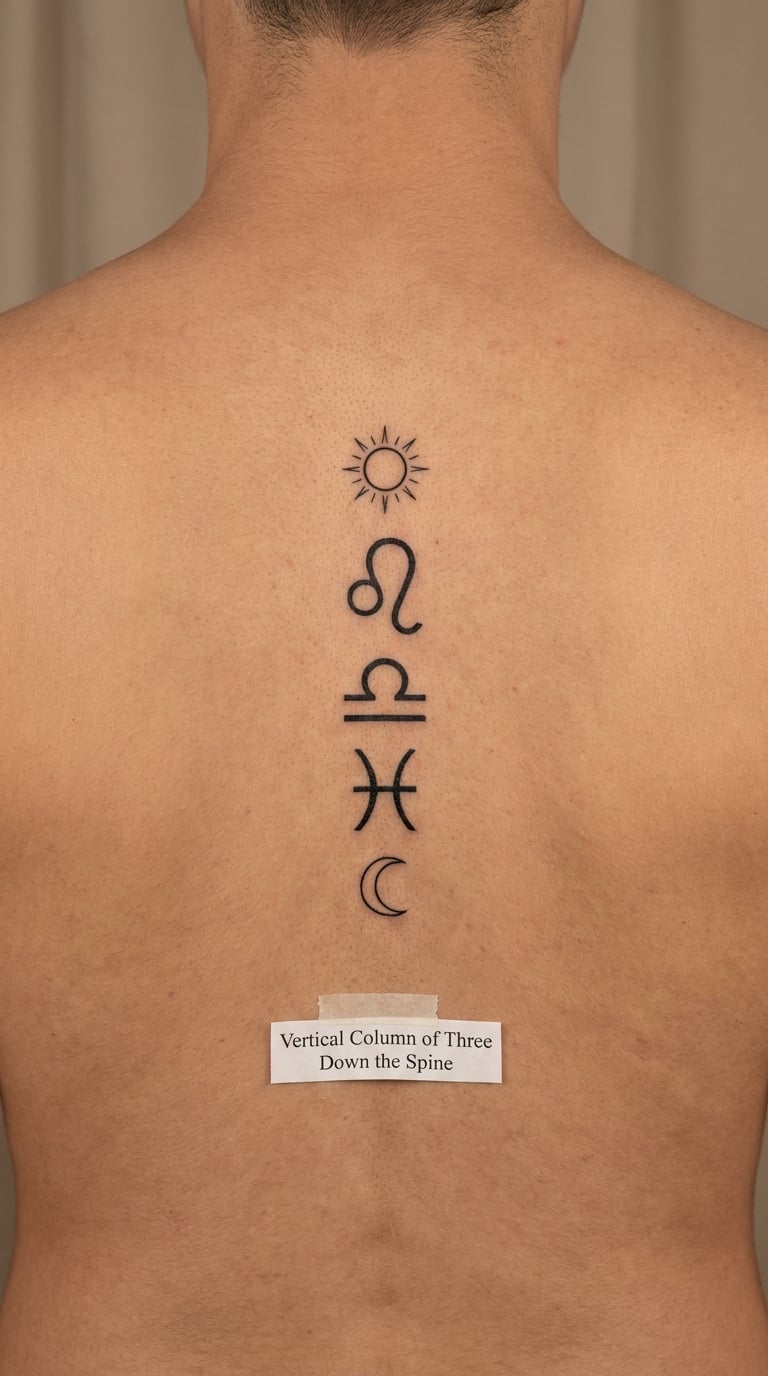
A narrow vertical stack: sun glyph at the top, moon glyph in the middle, rising glyph at the base. The spine gives you a natural centre line, so the three marks align without much planning. People describe this one as a spine of their own life, and the reading is yours to set.
It is also the easiest big three to extend later. One friend started with the sun and moon stacked and added the rising sign underneath two years after confirming her birth time.
Placement: centre of the upper to mid back, or one forearm if you want it visible. Size: 1 to 1.5 inch wide, 6 to 9 inch tall including spacing. Style: minimalist linework, no shading.
Pain: medium to high on the back — long session, and you will feel the sun spot on the shoulder blades. Make it yours: space the glyphs to the degrees they hold in your chart, widest gap where the energy is most active.
4. Micro-Reality Sun, Moon Phases and Ascendant
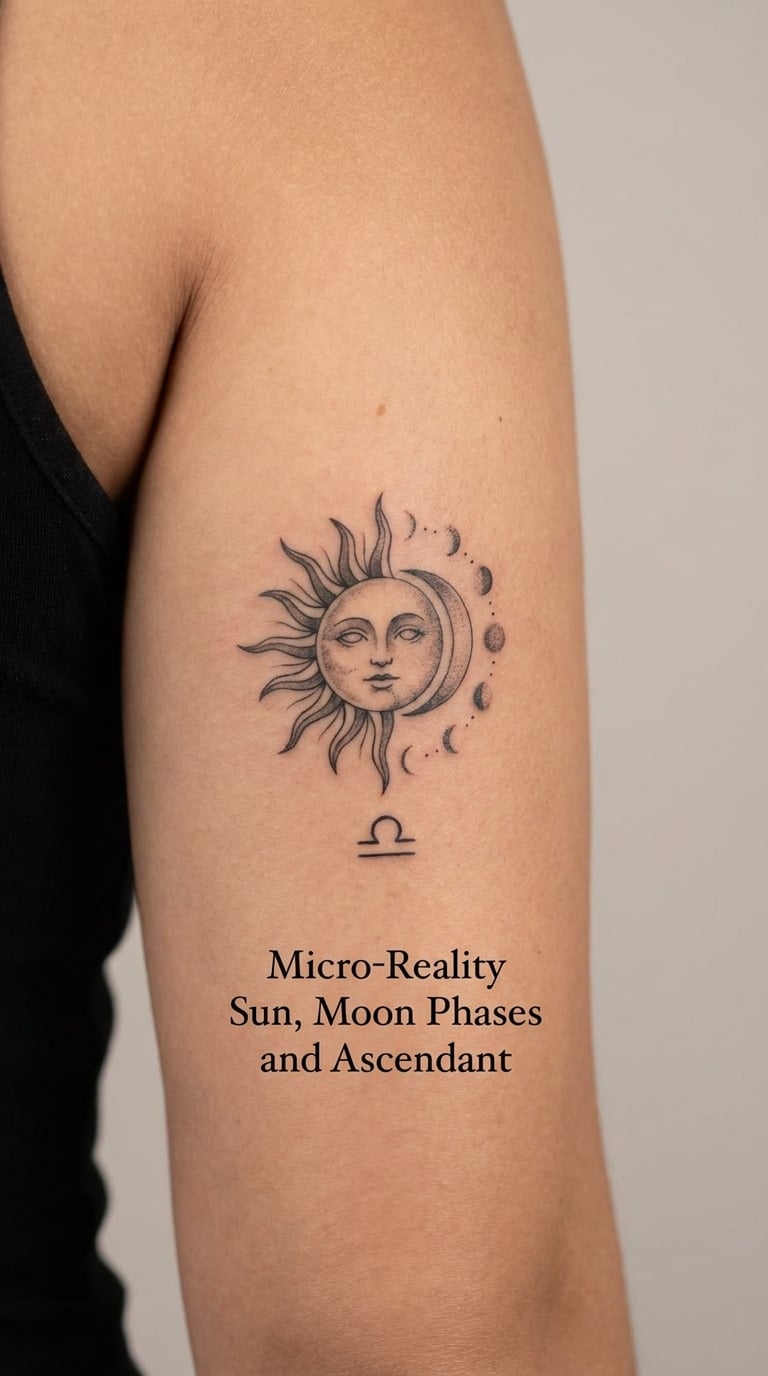
A photoreal sun with a face, a small arc of moon phases, and one crisp glyph for the ascendant, all rendered in grey wash rather than hard black line. This is the most illustrative of the twenty, so it suits anyone who wants the big three to look like a small painting rather than a diagram.
The reason to mix textures is hierarchy. Realism for the sun and moon, flat glyph for the rising, says the outer persona is the one that stayed simple.
Placement: outer upper arm, or the flat of the calf. Size: 3 to 4 inch across the group. Style: micro-realism with light wash shading.
Pain: medium, and a longer sitting because shading takes passes. Small grey-wash detail on the arm is the first thing to soften over a decade. Make it yours: add a single detail from your Sun sign’s ruling planet — a ring for Saturn, a key for Mercury.
5. Cybersigilism Glyph Stack
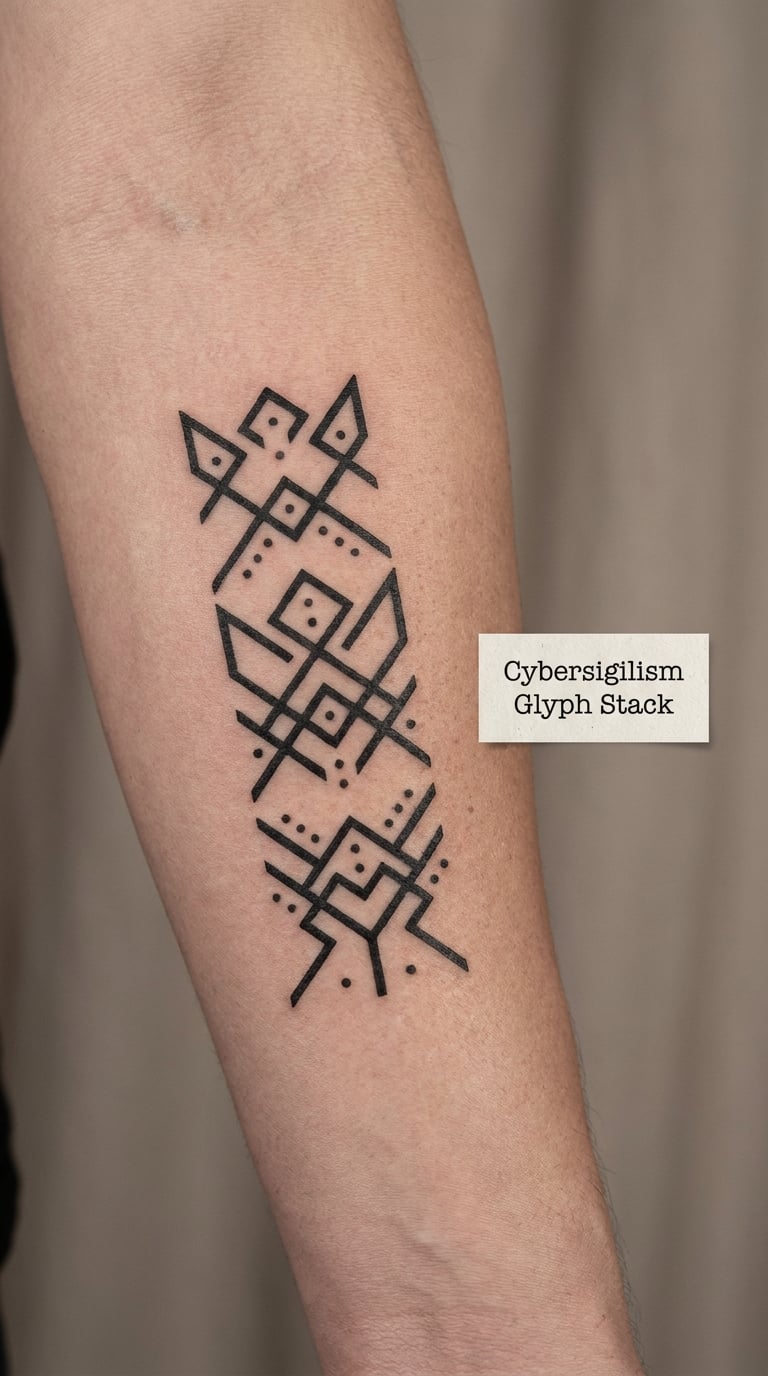
Three angular, machine-like sigils stacked in a column, each built from straight segments, notches and circuit traces. Cybersigilism is the most current-looking style on this list, and it works because the three shapes are distinct from each other at thumbnail size.
Read it as a code rather than a diagram: three systems running at once. Fans of the style care more about the form than the literal symbols.
Placement: outer forearm, running from just under the elbow toward the wrist. Size: 2 to 3 inch tall overall. Style: cybersigilism, geometric black line.
Pain: medium, constant low sting that builds across the piece. Make it yours: have the artist set the three sigils to a shared grid so the column reads as one circuit, and keep the dot accents off sun-exposed skin.
6. Blackwork Sun and Moon Yin-Yang With Rising Glyph
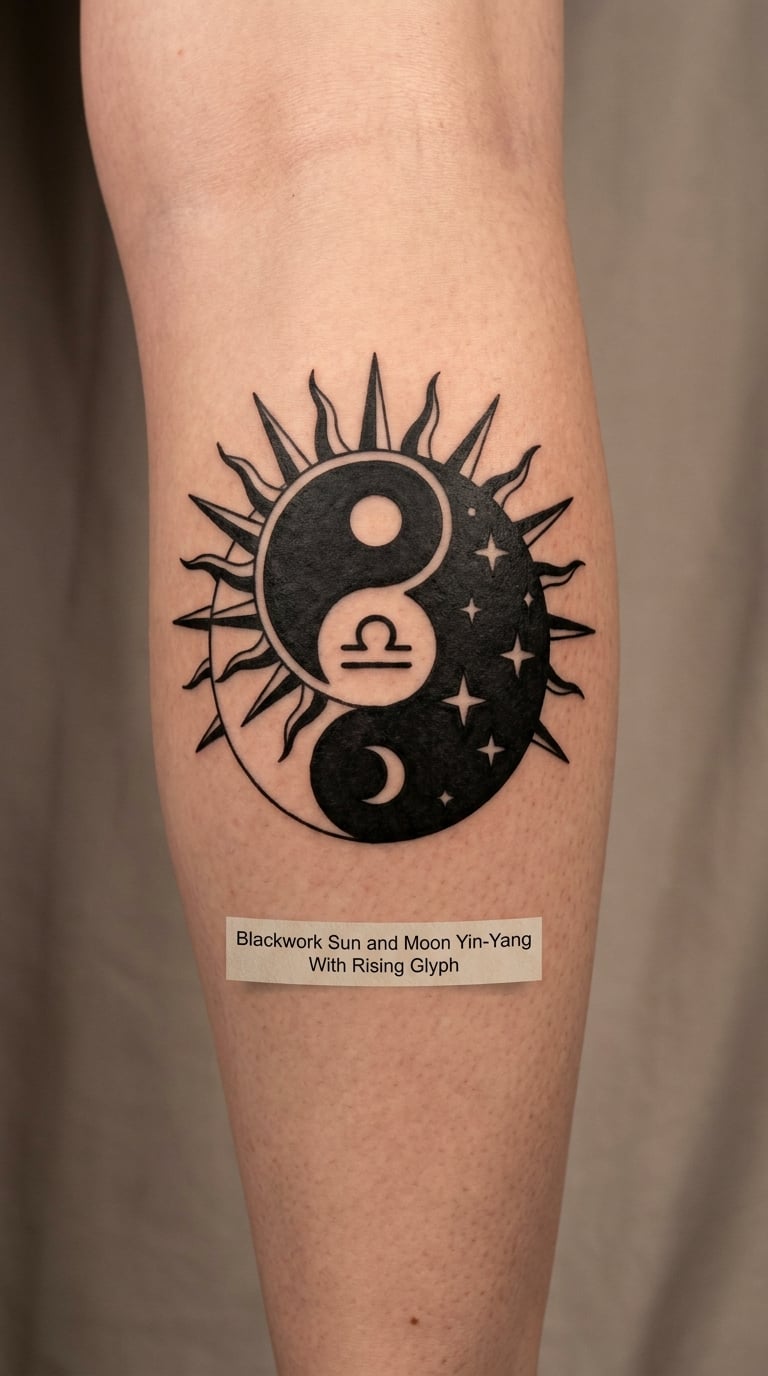
A solid black circle divided into a sun half and a moon half, with your rising glyph sitting in the middle where the two teardrop shapes meet. The black is dense — this is a blackwork piece, not a fine-line one, and it is the strongest contrast in the gallery.
It pairs the two placements most people think about as a couple, then adds the third as the quiet core. The interpretation is a little off the usual, which is a relief for people tired of the stock reading.
Placement: outer calf, or the thigh for more room. Size: 4 to 6 inch diameter. Style: blackwork with solid fill and a clean negative-space centre.
Pain: medium on the calf, one long pass for the fill. Solid black ages better than hairlines but can gain a faint sheen in the centre. Make it yours: have the sun half carry your Sun sign’s element colour in a thin inner ring only, keeping the outer circle pure black.
7. Watercolour Sun and Moon on the Shoulder
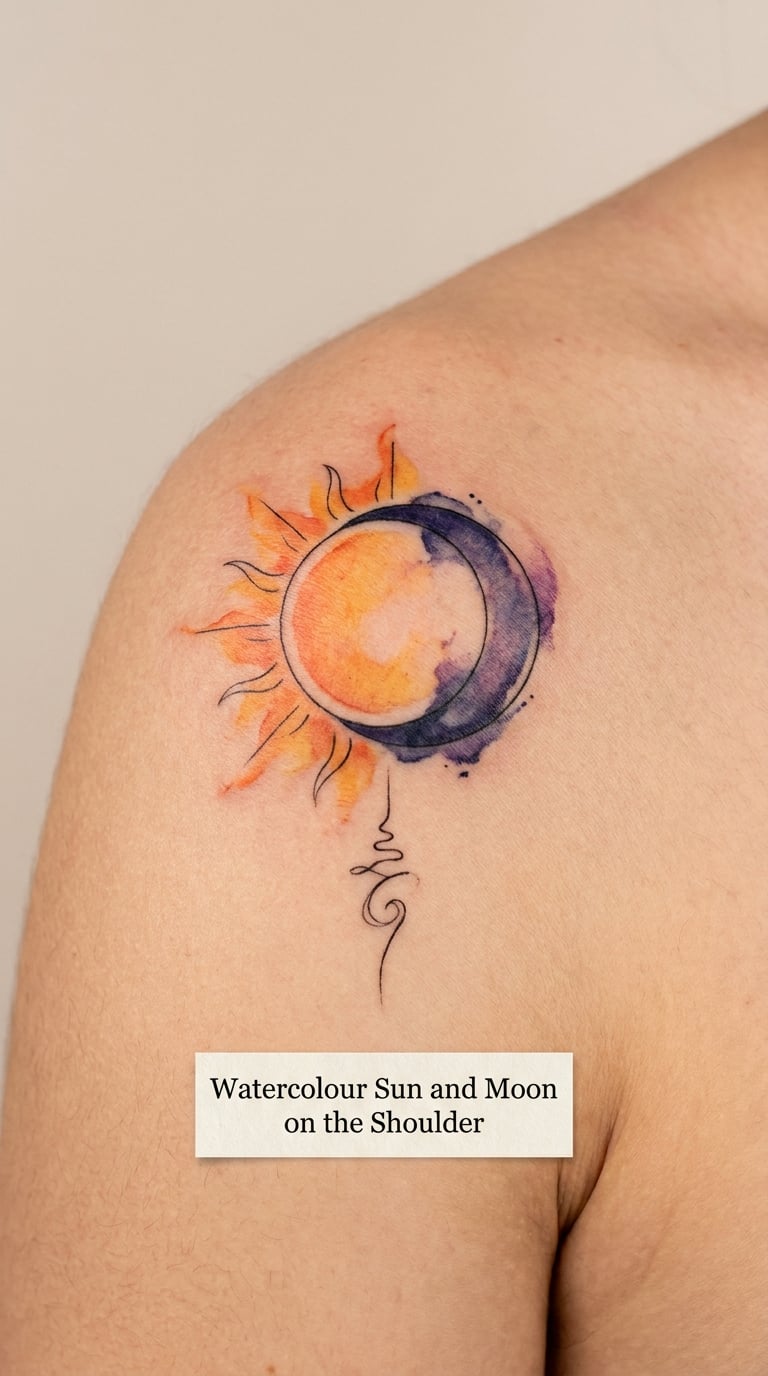
Warm orange and deep indigo bleeding past the linework, with a crescent moon overlapping the sun’s edge. A fine-line rising glyph sits underneath as a quiet anchor to hold the colour down. Watercolour celestial work photographs beautifully and hides small irregularities better than hard black.
Most people choosing it are after the colour memory rather than a diagram, so the sun and moon carry the meaning and the glyph keeps it honest.
Placement: shoulder cap or the top of the upper arm. Size: 3 to 4 inch. Style: watercolour with a fine-line glyph layer.
Pain: medium. Worth asking about sun exposure: colour on a shoulder that sees daylight year-round fades toward the yellows first, and touch-ups of pale washes are fiddly. Make it yours: add one genuine birth detail in the wash — a date, a birthplace, in a colour that matches your sun sign’s element.
8. Dotwork Constellation Trio
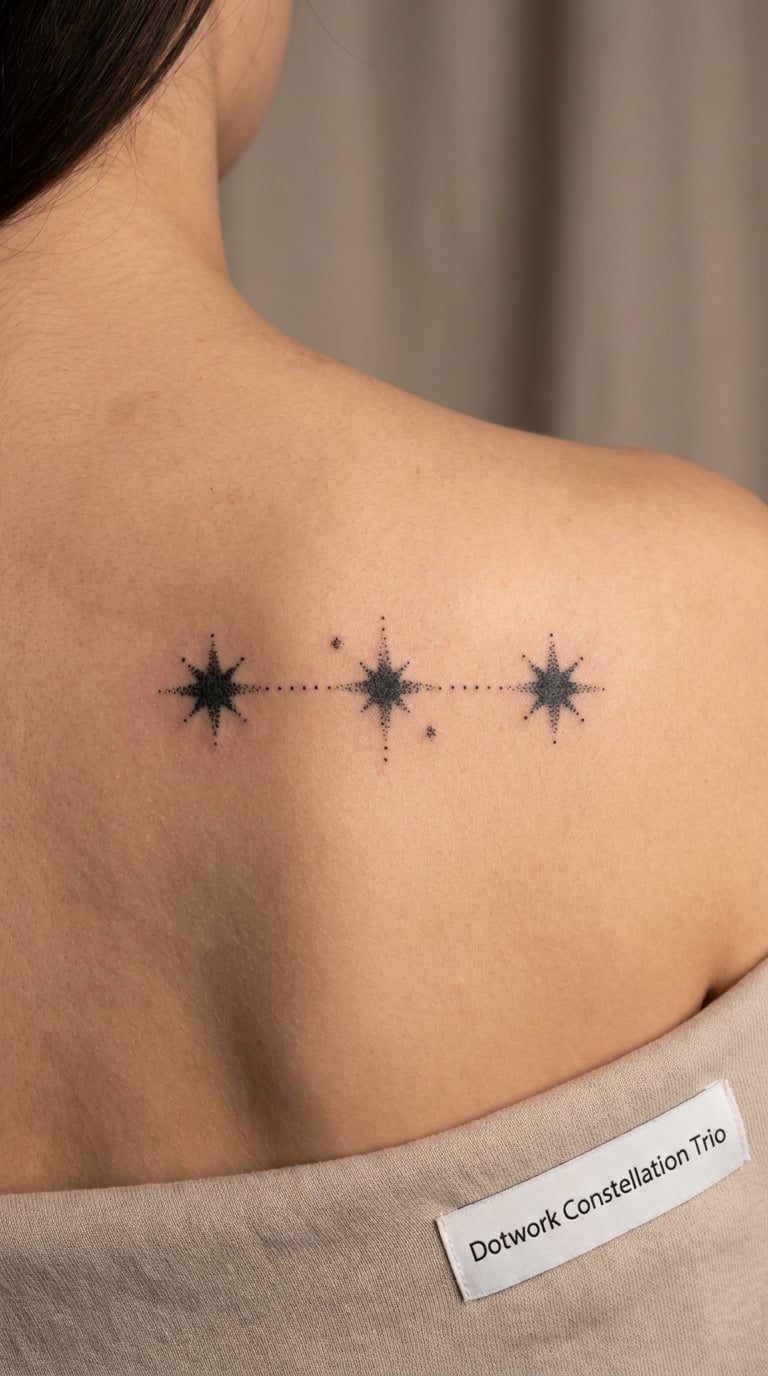
Three small star clusters rendered in dotwork, spaced in a row, each one the constellation tied to one of your three signs. Dotwork is dense and slow, and the tonal weight fills space in a way linework cannot, so three clusters read as one composition instead of three stickers.
It is the least literal option here. No one can identify your placements from it, which makes it the quietest big three tattoo in the gallery.
Placement: upper back between the shoulder blades, or the chest. Size: 4 to 5 inch wide with 1 inch of space between clusters. Style: dotwork, black only.
Pain: medium to high, and a long session — stippling is repetitive. A session break halfway through is common and fine. Make it yours: vary the dot size so your sun sign cluster is darkest, moon mid, rising lightest.
9. Neo-Traditional Sun, Moon and Ruling Animals
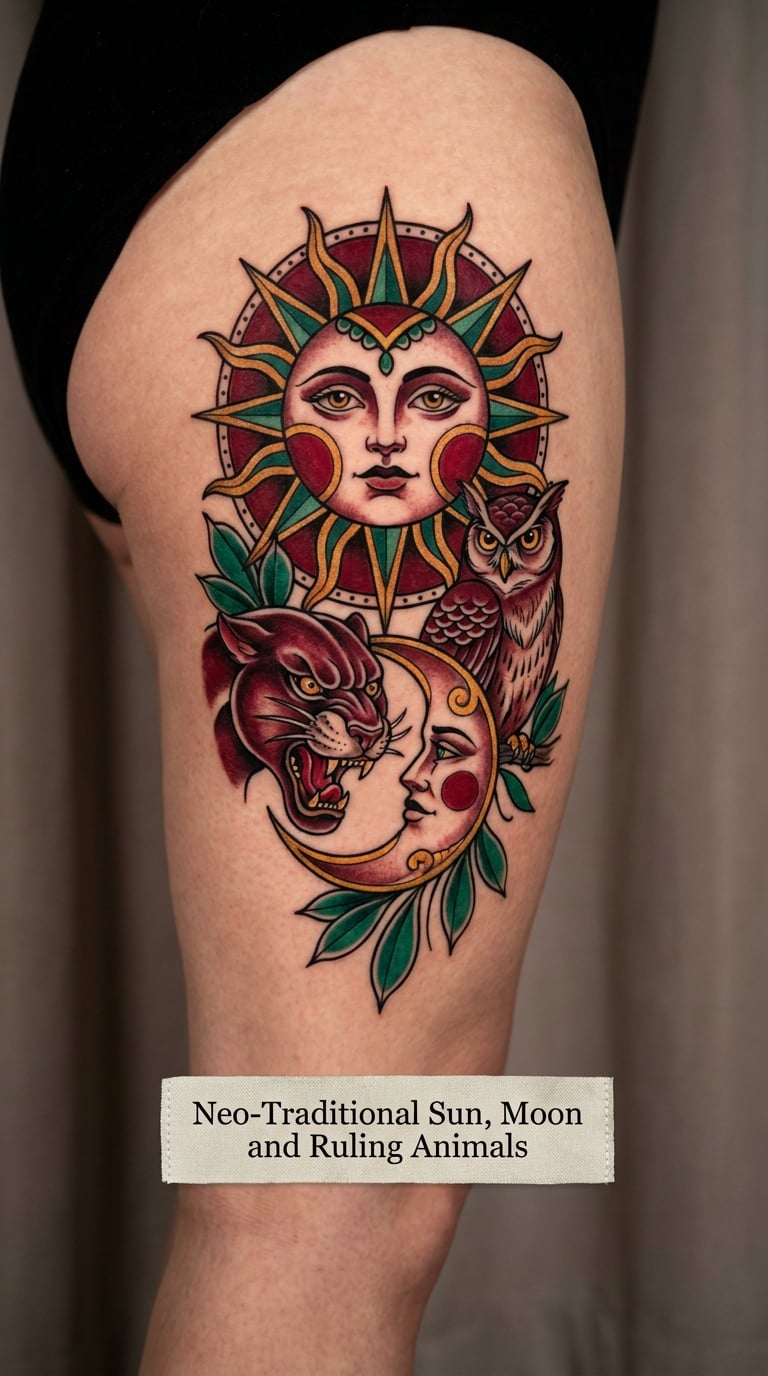
A stylised sun face with rays, a crescent moon, and the animals ruled by your Sun and Moon signs — a lion for Leo, a crab for Cancer, a bear for Libra, whatever your chart gives you — in saturated colour with heavy black outlines. This is a big piece and it rewards patience.
It reads as heraldry more than chart. You are wearing your own ruling creatures rather than your birth date, which feels older and less trend-bound.
Placement: outer thigh or upper back. Size: 5 to 7 inch. Style: neo-traditional, bold outlines, limited colour palette.
Pain: medium to high over a long sitting, and it may need two sessions. Make it yours: fix a three-colour palette from your three elements and refuse anything outside it — that constraint is what makes it look designed rather than decorated.
10. One-Line Continuous Stroke Behind the Ear
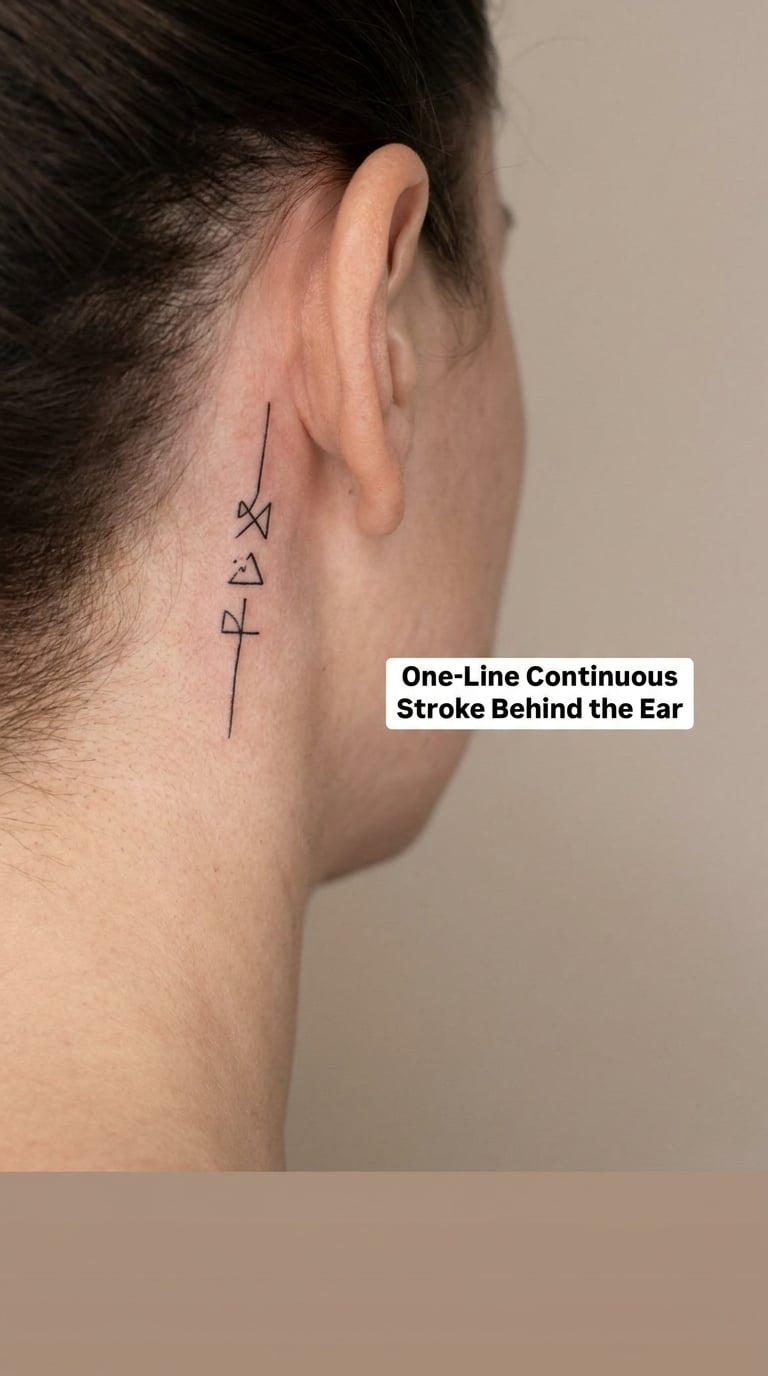
One unbroken line that becomes three tiny abstract glyph shapes without lifting the needle. Behind the ear, small enough to be nearly private. It is the least literal idea here and the easiest to keep quiet about.
People choose it because the location is emotional, not decorative. Tucked where hair covers it, the sun moon and rising sign tattoo becomes something only you see.
Placement: behind the ear, following the hairline. Size: 1.5 to 2 inch. Style: one line, single-needle.
Pain: low, and quick. This is the fastest-healing spot on the body. Behind the ear does fade fastest of all, so plan for a refresh in five or six years. Make it yours: add a fourth tiny loop that only you can read as an initial.
11. Moon Phase Arc With Rising Glyph Underneath
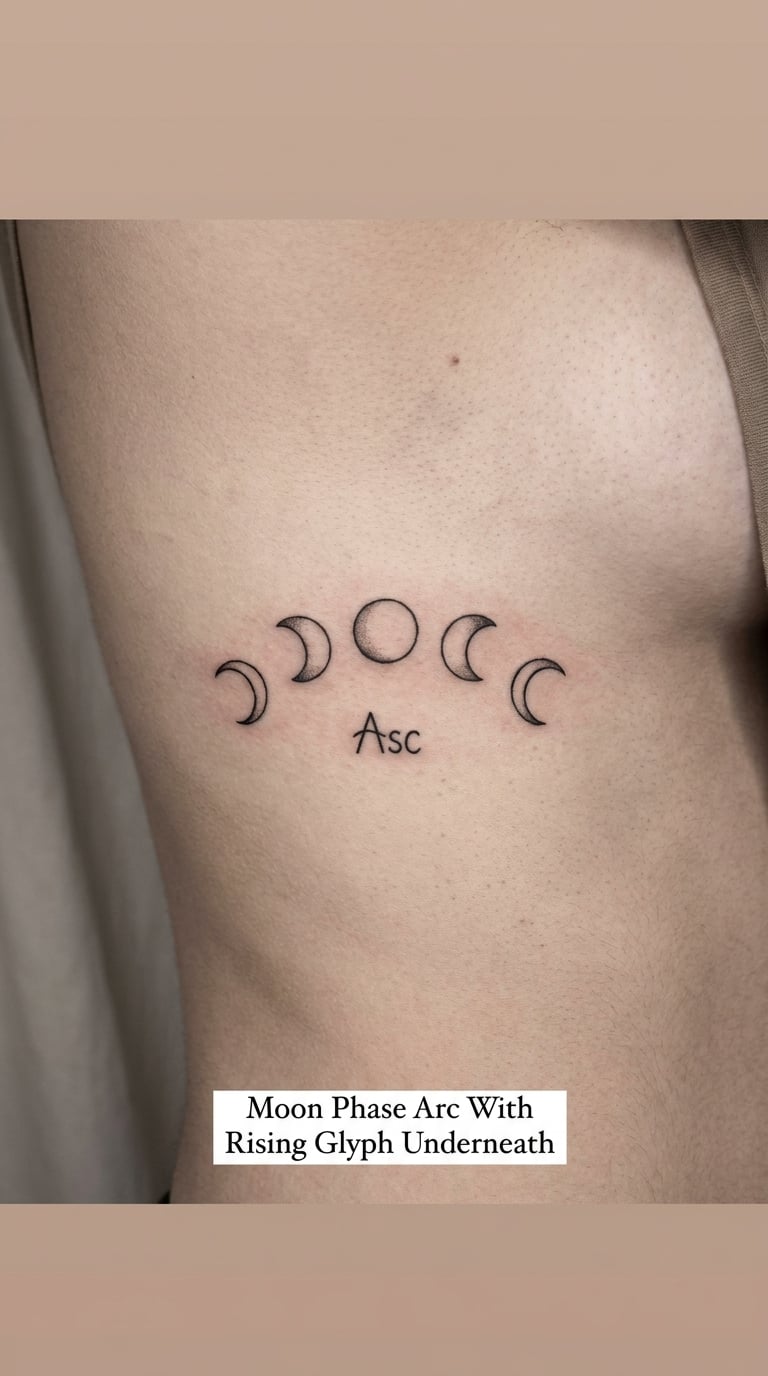
A curved arc of five moon phases running along the line of the ribs, with your rising sign glyph centred below the arc. The moon gets the space; the sun and rising share a small mark near the arc’s midpoint. It looks like a piece of jewellery drawn on you.
The phases track emotional cycles, so people pair this with their moon sign deliberately even though all twelve phases appear.
Placement: along the ribs on one side, curving with them. Size: 3 to 4 inch wide. Style: fine line, hairline arcs with one solid crescent for contrast.
Pain: high — rib skin is thin and the bone is close underneath, and the session is awkward to sit through. Expect a break. Make it yours: place your Moon sign glyph at the exact phase matching your Moon sign’s angle, rather than at the centre.
12. Elemental Triptych on the Calf
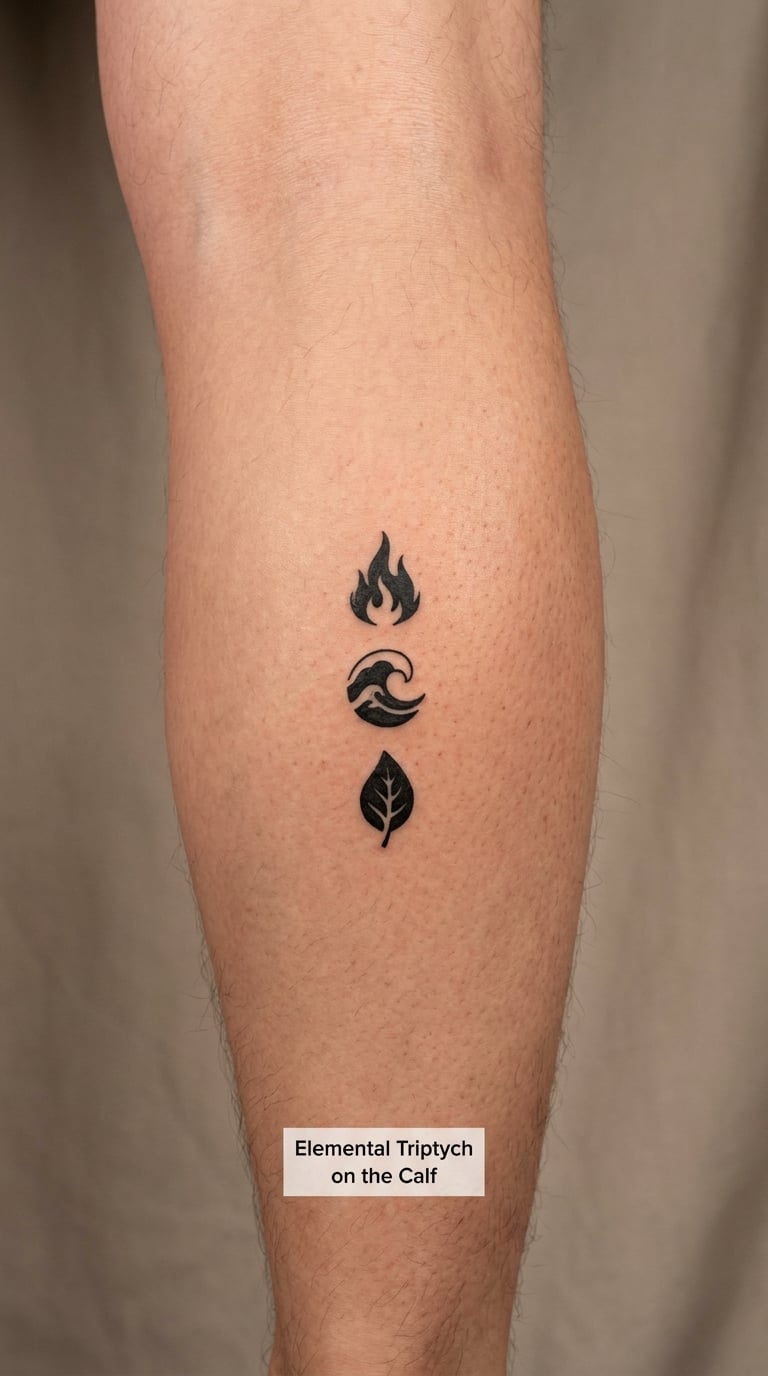
Three small element marks — a flame, a wave, a leaf, a wind swirl — one per placement, in a clean row on the calf. You lose the individual signs and keep the elements, which is the most abstracted big three tattoo that still means something.
Element-only is popular with people who want the meaning but not the flash. Nobody can read your chart from it, and that is usually the point.
Placement: outer calf. Size: 3 to 4 inch. Style: illustrative, solid black, minimal shading.
Pain: medium, and the calf holds ink well. The calf muscle tightens if you flex during the session — mention it early so the artist can time lines around it. Make it yours: order them by element weight in your chart, so the dominant element sits in the middle and gets the largest mark.
13. Finger Stack Across Three Fingers
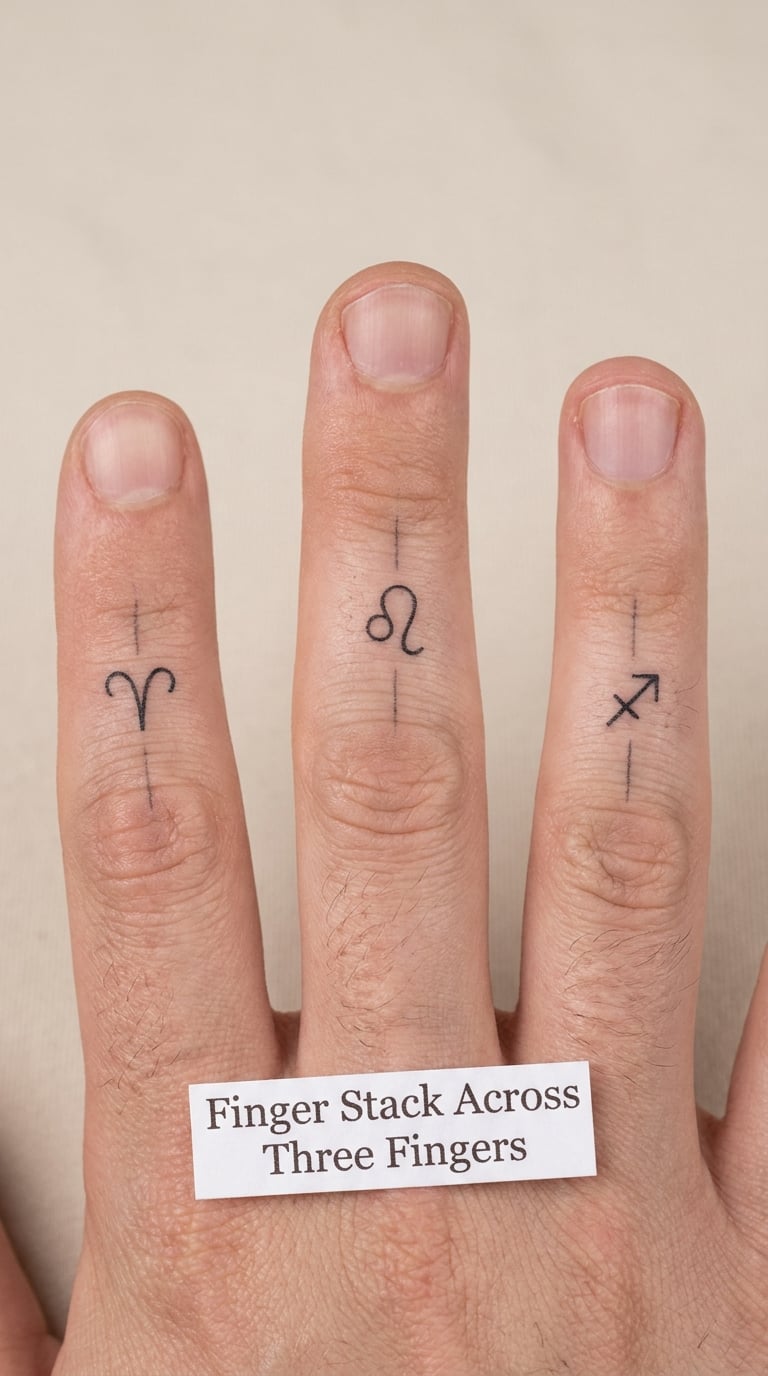
One small glyph on each of three fingers, running down the side of the finger in a thin line. A sun on one, moon on another, rising on the third. Fingers hide a lot, so this reads as a secret to most people and a full statement to whoever holds your hand.
It is popular with people who want the big three close to the body rather than worn on display.
Placement: the outer side of three fingers, one glyph each. Size: 0.5 to 0.75 inch per finger. Style: micro fine line.
Pain: high — the finger bones sit right under the skin and the sensation is sharp. This is the most frequently abandoned idea on the list. Fine line on fingers blurs fastest of anywhere. Make it yours: add a hairline band on the thumb in the same weight so the set reads as a group.
14. Matching Couple Big Three Interlock
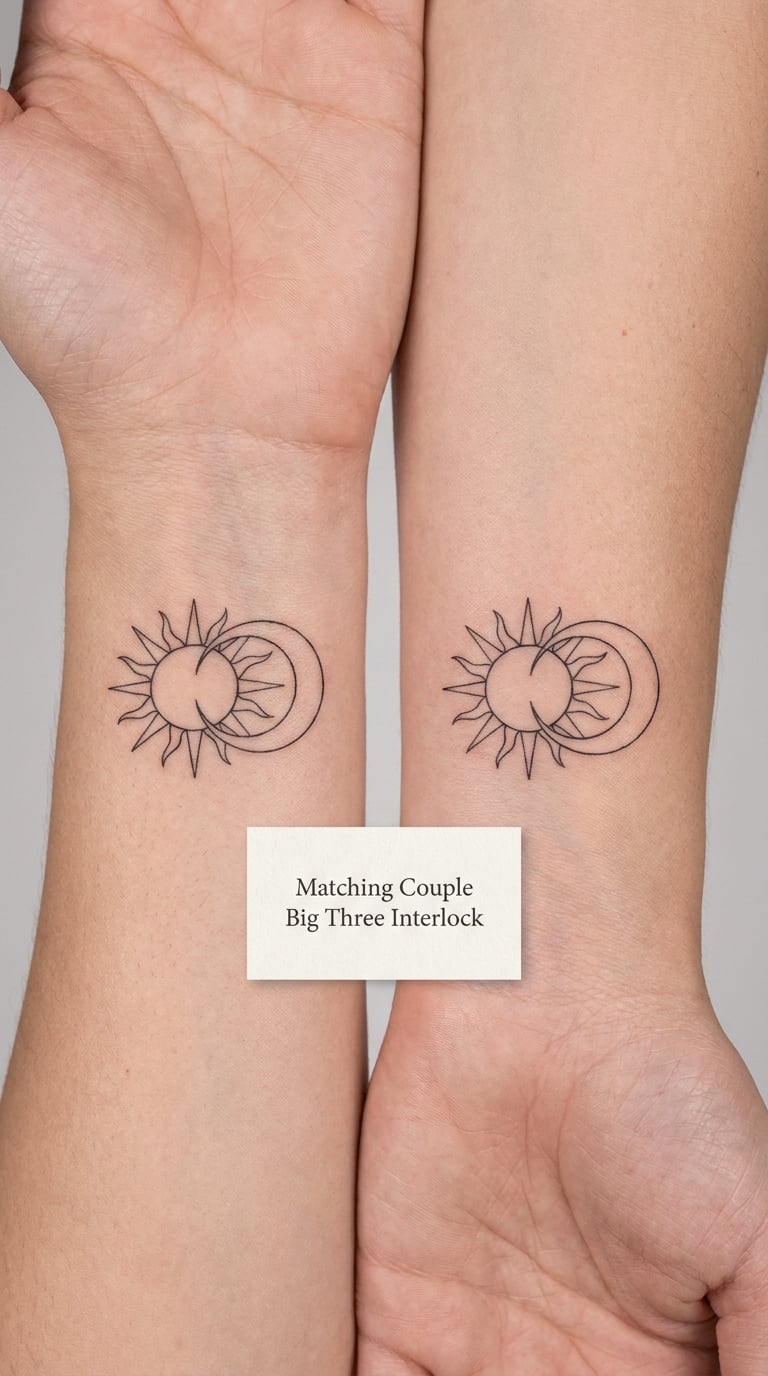
Two interlocking circular designs, one on each partner’s inner wrist. Each circle holds your own sun and moon; the two circles overlap on paper so the rising glyph of one sits beside the rising glyph of the other. Matching in structure, different in content.
Most couples who do this use element pairings to decide the shared shape: fire and air get sharp geometry, water and earth get curves. It is a way of connecting the designs without either person wearing the other’s signs.
Placement: inner wrist, both arms. Size: 2 to 2.5 inch diameter each. Style: fine line geometric.
Pain: low to medium; inner wrists bleed a little more, so a slower pass helps. Wrist fine line is exposed to sun and washing, and fades noticeably within a few years. Make it yours: put the day you met in the gap where the two circles cross.
15. Natal Chart Wheel With Three Glyphs Highlighted
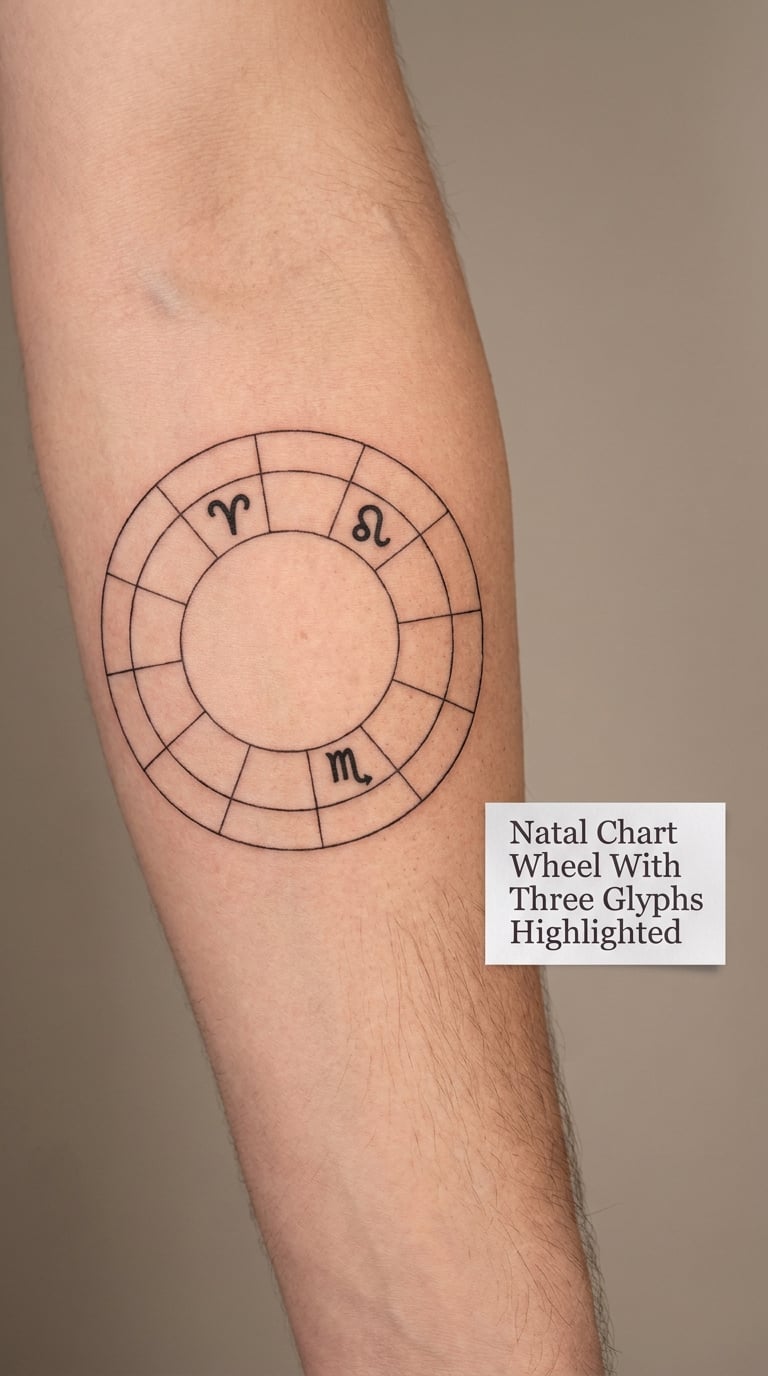
A small circular chart wheel with twelve houses, most of them left as empty line segments, and exactly three glyphs filled in solid black: your Sun, Moon and Rising. It looks like a page from a book you both understand.
This is the version for people who track transits and want the whole diagram on skin, not just the summary. It answers the question of where in the chart each placement sits.
Placement: inner forearm or the back of the calf. Size: 4 to 6 inch diameter. Style: illustrative fine line with solid fill accents.
Pain: medium; most of the work is a circle and a handful of spokes. A chart with real house lines needs line weight above 0.35mm or the inner divisions disappear. Make it yours: have the artist write your actual degrees on the three highlighted spokes in microtext.
16. Traditional American Sun and Moon Across the Upper Chest
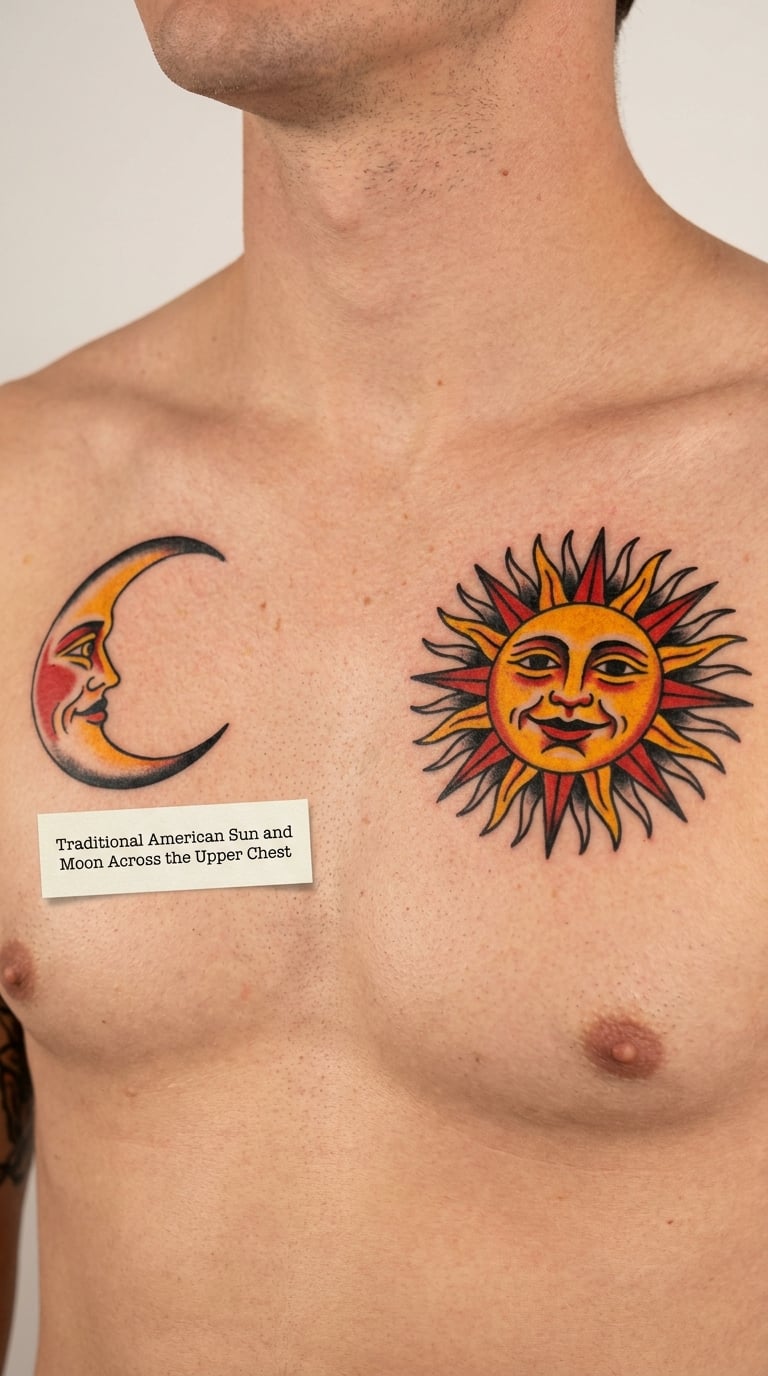
A smiling sun on one pectoral and a crescent moon face on the other, with your rising sign in a small banner or scroll across the sternum. Traditional American chest pieces go back a century, and the bold fills and thick outlines are designed to still read at fifty.
It is the loudest idea on this list and the one that hides a tattoo-aging problem entirely, because heavy black and saturated colour hold up far better than hairlines.
Placement: upper chest, centred on the sternum. Size: 6 to 8 inch across. Style: traditional, heavy outline, bold colour.
Pain: high — the sternum and collarbone are the two most sensitive areas in this article, and a piece this size needs breaks. Make it yours: keep the banner wording to two or three words; small lettering inside bold traditional work is where quality drops.
17. Negative Space Horizon on the Wrist
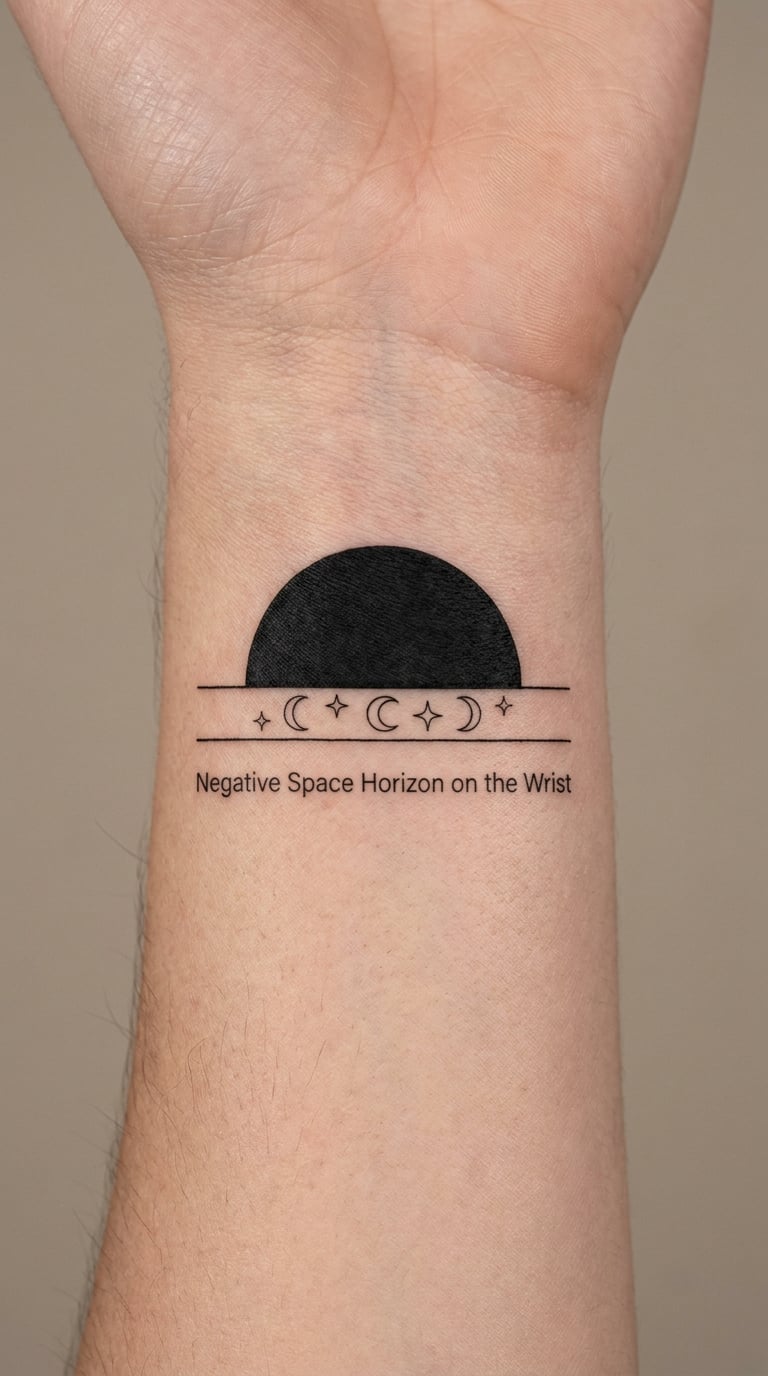
A solid black half circle sitting above a horizon line, with the sun, moon and rising glyphs cut out of the black as negative space. The shapes are defined by absence rather than ink, so the design reads as one bold shape with three small voids in it.
Negative space ages better than line work because there is less to fade. It is the answer for anyone who wants a bold wrist piece that will not need rewriting in ten years.
Placement: inner or outer wrist. Size: 2 to 3 inch. Style: blackwork, negative space, no linework.
Pain: medium on the inner wrist, quicker on the outer. The cut-out glyphs need a small stencil so they stay open rather than flooding with black. Make it yours: change which glyph sits highest in the sky — sun at the peak, rising at the horizon, moon below it.
18. Wave Line With Three Glyphs Along the Ribs
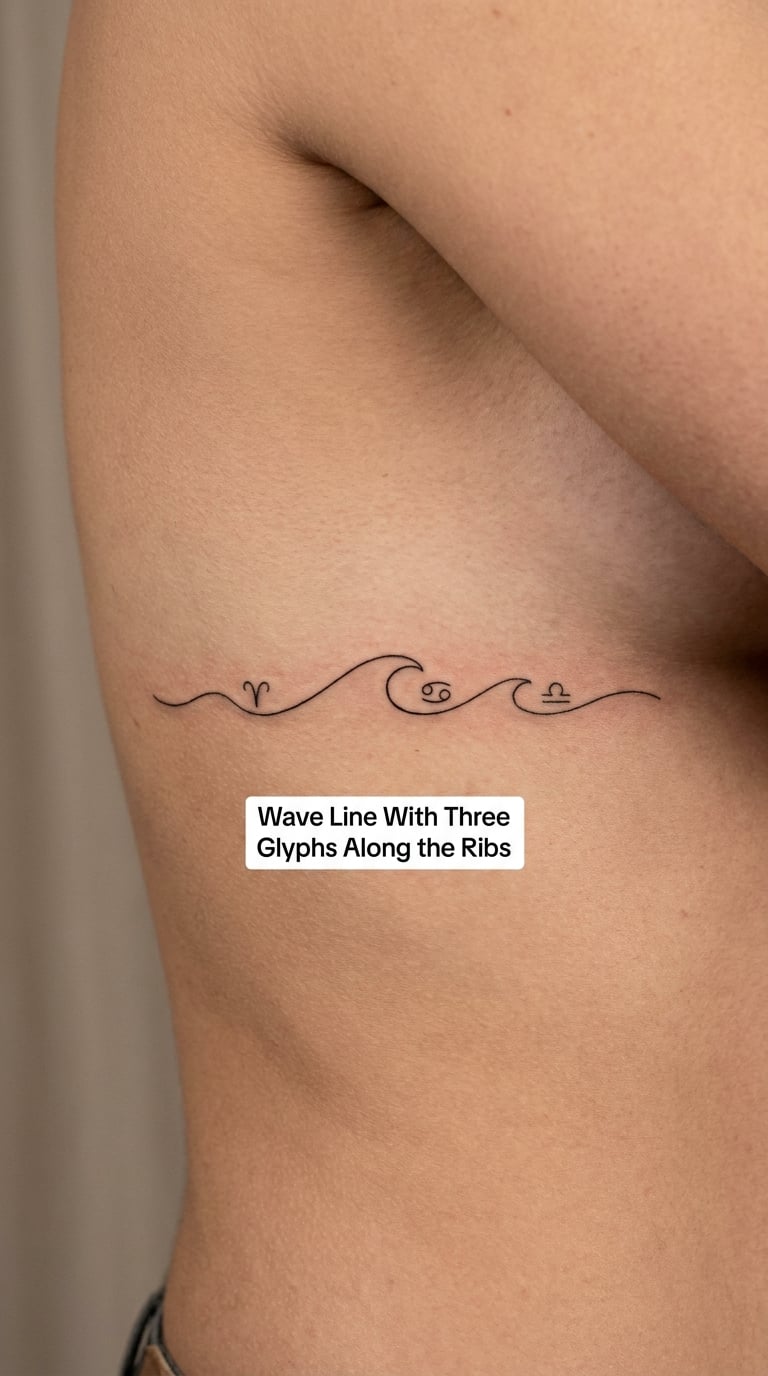
A long fine-line wave running horizontally along the ribs, with three small glyphs spaced along the crest at even intervals. It reads as one continuous line rather than three separate tattoos, which solves the clutter worry that stops people combining glyphs in the first place.
The wave gives the eye a path between the marks. A plain row of three symbols can look like a list; a row sitting on a curve looks designed.
Placement: along the ribs, following the natural curve, or along the outer arm. Size: 4 to 5 inch. Style: fine line, single weight.
Pain: high on the ribs, and you will be repositioning often to reach the middle of your back if the design extends there. Make it yours: set the wave crest heights to match the strength of each element in your chart.
19. Botanical Celestial Trio on the Ankle
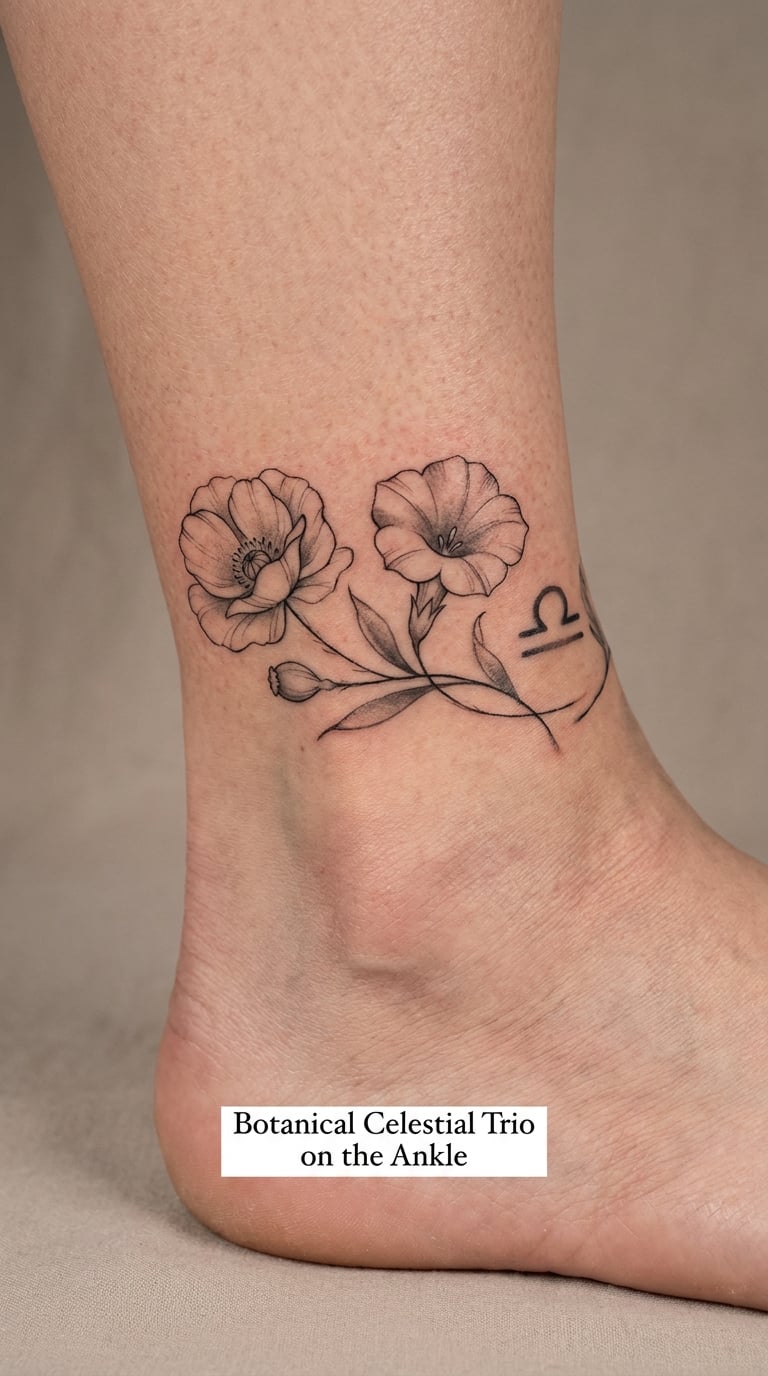
A sunflower bud, a moonflower, and a small glyph tucked into the stems, wrapping the ankle in a loose band. Botanical line work is soft and organic, which is a useful contrast to the geometry of glyphs — the plants do the decorating and the symbols stay small.
Ankle pieces are easy to conceal with shoes and boots, so this works for people who want the big three without announcing it at the office.
Placement: above or behind the ankle bone. Size: 2.5 to 3.5 inch band. Style: botanical fine line with light grey shading.
Pain: medium, with a ticklish stretch of skin near the Achilles. Grey shading on the ankle softens faster than elsewhere, so keep it light from the start. Make it yours: use flowers that actually bloom in your birth month.
20. Ascending Fine-Line Trio Up the Outer Arm
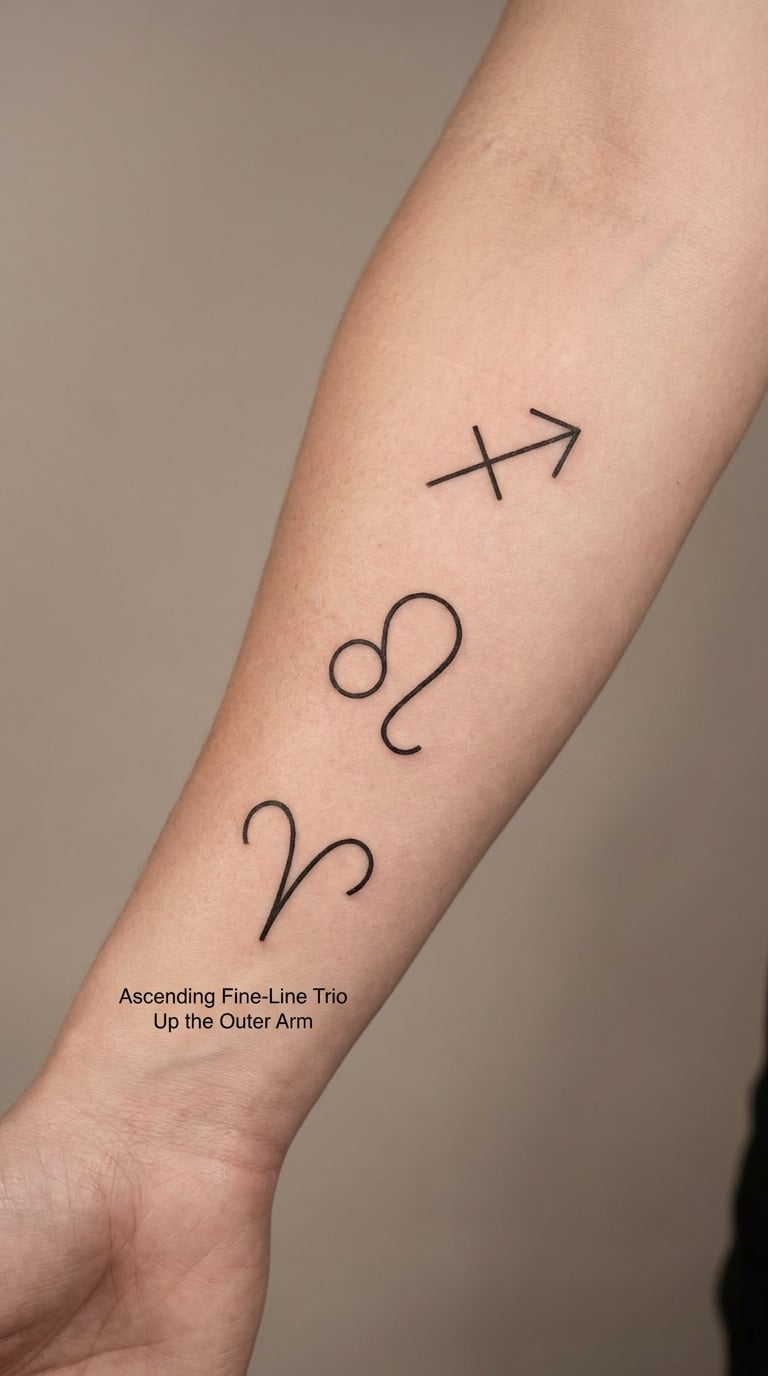
Three glyphs on a rising diagonal from wrist toward elbow, each a little higher than the last, sizes stepping down slightly. The diagonal feels like motion rather than a list, and it follows the natural line of the arm so it looks good even in a plain t-shirt.
It is the most useful layout for someone who is not sure yet. Each glyph reads clearly on its own, so you could stop at two and add the third later once you have confirmed your rising sign.
Placement: outer arm, wrist to elbow. Size: 4 to 5 inch tall overall. Style: fine line, single weight.
Pain: low to medium and a fast session. The outer arm is one of the better sun-exposed spots, so ask for a heavier line and plan a refresh. Make it yours: have the moon glyph smallest, echoing a waning moon, or reverse the size hierarchy so the rising sign dominates.
How to Choose the Right Big Three Design
Most disappointing astrology tattoos are not badly drawn. They are a nice piece of work in the wrong weight, on the wrong part of the body, saying something you never decided to say. Work through these in order before you message a studio.
Find your big three before you pick anything
You need three pieces of data: birth date, birth time, and birthplace. The sun sign follows from the date, and the moon sign usually follows too, but your rising sign is the sign that was rising on the eastern horizon at your exact moment of birth. Without the time, you do not have a rising sign — you have three possibilities.
Free natal chart calculators will give you all three in a few minutes, and printed charts are worth bringing to the appointment. If your birth time is genuinely unknown, the honest options are to check a birth record, ask family, or accept two placements now and add the rising sign after. Plenty of people take that two-then-three route, and it is the most common plan studios hear when the rising sign is still unconfirmed.
Choose a style that matches where the piece sits
A glyph trio and a constellation trio are not interchangeable just because they carry the same information. Here is the short version of how the main styles behave on skin.
- Fine line and one line: the cleanest read of three symbols, smallest sessions, fastest to heal. Needs a heavier line weight than instinct suggests, and it fades first on hands, fingers and anything in regular sun.
- Blackwork: solid fill holds its shape for decades and hides the ageing problem entirely. Best choice for a bold statement, least flexible for fine detail like degrees or microtext.
- Constellation and dotwork: dense tonal work that fills space and looks intentional. Slow sessions, and the intensity only suits larger flat areas like the back or thigh.
- Micro-realism: photoreal shading, superb in a photograph, and the first thing to soften over ten years. Better on shoulders and calves than on the inner arm.
- Watercolour: the most forgiving of small errors and the easiest to live with, but colour on sun-exposed skin shifts toward yellow and needs touch-ups.
- Cybersigilism: abstract and current, reads well small, and translates all three placements without looking like a chart.
Pick a size that survives your own habits
Rule of thumb: if you can see the piece clearly on your phone screen at arm’s length, an artist can tattoo it. Anything below about 0.5 inch per glyph loses internal detail as the skin heals, and healed skin is not the same as the paper or the stencil. Think about your real life — a wrist piece in office sleeves and frequent hand washing is a different commitment from a calf piece you show every summer.
Decide between one sign and the full big three
There is no wrong answer here, only a different kind of permanent. A single sun sign is simpler, cheaper, more legible at small sizes, and instantly recognisable to anyone who knows astrology. The big three is far more specific, works in a much wider size range because three marks fill a space better than one, and usually carries more meaning to you. Waiting months for a confirmed rising sign is a common reason the idea never gets booked at all.
What to bring to the consult
Arrive with your printed chart, your three placements, and one or two reference images for the style you want. Artists working in this niche will tell you that a specific brief gets a much better result than a vague request for a zodiac tattoo, because they are working out the composition and the line weight for you otherwise. If you want a specific layout, sketch it — even badly. Bring the actual birth degrees if you want them written into the design.
Cost and Session Time
Tattoo pricing is hourly by the shop, and every figure below moves with the city, the artist and the minimum charge. Use these as planning ranges, not quotes, and get a number in writing before you start.
- One small glyph, 0.5 to 1 inch: a short appointment, often at or near the shop minimum, because many studios will not book work under an hour.
- Fine-line trio, 2.5 to 4 inch: typically one to two hours, one session.
- Dotwork or constellation trio, 4 to 5 inch: three to five hours, most shops split this across two sessions so the shading stays even.
- Illustrative or blackwork piece, 4 to 6 inch: four to six hours, sometimes two sessions.
- Large traditional or chest piece, 6 to 8 inch: six hours or more, and honestly a multi-session project.
Three glyphs in one composition is usually one session, not three appointments. Three separate tattoos in three different places is three appointments, and that is a different piece of work altogether. A two-piece approach — sun and moon together, rising sign added later — is the cheapest path to the full big three and the most common one people take when they are still confirming details.
Urban studios and high-demand artists book weeks or months ahead, and the cost of a rush appointment is often higher. Ask about the deposit and reschedule policy too, since a large piece cancelled after the first session is expensive for everyone.
Aftercare Basics
Follow your artist’s aftercare instructions above anything else on this page, including any written sheet they give you. The general shape of good aftercare is simple enough to lay out here.
- Leave the covering on for as long your artist instructed, usually a few hours, and then wash gently with unscented soap and lukewarm water. Pat dry with a clean towel rather than rubbing.
- Keep the area clean and dry for the first few days. Loose dark clothing over a fresh piece prevents fabric sticking to scabs and pulling the healing skin.
- Do not soak, swim or cover the tattoo in a tight bandage for the first couple of weeks. Sauna, hot tub and swimming pools are worth skipping while the skin is still sealing.
- Moisturise a thin layer of a plain, fragrance-free lotion a few times a day once it has stopped weeping and drying out. Heavy creams and butters trap heat and can clog the fresh ink.
- Do not pick, itch or scratch the flaking skin, and do not use cortisone or antibiotic creams unless your artist specifically told you to. A tattoo is a healing wound, not a spot to treat.
- Expect visible healing for two to three weeks and final settling over a few months. The colour you see on day one is not the colour you keep.
One last practical note for this particular subject: a sun, moon and rising sign tattoo will be on your skin for a long time, and it will change as your skin changes. Fading is normal and predictable, so plan a refresh with the same artist every few years for fine-line work, and far less often for blackwork. If you call your artist with questions during healing, call — that is what they are there for.
Frequently Asked Questions
What does a sun, moon and rising sign tattoo represent?
It represents your three main astrological placements in one design. Your Sun sign is your core identity, the version of you that walks into a room. Your Moon sign is your inner emotional world and what you need to feel secure. Your Rising sign, also called the ascendant, is the outward persona and the impression you make first. Tattooing all three together is more personal than a single zodiac sign, because millions of people share a sun sign but very few share the exact same combination.
What do I need to know my rising sign before getting the tattoo?
You need your exact birth time, along with your birth date and birthplace. The rising sign is the zodiac sign that was on the eastern horizon at the moment you were born, so without the time you have three possible answers rather than one. Free natal chart calculators need all three pieces of data. If your birth time is truly unknown, a sensible approach is to tattoo your Sun and Moon now and add the rising sign after you have confirmed it from a birth record or a family member.
What does a 3-3-3 tattoo mean?
A 3-3-3 tattoo is three separate pieces of ink rather than one composition, traditionally tied to the idea of past, present and future. People who hold astrology as part of their belief system often repurpose it as a Sun, Moon and Rising set, with one small tattoo per placement. The number itself has no fixed astrological meaning and means something different in different circles, so it is worth deciding which version you want before you book.
What is the 1/3 rule tattoo?
The 1/3 rule is not an established term in astrology or tattooing, and you will not find a standard meaning for it. It most often shows up online as a restatement of the rule that three objects can be split into smaller thirds and still work together, which is why it gets attached to any three-symbol design. If you have seen it attached to a sun moon and rising sign tattoo, the design is almost certainly a big three piece, and the three positions refer to your three placements.
How do you combine three zodiac glyphs without it looking cluttered?
Give the three marks a hierarchy rather than treating them as equals. Make one larger, place them on a curve instead of a straight line, or connect them with a wave, orbit or banner so the eye travels between them. A vertical stack along the spine or a diagonal up the arm also works better than a flat row because the body already provides a direction. Artists working in this style will sketch the layout with you at the consult, which is the part worth getting right.
Which Big Three tattoos age best?
Blackwork and heavy traditional pieces age best because solid fill holds its edge far longer than hairline work. Fine-line glyph trios age fine in sheltered spots such as the inner arm or behind the ear, but they fade fastest on hands, fingers, the collarbone and anything in regular sun. Constellations and dotwork sit in between, since the tonal weight survives even when small details soften. If longevity matters to you, ask for a line weight above the minimum your artist would use by default.
Start with the smallest idea here that still feels like you — the fine-line glyph row on the inner forearm or the one-line stroke behind the ear both work as a first tattoo and cost you little if the placement is wrong. Once you have one healed and know how your skin takes ink, the bigger pieces like the natal chart wheel or the traditional chest sun and moon get much easier to plan, and the rising sign is the one detail worth nailing down before any of it is inked.