
20 Best Birth Month Flower Tattoo Ideas for December 2026
December’s birth flowers are the narcissus, which covers the paperwhite and the daffodil, and holly. So the same birth month gives you two very different subjects: a soft white trumpet flower that blooms early, and a spiky evergreen branch with red berries. These birth month flower tattoo ideas for December split that difference into twenty designs, from a one-inch daffodil on a finger to a six-inch mandala across the back.
Every design below is written the way I’d brief my own artist: what the linework should look like, where it sits, how big it really is once healed, and what will happen to it in five years. The narcissus suits people who want something quiet and fine. The daffodil suits people who want colour and a bolder read.
One naming note before the gallery, because it trips up almost everyone. Daffodil, narcissus, paperwhite and jonquil are all the same plant genus, Narcissus, and all of them work as a December birth flower mark. Poinsettia and chrysanthemum get called December flowers constantly, mostly because they are Christmas flowers, but they are not the assigned birth flowers. If you want the traditional answer, you are looking at narcissus and holly.
If you are still narrowing the wider field, browse our full birth flower tattoo gallery and 52 birth flower tattoo ideas that are built to last for other months, or look at flower sleeve tattoo ideas if you are planning a larger piece.
Quick Guide: Birth Month Flower Tattoo Ideas for December
Here is every design in the gallery, in order, with the style, the placement I would pick, a realistic healed size and the pain you can expect on that spot.
| Idea | Style | Best placement | Size | Pain |
|---|---|---|---|---|
| 1. Minimalist white narcissus | Minimalist fine line | Inner wrist | 2 in (5 cm) | Medium |
| 2. Fine-line narcissus | Fine line | Behind the ear | 2.5 in (6 cm) | Medium |
| 3. Realistic daffodil | Micro-realism | Inner forearm | 3 in (7.5 cm) | Medium |
| 4. Traditional yellow daffodil | Traditional | Outer shoulder | 4 in (10 cm) | Medium |
| 5. Watercolor narcissus | Watercolor | Outer ankle | 2.5 in (6 cm) | Low to medium |
| 6. Blackwork narcissus | Blackwork | Collarbone | 3 in (7.5 cm) | Medium |
| 7. Micro daffodil | Micro fine line | Side of index finger | 1 in (2.5 cm) | High |
| 8. Watercolor daffodil bouquet | Watercolor | Upper outer thigh | 5 in (13 cm) | Low |
| 9. Fine-line narcissus | Fine line | Side rib | 3 in (7.5 cm) | Medium to high |
| 10. Neo-traditional daffodil | Neo-traditional | Outer calf | 4 in (10 cm) | Low |
| 11. Single black narcissus | Blackwork | Below sternum | 3 in (7.5 cm) | High |
| 12. Daffodil sprig | Botanical line work | Outer wrist | 2 in (5 cm) | Medium |
| 13. Botanical narcissus | Botanical realism | Upper arm | 4 in (10 cm) | Medium |
| 14. Dotwork daffodil | Dotwork and stippling | Shoulder blade | 3.5 in (9 cm) | Medium |
| 15. Minimalist narcissus line | One-line minimalism | Back of hand | 1.5 in (4 cm) | High |
| 16. Color-blocking daffodil | Color blocking | Outer calf | 3.5 in (9 cm) | Low |
| 17. Narcissus and daffodil wreath | Fine colour with black and grey | Outer thigh | 5 in (13 cm) | Low |
| 18. Fine-line daffodil sprig | Fine line | Side of neck | 2 in (5 cm) | Low |
| 19. Realistic narcissus | Micro-realism | Top of foot | 2.5 in (6 cm) | Medium to high |
| 20. Geometric daffodil mandala | Geometric with fine line | Upper back | 6 in (15 cm) | Medium |
1. Minimalist White Narcissus on the Wrist
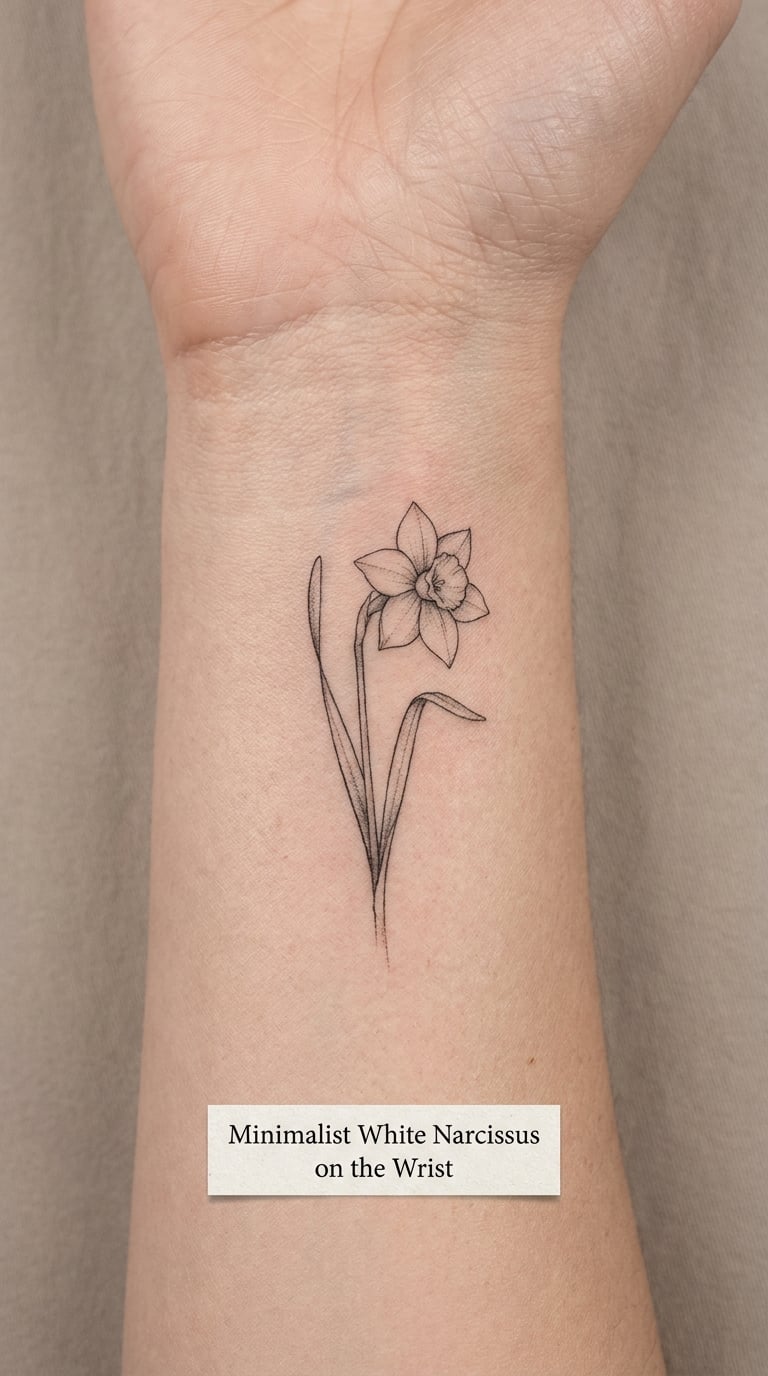
One bloom, six clean petals, a trumpet centre marked with a small ring of dots. No stem, no leaves, no shading except a whisper of grey under the petals. This is the quietest way to wear a December birth flower and the easiest to get right on a first sitting.
Narcissus carries hope, renewal and self-regard, so people choose it when they want a mark that reads as hopeful rather than decorative.
Placement: inner wrist, just above the bone, or the top of the foot. Size: 1.5 to 2.5 inches (4 to 6 cm). Style: minimalist fine line, single needle.
Pain: medium, and expect a stretchy, burning feeling on the inner wrist that comes and goes. The honest ageing note: this is a sun-exposed spot and thin skin, so expect a soft grey within a few years and plan on a touch-up.
Make it yours: add your birth year in tiny numerals under the bloom, or keep one petal slightly open to echo the real flower.
2. Fine-Line Narcissus Behind the Ear
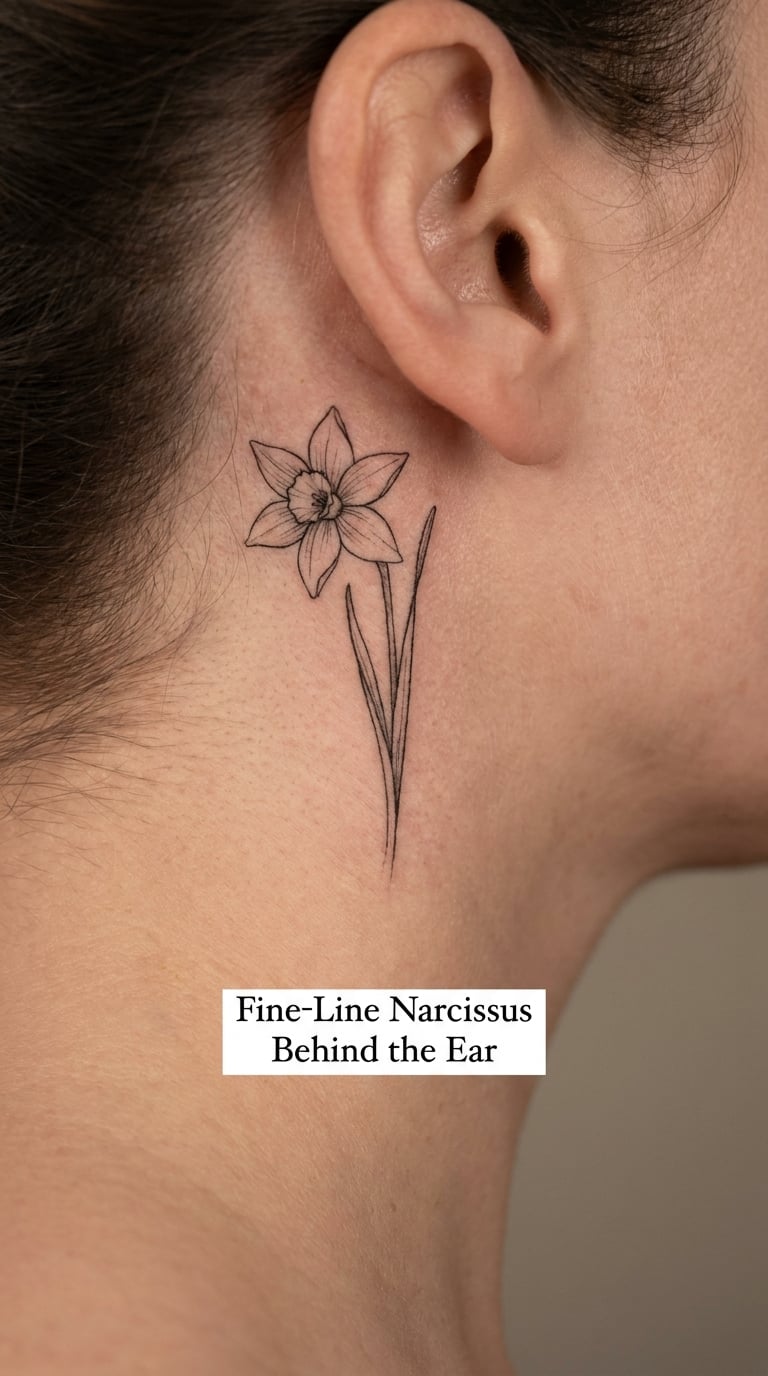
A taller, narrower flower drawn with thin single-needle lines and a small amount of whip shading in the trumpet. Behind the ear it reads almost like a piece of jewellery, especially if the head is turned to one side.
It is the placement people choose when they want their birth flower close but hidden, something only certain people see.
Placement: behind the ear, curving down the neck. Size: 2 to 3 inches (5 to 7.5 cm) tall. Style: fine line with light stippling in the centre.
Pain: medium. Behind the ear is thin skin over bone with plenty of nerve endings, so it is a sharp, quick sensation that settles as soon as you stop watching. Ageing note: neck skin stretches with age, so the fine lines soften a little sooner than arm work.
Make it yours: tuck a second smaller bud behind the first so the stem appears to disappear into the hairline.
3. Realistic Daffodil on the Forearm
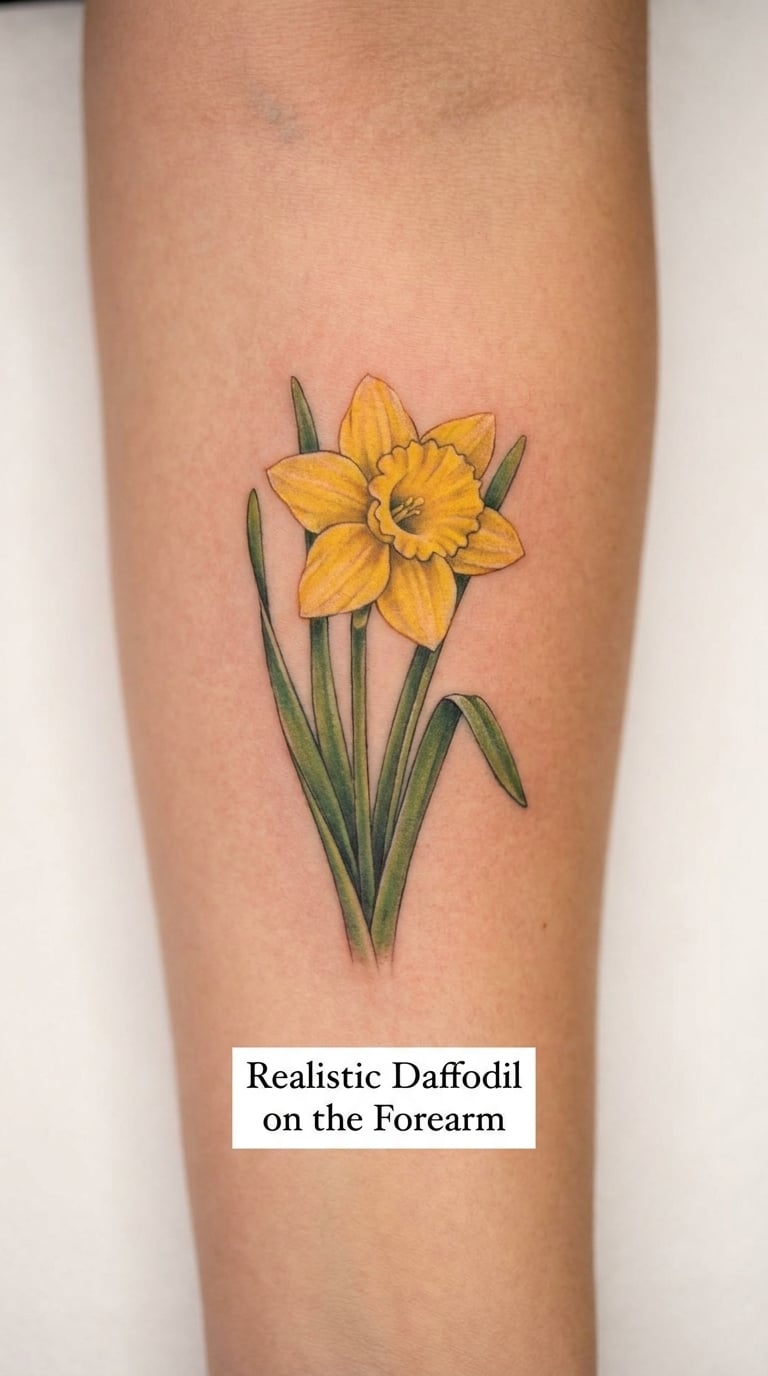
A daffodil is the easiest flower in the December set to draw recognisably, because the trumpet corona is a shape you can spot across a room. This version keeps the petals in warm yellow with grey whip shading in the shadowed edges and two long green leaves.
Since the daffodil and the narcissus are the same genus, a daffodil mark still counts as a December birth flower tattoo for most people, and plenty of tattooers treat the two as interchangeable.
Placement: inner forearm, running lengthwise. Size: 3 to 3.5 inches (7.5 to 9 cm). Style: micro-realism with soft colour blending.
Pain: medium. The inner forearm is fleshy and forgiving, one of the easier large-ish spots. Ageing note: yellow pigment is the first thing to fade, so this is a piece that wants sunscreen and a top-up every few years.
Make it yours: ask for a deeper orange corona so it still reads as a daffodil once the yellow softens.
4. Traditional Yellow Daffodil on the Shoulder
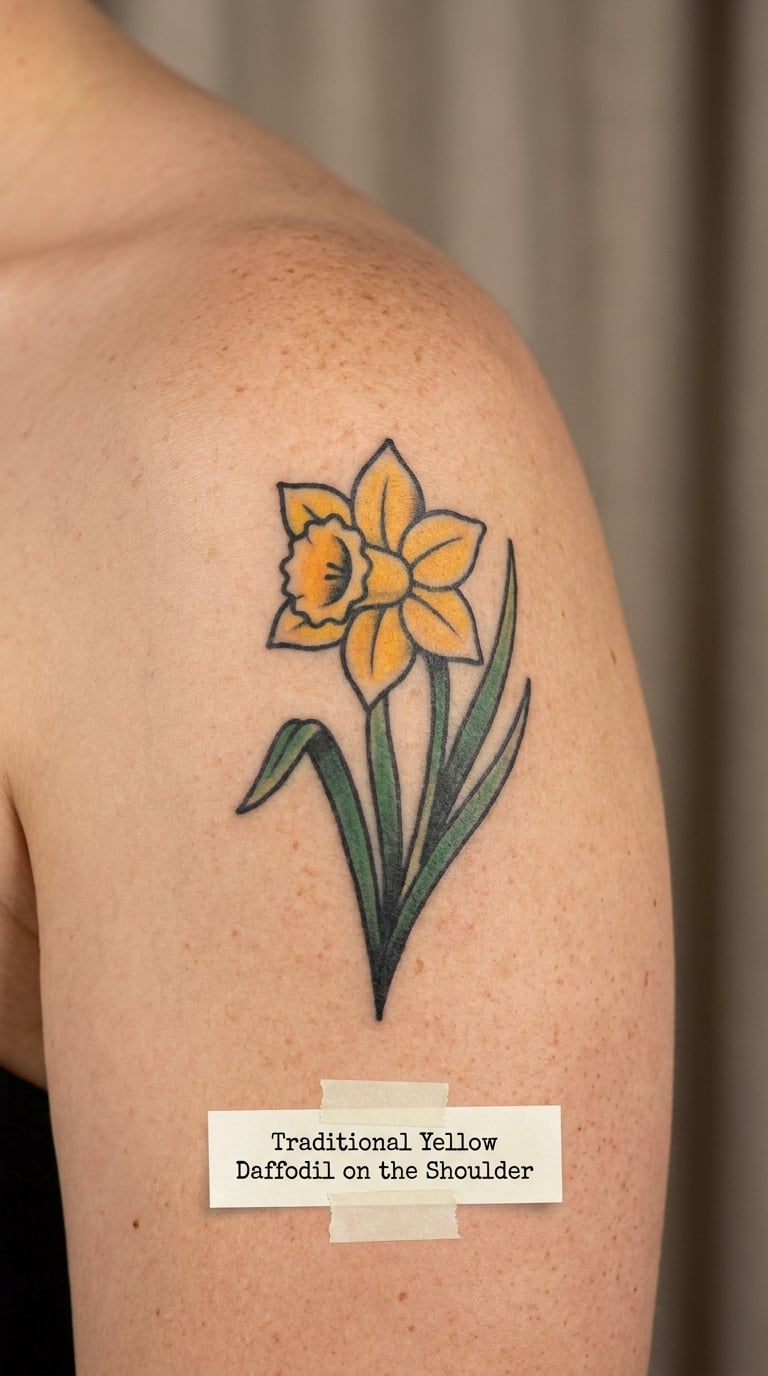
Thick black outlines, flat saturated yellow, orange corona, green leaves with a few bold shadow blocks. Traditional style is the one that survives a decade of sun and a washing machine without losing its shape, and the shoulder is a big flat canvas for it.
Traditional florals are less about delicacy and more about permanence, which suits people who want their birth flower to still be legible at forty.
Placement: outer shoulder or deltoid. Size: 3.5 to 4.5 inches (9 to 11 cm). Style: traditional American floral.
Pain: medium, and the shoulder softens after the first few passes. Ageing note: shoulder skin creases with age, so the stem can follow a natural line rather than fighting it.
Make it yours: add a banner underneath carrying a word that matters, or reduce it to the bloom alone and leave the leaves to a second session.
5. Watercolor Narcissus on the Ankle
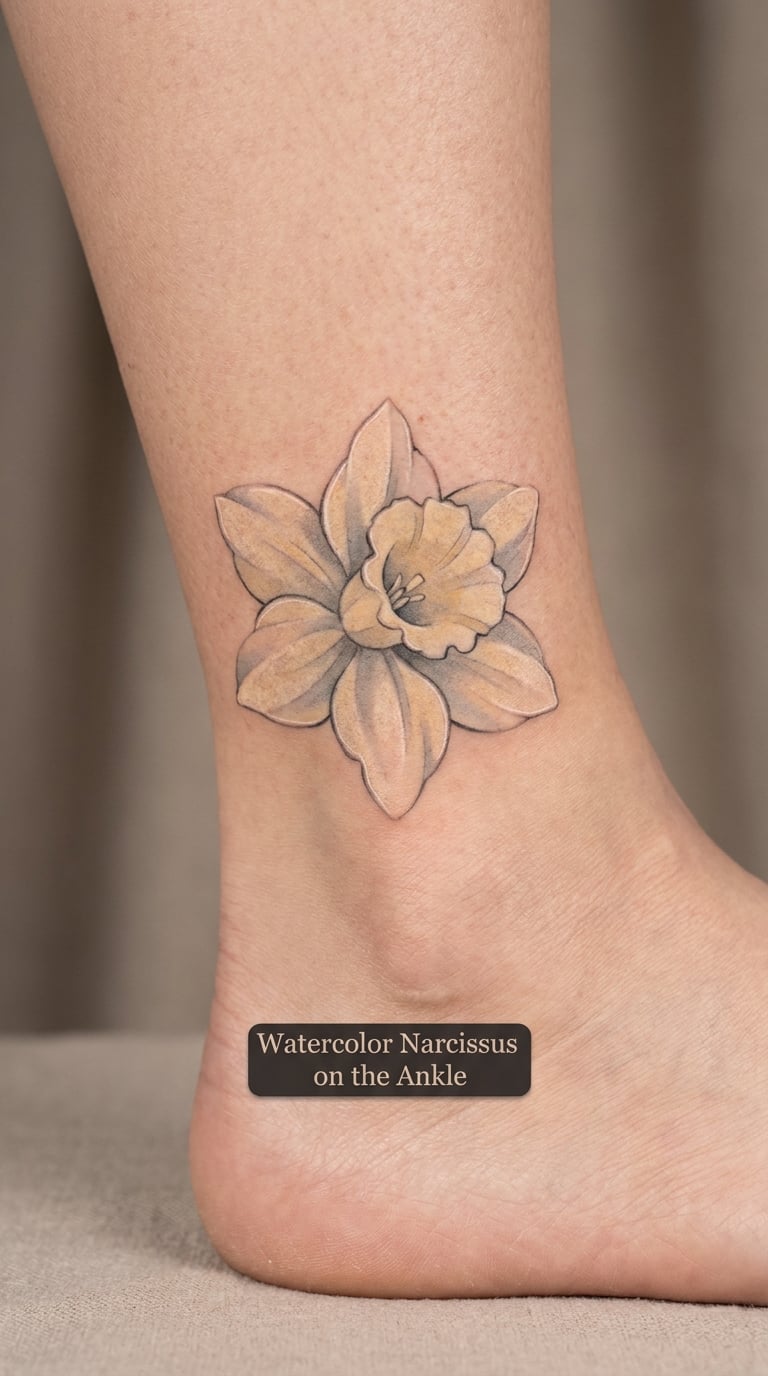
Loose washes of pale yellow and cream bleeding into soft grey, no outline at all. The edges are meant to look slightly unfinished, as if the flower is fading at the edges of the paper.
Watercolor florals are chosen for movement rather than precision, and the ankle is one of the few spots where a soft, blurry shape still looks intentional.
Placement: outer ankle above the bone, or inner ankle. Size: 2 to 3 inches (5 to 7.5 cm). Style: watercolor with no black line work.
Pain: low to medium, the ankle is relatively forgiving. Ageing note: this is the style that changes most over time, since pale washes and no outlines mean the design softens noticeably within a few years.
Make it yours: ask for one petal to run slightly outside the outline, which keeps the watercolour look from feeling accidental.
6. Blackwork Narcissus on the Collarbone
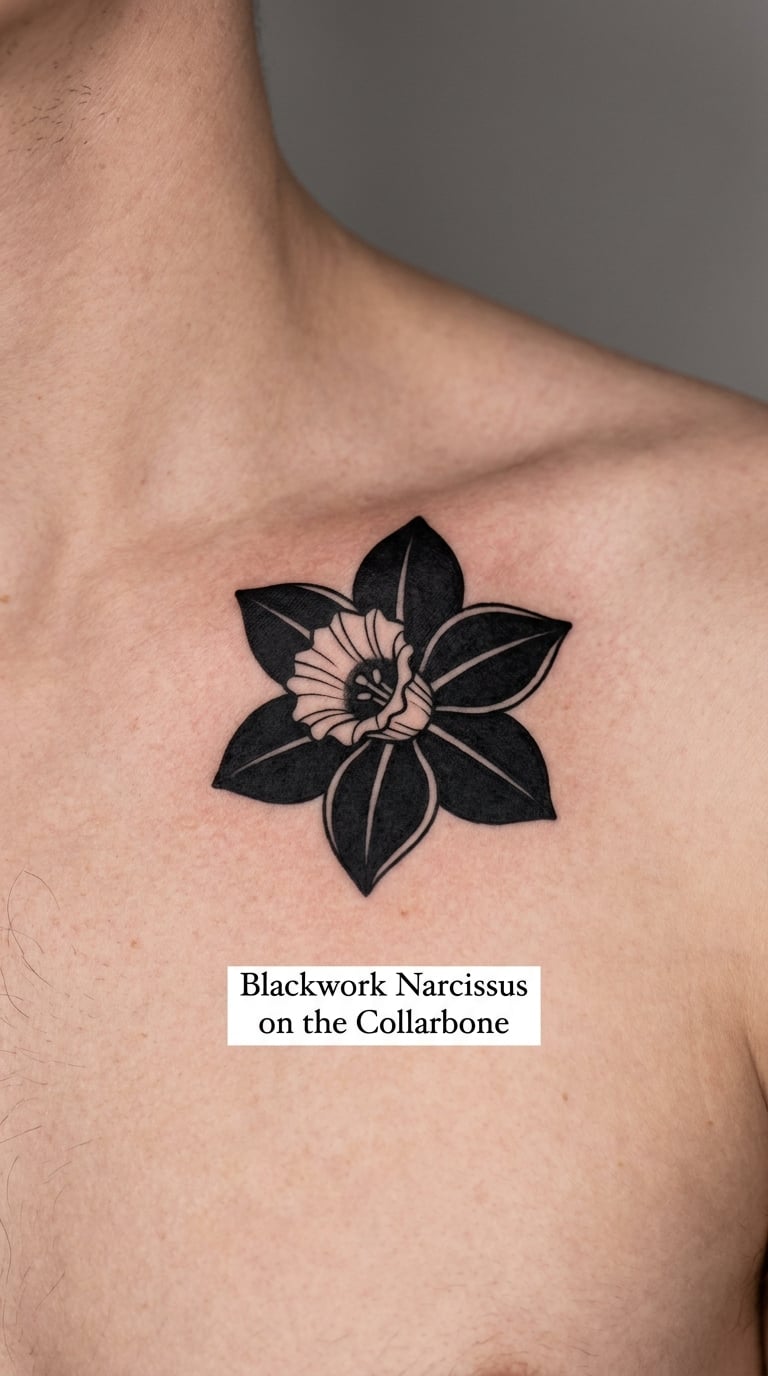
Solid black petals with white negative space cut into the trumpet centre, so the flower reads from a distance without a single colour on the skin. High contrast, graphic, and easy to keep looking sharp.
Blackwork is a good answer for someone who wants their birth flower to be noticed but who does not want a bright yellow bloom drawing every comment in the room.
Placement: along the collarbone, centred. Size: 2.5 to 3.5 inches (6 to 9 cm). Style: blackwork with negative space.
Pain: medium to high, bone sits right under collarbone skin, so you will feel every pass. Ageing note: the best-longevity option in this gallery, and the one most likely to still look sharp when you are older.
Make it yours: run the flower slightly off-centre and follow the natural curve of your collarbone rather than sitting it flat.
7. Micro Daffodil on the Finger
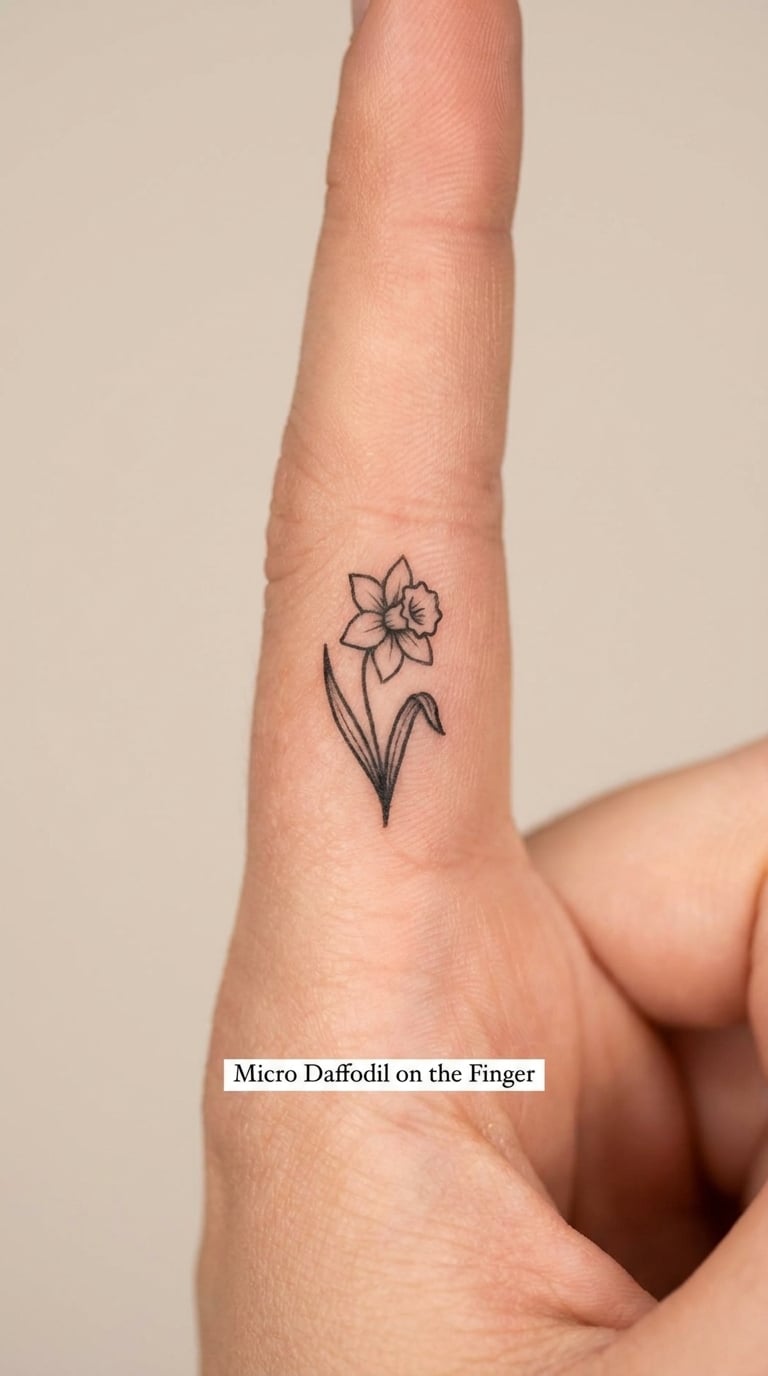
A tiny trumpet centre, six short petals, two small leaves and a stem, all inside an inch. There is no room for shading here, so the whole design depends on line weight and how confidently the shape is placed.
People choose finger daffodils for the same reason they choose finger flowers in general: it looks like a detail rather than a tattoo.
Placement: side of the index finger, or the thumb. Size: 0.75 to 1.25 inches (2 to 3 cm). Style: micro fine line.
Pain: high. Fingers have thin skin, dense nerves and a lot of bone nearby. Ageing note: be honest with yourself about this one, hands move constantly and get sun, so micro line work here fades and blurs faster than anywhere else on the body.
Make it yours: pick the daffodil over a denser flower, and consider a slightly thicker line weight at the same small size so it has something left to lose.
8. Watercolor Daffodil Bouquet on the Thigh
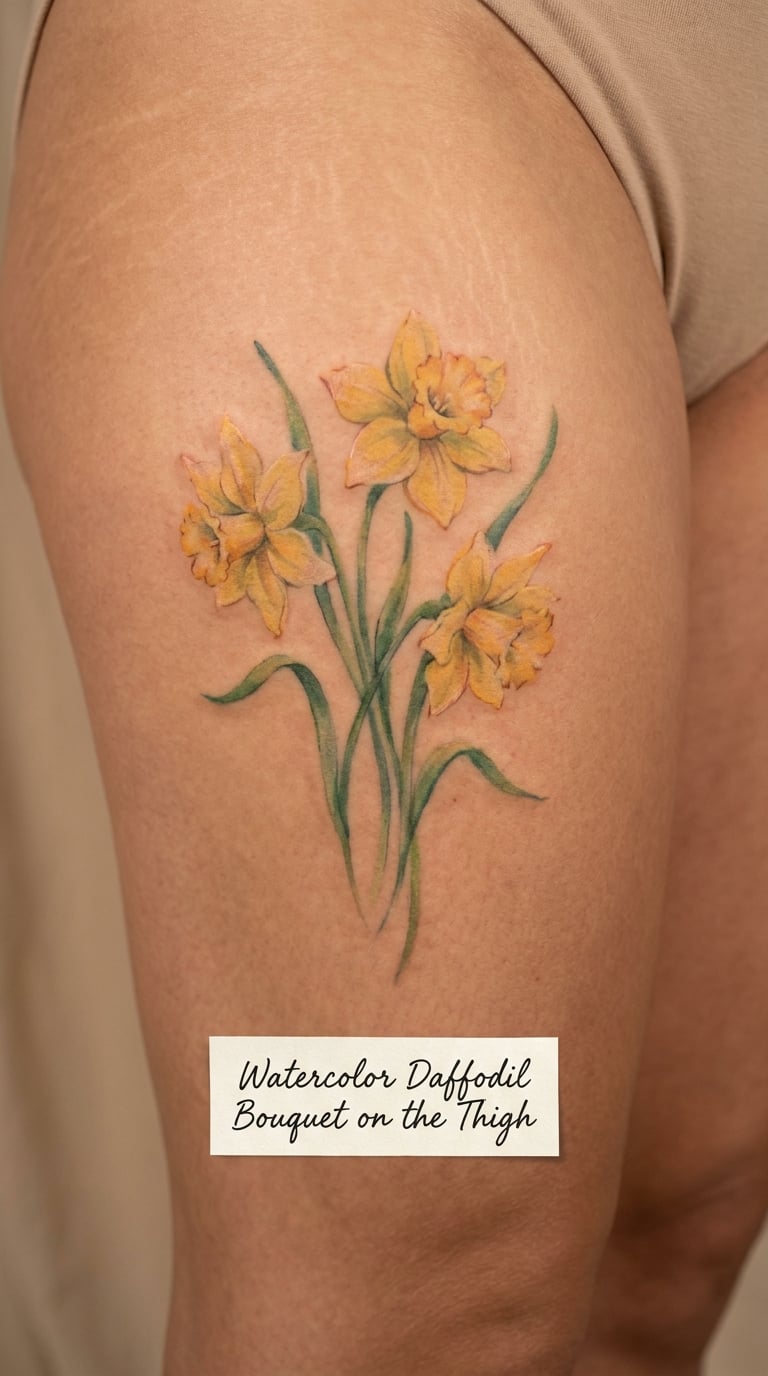
Three blooms at slightly different heights, stems trailing down and fading out rather than ending neatly. Yellow and soft green washes, no black, and a few loose petals dropped around the base to suggest movement.
Birth flower bouquet tattoos are usually a family thing, and this one has room to grow into a group piece for parents, children or a partner with a different birth month.
Placement: upper outer thigh, which is one of the least painful canvases on the body. Size: 4.5 to 6 inches (11 to 15 cm). Style: loose watercolor.
Pain: low, and the thigh is also a good spot for a long sitting if you want a bigger piece. Ageing note: pale washes will fade first, so keep the yellow saturated at the source rather than relying on touch-ups.
Make it yours: add a small birth date in the trailing stem area, where the wash naturally goes thin.
9. Fine-Line Narcissus on the Rib
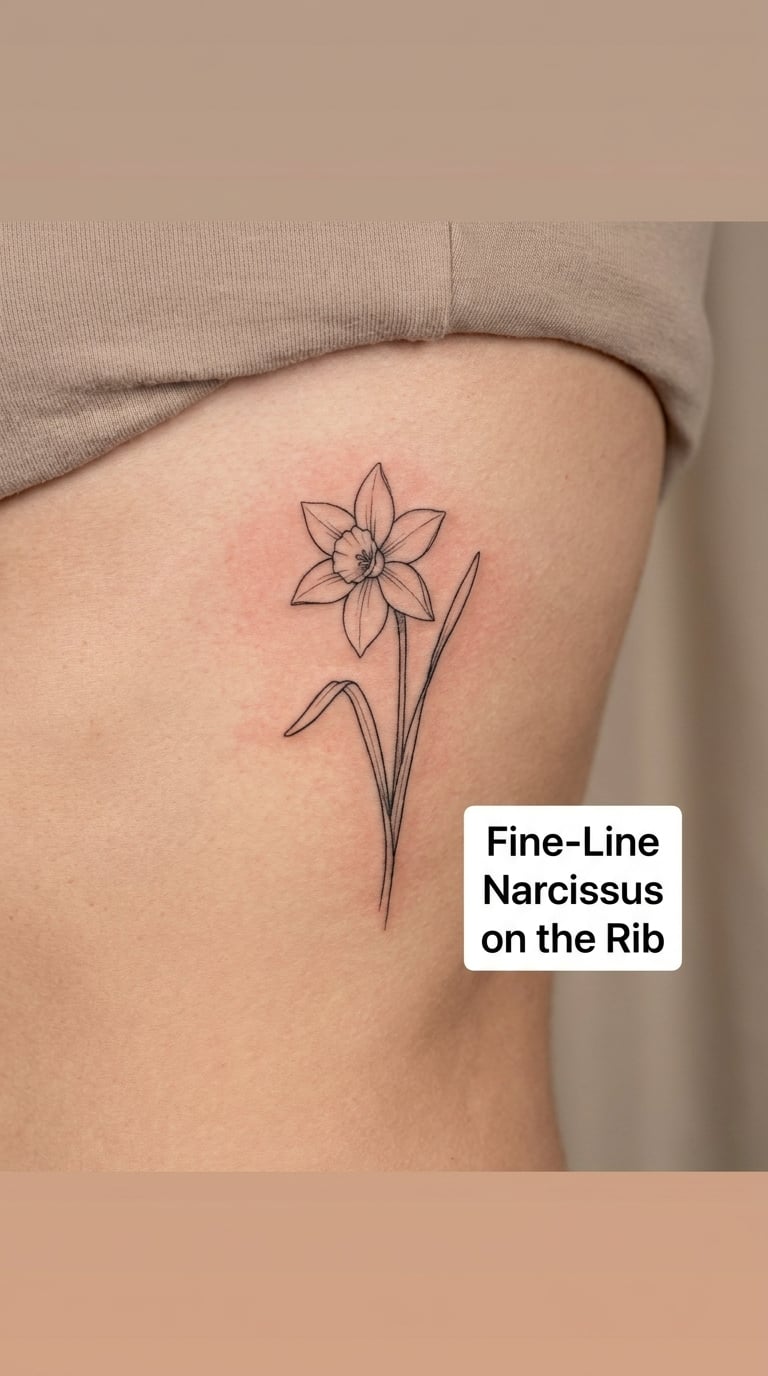
One vertical stem, six narrow petals fanning out at the top, drawn with the thinnest line your artist is comfortable holding. The whole flower follows the curve of the ribcage rather than sitting flat against it.
Rib florals feel more intimate than wrist or ankle pieces, and they follow the body rather than interrupting it, which is why they are so popular for a first larger tattoo.
Placement: side ribs, usually from the last two ribs down to the waist. Size: 3 to 4 inches (7.5 to 10 cm). Style: fine line, single needle.
Pain: medium to high and it builds, the discomfort creeps up rather than spiking. Breathing makes the skin move, so expect breaks. Ageing note: rib skin stretches with weight change and age, so the design can drift a little over decades.
Make it yours: angle the stem to follow one rib line, and add a single leaf pointing back toward your spine.
10. Neo-Traditional Daffodil on the Calf
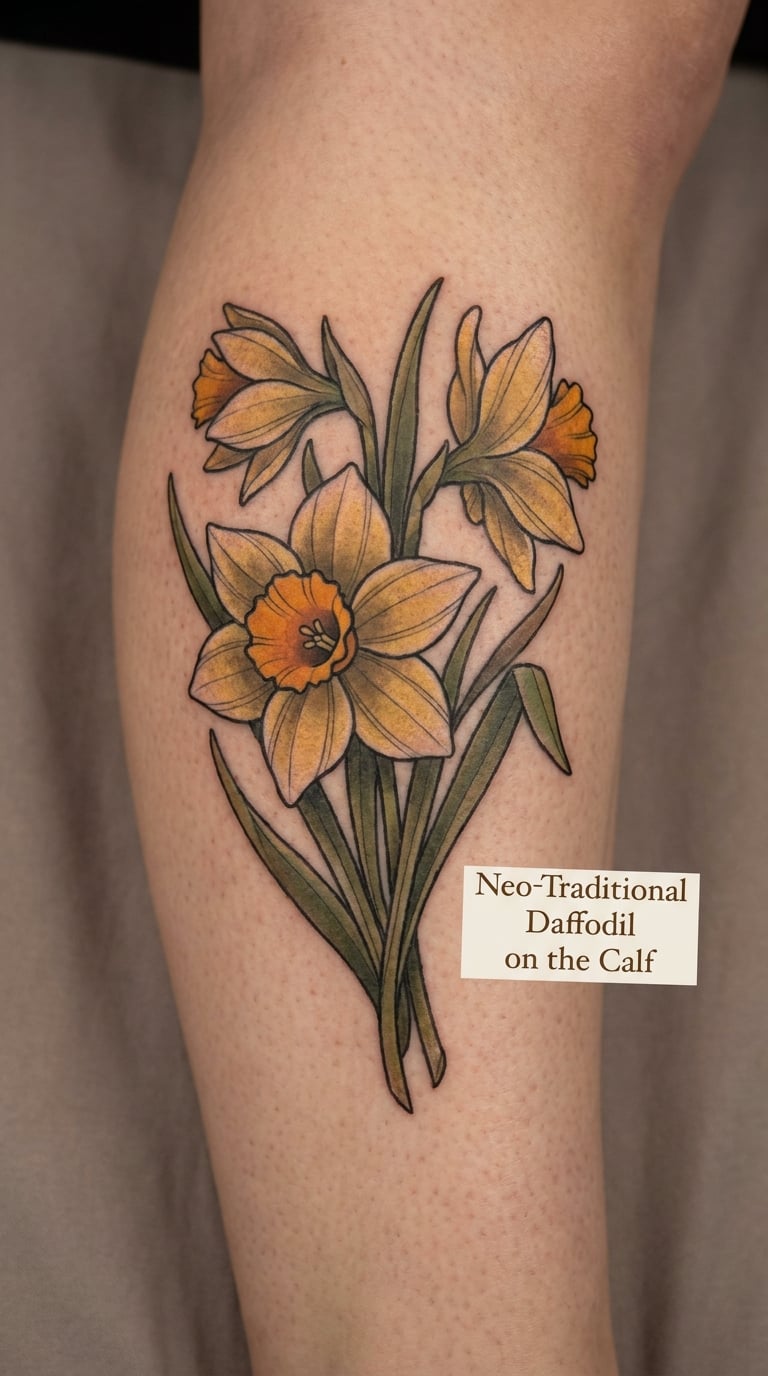
Dimensional shading on the petals, a bright orange corona, leaves with depth and a whip-shaded stem. Neo-traditional is the step up from traditional: it has the same bold readability with more modelling in the shadows.
A calf daffodil has room for the full botanical structure, corona, petals, leaves and stem, without crowding.
Placement: outer calf. Size: 3.5 to 5 inches (9 to 13 cm). Style: neo-traditional floral.
Pain: low to medium, the calf is meaty and takes a long session well. Ageing note: lower legs are visible year-round and take more sun, so a saturated yellow will need protection to stay bright.
Make it yours: pair it with a second daffodil at a lower angle so the piece reads as a growing stem rather than a clip art flower.
11. Single Black Narcissus on the Sternum
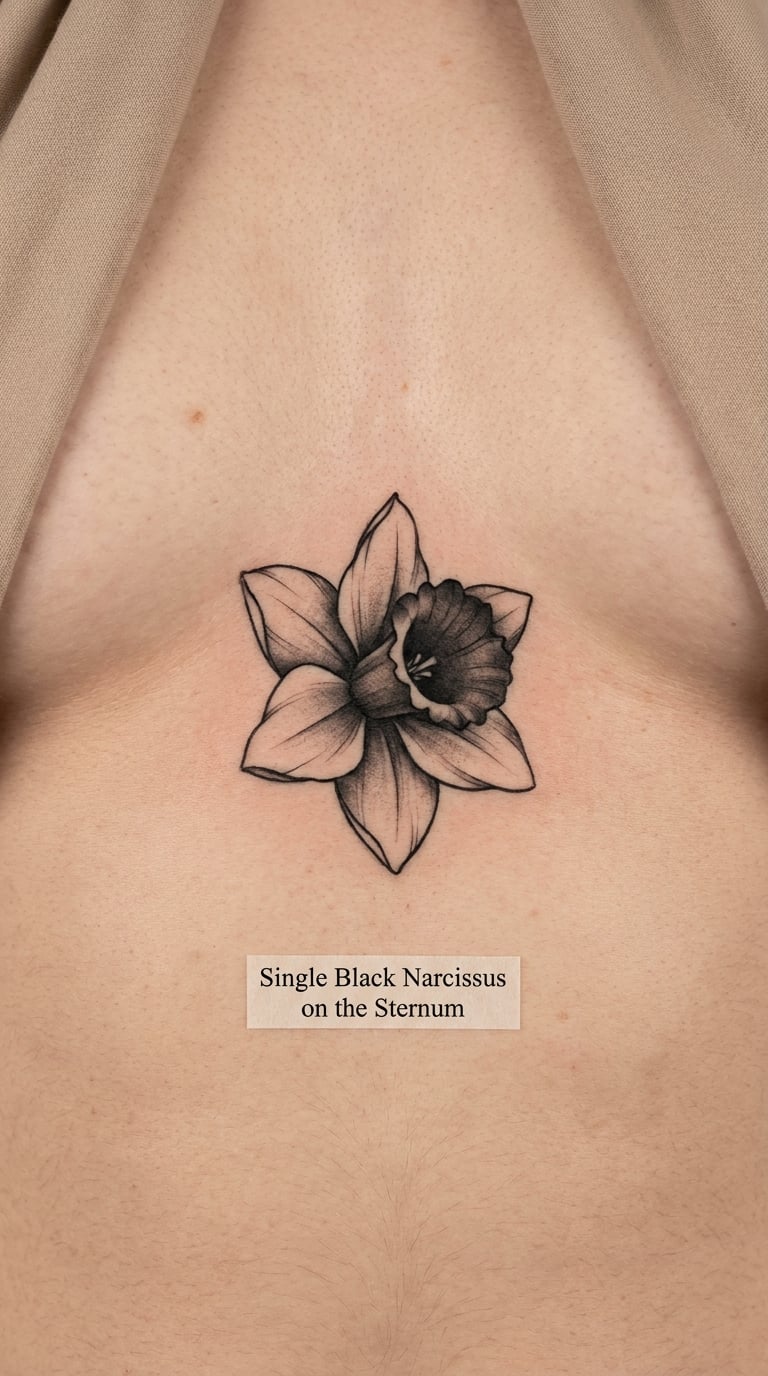
A symmetrical black silhouette with a dark trumpet centre and a small gap of white space at the middle, placed low on the chest. It looks like a sternum piece without the pain or commitment of filling the whole bone.
Central chest flowers are chosen when you want the design to sit with the body rather than on top of it, and the birth flower gives it a reason to be there.
Placement: just below the sternum, between the breasts. Size: 2.5 to 3.5 inches (6 to 9 cm) wide. Style: blackwork with negative space.
Pain: high. Bone and thin skin, and you will feel breathing against the needle. Ageing note: sternum skin moves with breathing and posture, so the edges soften faster here than on an arm.
Make it yours: ask for a mirrored pair of tiny leaves to close the bottom of the composition, which balances the trumpet shape.
12. Daffodil Sprig on the Wrist
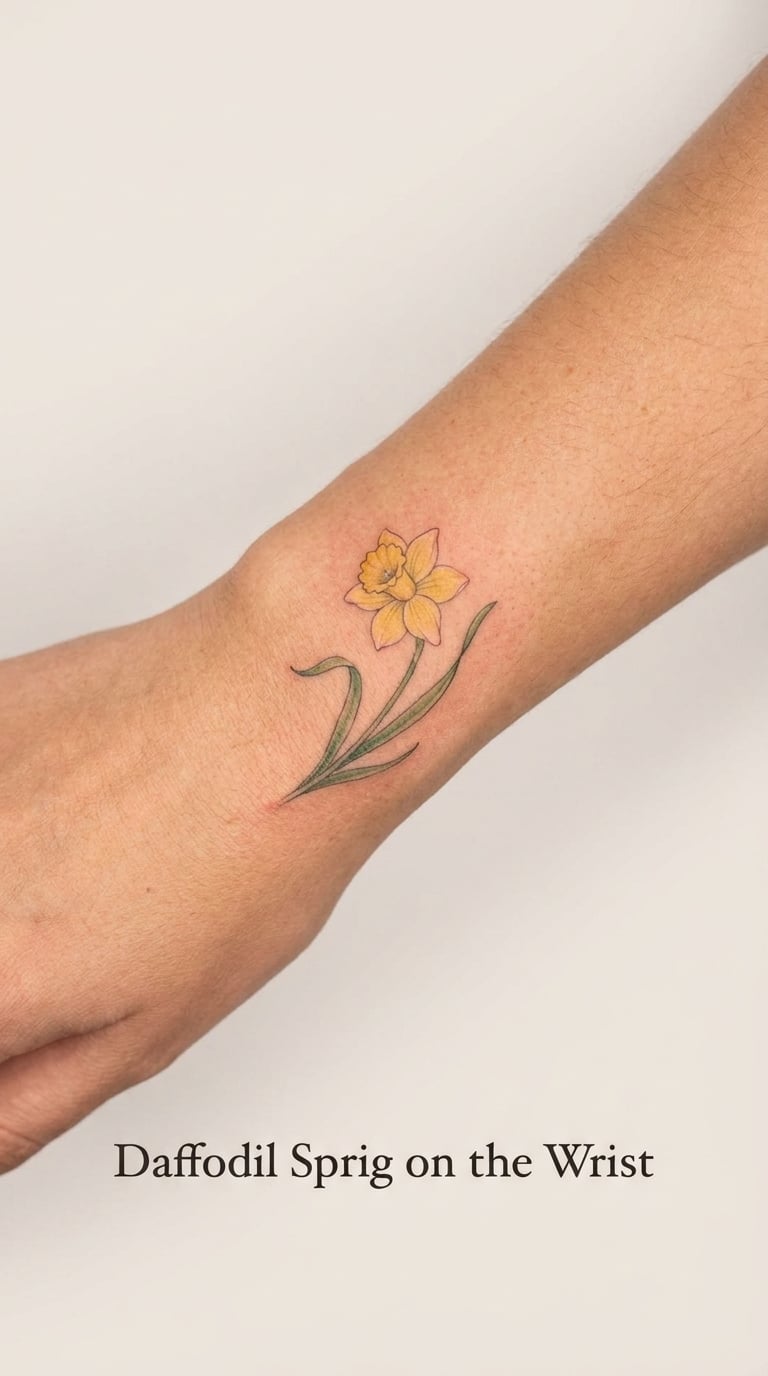
One bloom on a short stem with two leaves, slightly asymmetrical, with a small yellow wash in the centre of the flower. It has more personality than a single symmetrical bloom and it suits a wrist that is already busy with a watch or bracelet.
A sprig is the compromise design, big enough to be clearly a flower, small enough to sit comfortably on a narrow wrist.
Placement: outer wrist or inner wrist. Size: 1.5 to 2.5 inches (4 to 6 cm). Style: botanical line work with one colour accent.
Pain: medium. Wrist skin is thin and the area flexes constantly, so the artist will work in shorter passes. Ageing note: wrists get sun and movement all day, so expect the yellow to need refreshing sooner than the line work.
Make it yours: add a second unopened bud at the end of the stem, which gives the design a direction to grow in.
13. Botanical Narcissus on the Upper Arm
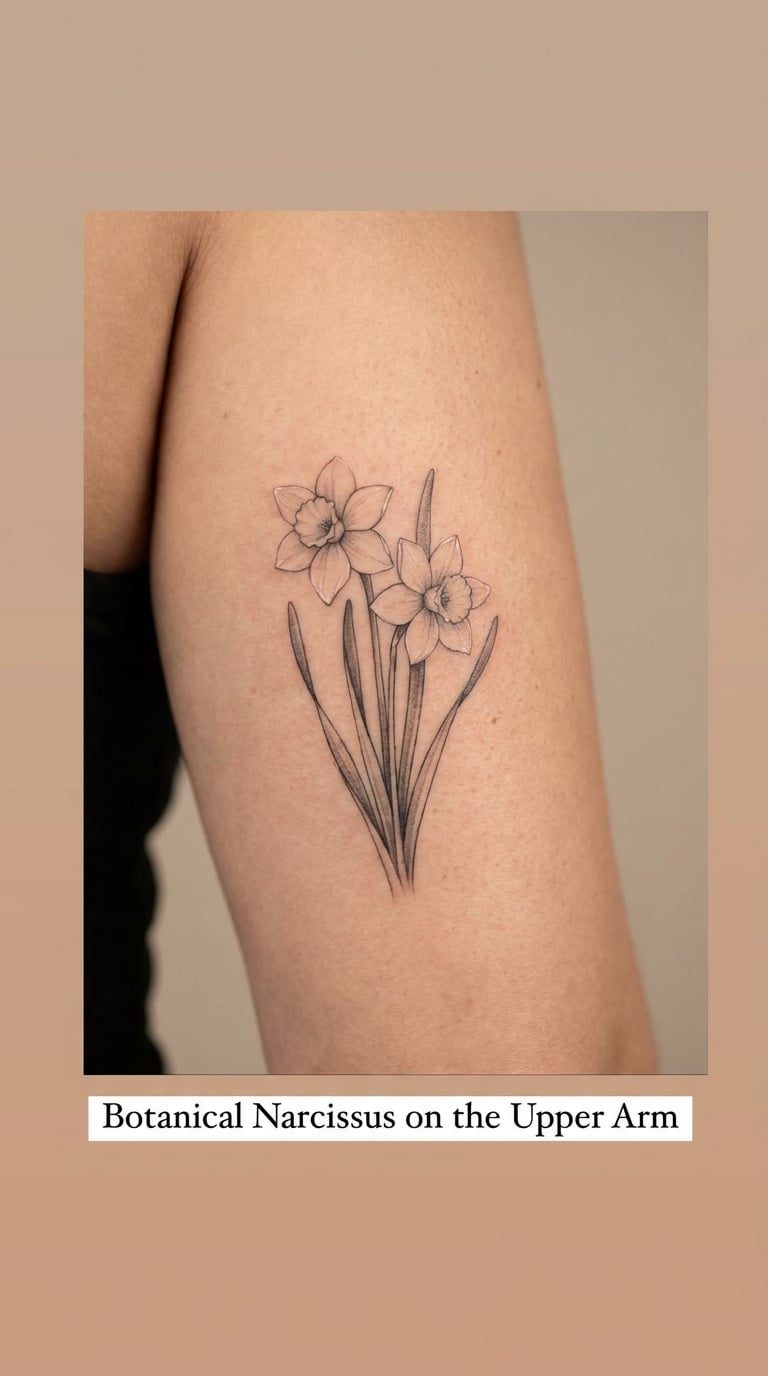
Two pale flowers, a few narrow leaves and light ink shading in the trumpet of each bloom, drawn with the flat-paper look of a botanical study rather than a tattoo flash sheet.
People choose the fuller botanical version when they want their birth flower to read as a plant rather than an icon, and it is a natural choice for a second or third piece.
Placement: outer upper arm or bicep. Size: 3.5 to 4.5 inches (9 to 11 cm). Style: botanical realism with delicate ink shading.
Pain: medium, a good compromise between a flat and a fleshy spot. Ageing note: upper arm skin stays relatively stable, so fine detail here holds longer than it does on a hand or a rib.
Make it yours: ask the artist to work from a pressed paperwhite or daffodil specimen, which gets you accurate petal proportions instead of a generic flower.
14. Dotwork Daffodil on the Shoulder Blade
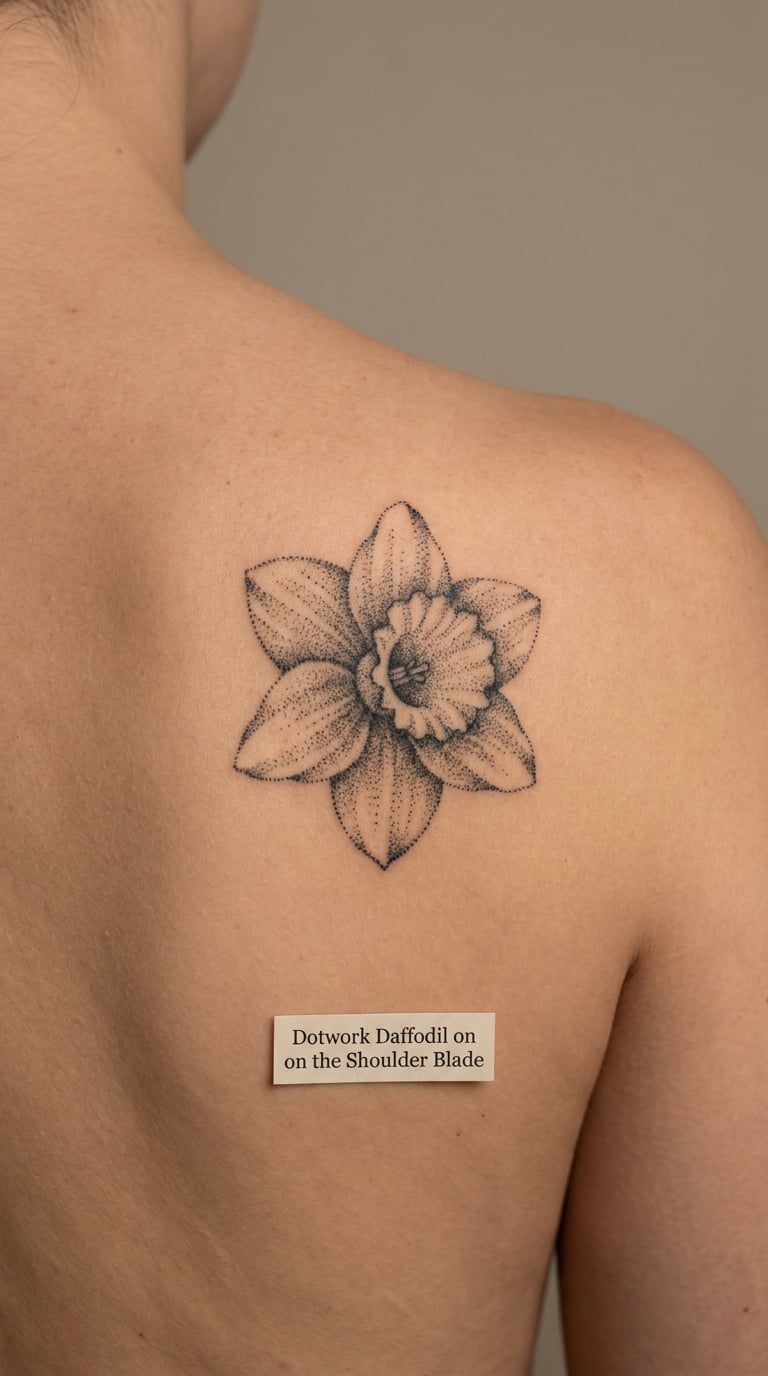
The daffodil built entirely from clustered dots, dense in the trumpet centre and thinning toward the petal tips so the bloom fades out into the skin. No outlines, no colour, just value made from points.
Dotwork is a slower, more technical style and it is chosen by people who want a birth flower with texture and depth rather than a picture of a flower.
Placement: between the shoulder blade and the spine, or on the outer shoulder. Size: 3 to 4 inches (7.5 to 10 cm). Style: dotwork and stippling.
Pain: medium, and dotwork takes patience, so expect a long sitting. Ageing note: dots soften at the edges as the skin ages, which gives the piece a stippled look you either love or do not, so book a touch-up at two months if you want it crisper.
Make it yours: let the dots trail off the lower petal into a scattering, which reads as the flower dissolving into the skin.
15. Minimalist Narcissus Line on the Hand
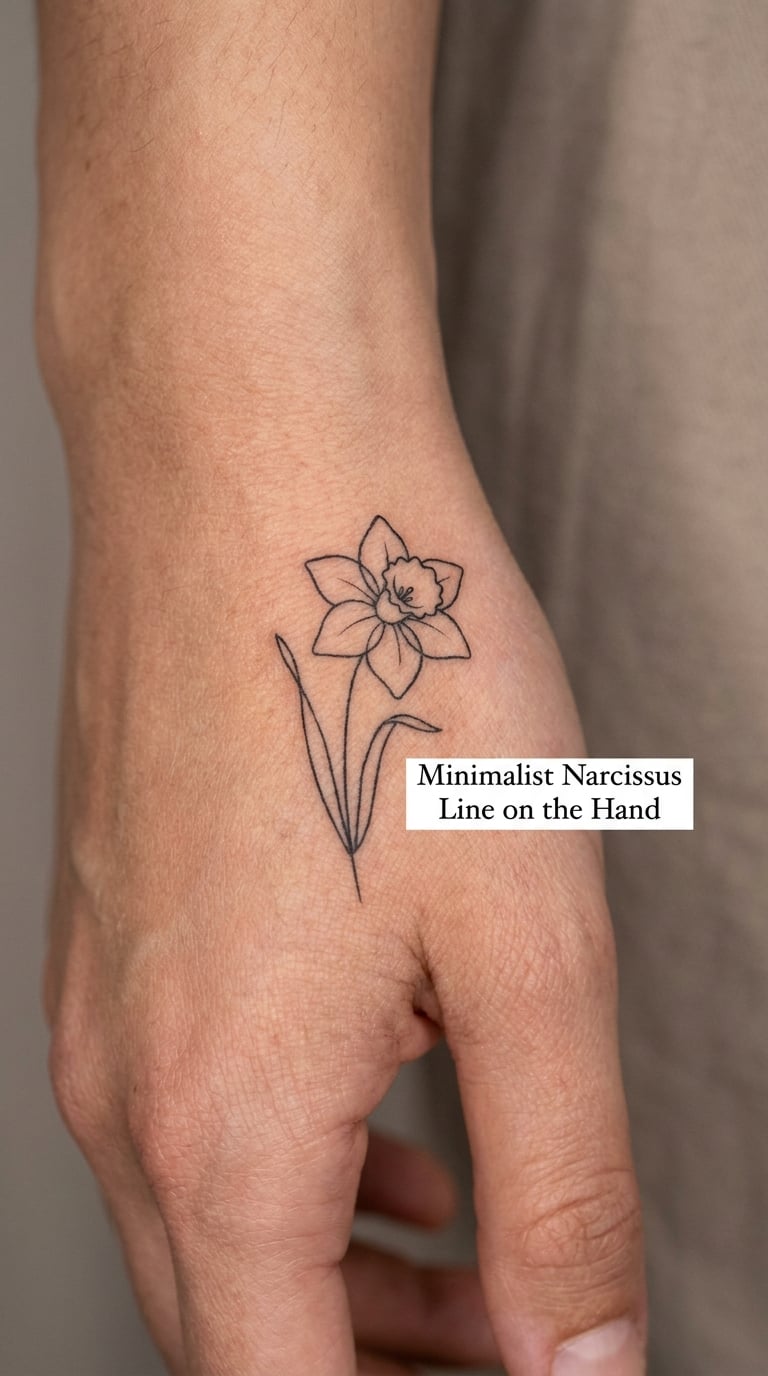
A single continuous line drawing one side of the flower, the other side suggested by the negative space around it. About an inch and a half wide, with the trumpet centre marked by two dots.
Hand placements are worn like a signature, and this one gets asked for by people who want their birth flower visible but not decorative.
Placement: back of the hand, between the knuckles or on the thumb side. Size: 1.25 to 1.75 inches (3 to 4.5 cm). Style: one-line minimalism.
Pain: high, the back of the hand is bony with dense nerves. Ageing note: the honest version is that hand tattoos fade considerably because of movement and sun exposure, and one-line work has the least ink to lose, so plan on a refresh every year or two.
Make it yours: get it mirrored on the other hand, or leave the line unfinished at the stem so it looks like it continues off the skin.
16. Color-Blocking Daffodil on the Calf
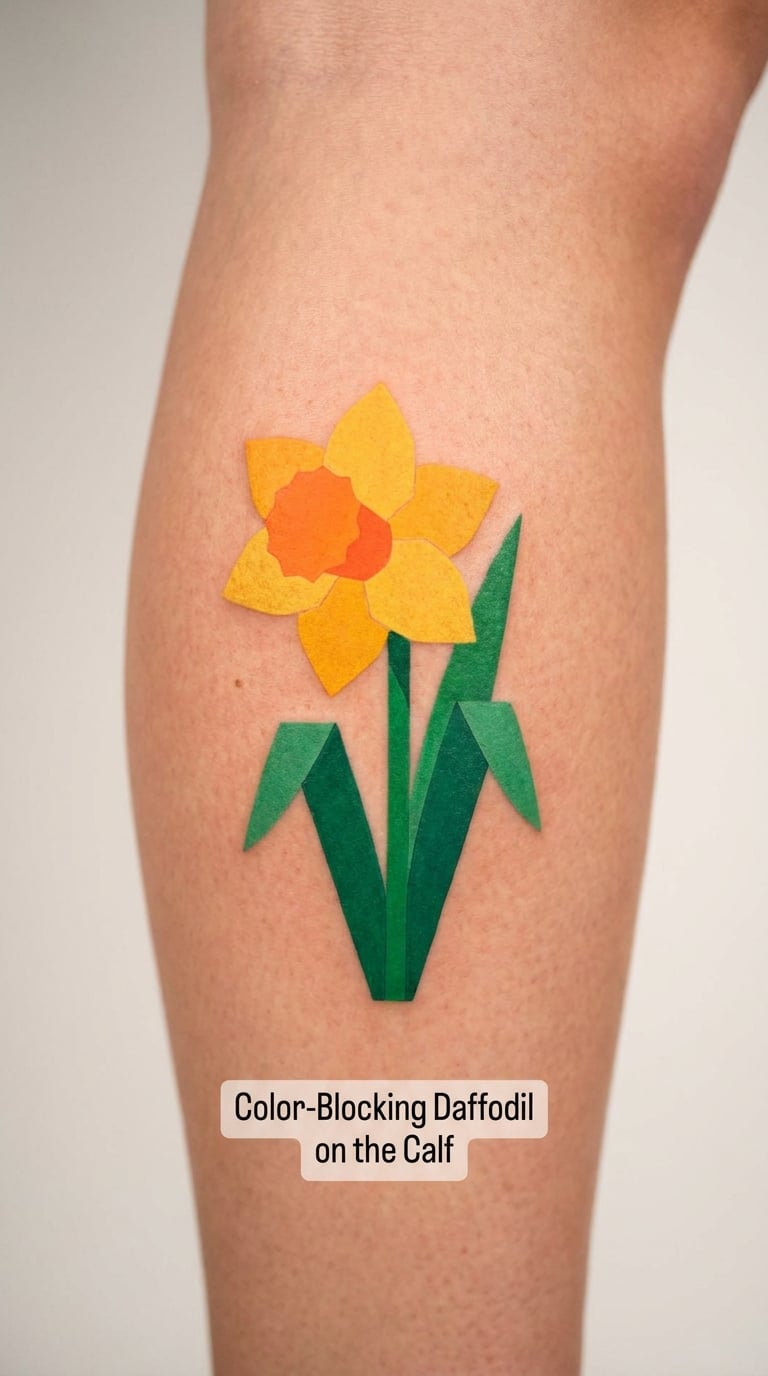
Flat blocks of saturated yellow, a solid orange centre and bold green leaves, separated by clean hard edges and no gradients. The flower is built like a graphic poster rather than a photograph.
Colour blocking is a good middle ground for people who want the cheerfulness of a bright daffodil but find traditional shading too old-fashioned.
Placement: outer calf or outer arm. Size: 3 to 4 inches (7.5 to 10 cm). Style: colour blocking with hard edges.
Pain: low to medium, large flat areas of colour go on faster than shading. Ageing note: flat blocks are easier to touch up than gradients, since a colourist can fill the shape again without rebuilding detail.
Make it yours: split the petals into two shades of yellow so the flower has depth without shading.
17. Floral Wreath of Narcissus and Daffodils on the Thigh
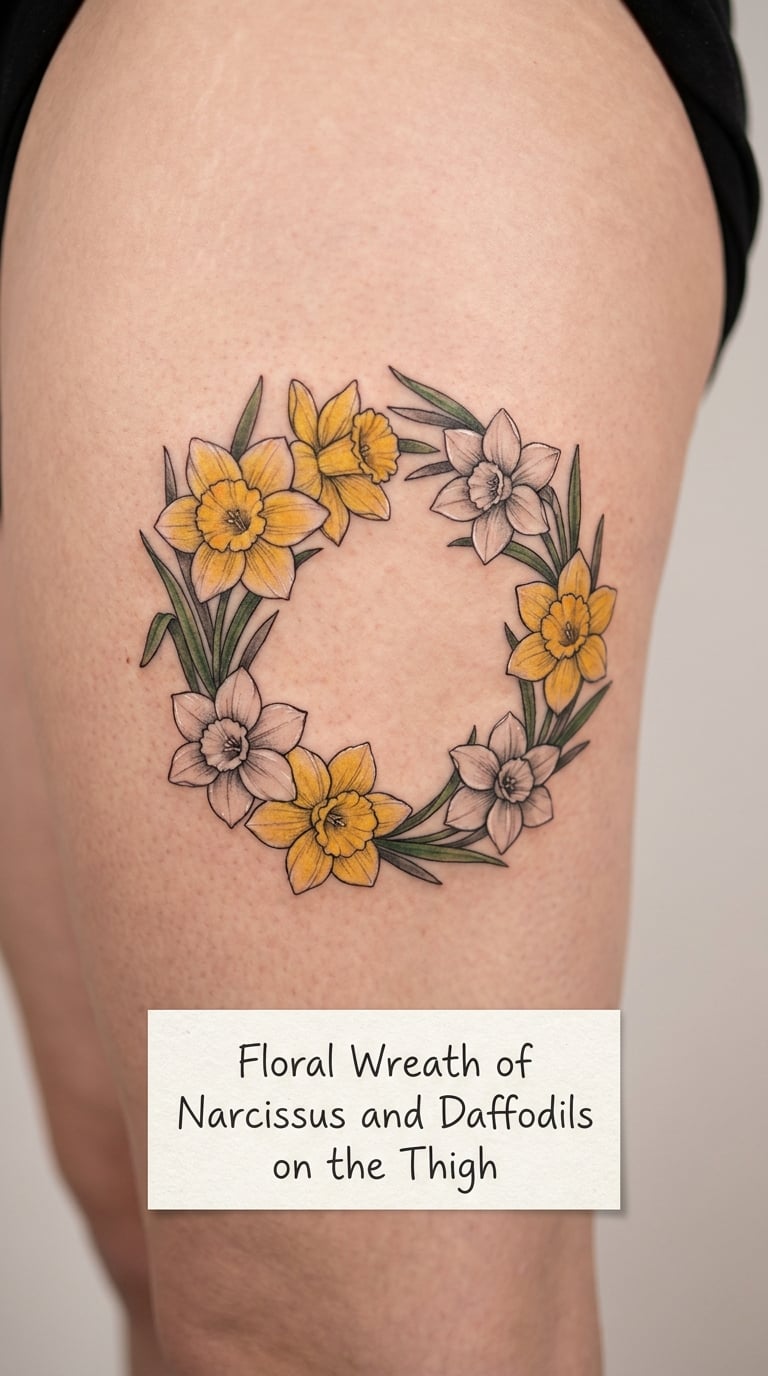
A circle built from both of your birth flowers, white narcissus on one side and yellow daffodils on the other, tied with a small ribbon and finished with fine black and grey leaf work. It is the one design on this list that uses both December flowers at once.
Wreaths are traditionally marking pieces, so this works well as a birthday gift, an anniversary design or a family piece that grows over the years.
Placement: outer thigh, or the back of the calf where there is room for a full circle. Size: 4.5 to 6 inches (11 to 15 cm) across. Style: fine colour with black and grey shading.
Pain: low, though it is a multi-session piece for most people. Ageing note: white ink in the narcissus petals will soften first, so ask your artist to build it with light grey shading underneath rather than pure white highlights.
Make it yours: set the birth year in the ribbon at the bottom, or leave a small empty arc to add a family member’s flower later.
18. Fine-Line Daffodil Sprig on the Neck
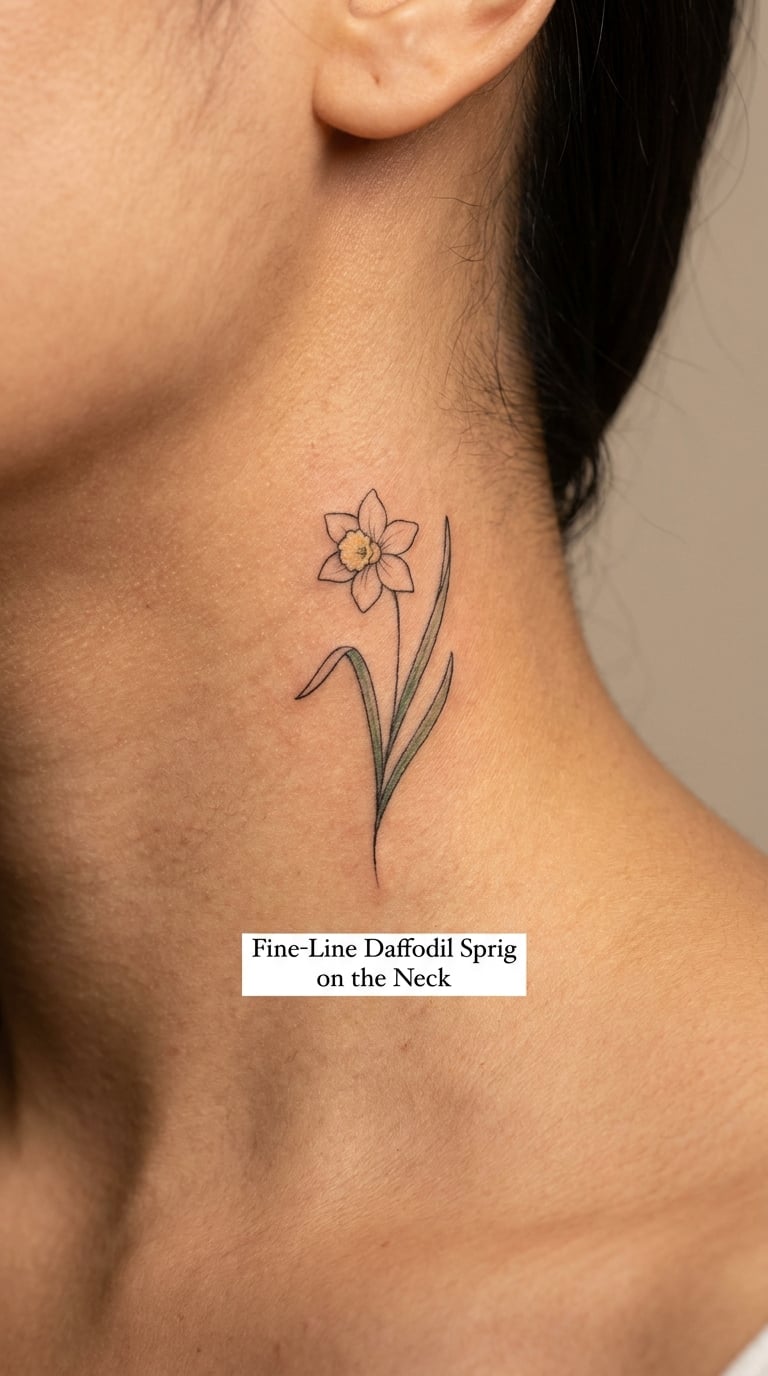
A small sprig with a single yellow centre, drawn with the same thin line as a wrist piece but placed on the side of the neck where it sits close to the hair. Two leaves angle down and away from the bloom.
Neck florals are usually chosen for the way they look in a photograph and for how private they feel in everyday life.
Placement: side of the neck, below the ear. Size: 1.5 to 2.5 inches (4 to 6 cm). Style: fine line with a single yellow accent.
Pain: low to medium, and brief, because the area is small. Ageing note: neck skin is thin and lines show more as skin changes with age, so a slightly heavier line here is worth asking for.
Make it yours: tuck the stem toward the collar so it disappears under a shirt collar, and mirror the sprig on the other side of the neck if you want a matched pair.
19. Realistic Narcissus on the Foot
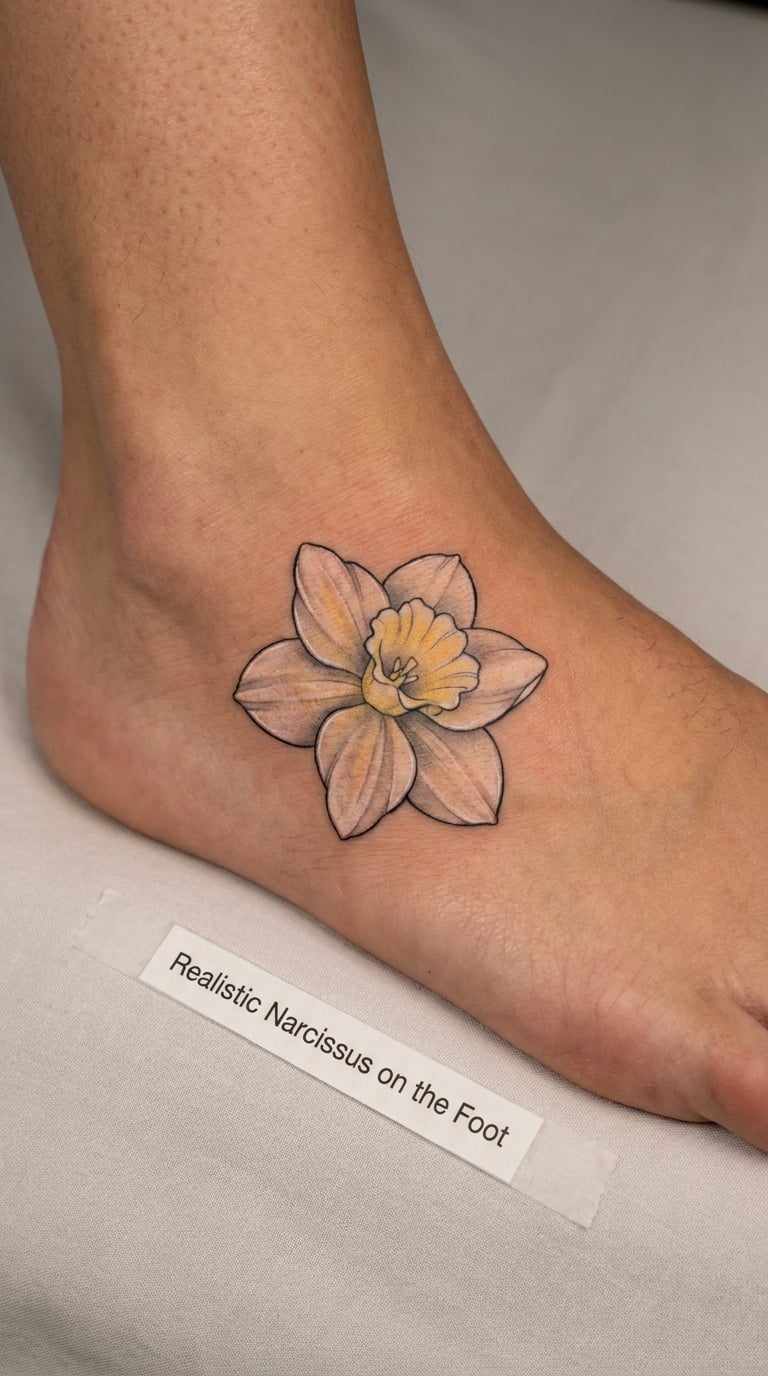
Layered petals with soft grey shading between them and a pale yellow trumpet, small enough to read as one bloom but detailed enough to hold the shading. The top of the foot gives a flat-enough surface for a rounded composition.
Feet are overlooked as tattoo placement, and that is exactly why people choose them, since a birth flower there is personal rather than public.
Placement: top of the foot near the ankle, or the inner ankle. Size: 2 to 3 inches (5 to 7.5 cm). Style: micro-realism with subtle shading.
Pain: medium to high, the ankle bone and the tendons in the top of the foot are both sensitive. Ageing note: feet get sandal sun and constant flexing, so this is one of the placements where choosing a stronger line weight up front pays off.
Make it yours: add a faint second bloom behind the first, partly hidden by the ankle bone, so the design changes as you move.
20. Geometric Daffodil Mandala on the Back
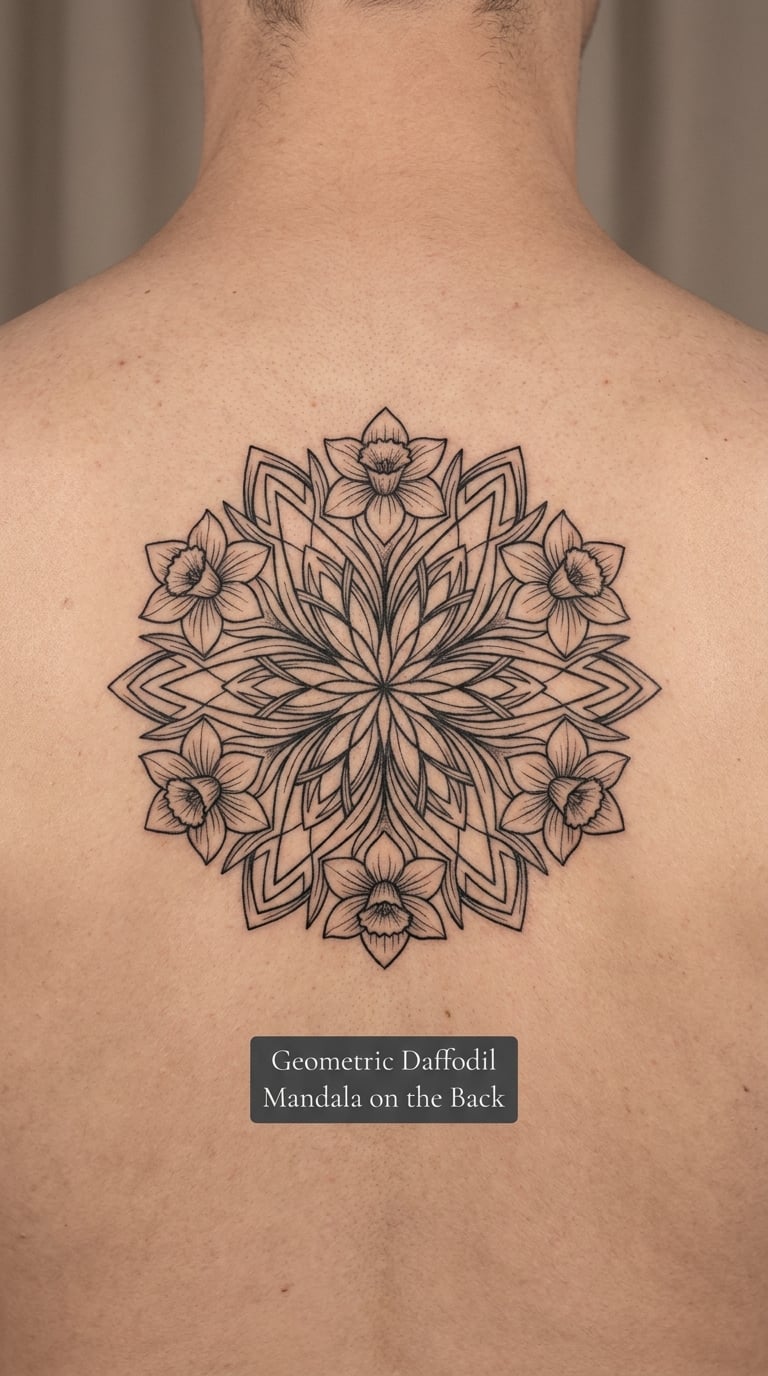
A symmetrical mandala built from the daffodil trumpet, mirrored petals radiating outward in fine black line work, with thin geometric rings around the edge. This is the statement piece in the gallery and the only one that reads as body art rather than a flower.
Geometric florals are chosen when the birth flower is the subject but the artwork should be the star, and they give a large back piece a clear centre point.
Placement: centred on the upper back between the shoulder blades, or centred on the chest. Size: 5 to 7 inches (13 to 18 cm) across. Style: geometric with fine line detail.
Pain: medium, though a piece this size is a full sitting and often a second session. Ageing note: fine geometric line work across the back is prone to the slowest kind of change, softening over many years, and a touch-up at two months keeps the ring detail crisp.
Make it yours: set the number of petals to match your birth day, then add your birth year along the lower ring.
How to Choose the Right Design
Almost everyone who lands on this page already knows they want a narcissus or a daffodil. The work is narrowing it down, and five questions do most of that narrowing.
- Which flower actually is your birth flower? Narcissus, paperwhite, daffodil and jonquil are all the same genus and all work for December. Holly is the other traditional December flower, and if you want it, go find an artist who draws berries well rather than forcing it into a floral design.
- What style do you want to be in five years? Blackwork and traditional styles keep their edges longest. Fine line and one-line work soften the most. Watercolour changes the most, because the washes were never meant to stay crisp.
- How small can the detail go? Below about 1.5 inches, a full daffodil loses its corona and starts looking like a blob. Below one inch, only a simplified trumpet or a solid silhouette still reads correctly.
- Where will you see it every day? Wrist, ankle, collarbone and lower rib are the easy daily spots. Sternum, rib and hand are bolder and more noticeable, and they hurt more to get.
- What does the meaning matter to you? Narcissus reads as hope, renewal and self-regard. Daffodil reads as the same flower in a louder visual voice. Decide whether you want the symbolism or the colour, because you rarely get both at full strength in one small piece.
What to bring to the consultation
Bring screenshots of the gallery here plus two or three reference photos of the real flower, in colour and in black and grey. Looking at healed work in an artist’s portfolio tells you far more than their fresh photos do, since fresh ink looks sharp on everything.
If you have been burned by a tattoo not matching the style you asked for, the fix is a conversation at the consultation, not a complaint afterwards. Say the word you want in the tattoo, such as fine line or blackwork, out loud, and ask to see the drawing before the stencil goes on.
Cost and Session Time
Tattoo pricing usually follows one of two models. Some studios charge a flat rate per design, so a small wrist flower and a large back piece can cost close to the same. Others charge by the hour, so size and detail drive everything. Most shops also have a minimum that covers the first hour, and some count a short session as a full hour even when the work takes forty minutes.
What moves a December birth flower tattoo up or down in that range: size is the biggest lever, then style, then how much colour blending is in it. A micro daffodil on a finger is a short single-needle job. A realistic forearm daffodil with whip shading takes much longer. A six-inch mandala is realistically a full day or split across two sittings.
Session length by rough size, so you can book sensibly: a piece under 2 inches usually takes well under an hour, a 3 to 4 inch floral runs one to two hours depending on shading, and anything above 5 inches is a long sitting or a multi-session project. Never let a shop rush a large piece into a single session to fit a schedule. If a price quote feels far out of line, ask what the hourly rate is and what the minimum is before booking.
Aftercare Basics
- Start with your artist’s instructions. Everyone heals a little differently, and what your artist told you on the day outranks any general advice, including this list.
- Wash it gently. Clean water and unscented soap, twice a day, then pat dry with a clean towel. Do not soak it, and keep it out of the shower for the first stretch of healing if your artist asked for that.
- Moisturise thinly. A thin layer of a plain unscented ointment or lotion, applied with clean hands. Thick layers trap heat and slow the process down.
- Protect it from sun and friction. No direct sun, no swimming pools or hot tubs, and no tight clothing over it while it is still fresh. Sunscreen on a healed tattoo is what keeps yellow and white flowers from fading.
- Expect the settling phase. Initial healing runs two to three weeks, the tattoo fully settles over four to eight, and most artists like to see you at two to three months for a free or reduced touch-up. Judging a design before the touch-up window is the most common source of regret, so give it time.
If you are not ready to commit, a temporary tattoo or a stencil on the skin for a few days is a genuinely sensible way to test a placement. More people regret the position than the flower, and a sticker costs nothing to try.
Frequently Asked Questions
What are December’s birth flowers?
December’s birth flowers are the narcissus and holly. The narcissus covers the paperwhite, the daffodil and the jonquil, since all of them are the same plant genus. The narcissus stands for hope, renewal, new beginnings and self-regard. Holly stands for protection, strength in difficulty and good fortune. Poinsettias and chrysanthemums are Christmas flowers but not birth flowers.
Is a daffodil the same as a narcissus?
Yes. Daffodil, narcissus, paperwhite and jonquil are all plants in the genus Narcissus, so any of them counts as a December birth flower tattoo. The daffodil is the one most people picture, with its yellow trumpet and ruffled corona, while the paperwhite is the white, heavily scented one that blooms indoors in winter. Pick whichever shape you actually like, because the meaning is the same.
What does a narcissus flower tattoo mean?
A narcissus tattoo usually means hope, renewal, new beginnings and self-regard. The flower comes from the Greek myth of Narcissus, who was so absorbed in his own reflection that he was transformed into the flower that bends toward water, and Victorian floriography added a note of respect and admiration. In modern symbolism it is the flower that blooms before everything else, which reads as a person who starts things.
Should a December birth flower tattoo be a narcissus or a holly?
Choose the narcissus if you want a floral, symbolic mark that reads clearly as a birth flower. Choose holly if you want something more graphic and seasonal, with berries, prickly evergreen leaves and a sharper silhouette. Many people wear both, one small flower and one sprig, in different places. Holly is the harder design to tattoo well, because the leaves need sharp edges and the berries need round, even volume.
Where do you place a small birth flower tattoo?
The best spots for a small birth flower are the inner wrist, the outer ankle, the collarbone and the side of the neck. All four are easy to reach, easy to keep clean, and low on the pain scale compared with the sternum or the ribs. The inner wrist and the ankle get more sun and movement, so plan on a touch-up. The collarbone and the side of the neck are the most discreet.
Do fine line flower tattoos fade?
Yes, and the honest version is that fine line work softens first. Thin single-needle lines have less ink in the skin than a blackwork fill, so they lose definition over time, and they fade fastest on the hands, fingers and inner wrist, where skin moves constantly and gets sun. Blackwork and traditional styles keep their edges longest. Book a touch-up at two to three months and use sunscreen on healed colour work.
For a first tattoo, go small and quiet: the minimalist white narcissus on the inner wrist or the fine-line daffodil sprig on the side of the neck. Both are under 2.5 inches, both heal predictably, and both are easy to walk away from if you change your mind later. For someone building a collection, the wreath on the thigh or the geometric daffodil mandala on the back give you room to add, and the matching-set idea works best if you start one small flower now and plan the second piece with it.