
20 Best Cancer Zodiac Tattoo Ideas to Inspire (September 2026)
Cancer is the fourth sign of the zodiac, ruled by the Moon and usually dated June 21 to July 22, and its symbols are a crab, the sideways 69 glyph, lunar phases and the Cancer constellation. These cancer zodiac tattoo ideas work because each one takes a recognisable piece of that vocabulary and adapts it to a real body shape, a real size and a real budget. Every design below covers what it looks like, where it sits, how big it should be and how it ages.
People book these for very different reasons. Some want the crab because it is their sign, others want a wave or a moon that fits a Cancer mood without the literal animal, and plenty of them are tattooing a partner, a child or a whole family of signs. If you are still deciding, save two or three of these and bring them to a consultation as references rather than asking an artist to copy one exactly.
Quick Guide: Cancer Zodiac Tattoo Ideas at a Glance
Here is the short version. Sizes are realistic healed dimensions, not drawing-board sizes, and pain ratings assume the placement named in the row.
| Idea | Style | Best placement | Size | Pain |
|---|---|---|---|---|
| 1. Fine-line crab | Fine line | Behind the ear | 2-2.5 in | Medium |
| 2. Cancer constellation | Dotwork | Inner forearm | 3.5-4 in | Medium |
| 3. Moon and crab | Fine line | Outer rib | 3 in | High |
| 4. Number 69 glyph | Geometric lettering | Inner wrist | 1.5-2 in | Medium |
| 5. Cancer wordmark | Fine-line script | Collarbone | 3 in | Medium |
| 6. Crab claw pair | Fine line | Both collarbones | 2-2.5 in each | Medium |
| 7. Glyph on the foot | Bold black line | Outer ankle | 1.5 in | High |
| 8. Zodiac wheel | Black and grey | Upper arm | 4.5-5 in | Medium |
| 9. Birth chart snapshot | Micro fine line | Forearm | 3.5-4 in tall | Medium |
| 10. Blackwork crab | Blackwork | Outer upper arm | 4 in | Medium |
| 11. Retro crab | Illustrated / mid-century | Outer ankle | 3 in | High |
| 12. Dotwork finger crab | Micro dotwork | Side of index finger | 1 in | Low to medium |
| 13. Crab and compass | Fine line | Forearm sleeve | 4 in | Medium |
| 14. Watercolor crab | Watercolor | Calf | 4.5-5 in | Low to medium |
| 15. Geometric mandala | Geometric linework | Shoulder blade | 3.5-4 in | Medium |
| 16. Botanical crab | Illustrative botanical | Thigh | 5 in | Medium |
| 17. Fortune-cookie crab | Illustrative / graphic | Upper arm | 3 in | Low to medium |
| 18. Sun, waves and crab | Illustrative colour | Shoulder / upper back | 5 in | Medium |
| 19. Rib crab | Minimal line | Between the ribs | 2-2.5 in | High |
| 20. Cracked glyph | Illustrative / bold | Outer calf | 3 in tall | Medium |
1. Fine-Line Cancer Crab Behind the Ear
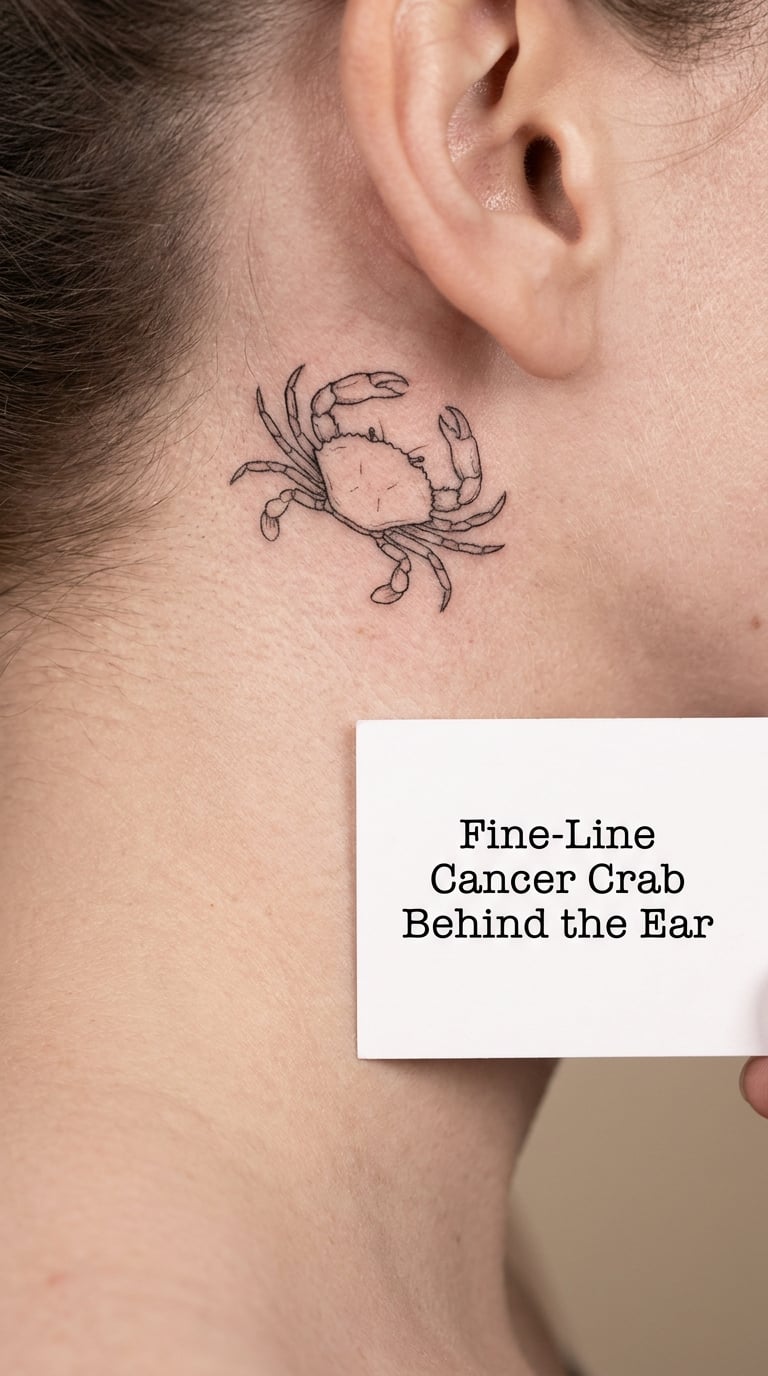
A single unbroken line traces the crab from claw to claw, with two or three short hatch marks for the legs and nothing else. Restrained detail is what makes this work at that scale, because anything more turns into a smudge behind the ear within a couple of years.
The crab is the sign’s emblem, a hard shell over a soft body, so people usually pick it to say something about how they protect the people they love. It is a first-tattoo design that does not shout, which is exactly why so many people start here.
Placement: behind the outer ear, on the soft skin between the ear and the hairline, or just under the earlobe · Size: 2 to 2.5 inches (5 to 6.5 cm) across · Style: fine line, single-needle black ink
Pain: medium, a scratchy sustained feeling rather than sharp. Fine line behind the ear softens and blurs faster than most placements, so expect a touch-up after a year or two if you want crisp claws.
Make it yours: put the claws holding a tiny dotwork star, or take a small wave under the body instead of a full crab outline.
Cancer Zodiac Tattoos by Style
Blackwork is the boldest read: solid ink shapes, no shading gradients, and it holds its shape for decades. Fine line is the opposite discipline, one-needle work that reads as elegant and delicate but fades sooner, particularly on hands, fingers and anywhere the skin stretches daily. Celestial work leans on moons, stars and constellations, and it is the easiest way to wear a Cancer sign without a literal crab.
Traditional and neo-traditional bring saturated colour, heavy black outlines and stylised shading, which is where a crab with a skull or a rose can live comfortably. Illustrative styles treat the crab as a character, soft edges and painterly transitions rather than hard contours. Geometric work turns the 69 glyph into a mandala or a cracked graphic shape, and it is the most forgiving family for someone who wants a bold piece that is still built from simple geometry.
2. Cancer Constellation Forearm Tattoo
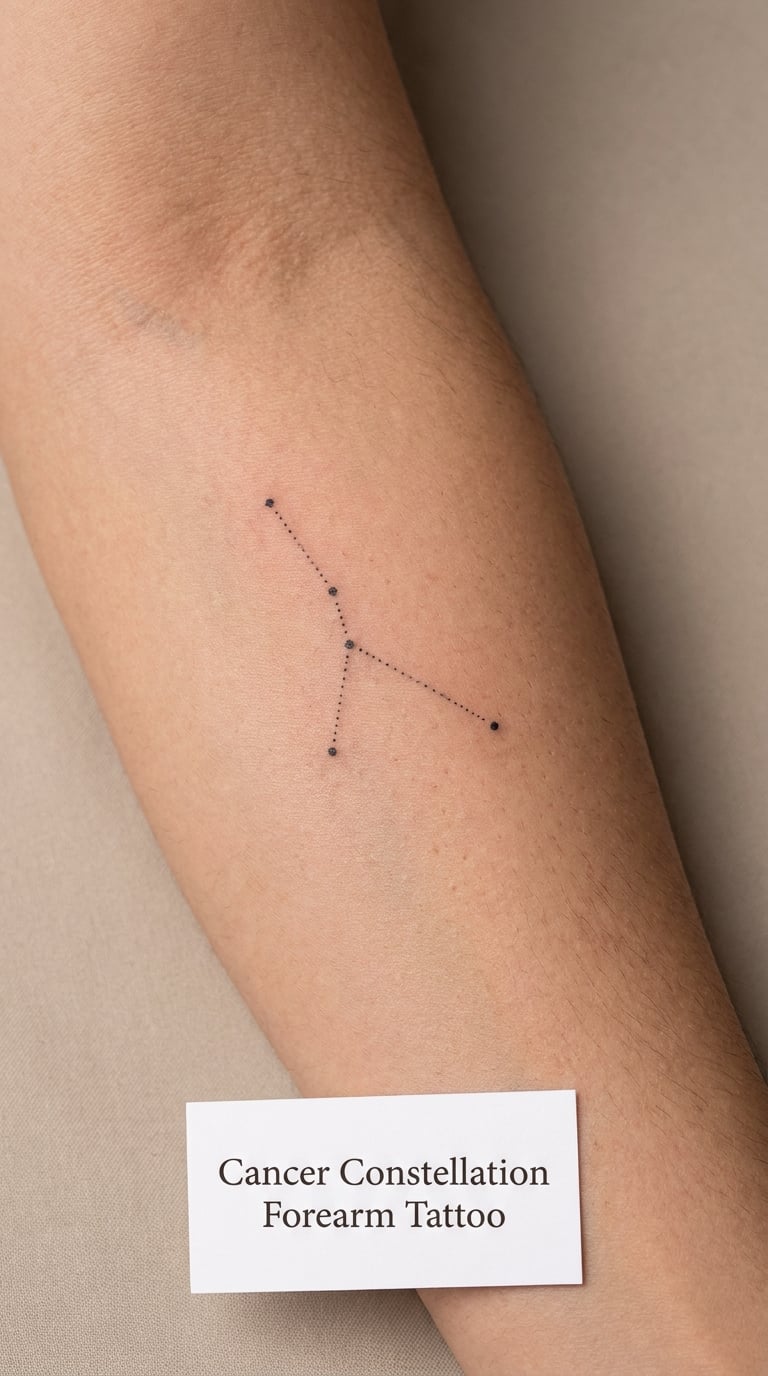
The Cancer constellation, 99 Cancri, is a scatter of fine dots joined by hairline strokes, arranged so the pattern still reads as the crab shape people recognise. The dots vary in size, which is what makes it look like a star map rather than a diagram.
Plenty of wearers pick this over the animal because a star map is personal without being literal. It can point at the real sky position for a birth date, or simply follow a stock pattern the artist already knows.
Placement: inner forearm running along the length of the arm, or across the upper arm · Size: 3.5 to 4 inches (9 to 10 cm) long · Style: micro dotwork with fine connecting lines
Pain: medium on the inner forearm, and the forearm tends to swell and shrink through the session so the design can need a break. Tiny dots are the first thing to soften over time, so a slightly bolder dot size buys more years of clarity.
Make it yours: plot the sky for your birth night, or add one extra larger star with your birth year inside it.
3. Crescent Moon and Crab Side Tattoo
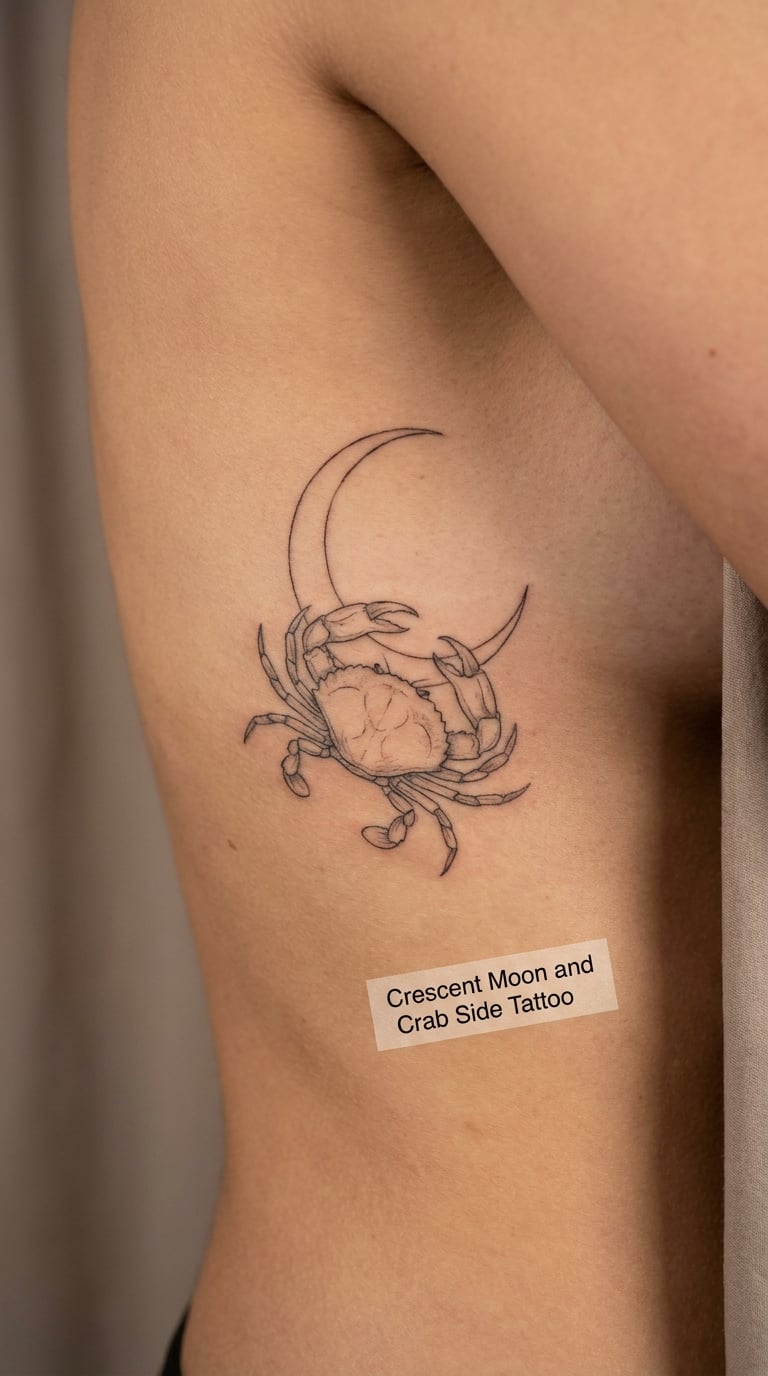
A crab in profile sits under a thin crescent, both drawn in outline with a few shading lines where the shell curves. The composition is quiet but balanced, and the crescent gives you a natural place to add a date later.
The Moon rules Cancer, so this pairing is the one wearers reach for when they want the sign to read as lunar rather than as a zodiac chart. It suits people who like their astrology visible but low-key.
Placement: outer rib, side thigh, or behind the calf · Size: about 3 inches (7.5 cm) wide · Style: fine line with light stippled shading
Pain: high on the ribcage. Bony, thin skin and constant movement make it one of the more talked-about spots, and expect the artist to stop and stretch the skin often.
Make it yours: phase the moon to the actual moon on your birth date instead of leaving it a plain crescent.
4. Graphic Number 69 Symbol
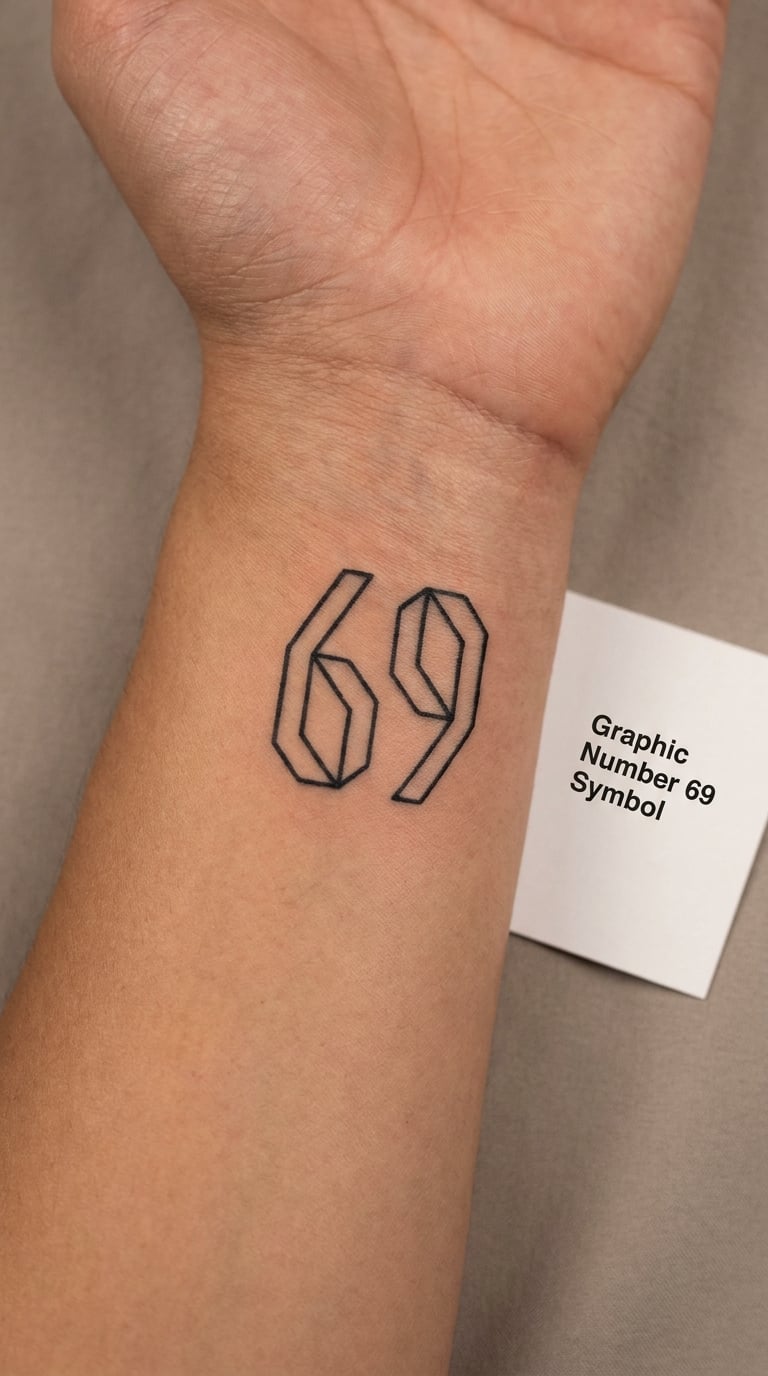
The Cancer glyph is two stacked loops, a 6 and a 9, and it is usually drawn as a clean geometric form rather than as handwriting. Bold terminals and an even stroke width are what stop it from reading as an ordinary number at small scale.
Some people avoid the glyph because it looks like a number and worry about being asked about it. In practice most wearers simply say it is their sign. Worth deciding before you sit down which explanation you are comfortable giving.
Placement: inner wrist, behind the ear, sole of the foot, or the small of the calf · Size: 1.5 to 2 inches (4 to 5 cm) tall · Style: geometric linework or clean black lettering
Pain: medium on the inner wrist, more noticeable on the wrist bone itself. The glyph is compact, and a thin version of it can lose its loop definition in a few years, so go bolder than feels necessary.
Make it yours: set it in a small circle of dotwork stars, or put it inside a hexagon honeycomb cell.
5. Cancer Word in Flowing Script
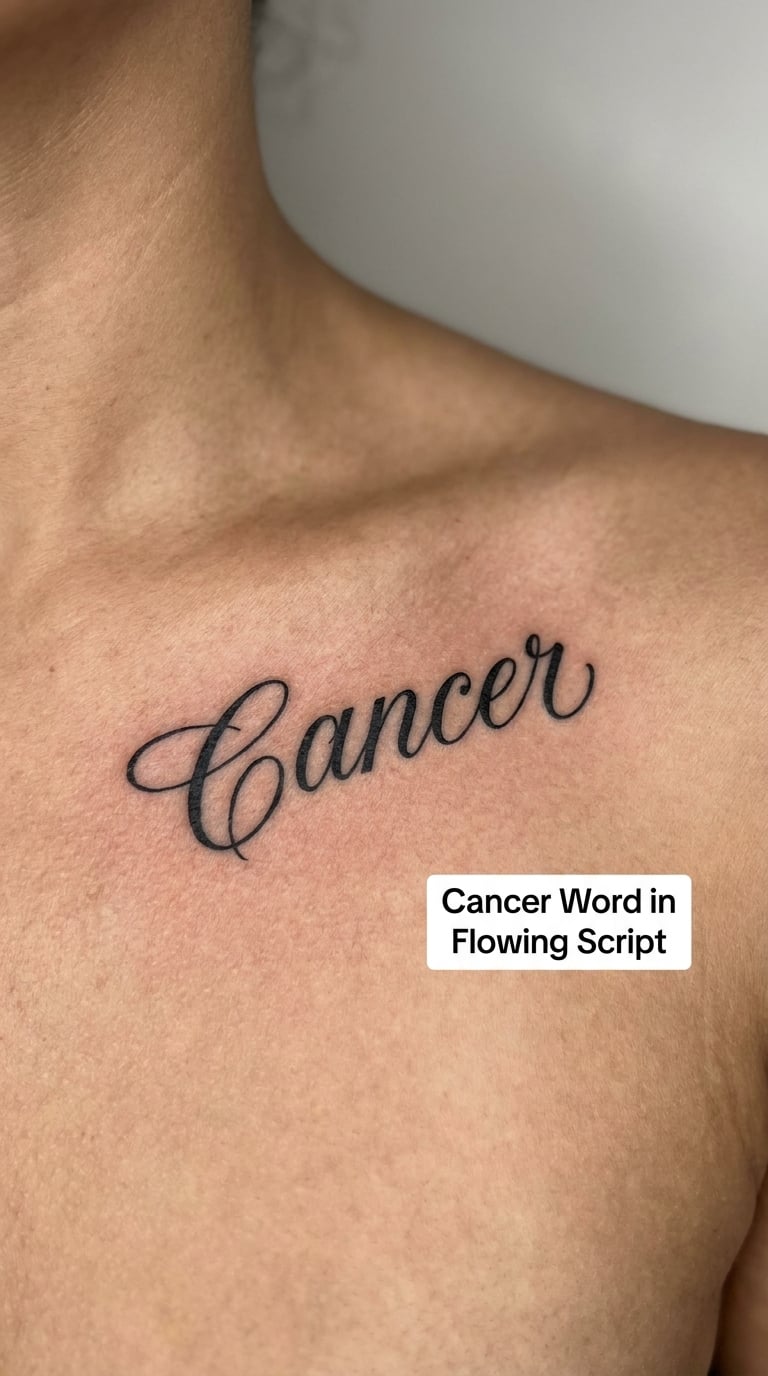
The word Cancer set in a slanted modern script, with a single thick downstroke and thin hairlines between, reads clearly even at collarbone scale. The trick is generous line spacing, because tight lettering fills in as the ink settles into the skin.
Word tattoos get dismissed more than they deserve, mostly because script ages with a shakier outline. Done with breathing room and a slightly heavier entry stroke, a word like this is a quiet way to name the sign without an animal.
Placement: above the collarbone, the inner arm, or along the ribs · Size: 3 to 3.5 inches (7.5 to 9 cm) wide · Style: fine-line script or modern calligraphy
Pain: medium, and the collarbone is tender where the bone sits close to the surface. Hand-lettered strokes like the thin connectors blur first, so a touch-up at around the one-year mark is normal for script.
Make it yours: add the birth date in small numerals underneath, or the word home beneath it if the sign’s fourth-house meaning is the part that matters to you.
6. Symmetrical Crab Claws Collarbone Tattoo
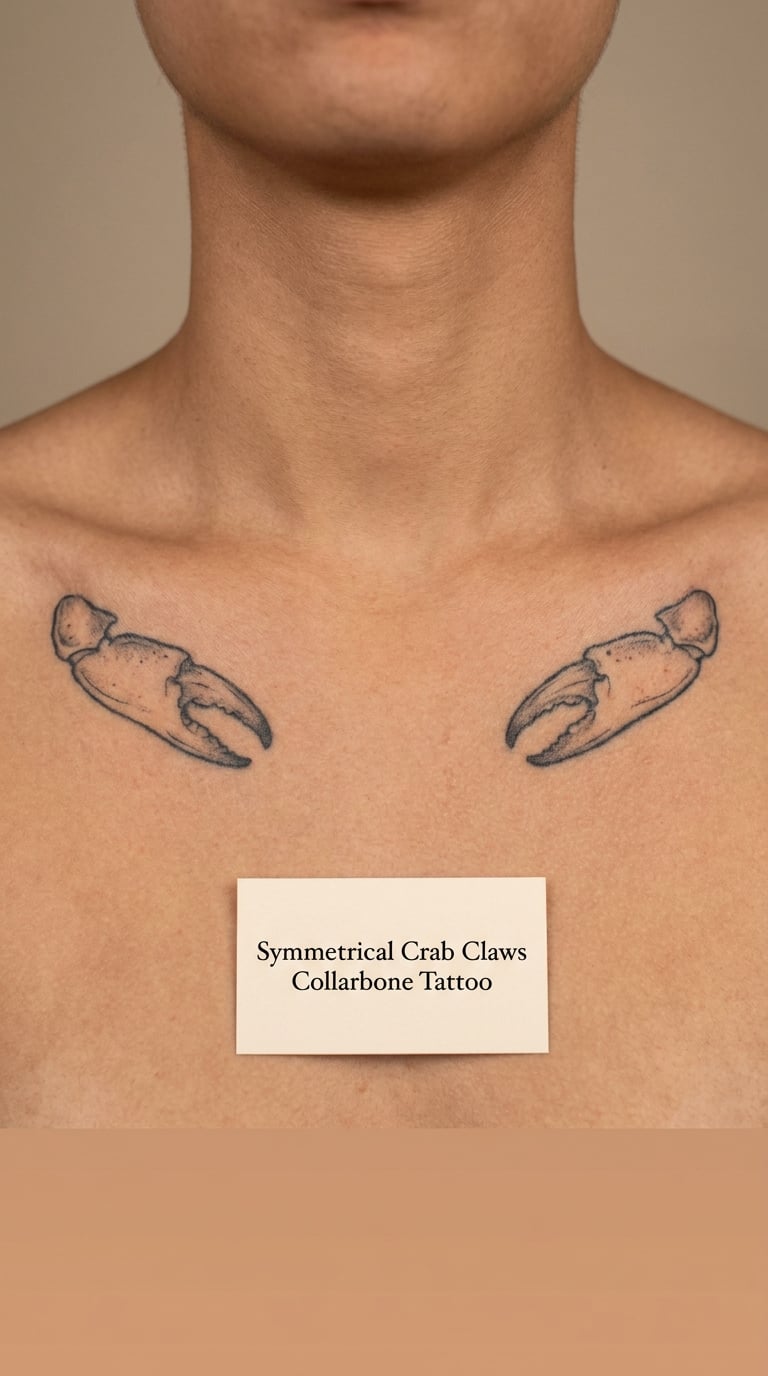
One claw on each side, mirrored so the pincers angle inward toward the throat. Each is drawn in outline with a couple of inner lines marking the pincer joint, and the two are matched closely enough to read as a pair from across a room.
Crab claws are a common shorthand for Cancer precisely because they suggest a protective grip without needing a whole animal. It is also a design two people can split between them, which makes it a natural matching tattoo.
Placement: just above each collarbone near the shoulder, or one claw on each inner forearm · Size: 2 to 2.5 inches (5 to 6.5 cm) each · Style: fine line, mirrored pair
Pain: medium, and the collarbone area bruises visibly afterwards. The real challenge is symmetry, since the two sides of the body sit differently and one claw will usually need a small adjustment as it is drawn.
Make it yours: fill the negative space inside one claw with a small dotwork wave so the two are related but not identical.
7. Cancer Glyph on the Foot
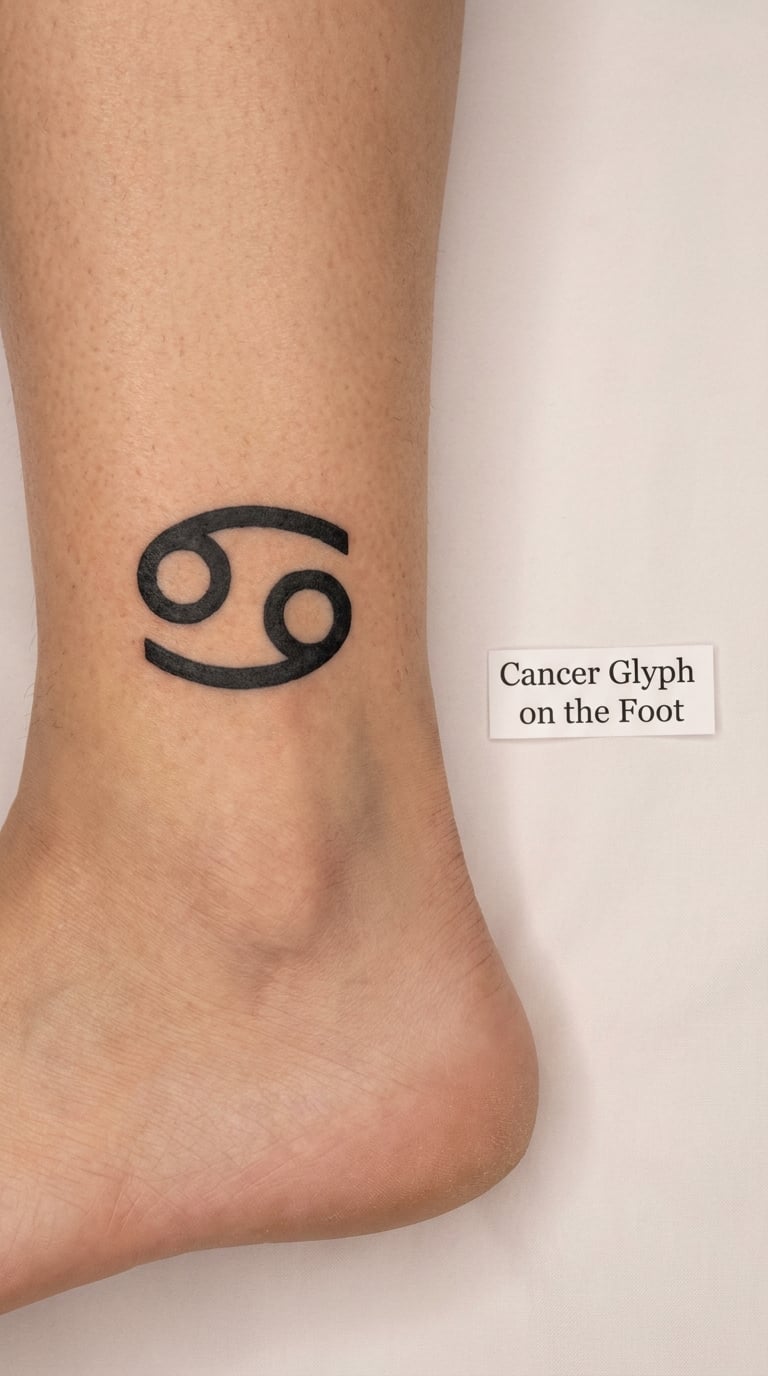
The 69 glyph drawn thick, with heavy stroke weight and squared terminals so the two loops stay distinct. Foot skin stretches and folds, so a bold version tolerates the movement in a way a thin outline does not.
An ankle placement keeps the sign close to something people notice late and in person rather than a chest or forearm piece everyone photographs. It suits people who want a meaningful tattoo without wearing it where they work.
Placement: outer ankle above the foot, the arch, or the inside of the heel · Size: 1.5 inches (4 cm) wide · Style: bold black line work
Pain: high. The ankle is bony and the nerve endings there are dense, and the arch is even more sensitive. Many people rate foot or ankle as the worst spot on the body.
Make it yours: run a small wave line along the ankle and out toward the toes so the glyph does not float there alone.
8. Full Zodiac Wheel with Cancer Highlighted
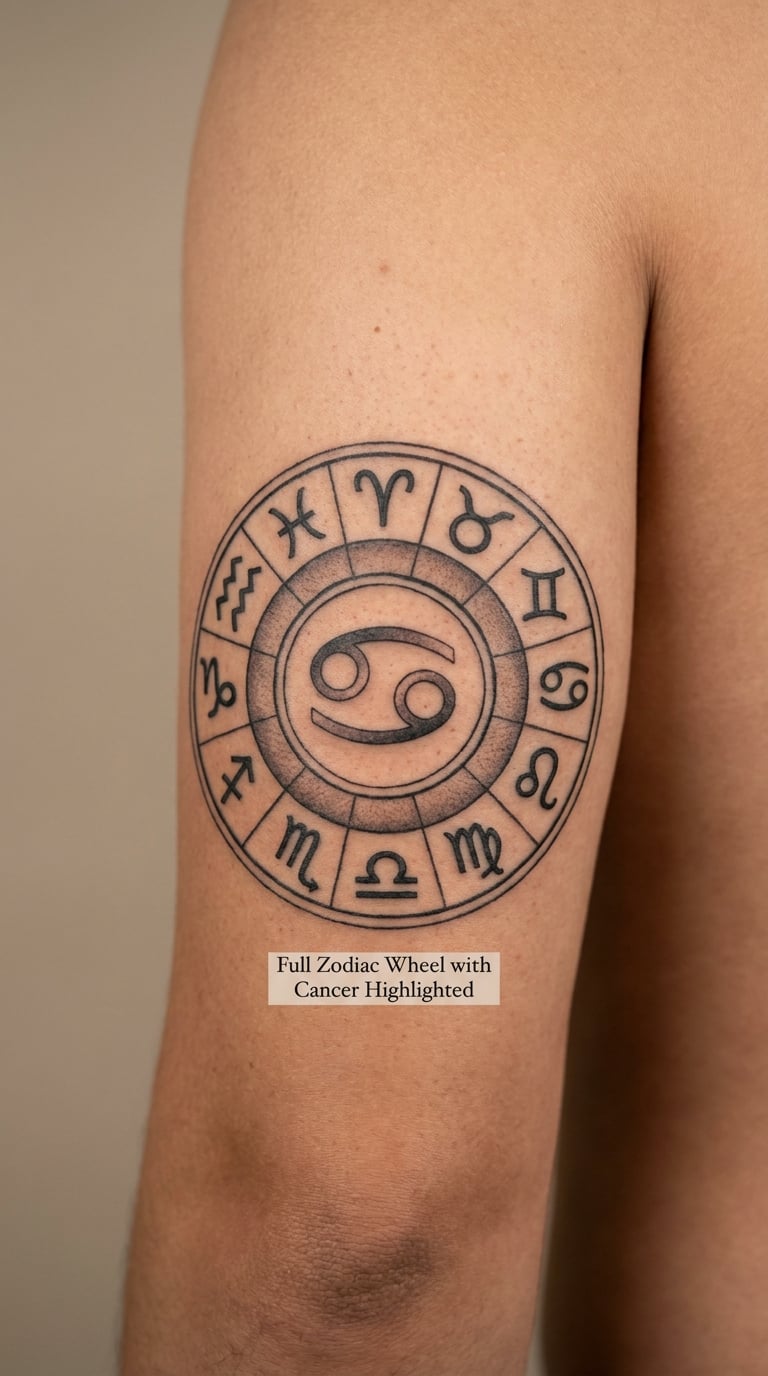
A circular wheel divided into twelve segments, each holding a small sign glyph, with the Cancer segment given heavier line weight, a thicker outer ring or a wash of grey behind it. At five inches across the smallest glyphs are still readable, which is what makes the circle work.
This is the piece for someone whose sign is one of a set, whether that is the whole zodiac, a birth chart, or a family of signs worn in several pieces. It also answers the question of how to show one sign without hiding the other eleven.
Placement: outer upper arm, thigh, or across the shoulder blade · Size: 4.5 to 5 inches (11 to 13 cm) diameter · Style: black and grey, illustrative linework
Pain: medium and long. This is a multi-hour piece, so budget breaks, and the forearm and inner elbow areas will need stretching partway through.
Make it yours: have the birth year or an initial drawn in the segment beside Cancer rather than treating all twelve as identical.
9. Cancer Birth Chart Snapshot
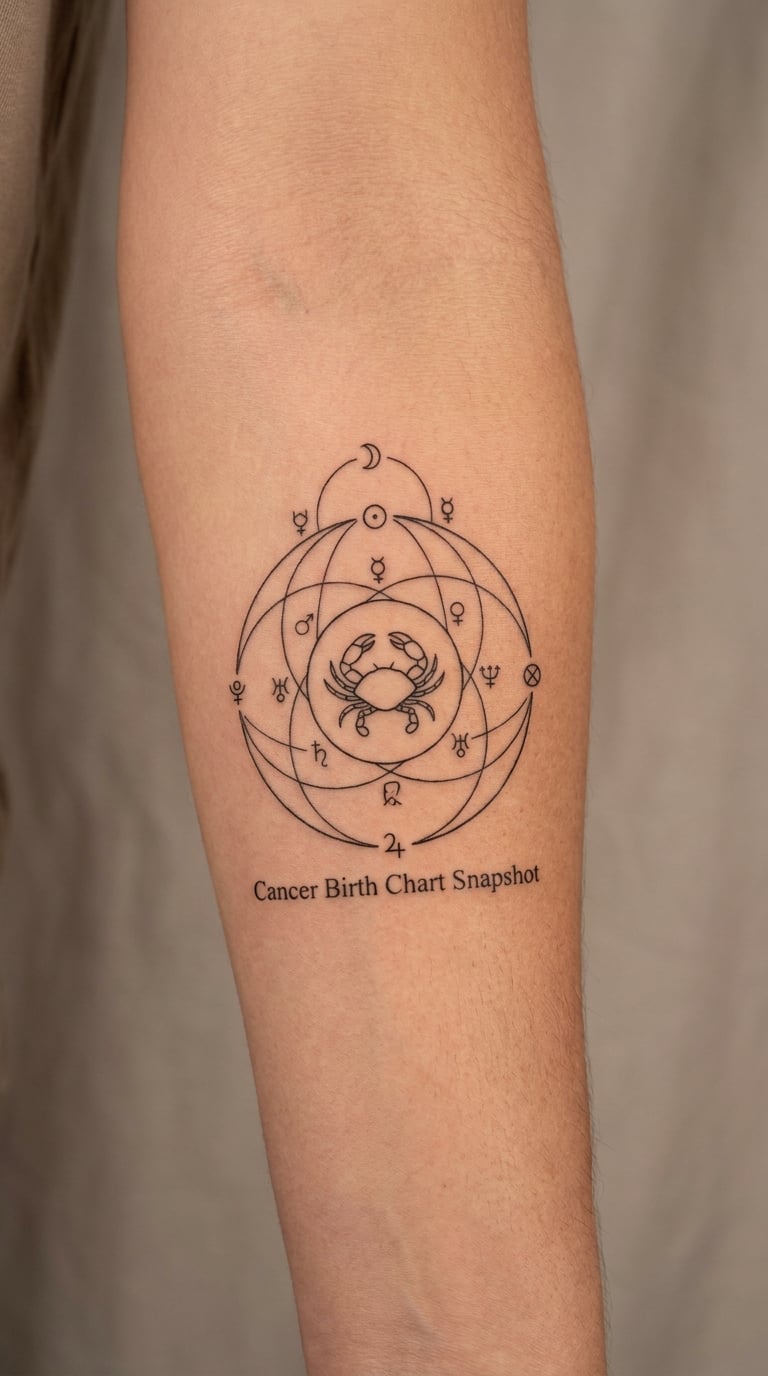
A simplified astrological chart: a circle, a few spokes, and the handful of planetary glyphs that actually fall in your chart, with the Cancer sun marker given a little more weight. A full chart printed small turns into grey mush, so the trick is cutting it down to the parts that matter to the wearer.
This is the version for someone who cares about more than the sun sign. Moon sign, rising sign and house placements are all things wearers genuinely distinguish, and a chart snapshot can carry any combination of them.
Placement: flat inner or outer forearm, back of the hand, or inside the upper arm · Size: 3.5 to 4 inches (9 to 10 cm) tall · Style: micro fine line
Pain: medium on the forearm. Planar text is the most fragile content on a forearm because the skin flexes every time you grip something, and small planetary glyphs will soften over time.
Make it yours: have your actual chart plotted rather than a generic one, and check it with a reliable chart calculator before it is tattooed.
10. Blackwork Crab with Flowing Claws
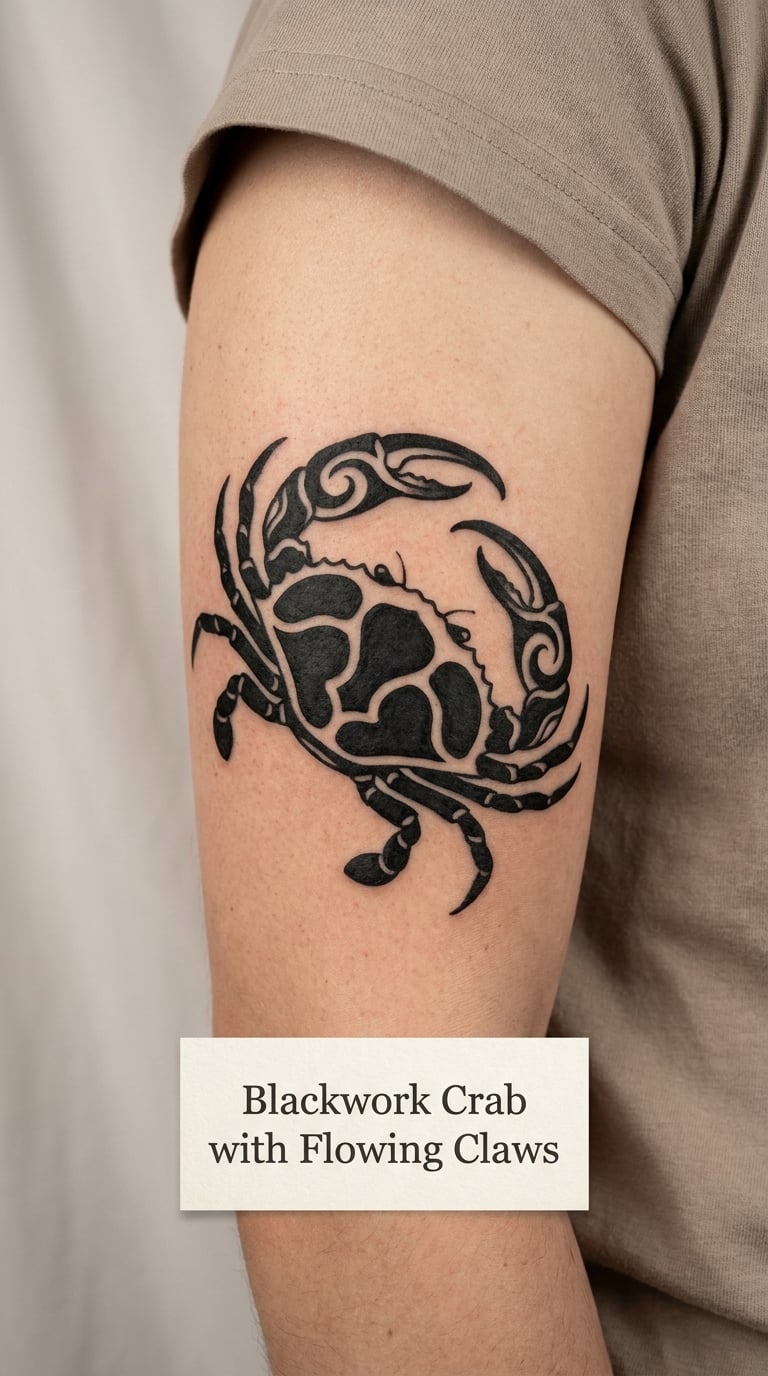
A crab built from solid black shapes, with the legs and claws flowing into long tapered strokes that trail off the body. The white space between the strokes is doing half the work, and that negative space is what separates good blackwork from a blob.
Blackwork ages better than anything else in this list. There is no shading to soften and no hairline detail to lose, which makes it the safest choice for a design someone wants to stay readable for decades.
Placement: outer upper arm, shoulder, or the calf · Size: 3.5 to 4 inches (9 to 10 cm) wide · Style: blackwork, solid fill
Pain: medium on the arm, and the solid fill is the stingiest part because the needle keeps going over the same area. Take the break when it is offered.
Make it yours: add a single colour pass, usually a red dot for the eye or one accent claw, to break up the black without turning it into a colour piece.
11. Retro Crab on the Ankle
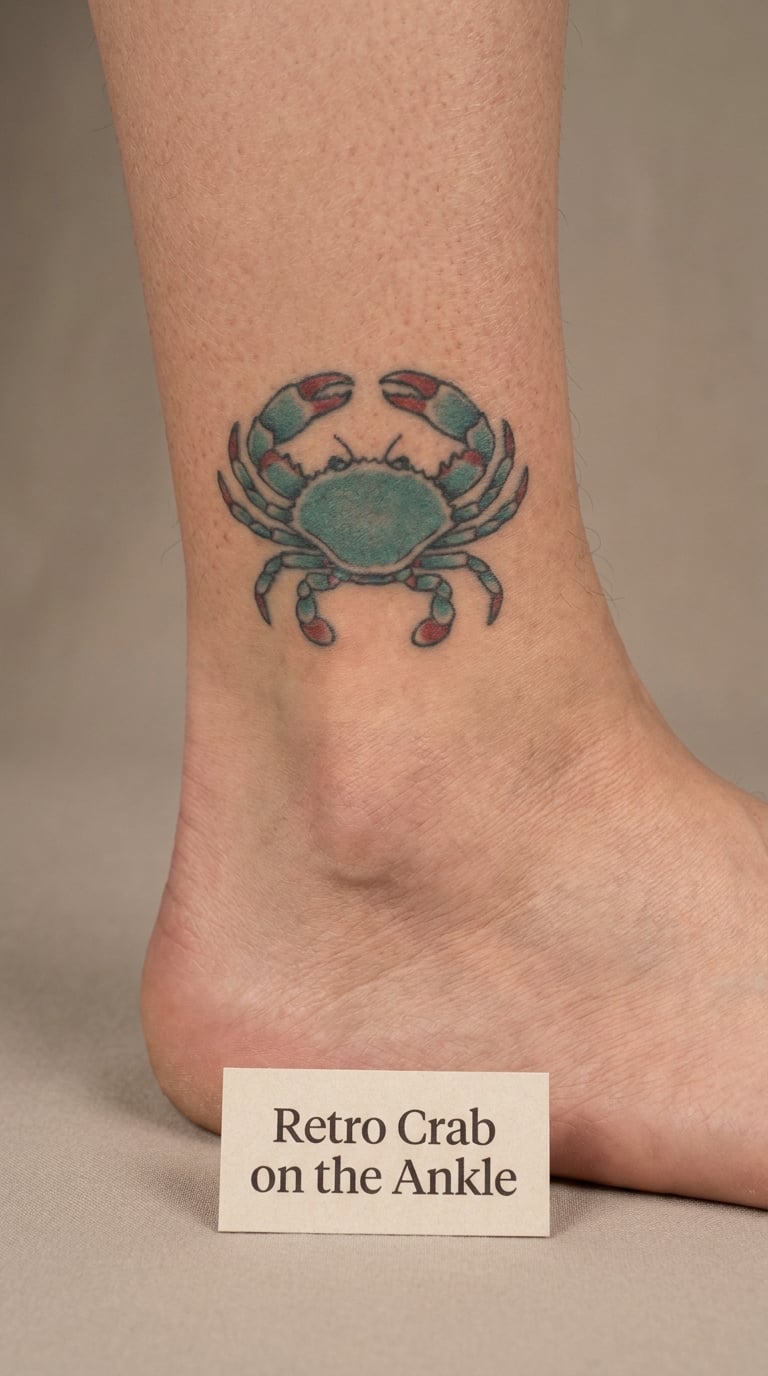
A mid-century illustrated crab, slightly rounded and stylised rather than anatomically exact, filled with muted teal and a warm red claw, all sitting inside a soft-edged shape. Flat colour and confident outlines are what carry the retro look.
Retro illustration suits a birthday piece or a summer birth sign, and it hides small imperfections better than fine line does. The palette is the personality here, and less colour reads more vintage than more colour.
Placement: outer ankle, lower calf, or the top of the foot · Size: 2.5 to 3 inches (6.5 to 7.5 cm) wide · Style: mid-century illustrative with light colour
Pain: high on the ankle bone. Coloured work means more passes over the same skin, and coloured ink on the lower leg takes a touch-up sooner than black line work.
Make it yours: put two or three stylised wave lines behind the crab so it looks like it is walking out of the water.
12. Tiny Dotwork Crab on a Finger
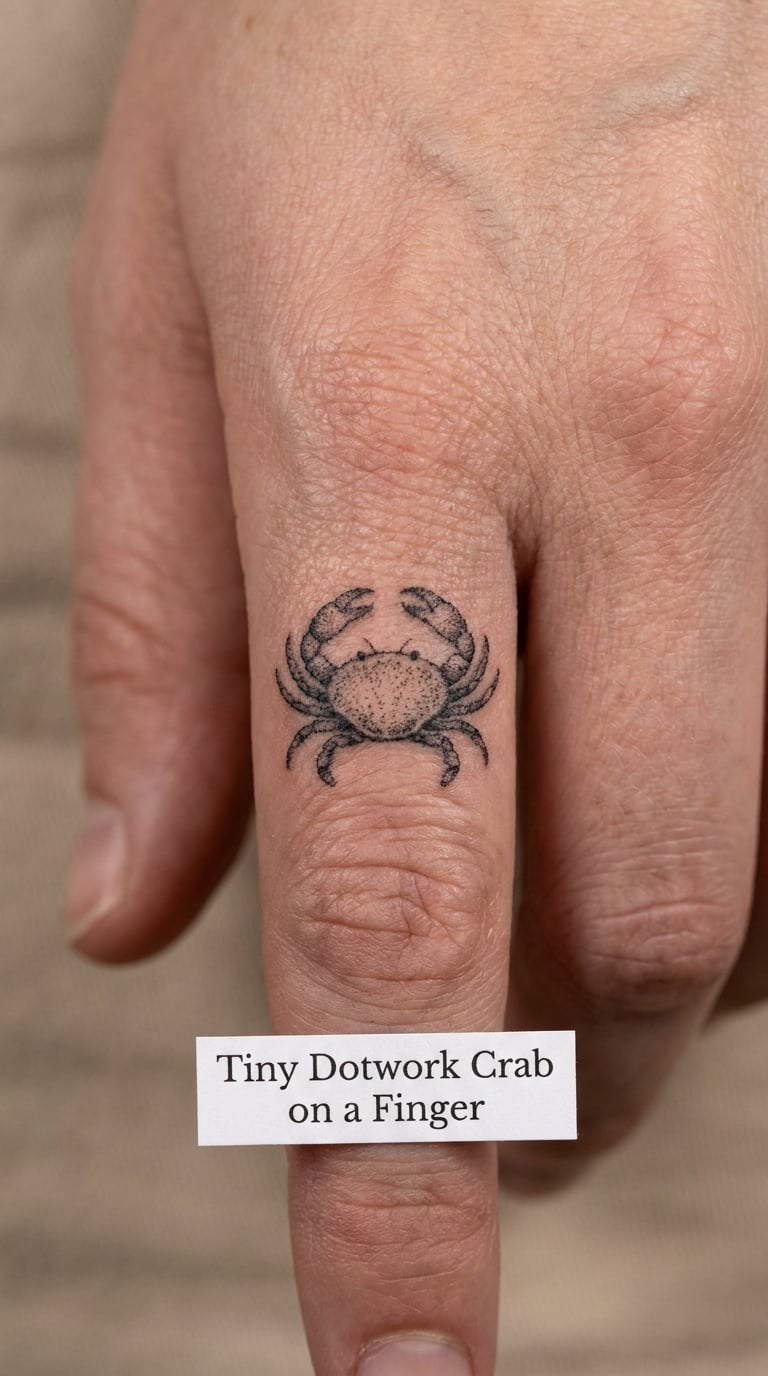
A crab reduced to a dot-filled body, two claw shapes and four stippled legs, kept deliberately simple so it still reads at finger scale. Dot density does the shading here instead of gradient grey, and the outline needs to be a solid line rather than dots.
Finger tattoos are the most common first small piece because they are cheap to commit to. The honest caveat: hands take a beating, and any design smaller than about an inch on a finger will blur noticeably within five years.
Placement: side of the index or ring finger, along the finger’s inner edge · Size: 0.75 to 1 inch (2 to 2.5 cm) wide · Style: micro dotwork
Pain: low to medium, a short scratchy sting, but the knuckle and the bony side of the finger are sharper than the padded inner face.
Make it yours: add a hairline wave wrapping the finger like a ring, which hides the edges of the crab when it eventually softens.
13. Crab and Compass Sleeve Element
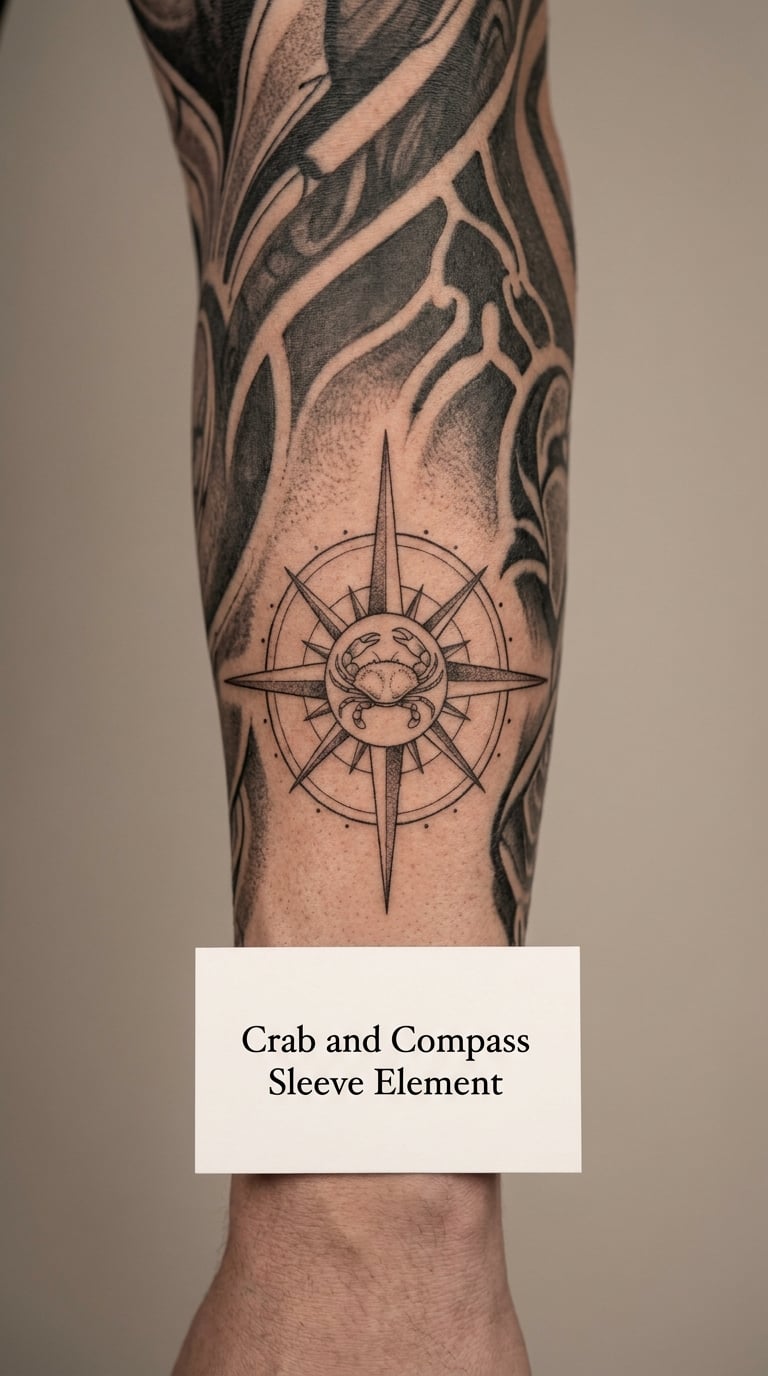
A four-point compass drawn in fine line, with a small crab sitting at the centre where the needle meets the rose. The crab is a supporting element rather than the subject, so it stays small and simple, around an inch, while the compass carries the shape.
Direction and travel are the reason this composition works for a Cancer, and it is a natural fit for someone who already has a sleeve in progress. It gives a blank stretch of forearm a focal point without competing with what is already there.
Placement: within an existing forearm sleeve, or alone on the inner forearm · Size: 4 inches (10 cm) long for the compass, 1 inch for the crab · Style: fine line, directional
Pain: medium, and it fits better into a planned sleeve session than as a standalone appointment, since the artist is already working that area.
Make it yours: set the crab at true north instead of the centre, or use a real destination’s coordinates as the frame around it.
14. Watercolor Crab Rising from Waves
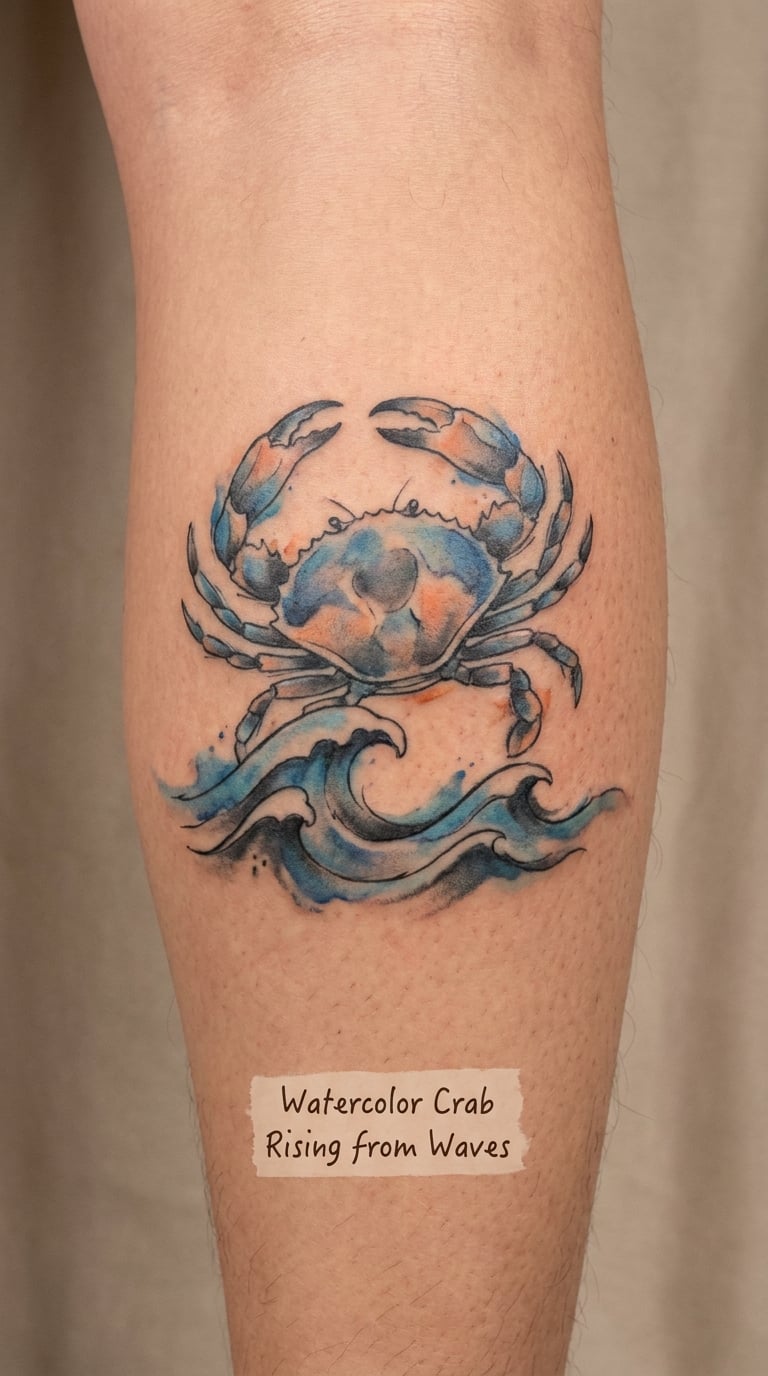
A loose crab built from soft washes rather than outlines, in diluted blue and charcoal with a single muted orange note, sitting above two sweeping wave strokes. Watercolour relies on very light pigment, so it looks softer and more like a painting than an illustration.
Water is the element Cancer belongs to, and the washes let the design carry that without any extra symbolism. It is a genuinely forgiving style, because a slightly uneven edge reads as intentional rather than as a mistake.
Placement: calf, thigh, or the shoulder where a soft piece can sit across a curve · Size: 4.5 to 5 inches (11 to 13 cm) wide · Style: watercolor with ink detail
Pain: low to medium, because a wash goes on gently. Colour work takes longer, so this is usually a two-to-three-hour sitting rather than a quick session.
Make it yours: choose the palette from something real, a shirt, a beach, a year you want marked, and give the artist the reference rather than picking a generic blue.
15. Geometric Cancer Sign Mandala
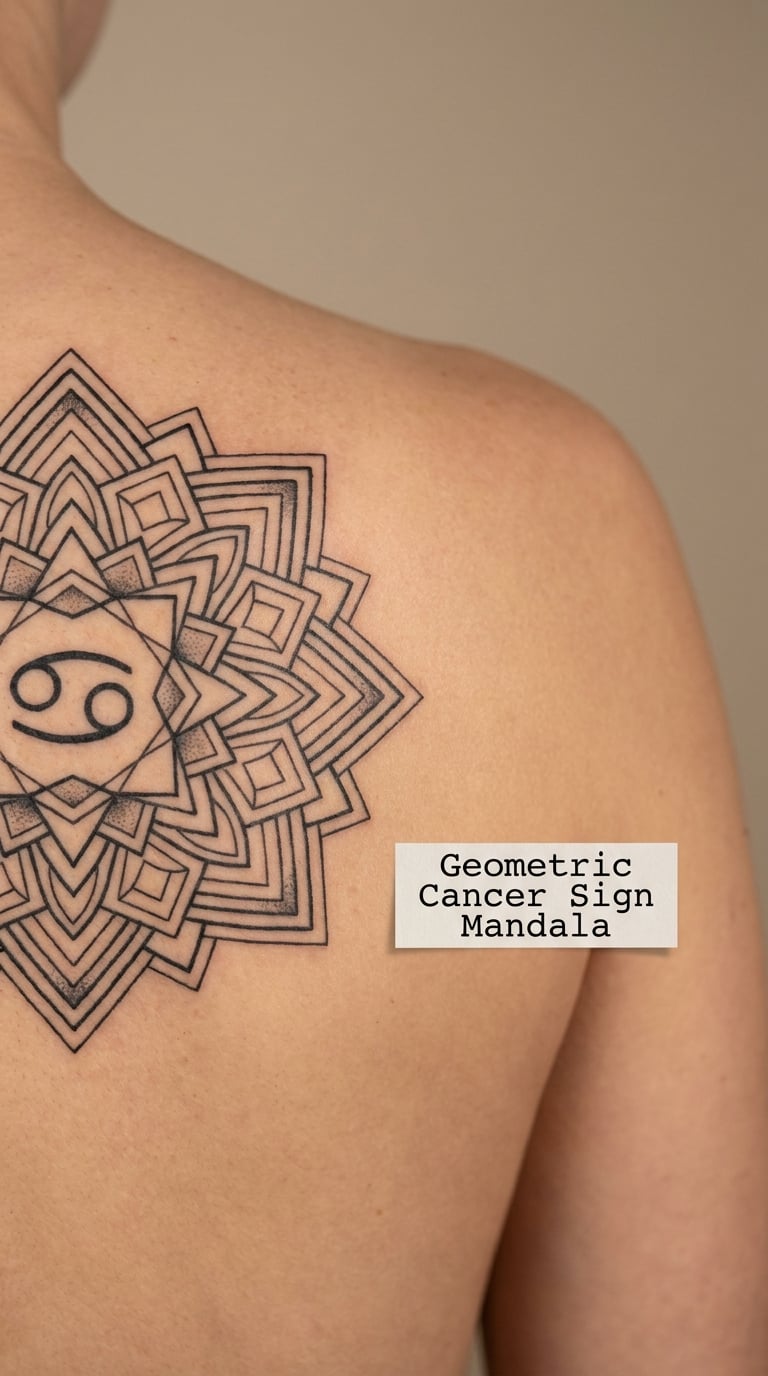
The 69 glyph taken apart and rebuilt as a radial pattern, with each loop mirrored across a centre axis and a ring of fine triangles or hexagons filling the space around it. Symmetry is the whole discipline, and it has to be built in, not corrected by eye.
Geometric work is a good answer for someone who finds the crab too literal but still wants the sign’s own shape. It also scales unusually well, since radial designs hold together at small sizes in a way a side-on crab does not.
Placement: shoulder blade, upper back, forearm, or the centre of the chest · Size: 3.5 to 4 inches (9 to 10 cm) diameter · Style: geometric linework, symmetrical
Pain: medium, higher over the shoulder blade where the skin is thin and near bone. Expect a long session for a detailed radial build, usually split in two.
Make it yours: set the birth month number in the outer ring instead of a generic pattern, or add one meaningful colour to a single segment.
16. Floral Crab Botanical Tattoo
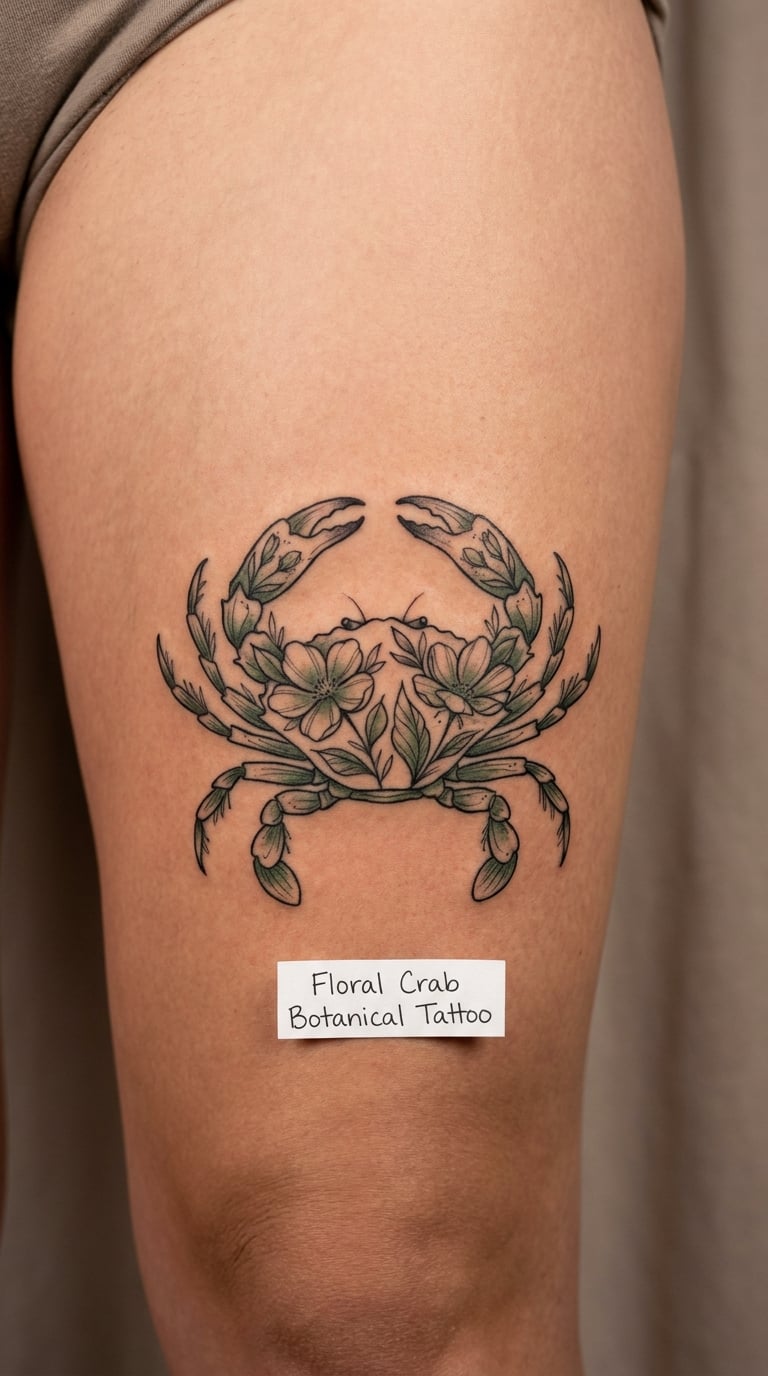
A detailed crab framed by stems and leaves, with the plant work in soft green and the crab in black and grey linework. The composition needs breathing room around the claws, since flowers and pincers both want to be the focus and fight if they touch.
Flowers soften a hard-shelled animal into something softer and more traditionally decorative, which is why this pairing comes up so often. If the wearer wants more symbolic furniture, the same construction works for a rose or a botanical wreath.
Placement: outer thigh, hip, or the forearm · Size: 4.5 to 5 inches (11 to 13 cm) wide · Style: illustrative botanical with light colour
Pain: medium on the thigh, though it is a long piece with a lot of small separate passes, so the session is a commitment even if any single patch is easy.
Make it yours: use a plant that means something to you rather than a generic laurel, and keep the green to a single hue so the crab still leads.
If the symbolic framing here appeals to you more than the crab, 73 Beautiful Tarot Card Tattoo Ideas That Will Inspire You covers the same build-it-from-symbols approach with a different set of motifs.
17. Crab Held in a Fortune-Cookie Shape
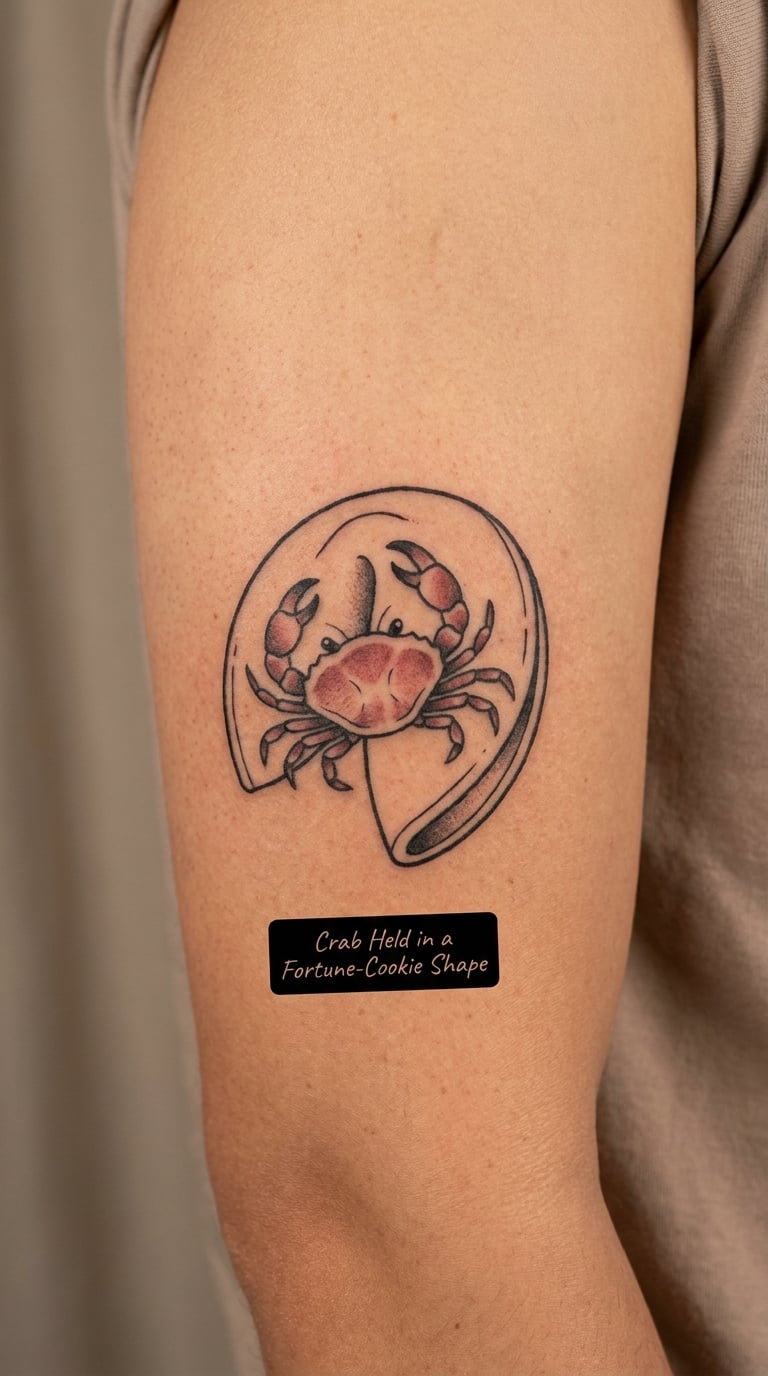
An opened fortune-cookie shape drawn in thick black outline, with a small red crab sitting in the opening and a paper slip tucked behind it. The shapes are simple and bold, which is what makes the joke land without turning into a cartoon.
It is the design in this list with the most personality and the least astrology in it, and it usually gets picked as a fun first tattoo or as a small piece for someone who does not want their sign taken too seriously.
Placement: outer upper arm, forearm, or the calf · Size: 2.5 to 3 inches (6.5 to 7.5 cm) wide · Style: bold graphic outline with one colour accent
Pain: low to medium, since it is a small piece of thick outline work. Thick lines also age better than hairlines, which is the right trade-off for a design this playful.
Make it yours: have a real message from the cookie folded into the drawing, hand-lettered small so it reads as a detail rather than a poster.
18. Sun, Waves and Cancer Crab Summer Motif
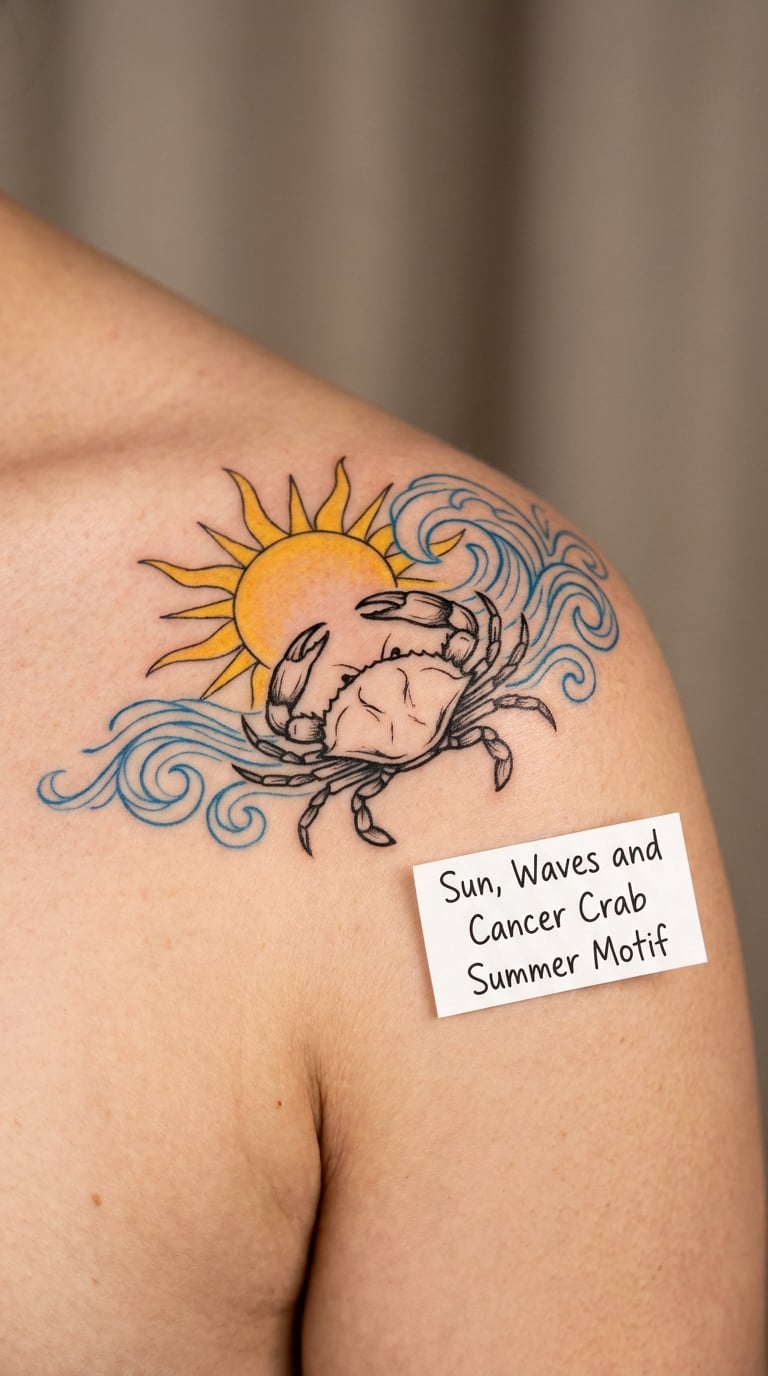
A crab centred between a half-circle sun above and two bands of blue wave below, all three elements locked into a circle. Warm yellows and oranges in the sun, cool blue in the water, and black linework on the crab to hold the two temperatures together.
Summer and birthdays are the usual reason this one gets chosen, and it works as a birthday piece for a Cancer born in July. It is a fuller composition than a lone crab, so it needs a flat enough area of skin to actually sit on.
Placement: across the shoulder, upper back, or the calf · Size: 4.5 to 5 inches (11 to 13 cm) wide · Style: illustrative colour, semi-traditional
Pain: medium, and the round shapes need a surface that does not distort. A shoulder blade or a bicep is better than a joint, where the circle will warp every time you move.
Make it yours: date the sun with the day the sun was in your birth sign, or tint the water with a colour tied to a place.
19. Minimal Cancer Crab on the Rib
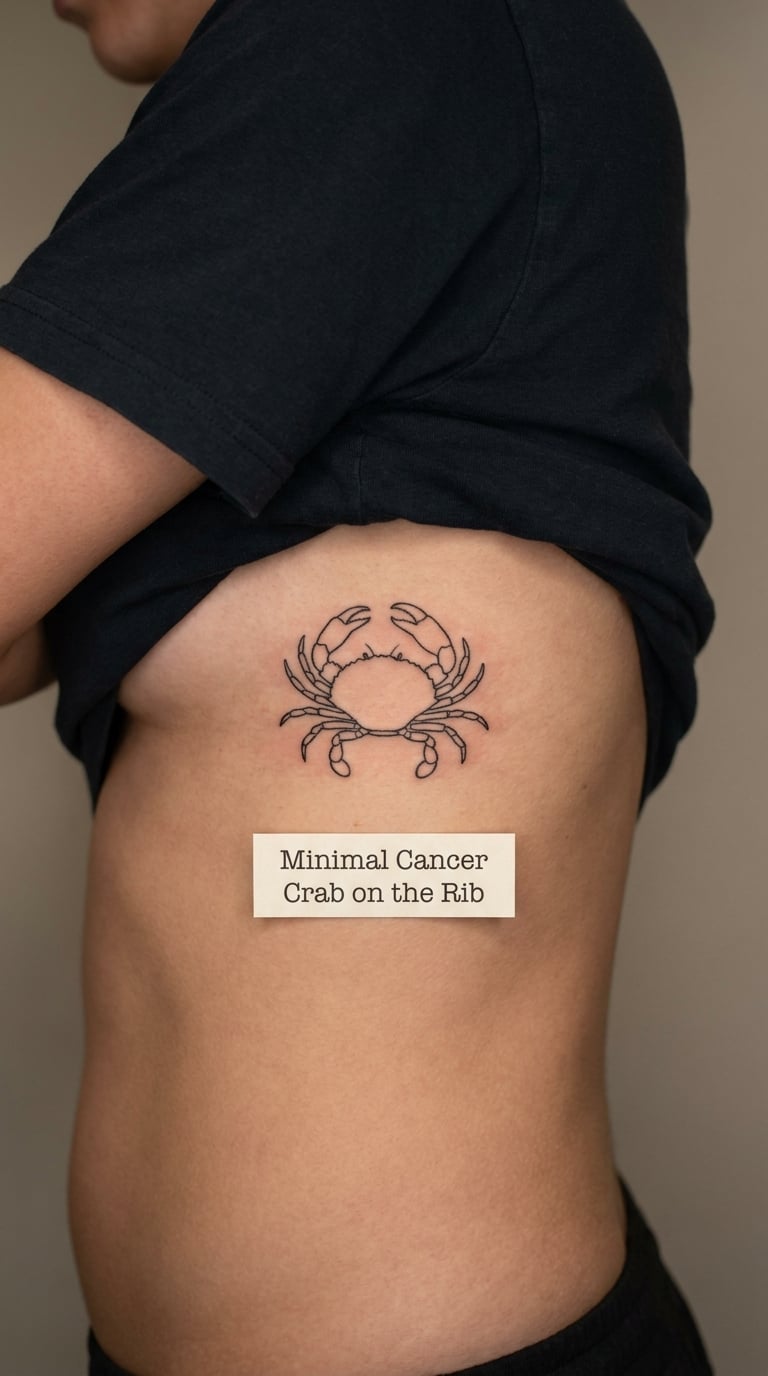
A side-profile crab in outline, with the shell as a single smooth curve and the legs implied by three or four short strokes. Side-on is the right angle here, because a full top-down crab does not compress into a rib’s narrow channel.
Rib tattoos are chosen as much for the location as the drawing, and a small crab suits someone who wants that placement without a large piece they would have to live with for a long time. It sits close to the body, so it is seen by people standing next to you.
Placement: between two ribs on the side, following the curve of the cage · Size: 2 to 2.5 inches (5 to 6.5 cm) wide · Style: minimal fine line
Pain: high, one of the highest-rated spots on the body. The ribs are thin-skinned, deeply boned, and the artist has to stretch the skin constantly, which is a large part of the discomfort.
Make it yours: add a short word or a date under the claws in the same line weight, kept small enough that it reads as a caption.
20. Cracked-Style Cancer Glyph
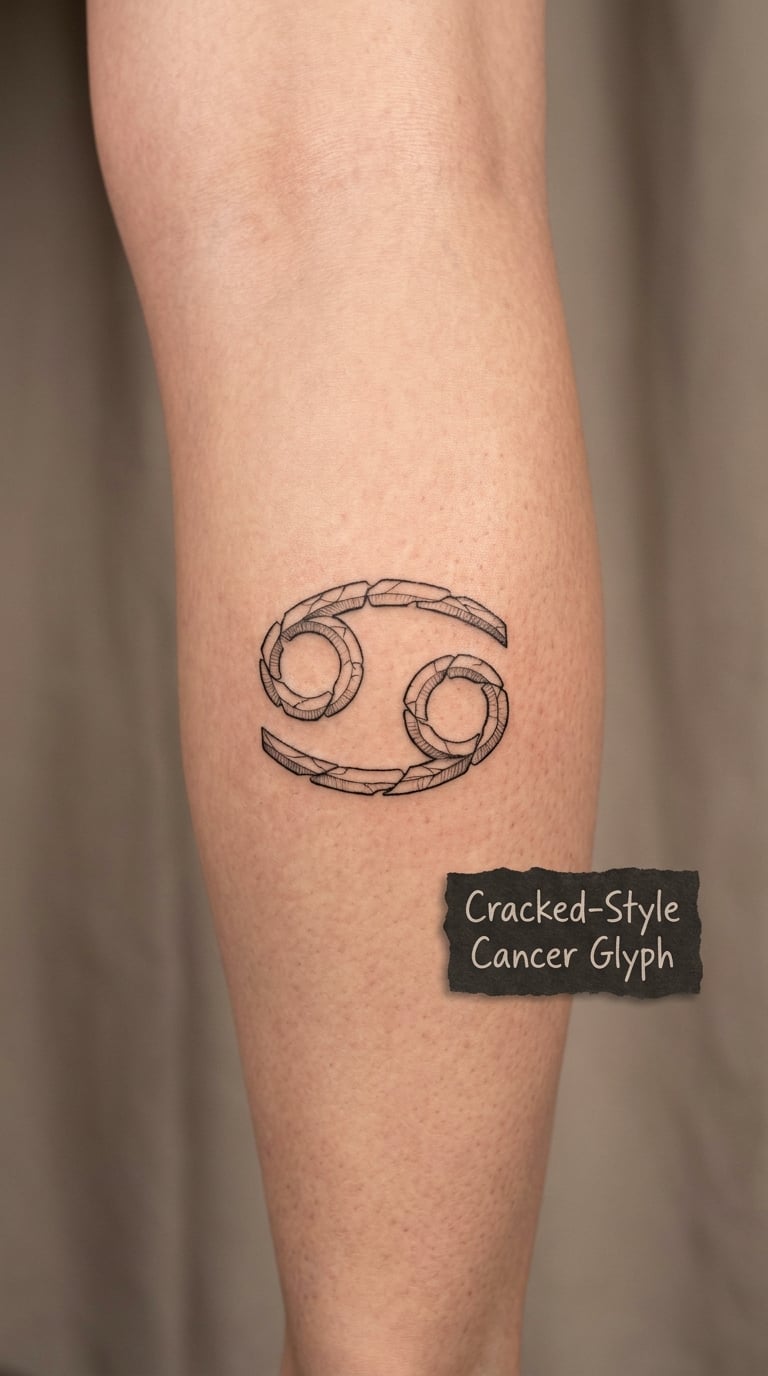
The 69 glyph drawn heavy and solid, with a network of narrow fracture lines running through it so it looks split rather than drawn. The cracks need to be wide enough to actually show as lines, since hairlines in this style disappear quickly.
It is the boldest read of the sign’s own shape, and it sits somewhere between a graphic design and an illustration. Wearers who wanted the glyph but found the clean version too plain usually end up here.
Placement: outer calf, forearm, or the upper arm · Size: 3 inches (7.5 cm) tall · Style: bold illustrative graphic
Pain: medium on the calf, with the solid black fill doing most of the uncomfortable part. Solid colour also means a flatter, cleaner result than a shaded version of the same idea.
Make it yours: run the fracture lines off the edge of the glyph into a small scattered piece, so the design looks like it is breaking apart on purpose.
How to Choose the Right Design
Five things decide whether a design works, and it is worth settling them before the consultation rather than after.
Visual complexity. Count the smallest elements in the design. A constellation, a birth chart and a botanical crab each have a different number of tiny parts, and everything below roughly 1/8 inch is what fades first. Fewer elements, drawn thicker, always last longer.
Personal connection. The motif has to be one you still want in ten years. A crab chosen because it is your sign and a crab chosen because a partner’s sign was the same thing wear very differently on you, and only you can tell the difference now.
Body shape. Follow the lines of the area rather than fighting them. Curved placements like the ribcage, ankle and calf suit flowing compositions, while flat panels like the outer thigh and forearm take circles and frames without distortion.
Placement. Decide how visible you want this to be before you pick the size. Behind the ear and the ribs are private, the wrist and forearm are visible every day, and the choice changes how bold the design should be.
Long-term readability. Fine line, micro dotwork and hand lettering all soften with time, and sun exposure speeds it up. Blackwork, bold geometric work and mid-scale colour hold their shape far better, which matters most for hands, fingers and anything unhidden in summer.
Cost and Session Time
Tattoo pricing in the US is usually hourly by the artist, so size and detail drive both the time and the bill. Shop minimums and regional rates vary widely, and a custom design costs more in consultation time than a design the artist has drawn before.
Micro pieces, 1 inch or under. A tiny finger or wrist crab is often a short appointment, sometimes well under an hour. Many shops apply a minimum charge that covers the setup and sterilisation, so the hourly rate rarely matters at this size.
Small pieces, 2 to 3 inches. Most fine-line crabs, glyphs and script words land here, roughly an hour to an hour and a half. Collarbone and rib work often runs longer because the skin needs stretching and the client needs breaks.
Medium pieces, 3.5 to 5 inches. Constellations, zodiac wheels, blackwork crabs, mandalas and watercolour compositions. Expect two to four hours, frequently split into two sessions so you are not sitting through hour four of a coloured piece.
Detailed pieces, 5 inches and up. Botanical crabs, full chart tattoos and anything with a lot of small separate detail. These are commonly booked across multiple sessions, and a coloured mid-size piece can need a later touch-up pass once the ink settles.
Rough US ranges run from about 60 to 150 dollars an hour in lower-cost areas and 150 to 300 in higher-cost ones, with large cities and well-known specialists at the top. Treat all of that as a starting point and ask the shop for its minimum and its hourly rate before booking.
Aftercare Basics
Start with your artist’s own aftercare instructions, because they have seen how their specific work heals. Everything below is general guidance that applies to most pieces.
Wash gently. Clean the area with lukewarm water and a mild unscented soap, then pat it dry with a clean hand rather than a towel. Do this once or twice a day for the first few days while the ink is still fresh and weeping slightly.
Moisturise thinly. Once the surface has closed, apply a thin layer of a plain fragrance-free moisturiser a couple of times a day. A heavy ointment can trap heat and irritate the skin underneath the tattoo.
Protect it. Keep it out of direct sun, avoid swimming pools and hot tubs while the surface is open, and leave any film or scab alone rather than picking at it. Loose clothing over a fresh piece helps with sheets and waistbands.
Be realistic about sun. Colour tattoos fade noticeably faster with repeated sun exposure, and once the outline has softened, a touch-up can restore it. Broad-spectrum sunscreen on exposed pieces is the single most effective thing you can do for longevity.
Plan a touch-up window. Fine line, dotwork and small lettering usually need a session in the 12 to 18 month range. Blackwork and bold colour rarely need one, unless you want the line weight to go heavier.
Frequently Asked Questions
What dates are usually considered Cancer?
Cancer is commonly listed as June 21 to July 22. The boundary shifts by a day or so depending on year, and it also depends on the exact time and place of birth, so a reliable zodiac calculator gives you the accurate answer for your birth details. Most people just check their sign against the standard range and go with it.
Is Cancer the crab constellation?
Yes. The constellation Cancer is one of the oldest recognised constellations, and the sun passes through it roughly from late June to late July, which is where the sign gets its date range. It is a faint, scattered star group rather than a bright shape, which is why constellation tattoos use added dots and connecting lines to make it read.
What does 69 mean in Cancer?
The 69 is the astrological glyph for Cancer, drawn as two stacked loops that look like a 6 above a 9. On a tattoo it is simply the sign symbol, the same way a Leo glyph is a different shape. Some wearers add stars, waves or a moon frame so the number reads as a symbol rather than a numeral.
Will a small cancer zodiac tattoo fade?
Small fine-line pieces fade faster than large ones, mostly because there is less ink in each line to survive. A tiny glyph on a finger or wrist can blur noticeably within a few years, while the same design at 3 inches on a forearm holds up far longer. Going bolder than feels necessary is the cheapest way to buy more years.
Should I get a crab or the constellation for my sign?
The crab is the emblem most people recognise instantly, so it works when you want the sign to read clearly. The constellation is subtler and more personal, and it suits people who want the astrology present without the animal. Many wearers start with one and add the other later in a matching or complementary piece.
Do all tattoos need to have meaning?
No. Plenty of people get a design because they like how it looks and only find the meaning afterwards, or never. Meaning tends to matter more to the wearer over time than to anyone else, and a piece you regret having a story about will age worse than one you simply liked.
Which Idea Fits Your First Tattoo
If this is your first piece, start with the fine-line crab behind the ear, the collarbone wordmark, or the micro dotwork finger crab. All three are small, quick and sit somewhere you can cover easily, which matters more for a first tattoo than how clever the design is.
If you already have ink and you are building a set, the constellation, the zodiac wheel and the compass element are the ones that reward a second or third piece. They reference each other, they read as a group from a distance, and they leave room for the crab to appear once and mean something specific.
Before any of them gets tattooed, check the symbol against a reliable source. A mirrored or mistyped glyph is a permanent thing to live with, and getting it right takes thirty seconds on a reference chart.