
20 Best Knuckle Tattoo Ideas for Men (September 2026)
Knuckle tattoo ideas for men run from heavy blackwork skulls that cover four joints at once down to a single fine-line mountain peak no one notices at a job interview. The difference is usually one thing: how much ink the artist is asking a single patch of tough, constantly flexing skin to hold.
These twenty designs cover every direction worth taking to a consultation, from traditional roses and anchors to micro-realism and dotwork. Each entry gives you the size that actually works, where it sits best, how it ages and one way to make it yours.
Quick Guide
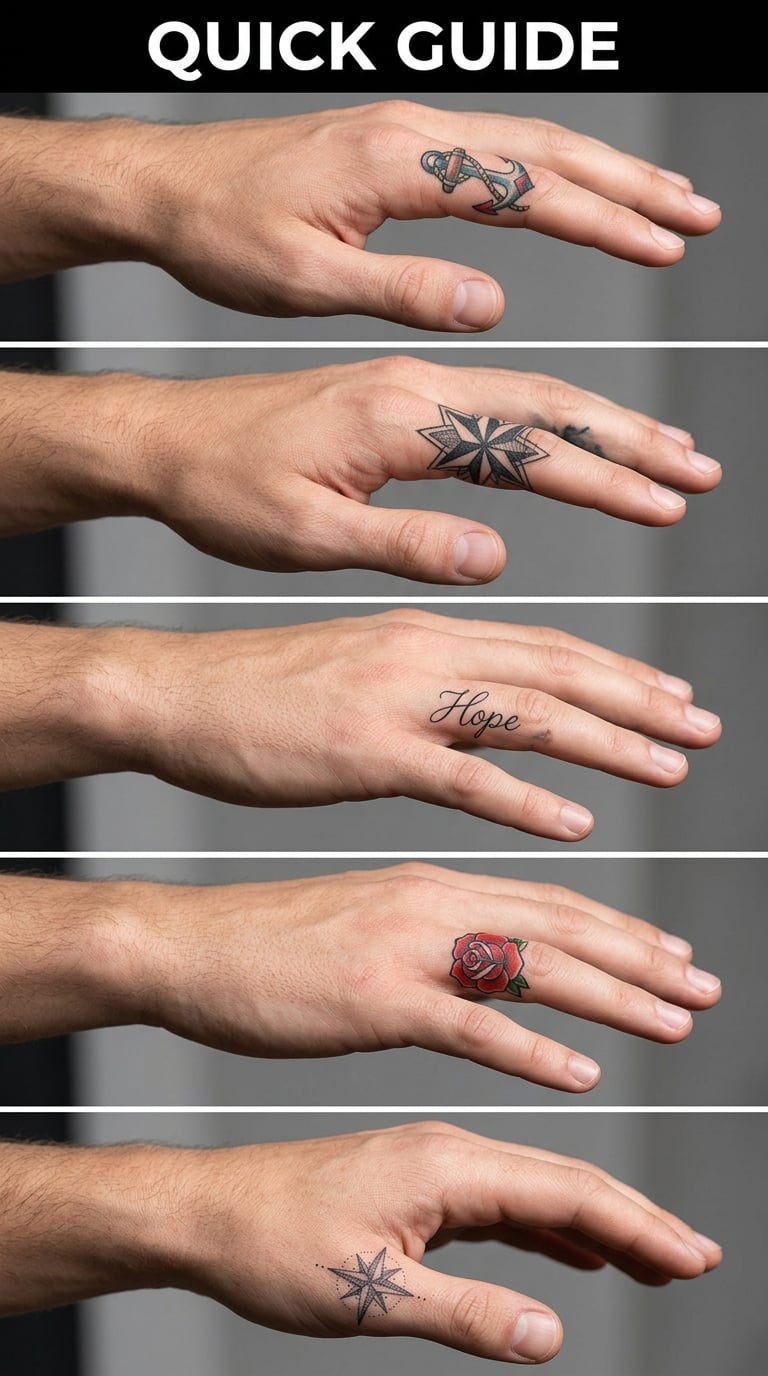
Here is the whole list on one page. The pain column is the honest one, because knuckles always sit higher than the back of the hand.
| Idea | Style | Best placement | Size | Pain |
|---|---|---|---|---|
| Blackwork skull | Blackwork | All four knuckles, one hand | 3 to 4 in wide | High |
| Traditional rose | Traditional | Two centre knuckles | 2 to 3 in wide | Medium-high |
| Minimal cross | Fine line | One knuckle | 0.8 to 1.2 in | Medium |
| Sailor ship | Old school | Two adjacent knuckles | 2 in wide | Medium-high |
| Geometric compass | Geometric | Index and middle knuckles | 1.5 to 2 in | Medium |
| Blackwork serpent | Blackwork | Three knuckles | 2.5 to 3 in | High |
| Star constellation | Fine line | Three knuckles | 2 in wide | Medium |
| Neo-traditional lion | Neo-traditional | Two knuckles | 2 to 2.5 in | Medium-high |
| Lettered word | Blackwork lettering | Four knuckles, one letter each | 1 in per letter | High |
| Dotwork mountain range | Dotwork | All four knuckles | 3 in wide | Medium-high |
| Red flame | Red ink | Two knuckles | 2 in wide | Medium-high |
| Micro-realism pinch | Micro-realism | One knuckle | Under 1 in | Medium |
| Blackwork arrow | Minimal blackwork | Index and middle knuckles | 1.5 in | Medium |
| Traditional eagle | Traditional | Two knuckles | 2 to 2.5 in | Medium-high |
| Gothic cross with dotwork | Blackwork | Two knuckles | 2 in wide | Medium-high |
| Anchor and rope | Blackwork | Middle and ring knuckles | 2.5 in wide | High |
| Roman numerals | Minimalist | One numeral per knuckle | 0.6 in tall | Medium |
| Watercolor butterfly | Watercolor | Two knuckles | 1.5 to 2 in | Medium |
| Rose and dagger | Blackwork | Two knuckles | 2.5 in wide | Medium-high |
| Fine-line mountain peak | Fine line | Three knuckles | 2 in wide | Medium |
1. Bold Blackwork Skull Knuckles
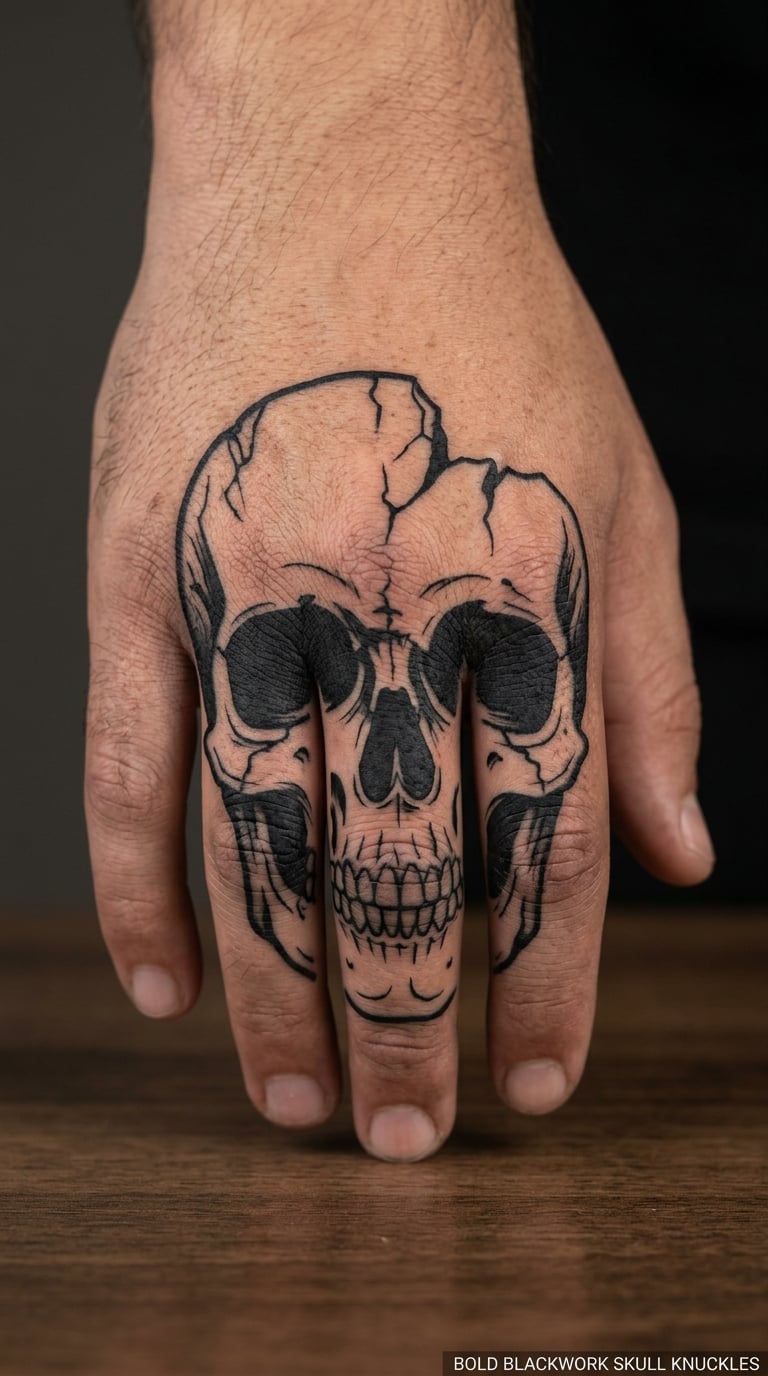
A skull in solid black, one simplified shape per knuckle, is the loudest thing you can put on a hand. The head reads on the index knuckle, the jaw carries the middle, and smaller marks trail down the ring and pinky. Heavy line weight is the point, because knuckles eat thin lines.
Men usually pick it for mortality, defiance or a hard-won second chapter. It is a memento mori design, old as the tradition itself, and it reads as a warning before it reads as decoration.
Placement: all four knuckles of one hand, ring and pinky wrapping slightly onto the fingers. Size: 3 to 4 inches (7.5 to 10 cm) across the hand. Style: blackwork. Pain: high, the whole set sits over bone and the session runs long. Bold black holds its edge far better than any alternative here.
Make it yours: swap the crossbones for a surname, a set of coordinates or a small date tucked under the jaw.
2. Traditional Rose Knuckle Tattoo
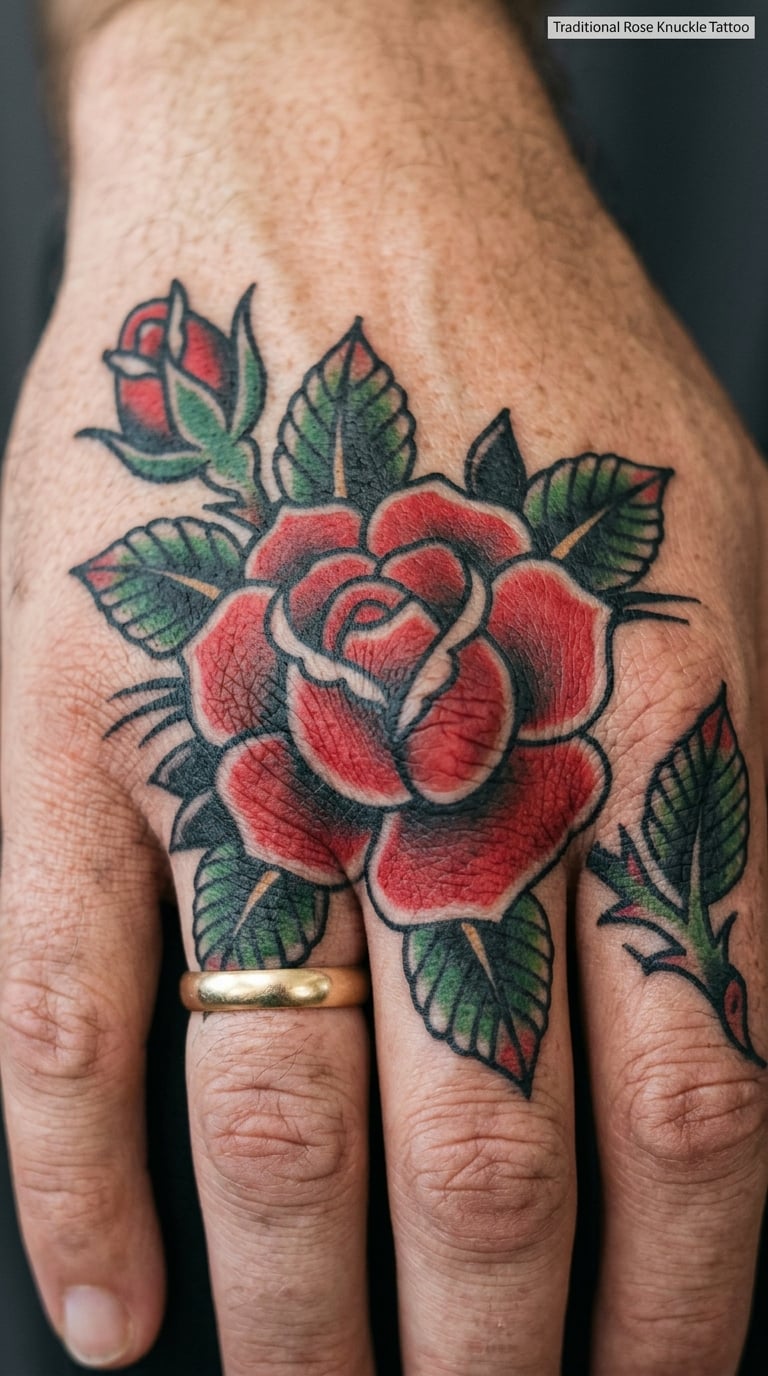
A red rose with black outlines and a couple of green leaves, stitched in the old tattooing manner, brings colour to a placement usually stuck in black. Two or three blossoms stacked across the knuckles look balanced, and a bud on the pinky finishes the run.
It is a classic love-and-betrayal motif, chosen as often for the craft of it as the message. Traditional colour work also gives the artist more to work with on textured knuckle skin.
Placement: the two centre knuckles, or all four if you want a fuller sleeve-style hand. Size: 2 to 3 inches (5 to 7.5 cm) wide. Style: traditional. Pain: medium-high. Red ink holds well, though the yellow in highlights fades first, so expect a touch-up on the highlights sooner than the outline.
Make it yours: add a banner with a word that matters, wrapped under the ring knuckle.
3. Minimal Cross Knuckle Tattoo
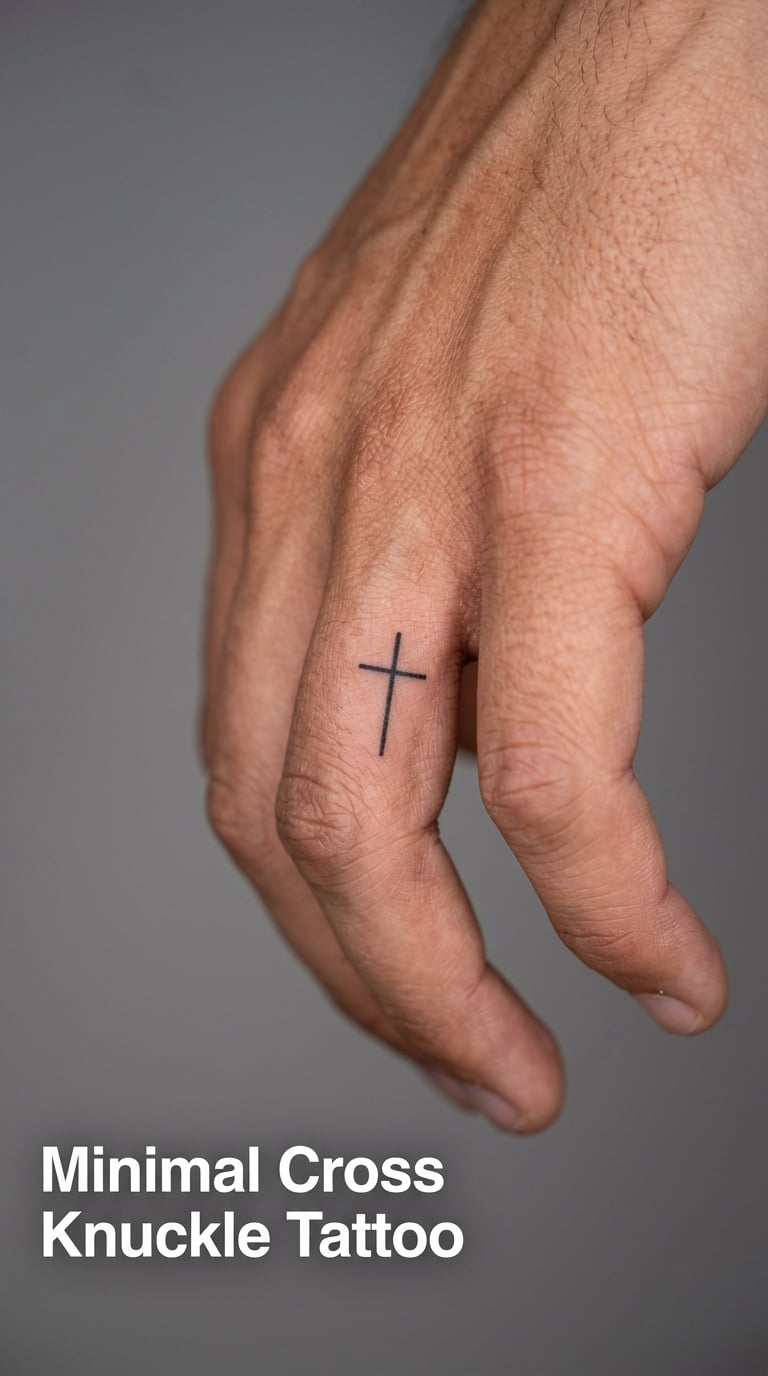
One cross, drawn with two clean black lines and nothing else, is the quietest option on this list. Keep the line weight even and the arms of the cross short so it reads as a shape rather than a set of four separate marks once the skin moves.
Faith, a parent, a promise, a grave. Whatever the reason, this one sits well on a man who wants a knuckle tattoo that starts a conversation without shouting.
Placement: a single knuckle, usually the middle or the index. Size: 0.8 to 1.2 inches (2 to 3 cm). Style: fine line. Pain: medium, and short. Fine line on hands fades faster than on arms because of washing, weather and sun, so plan on a refresh every few years rather than expecting a permanent line.
Make it yours: put a date or a single initial inside the cross instead of leaving it open.
4. Old-School Sailor Knuckle Tattoo
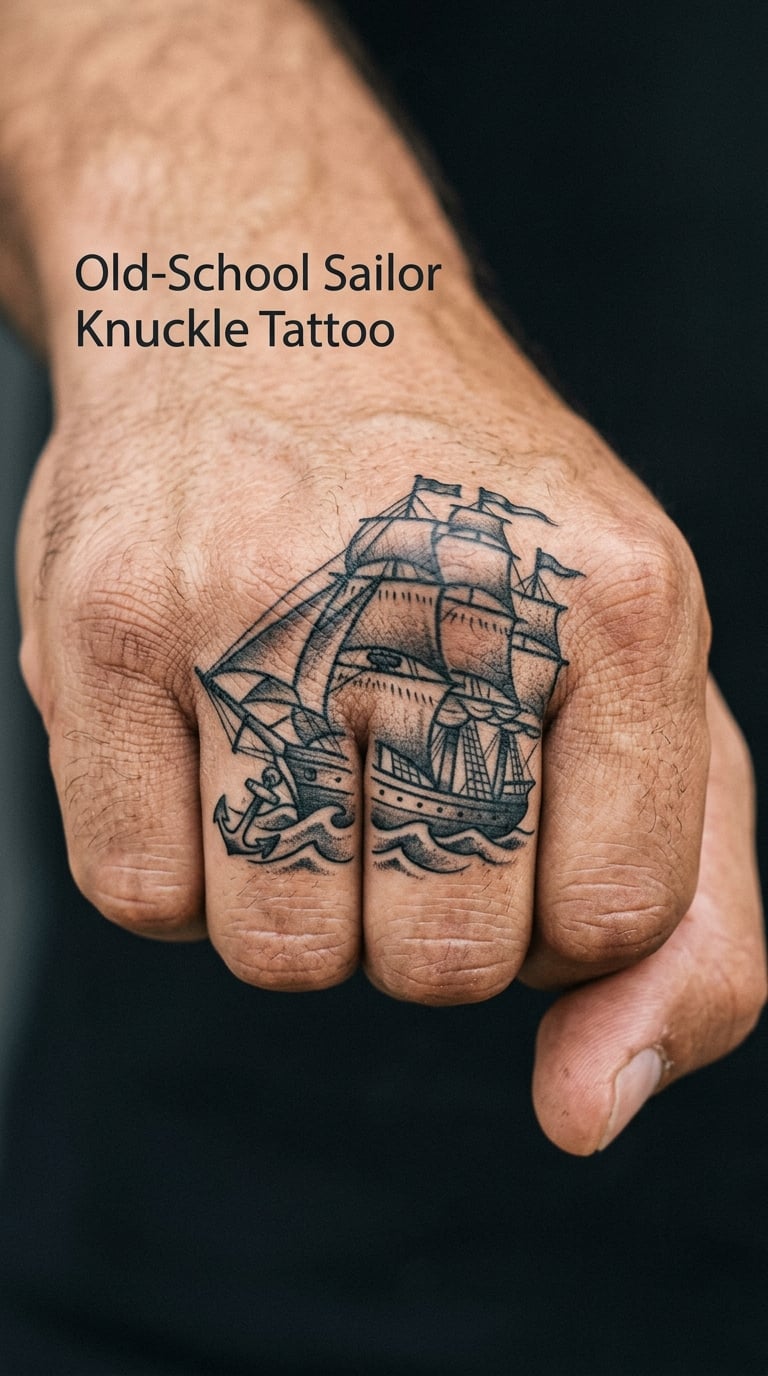
A small square-rigged ship under full sail, worked in black and grey with two or three restrained colour hits, is one of the oldest knuckle designs going. Sailors inked what they missed on long voyages, and the style came back hard about fifteen years ago and has not slowed down.
It means service, distance and coming home. It is also the easiest way to get old-school lettering and a picture to agree with each other on the same hand.
Placement: two adjacent knuckles, index and middle, so the hull and sails have room to read. Size: 2 inches (5 cm) wide. Style: old school traditional. Pain: medium-high. Masts and rigging are hairlines that will soften first, so an artist with a steady hand matters more here than almost anywhere else.
Make it yours: name the ship or the port on the hull, or trade the sails for a pair of anchors.
5. Geometric Compass Knuckle Tattoo
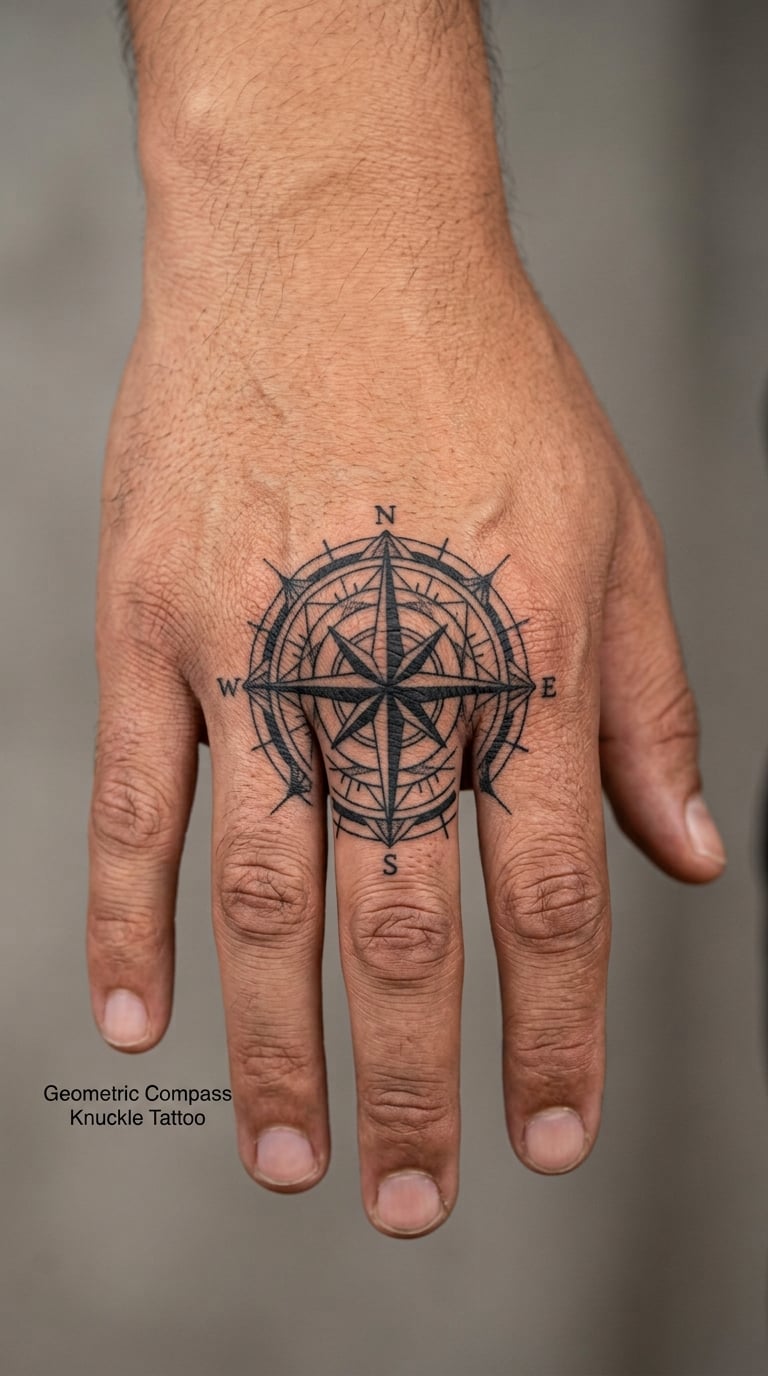
A compass rose built from straight segments, not curves, suits the joint because there is nothing soft on a knuckle. Two opposing points on the index and middle knuckles, joined by a thin line, keep it symmetrical and readable when the hand is closed.
Direction, protection, finding your way back. It is one of the more requested symbols in hand work right now, mostly because it is graphic rather than illustrative.
Placement: index and middle knuckles, centred on the seam between them. Size: 1.5 to 2 inches (4 to 5 cm). Style: geometric linework. Pain: medium. Spacing is the whole game here, since knuckles move independently and lines that sit too close to the joint edges migrate as the hand flexes.
Make it yours: set the compass needle to a real bearing, or add a small N only on the index knuckle.
6. Blackwork Serpent Knuckle Design
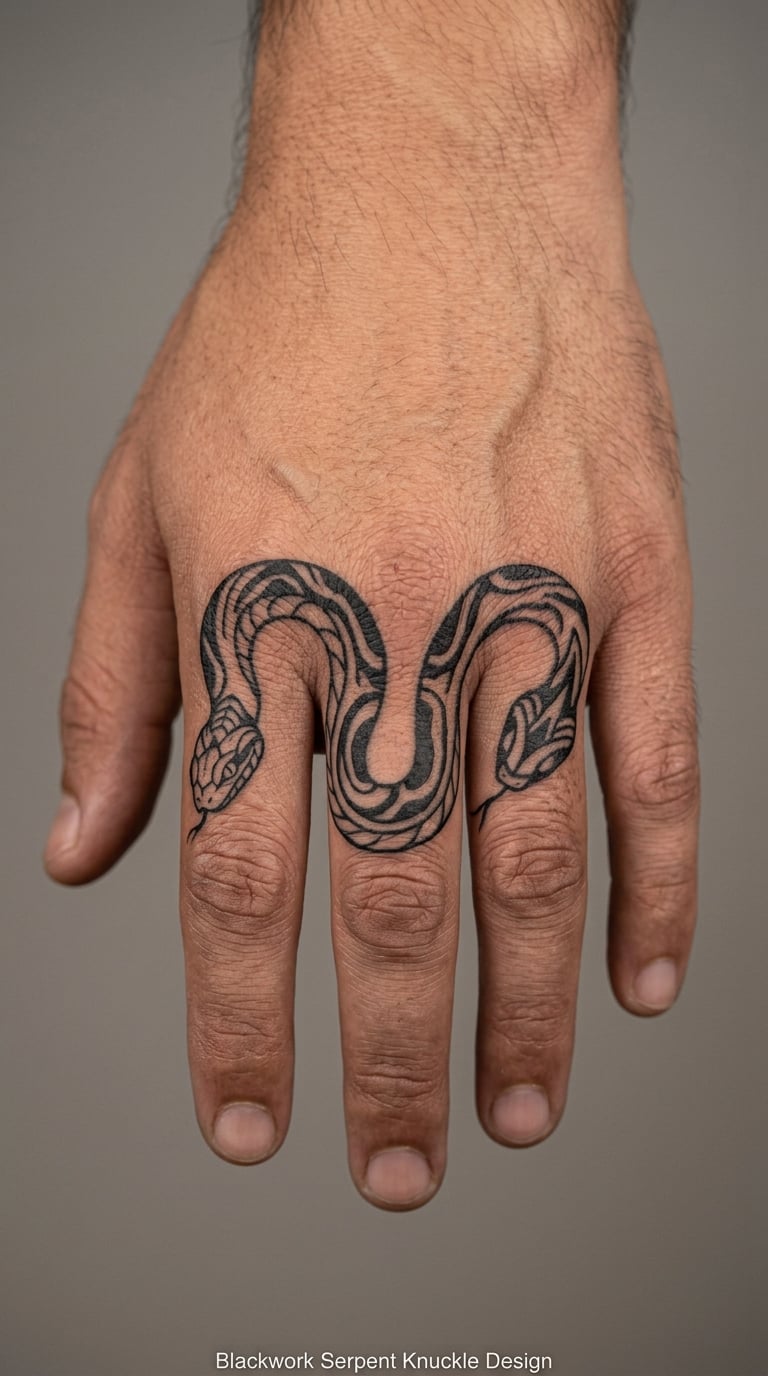
A snake in solid black with a clean silhouette, tail on the pinky and head lifting off the index, is the most graphic design on this list. Filling the body completely rather than shading it gives the artist a shape that survives the knuckle texture intact.
Rebirth, transformation, danger. Snake work is a favourite first hand tattoo for men who want something with an edge that is not a face or a skull.
Placement: three knuckles running pinky to index, letting the body follow the finger gap naturally. Size: 2.5 to 3 inches (6 to 7.5 cm). Style: blackwork. Pain: high, because it covers so much joint in one pass. Solid fill hides the bumps in knuckle skin that make shaded work look uneven.
Make it yours: have the snake hold a small object in its mouth, a blade, a coin or a match.
7. Small Star Constellation Knuckles
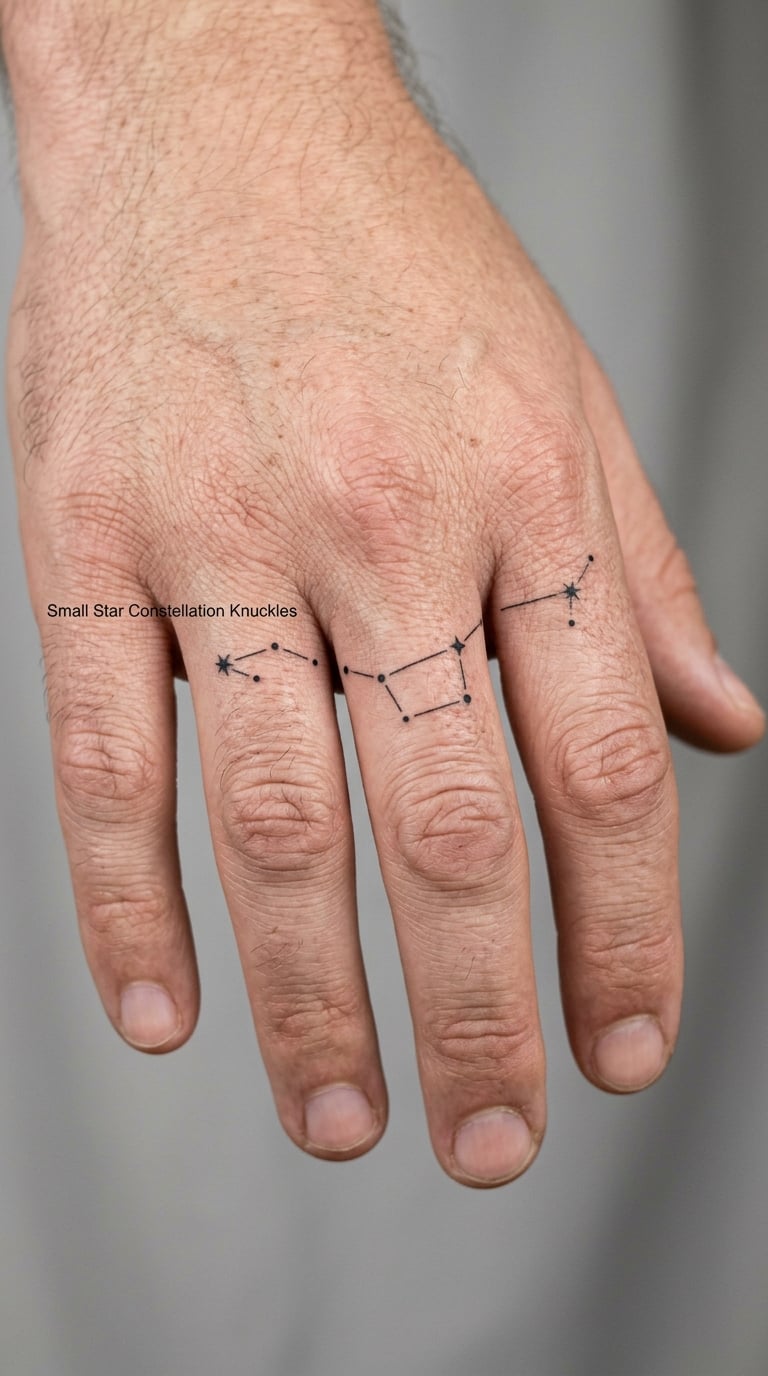
Five or six dots connected by single hairlines, laid across three knuckles, is the subtle end of the spectrum. Each dot needs a little more weight than you expect so it does not disappear in the first year, and the connecting lines should stay deliberately light.
Most people use the sky from a specific night or place. It is quietly personal in a way that only the wearer and whoever holds his hand will ever read.
Placement: three knuckles in a row, or a wrap that continues onto the side of the index finger. Size: 2 inches (5 cm) wide. Style: fine line. Pain: medium. This is the fastest fading category on the list. Hand washing strips fine line faster than sun does, and the dots will soften noticeably before the connecting lines do.
Make it yours: get the real star map for a date, printed and traced, rather than a generic pattern from a sleeve file.
8. Neo-Traditional Lion Knuckle Tattoo
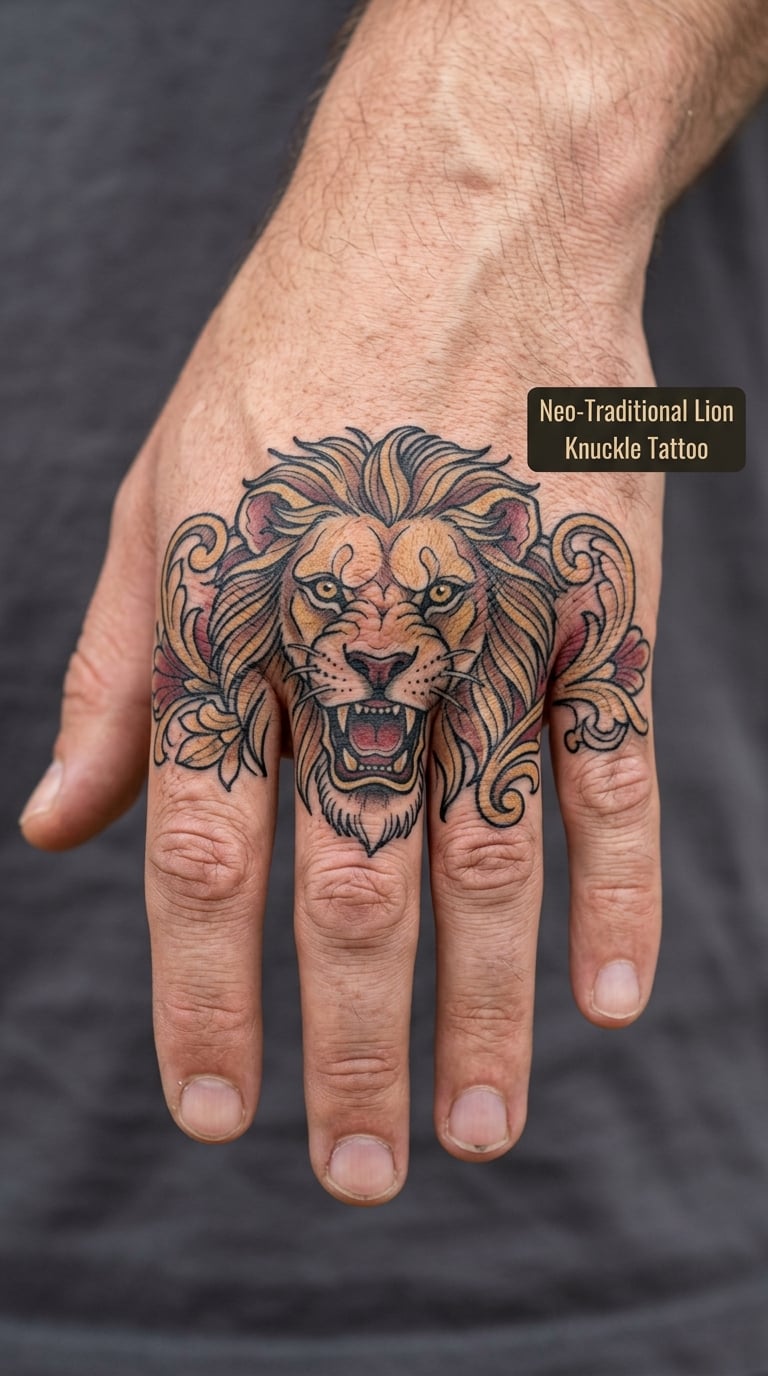
A lion’s face in bold outline with muted gold and one red accent, drawn compactly enough to sit on two knuckles, is a recent addition to the hand canon. The eyes carry the whole design, so they get a darker line than the mane.
Courage, leadership, restraint. Men ask for it when they want traditional craft without the softness of a rose or a butterfly.
Placement: the index and middle knuckles as a single face, or one eye per knuckle across four. Size: 2 to 2.5 inches (5 to 6.5 cm). Style: neo-traditional. Pain: medium-high. A face at knuckle scale is tight work, and the artist needs to place the eyes on the flat parts rather than the creases.
Make it yours: have the mane break the outline slightly past the knuckle edges, which softens the geometry of the hand.
9. Lettered Word Knuckle Tattoo
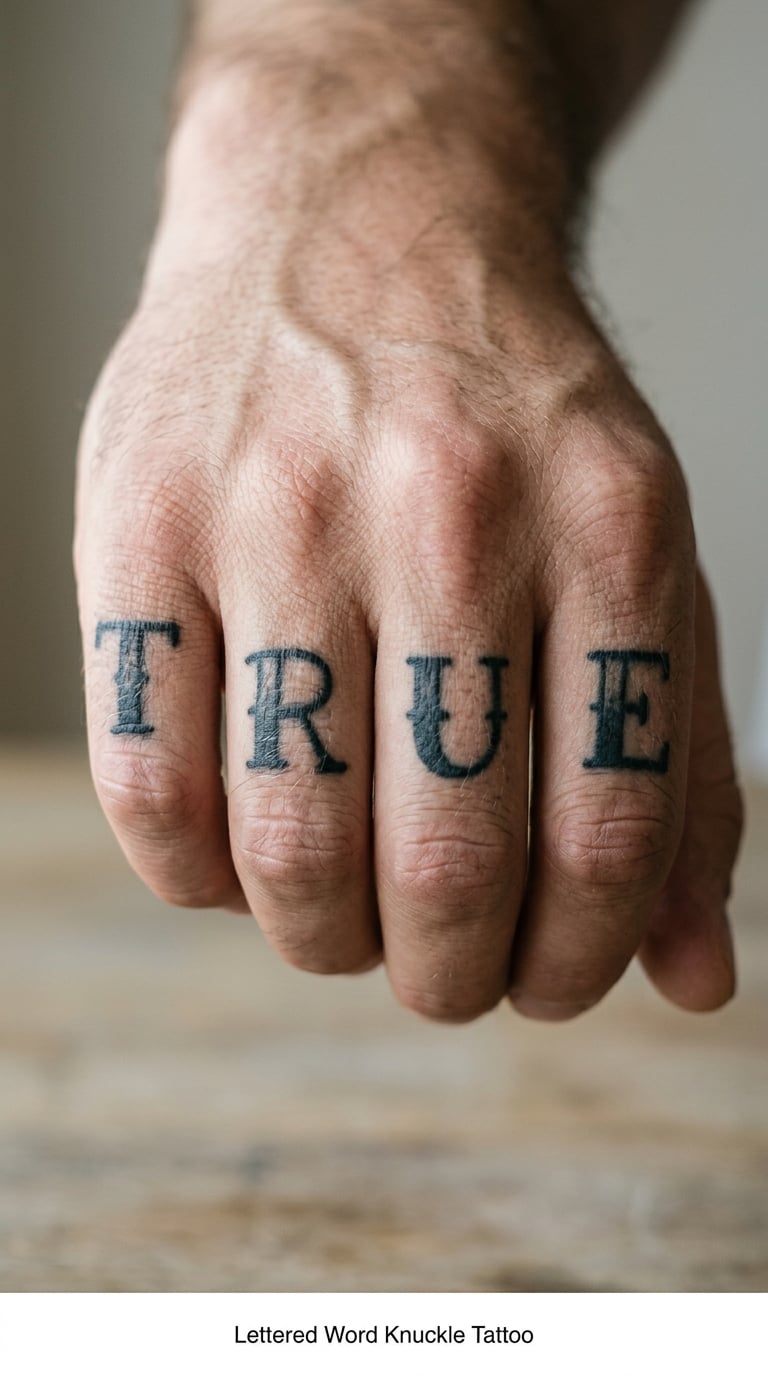
One bold letter per knuckle in a heavy display face, often with a script word threaded underneath, is still the most requested knuckle design in the world. The letters have to be blocky, tightly spaced and identical in height, or the word does not read when the hand closes.
STAY TRUE, HOLD FAST, LOVE HATE, SELF MADE. Motto tattoos are about holding yourself to something in front of other people, and the closed fist is part of the statement.
Placement: four knuckles per hand, one letter each. Size: roughly 1 inch (2.5 cm) tall per letter. Style: blackwork lettering. Pain: high across four knuckles. A tattooist will tell you to make a fist and check the read before the stencil goes down. Letter spacing decides whether the piece works, more than the font does.
Make it yours: run one eight-letter word across both hands, or a four-letter word on one hand and its mirror meaning on the other.
10. Dotwork Mountain Range Knuckles
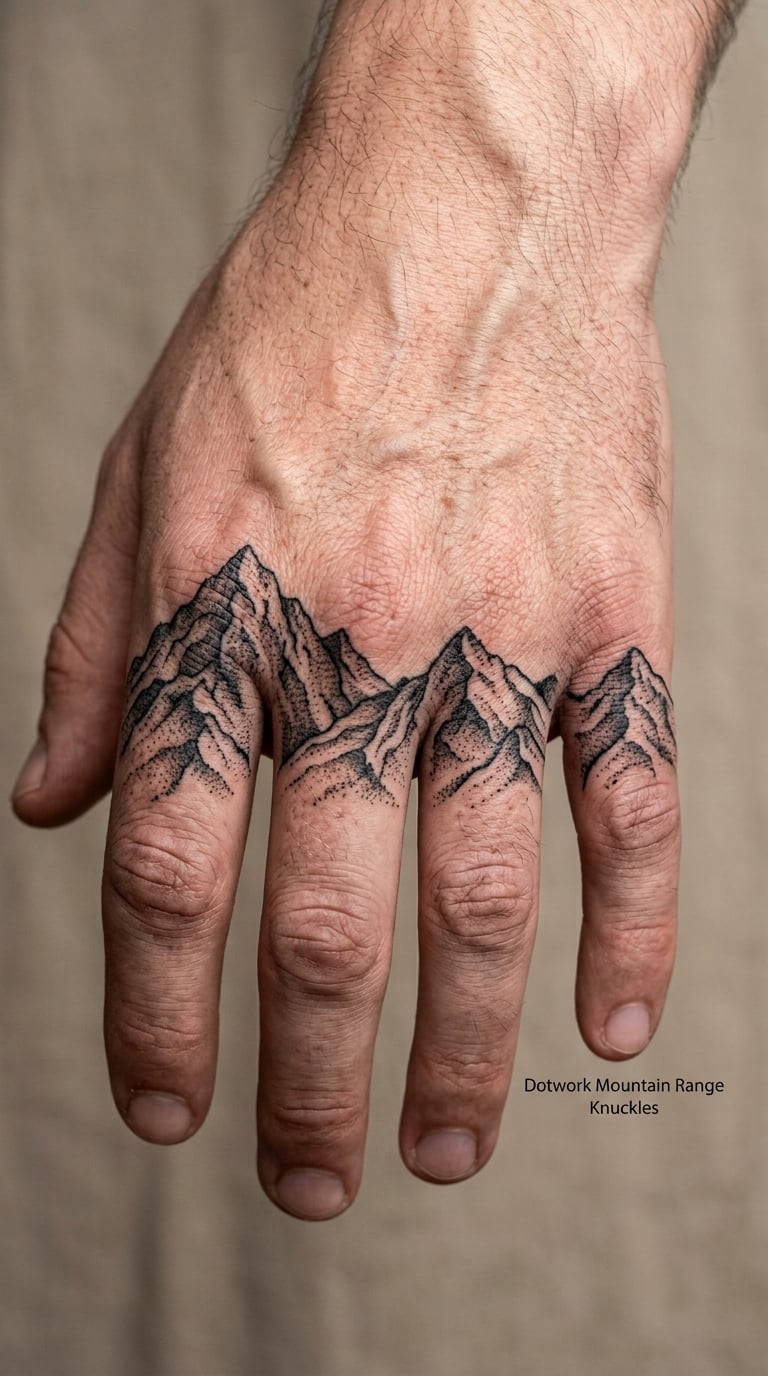
A mountain skyline built from layered stipple, three peaks across the knuckles with a dotted fade at the base, rewards patience and looks like more work than it is. Peaks sit best on the two centre knuckles, where there is flat skin to stack them.
Travel, a hard-earned summit, home country. It is a piece men usually keep quiet about, which is unusual for a hand tattoo.
Placement: all four knuckles as a range, or three knuckles for a single peak line. Size: 3 inches (7.5 cm) wide. Style: dotwork. Pain: medium-high, because stippling means more passes over the same skin. Small dots blur with skin texture over the years, so the artist should keep the gradient tight rather than spreading it across a wide knuckle.
Make it yours: trace the ridgeline of a range you have actually hiked and use its real contour.
11. Red Ink Flame Knuckle Tattoo
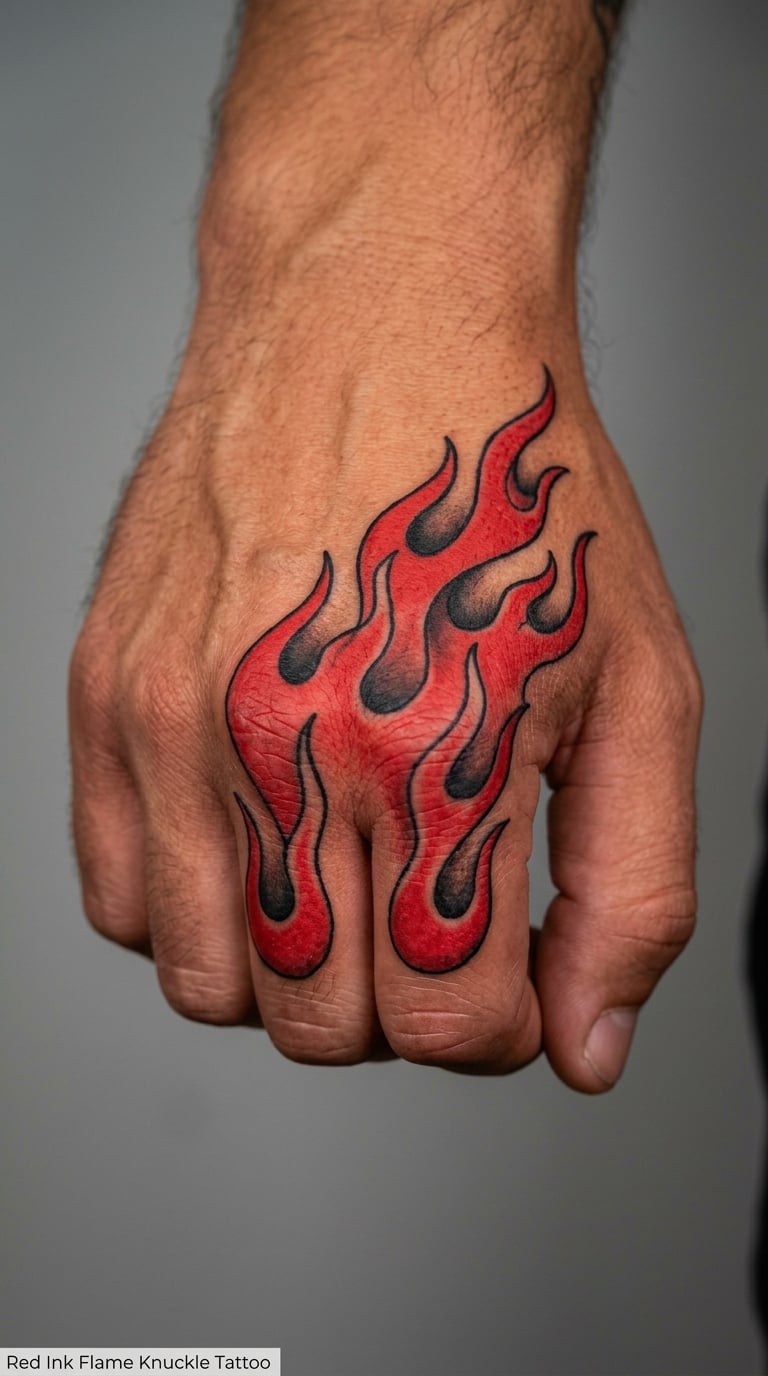
Flames in saturated red with black shadow underneath, pointing from the wrist side up across the knuckles, give the hand a single obvious focal point. Two or three tongues of fire work better than a full blaze, which turns to mush at knuckle scale.
Heat, transformation, energy. Red is the one colour that still reads as a statement from across a room.
Placement: two knuckles, either the index and middle or the middle and ring. Size: 2 inches (5 cm) wide. Style: red ink with black shading. Pain: medium-high. Red is a demanding colour to pack at this density, and it will fade towards orange first, so shade with black to protect the shape.
Make it yours: put a real word inside the negative space between two flame tongues.
12. Micro-Realism Hand Pinch Knuckle Tattoo
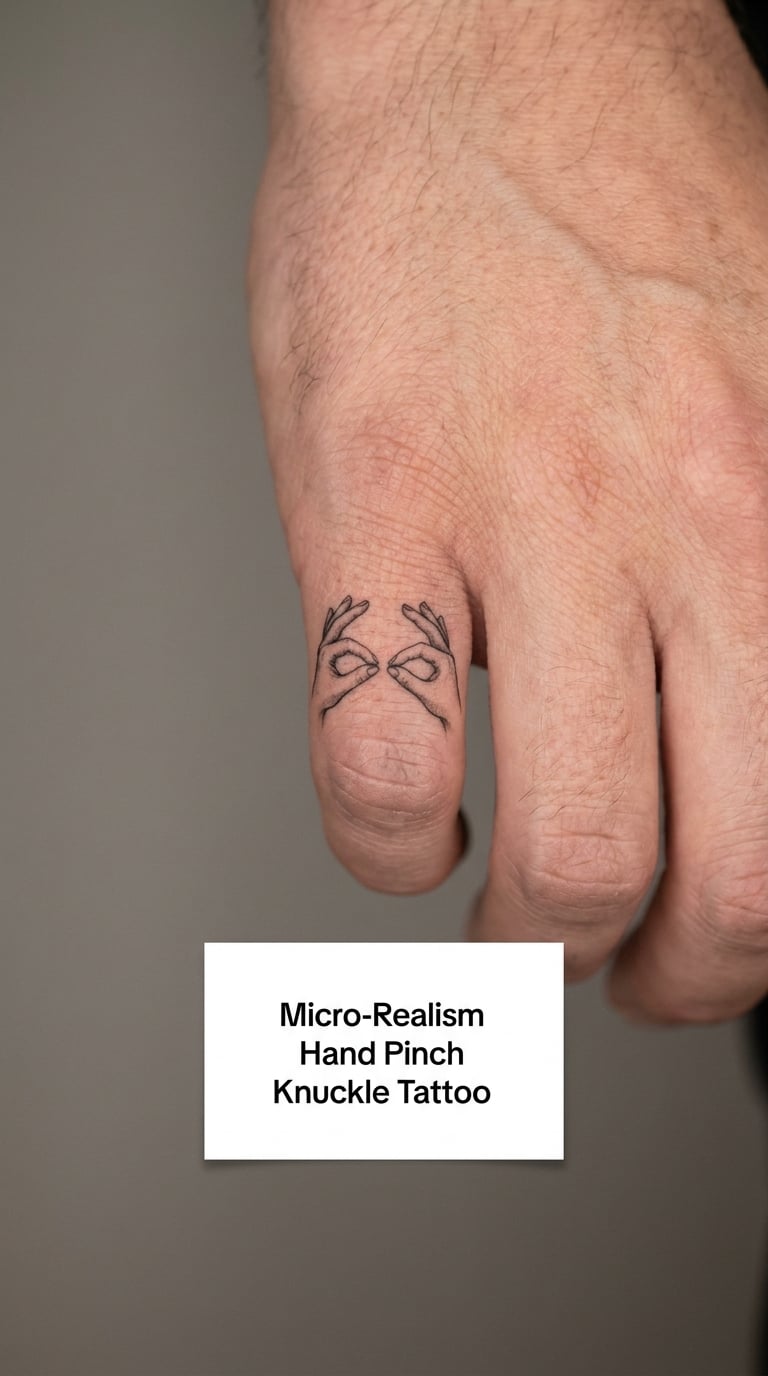
Two small hands, one holding the other, rendered in black and grey at under an inch, is the smallest design worth attempting here. An artist who works in micro-realism will build the shading out of dots rather than washes, because washes do not survive on a knuckle.
Almost always a memorial piece, sometimes a parent, sometimes a child. It is the most personal design on this list and the one people ask about most.
Placement: a single knuckle, the middle one is flattest. Size: under 1 inch (2.5 cm). Style: micro-realism. Pain: medium in intensity, long in duration, since a tiny shaded piece takes far longer than it looks like it should. Detail retention is the honest concern, and the honest answer is that it will soften noticeably within a few years.
Make it yours: bring a real photograph and have the artist work from it rather than a stock image.
13. Blackwork Arrow Knuckle Tattoo
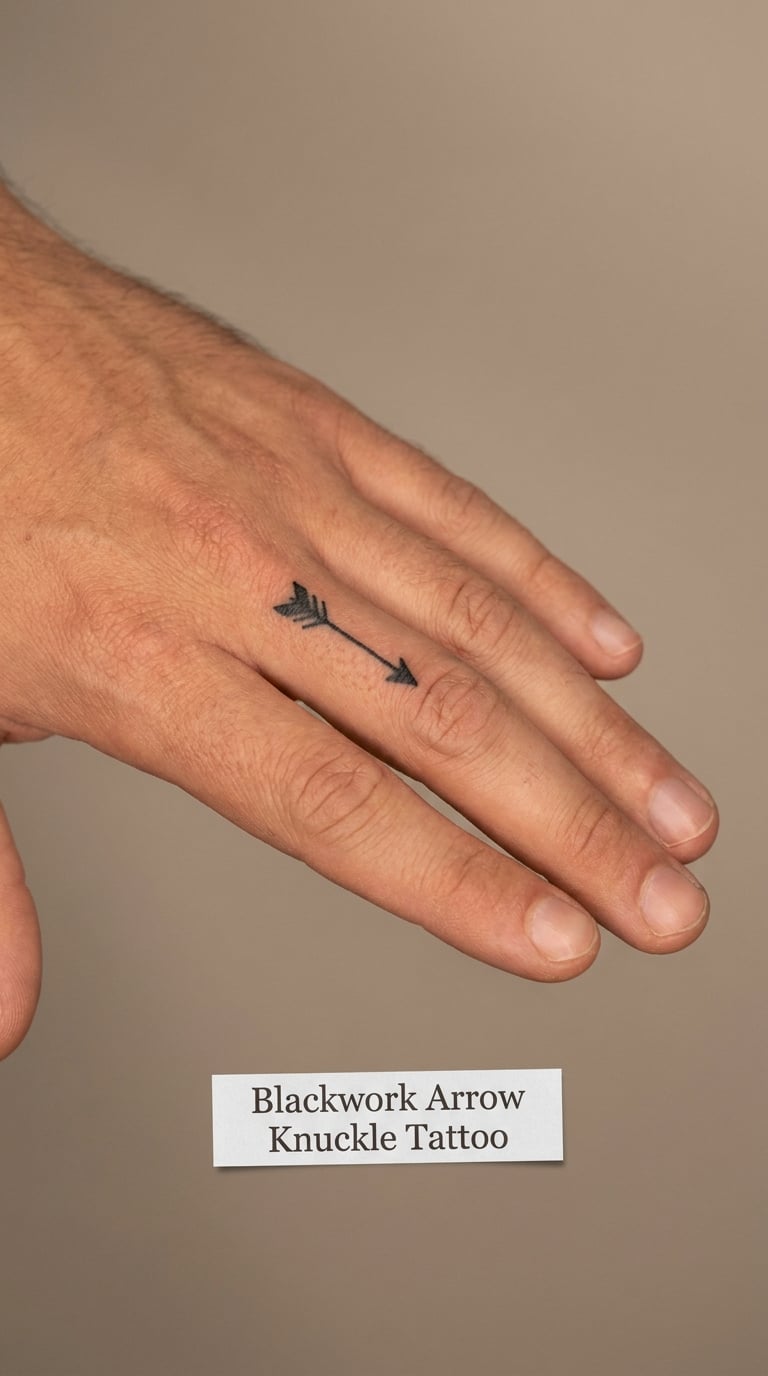
A single arrow in solid black running from the middle knuckle toward the fingertips, with a clean triangular head and no fletching detail, is as readable as lettering and half the work. Add small barbs on the shaft if you want more character.
Forward motion, focus, protection in some traditions. It works as a directional cue across the hand, pointing the eye outward.
Placement: index and middle knuckles as one long line, or one arrow per knuckle pointing at each fingertip. Size: 1.5 inches (4 cm) long. Style: minimal blackwork. Pain: medium. A straight black fill is the most reliable thing you can tattoo on a knuckle, and this one is quick to session.
Make it yours: have a set of coordinates in fine line running alongside the shaft, or point the arrow slightly inward instead.
14. Traditional Eagle Knuckle Tattoo
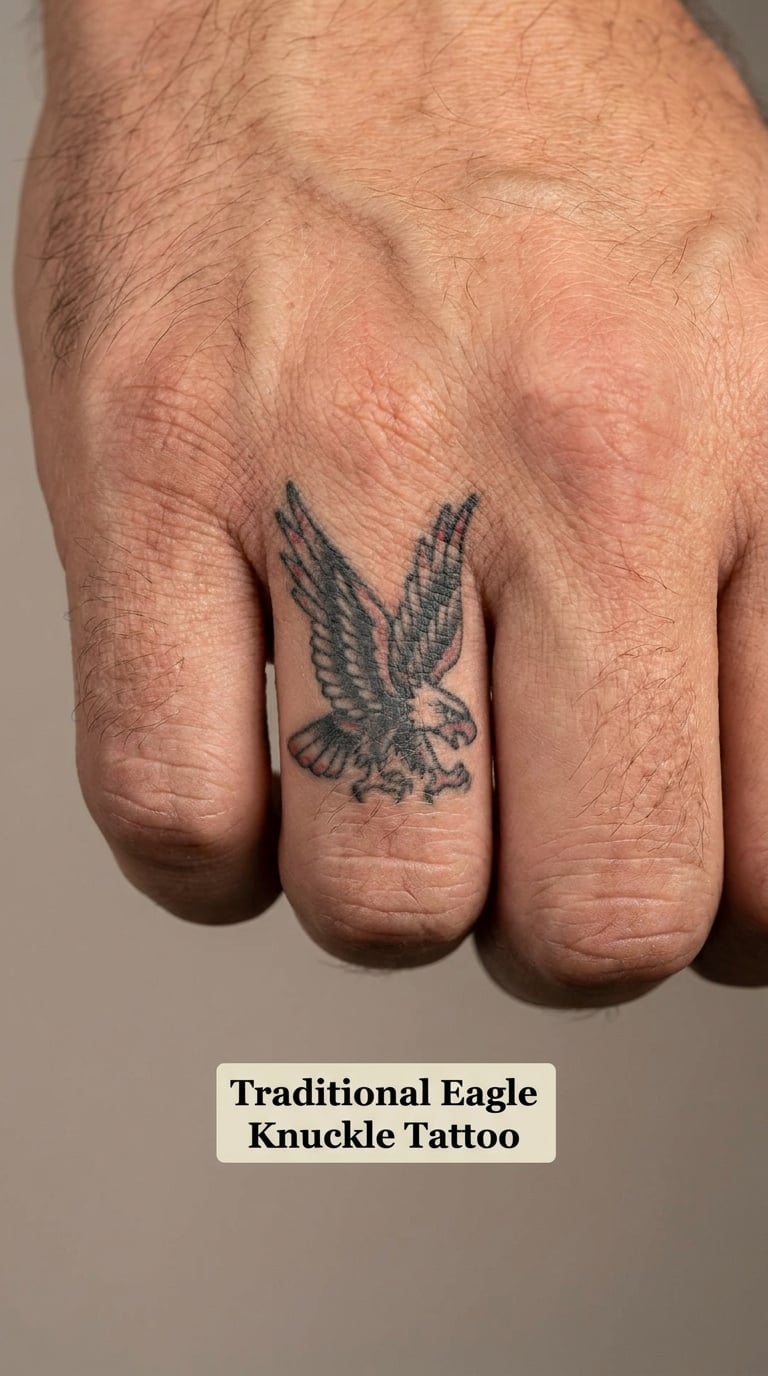
An eagle with wings half spread, worked in bold black with grey feather rows and one red accent, has to stay compact to work here. Scaled from a chest piece it turns into a smudge, so the design is redrawn at hand size with fewer feather separations.
Freedom, strength, service. It is the piece men in military and first responder communities ask for most, usually with a unit name in the banner.
Placement: two knuckles with wings spanning index to ring, or the whole knuckle line for a wider bird. Size: 2 to 2.5 inches (5 to 6.5 cm) wide. Style: traditional. Pain: medium-high. Feather rows are fine line and fine line on hands needs a heavier weight than instinct suggests, otherwise the wings blur into a grey block within a couple of summers.
Make it yours: have the banner carry a branch name, a unit or a date instead of a generic scroll.
15. Gothic Cross and Dotwork Knuckles
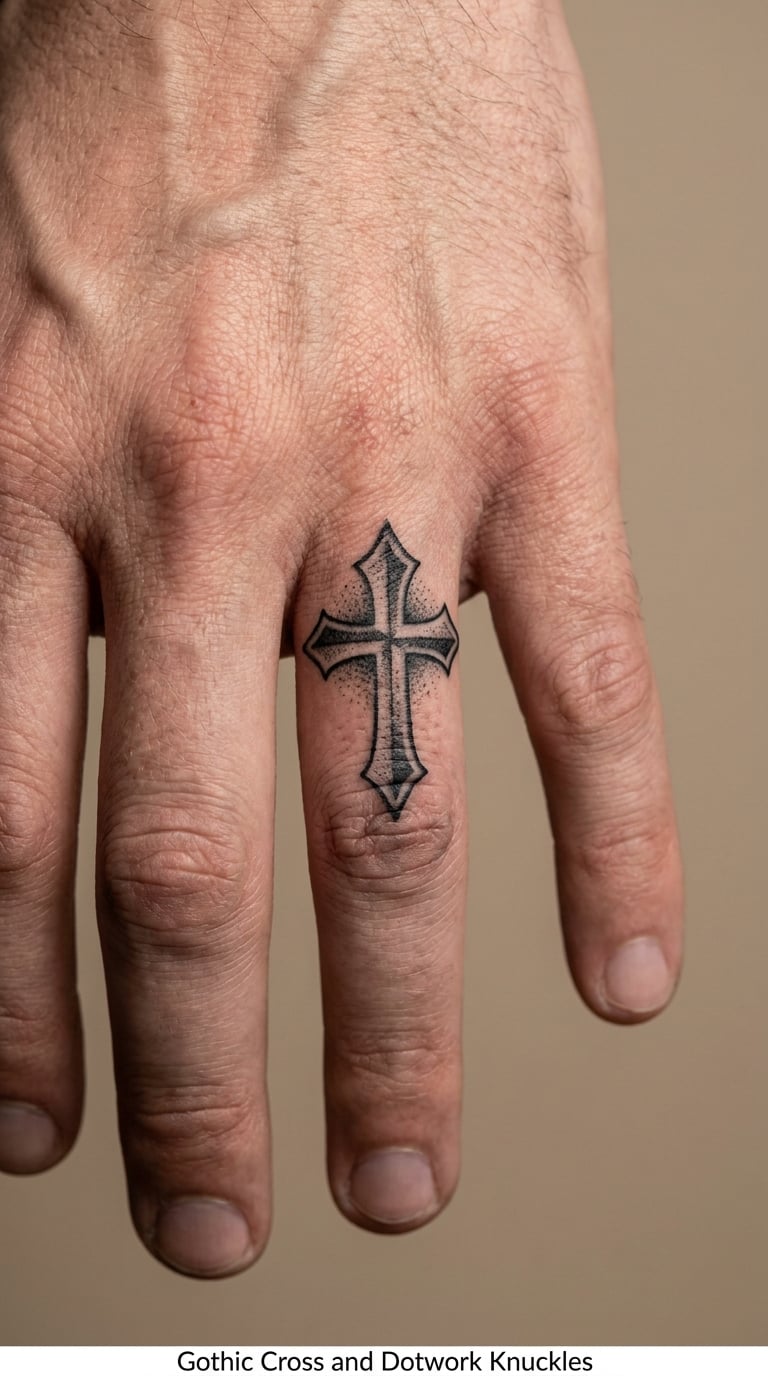
A slender cross in heavy black, framed by dotwork shading that fills the knuckle around it, is the ornamental take on a plain cross. The dots do the work of a border and stop the design looking thin on a wide joint.
Faith with a memorial edge, usually. The dotwork gives it weight that a bare outline never had on this placement.
Placement: two knuckles so the dot field has room, or one knuckle with a tight border. Size: 2 inches (5 cm) wide including the dotwork. Style: blackwork with dotwork accents. Pain: medium-high. Stippling around a shape means working close to an outline that has not healed yet, and the artist has to keep the dots off the moving part of the joint.
Make it yours: change the cross to a rosary or a set of prayer hands at the same scale and dotwork density.
16. Anchor and Rope Knuckle Tattoo
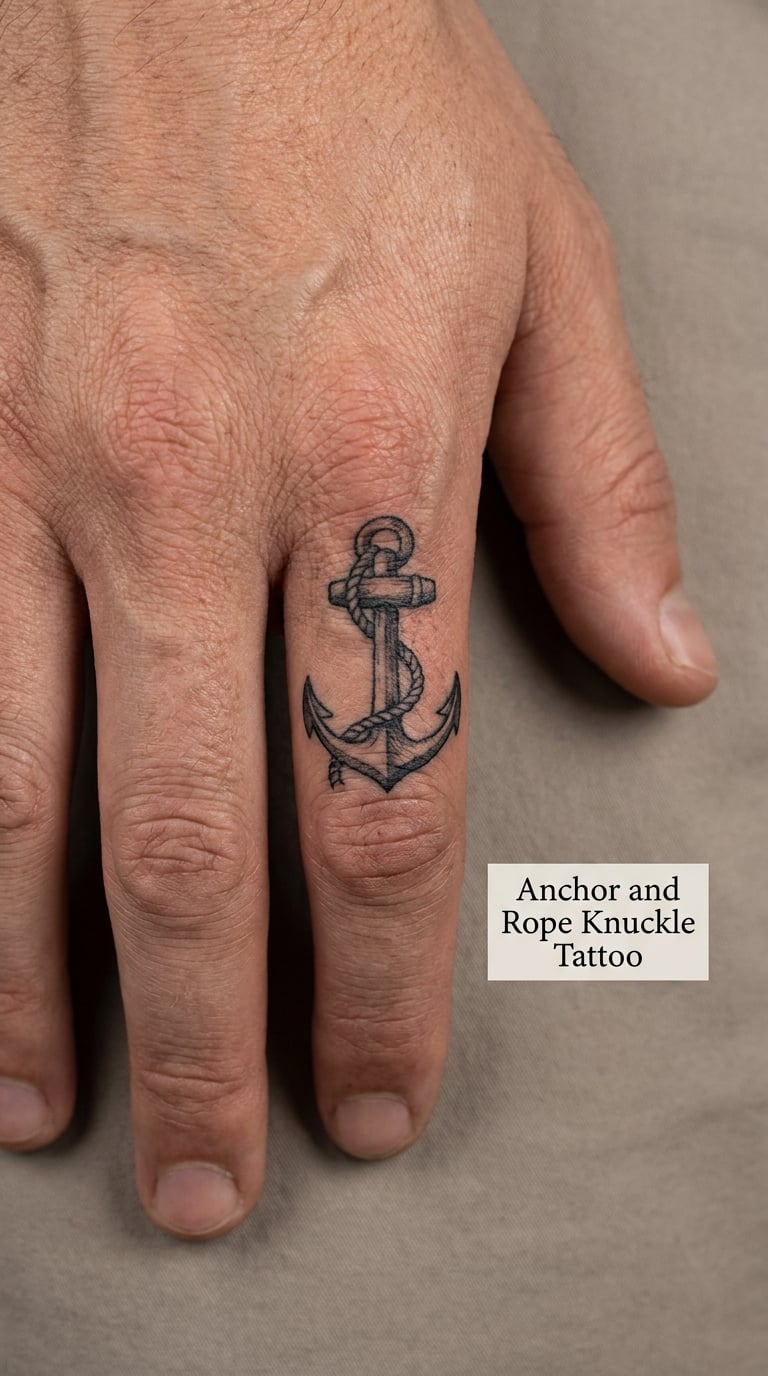
A stockless anchor in solid black with a rope wrapping the shank, the flukes landing on the index and ring knuckles, is the sturdiest design in the traditional kit. Filled-in shapes rather than shading are what make it survive.
Stability, loyalty, service, or a life spent around water. The rope is a personal choice more often than the anchor itself.
Placement: middle and ring knuckles, with the shank running lengthwise. Size: 2.5 inches (6 cm) tall. Style: blackwork. Pain: high, because the flukes and the rope both need solid coverage over two full knuckles. Line weight is non-negotiable, since a grey-shaded anchor here turns to soup in a few years.
Make it yours: knot the rope in a specific hitch, or wrap a thin band of lettering around the shank.
17. Minimalist Roman Numeral Knuckles
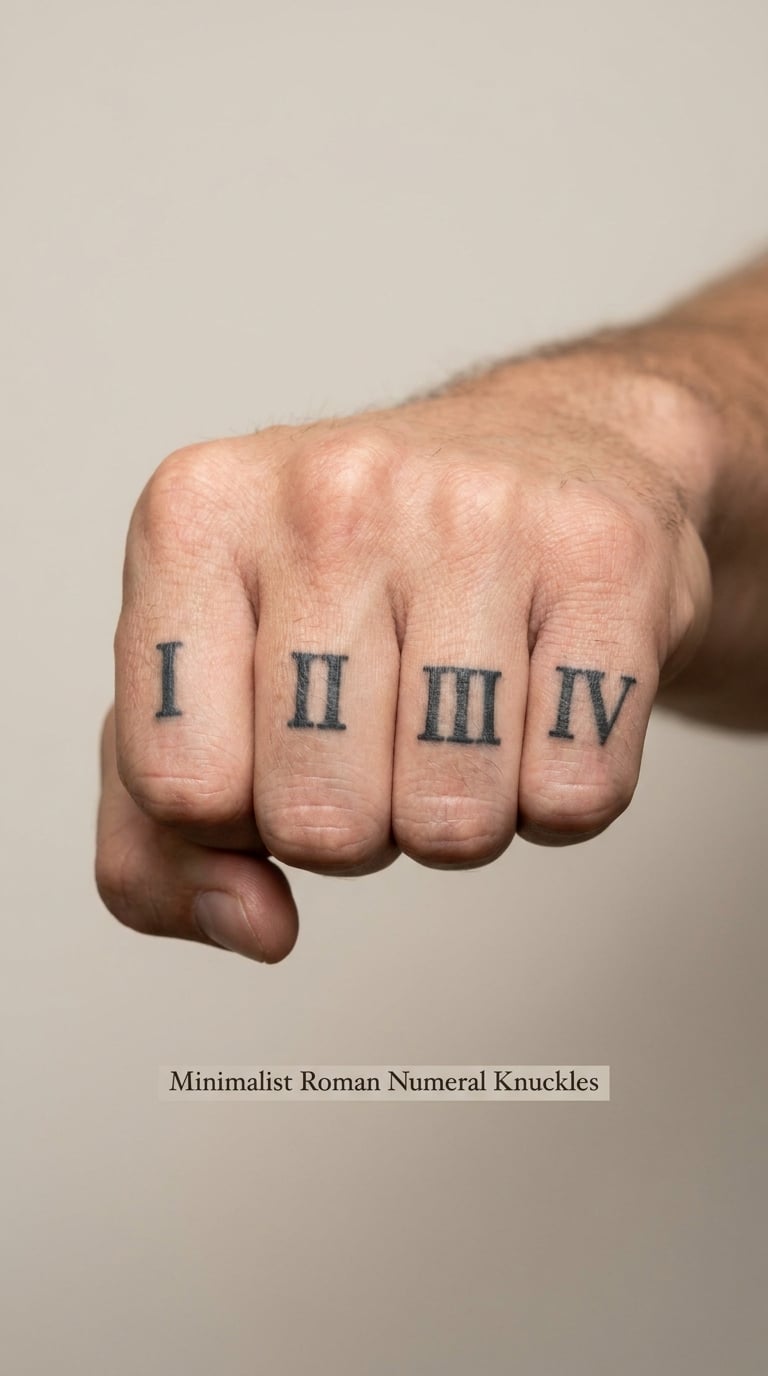
Small Roman numerals, one or two characters per knuckle, sit at the opposite end of the list from the skull. The typeface has to be a clean serif with thin-and-thick contrast, and the numerals need generous internal spacing or the counters fill in.
Dates, milestones, an anniversary. The most common use is a year, split so each knuckle carries a readable chunk of it.
Placement: one numeral group per knuckle, or a single small group on the middle knuckle only. Size: 0.6 inch (1.5 cm) tall per group. Style: minimalist. Pain: medium, and quick. Roman numerals are unforgiving of sloppy spacing because the eye reads them as a number, and a blurred counter changes what the date says.
Make it yours: use a serif face matched to an existing family or military crest, or set a second date in matching numerals on the other hand.
18. Watercolor Butterfly Knuckle Tattoo
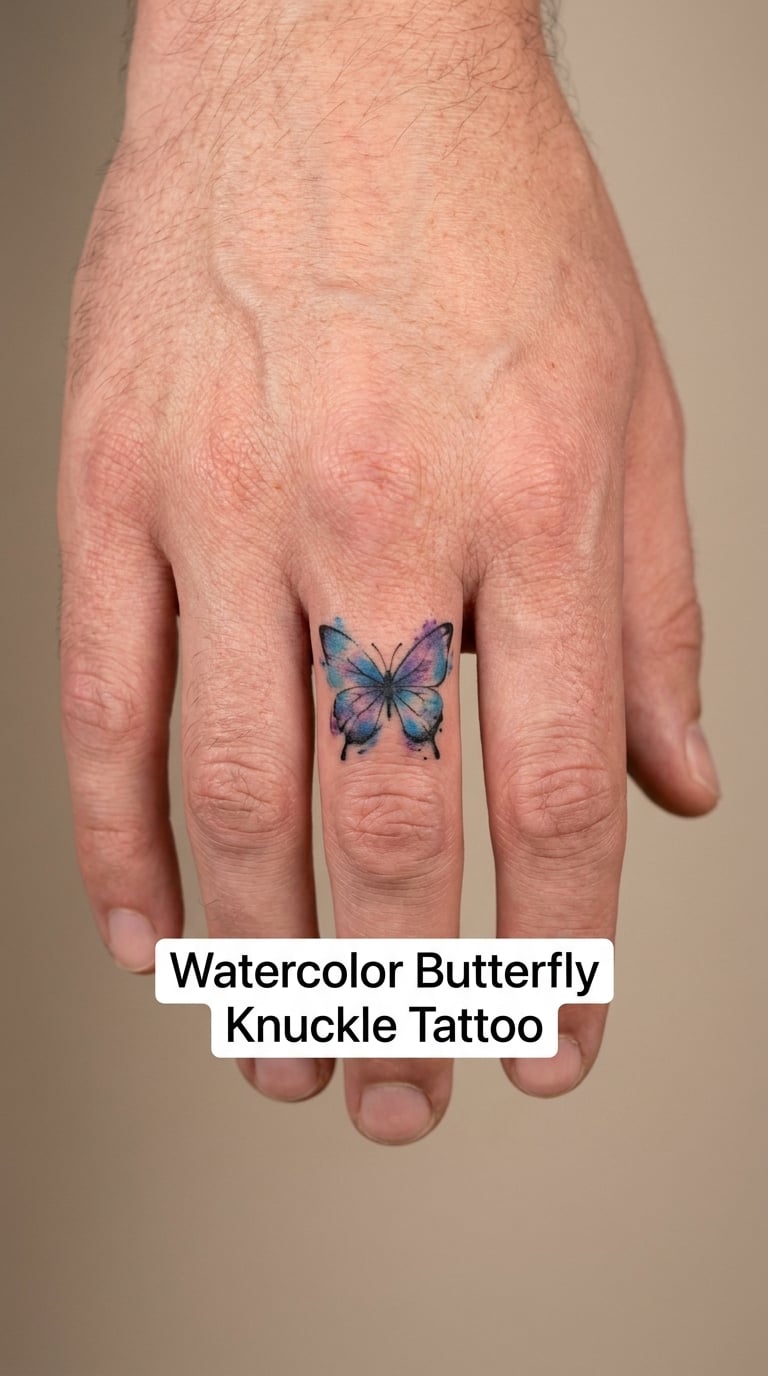
A butterfly with soft bleeding edges in blue, purple and a little black, no hard outline holding it together, is a genuine departure from knuckle tradition. It works because the wings follow the natural gap between two fingers.
Change, freedom, time passing. It is the least predictable design here and the easiest to start a conversation with.
Placement: two knuckles, ideally across a finger gap so the wings can spread. Size: 1.5 to 2 inches (4 to 5 cm) wide. Style: watercolor. Pain: medium. Watercolour is unforgiving on a hand. The ink sits on a surface that gets wet dozens of times a day, and pale washes will soften and pool before you have seen a healed photo of them.
Make it yours: pick two or three colours from something that matters to you rather than the full rainbow, which disappears anyway.
19. Blackwork Rose and Dagger Knuckles
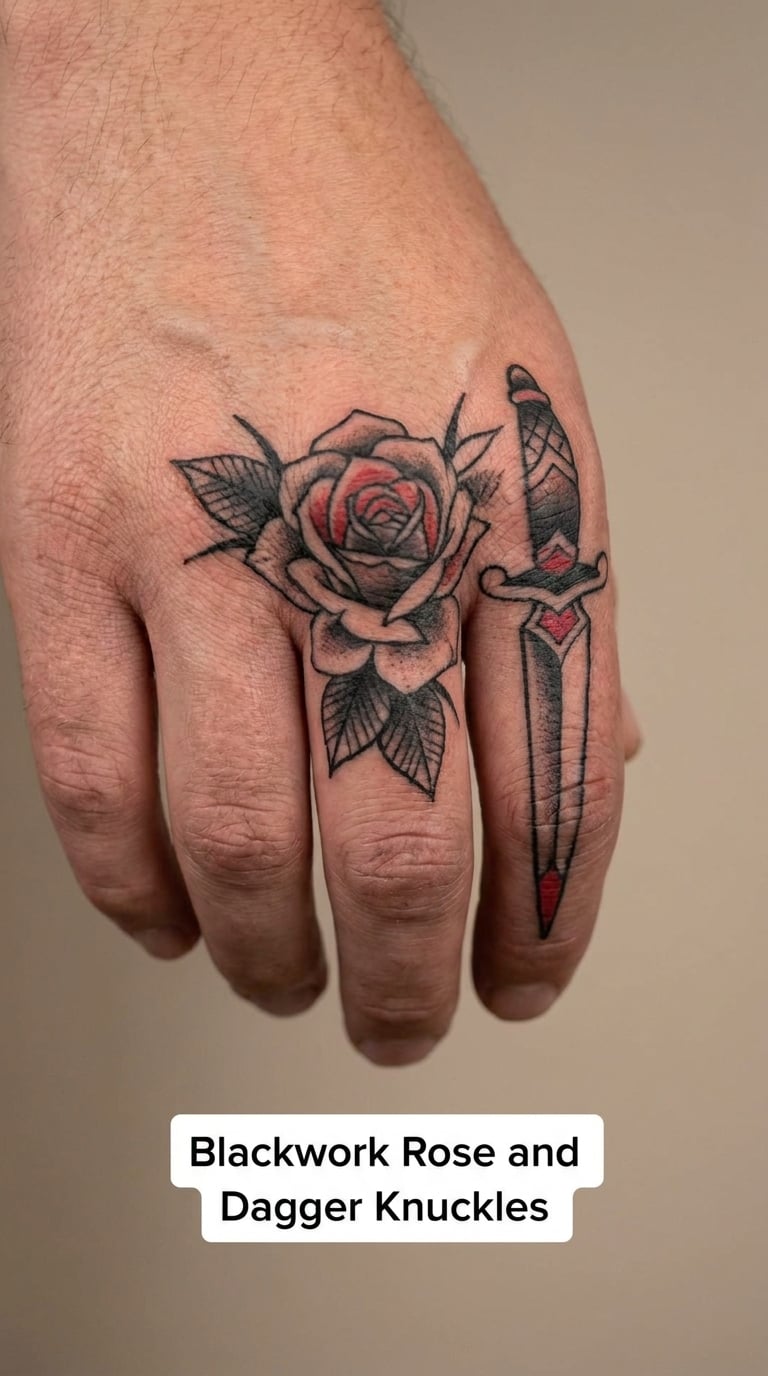
A dagger running lengthwise through two knuckles with a rose at the base, blade in black and one red bloom for contrast, is the traditional balance of hard and soft. The vertical blade gives the design an axis, which is what keeps two motifs on a moving hand from looking random.
Beauty and consequence, love and risk. Paired compositions like this are the traditional way of saying two things at once.
Placement: two knuckles set lengthwise, blade along the finger, rose sitting on the knuckle joint. Size: 2.5 inches (6 cm) long. Style: blackwork with one red accent. Pain: medium-high. The contrast between solid blade and shaded petals is the hard part, since a shaded rose next to a black blade is where knuckle texture shows most.
Make it yours: put a short word on the banner beneath the rose, or take the colour out entirely for a fully black version.
20. Fine-Line Mountain Peak Knuckles
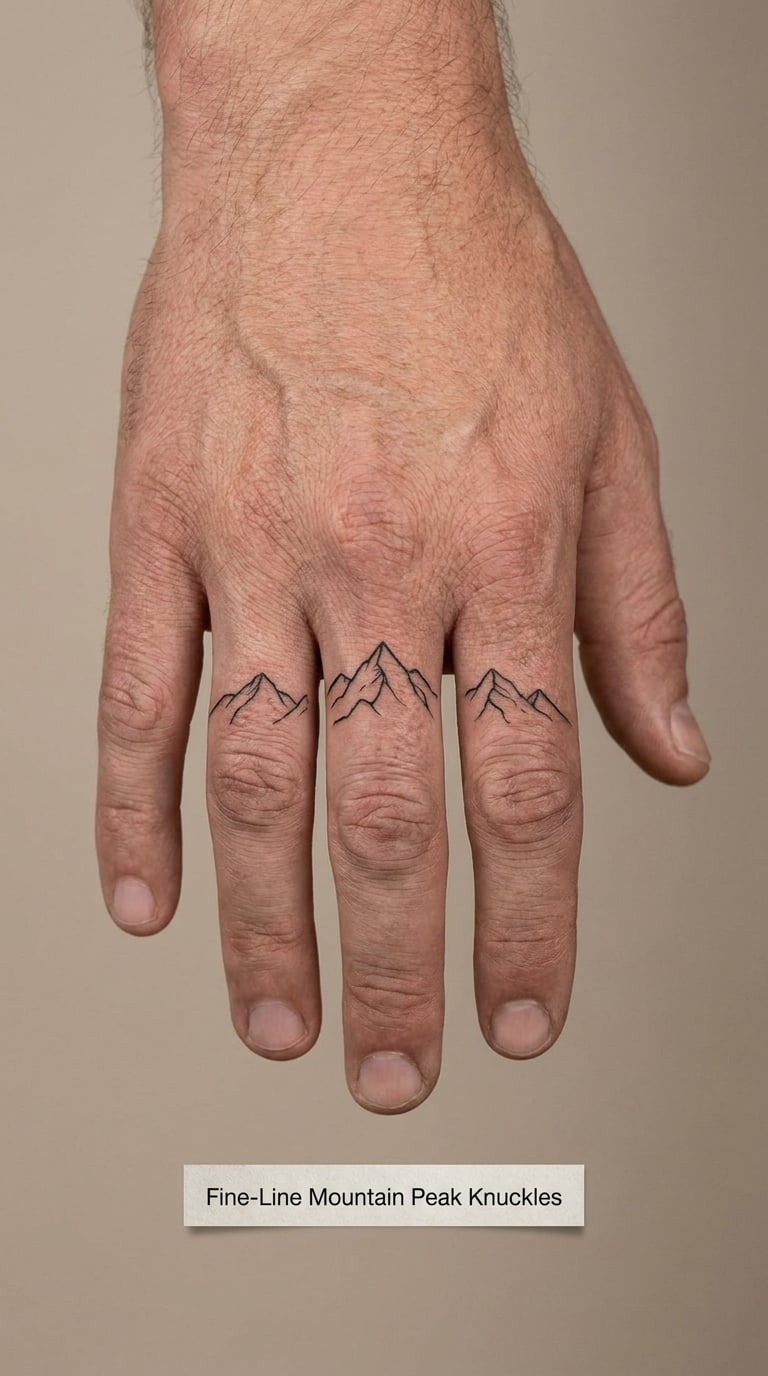
One mountain peak in a single confident line across three knuckles, with two or three shorter strokes for the shoulders, is the quietest way into knuckle work. It is a genuinely good first hand tattoo, because there is very little that can go structurally wrong.
The place you come from, or the one you have not reached yet. Men with a full arm sleeve often add it to carry a landscape into a placement nobody thinks to tattoo.
Placement: three knuckles, or the back of the hand for more room. Size: 2 inches (5 cm) wide. Style: fine line. Pain: medium, and brief. Fine line is the first thing to fade on a hand that gets washed, worked and sun-exposed daily, so a slightly heavier line now saves a touch-up later.
Make it yours: have the peak drawn from a photograph of the actual summit rather than a generic outline.
How to Choose the Right Design
Six things decide whether a design works on knuckles. Check them before the consultation, not after the stencil is down.
- Weight before detail. Whatever you want, the artist will need to run heavier lines on a knuckle than on your arm. If your design depends on hairlines, pick a bigger motif or a different placement.
- Size honestly. Most of the failures I have seen in hand work are designs that were too small. If the idea only works under half an inch, it belongs on the side of a finger, not on a knuckle.
- Test it in a fist. Lettering is the special case. Make a fist and a mirror before you commit. If the word does not read closed, the spacing is wrong and the font will not save it.
- Pick contrast, not just a motif. A solid black shape on a knuckle will outlast a shaded one, every time. Decide which matters more to you, the image or the longevity.
- Know what the placement means at work. Hands are the least hideable spot on the body. Some workplaces and some industries treat visible hand ink as a jobstopper, and no design changes that. If you want discretionary, the back of the hand or the inner wrist is kinder.
- Match the design to your hand’s ink behaviour. Some knuckles simply do not hold ink well. If you have had fading on previous hand or finger tattoos, go bigger and bolder, and expect to come back for a refresh.
Knuckle Tattoo Ideas for Men: Matching and Placement Questions
For matching hands, the cleanest approach is to stencil both hands flat at the same size before anything is tattooed, then mirror the layout rather than redrawing it. Identical spacing is what makes a pair look intentional rather than accidental.
Allow a little more room than you think you need. A knuckle with a quarter inch of clear skin around it reads far better than one where the design runs edge to edge, and that margin is the part you cannot add later.
Knuckle movement is the other half of it. Every design here flexes each time you make a fist, so anything that relies on a straight line, a fine connecting stroke or a tiny numeral should be positioned away from the deepest crease. The pad of the knuckle holds better than the seam beside it.
If you want a fuller look, read our bold forearm tattoo ideas for men for designs that can carry a knuckle piece into a sleeve.
Cost and Session Time
Knuckle work is priced by the hour, and a knuckle takes a long time for how small the finished piece is. Bone sitting close to the surface slows artists down, the skin is unforgiving, and nobody is rushing a line over a joint.
Here is the rough US picture. Micro work, a single cross or Roman numerals, usually lands between $80 and $150. A small single-element piece such as a rose, arrow or butterfly runs $150 to $300. Medium pieces covering two or three knuckles fall around $300 to $600, and a full four-knuckle set such as the skull, serpent or lettered word starts around $600 and runs to $1,200 depending on how many sessions it takes.
Colour work costs more than blackwork for the same outline, because packing red or a full traditional palette is slower. Micro-realism costs more per square inch than anything else here, since the shading is built dot by dot.
Rates vary widely between a town shop and a city studio, and every artist prices differently. Shop minimums mean a small piece can still carry a floor price that has nothing to do with its size. Get the hourly rate and the estimated hours in writing at the consultation, then decide whether the design is worth it. Many people scale the idea down rather than scale the budget up.
Aftercare Basics
- Follow your artist’s aftercare instructions first. They know what they did to your skin, and generic advice can undo their work.
- Wash the area a few times a day with clean lukewarm water and a fragrance-free wash, then pat it dry. Hands get dirty and this is the one piece of aftercare you can keep up with.
- Keep it clean and let it breathe. Cover it loosely when you have to for work or gym, but leave it uncovered as soon as you reasonably can.
- Protect it from the sun. UV is the fastest way to lose a colour tattoo on a hand, and knuckles get sun without you noticing.
- Moisturise once the skin is closed over, using something plain and unscented. Dry, cracked knuckle skin pulls ink and is a slow way to lose definition.
- Do not pick, itch or scrub the peeling skin. It will come off on its own, and picking it is how people end up with patchy hands.
One honest note on healing: hands heal roughly because you have to use them, and a raised or bumpy knuckle weeks after the session is a normal part of that, not a failure. Deep healing on a hand can take several months, so treat the first fortnight like a minor injury and ramp your hand use back up gradually.
Frequently Asked Questions
Are knuckle tattoos more painful than other hand tattoos?
Yes, usually. Knuckles rate around 6 to 8 out of 10, because bone sits closest to the surface there and nerve endings are dense. The back of the hand sits closer to 4 to 6, and the palm is worst of all. Expect the last knuckle of each finger to be the sharpest part of a session.
How long does a knuckle tattoo take to heal?
The surface looks settled in two to three weeks, but hands heal slowly because you cannot stop using them. Expect a raised or bumpy texture for several weeks and full settling over three to six months. Ease into normal use instead of picking the skin back up straight away, and keep the sun off it while it settles.
Do knuckle tattoos fade faster than arm tattoos?
They do. Knuckles get washed, worked, flexed and exposed to sun more than an arm does, so fine line and light colour go first. Blackwork with solid fills lasts longest. Plan to refresh fine detail every few years, and choose a heavier line weight now if you want it to still read in five years.
What size should a first knuckle tattoo be?
Bigger than most people expect. A design needs roughly an inch of clear skin around it to read properly on a knuckle, so aim for around two inches across for a single element and three to four inches for a full four-knuckle set. If your idea only works at half an inch, put it on the side of a finger instead.
Are knuckle tattoos a good choice for a beginner?
They can be, but only with a bold design. A first hand tattoo should be simple, high contrast and short to session, which rules out fine line, micro-realism and heavy colour work. Ask the artist to check a fist test on any lettering before the stencil goes down, and be prepared to commit to touch-ups later.
Conclusion
For a first knuckle tattoo, start with the fine-line mountain peak, the minimal cross or a single bold black arrow. They are short sessions, forgiving designs and they hold up longest on a hand that never stops moving.
If you are adding to an existing collection, the skull set, the word across four knuckles or the rose and dagger give you the boldness that reads across a room. Either way, decide on the placement and the personal meaning first, then let the artist’s fist test and line weight decide the final drawing.
If you are still building the rest of the set, browse our galaxy tattoo ideas for deep colour work, or our sparrow tattoo ideas for a small illustrative piece that travels well on a hand.