
18 Best Tattoo Ideas for Guys on the Arm (September 2026)
Most people searching tattoo ideas for guys on the arm are not looking for a specific flash sheet. They are standing in a studio or scrolling on a phone trying to work out one thing: which design will still look right in ten years, on an arm that moves, ages and changes shape. The arm is the most popular canvas in the world for good reason. It is long, it is flat in places, and every single design on it is visible every time you move your sleeve.
It is also a canvas that punishes lazy choices. A tattoo drawn for a flat digital screen will sag the moment it wraps a biceps, and a thin line on the inner forearm will blur faster than the same line on the upper arm. What follows is eighteen arm designs picked for how they age, not just how they look on day one, plus the placement logic that decides whether one works for you.
Updated for September 2026. If you are new to this, start with the placement section below before you fall for a design, because the zone you pick changes what is possible.
Which arm tattoo is best for a male?
For most men, the best arm tattoo is a bold single subject on the outer forearm or the deltoid, sized to the muscle rather than to the photo, because both zones take a clean shape, stay readable at a distance, and distort far less than the inner forearm. The tricep suits larger landscape work, the inner forearm suits readable text, and the wrist suits fine minimal work.
| Arm zone | Best size | Visibility | Pain | Best design type | Hides at work? |
|---|---|---|---|---|---|
| Deltoid (shoulder cap) | 10-20cm round | High | Low | Realistic portrait, traditional badge, animal head | Yes, with a sleeve |
| Bicep | 10-15cm | Medium-high | Low | Bold shapes, blackwork, wrapping pieces | Partly |
| Tricep | 15-25cm | Low-medium | Low-medium | Landscapes, memorial pieces, sleeve backgrounds | Yes |
| Outer forearm | 15-30cm length | High | Low-medium | Line work, script, nautical, botanical stems | Partly |
| Inner forearm | 10-20cm | Medium | Medium | Text, coordinates, fine line, small scripts | Yes, with a long sleeve |
| Elbow | 6-10cm | Medium | High | Small motifs, lettering that follows the curve | Yes |
| Wrist | 4-8cm | High | Medium | Fine line, small symbols, single word | No |
Two things on that table are worth more attention than the rest. Visibility and hideability pull in opposite directions: the wrist is the most looked-at zone on the whole arm and the hardest to cover at a desk, while the tricep is nearly always hidden under a shirt but stays visible whenever you roll a sleeve.
How a tattoo ages on the inner vs outer forearm
The inner forearm has thinner skin, more movement and more exposure to scrubbing, washing and shaving, so fine detail fades there faster. The outer forearm sits on denser skin that takes a heavier line, and shading on the outer forearm ages far more evenly than on the inner.
The other difference is distortion. Inner forearm ink stretches as the arm rotates and the wrist bends, so curves and circles visibly deform. Outer forearm and bicep designs sit on muscle that holds a shape, which is why bold, angular blackwork ages more predictably there than soft script.
1. Fine-Line Compass Rose on the Outer Forearm
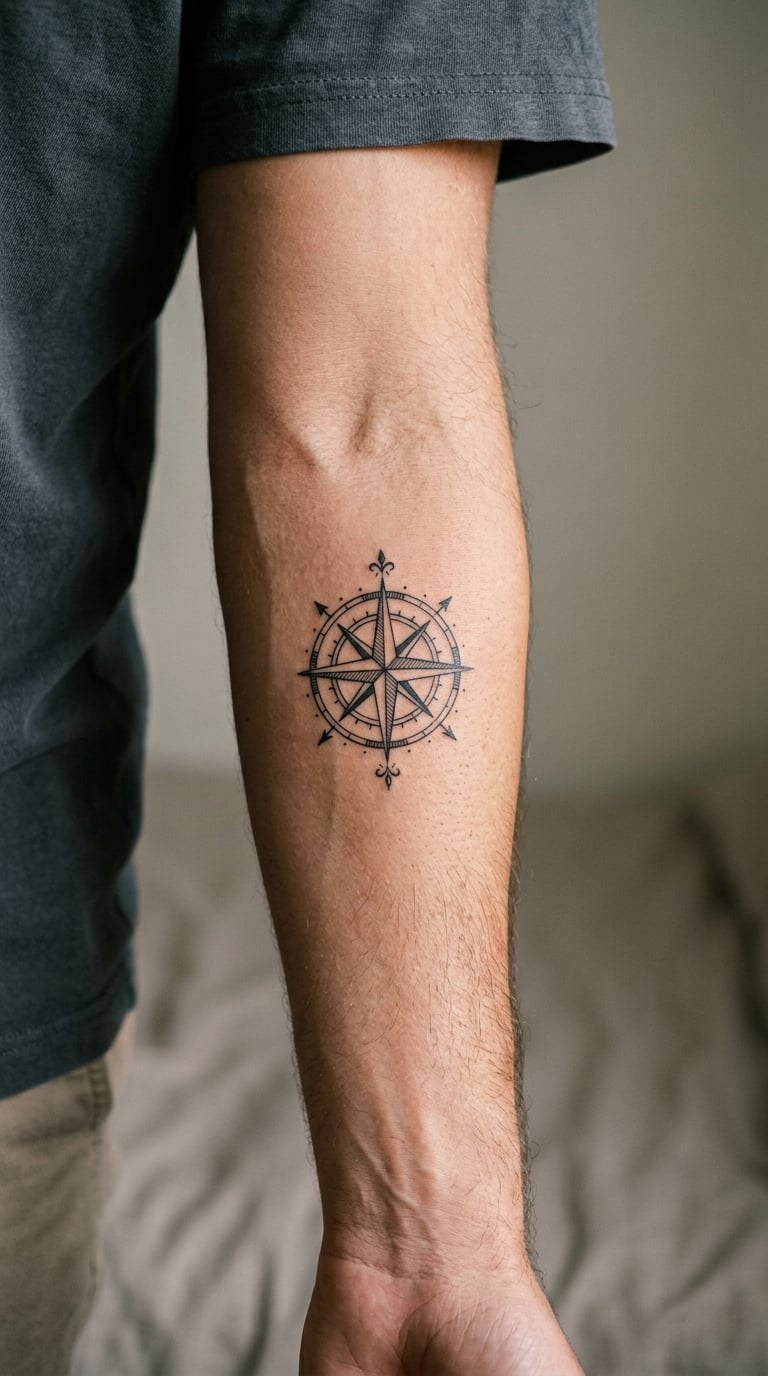
A compass rose is about direction rather than travel, and it stays one of the cleanest small arm designs there is. Fine line keeps it quiet: one needle, a few tick marks, no shading, so it reads as considered rather than loud.
Placed on the outer forearm it sits about 10-15cm long, running with the bone so the movement never fights the design. The lines are the weak point here. Give your artist explicit permission to run a heavier line, because hairline work on a mobile arm tends to fade into a smudge within a few summers.
Pain and time: The outer forearm is one of the easier spots, roughly a 3 out of 10, and a design this size takes 45 to 90 minutes.
2. Blackwork Serpent Curled Around the Bicep
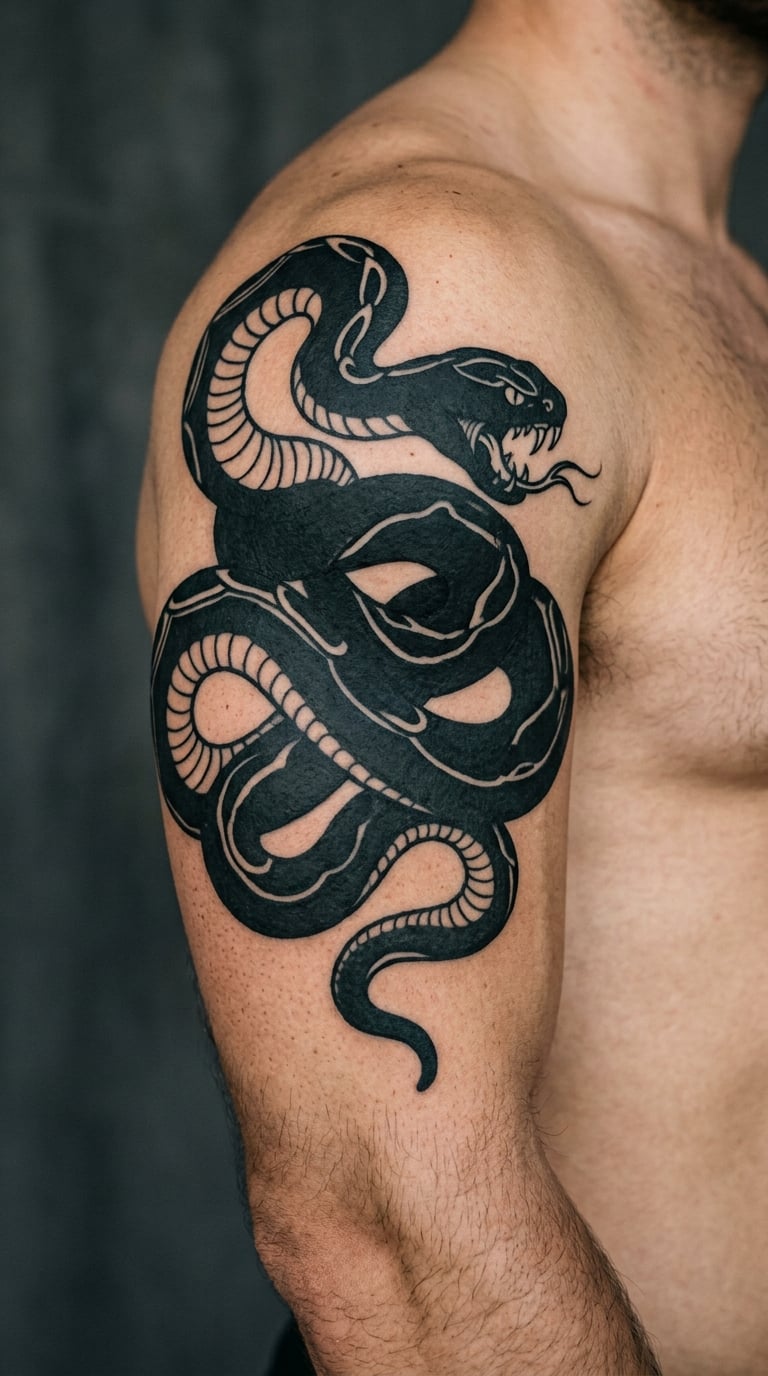
A serpent wrapped around the bicep is a strength piece disguised as a single animal. Solid black fills with no grey shading read as heavy and modern, and the coil gives the design a reason to follow the muscle instead of fighting it.
Spend your detail budget on scale texture and eye shape, because fine detail inside a solid black area disappears. The bicep is roughly 10-15cm across, so keep the head larger than you think it needs to be, and ask the artist to leave a gap of bare skin on the underside so the coil reads as wrapping.
Pain and time: The upper arm is low on the pain scale, around a 3, but a blacked-out fill takes longer than the size suggests. Expect 2 to 3 hours.
3. Minimal Mountain Range on the Inner Forearm
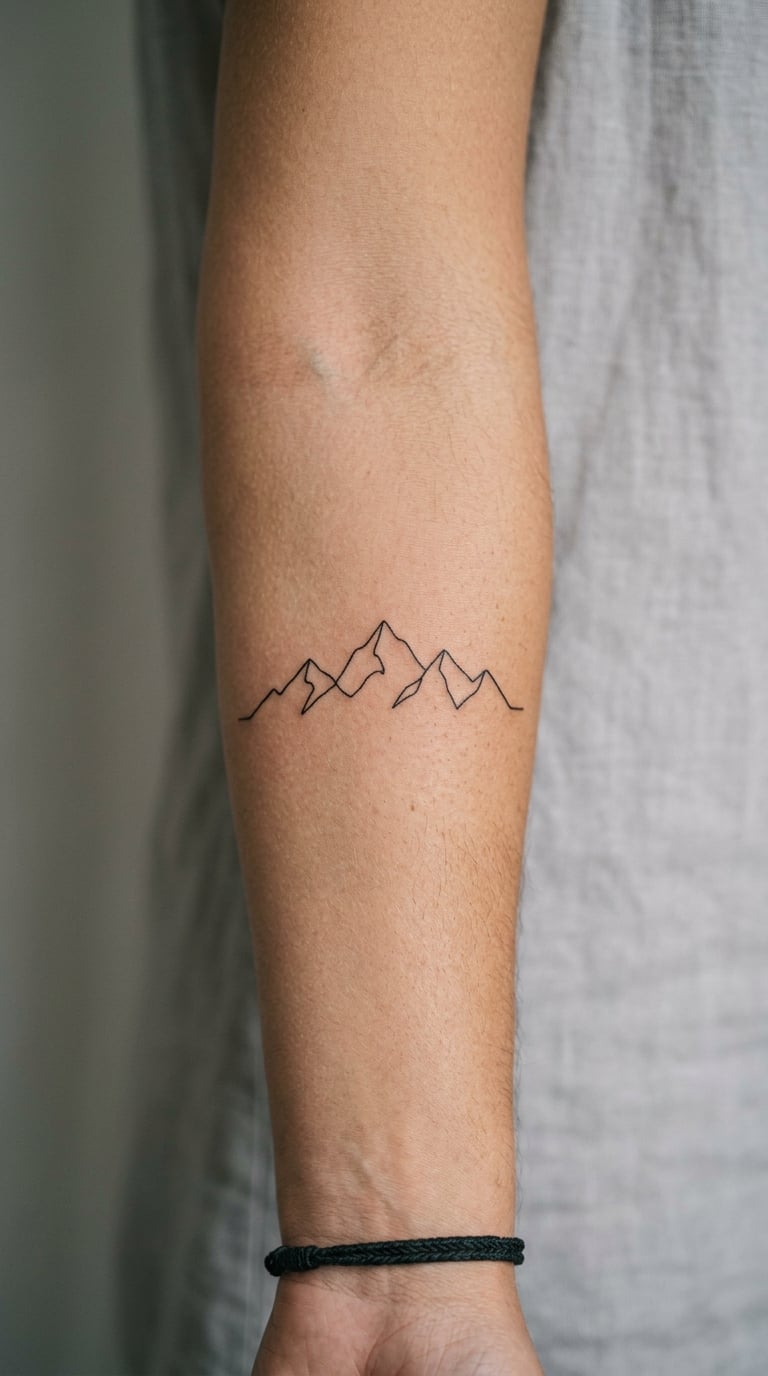
Peaks drawn as a single continuous line are the most understated arm design that still means something specific. It suits anyone who wants a first tattoo that does not announce itself, and it pairs well with a date or coordinate added later.
On the inner forearm this design lives or dies on proportion. Peaks that are too tall and narrow get stretched by the wrist bend, so ask for a wider, flatter composition. A good artist will tell you the design needs to be about 12cm across to read correctly on an inner forearm, and that is a real size, not a small one.
Pain and time: Inner forearm sits around a 4 or 5, mostly from the skin being thin and sensitive. 45 to 60 minutes.
4. Traditional Rose and Dagger Half-Sleeve
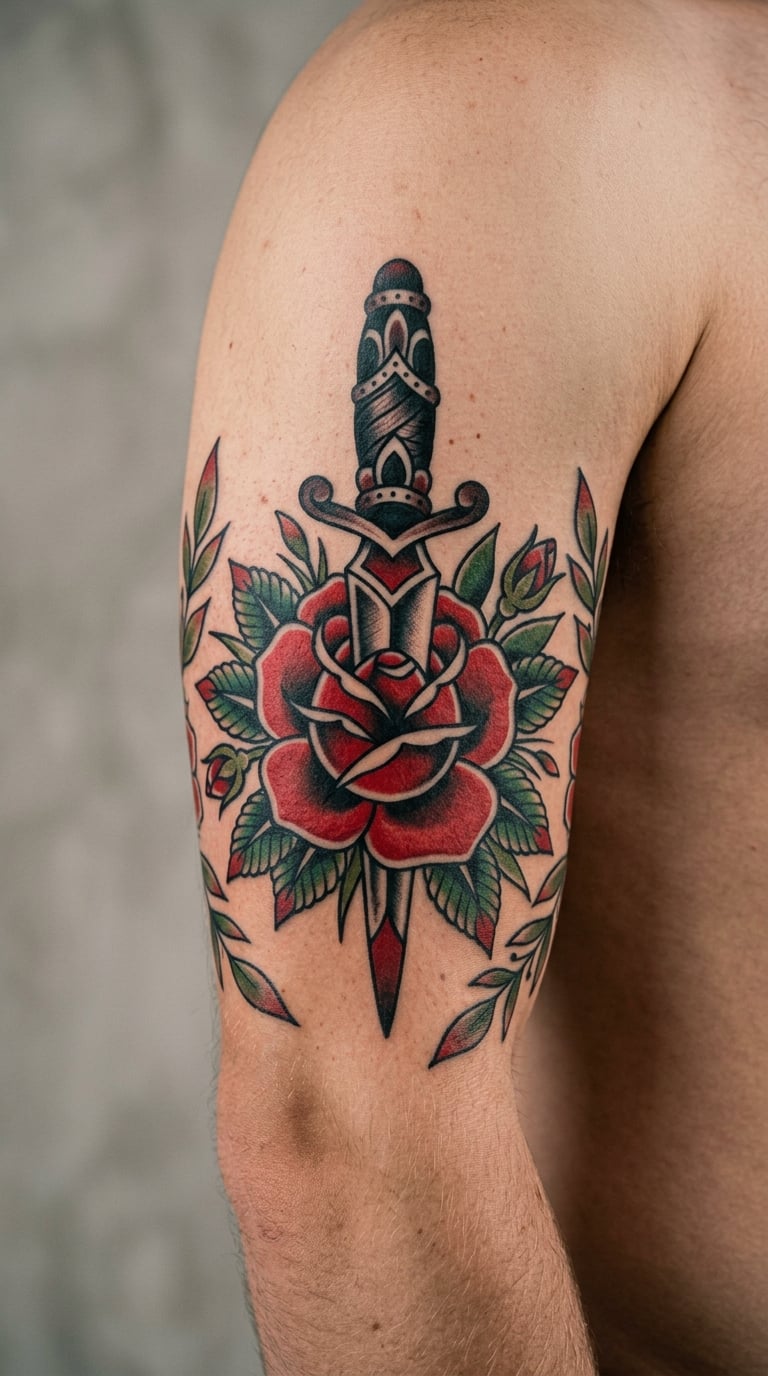
The rose and dagger is the oldest shortcut in American tattooing and it still works because the shapes are strong. Bold outlines, a small colour palette, heavy black shading, no gradients, and it reads perfectly from across a room.
As a half-sleeve it runs from the deltoid down across the bicep to the elbow, usually covering 25-35cm of arm. Traditional shading is the part to watch: heavy black stipple in a big field can look muddy after a decade, so ask for shading that breaks up rather than floods, and expect a touch-up visit on the red after a few years.
Pain and time: The deltoid and bicep are among the least sensitive areas, around a 2 to 3. A piece this size runs 3 to 5 hours, often in two sessions.
5. Koi Swimming Around the Elbow
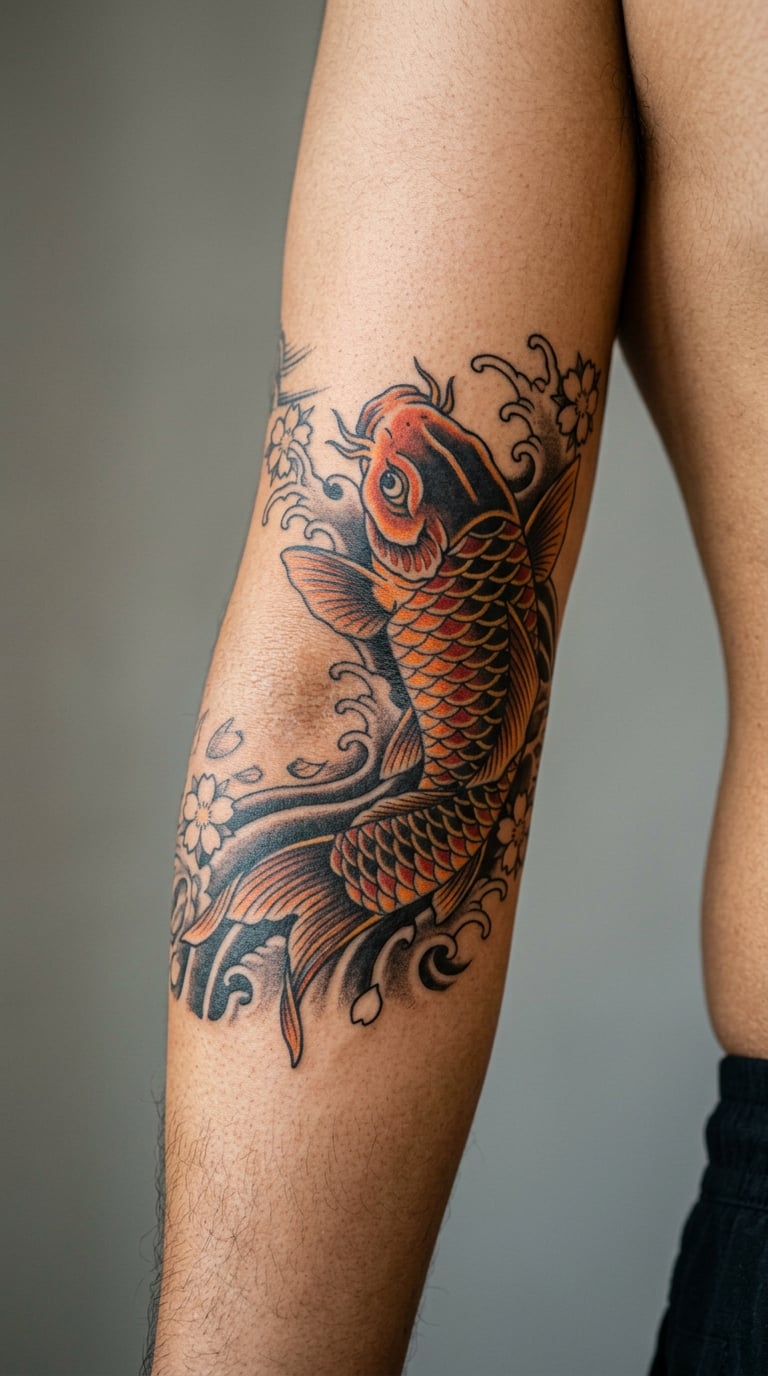
A koi around the elbow is the design people mean when they say they want something that flows. Fish imply persistence and movement, and the elbow is the only spot on the arm where a body can genuinely appear to swim around a curve.
Style matters more here than anywhere else. Irezumi-style koi want soft grey washes and long flowing fins, while a semi-traditional koi wants bold outlines and a red belly. Ask for fins and scales that follow the direction of the elbow, and be aware that the inner elbow crease is where this style blurs first.
Pain and time: The inner elbow is one of the more tender zones on the arm, closer to a 6. Allow 2 to 3 hours, and plan a short sitting rather than pushing through.
6. Black-and-Grey Wolf Head on the Deltoid
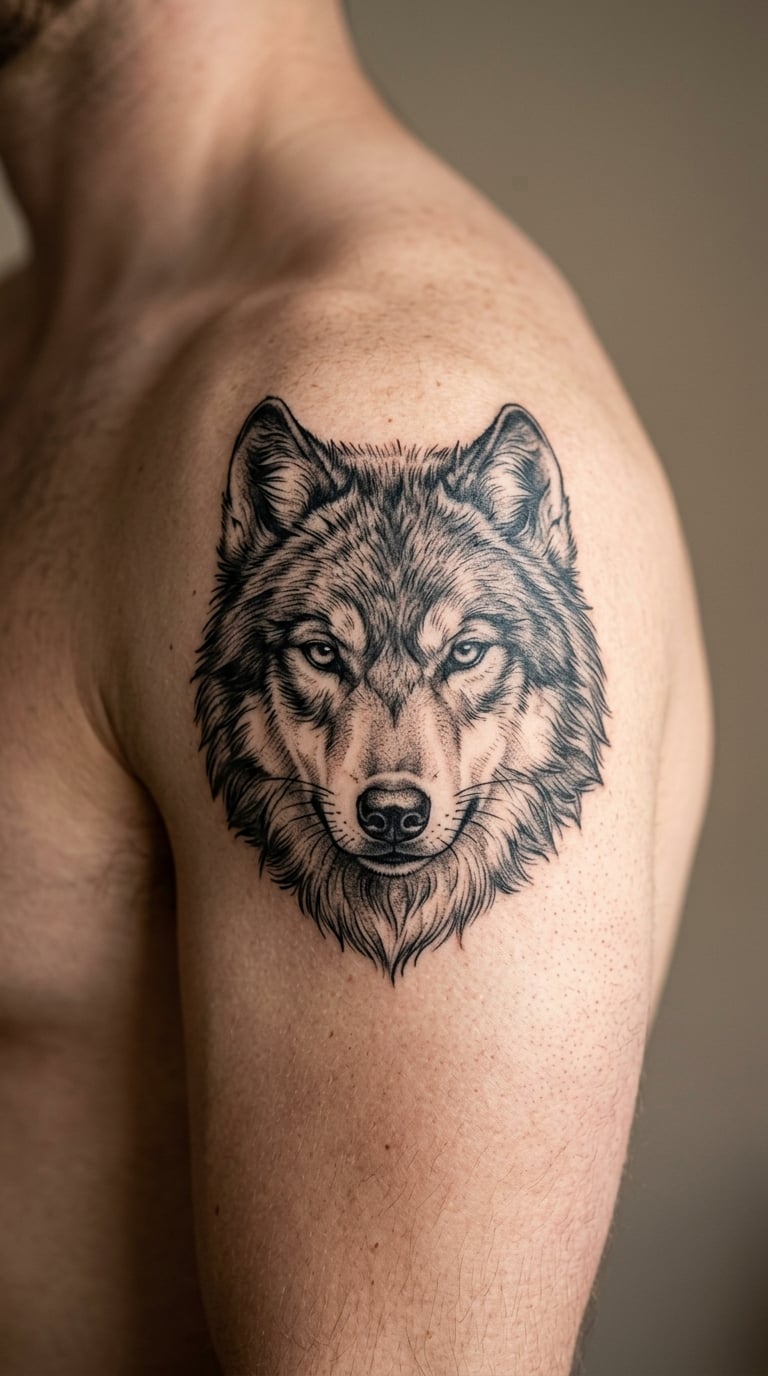
A realistic wolf head on the deltoid is a loyalty and family design that carries the same weight as a portrait of a person, which is exactly why it is so common. Grey wash work gives it depth without turning into a full-colour mural.
The deltoid is a rounded canvas, so a head reads best slightly turned rather than facing dead forward, and it needs real size: 12-18cm across the shoulder cap. Grey shading ages more slowly than colour, but the lightest washes fade toward skin tone within about eight years, so an artist who plans the value range in advance will keep the face readable longer.
Pain and time: The deltoid is low, roughly a 3. Grey wash portraits take 4 to 6 hours and are normally split across two sessions.
7. Olive Branch Along the Inner Forearm
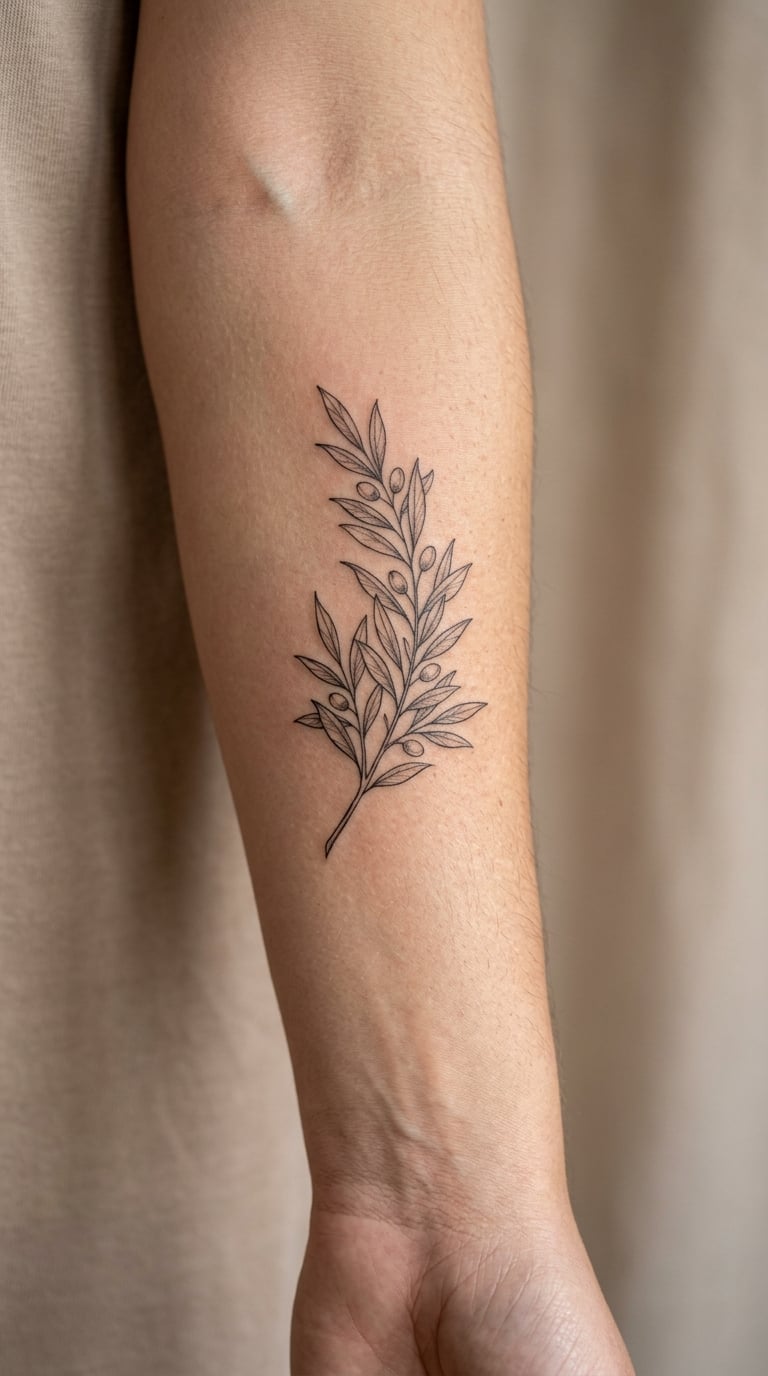
Olive branches carry peace, reconciliation and survival, and they look like something you grew rather than something you chose. Fine-line botanical work is currently the most requested style for first arm tattoos, mostly because it hides easily and photographs well.
Run it lengthwise along the inner forearm from wrist to elbow, following the tendon line rather than crossing it. This is the style most exposed to fading, because thin single-needle lines on soft skin break down first, so plan for a lighter version of itself and check in about six months for a tidy-up.
Pain and time: Inner forearm, around a 4. Fine line is slow going, so expect 90 minutes for a 15cm branch.
8. Geometric Blackwork Bands on the Upper Arm
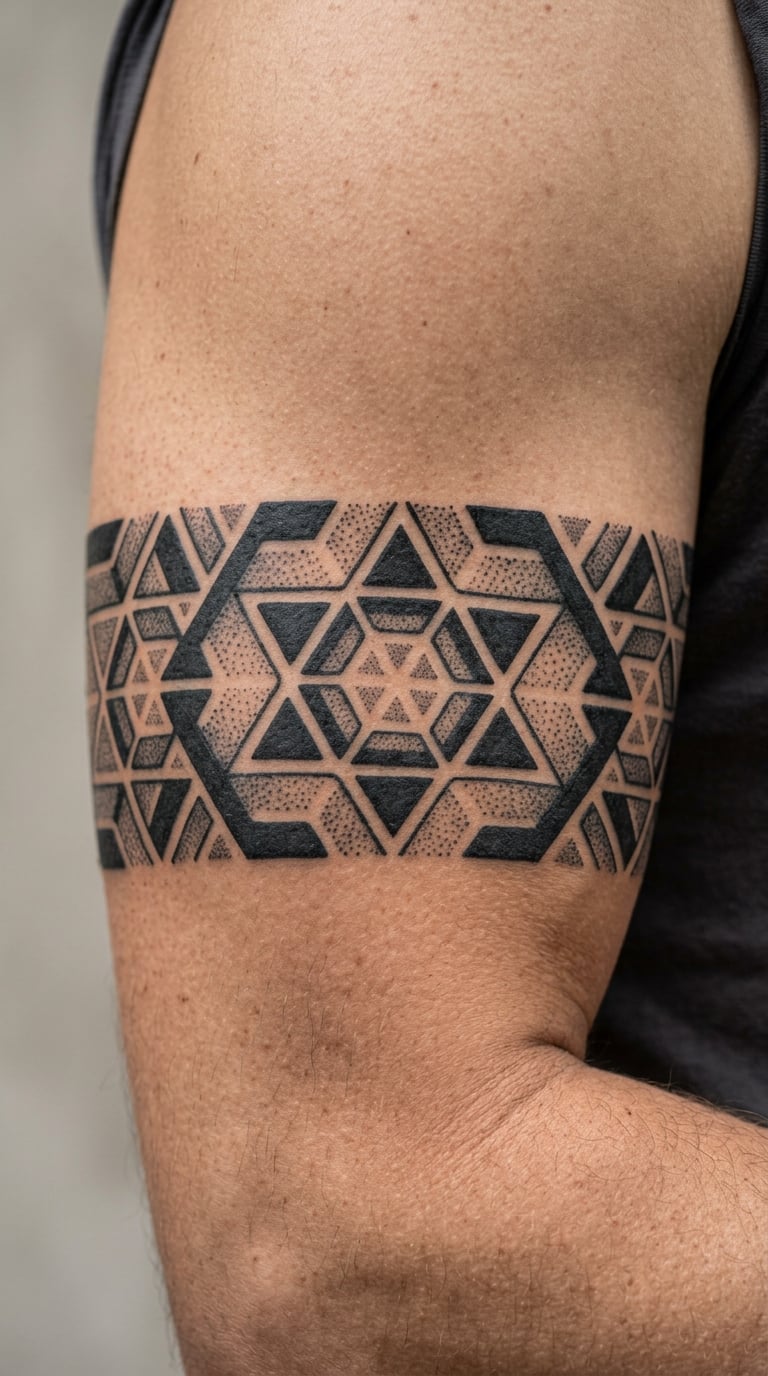
Geometric work is the design people choose when they want something modern that does not depend on anybody’s opinion of the imagery. Repeating line patterns, nested shapes, or a broken band that wraps the bicep all land in this category.
The trap is going too small. A geometric pattern under about 7cm reads as a smudge once the ink settles, so keep each shape at least 1cm across and let the whole band run 10-12cm around the bicep. Line weight should be consistent across the whole design, and that consistency is the single thing separating a clean piece from a muddy one.
Pain and time: Upper arm, around a 3. 2 to 3 hours for a well-sized band.
9. Nautical Anchor with Rope on the Outer Forearm
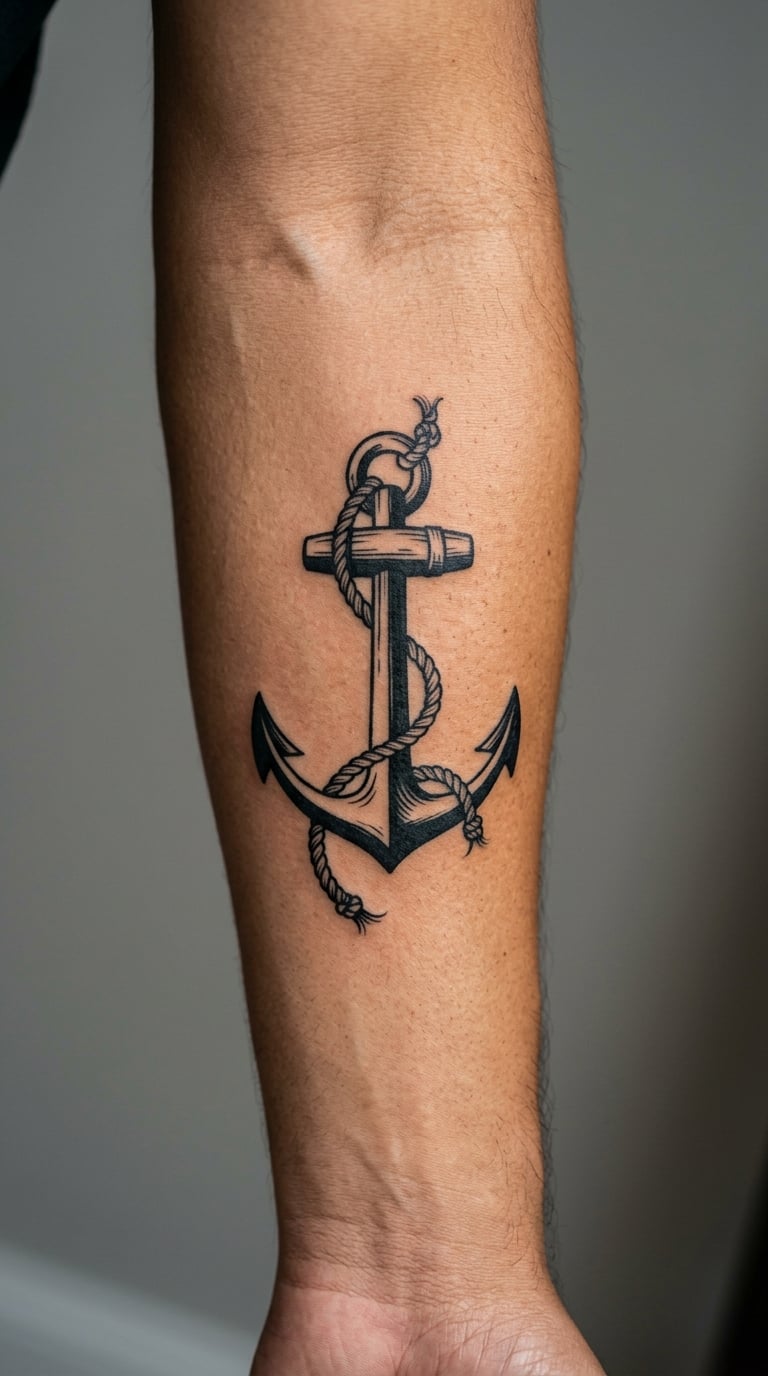
An anchor is a steady, unglamorous symbol that suits people who do not want to explain themselves. The rope detail is what turns it from clip art into a tattoo, so keep it and let it run off the edge of the design as a wrap.
Outer forearm, roughly 12-15cm, black ink with maybe one red accent. The rope crossing the wrist bone needs to be planned around the joint, not over it, and old nautical work typically wants heavier line weight than your instinct tells you. A fine-line version of this design fades into unreadability faster than anything else in this list.
Pain and time: Outer forearm, around a 3 to 4. 60 to 90 minutes.
10. Memorial Portrait in Black and Grey on the Tricep
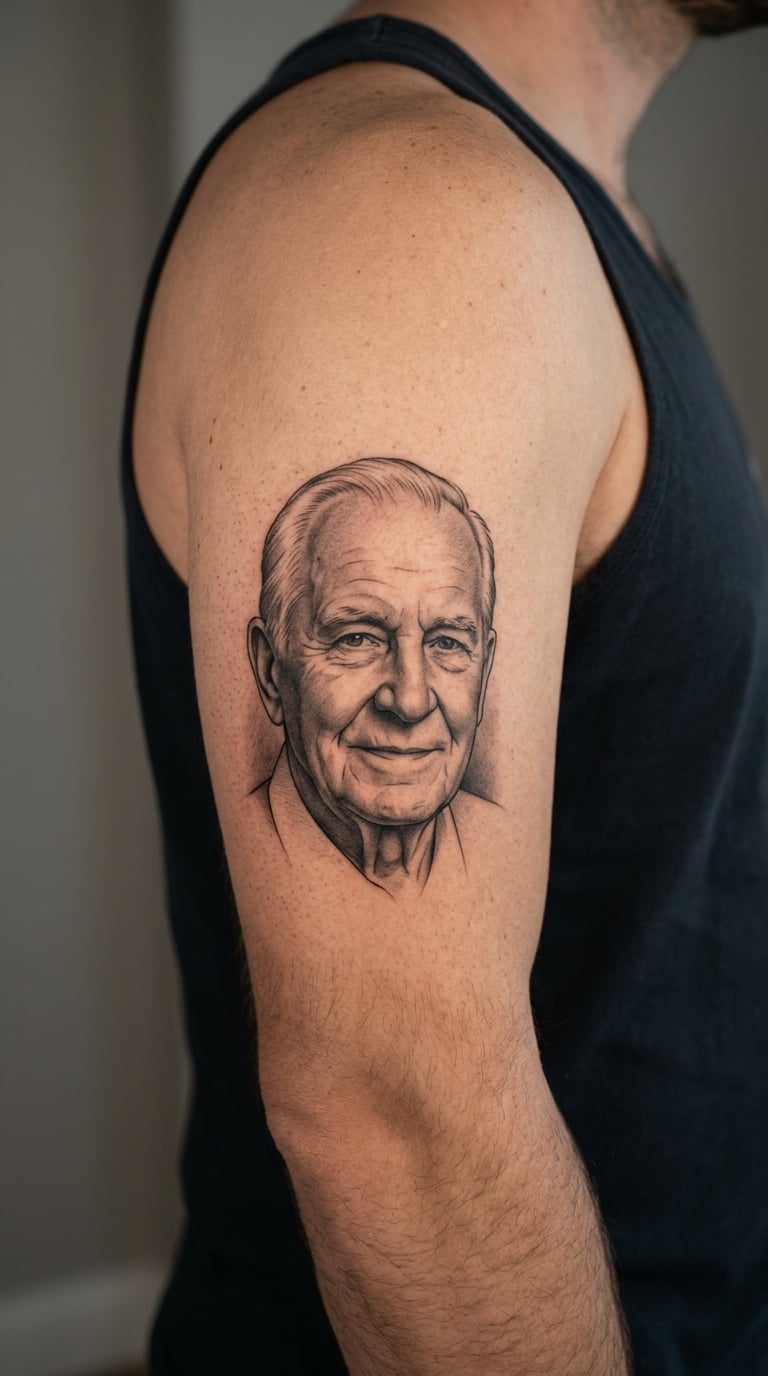
A portrait on the tricep is the placement most people land on for a memorial, and the reason is simple: it is large, it is discreet under a short sleeve, and it sits where you can see it without displaying it. Faces in grey wash are the most demanding thing you can ask an arm to do.
Give this one more time than any other design here. Ask to see the full drawing before the session, ask who is doing the shading, and expect 5 to 8 hours, often over two days. Small reference photos produce blurry faces, so a large, sharp printed photo makes a real difference to the result.
Pain and time: The tricep is moderate, around a 4, and the forearm below it will be sore for a couple of days after a long session.
11. Coordinates and a Date on the Wrist
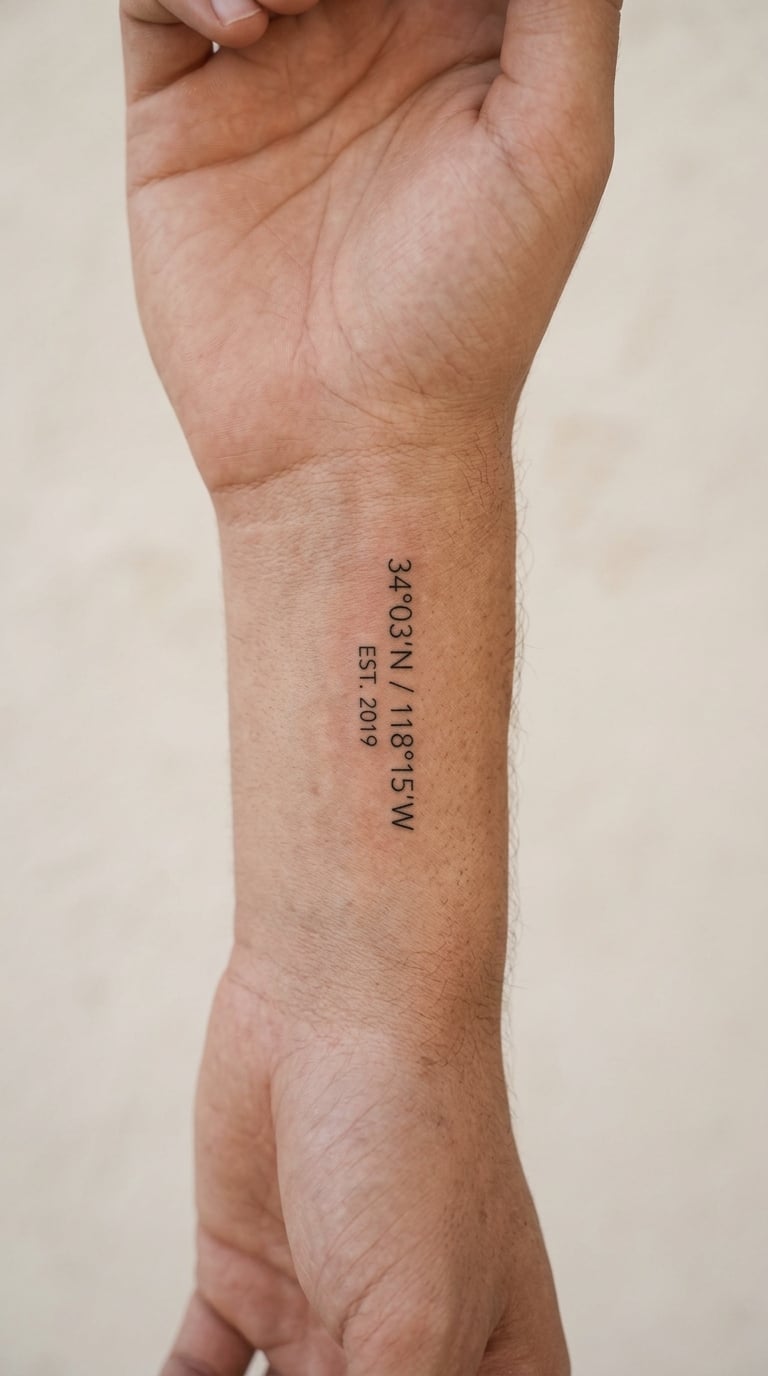
Coordinates mark a place that mattered: where you met someone, where a parent lives, where you were when things changed. It is the most personal design on this list and almost the least noticeable.
Keep it small and keep it on the inner wrist, 4-6cm or less, so it stays under a cuff. The wrist is where script distorts most, so ask your artist to straighten and lengthen the lettering slightly from the reference, and accept that this is a piece you will get touched up more often than anything else you own.
Pain and time: The inner wrist is thin and bony, around a 5 to 6, and it is a quick 30 to 45 minutes.
12. Night Sky Map Across the Forearm
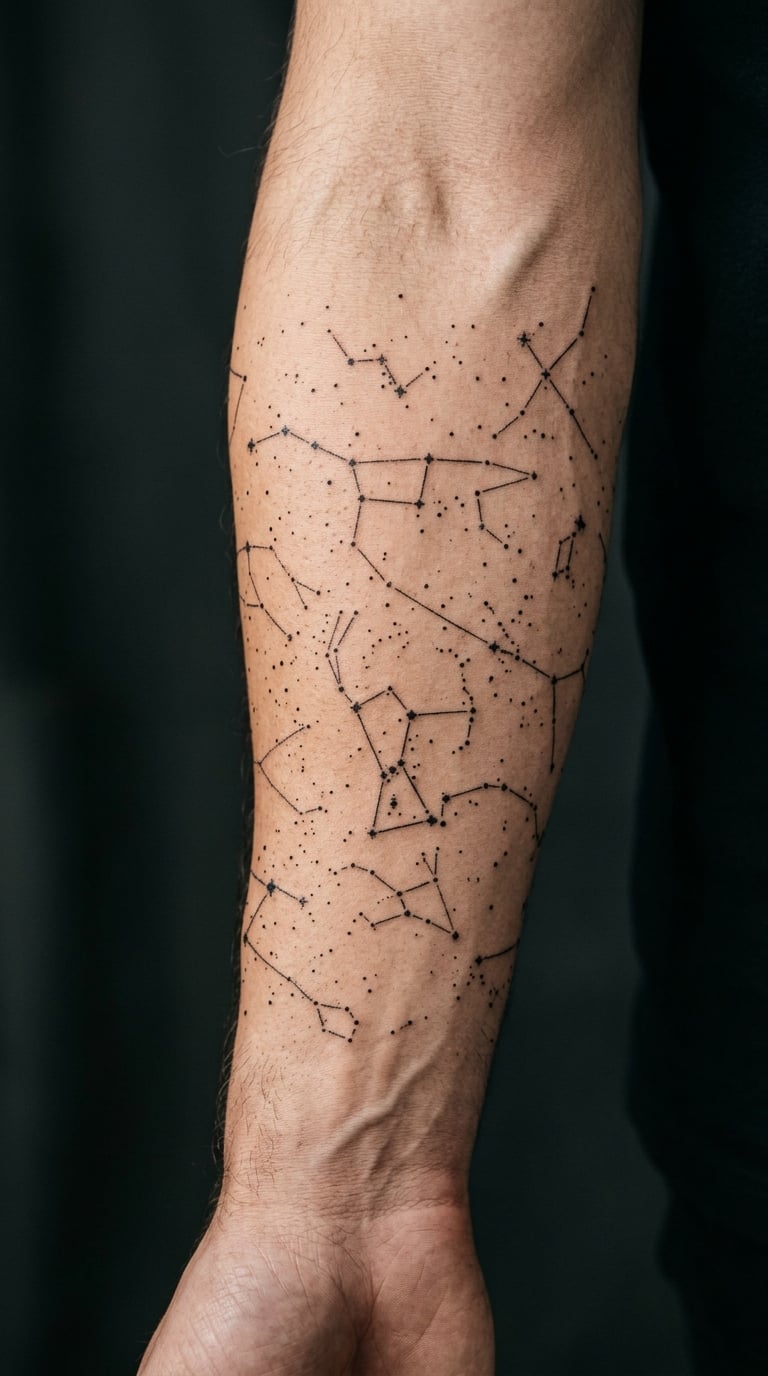
A constellation map turns the forearm into a window. It reads as one image from a distance and rewards close inspection, which is a rare combination on a moving canvas.
It wants length. Anywhere from 20 to 30cm of forearm, laid out along the bone, with blackwork dots rather than fine grey shading so the stars stay crisp. Constellations distort with the arm in a way that is actually part of the charm, but pick a real sky: a specific date and place makes the piece yours, and a random star pattern just looks like decoration.
Pain and time: Dots are quicker than they look, but a piece this size runs 3 to 4 hours, around a 4 out of 10.
13. Traditional Swallow on the Shoulder
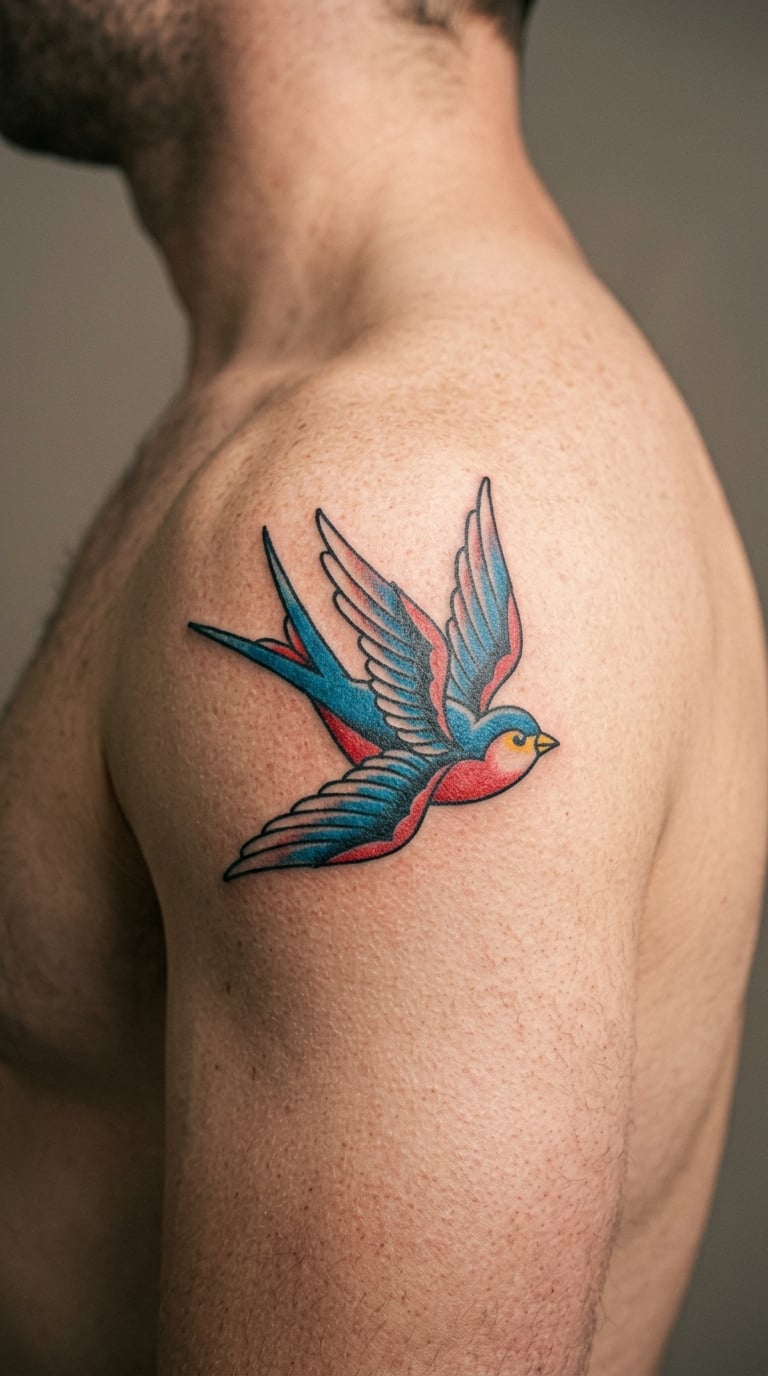
The swallow is the oldest tattoo most Western men will ever get, and it is still the safest traditional design there is: bold outline, limited colour, no religious or political statement. Paired swallows, a single swallow, swallow-and-banner, all still work.
Size it to the deltoid, 10-14cm, and let the wings run parallel to the shoulder rather than pointing down, which is what keeps it from looking cramped. Blue in a swallow fades noticeably faster than black, so a touch-up every few years is normal and worth budgeting for.
Pain and time: Deltoid, around a 3. 60 to 90 minutes for a single bird.
14. Sun and Moon Split on the Forearm
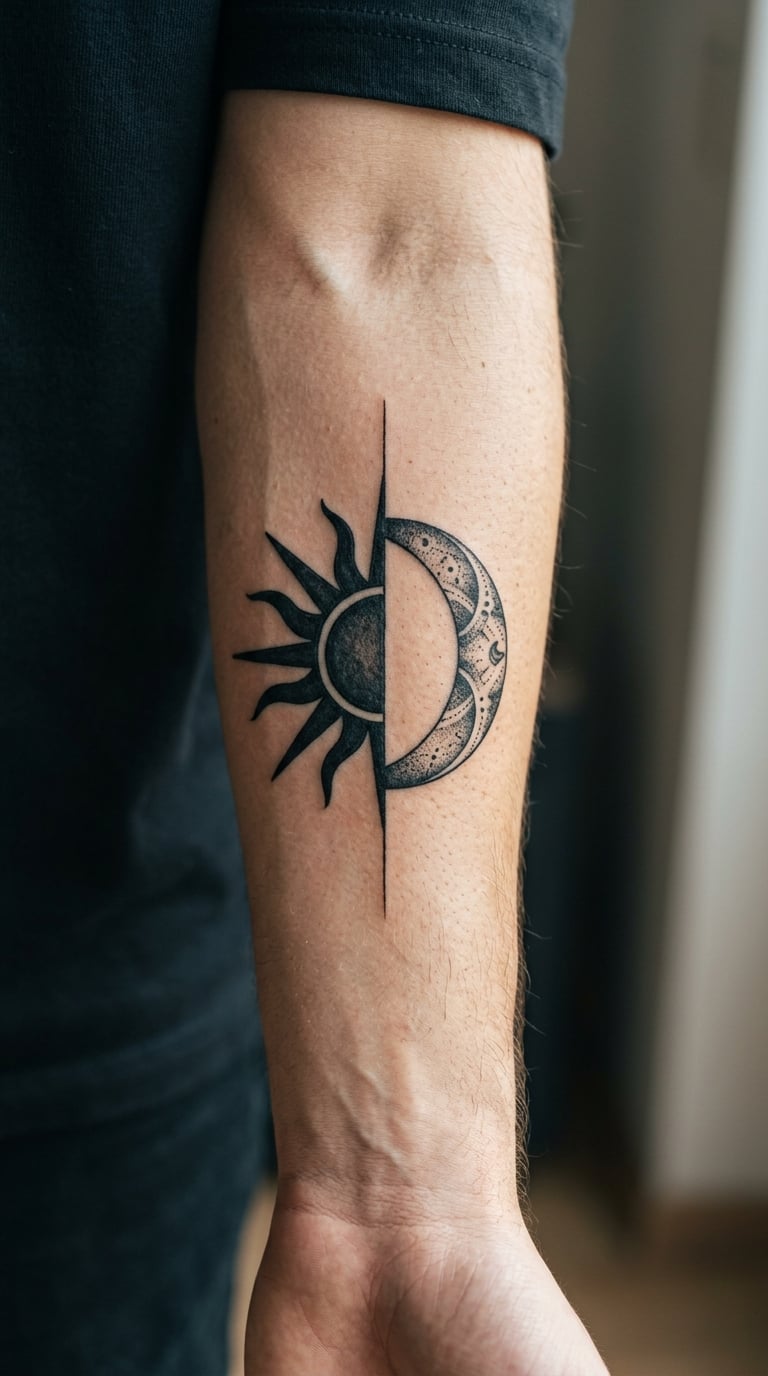
Duality, day and night, the parts of yourself that do not get along. Done as a single blackwork piece with both halves in the same ink, it stays modern and avoids the two-colour work that ages badly.
Place it on the outer forearm running lengthwise, 15-20cm, so the split line falls along the natural gap between muscles. This design needs careful negative space: the dark half should be genuinely solid and the light half genuinely open, and the contrast is what makes it read from a distance. Skin conditions like eczema and psoriasis can affect how solid black settles, so mention any history before booking.
Pain and time: Outer forearm, around a 3. Solid black fills take their time, so 2 to 3 hours.
15. Blackwork Lion Mask on the Outer Upper Arm
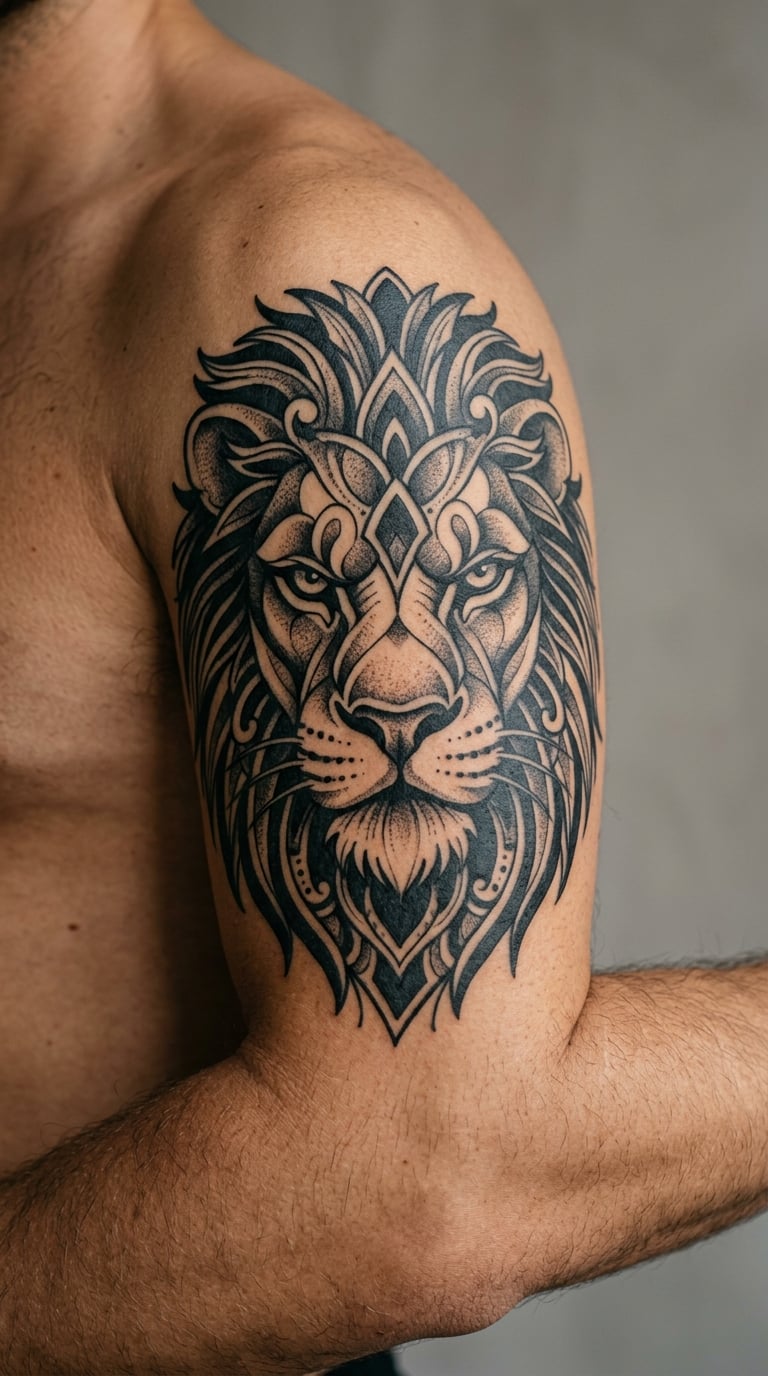
A lion mask in blackwork is confidence stated as decoration, and unlike most animal heads it was built for solid black: mane, nose, heavy shadow blocks. It is one of the few traditional motifs that genuinely suits the modern heavy-line look.
Run it around the outer upper arm, 12-15cm, with the mane breaking at the edges so it wraps rather than sitting flat. Give the face more space than you think, since a compressed lion looks mean in a bad way instead of a good one. Solid black on the outer arm holds detail for a long time because the skin there is thick and stable.
Pain and time: Upper arm, around a 3. 2 to 3 hours.
16. Watercolour Nebula on the Forearm
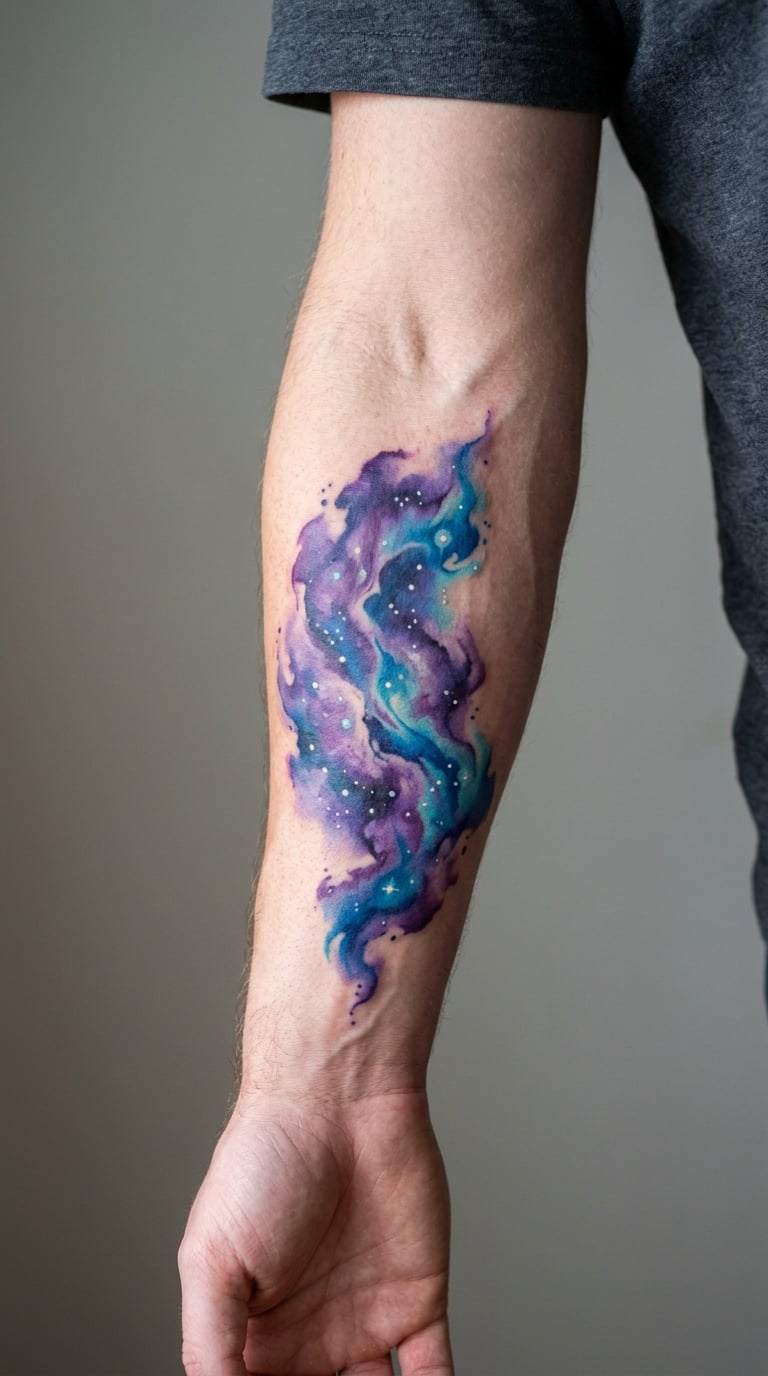
Watercolour tattoos have quietly become the counterpoint to heavy blackwork: soft edges, no outlines, colour that bleeds past the lines of the design. A nebula is the most natural fit because real nebulae are formless anyway.
Give it room, 20cm or more along the outer forearm, and pick a palette of two or three colours rather than a full rainbow, which is what keeps it from looking cheap. This is a harder style to tattoo than it looks, so check that the artist does colour work regularly rather than assuming any blackwork specialist can do it. Every watercolour piece needs a colour boost every 2 to 3 years, and that is a real ongoing commitment.
Pain and time: Outer forearm, around a 3. Colour work is slow, so 3 to 4 hours.
17. Matching Birds on the Inner Bicep
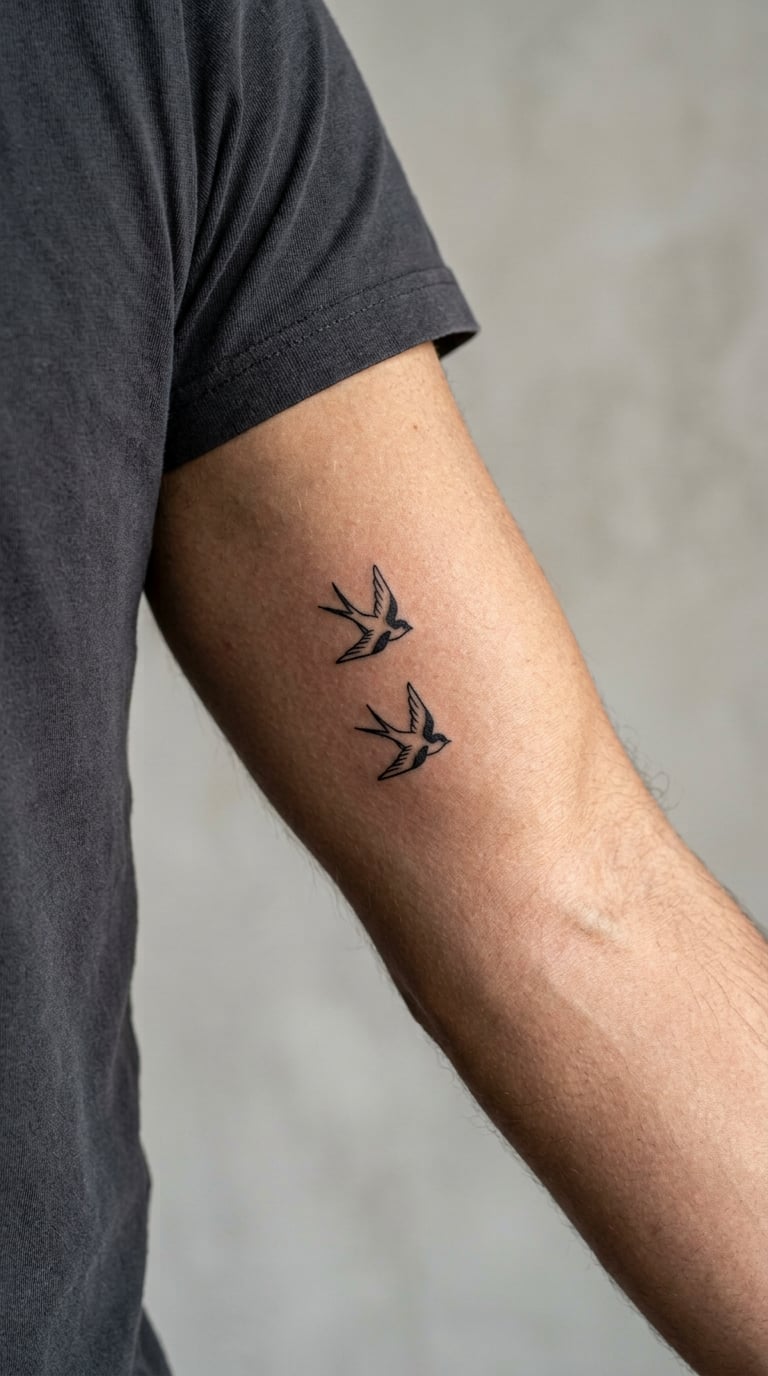
A pair of small birds placed on the inner bicep is the low-commitment way to start an arm that might grow later. Each one is 4-7cm, they cost little, and together they already read as a composition rather than two separate tattoos.
Inner bicep placement is chosen for a reason: it is hidden by a shirt, it barely moves, and it is one of the least painful zones on the arm. Keep them simple, one colour, no shading, and leave a clear band of skin between them so you can add a background or a sleeve element around them in a few years.
Pain and time: Inner bicep, around a 3, and 30 to 45 minutes each.
18. Lighthouse in Line Art on the Outer Forearm
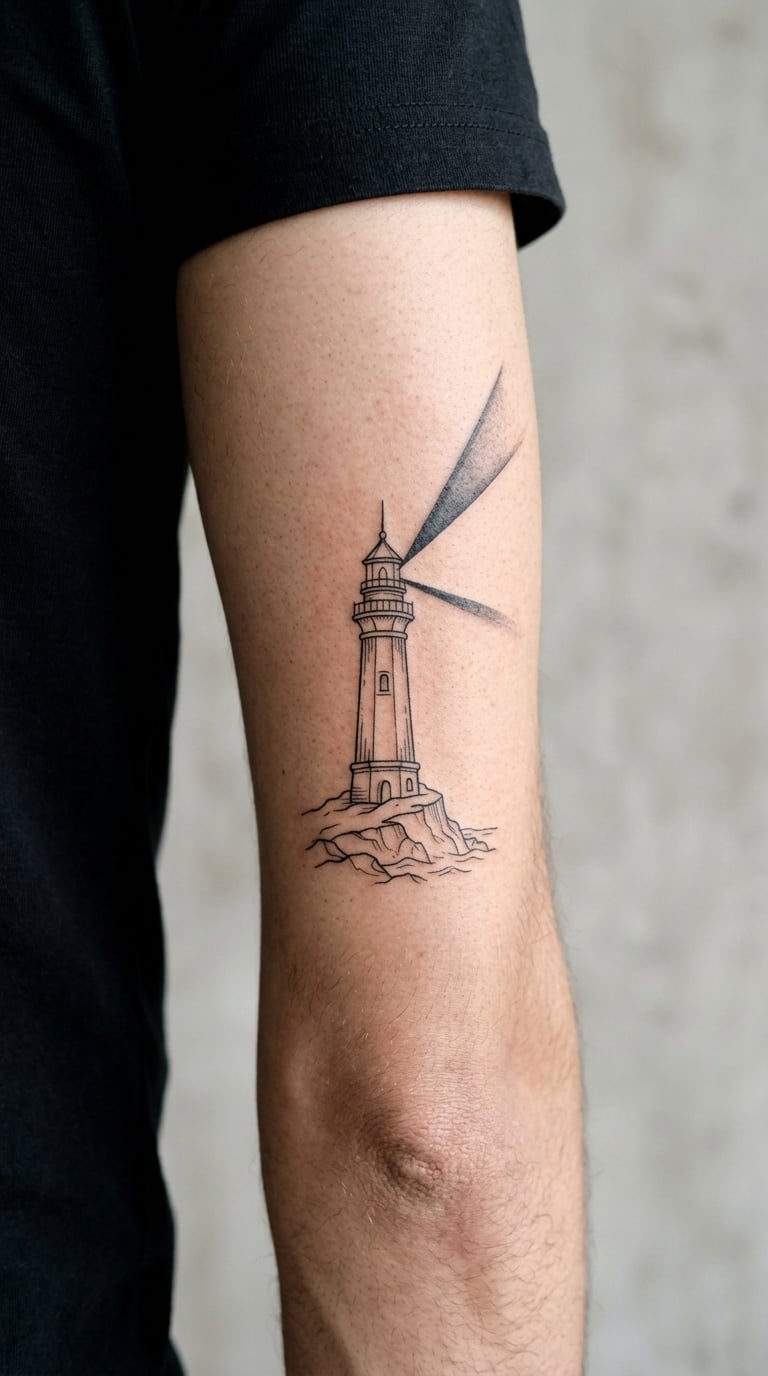
A lighthouse is a marker rather than a warning, which makes it a good quiet symbol for someone who spends a lot of time navigating other people’s problems. Line art suits it, because the subject is mostly straight lines and simple geometry.
Outer forearm, 12-16cm, running lengthwise so the beam points along the arm. Keep the beam simple rather than shading it, and let the base fade out rather than ending it in a hard line, which makes the whole piece look deliberate instead of pasted on. Fine line on the outer forearm holds up better than fine line on the inner, but still plan a refresh in four or five years.
Pain and time: Outer forearm, around a 3. 60 to 90 minutes.
How to plan an arm tattoo that can grow into a sleeve
Most people who start small on the arm are not planning a sleeve, but most people who start small and love it end up there. These five steps are what separate a first tattoo you can build on from one you will cover in a few years.
- Leave real negative space. An empty patch of skin around your design is the only thing a future sleeve can grow into. Fill every corner and there is nowhere left to go.
- Follow the natural flow. Place the subject so it points along the arm or around it, not across it. Pieces that fight the direction of the limb look wrong the moment you move.
- Keep line weight honest. If your first piece is heavy blackwork, your sleeve needs to be heavy blackwork. Fine line cannot be filled in with bold work without a full cover-up.
- One focal subject. A single animal, a single star, a single bloom. Multi-subject compositions are very hard to expand later because there is no room for the background.
- Keep the elbow open. The inner elbow is where a wrap-around sleeve is hardest to place and easiest to blur. Leaving it bare keeps your options wide.
Tattoo ideas for guys on the arm: 10 common styles
Most men who start browsing tattoo ideas for guys on the arm end up comparing styles before designs, and the vocabulary is worth having.
- Blackwork – solid black fills with no grey, built from bold shapes and negative space.
- Black and grey realism – photographic portraits and animals built entirely from grey wash, no colour.
- Neotraditional – thick outlines, limited colour and heavy shading, the modern version of old-school American tattooing.
- Irezumi – Japanese style, built around large wrapping subjects, soft washes and long flowing composition.
- Fine line – single-needle detail, minimal shading, elegant but the first thing to fade on a moving arm.
- Illustrative – drawing-like line work with some shading, somewhere between fine line and traditional.
- Geometric – repeated line patterns and nested shapes, entirely dependent on consistent line weight.
- Script – lettering tattoos, which need the most care on the arm because the wrist and elbow twist the letterforms.
- Botanical – flowers, leaves and stems, usually in fine line, frequently grown into a full botanical sleeve.
- Negative space – a technique rather than a style, where the background stays bare skin and the design is what is left.
Things to know before you book
- Choose the artist, then the design. Find someone whose existing work in the style you want is on an arm, not just on a flat sheet. An artist who is excellent at portraits and untested in Japanese style will not magically transfer.
- Bring references, expect a custom drawing. Photo collections of other people’s tattoos are completely normal at a consultation. What is not normal is asking for a design to be traced verbatim, which most artists decline and which you will regret, because proportions never match your arm exactly.
- Know what your budget buys in size. Tattoos are priced by the hour, and what matters is what that buys in centimetres. A small single-subject piece is usually a short session. Anything covering a third of your forearm is realistically two long sessions and the price tag that comes with them. Ask for an hourly rate and a session estimate, not a total, and budget for a touch-up visit as part of the cost rather than an extra.
- Plan the session, not just the day. Anything over four hours means a break, food and a long recovery. Long sessions leave the arm swollen for days, and the design is not finished at the end of the first sitting, so plan your week around it rather than booking a Friday night session before something social.
- Protect it for two weeks. Wash it daily with clean water, keep it out of the sun, no swimming, no gym for the arm while it heals, and no shaving over it. A fresh arm tattoo that gets a tan line across it is the single most avoidable regret in this list.
- Know the exit routes. If a design gets reinterpreted by everyone who sees it, or a job turns out to be conservative, the arm is one of the easier places to cover or remove because there is a lot of flat surface to work with. That is the other side of the visibility that makes the arm appealing.
Frequently Asked Questions
Which arm tattoo is best for a male?
For most men the best arm tattoo is a bold single subject on the outer forearm or the deltoid, sized to the muscle rather than to the photo. Both zones take a clean shape, stay readable at a distance and distort far less than the inner forearm. The tricep suits larger landscape work, the inner forearm suits readable text, and the wrist suits fine minimal work.
Do forearm tattoos hurt?
Forearm tattoos sit in the middle of the scale. The outer forearm and bicep are among the least sensitive areas, closer to a 3 out of 10, because the skin is thick and the muscle is large. The inner forearm and inner wrist are noticeably sharper, more like a 5, because the skin is thin and there is very little cushion. The elbow crease and the armpit side of the bicep are the two spots people are most warned about.
Can a small arm tattoo be turned into a sleeve later?
Yes, as long as the artist planned for it. The essentials are empty skin around the design, line weight that matches what a sleeve would use, and a single focal subject rather than a filled composition. If your first piece is fine line, a later blackwork sleeve will need the fine line covered or worked around, which is far more expensive. Bring sleeve plans to the first consultation and ask the artist to design with them in mind.
What is the 1/3 rule for tattoo sizing?
The 1/3 rule is a rough way to avoid a tattoo that looks too small: the finished design should cover roughly a third of the zone you are putting it on. So a piece on the outer forearm should be around a third of the forearm length, not a coin-sized motif in the middle. The rule comes from the fact that ink appears to shrink as it settles, and small designs shrink into unreadability first.
How long does a forearm tattoo take to heal?
The surface usually settles within two to three weeks, when the flaking and the tenderness stop and the tattoo looks like the finished version. Full internal healing of the deeper layers takes closer to two months, which is why you should still avoid sun exposure, swimming and heavy gym work on that arm well after the surface looks healed.
What should I bring to a tattoo consultation?
Bring a clear idea of the style, the rough size, the placement and the feeling you want, plus a folder of reference images you like. Expect the artist to redraw it rather than copy it, and expect to be asked what you do not want as well. Bring a second choice for the date if the first one is booked out, and wear a shirt that exposes the area so the artist can see how the design will sit on the arm in real light.
Conclusion
Start with the zone, not the image. Tattoo ideas for guys on the arm only come down to a handful of decisions: which part of the arm, how big, and how heavy the line weight is. Get those three right and almost any good design will work. Get them wrong and even a beautiful piece ends up distorted, faded or simply in the wrong spot for the rest of your life.
So do one thing first: pick a single-subject design in a style you will still like in fifteen years, take the size to roughly a third of the zone, and tell the artist whether you might want a sleeve later. Everything else in the session is detail.