
12 Airplane Tattoo Ideas for Travel Lovers (September 2026)
Airplane tattoo ideas work because the shape is instantly readable at almost any size, and because flight already carries a lot of emotional weight. If you have a passport with more stamps than blank pages, this gallery is built for you. Every design below is chosen for what it means to a traveler, not for aviation accuracy.
Here is the short answer: an airplane tattoo usually stands for freedom, wanderlust, departure, arrival, or a specific trip you want to keep. Most people attach it to a memory, your first flight abroad, a favourite city, a homecoming. The plane is the symbol; the story behind it is the point. Updated for September 2026, and worth reading a few weeks before you book since studios fill up across the autumn and winter months.
Twelve designs sit below, grouped so you can skip straight to the size and style you want. If you are planning a first tattoo, read the placement and ageing sections before you fall in love with something tiny.
What Does an Airplane Tattoo Mean?
An airplane tattoo represents travel, freedom, distance and the moment you leave one place for another. Most wearers tie it to a specific trip rather than a general idea of adventure.
| Element in the design | What it usually means | Where it reads best |
|---|---|---|
| Airliner viewed from below | Takeoff, new beginnings, leaving | Collarbone, ribs, forearm |
| Airliner landing with gear down | Homecoming, arriving somewhere safe | Ankle, calf, inner arm |
| Contrail line | A route already travelled, a wish | Ribs, spine, shoulder blade |
| Paper plane | Childhood, sending something out into the world | Behind the ear, wrist, finger |
| Fighter or military jet | Discipline, nerve, service | Shoulder, upper arm, thigh |
| Single-engine prop plane | Doing it slowly, on purpose, your own way | Calf, forearm, bicep |
| Glider | Peace, quiet hours, the view from above | Ribs, back of the shoulder |
| Pair or matching planes | A shared trip or a relationship | Inner wrists, ankles |
The most requested aircraft in tattoo communities right now is the Cessna-style single-engine prop plane, with the paper airplane and the Super Guppy cargo plane close behind. None of them are glamorous. That is exactly the appeal.
1. Fine-Line Airliner Outline on the Inner Forearm
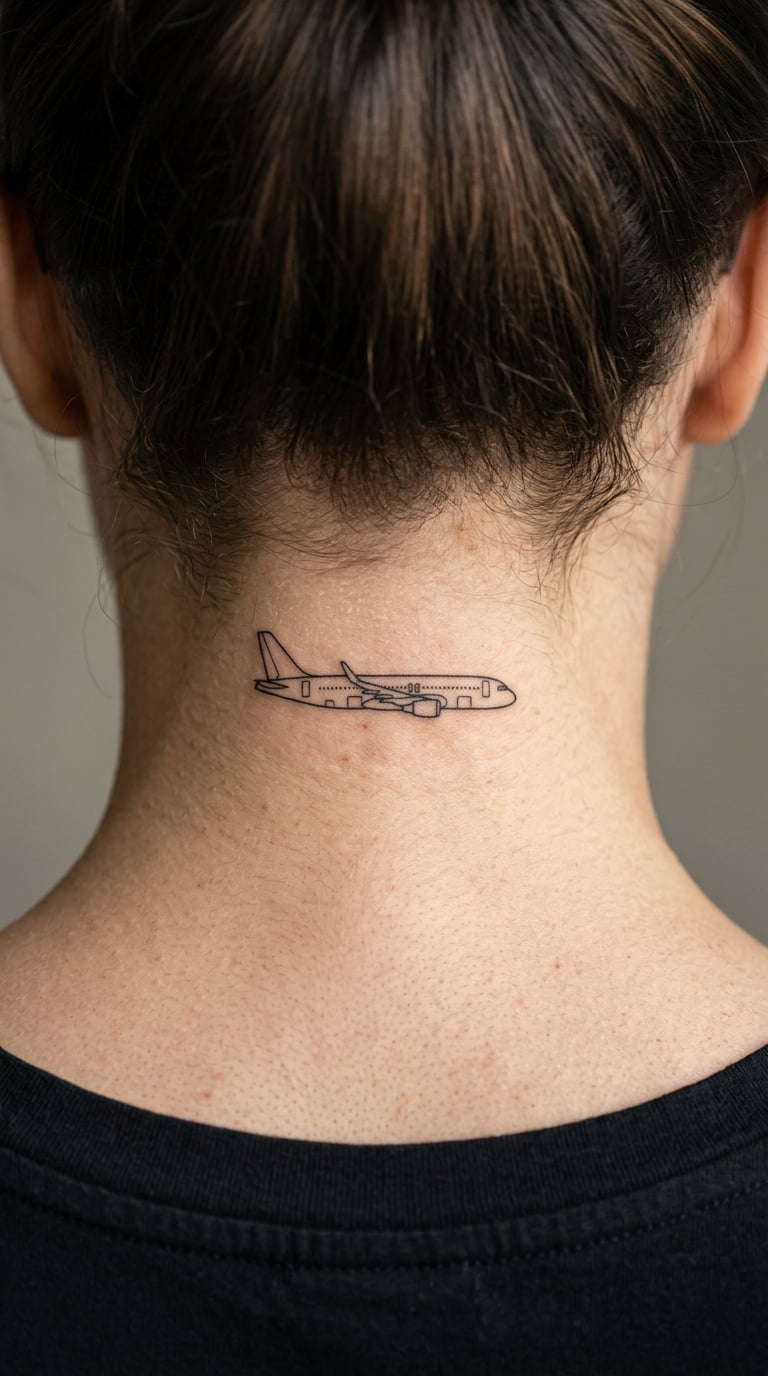
A clean outline of a passenger jet, nose tilted up, nothing behind it but skin. It is the most classic airplane tattoo there is, and it is the one most people end up with.
Drawn in a single weight line, it holds together well and the shape stays recognisable after years. Ask for the fuselage and wings simplified, because window rows and door details are the first things to blur.
Pain and time: mild, an hour or so for a design this size, depending on how much detail you add.
2. Tiny Single-Line Paper Plane Behind the Ear
One continuous line, folded shape, about the size of a thumbnail. The paper plane is the least literal option and the one people regret least, because it reads as a thought rather than a machine.
Behind the ear it looks like an idea you keep close. It fades fastest anywhere sun hits, so expect a refresh after a few summers outdoors.
Pain and time: very mild and quick, the shallowest skin on the body. Under half an hour.
3. Solid Black Fighter Jet Silhouette on the Outer Calf
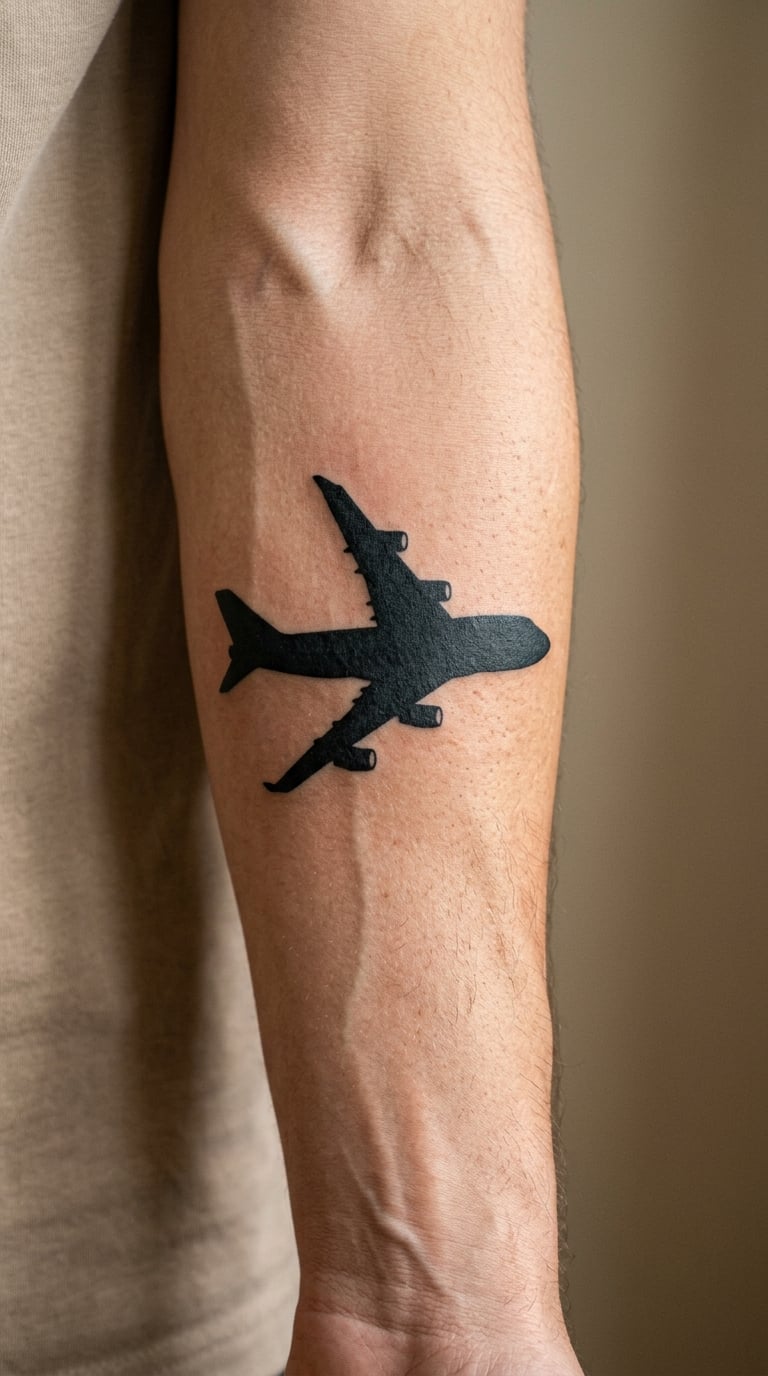
A filled black silhouette, no outline, no shading. The heavy block of ink gives it real presence on a leg, and it hides small imperfections better than fine line.
Skip official roundels, squadron markings and service insignia. A generic jet profile with no national markings sidesteps a problem that has annoyed plenty of people in uniform.
Pain and time: a real scratch, moderate to firm, and a bigger area means a longer sitting. One to two hours is normal.
4. Watercolour Contrail Heart, Off-Centre Back
A soft colour trail that curves into a heart. It is the most decorative idea on this list and the one that reads best as a piece about a person rather than about travel.
Back placement suits the scale. Watercolour is the least durable style on this page, so treat it as artwork that will soften and fade over time, and keep it out of long, hot showers for the first fortnight.
Pain and time: moderate, and colour work spreads over a longer session. Two to three hours is typical.
5. Vintage Biplane Inside a Circle, Upper Arm
A two-winged biplane with a visible propeller, framed in a thin circle like an old travel badge. The circle gives a simple drawing somewhere to sit and makes it look considered.
Upper arm skin is forgiving and the space handles a wide drawing. A circular border is also a good trick for older tattoos, since the outline keeps the composition together as the inside fades.
Pain and time: moderate. One to two hours for a clean line version.
6. Dotted Contrail Flight Path Over the Shoulder Blade
No aircraft at all, just a dotted arc that curves away over the shoulder. It is the quietest design here and the easiest to keep private if you work somewhere formal.
Dotwork heals patchily in the first few days. Keep it clean, avoid swimming pools and sunbeds while it settles, and do not panic at the faint stage around day five.
Pain and time: mild, and dotwork takes longer than the final look suggests. Around an hour.
7. Geometric Jet Built from Straight Lines, Sternum
An aircraft reduced to triangles and hard angles. Geometric work suits anyone who likes aircraft as shapes rather than objects.
Sternum placement is bold and gets seen, so consider it a deliberate statement. Line ends that are left too thin are the weak point here, so agree a minimum line weight with your artist before the stencil goes down.
Pain and time: firm, bone is close to the surface. One to two hours.
8. Sticker-Style Propeller Plane on the Bicep
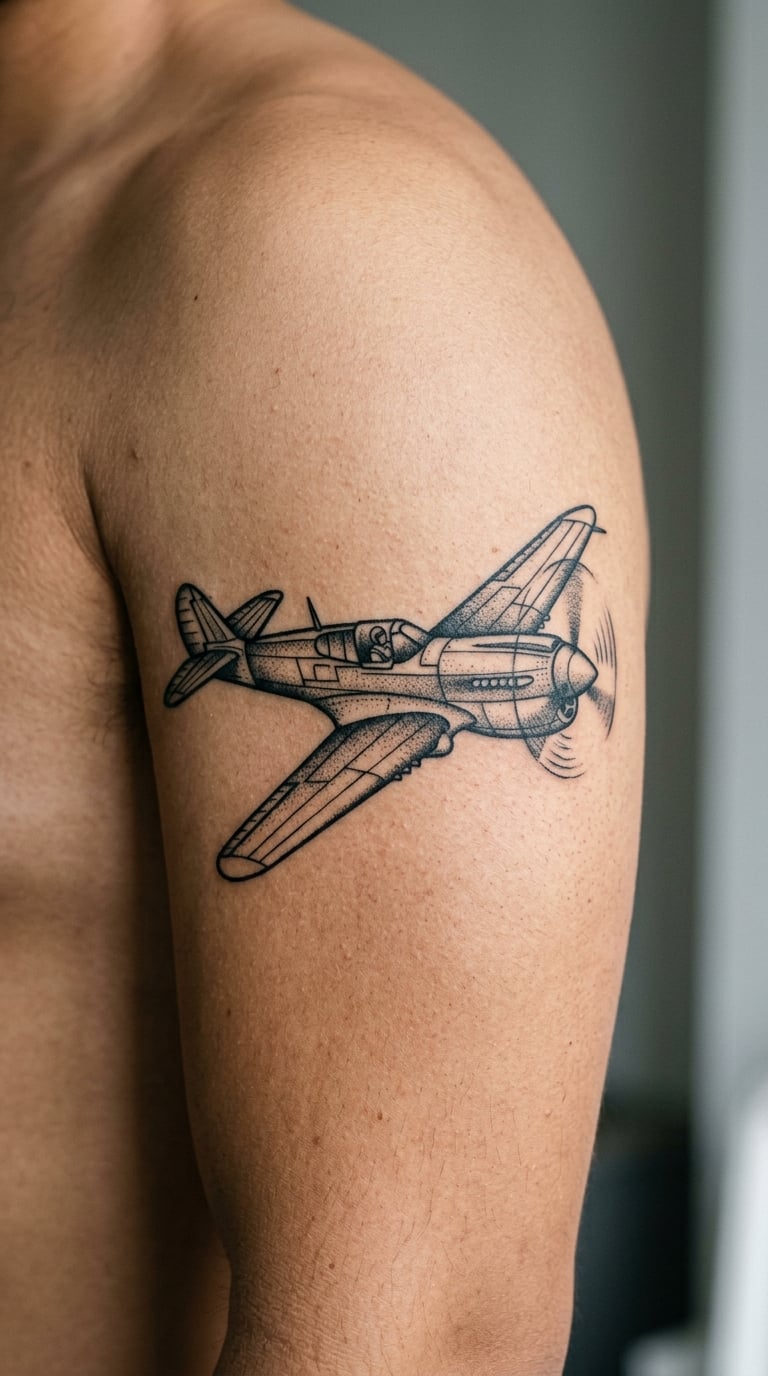
Chunky outlines, flat colour, slightly cartoon proportions, like a peel-off sticker. The style forgives a lot and photographs well, which matters if the reason you are getting it is that you travel and post photos.
Flat colour patches stay even as the design ages, and a bold outline keeps edges crisp. Ask for no lettering inside the sticker border. Text at sticker scale always softens first.
Pain and time: moderate. One to two hours including colour.
9. Blueprint Grid Airliner Drawing on the Thigh
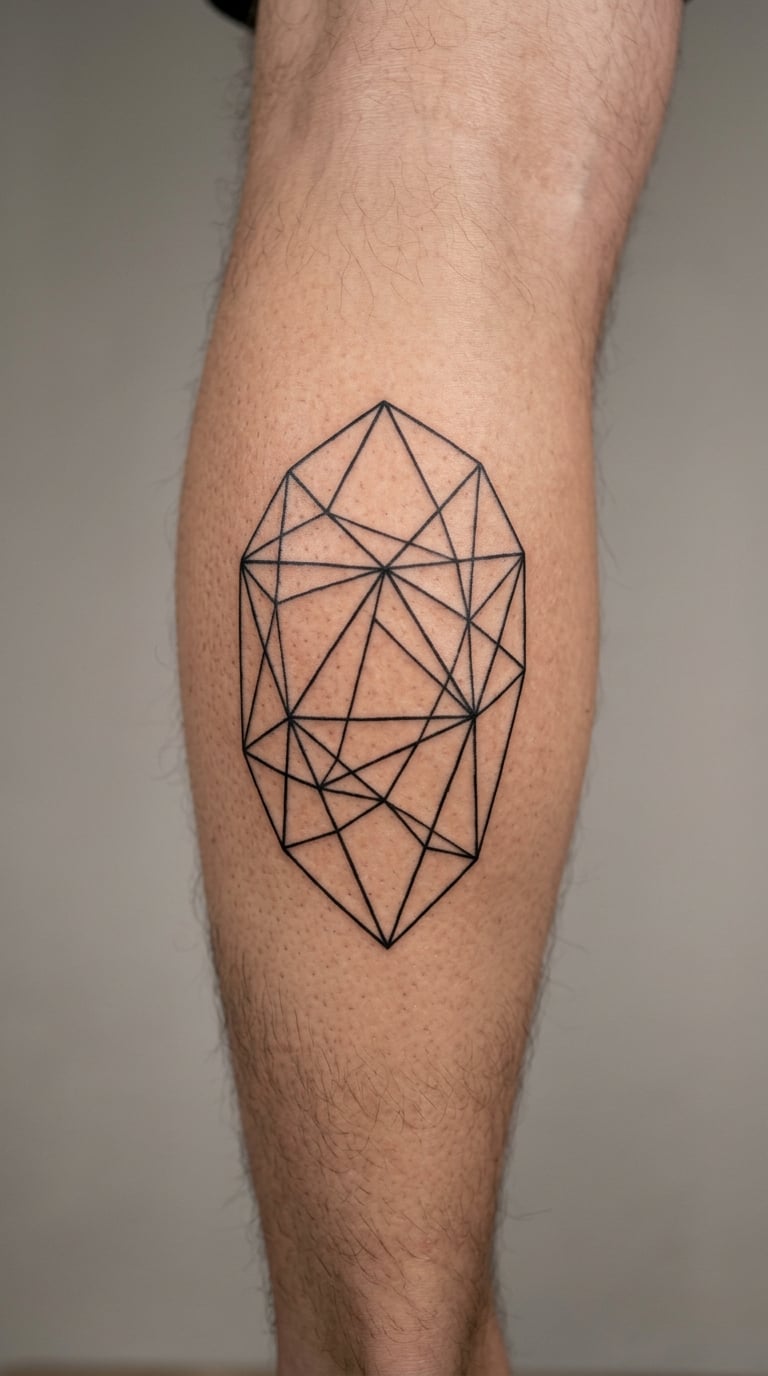
A side-view aircraft drawn as a technical schematic, complete with light grid lines. It is the closest thing here to a plan rather than a picture, and it suits people who like the engineering side of flying.
Thigh skin is flat and easy to work across, so a drawing this wide works there better than anywhere else. Keep the grid faint or it turns into a grey smudge within a few years.
Pain and time: moderate, and a wide design means a longer stretch. Two to three hours.
10. Glider Silhouette Over a Compass Rose, Forearm
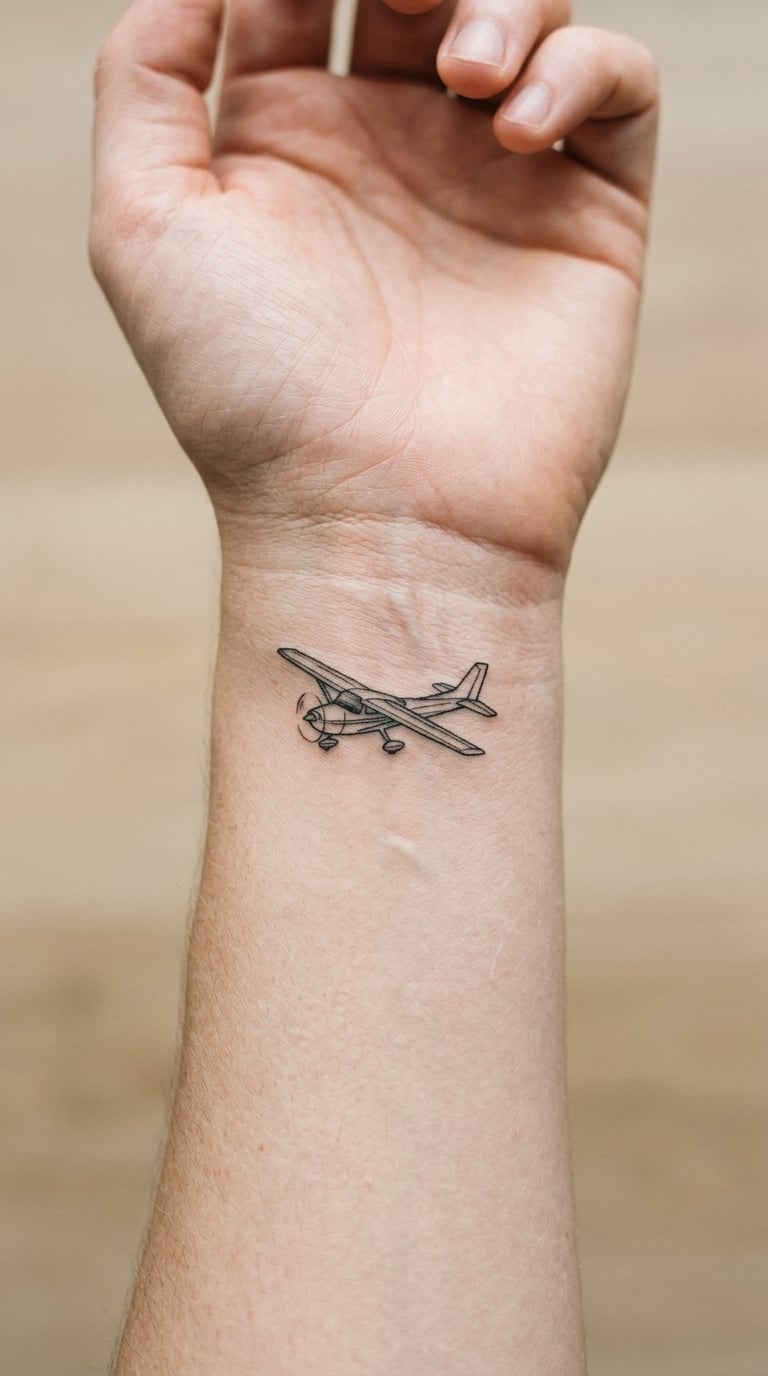
A long-winged glider above a small compass rose. The glider is the least commercial aircraft in aviation, which is why it tends to be chosen by people who like flying for the quiet of it.
Forearm placement makes the pairing easy to read, and the two shapes balance well at roughly equal weight. Both are fine line, so ask for a line weight that will still be visible at healed size.
Pain and time: mild to moderate. An hour to an hour and a half.
11. Matching Twin Plane Doodles, Inner Wrists
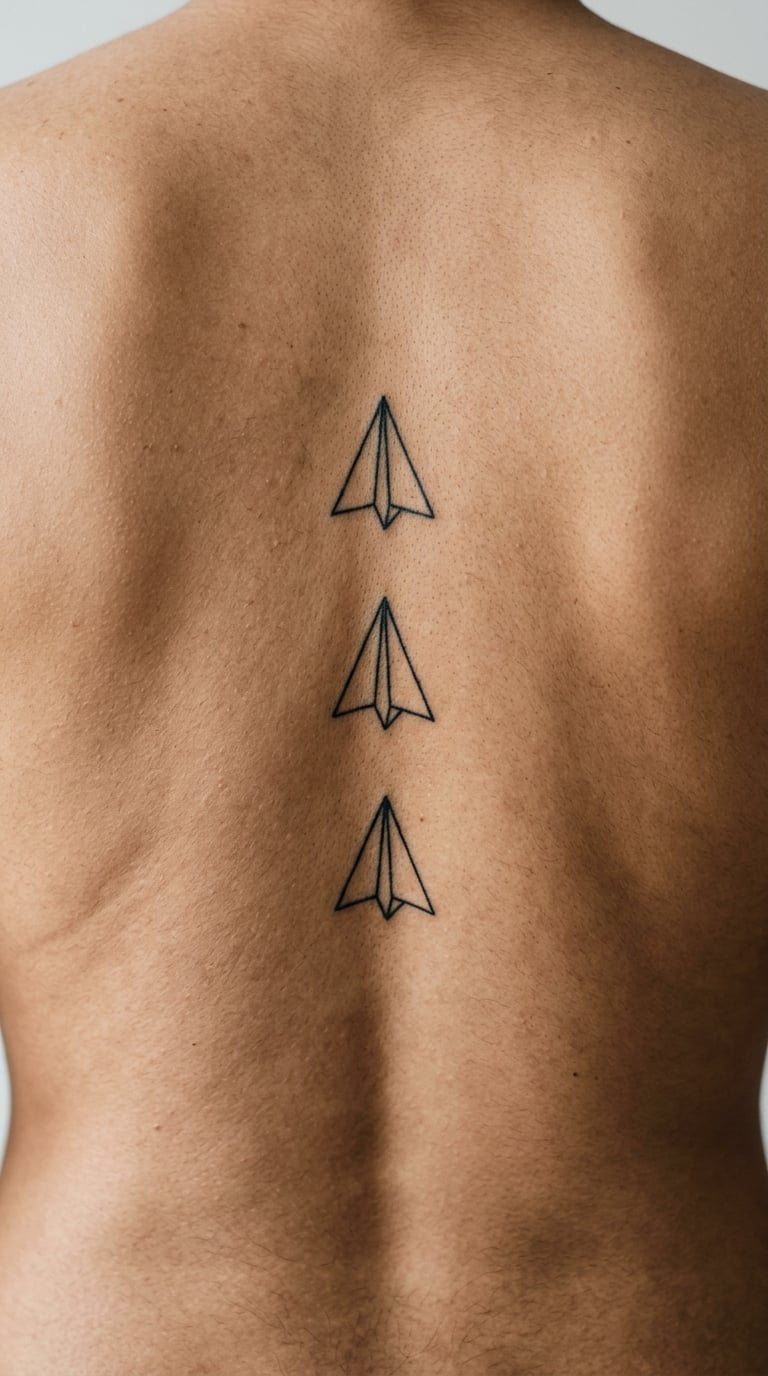
Two small identical airliners, one on each inner wrist. Traditionally it marks a trip taken with someone. Sometimes it is two people in the same city rather than the same trip.
Wrists show wear from watch straps, and inner wrist skin moves a lot, so line work softens faster there than on an arm. Make the plane a little larger than feels right in the drawing.
Pain and time: mild, and the two are done in one short sitting. Under an hour together.
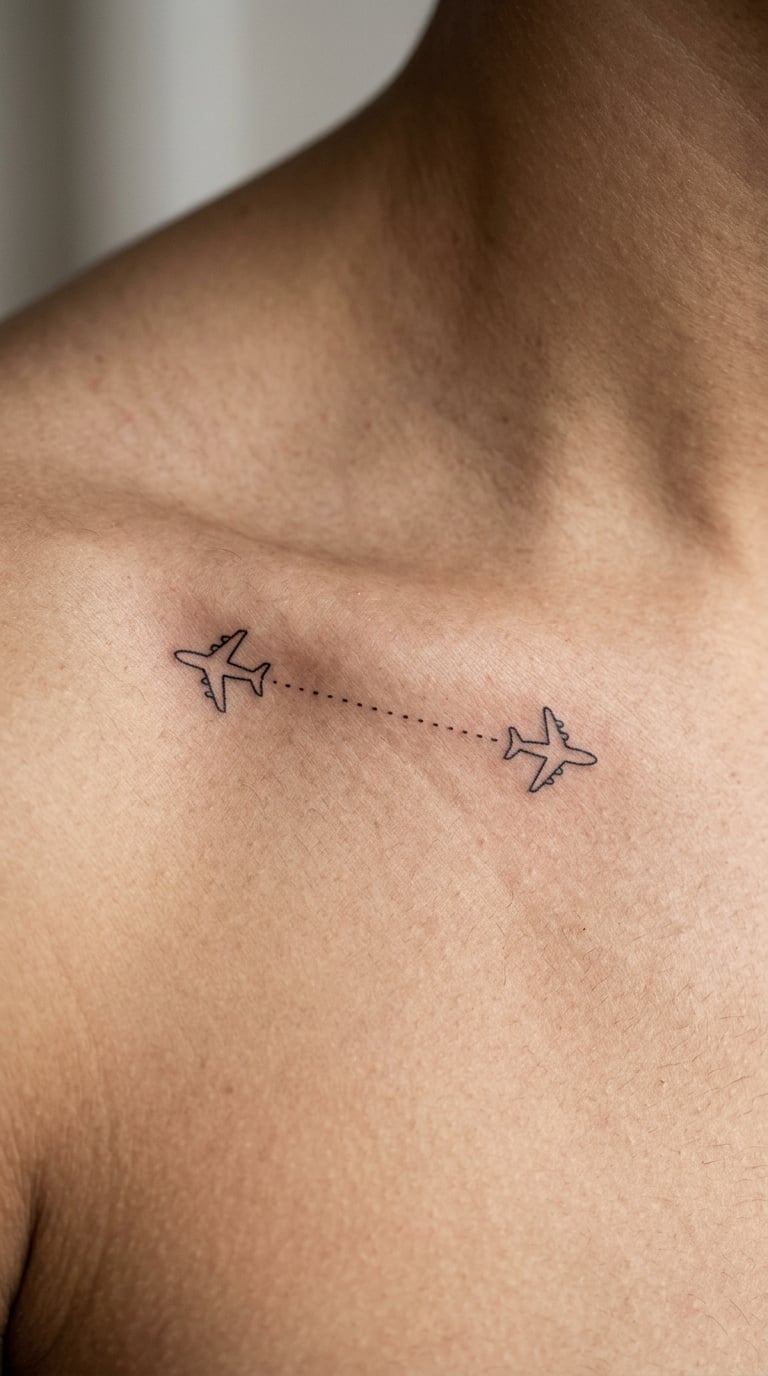
12. Super Guppy Cargo Plane on the Collarbone
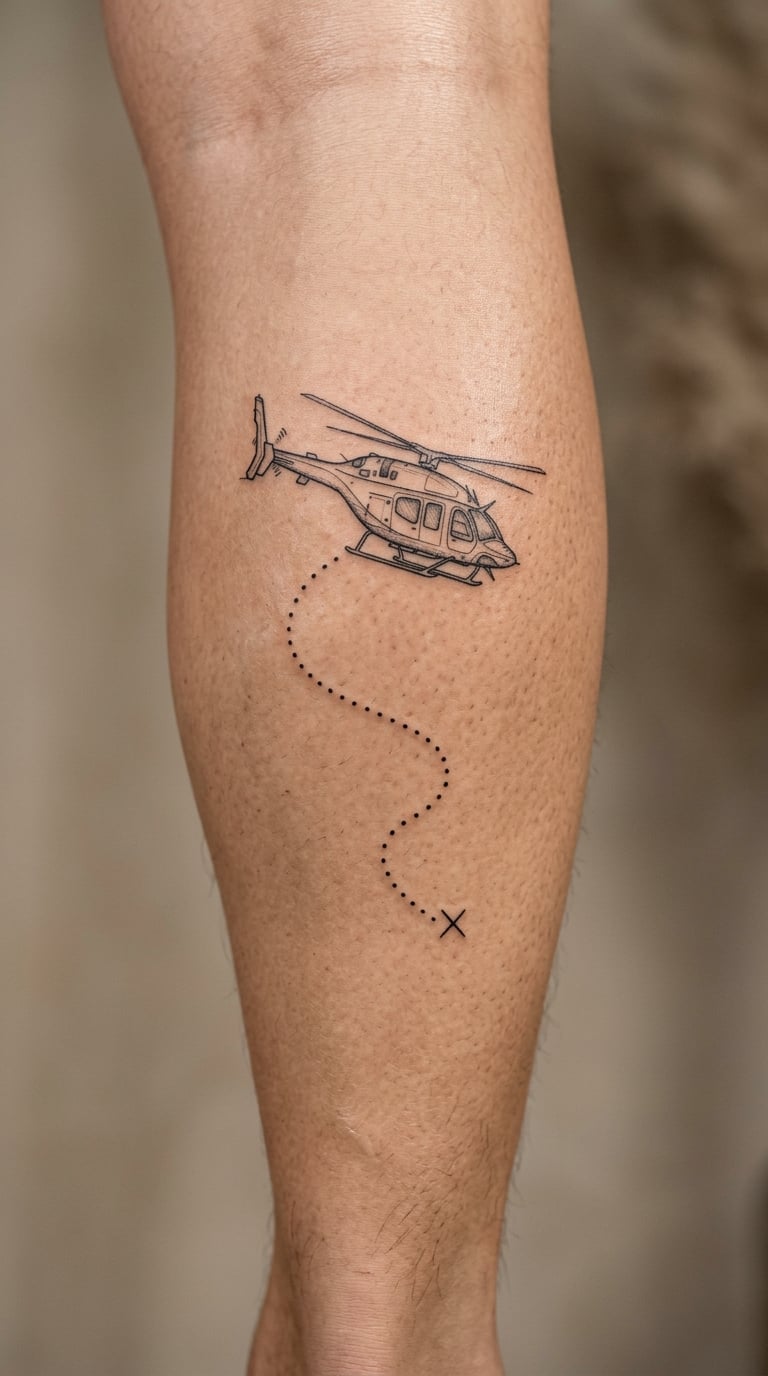
The bulbous, wide-nosed cargo plane, drawn in clean line. It came up constantly as a suggestion in a tattoo group thread, and it is a fun choice because it does not look like anything else in the category.
Collarbone placement is a thin canvas, so a simplified fuselage and a shortened wing shape work better than a technically accurate outline. It heals well there but sits in a spot that creases when you sleep on your side.
Pain and time: mild to moderate. Around an hour.
Small Airplane Tattoo Ideas That Still Read at 2 cm
Small plane tattoos are the most booked and the most disappointing, usually because the design is drawn too small for the detail it contains. Ask for the smallest version of the idea, not a shrunken version of a detailed one.
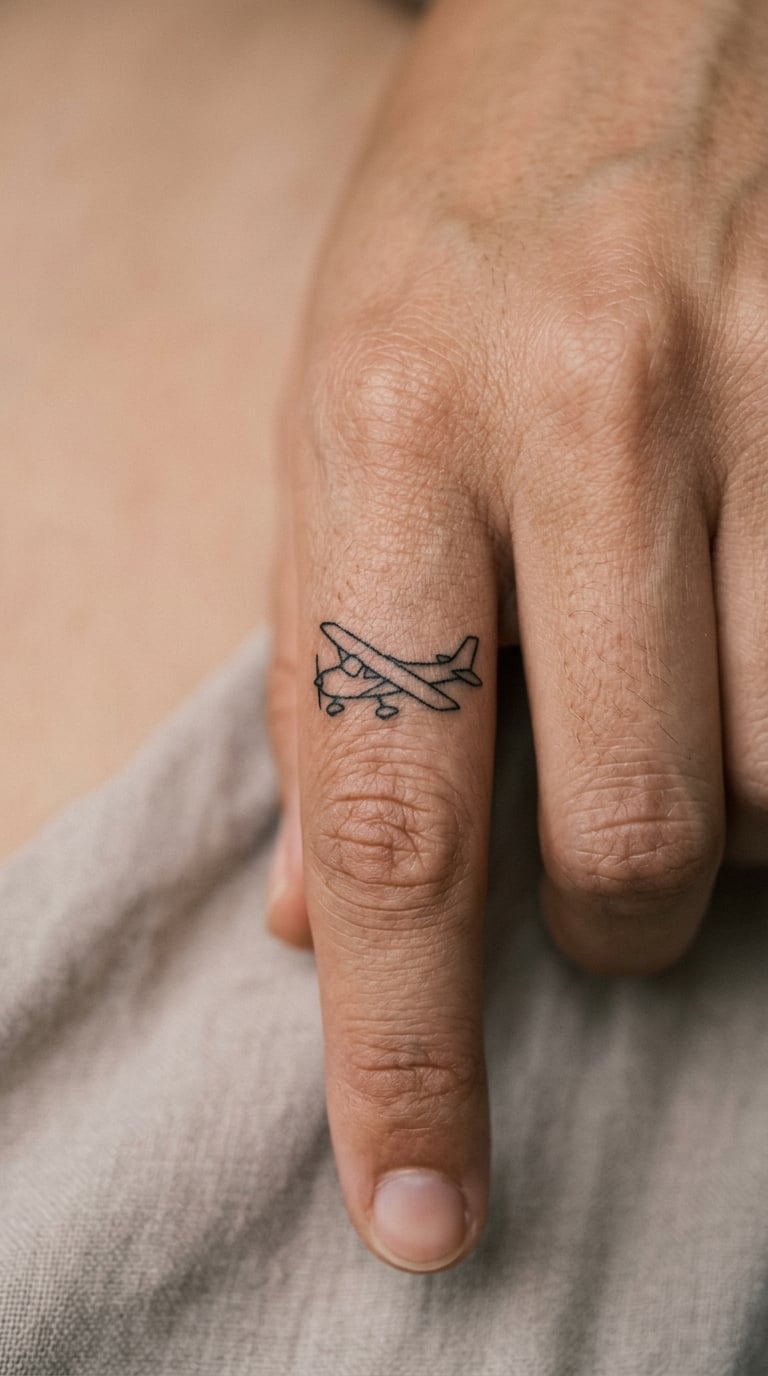
An inner finger plane, nose pointing along the finger, is the smallest option that still works. It reads as a small mark to most people and as an aircraft to anyone who looks. Fingers take a beating though, so expect a touch-up within a couple of years.
A wrist tattoo in a single line, angled slightly with the forearm rather than straight across it, sits well under a watch strap and stays visible when your hand is turned palm down.
The ankle suits a landing plane, gear down, angled along the bone. It is a spot most people cover with shoes, which suits a design you like but do not need everyone to see.
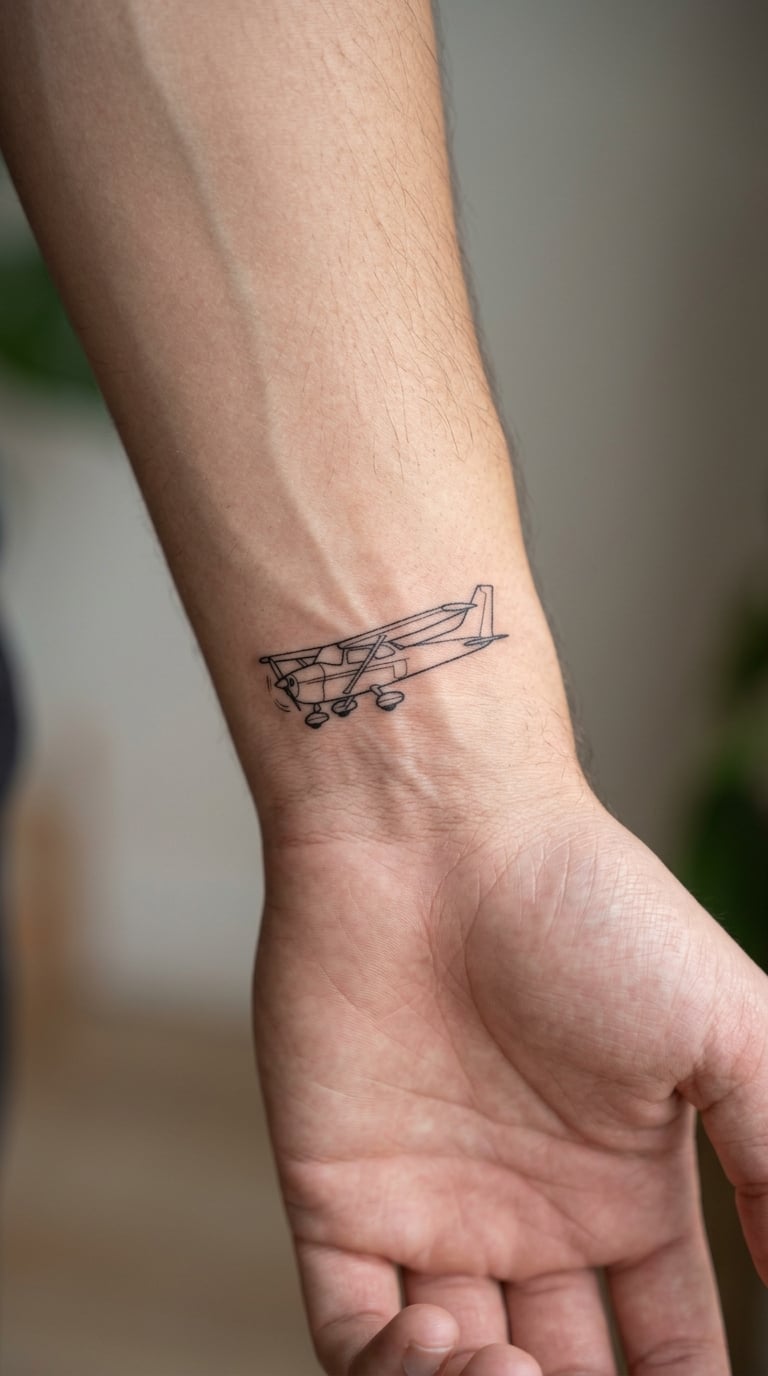
A single-engine prop plane on the inner forearm is the sweet spot for small work. The wing and fuselage are broad shapes, so they survive healing at two to three centimetres.
Paper Airplane Tattoo Ideas
The paper airplane tattoo is the most nostalgic design in this category and the easiest to get wrong, because a badly folded outline just looks like a triangle with a tail.
A paper plane in flight, tilted, with a short fold line showing, works as a single fine-line drawing behind the ear or on the inside of the wrist. The tilt is what makes it read as flying rather than sitting.
A paper plane trailing three small fold creases, like motion lines, is a nice touch on the forearm. Those extra marks are the part that fades first, so keep them larger than you would expect.
A paper plane inside a passport-stamp style circle, in single-colour ink, gives you the travel reference without needing real text. It is the most useful version of the idea and ages the best.
A minimal origami-style plane, drawn as if from the folds, works on a finger or a knuckle at a size where anything else turns to mush. The geometric fold lines are what carry it, not the outline.
Travel-Specific Airplane Tattoos: Boarding Pass, Coordinates, Window Seat
A travel tattoo is not just a plane. The designs that mean the most are the ones that pin down a real memory, because a generic jet is decoration and a boarding pass is a record.
A boarding pass outline with a torn edge, no readable text, is a good middle ground. The shape says travel instantly, and leaving the details out avoids ink that blurs and a ticket number that dates the tattoo to a trip you have moved on from.
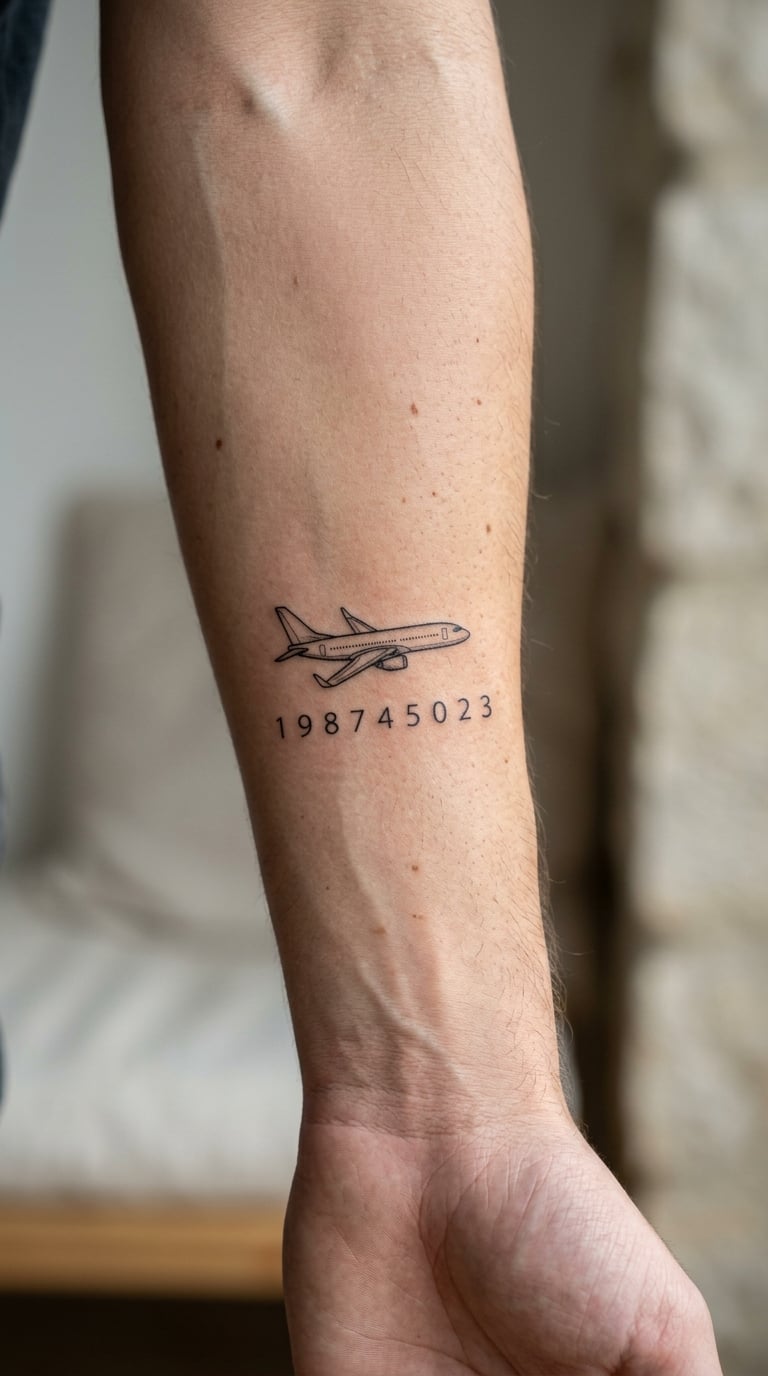
Coordinates of a first flight, or a place that mattered, sit well under a tiny plane. Check the numbers twice and ask for a slightly heavier number weight, because small digits are the first thing to become unreadable.
A window seat view, cloud tops and a wing edge, is the one that is purely about a feeling rather than an event. It works best as a soft shape composition rather than a detailed cabin interior.
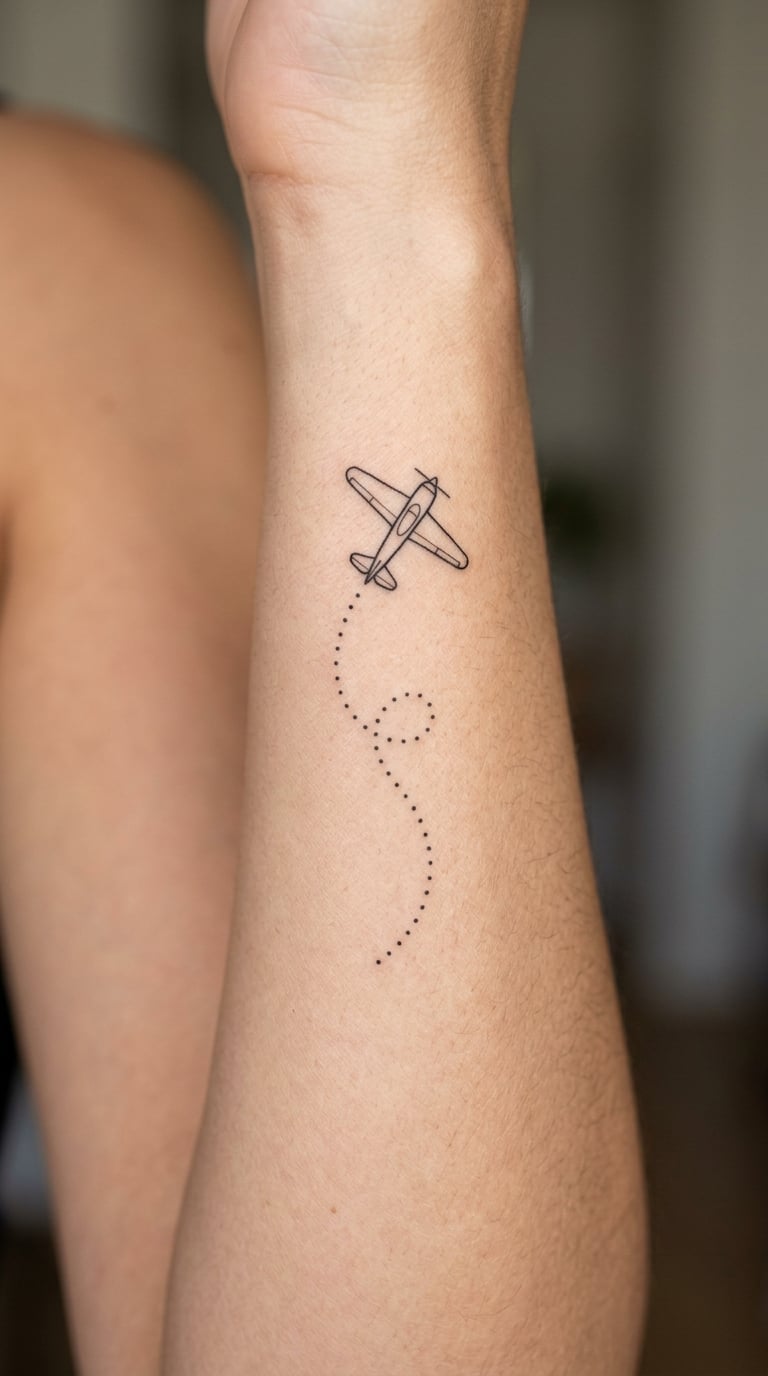
A dotted route line across a simple map fragment, with one small plane at the end, tells a story without a single word. Keep the map detail sparse, since dense line work at map scale turns grey within about five years.
Where to Place an Airplane Tattoo, Body Part by Body Part
Placement changes how a design ages more than the design does. These are the general patterns most travelers end up with.
| Body part | Typical size | Visibility | Pain | Healing note |
|---|---|---|---|---|
| Inner wrist | 3 to 6 cm | Seen when hands are visible | Mild | Constant movement and watch strap wear, so fades faster |
| Inner forearm | 5 to 10 cm | Easy to cover | Mild | Holds line work well |
| Collarbone | 5 to 9 cm | Visible in most tops | Mild to moderate | Creases when you sleep on that side |
| Ribs and side | 8 to 15 cm | Hidden until it is not | Moderate | Skin stretches, so solid shapes beat fine detail |
| Calf or outer thigh | 6 to 12 cm | Seasonal | Moderate | Large flat area, good for bold work |
| Shoulder blade | 6 to 12 cm | Only when you take a top off | Moderate | Deep creases during healing flatten details |
| Behind the ear | 2 to 4 cm | Only close up | Very mild | Sun exposure makes it the fastest fade on this page |
Best airplane tattoo ideas for a first-timer
For a first tattoo, the inner forearm and the outer arm are the forgiving picks. They are easy to hide, they barely move, and a small mistake is much less obvious there than on the ribs. Save the ribs and the spine for something you have lived with for a while.
What Different Aircraft Styles Mean, Jet to Glider
The aircraft you pick changes the tone of the whole design. A cargo plane and a fighter jet say very different things about the person wearing it.
| Aircraft | What it suggests | Style that suits it |
|---|---|---|
| Commercial airliner | Travel, ordinary magic, going somewhere | Fine line or minimal outline |
| Fighter jet | Nerve, focus, service | Solid blackwork silhouette |
| Biplane | The early days, the long way round | Vintage line or circular badge framing |
| Single-engine prop plane | Slow travel, self-guided | Simple line drawing |
| Private jet | Getting there your own way | Clean outline, no windows |
| Glider | Quiet, altitude, patience | Fine line with a compass or cloud |
| Helicopter | Getting in where a plane cannot | Bold blackwork |
| Paper plane | Childhood, sending something off | Single line or origami geometric |
How to Get an Airplane Tattoo That Ages Well
Fine detail is what blurs. That is the single most useful thing to know before you sit down, and it is the thing most first-timers get wrong by asking for a full aircraft at fingernail size.
Set a minimum size. An airliner outline needs roughly four to five centimetres of length to still read clearly in ten years. Below that, ask for a simpler shape instead of a smaller detailed one.
Winnow the list of what fades. Window rows, door outlines, flag patches, registration lettering, airline names, ticket numbers and hairline shading are the first to soften. Solid silhouettes and thick outlines are the last to change.
There are designs to steer clear of too. Copied airline, military or association badges can land you in an awkward conversation, especially if you fly or wear a uniform. Real flight numbers and dates tie a tattoo to a job or a relationship that may not be there in ten years. And micro-realistic cockpit detail turns to grey mush on most body parts within a few summers.
Line weight matters as much as size. A single hairline that looks elegant fresh will be barely there healed. Ask your artist what weight they would use for that piece at healed size, and trust the answer over your own instinct.
Things to Know Before You Book Your Airplane Tattoo
A few practical points before the appointment, most of which come from people who learned them the slow way.
- Choose the artist for the style, not just the flash. Fine line, blackwork and colour realism are different skills. Look for healed work in the style you are after, not for a portfolio that has everything.
- Bring references, not instructions. Two or three images of aircraft you like, plus a note about the style, gives an artist far more to work with than a name of a model.
- Ask about a stencil. A drawn stencil you can check and adjust before any ink goes in costs nothing and saves a lot of regret.
- Budget for a touch-up. Fine line and small details usually need one free or cheap session after healing, around six to eight weeks in, before you judge the final result.
- Plan around sun. Fresh tattoos should stay covered or shaded for the first couple of weeks, and every future holiday will fade it a little more.
- Healing is part of the design. Expect a few days of raised, tender, slightly dull skin before the settled look arrives. That stage is normal, not a mistake.
- Aftercare is simple. Wash it gently, keep it clean, avoid swimming pools and hot tubs while it heals, and let your artist or their aftercare sheet be the final word.
Can You Have a Tattoo and Still Be a Pilot or Cabin Crew Member?
For passengers, no airline restricts what you can have inked. Crew are a different story, and the honest answer is that grooming and uniform rules vary by carrier and by role, so check your employer’s policy in writing before you get anything large or visible.
If you fly professionally or wear a uniform, the practical choices are a small design on a covered area, or a placement that sits well under a sleeve or collar. That is a wardrobe problem before it is a career one, and it is far easier to solve now than after a session.
Frequently Asked Questions
What does an airplane tattoo symbolize?
An airplane tattoo usually symbolizes travel, freedom, wanderlust, departure and arrival. Most people attach it to a specific memory such as a first flight abroad, a favourite city or a homecoming, rather than to a general idea of adventure. The shape is easy to read at small sizes, which is one reason it stays so popular.
What is the best small airplane tattoo design?
A single-line airliner outline or a tiny prop plane works best at small sizes because both are built from a few broad shapes. Keep it around four to five centimetres long so the wings and tail still read after healing. Avoid window rows, door lines and any lettering, since those are the first details to fade.
Do small fine-line airplane tattoos last?
They can, but they need more care than solid blackwork. Fine line placed on skin that gets regular sun, such as behind the ear or the outer arm, fades fastest, while a forearm or thigh placement holds much better. After six to eight weeks, ask your artist for a free or low-cost touch-up to bring the line weight back up.
Where do you put a small airplane tattoo?
The inner forearm, outer arm and calf are the most forgiving spots for small aircraft designs because they barely move and are easy to cover. Wrists work but take more wear from watch straps, behind the ear fades quickly in sun, and the fingers take a beating all day. Choose the placement for how you live, not only how it looks.
What are some plane tattoos to avoid?
Avoid copied airline, military or association badges, real flight numbers and dates, and hyper-detailed micro-work, since all of it either causes social problems or fades badly. Also skip anything with tiny lettering. Solid silhouettes, clean outlines and bold shapes are the designs that still look deliberate years later.
Can pilots and flight attendants have tattoos?
Passengers face no restrictions from airlines. For pilots and cabin crew, grooming and uniform policies differ by carrier and role, so anything visible should be checked against your employer’s rules in writing first. The safest choices are small designs on covered areas, or placements that sit neatly under a sleeve or collar.
Conclusion
If you are starting from scratch, pick the memory first and the aircraft second. A boarding pass outline or a dotted route with a small plane at the end will say more about your travels than a generic airliner, and it will hold its shape longer if you keep it bold and simple. Book a consultation, ask for a stencil, and settle the minimum size before anything is inked. Then these 12 airplane tattoo ideas become the easy part, because the tattoo already means something specific.