
25 Matching Tattoo Ideas for Mother and Daughter (October 2026)
Matching tattoo ideas for mother and daughter work in three ways: the same symbol worn twice, two halves of one image, or one design drawn twice in slightly different styles. The pairs that hold up best on two different bodies are usually the simplest, like a fine-line flower, a heartbeat trace or a birth flower stem. Pick something you would happily wear alone, and the match stops feeling like a compromise.
Most people searching this are an adult daughter booking with her mum, or a mum marking a milestone with a grown-up who already has ink. Some are planning around a birthday or a long-distance weekend, so book a few weeks ahead rather than the week of. If you want a set you can add to later, start with something that sits well next to a second and third piece.
25 Matching Tattoo Ideas for Mother and Daughter: Quick Guide
| Idea | Style | Best placement | Size | Pain |
|---|---|---|---|---|
| Fine-line rosebuds | Fine line | Inner forearm | 1.5-2.5 in | Low |
| Heartbeat line | Single-line | Inner wrist | 2-3 in | Medium |
| Infinity with small heart | Minimal line | Inner wrist | 1.5-2 in | Low |
| Birth flower line art | Botanical line | Outer forearm | 2-4 in | Low |
| Sun and moon | Fine line | Inner forearm | 2-2.5 in | Low |
| Olive branch | Fine line | Wrist or ankle | 2.5-3.5 in | Medium |
| Tiny birds on a branch | Fine line realism | Inner arm | 1.5-2.5 in | Low |
| Daisy chain | Fine line | Outer wrist | 2-3 in | Low |
| Coordinates | Lettering | Inner wrist | 1.5-2.5 in | Medium |
| Constellation | Dotwork with fine lines | Shoulder | 3-4 in | Medium |
| Sea turtles | Illustrative | Calf | 3-4 in | Medium |
| Cherries | Traditional | Forearm | 2 in | Medium |
| Butterfly line art | Fine line | Wrist | 1.5-2.5 in | Low |
| Crescent moon faces | Fine line with dots | Inner arm | 1.5-2 in | Low |
| Lavender sprigs | Watercolour or line | Outer forearm | 2.5-3.5 in | Low |
| Initial letter | Script lettering | Wrist | 1.5-2 in | Medium |
| Roman numeral date | Serif lettering | Inner forearm | 2.5-3.5 in | Medium |
| Small elephant | Fine line silhouette | Upper arm | 3-4 in | Medium |
| Four-petal flowers | Line work | Collarbone | 1.5-2 in | Low |
| Music notes | Fine line | Inner wrist | 1.5-2 in | Medium |
| North star | Minimal line | Inner forearm | 1.5-2 in | Low |
| Teacup and wildflower | Fine line | Forearm | 2.5-3 in | Low |
| Rainbow line | Colour, minimal | Wrist or ankle | 1.5-2 in | Low |
| Paw prints | Solid black | Forearm | 1.5-2 in | Low |
| Handwritten names | Script lettering | Inner wrist | 1.5-2.5 in | Medium |
1. Fine-Line Rosebuds
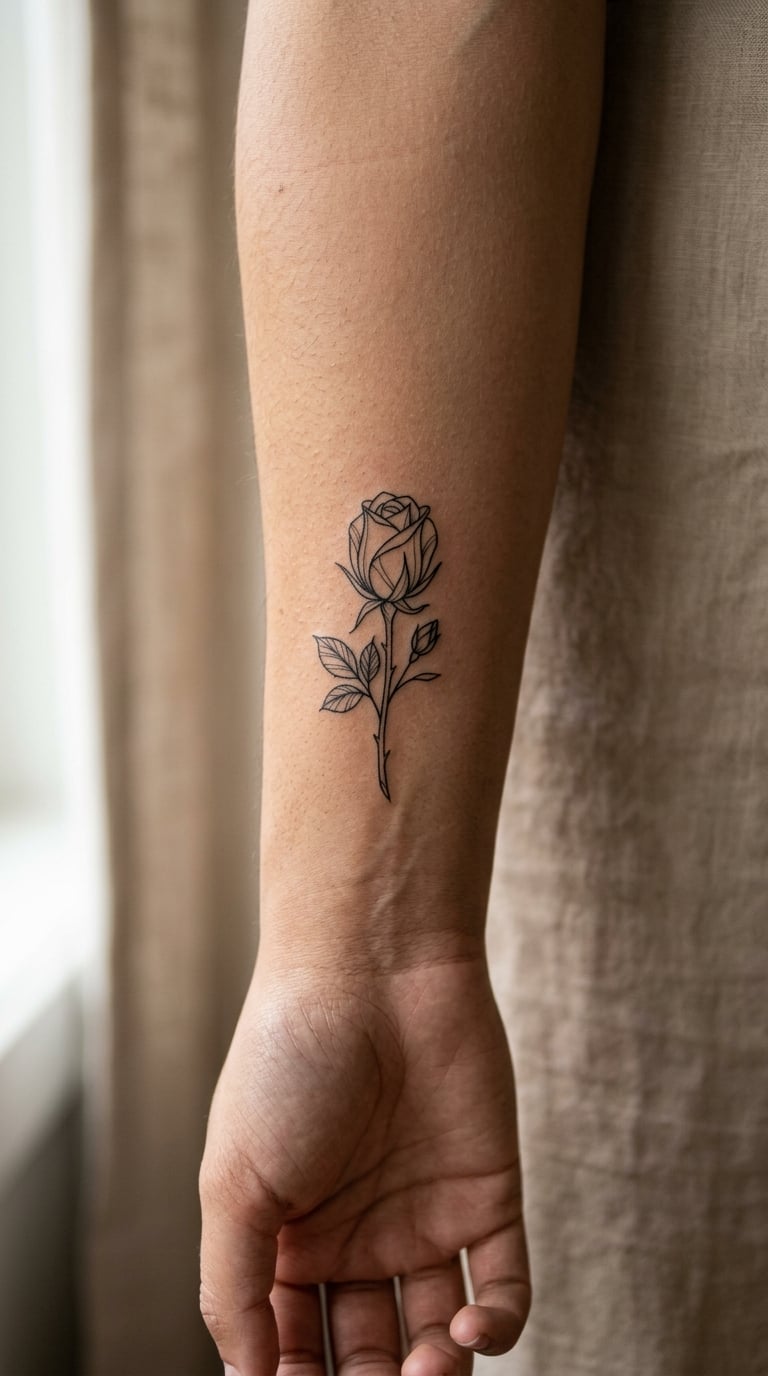
A single rosebud with a short stem and two small leaves, drawn in a thin, even black line. There is no shading, no colour, and the outline stays botanical rather than decorative.
People choose it because it reads as a flower without committing to a full bouquet, and rosebuds stand for a love still unfolding. That suits a pair who would rather not explain the design to everyone they meet.
Placement: Inner forearm, outer forearm, or behind the ear · Size: 1.5-2.5 in (4-6 cm) · Style: fine line
Pain: Low on the forearm, a sharp scratch for the first few minutes. One ageing note: the smallest versions need a line-weight minimum or the outline blurs within a few years.
Make it yours: Give one wearer a bud on a stem and the other a bud alone, or add a birth year in tiny numerals under the leaf.
2. Matching Heartbeat Line
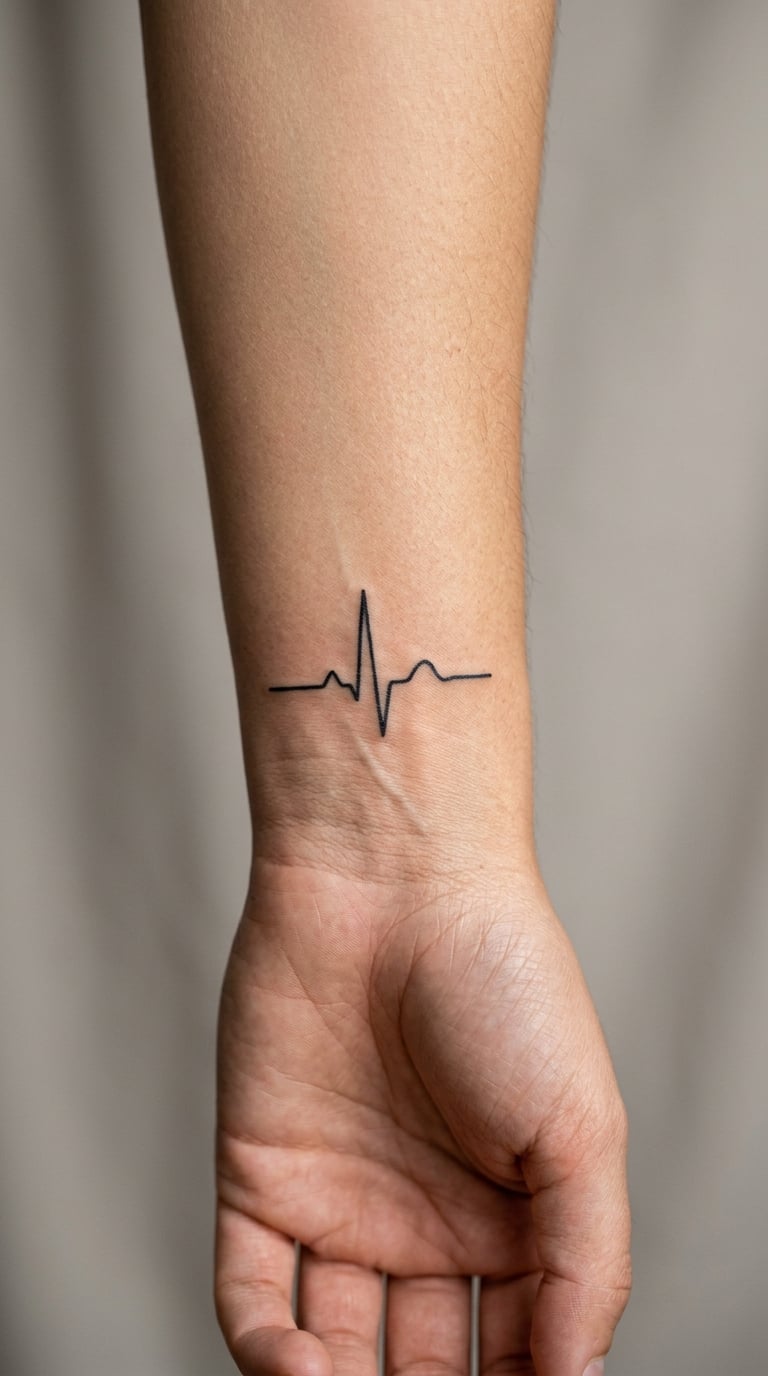
A single unbroken line that runs flat, kicks into a spike, flattens again, and finishes. It looks like a pulse trace lifted from a monitor, which is exactly the appeal: it is a record of a heartbeat, and it stays legible at wrist size.
It is one of the most requested mother and daughter designs because it carries a feeling rather than a picture. The line length can be cut to the wrist it is going on.
Placement: Inner wrist, inner arm near the elbow, or ankle · Size: 2-3 in (5-7.5 cm) · Style: single-line
Pain: Medium. The wrist has more nerve and bone close to the surface, and the inner arm near the elbow is one of the more sensitive spots on the body.
Make it yours: Use a real trace from a hospital bracelet if you have one. Keep the spike shapes identical even when the overall line length differs.
3. Matching Infinity Symbol with a Small Heart
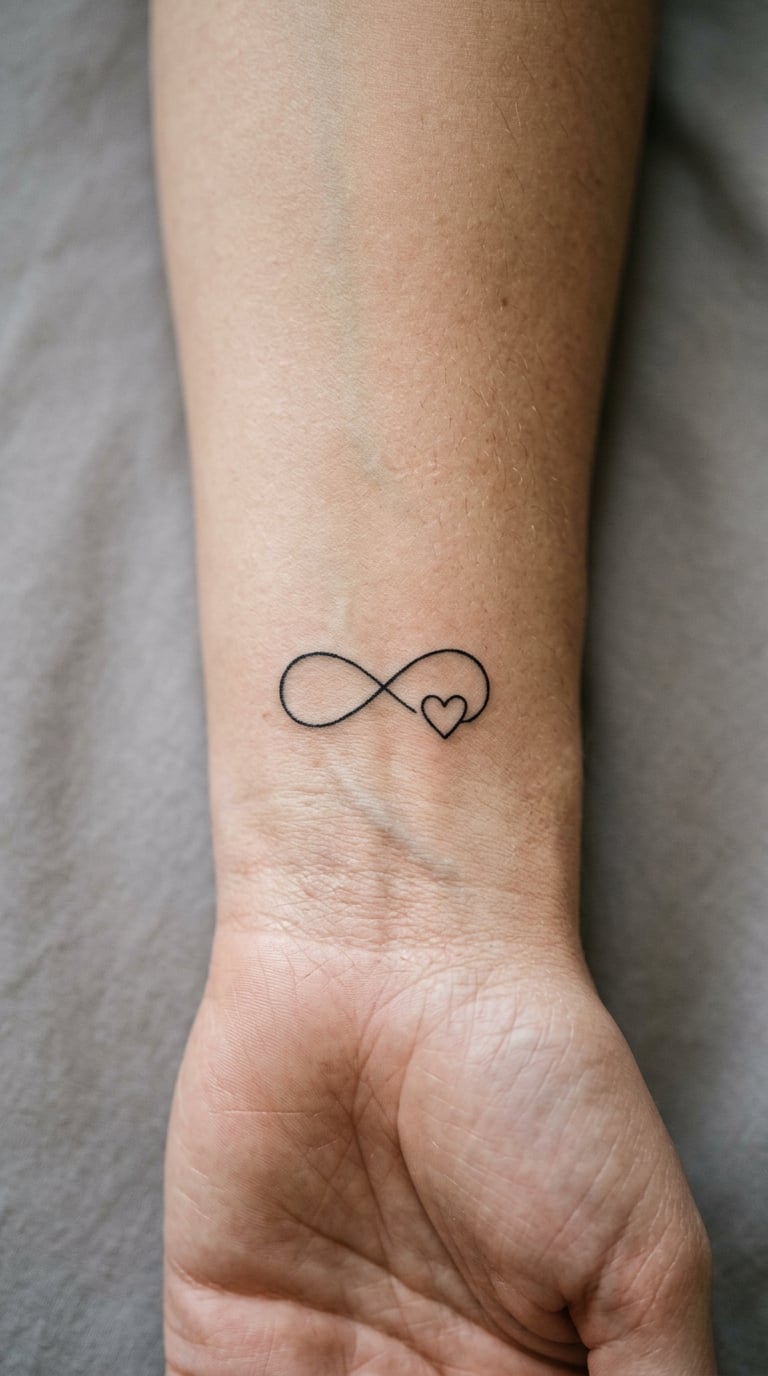
An infinity loop drawn in a clean, slightly thickened line, with a tiny solid heart sitting in one of the two curves. Kept at two inches, it is a symbol rather than an ornament, and the heavier stroke stops it disappearing.
Infinity is the most literal reading of an endless bond, and most people are honest that they picked it for that reason. The heart adds the part everyone actually wanted to say.
Placement: Inner wrist, ankle, or behind the ear · Size: 1.5-2 in (4-5 cm) · Style: minimal line
Pain: Low, on the wrist it is a quick scratch. Too small and the crossing point fills in with ink, so ask for the line weight to be heavier than feels necessary.
Make it yours: Put the heart on the outside curve for one wearer and the inside curve for the other, so the two read as a matched pair from a different angle.
4. Matching Birth Flower Line Art
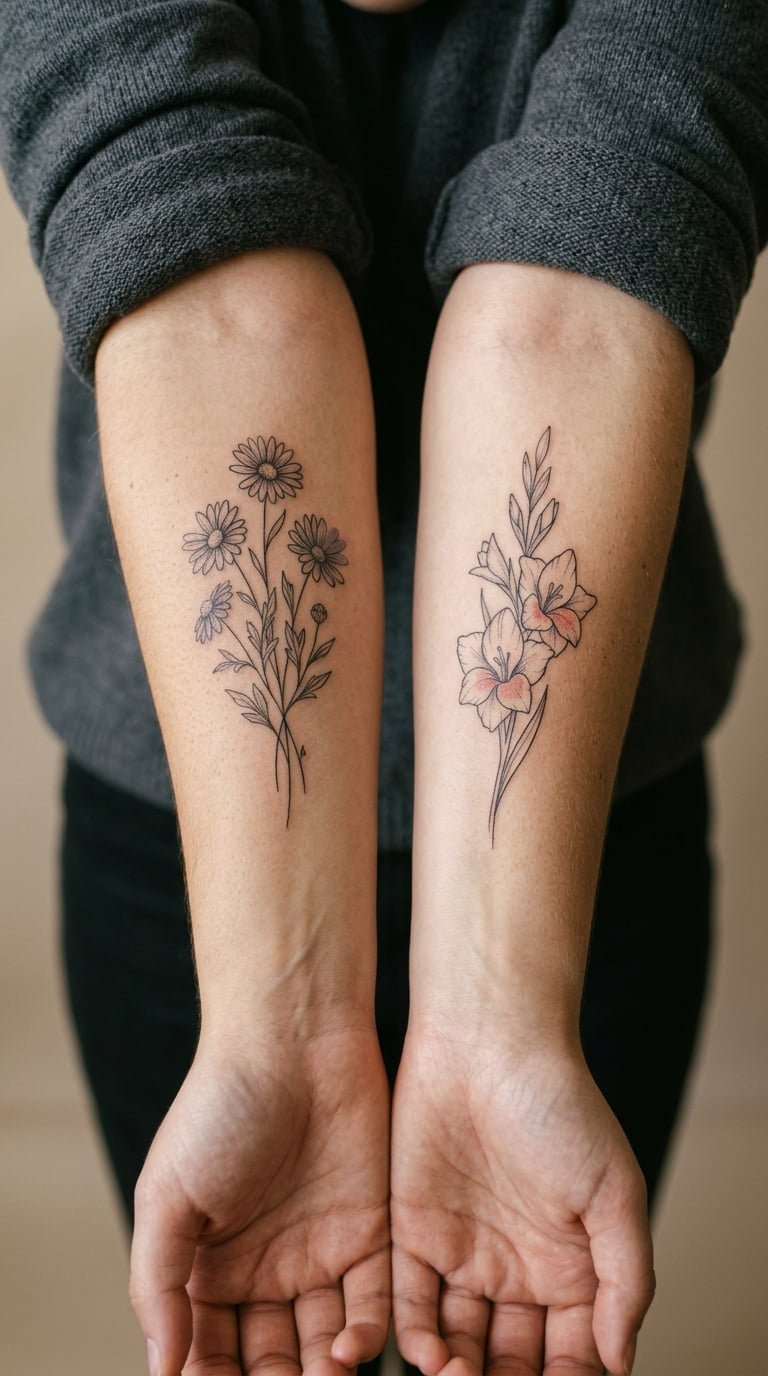
Each wearer gets their own birth flower drawn as a clean botanical outline, stem and petal structure included, with the stem running vertically. Same line weight on both, so the two flowers look like a set even though the species differ.
Birth flowers connect a person to the month they arrived, which makes the pair specific rather than decorative. Plenty of people add a small bud or leaf so the younger wearer’s plant is not bare.
Placement: Outer forearm, inner arm, calf · Size: 2-4 in (5-10 cm) · Style: botanical line art
Pain: Low. Petal edges take longer than the stem, so give the artist time rather than rushing to a single sitting.
Make it yours: Give both flowers one shared colour accent, such as the same muted green on the stem, and leave the petals black.
5. Matching Sun and Moon
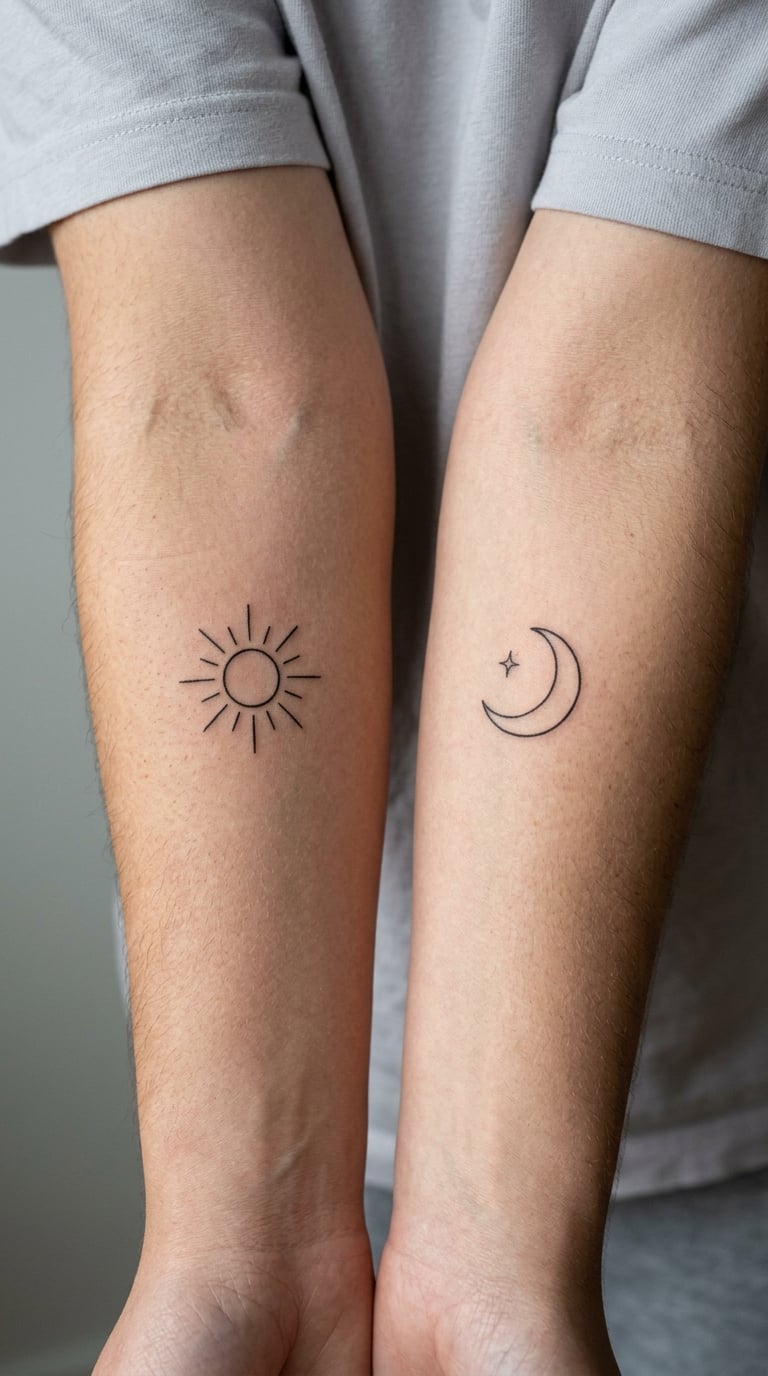
Complementary rather than identical: one wearer takes a simple sun with short triangular rays, the other a crescent moon with a closed eye and a calm profile. Same line weight, same height, placed on matching sides of the body.
Sun and moon pairings are usually chosen as constant and companion rather than as mother and daughter, which is precisely why they read well. Nothing about the design has to be explained.
Placement: Inner forearm, rib area, or behind the ear · Size: 2-2.5 in (5-6 cm) each · Style: fine line
Pain: Low on the forearm, moderate over the ribs because the skin there is thinner and the breathing makes it harder to hold still.
Make it yours: Add a scatter of three tiny stars between them, shared across both pieces so the pair is linked even from across a room.
6. Matching Olive Branch
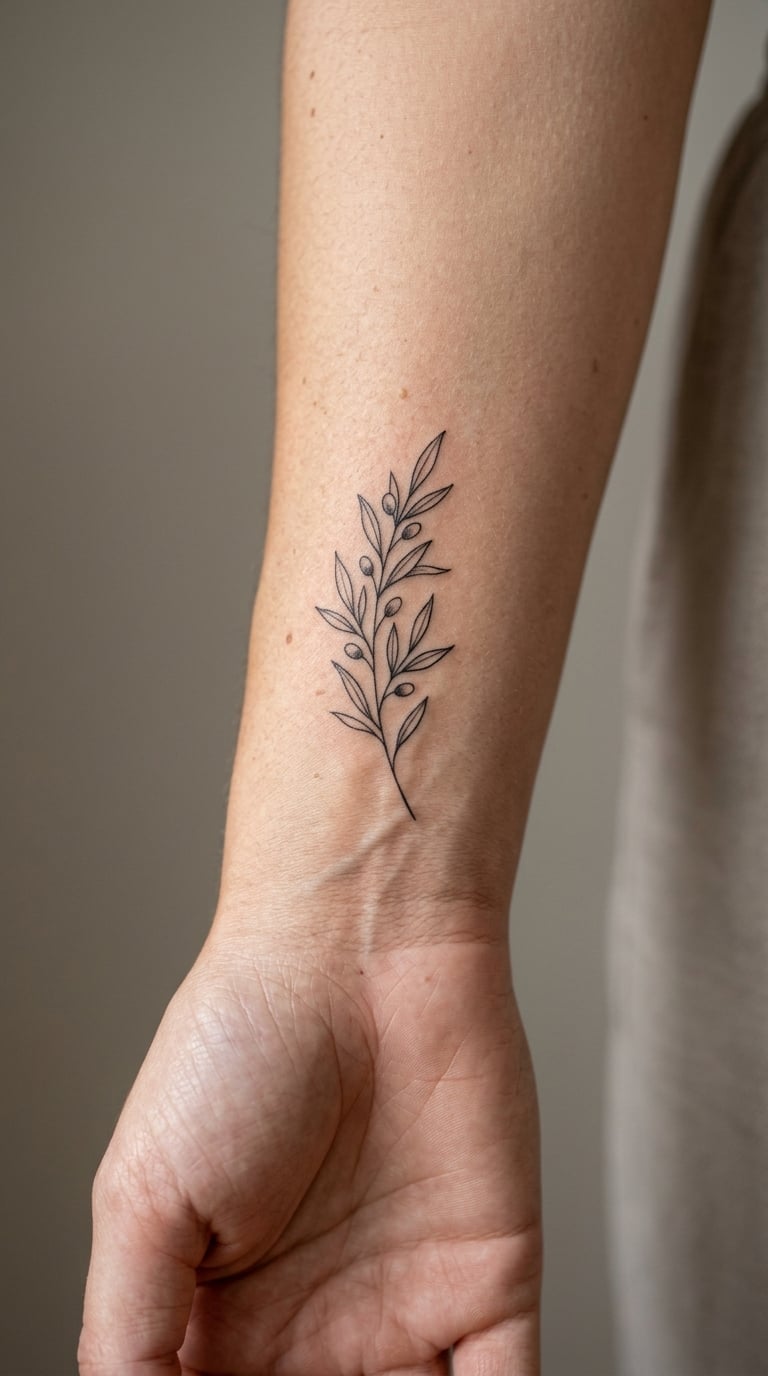
A slim curved branch with narrow leaves alternating along it, drawn in one fine line with no fill. It is the least floral-looking of the plant options here, which is why it suits people who find roses too sweet.
Olive branches are usually chosen for peace and family rather than any single story, so the meaning stays open. Ask your artist for a few leaves to fall away at the tip, a detail most olive branch drawings include.
Placement: Wrist, ankle, or along the collarbone · Size: 2.5-3.5 in (6-9 cm) · Style: fine line
Pain: Medium. The ankle is bony and the wrist sits over a tendon, so both take longer than the forearm even for a small piece.
Make it yours: Give each branch a slightly different curve so it follows that arm, keeping the leaf count and spacing the same on both.
7. Matching Tiny Birds on a Branch
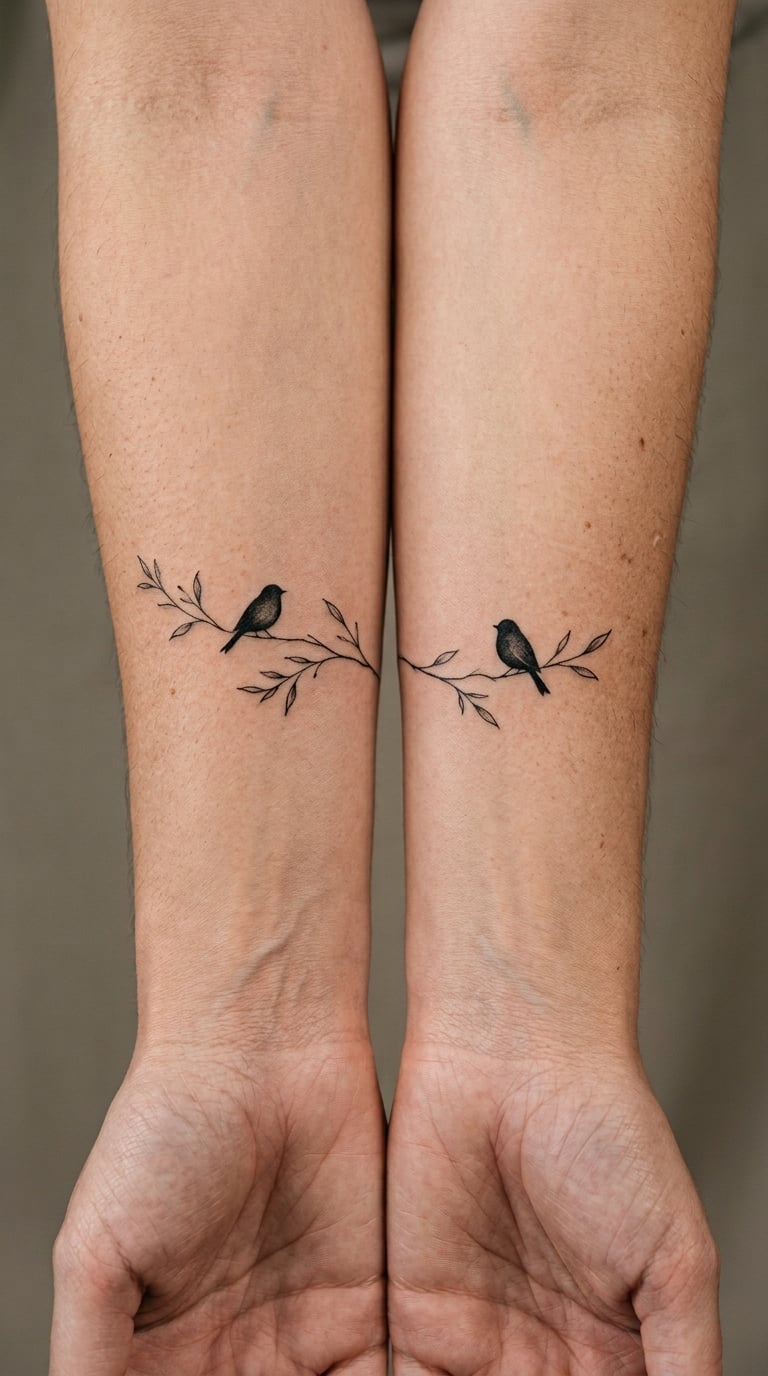
One small bird each, with a rounded body, a short beak and a tail, perched on a thin branch. Drawn with a few careful strokes rather than feather detail, so the shape stays readable at two inches.
Two birds rather than one signals the pair directly. Many people choose a sparrow for one and a swallow for the other, and the size difference then says which is which.
Placement: Inner arm, outer wrist, or ankle · Size: 1.5-2.5 in (4-6 cm) each · Style: fine-line realism
Pain: Low. The eye detail is the only fiddly part, and it stings more than the body of the bird.
Make it yours: Mirror the poses so both birds face the wrist, which reads as a set when both arms are side by side.
8. Matching Dainty Daisy Chain
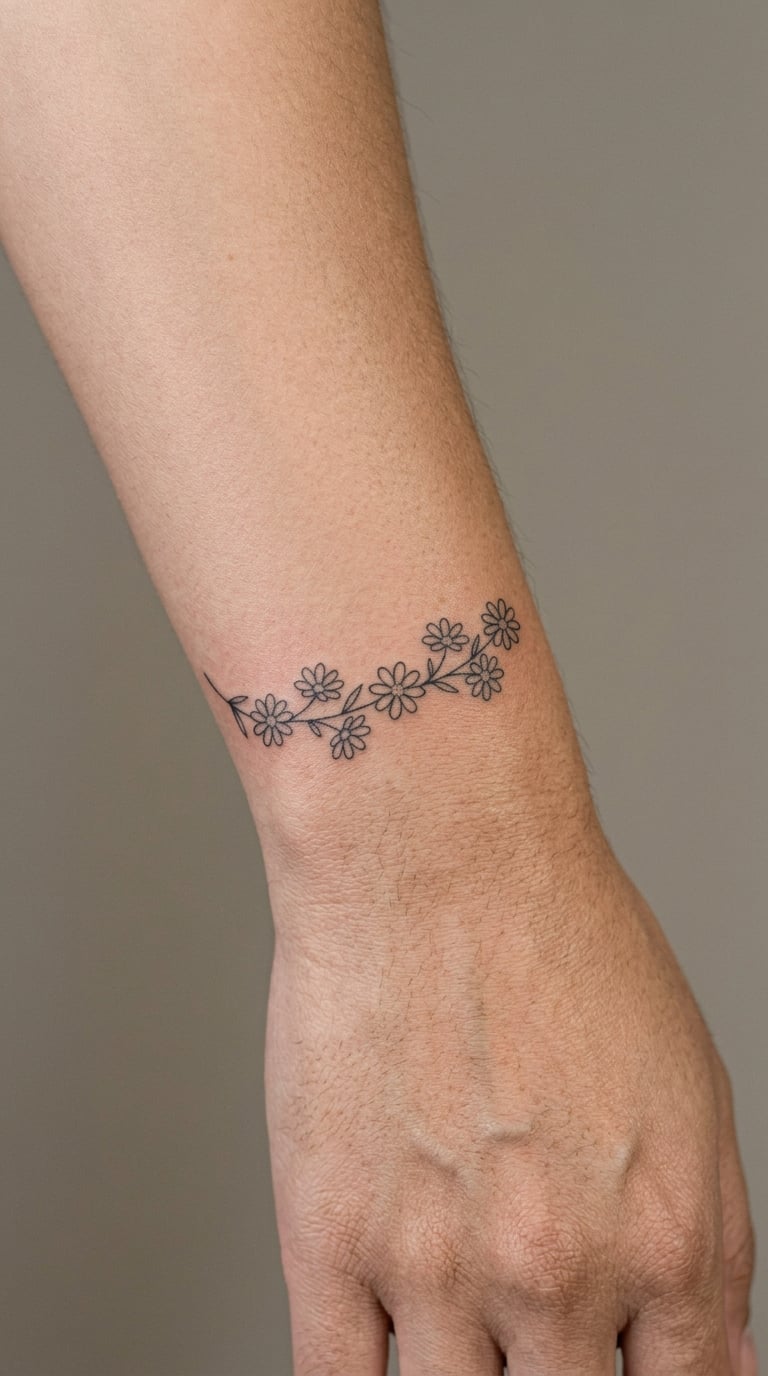
A short run of five or six daisies linked by a curving stem, each flower no bigger than a fingertip. Petals are simple loops rather than individually shaded, which is what keeps the whole chain from turning to grey over time.
It is a youthful design that works just as well at fifty, which is the point for an age-split pair. The chain shape also fills a narrow strip of skin nicely.
Placement: Outer wrist, ankle, collarbone, or upper arm · Size: 2-3 in (5-7.5 cm) long · Style: fine line
Pain: Low. The collarbone hurts more than people expect because the bone is right under the skin, so take breaks there.
Make it yours: Add one small coloured centre to a single daisy in the chain, at the same point on both pieces.
9. Matching Coordinates
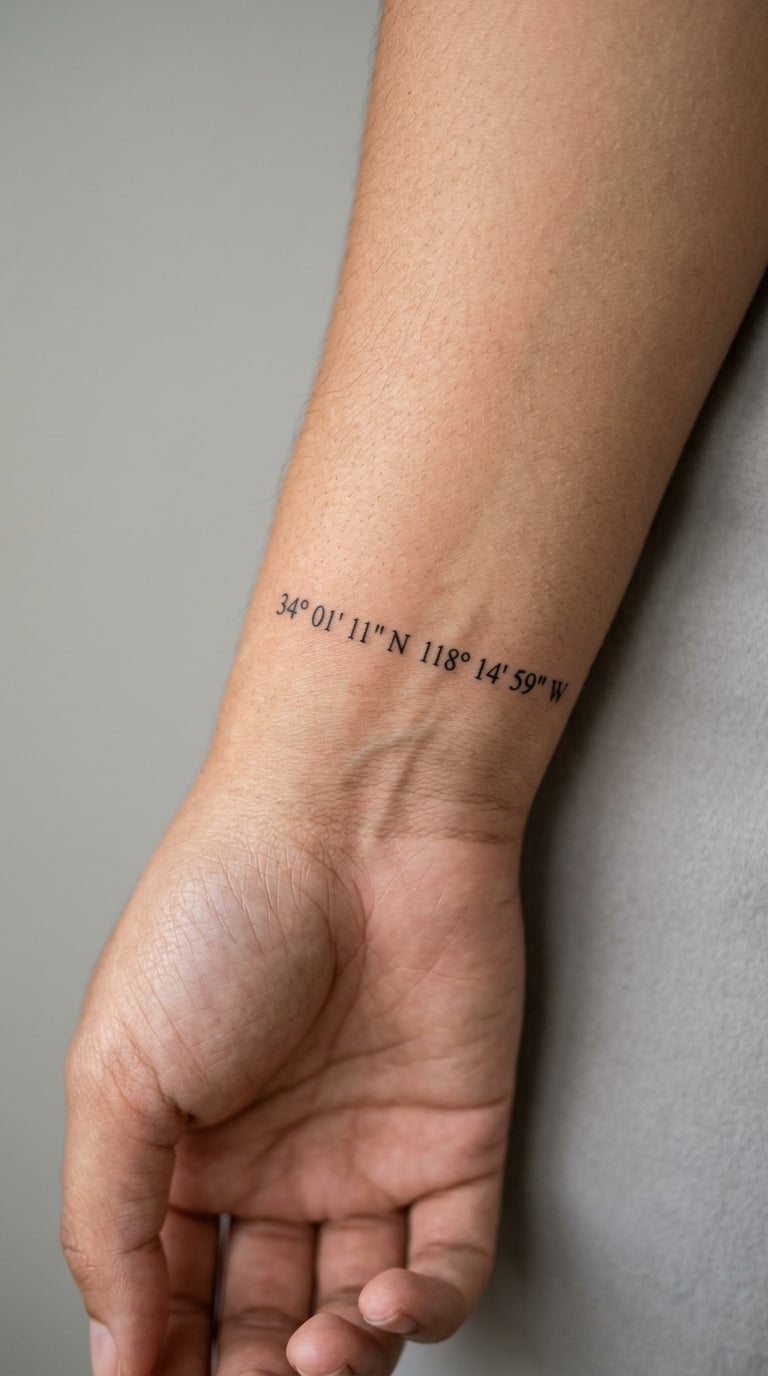
A latitude and longitude pair set in one clean horizontal line, numerals small and evenly spaced. Kept in a plain serif or a simple sans serif, it looks like a line of data rather than a decorative flourish.
Coordinates are usually a place that belongs to both of you: a first home, a meeting point, a holiday you both remember. It is the most quietly personal design on this list, and the least obvious to a stranger.
Placement: Inner wrist, inner arm, or rib · Size: 1.5-2.5 in (4-6 cm) wide · Style: lettering
Pain: Medium, mostly from working on curved skin near the wrist. Numerals need a steady hand, so expect the session to run longer than the size suggests.
Make it yours: Use the daughter’s birthplace on one and the mother’s on the other, or set both to the same place at two different scales.
10. Matching Constellation
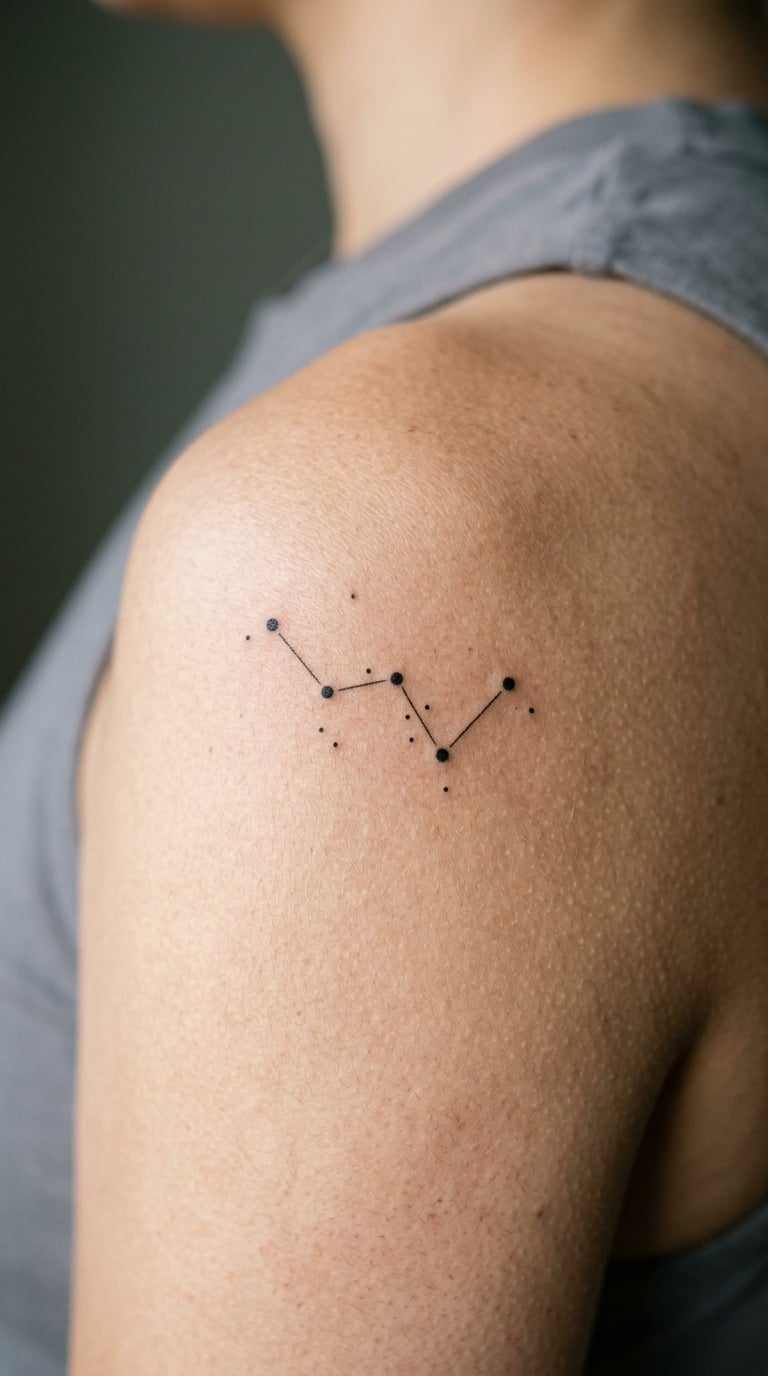
A scatter of small black dots joined by hairline segments in an irregular shape, with no shading and no background. A few brighter four-point stars mixed into the dots keep it from looking like a smudge at a distance.
Constellations are chosen for a named sky, often the night of something that happened, or the month someone was born. The name usually goes underneath in small letters or not at all.
Placement: Shoulder, upper back, outer thigh · Size: 3-4 in (7.5-10 cm) wide · Style: dotwork with fine connecting lines
Pain: Medium. Dots are quick, the connecting lines are slow, and the shoulder gets uncomfortable once you have been sitting still for half an hour.
Make it yours: Build both pieces from the same sky and let each person take a different handful of stars from it, rather than copying the full shape twice.
11. Matching Sea Turtles
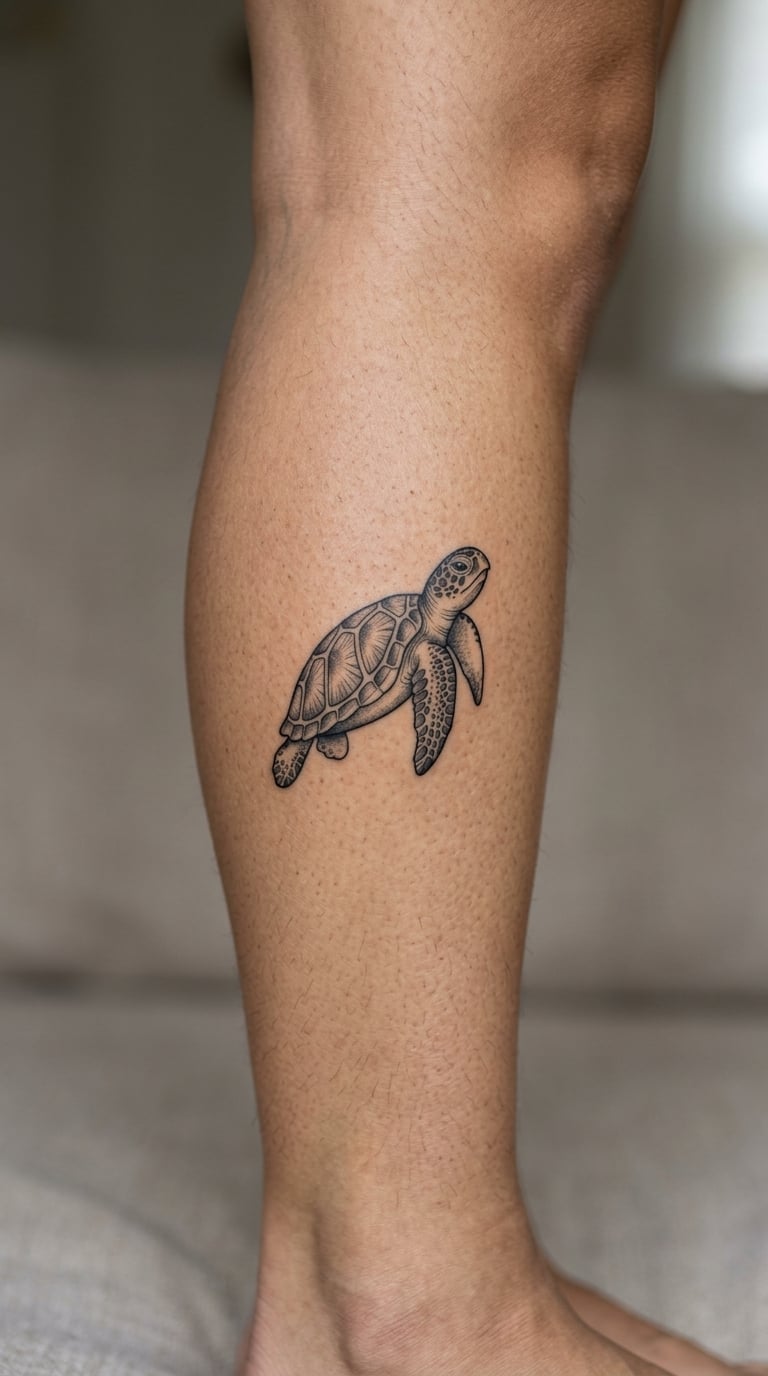
A sea turtle in clean illustrative linework, with a segmented shell, four compact flippers and a small eye. Black and grey washes sit under the line work rather than replacing it, which keeps the outline readable.
Turtles are widely read as long life, protection and steady pace, which fits a mother and daughter pairing well. The shells give a natural place to put a date or an initial.
Placement: Calf, outer arm, or ribs · Size: 3-4 in (7.5-10 cm) shell · Style: illustrative, black and grey
Pain: Medium on the calf, moderate over the ribs. The shell pattern needs real time, so this is usually a two-hour sitting rather than a quick one.
Make it yours: Point the two turtles in opposite directions so they look like they are swimming towards each other when the arms are side by side.
12. Matching Cherries
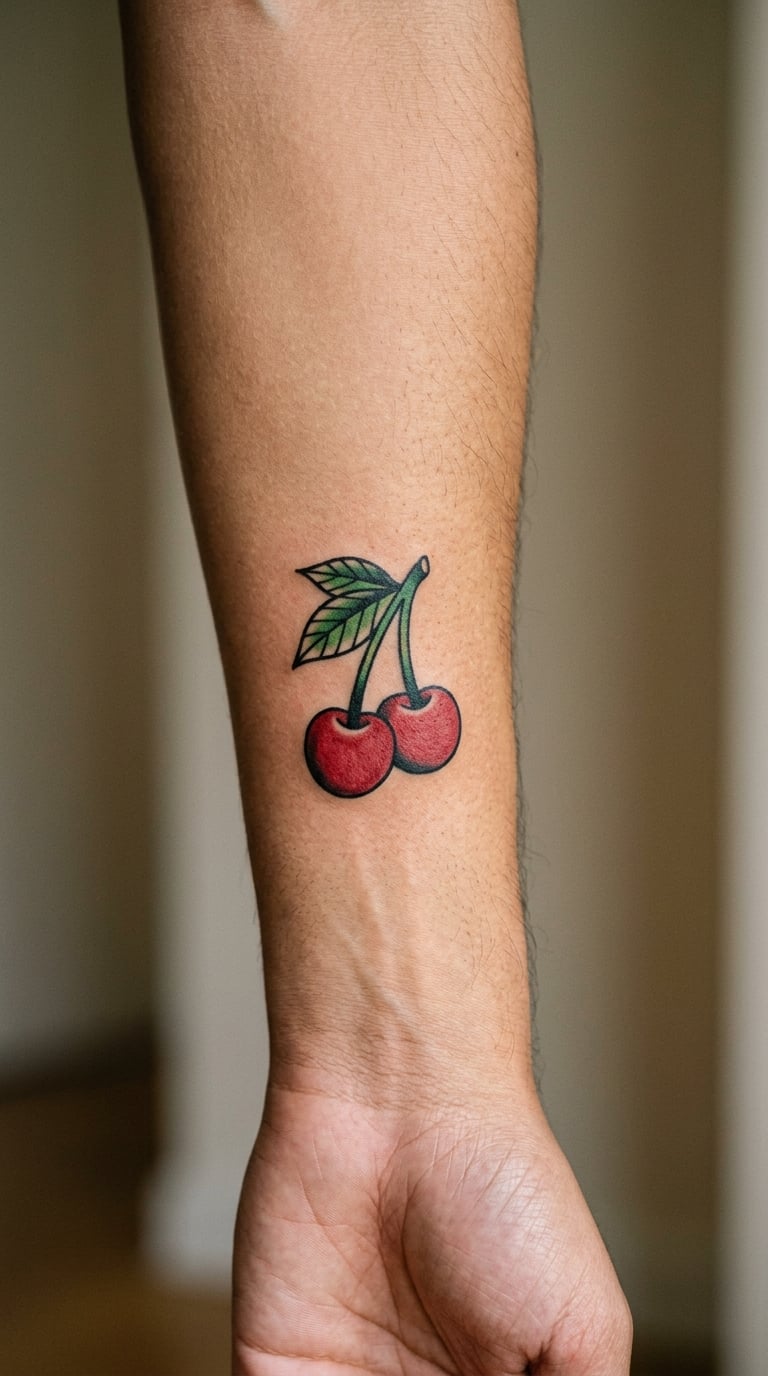
Two ripe cherries on joined green stems, in traditional style with an even black outline and flat red fill. The highlight is a single small white gap left in one cherry rather than a shading pass.
It is a playful, slightly retro design and people tend to choose it for the joke rather than the symbolism. It works well for a pair who want something that gets comments.
Placement: Forearm, calf, or upper arm · Size: 2 in (5 cm) tall · Style: traditional
Pain: Medium. The stem is the stingy part, since it is a narrow line of colour worked into skin that keeps moving.
Make it yours: Let one cherry be slightly larger than the other and skip a leaf on one piece only, so the pair looks drawn rather than stamped.
13. Matching Butterfly Line Art
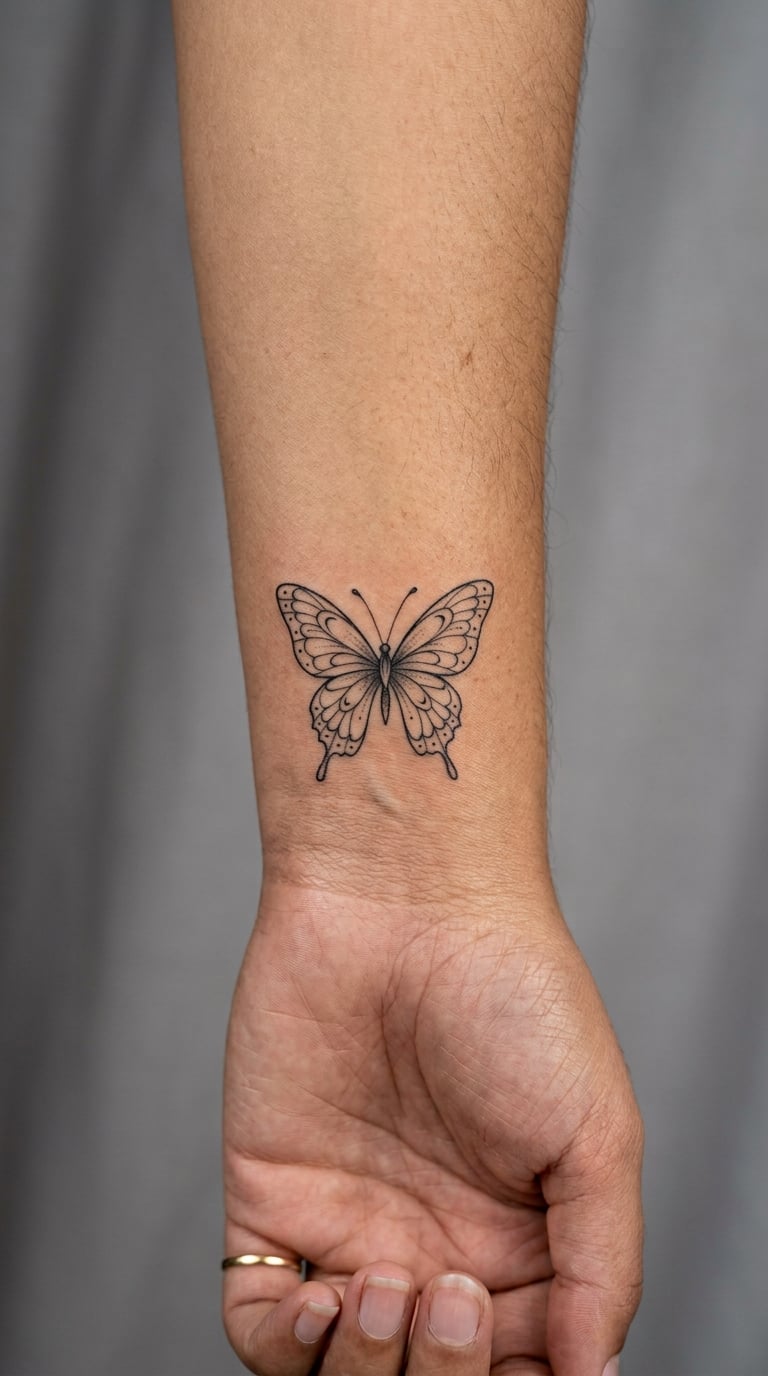
A butterfly built from symmetrical wing outlines, a slim body and two short antennae, with nothing inside the wings. Leaving the wings empty is what stops it looking busy at small scale.
Butterflies get chosen for change and for the way one design can be split in half. Two half-butterflies, one on each inner forearm, look deliberate when the arms are held together.
Placement: Wrist, shoulder blade, or behind the ear · Size: 1.5-2.5 in (4-6 cm) wide · Style: fine line
Pain: Low on the wrist, more on the shoulder blade because the skin there is thin and the client cannot see it. A mirror so both can watch helps.
Make it yours: Split the design down the middle, give each person one wing, and keep a small shared dot on the inner edge so the halves still line up.
14. Matching Crescent Moon Faces
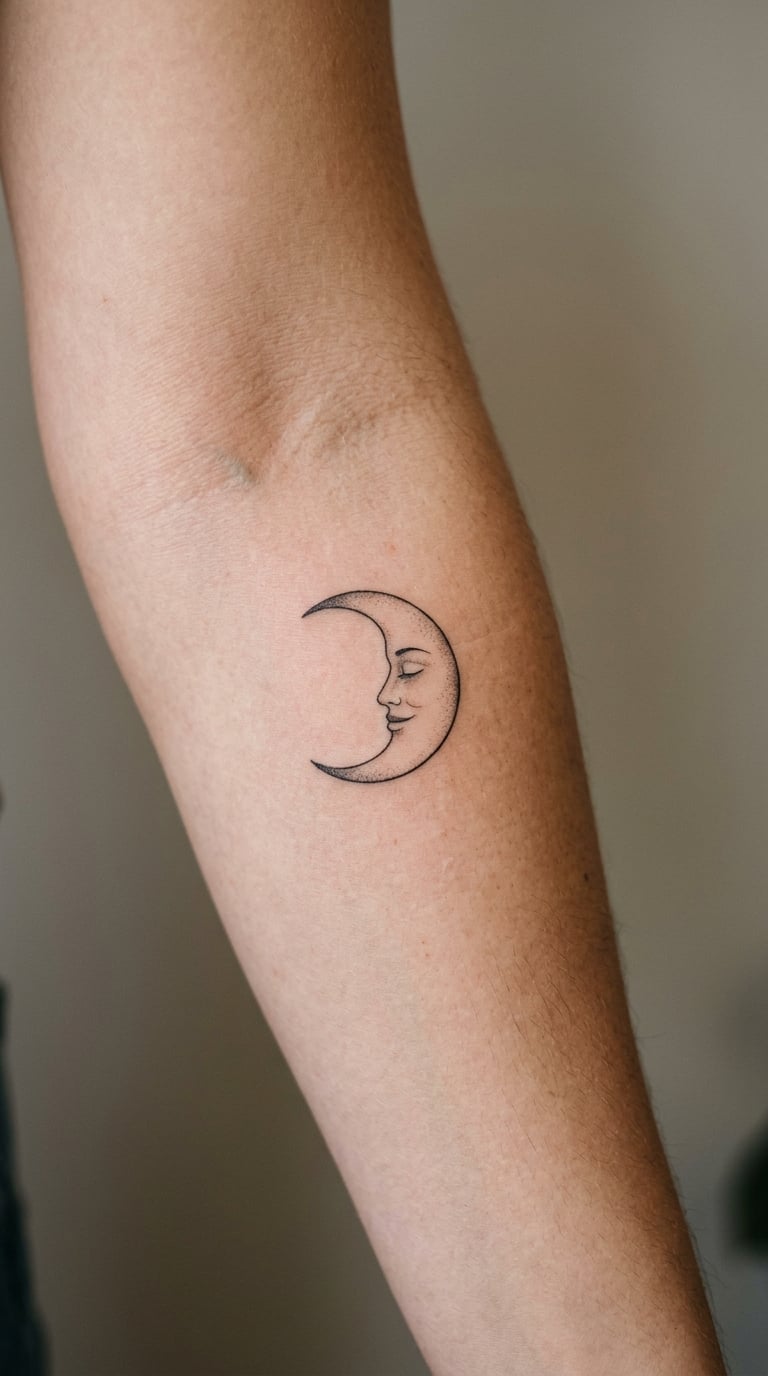
A crescent moon with a face in profile: a closed eye, a small nose, a calm mouth, and a scatter of fine dot shading inside the curve. The dots do the work that shading would, and they hold better than a grey wash at this size.
Two moon faces in different phases is a quiet way of saying the two of you are connected without being identical. Different phases, same style, same size range.
Placement: Inner arm, rib, or behind the ear · Size: 1.5-2 in (4-5 cm) tall · Style: fine line with dot shading
Pain: Low. Dot shading is repetitive and quick, so the slow part is the face line.
Make it yours: Give one wearer a waxing crescent and the other a waning one, both at the same height on the arm.
15. Matching Lavender Sprigs
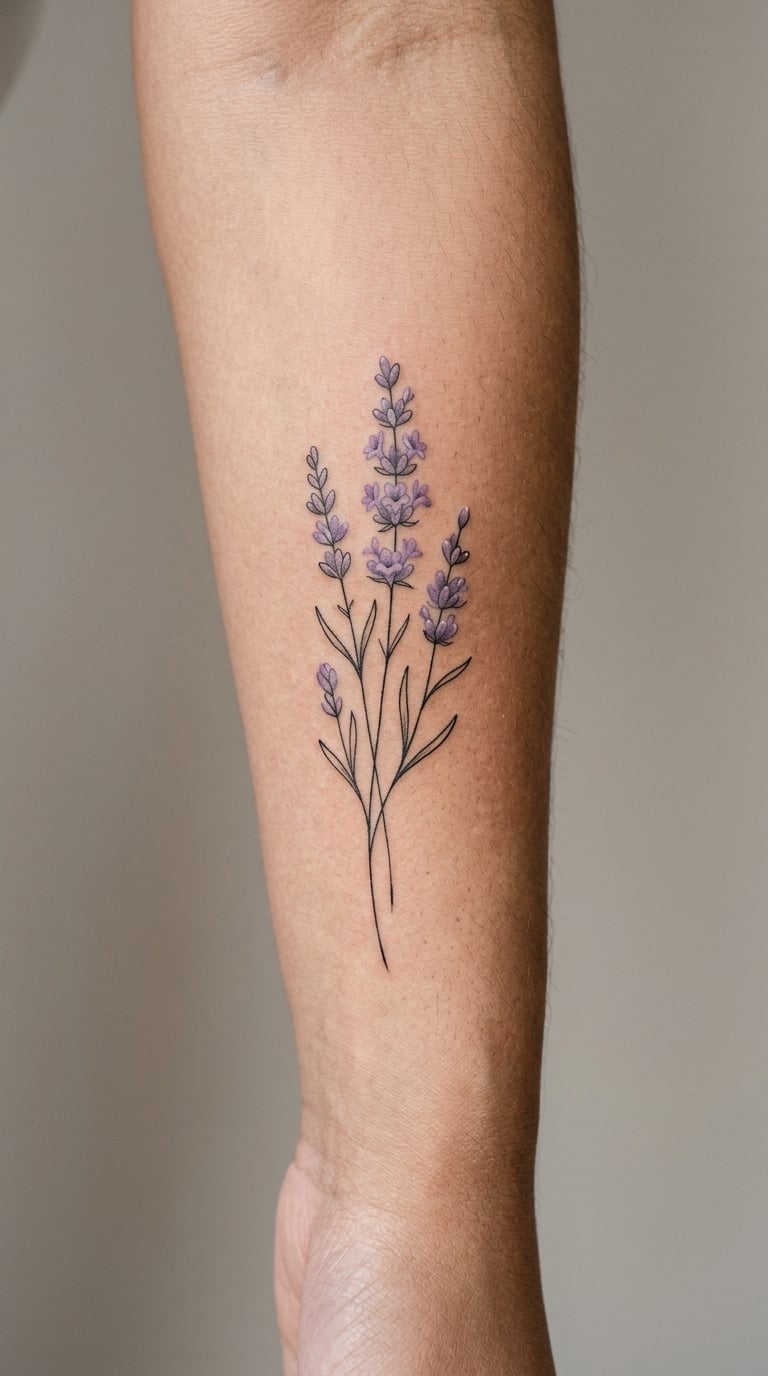
One upright sprig with a thin stem and stacked buds, the buds tinted in a muted purple or kept solid black. Watercolour bleeds slightly past the outline, which is the charm of it, and it settles into something softer than a fill.
Lavender is usually picked for calm rather than sentiment, and it gives a pair a matching colour without committing to bright ink. Very few of these are identical between two people, which many wearers prefer.
Placement: Outer forearm, calf, or upper arm · Size: 2.5-3.5 in (6-9 cm) tall · Style: fine line with watercolour
Pain: Low. Colour passes over the same line work, so it adds time but not much discomfort.
Make it yours: Have one sprig hold three stems and the other a single stem, sharing the same purple so the pair reads as a set from a distance.
16. Matching Initial Letter Tattoos
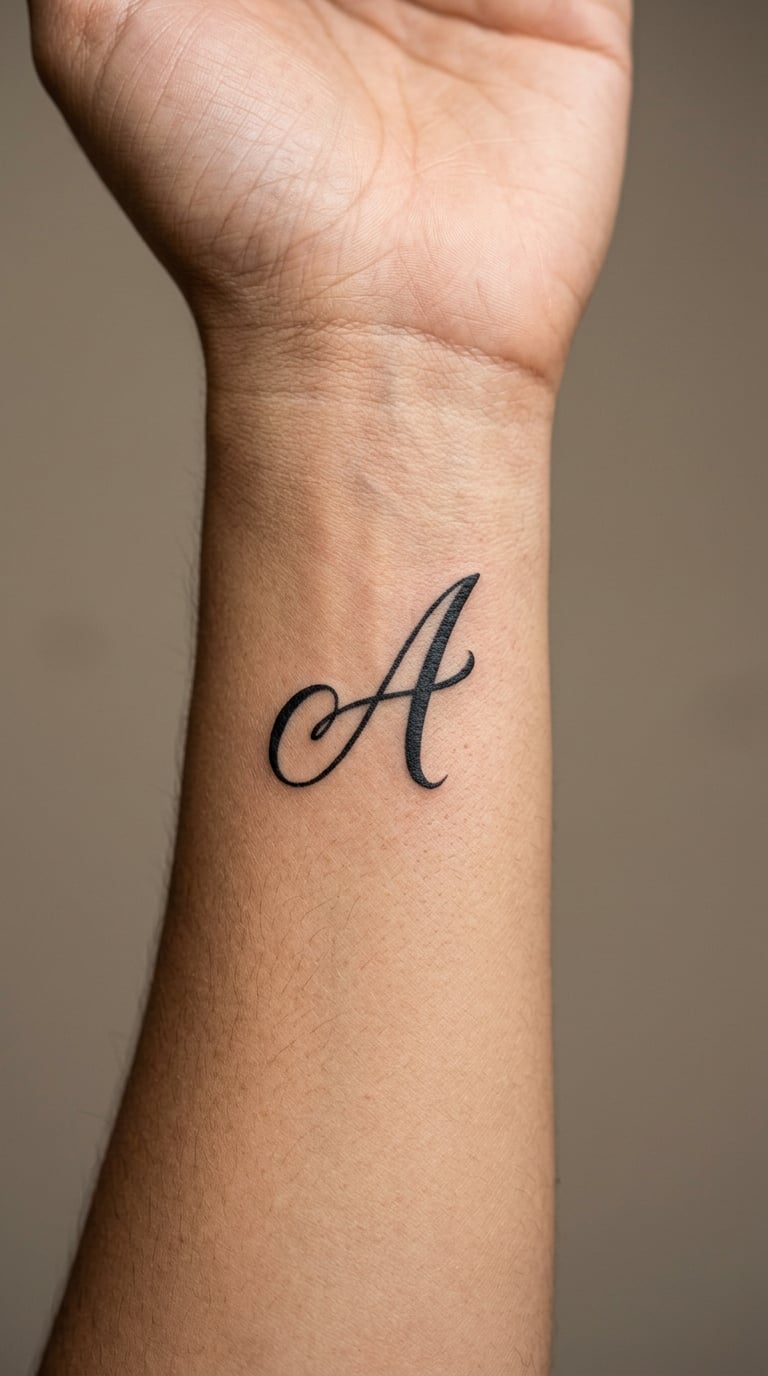
One letter each, in a soft handwritten script with a thicker downstroke and a thin upstroke, the kind of contrast that comes from a single needle and a change in speed. Clean edges, no drop shadow, no script font printed flat.
A shared initial, a family surname’s first letter, or the first letter of a name that matters is more personal than a symbol. It is also the design most often added to later as a set grows.
Placement: Inner wrist, behind the ear, or the rib area · Size: 1.5-2 in (4-5 cm) tall · Style: script lettering
Pain: Medium on the wrist. Lettering has more stops and starts than a shape, and each change of direction means a fresh pass.
Make it yours: Match the slant and the letter height exactly, then let the two letters differ. Same hand, different character.
17. Matching Date in Roman Numerals
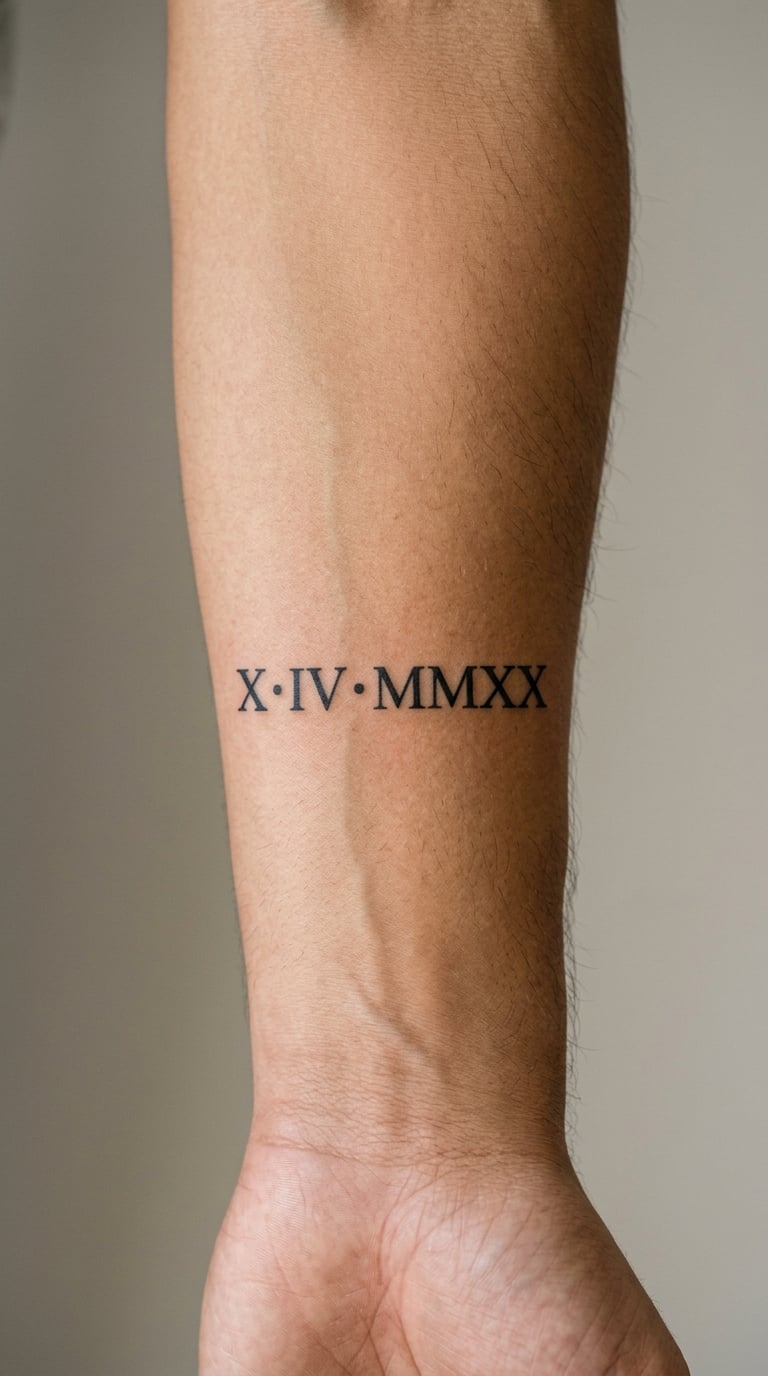
A date in Roman numerals, day month year, in an even serif with letters of consistent height and consistent gaps. The spacing is the whole job: too tight and the numerals merge once healed.
It suits a pair who already has a date that means something, a birth, a wedding, the day a difficult year turned around. Very common as a memorial piece, where the date is the reason.
Placement: Inner forearm, wrist, or rib · Size: 2.5-3.5 in (6-9 cm) wide · Style: serif lettering
Pain: Medium. The rib placement is the sore one; the forearm is steady work rather than painful work.
Make it yours: Put one date on the forearm and the other in Roman numerals of a different year, so the two relate without repeating the same line.
18. Matching Small Elephant
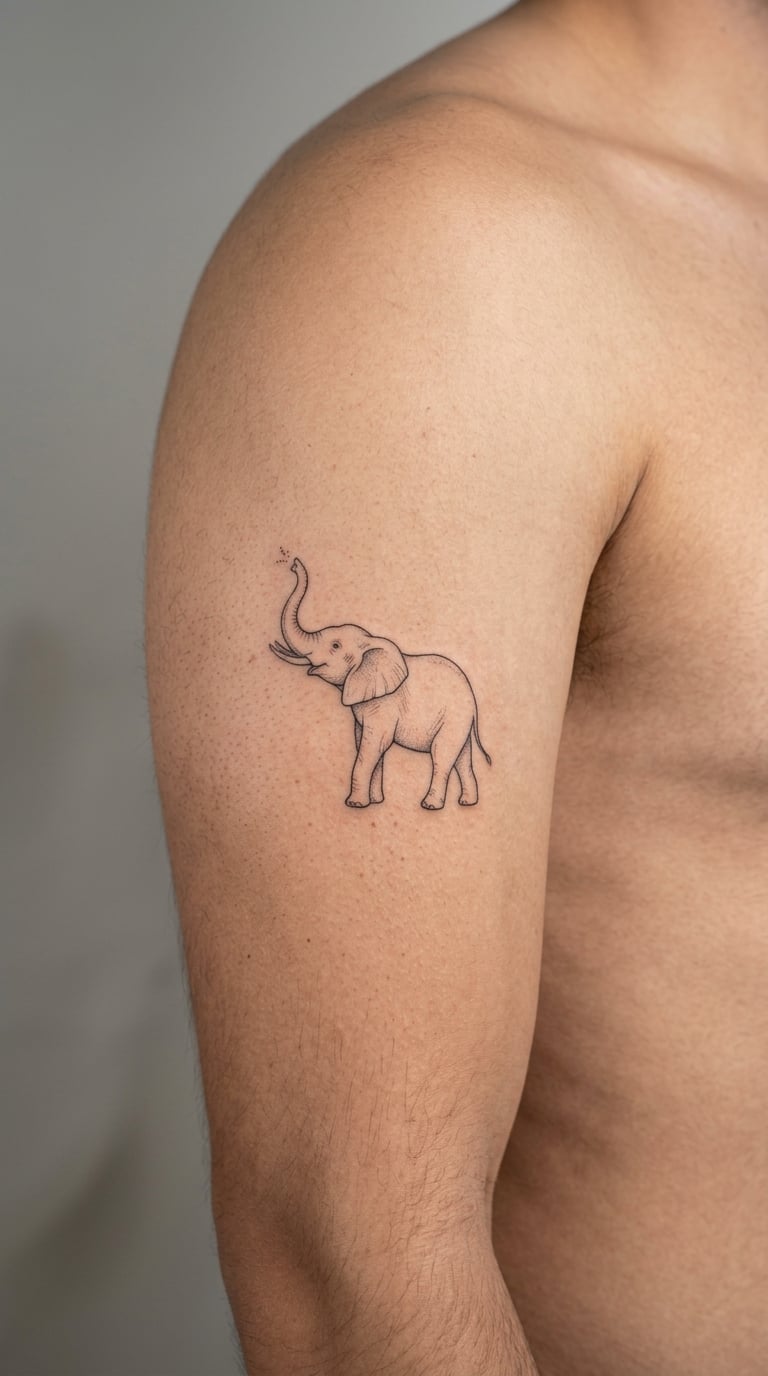
An elephant in fine-line silhouette with a raised trunk, a visible ear edge and one tusk, no grey fill. The outline is a single confident stroke with a few short lines inside for the ear and the leg joints.
Elephant and calf pairings are a well-worn way of showing a parent and child, and the adult version of that reads the same. It is one of the designs that photographs well from a distance.
Placement: Upper arm, calf, or outer thigh · Size: 3-4 in (7.5-10 cm) · Style: fine-line silhouette
Pain: Medium. The outer thigh and calf have more fleshy padding, which makes them easier; the upper arm is comfortable for a first sitting.
Make it yours: Turn one elephant to face the other, and let the smaller wear a tiny filled dot where the eye is. The dot repeats on both as a shared mark.
19. Matching Four-Petal Flowers
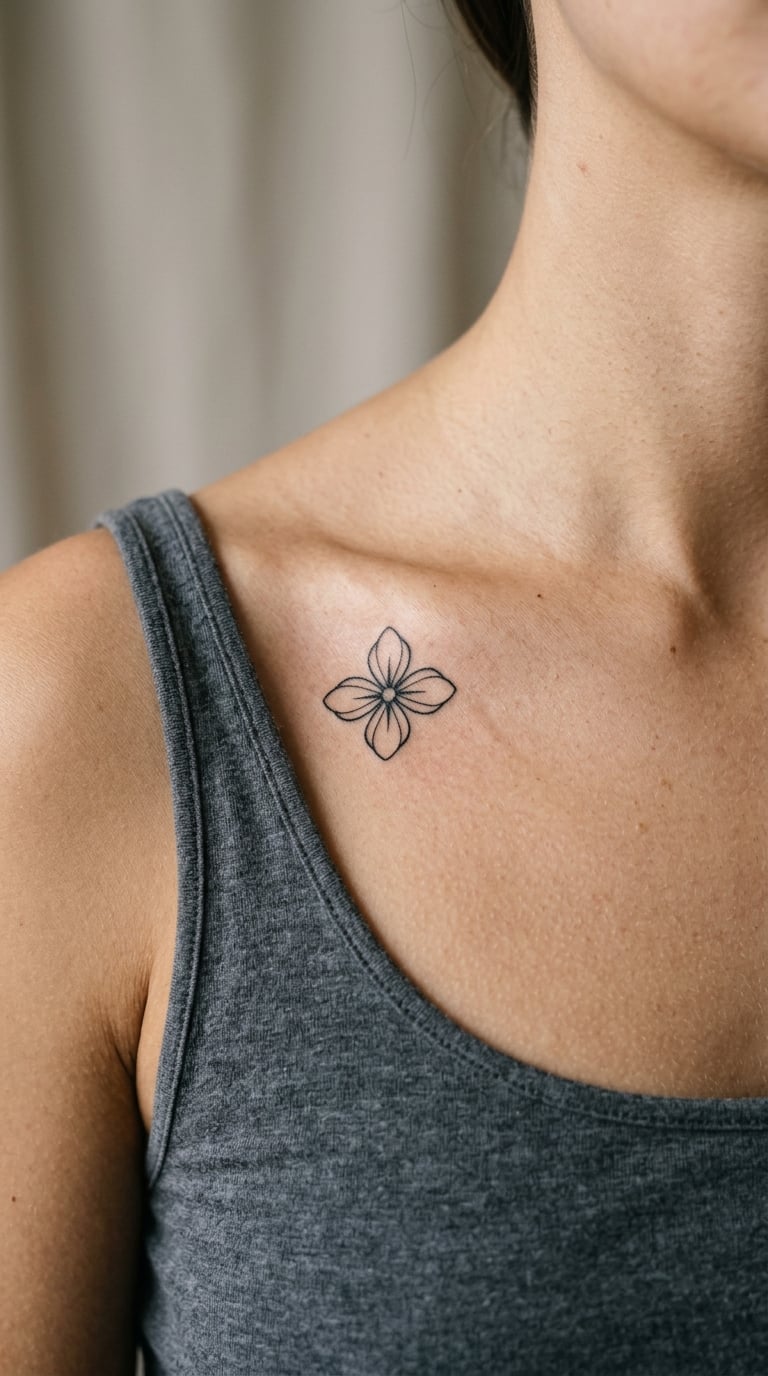
Four petals on a small circle, drawn with even spacing and a short stem, nothing else. The simplicity is the point: it is one of the few floral designs that still looks deliberate in fifteen years.
Four-petal flowers are chosen for how easily they repeat, so a pair can each take a different colour or a different petal count and still obviously belong together.
Placement: Collarbone, wrist, behind the ear, or upper back · Size: 1.5-2 in (4-5 cm) across · Style: line work
Pain: Low, though the collarbone stings more than the arm because there is very little soft tissue there.
Make it yours: Colour the centre dot on one piece and leave the other’s black. Small, deliberate, and only the two of you know why.
20. Matching Music Notes
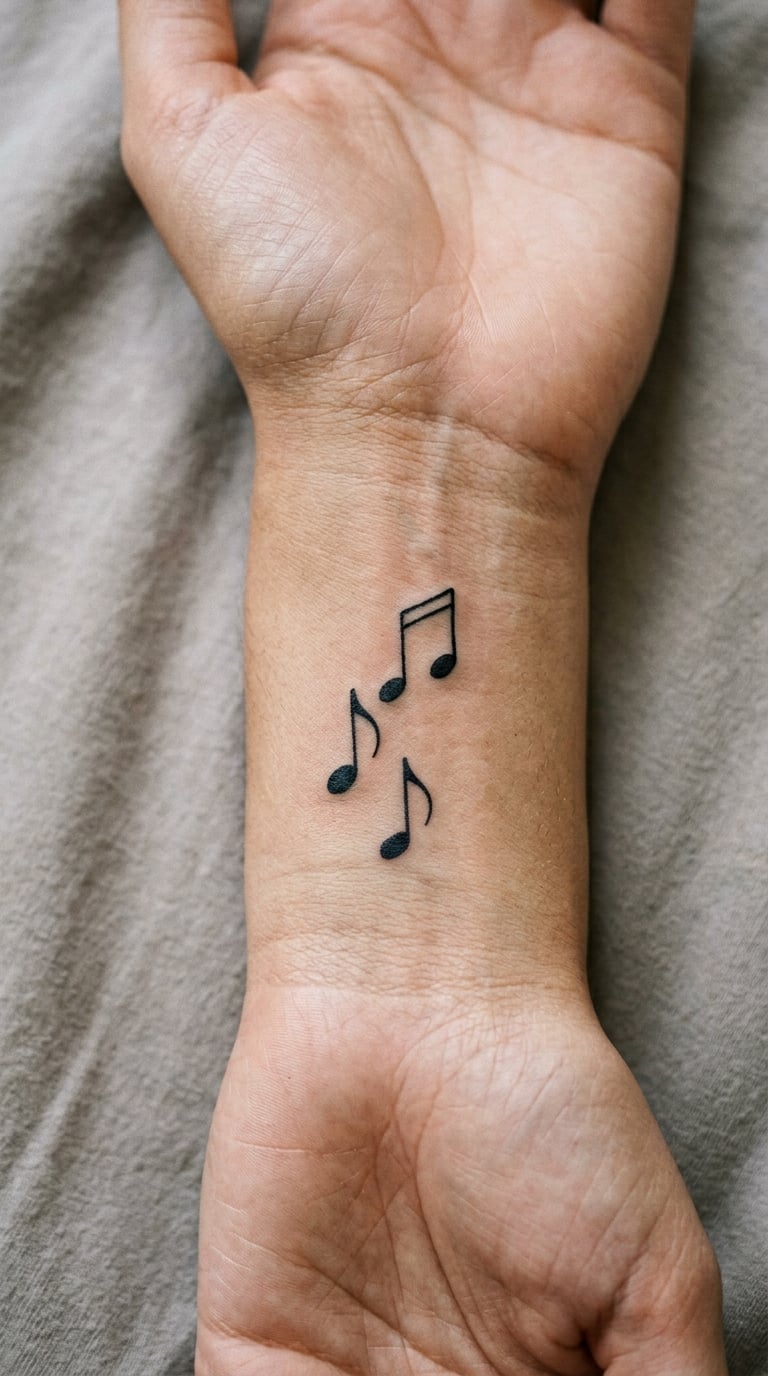
Three notes in a loose diagonal run, with stems and flags drawn in a single line and no shading. Two eighth notes and a quarter note give more variety than three identical ones.
For a family that plays, sings, or has been listening to the same records for decades, this beats another flower. It also works as an inside joke that only the two of you read correctly.
Placement: Inner wrist, behind the ear, or the rib area · Size: 1.5-2 in (4-5 cm) · Style: fine line
Pain: Medium. Small flags and beams need a controlled hand, and the inner wrist feels every pause.
Make it yours: Use the opening three notes of a song one of you plays, arranged in the same order for both.
21. Matching North Star
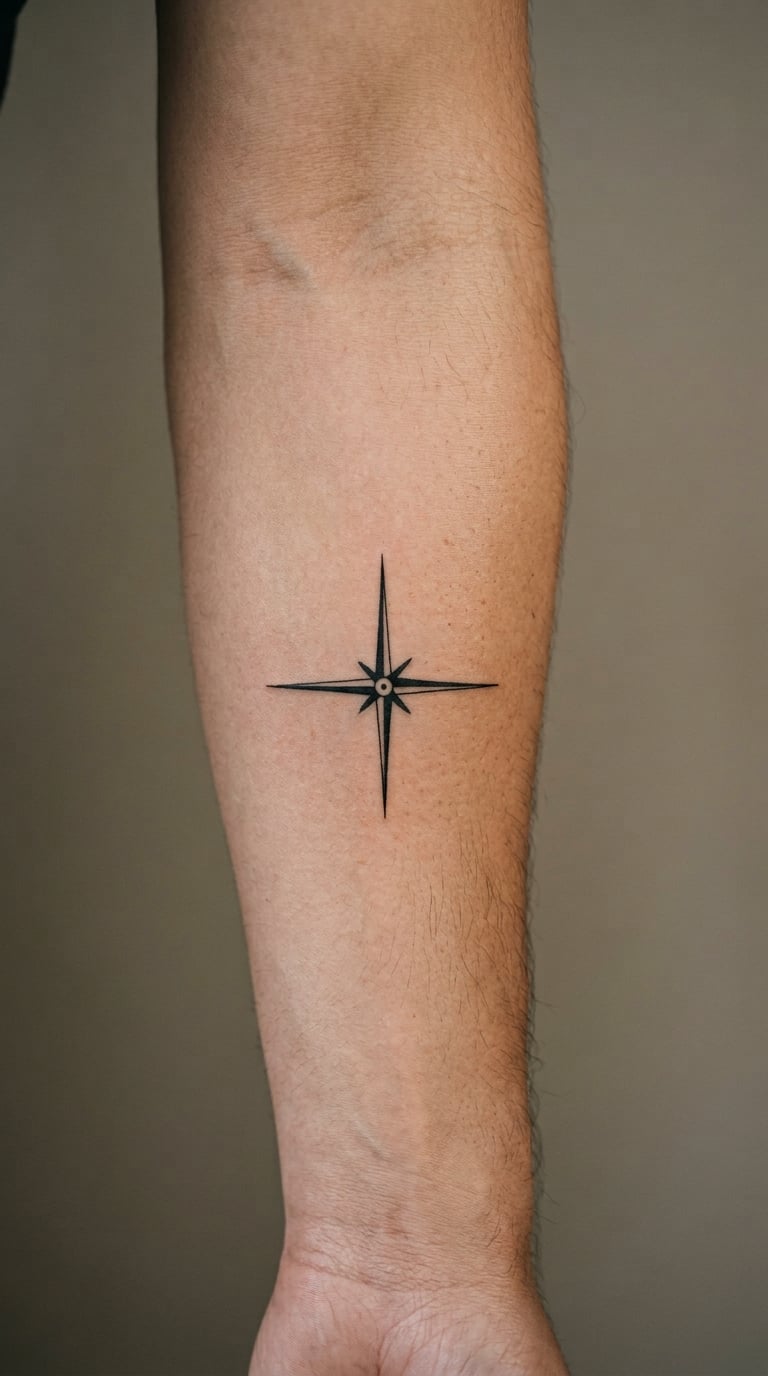
A small solid star with four fine rays extending from it, drawn black and left otherwise empty. Some versions put a small dot at the end of one ray, and that dot is the only detail worth keeping.
A north star is the most restrained of the directional symbols, and it gets chosen for the idea of something that does not move. It pairs well with a distance-reading design such as coordinates.
Placement: Inner forearm, wrist, or behind the ear · Size: 1.5-2 in (4-5 cm) wide · Style: minimal line
Pain: Low. It is a short piece, and the thin rays are the only part that needs a steady hand.
Make it yours: Put a tiny coordinate or a date under one ray on each piece, at the same angle.
22. Matching Teacup and Wildflower
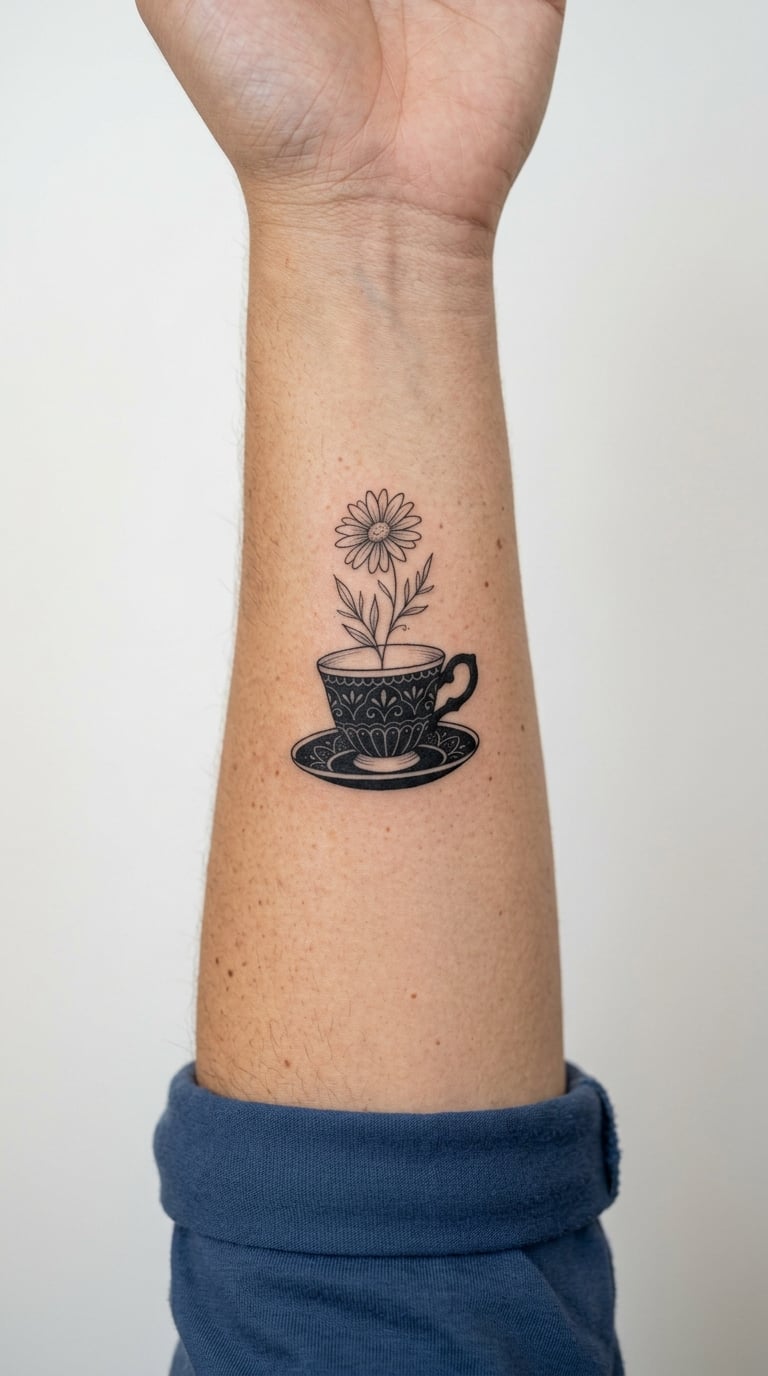
A simple cup and saucer in clean line, with a handle drawn in one stroke and a single small wildflower rising from the cup. Nothing shaded, no steam, no pattern on the china.
It is a warm, domestic design that suits a pair who would rather not wear anything grand. The flower gives it a natural element without tipping into floral.
Placement: Forearm, calf, or upper arm · Size: 2.5-3 in (6-7.5 cm) · Style: fine line
Pain: Low. Curves are slower work than straight lines, so give the artist time on the handle.
Make it yours: Add two thin steam lines on one piece and three on the other, and use the same flower on both.
23. Matching Rainbow Line
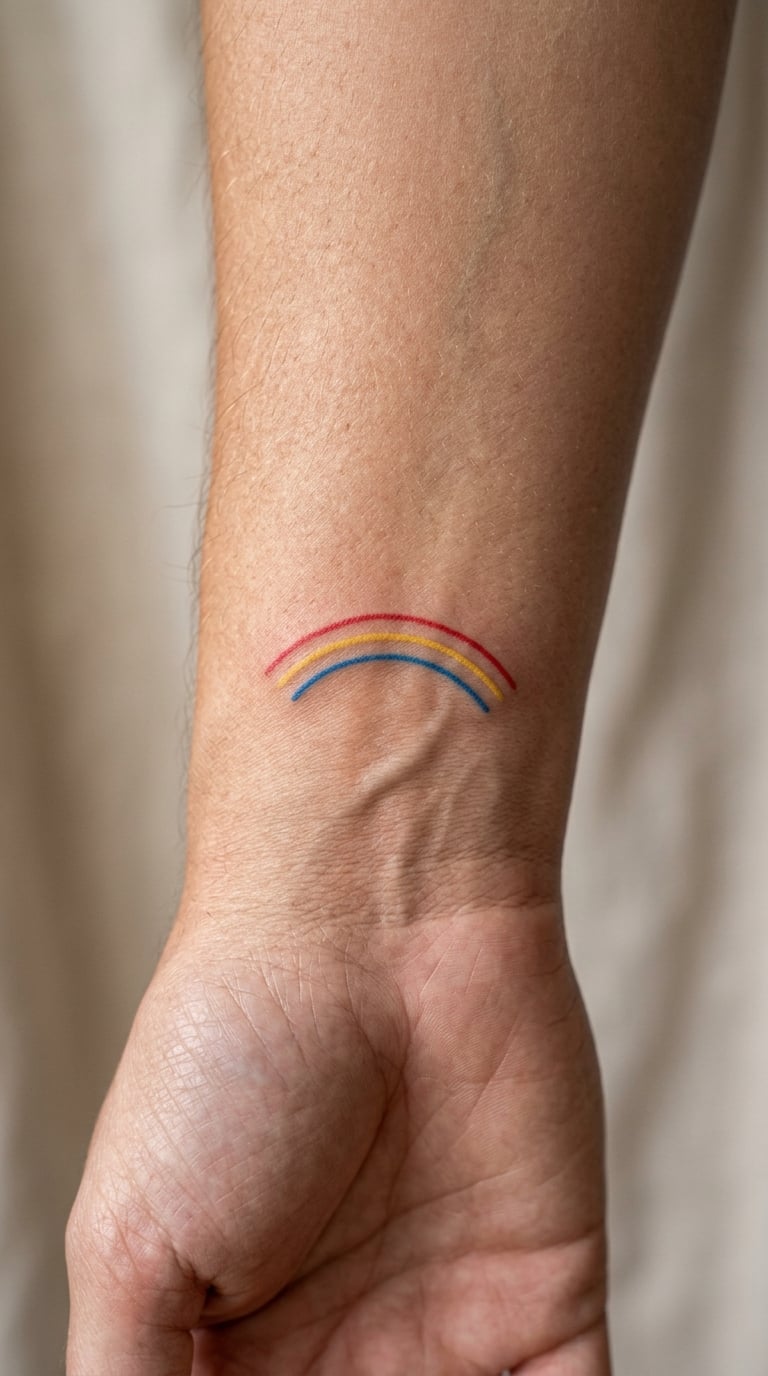
Three or four thin colour bands following one clean arc, no clouds underneath and no pot at the end. The bands are narrow and separated by untanned skin so each line keeps its own edge.
It is the most cheerful option here and the one that reads well on a teenager, which makes it a good first piece for a younger half of the pair. Adults get it too, usually smaller.
Placement: Wrist, ankle, or upper arm · Size: 1.5-2 in (4-5 cm) across · Style: minimal colour
Pain: Low. The arc is one continuous pass; the sting comes from the first pass at a new spot.
Make it yours: Keep three bands and change the middle colour on each piece, so the two arcs are recognisably paired and not identical.
24. Matching Paw Prints
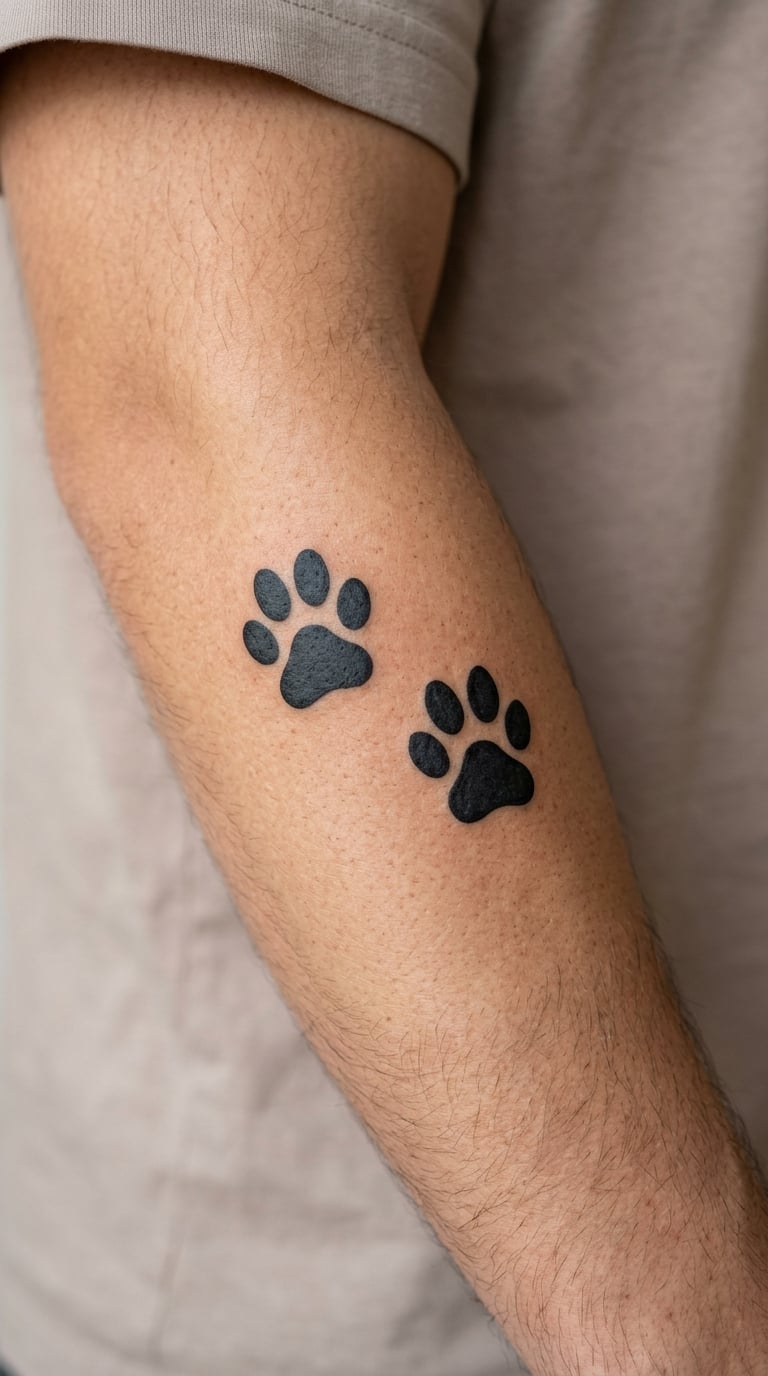
Two paw prints in solid black, each with a main pad and four toe beans, set slightly apart on a diagonal. Solid fill ages more evenly than a line drawing, which is why this stays clear for years.
Paw prints are usually a family thing rather than a mother and daughter thing, so it works best when a dog or a wider group is part of the story. Otherwise pick something more specific.
Placement: Forearm, calf, or ankle · Size: 1.5-2 in (4-5 cm) each · Style: solid black, minimal
Pain: Low. Filling a solid shape takes several passes over the same spot, so expect a brief uncomfortable stretch at the end.
Make it yours: Place the prints in sequence along the arm, one set slightly larger than the other, and count them out from a date.
25. Matching Handwritten Names
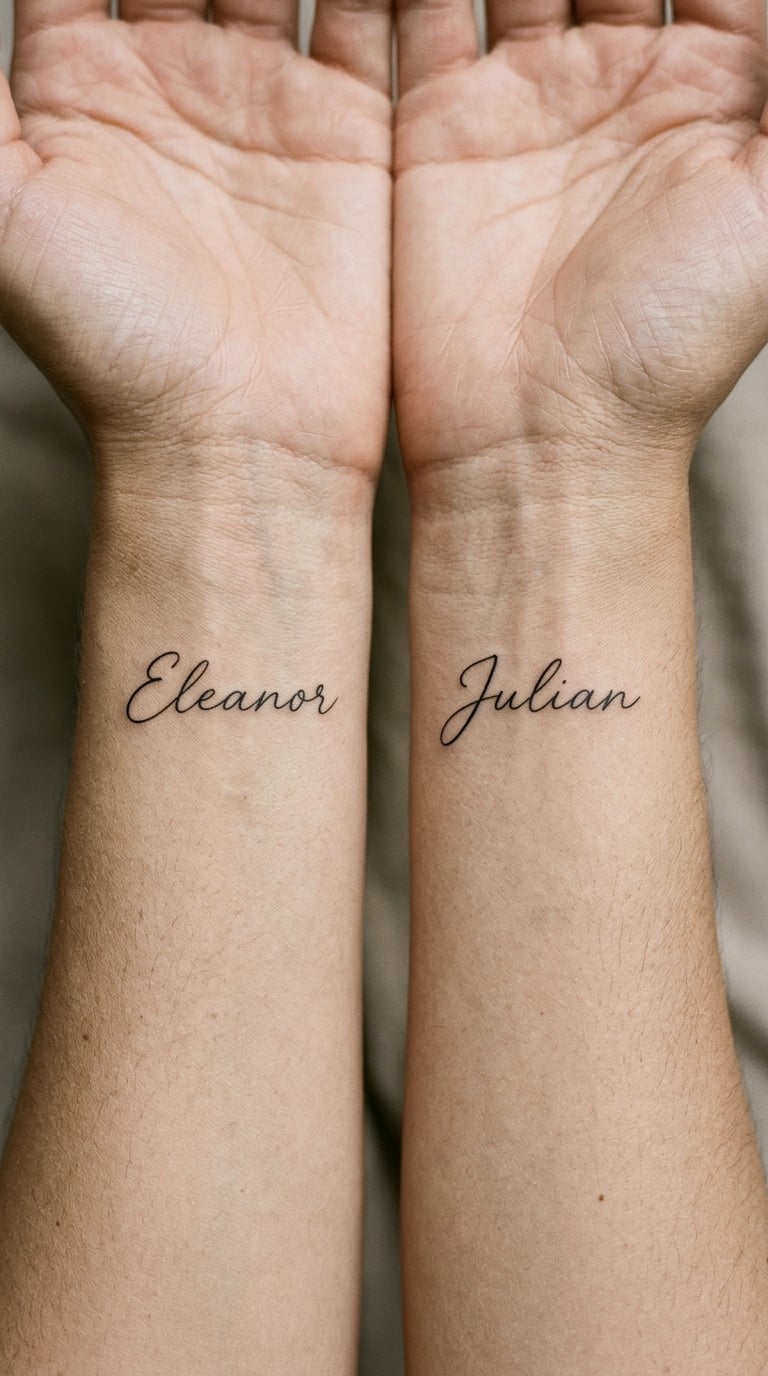
A name written by hand in fine black script, with a soft slant, a light entry stroke and a thicker downstroke where the pen pressed. The two names use the same hand and the same slant so they look like one person’s writing.
This is the design people describe as the most meaningful, and the one most likely to be right for a pair who wants something only they can read. It is also the hardest to plan, because the handwriting has to come from somewhere real.
Placement: Inner wrist, rib, or the back of the shoulder · Size: 1.5-2.5 in (4-6 cm) of lettering · Style: script lettering
Pain: Medium, and it runs long. Cursive means a continuous line with a lot of direction changes, and thin script lines need a heavier minimum than they look like they do.
Make it yours: Bring a clear photo of the real handwriting, or a note written and signed by the person it belongs to, and ask the artist to trace the actual letter shapes rather than a font.
Still deciding? Our small matching mother and daughter tattoo ideas round-up covers the tiniest options in more depth, and the wider mother and daughter tattoo designs gallery goes bigger on colour and illustrative work.
How to Choose the Right Design
Filtering the 25 matching tattoo ideas for mother and daughter comes down to four decisions, and the order matters. Size first, then placement, then style, then how closely the two should match.
Start with size, not the picture
Anything under half an inch of fine detail will soften. If the design has a face, an eye, a date or a coordinate, it needs enough room to be tattooed without the artist rushing, which usually means at least two inches on the long edge.
Pick a style both of you will actually wear
Matching does not require matching style, and often should not. A collector with blackwork and a first-timer with a single fine-line flower can share one motif comfortably. What does not work is one person carrying a large illustrative piece while the other is handed a shrunken version of it.
Choose complementary over identical when the ages differ
Identical copies work when both wearers want the same thing. If one is older and adding to a collection that already has pieces, or one wants more colour than the other, complementary is kinder: same motif, different scale, line weight or ink.
Check the placement against daily life
Wrist and ankle designs are visible and easy to show, and both fade faster from sun and hand washing. Inner forearm and rib pieces hide under a shirt but hold their line better. Whatever you pick, both people should want that spot on their own body, not just tolerate it for the match.
Make the two actually match
Book the same day, at the same studio, with the same artist if the shop allows it. Bring one reference image and let the artist reuse the same stencil at the same scale, adjusting only for placement. Aftercare decides how alike they look in five years, so follow the same routine on both arms.
Cost and Session Time
Tattoo pricing in the US works in one of two ways, and it is worth knowing which before you call. A flat rate per piece is common for simple, small designs. An hourly rate is more common for anything with real detail, colour or custom lettering, and it is the safer option for a matching pair because you are not locked into a price for a design that takes longer than expected.
Simple single-line work at two inches or so sits at the low end of the range and often takes under an hour. Small florals and lettering sit in the middle, usually one to two hours. Anything with colour, shading, a face or a full composition runs longer, and a four-inch illustrative piece can take a full session or a second sitting.
As a rough US guide, most of the small fine-line designs on this list land somewhere between $90 and $200 a piece, small florals and lettering between $150 and $300, and colour or full illustrative work from $300 up to several hundred. Plenty of shops set an hourly rate in the $80 to $200 range depending on the city and the artist, and it is worth confirming that figure when you enquire rather than assuming a number from a different part of the country.
Two things push a two-person session up: shop minimums, which mean you pay for a block of time whether the piece fills it or not, and booking two people at once, which many studios will not do because one artist cannot work on two clients in parallel. Book two separate slots on the same day instead. Ask three studios for a quote and compare what is included.
Aftercare Basics
- Follow your artist’s aftercare instructions first. Every studio has a method and a product they prefer, and theirs outranks anything general you read online.
- Wash gently with lukewarm water and unscented soap for the first couple of days, then pat dry with something clean rather than rubbing.
- Keep it loose and covered. Clean cotton tops and sleeves that do not cling beat tight synthetic fabric while the skin is still settling.
- Leave the film or gauze alone. If your artist applied one, peeling it off early is the most common avoidable mistake.
- Stay out of direct sun on the area, and once healed use sunscreen on exposed placements like wrists and ankles. UV is the main reason fine line goes grey.
- Contact the studio, not the internet, if the area becomes hot, swollen, painful or starts weeping after the first few days. Most early problems are simple and fixable.
Frequently Asked Questions
What tattoo symbolizes mother and daughter?
The most requested symbols are an infinity loop, a heartbeat line, birth flowers, sun and moon, handwritten names, a mother and calf elephant, and a fingerprint heart. Each is chosen for a stated reason rather than decoration, which is what keeps it meaningful years later. Complementary pairs such as sun and moon or a half butterfly work as well as identical copies, and often suit two different styles better.
Where is the best place to put a mother and daughter tattoo?
The inner forearm is the most forgiving: flat, low pain, and easy to match at the same scale. Inner wrists show the design off and photograph well but fade faster from sun and washing. Ankles and collarbones suit small fine-line work. Whichever spot you choose, both people should want it on their own body, not simply accept it for the sake of matching.
Should a daughter wait to get a matching tattoo with her mum?
Under-18 rules are legal and vary by state, and reputable studios will ask for ID and sometimes a parent present. Past that, waiting until you are settled about the design and the placement tends to matter more than waiting for a birthday. Healed skin also photographs better, so let a first piece finish before booking the matching one.
Is it weird to get a matching tattoo with your mum?
No. It is a common request, and most people who do it say the same thing: the design matters less than the occasion. A few people hesitate because the tattoo is visible to colleagues or relatives. If that is your worry, an inner forearm or rib piece shows in a swimsuit rather than at a desk.
How do you make two matching tattoos look identical?
Book both pieces at the same studio, ideally with the same artist, and bring one shared reference. Ask the artist to reuse a single stencil at the same scale rather than drawing the second from scratch. Keep the same aftercare routine on both. And if the two of you want different colours or line weights, say so at the booking, not on the day.
How long does a small fine-line tattoo take to heal?
Most studios quote two to three weeks for the surface to settle, with the full result showing at around six weeks once the ink settles into the skin. Do not judge colour or sharpness in week one. If you want both pieces to look alike, keep sun off them during that period, especially on wrists and ankles.
Which Idea to Pick First
For a first tattoo, the fine-line rosebud or the four-petal flower. Both are small, both heal cleanly, and neither commits you to a style you might want to leave behind. For someone adding to a collection, the birth flower stem or the handwritten name is the better pick, because both sit neatly next to later pieces.
Whichever one you choose, bring the same reference to both appointments and give the artist both placements up front. A matching tattoo works because two people decided on the same thing, and that is decided long before the stencil goes on.
Related reading: matching couple tattoo ideas with meaning covers the same planning questions for partners.