
25 Chest to Shoulder Tattoo Ideas for Men (October 2026)
These 25 chest to shoulder tattoo ideas for men all share one thing: they start on the upper chest and keep going over the shoulder joint, so the design reads as a single piece from the front and from the side. That wrap is what separates them from a plain sternum tattoo, and it is also what makes them bold, hard to hide and worth planning carefully before you sit down.
Every entry below gives you the placement, a realistic size in inches and centimetres, the style, an honest pain read, and one way to make it personal. A few are quiet and minimal. A few are large traditional pieces that will eat a whole afternoon. If you are still deciding on a motif, start with the bold chest tattoo ideas for men first, then come back here for the shoulder flow.
Updated for 2026. A word on planning ahead: this is the kind of tattoo people book in late winter and early spring, so if you want a piece done in a particular season, sort out the consultation and the artist months ahead. Healing on the upper chest and shoulder is slower than most people expect because the skin is thin, mobile and constantly moving.
25 Chest to Shoulder Tattoo Ideas for Men: Quick Guide
| Idea | Style | Best placement | Size | Pain |
|---|---|---|---|---|
| Fine-line mountain range | Fine line | Collarbone to shoulder | 7 by 2 in (18 by 5 cm) | Low to medium |
| Eagle in a chest shield | Traditional American | Centre of upper chest | 9 by 8 in (23 by 20 cm) | Medium to high |
| Wrapping snake | Blackwork | Sternum across the pectoral | 8 by 3 in (20 by 8 cm) | High |
| Single rose | Neo-traditional | Collarbone to shoulder edge | 4 by 3 in (10 by 8 cm) | Medium |
| Japanese waves | Irezumi-inspired | Centre chest over the collarbone | 10 by 4 in (25 by 10 cm) | Medium to high |
| Compass rose | Black and grey realism | Upper chest, centred | 7 by 7 in (18 by 18 cm) | Medium |
| Fine-line arrow | Minimalist | Sternum toward the shoulder | 5 by 1 in (13 by 3 cm) | Low to medium |
| Lion profile | Blackwork | Outer pectoral | 6 by 5 in (15 by 13 cm) | Medium |
| Botanical vine | Illustrative fine line | Collarbone onto the shoulder | 7 by 2 in (18 by 5 cm) | Medium |
| Anchor with rope | Traditional American | Diagonal across the upper chest | 6 by 4 in (15 by 10 cm) | Medium to high |
| Constellation | Dotwork | Collarbone to shoulder | 6 by 2 in (15 by 5 cm) | Medium |
| Sailing ship | Micro-realism | Upper chest toward the shoulder | 9 by 5 in (23 by 13 cm) | Medium to high |
| Feathered wing | Illustrative blackwork | Upper chest over the deltoid | 10 by 5 in (25 by 13 cm) | High |
| Celtic knot panel | Blackwork knotwork | Collarbone line | 5 by 3 in (13 by 8 cm) | Medium |
| Wolf profile | Micro-realism | Outer chest near the shoulder | 3 by 3 in (8 by 8 cm) | Medium |
| Red phoenix | Illustrative colour | Diagonal across the pectoral | 9 by 5 in (23 by 13 cm) | Medium |
| ECG line | Fine line | Over the heart to the shoulder | 6 by 1 in (15 by 3 cm) | Low to medium |
| Bull head | Traditional American | Broad across the upper chest | 7 by 6 in (18 by 15 cm) | Medium |
| Geometric peak | Geometric blackwork | Sternum toward one shoulder | 8 by 4 in (20 by 10 cm) | Medium |
| Lightning bolt | Minimalist | Angled across the collarbone | 2 by 1 in (5 by 3 cm) | Medium |
| Rose and dagger | Traditional American | Along the collarbone | 6 by 2 in (15 by 5 cm) | High |
| Phoenix feather | Dotwork | Between collarbone and shoulder | 4 by 2 in (10 by 5 cm) | Medium |
| Sunburst | Blackwork | Sternum out to both shoulders | 12 by 4 in (30 by 10 cm) | Medium |
| Curling wave | Black and grey | Upper chest toward the shoulder | 7 by 3 in (18 by 8 cm) | Medium |
| Mountain and pine | Fine line | Across the upper chest | 10 by 3 in (25 by 8 cm) | Medium |
1. Fine-Line Mountain Range Across the Collarbone
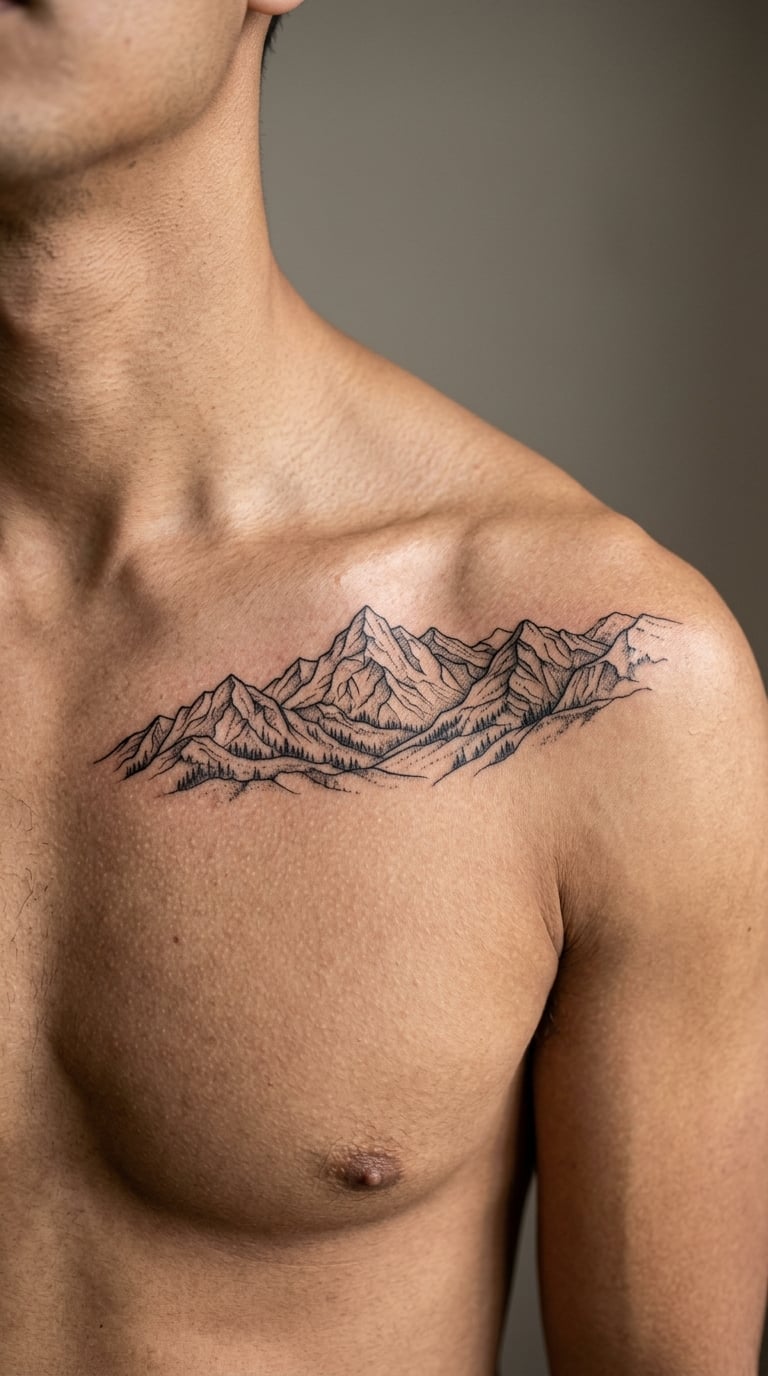
This is a single unbroken line of peaks that starts near the sternum notch, runs along the collarbone, and tips over the top of the shoulder. The line weight stays even, the peaks overlap slightly, and there is almost no shading, so the whole thing is drawn in one confident pass.
Most people choose it for a place they have been to or somewhere they want to get to. The meaning is personal rather than traditional, which is exactly why it works so well as a quiet piece.
Placement: along the collarbone, finishing on the outer shoulder. Size: 7 by 2 inches (18 by 5 cm). Style: fine line. Pain: low to medium, but the collarbone run is the sharp part. Fine-line work on a sun-exposed area softens faster than most people expect, so keep it out of strong sun and expect a touch-up on the faintest peaks. Make it yours: add the coordinates of the summit under the lowest peak in a 3-point style.
Why this range sits high on the list of chest to shoulder tattoo ideas for men
Because it travels the natural line of the body without fighting it. The collarbone already runs diagonally from sternum to shoulder, so the peaks follow an existing edge rather than sitting on flat skin and looking pasted on. It is also the easiest of the 25 to extend later: the same line can keep going down the arm into a half sleeve if you decide you want more ink there in a few years.
2. Traditional Eagle in a Chest Shield
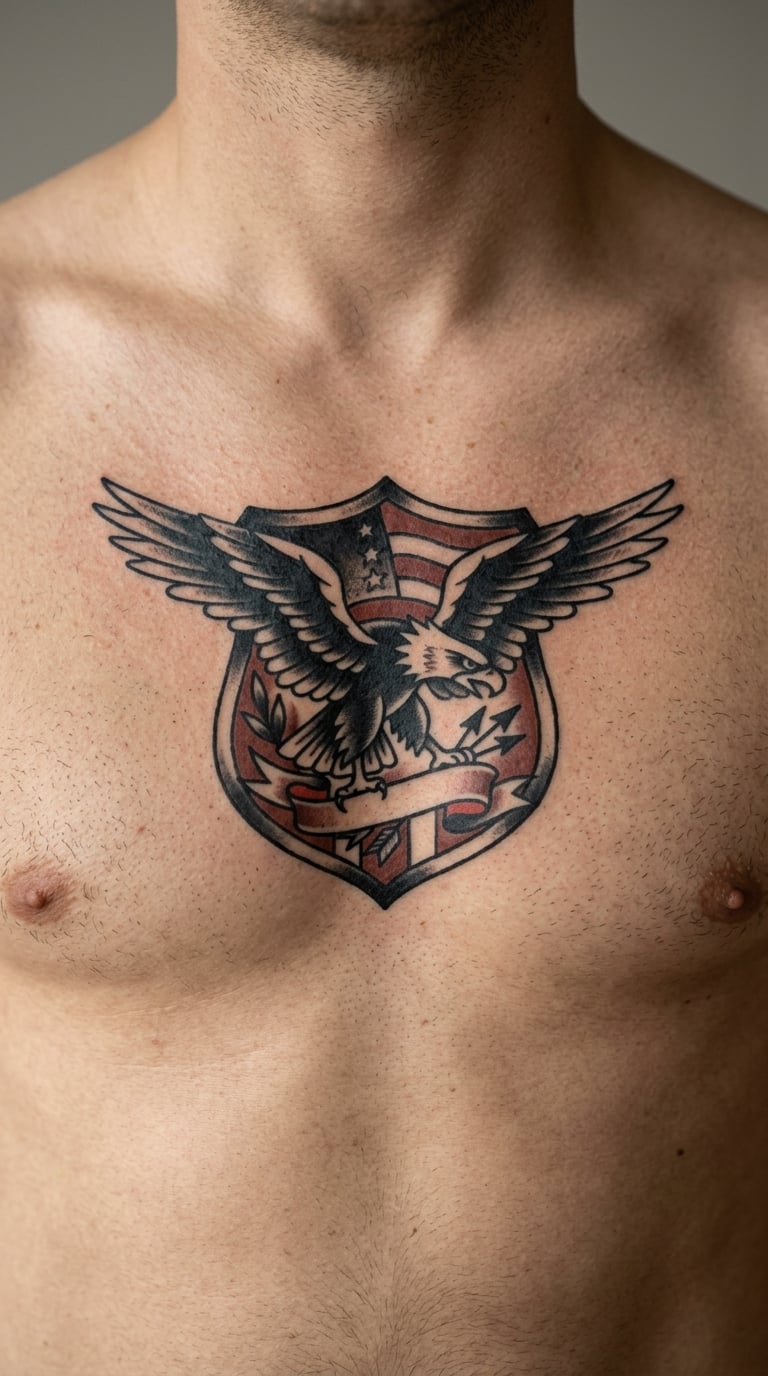
An old-school eagle, wings up and out, drawn with thick black outlines and a shield behind it. The feathers are built from solid black shapes with a small amount of red or gold inside the wings, nothing more. Bold lines age far better than soft realism, and this is the reason traditional pieces still dominate chest tattoos three decades on.
People pick eagles for lots of reasons, and it is not really worth pretending there is one fixed meaning. Service, family, a country, a first letter, or simply because it looks serious.
Placement: centred on the upper chest, shield behind the sternum. Size: 9 by 8 inches (23 by 20 cm). Style: traditional American. Pain: medium to high, because it sits over bone and takes a few hours. Make it yours: put a date inside the shield banner, or add a small banner with a name under the wings.
3. Blackwork Snake Wrapping Toward the Shoulder
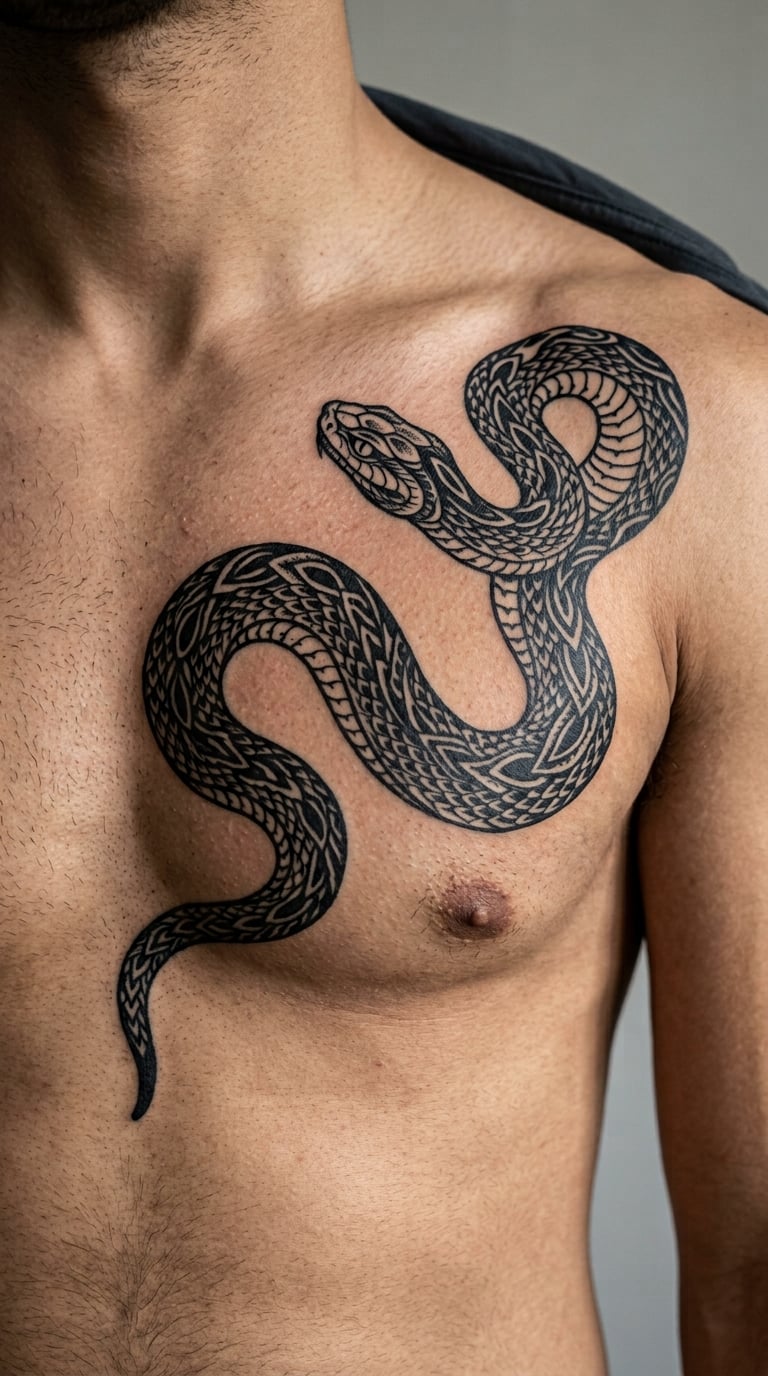
One snake, drawn in solid black, beginning at the sternum and curving over the pectoral before pointing up toward the shoulder. Scales are suggested with negative space and hard-edged highlights rather than grey wash, so the whole thing stays graphic instead of turning soft.
Snakes turn up more than almost any other motif on this list, and the reasons are as personal as they come: change, protection, patience, or just a shape that moves well over a curved body part.
Placement: sternum across the pectoral toward the shoulder. Size: 8 by 3 inches (20 by 8 cm). Style: blackwork. Pain: high, since the collarbone crossing is right on bone. Ageing note: the black stays strong, but fine scale detail in the belly can blur into a solid mass over years. Make it yours: have the tail end in a tight spiral of negative space rather than a fade-out.
4. Neo-Traditional Rose at the Pectoral Edge
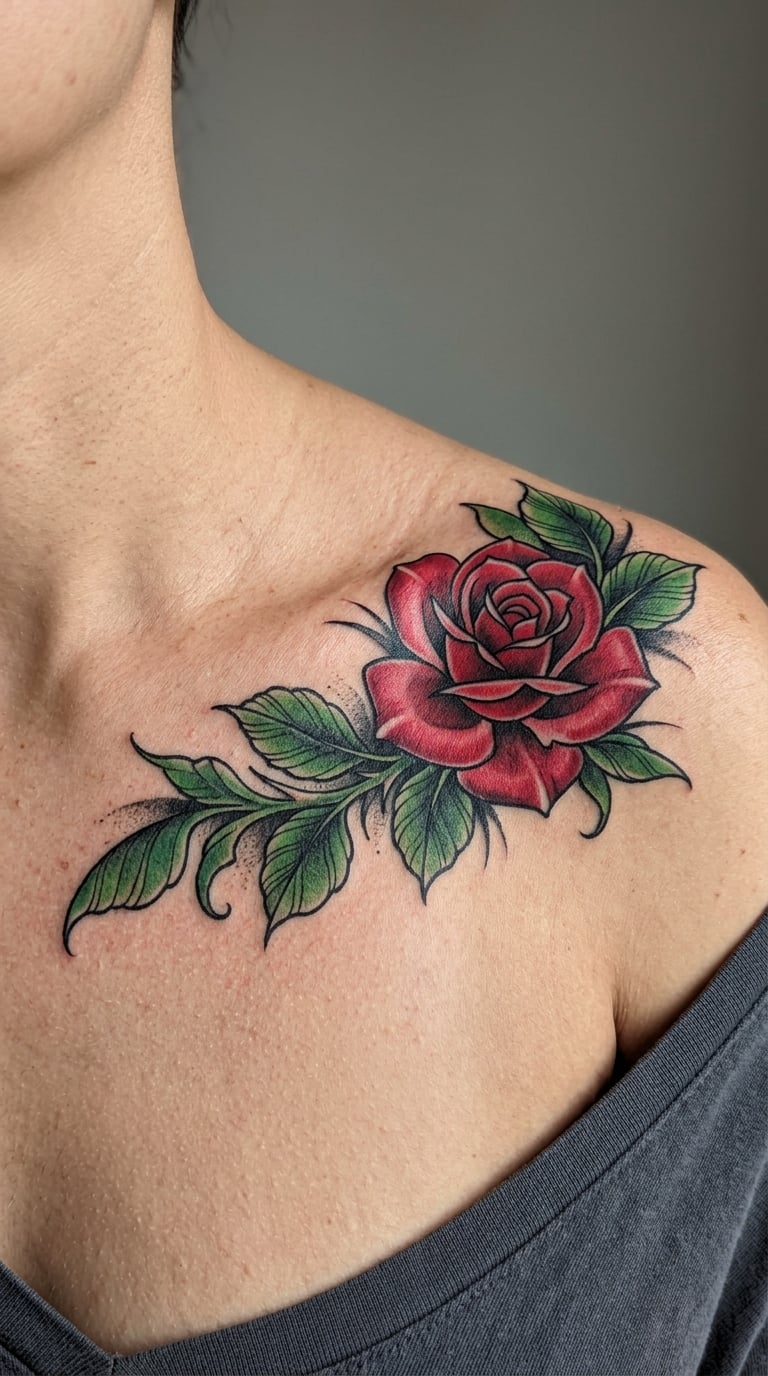
A red rose with two or three green leaves, painted in a modern take on traditional work. Colour is saturated but shaded, with a dark outline holding the shape. Neo-traditional sits between the flat boldness of old school and the shading depth of realism, which gives it more dimension without losing readability at a distance.
There is no fixed meaning attached to a rose, whatever a shop poster says. People choose it for the look of it, or to carry a specific person through a specific colour.
Placement: where the collarbone meets the shoulder, angled slightly. Size: 4 by 3 inches (10 by 8 cm). Style: neo-traditional. Pain: medium. Colour reds and greens hold up well here, though the red can warm-shift toward orange over a decade without sun protection. Make it yours: choose a rose colour that matches a birth flower, or hide a small initial in the leaf veining.
5. Japanese Waves Spilling from Chest to Shoulder
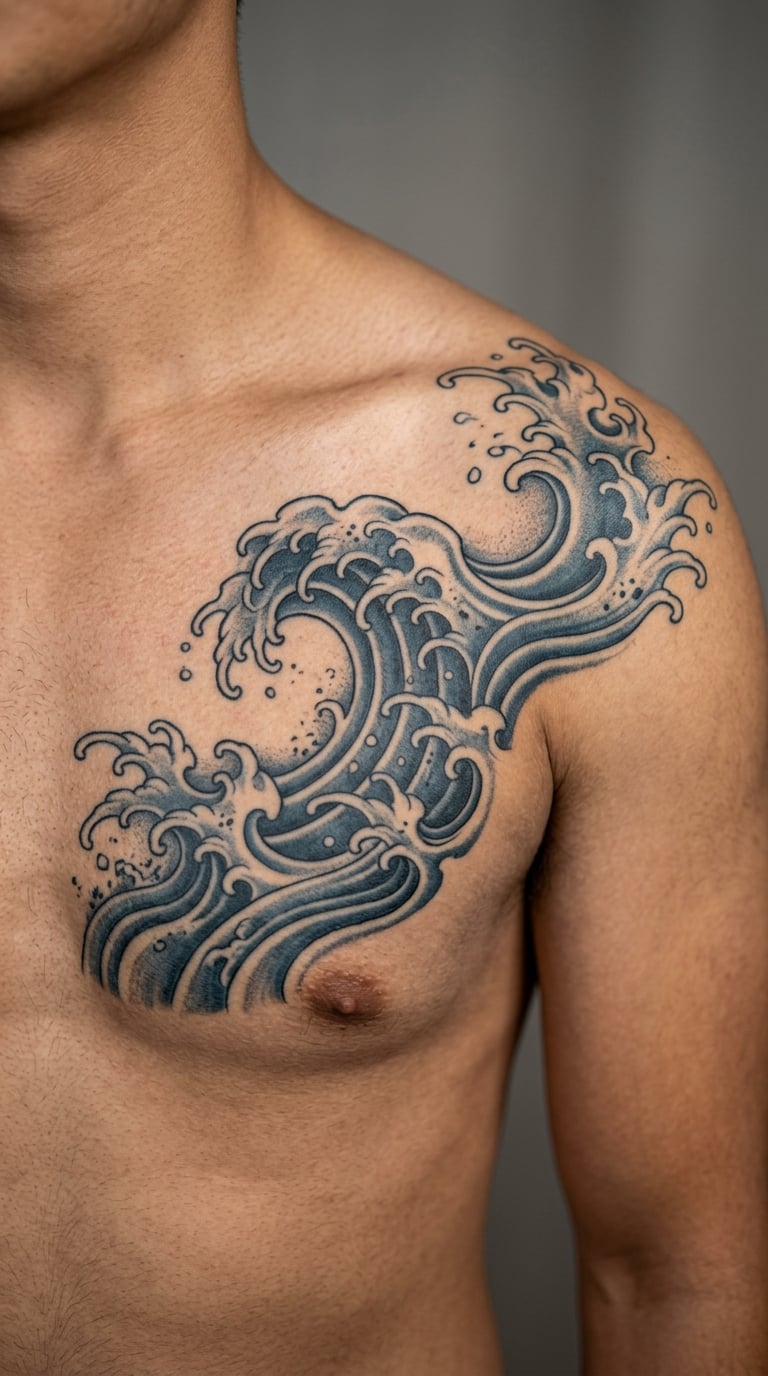
Layered waves built from blue-grey blocks with white foam claws and plenty of open skin between them. The composition starts on the centre of the chest and breaks over the collarbone so the water appears to spill toward the shoulder. Real Japanese and Irezumi-inspired work composes for the body like this, following the flow rather than fighting it.
Water imagery gets chosen for very different reasons, from surf background to a memory of a specific sea, so treat any fixed symbolism you read online with suspicion.
Placement: centre chest over the collarbone toward the shoulder. Size: 10 by 4 inches (25 by 10 cm). Style: Irezumi-inspired illustrative. Pain: medium to high over the collarbone, and a piece this size is usually a multi-hour sitting. Small foam details and light blue fills lose definition first, so ask for a bold value range. Make it yours: add a small coordinate line under the lowest wave in a plain gothic letter.
6. Oversized Compass Rose on the Upper Chest
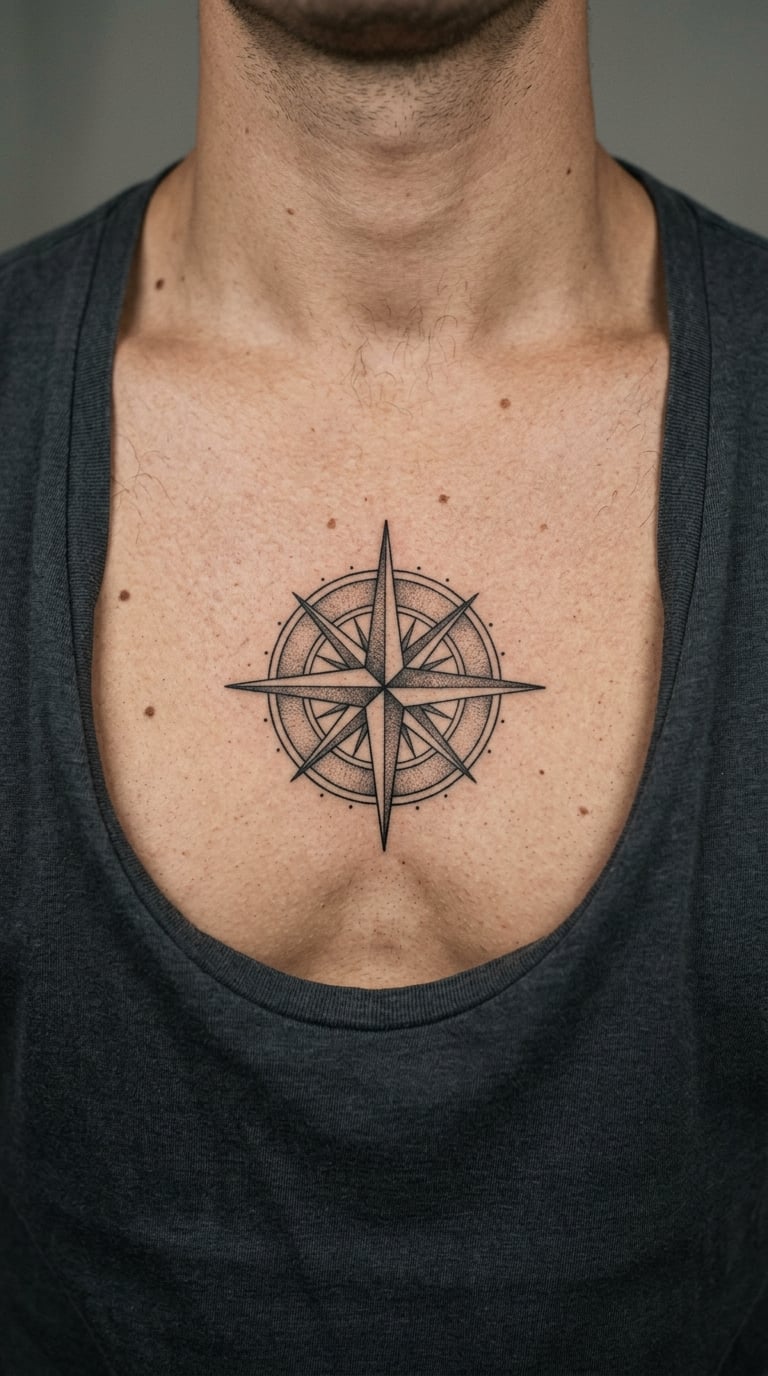
A compass rose with long and short cardinal points, built from clean black lines and light stippled shading between the arms. The gaps between each point do the work, which is what keeps it legible from across a room rather than turning into a black square.
Direction, travel, or a person who pointed you somewhere. Again, no fixed meaning, just a shape that suggests movement.
Placement: centred on the upper chest between the pecs. Size: 7 by 7 inches (18 by 18 cm). Style: black and grey realism. Pain: medium, more from length than sharpness, since most of the work sits over muscle. Make it yours: replace the north point with a real bearing and date from a trip that mattered.
7. Minimalist Arrow Reaching for the Shoulder
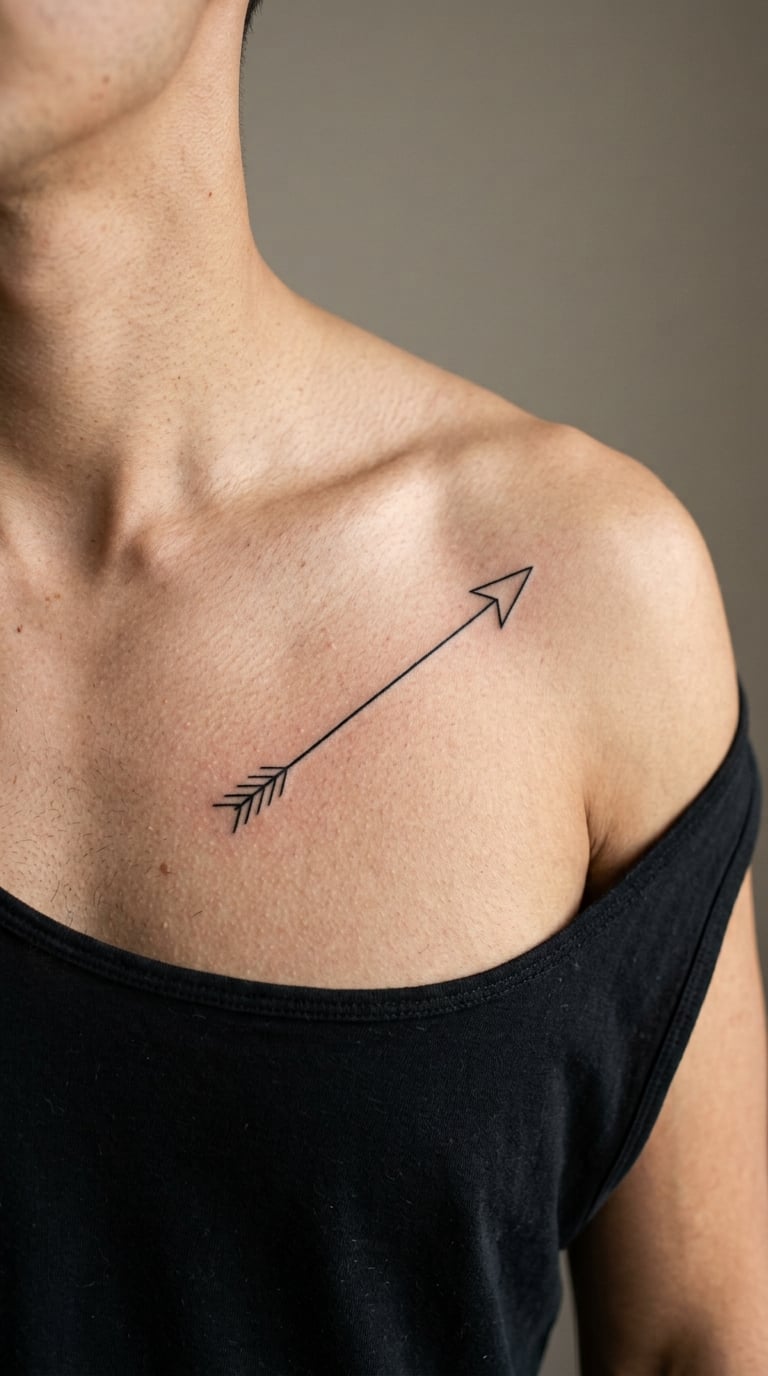
One arrow, one line weight, a small arrowhead at the end. It starts near the sternum and points up toward the shoulder, and the empty skin around it does most of the work. This is the design I would put in front of someone getting their first chest piece, because it is quick, it hides easily and it teaches you how the skin moves without committing you to a large commitment.
Momentum, direction, moving forward, aiming at something. People describe it in their own words every time.
Placement: diagonal from the centre of the chest toward the shoulder. Size: 5 by 1 inch (13 by 3 cm). Style: fine line and minimalist. Pain: low to medium, usually a short session. A single fine line on the chest is a fair bit more vulnerable to sun fade than people expect. Make it yours: add a short date under the shaft in a fine hand, or add a second thinner arrow running parallel.
8. Blackwork Lion Profile on One Pectoral
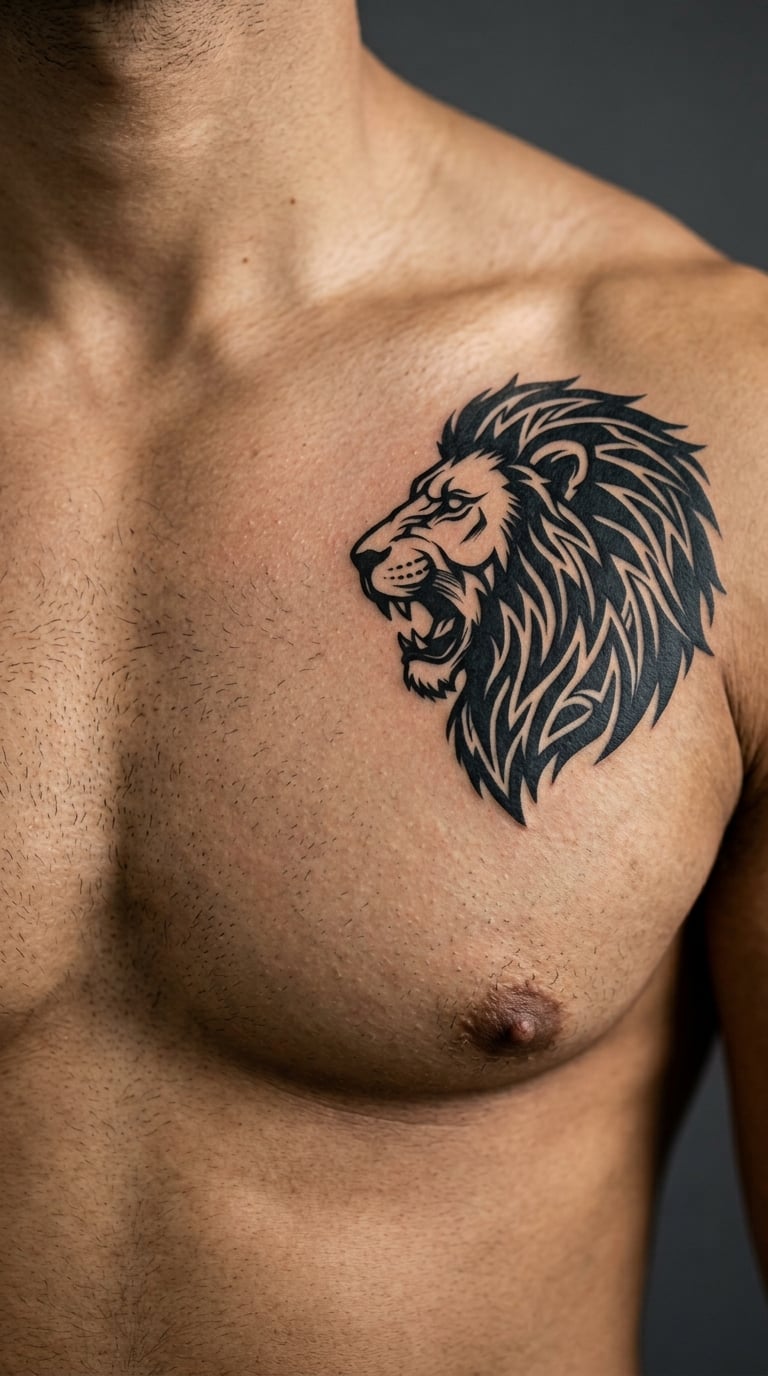
A lion in side profile, built from solid black masses with the mane cut out in sharp negative space. There is no background and no colour, which is what lets the piece sit on a curved pectoral without looking crowded. The eye and the muzzle are the only detailed areas, so those get the most ink and the most attention.
Strength, courage, stubbornness, a family crest. People attach their own reason and the design is happy to carry all of them.
Placement: outer pectoral, angled so the muzzle points toward the shoulder. Size: 6 by 5 inches (15 by 13 cm). Style: blackwork. Pain: medium. Blackwork goes in fast and stays legible, but heavy saturation on a flat area like the outer chest can spread at the edges over time. Make it yours: add a small matching paw print on the opposite pec, or a crescent moon inside the negative space behind the mane.
9. Botanical Vine From Collarbone to Shoulder
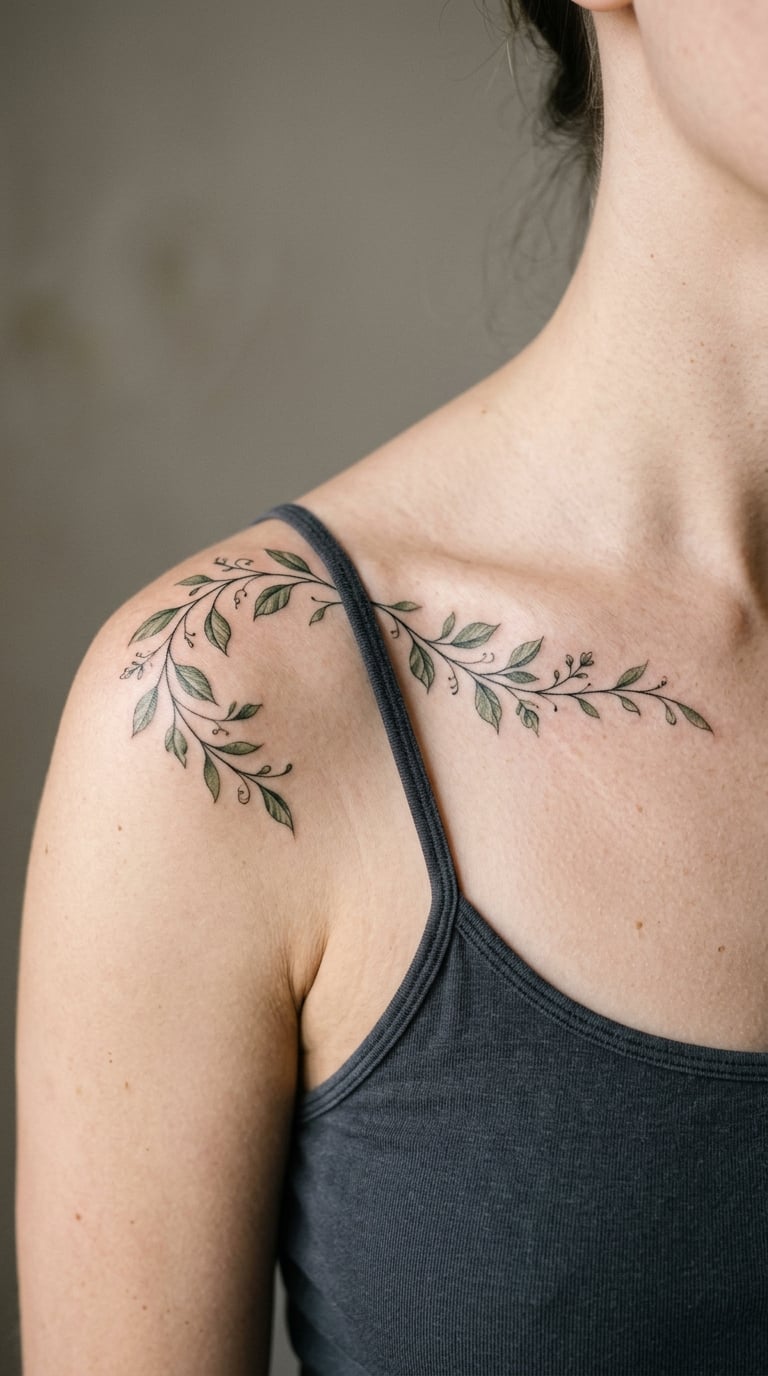
A long, thin stem with leaves alternating along it, following the collarbone before curling onto the shoulder. Line work is illustrative rather than strictly botanical, and a few leaves carry muted green while the stem stays black. That mix keeps it from looking like a sticker.
Plants can be picked for a species that means something to the wearer, or for the growth idea, which is one of the most common reasons people bring this one in.
Placement: along the collarbone, turning up onto the shoulder. Size: 7 by 2 inches (18 by 5 cm). Style: fine-line illustrative. Pain: medium, and it takes longer than you would think because of all the little turns. Make it yours: name the actual species you want rather than asking for generic leaves, and let the leaves thin out toward the shoulder so the wrap reads smoothly.
10. Traditional Anchor with Rope
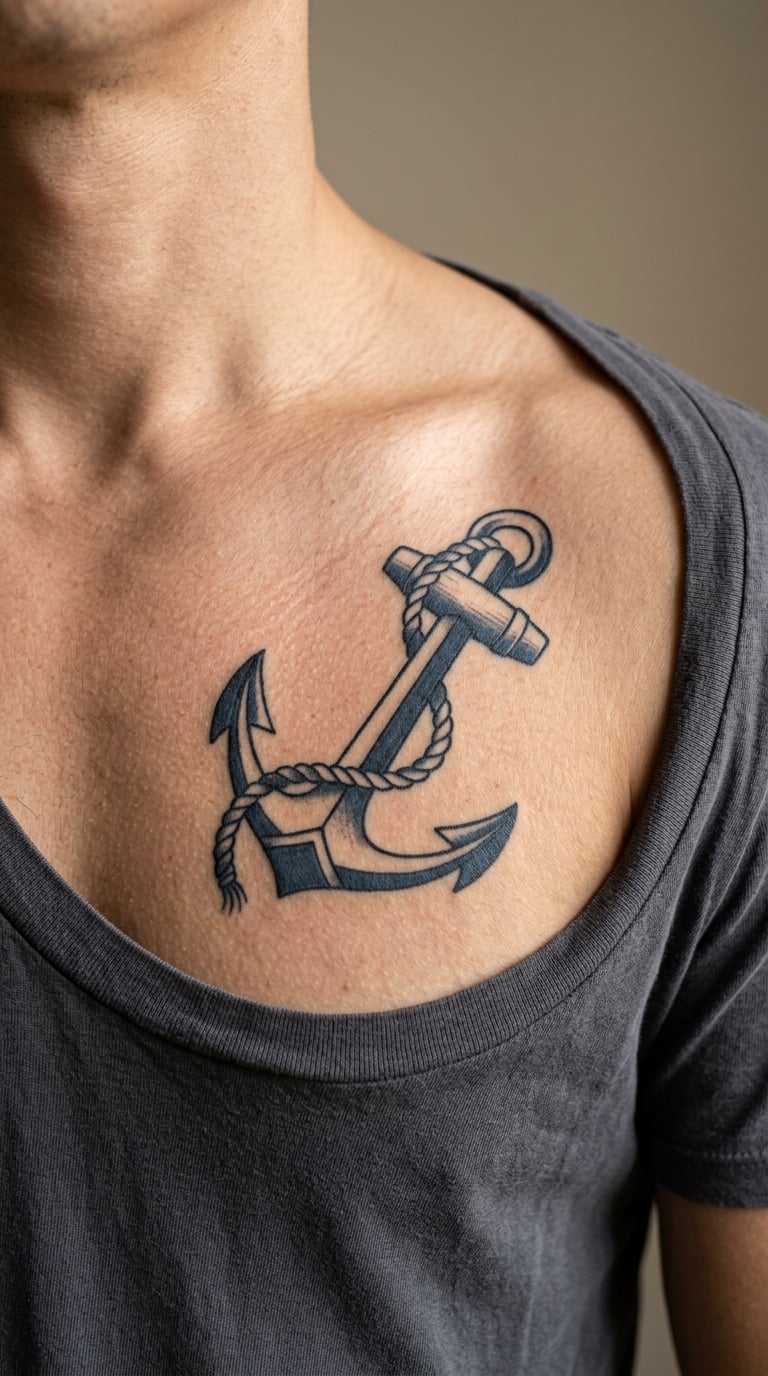
A vintage-style anchor wrapped in rope, drawn with heavy black outlines and a muted navy fill. The shank and the ring are the bold parts, the rope is where the detail sits. Placing it diagonally lets the design follow the chest-to-shoulder line instead of standing straight up in the middle of the chest.
Maritime work is usually a family or service thing, sometimes just an affinity for the sea. Plenty of people just like the shape.
Placement: diagonal across the upper chest. Size: 6 by 4 inches (15 by 10 cm). Style: traditional American. Pain: medium to high when the line crosses the collarbone. Make it yours: add coordinates, a date, or a small initial in the rope coil at the base.
11. Dotwork Constellation Flowing Over the Collarbone
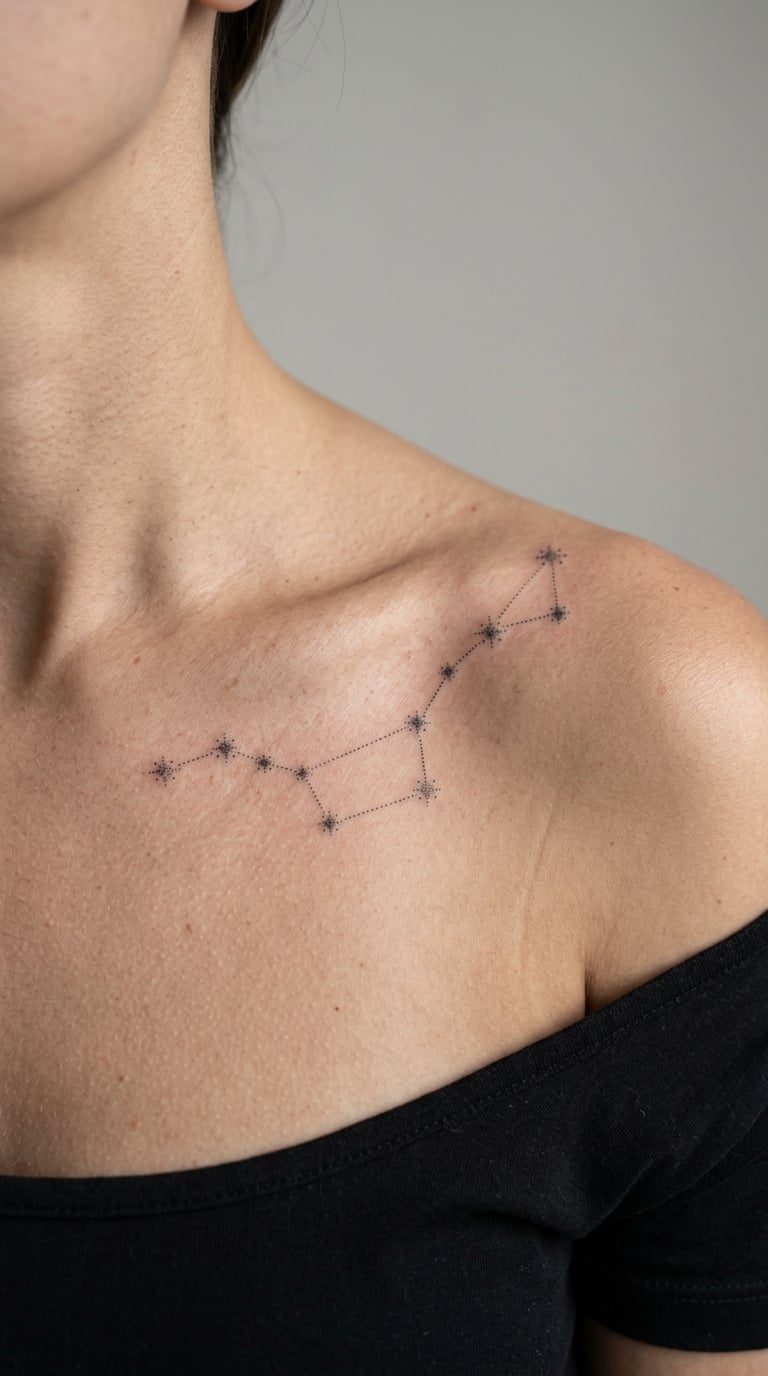
A star map drawn in tiny dots of varied density, joined by hairline lines, laid out along the collarbone toward the shoulder. Dot sizes change to suggest brightness, so a real sky map looks convincing without a single outline.
Most people use a sky map for a date or a place that mattered to them. That is the whole reason it works.
Placement: collarbone running to the shoulder. Size: 6 by 2 inches (15 by 5 cm). Style: dotwork. Pain: medium. The honest ageing note: single dots and hairline connectors are the first thing to soften on the upper body, so expect a lightening after a few summers and a possible top-up. Make it yours: use the real coordinates of the sky above a place, or add one brighter dot in a different colour for a person who was there.
12. Sailing Ship with a Windblown Sea
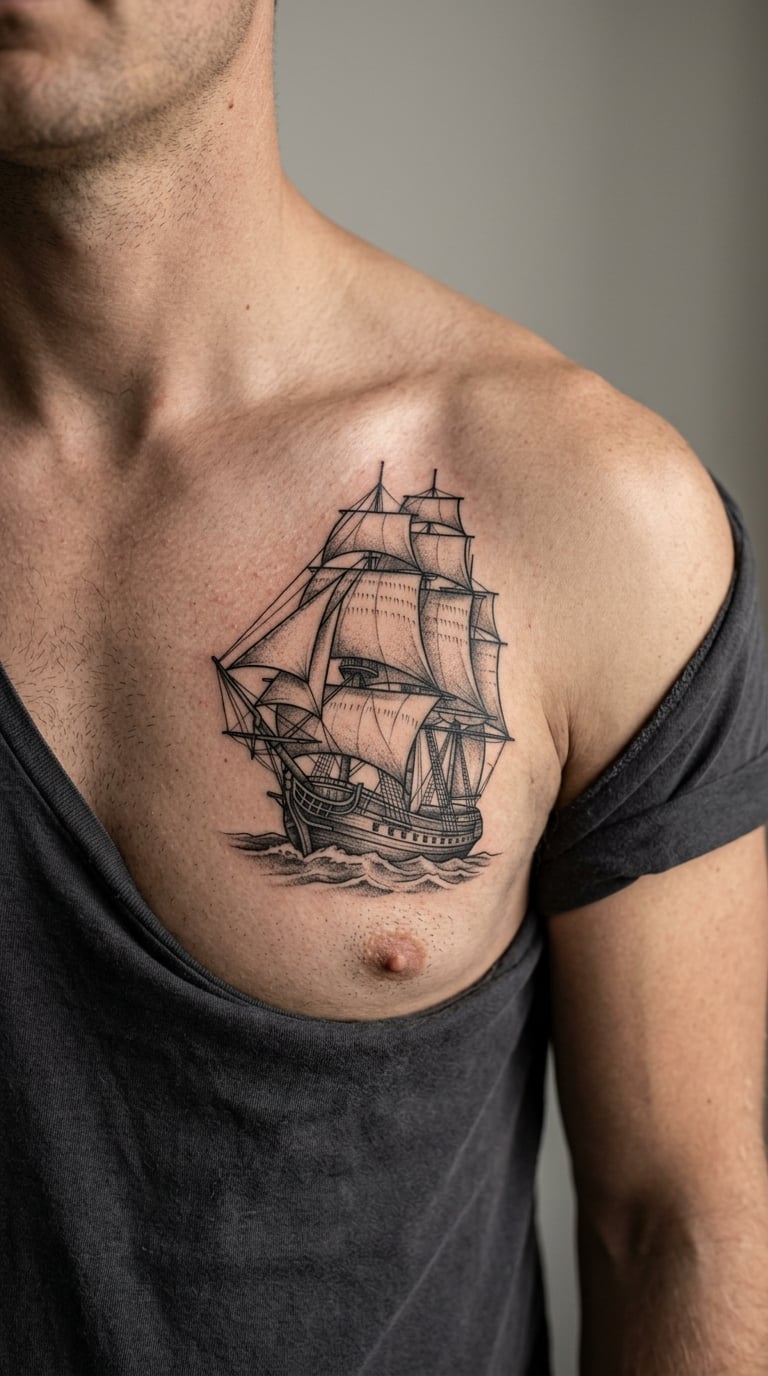
A single sailing ship in black-and-grey realism, sails filled, sitting above a short wave base. The mast rises toward the collarbone and the hull points down toward the pec, so the composition uses the height of the chest instead of spreading sideways. The wave base is kept small on purpose, because this is a chest piece, not a sleeve.
Voyage, a family that sailed, a coast that means something. As always, the personal reason beats any dictionary reading.
Placement: upper chest angled toward the shoulder. Size: 9 by 5 inches (23 by 13 cm). Style: micro-realism. Pain: medium to high, mostly a length problem. Fine rigging lines are the parts that will blur first, so ask the artist to thicken anything under a millimetre. Make it yours: name the ship and the sea it crossed, and let the artist letter it small under the hull.
13. Oversized Wing Sweeping Onto the Shoulder
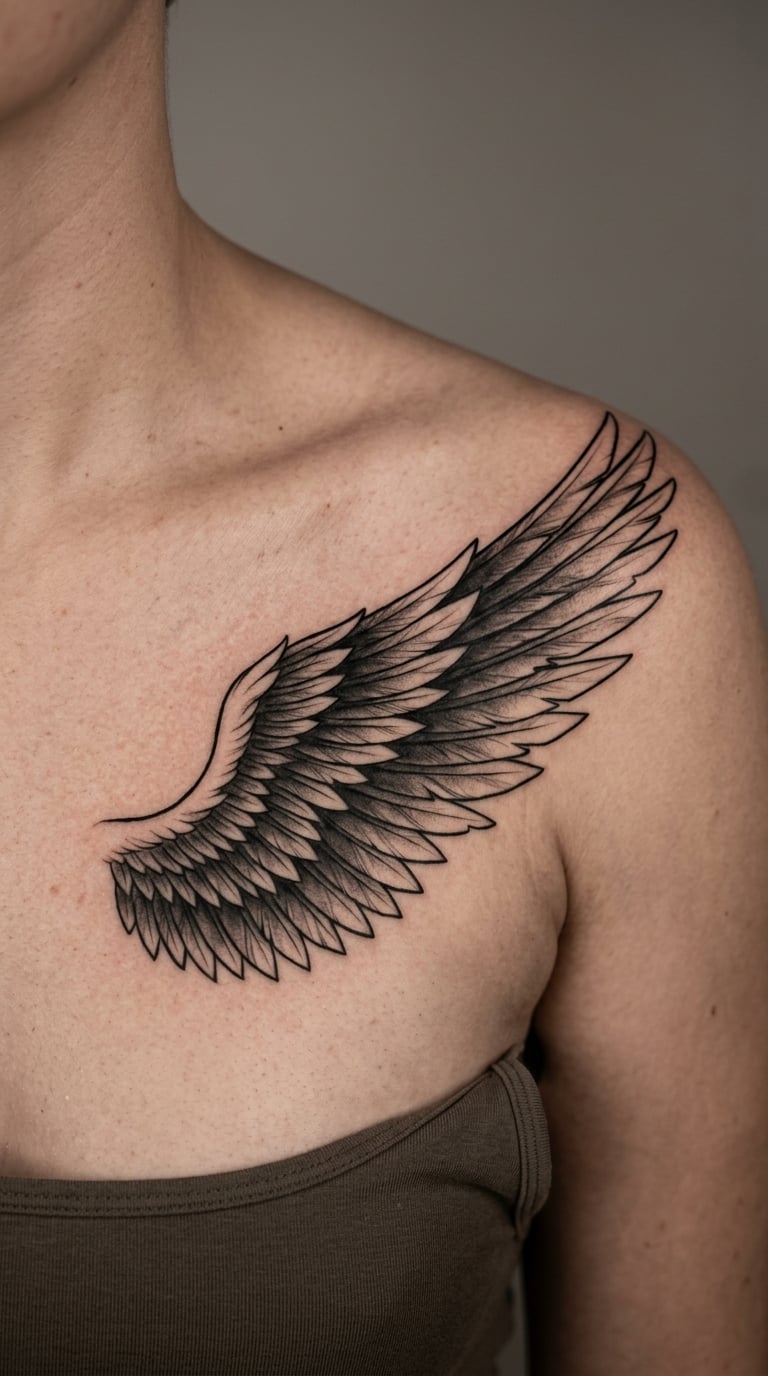
A feathered wing built from layered black-and-grey shapes, starting at the upper chest and sweeping across the deltoid so the feathers lengthen and lift as they pass the shoulder joint. Designed around the anatomy, it reads as one wing rather than a picture sitting on a shoulder.
Wings get chosen for a lot of reasons, some of them private. Leave it alone in the shop and let it stay yours.
Placement: upper chest over the shoulder into the deltoid. Size: 10 by 5 inches (25 by 13 cm). Style: illustrative blackwork. Pain: high. This is a big commitment, usually split over two sessions, and the shoulder cap is one of the more sensitive areas. Layered grey feathering softens into a grey mass without periodic touch-ups. Make it yours: add one accent colour in a single row of feathers, or mirror a smaller wing on the other side later.
14. Celtic Knot Panel at the Shoulder Line
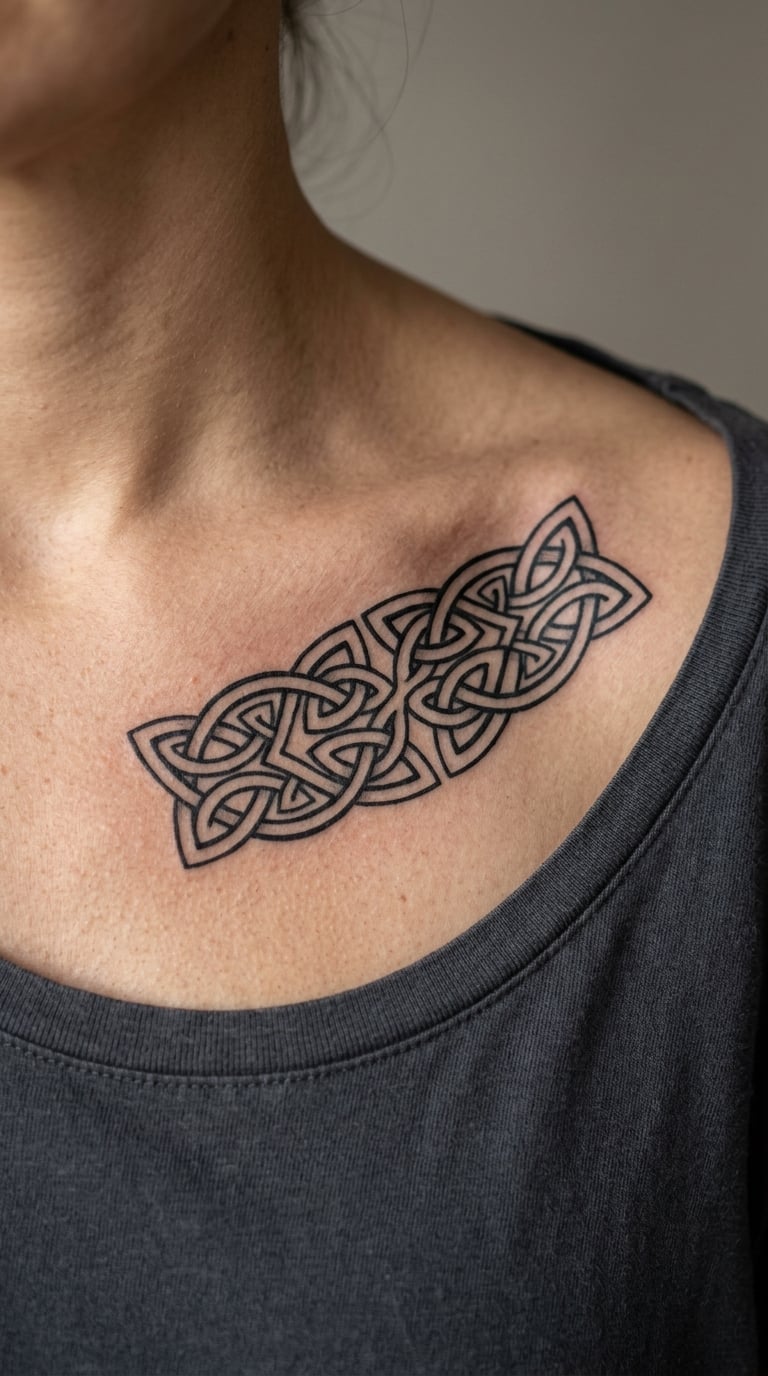
A compact interlaced knot panel with even line weight throughout and clearly separated openings so the crossings actually read. One continuous ribbon loops over and under itself, and the gaps between strands are kept wide enough to survive healing.
Knotwork is often inherited rather than chosen from a menu, sometimes tied to a family, region or heritage. Check the pattern’s background yourself before it goes on permanently.
Placement: along the collarbone and upper chest. Size: 5 by 3 inches (13 by 8 cm). Style: blackwork knotwork. Pain: medium. Every strand is a line pass, so a panel this size runs long relative to its area. Make it yours: add a related date or a second smaller knot in a different pattern on the opposite side.
15. Micro-Realism Wolf Profile Reaching the Shoulder
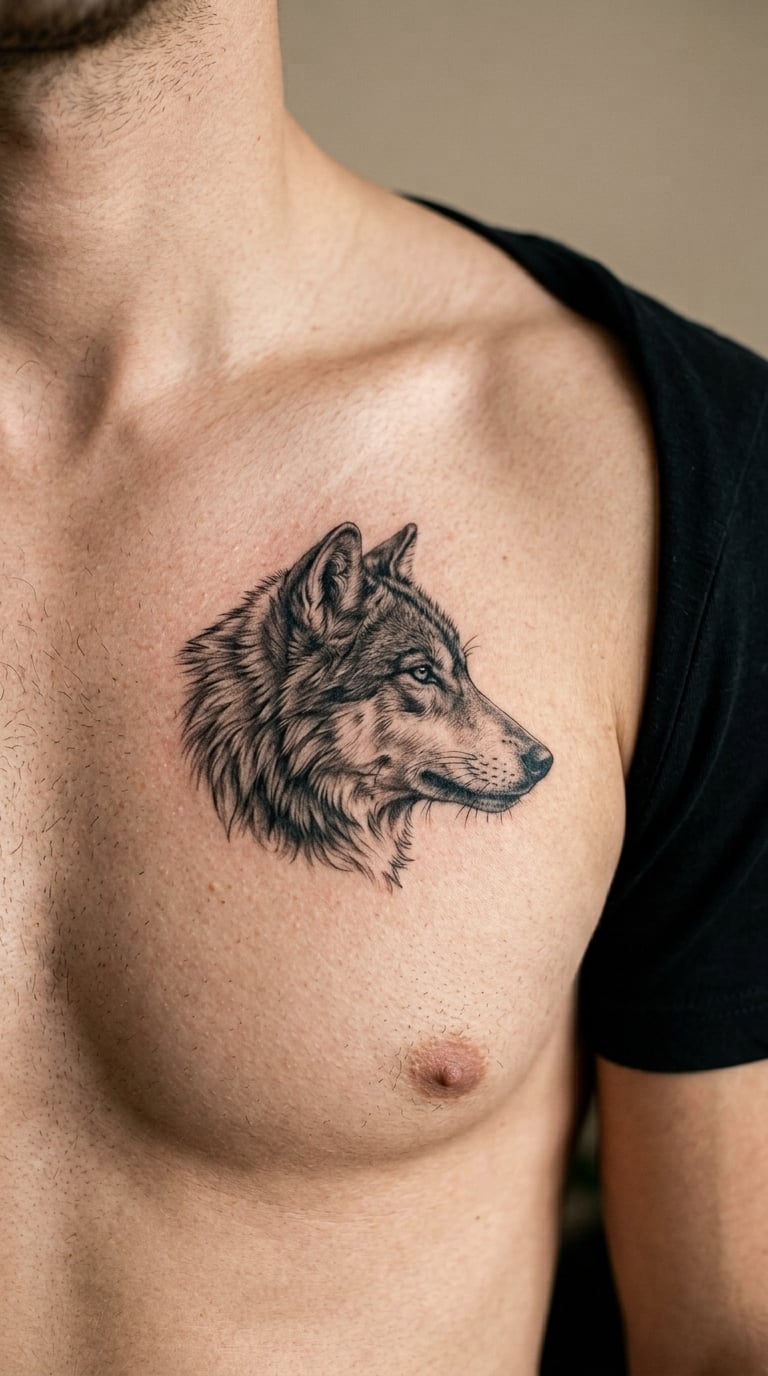
A wolf in profile with textured fur, built from short directional strokes rather than smooth gradients, and one clear focal feature, usually the eye. Restraint is the point here: a busy animal portrait at this size turns to grey mush, while a single subject with a sharp eye holds up for years.
Loyalty, family, wildness, a particular wolf from a documentary someone watched at the wrong age. Personal, always.
Placement: outer chest near the shoulder, angled so the snout points up. Size: 3 by 3 inches (8 by 8 cm). Style: micro-realism. Pain: medium. Small does not mean quick, since fine texture work is slow. Make it yours: pair it later with a matching animal portrait on the arm, and have the artist match the fur stroke direction across both pieces.
16. Red Ink Phoenix Rising Across the Pectoral
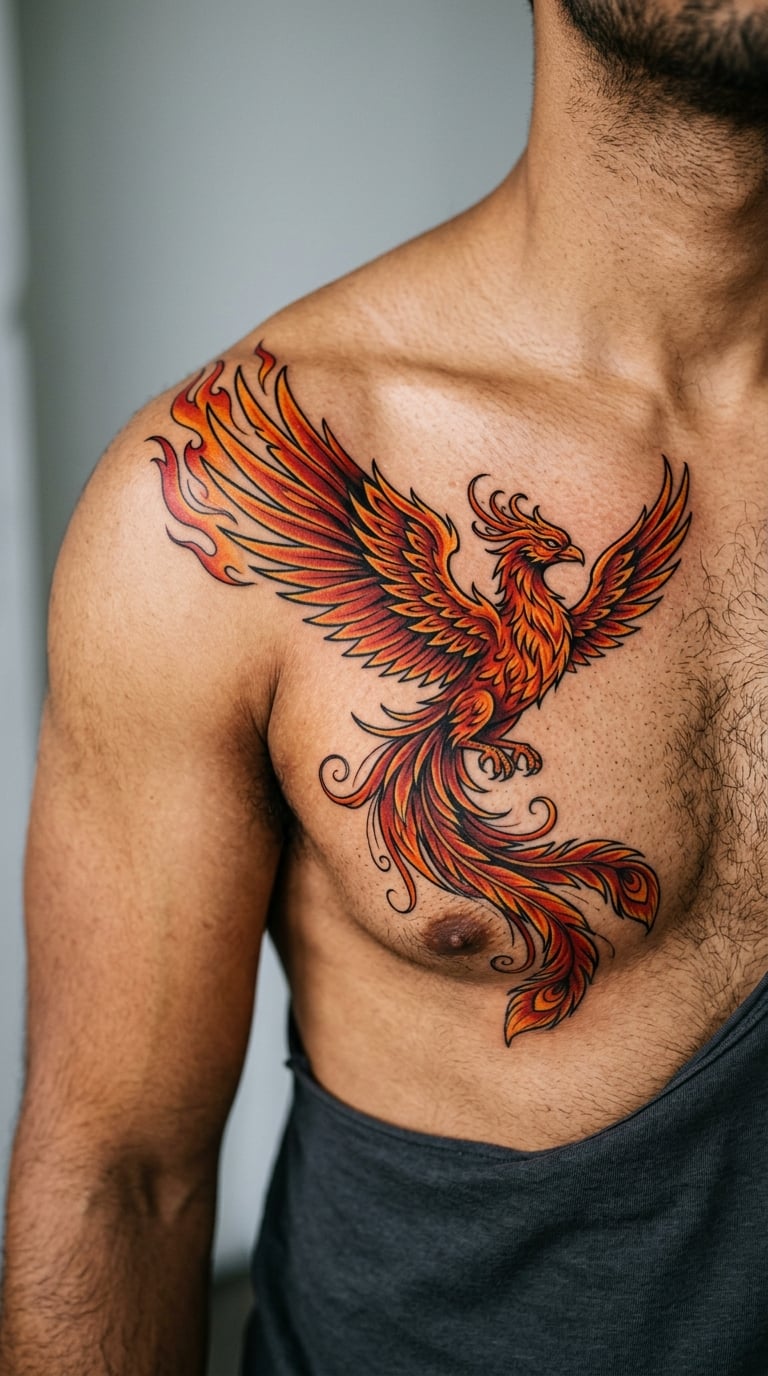
A stylised phoenix built from flowing red-orange feathers and sharp negative space, rising diagonally from the lower chest toward the shoulder. The outlines are black and confident, the colour work is loose enough to read as feathers rather than a flame. The negative space between the tail feathers is what stops it looking crowded.
Rebirth and change come up constantly, usually after something specific in someone’s life. It is a personal reading of the bird, not a rule.
Placement: diagonal across the pectoral toward the shoulder. Size: 9 by 5 inches (23 by 13 cm). Style: illustrative colour. Pain: medium. Warm reds and oranges fade first, so plan on a colour refresh every few years if you want it bright. Make it yours: add a small yellow or gold accent in the crest, or hide a date inside the tail feathers.
17. Minimalist Heartbeat and ECG Line
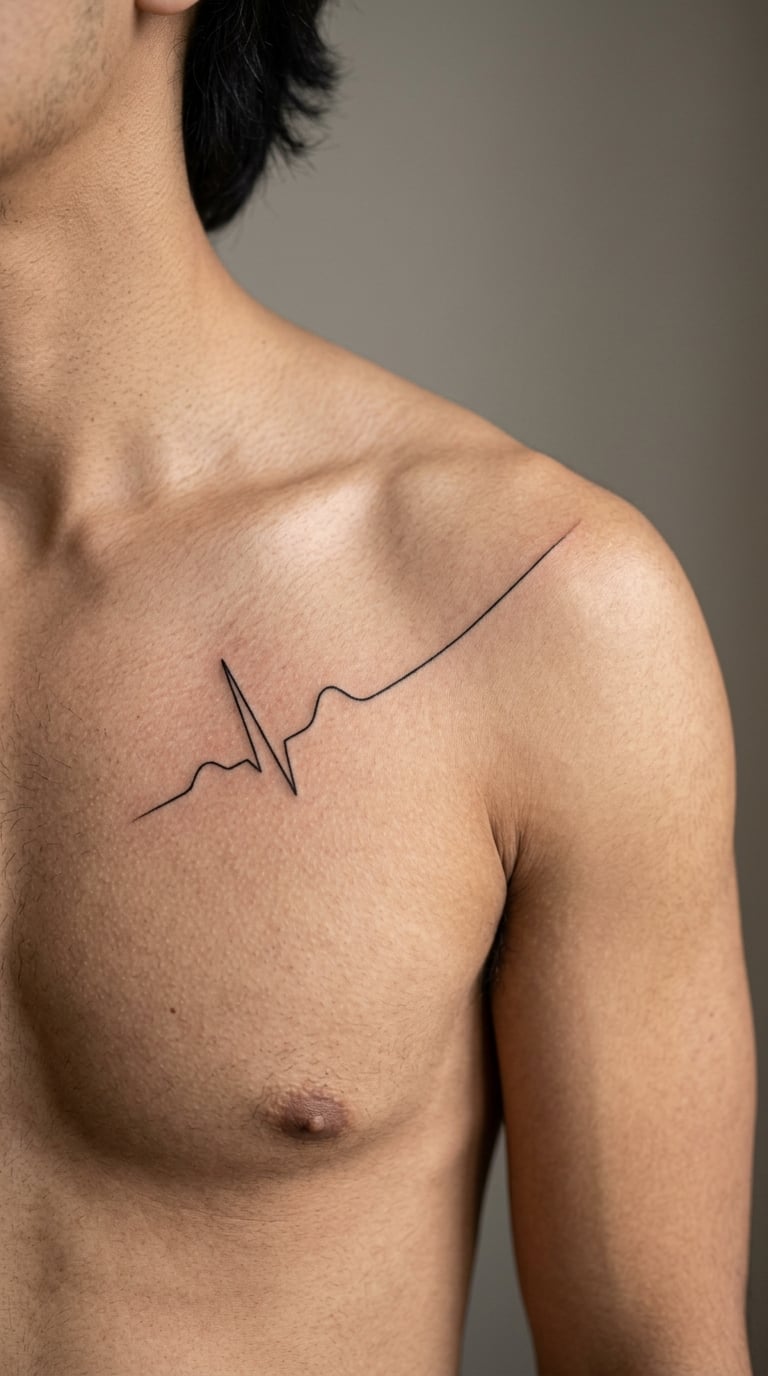
A clean ECG-style line, a short run of peaks rather than a full rhythm strip, starting over the heart and running toward the shoulder. The spacing is even, the peaks are geometric, and there is no text unless you want some.
It usually marks a person, an event or a period of time. Some people get it after a medical scare, some after recovering from one.
Placement: over the heart extending to the shoulder. Size: 6 by 1 inch (15 by 3 cm). Style: fine line. Pain: low to medium and quick. This is one of the designs that looks almost too simple on paper and surprisingly good in person. Make it yours: use the peaks from a real reading, or add a name and date in a small hand at the end of the line.
18. Traditional Bull Head in Deep Red and Black
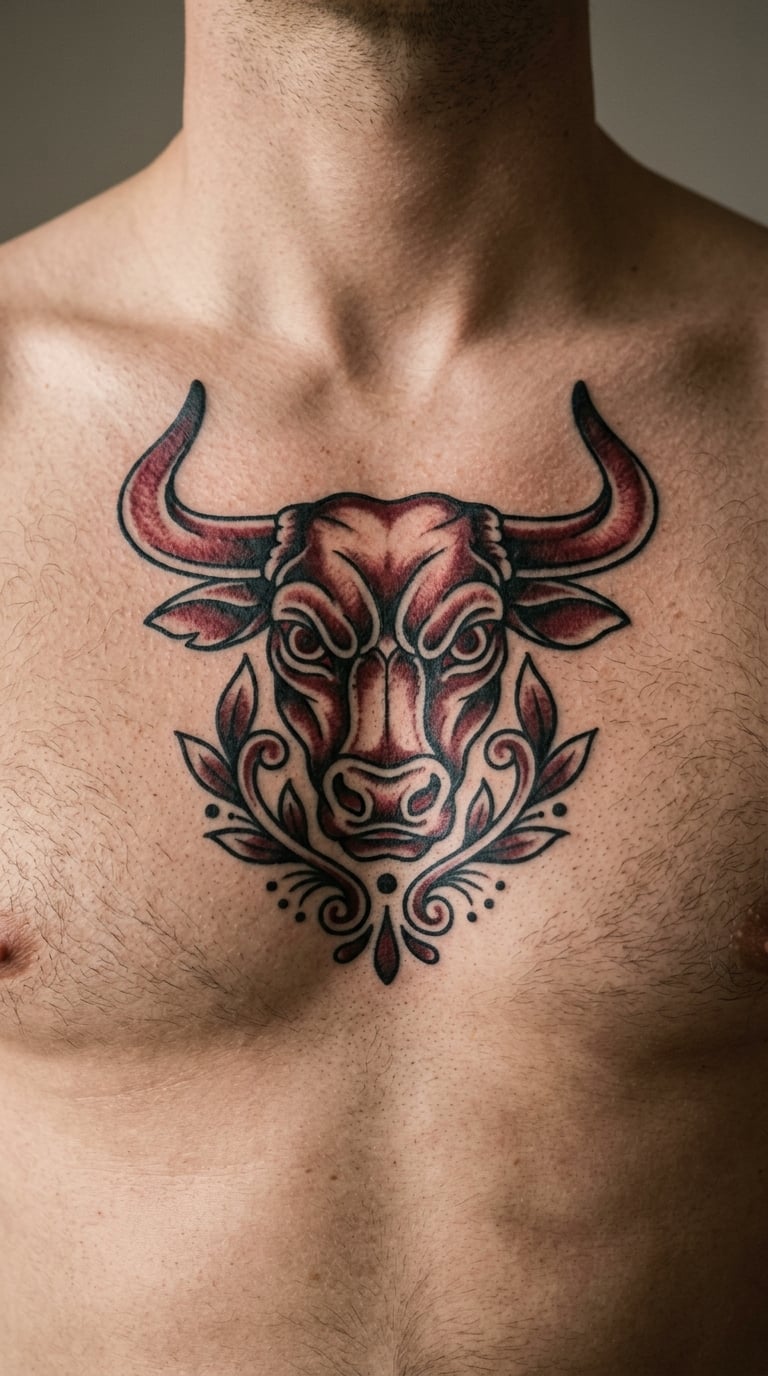
A bull head with heavy black outlines, deep red shadow across the face and restrained white highlights in the eyes. The horns are positioned to frame the upper chest, which is the part of this design that makes it work as a chest piece rather than a sticker in the middle of you.
Strength, determination, a zodiac sign, a team. Pick the one that is actually yours and ignore the rest.
Placement: broad and centred on the upper chest. Size: 7 by 6 inches (18 by 15 cm). Style: traditional American. Pain: medium, a steady burn rather than spikes. Make it yours: alter the horn detail, or keep the piece entirely in black and grey for a harder look that will not need colour work later.
19. Geometric Mountain Peak in Blackwork
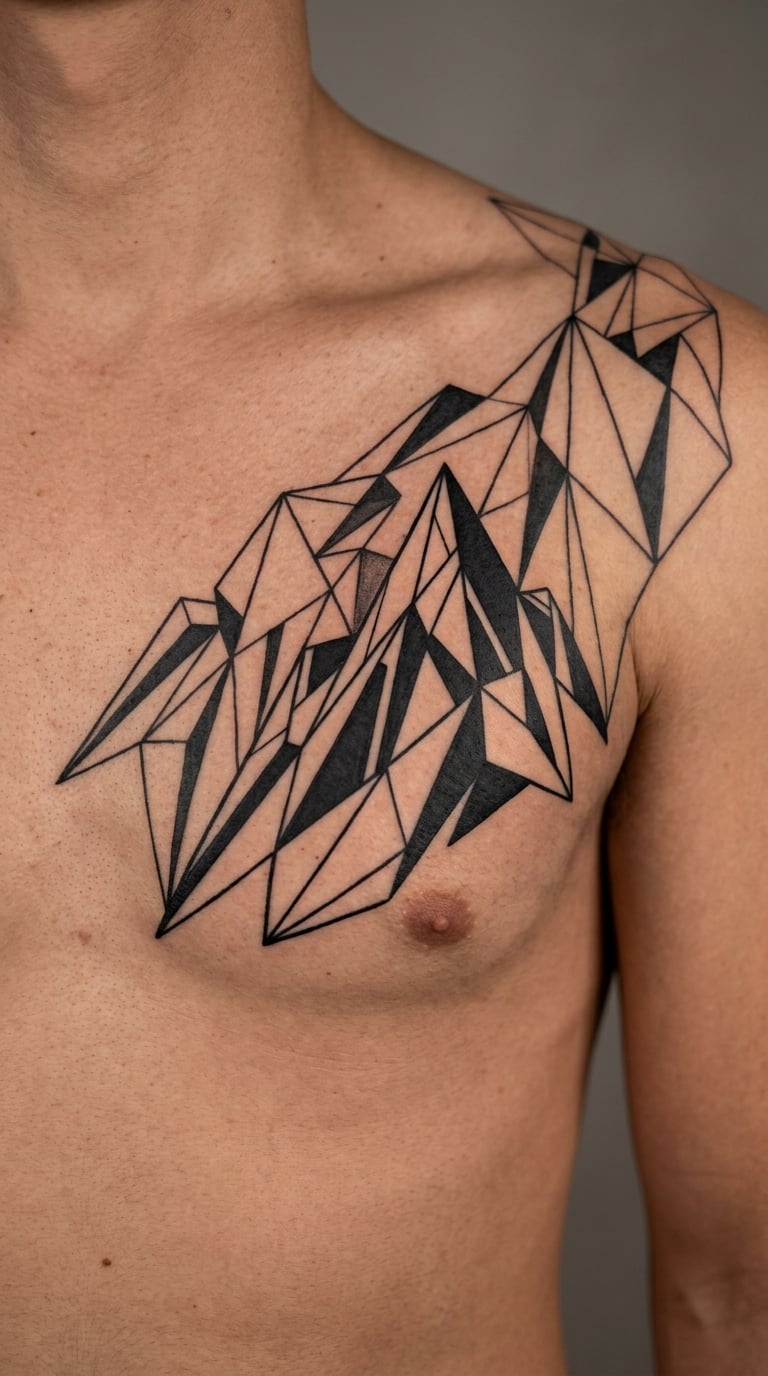
An abstract mountain built from angular black planes with a few white gaps cutting through them, stretching from the sternum toward one shoulder. It is a view rendered the way a logo is, hard edges and no atmospheric haze, and the gaps are placed so the whole thing breathes.
Usually a favourite place, or a challenge someone wanted to record. The geometry is what carries it visually, not the reference.
Placement: sternum toward one shoulder. Size: 8 by 4 inches (20 by 10 cm). Style: geometric blackwork. Pain: medium. Large flat black fills in this area can creep at the edges as skin relaxes over time, so ask for a slightly firmer line than feels necessary. Make it yours: use the actual coordinates of the place, or change one peak line so the design is yours rather than a copy.
20. Small Lightning Bolt Crossing the Collarbone
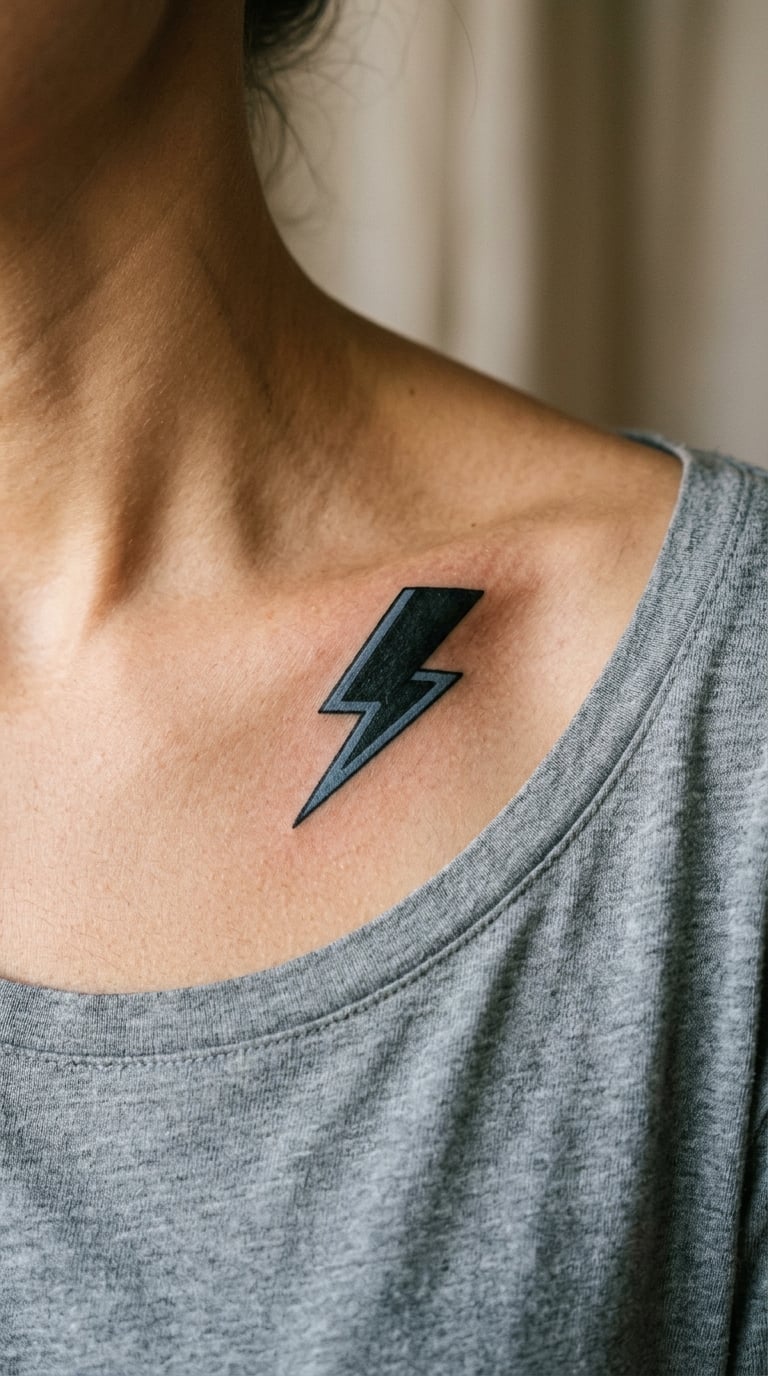
A small bolt with sharp angles, solid black, sitting at a diagonal across the collarbone. No gradients, no clouds, no background. The angle is the design: straight up reads as an afterthought, diagonal reads as deliberate.
Energy, change, a quick decision. Plenty of people just like the shape and cannot explain it, which is fine.
Placement: angled across the collarbone. Size: 2 by 1 inch (5 by 3 cm). Style: minimal and illustrative. Pain: medium, short session, sharp while it is going in. A small solid shape holds its edge well, which makes it a good candidate for a first piece. Make it yours: run a muted blue down one edge as a split-colour treatment, or add a matching bolt on the other collarbone at a different scale.
21. Traditional Rose and Dagger Collarbone Piece
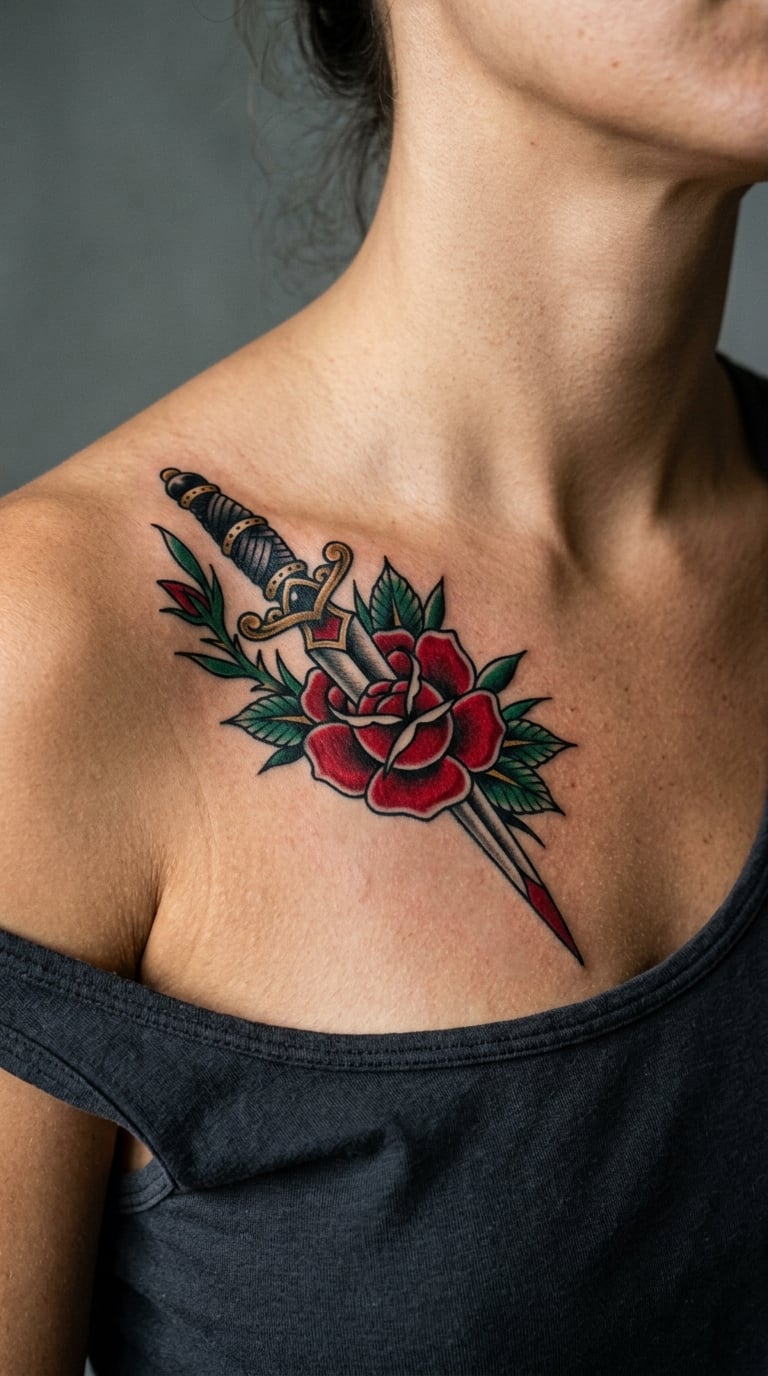
A dagger driven through a red rose, laid horizontally along the collarbone so the blade runs toward the shoulder and the bloom sits closer to the sternum. Bold black outlines, saturated red, green leaves kept to one side so the composition does not get busy. Old-school pieces like this have been drawn for decades, which is exactly why they hold up.
The pairing is often chosen for how it looks, and sometimes for what the two things mean to the wearer. Neither reason is better than the other.
Placement: along the collarbone. Size: 6 by 2 inches (15 by 5 cm). Style: traditional American. Pain: high, since almost the whole design runs over the collarbone. A piece this size also fights side-sleeping for a couple of weeks. Make it yours: shift the colour toward a personal red, or add a small initial on the dagger handle.
22. Dotwork Phoenix Feather at the Shoulder
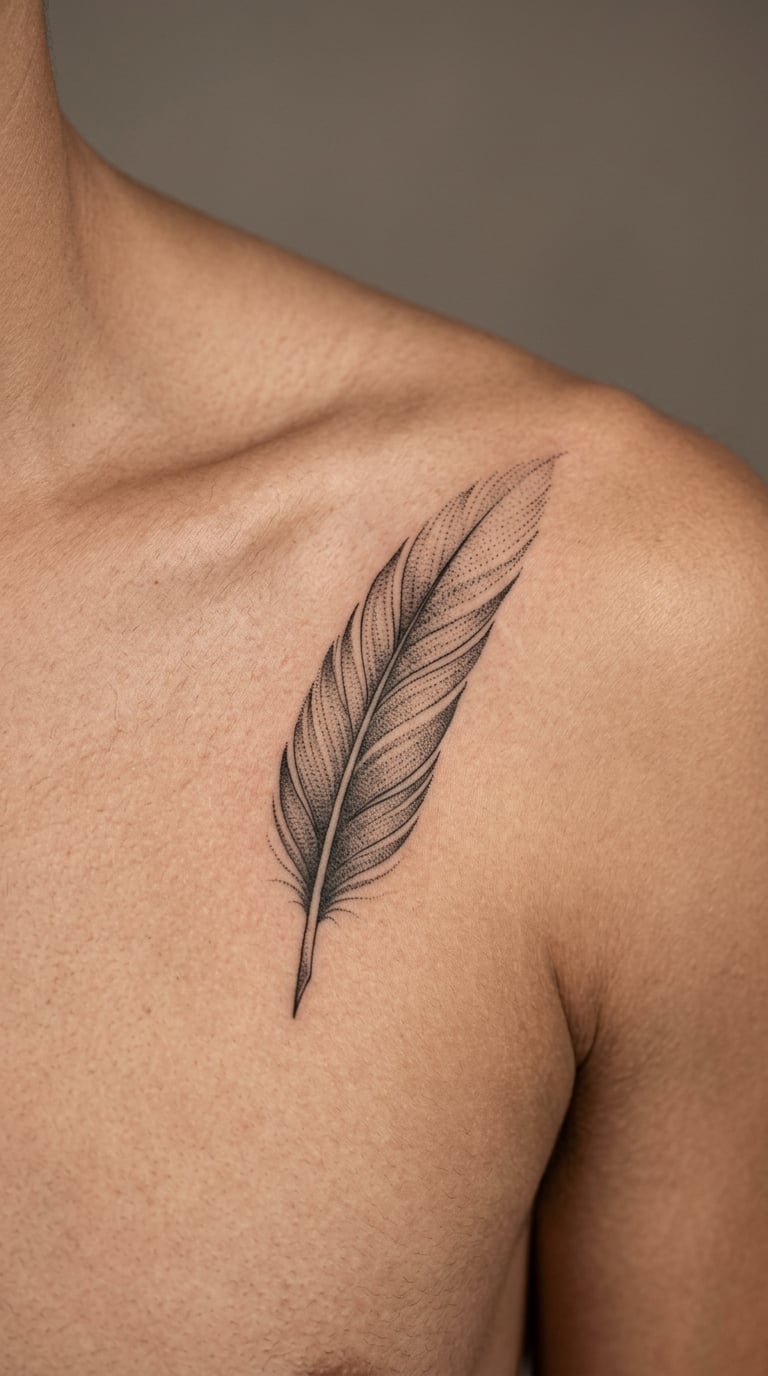
One elongated feather built from graduated dots, dense at the quill and fading to nothing at the tip, with fine barbs suggested by rows of dots rather than drawn lines. It is the lighter alternative to a full bird, and it works well as a first piece on this part of the body.
Choosing a specific bird usually means something, whether that is a bird connected to someone or a bird that simply means what the wearer needs it to mean.
Placement: between the collarbone and the shoulder. Size: 4 by 2 inches (10 by 5 cm). Style: dotwork. Pain: medium, and dotwork takes its time. Make it yours: use one colour of dot in the first third of the feather so it reads as deliberate rather than a printing error, or add a small date at the quill end.
23. Blackwork Sunburst Wrapping the Upper Chest
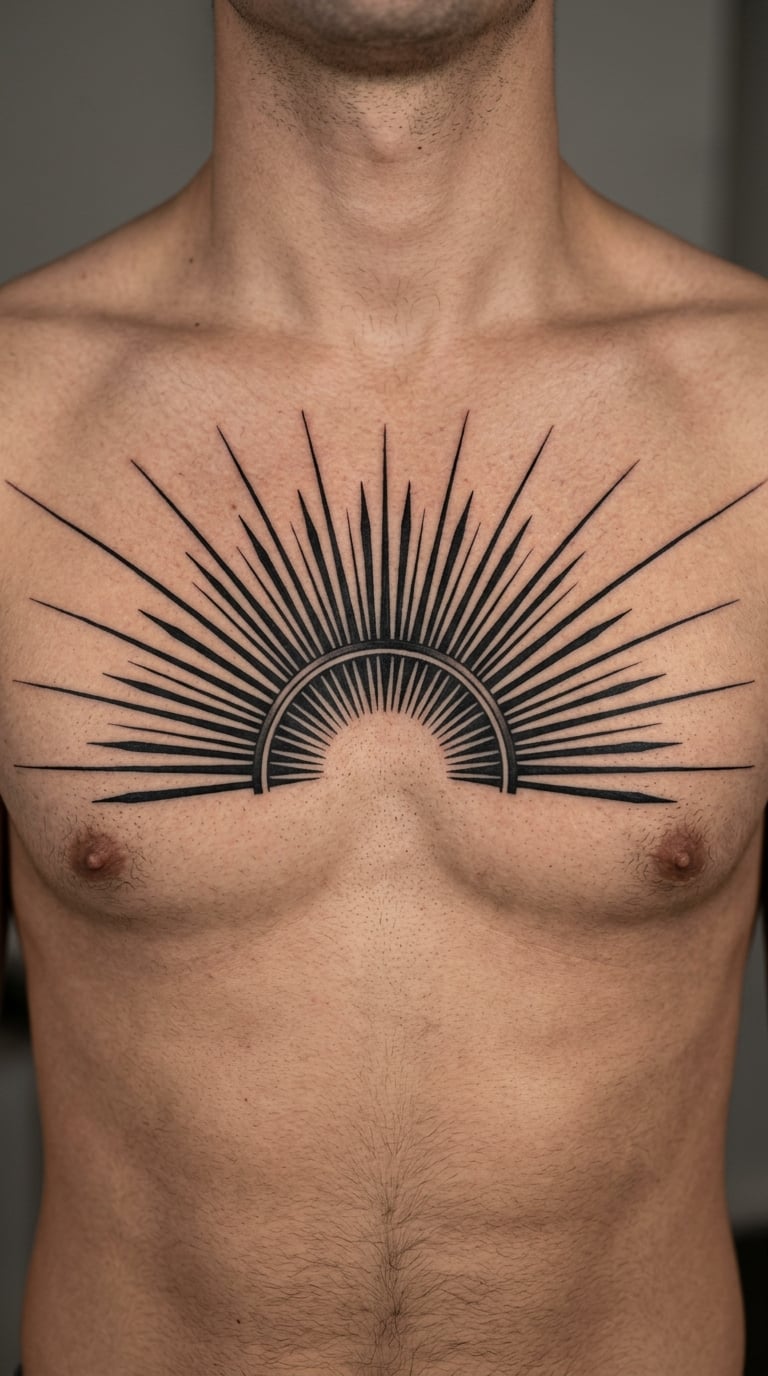
A semicircular sunburst anchored near the sternum, with alternating long and short rays reaching out toward both shoulders. The lower chest stays open, which keeps it from looking like a logo. This is the widest design on the list and the one that most obviously changes how a chest looks.
Optimism, energy, a new start, a specific sunrise that mattered. The interpretation belongs to the person wearing it.
Placement: sternum outward to both shoulders. Size: 12 by 4 inches (30 by 10 cm). Style: blackwork. Pain: medium overall, but both collarbones are involved so expect the ends of long sessions to be the hard part. Because the design sits on flat upper-chest skin, ask your artist to keep the ray tips tight, since that is where edge spread shows first. Make it yours: colour a single ray in a muted tone, or build it from the number of years that matter to you.
24. Black-and-Grey Ocean Wave at the Shoulder
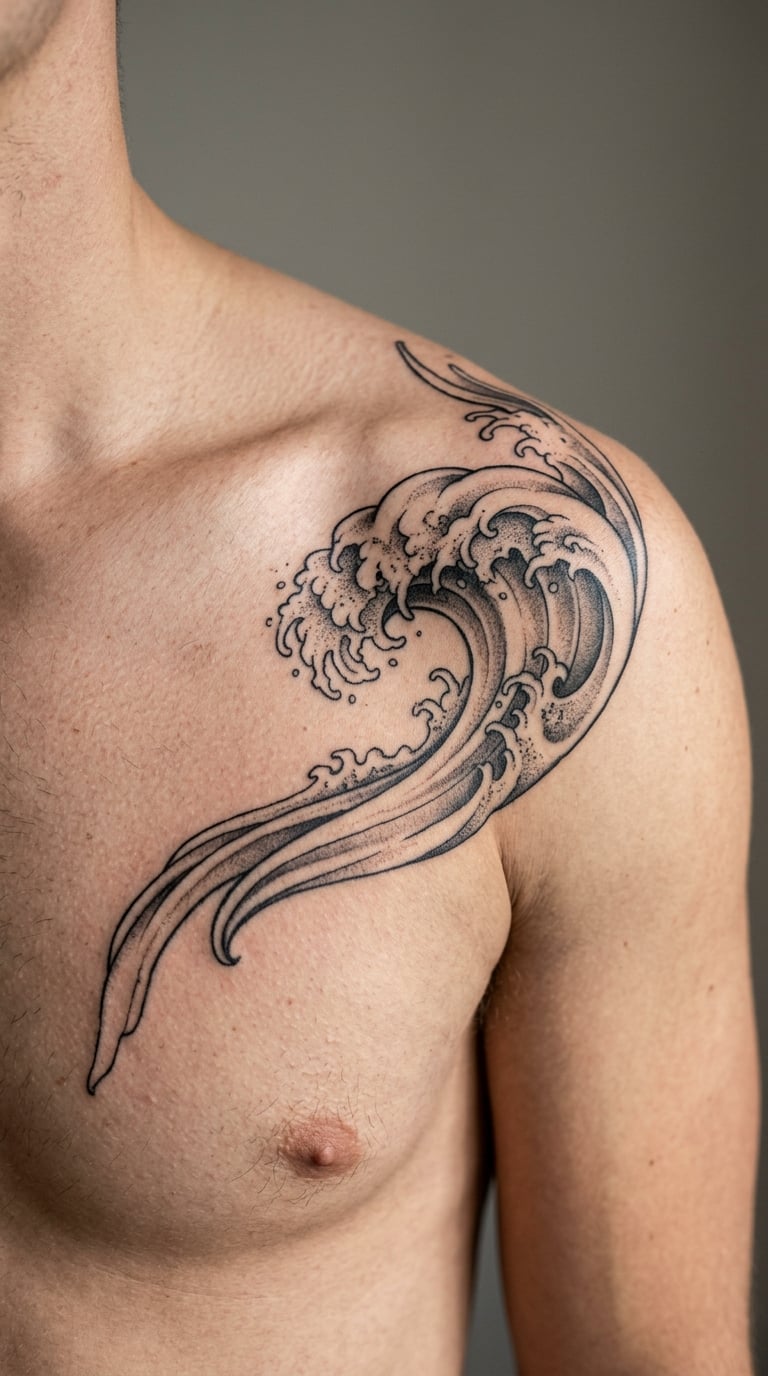
One curling wave in black-and-grey, with stippled foam along the crest and grey wash building in the trough. It sweeps from the upper chest toward the shoulder and stops, rather than becoming a full sleeve. One wave, done properly, looks far better than three done quickly.
Water imagery covers everything from surfing to a difficult year, so no reading fits everybody.
Placement: upper chest sweeping toward the shoulder. Size: 7 by 3 inches (18 by 8 cm). Style: black and grey. Pain: medium. Grey wash covers a lot of skin quickly, so the duration is shorter than the size suggests. Make it yours: put the coordinates of a meaningful break on the foam line, or reduce it to a single foam curl if you want it smaller.
25. Fine-Line Mountain and Pine Silhouette
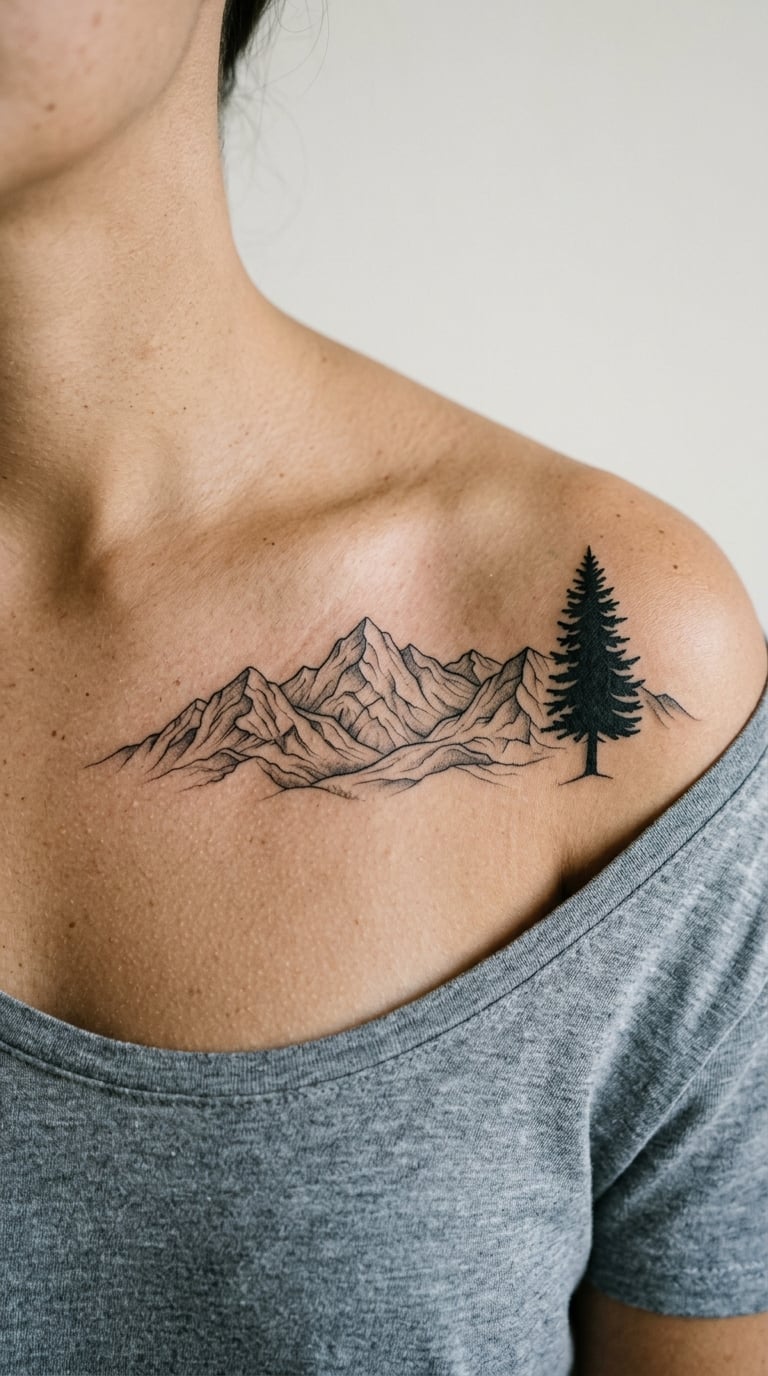
A wide, quiet scene: layered mountain peaks with one pine silhouette in front and plenty of empty skin between them. The line weight is light and even, and the composition is built broad but shallow so it lies across the upper chest rather than dropping down over the pecs.
It is usually a place, or a trip that changed how someone sees things. Adding the date makes it unmistakably personal.
Placement: across the upper chest toward the shoulder. Size: 10 by 3 inches (25 by 8 cm). Style: fine line. Pain: medium, spread over a long stretch of sensitive skin. Fine-line scenery on the upper chest fades first, so expect a refresh every few years if you want the peaks to stay crisp. Make it yours: choose the actual skyline you want, or add a small date tucked under the lowest ridge. It also pairs well with more shoulder tattoo ideas for men if you are building a full piece later.
How to Choose the Right Design
- Let the anatomy pick the shape. The chest-to-shoulder line already runs diagonally from the sternum to the deltoid. A design built along that existing edge looks natural, and a design forced across it will warp every time you raise your arm.
- Check the size against your frame, not the reference photo. Designs read smaller on skin than on screen. A common rule of thumb is to scale a design up by about a third, but your artist’s eye beats any rule, and they can stencil it on you in a standing position before any ink goes in.
- Match the level of detail to the skin. The upper chest and shoulder are high-movement, high-UV areas. Hairline dots, tiny lettering and soft grey gradients all soften there sooner. Bold blackwork and traditional outlines are the safest long-term bet on this placement.
- Think about what is already there. Existing work on the shoulder cap, neck or arm dictates where your new piece can start and stop. Send your artist photos of everything in place, because a composition that ignores the sleeve next to it will look wrong forever.
- Plan for the long term, not the photo. Weight changes, muscle changes and a new job all change the body. A design with generous negative space and clear outer edges survives all three better than a tight, fully filled panel.
- Pick the artist over the design. A portfolio that shows finished work in the style you want, healed and not just fresh, matters more than any mockup on social media. Ask to see a healed piece from a chest or shoulder placement if they have one.
Cost and Session Time
There is no single number for a chest to shoulder piece, and anyone quoting you one before seeing the design is guessing. The final cost is built from the artist’s hourly rate, the shop minimum, how long your piece actually takes, and whether it needs more than one sitting. Travel, complexity and touch-ups all move the number as well.
What you can do is estimate the time. A small single-motif design, roughly 3 by 3 inches, usually lands somewhere between one and two hours and often fits a single session. A mid-size composition of 7 to 9 inches is more likely a two-to-four-hour sitting. Anything approaching a half-chest panel, like the wing or the sunburst on this list, is realistically a multi-session project, and the hours add up faster than most first-timers expect.
Ask the artist for a session plan before booking, and ask what the shop minimum is. If two artists quote different totals for the same design, the difference is usually session count and hourly rate, not quality.
Aftercare Basics
- Follow your artist’s aftercare instructions first. They know what they did and which film or ointment suits it.
- Wash it gently. Lukewarm water and a mild unscented soap, patted rather than scrubbed, and dried with a clean towel or paper.
- Protect it for the first couple of weeks. Loose clothing over the piece, and no straps, seat belt buckles or bag handles rubbing directly on it.
- Keep swimming and soaking out of it. Pools, hot tubs, baths and ocean water are all off the table until the piece has properly healed and any scabbing is gone.
- Watch for red flags, not for every bump. Spreading redness, heat, swelling, discharge or pain that keeps increasing are reasons to contact your artist, and a licensed physician if it persists.
- Think about sun from day one. The upper chest and shoulder take the most direct overhead UV of any placement. Once healed, keep sunscreen on the area when you are out in it, because no amount of touch-up fixes permanent sun fade.
Side-sleeping deserves its own mention. If you sleep on your side, the first ten to fourteen days on that side are uncomfortable, and pressure on a fresh chest piece can genuinely affect how it settles. A week of sleeping on the other side is a small sacrifice.
Frequently Asked Questions
Are chest to shoulder tattoos visible under a shirt?
It depends entirely on the design. The arrow, the compass rose, the small lightning bolt and the sunburst across the upper chest will all show above most collars and necklines, because they sit on the upper chest and the shoulder cap. Larger pieces, especially the wing and the eagle in a chest shield, tend to run wider than a shirt collar covers, so they show at the neckline and on the shoulder. If discretion at work matters, measure the collar on the shirts you already own before you book.
Can these designs work on different chest and shoulder shapes?
Yes, with the drawing adjusted. A good artist maps every design onto the individual frame rather than copying a reference straight onto skin. Broad shoulders and a strong V-taper suit sweeping designs, because the line follows the taper. Narrower frames generally look better with a compact motif placed high on the chest, where there is not enough width for a full panel. Body changes matter too, and designs with generous negative space hold their shape better if your weight or muscle moves.
Is a tattoo across the collarbone especially painful?
Usually, yes. The collarbone sits just under the skin with very little cushion, so the needle reaches bone almost immediately, and the sensation is a sharp, hot sting that comes and goes as the artist moves. Most people describe the deltoid as easier by comparison, since muscle absorbs the vibration. Chest and shoulder work is generally moderate, but people on tattoo forums consistently single out the sternum and the collarbone as the two hardest zones, and a long session tires anyone out.
Which chest to shoulder tattoo styles age the best?
Traditional American and bold blackwork age the best, because they rely on thick outlines and large areas of solid black rather than fine detail. Traditional roses, eagles, anchors and dagger-and-rose pieces stay readable for decades with an occasional line touch-up. Fine-line mountains, dotwork constellations and grey-wash pieces fade faster on the upper chest and shoulder, which take direct sun and a lot of movement. Whatever the style, sunscreen on a healed piece does more for longevity than anything else.
How should I prepare for a chest to shoulder tattoo consultation?
Bring references and be honest about the direction you want, even a rough sketch works. Send photos of your existing tattoos so the artist can see what the new piece has to work with. Wear a shirt that opens or comes off easily, since you will need to lift your arms and expose the whole area. Eat beforehand and get a good night of sleep, because a chest session is long. Most artists will also talk you through sizing, session count and price at this stage, and that is the moment to ask.
Conclusion
If this is your first piece, start with the fine-line arrow. It is small, quick, cheap in time and it teaches you how the skin on your chest moves without tying you to a large commitment you have not lived with yet.
For someone who already has tattoos and wants a chest to shoulder piece with real presence, the wing is the stronger choice, though it is a bigger job, a bigger bill and a bigger commitment to living with. The other designs in this list of chest to shoulder tattoo ideas for men sit somewhere between the two, and the right one is the design that suits your frame, your patience and your life five years from now, not the one that looks best in a photo this week.
If you are still narrowing the field, the center chest tattoo ideas that turn heads are worth a look next, and so is a second pass through our shoulder gallery.