
25 Dragon Ball Tattoo Ideas: Original Anime-Inspired Picks 2026
These 25 dragon ball tattoo ideas take the energy, colour and attitude of the anime and rebuild it as original dragon art: no traced manga panels, no franchise emblems, no costumes lifted straight off a screen. Each one lists placement, size, style, pain and a way to make it personal.
That matters because the franchise is drawn in a way that does not survive a straight copy. A screen-printed panel wraps badly around a forearm and flattens into a sticker. An original dragon, redrawn for the curve of your body, keeps the drama and ages like art. If you want the bold graphic language of the series without the copyright baggage, start at number one and work down. There is also a broader set of dragon tattoo designs that read well on the back if you are thinking bigger than an arm piece.
25 Dragon Ball Tattoo Ideas: Quick Guide
| Idea | Style | Best placement | Size | Pain |
|---|---|---|---|---|
| 1. Fine-Line Ascending Dragon | Fine line | Inner forearm, calf | 3-6 in (7.5-15 cm) | Medium |
| 2. Circular Blackwork Emblem | Blackwork | Upper arm, sternum | 4-8 in (10-20 cm) | Medium-high |
| 3. Watercolor Forearm Dragon | Watercolour | Outer forearm, shoulder blade | 7-12 in (18-30 cm) | Medium |
| 4. Minimalist Wrist Silhouette | Minimalist blackwork | Inner wrist, ankle | 1.5-3 in (4-7.5 cm) | Medium |
| 5. Traditional Red-and-Green Dragon | Traditional | Shoulder, thigh | 6-10 in (15-25 cm) | Medium |
| 6. Kawaii Dragon with Tiny Flame | Illustrative cute | Forearm, calf | 3-5 in (7.5-12.5 cm) | Low-medium |
| 7. Neo-Traditional Wind Swirls | Neo-traditional | Forearm, thigh | 7-11 in (18-28 cm) | Medium-high |
| 8. Geometric Triangle Dragon | Geometric blackwork | Calf, shoulder blade | 4-8 in (10-20 cm) | Medium |
| 9. Dotwork Flowing-Tail Dragon | Dotwork | Forearm, upper arm | 4-7 in (10-18 cm) | Medium |
| 10. Red Ink Negative-Space Clouds | Red ink illustrative | Forearm, shoulder | 5-9 in (13-23 cm) | Medium |
| 11. Dragon and Flame Split | Illustrative realism | Forearm, sternum | 4-8 in (10-20 cm) | Medium-high |
| 12. White Negative-Space Dragon | Blackwork negative space | Upper arm, back | 4-9 in (10-23 cm) | Medium-high |
| 13. Realistic Black-and-Grey Dragon | Black-and-grey realism | Shoulder, thigh, back | 7-13 in (18-33 cm) | Medium-high |
| 14. Tiny Dragon Behind the Ear | Fine line minimal | Behind ear, neck | 1.5-3 in (4-7.5 cm) | High |
| 15. Dragon Sleeve with Mountain Clouds | Colour or black-and-grey | Upper arm, thigh | 8-16 in (20-40 cm) | High |
| 16. Tribal-Inspired Bold Claws | Tribal-inspired blackwork | Calf, shoulder | 6-12 in (15-30 cm) | Medium-high |
| 17. Blue Water Dragon with Pearl | Watercolour illustrative | Forearm, thigh | 6-10 in (15-25 cm) | Medium |
| 18. Japanese-Style Black and Red Dragon | Japanese-inspired | Shoulder, forearm | 6-11 in (15-28 cm) | Medium-high |
| 19. Fire-and-Smoke Dragon | Blackwork with colour | Forearm, back | 6-10 in (15-25 cm) | Medium-high |
| 20. Micro Dragon on the Hand | Micro-realism | Outer hand, knuckles | 2-4 in (5-10 cm) | High |
| 21. Dragon with Floral Background | Illustrative colour | Thigh, shoulder blade | 7-12 in (18-30 cm) | Medium |
| 22. Minimal Dragon, One Red Scale | Fine line with red accent | Wrist, ankle, upper arm | 2-5 in (5-12.5 cm) | Low-medium |
| 23. Dragon and Mountain Back Piece | Illustrative blackwork | Upper back, calf | 8-14 in (20-35 cm) | High |
| 24. Dragon with Speed-Line Finish | Manga-inspired blackwork | Forearm, calf | 6-10 in (15-25 cm) | Medium-high |
| 25. Dragon Portrait with Power Aura | Black-and-grey realism | Chest, upper arm, back | 5-9 in (13-23 cm) | High |
1. Fine-Line Ascending Dragon
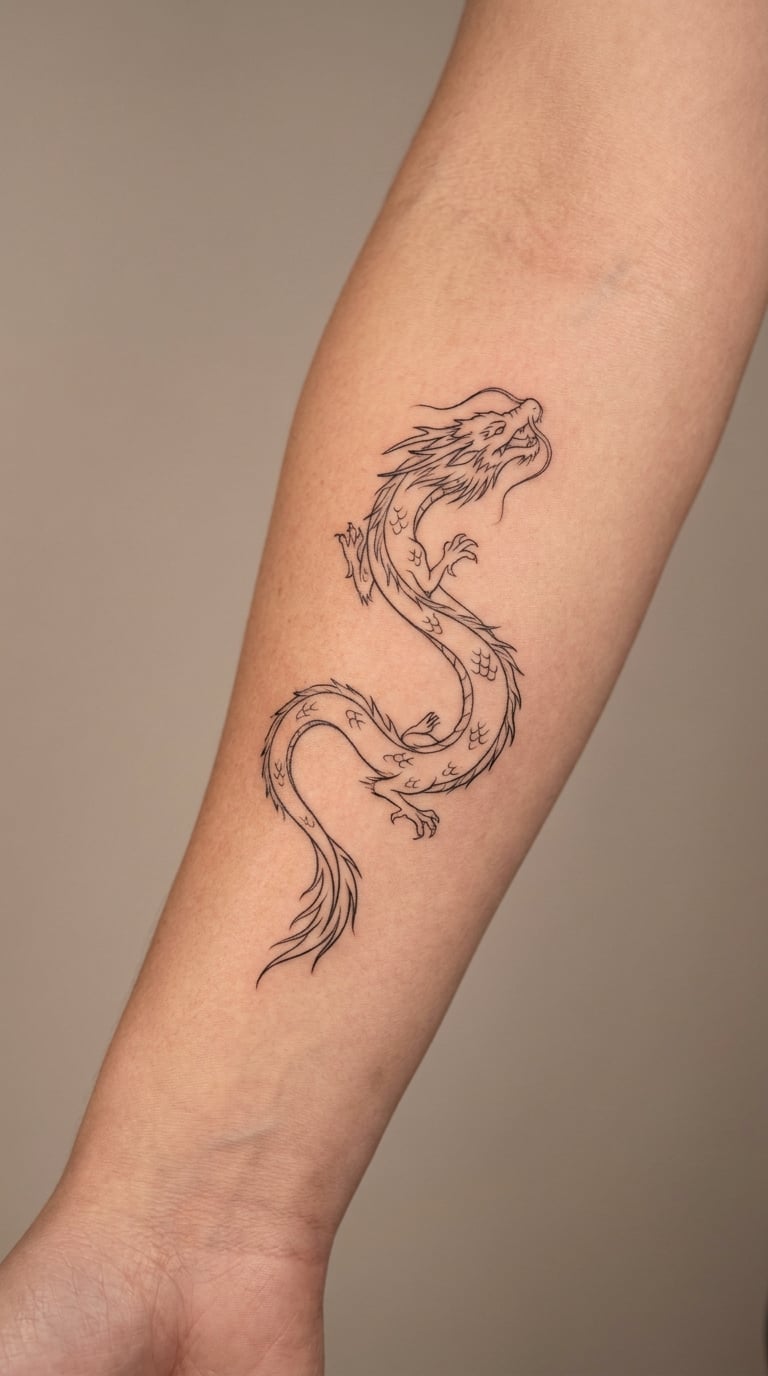
This dragon ball tattoo idea is a single thin-line serpentine body climbing in an S-curve, with sparse scale ticks along the back and one small clawed forelimb. The head stays simple: two horn lines, a dot eye, a slight open jaw. Nothing is filled in.
A rising dragon often gets chosen because it reads as upward movement, but wearers pick their own reason. Fine line also happens to be the style that survives the least sun exposure, so placement matters more than usual.
Placement: inner forearm, outer upper arm or calf. Size: 3-6 inches (7.5-15 cm). Style: fine line. Pain: medium on the forearm, low to medium on the upper arm. Fine lines on hands and fingers fade and blur fastest, so keep this one off the hand if you want it crisp in ten years.
Make it yours: add a short date in matching single-line script beneath the tail.
How to personalize a 25 dragon ball tattoo ideas design
Take the concept, not the reference. Change the pose so the body follows the muscle it sits on, swap the background for something you actually care about, and vary the ink treatment from outline to wash to solid fill.
Scale pattern is the easiest lever: dot rows, engraved lines or interlocking triangles each give a different texture without touching the silhouette. Add one personal detail, a birth month, a coordinate, a plant from home.
What to leave alone is the part that causes arguments. Skip franchise kanji in the wrong stroke order, costumes, armour, the seven-star balls and any traced screen frame. A tattooer who works in anime linework can reference a style without lifting an image. If a shop offers to trace a panel for you, ask instead for a redraw from your description, and expect to pay the same either way. Look at healed portfolio work, not fresh posts, and check that the artist can show you a dragon that still reads after two years.
2. Blackwork Dragon in a Circular Emblem
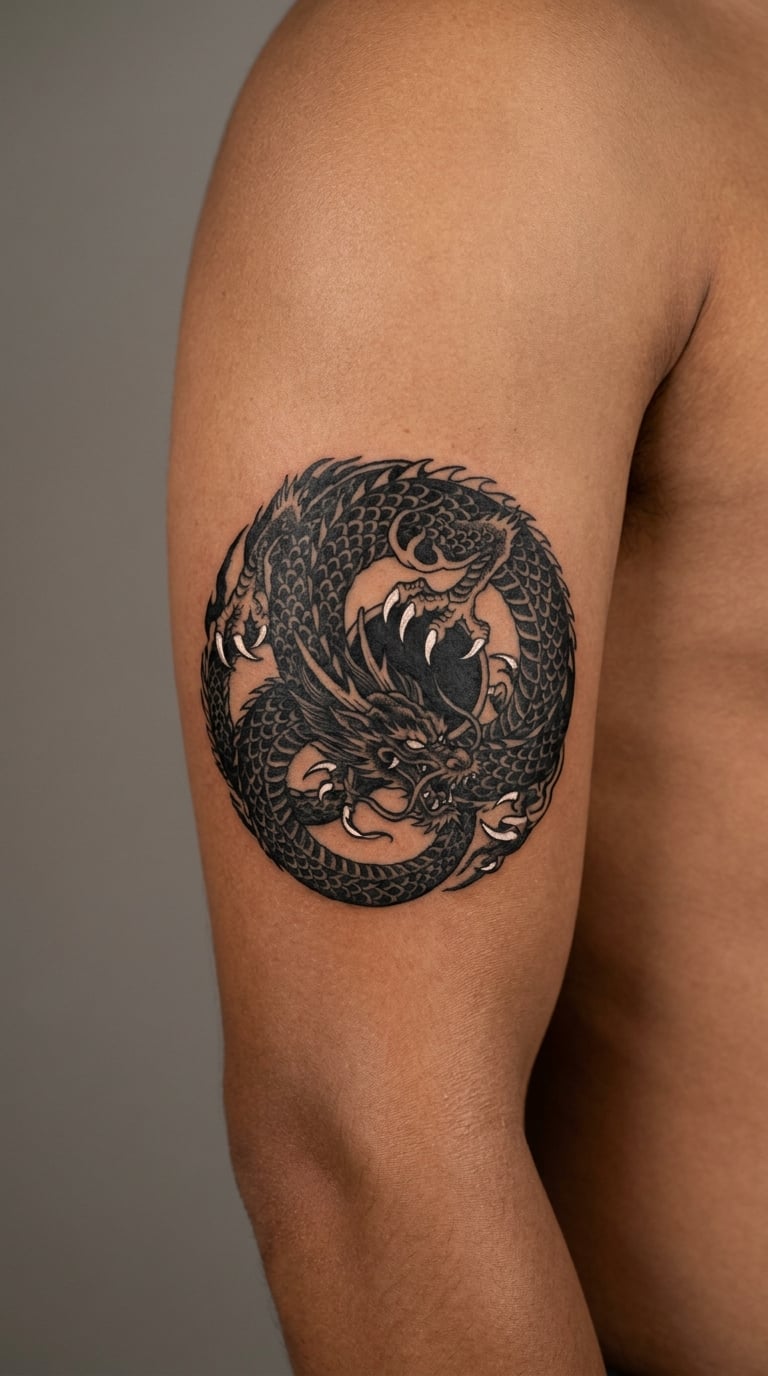
A bold black dragon coils inside a hard-edged circle, body wrapping the ring twice with the head breaking the lower edge. Solid black scales alternate with clean white cuts at the claws and jaw so the shape stays readable at a distance.
This is the badge version of the idea, the one people pick when they want a single graphic object rather than an illustration. Dense black reads heavy over time, so plan for how it will look softened rather than assume it stays solid.
Placement: upper arm, shoulder, back of the calf or sternum. Size: 4-8 inches (10-20 cm). Style: blackwork. Pain: medium, rising to high on the sternum and inner calf. Ageing: solid black softens and spreads slightly as the years pass, which suits this design rather than hurting it.
Make it yours: cut a small birth month into the ring, or split the circle with a thin gap of bare skin.
3. Watercolor Dragon Winding Around a Forearm
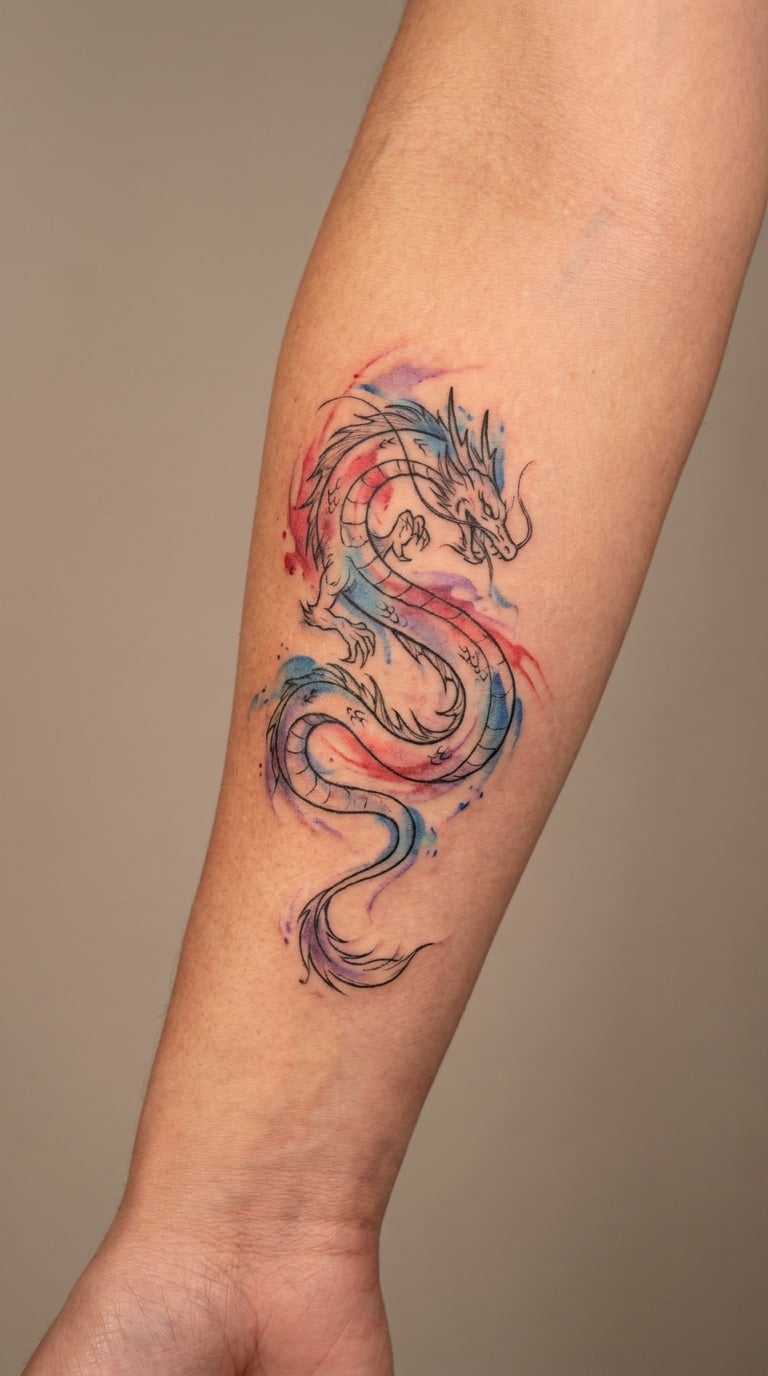
Loose red, blue and violet washes bleed well past the black linework, with pigment pooling at the edges and a few dry-brush gaps left on purpose. The head is the only fully drawn part, so the eye lands there first.
People reach for this when they want movement and a bit of chaos rather than a tight illustration. It also hides a rough edge better than flat colour, which helps on a curved forearm.
Placement: outer forearm, calf or shoulder blade. Size: 7-12 inches (18-30 cm). Style: watercolour. Pain: medium, with moderate discomfort over bony areas. Soft edges and pale tones soften fastest, so ask about sun protection and expect a touch-up on the light washes.
Make it yours: pick your two colours from something you own, like a team jersey or a coastline you grew up near.
4. Minimalist Dragon Silhouette on the Wrist
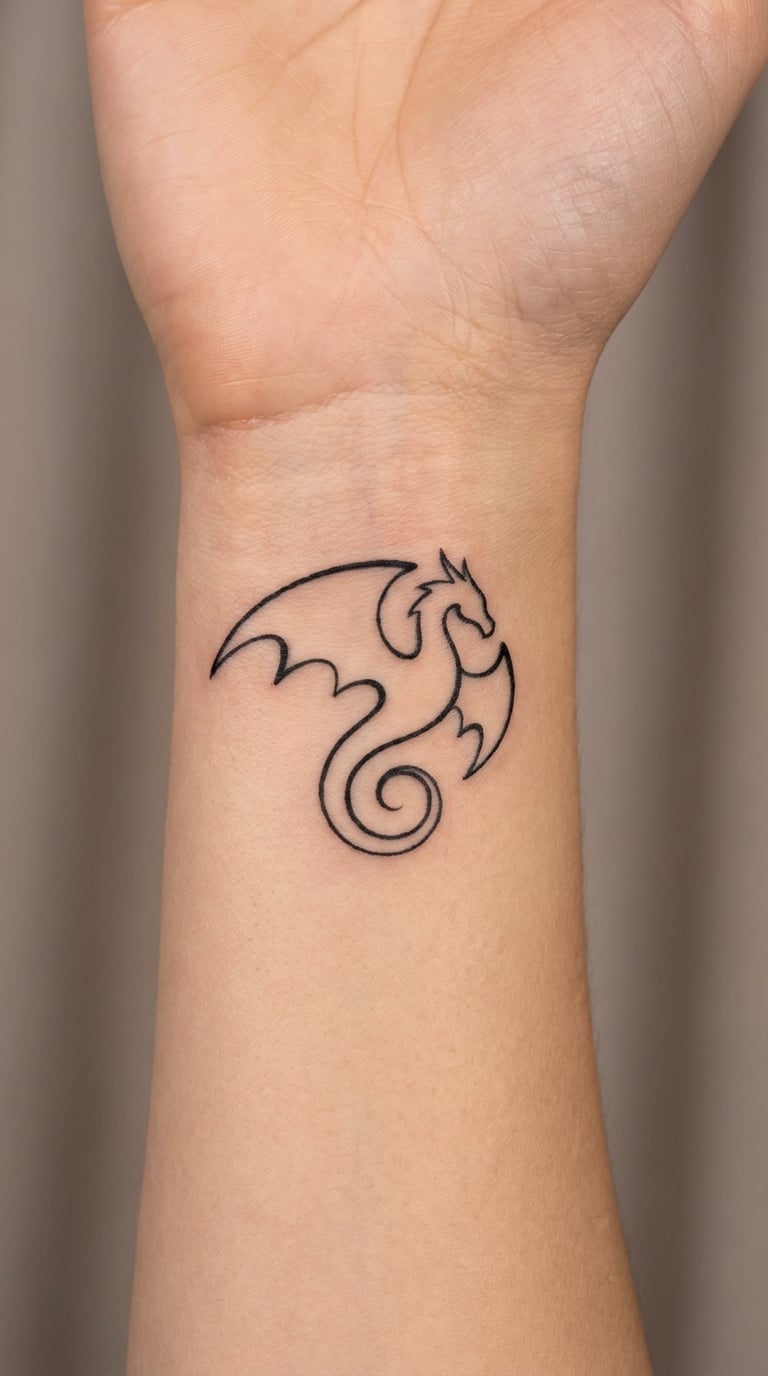
One continuous black contour, a tiny head, a curled tail, and nothing else. The whole thing is filled flat so it still reads at two inches, where line work would turn to fuzz.
Small and quiet, this works as a first tattoo or as a discreet mark that only shows when you turn your palm up. Simplified forms like this age more gracefully than detail-heavy pieces in the same spot.
Placement: inner wrist, ankle or behind the ear. Size: 1.5-3 inches (4-7.5 cm). Style: minimalist blackwork. Pain: medium on the wrist, low to medium on the ankle. Wrist ink and tiny hand-adjacent detail blur with hand washing and daily movement, so keep the shape simple and expect a redraw after a few years.
Make it yours: have the tail wrap once around the wrist line and finish underneath, so the design follows your arm rather than sitting on it.
5. Traditional Red-and-Green Dragon
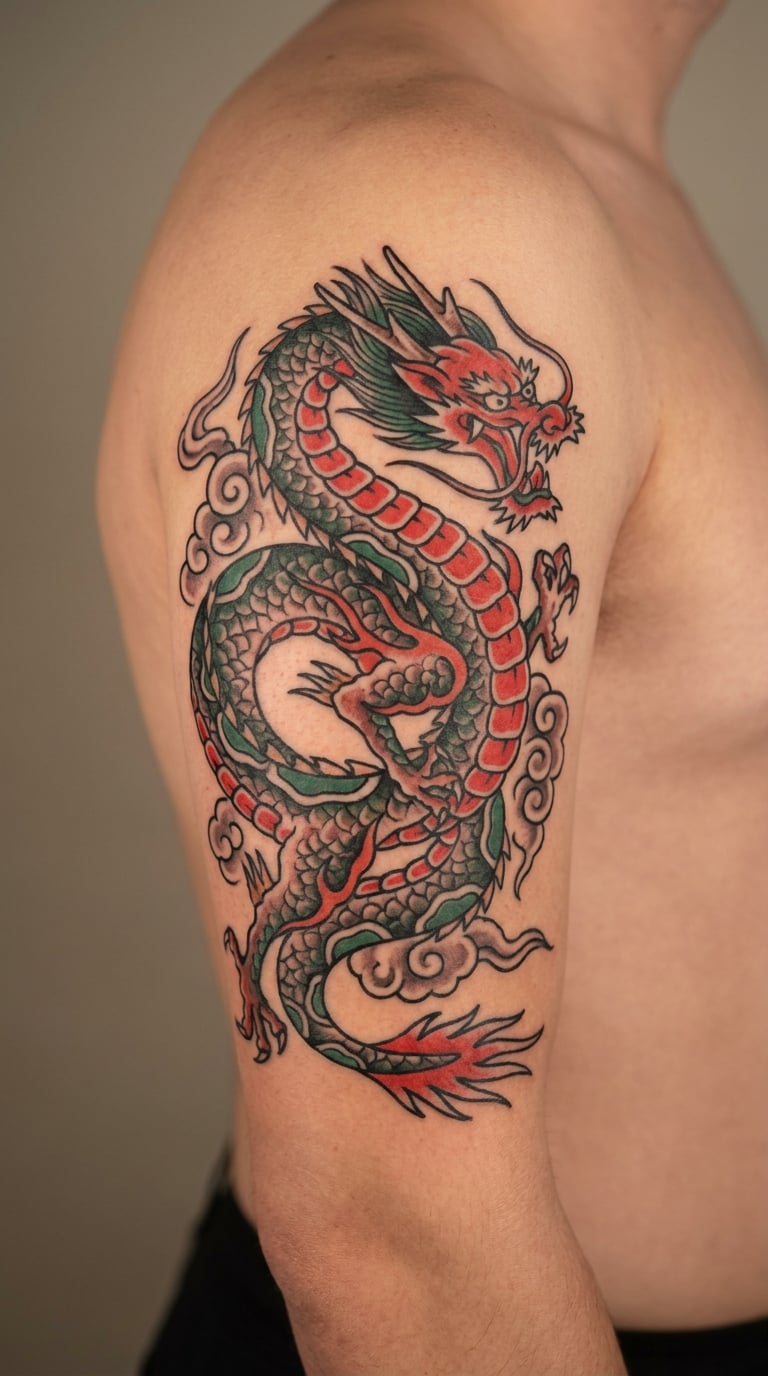
Thick black outlines, saturated red scales, green cloud forms pushing in from the edges and hard shading in the body folds. No gradients, no soft edges, the way a flash sheet from decades ago would have drawn it.
The high contrast is the whole point. It is a loud piece that still photographs well and holds its shape as the skin moves, which is why it keeps turning up in galleries of anime-influenced traditional work.
Placement: shoulder, upper arm, thigh or calf. Size: 6-10 inches (15-25 cm). Style: traditional. Pain: medium, depending on the exact spot. Large colour fills need more healing attention than a small line piece, so follow the artist’s cleaning guidance closely.
Make it yours: change the accent colour from red-green to a two-colour pairing that belongs to you.
6. Kawaii-Style Dragon with a Tiny Flame
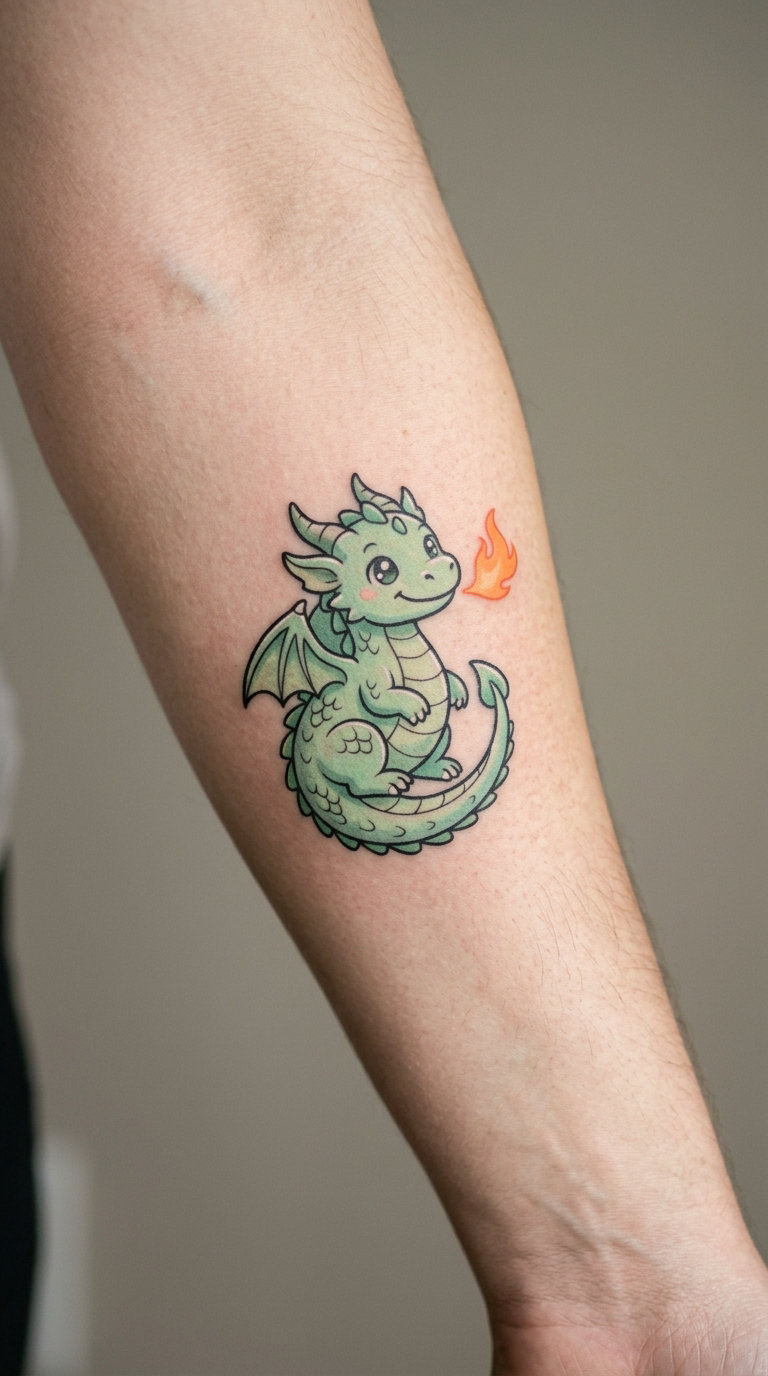
Rounded proportions, large friendly eyes, stubby limbs and a small orange flame held in front like a torch. Soft pastel green shading keeps it light rather than childish, and the body curls into a comma shape that fits a forearm curve.
This is the lighthearted option. A simplified cute dragon gives you a playful nod to the anime you grew up on without any trace of a specific character, and it reads fine on a smaller arm.
Placement: forearm, calf, shoulder or upper arm. Size: 3-5 inches (7.5-12.5 cm). Style: illustrative cute, sometimes labelled neo-traditional chibi. Pain: low to medium on the outer arm, medium on the calf. Pale pastel fill fades quickest, so plan a colour refresh every few years.
Make it yours: add a small name or nickname inside the curl of the body in a single clean line.
7. Neo-Traditional Dragon with Wind Swirls
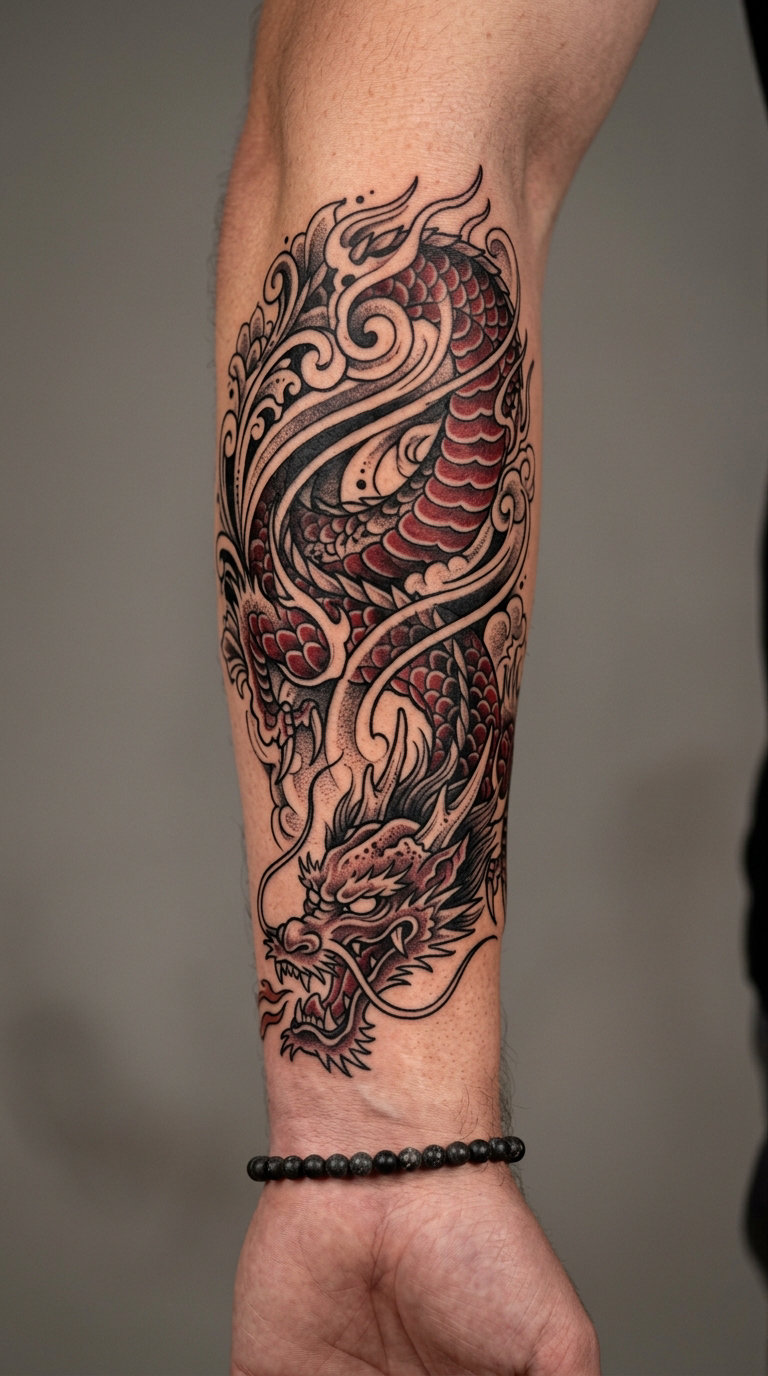
A coiled dragon with deep black shadow work, muted red highlights on the scale ridges and sweeping wind lines that fill every gap around the body. The tail breaks the frame so the piece feels larger than its edges.
Wind and movement give the composition a sense of travel without fixing a single meaning. Readers usually take it as change or momentum, but plenty of wearers just wanted the pattern to flow with the arm.
Placement: forearm, shoulder, back or thigh. Size: 7-11 inches (18-28 cm). Style: neo-traditional. Pain: medium on the arm, high over the ribs and shoulder blade where the skin is thin and bone sits close. Broad shaded areas build warmth, so short breaks help.
Make it yours: work a single meaningful glyph into one of the wind swirls rather than adding another element.
8. Geometric Dragon Built from Triangles
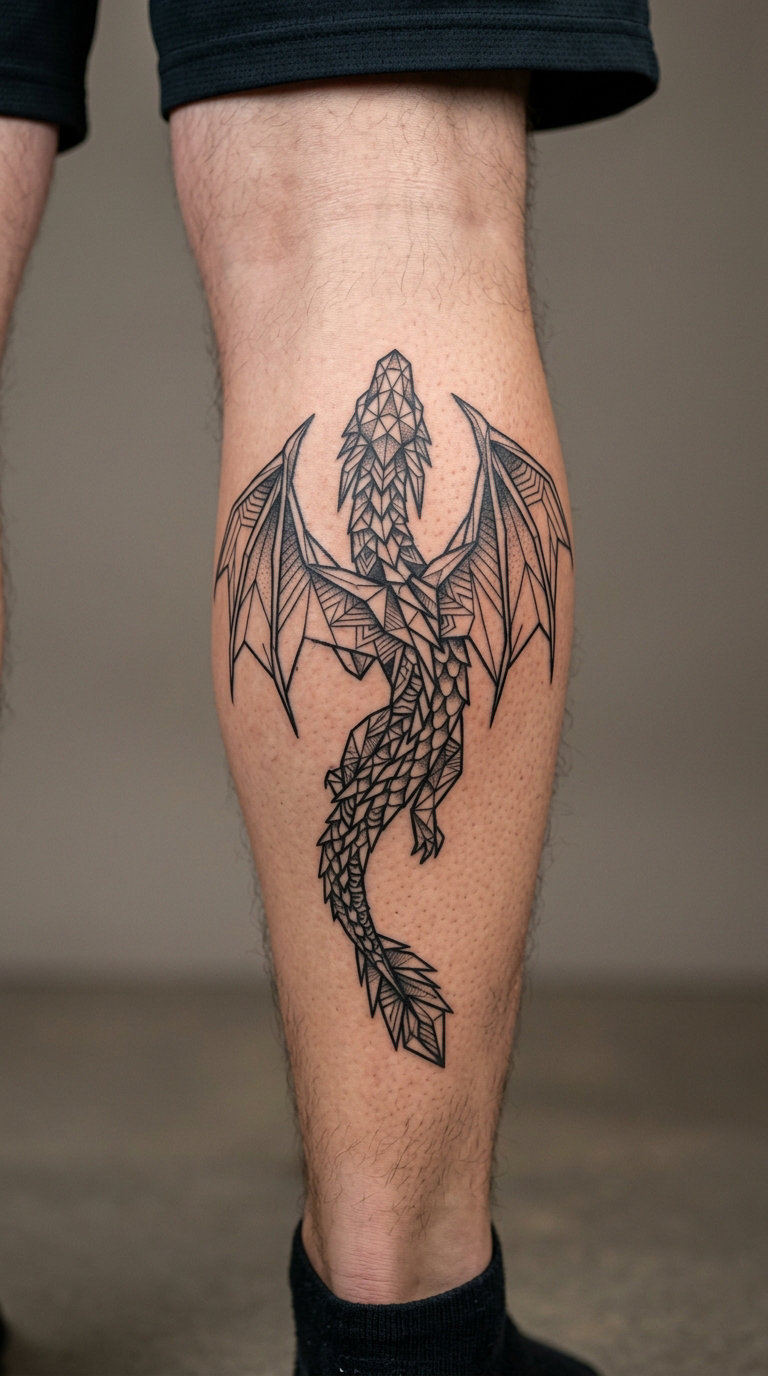
Interlocking triangles make up the whole creature: sharp wing shapes, a segmented body, a triangular head with one cut-out eye. Solid black shapes alternate with bare skin so the dragon is built from gaps as much as from ink.
Geometry makes the animal feel controlled and modern while keeping the silhouette instantly dragon. It also photographs cleanly, which is a bonus if you want the piece to read in a photo rather than only in person.
Placement: forearm, calf, shoulder blade or upper arm. Size: 4-8 inches (10-20 cm). Style: geometric blackwork. Pain: medium, with higher discomfort over the ribs and shoulder blade. Very fine triangular gaps fill in slowly as lines thicken, so a slightly bolder version holds up better.
Make it yours: hide a small initial in the negative space under the wing.
9. Dotwork Dragon with a Flowing Tail
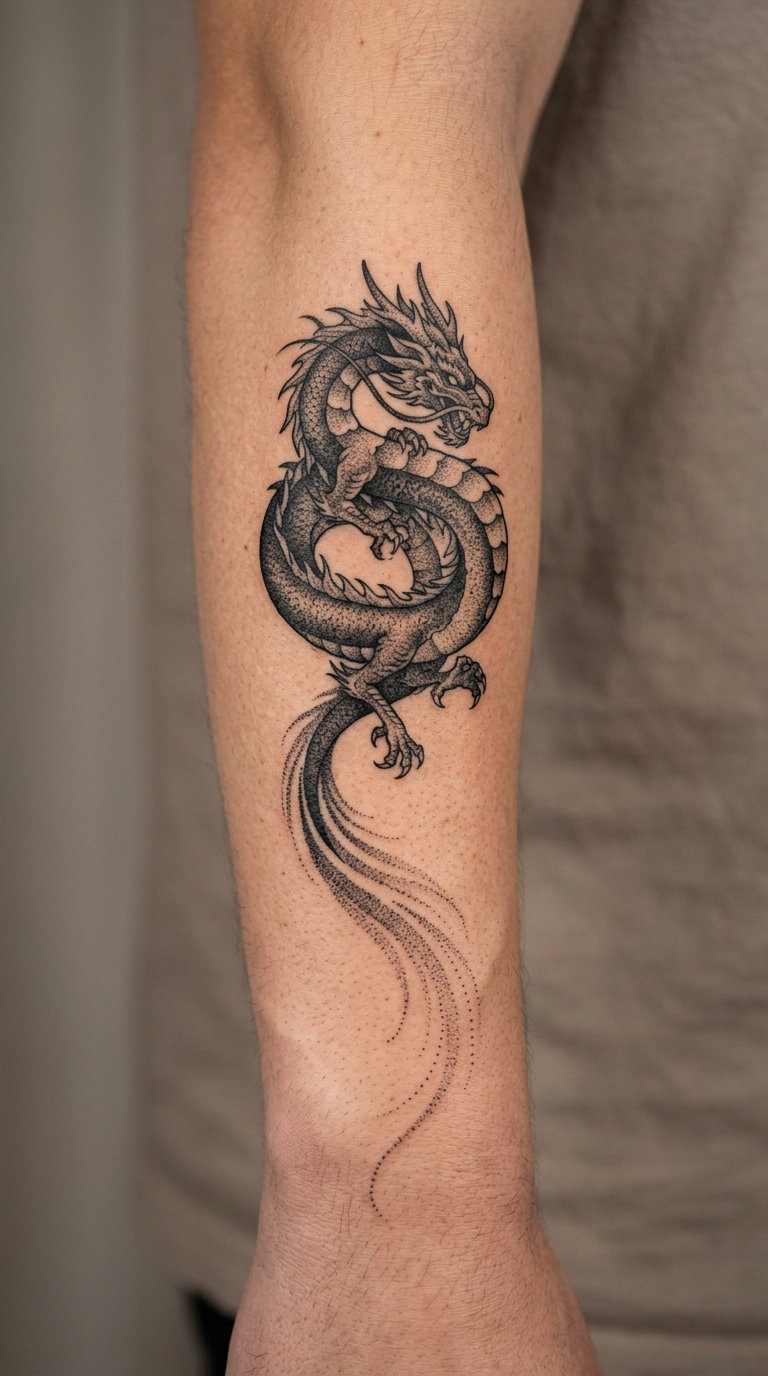
Dots do all the work here. They pack tight under the belly for shadow, spread across the back for midtone, and trail off along the tail in graduated sizes so the eye follows the movement across the skin.
Dotwork suits people who like texture more than colour. It has a quiet, handmade feel and rewards a close look rather than a distance one, which is the opposite of a flash-style piece.
Placement: forearm, upper arm, shoulder blade or calf. Size: 4-7 inches (10-18 cm). Style: dotwork. Pain: medium on the arm, higher over the ribs. Very fine dot patterns blur and soften over time, so ask for slightly larger dots than the reference image if you care about the texture surviving.
Make it yours: make the dot density follow a gradient from a light area of your life to a heavier one.
10. Red Ink Dragon with Negative-Space Clouds
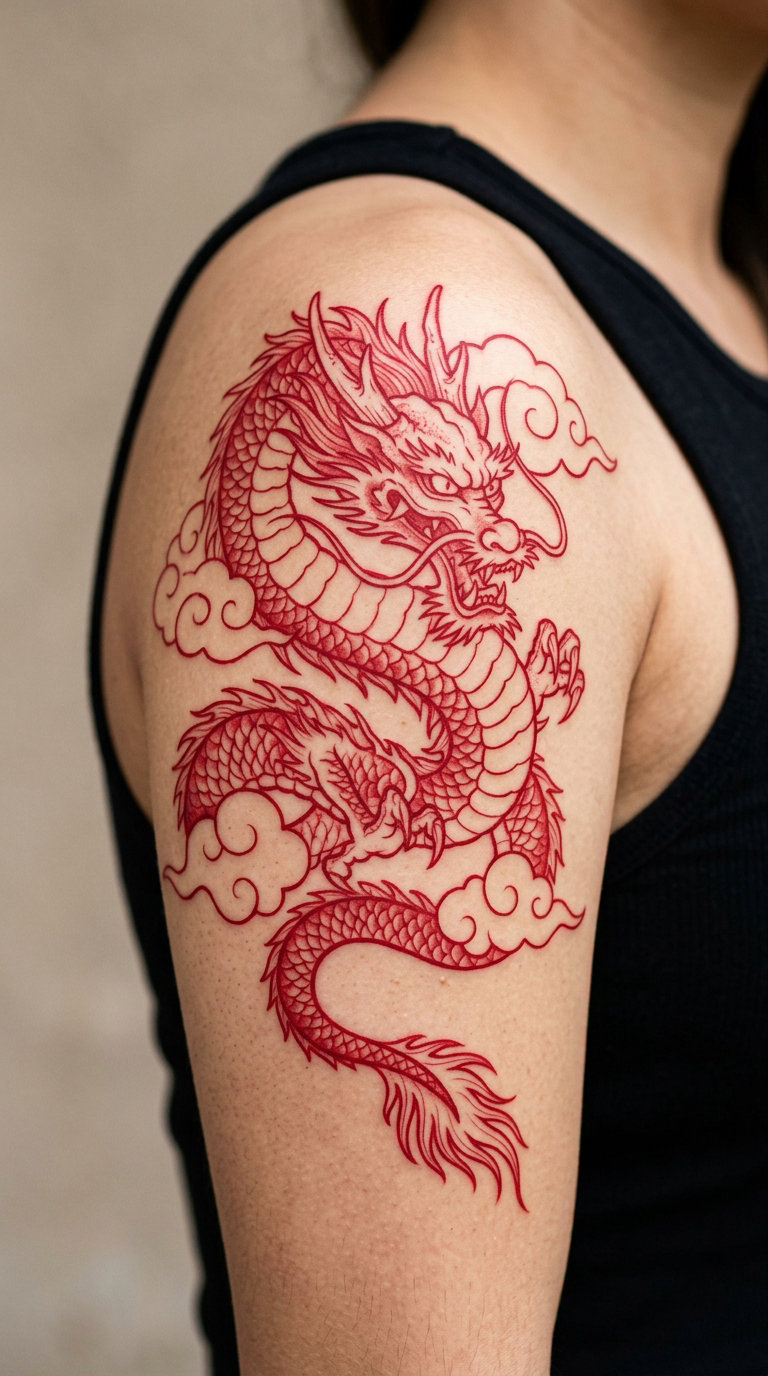
One rich red contour defines the entire dragon, with a second thinner line for the scales. The clouds around it are not drawn at all; they are shapes of untouched skin cut out of a soft grey field.
A single-colour dragon gives you something bold and graphic without a full colour commitment. Reviewers of this style usually say the same thing: the empty skin does as much work as the ink.
Placement: forearm, shoulder, calf, thigh or back. Size: 5-9 inches (13-23 cm). Style: red-ink illustrative. Pain: medium on most areas, high over the ribs. Red pigment can look warmer and slightly deeper as it heals, so judge the shade after a few weeks rather than the day you leave.
Make it yours: carve a small word into the negative-space cloud on the inner curve.
11. Dragon and Flame Split Design
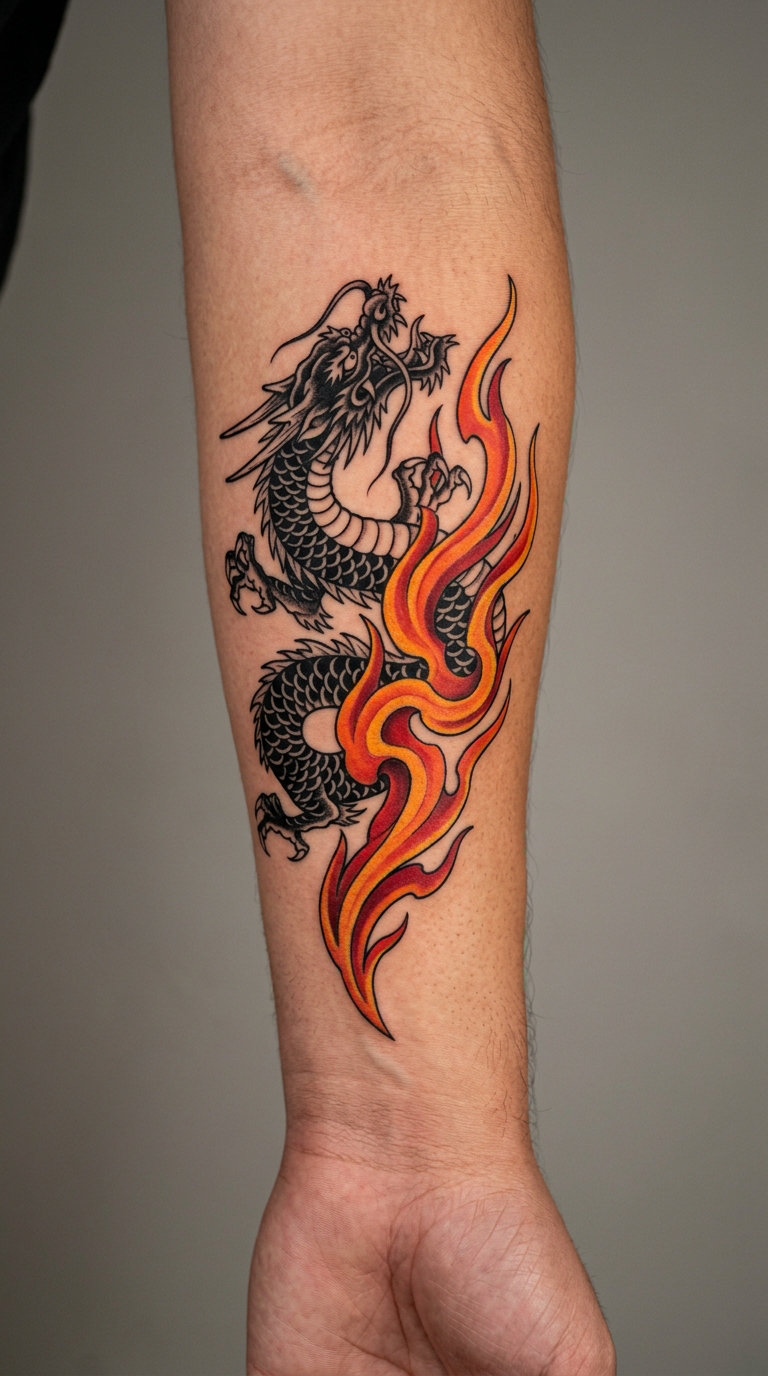
A vertical composition with the dragon rising on one side in black and grey scales, the flame climbing the other in stacked orange, yellow and red bands. The two meet at the base in a shared black shadow.
The pairing is often chosen for a personal story about change or intensity, though plenty of people just liked the balance of the two shapes. There is no fixed reading, and you get to pick yours.
Placement: forearm, calf, shoulder blade or sternum. Size: 4-8 inches (10-20 cm). Style: illustrative realism with blackwork and colour. Pain: medium, high on the sternum and inner arm. Bright yellow is the least permanent colour in this palette, so expect a touch-up on the flame within a few years.
Make it yours: add a date at the base where the dragon and flame meet.
12. White-Negative-Space Dragon
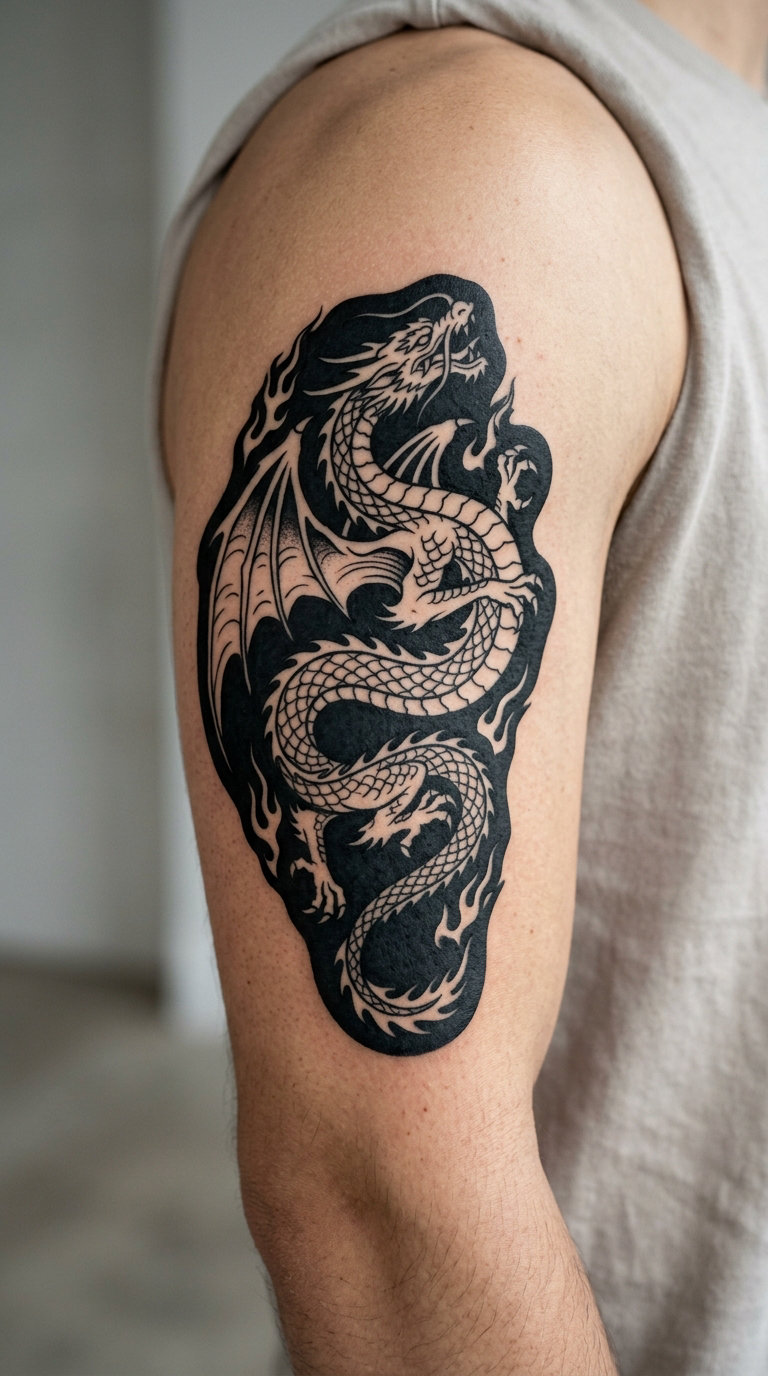
A solid black field with the dragon left as clean white negative space, the shape defined by cut-outs at the eye, jaw and claws. A few sparse flame ticks break the field so the black never sits as one flat block.
The high contrast makes a small design look bigger than it is. It suits people who like graphic simplicity and want something that still reads clearly at a distance.
Placement: forearm, upper arm, calf, back or shoulder. Size: 4-9 inches (10-23 cm). Style: blackwork with negative space. Pain: medium, high over the ribs, shoulder blade and inner calf. Solid black areas need more passes and feel warmer, and they stay dark longer than fine detail does.
Make it yours: leave a thin band of bare skin across the black field carrying a line of small text.
13. Realistic Black-and-Grey Dragon
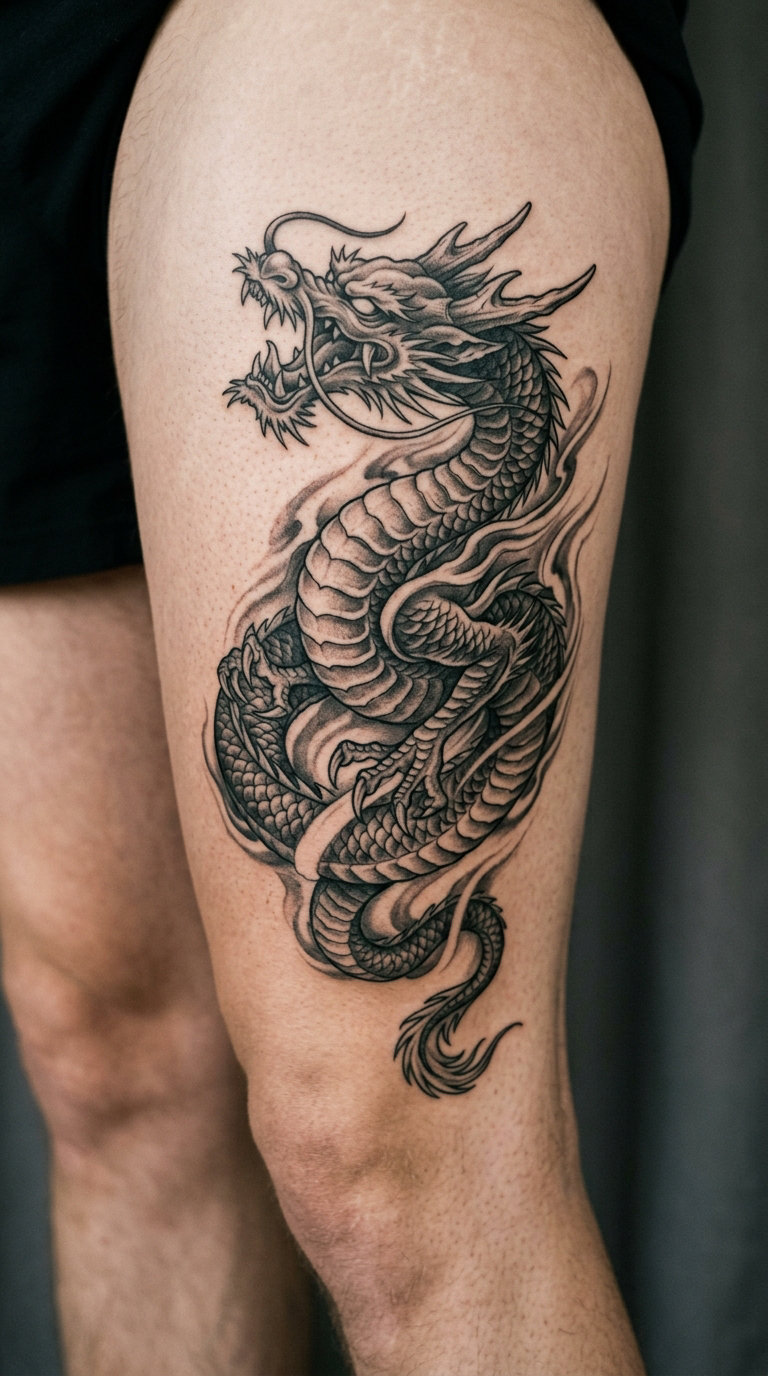
Rendered entirely in black and grey: overlapping scale texture on the body, smoky shadow under the jaw, a raised head in three-quarter view and a soft background haze to keep the silhouette from floating.
Realism is the route for a dragon that should outlive any particular anime style. Once it is drawn as a creature rather than a character, it stops dating with the show.
Placement: shoulder, upper arm, thigh, calf or back. Size: 7-13 inches (18-33 cm). Style: black-and-grey realism. Pain: medium, higher across the shoulder blade, ribs and inner thigh. Fine scale texture blurs as the piece ages, so a grey wash that reads bold at three weeks usually holds better than one built from tiny dots.
Make it yours: set the background haze to a real sky from a place you have been.
14. Tiny Dragon Behind the Ear
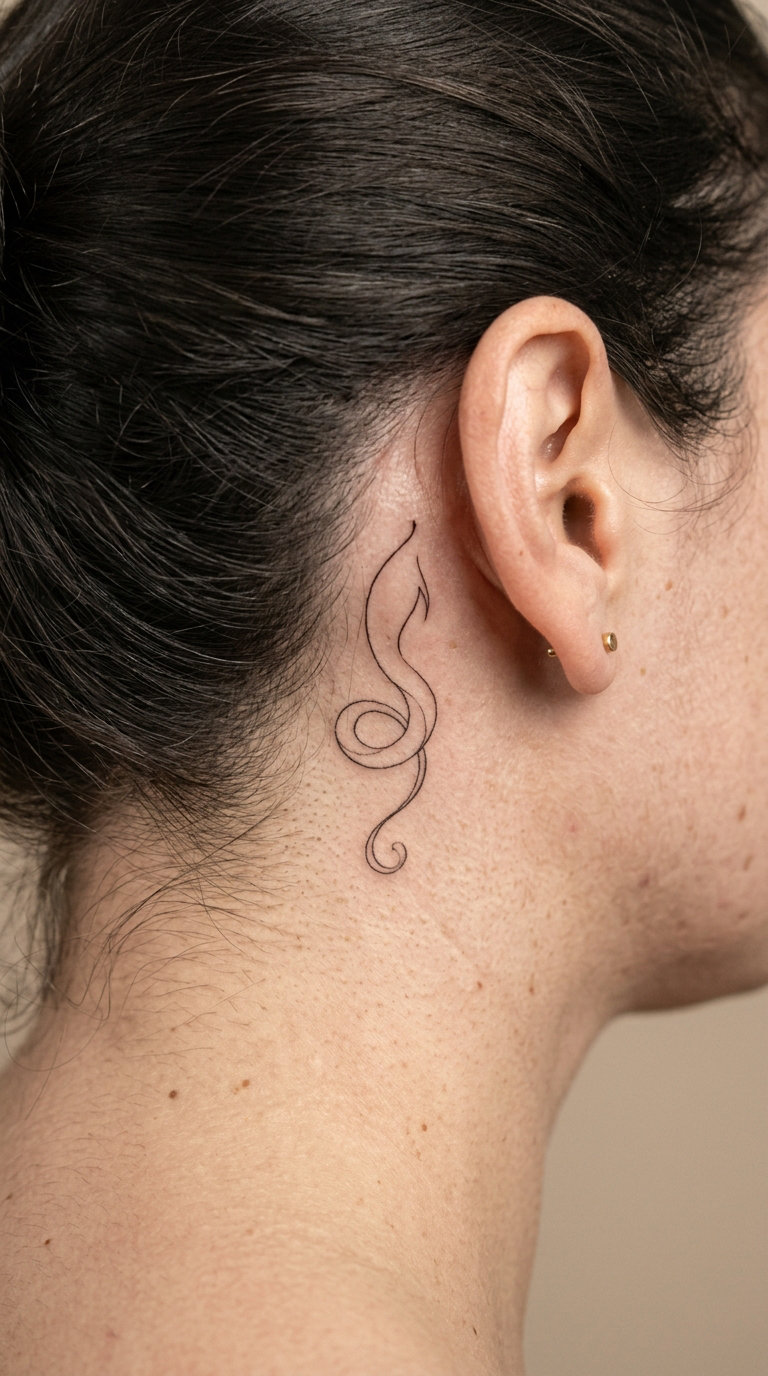
Only the head and neck show, rising from behind the ear with one curled line for the tail disappearing under the hairline. Everything else is implied, and that implication is what makes it work at that size.
A partial creature gives you a discreet anime-inspired reference without a full illustration on display. It is the easiest of these designs to keep private, which is why it appeals to people who like the reference but not the attention.
Placement: behind the ear, side of the neck or upper shoulder. Size: 1.5-3 inches (4-7.5 cm). Style: fine line or minimalist blackwork. Pain: high behind the ear, medium on the neck. Small facial and scale details blur over the years, and hair washing and product sit right on the design, so keep it to as few lines as you can.
Make it yours: run the tail line into a second small mark further down the neck so the two read as one piece.
15. Dragon Sleeve with Mountain Clouds
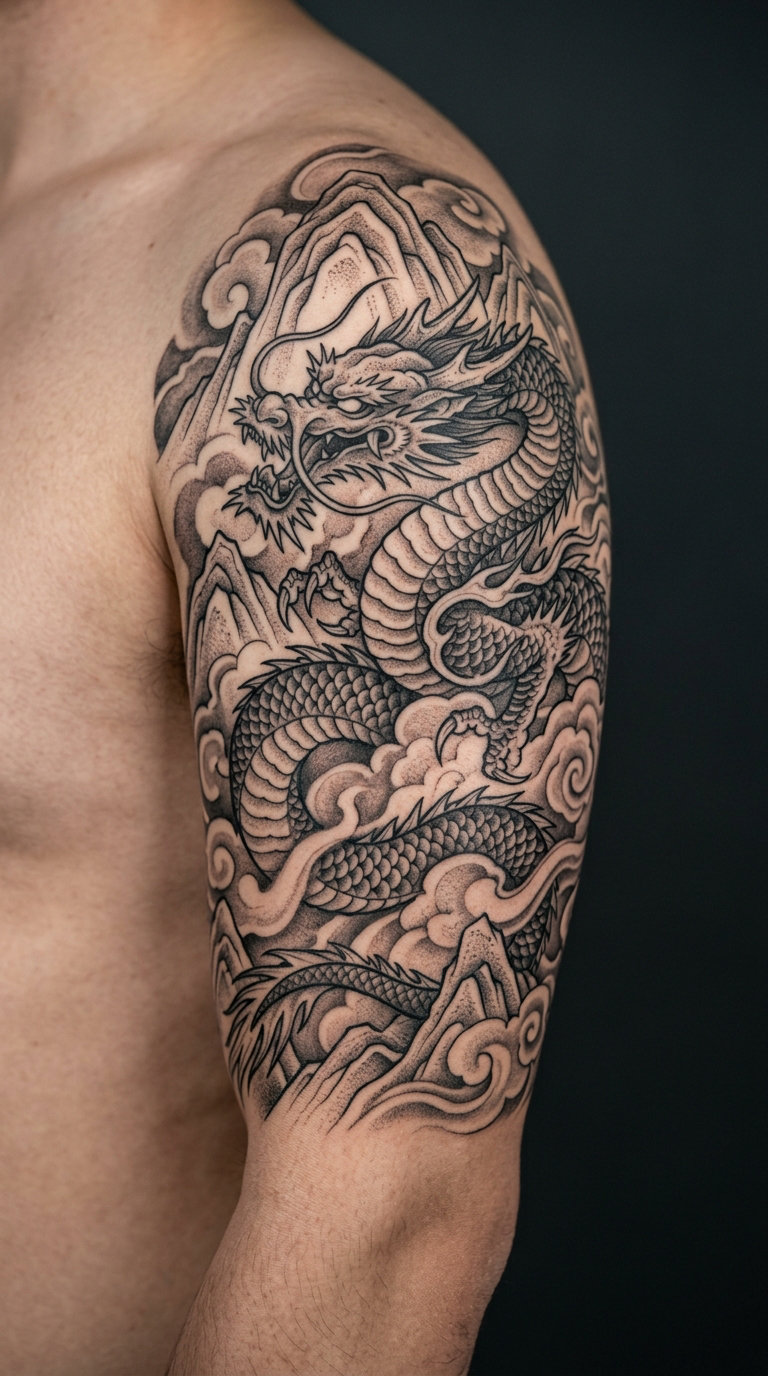
A large dragon moves through layered mountain forms and rolling stylised clouds, with atmospheric scale so the peaks recede and the body has somewhere to travel. Background work carries the piece rather than a plain colour block.
This is the direction for a collector who wants a connected work across an arm or a leg. If you have more dragon sleeve ideas to compare, this is the one to sketch first.
Placement: upper arm to elbow, shoulder to elbow, thigh or calf. Size: 8-16 inches (20-40 cm) depending on the area. Style: illustrative colour or black-and-grey realism. Pain: high across the ribs, shoulder blade and inner arm. Large pieces get split across several sessions of three to five hours, and fans in the Dragon Ball community describe multi-session leg work as routine rather than unusual.
Make it yours: set the mountains to somewhere you have actually stood.
16. Tribal-Inspired Dragon with Bold Claws
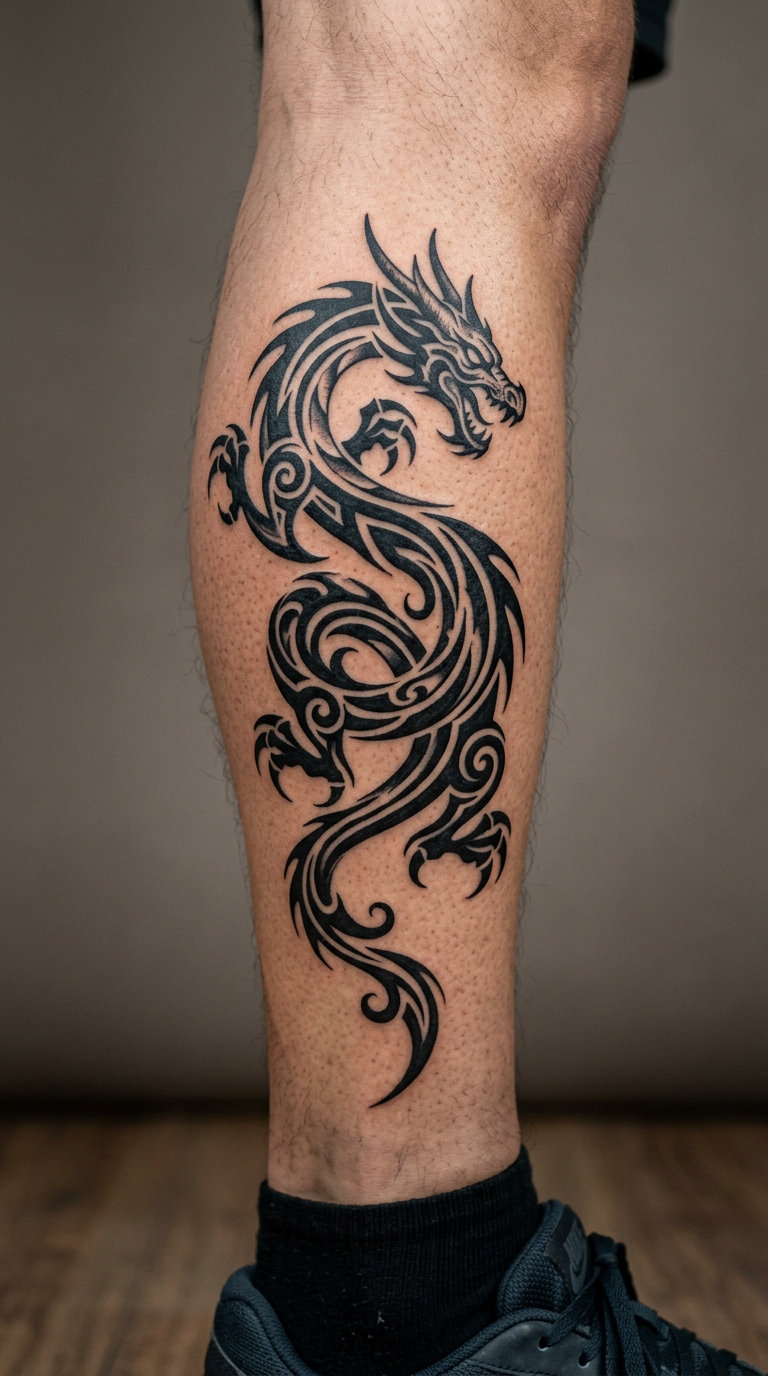
Heavy black bands wrap the body in thick curves, with claw shapes cut out as hard white gaps and no shading at all. The silhouette is confident and blocky so the creature reads from across a room.
Visual weight is the reason people choose this. It suits anyone who wants the dragon to be legible at a distance and who prefers graphic certainty over fine texture.
Placement: upper arm, shoulder, calf, thigh or back. Size: 6-12 inches (15-30 cm). Style: tribal-inspired blackwork. Pain: medium to high depending on the ribs, inner arm and shoulder. Thick bands need repeated passes, so this is a longer sitting and a warmer feeling area than a fine-line piece.
Make it yours: break the banding once with a single thin line, a small contrast that keeps the design from feeling flat.
17. Blue Water Dragon with Pearl Accent
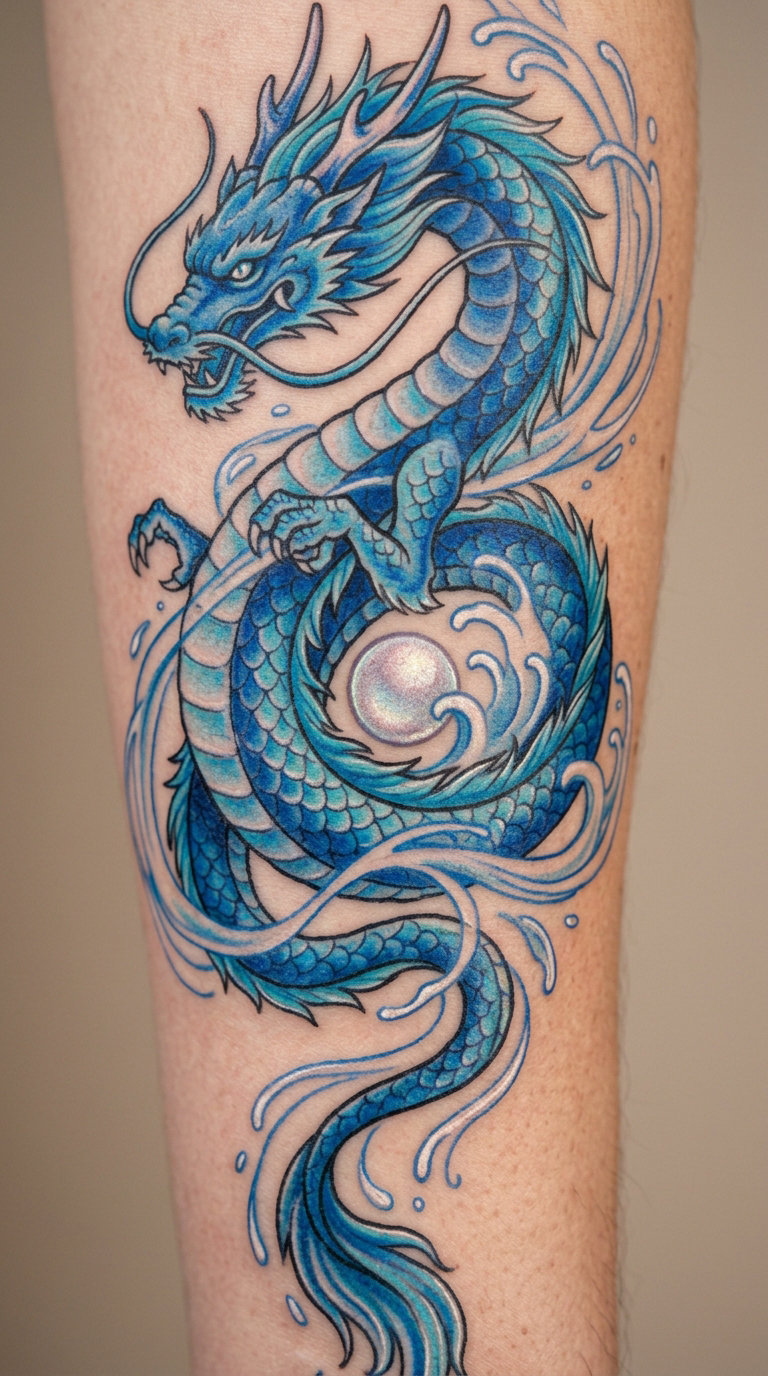
A blue-grey dragon curls through loose wave lines, with a simple pearl-shaped circle as the focal point and open skin between the wave crests. Soft gradients in the water keep the composition calm rather than busy.
Water movement makes for an open, flowing piece that does not feel crowded even at a larger size. It is a good match for someone who wants colour without the density of a full colour piece.
Placement: forearm, calf, shoulder or thigh. Size: 6-10 inches (15-25 cm). Style: watercolour or illustrative colour. Pain: medium, with higher discomfort near the inner arm and ribs. Pale blue details fade faster than black, so ask about a deeper shadow tone in the wave troughs to hold the contrast later.
Make it yours: replace the pearl with a small object only you would recognise, a coin, a bead, a stone.
18. Japanese-Style Dragon in Black and Red
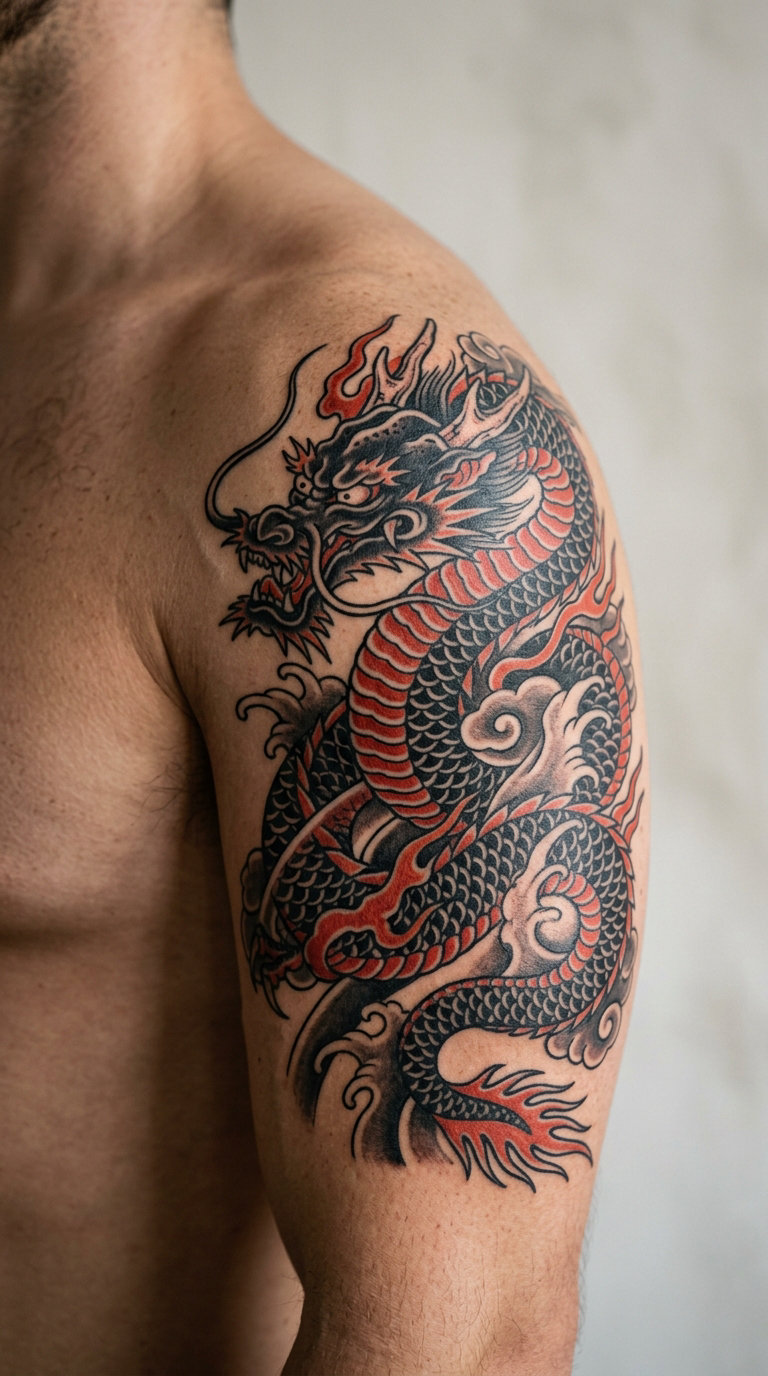
A serpentine dragon drawn in Japanese-inspired composition: long S-curves, stylised wave forms underneath, heavy black outlines and restrained vermilion on the scale ridges and eye.
This aesthetic is about linework and balance more than colour volume. Fans who like dramatic traditional composition tend to land here, and it holds up well on a shoulder where the body has a broad plane to work with.
Placement: forearm, shoulder, upper arm or calf. Size: 6-11 inches (15-28 cm). Style: Japanese-inspired blackwork with red ink. Pain: medium on the arm, high over the ribs and shoulder. Thin interior lines in this style are the first thing to soften, so a slightly heavier outline is worth asking for.
Make it yours: add a single brushed cloud form in grey behind the coils, the one soft shape in an otherwise hard-edged design.
19. Dragon Made of Fire and Smoke
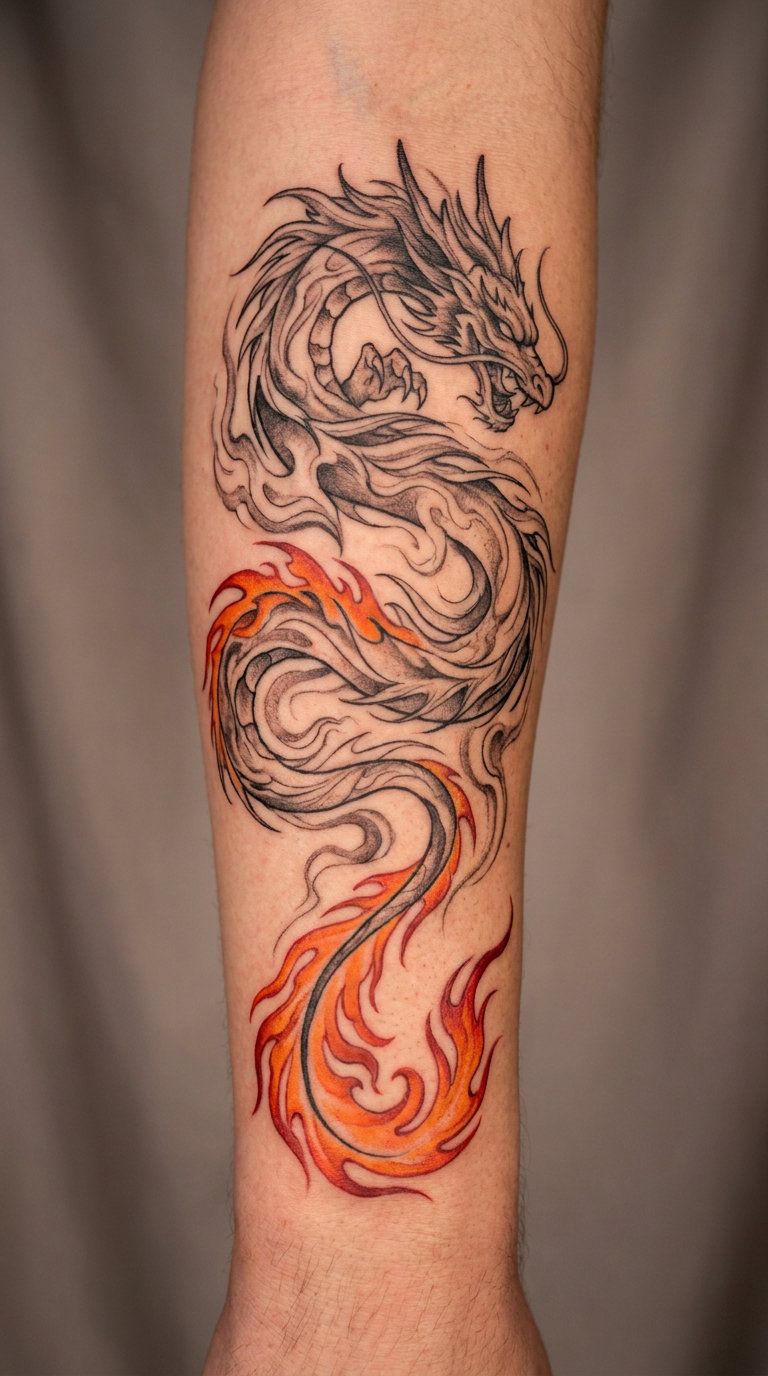
The tail dissolves into orange and yellow flame, the middle breaks into loose black smoke lines, and the head resolves into clear black linework. The transition is the design, not an afterthought.
A visual transformation from one state to another works well for people who mark a change or a milestone with the piece. The interpretation stays open, which is probably why it wears well over a decade.
Placement: forearm, calf, upper arm or back. Size: 6-10 inches (15-25 cm). Style: blackwork with colour realism. Pain: medium to high depending on the arm and back. Smoke detail and flame edges blur fast if made too fine, so let the artist simplify the smoke on the first pass rather than chasing detail that will fade.
Make it yours: put a real date on the flame end, where the shape is loosest and a few small characters will not fight the composition.
20. Micro Dragon on the Hand
A compact dragon wraps the outer hand or crosses the knuckles, using only a head, two claws and one curved body segment. Nothing that needs a long line survives well here, so the design is built from short confident marks.
Hand placement is bold and intimate at the same time. It is also the placement most often offered with a warning: find an artist who has done detailed hand work before, and expect it to need a refresh sooner than an arm piece.
Placement: outer hand, side of the hand or knuckles. Size: 2-4 inches (5-10 cm). Style: fine line or micro-realism. Pain: high on the hand. Hand and finger fine line fades and blurs faster than larger body placements, so keep detail minimal and budget for a possible touch-up.
Make it yours: have the claws land between two knuckles so the design follows the joints as your hand closes.
21. Dragon with a Floral Background
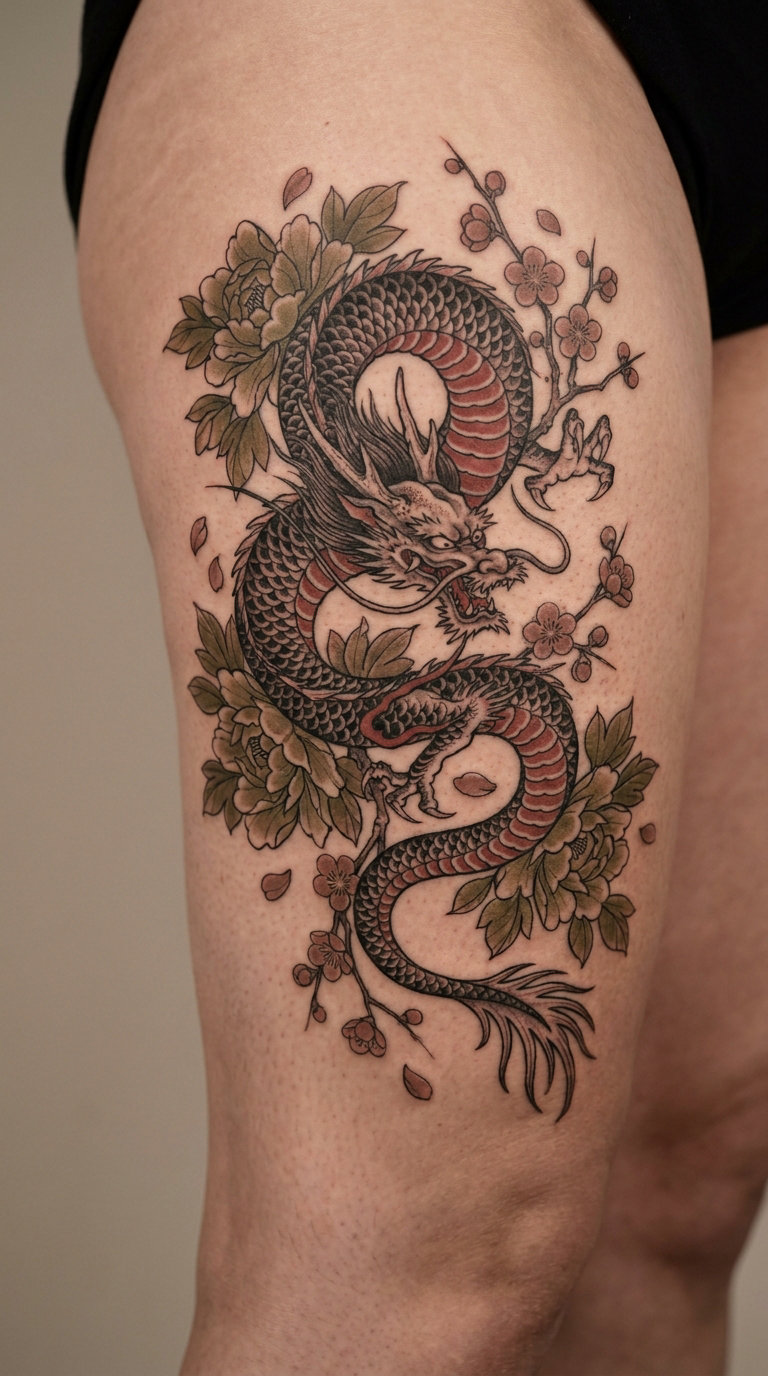
A confident dragon silhouette in black and red, softened by peonies, plum blossom and angular leaves in muted green and pink. The flowers overlap the coils at a few points so the two elements share the same space.
Flowers give the creature some relief, and people often choose specific blooms for their own associations rather than for any traditional reading. Balance is the skill here, more than detail.
Placement: shoulder, thigh, upper arm or back. Size: 7-12 inches (18-30 cm). Style: illustrative colour or neo-traditional. Pain: medium, higher over the ribs and shoulder blade. Small petal interiors blur together over time, so keep the flower centres simple and let the larger petals carry the shape.
Make it yours: pick a plant that means something where you live, a specific flower from a garden you remember.
22. Minimal Dragon with a Single Red Scale
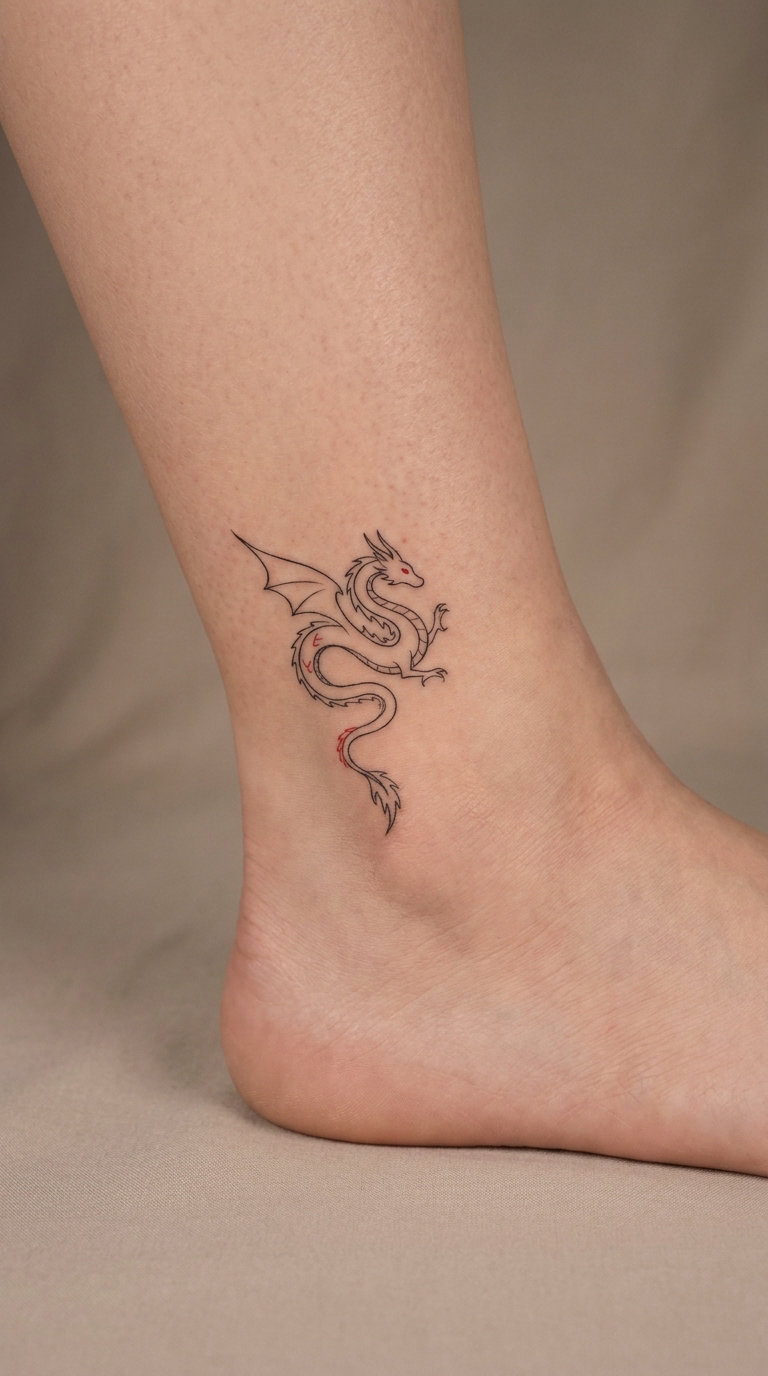
Mostly black fine line with one controlled colour hit: a single red scale, a red eye, maybe a short red tail tip. Everything else stays restrained, and the small accent is what makes people look twice.
This is a subtle way to reference dragon anime and martial-arts energy without a loud piece. The colour focus gives you an emotional punch at a fraction of the commitment of a full colour design.
Placement: wrist, ankle, forearm or upper arm. Size: 2-5 inches (5-12.5 cm). Style: fine line with a red accent. Pain: low to medium on the upper arm, medium on the wrist. Tiny red details and fine outlines are the first to fade on hands, wrists and ankles, so keep the accent large enough to still register after a few years.
Make it yours: repeat one red scale elsewhere on the body, such as an earlobe or a finger, as a quiet matching piece.
23. Dragon and Mountain Range Back Piece
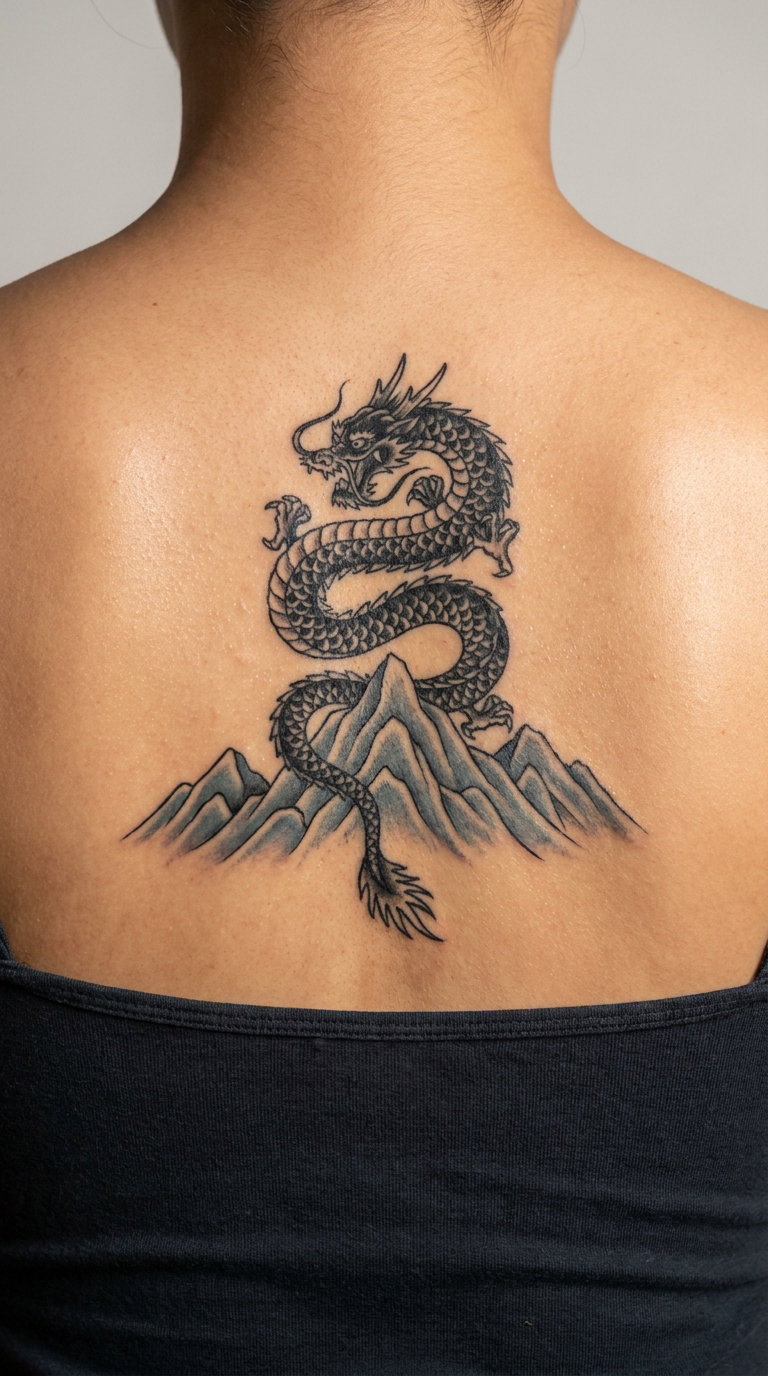
A broad composition with the dragon rising above a mountain range, open sky and atmospheric scale used so the peaks recede into distance. The creature is part of a scene rather than floating alone on a blank field.
Many wearers connect this direction to travel, home or a horizon that matters to them. It is a bigger commitment and a longer project, which suits people who already know what they want from a piece.
Placement: upper back, shoulder blade, thigh or calf. Size: 8-14 inches (20-35 cm). Style: illustrative blackwork with colour accents. Pain: high on the back, ribs and inner arm. A back piece of this size is a multi-session project, usually several sittings of three to five hours with breaks between them, and you should plan on aftercare across the whole series.
Make it yours: draw the range from a photograph you took, then leave one peak out of frame.
24. Dragon with a Dynamic Speed-Line Finish
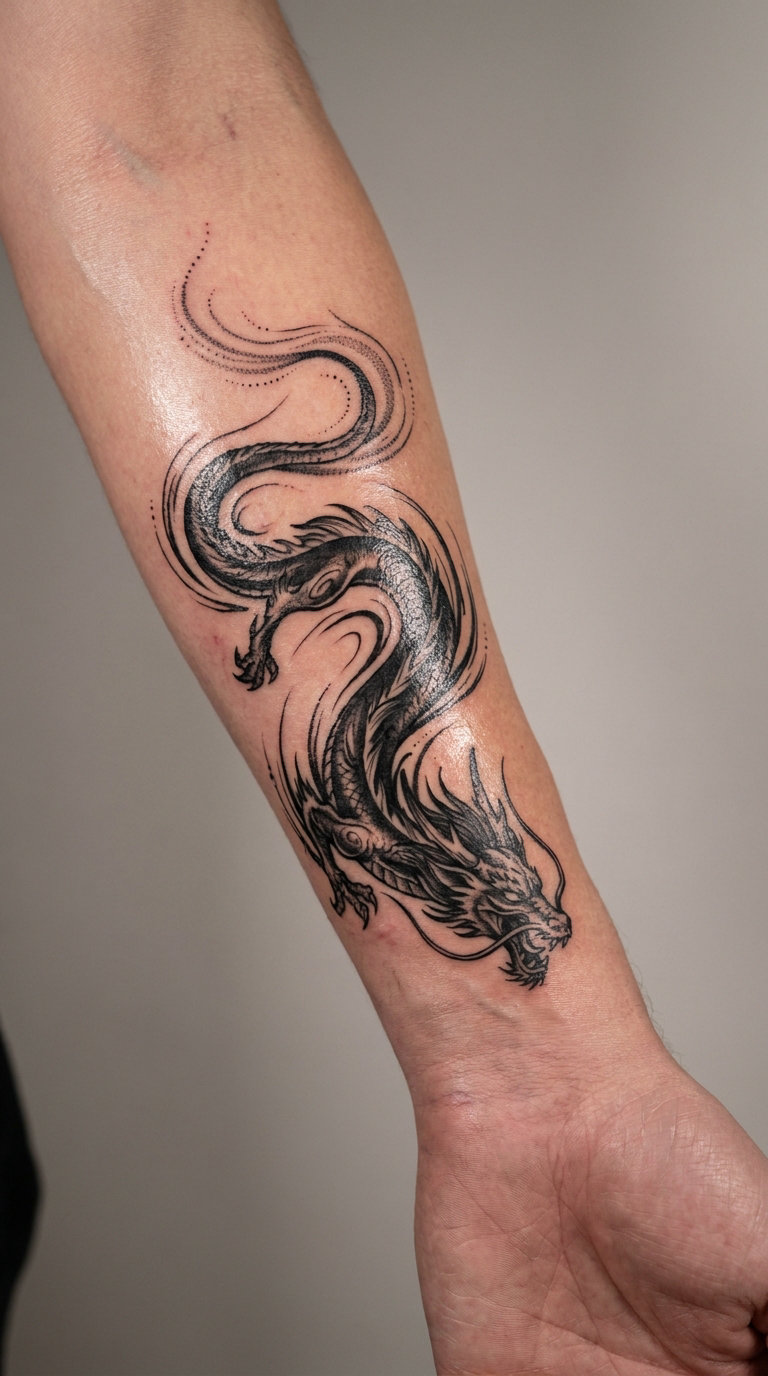
The dragon lunges forward, body foreshortened, with tapered speed lines streaming behind it and a wind trail curling off the tail. Selective black shading concentrates under the jaw and along the spine so the pose carries the movement.
Motion-focused compositions appeal to people who like energetic storytelling, and the forward lean suits a forearm or calf where the limb itself adds direction. Nothing here depends on a specific action scene.
Placement: forearm, calf, shoulder or thigh. Size: 6-10 inches (15-25 cm). Style: manga-inspired blackwork or neo-traditional. Pain: medium to high depending on placement. Very thin speed lines close up and thicken as they heal, so ask for them a little heavier than the reference and check the healed result at your follow-up appointment.
Make it yours: run one speed line out past the edge of the design and let it fade into bare skin.
25. Original Dragon Portrait with Power Aura
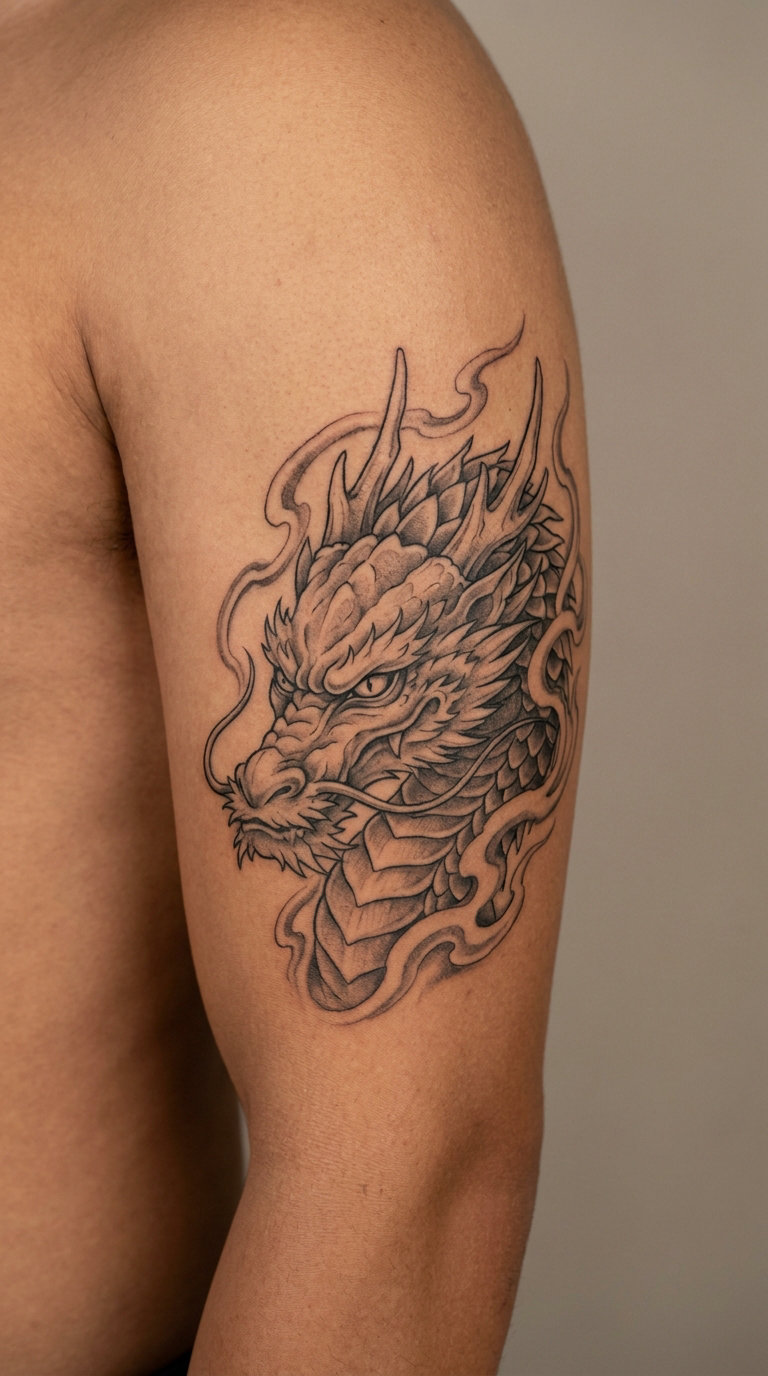
A front-facing portrait with a non-franchise silhouette, focused eyes, layered scales across the neck and a soft aura built from smoke and radiating lines behind the head. The expression carries the piece, not the background.
Portraits get chosen for strength, protection or plain admiration of the creature. Drawn as an original design with no costume or emblem, it keeps working even for someone who has moved past the fandom.
Placement: chest, shoulder, upper arm or back. Size: 5-9 inches (13-23 cm). Style: black-and-grey realism or illustrative blackwork. Pain: high on the chest, shoulder blade and ribs. Facial details are what viewers notice most and what ages least well, so keep the eye and mouth clean rather than adding texture there.
Make it yours: give the aura a shape borrowed from somewhere real, a wave pattern, a cloud form, a ring of light.
How to Choose the Right Design
Start with how much room you actually have. A flat area of skin that never creases will hold detail better than a joint, and a dragon that wraps a forearm needs to be drawn for that curve rather than scaled down onto it.
| Decide first | Then pick |
|---|---|
| First tattoo, low commitment | Number 4, 14 or 22, anything under 3 inches |
| Small and discreet | Number 1, 9 or 20 |
| Bold and readable at distance | Number 2, 12 or 16 |
| Collector piece, several sessions | Number 15, 23 or 25 |
| Colour, light and movement | Number 3, 17 or 19 |
| Matching pair or two-part set | Number 11 and 22, or 1 and 5 mirrored |
Think about the style before the subject. If you want something that ages with dignity, fine line and blackwork are easier to keep looking intentional. If you want a full colour piece, go in knowing that yellow and orange are the first colours to shift and plan a refresh.
Then ask the artist to redraw, not trace. Bring screenshots of what you like and describe what you want the dragon to be doing. If you want more traditional dragon work rather than anime-influenced linework, the Celtic dragon tattoo gallery shows a very different visual language worth looking at before you commit.
Cost and Session Time
There is no product to buy here, but there is a bill, so it is worth knowing how it is built. Most US shops charge by the hour, with a minimum that covers a short first piece, and rates vary a lot by city and by artist.
A small line piece in the 2-3 inch range usually fits in a single sitting of well under an hour, minus the consultation. A medium colour design of 6-8 inches commonly runs two to three hours and may be booked as a full session. A piece over 8 inches, and anything on the back, ribs or a full sleeve, is almost always a multi-session project.
For ballpark numbers, most US shops sit in the $80 to $200 an hour range with a $75 to $150 minimum, so a small fine-line piece lands somewhere around $100 to $250 all in, a 6-8 inch colour design around $400 to $900, and a full sleeve or back piece can run into the thousands once four or five sittings are added up.
What moves the number: hours, colour count, placement difficulty and how much detail the drawing holds at final size. Hourly rates and shop minimums vary by region, so treat any figure you are quoted as specific to that artist and that city, and ask whether the price covers a single sitting or the full project.
Aftercare Basics
- Follow your artist’s aftercare instructions first, since they know exactly what they did in your skin.
- Wash the area gently with clean lukewarm water and a mild unscented cleanser, then pat dry with a clean towel rather than rubbing.
- Protect it from sun and friction. Loose clothing over a fresh piece beats tight fabric, and sunscreen on a healed tattoo matters for years, especially for yellow and orange ink.
- Avoid swimming, soaking, hot tubs and saunas for as long as your artist advises.
- Do not pick scabs or peel flakes. If anything looks wrong to you, message the artist first, and contact a qualified healthcare professional if symptoms persist or concern you.
Frequently Asked Questions
Can I get a Dragon Ball character tattoo without copyright problems?
Yes, and the way to do it is redrawing rather than tracing. Screen-printed manga panels, logos, costumes, armour and the seven-star Dragon Balls are all protected. An artist can take the general idea, such as a golden-haired fighter in a power-up pose, and draw an original figure with different proportions, features and no insignia. Ask for a redraw from your description, and check the artist’s portfolio for healed anime-influenced work.
What size Dragon Ball tattoo should I get as my first one?
Under 3 inches if it is your first tattoo. Ideas 4, 14 and 22 in this list all fit that range, take under an hour, and sit in placements that heal predictably like the outer upper arm or calf. Avoid the wrist, hand and fingers for a first piece, since those areas move constantly and fine detail there blurs quickly. A small piece also gives you a realistic idea of how you handle a sitting before committing to a larger project.
What is the least painful placement for a dragon tattoo?
The outer upper arm, outer thigh and calf are the gentlest options, because there is muscle and some fat cushioning the needle. The inner arm, ribs, collarbone, sternum, shoulder blade, lower back, wrist and hand sit near bone or over nerve clusters, so expect noticeably more discomfort there. Behind the ear and across the knuckles rate highest in most wearer accounts. Duration and personal tolerance change the experience more than placement alone.
How many sessions does a large dragon tattoo take?
A 6-8 inch design with colour often takes two to three sittings of two to three hours. A full sleeve or a back piece of 12 inches or more is a project rather than an appointment, usually split into several sittings of three to five hours with healing time in between. Dragon Ball collectors posting about their own sets describe third and fourth sessions as routine. Book each session as a separate project so the artist is never rushing a heal.
How do I make a dragon tattoo personal rather than copied?
Change at least three things from any reference: the pose, the background, the ink treatment and the scale pattern. Then add one detail that is genuinely yours, such as a birth month, a coordinate, a plant from your home town or a word that means something to you. Leave out the protected material, which means no franchise kanji in the wrong stroke order, no costume details and no traced panel. That combination is what makes the piece yours rather than a copy.
Will a yellow or gold dragon tattoo fade quickly?
Yes, bright yellow and warm orange are the least stable pigments in tattooing, and a Super Saiyan style gold hair design will shift toward pale within a few years. Red holds better but still warms over time. If a full colour design matters to you, ask your artist to build shadow in a deeper tone so the piece still reads once the gold softens, and plan a colour refresh rather than treating that as a failure. Blackwork and black-and-grey ageing is far more predictable.
Conclusion
If this is your first tattoo, go with number 4 or number 22. Both are small, both are drawn in restrained black with one clear idea, and both sit in placements that heal without drama. Number 1 is the other safe pick if you want something a little more visible but still line-based.
If you are building a set rather than making your first mark, number 15, number 23 and number 25 are the ones worth sketching first, and they are all multi-session projects, so plan the timeline before the drawing. Save the designs that pulled you in, take them to an artist who works in anime-influenced linework, and talk through originality, placement and final size before you book.