
20 Best Stained Glass Tattoo Ideas: Gothic Colors (October 2026)
A stained glass tattoo is a design that imitates a leaded window: bold black outlines divide the image into flat color panels, and saturated pigment is packed inside each one so the finished piece looks like light passing through glass. That effect is why the style keeps trending — the color really does pop in a way flat illustrative work doesn’t.
The 20 stained glass tattoo ideas below cover gothic cathedral windows, florals, birds, insects and a few minimal pieces small enough for a collarbone. Every entry lists placement, realistic size, style, pain and one way to make it personal. If you’re booking this year, plan 30 to 45 days ahead so a touch-up window sits after you plan to unveil it.
One honest note before you browse. Tattooers working in this style treat it as a color-packing variant of neo-traditional, not a separate medium, so it heals the same way. What does not survive healing is over-detailed linework. Artists in r/TattooApprentice and r/StainedGlass keep warning that fine lead lines packed too small “fade together into blobs.” Ask to see healed work, not fresh photos.
Stained Glass Tattoo Ideas: Quick Guide
| Idea | Style | Best placement | Size | Pain |
|---|---|---|---|---|
| 1. Gothic rose window | Color neo-traditional | Outer forearm | 4 in (10 cm) | Medium |
| 2. Jeweled dragonfly | Color, symmetrical | Inner upper arm | 3 in (7.5 cm) | Medium |
| 3. Rose window sun | Color geometric | Upper back | 4 in (10 cm) | Medium |
| 4. Gothic cathedral window | Blackwork | Calf, vertical | 7 in (18 cm) | Medium-high |
| 5. Watercolor hummingbird | Watercolor, soft edges | Shoulder blade | 3 in (7.5 cm) | Low-medium |
| 6. Lotus mandala | Color mandala | Lower back | 5 in (13 cm) | Medium-high |
| 7. Multi-color butterfly | Color illustrative | Upper back | 4 in (10 cm) | Medium |
| 8. Minimalist lungs | Minimal line and flat color | Ribs, along the side | 5 in (13 cm) | Medium-high |
| 9. Peacock feather pane | Color illustrative | Outer forearm | 6 in (15 cm) | Medium |
| 10. Art Nouveau lily | Fine line, opal tones | Hip | 5 in (13 cm) | Medium |
| 11. Tree of life | Color, organic panels | Forearm | 6 in (15 cm) | Medium |
| 12. Crescent moon in glass | Minimal color | Behind the ear | 3 in (7.5 cm) | High |
| 13. Koi in a blue panel | Color illustrative | Forearm, pale skin | 5 in (13 cm) | Medium |
| 14. Square-framed sunflower | Bold color graphic | Upper arm | 4 in (10 cm) | Medium |
| 15. Two-pane heart | Micro color | Wrist | 1.5 in (4 cm) | Medium-high |
| 16. Gothic skull in arches | Black and grey with color | Calf | 4 in (10 cm) | Medium-high |
| 17. Hummingbird and blossom | Color, vertical | Inner arm | 3 in (7.5 cm) | Medium |
| 18. Galaxy rose window | Color, fine detail | Back of shoulder | 5 in (13 cm) | Medium |
| 19. Collarbone rose | Color, small | Collarbone | 2.5 in (6 cm) | High |
| 20. Full-color phoenix | Color, large format | Shoulder blade | 9 in (23 cm) | High |
1. Gothic Rose in a Jewel-Tone Window
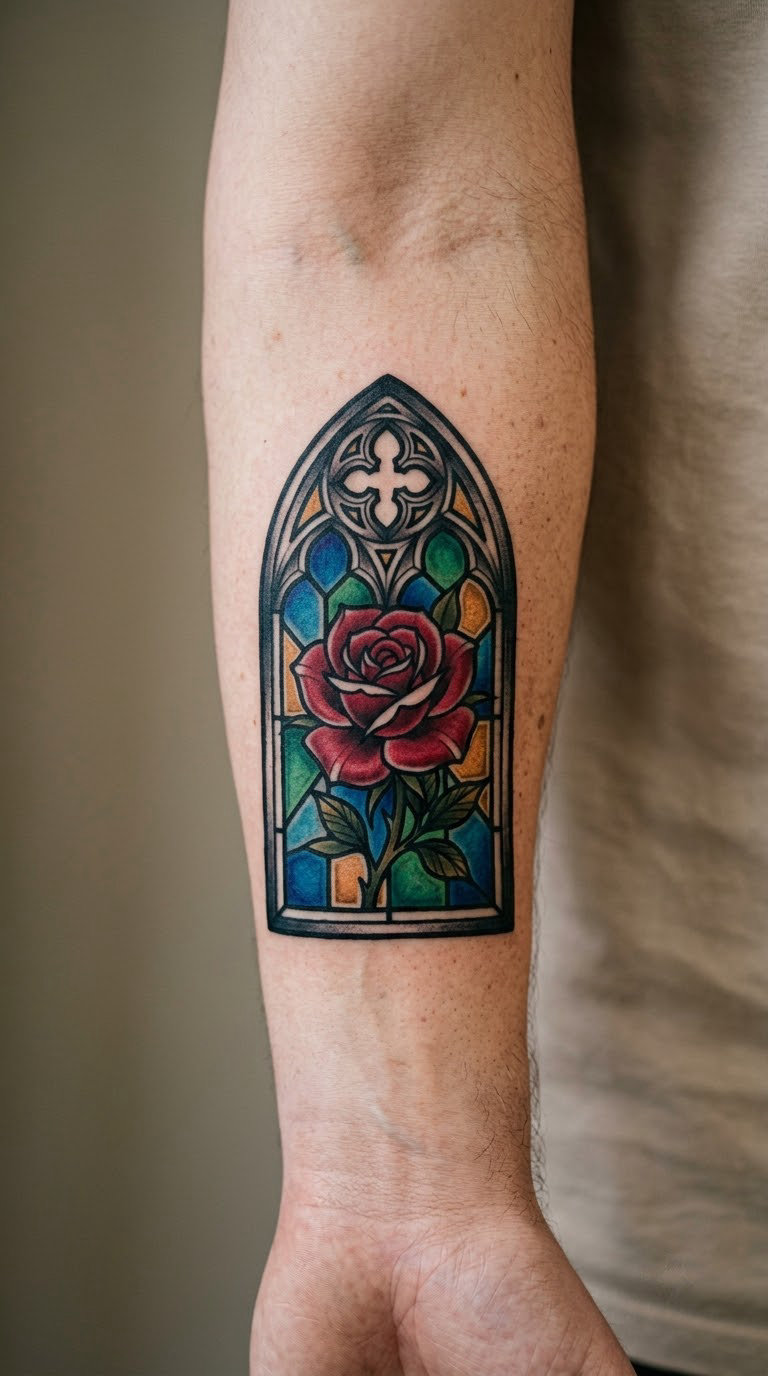
A deep red rose sits inside a pointed arch, its petals broken into flat panes of ruby, cobalt and amber by a heavy black frame. The outline does most of the work here, so the design needs a bold leading style rather than a painterly one.
People choose this one because a rose is easy to read even at small scale, and the arch frame makes a single motif feel like an entire window. It’s the gothic church stained glass tattoo seen in an old cathedral, compressed to forearm size.
Placement: outer forearm, inner bicep. Size: 3.5 to 4.5 inches (9 to 11 cm). Style: color neo-traditional with blackwork leading.
Pain: medium on the forearm. The color packing stings more than the linework. Fine highlight lines inside the petals can soften over the years, so ask the artist to leave the petal detail broad.
Make it yours: swap the ruby for a birthstone color, or set a date in small panes along the arch base.
2. Stained-Glass Dragonfly with Jeweled Wings
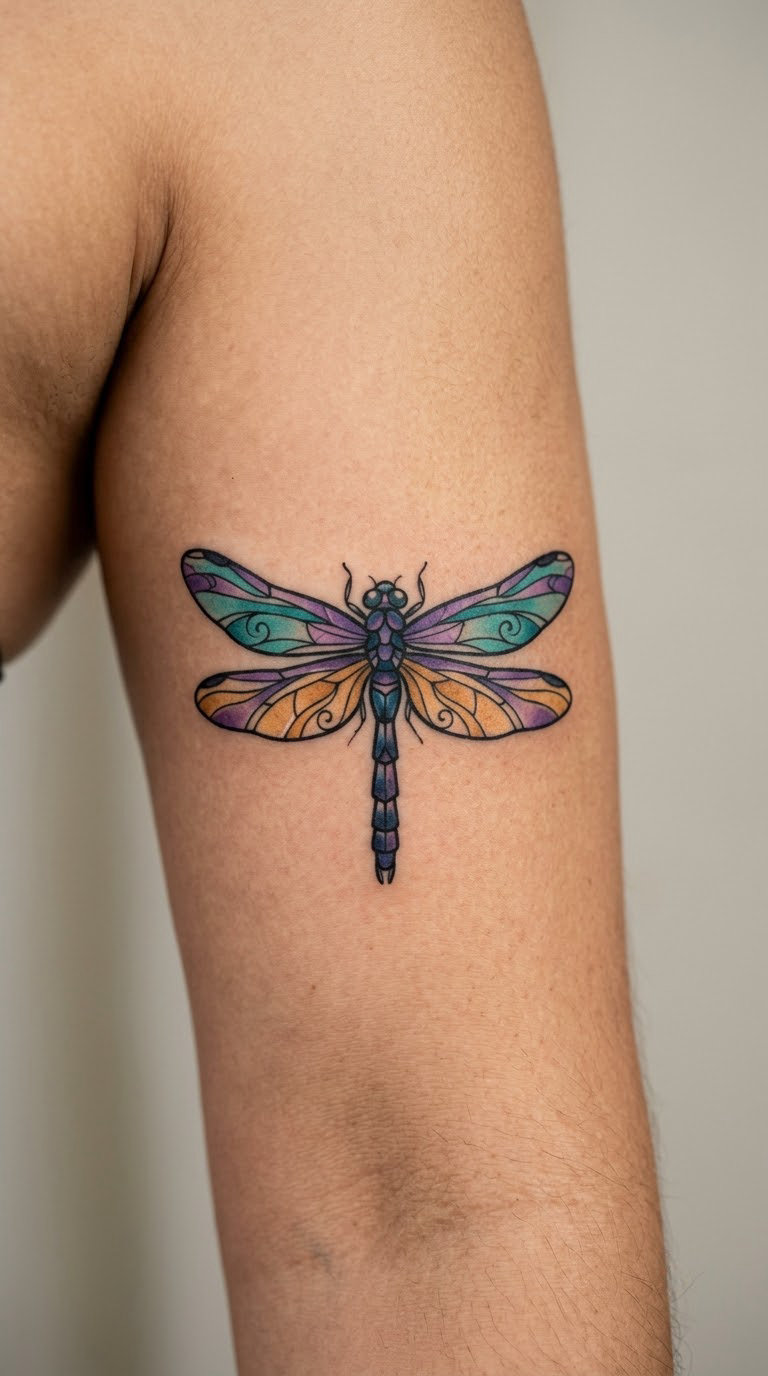
A dragonfly built symmetrically, with four wings divided into teal, violet and amber panels and a slim dark body. Because both sides match, the eye reads the whole design as balanced rather than as a collection of shapes.
It’s a good pick if you like the jewelry-like quality of the style but don’t want a piece that shouts. Dragonflies come with a light, transitional reputation in this work, and the symmetry does most of the visual lifting.
Placement: inner upper arm, sternum, back of the shoulder. Size: 2.5 to 3.5 inches (6 to 9 cm). Style: symmetrical color with fine black linework.
Pain: medium on the upper arm, higher on the sternum because the bone sits close to the surface. Thin wing veins blur a little with age, so the artist should keep them at two tones rather than gradients.
Make it yours: tint the four wings in two colors instead of four, and add a second smaller dragonfly a few inches along as a pair.
3. Rose Window Sun with Geometric Petals
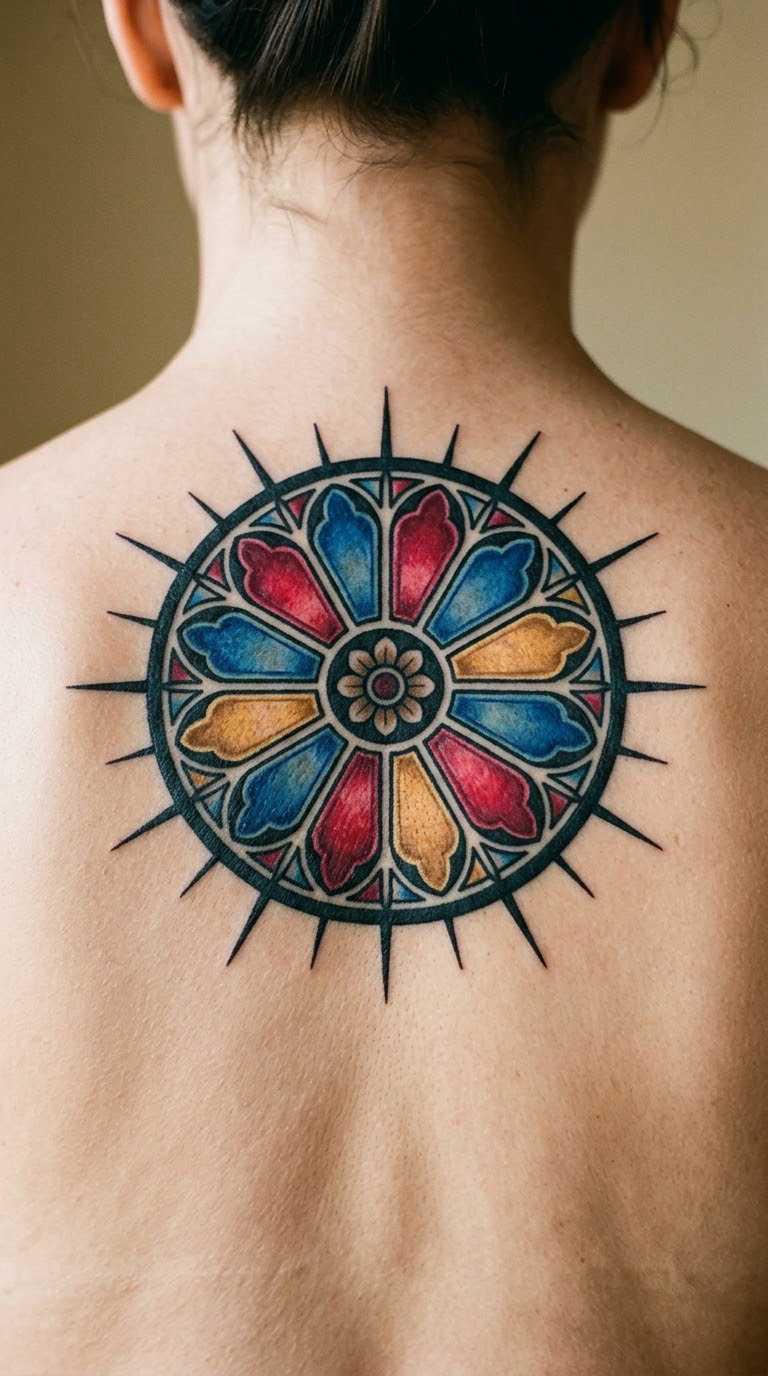
A circular rose window turned into a sun, built from twelve radial petals in ruby, cobalt and gold with short black rays around the rim. The whole design depends on even spacing, which is where an inexperienced hand shows.
This one shows up for people who like geometry and symmetry more than illustration. It’s a mandala with a light source in the middle, and the radial layout means it works from a distance as well as up close.
Placement: upper back, sternum, thigh. Size: 4 to 5 inches (10 to 13 cm). Style: color geometric with black leading.
Pain: medium to medium-high. The upper back takes a long session and the ribs underneath it make the last stretch tiring. Fine radial divisions in the outer ring can look muddy after a few years, so simplify them at the start.
Make it yours: have the center pane left as bare skin instead of a solid color, so the design reads as light shining through.
4. Blackwork Gothic Cathedral Window
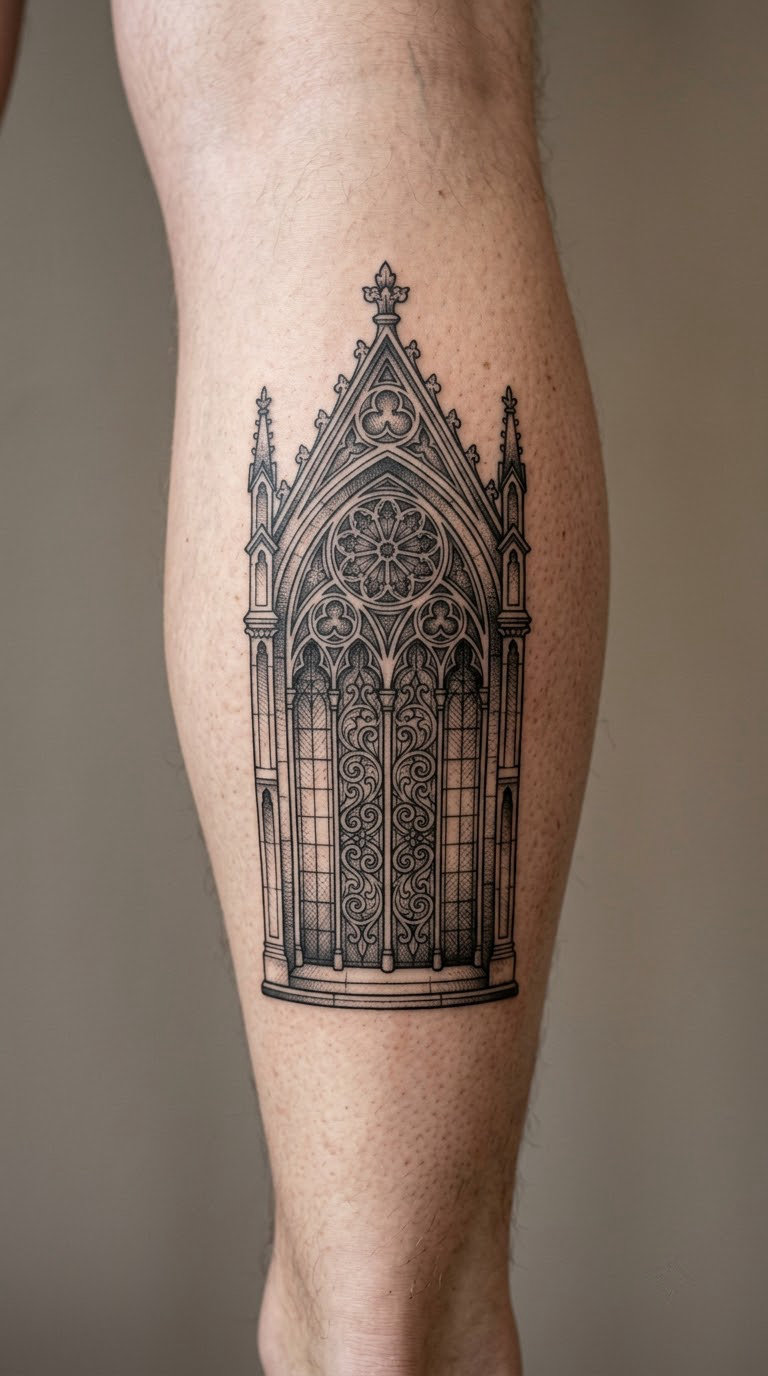
The same window idea with no color at all: pointed arches, tracery and dense crosshatching built from black ink and negative space. Done well, this is the most underrated version of the style and the easiest to place on a large flat area.
Blackwork reads as gothic rather than colorful, which suits anyone drawn to the cathedral lineage of stained glass without wanting a rainbow on their arm. It also hides healed color change entirely, since there is no color to dull.
Placement: calf, outer thigh, forearm sleeve. Size: 6 to 8 inches (15 to 20 cm) tall. Style: blackwork with fine linework.
Pain: medium-high. A seven-inch piece of fine crosshatching is a long sitting, and the calf is a fleshy spot. Small line weights in the tracery fill in over time, so the artist should work at a heavier line than feels necessary.
Make it yours: put a real cathedral’s window layout into the tracery, or leave the central pane empty and let bare skin be the light.
5. Watercolor Stained-Glass Hummingbird
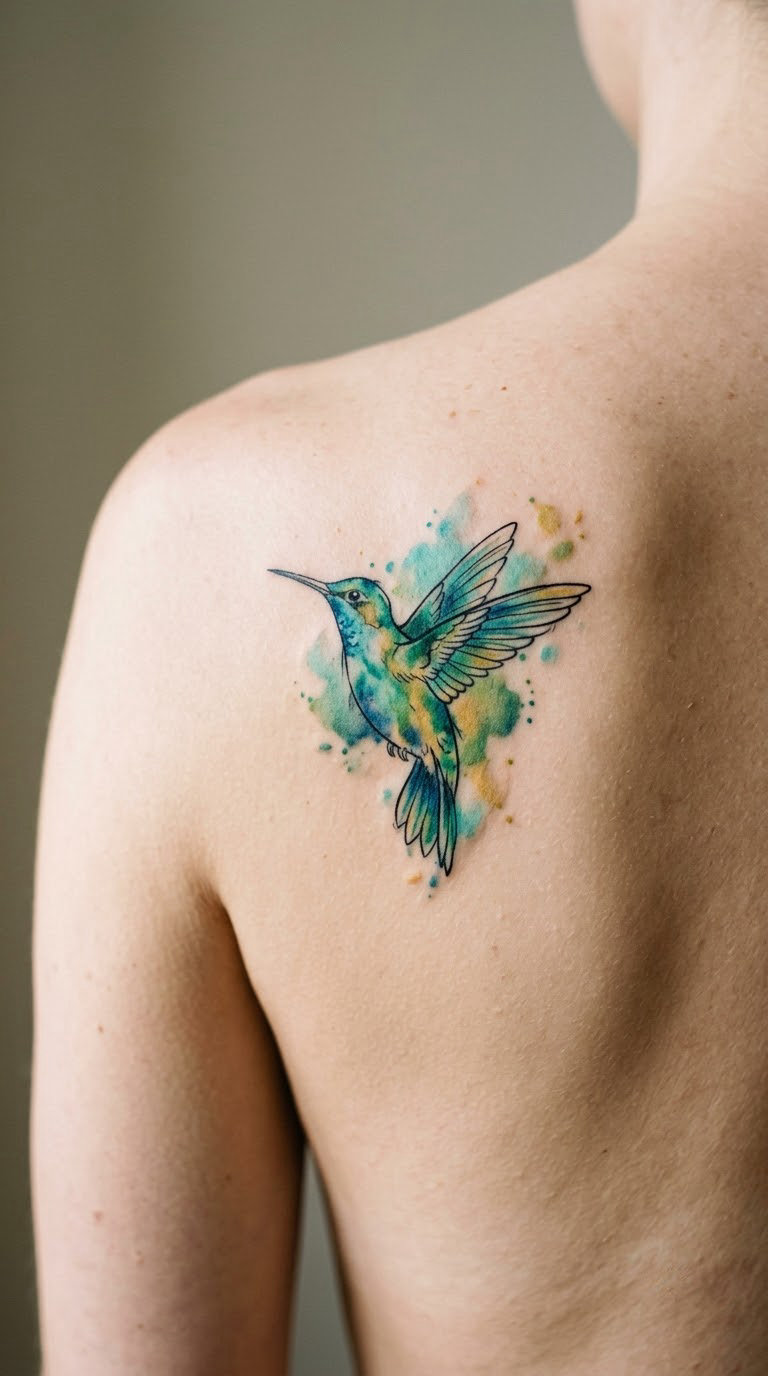
A hummingbird suspended inside loose watercolor panes, with turquoise, forest green and golden yellow washes that bleed into each other instead of stopping at hard edges. It’s a soft take on a style that usually runs black and hard-edged.
Most people chasing this style want the color saturation payoff, and a client with a healed stained glass hummingbird described it best in r/tattoos: it makes the colors pop. This version trades crisp leading for an airy feel.
Placement: shoulder blade, upper back, forearm. Size: 2.5 to 3.5 inches (6 to 9 cm). Style: watercolor with loose color washes.
Pain: low to medium. Shoulder blades are one of the more forgiving spots for a soft design. Watercolor is harder to heal sharply than saturated packing, so expect the edges to settle softer than the reference image.
Make it yours: tint the wash with a color tied to a place, or add a second smaller bird flying out of frame.
6. Stained-Glass Lotus Mandala
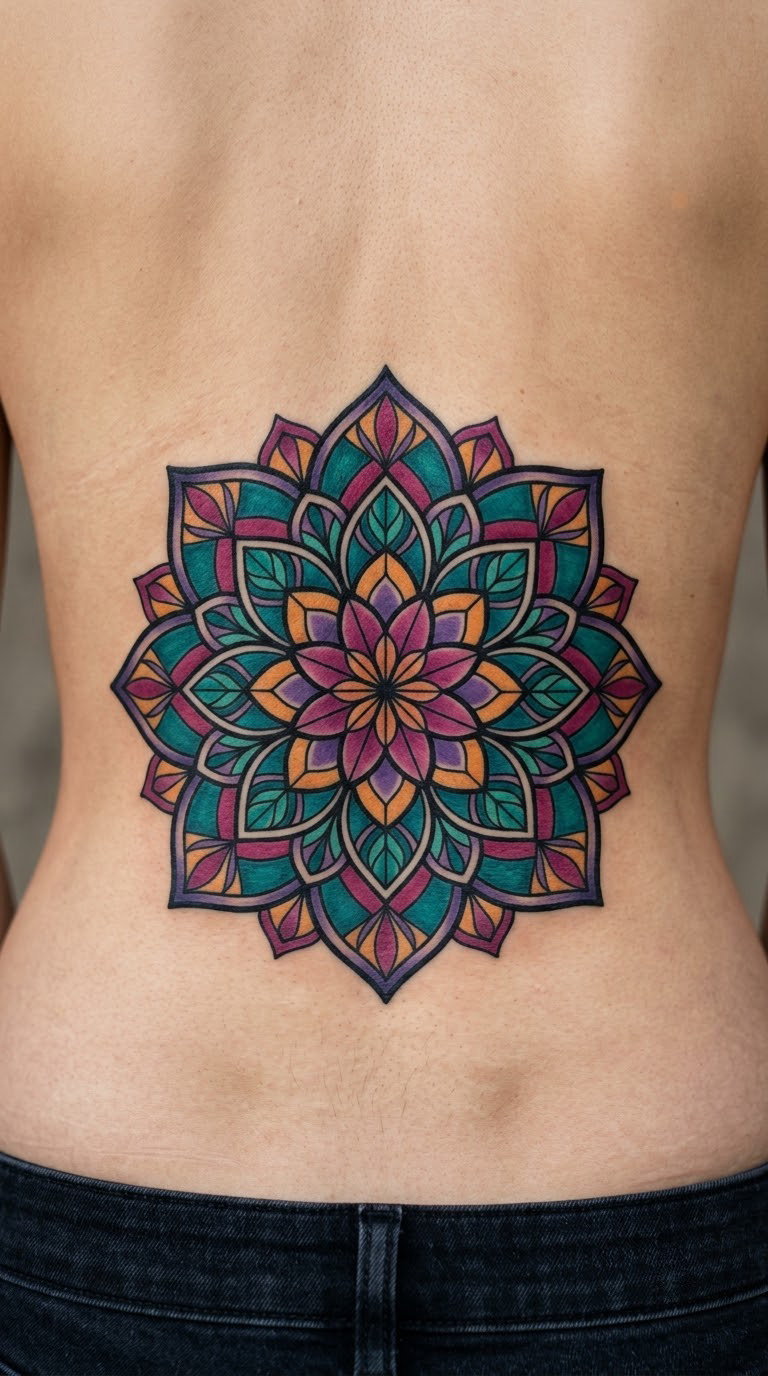
Concentric lotus petals in alternating jewel colors, eight layers deep, each ring a different shade with black outlines holding it together. It’s the most mandala-like entry on this list and the most demanding to keep symmetrical.
Lotus designs get chosen for the calm, layered look rather than a fixed piece of symbolism — nobody in the artist community I checked attributes one fixed meaning to it. If you want a piece that reads well from across a room, this is it.
Placement: lower back, sternum, upper thigh. Size: 5 to 6 inches (13 to 15 cm). Style: color mandala with black linework.
Pain: medium-high over several hours. The lower back is bony and hard to rest on. Eight rings of thin detail will blur, so most artists cap it at four or five and widen the color bands.
Make it yours: use four rings with a wider spacing instead of eight, then add a personal color to the outermost ring only.
7. Butterfly in Multi-Colored Glass Panels
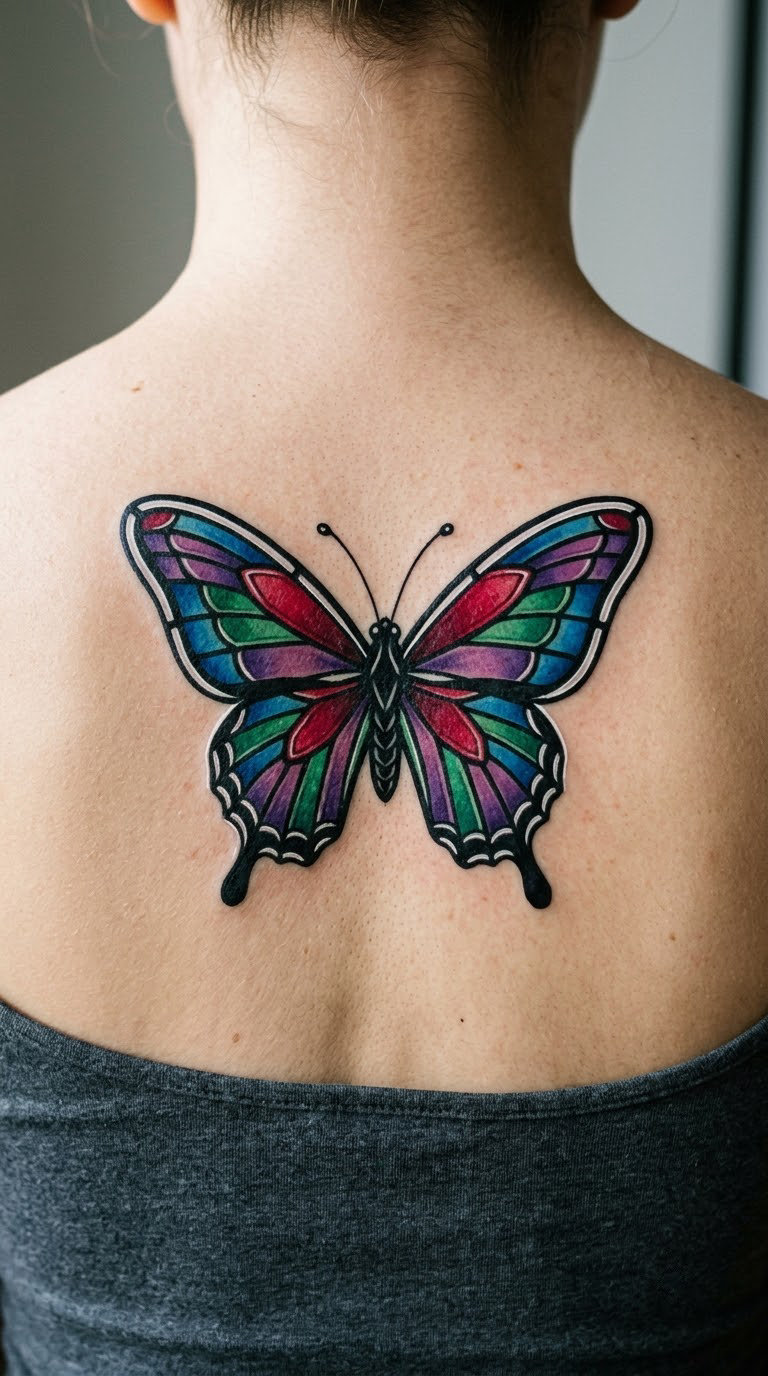
A butterfly whose wings are divided into irregular translucent panels of ruby, cobalt, emerald and violet, with thick black leading and a pale inner border separating wing from body. The white gap is what keeps the color from looking muddy.
This is the version most tattooed in a single sitting, because the panel count is high but each panel is large. It suits a first tattoo more than the finer botanical pieces on this list.
Placement: upper back, shoulder blade, calf, hip. Size: 3.5 to 4.5 inches (9 to 11 cm). Style: color illustrative with heavy black leading.
Pain: medium. Wing veins are single-pass linework, so the sting is brief. Small vein detail on the inner wings softens first, so the artist should keep veins to two tones.
Make it yours: mirror the panel layout from one wing onto the other instead of repeating it exactly, which reads as designed rather than stamped.
8. Minimalist Stained-Glass Lungs
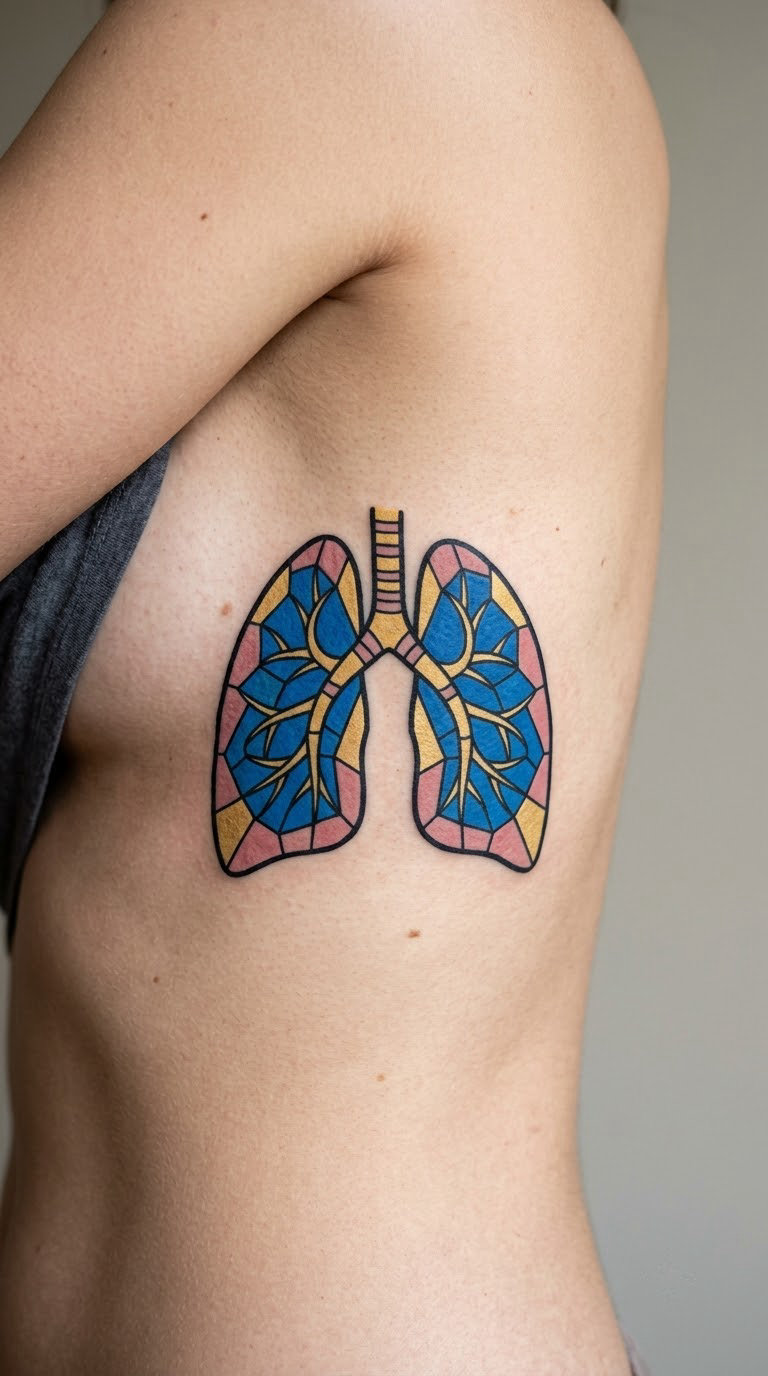
An anatomical lung shape segmented into flat cobalt, dusty rose and gold sections with clean black outlines and no gradient anywhere. The restraint is the point: three colors, hard edges, no shading.
It reads as anatomical rather than gothic, and people choose it when they want the stained glass look without a floral motif. Three colors is about the ceiling for a piece this shape-driven at a medium size.
Placement: along the ribs, side of the torso, inner arm. Size: 4.5 to 5.5 inches (11 to 14 cm). Style: minimal line with flat color.
Pain: medium-high. Ribs are bony and the session runs long. Fine bronchial lines inside the lobes blur noticeably over the years, so a simplified lobe structure lasts far better.
Make it yours: add a thin black baseline running under both lungs, connecting it to a second small piece later.
9. Peacock Feather as a Colorful Pane
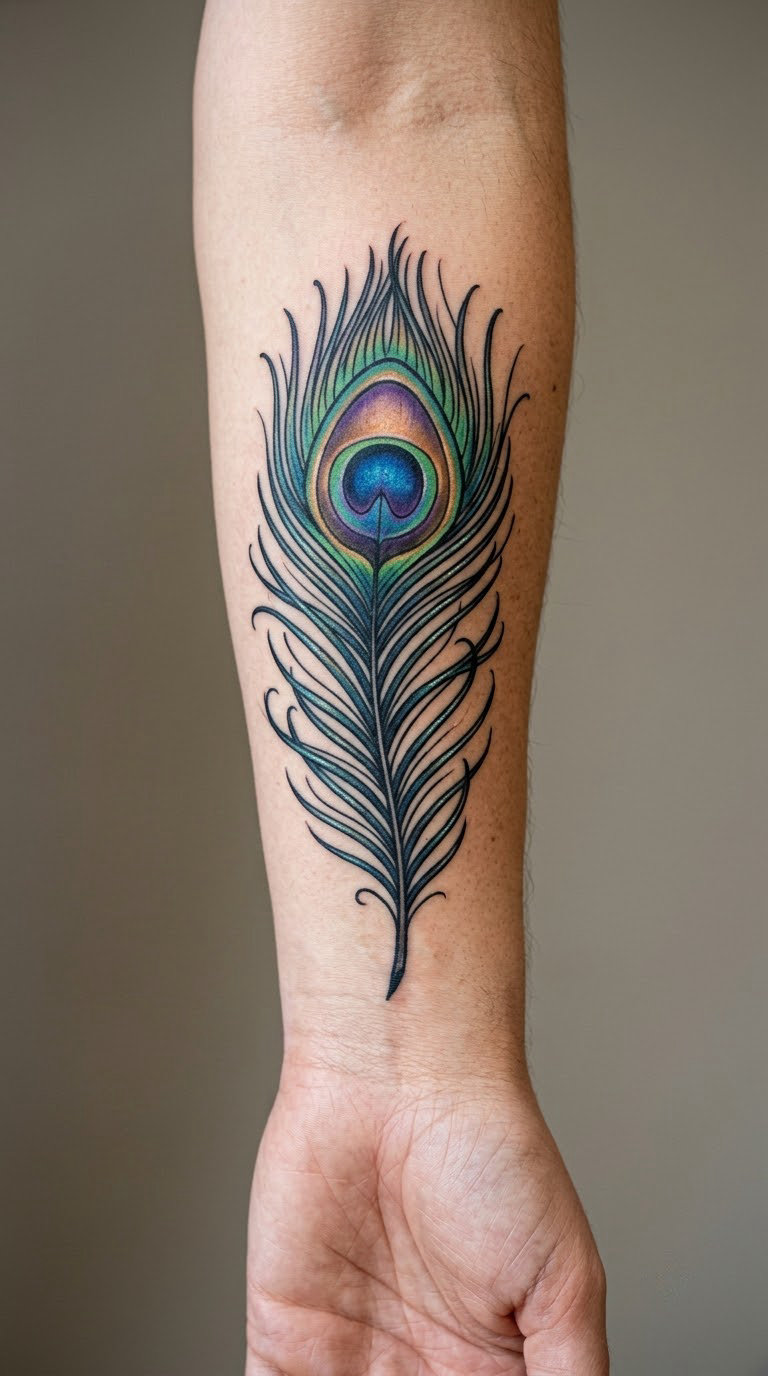
A single peacock feather built from eye-shaped segments in emerald, sapphire, violet and amber, each one enclosed by a bold black outline so it reads as a separate pane of glass.
It’s one of the most requested motifs in this style because the eyes are naturally shaped panels. The barbs either side can stay as loose linework in green and gold, which keeps the session shorter.
Placement: outer forearm, thigh, back of the calf. Size: 5.5 to 6.5 inches (14 to 16 cm). Style: color illustrative with black leading.
Pain: medium. The outer forearm is a good canvas for this length. Tight barb detail near the shaft fades fastest, so it should be simplified or dropped at smaller sizes.
Make it yours: keep two eyes in full color and render the rest of the feather as green and gold linework only.
10. Art Nouveau Lily in Opal Glass
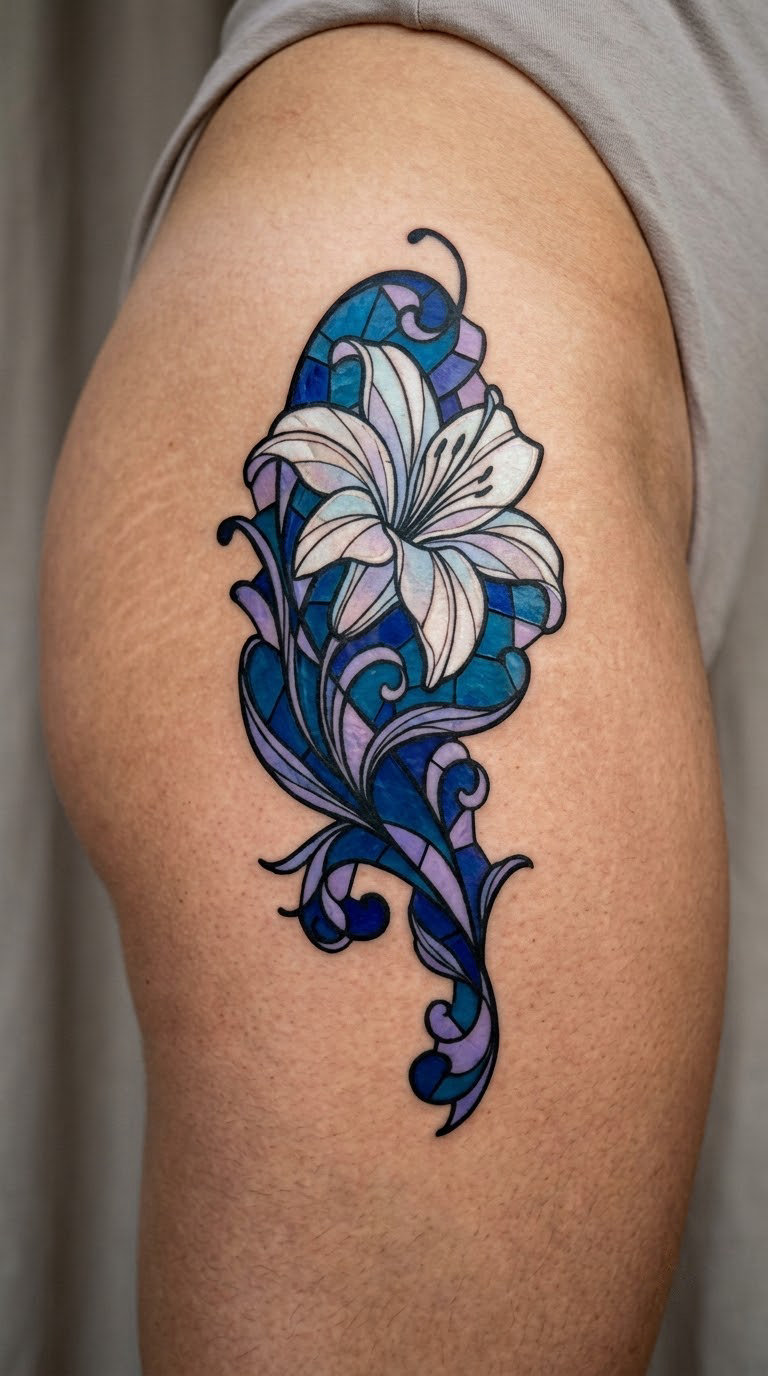
A lily drawn in Art Nouveau curves, with opal white petals, pale blue and lavender panes and stems that curl in long single lines. The palette is soft where most stained glass work is saturated, and that is the whole appeal.
Soft-toned glass is the practical choice if you want this style and prefer a piece that doesn’t dominate a room. Ask for a matte-ish look and expect the artist to keep the color count low.
Placement: hip, thigh, forearm, ribs. Size: 4.5 to 5.5 inches (11 to 14 cm). Style: Art Nouveau linework with pale color.
Pain: medium. Curving stems are single-line work, so it feels lighter than the session length suggests. Pale tints and fine stems both fade a little faster than saturated packing, which is the tradeoff here.
Make it yours: keep the stems black and make every other pane one shade lighter than the reference, which holds up better over a decade.
11. Stained-Glass Tree of Life
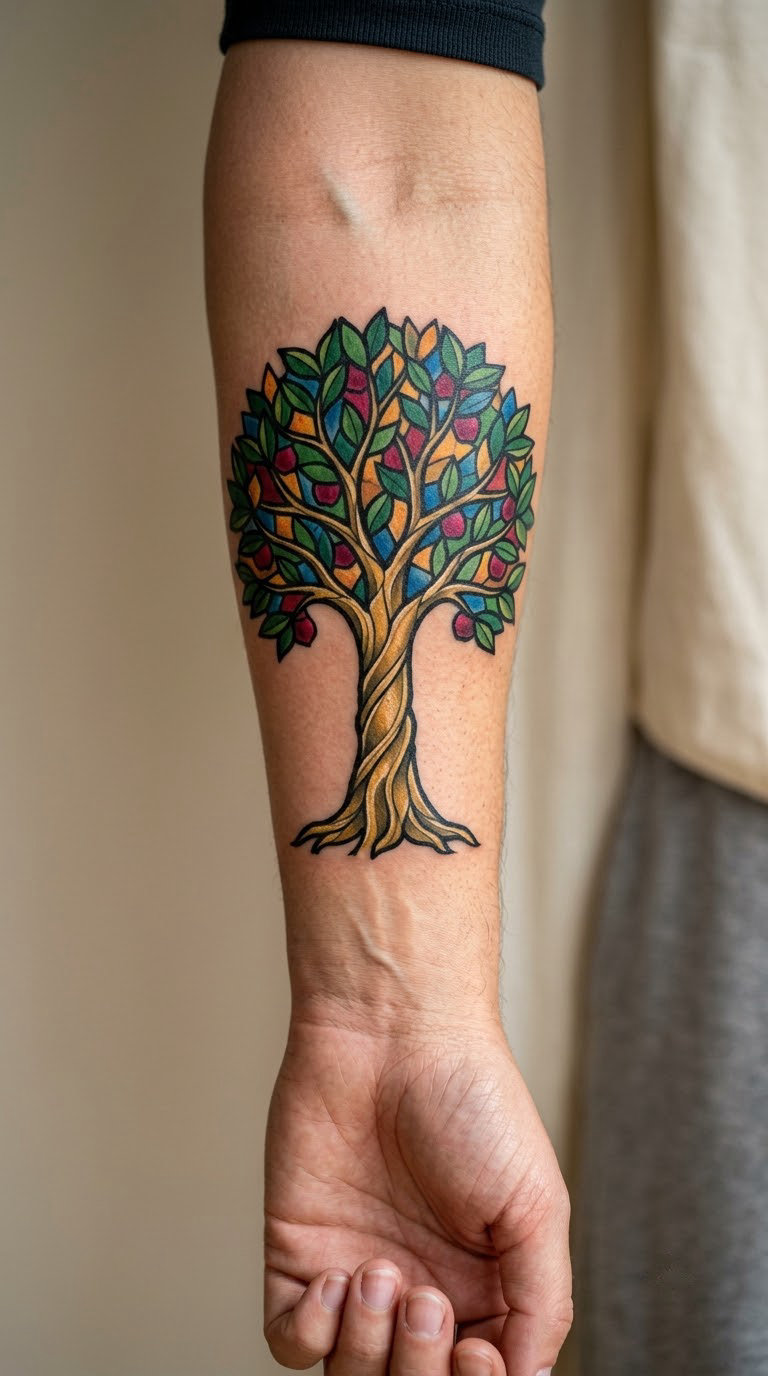
A branching tree where the canopy and the roots are built from separate colored sections, with a gold or amber trunk running down the middle. Roots and branches usually mirror each other, which keeps it readable as one shape.
Tree designs get chosen as a family or memorial piece, and stained glass suits that because each section can hold a different color for a different person. Say who each color is for at the consult, not after it’s healed.
Placement: forearm, calf, back of the arm. Size: 5.5 to 6.5 inches (14 to 16 cm). Style: color illustrative with organic panels.
Pain: medium. Branches add time, so expect a three to four hour sitting at this size. Hairline branches at the canopy edge are the first thing to blur, so they should be simplified from the start.
Make it yours: cap the panel count at twelve, one per person or year, instead of filling every gap with leaf detail.
12. Crescent Moon in Jewel-Colored Glass
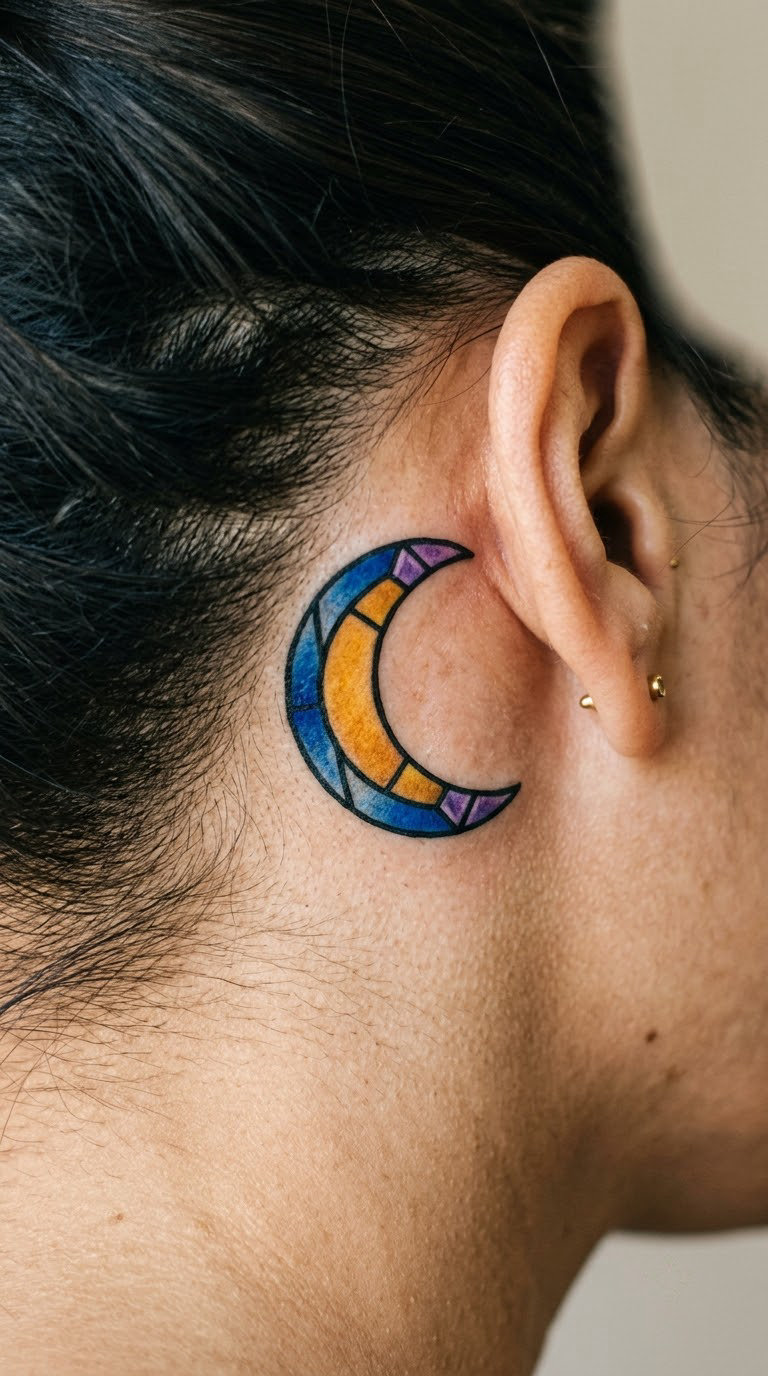
A crescent with a golden center, framed by a small border of cobalt and violet corner panes, all in hard black outline. It’s a compact window shape with a single subject, which means few panels and clean color.
Moon designs are usually chosen for the small, quiet placement, and the border is what separates this from a plain crescent. Behind the ear suits the size; nothing larger will sit there properly.
Placement: behind the ear, inner arm, ankle. Size: 2.5 to 3 inches (6 to 8 cm). Style: minimal color with geometric border.
Pain: high. Behind the ear is thin skin over bone and everyone feels it. The thin crescent itself is quick work, so the session is short even when the sitting is uncomfortable.
Make it yours: add a phase mark in one corner pane, or set the crescent over a stained-glass sun from another piece.
13. Koi Swimming Through a Blue Panel
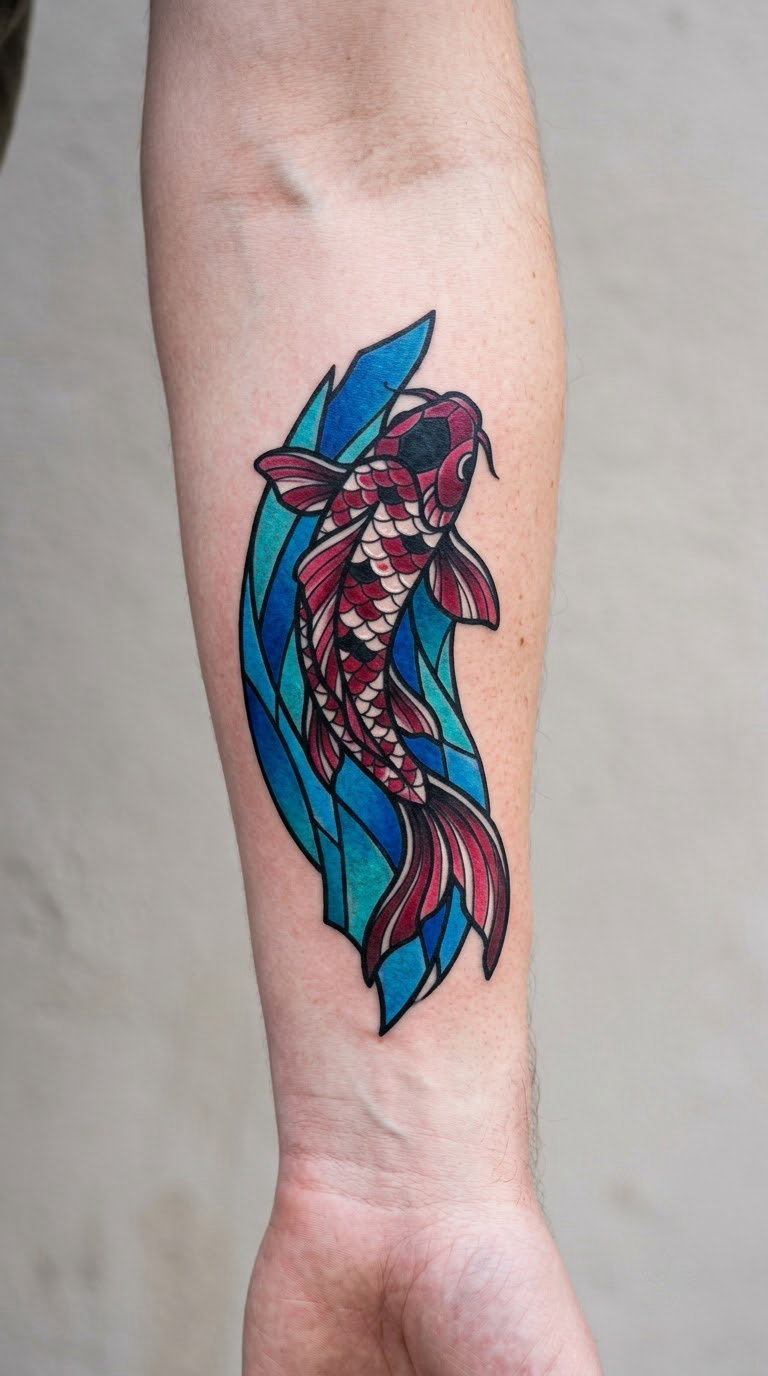
A koi made of red, white and black glass-like sections, swimming through irregular cobalt water panels inside an unbordered window shape. Leaving the outer edge open is what makes it feel like a fragment rather than a sticker.
Koi is common in this style because the fish body already breaks into patches of color. It’s a good piece for someone who wants the stained glass effect without literal church architecture.
Placement: forearm, calf, thigh, lower back. Size: 4.5 to 5.5 inches (11 to 14 cm). Style: color illustrative, open frame.
Pain: medium. Similar work to a half sleeve. Blue water panels need even saturation to avoid patchiness after healing, so the artist should avoid going too light in the thinnest areas.
Make it yours: change the water to a green palette and keep the koi red, which inverts the usual reading and hides future cover-up work better.
14. Stained-Glass Sunflower in a Square Frame
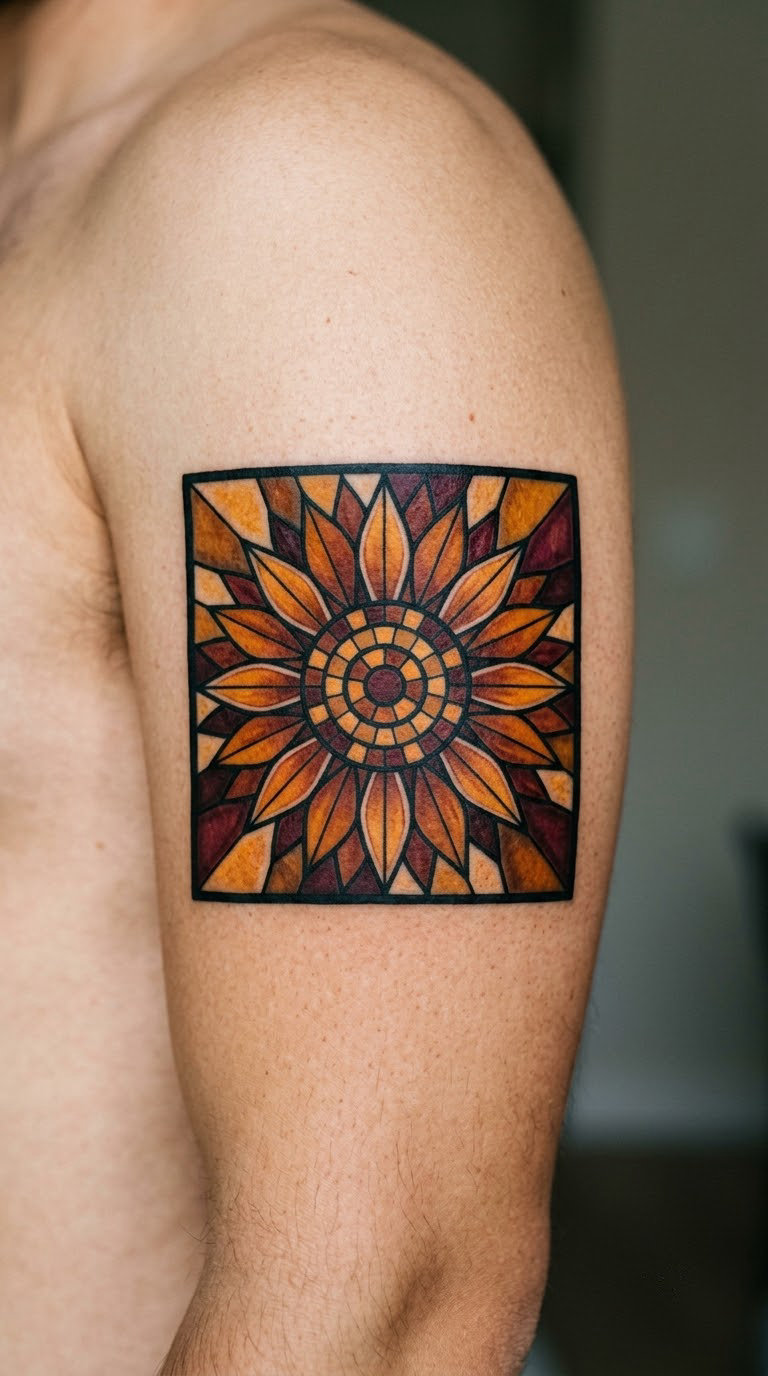
A bold sunflower built from amber, orange and burgundy panes, divided by strong black leading and set inside a hard-edged black square frame. The square keeps the round flower from looking unfinished.
Square frames are the safest structure in this style because straight edges are forgiving to heal. People pick a sunflower piece for the color, and the dark palette means it ages more evenly than a pastel one.
Placement: upper arm, forearm, calf, chest. Size: 3.5 to 4.5 inches (9 to 11 cm). Style: bold color graphic with black leading.
Pain: medium. Mostly flat packing at a comfortable location. Seed and petal detail should be kept chunky, since small texture in the center turns to grey within a few years.
Make it yours: keep the frame but drop the square’s outer border on one side so it opens onto the skin.
15. Tiny Two-Pane Stained-Glass Heart
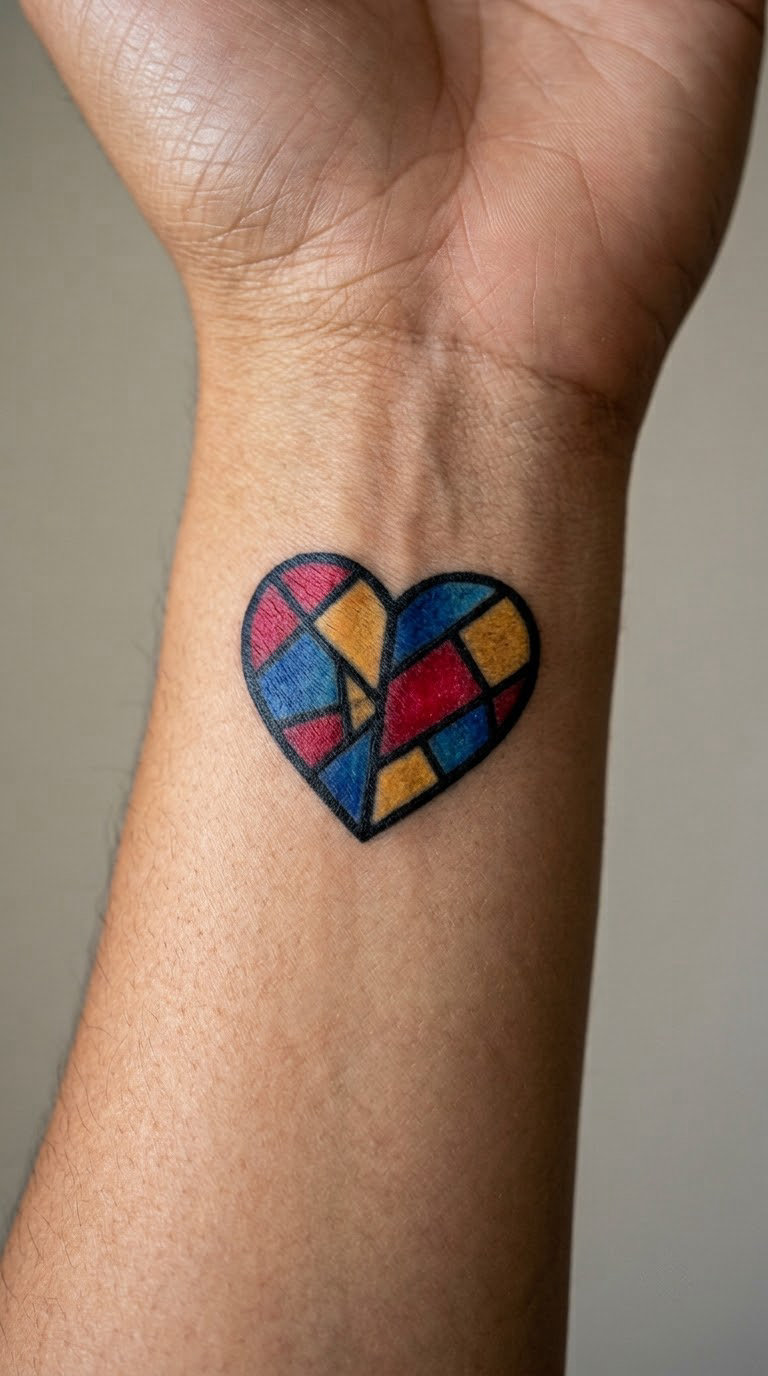
A small heart divided into just three panes — ruby, cobalt and gold — with thick black leading between them. Three panels is the practical ceiling for a piece this size, and going to five is where designs start to fail.
This is the version people get when they want the style as a first tattoo or as part of a group. At 1.5 inches it reads clearly from a short distance, which is more than a smaller heart would.
Placement: wrist, inner arm, ankle, behind the ear. Size: 1.5 to 2 inches (4 to 5 cm). Style: micro color, bold leading.
Pain: medium to high on the wrist and inner arm, where skin is thin and veins sit close. Inner wrist detail softens fastest of any spot on the body, so a heart that size will need touch-ups.
Make it yours: match the three colors to a set of two or three friends, each taking one pane and the same design at a slightly different size.
16. Gothic Skull Behind Geometric Arches
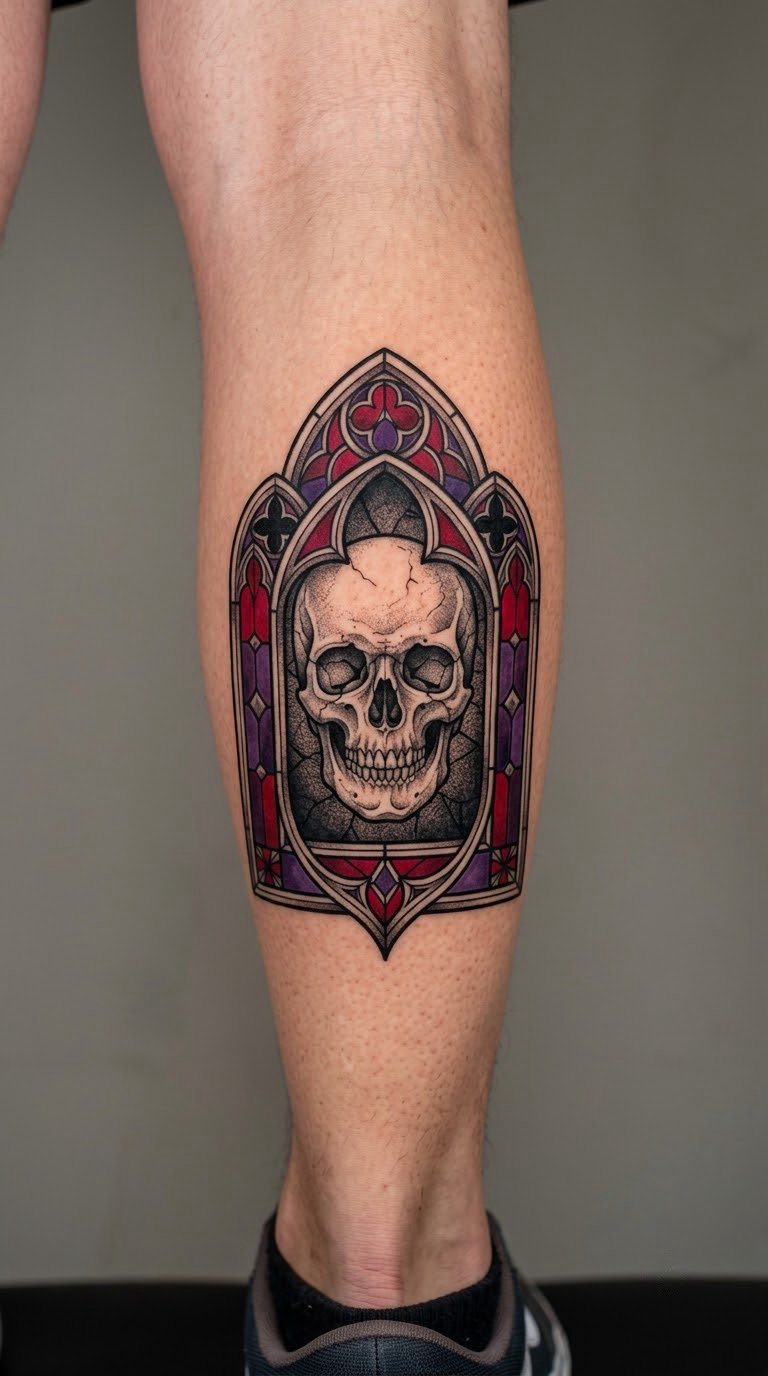
A skull rendered in monochrome shading, layered beneath pointed arches picked out in red, purple and black. The grayscale subject against colored architecture is what gives this one its depth.
Skull pieces get chosen for the gothic register that cathedral windows already carry, so the arches feel native rather than added. Keep the arches simple; competing detail around a skull turns to mush quickly.
Placement: calf, forearm, upper back, thigh. Size: 3.5 to 4.5 inches (9 to 11 cm). Style: black and grey realism with color arches.
Pain: medium-high. The calf is a decent canvas but shaded grey work takes time. Grey gradients in the skull can warm and lighten as they heal, which is normal and worth warning your artist about now.
Make it yours: limit the arches to three points and use one red for all of them, which keeps the color read stronger and the session shorter.
17. Stained-Glass Hummingbird and Blossom
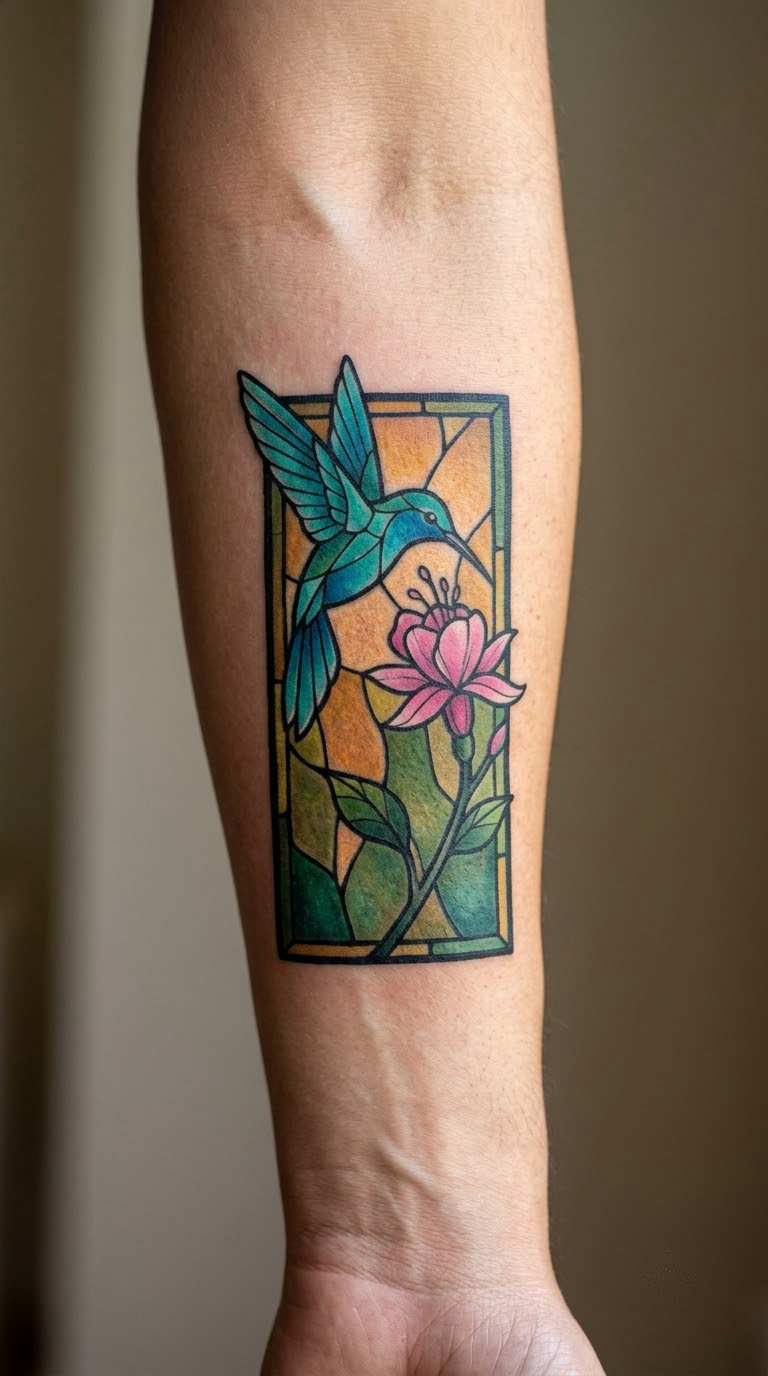
A teal hummingbird angled toward a pink blossom, framed by amber and green background panes in a tall, narrow composition. Vertical layouts suit the inner arm far better than a square grid does.
This is the compact counterpart to the watercolor hummingbird earlier on the list — same bird, harder edges, fewer washes. A client posting a healed hummingbird in r/tattoos said the stained glass treatment is what makes the color pop, and this is the version where that reads most clearly.
Placement: inner arm, forearm, side of the calf. Size: 2.5 to 3.5 inches (6 to 9 cm). Style: color illustrative, vertical layout.
Pain: medium. Two focal subjects means more packing passes, so budget more time than the size suggests. The beak and the thin stem between bird and flower are the two details most likely to blur.
Make it yours: use a blossom from a plant that actually matters to you rather than a generic five-petal flower.
18. Galaxy in a Gothic Rose Window
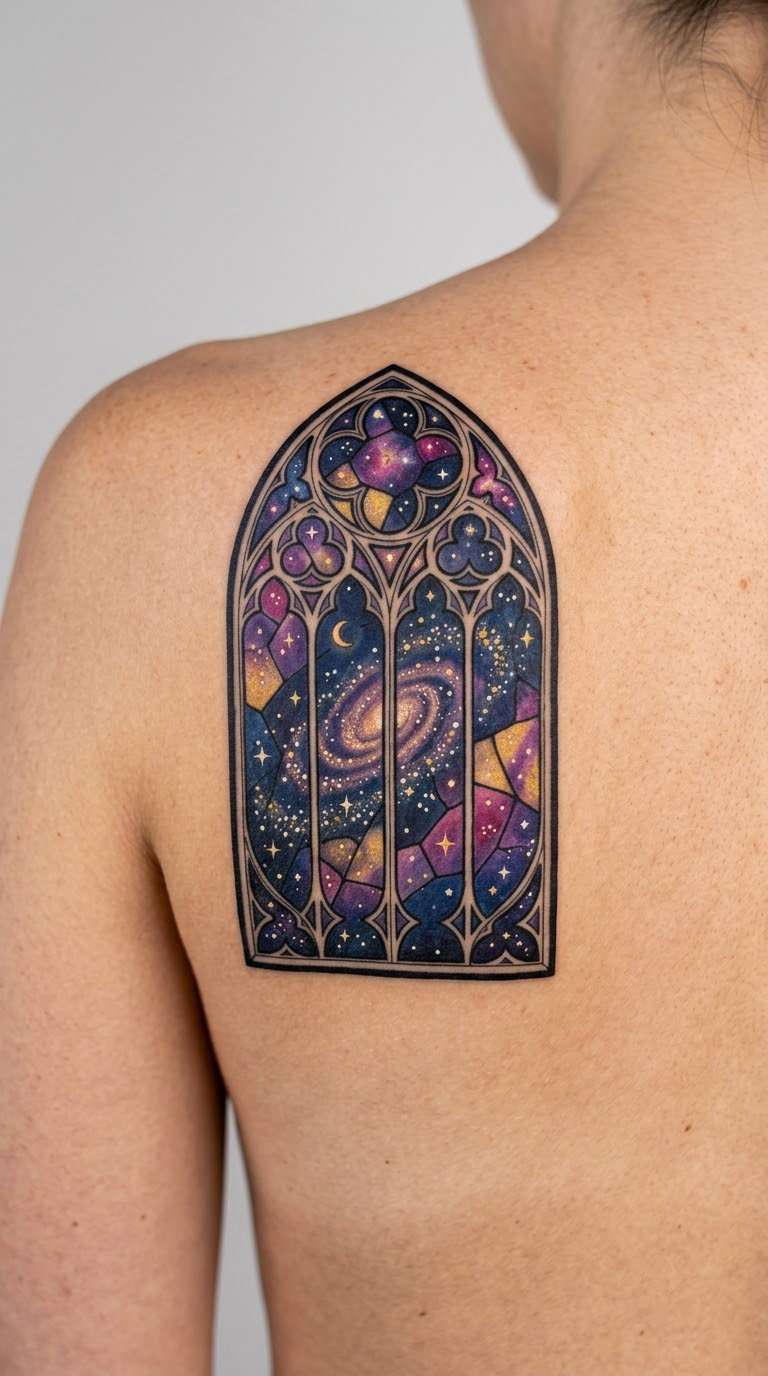
A Gothic rose window frame filled with navy, violet and gold panes, with tiny white stars scattered through the color. It’s a stained glass window that happens to be showing space rather than a saint.
Galaxy work is common enough to feel familiar, and the tracery is what keeps it from looking like every other space piece. Ask the artist to keep stars as untouched skin wherever possible so they read as light rather than dots.
Placement: back of the shoulder, upper back, forearm. Size: 4.5 to 5.5 inches (11 to 14 cm). Style: color with fine black tracery.
Pain: medium to high. Small stars are repeated needle passes and add real time. Star points soften within a couple of years, so a good artist will make them slightly larger than the reference shows.
Make it yours: keep the tracery monochrome and use one warm gold pane at the center, which reads as a light source.
19. Stained-Glass Rose on the Collarbone
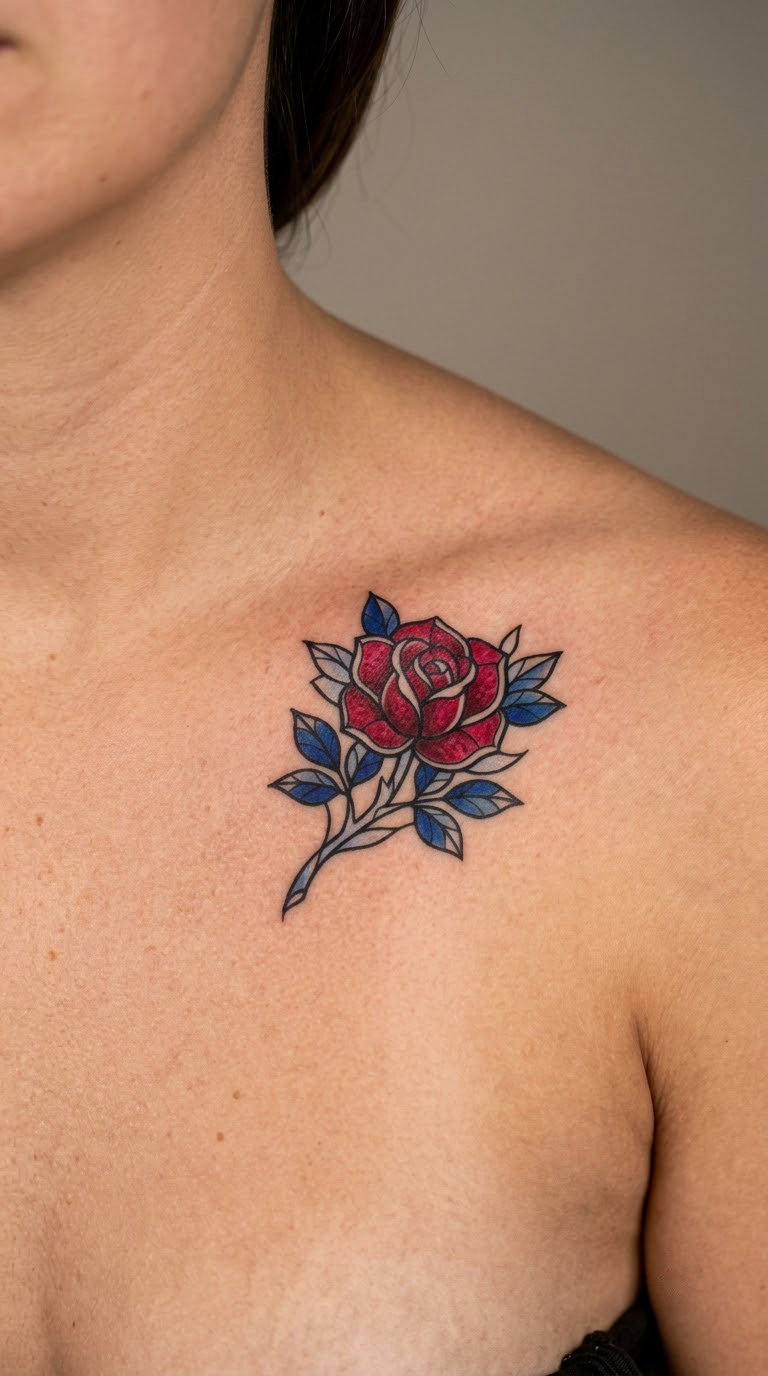
A small rose in ruby, cobalt and pale gray, built from five or six broad panes and a thin black frame, sitting just above the collarbone. Broad panes and a thin frame are the two rules that make this placement work.
Collarbone tattoos sit on a curve, so a design that looks rectangular on paper will wrap. This one is worth checking in person at the consult, held up against the actual curve rather than judged on a screen.
Placement: just above the collarbone, sternum, upper chest. Size: 2 to 3 inches (5 to 8 cm). Style: small color with thin black frame.
Pain: high. The collarbone is bone with very little soft tissue. Pale gray is the first color to look tired on this spot, so a slightly stronger mid-gray holds its shape longer.
Make it yours: angle the rose along the bone instead of sitting it square, which suits the body’s line and hides a touch more if placement shifts.
20. Full-Color Stained-Glass Phoenix
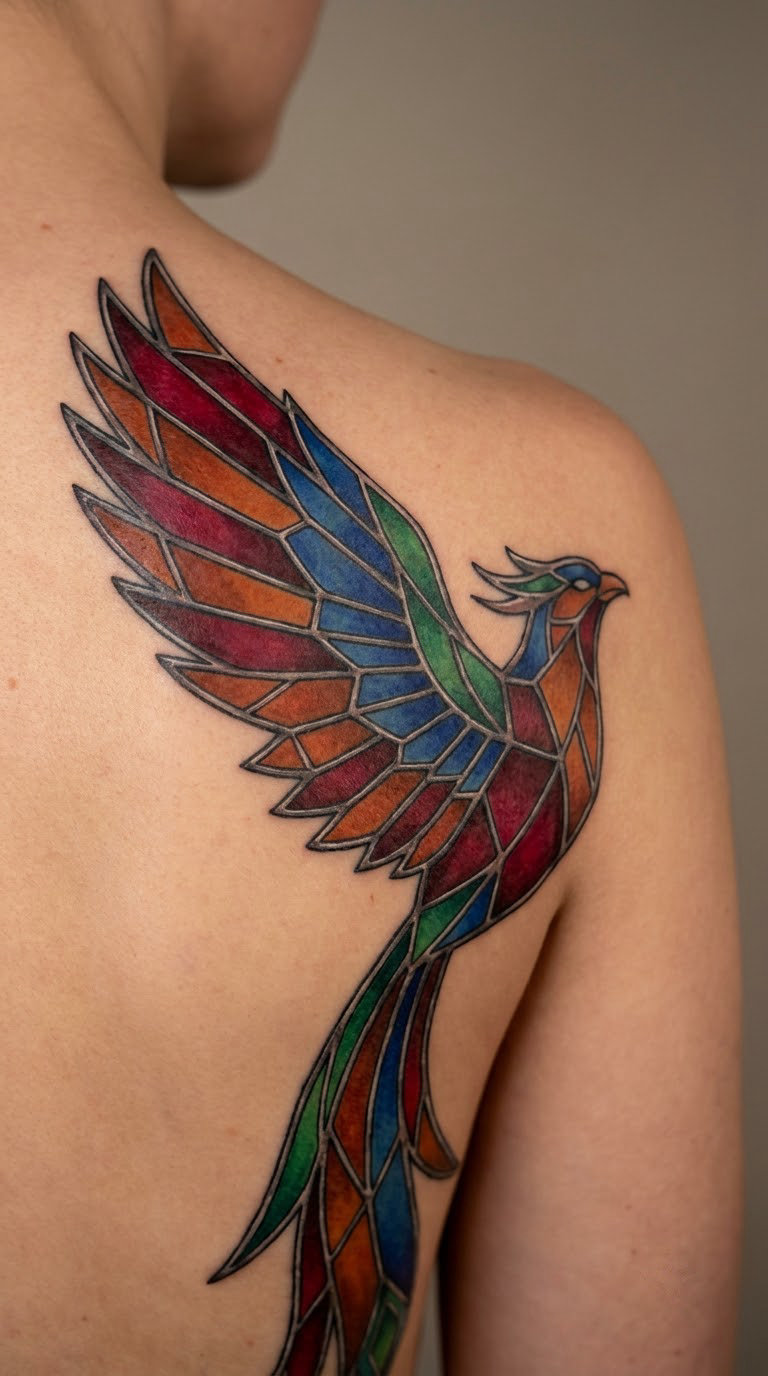
A phoenix with flame-shaped feather panes in ruby, orange, cobalt and emerald, arranged in a sweeping wing composition across the shoulder blade. At this scale each feather can be a real pane rather than a line.
Large color pieces like this are where stained glass is genuinely at its best, and also where the cost climbs. Anyone considering it should be planning for a long day and at least one return sitting.
Placement: shoulder blade, upper back, outer thigh. Size: 8 to 10 inches (20 to 25 cm). Style: large color illustrative with black leading.
Pain: high over a long session. A nine-inch color piece is not a single sitting for most people, and the shoulder blade position is awkward to hold still. Feather barbs need to be broad from the start.
Make it yours: build the tail as a set of trailing panes that fade toward bare skin, which softens the edge of a large piece and hides the far end of the composition.
How to Choose the Right Design
Six questions settle most of it before you sit down with an artist. Ask them in this order, because each one narrows the next.
- Blackwork or full color? Blackwork cathedral windows need far less color work, age more evenly and hide fading entirely, since there’s no pigment to dull. Full color gives you the saturation payoff people describe in the artist communities as the main reason to pick this style.
- Does the detail fit the size? Count the panels. A 1.5 inch heart can hold three reliably. A four inch rose window can hold a dozen. If your reference has forty panels and you’re asking for two inches, something has to be cut, and it’s better decided at the consult.
- Does the shape suit the body? Arches and circles suit the forearm, the hip and the upper back. Vertical compositions suit the inner arm and the calf. Square frames work anywhere because straight edges don’t fight a curve.
- What location, honestly? Inner wrist, collarbone and behind the ear all fade faster than the forearm, calf or upper arm. If the piece must be small and permanent-looking, put it on a limb rather than a pulse point.
- How much color are you committing to? Every additional panel means another packing pass and more hours. Three to five colors is a normal one-sitting range. Ten or more turns a design into a multi-visit project.
- Have you seen their healed work? Not fresh photos, not Instagram reels from last month. Ask to see stained glass pieces at least three months healed, in person if the shop allows it. Artists in these communities treat healed photos as the only real evidence of line quality.
One more thing worth raising at the consult: ask whether they’ll commit the black frame first and heal it before packing color on top. A working artist described exactly that split in r/tattoo — the glass parts fresh, the framing healed — and it’s a sensible approach to line bleed.
Cost and Session Time
Stained glass sits at the expensive end of tattooing because it’s linework and color packing in the same piece. In the US, expect these broad bands for a single-session piece, and treat them as a starting conversation rather than a quote.
| Size band | Typical range | Session length |
|---|---|---|
| Micro (1.5 to 2 in / 4 to 5 cm) | 120 to 300 USD | 1 to 1.5 hours |
| Small (2.5 to 3.5 in / 6 to 9 cm) | 250 to 550 USD | 2 to 3 hours |
| Medium (4 to 6 in / 10 to 15 cm) | 450 to 1,000 USD | 3 to 5 hours |
| Large (7 to 10 in / 18 to 25 cm) | 900 to 2,000 USD | 5 to 8 hours, often split |
| Full sleeve | 2,500 to 6,000 USD | Multiple sessions |
What pushes a piece up: more colored panels, more outline work, sleeve scale, and an artist who does this style specifically rather than occasionally. What pushes it down: a blackwork version, a smaller design, and a simple frame with a single subject.
Most studios have a shop minimum, and many charge by the hour, so a design that needs six hours gets quoted differently from one that needs two even if both are the same size. Ask what the hourly rate is and what the minimum is before you commit to a design with twenty panels in it.
Aftercare Basics
Follow your artist’s aftercare instructions first — they know what they put in your skin. Beyond that, the standard advice is short and boring, which is the point.
- Wash gently with lukewarm water and unscented soap, then pat dry with a clean hand rather than a towel.
- Protect it from direct sun while it’s healing, and think of that as ongoing rather than temporary. Sun is the main reason saturated color dulls over the years.
- Skip lotions, oils and heavy balms on the fresh area. They sit on the skin and can trap moisture against the new ink.
- Leave the scab or flaking skin alone. Picking at it is the fastest route to patchy color and blurred lead lines.
- Wait the full healing period before judging the result. Fresh color looks brighter and the lines look softer than the settled piece will.
- Book a free touch-up window if the artist offers one, and use it for the pale panels rather than the black linework.
Frequently Asked Questions
Are stained glass tattoos suitable for small or delicate placements?
Yes, as long as the panel count is cut to match the size. A 1.5 inch heart holds about three panes reliably; a two inch version holds five at a push. Small placements like wrists, collarbones and behind the ear heal softer than forearms, so the design should be built with broader color blocks and heavier outlines from the start. Ask to see healed work at that exact size before booking.
What tattoo style works best for a stained glass design?
Neo-traditional color work is the usual answer, because stained glass is essentially color packing inside hard black linework. A working artist in the tattoo community described the technique as the same process as their neo-traditional work, healing identically. Blackwork works well too if you want the gothic cathedral look without saturated color, and it ages more evenly since there is no pigment to dull.
Do stained glass tattoos fade faster than solid-color tattoos?
Not inherently, but two things fade faster than average. Fine lead lines packed close together can merge into each other as the skin heals, and pale or pastel panels lose their edge sooner than saturated ones. Deep colors like cobalt, ruby and emerald hold well. Keep panels broad, keep outlines heavy, and ask the artist to work at a line weight slightly heavier than the reference image suggests.
How much does a stained glass tattoo cost in the US?
Broadly, micro pieces at 1.5 to 2 inches run 120 to 300 USD, small pieces at 2.5 to 3.5 inches run 250 to 550 USD, and medium pieces at 4 to 6 inches run 450 to 1,000 USD. A large piece at 7 to 10 inches usually runs 900 to 2,000 USD across several sessions. Hourly rates, shop minimums and artist specialisation all move the number, so ask for both the rate and the minimum.
Can stained glass tattoo ideas be made in black and grey?
They can, and for a lot of people the gothic cathedral window in pure blackwork is the better piece. Without colour, the design lives or dies on line weight, tracery detail and negative space, so it needs a slightly larger scale to read well. The upside is that it never fades in the way colour does. Ask for heavier lines than look necessary on paper, because fine hatching fills in over time.
Where is the least painful place to get a stained glass tattoo?
The upper arm, outer forearm, shoulder blade and calf are the most forgiving, because they have enough soft tissue and few bony edges. Inner wrist, collarbone, sternum and behind the ear are the worst, sitting over bone with thin skin. Placement matters less than session length here: a four hour forearm sitting is more uncomfortable overall than a one hour wrist piece.
Which Stained Glass Idea Should You Pick First?
If this is your first tattoo and you want to try the style without committing to a long session, go with the two-pane heart or the hummingbird and blossom. Both hold clean color at under three inches and both sit on a limb that heals evenly.
For a piece that shows off what the style actually does, choose the gothic rose in the arched window, and ask to see healed examples before you book. If you are already collecting work, the blackwork cathedral window adds contrast to a colorful arm, and the phoenix or the sleeve is the one to plan around multiple sittings and a longer timeline in 2026.