
20 Forearm Tattoo Ideas for Women With Meaning (September 2026)
Forearm tattoo ideas for women with meaning work best when the symbol is small enough to read at a glance and bold enough to survive ten years of sun and movement. The forearm gives you a wide, mostly flat canvas, and the skin there hides cleanly under a long sleeve.
Most people choose one of these because a date, a person or a hard year is attached to it, not because the drawing is fashionable. If your design has a moment attached to it, book four to six weeks ahead of anything you have planned.
What Does a Forearm Tattoo Symbolize?
A forearm tattoo usually symbolizes something the wearer wants to carry and read: growth, resilience, protection, faith, or connection to another person. Because the inner forearm is visible, easy to cover, and sits on a broad flat canvas, many women choose it for designs that hold personal meaning rather than decoration alone.
Quick Guide to All 20 Designs
| Idea | Style | Best placement | Size | Pain |
|---|---|---|---|---|
| Fine-line rose | Fine line | Inner forearm | 2 to 3 inch | Low to medium |
| One word script | Handwritten script | Inner forearm, above wrist | 2 to 4 inch wide | Medium |
| Compass rose | Linework with colour accent | Outer forearm | 3 to 4 inch | Medium |
| Moon phases and moth | Fine line | Inner forearm, vertical | 4 to 6 inch | Low to medium |
| Roman numeral date | Fine-line script | Inner forearm, below elbow | 2 to 3 inch | Medium |
| Birth flower stem | Watercolour | Outer forearm | 3 to 5 inch | Low |
| Constellation strip | Dot work and line | Side forearm | 5 to 7 inch | Medium |
| Butterfly and peony | Black and grey realism | Outer forearm | 4 to 6 inch | Medium |
| Sun and moon pair | Fine line, matching | One inner, one outer | 2 to 3 inch each | Low to medium |
| Kintsugi blackwork | Blackwork with gold | Side forearm | 5 to 8 inch | Medium to high |
| Hamsa hand with eye | Fine line | Inner forearm | 3 to 4 inch | Medium |
| Eye of Horus | Fine line | Inner forearm, above wrist | 2 to 3 inch | Medium |
| Lioness portrait | Micro realism | Outer forearm | 3 to 5 inch | Medium |
| Queen bee | Line art | Side forearm | 2 to 3 inch | Medium |
| Phoenix rising | Blackwork | Outer forearm to elbow | 6 to 10 inch | Medium to high |
| Crown and vine | Filigree ornamental | Inner forearm | 3 to 4 inch | Medium |
| Angel number 444 | Fine line | Inner forearm, above wrist | Under 2 inch | Medium |
| Quote in script | Handwritten script | Inner forearm, vertical stack | 3 to 5 inch | Medium |
| Coordinates | Fine line | Inner forearm, above wrist | 2 to 3 inch | Medium |
| Eucalyptus and olive wrap | Botanical linework | Outer forearm to elbow | 8 to 12 inch | Medium |
1. Fine-Line Rose on the Inner Forearm
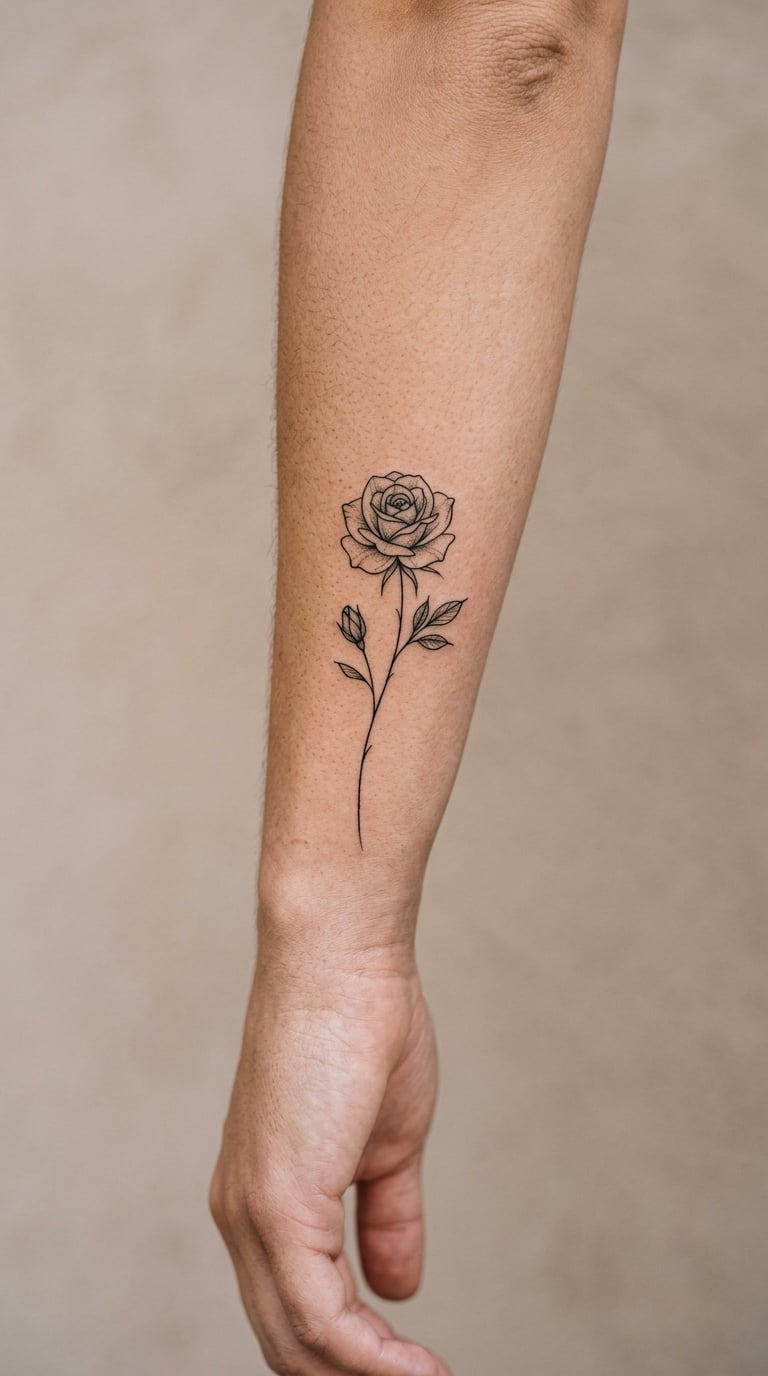
The drawing is one stem, three blooms at different stages, and almost no shading beyond a grey wash in the deepest petal folds. It reads as a line sketch first and a flower second, which is exactly why it holds up close to the skin.
A rose is chosen for love that survived something, or for a fresh start after a break-up or a rough year. Most wearers pick it as a private piece rather than a statement one.
Placement: inner forearm, three to five inch above the wrist crease. Size: 2 to 3 inch tall (5 to 7.5 cm). Style: fine line. Pain: low to medium; the wrist end of the inner arm stings more than the upper part. Ageing note: hairline work on the inner forearm softens noticeably within a few years, so a slightly heavier line holds its shape longer.
Make it yours: set the year underneath the stem in 1pt script, or add a single colour petal in red so the rest stays monochrome.
2. One Word in Hairline Script
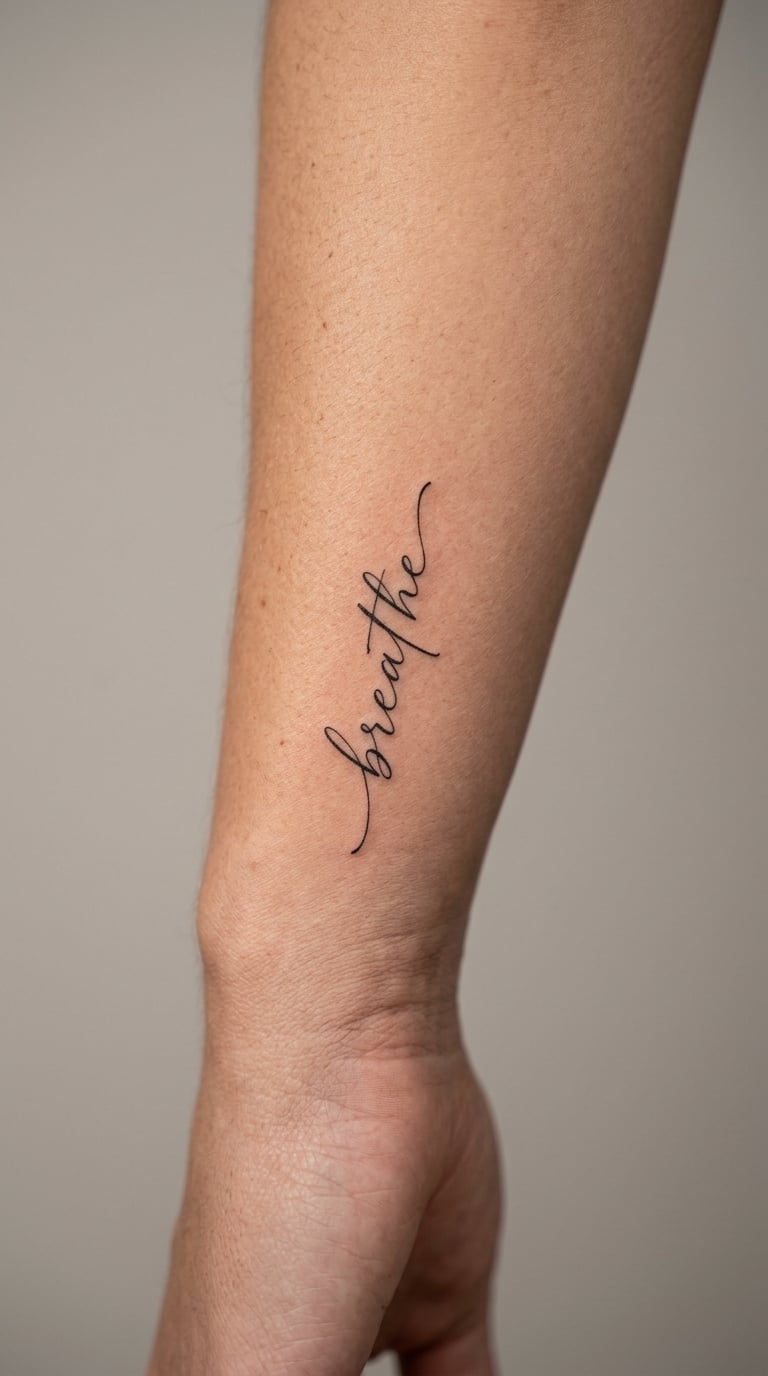
One word, no decoration, set in a slanted hand with a hairline entry stroke and a longer exit stroke. The trick is spacing: the letters need air around them, because a forearm is narrower than a page and closer to the eye than you think.
Common choices are a surname, a first name, a single verb like stay or begin, or a word in a second language the wearer speaks. The meaning is the private part, and it usually stays private.
Placement: inner forearm just above the wrist crease, running along the arm. Size: 2 to 4 inch wide (5 to 10 cm). Style: handwritten script. Pain: medium; the inner forearm is warm and reacts faster than most people expect. Ageing note: script with thin downstrokes blurs first, so ask for a slightly heavier line weight than feels right.
Make it yours: use your own handwriting rather than a traced font, even a rough version, or add a small dot after the word as a period.
3. Compass Rose With a Personal Bearing
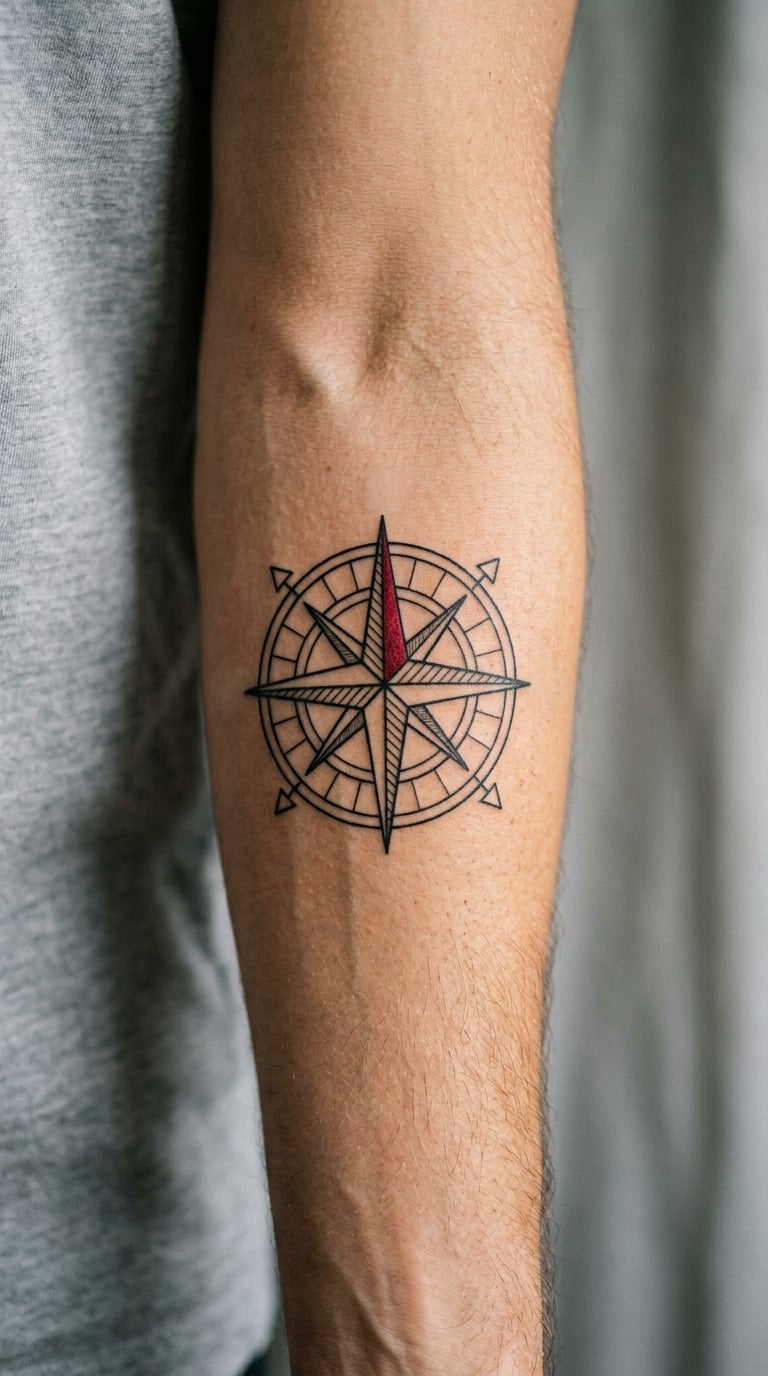
A classic compass rose built from eight points, with the north point doubled in length and a thin circle around it. Most artists add one filled or coloured section so the design has a centre of gravity instead of sitting flat.
The compass is about direction: the place you are from, the direction you are going, or the family you navigate back to. The bearing is often the real reason the piece exists.
Placement: outer forearm, centred between elbow and wrist. Size: 3 to 4 inch across (7.5 to 10 cm). Style: linework with a colour accent. Pain: medium; the outer arm has more muscle and takes the needle better than the inner side. Ageing note: outer forearm ink sees more sun, so plan on a colour refresh every few years if you use red or yellow.
Make it yours: have the long point marked with the real bearing to a place that matters, in degrees, inside the circle.
4. Moon Phases and a Moth in Fine Line
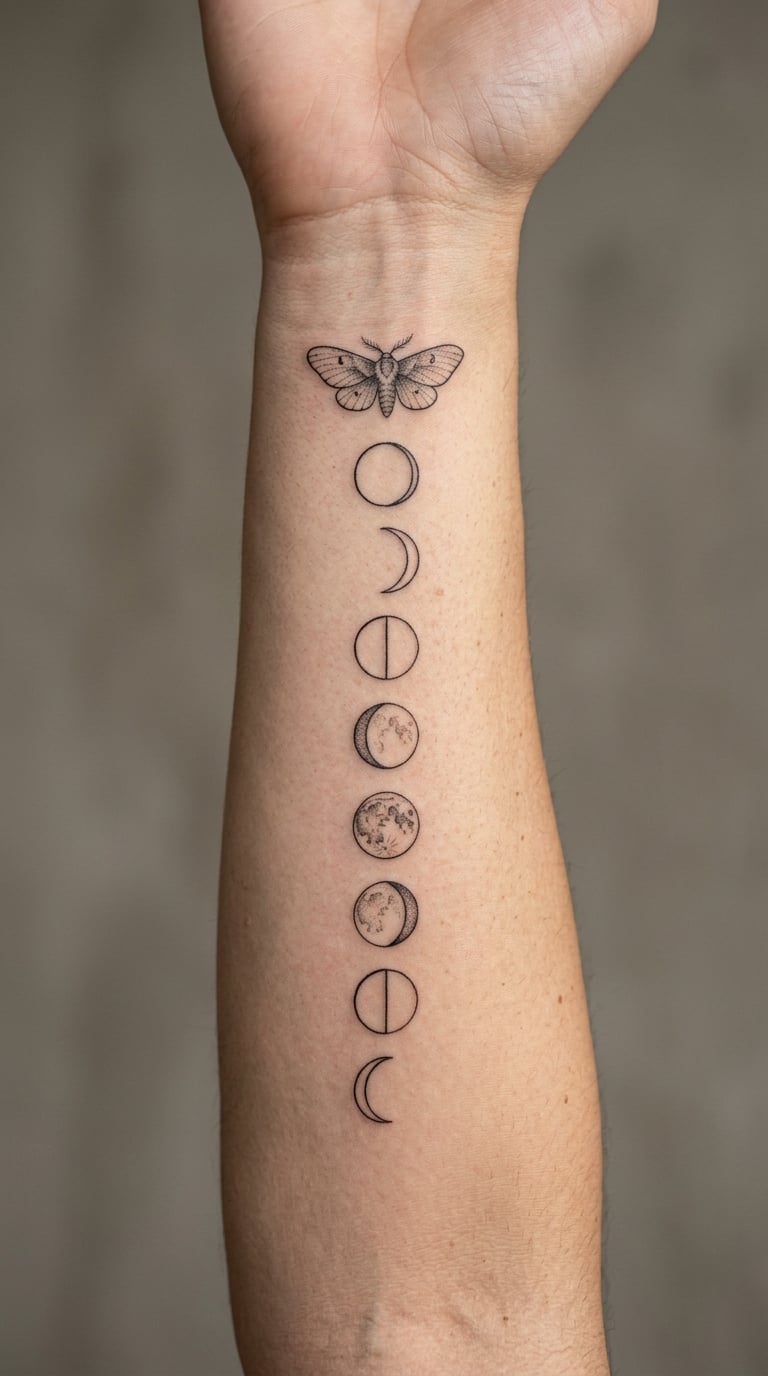
Eight moon phases stacked in a slim vertical column, each one a simple circle detail, with a moth drawn at the top with fine antennae and veined wings. It is a pattern before it is a picture, and the rhythm of the phases is what carries it.
Moon phases track change, cycles and the long middle of something difficult. The moth is older than the moon, though: light, drawn to what illuminates it, and a reminder of night and rest.
Placement: inner forearm, running vertically from wrist toward elbow. Size: 4 to 6 inch tall (10 to 15 cm). Style: fine line. Pain: low to medium across the length, higher near the elbow crease. Ageing note: stacked small circles blur into each other over time, so spacing matters more than detail here.
Make it yours: ink only the phases that mattered and leave the rest as thin empty circles, or mark your birth moon with a tiny dot.
5. Roman Numereral Date in Fine-Line Script
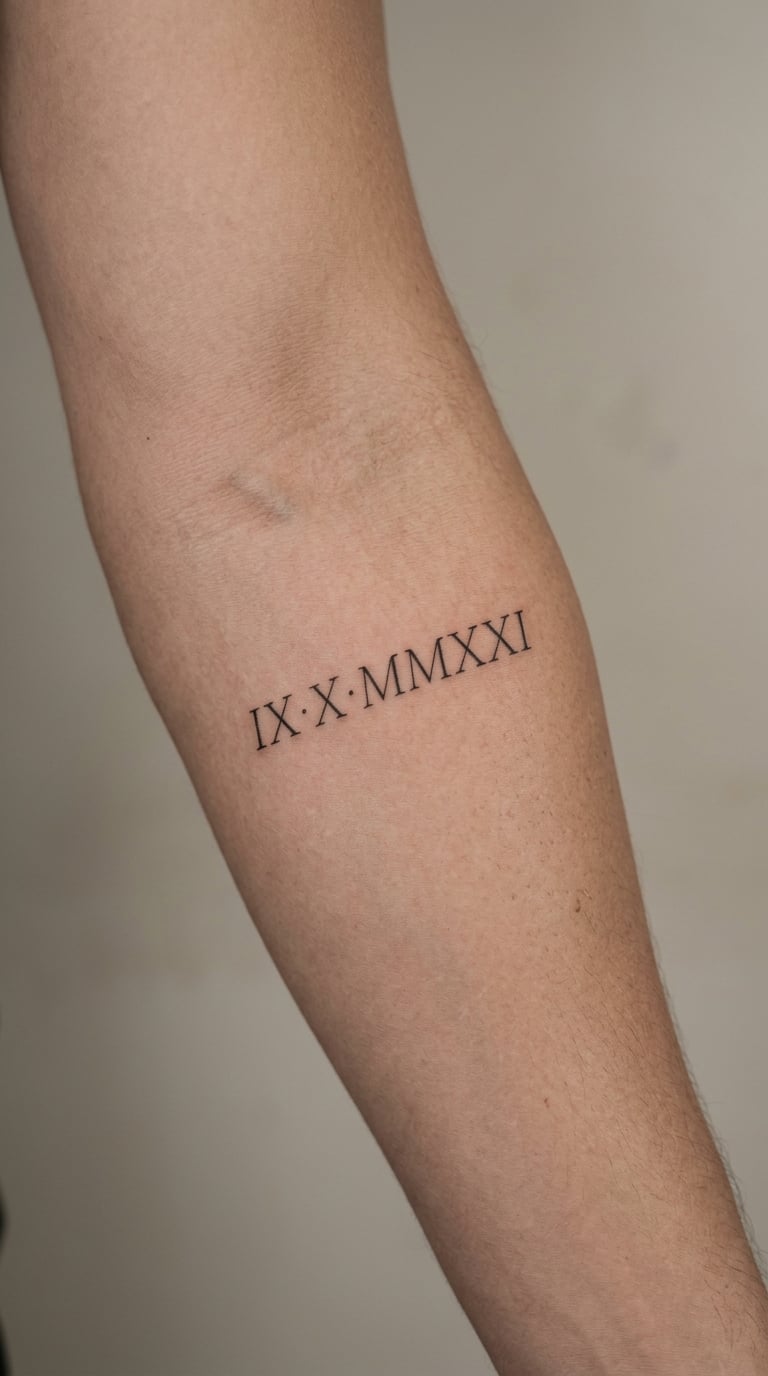
Numerals, not a full sentence: a wedding date, a birth date, or the day something ended and started again. The letters are drawn in a Roman serif with thin horizontal serifs, and the M and V shapes carry most of the visual weight.
This is the most requested design on the list for a reason. It dates something without announcing it, and dates stay meaningful long after the mood around them has changed.
Placement: inner forearm, a few inch below the elbow where there is room for the string of numerals. Size: 2 to 3 inch wide (5 to 7.5 cm). Style: fine-line script. Pain: medium, steady across a flat area. Ageing note: serif ends on I and X are the first details to soften, so thicker serifs age better than hairline ones.
Make it yours: split the date across two lines with the year underneath, or pair it with one small symbol that only makes sense to you.
6. Birth Flower Stem in Watercolour
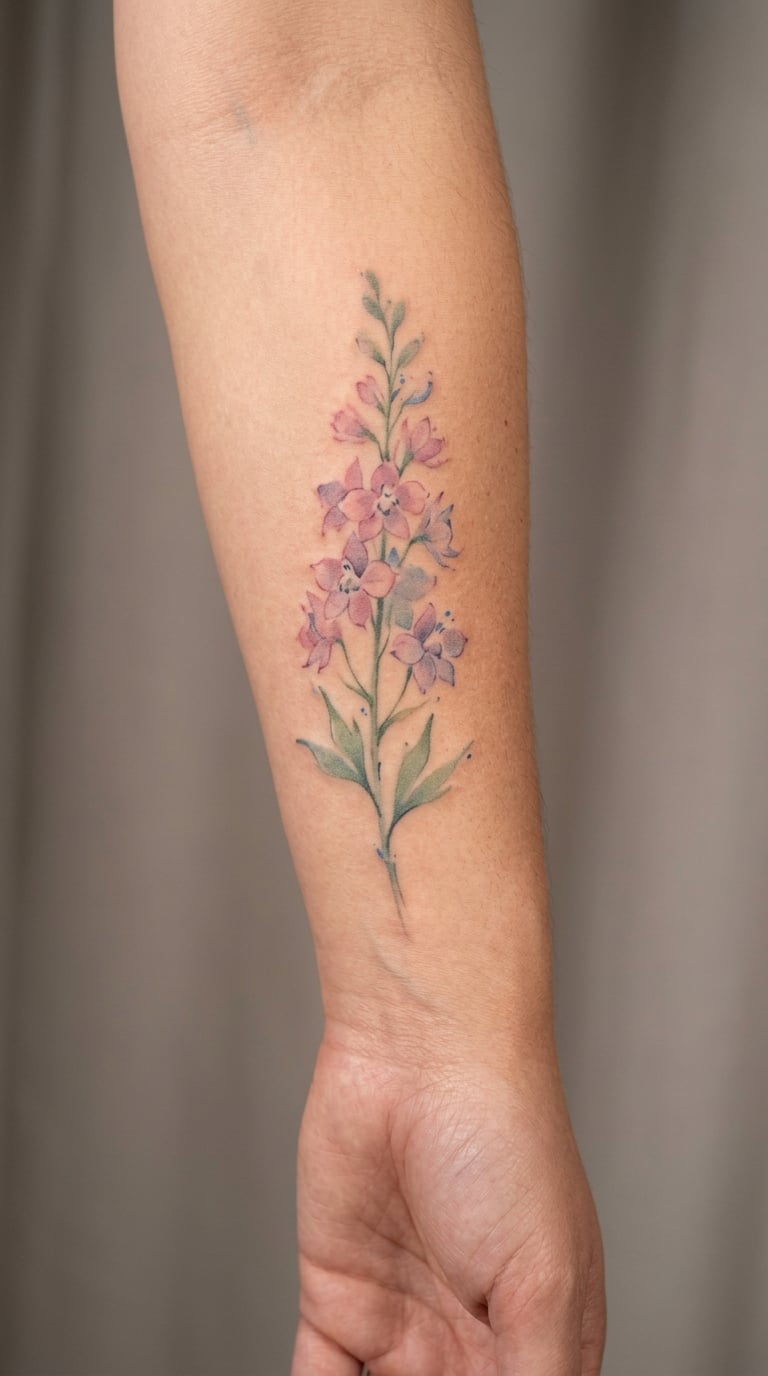
One stem, a handful of leaves and two or three flowers painted in loose watercolour washes that sit a little outside the outline. Colour bleeds past the line on purpose, so the drawing feels like it is still spreading after the needle stops.
Birth month flowers are chosen for the person, not the flower, which makes them easy to explain and hard to forget. They also work as a small piece you can add to later.
Placement: outer forearm, angled along the arm. Size: 3 to 5 inch (7.5 to 12.5 cm). Style: watercolour. Pain: low; colour work means more passes, but passes are lighter than a long single line. Ageing note: soft colour edges are the point and they fade first, so expect a touch-up conversation in a few years.
Make it yours: ask for a second stem in a different month, or add a tiny initial inside one petal.
7. Constellation Strip With Dot Work
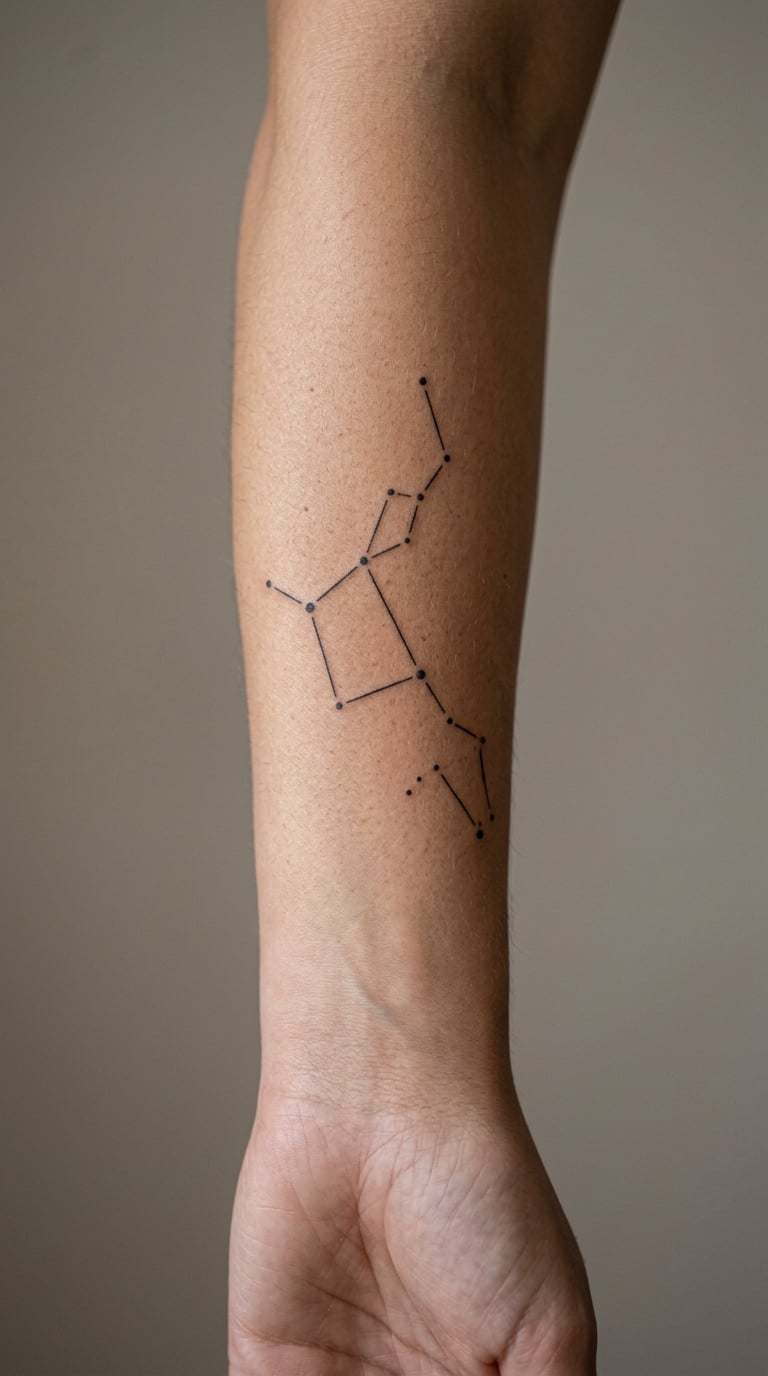
A strip of five or six constellations drawn as hairline connections between solid dot stars, with a few extra dots scattered into the gaps so the negative space does the decorating. Some artists add one hand-drawn star in the middle of the group.
A specific sky on a specific night is the usual reason. People get the constellation they saw from a porch, a hospital window, or the drive home, and the pattern becomes a private coordinate.
Placement: side forearm, running lengthwise. Size: 5 to 7 inch (12.5 to 17.5 cm). Style: dot work and line. Pain: medium; the side forearm has less give than the inner arm, so the needle sits closer to bone. Ageing note: individual dots spread and soften as skin ages, so larger dots hold together better than pinprick ones.
Make it yours: use your birth month constellation as the anchor and keep the rest as sky, or add one small solid star for the person who was there.
8. Butterfly Emerging From a Peony
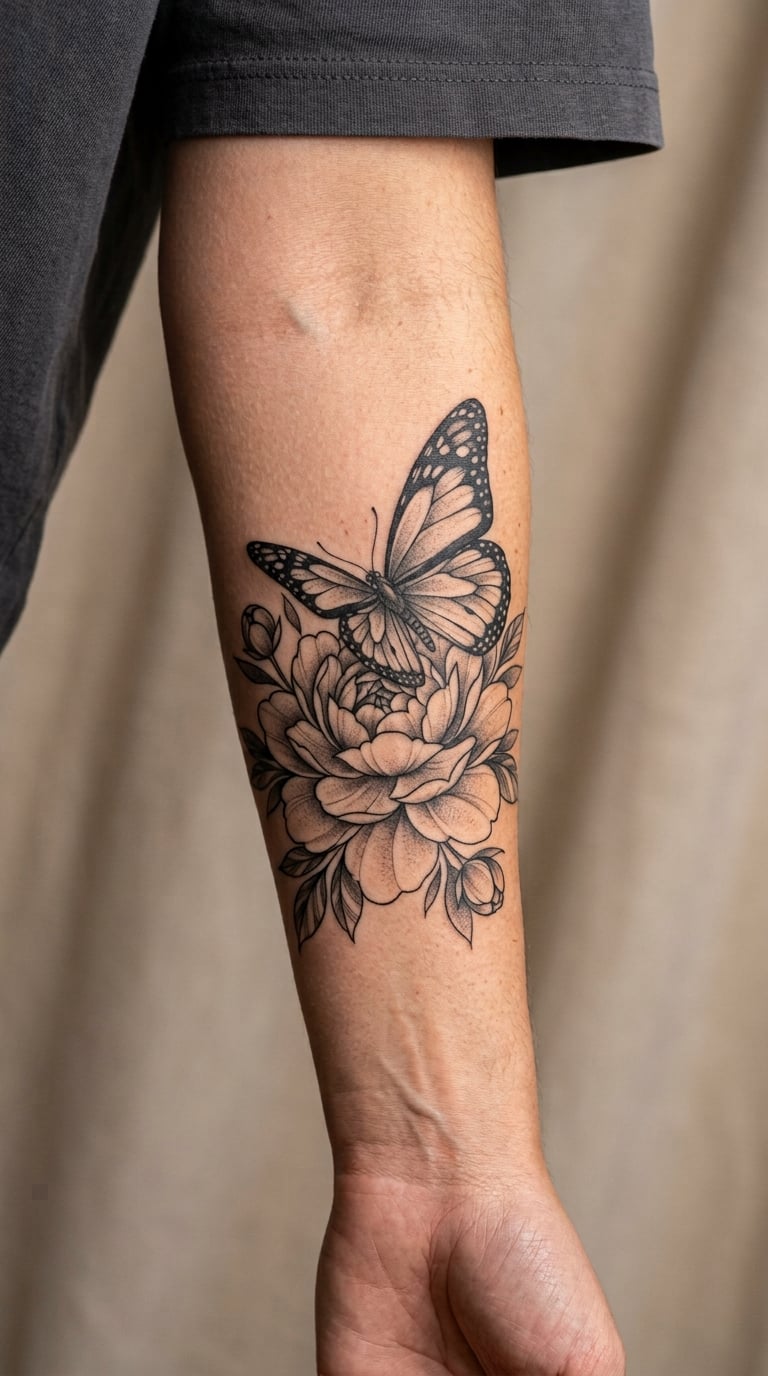
One large shaded peony with a butterfly lifting off the top petal, rendered in black and grey with soft grey wash in the flower and hard black edges on the wings. The overlap between the two is the whole point of the composition.
It is the most common transformation tattoo there is, and that is fine. People choose it after recovery, a graduation, a divorce, or the first year of a new job.
Placement: outer forearm, centred mid-arm. Size: 4 to 6 inch (10 to 15 cm). Style: black and grey realism. Pain: medium; grey wash takes several light passes that itch more than a single line hurts. Ageing note: shaded work on the outer arm fades in tone first, so contrast drops over the years even when the line survives.
Make it yours: have the butterfly face along the direction of travel, toward the elbow, or toward the wrist if the symbolism runs the other way.
9. Sun and Moon Matching Pair
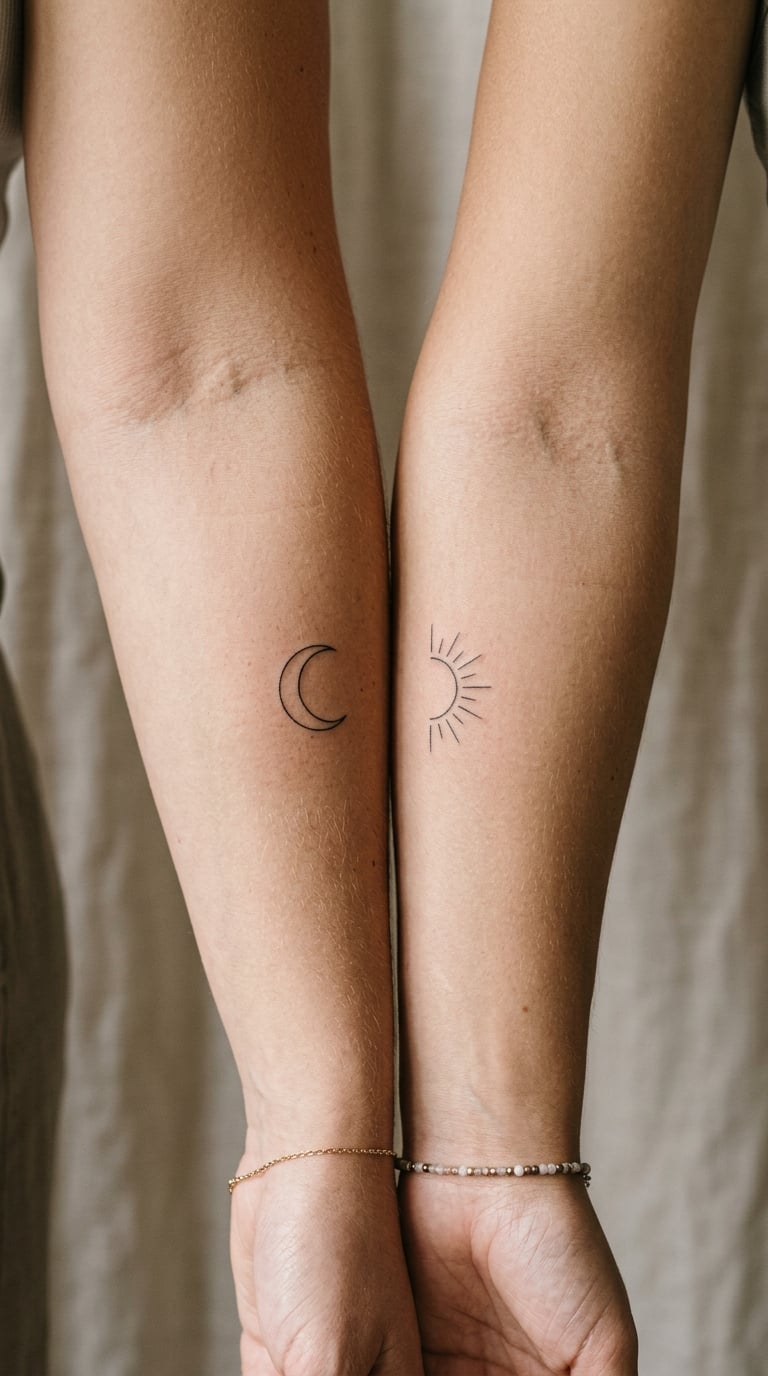
Two small designs in one sitting across two arms: a half sun with short straight rays, and a crescent moon facing it. Same line weight, same size, slightly different detail so each one belongs to a different person.
The sun and moon pair is the simplest matching tattoo that still looks deliberate on its own. It works for partners, sisters, best friends, and for one person who wants both halves on two arms.
Placement: one inner forearm and one outer forearm, mirrored at the same height. Size: 2 to 3 inch each (5 to 7.5 cm). Style: fine line. Pain: low to medium, twice. Ageing note: matching pieces age at different rates if one arm sees more sun, so keep the line weight generous on the outer-arm piece.
Make it yours: swap the sun for a sun with one filled ray, or pick two elements that mean something specific to your pair.
10. Kintsugi-Style Blackwork With Gold
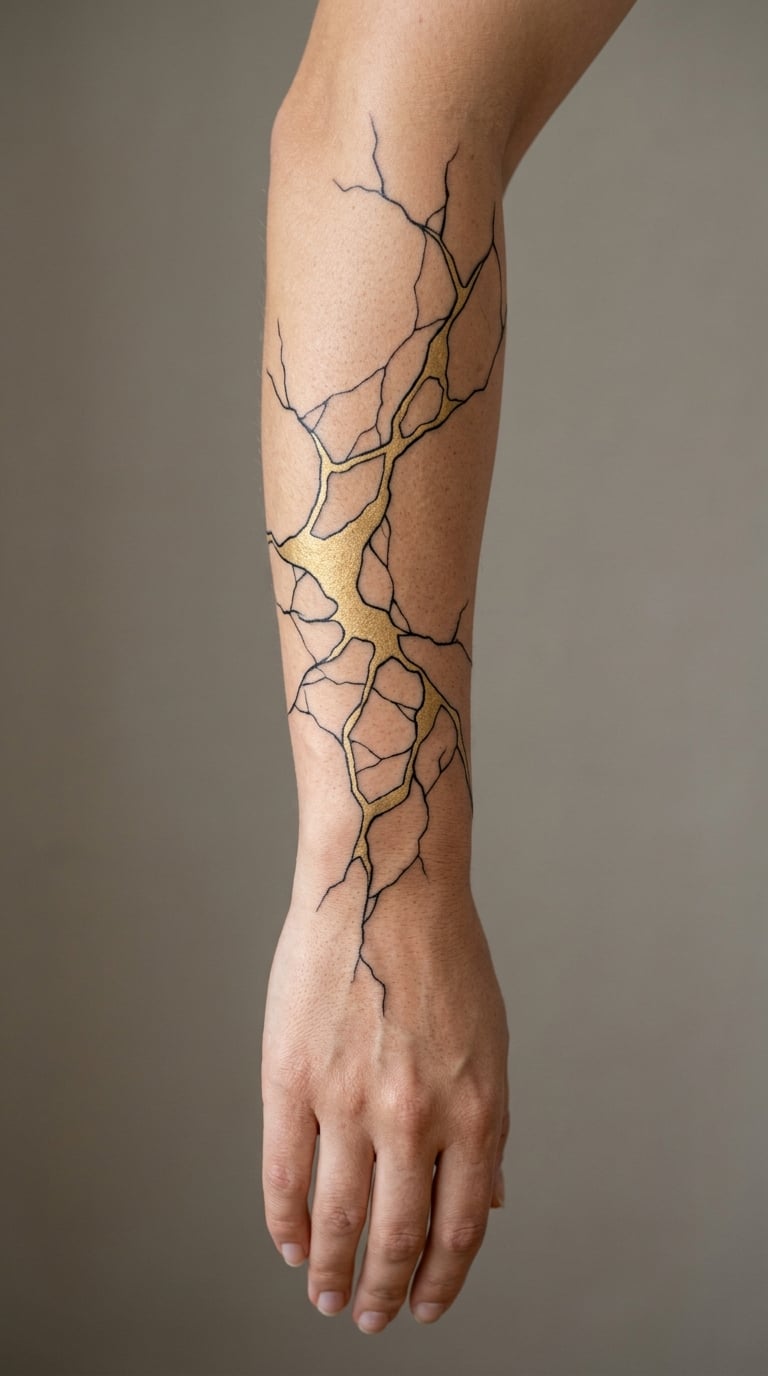
A network of irregular black lines branching across the arm like a crack in ceramic, with gold paint sitting inside some of the fissures. It borrows the Japanese art of repairing pottery with gold so the break becomes the most decorated part.
Wearers usually pick it after something broke, whether that was a relationship, a body, or a stretch of years. The reading is resilience, and it is not subtle about it.
Placement: side forearm, angled across the arm so the cracks wrap rather than run straight down. Size: 5 to 8 inch across (12.5 to 20 cm). Style: blackwork with gold. Pain: medium to high; large areas of solid black take a while. Ageing note: gold in skin photographs flat after a few years, so expect to leave the gold off if you want it subtle.
Make it yours: have the main crack trace the line of a real healed scar, or add a single unbroken gold line crossing the damaged area.
11. Hamsa Hand With an Eye
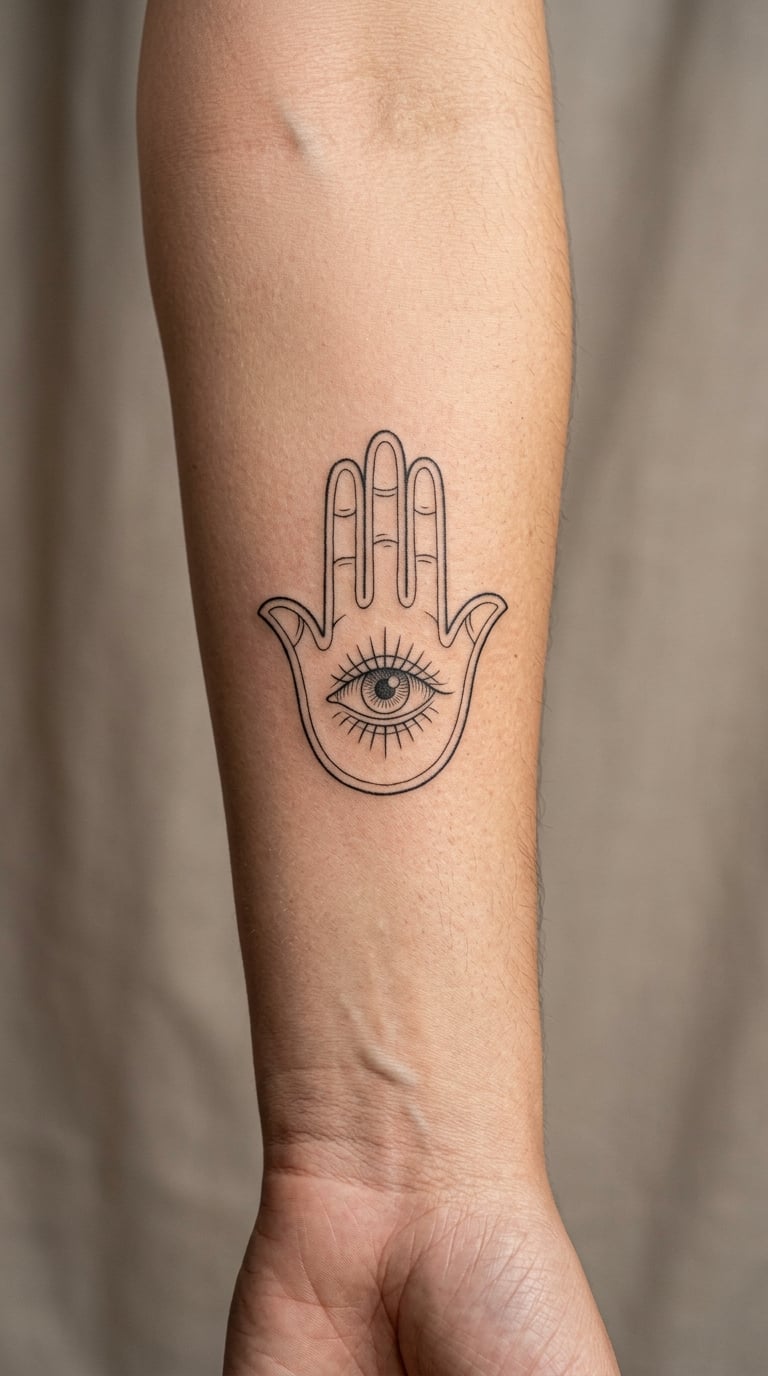
An open hand, palm forward, drawn in a single consistent line with five slim fingers and no shading, with a small eye or teardrop in the centre of the palm. Some versions add a short symmetrical vine at the wrist edge.
The hand is a protective symbol used across several Middle Eastern and North African traditions, and the eye in the palm points the protection outwards at whatever is in front of you. Ask the artist to draw it respectfully rather than copying a traced image.
Placement: inner forearm, upright toward the elbow. Size: 3 to 4 inch tall (7.5 to 10 cm). Style: fine line. Pain: medium, with more sensitivity on the palm side. Ageing note: the small eye detail is the first thing to close up, so make it a solid shape rather than an outlined one.
Make it yours: have the palm hold a tiny symbol instead of an eye, such as a date or a single initial.
12. Eye of Horus in Fine Line
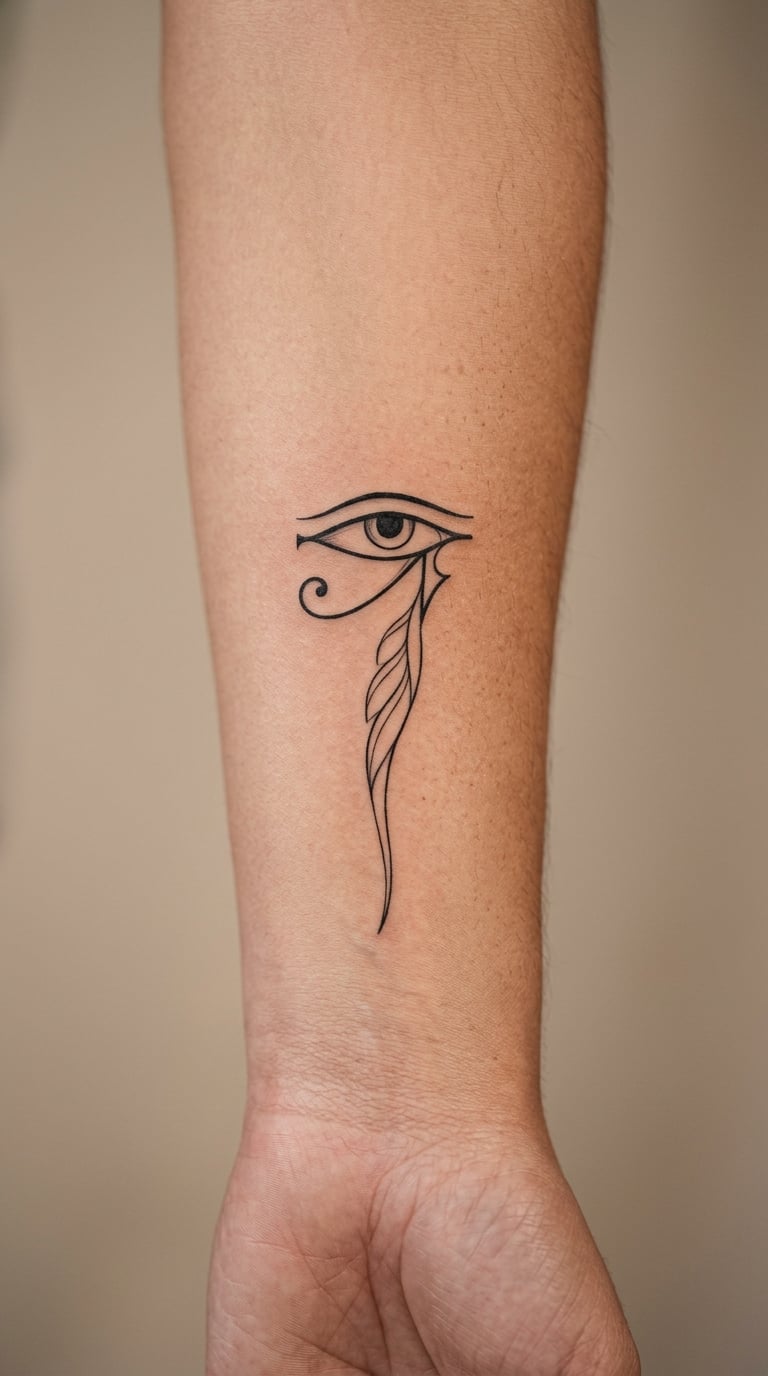
The Egyptian eye drawn in clean single-weight line: an almond outline, a brow above it, the long cosmetic flick trailing past the corner, and a curl dropping below. The proportions are traditional, so it is recognisable even at two inch tall.
It carries ideas of protection, restoration and clarity in Egyptian iconography, which is why it turns up in tattoos about getting through something. Plenty of people also choose it because the shape is beautiful and nothing else.
Placement: inner forearm above the wrist, with the flick pointing toward the hand. Size: 2 to 3 inch (5 to 7.5 cm). Style: fine line. Pain: medium. Ageing note: the trailing cosmetic line is long and thin, so it is the part that disappears first, and the shape starts to read as a plain eye without it.
Make it yours: pair it with a single hieroglyph-style initial, or place it at the exact spot on the arm that lines up with your eye when your arm is down.
13. Lioness Portrait in Micro-Realism
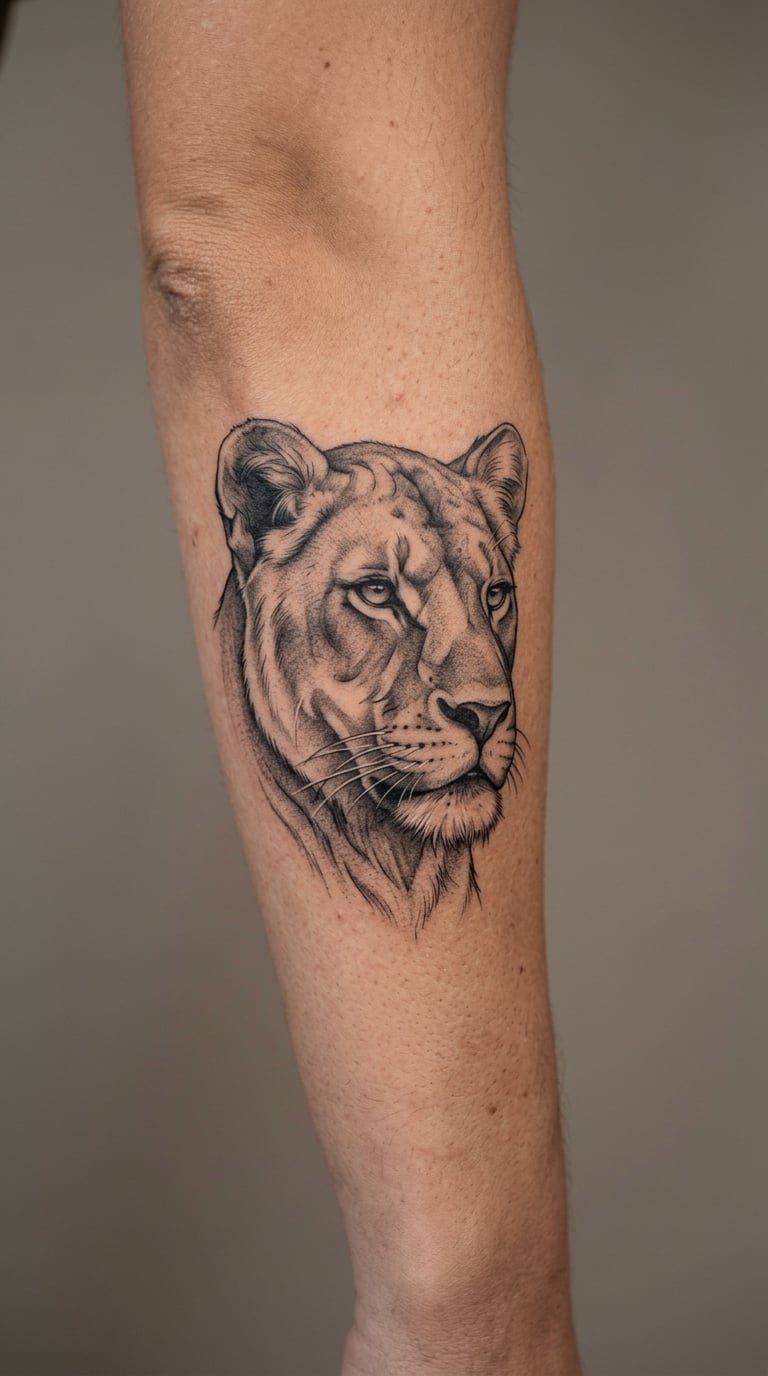
A lioness head in profile, about two inch of face on the skin, with fur suggested by short directional strokes rather than outlines and eyes rendered as soft dark shapes. It rewards a second look from across a room and holds up close.
The lioness rather than the lion is the detail that matters. She is the protective, patient, hunting parent, and wearers usually pick her for leadership, for raising something on their own, or for protecting people.
Placement: outer forearm, slightly above centre. Size: 3 to 5 inch (7.5 to 12.5 cm). Style: micro realism. Pain: medium; fine shading is a long session and the skin gets sore toward the end. Ageing note: soft grey fur texture loses contrast first, so keep a strong dark outline around the face.
Make it yours: have the profile face toward your dominant hand, or add a mane made of thin linework that fades into the arm.
14. Queen Bee in Line Art
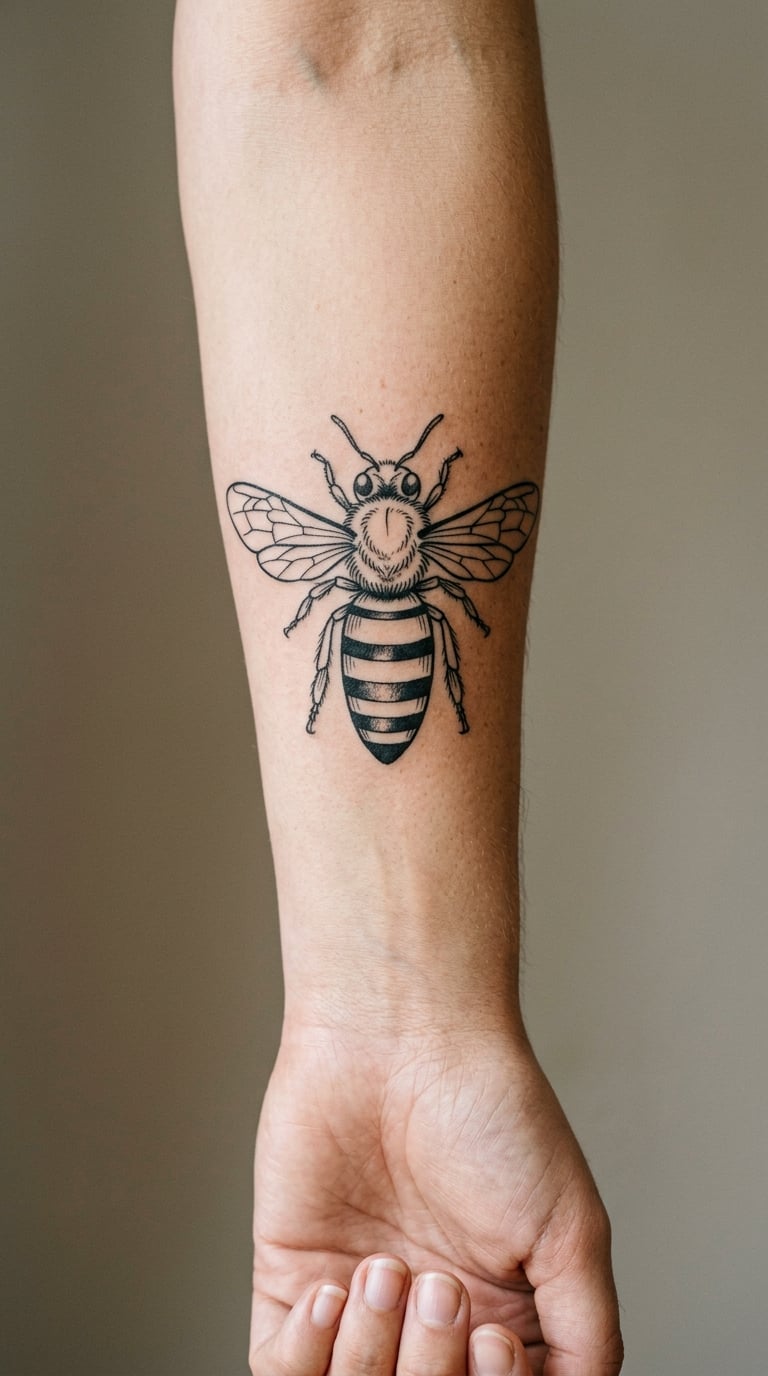
A queen bee drawn as clean line art: a striped oval body, two pairs of wings, legs in short curved strokes and a couple of small hexagons trailing behind. No colour is needed, though an amber abdomen in one flat tone is a good alternative.
It reads as diligence, organisation and being the one who keeps the colony moving, and it is a favourite for women in leadership or working through a qualification.
Placement: side forearm, angled nose-up. Size: 2 to 3 inch (5 to 7.5 cm). Style: line art. Pain: medium, more sensitive over the bony outer edge. Ageing note: thin leg strokes and hexagon outlines blur quickly, so simplify the legs to two or three confident marks.
Make it yours: add a small flower stem under the bee, or keep the hexagons trailing into a line that wraps the arm.
15. Phoenix Rising in Blackwork
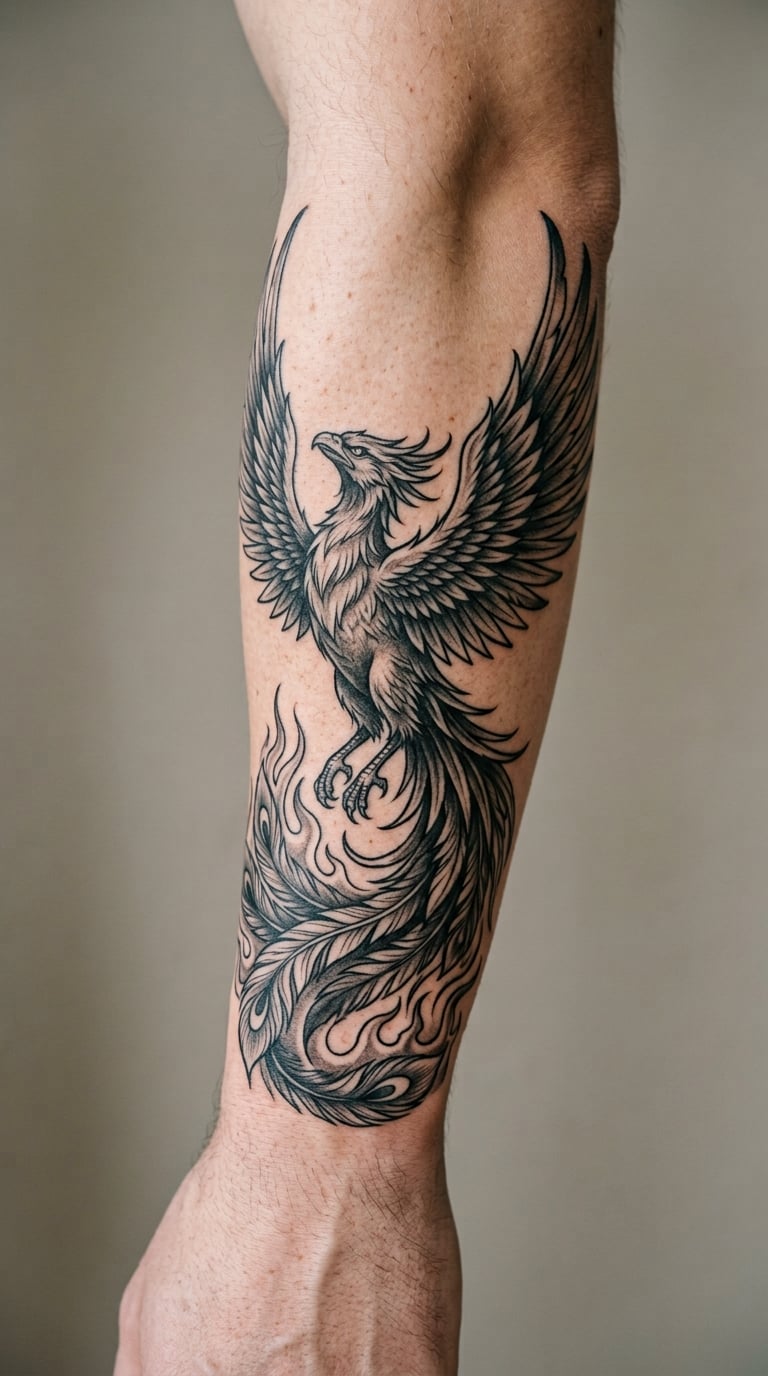
A phoenix in heavy blackwork: solid black wing shapes, feather tips breaking into linework, and flames or falling feathers underneath. It needs elbow-to-wrist room to breathe, and the composition should read clearly even from across a room.
Rebirth and survival are the meanings people claim for it, and it suits a first tattoo that has to carry a real story. It is also the easiest to disappoint with, because a small version of a big design just looks busy.
Placement: outer forearm running to the elbow. Size: 6 to 10 inch (15 to 25 cm). Style: blackwork. Pain: medium to high, and expect a two-session piece with a healing break. Ageing note: large solid black on the outer arm can grey out unevenly with sun exposure, so keep up with sunscreen on that arm.
Make it yours: add a date hidden inside the flame work, or leave a gap in the wing to fill with a second small piece later.
16. Crown and Vine Filigree
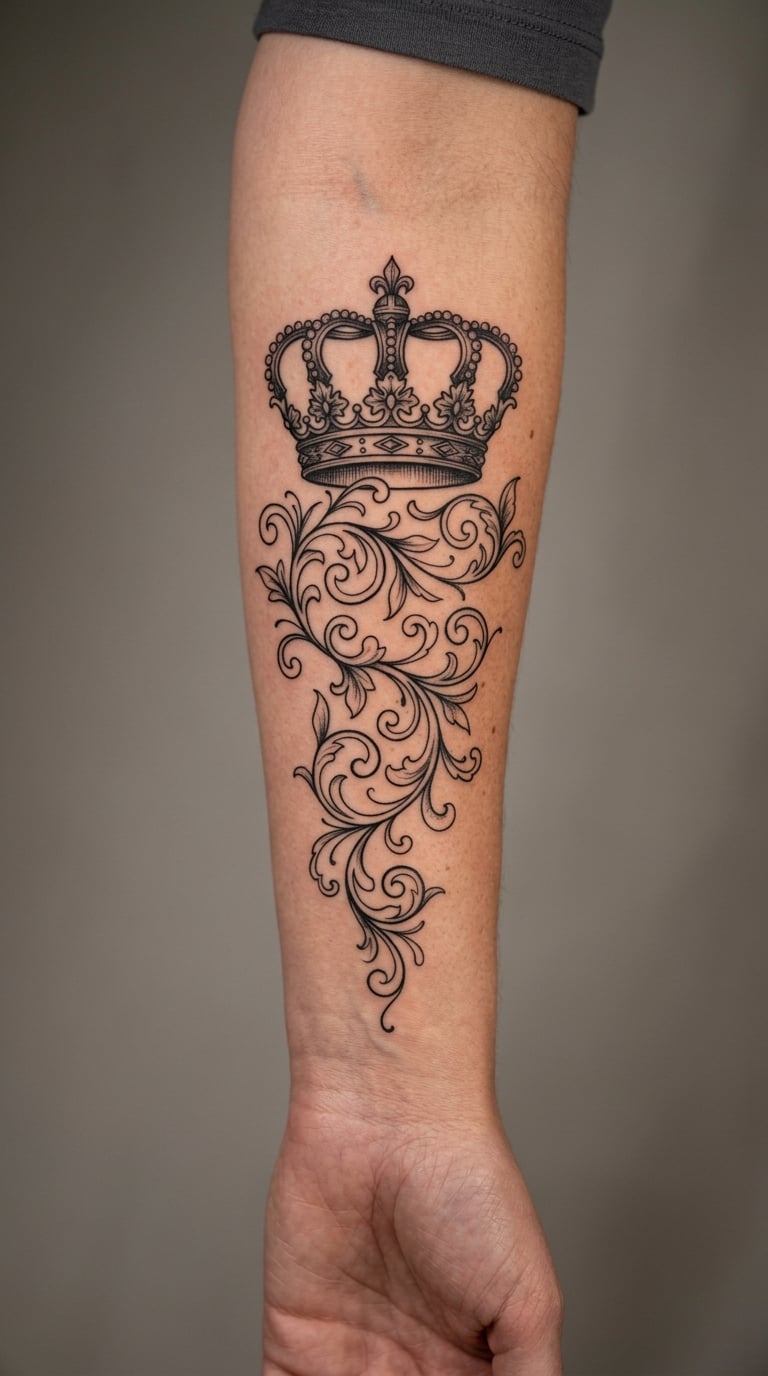
A small crown in ornamental linework, three points with a bead at each tip, sitting on a pair of symmetrical vine scrolls that curl back toward the wrist. The scrollwork is the detail: even, mirrored, no stray lines.
Self-possession and having earned something are the usual readings, and it works well as a first tattoo because it is a single readable object with one layer of detail.
Placement: inner forearm, crown upright toward the elbow. Size: 3 to 4 inch (7.5 to 10 cm). Style: filigree ornamental. Pain: medium. Ageing note: the fine scroll curls blur into each other first, so ask for a slightly thicker line than the drawing in your head.
Make it yours: replace the beads with three small stones, or set the crown on a line of text rather than vines.
17. Angel Number 444 in Fine Line
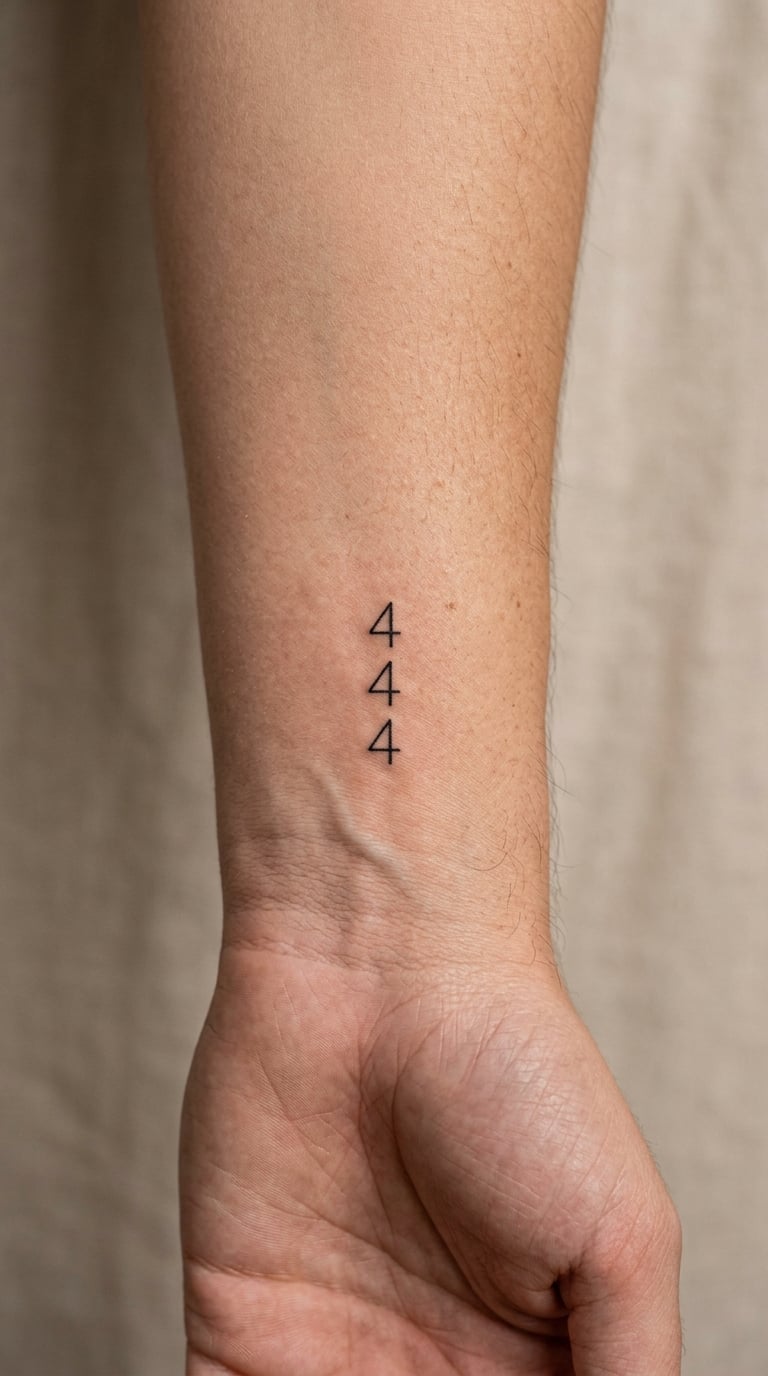
Three or four numerals in thin line type, usually 444 or 1111, placed without any other ornament. The type is small and light, which is intentional, because the wearer is not usually trying to explain it.
Angel numbers are read as reassurance that you are on the right path at a moment when things feel uncertain. 444 in particular is associated with protection and with people who have gone through something hard.
Placement: inner forearm just above the wrist, or at the wrist crease itself. Size: under 2 inch wide (under 5 cm). Style: fine line. Pain: medium, and the wrist crease is one of the more sensitive spots on the arm. Ageing note: at this size the numerals are all line, so a heavier weight and generous spacing matter more than detail.
Make it yours: add a tiny open circle around the number, or repeat the sequence three times down the forearm as a column.
18. Meaningful Quote in Handwritten Script
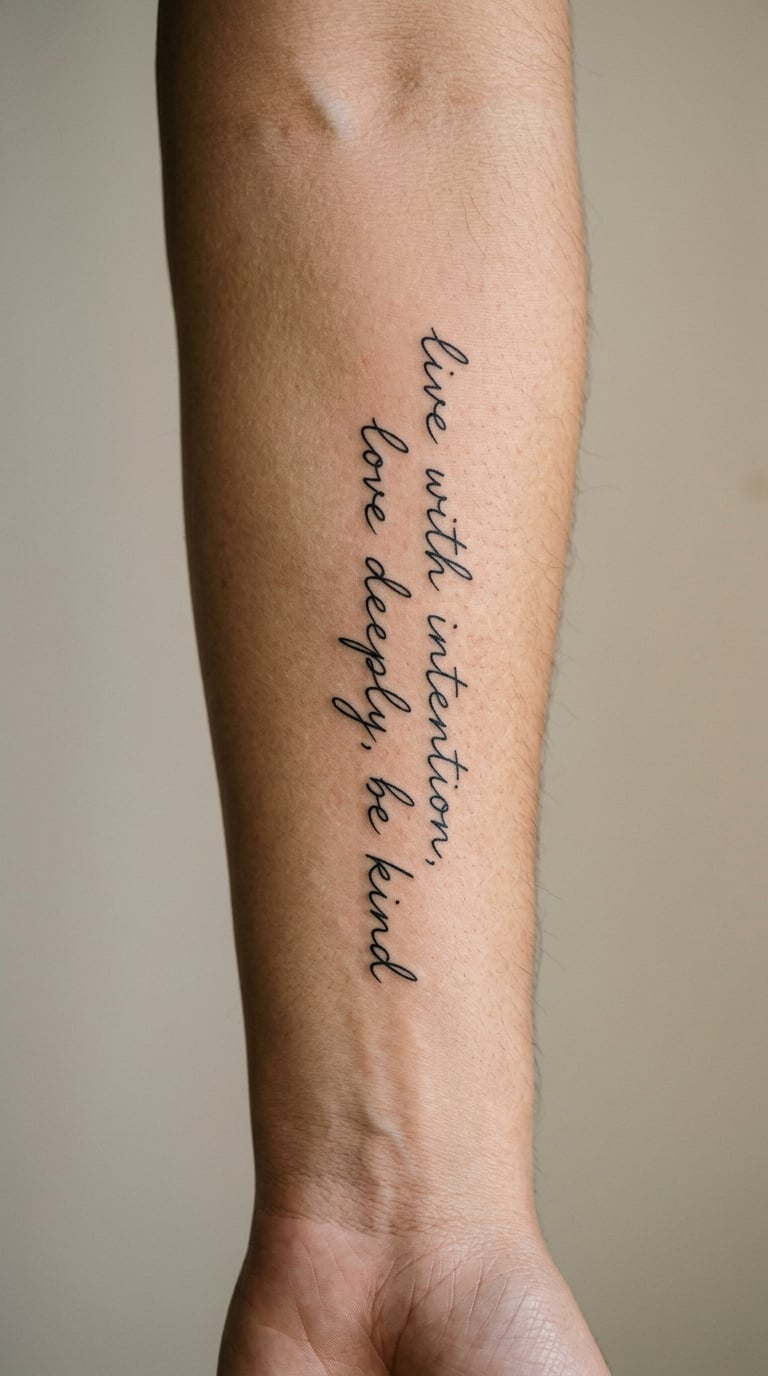
Two or three short lines of handwriting stacked along the arm, each line no longer than the arm is wide, with generous leading between lines. Long quotes fail on a forearm because the arm curves; short ones follow it.
The meaning is the sentence, and the handwriting matters as much as the words. A line from a letter, a line someone said out loud, or a phrase you decided to live by are the usual sources.
Placement: inner forearm, stacked vertically so the text reads with the arm down. Size: 3 to 5 inch tall (7.5 to 12.5 cm). Style: handwritten script. Pain: medium, steady. Ageing note: stacked script is the hardest style to keep legible, so keep lines short and check the hand position before the stencil goes on.
Make it yours: use your own handwriting and trace it onto transparent paper at home rather than picking a font.
19. Coordinates of a Place You Love
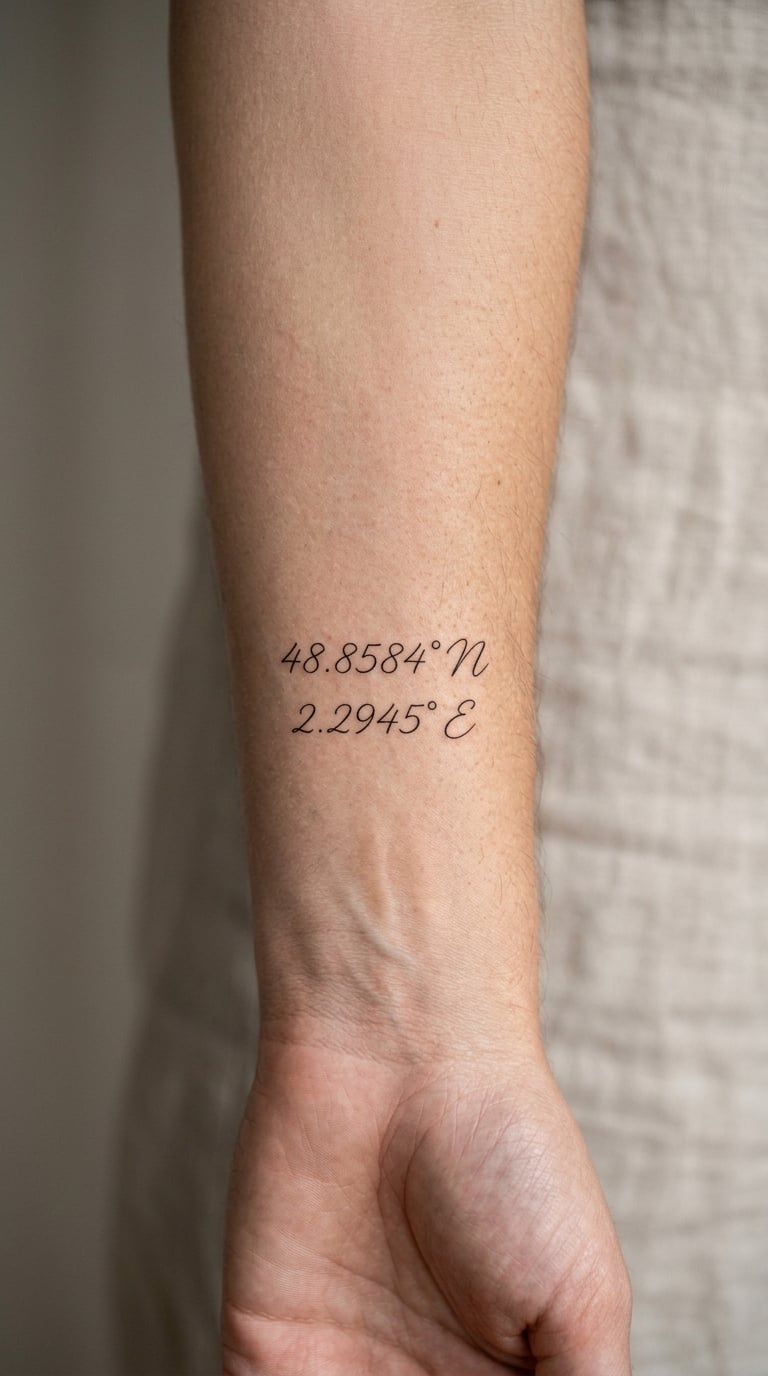
A short string of latitude and longitude numbers in small clean type, sometimes with a tiny outline of the place or a single line marking it on a map. It looks like data to everyone else and like a home address to you.
People get coordinates for the spot where they met, where they were born, or where they want to end up. It is the most private design in this list, and one of the few that only two people can read.
Placement: inner forearm above the wrist where the numbers sit straight. Size: 2 to 3 inch (5 to 7.5 cm). Style: fine line. Pain: medium. Ageing note: digits and decimal points are the first details to soften, so keep the type size and the line weight matched.
Make it yours: round the coordinates to three decimal places, or add one small mark showing the direction of the place from where you are.
20. Eucalyptus and Olive Branch Wrap
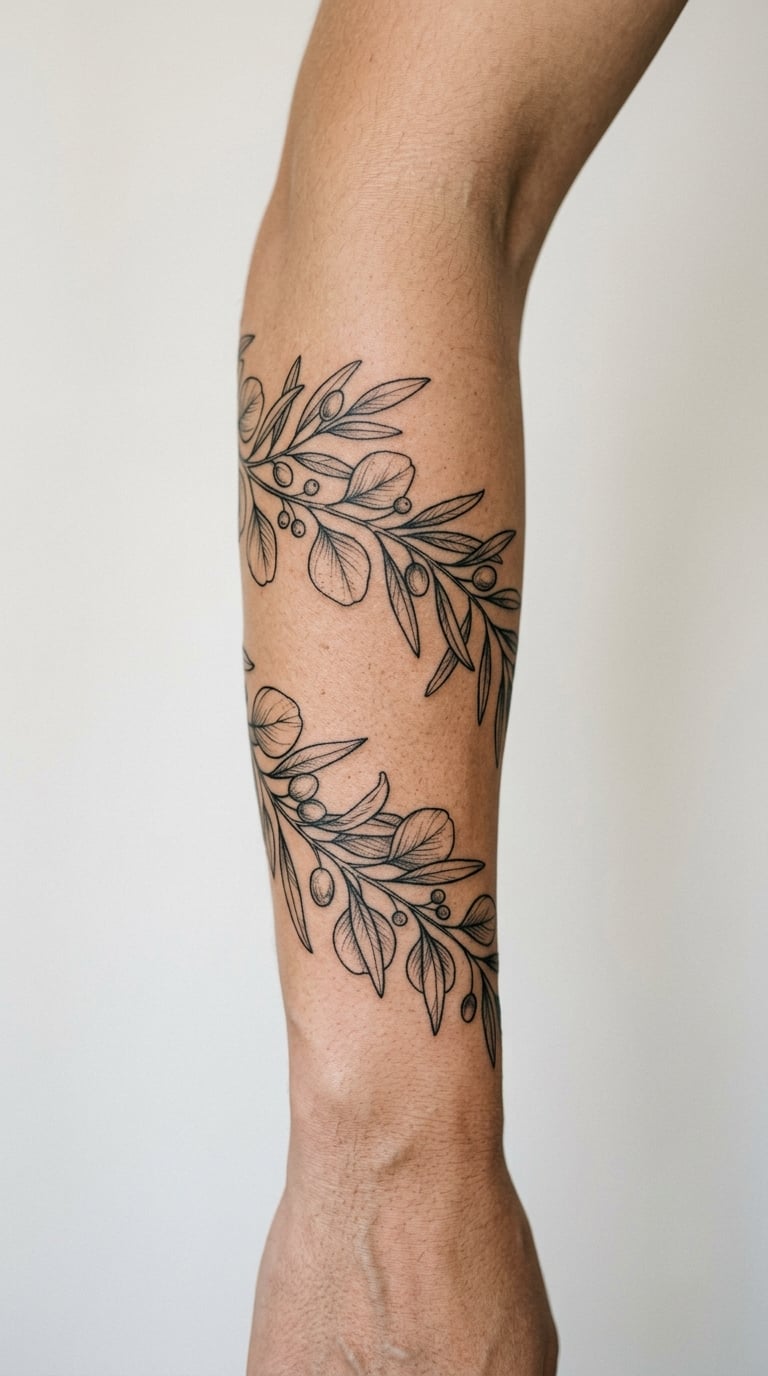
A garland of leaves that wraps the forearm, alternating eucalyptus rounds with pointed olive leaves, each one a single outline with a centre vein and light stippling. The stems cross behind each other so it reads as a ring rather than a row.
Botanical branches are usually chosen for peace, endurance or a long relationship, and a wrap is the natural first step for someone who will eventually want a full half-sleeve.
Placement: outer forearm running to the elbow, spaced so gaps can be filled later. Size: 8 to 12 inch (20 to 30 cm). Style: botanical linework. Pain: medium across a long area, with a break needed partway through. Ageing note: outline-only leaves lose their edges on the sun side of the arm, so a light grey fill in each leaf holds the shape.
Make it yours: leave one deliberate gap in the garland, or work your own birth month flower into the middle of the sequence.
What Is Trending in Forearm Tattoos for Women in 2026
Five things keep coming up in studios this year, and most of them are old ideas redrawn with less ink rather than new ones.
- Handwritten over typed. Traced real handwriting instead of script fonts, so the loops and uneven letter spacing stay.
- One subject, more room. A single flower, bee or rose given five inches instead of a busy composition given three.
- Soft grey and no black. Black and grey realism, or pale watercolour washes, for anything that has to survive an office.
- Nostalgic botanical linework. Wrapping eucalyptus, olive and herb stems with light stippling, designed to be added to over years.
- Numerals and coordinates. Dates, angel numbers and map points in small fine line, kept deliberately illegible to strangers.
How to Choose a Forearm Design You Will Not Regret
Five questions settle most of the doubt before you sit down with an artist.
- Is the detail bigger than the space? The one third rule is a useful check. If the design has detail, each element should be at least a third of the space it sits in, or the smallest parts will merge after a couple of years.
- Can you hide it? The inner forearm disappears under a long sleeve or a wide cuff; the outer forearm and the side of the arm do not. Check that against your actual work wardrobe, not the theoretical one.
- Does it distort when your arm bends? Anything with a straight horizontal line will bow at the elbow and the wrist. Ask the artist to place the stencil while your arm is in the position you use most.
- Is the meaning still yours in ten years? A design tied to a person will change meaning when that relationship changes. A design tied to a value, a date or a place usually holds.
- Can you build on it? If you might want a half-sleeve later, leave even gaps and keep the design off the elbow and wrist creases where future work has to bend.
Bring references rather than finished flash. A folder of three or four images plus a sentence about what you want out of it is easier for an artist to work from than a screen full of designs you like for different reasons.
Session Time and What Affects Cost
Size and detail drive everything else. A small fine-line piece under two inch usually takes well under an hour, a 4 to 6 inch composition takes one to three hours, and a wrap or a blackwork piece is often split over two or more sessions with a healing break in between.
What moves the price: the square inch of the design, how much fine shading there is, how many colours are involved, whether you want it custom-drawn or adapted from existing flash, and the shop’s minimum charge. Hourly rates and shop minimums vary a lot by city and by artist experience, so the only reliable number is the quote your artist gives at the consultation.
Ask for the total for the whole design, not the hourly rate, and ask what a touch-up window looks like before you commit. A good artist will have a healing policy already written down.
Aftercare Basics for a Healing Forearm Tattoo
Follow your artist’s aftercare instructions first, because skin type and ink depth change what works. The general shape of it is this.
- Leave the covering on for as long as you were told, then wash gently with unscented soap and lukewarm water.
- Pat dry with a clean cloth or paper towel, and keep the forearm out of standing water for the first two weeks.
- Moisturise thinly with whatever product your artist recommends, more often in the first three days than after that.
- Expect the forearm to flake, peel and look dull for a week or two. Do not pick it, and do not soak it to loosen it.
- Keep the fresh ink out of direct sun, and use sunscreen on a healed outer forearm tattoo, which fades faster than most people expect.
- Hold off on heavy gym sessions that use the forearm for a few days, and skip hot tubs and swimming pools until it has closed over.
Frequently Asked Questions
What does a forearm tattoo symbolize?
Usually it symbolizes something the wearer wants to read daily: growth, resilience, protection, faith, or connection to a person. The forearm is popular for meaning because it is visible, easy to hide under a sleeve, and a broad flat canvas, so a symbol can be large enough to be seen and simple enough to still be there in twenty years.
What is the most meaningful tattoo for women?
There is no single most meaningful design, because the meaning is carried by the story rather than the drawing. Designs people return to most often are the ones that hold a specific fact: a Roman numeral date, a set of coordinates, a birth flower, a loved one’s handwriting, or a name in their own hand. Those stay readable as symbols to anyone who asks.
What does 444 tattooed on a woman mean?
444 is read in angel number practice as a sign of protection and guidance, often showing up during periods of stress, change or loss. The number is usually chosen after something difficult rather than before, which is why people ask about it. The wearer decides what it means, and many never explain it to anyone.
What is the 1/3 rule tattoo?
The one third rule is a sizing check used before a tattoo is placed. If a design has detail, each element should be at least a third of the space it occupies rather than being squeezed into a small area of skin. It applies most clearly to faces, flowers and lettering, where tiny features left too small blur together within a few years of healing.
Is a forearm a good place for a first tattoo?
It is a reasonable first placement for one reason: the forearm is a flat, well understood shape, so the artist can see the design properly and so can you. Most people rate it as one of the less painful areas, though the inner wrist and the elbow crease sting more than the middle. Decide how visible you want it to be before booking, because that is harder to change later.
How do I hide a forearm tattoo at work?
The inner forearm hides best, under a long sleeve, a wide cuff or a shirt that stays buttoned at the wrist. The outer forearm and the side of the arm are visible in most office clothing, including short sleeves and rolled cuffs. If concealment matters, the inner forearm above the wrist gives you the most options without shrinking the design too far.
Which Forearm Idea Should You Pick First?
If this is your first tattoo, the fine-line rose or the single word in your own handwriting will serve you best. Both are small, both sit well on a flat part of the arm, and neither commits you to a colour or a style you may want to leave behind.
If you are adding to a collection already, go bigger than feels sensible and leave a gap you can fill later. The peony with the butterfly, the phoenix and the eucalyptus wrap are the three here that reward that approach, and all three ask for more than one sitting.
Whichever you pick, take the references and the meaning to the consultation, then let the artist adjust both to the shape of your arm. The design that stays with you is the one that still looks right in ten years, not the one that photographs best this week.